EP4517864A2 - Negativelektrodenaktivmaterial für sekundärbatterie, verfahren zur herstellung davon und lithiumsekundärbatterie damit - Google Patents
Negativelektrodenaktivmaterial für sekundärbatterie, verfahren zur herstellung davon und lithiumsekundärbatterie damit Download PDFInfo
- Publication number
- EP4517864A2 EP4517864A2 EP24195575.6A EP24195575A EP4517864A2 EP 4517864 A2 EP4517864 A2 EP 4517864A2 EP 24195575 A EP24195575 A EP 24195575A EP 4517864 A2 EP4517864 A2 EP 4517864A2
- Authority
- EP
- European Patent Office
- Prior art keywords
- carbon
- silicon
- negative electrode
- based particles
- composite
- Prior art date
- Legal status (The legal status is an assumption and is not a legal conclusion. Google has not performed a legal analysis and makes no representation as to the accuracy of the status listed.)
- Pending
Links
Images



Classifications
-
- H—ELECTRICITY
- H01—ELECTRIC ELEMENTS
- H01M—PROCESSES OR MEANS, e.g. BATTERIES, FOR THE DIRECT CONVERSION OF CHEMICAL ENERGY INTO ELECTRICAL ENERGY
- H01M4/00—Electrodes
- H01M4/02—Electrodes composed of, or comprising, active material
- H01M4/36—Selection of substances as active materials, active masses, active liquids
- H01M4/362—Composites
- H01M4/366—Composites as layered products
-
- B—PERFORMING OPERATIONS; TRANSPORTING
- B82—NANOTECHNOLOGY
- B82Y—SPECIFIC USES OR APPLICATIONS OF NANOSTRUCTURES; MEASUREMENT OR ANALYSIS OF NANOSTRUCTURES; MANUFACTURE OR TREATMENT OF NANOSTRUCTURES
- B82Y30/00—Nanotechnology for materials or surface science, e.g. nanocomposites
-
- B—PERFORMING OPERATIONS; TRANSPORTING
- B82—NANOTECHNOLOGY
- B82Y—SPECIFIC USES OR APPLICATIONS OF NANOSTRUCTURES; MEASUREMENT OR ANALYSIS OF NANOSTRUCTURES; MANUFACTURE OR TREATMENT OF NANOSTRUCTURES
- B82Y40/00—Manufacture or treatment of nanostructures
-
- C—CHEMISTRY; METALLURGY
- C01—INORGANIC CHEMISTRY
- C01B—NON-METALLIC ELEMENTS; COMPOUNDS THEREOF; METALLOIDS OR COMPOUNDS THEREOF NOT COVERED BY SUBCLASS C01C
- C01B32/00—Carbon; Compounds thereof
- C01B32/20—Graphite
-
- C—CHEMISTRY; METALLURGY
- C01—INORGANIC CHEMISTRY
- C01B—NON-METALLIC ELEMENTS; COMPOUNDS THEREOF; METALLOIDS OR COMPOUNDS THEREOF NOT COVERED BY SUBCLASS C01C
- C01B32/00—Carbon; Compounds thereof
- C01B32/20—Graphite
- C01B32/21—After-treatment
-
- H—ELECTRICITY
- H01—ELECTRIC ELEMENTS
- H01M—PROCESSES OR MEANS, e.g. BATTERIES, FOR THE DIRECT CONVERSION OF CHEMICAL ENERGY INTO ELECTRICAL ENERGY
- H01M10/00—Secondary cells; Manufacture thereof
- H01M10/05—Accumulators with non-aqueous electrolyte
- H01M10/052—Li-accumulators
-
- H—ELECTRICITY
- H01—ELECTRIC ELEMENTS
- H01M—PROCESSES OR MEANS, e.g. BATTERIES, FOR THE DIRECT CONVERSION OF CHEMICAL ENERGY INTO ELECTRICAL ENERGY
- H01M10/00—Secondary cells; Manufacture thereof
- H01M10/05—Accumulators with non-aqueous electrolyte
- H01M10/052—Li-accumulators
- H01M10/0525—Rocking-chair batteries, i.e. batteries with lithium insertion or intercalation in both electrodes; Lithium-ion batteries
-
- H—ELECTRICITY
- H01—ELECTRIC ELEMENTS
- H01M—PROCESSES OR MEANS, e.g. BATTERIES, FOR THE DIRECT CONVERSION OF CHEMICAL ENERGY INTO ELECTRICAL ENERGY
- H01M4/00—Electrodes
- H01M4/02—Electrodes composed of, or comprising, active material
- H01M4/13—Electrodes for accumulators with non-aqueous electrolyte, e.g. for lithium-accumulators; Processes of manufacture thereof
- H01M4/133—Electrodes based on carbonaceous material, e.g. graphite-intercalation compounds or CFx
-
- H—ELECTRICITY
- H01—ELECTRIC ELEMENTS
- H01M—PROCESSES OR MEANS, e.g. BATTERIES, FOR THE DIRECT CONVERSION OF CHEMICAL ENERGY INTO ELECTRICAL ENERGY
- H01M4/00—Electrodes
- H01M4/02—Electrodes composed of, or comprising, active material
- H01M4/13—Electrodes for accumulators with non-aqueous electrolyte, e.g. for lithium-accumulators; Processes of manufacture thereof
- H01M4/134—Electrodes based on metals, Si or alloys
-
- H—ELECTRICITY
- H01—ELECTRIC ELEMENTS
- H01M—PROCESSES OR MEANS, e.g. BATTERIES, FOR THE DIRECT CONVERSION OF CHEMICAL ENERGY INTO ELECTRICAL ENERGY
- H01M4/00—Electrodes
- H01M4/02—Electrodes composed of, or comprising, active material
- H01M4/36—Selection of substances as active materials, active masses, active liquids
- H01M4/38—Selection of substances as active materials, active masses, active liquids of elements or alloys
- H01M4/386—Silicon or alloys based on silicon
-
- H—ELECTRICITY
- H01—ELECTRIC ELEMENTS
- H01M—PROCESSES OR MEANS, e.g. BATTERIES, FOR THE DIRECT CONVERSION OF CHEMICAL ENERGY INTO ELECTRICAL ENERGY
- H01M4/00—Electrodes
- H01M4/02—Electrodes composed of, or comprising, active material
- H01M4/36—Selection of substances as active materials, active masses, active liquids
- H01M4/58—Selection of substances as active materials, active masses, active liquids of inorganic compounds other than oxides or hydroxides, e.g. sulfides, selenides, tellurides, halogenides or LiCoFy; of polyanionic structures, e.g. phosphates, silicates or borates
- H01M4/583—Carbonaceous material, e.g. graphite-intercalation compounds or CFx
-
- H—ELECTRICITY
- H01—ELECTRIC ELEMENTS
- H01M—PROCESSES OR MEANS, e.g. BATTERIES, FOR THE DIRECT CONVERSION OF CHEMICAL ENERGY INTO ELECTRICAL ENERGY
- H01M4/00—Electrodes
- H01M4/02—Electrodes composed of, or comprising, active material
- H01M4/36—Selection of substances as active materials, active masses, active liquids
- H01M4/58—Selection of substances as active materials, active masses, active liquids of inorganic compounds other than oxides or hydroxides, e.g. sulfides, selenides, tellurides, halogenides or LiCoFy; of polyanionic structures, e.g. phosphates, silicates or borates
- H01M4/583—Carbonaceous material, e.g. graphite-intercalation compounds or CFx
- H01M4/587—Carbonaceous material, e.g. graphite-intercalation compounds or CFx for inserting or intercalating light metals
-
- H—ELECTRICITY
- H01—ELECTRIC ELEMENTS
- H01M—PROCESSES OR MEANS, e.g. BATTERIES, FOR THE DIRECT CONVERSION OF CHEMICAL ENERGY INTO ELECTRICAL ENERGY
- H01M4/00—Electrodes
- H01M4/02—Electrodes composed of, or comprising, active material
- H01M4/62—Selection of inactive substances as ingredients for active masses, e.g. binders, fillers
- H01M4/624—Electric conductive fillers
- H01M4/625—Carbon or graphite
-
- C—CHEMISTRY; METALLURGY
- C01—INORGANIC CHEMISTRY
- C01P—INDEXING SCHEME RELATING TO STRUCTURAL AND PHYSICAL ASPECTS OF SOLID INORGANIC COMPOUNDS
- C01P2004/00—Particle morphology
- C01P2004/80—Particles consisting of a mixture of two or more inorganic phases
-
- C—CHEMISTRY; METALLURGY
- C01—INORGANIC CHEMISTRY
- C01P—INDEXING SCHEME RELATING TO STRUCTURAL AND PHYSICAL ASPECTS OF SOLID INORGANIC COMPOUNDS
- C01P2006/00—Physical properties of inorganic compounds
- C01P2006/40—Electric properties
-
- C—CHEMISTRY; METALLURGY
- C01—INORGANIC CHEMISTRY
- C01P—INDEXING SCHEME RELATING TO STRUCTURAL AND PHYSICAL ASPECTS OF SOLID INORGANIC COMPOUNDS
- C01P2006/00—Physical properties of inorganic compounds
- C01P2006/60—Optical properties, e.g. expressed in CIELAB-values
- C01P2006/62—L* (lightness axis)
-
- H—ELECTRICITY
- H01—ELECTRIC ELEMENTS
- H01M—PROCESSES OR MEANS, e.g. BATTERIES, FOR THE DIRECT CONVERSION OF CHEMICAL ENERGY INTO ELECTRICAL ENERGY
- H01M4/00—Electrodes
- H01M4/02—Electrodes composed of, or comprising, active material
- H01M2004/021—Physical characteristics, e.g. porosity, surface area
-
- H—ELECTRICITY
- H01—ELECTRIC ELEMENTS
- H01M—PROCESSES OR MEANS, e.g. BATTERIES, FOR THE DIRECT CONVERSION OF CHEMICAL ENERGY INTO ELECTRICAL ENERGY
- H01M4/00—Electrodes
- H01M4/02—Electrodes composed of, or comprising, active material
- H01M2004/026—Electrodes composed of, or comprising, active material characterised by the polarity
- H01M2004/027—Negative electrodes
-
- Y—GENERAL TAGGING OF NEW TECHNOLOGICAL DEVELOPMENTS; GENERAL TAGGING OF CROSS-SECTIONAL TECHNOLOGIES SPANNING OVER SEVERAL SECTIONS OF THE IPC; TECHNICAL SUBJECTS COVERED BY FORMER USPC CROSS-REFERENCE ART COLLECTIONS [XRACs] AND DIGESTS
- Y02—TECHNOLOGIES OR APPLICATIONS FOR MITIGATION OR ADAPTATION AGAINST CLIMATE CHANGE
- Y02E—REDUCTION OF GREENHOUSE GAS [GHG] EMISSIONS, RELATED TO ENERGY GENERATION, TRANSMISSION OR DISTRIBUTION
- Y02E60/00—Enabling technologies; Technologies with a potential or indirect contribution to GHG emissions mitigation
- Y02E60/10—Energy storage using batteries
Definitions
- the present invention relates to a negative electrode active material for a secondary battery, a method of preparing the same, and a lithium secondary battery including the same.
- silicon-based negative electrode materials having excellent theoretical capacity as negative electrode materials for secondary batteries.
- the silicon-based negative electrode materials may cause a significant volume change upon intercalation/deintercalation of lithium, thereby causing electrical detachment due to pulverization of silicon particles and loss of reversible capacity during repeated charging and discharging cycles.
- the present invention relates to a method of preparing a composite negative electrode material in which a carbon-based material is composited with nano-sized silicon in a single process and provides a method of preparing a silicon-carbon composite by which silicon nanoparticles are formed on the surface of carbon using microwaves.
- Silicon has a melting point of 1,414°C and when melted, its density increases more than when it is in a solid state like water.
- Graphite (a carbon-based material) has the characteristic of rapid heat generation when the ⁇ electrons present in the structure are alternately induced in negative (-) and positive (+) directions using microwaves (wavelength: 1 m to 1 mm; frequency: 300 MHz to 300 GHz).
- silicon having a lower melting point than graphite may be melt-processed on the surface of graphite, and the entropy may rapidly increase by rapid energy transfer, which makes it possible to prepare a silicon nanomaterial having an increased specific surface area on the surface of graphite (graphite composited with nano-sized silicon).
- the method of preparing a silicon-carbon composite using microwaves is a method of directly transferring energy to the surface of carbon. Regardless of the medium used to support the carbon material, when carbon is irradiated with microwaves, only the temperature of the carbon itself rises rapidly, and when microwave irradiation is stopped, it cools rapidly. Therefore, it has the advantage of reducing the manufacturing time and energy costs compared to existing heating methods.
- silicon carbide which is synthesized at a high temperature of 900°C or higher, is generated as a by-product on the surface of carbon (graphite), which is rapidly heated to around 1,400°C by microwaves.
- silicon carbide is inert to lithium ions and prevents lithium ions from diffusing into silicon particles, leading to a decrease in capacity and efficiency.
- a negative electrode active material including a silicon/carbon (Si/C) composite in which a silicon-based coating layer is formed on carbon-based particles, wherein the Si/C composite has a peak area ratio A2/A1 of 0.2 to 3.0 as determined by X-ray diffraction analysis.
- A1 may be an area of the Si peak in X-ray diffraction analysis
- A2 may be an area of the SiC peak in X-ray diffraction analysis.
- the Si/C composite may have a peak area ratio A2/A1 of 0.3 to 0.5 as determined by X-ray diffraction analysis.
- A1 may be an area of the Si peak in X-ray diffraction analysis
- A2 may be an area of the SiC peak in X-ray diffraction analysis.
- the Si/C composite may have a Si peak area (A1) of 2 to 7% and a SiC peak area (A2) of 0.5 to 5.5% with respect to 100% of the total peak area in X-ray diffraction analysis.
- the Si/C composite may have a BET specific surface area (B2) of 8 m 2 /g or more.
- the Si/C composite may have a BET specific surface area (B2) of 8 to 23 m 2 /g.
- the Si/C composite may have a BET specific surface area ratio B2B 1 of 1 or more.
- B 1 may be a BET specific surface area of carbon-based particles before forming the silicon-based coating layer in the Si/C composite
- B2 may be a BET specific surface area of the Si/C composite.
- the Si/C composite may have a BET specific surface area ratio B2B 1 of 1.2 to 2.5.
- B 1 may be a BET specific surface area of carbon-based particles before forming the silicon-based coating layer in the Si/C composite
- B2 may be a BET specific surface area of the Si/C composite.
- the Si/C composite may have a specific surface area contribution rate (B2_C) of the carbon-based particles ranging from 50 to 89.5% and a specific surface area contribution rate (B2_Si) of the silicon-based coating layer ranging from 10.5 to 50%, with respect to 100% of the total BET specific surface area (B2).
- the Si/C composite may have a BET specific surface area contribution rate (B2_C) of the carbon-based particles ranging from 60 to 80% and a BET specific surface area contribution rate (B2_Si) of the silicon-based coating layer ranging from 20 to 40%, with respect to 100% of the total BET specific surface area (B2).
- B2_C BET specific surface area contribution rate
- B2_Si BET specific surface area contribution rate
- the silicon-based coating layer may include silicon nanoparticles having a size of 1 to 100 nm.
- the silicon-based coating layer may be included in an amount of 5 to 50% by weight based on the total weight of the Si/C composite.
- the silicon-based coating layer may be formed to a thickness of 10 to 200 nm.
- the carbon-based particles may be at least one selected from the group consisting of natural graphite, artificial graphite, expanded graphite, graphene oxide, carbon nanotubes, carbon fibers, and hard carbon.
- the carbon-based particles may have a colorimetric L* value of 35 or less.
- a method of preparing a negative electrode active material for a secondary battery which includes a pretreatment step of heat treating carbon-based particles; and a microwave sintering step of mixing silicon-based particles with the heat-treated carbon-based particles and irradiating the resulting mixture with microwaves.
- the pretreatment step may be a process of heat treating the carbon-based particles at 400 to 900°C for 1 to 10 hours.
- the microwave sintering step may be a process of rapidly heating the surfaces of the heat-treated carbon-based particles with microwaves and melting the silicon-based particles using the carbon-based particles heated with the microwaves to form a silicon-based coating layer on a surface of the carbon-based material.
- the microwave heating may involve microwave irradiation at an output of 1 to 3 kW for 10 seconds to 10 minutes.
- a negative electrode for a secondary battery including the negative electrode active material.
- a secondary battery including the negative electrode.
- One exemplary embodiment of the present invention provides a negative electrode active material including a silicon/carbon (Si/C) composite in which a silicon-based coating layer is formed on carbon-based particles.
- Si/C silicon/carbon
- the problem of mechanical damage to electrodes caused by the volume expansion and contraction of silicon and the resulting rapid shortening of lifespan may be improved through compositing with carbon-based particles capable of buffering the volume expansion of silicon.
- the Si/C composite may have a peak area ratio A2/A1 of 0.2 to 3.0, for example, a peak area ratio A2/A1 of 0.2 to 2.5, 0.2 to 2, 0.2 to 1.5, 0.2 to 1, 0.2 to 0.8, 0.2 to 0.7, 0.2 to 0.6, 0.2 to 0.6, 0.3 to 0.6, or 0.3 to 0.5, as determined by X-ray diffraction analysis.
- A1 is a peak area at all angles corresponding to the Si peaks in X-ray diffraction analysis
- A2 is a peak area at all angles corresponding to the SiC peaks in X-ray diffraction analysis.
- all the angles (2theta) corresponding to the Si peaks in X-ray diffraction analysis may be 28.4 ⁇ 0.5°, 47.3 ⁇ 0.5°, 56.1 ⁇ 0.5°, 69.1 ⁇ 0.5°, 76.4 ⁇ 0.5°, and 88.0 ⁇ 0.5°
- respective crystal planes may be (111), (202), (311), (400), (313), and (422)
- all the angles (2theta) corresponding to the SiC peaks may be 35.6 ⁇ 0.5°, 41.4 ⁇ 0.5°, 59.9 ⁇ 0.5°, 71.7 ⁇ 0.5°, 75.5 ⁇ 0.5°, and 89.9 ⁇ 0.5°
- respective crystal planes may be (111), (020), (202),
- all the angles (2theta) corresponding to the graphite peaks may be 26.5 ⁇ 0.5°, 42.3 ⁇ 0.5°, 44.5 ⁇ 0.5°, 50.6 ⁇ 0.5°, 54.6 ⁇ 0.5°, 59.8 ⁇ 0.5°, 71.4 ⁇ 0.5°, and 77.4 ⁇ 0.5°
- respective crystal planes may be (002), (100), (101), (012), (004), (013), (014), and (110).
- the proportion of silicon nanoparticles deposited on the surfaces of the carbon-based particles may increase by suppressing the production of silicon carbide (SiC), which is an inert material.
- SiC silicon carbide
- the carbon-based particles and the silicon in a solid state before melting are dispersed and mixed uniformly so that the melting proportion of solid silicon on the surfaces of the microwave-irradiated carbon-based particles is high and the melting proportion of unreacted silicon is low, meaning that the Si/C composite manufacturing efficiency is improved.
- Silicon carbide which is synthesized at a high temperature of 900°C or higher and is inert to lithium ions, may be deposited on the surfaces of carbon-based particles that are rapidly heated to around 1,400°C by microwaves.
- the microwave absorption capacity of the carbon-based particles may be improved by forming surface defects using pretreated carbon-based particles. Improvements in microwave absorption and heat generation performance may be confirmed by reducing the hot spot formation time on the surfaces of carbon-based particles.
- the hot spot formation time is reduced, a uniform temperature rise and rapid heating/cooling of the carbon-based particles are possible, thereby reducing the residence time in the high temperature range where a SiC synthesis reaction occurs.
- the shape formation of the molten silicon may be controlled by the uneven structures (defects) on the surfaces of the pretreated (heat-treated) carbon-based particles, thereby preventing silicon particle coarsening and interparticle connection (thinning). Accordingly, the physical contact area between silicon and carbon-based particles where the SiC synthesis reaction occurs may be reduced, which makes it possible to further reduce the amount of SiC synthesis.
- the hot spots of carbon-based particles refers to the fact that a uniform reaction does not occur at all locations within the same time, but rather a reaction occurs first in a specific part. This phenomenon may be defined as a "hot spot.” Hot spots that occur on the surfaces of carbon-based particles may be observed with the naked eye, and the "hot spot time" may be measured based on when the reaction first occurs.
- the Si/C composite may have a Si peak area (A1) of 2 to 7%, for example, a Si peak area (A1) of 2.5 to 7%, 2.5 to 6.5%, 2.5 to 6%, 2.5 to 5.5%, 2.5 to 5%, or 2.5 to 4%, with respect to 100% of the total peak area.
- the SiC peak area (A2) with respect to 100% of the total peak area may be 0.5 to 5.5%, 0.5 to 5%, 1 to 5%, 2 to 5%, 3 to 5%, 3.5 to 5%, 3.5 to 4.5%, or 4 to 4.5%. Accordingly, the above-described effect may be further improved.
- 100% of the total peak area may refer to the sum of the peak area at all angles corresponding to the Si peaks (A1), the peak area at all angles corresponding to the SiC peaks (A2), and the peak area at all angles corresponding to the graphite peaks (A3).
- the silicon-carbon composite When the silicon-carbon composite is prepared using microwaves, silicon is only deposited on the surfaces of the carbon-based particles heated by microwave irradiation. Therefore, it is analyzed that the silicon melted by the microwave sintering reaction does not block the uneven structure and pore structure of the surfaces of the pretreated carbon-based particles. It was confirmed that the BET specific surface area of the Si/C composite finally prepared after the microwave sintering reaction may be adjusted to a relatively high level compared to before the reaction. Meanwhile, when the BET specific surface area falls within the above range, it may mean that silicon particles are uniformly dispersed and deposited on the surfaces of the carbon-based particles in a nano size.
- the BET specific surface area when the BET specific surface area is less than the lower limit, it means that silicon particles in the form of a thin film are deposited.
- the BET specific surface area is greater than the upper limit, the particle structure collapses and the basal surface of the graphite is exposed, which may cause electrolyte side reactions due to an excessive increase in specific surface area.
- the Si/C composite may have a BET specific surface area ratio B2/B1 of 1 or more, for example, a BET specific surface area ratio B2/B1 of 1.1 or more, 1.2 or more, 1.3 or more, 1.4 or more, or 1.5 or more, and 2.5 or less, 2.4 or less, 2.3 or less, 2.2 or less, 2.1 or less, or 2.0 or less.
- B1 is a BET specific surface area of the carbon-based particles before forming a silicon-based coating layer in the Si/C composite
- B2 is a BET specific surface area of the Si/C composite (after forming the silicon-based coating layer).
- the BET specific surface area ratio B2/B1 is greater than or equal to the lower limit, this may mean that the rate at which molten silicon is deposited in the form of nanoparticles on the surfaces of the microwave-irradiated carbon-based particles increases, and silicon particle coarsening and interparticle connection (thinning) are controlled.
- the particle size of the silicon deposited on the surfaces of the carbon-based particles increases or the silicon particles are connected to form a thin film (a network form)
- the BET specific surface area may be reduced by the silicon coating layer.
- the BET specific surface area ratio B2/B1 is less than or equal to the upper limit, the melting proportion of solid silicon on the surfaces of the microwave-irradiated carbon-based particles is high and the proportion of unreacted silicon is low, meaning that the overall Si/C composite manufacturing efficiency is improved.
- the Si/C composite may have a specific surface area contribution rate (B2_C) of the carbon-based particles ranging from 50 to 89.5% and a specific surface area contribution rate (B2_Si) of the silicon-based coating layer ranging from 10.5 to 50% with respect to 100% of the total BET specific surface area (B2).
- the specific surface area contribution rate (B2_C) of the carbon-based particles is calculated as a percentage of the BET specific surface area of the Si/C composite by measuring the BET specific surface area of graphite (pretreated graphite) treated with microwaves in the same manner, except that Si powder was not used.
- the specific surface area contribution rate (B2_Si) of the silicon coating layer is a value obtained by subtracting the specific surface area ratio of the carbon-based particles from 100% of the total BET specific surface area of the Si/C composite.
- the Si/C composite may have a contribution rate (B2_C) of the carbon-based particles ranging from 50 to 85%, 55 to 80%, 60 to 80%, or 65 to 75%, and a contribution rate (B2_Si) of the silicon coating layer ranging from 15 to 50%, 20 to 45%, 20 to 40%, or 25 to 35%, with respect to 100% of the total BET specific surface area (B2).
- the contribution rate (B2_Si) of the silicon coating layer increases and the contribution rate (B2_C) of the carbon-based particles decreases, the proportion at which molten silicon is deposited in the form of nanoparticles on the surfaces of the microwave-irradiated carbon-based particles may increase.
- the contribution rate (B2_Si) of the silicon coating layer decreases and the contribution rate (B2_C) of the carbon-based particles increases, this may mean that the total BET specific surface area increases due to a change in morphology of the surfaces of the microwave-irradiated carbon-based particles, and unreacted silicon increases.
- the carbon-based particles may be at least one selected from the group consisting of natural graphite, artificial graphite, expanded graphite, graphene oxide, carbon nanotubes, carbon fibers, and hard carbon.
- natural graphite or artificial graphite may be preferable.
- the carbon-based particles may be single particles or secondary particles in which a plurality of particles are aggregated.
- the carbon-based particles have an average particle diameter (D50) of 5 to 30 ⁇ m, 5 to 20 ⁇ m, or 10 to 20 ⁇ m, an average particle diameter (D10) of 3 to 20 ⁇ m, 3 to 15 ⁇ m, or 5 to 15 ⁇ m, and/or an average particle diameter (D90) of 15 to 35 ⁇ m, 15 to 30 ⁇ m, or 20 to 25 ⁇ m.
- D50 average particle diameter
- D10 average particle diameter
- D10 average particle diameter
- D90 average particle diameter
- the carbon-based particles may be spherical, plate-shaped, and needle-shaped particles.
- the absorption capacity of a microwave absorber may be further improved by expanding the propagation path of microwaves.
- the conditions for controlling the heating of the carbon-based particles through microwaves include the type, content, and particle shape of the carbon material.
- the microwave absorption capacity may be improved.
- the carbon-based particles may have a colorimetric L* value of 35 or less, for example, a colorimetric L* value of 34 or less, 33 or less, or 32 or less.
- the lower limit is not particularly limited, but may be, for example, 10 or more, 20 or more, 25 or more, or 30 or more.
- colorimetric L* value used in the present invention may refer to an L value representing brightness in the color coordinates such as L*a*b*.
- the L value is displayed from 0 to 100, with a value closer to 0 indicating black and a value closer to 100 indicating white.
- the heat-treated carbon-based particles may have increased light absorption due to surface defects, resulting in a decrease in the colorimetric L* value.
- the heat generation performance of the carbon-based particles may be improved by forming defects on the surface of the heat-treated carbon-based particles, and the shape formation of molten silicon may be controlled due to the uneven structure (defect) on the surfaces of the heat-treated carbon-based particles, thereby preventing silicon particle coarsening and interparticle connection (thinning).
- the equipment for measuring the colorimetric value there is no limitation to the equipment for measuring the colorimetric value, but equipment such as a spectrophotometer, a colorimeter, a color reader, a chroma meter, and the like may be, for example, used.
- the colorimetric value may be measured using a chroma meter CR-410 KONICA MINOLTA meter.
- the silicon-based coating layer may include silicon (Si) particles having a size of 10 to 100 nm.
- the silicon nanoparticles included in the silicon-based coating layer may have a particle size (D50) of 10 to 100 nm or 20 to 100 nm.
- D50 particle size
- the shape formation of molten silicon on the surfaces of particles may be controlled using pretreated carbon-based particles having a concave-convex structure (defect) formed on the surface thereof. As a result, silicon particle coarsening and interparticle connection (thinning) may be prevented.
- the size of the silicon (Si) particles may refer to a size (D50) measured by cumulative volume.
- D50 refers to an average size, which means the diameter of pores having a cumulative volume of 50% by volume in the particle size distribution.
- the average size (D50) may be measured by a method well known to those skilled in the art, and may also be, for example, measured using a transmission electron micrograph or a scanning electron micrograph.
- the average size (D50) value may be obtained by measuring the average size (D50) using a measuring device using a dynamic light scattering method, performing data analysis to count the number of pores for each pore size range, and then calculating the average size (D50) value therefrom.
- the silicon-based coating layer may be included in an amount of 1 to 50% by weight, for example, 1 to 40% by weight, 1 to 30% by weight, 5 to 30% by weight, or 5 to 20% by weight, based on the total weight of the Si/C composite. Also, the silicon-based coating layer may be formed to a thickness of 10 to 200 nm, for example, a thickness of 10 to 180 nm, 10 to 160 nm, 10 to 150 nm, or 10 to 130 nm.
- the Si/C composite may further include a carbon coating layer located on the silicon coating layer.
- a carbon coating layer located on the silicon coating layer.
- the carbon coating layer may be formed to a thickness of 0.01 ⁇ m or more, for example, a thickness of 0.03 ⁇ m or more, 0.05 ⁇ m or more, and a thickness of 10 ⁇ m or less, 5 ⁇ m or less, or 1 ⁇ m or less. Accordingly, the above-described effects may be further improved.
- the preparation method may be a method of preparing the negative electrode active material according to one exemplary embodiment of the present invention.
- the method of preparing a negative electrode active material for a secondary battery includes a pretreatment step of heat treating carbon-based particles; and a microwave sintering step of mixing silicon-based particles with the heat-treated carbon-based particles and irradiating the resulting mixture with microwaves.
- the pretreatment step is a process of heat treating the carbon-based particles at 400 to 900°C for 1 to 10 hours.
- the pretreatment step is intended to improve the heat generation performance of the carbon-based particles during the sintering step of irradiating the mixture with microwaves by forming defects on the surfaces of the carbon-based particles.
- the heat generation performance of the carbon-based particles may be improved through the formation of defects on the surfaces of the heat-treated carbon-based particles.
- heat treatment may be, for example, performed in an air atmosphere at a temperature increase rate of 1 to 10°C/min or 2 to 7°C/min and a reactor temperature of 400 to 800°C, 400 to 700°C, or 400 to 600°C for 1 to 6 hours, 2 to 6 hours, or 3 to 6 hours.
- the pretreatment step is a process of heat treating carbon-based particles, characterized in that the carbon-based particles are heat-treated so that the weight reduction rate of the carbon-based particles before and after heat treatment (weight of carbon-based particles after heat treatment/weight of carbon-based particles before heat treatment ⁇ 100 (%)) can be greater than 1% by weight and less than 40% by weight, greater than 5% by weight and less than 30% by weight, greater than 10% by weight and less than 25% by weight, greater than 14% by weight and less than 25% by weight, or greater than 15% by weight and less than 20% by weight.
- the sintering step is a process of mixing silicon-based particles with the heat-treated carbon-based particles to obtain a mixture in which the silicon-based particles are dispersed on the surfaces of the carbon-based particles, rapidly heating the surfaces of the heat-treated carbon-based particles in the mixture with microwaves, and melting the silicon-based particles using the carbon-based particles heated with the microwaves to form a silicon-based coating layer on the surface of the carbon-based material.
- the mixing may be performed for 1 to 10 minutes at 500 to 2,000 RPM or 700 to 1,500 RPM using a particle mixer, and a rotating stirrer, an orbital stirrer, a blade mixer, or a particle fusion device may be used as the particle mixer, but the present invention is not limited thereto.
- the mixing may be performed by mixing the carbon-based particles and the silicon-based particles at a weight ratio of 99:1 to 60:40, a weight ratio of 99:1 to 70:30, a weight ratio of 95:5 to 70:30, or a weight ratio of 95:5 to 80:20.
- the carbon-based particles may be natural graphite, artificial graphite, expanded graphite, graphene oxide, carbon nanotubes, carbon fiber, hard carbon, or a combination thereof
- the silicon-based particles may be a silicon particle powder having a size of 10 nm to 10 ⁇ m, 100 nm to 10 ⁇ m, or 100 nm to 5 ⁇ m.
- the microwave heating may be performed by microwave irradiation (wavelength: 1 m to 1 mm; frequency: 300 MHz to 300 GHz) at an output of 1 to 3 kW for 10 seconds to 10 minutes, 30 seconds to 2 minutes, or 30 seconds to 60 seconds. Also, the microwave heating may be performed by heating the surfaces of the carbon-based particles to 1,400°C or higher within 1 minute, for example, by heating the surfaces of the carbon-based particles to 1,400°C or higher within 30 seconds or within 10 seconds.
- the formation time of hot spots on the surfaces of particles may be shortened by forming defects on the surfaces of the heat-treated carbon-based particles to improve microwave absorption and heat generation performance.
- the hot spot formation time may be shortened to 5 to 30 seconds, 5 to 25 seconds, 5 to 20 seconds, 10 to 20 seconds, or 10 to 15 seconds.
- the term "hot spot” refers to a phenomenon in which a reaction does not occur equally in all areas when microwaves (MW) are irradiated due to the nature of MW, but rather a reaction occurs partially first.
- the term refers to a phenomenon in which heat generation is observed first.
- a method of measuring the hot spot formation time was to measure the moment at which the heat-generated area was observed with the naked eye, as shown in FIG. 3 .
- the microwave absorption capacity may be improved as defects are formed on the surfaces of the pretreated graphite particles. Accordingly, as the surface heat generation characteristics of carbon particles are improved upon microwave irradiation, the time at which a heat generation phenomenon is observed may be shortened.
- a cooling step may be further included to prevent the crystallinity of the silicon-based material deposited on the surface from increasing due to thermal energy remaining in the carbon-based particles.
- the cooling step may be carried out at room temperature or a temperature of -10 to 10°C under normal pressure conditions, and preferably carried out in a cooled reactor into which nitrogen gas is injected.
- Another exemplary embodiment of the present invention provides a negative electrode for a secondary battery and a secondary battery including the negative electrode active material.
- the negative electrode includes a negative electrode current collector and a negative electrode active material layer located on the negative electrode current collector, and the negative electrode active material according to one aspect of the present invention is present in the negative electrode active material layer.
- the negative electrode current collector is not particularly limited as long as it is conductive without causing a chemical change in the battery.
- stainless steel, aluminum, nickel, titanium, calcined carbon, or aluminum or stainless steel surface-treated with carbon, nickel, titanium, silver, and the like may be used.
- the negative electrode current collector may typically have a thickness of 3 to 500 ⁇ m, and fine irregularities may also be formed on the surface of the current collector to increase the adhesion of the negative electrode active material.
- Such a negative electrode current collector may be provided in various forms such as films, sheets, foils, nets, porous materials, foams, non-woven fabrics, and the like.
- the negative electrode active material layer may be a layer including a conductive material and a binder along with the above-described negative electrode active material.
- the conductive material is used to provide conductivity to the electrode, and may be used without particular limitation as long as it has conductivity without causing a chemical change in the negative electrode active material.
- Non-limiting examples of the conductive material include graphite such as natural graphite or artificial graphite; carbon-based materials such as carbon black, acetylene black, Ketjen black, channel black, furnace black, lamp black, summer black, carbon fibers, and the like; metal powders or metal fibers such as copper, nickel, aluminum, silver, and the like; conductive whiskers such as zinc oxide, potassium titanate, and the like; conductive metal oxides such as titanium oxide and the like; or conductive polymers such as polyphenylene derivatives and the like.
- the conductive material may typically be included in an amount of 1 to 30% by weight based on the total weight of the negative electrode active material layer.
- the binder is a material that serves to improve the adhesion between negative electrode active material particles and the adhesion between the negative electrode active material and the current collector.
- Non-limiting examples of the binder include polyvinylidene fluoride (PVDF), a vinylidene fluoride-hexafluoropropylene copolymer (PVDF-co-HFP), polyvinyl alcohol, polyacrylonitrile, carboxymethyl cellulose (CMC), starch, hydroxypropyl cellulose, regenerated cellulose, polyvinylpyrrolidone, tetrafluoroethylene, polyethylene, polypropylene, an ethylene-propylene-diene polymer (EPDM), a sulfonated EPDM, styrene butadiene rubber (SBR), fluorinated rubber, or various copolymers thereof.
- the binder may typically be included in an amount of 1 to 30% by weight based on the total weight of the negative electrode active material layer.
- the negative electrode according to one exemplary embodiment of the present invention may be manufactured according to a conventional method of preparing a negative electrode for a secondary battery, except that the above-described negative electrode active material is used.
- a negative electrode may be manufactured by applying a slurry for forming a negative electrode active material layer, which includes a negative electrode active material and, optionally, a binder and a conductive material, onto a negative electrode current collector, followed by drying and rolling.
- a negative electrode may be manufactured by casting a slurry for forming a negative electrode active material layer on a separate support, peeling the negative electrode active material layer from the support, and then laminating the film thus obtained on the negative electrode current collector.
- an electrochemical device including the above-described negative electrode.
- the electrochemical device may specifically be a battery, a capacitor, and the like. More specifically, the electrochemical device may be a lithium secondary battery.
- the secondary battery includes a negative electrode, a positive electrode positioned to face the negative electrode, a separator interposed between the negative electrode and the positive electrode, and an electrolyte.
- the lithium secondary battery may include a battery container (case) that accommodates an electrode assembly including a positive electrode, a negative electrode, and a separator, and a sealing member that seals the battery container.
- lithium secondary batteries may be classified into can-type lithium secondary batteries in which the electrode assembly is built into a metal can, and pouch-type lithium secondary batteries in which the electrode assembly is built in a pouch made of a sheet such as an aluminum laminate.
- Step 1 Graphite pretreatment
- Step 2 Si/C compositing through microwave irradiation
- Pretreated natural graphite and plate-shaped Si particle (D50: 400 nm) powder were charged into a super mixer at a weight ratio of 9:1 and mixed at 1,000 RPM for 10 minutes. Then, the resulting mixture was irradiated with microwaves at 2,450 MHz for 60 seconds at an output of 1 kW. At this time, the hot spot formation time is shown in Table 1 below.
- the hot spot formation time is a measurement of the time when hot spots first occur on the surfaces of the carbon-based particles, and reflects the results of visual observation as shown in FIG. 3 .
- Step 1 Step 2 Heat treatment time (h) Graphite weight reduction rate (% by weight) Hot spot formation time (sec) Comparative Example 1 - - 31 Example 1 1 1.6 26 Example 2 4 14.3 15 Example 3 5 19.9 13 Comparative Example 2 7 40.0 8
- a negative electrode slurry was prepared by dispersing 96% by weight of the prepared negative electrode active material, 1 % by weight of carbon black, 1.5 % by weight of an SBR binder, and 1.5 % by weight of carboxymethyl cellulose in 30 g of distilled water.
- the prepared negative electrode slurry was uniformly applied on a Cu thin film, and vacuum-dried at 135°C to manufacture a negative electrode for a lithium secondary battery.
- a positive electrode slurry was prepared by mixing 94% by weight of LiNi 0.9 Co 0.1 Mn 0.1 O 2 (NCM911, Ecopro BM), 3% by weight of carbon black, and 3% by weight of a PVdF binder in N-methyl-2-pyrrolidone.
- the prepared positive electrode slurry was uniformly applied on an Al thin film, vacuum-dried at 135°C, and then rolled to manufacture a positive electrode for a lithium secondary battery.
- the manufactured positive and negative electrodes and a porous polyethylene separator (Celgard 2300, thickness: 25 ⁇ m) were input into a battery container, and a lithium secondary battery was manufactured using an electrolyte solution containing LiPF 6 at a concentration of 1.15 M in a solvent in which EC and EMC were mixed at a volume ratio of 3:7.
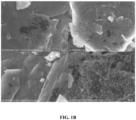
- FIGS. 1A to 1D are SEM images of surfaces of Si/C composites prepared in Comparative Example 1 and Examples 1 to 3, respectively.
- Si nanoparticles having a size of 1 to 100 nm were uniformly deposited on the surface of graphite in the Si/C composites prepared in Examples 1 to 3.
- the deposition rate of Si nanoparticles in the spherical form on the surface of graphite increased as the graphite weight reduction rate and graphite heat treatment time increased within the desirable ranges.
- Comparative Example 1 it was confirmed that the silicon deposition form and size were not uniform due to the size coarsening of Si particles and the connected structure (network structure) between the particles.
- pretreated graphite (B1) is a BET specific surface area value of the pretreated graphite (graphite before forming a silicon-based coating layer in the Si/C composite) prepared in Step 1.
- Si/C composite (B2) is a BET specific surface area value of the Si/C composite prepared in Step 2.
- Microwave-treated graphite (R) is a BET specific surface area value of microwave-treated (pretreated) graphite prepared in the same manner as in Step 2 (microwave irradiation), except that the Si powder was not used.
- the specific surface area ratio (B2B 1) is a value obtained by calculating the BET specific surface area (B2) of the Si/C composite after forming the silicon-based coating layer with respect to the BET specific surface area (B 1) of the carbon-based particles before forming the silicon-based coating layer.
- the specific surface area ratio (B2/R) is a value obtained by calculating the BET specific surface area (B2) of the Si/C composite after forming the silicon-based coating layer with respect to the BET specific surface area (R) of the microwave-treated (pretreated) graphite prepared in the same manner as in Step 2 (microwave irradiation), except that the Si powder was not used.
- the specific surface area contribution rate (B2_C) is calculated as a percentage of the BET specific surface area of the Si/C composite by measuring the BET specific surface area of graphite (pretreated graphite) treated with microwaves in the same manner, except that the Si powder was not used.
- the specific surface area contribution rate (B2_C) is a value calculated as a percentage of the BET specific surface area (R) of the microwave-treated graphite with respect to the BET specific surface area (B2) of the Si/C composite.
- the BET specific surface areas (B2) of the Si/C composites prepared in all the examples increased to more than 9.5 m 2 /g compared to Comparative Example 1, and the BET specific surface area tended to increase as the graphite weight reduction rate and graphite heat treatment time increased within the desirable ranges.
- the specific surface area ratio (B2B 1) was highest at 2.7 m 2 /g in Comparative Example 1, and tended to decrease as the graphite weight reduction rate increased (Example 1 ⁇ Comparative Example 2).
- the specific surface area contribution rate (B2_C) was relatively high in Comparative Examples 1 and 2, and tended to decrease in the examples as the graphite weight reduction rate increased (Example 1 ⁇ Example 3). Especially, it was confirmed that the specific surface area contribution rate (B2_C) of carbon significantly decreased in Examples 2 and 3 compared to Comparative Examples 1 and 2 and Example 1.
- Comparative Example 1 When non-pretreated graphite was used (Comparative Example 1), the proportion of an increase in specific surface area by microwave sintering due to the change in surface morphology of graphite was higher than in the examples. Accordingly, it was analyzed that unreacted silicon relatively increased in Comparative Example 1. Also, since the total BET specific surface area (B2) of the Si/C composite was significantly smaller in Comparative Example 1 than in the examples, it was analyzed that the coarsening and deposition rate of silicon particles in the form of interparticle connection were high.
- FIG. 1E is an SEM image of graphite particles before pretreatment (left SEM image) and after pretreatment (right SEM image) according to Comparative Example 2.
- the weight reduction rate of pretreated graphite reached 40%, the particle structure collapsed and the heat generation performance was excessively improved. Accordingly, it was analyzed that the BET increase rate decreased as the SiC crystal phase increased and the proportion of Si deposited in the form of a thin film increased.
- Electrochemical characterization was performed by a charge/discharge test using an electrochemical analysis device (Shincorp, Toscat-3100) at 25°C, a voltage range of 0.005 V to 1.5 V, and a C-rate of 0.1C to 0.5C to determine initial charge capacity, initial discharge capacity, and initial efficiency (ICE).
- the measurement results are shown in Table 4 below.
- the microwave absorption capacity can be improved due to defects formed on the surfaces of the carbon-based particles. Since a uniform temperature rise and rapid heating/cooling of the carbon-based particles are possible, the residence time (retention time) in the temperature range (approximately 900°C) where the SiC synthesis reaction occurs can be reduced, thereby reducing the amount of SiC synthesis.
- the form in which molten silicon is deposited (adhered) on the surface of the carbon-based particles can be controlled by the uneven structure (defect) on the surfaces of the pretreated (heat-treated) carbon-based particles, thereby preventing the silicon particle coarsening and interparticle connection (thinning) phenomena.
- silicon particles can be uniformly dispersed and deposited on the surfaces of the carbon-based particles in a nano size. Accordingly, it is possible to prevent silicon particles from becoming coarse or being deposited in the form of a thin film. As a result, the problem of electrolyte side reactions due to an excessive increase in specific surface area can be improved.
Landscapes
- Chemical & Material Sciences (AREA)
- Chemical Kinetics & Catalysis (AREA)
- Electrochemistry (AREA)
- General Chemical & Material Sciences (AREA)
- Engineering & Computer Science (AREA)
- Composite Materials (AREA)
- Manufacturing & Machinery (AREA)
- Materials Engineering (AREA)
- Inorganic Chemistry (AREA)
- Organic Chemistry (AREA)
- Nanotechnology (AREA)
- Geology (AREA)
- General Life Sciences & Earth Sciences (AREA)
- Life Sciences & Earth Sciences (AREA)
- Physics & Mathematics (AREA)
- Condensed Matter Physics & Semiconductors (AREA)
- General Physics & Mathematics (AREA)
- Crystallography & Structural Chemistry (AREA)
- Battery Electrode And Active Subsutance (AREA)
- Silicon Compounds (AREA)
- Electric Double-Layer Capacitors Or The Like (AREA)
Applications Claiming Priority (1)
| Application Number | Priority Date | Filing Date | Title |
|---|---|---|---|
| KR1020230112639A KR20250031334A (ko) | 2023-08-28 | 2023-08-28 | 이차전지용 음극 활물질, 이의 제조방법 및 이를 포함하는 리튬 이차전지 |
Publications (2)
| Publication Number | Publication Date |
|---|---|
| EP4517864A2 true EP4517864A2 (de) | 2025-03-05 |
| EP4517864A3 EP4517864A3 (de) | 2025-04-23 |
Family
ID=92503547
Family Applications (1)
| Application Number | Title | Priority Date | Filing Date |
|---|---|---|---|
| EP24195575.6A Pending EP4517864A3 (de) | 2023-08-28 | 2024-08-21 | Negativelektrodenaktivmaterial für sekundärbatterie, verfahren zur herstellung davon und lithiumsekundärbatterie damit |
Country Status (5)
| Country | Link |
|---|---|
| US (1) | US20250079450A1 (de) |
| EP (1) | EP4517864A3 (de) |
| JP (1) | JP2025032989A (de) |
| KR (1) | KR20250031334A (de) |
| CN (1) | CN119542369A (de) |
Family Cites Families (15)
| Publication number | Priority date | Publication date | Assignee | Title |
|---|---|---|---|---|
| KR101375328B1 (ko) * | 2007-07-27 | 2014-03-19 | 삼성에스디아이 주식회사 | Si/C 복합물, 이를 포함하는 음극활물질 및 리튬전지 |
| EP3309873B1 (de) * | 2015-06-15 | 2020-05-27 | UNIST (Ulsan National Institute of Science and Technology) | Anodenaktivmaterial für lithiumsekundärbatterie, herstellungsverfahren dafür und lithiumsekundärbatterie damit |
| EP3133690A1 (de) * | 2015-07-20 | 2017-02-22 | Commissariat A L'energie Atomique Et Aux Energies Alternatives | Partikelförmiges silicium-carbon-verbundmaterial |
| CN119419246A (zh) * | 2015-08-28 | 2025-02-11 | 14集团技术公司 | 具有极其持久的锂嵌入的新型材料及其制造方法 |
| KR20190074313A (ko) * | 2016-11-11 | 2019-06-27 | 쇼와 덴코 가부시키가이샤 | 부극 재료 및 리튬 이온 전지 |
| EP3593369A4 (de) * | 2017-03-09 | 2021-03-03 | Group14 Technologies, Inc. | Zersetzung von siliciumhaltigen vorläufern auf porösen gerüstmaterialien |
| CN106848268A (zh) * | 2017-04-11 | 2017-06-13 | 深圳市贝特瑞新能源材料股份有限公司 | 一种碳‑硅复合材料、其制备方法及用途 |
| CN108417794B (zh) * | 2018-02-05 | 2021-02-26 | 合肥国轩高科动力能源有限公司 | 一种硅纳米层石墨复合异质结材料及其制备方法和应用 |
| KR102131262B1 (ko) * | 2018-08-14 | 2020-08-05 | 울산과학기술원 | 음극활물질, 이의 제조방법 및 이를 포함하는 음극을 구비한 리튬 이차전지 |
| KR102213082B1 (ko) * | 2018-12-26 | 2021-02-08 | 울산과학기술원 | 음극활물질, 이의 제조방법 및 이를 포함하는 음극을 구비한 리튬 이차전지 |
| KR102133961B1 (ko) * | 2019-04-05 | 2020-07-14 | (주)에이치피케이 | 복합 음극재의 제조 방법 및 리튬이차전지용 복합 음극재 |
| CN115832267B (zh) * | 2021-09-16 | 2024-10-11 | 南宁宸宇新能源科技有限公司 | 非晶硅/硬碳复合材料及其制备和在锂离子电池中的应用 |
| WO2023100548A1 (ja) * | 2021-12-03 | 2023-06-08 | Dic株式会社 | 負極活物質、二次電池および負極活物質の製造方法 |
| CN114914418B (zh) * | 2022-05-16 | 2023-06-02 | 合肥国轩高科动力能源有限公司 | 一种硅基纳米复合负极材料及其制备方法 |
| KR102538758B1 (ko) * | 2023-02-17 | 2023-06-01 | (주)에이치피케이 | 이차전지용 복합 음극재 제조장치 |
-
2023
- 2023-08-28 KR KR1020230112639A patent/KR20250031334A/ko active Pending
-
2024
- 2024-08-20 CN CN202411144093.5A patent/CN119542369A/zh active Pending
- 2024-08-20 US US18/809,409 patent/US20250079450A1/en active Pending
- 2024-08-20 JP JP2024138432A patent/JP2025032989A/ja active Pending
- 2024-08-21 EP EP24195575.6A patent/EP4517864A3/de active Pending
Also Published As
| Publication number | Publication date |
|---|---|
| JP2025032989A (ja) | 2025-03-12 |
| US20250079450A1 (en) | 2025-03-06 |
| CN119542369A (zh) | 2025-02-28 |
| EP4517864A3 (de) | 2025-04-23 |
| KR20250031334A (ko) | 2025-03-07 |
Similar Documents
| Publication | Publication Date | Title |
|---|---|---|
| EP2722914B1 (de) | Hochdichtes anodenaktivmaterial und verfahren zu seiner herstellung | |
| JPWO2002059040A1 (ja) | 人造黒鉛質粒子及びその製造方法、非水電解液二次電池負極及びその製造方法、並びにリチウム二次電池 | |
| EP3793004A1 (de) | Anode für lithiumsekundärbatterie und lithiumsekundärbatterie damit | |
| KR20190101651A (ko) | 음극 슬러리, 이를 포함하는 리튬 이차전지용 음극 및 리튬 이차전지 | |
| KR102697188B1 (ko) | 리튬 이차전지의 제조 방법 및 이에 의하여 제조된 리튬 이차전지 | |
| JP2026511565A (ja) | 正極活物質、それを含む正極およびリチウム二次電池 | |
| JP4945906B2 (ja) | 二次電池用負極及びそれを用いた二次電池 | |
| KR20220059125A (ko) | 이차전지용 음극 및 이를 포함하는 이차전지 | |
| EP4033570A2 (de) | Negativelektroden-aktivmaterial, herstellungsverfahren dafür sowie negativelektrode und sekundärbatterie damit | |
| WO2019064547A1 (ja) | リチウムイオン二次電池用負極材料、リチウムイオン二次電池用負極及びリチウムイオン二次電池 | |
| EP3863093B1 (de) | Aktives anodenmaterial, verfahren zu seiner herstellung sowie anode und sekundärbatterie damit | |
| EP3813160B1 (de) | Aktives material für negative elektroden, verfahren zur herstellung des aktiven materials für negative elektroden, negative elektrode und sekundärbatterie mit negativer elektrode | |
| EP4517864A2 (de) | Negativelektrodenaktivmaterial für sekundärbatterie, verfahren zur herstellung davon und lithiumsekundärbatterie damit | |
| EP4447157A1 (de) | Kathodenaktivmaterial und herstellungsverfahren dafür | |
| JP2025534181A (ja) | リチウム二次電池用正極活物質、その製造方法およびこれを含むリチウム二次電池 | |
| EP4550434A1 (de) | Negativelektrodenaktivmaterial für sekundärbatterie, verfahren zur herstellung davon und lithiumsekundärbatterie damit | |
| KR20190060792A (ko) | 재충전이 가능한 전기화학 셀 및 배터리(rechargeable electrochemical cell and battery) | |
| KR102879112B1 (ko) | 이차전지용 음극 활물질, 이의 제조방법 및 이를 포함하는 리튬 이차전지 | |
| EP4647399A1 (de) | Elektrode für eine wiederaufladbare lithiumbatterie und wiederaufladbare lithiumbatterie damit | |
| EP4708398A1 (de) | Positivelektrodenaktivmaterial, verfahren zur herstellung davon, positivelektrode mit positivelektrodenaktivmaterial und lithiumsekundärbatterie mit positivelektrodenaktivmaterial | |
| KR102800858B1 (ko) | 리튬 이차 전지용 음극 활물질, 이의 제조방법 및 이를 포함하는 리튬 이차 전지 | |
| JP7804081B2 (ja) | リチウム二次電池用正極およびその製造方法 | |
| KR20250064100A (ko) | 이차전지용 음극재, 이의 제조방법 및 이를 포함하는 리튬 이차전지 | |
| EP4700861A1 (de) | Anodenaktivmaterial für lithiumsekundärbatterie, herstellungsverfahren dafür und lithiumsekundärbatterie damit | |
| KR20250051506A (ko) | 양극재 분말, 이를 포함하는 양극 및 리튬 이차전지 |
Legal Events
| Date | Code | Title | Description |
|---|---|---|---|
| PUAI | Public reference made under article 153(3) epc to a published international application that has entered the european phase |
Free format text: ORIGINAL CODE: 0009012 |
|
| STAA | Information on the status of an ep patent application or granted ep patent |
Free format text: STATUS: THE APPLICATION HAS BEEN PUBLISHED |
|
| AK | Designated contracting states |
Kind code of ref document: A2 Designated state(s): AL AT BE BG CH CY CZ DE DK EE ES FI FR GB GR HR HU IE IS IT LI LT LU LV MC ME MK MT NL NO PL PT RO RS SE SI SK SM TR |
|
| PUAL | Search report despatched |
Free format text: ORIGINAL CODE: 0009013 |
|
| AK | Designated contracting states |
Kind code of ref document: A3 Designated state(s): AL AT BE BG CH CY CZ DE DK EE ES FI FR GB GR HR HU IE IS IT LI LT LU LV MC ME MK MT NL NO PL PT RO RS SE SI SK SM TR |
|
| RIC1 | Information provided on ipc code assigned before grant |
Ipc: H01M 4/02 20060101ALN20250314BHEP Ipc: H01M 10/0525 20100101ALI20250314BHEP Ipc: H01M 4/587 20100101ALI20250314BHEP Ipc: H01M 4/38 20060101ALI20250314BHEP Ipc: H01M 4/36 20060101ALI20250314BHEP Ipc: H01M 4/134 20100101ALI20250314BHEP Ipc: H01M 4/133 20100101AFI20250314BHEP |
|
| STAA | Information on the status of an ep patent application or granted ep patent |
Free format text: STATUS: REQUEST FOR EXAMINATION WAS MADE |
|
| 17P | Request for examination filed |
Effective date: 20251023 |