EP4516847A1 - Aromatic polyether ketone molded body and production method therefor - Google Patents
Aromatic polyether ketone molded body and production method therefor Download PDFInfo
- Publication number
- EP4516847A1 EP4516847A1 EP23795982.0A EP23795982A EP4516847A1 EP 4516847 A1 EP4516847 A1 EP 4516847A1 EP 23795982 A EP23795982 A EP 23795982A EP 4516847 A1 EP4516847 A1 EP 4516847A1
- Authority
- EP
- European Patent Office
- Prior art keywords
- molded body
- peak
- surface layer
- layer portion
- aromatic polyetherketone
- Prior art date
- Legal status (The legal status is an assumption and is not a legal conclusion. Google has not performed a legal analysis and makes no representation as to the accuracy of the status listed.)
- Withdrawn
Links
Images
Classifications
-
- C—CHEMISTRY; METALLURGY
- C08—ORGANIC MACROMOLECULAR COMPOUNDS; THEIR PREPARATION OR CHEMICAL WORKING-UP; COMPOSITIONS BASED THEREON
- C08J—WORKING-UP; GENERAL PROCESSES OF COMPOUNDING; AFTER-TREATMENT NOT COVERED BY SUBCLASSES C08B, C08C, C08F, C08G or C08H
- C08J7/00—Chemical treatment or coating of shaped articles made of macromolecular substances
- C08J7/12—Chemical modification
- C08J7/123—Treatment by wave energy or particle radiation
-
- C—CHEMISTRY; METALLURGY
- C08—ORGANIC MACROMOLECULAR COMPOUNDS; THEIR PREPARATION OR CHEMICAL WORKING-UP; COMPOSITIONS BASED THEREON
- C08G—MACROMOLECULAR COMPOUNDS OBTAINED OTHERWISE THAN BY REACTIONS ONLY INVOLVING UNSATURATED CARBON-TO-CARBON BONDS
- C08G65/00—Macromolecular compounds obtained by reactions forming an ether link in the main chain of the macromolecule
- C08G65/34—Macromolecular compounds obtained by reactions forming an ether link in the main chain of the macromolecule from hydroxy compounds or their metallic derivatives
- C08G65/38—Macromolecular compounds obtained by reactions forming an ether link in the main chain of the macromolecule from hydroxy compounds or their metallic derivatives derived from phenols
- C08G65/40—Macromolecular compounds obtained by reactions forming an ether link in the main chain of the macromolecule from hydroxy compounds or their metallic derivatives derived from phenols from phenols (I) and other compounds (II), e.g. OH-Ar-OH + X-Ar-X, where X is halogen atom, i.e. leaving group
- C08G65/4012—Other compound (II) containing a ketone group, e.g. X-Ar-C(=O)-Ar-X for polyetherketones
-
- B—PERFORMING OPERATIONS; TRANSPORTING
- B29—WORKING OF PLASTICS; WORKING OF SUBSTANCES IN A PLASTIC STATE IN GENERAL
- B29C—SHAPING OR JOINING OF PLASTICS; SHAPING OF MATERIAL IN A PLASTIC STATE, NOT OTHERWISE PROVIDED FOR; AFTER-TREATMENT OF THE SHAPED PRODUCTS, e.g. REPAIRING
- B29C35/00—Heating, cooling or curing, e.g. crosslinking or vulcanising; Apparatus therefor
- B29C35/02—Heating or curing, e.g. crosslinking or vulcanizing during moulding, e.g. in a mould
- B29C35/08—Heating or curing, e.g. crosslinking or vulcanizing during moulding, e.g. in a mould by wave energy or particle radiation
- B29C35/0866—Heating or curing, e.g. crosslinking or vulcanizing during moulding, e.g. in a mould by wave energy or particle radiation using particle radiation
-
- B—PERFORMING OPERATIONS; TRANSPORTING
- B29—WORKING OF PLASTICS; WORKING OF SUBSTANCES IN A PLASTIC STATE IN GENERAL
- B29C—SHAPING OR JOINING OF PLASTICS; SHAPING OF MATERIAL IN A PLASTIC STATE, NOT OTHERWISE PROVIDED FOR; AFTER-TREATMENT OF THE SHAPED PRODUCTS, e.g. REPAIRING
- B29C35/00—Heating, cooling or curing, e.g. crosslinking or vulcanising; Apparatus therefor
- B29C35/16—Cooling
-
- C—CHEMISTRY; METALLURGY
- C08—ORGANIC MACROMOLECULAR COMPOUNDS; THEIR PREPARATION OR CHEMICAL WORKING-UP; COMPOSITIONS BASED THEREON
- C08K—Use of inorganic or non-macromolecular organic substances as compounding ingredients
- C08K7/00—Use of ingredients characterised by shape
- C08K7/02—Fibres or whiskers
- C08K7/04—Fibres or whiskers inorganic
- C08K7/06—Elements
-
- B—PERFORMING OPERATIONS; TRANSPORTING
- B29—WORKING OF PLASTICS; WORKING OF SUBSTANCES IN A PLASTIC STATE IN GENERAL
- B29C—SHAPING OR JOINING OF PLASTICS; SHAPING OF MATERIAL IN A PLASTIC STATE, NOT OTHERWISE PROVIDED FOR; AFTER-TREATMENT OF THE SHAPED PRODUCTS, e.g. REPAIRING
- B29C35/00—Heating, cooling or curing, e.g. crosslinking or vulcanising; Apparatus therefor
- B29C35/02—Heating or curing, e.g. crosslinking or vulcanizing during moulding, e.g. in a mould
- B29C35/08—Heating or curing, e.g. crosslinking or vulcanizing during moulding, e.g. in a mould by wave energy or particle radiation
- B29C35/0866—Heating or curing, e.g. crosslinking or vulcanizing during moulding, e.g. in a mould by wave energy or particle radiation using particle radiation
- B29C2035/0877—Heating or curing, e.g. crosslinking or vulcanizing during moulding, e.g. in a mould by wave energy or particle radiation using particle radiation using electron radiation, e.g. beta-rays
-
- B—PERFORMING OPERATIONS; TRANSPORTING
- B29—WORKING OF PLASTICS; WORKING OF SUBSTANCES IN A PLASTIC STATE IN GENERAL
- B29K—INDEXING SCHEME ASSOCIATED WITH SUBCLASSES B29B, B29C OR B29D, RELATING TO MOULDING MATERIALS OR TO MATERIALS FOR MOULDS, REINFORCEMENTS, FILLERS OR PREFORMED PARTS, e.g. INSERTS
- B29K2071/00—Use of polyethers, e.g. PEEK, i.e. polyether-etherketone or PEK, i.e. polyetherketone or derivatives thereof, as moulding material
-
- B—PERFORMING OPERATIONS; TRANSPORTING
- B29—WORKING OF PLASTICS; WORKING OF SUBSTANCES IN A PLASTIC STATE IN GENERAL
- B29L—INDEXING SCHEME ASSOCIATED WITH SUBCLASS B29C, RELATING TO PARTICULAR ARTICLES
- B29L2015/00—Gear wheels or similar articles with grooves or projections, e.g. control knobs
- B29L2015/003—Gears
-
- C—CHEMISTRY; METALLURGY
- C08—ORGANIC MACROMOLECULAR COMPOUNDS; THEIR PREPARATION OR CHEMICAL WORKING-UP; COMPOSITIONS BASED THEREON
- C08G—MACROMOLECULAR COMPOUNDS OBTAINED OTHERWISE THAN BY REACTIONS ONLY INVOLVING UNSATURATED CARBON-TO-CARBON BONDS
- C08G2650/00—Macromolecular compounds obtained by reactions forming an ether link in the main chain of the macromolecule
- C08G2650/28—Macromolecular compounds obtained by reactions forming an ether link in the main chain of the macromolecule characterised by the polymer type
- C08G2650/38—Macromolecular compounds obtained by reactions forming an ether link in the main chain of the macromolecule characterised by the polymer type containing oxygen in addition to the ether group
- C08G2650/40—Macromolecular compounds obtained by reactions forming an ether link in the main chain of the macromolecule characterised by the polymer type containing oxygen in addition to the ether group containing ketone groups, e.g. polyarylethylketones, PEEK or PEK
-
- C—CHEMISTRY; METALLURGY
- C08—ORGANIC MACROMOLECULAR COMPOUNDS; THEIR PREPARATION OR CHEMICAL WORKING-UP; COMPOSITIONS BASED THEREON
- C08J—WORKING-UP; GENERAL PROCESSES OF COMPOUNDING; AFTER-TREATMENT NOT COVERED BY SUBCLASSES C08B, C08C, C08F, C08G or C08H
- C08J2371/00—Characterised by the use of polyethers obtained by reactions forming an ether link in the main chain; Derivatives of such polymers
Definitions
- the present invention relates to an aromatic polyetherketone molded body that can be used for various parts and a method of producing the same.
- Patent Literature 1 Japanese Patent Application Laid-open No. 2011-111091
- the resin molded body In the resin molded body, rapid cooling of a mold after molding is necessary for shortening the tact time, but the rapid cooling of a mold tends to reduce the strength in the vicinity of the surface where crystallization is likely to be hindered.
- the resin molded body In order to sufficiently progress crystallization in the vicinity of the surface of the resin molded body, the resin molded body can be further subjected to heat treatment such as annealing treatment.
- an aromatic polyetherketone molded body includes: a body portion; and a surface layer portion covering the body portion.
- An infrared absorption spectrum is obtained by measurement using an infrared spectrophotometer for both the body portion and the surface layer portion, the infrared absorption spectrum including a peak A and a peak B, the peak A appearing in a wavenumber range of 1295 to 1340 cm -1 , the peak B appearing in a wavenumber range of 1265 to 1295 cm -1 .
- a ratio A'/B' of strength A' of the peak A to strength B' of the peak B is higher in the surface layer portion than in the body portion.
- the aromatic polyetherketone molded body may be formed of at least one of polyetheretherketone or polyetherketone.
- the aromatic polyetherketone molded body may be formed of an aromatic polyetherketone including an additive.
- the aromatic polyetherketone molded body may be configured as a sliding member.
- the aromatic polyetherketone molded body may be configured as a gear member.
- a method of producing an aromatic polyetherketone molded body includes the steps of: preparing a molded body from which an infrared absorption spectrum is obtained by measurement using an infrared spectrophotometer, the infrared absorption spectrum including a peak A and a peak B, the peak A appearing in a wavenumber range of 1295 to 1340 cm -1 , the peak B appearing in a wavenumber range of 1265 to 1295 cm -1 ; and applying an electron beam to a surface of the molded body.
- the step of applying an electron beam may include increasing a ratio A'/B' of strength A' of the peak A to strength B' of the peak B in a surface layer portion of the molded body.
- the step of applying an electron beam may include heating the molded body.
- the application of an electron beam allows the degree of crystallization to increase selectively only in the surface layer portion forming the surface of the aromatic polyetherketone molded body.
- the present invention relates to an aromatic polyetherketone molded body that is a resin molded body formed of an aromatic polyetherketone.
- the aromatic polyetherketone is a resin including a benzene ring, an ether, and a ketone.
- Typical examples thereof include polyetheretherketone (PEEK) having excellent heat resistance and mechanical strength.
- examples of the aromatic polyetherketone capable of forming the resin molded body according to the present invention include polyetherketone (PEK), polyetherketoneketone (PEKK), polyetheretherketoneketone (PEEKK), and polyetherketoneetherketoneketone (PEKEKK), in addition to PEEK.
- the aromatic polyetherketone forming the resin molded body according to the present invention may have a configuration in which a plurality of types is blended.
- the resin molded body according to the present invention may be formed of an aromatic polyetherketone including an additive.
- the additive include a fibrous filler, a non-fibrous filler, and a solid lubricant.
- Examples of the fibrous additive include carbon fiber, nanocarbon (carbon nanotube or carbon nanowire), and glass fiber.
- Examples of the non-fibrous filler include graphite, mica, talc, and alumina.
- Examples of the solid lubricant include polytetrafluoroethylene(PTFE) and a tetrafluoroethylene/perfluoroalkylvinylether copolymer (PFA) .
- the infrared absorption spectrum is obtained as a graph with a wavenumber as the horizontal axis and absorbance as the vertical axis, which is obtained by measuring absorbance while changing the wavenumber in a continuous manner by the infrared spectrophotometer.
- the absorbance of the resin molded body according to this embodiment is measured within a wavenumber range including at least 1265 to 1340 cm -1 .
- the infrared absorption spectrum of the aromatic polyetherketone includes a peak A appearing in a wavenumber range of 1295 to 1340 cm -1 and a peak B appearing in a wavenumber range of 1265 to 1295 cm -1 .
- the degree of crystallization of the aromatic polyetherketone is evaluated by a ratio A'/B' of strength A' obtained as the height of the peak A to strength B' as the height of the peak B. That is, it can be seen that in the aromatic polyetherketone, the larger the ratio A'/B', the higher the degree of crystallization, and the smaller the ratio A'/B', the lower the degree of crystallization.
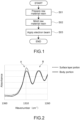
- Fig. 1 is a flowchart showing a method of producing a resin molded body according to this embodiment.
- a raw material resin is prepared.
- the raw material resin prepared in Step S01 for example, commercial products configured as pellets, powder, or the like of the aromatic polyetherketone can be used.
- Step S03 an electron beam is applied to the entire surface of the molded body of the raw material resin obtained in Step S02.
- the electron beam that has entered the surface promotes crystallization of the amorphous portion in the aromatic polyetherketone forming the vicinity of the surface and increases the degree of crystallization in the vicinity of the surface.
- Step S03 application of an electron beam obtains a resin molded body that includes a surface layer portion whose degree of crystallization has been increased and a body portion that is located on the inner side of the surface layer portion and is not affected by the application of an electron beam.
- the degree of crystallization immediately after Step S02 is maintained in the body portion covered with the surface layer portion.
- Fig. 2 shows an example of an infrared absorption spectrum of the surface layer portion and the body portion in the resin molded body according to this embodiment.
- the infrared absorption spectrum of the surface layer portion is obtained by, for example, measurement of absorbance of the surface of the resin molded body.
- the infrared absorption spectrum of the body portion is obtained by, for example, measurement of absorbance of a cross section obtained by cutting the resin molded body to expose the body portion.
- Fig. 2 shows the absorption spectrum of the surface layer portion by a broken line and the absorption spectrum of the body portion by a solid line. While the strengths B' of the peak B are equivalent to each other between the surface layer portion and the body portion, the strength A' of the peak A is higher in the surface layer portion than in the body portion. That is, in the resin molded body according to this embodiment, the ratio A'/B' of the strengths A' and B' is larger in the surface layer portion than in the body portion.
- the resin molded body according to this embodiment by increasing the degree of crystallization of the surface layer portion, it is possible to increase the mechanical strength in the vicinity of the surface where large stress is likely to be applied from the outside. As a result, in the resin molded body according to this embodiment, it is possible to suppress the progress of wear and the occurrence of chipping in the vicinity of the surface formed by the surface layer portion.
- the resin molded body according to this embodiment since the shock absorbing properties in the body portion that is not affected by the application of an electron beam are maintained, an impact to be applied to the surface layer portion is absorbed well. As a result, in the resin molded body according to this embodiment, since large stress is less likely to be locally applied to the surface layer portion, it is possible to further effectively suppress the occurrence of damage.
- the resin molded body according to this embodiment it is possible to increase only the mechanical strength of the surface layer portion without increasing the mechanical strength of the body portion by applying an electron beam. As a result, in the resin molded body according to this embodiment, the effect of suppressing the occurrence of damage by the synergistic effect between the surface layer portion and the body portion can be achieved.
- the portion in which the degree of crystallization is changed by application of an electron beam is limited only to the surface layer portion, and the degree of crystallization of the body portion, which occupies the majority thereof, is not changed. For this reason, in this resin molded body, the amount of shrinkage due to the progress of crystallization after molding remains small, and dimensional changes from the shape immediately after molding can be kept small.
- the thickness of the surface layer portion in the resin molded body according to this embodiment can be appropriately determined in accordance with the application or the like. For example, from the viewpoint of more reliably achieving the above effect of the surface layer portion, it is favorable to set the thickness of the surface layer portion to 50 ⁇ m or more. Meanwhile, from the viewpoint of more effectively achieving the shock absorbing properties of the body portion, it is favorable to limit the thickness of the surface layer portion to 700 ⁇ m or less.
- the thickness of the surface layer portion in the resin molded body can be controlled in various ways by changing the conditions for applying an electron beam.
- large-scale equipment is necessary to increase the thickness of the surface layer portion, it is favorable to limit the thickness of the surface layer portion to 700 ⁇ m or less from the viewpoint of keeping the production cost low without using large-scale equipment.
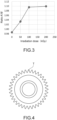
- Fig. 3 is a graph plotting the ratio A'/B' of the surface layer portion when changing the irradiation dose of an electron beam in Step S03. Note that in all plots in Fig. 3 , the other conditions for applying an electron beam and the configuration of the molded body of the raw material resin were common. Further, the plot of the zero irradiation dose in Fig. 4 indicates the condition for applying no electron beam.
- Fig. 3 it can be seen that the effect of promoting crystallization described above is easily achieved by setting the irradiation dose of an electron beam to 50 kGy or more. Meanwhile, when the irradiation dose of an electron beam is too large, the decomposition of the molecular chain of the aromatic polyetherketone progresses. For this reason, it is favorable to limit the irradiation dose of an electron beam to 200 kGy or less.
- Step S03 it is favorable to apply an electron beam while heating the molded body of the raw material resin. This makes it easier for the resin molded body to achieve the effect of improving the mechanical strength of the surface layer portion, e.g., it is possible to further improve the fracture properties. It is favorable to set the temperature of the molded body of the raw material resin during application of an electron beam to, for example, 200°C or more.
- the resin molded body according to this embodiment is particularly suitable for application to a part where stress is likely to concentrate on the surface.
- a part examples include a sliding member such as a gear member, a seal ring, a thrust washer, and a bearing.
- a sliding member such as a gear member, a seal ring, a thrust washer, and a bearing.
- the resin molded body configured as a sliding member it is possible to suppress the occurrence of damage and reduce the friction loss.
- Fig. 4 shows a gear member as an application example of a sliding member of the resin molded body according to this embodiment.
- stress tends to concentrate at the tooth roots of a plurality of teeth T arranged along the outer periphery, but the occurrence of chipping of the teeth T can be effectively suppressed by configuring the resin molded body according to this embodiment.
- Examples and Comparative Examples of the above embodiment will be described.
- samples of resin molded bodies were prepared, and each of the samples was evaluated.
- An electron beam was applied to the molded body of the raw material resin in all Examples 1 to 8, and no electron beam was applied to the molded body of the raw material resin in both Comparative Examples 1 and 2.
- Example 1 PEEK was used as a raw material resin. Specifically, "VESTAKEEP (registered trademark) 4000G” manufactured by Daicel-Evonik Ltd. was used. Further, in Example 4, PEK was used as a raw material resin. Specifically, “VICTREX (registered trademark) HT” manufactured by Victrex plc. was used. Further, in Example 5, 20 weight% of carbon fiber and 10 weight% of PTFE were contained in the raw material resin as additives.
- an electron beam was applied at room temperature. Further, in Examples 1 to 3, an electron beam was applied at irradiation doses different from each other. Specifically, the irradiation dose was set to 50 kGy in Example 1, the irradiation dose was set to 100 kGy in Example 2, and the irradiation dose was set to 200 kGy in Example 3. Further, the irradiation dose was set to 100 kGy in Example 4, and the irradiation dose was set to 200 kGy in Example 5.
- All the samples according to Examples 1 to 5 had a common configuration except for the configuration described above. Further, as the sample according to Comparative Example 1, the molded body of the raw material resin before applying an electron beam in the samples according to Examples 1 to 3 was used. The absorbances of the surface layer portion and the body portion of the samples according to Examples 1 to 5 and Comparative Example 1 were measured using an infrared spectrophotometer. The absorbance was measured by an ATR method with a Ge lens using a Fourier transformation infrared spectrophotometer "FT/IR-4600" manufactured by JASCO Corporation.
- FT/IR-4600 Fourier transformation infrared spectrophotometer
- the ratio A'/B' was calculated from each infrared absorption spectrum obtained by measurement of absorbance.
- Table 1 shows the ratio A'/B' of the surface layer portion and the body portion in Examples 1 to 5 and Comparative Example 1. While the ratios A'/B' were equal to each other between the surface layer portion and the body portion in Comparative Example 1, the ratio A'/B' was higher than in the surface layer portion than in the body portion in all Examples 1 to 5.
- Table 1 shows the results for each number of reciprocations (10 reciprocations, 20 reciprocations, 30 reciprocations, 40 reciprocations, and 50 reciprocations) in Examples 1 to 5 and Comparative Example 1. As shown in Table 1, in each of the samples according to Examples 1 to 5, good results were obtained up to 50 reciprocations, and wear resistance higher than that of the sample according to Comparative Example 1, which was determined as "NG", was obtained for 40 or more reciprocations.
- Table 1 shows the breaking strength as the change rate (%) in Examples 1 to 3 with reference to Comparative Example 1. As shown in Table 1, it can be seen that all samples according to Examples 1 to 3 had higher breaking strength than the sample according to Comparative Example 1 and high breaking strength is obtained by the effect of the surface layer portion.
- a tear test was conducted on each of the samples according to Examples 1 to 3 and Comparative Example 1.
- "AGX" manufactured by Shimadzu Corporation was used.
- each sample was formed into a strip shape (with a 1 mm notch) of 10 mm ⁇ 80 mm ⁇ 0.1 mm.
- the tensile speed was set to 10 mm/min and the other conditions were also common.
- Table 1 shows the tear stroke as the change rate (%) in Examples 1 to 3 with reference to Comparative Example 1. As shown in Table 1, it can be seen that in all samples according to the Examples 1 to 3, the tear stroke is higher than that of the sample according to the Comparative Example and a large tear stroke is achieved by the effect of the surface layer portion.
- Table 1 shows the dynamic friction coefficient as the change rate (%) in Examples 1 to 3 with reference to Comparative Example 1. As shown in Table 1, it can be seen that in each of the samples according to Examples 1 to 3, the dynamic friction coefficient was lower than that of the sample according to Comparative Example and high sliding properties as a sliding member is achieved by the effect of the surface layer portion.
- Table 1 shows the results of the gear fatigue test in Examples 1 to 3 and Comparative Example 1. As shown in Table 1, while no tooth chipping occurred in all samples according to Examples 1 to 3, tooth chipping occurred in the sample according to Comparative Example 1. As a result, it can be seen that in Examples 1 to 3, high fatigue properties as a gear member can be achieved.
- Example 6 the sample temperature during application of an electron beam was changed from that in Example 2. Specifically, the sample temperature was set to 200°C in Example 6, the sample temperature was set to 250°C in Example 7, and the sample temperature was set to 300°C in Example 8. Further, in all Examples 6 to 8, the irradiation dose of an electron beam was set to 100 kGy, similarly to Example 2.
- Example 6 the conditions for applying an electron beam in Examples 6 to 8 are different from those in Example 2 in which the sample temperature is room temperature in that the sample is heated.
- Example 6 the conditions for applying an electron beam in Examples 6 to 8 are different from those in Example 2 in which the sample temperature is room temperature in that the sample is heated.
- a tensile test was conducted on each of the samples according to Examples 6 to 8. The conditions of the tensile test were the same as those in the above Examples 1 to 3 and Comparative Example 1.
- Table 2 shows the breaking strength as the change rate (%) in Examples 2 and 6 to 8 with reference to Comparative Example 1.
- Table 2 shows the breaking strength as the change rate (%) in Examples 2 and 6 to 8 with reference to Comparative Example 1.
- the sample according to Comparative Example 1 was subjected to heat treatment (annealing treatment) at 300°C to prepare a sample according to Comparative Example 2. That is, the sample according to Comparative Example 2 is the same as the sample according to Example 8 in that the molded body of the raw material resin is heated to 300°C but is different from the sample according to Example 8 in that no electron beam is applied.
- heat treatment annealing treatment
- Example 8 A tensile test similar to that in Example 8 was conducted on the sample according to Comparative Example 2.
- Table 3 shows the breaking strength as the change rate (%) in Example 8 with reference to Comparative Example 2. As shown in Table 3, it can be seen that in the sample according to Example 8 in which an electron beam was applied while heating the sample, higher breaking strength than that of the sample according to Comparative Example 2 in which the sample was simply heated is achieved. (Table 3) Comparative Example 2
- Example 8 Raw material resin PEEK PEEK Irradiation conditions Irradiation dose - 100kGy Temperature - 300°C Heat treatment Temperature 300°C - Ratio A'/B' Surface layer portion 1.20 1.27 Body portion 1.20 1.20 Fracture properties Breaking strength Reference +7.8%
- the method of increasing the degree of crystallization of the surface layer portion of the aromatic polyetherketone molded body is not limited to irradiation of an electron beam.
- the other methods of increasing the degree of crystallization of the surface layer portion include laser irradiation, UV irradiation, excimer irradiation, plasma irradiation, corona irradiation, flame treatment, and chemical treatment.
Landscapes
- Health & Medical Sciences (AREA)
- Chemical & Material Sciences (AREA)
- Chemical Kinetics & Catalysis (AREA)
- Medicinal Chemistry (AREA)
- Polymers & Plastics (AREA)
- Organic Chemistry (AREA)
- Physics & Mathematics (AREA)
- Oral & Maxillofacial Surgery (AREA)
- Thermal Sciences (AREA)
- Toxicology (AREA)
- General Chemical & Material Sciences (AREA)
- Treatments Of Macromolecular Shaped Articles (AREA)
- Laminated Bodies (AREA)
- Injection Moulding Of Plastics Or The Like (AREA)
- Investigating Or Analysing Materials By Optical Means (AREA)
- Manufacture Of Macromolecular Shaped Articles (AREA)
Applications Claiming Priority (2)
| Application Number | Priority Date | Filing Date | Title |
|---|---|---|---|
| JP2022073067A JP7721480B2 (ja) | 2022-04-27 | 2022-04-27 | 芳香族ポリエーテルケトン成形体、及びその製造方法 |
| PCT/JP2023/012216 WO2023210235A1 (ja) | 2022-04-27 | 2023-03-27 | 芳香族ポリエーテルケトン成形体、及びその製造方法 |
Publications (1)
| Publication Number | Publication Date |
|---|---|
| EP4516847A1 true EP4516847A1 (en) | 2025-03-05 |
Family
ID=88518599
Family Applications (1)
| Application Number | Title | Priority Date | Filing Date |
|---|---|---|---|
| EP23795982.0A Withdrawn EP4516847A1 (en) | 2022-04-27 | 2023-03-27 | Aromatic polyether ketone molded body and production method therefor |
Country Status (5)
| Country | Link |
|---|---|
| US (1) | US20250215151A1 (https=) |
| EP (1) | EP4516847A1 (https=) |
| JP (1) | JP7721480B2 (https=) |
| CN (1) | CN119072521A (https=) |
| WO (1) | WO2023210235A1 (https=) |
Families Citing this family (1)
| Publication number | Priority date | Publication date | Assignee | Title |
|---|---|---|---|---|
| JP2024138821A (ja) * | 2023-03-27 | 2024-10-09 | 株式会社リケン | 芳香族ポリエーテルケトン成形体、及びその製造方法 |
Family Cites Families (7)
| Publication number | Priority date | Publication date | Assignee | Title |
|---|---|---|---|---|
| JP2000080181A (ja) * | 1998-09-07 | 2000-03-21 | Shiyuukai | 電子線によるプラスチック改質方法 |
| JP3790865B2 (ja) | 2001-03-13 | 2006-06-28 | 独立行政法人 日本原子力研究開発機構 | エンジニアリングプラスチック架橋体の製造方法 |
| JP5084412B2 (ja) | 2007-09-07 | 2012-11-28 | キヤノン株式会社 | 画像形成装置および中間転写ベルト |
| JP5472689B2 (ja) | 2009-06-18 | 2014-04-16 | 日立金属株式会社 | 改質ふっ素樹脂組成物及び成形体 |
| JP2011111091A (ja) | 2009-11-30 | 2011-06-09 | Nsk Ltd | 車両ステアリング用伸縮軸 |
| JP2015067645A (ja) * | 2013-09-26 | 2015-04-13 | 住友電工ファインポリマー株式会社 | 混合樹脂組成物、混合樹脂成形体及び混合樹脂被覆物 |
| JP7142075B2 (ja) * | 2020-11-13 | 2022-09-26 | 株式会社リケン | Peek成形体、及びその製造方法 |
-
2022
- 2022-04-27 JP JP2022073067A patent/JP7721480B2/ja active Active
-
2023
- 2023-03-27 US US18/852,855 patent/US20250215151A1/en active Pending
- 2023-03-27 CN CN202380035672.3A patent/CN119072521A/zh active Pending
- 2023-03-27 EP EP23795982.0A patent/EP4516847A1/en not_active Withdrawn
- 2023-03-27 WO PCT/JP2023/012216 patent/WO2023210235A1/ja not_active Ceased
Also Published As
| Publication number | Publication date |
|---|---|
| WO2023210235A1 (ja) | 2023-11-02 |
| CN119072521A (zh) | 2024-12-03 |
| JP2023162618A (ja) | 2023-11-09 |
| JP7721480B2 (ja) | 2025-08-12 |
| US20250215151A1 (en) | 2025-07-03 |
Similar Documents
| Publication | Publication Date | Title |
|---|---|---|
| KR101940431B1 (ko) | 수지 조성물 및 성형품 | |
| KR102476625B1 (ko) | 마모 감소를 위한 폴리에테르케톤케톤 기반 중합체성 물질의 용도 | |
| EP2035721B1 (de) | Wälzlagerkäfig | |
| EP4516847A1 (en) | Aromatic polyether ketone molded body and production method therefor | |
| EP4215569B1 (en) | Peek molded body and method for producing same | |
| US7595285B2 (en) | Thermoplastic resin composition including a fluororesin, resinous material including same composition, and sliding members using same material | |
| CN113242945B (zh) | 包括涂层的密封件及其形成方法 | |
| CN105440574A (zh) | 一种改性peek材料及其制备方法 | |
| WO2022186258A1 (ja) | ピストンリング | |
| DE102017204355B4 (de) | Wälzlagerkäfig für ein Dentaltechniklager und Verfahren zum Herstellen eines solchen Wälzlagerkäfigs | |
| JP2004217758A (ja) | 樹脂組成物、樹脂材料及びこれを用いた内燃機関用バルブリフタ | |
| KR20250124349A (ko) | 피스톤 링 | |
| Rakhadilov et al. | Influence of irradiation doses on the mechanical and tribological properties of polyetheretherketone exposed to electron beam treatment | |
| JP2024138821A (ja) | 芳香族ポリエーテルケトン成形体、及びその製造方法 | |
| JP2023028623A (ja) | ピストンリングおよびその製造方法 | |
| JP2024139781A (ja) | 芳香族ポリエーテルケトン成形体、及びその製造方法 | |
| MELICHAR et al. | Tábor, October 26th–27th 2021 CZECH REPUBLIC | |
| Polonik et al. | The modification of elastomer composites with organofluorine compounds | |
| JP2026074021A (ja) | ピストンリングおよびその製造方法 | |
| CN120173411A (zh) | 一种高耐磨的聚苯硫醚材料及其制备方法和应用 | |
| CN115521574A (zh) | 一种peek复合材料及其制备方法 | |
| JP2018162411A (ja) | ポリイミド樹脂組成物、及びシールリング |
Legal Events
| Date | Code | Title | Description |
|---|---|---|---|
| STAA | Information on the status of an ep patent application or granted ep patent |
Free format text: STATUS: THE INTERNATIONAL PUBLICATION HAS BEEN MADE |
|
| PUAI | Public reference made under article 153(3) epc to a published international application that has entered the european phase |
Free format text: ORIGINAL CODE: 0009012 |
|
| STAA | Information on the status of an ep patent application or granted ep patent |
Free format text: STATUS: REQUEST FOR EXAMINATION WAS MADE |
|
| 17P | Request for examination filed |
Effective date: 20241002 |
|
| AK | Designated contracting states |
Kind code of ref document: A1 Designated state(s): AL AT BE BG CH CY CZ DE DK EE ES FI FR GB GR HR HU IE IS IT LI LT LU LV MC ME MK MT NL NO PL PT RO RS SE SI SK SM TR |
|
| DAV | Request for validation of the european patent (deleted) | ||
| DAX | Request for extension of the european patent (deleted) | ||
| STAA | Information on the status of an ep patent application or granted ep patent |
Free format text: STATUS: THE APPLICATION HAS BEEN WITHDRAWN |
|
| 18W | Application withdrawn |
Effective date: 20250807 |