EP4516502A1 - Profilanordnung - Google Patents
Profilanordnung Download PDFInfo
- Publication number
- EP4516502A1 EP4516502A1 EP24196863.5A EP24196863A EP4516502A1 EP 4516502 A1 EP4516502 A1 EP 4516502A1 EP 24196863 A EP24196863 A EP 24196863A EP 4516502 A1 EP4516502 A1 EP 4516502A1
- Authority
- EP
- European Patent Office
- Prior art keywords
- profile arrangement
- halogen
- polymeric material
- strip core
- free
- Prior art date
- Legal status (The legal status is an assumption and is not a legal conclusion. Google has not performed a legal analysis and makes no representation as to the accuracy of the status listed.)
- Pending
Links
Images
Classifications
-
- B—PERFORMING OPERATIONS; TRANSPORTING
- B32—LAYERED PRODUCTS
- B32B—LAYERED PRODUCTS, i.e. PRODUCTS BUILT-UP OF STRATA OF FLAT OR NON-FLAT, e.g. CELLULAR OR HONEYCOMB, FORM
- B32B27/00—Layered products comprising a layer of synthetic resin
- B32B27/06—Layered products comprising a layer of synthetic resin as the main or only constituent of a layer, which is next to another layer of the same or of a different material
- B32B27/08—Layered products comprising a layer of synthetic resin as the main or only constituent of a layer, which is next to another layer of the same or of a different material of synthetic resin
-
- A—HUMAN NECESSITIES
- A47—FURNITURE; DOMESTIC ARTICLES OR APPLIANCES; COFFEE MILLS; SPICE MILLS; SUCTION CLEANERS IN GENERAL
- A47B—TABLES; DESKS; OFFICE FURNITURE; CABINETS; DRAWERS; GENERAL DETAILS OF FURNITURE
- A47B13/00—Details of tables or desks
- A47B13/08—Table tops; Rims therefor
- A47B13/083—Rims for table tops
-
- B—PERFORMING OPERATIONS; TRANSPORTING
- B29—WORKING OF PLASTICS; WORKING OF SUBSTANCES IN A PLASTIC STATE IN GENERAL
- B29C—SHAPING OR JOINING OF PLASTICS; SHAPING OF MATERIAL IN A PLASTIC STATE, NOT OTHERWISE PROVIDED FOR; AFTER-TREATMENT OF THE SHAPED PRODUCTS, e.g. REPAIRING
- B29C48/00—Extrusion moulding, i.e. expressing the moulding material through a die or nozzle which imparts the desired form; Apparatus therefor
- B29C48/03—Extrusion moulding, i.e. expressing the moulding material through a die or nozzle which imparts the desired form; Apparatus therefor characterised by the shape of the extruded material at extrusion
- B29C48/07—Flat, e.g. panels
-
- B—PERFORMING OPERATIONS; TRANSPORTING
- B27—WORKING OR PRESERVING WOOD OR SIMILAR MATERIAL; NAILING OR STAPLING MACHINES IN GENERAL
- B27D—WORKING VENEER OR PLYWOOD
- B27D5/00—Other working of veneer or plywood specially adapted to veneer or plywood
- B27D5/003—Other working of veneer or plywood specially adapted to veneer or plywood securing a veneer strip to a panel edge
-
- B—PERFORMING OPERATIONS; TRANSPORTING
- B27—WORKING OR PRESERVING WOOD OR SIMILAR MATERIAL; NAILING OR STAPLING MACHINES IN GENERAL
- B27N—MANUFACTURE BY DRY PROCESSES OF ARTICLES, WITH OR WITHOUT ORGANIC BINDING AGENTS, MADE FROM PARTICLES OR FIBRES CONSISTING OF WOOD OR OTHER LIGNOCELLULOSIC OR LIKE ORGANIC MATERIAL
- B27N7/00—After-treatment, e.g. reducing swelling or shrinkage, surfacing; Protecting the edges of boards against access of humidity
- B27N7/005—Coating boards, e.g. with a finishing or decorating layer
-
- B—PERFORMING OPERATIONS; TRANSPORTING
- B29—WORKING OF PLASTICS; WORKING OF SUBSTANCES IN A PLASTIC STATE IN GENERAL
- B29C—SHAPING OR JOINING OF PLASTICS; SHAPING OF MATERIAL IN A PLASTIC STATE, NOT OTHERWISE PROVIDED FOR; AFTER-TREATMENT OF THE SHAPED PRODUCTS, e.g. REPAIRING
- B29C48/00—Extrusion moulding, i.e. expressing the moulding material through a die or nozzle which imparts the desired form; Apparatus therefor
- B29C48/15—Extrusion moulding, i.e. expressing the moulding material through a die or nozzle which imparts the desired form; Apparatus therefor incorporating preformed parts or layers, e.g. extrusion moulding around inserts
- B29C48/154—Coating solid articles, i.e. non-hollow articles
-
- B—PERFORMING OPERATIONS; TRANSPORTING
- B29—WORKING OF PLASTICS; WORKING OF SUBSTANCES IN A PLASTIC STATE IN GENERAL
- B29C—SHAPING OR JOINING OF PLASTICS; SHAPING OF MATERIAL IN A PLASTIC STATE, NOT OTHERWISE PROVIDED FOR; AFTER-TREATMENT OF THE SHAPED PRODUCTS, e.g. REPAIRING
- B29C48/00—Extrusion moulding, i.e. expressing the moulding material through a die or nozzle which imparts the desired form; Apparatus therefor
- B29C48/16—Articles comprising two or more components, e.g. co-extruded layers
- B29C48/18—Articles comprising two or more components, e.g. co-extruded layers the components being layers
- B29C48/21—Articles comprising two or more components, e.g. co-extruded layers the components being layers the layers being joined at their surfaces
-
- B—PERFORMING OPERATIONS; TRANSPORTING
- B32—LAYERED PRODUCTS
- B32B—LAYERED PRODUCTS, i.e. PRODUCTS BUILT-UP OF STRATA OF FLAT OR NON-FLAT, e.g. CELLULAR OR HONEYCOMB, FORM
- B32B2262/00—Composition or structural features of fibres which form a fibrous or filamentary layer or are present as additives
- B32B2262/06—Vegetal fibres
- B32B2262/062—Cellulose fibres, e.g. cotton
-
- B—PERFORMING OPERATIONS; TRANSPORTING
- B32—LAYERED PRODUCTS
- B32B—LAYERED PRODUCTS, i.e. PRODUCTS BUILT-UP OF STRATA OF FLAT OR NON-FLAT, e.g. CELLULAR OR HONEYCOMB, FORM
- B32B2479/00—Furniture
-
- B—PERFORMING OPERATIONS; TRANSPORTING
- B32—LAYERED PRODUCTS
- B32B—LAYERED PRODUCTS, i.e. PRODUCTS BUILT-UP OF STRATA OF FLAT OR NON-FLAT, e.g. CELLULAR OR HONEYCOMB, FORM
- B32B27/00—Layered products comprising a layer of synthetic resin
- B32B27/18—Layered products comprising a layer of synthetic resin characterised by the use of special additives
-
- B—PERFORMING OPERATIONS; TRANSPORTING
- B32—LAYERED PRODUCTS
- B32B—LAYERED PRODUCTS, i.e. PRODUCTS BUILT-UP OF STRATA OF FLAT OR NON-FLAT, e.g. CELLULAR OR HONEYCOMB, FORM
- B32B27/00—Layered products comprising a layer of synthetic resin
- B32B27/18—Layered products comprising a layer of synthetic resin characterised by the use of special additives
- B32B27/20—Layered products comprising a layer of synthetic resin characterised by the use of special additives using fillers, pigments, thixotroping agents
Definitions
- the invention relates to a profile arrangement, in particular an edge strip, with at least one strip core made of at least one halogen-free, polymeric material, wherein the strip core has a front side and a rear side arranged opposite thereto. Furthermore, the invention relates to the technical field of objects such as furniture panels and the like with at least one such profile arrangement.
- Such profile arrangements have so far been used primarily to decorate narrow sides/side edges of objects such as furniture panels or wood-based panels, chipboard, but also increasingly doors, walls, ceilings, floors, stair banisters, handrails and the like.
- the profile arrangements are fixed, for example, to the narrow sides/side edges of the objects to be decorated.
- said profile arrangements can be adapted in such a way that a desired appearance can be achieved with regard to, for example, the corresponding furniture part edge.
- a profile arrangement with a multi-layer structure wherein the profile arrangement has a decorative layer and a carrier layer arranged immediately adjacent to it, which are produced using a coextrusion process, wherein the decorative layer has organic fibers, wherein the organic fibers are a shredded leather material and wherein the proportion of shredded leather material in the decorative layer is between 30 and 70% by weight, wherein the thermoplastically processable plastic of the decorative layer is a polyolefin or acrylonitrile-butadiene-styrene.
- the profile arrangement is further designed such that the carrier layer consists of a thermoplastically processable plastic, preferably of a polyolefin or of acrylonitrile-butadiene-styrene (ABS) or of polymethyl methacrylate (PMMA) or of polyethylene terephthalate (PET) or of polyvinyl chlorides (PVC) or of polycarbonates (PC) or of mixtures thereof.
- ABS acrylonitrile-butadiene-styrene
- PMMA polymethyl methacrylate
- PET polyethylene terephthalate
- PC polyvinyl chlorides
- the invention is therefore based on the object of overcoming the disadvantages of the prior art and providing profile arrangements which, on the one hand, make it possible to achieve a high-quality optical impression and retain the previous functions from the prior art, and, on the other hand, contain new functionalities, are halogen-free and can also be produced economically and cost-effectively.
- Delignified in the sense of the invention means that the cellulosic fibers and/or the pulp in the polymeric material of the core do not contain lignin.
- the cellulosic fibers and/or the pulp in the halogen-free, polymeric material of the strip core preferably contain a maximum of 5% by weight, preferably a maximum of 4% by weight, particularly preferably a maximum of 3.5% by weight, based on the total weight, of lignin.
- the kappa number according to ISO 302:2015-08 can also be used for evaluation/determination.
- this amount of residual lignin has little or no influence on the positive properties of the profile arrangement.
- the halogen-free, polymeric material of the strip core has a color fastness number according to the gray scale of at least 3 (three), preferably at least 3 (three) to 4 (four) according to DIN EN 20105-A02:1994, according to light fastness in accordance with DIN EN ISO 4892-2:2021-11, method B, cycle B2, blue scale level 6 in accordance with EN ISO 105_B02:1999, 4.1.1.
- the profile arrangement can be produced economically and cost-effectively and can be optimally adapted to objects such as furniture panels, pieces of furniture, chipboard, doors, worktops and the like in terms of appearance, feel and structural effects.
- a further advantage of the profile arrangement is that the cellulosic fibers and/or the pulp have a length to thickness ratio of about 2:1 to about 30:1.
- profile arrangement Another advantage of the profile arrangement is that the cellulosic fibers and/or the pulp have at least one surface treatment with at least one adhesion promoter system. This makes it possible to provide profile arrangements that are not only economical and inexpensive to produce, but are also sustainable and offer a variety of options for creatively designing the design, the surface or the optical structural effects of such profile arrangements.
- the cellulosic fibers and/or the pulp are contained in a spatially uniform, homogeneous and/or inhomogeneous distribution in the halogen-free, polymeric material of the strip core. This leads to a homogeneous, flat and visually appealing structural effect that is distributed over the entire cross-section of the profile arrangement.
- the front side of the strip core has a coating at least in sections.
- the coating on the front side of the strip core has a thickness of approximately 1 to 350 ⁇ m, preferably 2 to 300 ⁇ m, particularly preferably 5 to 250 ⁇ m.
- the coating on the front of the strip core is designed as a co-extruded or post-co-extruded layer or as a paint application or as a printed layer.
- This coating designed as a paint application or as a printed layer can advantageously be implemented in particular by so-called multi-color printing, by digital printing, by gravure printing or the like.
- the intensity and the feel of the surface of the profile arrangement can be further optimized by the material, the thickness and the shape of the coating.
- the coating can advantageously contain renewable raw materials of approximately 0.01 to 100%, preferably 20 to 100%, particularly preferably 40 to 100%.
- the back of the strip core has a functional layer at least in sections.
- Variation of the functional layer in particular to optimize the fixation of the profile arrangement to an object by, for example, designing the functional layer as a so-called adhesion promoter layer and/or in which the functional layer is designed as a so-called hot melt adhesive layer and/or in which the functional layer is designed as a polymeric functional layer.
- the profile arrangement is that at least one cover layer with a thickness of about 2 to 60 ⁇ m, preferably 5 to 30 ⁇ m, is arranged on the front of the strip body. It has also proven to be advantageous that the cover layer on the front of the strip core comprises at least one acrylic polymer and has a maximum transmittance of 80% for visible light across its thickness, measured according to DIN EN ISO 13468-2:2006-07.
- the cover layer can advantageously contain renewable raw materials of about 0.01 to 100%, preferably 20 to 100%, particularly preferably 40 to 100%.
- a further advantage of the profile arrangement is that the halogen-free, polymer material of the strip core has a Shore D hardness of at least 40 in accordance with DIN EN ISO 868:2003-10. This ensures economic and cost-effective production on the one hand and, on the other hand, it makes it possible to adapt the halogen-free, polymer material of the strip core to the respective requirements of the objects, for example the pieces of furniture to be edged and the like.
- the profile arrangement is further characterized by the fact that the halogen-free, polymeric material of the strip core has a tensile strength of at least 35 MPa, preferably at least 40 MPa according to DIN EN ISO 527:2019-12.
- halogen-free, polymeric material of the strip core with the cellulosic fibers and/or the pulp has a tensile strength of at least 85% according to DIN EN ISO 527:2019-12 of the unrecycled, halogen-free, polymeric material, even after multiple recycling processes.
- the back of the strip core of the profile arrangement can be subjected to a surface treatment by a corona process, flame treatment, plasma process, silicatisation process and This allows an optimized connection of the profile arrangement for a wide variety of material combinations to be realized.
- the halogen-free, polymeric material of the strip core and/or the halogen-free, polymeric material of the functional layer contains light and/or radiation-absorbing additives in an amount of 0.01 to 5% by weight, preferably 0.02 to 3.0% by weight, based on the total amount.
- it can be optimally welded using known laser joining methods by specifically introducing the energy into the halogen-free, polymeric material of the functional layer, for example on the narrow sides of pieces of furniture.
- the halogen-free, polymeric material of the strip core and/or the halogen-free, polymeric material of the functional layer contains at least one additive, partially containing inorganic and/or organic pigments, in an amount of about 0.01 to 5.0% by weight, preferably 0.02 to 3.0% by weight, based on the total amount.
- the material of the strip core contains about 5 to 50% by weight, preferably about 10 to 45% by weight, particularly preferably 15 to 35% by weight, based on its total weight, of at least one filler, the filler being selected in particular from silicates, carbonates, phosphates, sulfates, sulfides and the like.
- the filler is also advantageously selected from the group of layered silicates, as well as carbonates or sulfates of barium and calcium, and the like.
- the filler of the strip core comprises in particular barium sulfate, calcium sulfate, calcium carbonate, talc, wollastonite.
- the fillers can advantageously contain renewable raw materials of about 0.01 to 100%, preferably 20 to 100%, particularly preferably 40 to 100%.
- a further advantage of the profile arrangement is that the filler in the material of the strip core has an average particle size with a D50 value of about 0.2 to 25 ⁇ m, preferably 0.5 to 15 ⁇ m, particularly preferably 1 to 8 ⁇ m according to DIN 66165-1:2016-08. It is advantageous in the profile arrangement that the filler in the material of the strip core has a particle size with a D98 value of approximately 15 ⁇ m, preferably less than 15 ⁇ m, particularly preferably less than 10 ⁇ m according to DIN 66165-1:2016-08.
- the strip core is made of polyolefin, such as polypropylene (PP) or polyethylene (PE); a styrene-based polymer, such as polystyrene (PS) or styrene-butadiene copolymer with a predominantly styrene content (SB) or acrylonitrile-styrene-acrylate copolymers (ASA) or acrylonitrile-butadiene-styrene copolymers (ABS) or styrene-acrylonitrile (SAN); polybutylene terephthalate (PBT); polyethylene terephthalate (PET); polyoxymethylene (POM); polyamide (PA); polymethyl methacrylate (PMMA); polyphenylene oxide (PPO); polyetheretherketone (PEEK); polyphenylene sulfide (PPS); liquid crystal polymer (LCP); polyamideimide (PAI); polyphenylsulf
- the profile arrangement is advantageously designed such that the halogen-free, polymeric material of the strip core and/or the polymeric material of the functional layer contains at least one of the following additives: stabilizers to improve resistance to light, UV radiation and weathering; stabilizers to improve thermal and thermo-oxidative resistance; stabilizers to improve hydrolytic resistance, stabilizers to improve acidolytic resistance, lubricants, demolding aids, coloring additives, crystallization-regulating substances and nucleating agents, flame retardants, impact modifiers, fillers and/or plasticizers.
- the additives can advantageously contain renewable raw materials from about 0.01 to 100%, preferably 20 to 100%, particularly preferably from 40 to 100%.
- the profile arrangement is also characterized by the fact that the carbon content of the core at least partially has isotope contents of 14 C/12 C of about 0.01 to 100%, preferably 20 to 100%, particularly preferably 40 to 100% according to ASTM 6866-22 Method B.
- Another advantage of the profile arrangement is that the core has an isotope content of 14 C of 0.01% to 100%, preferably 20% to 100%, particularly preferably 40 to 100%.
- the invention has recognized that the profile arrangement can only be produced economically and cost-effectively, achieves a high-quality visual impression and retains the previous functions from the state of the art if exactly the listed isotope contents are added to the strip core.
- the halogen-free, polymeric material of the panel core with the cellulosic fibers and/or the pulp contains renewable raw materials of around 0.01 to 100%, preferably 20 to 100%, particularly preferably 40 to 100%, as proven by mass balancing, for example via ISCC.
- the profile arrangement, the halogen-free, polymeric material of the strip core with the cellulosic fibers and/or the pulp can contain around 60% renewable raw materials certified via mass balancing and around 40% non-renewable, fossil-based raw materials.
- a further preferred embodiment relates to a profile arrangement according to one of the previous embodiments, wherein the functional layer is based on a halogen-free, polymeric material, preferably polypropylene (PP), acrylonitrile-butadiene-styrene copolymer (ABS), polymethyl methacrylate (PMMA), polyethylene terephthalate (PET), polyethylene (PE), styrene-ethylene-butadiene-styrene block copolymer (SEBS), polyamide (PA), olefin-based thermoplastic elastomer (TPO), urethane-based thermoplastic elastomer (TPU), thermoplastic copolyester (TPC), styrene block copolymers (SBS, SEBS, SEPS, SEEPS and MBS), thermoplastic copolyamide (TPA) and the like.
- PP polypropylene
- ABS acrylonitrile-butadiene-styrene copolymer
- the halogen-free, polymeric material can advantageously contain renewable raw materials of approximately 0.01 to 100%, preferably 20 to 100%, particularly preferably 40 to 100%. This measure has the advantage that this material is inexpensive and easy to process, and is also easy to chemically modify.
- the functional layer is designed as a thermoplastic functional layer, which makes it possible to fix a profile arrangement according to the previously described embodiments to a narrow side of a lightweight panel without the use of adhesive, i.e. without additionally applying a so-called hot melt adhesive immediately before joining, and without a visible joint.
- a further preferred embodiment relates to a profile arrangement according to at least one of the preceding embodiments, wherein the halogen-free, polymeric material of the functional layer a copolymer, preferably a graft copolymer, preferably a maleic anhydride-grafted polypropylene (PP-MAH).
- a copolymer preferably a graft copolymer, preferably a maleic anhydride-grafted polypropylene (PP-MAH).
- PP-MAH maleic anhydride-grafted polypropylene
- the halogen-free, polymeric material of the functional layer is selected from the group of polyurethanes (PUR), acrylates, epoxy resins, ethylene vinyl acetates (e.g. EVA dispersions), polyvinyl acetates (PVAC dispersions) and the like, as well as mixtures of two or more of the aforementioned substances.
- PUR polyurethanes
- acrylates epoxy resins
- ethylene vinyl acetates e.g. EVA dispersions
- PVAC dispersions polyvinyl acetates
- the halogen-free, polymeric material of the functional layer has an adhesion promoter system, preferably as aqueous dispersions or solutions in organic solvents of binder resins, which are selected in particular from the group of polyurethanes, polyesters, acrylates, methyl methacrylates, epoxy resins, ethylene vinyl acetates, polyvinyl acetates, polyvinylidene, natural rubber, as well as mixtures of two or more of the aforementioned binder groups. Used with or without the addition of crosslinker / activator components, e.g. based on polyisocyanates, amines or peroxides.
- the halogen-free, polymeric material of the functional layer can be applied to the back of the strip core during the direct production of the profile arrangement.
- the functional layer of the profile arrangement has a thickness of approximately 0.1 ⁇ m to 100 ⁇ m, preferably 0.2 ⁇ m to 75 ⁇ m, particularly preferably 0.5 to 30 ⁇ m. In addition to economical and cost-effective production of the profile arrangement, this advantageously results in the functional layer being optimally adaptable to the respective geometry of the profile arrangement.
- the object of the invention to show an object is achieved by an object such as a furniture panel, piece of furniture, door, chipboard, worktop and the like with at least one profile arrangement which has the advantageous embodiments of the previous sections.
- the object such as furniture panel, piece of furniture, chipboard, door, worktop and the like is further advantageously designed such that the profile arrangement is arranged on the object with a rear side facing away from the front side.
- the object such as furniture panel, piece of furniture, chipboard, door, worktop and the like is further characterized in that the profile arrangement has a peel strength of at least 40 N/cm according to DIN 53539:1979-09, measured on chipboard.
- the profile arrangement 1 is designed such that the cellulosic fibers and/or the pulp in the polymeric material of the strip core 2 comprise a maximum of 4 wt.%, preferably a maximum of 4 wt.%, particularly preferably a maximum of 3.5 wt.%, based on the total weight, of lignin.
- the profile arrangement 1 is designed such that the cellulosic fibers and/or the pulp in the polymeric material of the strip core have 0 wt.%, based on the total weight, of lignin.
- the halogen-free, polymeric material of the strip core 2 comprises about 50 wt.%, based on the total weight, cellulosic fibers with an average particle size of about 500 ⁇ m according to ISO 13320:2020-0.
- the profile arrangement 1 is further designed such that the halogen-free, polymeric material of the strip core 2 has a colour fastness number according to grey scale of at least 3 (three), preferably at least 3 (three) to 4 (four) according to DIN EN 20105-A02:1994, according to light fastness according to DIN EN ISO 4892-2:2021-11, method B, cycle B2, blue scale level 6 according to EN ISO 105_B02:1999, 4.1.1.
- the halogen-free, polymeric material of the last core 2 has a colour fastness number according to grey scale of approximately 3.2 according to DIN EN 20105-A02:1994 according to light fastness according to DIN EN ISO 4892-2:2021-11, method B, cycle B2, blue scale level 6 according to EN ISO 105_B02:1999, 4.1.1.
- the profile arrangement 1 is further designed such that the halogen-free, polymeric material of the strip core 2 has CIELAB color differences of at least 3 (three), preferably at least 3.4 according to DIN EN 20105-A02:1994.
- the profile arrangement is designed such that the halogen-free, polymeric material of the strip core 2 has CIELAB color differences of approximately 3.2 according to DIN EN 20105-A02:1994.
- the cellulosic fibers in the strip core 2 of the profile arrangement 1 are contained in a spatially uniform distribution in order to realize a uniform, visually appealing surface of the profile arrangement 1.
- the profile arrangement 1 is also characterized in that the carbon content of the strip core 2 at least partially has isotope contents of 14 C/12 C of about 0.01 to 100%, preferably 20 to 100%, particularly preferably 40 to 100% according to ASTM 6866-22 Method B.
- the carbon content of the inguinal core 2 has at least partial isotopic proportions of 14 C/12 C of about 50% according to ASTM 6866-22 Method B.
- the halogen-free, polymeric material of the strip core 2 with the cellulosic fibers and/or the cellulose contains renewable raw materials of approximately 0.01 to 100%, preferably 20 to 100%, particularly preferably 40 to 100%, as proven by mass balancing, for example via ISCC.
- the profile arrangement 1, the halogen-free, polymeric material of the strip core with the cellulosic fibers and/or the cellulose can contain certified renewable raw materials of approximately 55% and approximately 45% non-renewable, fossil-based raw materials via mass balancing.
- the profile arrangement 1 is designed such that the cellulosic fibers and/or the pulp in the polymeric material of the strip core 2 contain a maximum of 4% by weight, preferably a maximum of 4% by weight, particularly preferably a maximum of 3.5% by weight, based on the total weight, of lignin.
- the profile arrangement 1 is designed such that the cellulosic fibers and/or the pulp in the polymeric material of the strip core contain a maximum of 1% by weight, based on the total weight, of lignin.
- the halogen-free, polymeric material of the strip core 2 comprises about 25 wt.%, based on the total weight, of cellulosic fibers, with an average particle size of about 250 ⁇ m according to ISO 13320:2020-0.
- the profile arrangement 1 is further designed such that the halogen-free, polymeric material of the strip core 2 has a color fastness number of at least 3, preferably at least 3 to 4 according to DIN EN 20105-A02:1994.
- the halogen-free, polymeric material of the last core 2 has a colour fastness number according to grey scale of approximately 3.3 according to DIN EN 20105-A02:1994 according to light fastness according to DIN EN ISO 4892-2:2021-11, method B, cycle B2, blue scale level 6 according to EN ISO 105_B02:1999, 4.1.1.
- the profile arrangement 1 is further designed such that the halogen-free, polymeric material of the strip core 2 has CIELAB color differences of at least 3 (three), preferably at least 3.4 according to DIN EN 20105-A02:1994.
- the profile arrangement is designed such that the halogen-free, polymeric material of the strip core 2 has CIELAB color differences of approximately 3.2 according to DIN EN 20105-A02:1994.
- a further advantage of profile arrangement 1 is that I the strip core 2 has an isotope proportion of 14 C/12 C according to ASTM 6866-22 Method B of about 0.01% to about 100%, preferably 20% to about 100%, particularly preferably 40 to 100%.
- the coating 6 on the front side 3 of the strip core 2 of the profile arrangement 1 is essentially single-colored.
- the coating 6 on the front side 3 of the strip core 2 of the profile arrangement 1 is designed as a paint application in the color white.
- the thickness of the coating 6 is about 25 ⁇ m.
- the thickness of the cover layer 5 is about 10 ⁇ m.
- the functional layer 7 of the profile arrangement 1 is designed as an adhesion promoter layer.
- the halogen-free, polymeric material of the functional layer 7 is selected from the group of polyurethanes (PUR).
- the profile arrangement 1 is thus extremely versatile and can be used or attached to a wide variety of objects such as furniture panels, pieces of furniture, chipboard, doors, worktops and the like and, in addition to the function of protecting a narrow side of a furniture panel, for example, it can also realize optical or haptic aspects, for example in that the worktops have a profile arrangement 1 which has a visually appealing, haptically perceptible structural effect that has not yet been possible in this form and which, in particular in the case of a profile arrangement that has been machined/milled on its longitudinal edges, significantly improves or optimizes the appearance of the entire panel.
- FIG 3 is a perspective view of an object, such as furniture panel 10 with at least one further profile arrangement 1.
- the profile arrangement 1 is designed such that the cellulosic fibers and/or the pulp in the polymeric material of the strip core 2 contain a maximum of 4 wt.%, preferably a maximum of 4 wt.%, particularly preferably a maximum of 3.5 wt.%, based on the total weight, of lignin.
- the profile arrangement 1 is designed such that the cellulosic fibers and/or the pulp in the polymeric
- the material of the core of the strip may contain a maximum of 2.5% by weight of lignin, based on the total weight.
- the profile arrangement 1 is further designed such that the halogen-free, polymeric material of the strip core 2 has a colour fastness number according to grey scale of at least 3 (three), preferably at least 3 (three) to 4 (four) according to DIN EN 20105-A02:1994, according to light fastness according to DIN EN ISO 4892-2:2021-11, method B, cycle B2, blue scale level 6 according to EN ISO 105_B02:1999, 4.1.1.
- the halogen-free, polymeric material of the last core 2 has a colour fastness number according to the grey scale of approximately 3.4 according to DIN EN 20105-A02:1994 according to light fastness according to DIN EN ISO 4892-2:2021-11, method B, cycle B2, blue scale level 6 according to EN ISO 105_B02:1999, 4.1.1.
- the profile arrangement 1 is further designed such that the halogen-free, polymeric material of the strip core 2 has CIELAB color differences of at least 3 (three), preferably at least 3.4 according to DIN EN 20105-A02:1994.
- the profile arrangement is designed such that the halogen-free, polymeric material of the strip core 2 has CIELAB color differences of approximately 3.2 according to DIN EN 20105-A02:1994.
- the strip core 2 has an isotope content 14 C of 0.01% to 100%, preferably 20% to 100%, particularly preferably 40 to 100%.
- the strip core 2 has an isotope content 14 C of approximately 50%.
- a further advantage of the profile arrangement 1 is that the halogen-free, polymeric material of the strip core 2 with the cellulosic fibers and/or the cellulose contains renewable raw materials of approximately 0.01 to 100%, preferably 20 to 100%, particularly preferably 40 to 100%, as proven by mass balancing, for example via ISCC.
- the profile arrangement 1, the halogen-free, polymeric material of the strip core 2 with the cellulosic fibers and/or the pulp can contain about 100% renewable raw materials certified via mass balance.
- the material of the strip core 2 contains about 5 to 50% by weight, preferably about 10 to 45% by weight, particularly preferably 15 to 35% by weight, based on its total weight, of at least one filler, the filler being selected in particular from silicates, carbonates, phosphates, sulfates, sulfides and the like.
- the filler is also advantageously selected from the group of layered silicates, as well as carbonates or sulfates of barium and calcium, and the like.
- the fillers can advantageously contain renewable raw materials of about 0.01 to 100%, preferably 20 to 100%, particularly preferably 40 to 100%.
- the material of the strip core 2 comprises approximately 35 wt.%, based on its total weight, of a filler selected from the group of calcium carbonates, namely calcium carbonate.
- the profile arrangement 1 is further designed such that the front side 3 of the strip core 2 has a coating 6 at least in sections. Furthermore, the profile arrangement is designed such that the coating 6 on the front side 3 of the strip core 2 is designed as a coextruded or post-coextruded layer or as a paint application or as a printed layer.
- the coating 6 on the front side 3 of the strip core 2 of the profile arrangement 1 is essentially single-colored.
- the coating 6 on the front side 3 of the strip core 2 of the profile arrangement 1 is designed as a co-extruded layer in the color brown.
- the coating 6 on the front side 3 of the strip core 2 has a thickness of approximately 1 to 350 ⁇ m, preferably 2 to 300 ⁇ m, particularly preferably 5 to 250 ⁇ m.
- the thickness of the coating 6 is about 15 ⁇ m.
- the object such as furniture panel 10 is characterized in that the profile arrangement 1 is attached, in particular fixed, to at least one end face 11 of the furniture panel 10.
- the object such as furniture panel 10 is designed such that the profile arrangement 1 is integrally connected, in particular fixed, to the end face 11 of the furniture panel 10 without an additional functional layer, in particular an adhesion promoter layer.
- the object such as furniture panel 10 is advantageously designed such that the profile arrangement 1 attached to the end face 11 of the furniture panel 10 has at least one chamfer 80 and/or at least one radius 90 on at least one of its end faces 8, 9 arranged in the profile longitudinal direction L.
Landscapes
- Engineering & Computer Science (AREA)
- Mechanical Engineering (AREA)
- Laminated Bodies (AREA)
Abstract
Die Erfindung betrifft eine Profilanordnung, insbesondere Kantenleiste, mit wenigstens einem Leistenkern aus wenigstens einem halogenfreien, polymeren Material, wobei der Leistenkern eine Vorderseite, sowie eine dieser gegenüberliegend angeordnete, Rückseite aufweist, wobei das halogenfreie, polymere Material des Leistenkernes 2 wenigstens 15 bis 80 Gew.-%, bevorzugt 20 bis 75 Gew.-%, besonders bevorzugt 25 bis 70 Gew.-%, bezogen auf das Gesamtgewicht, cellulosische Fasern und/oder Zellstoff aufweist, mit einer durchschnittlichen Partikellänge von etwa 5 bis 1.500 µm, bevorzugt 7 bis 1.000 µm, besonders bevorzugt 5 bis 500 µm nach ISO 13320:2020-01, dass die cellulosischen Fasern und/oder der Zellstoff im halogenfreien, polymeren Material des Leistenkerns 2 deligniert sind/ist,
Description
- Die Erfindung betrifft eine Profilanordnung, insbesondere Kantenleiste, mit wenigstens einem Leistenkern aus wenigstens einem halogenfreien, polymeren Material, wobei der Leistenkern eine Vorderseite, sowie eine dieser gegenüberliegend angeordnete, Rückseite aufweist, weiterhin betrifft die Erfindung das technische Gebiet von Gegenständen wie Möbelplatten und dergleichen mit wenigstens einer solchen Profilanordnung.
- Derartige Profilanordnungen dienen bisher vorzugsweise der Dekoration von Schmalseiten/ Seitenkanten von Gegenständen wie Möbelplatten oder Holzwerkstoffplatten, Spanplatten, aber auch zunehmend von Türen, Wänden, Decken, Böden, Treppengeländern, Handläufen und dergleichen. Hierzu werden die Profilanordnungen bspw. auf die zu dekorierenden Schmalseiten/ Seitenkanten der Gegenstände fixiert. Durch eine spezielle Materialauswahl können besagte Profilanordnungen so angepasst werden, dass eine gewünschte Optik bezüglich bspw. der entsprechenden Möbelteilkante erzielbar ist.
- So ist in der
DE 102008038008 B4 eine Profilanordnung offenbart mit einem mehrschichtigen Aufbau, wobei die Profilanordnung eine Dekorschicht sowie eine unmittelbar benachbart angeordnete Trägerschicht aufweist, welche im Koextrusionsverfahren hergestellt sind, wobei die Dekorschicht organische Fasern aufweist, wobei die organischen Fasern ein zerkleinertes Ledermaterial sind und wobei der Anteil des zerkleinerten Ledermaterials in der Dekorschicht zwischen 30 und 70 Gew.-% beträgt, wobei der thermoplastisch verarbeitbare Kunststoff der Dekorschicht ein Polyolefin oder Acrylnitril-Butadien-Styrol ist. Die Profilanordnung ist weiter so ausgebildet, dass die Trägerschicht aus einem thermoplastisch verarbeitbaren Kunststoff, vorzugsweise aus einem Polyolefin oder aus Acrylnitril-Butadien-Styrol (ABS) oder aus Polymethylmethacrylat (PMMA) oder aus Polyethylenterephthalat (PET) oder aus Polyvinylchloriden (PVC) oder aus Polycarbonaten (PC) besteht oder aus Mischungen dieser. - Allerdings kann der, mit den bisherigen Profilanordnungen erzielbare, optische Eindruck nicht immer die ständig steigenden Anforderungen an die Optik moderner Gegenstände wie bspw. Möbelstücke befriedigen, insbesondere dann, wenn neue Funktionen / Designs / Oberflächen für die Profilanordnungen erwünscht sind.
- Es war daher erforderlich, die bisher eingesetzten Materialien so zu optimieren / zu verändern, dass neue Funktionalitäten / Designs / Oberflächen realisierbar sind.
- Der Erfindung liegt daher die Aufgabe zugrunde, die Nachteile des Standes der Technik zu überwinden und Profilanordnungen bereitzustellen, welche es einerseits ermöglichen, einen hochwertigen optischen Eindruck zu erzielen und die bisherigen Funktionen aus dem Stand der Technik beibehalten, sowie andererseits neue Funktionalitäten beinhalten, halogenfrei und dabei auch noch wirtschaftlich und kostengünstig herstellbar sind.
- Erfindungsgemäß wird diese Aufgabe durch die Merkmale des Anspruches 1 gelöst. Weitere vorteilhafte Ausgestaltungen sind in den Unteransprüchen beschrieben.
- Es hat sich überraschend herausgestellt, dass eine Profilanordnung, insbesondere Kantenleiste, mit wenigstens einem Leistenkern aus wenigstens einem halogenfreien, polymeren Material, wobei der Leistenkern eine Vorderseite, sowie eine dieser gegenüberliegend angeordnete, Rückseite aufweist, wobei
- ∘ das halogenfreie, polymere Material des Leistenkernes 2 wenigstens 15 bis 80 Gew.-%, bevorzugt 20 bis 75 Gew.-%, besonders bevorzugt 25 bis 70 Gew.-%, bezogen auf das Gesamtgewicht, cellulosische Fasern und/oder Zellstoff aufweist,
- o mit einer durchschnittlichen Partikellänge von etwa 5 bis 1.500 µm, bevorzugt 7 bis 1.000 µm, besonders bevorzugt 5 bis 500 µm nach ISO 13320:2020-01,
- ∘ dass die cellulosischen Fasern und/oder der Zellstoff im halogenfreien, polymeren Material des Leistenkerns 2 deligniert sind/ist,
- Deligniert im Sinne der Erfindung heißt, dass die cellulosischen Fasern und/oder der Zellstoff im polymeren Material des Leistenkerns kein Lignin aufweisen.
- Es liegt jedoch auch noch im Rahmen der Erfindung, dass die cellulosischen Fasern und/oder der Zellstoff im halogenfreien, polymeren Material des Leistenkerns vorzugsweise maximal 5 Gew.-%, bevorzugt maximal 4 Gew.-%, besonders bevorzugt maximal 3,5 Gew.-%, bezogen auf das Gesamtgewicht, an Lignin aufweisen. Hierbei kann zur Bewertung / Bestimmung auch die Kappa- Zahl gemäß ISO 302:2015-08 verwendet werden.
- Dieser Anteil an Restlignin hat überraschenderweise keinen bzw. nahezu keinen Einfluss auf die positiven Eigenschaften der Profilanordnung.
- Vorteilhaft bei der Profilanordnung ist, das halogenfreie, polymere Material des Leistenkerns nach Lichtechtheit gemäß DIN EN ISO 4892-2:2021-11, Verfahren B, Zyklus B2, Blaumaßstab Stufe 6 gemäß EN ISO 105_B02:1999, 4.1.1. eine Farbechtheitszahl nach Graumaßstab von wenigstens 3 (drei), bevorzugt wenigstens 3 (drei) bis 4 (vier) gemäß DIN EN 20105-A02:1994 aufweist. Hierdurch ist die Profilanordnung wirtschaftlich und kostengünstig herstellbar und ist hinsichtlich der Optik, der Haptik sowie der Struktureffekte optimal an Gegenstände wie Möbelplatten, Möbelstücke, Spanplatten, Türen, Arbeitsplatten und dergleichen anpassbar.
- Ein weiterer Vorteil der Profilanordnung ist, dass die cellulosischen Fasern und/ oder der Zellstoff ein Längen- zu Dickenverhältnis von etwa 2 : 1 bis etwa 30:1 aufweisen. Auch durch diese vorteilhaften Merkmale sind Profilanordnungen zur Verfügung stellbar, die wirtschaftlich sowie kostengünstig herstellbar sind und die hinsichtlich ihrer optischen sowie designerischen Eigenschaften vielfältig gestaltbar sind.
- Ebenso vorteilhaft bei der Profilanordnung ist, dass die cellulosischen Fasern und/oder der Zellstoff wenigstens eine Oberflächenbehandlung mit wenigstens einem Haftvermittlersystem aufweisen. Dadurch sind Profilanordnungen zur Verfügung stellbar, die nicht nur wirtschaftlich sowie kostengünstig herstellbar sind, sondern die auch nachhaltig sind und die eine Vielzahl von Möglichkeiten bieten, das Design, die Oberfläche bzw. die optischen Struktureffekte derartiger Profilanordnungen kreativ auszugestalten.
- Dabei hat es sich weiterhin als vorteilhaft bei der Profilanordnung erwiesen, dass die cellulosischen Fasern und/oder der Zellstoff in räumlich gleichmäßiger, homogener und/ oder inhomogener Verteilung in dem halogenfreien, polymeren Material des Leistenkerns enthalten. Dies führt zu einem homogenen, flächigen sowie optisch ansprechenden Struktureffekt, der sich über den gesamten Querschnitt der Profilanordnung verteilt.
- Es hat sich weiterhin als vorteilhaft herausgestellt bei der Profilanordnung, dass die Vorderseite des Leistenkerns wenigstens abschnittsweise eine Beschichtung aufweist. Weiterhin vorteilhaft bei der Profilanordnung ist, dass die Beschichtung an der Vorderseite des Leistenkerns eine Dicke von etwa 1 bis 350 µm, bevorzugt 2 bis 300 µm, besonders bevorzugt 5 bis 250 µm aufweist.
- Ebenfalls vorteilhaft ist, dass die Beschichtung an der Vorderseite des Leistenkerns als koextrudierte oder postkoextrudierte Schicht oder als Farbauftrag oder als Druckschicht ausgebildet ist. Diese als Farbauftrag oder als Druckschicht ausgebildete Beschichtung lässt sich vorteilhafterweise realisieren insbesondere durch sogenannten Mehrfarbendruck, durch Digitaldruck, durch Tiefdruck dergleichen. In dieser vorteilhaften Ausgestaltung lässt sich durch den Werkstoff, die Dicke sowie die Form der Beschichtung die Intensität als auch die Haptik der Oberfläche der Profilanordnung weiter optimieren. Die Beschichtung kann vorteilhafterweise nachwachsende Rohstoffe von etwa 0,01 bis 100 %, vorzugsweise 20 bis 100 %, besonders bevorzugt von 40 bis 100 % aufweisen.
- Dies alles führt zu einer wirtschaftlichen und kostengünstigen Herstellung der Profilanordnung sowie zu weiteren Optimierungsmöglichkeiten insbesondere für die Oberfläche bzw. die Optik der Profilanordnung.
- Vorteilhaft bei der Profilanordnung ist außerdem, dass die Rückseite des Leistenkerns wenigstens abschnittsweise eine Funktionsschicht aufweist. Neben der wirtschaftlichen und kostengünstigen Herstellung der Profilanordnung ist es außerdem möglich, durch eine Variation der Funktionsschicht insbesondere die Fixierung der Profilanordnung an einem Gegenstand zu optimieren indem beispielsweise die Funktionsschicht als sogenannte Haftvermittlerschicht ausgebildet ist und/oder in dem die Funktionsschicht als sogenannte Schmelzkleberschicht ausgebildet ist und/oder in dem die Funktionsschicht als polymere Funktionsschicht ausgebildet ist.
- Ein Vorteil der Profilanordnung liegt weiter darin, dass an der Vorderseite des Leistenkörpers wenigstens eine Deckschicht mit einer Dicke von etwa 2 bis 60 µm, vorzugsweise 5 bis 30 µm angeordnet ist. Dabei hat es sich weiter als vorteilhaft herausgestellt, dass die Deckschicht an der Vorderseite des Leistenkerns wenigstens eine Acrylpolymer umfasst, sowie über ihre Dicke für sichtbares Licht einen Transmissionsgrad von maximal 80 % gemessen nach DIN EN ISO 13468-2:2006-07 aufweist. Die Deckschicht kann dabei vorteilhafterweise nachwachsende Rohstoffe von etwa 0,01 bis 100 %, vorzugsweise 20 bis 100 %, besonders bevorzugt von 40 bis 100 % aufweisen.
- Neben einer optisch ansprechenden Oberseite der Profilanordnung ist auch weiterhin ein mechanischer Schutz realisierbar, der jedoch die Optik insbesondere den optischen Struktureffekt der Profilanordnung nicht beeinflusst.
- Ein weiterer Vorteil der Profilanordnung besteht darin, dass das halogenfreie, polymere Material des Leistenkerns eine Härte Shore D von wenigstens 40 gemäß DIN EN ISO 868:2003-10 aufweist. Hierdurch ist einerseits die wirtschaftliche sowie kostengünstige Herstellung gewährleistet und andererseits ist es möglich, das halogenfreie, polymere Material des Leistenkerns den jeweiligen Anforderungen an beispielsweise die Gegenstände bspw. die zu bekantenden Möbelstücke und dergleichen anzupassen.
- Die Profilanordnung zeichnet sich weiterhin dadurch aus, dass das halogenfreie, polymere Material des Leistenkerns eine Zugfestigkeit von wenigstens 35 MPa, bevorzugt wenigstens 40 MPa nach DIN EN ISO 527:2019-12 aufweist.
- Weiterhin vorteilhaft bei der Profilanordnung ist, dass das halogenfreie, polymere Material des Leistenkerns mit den cellulosischen Fasern und/oder dem Zellstoff auch nach mehrfachen Recyclingprozessen eine Zugfestigkeit von wenigstens 85 % nach DIN EN ISO 527:2019-12 des unrecycelten, halogenfreien, polymeren Materials aufweist.
- In einer weiteren vorteilhaften Ausgestaltung der Profilanordnung hat sich gezeigt, dass die Rückseite des Leistenkerns der Profilanordnung einer Oberflächenbehandlung durch ein Coronaverfahren, Beflammungsverfahren, Plasmaverfahren, Silikatisierungsverfahren und dergleichen unterworfen wurde. Hierdurch kann ein optimierter Verbund der Profilanordnung für verschiedenste Werkstoffkombinationen realisiert werden.
- In einer ebenfalls vorteilhaften Ausgestaltung der Profilanordnung hat sich herausgestellt, dass das halogenfreie, polymere Material des Leistenkerns und/oder das halogenfreie, polymere Material der Funktionsschicht licht- und/oder strahlungsabsorbierende Zusatzstoffe in einer Menge von 0,01 bis 5 Gew.-%, bevorzugt 0,02 bis 3,0 Gew.-%, bezogen auf die Gesamtmenge, eingelagert enthält. In dieser Ausgestaltung der Profilanordnung ist diese durch an sich bekannte Laserfügeverfahren optimal durch das gezielte Einbringen der Energie in das halogenfreie, polymere Material der Funktionsschicht beispielsweise an den Schmalseiten von Möbelstücken verschweißbar.
- Es hat sich weiterhin vorteilhaft herausgestellt, dass das halogenfreie, polymere Material des Leistenkerns und/oder das halogenfreie, polymere Material der Funktionsschicht wenigstens einen, teilweise anorganische und/oder organische Pigmente enthaltenden, Zusatzstoff in einer Menge von etwa 0,01 bis 5,0 Gew.-%, bevorzugt 0,02 bis 3,0 Gew.-%, bezogen auf die Gesamtmenge, eingelagert enthält. Hierdurch ist es möglich, die Profilanordnung mit allen derzeit bekannten strahlungsaktivierbaren Verfahren bspw. an den Schmalseiten von Möbelstücken kostengünstig und wirtschaftlich anzubringen.
- Ebenfalls vorteilhaft bei der Profilanordnung ist, dass der Werkstoff des Leistenkerns etwa 5 bis 50 Gew.-%, bevorzugt etwa 10 bis 45 Gew.-%, besonders bevorzugt 15 bis 35 Gew.-%, bezogen auf sein Gesamtgewicht, wenigstens einen Füllstoff aufweist, wobei der Füllstoff ausgewählt ist insbesondere aus Silikaten, Karbonaten, Phosphaten, Sulfaten, Sulfiden und dergleichen. Weiter vorteilhaft ist der Füllstoff ausgewählt aus der Gruppe der Schichtsilikate, sowie Carbonate bzw. Sulfate von Barium sowie Kalzium, und dergleichen. In einer besonders vorteilhaften Ausführungsform der Profilanordnung umfasst der Füllstoff des Leistenkerns insbesondere Bariumsulfat, Kalziumsulfat, Kalziumcarbonat, Talkum, Wollastonit. Die Füllstoffe können dabei vorteilhafterweise nachwachsende Rohstoffe von etwa 0,01 bis 100 %, vorzugsweise 20 bis 100 %, besonders bevorzugt von 40 bis 100 % aufweisen.
- Ein weiterer Vorteil der Profilanordnung ist, dass der Füllstoff im Werkstoff des Leistenkerns eine mittlere Partikelgröße mit einem D50- Wert von etwa 0,2 bis 25 µm, bevorzugt 0,5 bis 15 µm, besonders bevorzugt 1 bis 8 µm gemäß DIN 66165-1:2016-08 aufweist. Ebenfalls vorteilhaft bei der Profilanordnung ist, dass der Füllstoff im Werkstoff des Leistenkerns eine Partikelgröße mit einem D98- Wert von etwa 15 µm, bevorzugt kleiner 15 µm, besonders bevorzugt kleiner 10 µm gemäß DIN 66165-1:2016-08 aufweist.
- Ein weiterer Vorteil der Profilanordnung besteht darin, dass der Leistenkern auf Polyolefin, wie Polypropylen (PP) oder Polyethylen (PE); einem styrolbasiertem Polymer, wie Polystyrol (PS) oder Styrol-Butadien-Copolymer mit überwiegendem Styrolanteil (SB) oder Acrylnitril-Styrol-Acrylester-Copolymere (ASA) oder Acrylnitril-Butadien-Styrol-Copolymere (ABS) oder Styrolacrylnitril (SAN); Polybutylentherephthalat (PBT); Polyethylentherephthalat (PET); Polyoxymethylen (POM); Polyamid (PA); Polymethylmethacrylat (PMMA); Polyphenylenoxid (PPO); Polyetheretherketon (PEEK); Polyphenylensulfid (PPS); Liquid Crystal Polymer (LCP); Polyamidimide (PAI); Polyphenylsulfon (PPSU); Polyaryletherketon (PAEK); Polyacrylnitril (PAN); Polyetherketon (PEK); Polyimid (PI); Polyisobuten (PIB); Polyphthalamid (PPA); Polypyrrol (PPY); Polyurethan (PUR); Polyvinylalkohol (PVA); Polyvinylacetat (PVAC) sowie Mischungen aus wenigstens zwei diesen Materialien basiert. Weiterhin ist die Profilanordnung vorteilhafterweise so ausgebildet, dass das halogenfreie, polymere Material des Leistenkerns und/oder das polymere Material der Funktionsschicht wenigstens eines der folgenden Additive enthält: Stabilisatoren zur Verbesserung der Beständigkeit gegen Lichteinwirkung, UV-Strahlung und Bewitterung; Stabilisatoren zur Verbesserung der thermischen und thermooxidativen Beständigkeit; Stabilisatoren zur Verbesserung der hydrolytischen Beständigkeit, Stabilisatoren zur Verbesserung der acidolytischen Beständigkeit, Gleitmittel, Entformungshilfen, farbgebende Additive, kristallisationsregulierende Substanzen und Nukleierungsmittel, Flammschutzmittel, Schlagzähmodifier, Füllstoffe und / oder Weichmacher. Die Additive können dabei vorteilhafterweise nachwachsende Rohstoffe von etwa 0,01 bis 100 %, vorzugsweise 20 bis 100 %, besonders bevorzugt von 40 bis 100 % aufweisen.
- Somit ist eine Profilanordnung zur Verfügung stellbar, die einerseits wirtschaftlich und kostengünstig herstellbar ist, die aber auch die bisher aus dem Stand der Technik bekannten Funktionen wie Haftfestigkeitswerte bzw. Schälfestigkeitswerte sowie die Wasserbeständigkeit realisiert.
- Die Profilanordnung zeichnet sich auch dadurch aus, dass der Kohlenstoff- Anteil des Leistenkerns wenigstens teilweise Isotopenanteile von 14 C/12 C von etwa 0,01 bis 100 %, vorzugsweise 20 bis 100 %, besonders bevorzugt 40 bis 100 % gemäß ASTM 6866-22 Methode B aufweist. Ebenfalls vorteilhaft bei der Profilanordnung ist, dass der Leistenkern einen Isotopenanteil 14 C von 0,01 % bis 100 %, vorzugsweise 20 % bis 100 %, besonders bevorzugt 40 bis 100 % aufweist. Die Erfindung hat erkannt, dass die Profilanordnung erst dann wirtschaftlich und kostengünstig herstellbar ist, einen hochwertigen optischen Eindruck erzielt und die bisherigen Funktionen aus dem Stand der Technik beibehält, wenn dem Leistenkern genau die aufgelisteten Isotopenanteile zugefügt sind.
- Weiter vorteilhaft bei der Profilanordnung ist, dass das halogenfreie, polymere Material des Plattenkerns mit den cellulosischen Fasern und/oder dem Zellstoff nachwachsende Rohstoffe von etwa 0,01 bis 100 %, vorzugsweise 20 bis 100 %, besonders bevorzugt von 40 bis 100 % aufweist, nachgewiesen gemäß Massenbilanzierung bspw. über ISCC. Bspw. kann die Profilanordnung, das halogenfreie, polymere Material des Leistenkerns mit den cellulosischen Fasern und/oder dem Zellstoff, über Massenbilanzierung zertifizierte, nachwachsende Rohstoffe von etwa 60 % sowie etwa 40 % nichtnachwachsende, fossilbasierende Rohstoffe aufweisen.
- Eine weitere bevorzugte Ausführung betrifft eine Profilanordnung nach einer der vorherigen Ausführungen, wobei die Funktionsschicht auf einem halogenfreien, polymeren Material, bevorzugt Polypropylen (PP), Acrylnitril-Butadien-Styrol-Copolymerisat (ABS), Polymethylmethacrylat (PMMA), Polyethylenterephthalat (PET), Polyethylen (PE), Styrol-Ethylen-Butadien-Styrol-Blockcopolymer (SEBS), Polyamid (PA),_Thermoplastischem Elastomer auf Olefinbasis (TPO), Thermoplastischem Elastomer auf Urethanbasis (TPU), Thermoplastischem Copolyester (TPC), Styrol-Blockcopolymere (SBS, SEBS, SEPS, SEEPS und MBS), Thermoplastischem Copolyamid (TPA) und dgl. basiert.
- Das halogenfreie, polymere Material kann dabei vorteilhafterweise nachwachsende Rohstoffe von etwa 0,01 bis 100 %, vorzugsweise 20 bis 100 %, besonders bevorzugt von 40 bis 100 % aufweisen. Diese Maßnahme hat den Vorteil, dass dieses Material kostengünstig verfügbar sowie gut verarbeitbar ist, und zudem einfach chemisch modifizierbar ist. In einer weiter bevorzugten Ausführungsform ist die Funktionsschicht als thermoplastische Funktionsschicht ausgebildet, die es ermöglicht, eine Profilanordnung nach den vorher beschriebenen Ausführungsformen klebstofffrei, d.h. ohne unmittelbar vor dem Anfügen zusätzlich einen sogenannten Schmelzkleber aufzubringen sowie ohne eine sichtbare Fuge an einer Schmalseite einer Leichtbauplatte zu fixieren.
- Eine weitere bevorzugte Ausführung betrifft eine Profilanordnung nach wenigstens einer der vorangegangenen Ausführungen, wobei das halogenfreie, polymere Material der Funktionsschicht ein Copolymer, vorzugsweise ein Pfropfcopolymer, bevorzugt ein Maleinsäureanhydrid- gepfropftes Polypropylen (PP-MAH) ist. Diese Maßnahme hat den Vorteil, dass sich die Werkstoffzusammensetzung, insbesondere der Anteil polarer Gruppen im Molekülaufbau, und damit die Werkstoffeigenschaften gezielt einstellen lassen.
- Es hat sich weiterhin als äußerst vorteilhaft herausgestellt, dass das halogenfreie, polymere Material der Funktionsschicht ausgewählt ist aus der Gruppe der Polyurethane (PUR), der Acrylate, der Epoxidharze, der Ethylenvinylacetate (beispielsweise EVA-Dispersionen), der Polyvinylacetate (PVAC-Dispersionen) und dergleichen, sowie Mischungen aus zwei oder mehreren der vorgenannten Stoffe.
- Ein weiterer Vorteil der Profilanordnung ist, dass das halogenfreie, polymere Material der Funktionsschicht ein Haftvermittlersystem aufweist, vorzugsweise als wässriger Dispersionen bzw. Lösungen in organischen Lösemitteln von Bindemittelharzen, welche insbesondere aus der Gruppe von Polyurethanen, Polyestern, Acrylaten, Methylmethacrylaten, Epoxidharzen, Ethylenvinylacetaten, Polyvinylacetaten, Polyvinyliden, Naturkautschuk, sowie Mischungen aus zwei oder mehreren der vorgenannten Bindemittelgruppen, ausgewählt sind. Verwendet mit oder ohne Zusatz von Vernetzer- / Aktivator-Komponenten, z.B. auf Basis von Polyisocyanaten, Aminen oder Peroxiden. Das halogenfreie, polymere Material der Funktionsschicht ist dabei bei der direkten Herstellung der Profilanordnung auf die Rückseite des Leistenkerns aufbringbar.
- Es hat sich weiterhin als vorteilhaft herausgestellt, dass die Funktionsschicht der Profilanordnung eine Dicke von etwa 0,1 µm bis 100 µm, vorzugsweise 0,2 µm bis 75 µm, besonders bevorzugt 0,5 bis 30 µm aufweist. Dies führt vorteilhafterweise neben einer wirtschaftlichen und kostengünstigen Herstellung der Profilanordnung dazu, dass die Funktionsschicht der jeweiligen Geometrie der Profilanordnung optimal anpassbar ist.
- Die Aufgabe der Erfindung, einen Gegenstand aufzuzeigen, wird durch einen Gegenstand wie Möbelplatte, Möbelstück, Tür, Spanplatte, Arbeitsplatte und dergleichen mit wenigstens einer Profilanordnung, welche die vorteilhaften Ausführungsformen der vorherigen Abschnitte aufweist, gelöst.
- Der Gegenstand wie Möbelplatte, Möbelstück, Spanplatte, Tür, Arbeitsplatte und dergleichen ist weiter vorteilhafterweise so ausgebildet, dass die Profilanordnung mit einer der Vorderseite abgewandten Rückseite an dem Gegenstand angeordnet ist.
- Der Gegenstand wie Möbelplatte, Möbelstück, Spanplatte, Tür, Arbeitsplatte und dergleichen zeichnet sich weiterhin dadurch aus, dass die Profilanordnung eine Schälfestigkeit von wenigstens 40 N/cm nach DIN 53539:1979-09, gemessen an Spanplatten, aufweist.
- Die Profilanordnung soll nun an diesen, nicht einschränkenden, Ausführungsbeispielen näher beschrieben werden.
- Es zeigen:
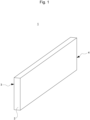
- Fig. 1:
- perspektivische Darstellung einer Profilanordnung 1;
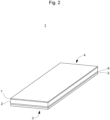
- Fig. 2:
- perspektivische Darstellung einer weiteren Profilanordnung 1;
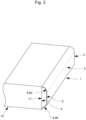
- Fig. 3:
- perspektivische Darstellung eines Gegenstandes, wie Möbelplatte 10 mit wenigstens einer weiteren Profilanordnung 1.
- In der
Figur 1 ist eine perspektivische Darstellung einer Profilanordnung 1 dargestellt. - Die Profilanordnung 1, insbesondere Kantenleiste, mit wenigstens einem Leistenkern 2 aus wenigstens einem halogenfreien, polymeren Material, wobei der Leistenkern 2 eine Vorderseite 3, sowie eine dieser gegenüberliegend angeordnete, Rückseite 4 aufweist, wobei
- ∘ das halogenfreie, polymere Material des Leistenkernes 2 wenigstens 15 bis 80 Gew.-%, bevorzugt 20 bis 75 Gew.-%, besonders bevorzugt 25 bis 70 Gew.-%, bezogen auf das Gesamtgewicht, cellulosische Fasern und/oder Zellstoff aufweist,
- o mit einer durchschnittlichen Partikellänge von etwa 5 bis 1.500 µm, bevorzugt 7 bis 1.000 µm, besonders bevorzugt 150 bis 500 µm nach ISO 13320:2020-01,
- Weiter ist die Profilanordnung 1 so ausgebildet, dass die cellulosischen Fasern und/oder der Zellstoff im polymeren Material des Leistenkerns 2 maximal 4 Gew.-%, bevorzugt maximal 4 Gew.-%, besonders bevorzugt maximal 3,5 Gew.-%, bezogen auf das Gesamtgewicht, an Lignin aufweisen. In diesem Ausführungsbeispiel ist die Profilanordnung 1 so ausgebildet, dass die cellulosischen Fasern und/oder der Zellstoff im polymeren Material des Leistenkerns 0 Gew.-%, bezogen auf das Gesamtgewicht, an Lignin aufweisen.
- In diesem Ausführungsbeispiel weist das halogenfreie, polymere Material des Leistenkerns 2 etwa 50 Gew.-%, bezogen auf das Gesamtgewicht, cellulosische Fasern auf, mit einer durchschnittlichen Partikelgröße von etwa 500 µm nach ISO 13320:2020-0 auf.
- Die Profilanordnung 1 ist weiter so ausgebildet, dass das halogenfreie, polymere Material des Leistenkernes 2 nach Lichtechtheit gemäß DIN EN ISO 4892-2:2021-11, Verfahren B, Zyklus B2, Blaumaßstab Stufe 6 gemäß EN ISO 105_B02:1999, 4.1.1. eine Farbechtheitszahl nach Graumaßstab von wenigstens 3 (drei), bevorzugt wenigstens 3 (drei) bis 4 (vier) gemäß DIN EN 20105-A02:1994 aufweist.
- Das halogenfreie, polymere Material des Leistenkernes 2 weist nach Lichtechtheit gemäß DIN EN ISO 4892-2:2021-11, Verfahren B, Zyklus B2, Blaumaßstab Stufe 6 gemäß EN ISO 105_B02:1999, 4.1.1. eine Farbechtheitszahl nach Graumaßstab von etwa 3,2 gemäß DIN EN 20105-A02:1994 auf.
- Die Profilanordnung 1 ist weiterhin so ausgebildet, dass das halogenfreie, polymere Material des Leistenkernes 2 CIELAB- Farbabstände von wenigstens 3 (drei), bevorzugt wenigstens 3,4 gemäß DIN EN 20105-A02:1994 aufweist. In diesem Ausführungsbeispiel ist die Profianordnung so ausgebildet, dass das halogenfreie, polymere Material des Leistenkernes 2 CIELAB- Farbabstände von etwa 3,2 gemäß DIN EN 20105-A02:1994 aufweist.
- Weiterhin sind die cellulosische Fasern im Leistenkern 2 der Profilanordnung 1 in räumlich gleichmäßiger Verteilung enthalten, um so eine gleichmäßige optisch ansprechende Oberfläche der Profilanordnung 1 zu realisieren.
- Die Profilanordnung 1 zeichnet sich auch dadurch aus, dass der Kohlenstoff- Anteil des Leistenkerns 2 wenigstens teilweise Isotopenanteile von 14 C/12 C von etwa 0,01 bis 100 %, vorzugsweise 20 bis 100 %, besonders bevorzugt von 40 bis 100 % gemäß ASTM 6866-22 Methode B aufweist. In diesem Ausführungsbeispiel weist der Kohlenstoff- Anteil des Leistenkerns 2 wenigstens teilweise Isotopenanteile von 14 C/12 C von etwa 50 % gemäß ASTM 6866-22 Methode B auf.
- Weiter vorteilhaft bei der Profilanordnung 1 ist, dass das halogenfreie, polymere Material des Leistenkerns 2 mit den cellulosischen Fasern und/oder dem Zellstoff nachwachsende Rohstoffe von etwa 0,01 bis 100 %, vorzugsweise 20 bis 100 %, besonders bevorzugt von 40 bis 100 % aufweist, nachgewiesen gemäß Massenbilanzierung bspw. über ISCC. Bspw. kann die Profilanordnung 1, das halogenfreie, polymere Material des Leistenkerns mit den cellulosischen Fasern und/oder dem Zellstoff, über Massenbilanzierung zertifizierte, nachwachsende Rohstoffe von etwa 55 % sowie etwa 45 % nichtnachwachsende, fossil basierende Rohstoffe aufweist.
- In der
Figur 2 ist eine perspektivische Darstellung einer weiteren Profilanordnung 1 dargestellt. - Die Profilanordnung 1, insbesondere Kantenleiste, mit wenigstens einem Leistenkern 2 aus wenigstens einem halogenfreien, polymeren Material, wobei der Leistenkern 2 eine Vorderseite 3, sowie eine dieser gegenüberliegend angeordnete, Rückseite 4 aufweist, wobei
- ∘ das halogenfreie, polymere Material des Leistenkernes 2 wenigstens 15 bis 80 Gew.-%, bevorzugt 20 bis Gew.-%, besonders bevorzugt 25 bis 70 Gew.-%, bezogen auf das Gesamtgewicht, cellulosische Fasern und/oder Zellstoff aufweist,
- ∘ mit einer durchschnittlichen Partikellänge von etwa 5 bis 1.500 µm, bevorzugt 7 bis 1.000 µm, besonders bevorzugt 150 bis 500 µm nach ISO 13320:2020-01,
- Weiter ist die Profilanordnung 1 so ausgebildet, dass die cellulosischen Fasern und/oder der Zellstoff im polymeren Material des Leistenkerns 2 maximal 4 Gew.-%, bevorzugt maximal 4 Gew.-%, besonders bevorzugt maximal 3,5 Gew.-%, bezogen auf das Gesamtgewicht, an Lignin aufweisen. In diesem Ausführungsbeispiel ist die Profilanordnung 1 so ausgebildet, dass die cellulosischen Fasern und/oder der Zellstoff im polymeren Material des Leistenkerns maximal 1 Gew.-%, bezogen auf das Gesamtgewicht, an Lignin aufweisen.
- In diesem Ausführungsbeispiel weist das halogenfreie, polymere Material des Leistenkerns 2 etwa 25 Gew.-%, bezogen auf das Gesamtgewicht, cellulosische Fasern auf, mit einer durchschnittlichen Partikelgröße von etwa 250 µm nach ISO 13320:2020-0.
- Die Profilanordnung 1 ist weiter so ausgebildet, dass das halogenfreie, polymere Material des Leistenkernes 2 eine Farbechtheitszahl von wenigstens 3, bevorzugt wenigstens 3 bis 4 gemäß DIN EN 20105-A02:1994 aufweist.
- Das halogenfreie, polymere Material des Leistenkernes 2 weist nach Lichtechtheit gemäß DIN EN ISO 4892-2:2021-11, Verfahren B, Zyklus B2, Blaumaßstab Stufe 6 gemäß EN ISO 105_B02:1999, 4.1.1. eine Farbechtheitszahl nach Graumaßstab von etwa 3,3 gemäß DIN EN 20105-A02:1994 auf.
- Die Profilanordnung 1 ist weiterhin so ausgebildet, dass das halogenfreie, polymere Material des Leistenkernes 2 CIELAB- Farbabstände von wenigstens 3 (drei), bevorzugt wenigstens 3,4 gemäß DIN EN 20105-A02:1994 aufweist. In diesem Ausführungsbeispiel ist die Profianordnung so ausgebildet, dass das halogenfreie, polymere Material des Leistenkernes 2 CIELAB- Farbabstände von etwa 3,2 gemäß DIN EN 20105-A02:1994 aufweist.
- Weiter vorteilhaft bei Profilanordnung 1 ist, dass I der Leistenkern 2 ein Isotopenanteil von 14 C/12 C gemäß ASTM 6866-22 Methode B von etwa 0,01 % bis etwa 100 %, vorzugsweise 20 % bis etwa 100 %, besonders bevorzugt 40 bis 100 % aufweist.
- In diesem Ausführungsbeispiel weist I der Leistenkern 2 ein Isotopenverhältnis von 14 C/12 C und/oder 13 C/12 C gemäß ASTM 6866-22 Methode B von etwa 50 % auf.
- Weiter vorteilhaft bei der Profilanordnung 1 ist, dass das halogenfreie, polymere Material des Leistenkerns 2 mit den cellulosischen Fasern und/oder dem Zellstoff nachwachsende Rohstoffe von etwa 0,01 bis 100 %, vorzugsweise 20 bis 100 %, besonders bevorzugt von 40 bis 100 % aufweist, nachgewiesen gemäß Massenbilanzierung bspw. über ISCC. Bspw. kann die Profilanordnung 1, das halogenfreie, polymere Material des Leistenkerns 2 mit den cellulosischen Fasern und/oder dem Zellstoff, über Massenbilanzierung zertifizierte, nachwachsende Rohstoffe von etwa 50 % sowie etwa 50 % nichtnachwachsende, fossilbasierende Rohstoffe aufweisen.
- Die Profilanordnung 1 zeichnet sich weiterhin dadurch aus, dass das halogenfreie, polymere Material des Leistenkerns 2 eine Zugfestigkeit von wenigstens 35 MPa, bevorzugt wenigstens 40 MPa nach DIN EN ISO 527:2019-12 aufweist. In diesem Ausführungsbeispiel weist das halogenfreie, polymere Material des Leistenkerns 2 eine Zugfestigkeit von etwa 38 MPa gemäß DIN EN ISO 527:2019-12 auf.
- Weiterhin vorteilhaft bei der Profilanordnung 1 ist, dass das halogenfreie, polymere Material des Leistenkerns 2 mit den cellulosischen Fasern und/oder dem Zellstoff auch nach mehrfachen Recyclingprozessen eine Zugfestigkeit von wenigstens 85 % nach DIN EN ISO 527:2019-12 des unrecycelten, halogenfreien, polymeren Materials aufweist.
- In diesem Ausführungsbeispiel weist das halogenfreie, polymere Material des Leistenkerns 2 mit den cellulosischen Fasern und/oder dem Zellstoff auch nach fünffachem Recyclingprozessen eine Zugfestigkeit von wenigstens 90 %, also etwa 34 MPa, nach DIN EN ISO 527:2019-12 des unrecycelten, halogenfreien, polymeren Materials auf.
- Die Profilanordnung 1 ist in diesem Ausführungsbeispiel so ausgebildet, dass die Vorderseite 3 des Leistenkerns 2 wenigstens abschnittsweise eine Beschichtung 6 aufweist. Weiterhin ist die Profilanordnung so ausgebildet, dass die Beschichtung 6 an der Vorderseite 3 des Leistenkerns 2 als koextrudierte oder postkoextrudierte Schicht oder als Farbauftrag oder als Druckschicht ausgebildet ist.
- Die Beschichtung 6 an der Vorderseite 3 des Leistenkerns 2 der Profilanordnung 1 ist im Wesentlichen einfarbig ausgebildet. In diesem Ausführungsbeispiel ist die Beschichtung 6 an der Vorderseite 3 des Leistenkerns 2 der Profilanordnung 1 als Farbauftrag in der Farbe Weiß ausgebildet.
- Die Beschichtung 6 an der Vorderseite 3 des Leistenkerns 2 weist eine Dicke von etwa 1 bis 350 µm, bevorzugt 2 bis 300 µm, besonders bevorzugt 5 bis 250 µm auf.
- In diesem Ausführungsbeispiel ist die Dicke der Beschichtung 6 etwa 25 µm.
- Die Profilanordnung 1 ist weiterhin so ausgebildet, dass an der Beschichtung 6 an der Vorderseite 3 des Leistenkerns 2 wenigstens eine Deckschicht 5 mit einer Dicke von etwa 2 bis 60 µm, vorzugsweise 5 bis 30 µm angeordnet ist.
- In diesem Ausführungsbeispiel ist die Dicke der Deckschicht 5 etwa 10 µm.
- Die Profilanordnung 1 ist weiter so ausgebildet, dass die Rückseite 4 des Leistenkerns 2 wenigstens abschnittsweise eine Funktionsschicht 7 aufweist.
- Die Funktionsschicht 7 der Profilanordnung 1 ist in diesem Ausführungsbeispiel als Haftvermittlerschicht ausgebildet. Das halogenfreie, polymere Material der Funktionsschicht 7 ist ausgewählt aus der Gruppe der Polyurethane (PUR).
- Die Profilanordnung 1 ist somit äußerst vielseitig anwendbar bzw. anbringbar an verschiedenste Gegenstände wie Möbelplatten, Möbelstücke, Spanplatten, Türen, Arbeitsplatten und dergleichen und kann neben der Funktion des Schutzes einer Schmalseite einer beispielsweise Möbelplatte auch optische bzw. haptische Aspekte realisieren, indem beispielsweise die Arbeitsplatten eine Profilanordnung 1 aufweisen, die einen optisch ansprechenden, haptisch fühlbaren Struktureffekt aufweist, der in dieser Form bisher noch nicht realisierbar war und der insbesondere bei einer an ihren Längsrandkanten bearbeiteten/abgefrästen Profilanordnung die Optik der gesamten Platte noch einmal wesentlich verbessert bzw. optimiert.
- In der
Figur 3 ist eine perspektivische Darstellung eines Gegenstandes, wie Möbelplatte 10 mit wenigstens einer weiteren Profilanordnung 1 dargestellt. - Die Profilanordnung 1, insbesondere Kantenleiste, mit wenigstens einem Leistenkern 2 aus wenigstens einem halogenfreien, polymeren Material, wobei der Leistenkern 2 eine Vorderseite 3, sowie eine dieser gegenüberliegend angeordnete, Rückseite 4 aufweist, wobei
- ∘ das halogenfreie, polymere Material des Leistenkernes 2 wenigstens 15 bis 80 Gew.-%, bevorzugt 20 bis 75 Gew.-%, besonders bevorzugt 25 bis 70 Gew.-%, bezogen auf das Gesamtgewicht, cellulosische Fasern und/oder Zellstoff aufweist,
- ∘ mit einer durchschnittlichen Partikelgröße von etwa 5 bis 1.500 µm, bevorzugt 7 bis 1.000 µm, besonders bevorzugt 150 bis 500 µm nach ISO 13320:2020-01,
- Weiter ist die Profilanordnung 1 so ausgebildet, dass die cellulosischen Fasern und/oder der Zellstoff im polymeren Material des Leistenkerns 2 maximal 4 Gew.-%, bevorzugt maximal 4 Gew.-%, besonders bevorzugt maximal 3,5 Gew.-%, bezogen auf das Gesamtgewicht, an Lignin aufweisen. In diesem Ausführungsbeispiel ist die Profilanordnung 1 so ausgebildet, dass die cellulosischen Fasern und/oder der Zellstoff im polymeren Material des Leistenkerns maximal 2,5 Gew.-%, bezogen auf das Gesamtgewicht, an Lignin aufweisen.
- In diesem Ausführungsbeispiel weist das halogenfreie, polymere Material des Leistenkerns 2 etwa 40 Gew.-%, bezogen auf das Gesamtgewicht, cellulosische Fasern auf, mit einer durchschnittlichen Partikelgröße von etwa 350 µm nach ISO 13320:2020-0.
- Die Profilanordnung 1 ist weiter so ausgebildet, dass das halogenfreie, polymere Material des Leistenkernes 2 nach Lichtechtheit gemäß DIN EN ISO 4892-2:2021-11, Verfahren B, Zyklus B2, Blaumaßstab Stufe 6 gemäß EN ISO 105_B02:1999, 4.1.1. eine Farbechtheitszahl nach Graumaßstab von wenigstens 3 (drei), bevorzugt wenigstens 3 (drei) bis 4 (vier) gemäß DIN EN 20105-A02:1994 aufweist.
- Das halogenfreie, polymere Material des Leistenkernes 2 weist nach Lichtechtheit gemäß DIN EN ISO 4892-2:2021-11, Verfahren B, Zyklus B2, Blaumaßstab Stufe 6 gemäß EN ISO 105_B02:1999, 4.1.1. eine Farbechtheitszahl nach Graumaßstab von etwa 3,4 gemäß DIN EN 20105-A02:1994 auf.
- Die Profilanordnung 1 ist weiterhin so ausgebildet, dass das halogenfreie, polymere Material des Leistenkernes 2 CIELAB- Farbabstände von wenigstens 3 (drei), bevorzugt wenigstens 3,4 gemäß DIN EN 20105-A02:1994 aufweist. In diesem Ausführungsbeispiel ist die Profianordnung so ausgebildet, dass das halogenfreie, polymere Material des Leistenkernes 2 CIELAB- Farbabstände von etwa 3,2 gemäß DIN EN 20105-A02:1994 aufweist.
- Ebenfalls vorteilhaft bei der Profilanordnung 1 ist, dass der Leistenkern 2 einen Isotopenanteil 14 C von 0,01 % bis 100 %, vorzugsweise 20 % bis 100 %, besonders bevorzugt 40 bis 100 % aufweist. In diesem Ausführungsbeispiel weist der Leistenkern 2 einen Isotopenanteil 14 C von etwa 50 % auf.
- Weiter vorteilhaft bei der Profilanordnung 1 ist, dass das halogenfreie, polymere Material des Leistenkerns 2 mit den cellulosischen Fasern und/oder dem Zellstoff nachwachsende Rohstoffe von etwa 0,01 bis 100 %, vorzugsweise 20 bis 100 %, besonders bevorzugt von 40 bis 100 % aufweist, nachgewiesen gemäß Massenbilanzierung bspw. über ISCC.
- Bspw. kann die Profilanordnung 1, das halogenfreie, polymere Material des Leistenkerns 2 mit den cellulosischen Fasern und/oder dem Zellstoff, über Massenbilanzierung zertifizierte, nachwachsende Rohstoffe von etwa 100 % aufweist.
- Ebenfalls vorteilhaft bei der Profilanordnung 1 ist, dass der Werkstoff des Leistenkerns 2 etwa 5 bis 50 Gew.-%, bevorzugt etwa 10 bis 45 Gew.-%, besonders bevorzugt 15 bis 35 Gew.-%, bezogen auf sein Gesamtgewicht, wenigstens einen Füllstoff aufweist, wobei der Füllstoff ausgewählt ist insbesondere aus Silikaten, Karbonaten, Phosphaten, Sulfaten, Sulfiden und dergleichen. Weiter vorteilhaft ist der Füllstoff ausgewählt aus der Gruppe der Schichtsilikate, sowie Carbonate bzw. Sulfate von Barium sowie Kalzium, und dergleichen. Die Füllstoffe können dabei vorteilhafterweise nachwachsende Rohstoffe von etwa 0,01 bis 100 %, vorzugsweise 20 bis 100 %, besonders bevorzugt von 40 bis 100 % aufweisen.
- In diesem Ausführungsbeispiel weist der Werkstoff des Leistenkerns 2 etwa 35 Gew.-%, bezogen auf sein Gesamtgewicht, einen Füllstoff auf ausgewählt aus der Gruppe der Carbonate von Kalzium, nämlich Kalziumcarbonat.
- Die Profilanordnung 1 ist in diesem Ausführungsbeispiel weiter so ausgebildet, dass die Vorderseite 3 des Leistenkerns 2 wenigstens abschnittsweise eine Beschichtung 6 aufweist. Weiterhin ist die Profilanordnung so ausgebildet, dass die Beschichtung 6 an der Vorderseite 3 des Leistenkerns 2 als koextrudierte oder postkoextrudierte Schicht oder als Farbauftrag oder als Druckschicht ausgebildet ist.
- Die Beschichtung 6 an der Vorderseite 3 des Leistenkerns 2 der Profilanordnung 1 ist im Wesentlichen einfarbig ausgebildet.
- In diesem Ausführungsbeispiel ist die Beschichtung 6 an der Vorderseite 3 des Leistenkerns 2 der Profilanordnung 1 als koextrudierte Schicht in der Farbe Braun ausgebildet. Die Beschichtung 6 an der Vorderseite 3 des Leistenkerns 2 weist eine Dicke von etwa 1 bis 350 µm, bevorzugt 2 bis 300 µm, besonders bevorzugt 5 bis 250 µm auf.
- In diesem Ausführungsbeispiel ist die Dicke der Beschichtung 6 etwa 15 µm.
- Der Gegenstand wie Möbelplatte 10 zeichnet sich dadurch aus, dass die Profilanordnung 1 an wenigstens einer Stirnseite 11 der Möbelplatte 10 angebracht, insbesondere fixiert, ist. In diesem Ausführungsbeispiel ist der Gegenstand wie Möbelplatte 10 so ausgebildet, dass die Profilanordnung 1 ohne eine zusätzliche Funktionsschicht, insbesondere Haftvermittlerschicht, mit der Stirnseite 11 der Möbelplatte 10 stoffschlüssig verbunden, insbesondere fixiert ist.
- Der Gegenstand wie Möbelplatte 10 ist vorteilhafterweise so ausgebildet, dass die, an der Stirnseite 11 der Möbelplatte 10 angebrachte, Profilanordnung 1 an wenigstens einer ihrer, in Profillängsrichtung L angeordneten, Stirnseite 8,9 wenigstens eine Fase 80 und/oder wenigstens einen Radius 90 aufweist.
Claims (13)
- Profilanordnung (1), insbesondere Kantenleiste, mit wenigstens einem Leistenkern (2) aus wenigstens einem halogenfreien, polymeren Material, wobei der Leistenkern (2) eine Vorderseite (3), sowie eine dieser gegenüberliegend angeordnete, Rückseite (4) aufweist, wobei∘ das halogenfreie, polymere Material des Leistenkernes (2) wenigstens 15 bis 80 Gew.-%, bevorzugt 20 bis 75 Gew.-%, besonders bevorzugt 25 bis 70 Gew.-%, bezogen auf das Gesamtgewicht, cellulosische Fasern und/oder Zellstoff aufweist,∘ mit einer durchschnittlichen Partikellänge von etwa 5 bis 1500 µm, bevorzugt 7 bis 1.000 µm, besonders bevorzugt 10 bis 500 µm nach ISO 13320:2020-01.∘ dass die cellulosischen Fasern und/oder der Zellstoff im halogenfreien, polymeren Material des Leistenkerns (2) deligniert sind/ ist.
- Profilanordnung (1) nach Anspruch 1, dadurch gekennzeichnet, dass die cellulosischen Fasern und/oder der Zellstoff im halogenfreien, polymeren Material des Leistenkerns (2) vorzugsweise maximal 5 Gew.-%, bevorzugt maximal 4 Gew.-%, besonders bevorzugt maximal 3,5 Gew.-%, bezogen auf das Gesamtgewicht, an Lignin aufweisen.
- Profilanordnung (1) nach einem der vorhergehenden Ansprüche, dadurch gekennzeichnet, dass das halogenfreie, polymere Material des Leistenkernes (2) nach Lichtechtheit gemäß DIN EN ISO 4892-2:2021-11, Verfahren B, Zyklus B2, Blaumaßstab Stufe 6 gemäß EN ISO 105_B02:1999, 4.1.1. eine Farbechtheitszahl nach Graumaßstab von wenigstens 3 (drei), bevorzugt wenigstens 3 (drei) bis 4 (vier) gemäß DIN EN 20105-A02:1994 aufweist.
- Profilanordnung (1) nach einem der vorhergehenden Ansprüche, dadurch gekennzeichnet, dass die cellulosischen Fasern und/oder der Zellstoff in räumlich gleichmäßiger, homogener und/ oder inhomogener Verteilung in dem halogenfreien, polymeren Material des Leistenkerns (2) enthalten sind.
- Profilanordnung (1) nach einem der vorhergehenden Ansprüche, dadurch gekennzeichnet, dass der Kohlenstoff- Anteil des Leistenkerns (2) wenigstens teilweise Isotopenanteile von 14 C/12 C von etwa 0,01 bis 100 %, vorzugsweise 20 bis 100 %, besonders bevorzugt von 40 bis 100 % gemäß ASTM 6866-22 Methode B aufweist.
- Profilanordnung (1) nach einem der vorhergehenden Ansprüche, dadurch gekennzeichnet, dass das halogenfreie, polymere Material des Leistenkerns (2) nachwachsende Rohstoffe von etwa 0,01 bis 100 %, vorzugsweise 20 bis 100 %, besonders bevorzugt von 40 bis 100 % aufweist, nachgewiesen gemäß Massenbilanzierung bspw. über ISCC.
- Profilanordnung (1) nach einem der vorhergehenden Ansprüche, dadurch gekennzeichnet, dass die Vorderseite (3) des Leistenkerns (2) wenigstens abschnittsweise eine Beschichtung (6) aufweist.
- Profilanordnung (1) nach einem der vorhergehenden Ansprüche, dadurch gekennzeichnet, dass die Beschichtung (6) an der Vorderseite (3) des Leistenkerns (2) eine Dicke von etwa 1 bis 350 µm, bevorzugt 2 bis 300 µm, besonders bevorzugt 5 bis 250 µm aufweist.
- Profilanordnung (1) nach einem der vorhergehenden Ansprüche, dadurch gekennzeichnet, dass die Beschichtung (6) an der Vorderseite (3) des Leistenkerns (2) als koextrudierte oder postkoextrudierte Schicht oder als Farbauftrag oder als Druckschicht ausgebildet ist.
- Profilanordnung (1) nach einem der vorhergehenden Ansprüche, dadurch gekennzeichnet, dass die Rückseite (4) des Leistenkerns (2) wenigstens abschnittsweise eine Funktionsschicht (7) aufweist.
- Profilanordnung (1) nach einem der vorhergehenden Ansprüche, dadurch gekennzeichnet, dass an der Vorderseite (3) des Leistenkörpers (2) und/oder an der Beschichtung (6) wenigstens teilweise eine Deckschicht (5) mit einer Dicke von etwa 2 bis 60 µm, vorzugsweise 5 bis 30 µm angeordnet ist.
- Gegenstand wie Möbelplatte, Möbelstück, Spanplatte, Tür, Arbeitsplatte und dergleichen mit wenigstens einer Profilanordnung (1) nach zumindest einem der vorangegangenen Ansprüche.
- Gegenstand wie Möbelplatte, Möbelstück, Spanplatte, Tür, Arbeitsplatte und dergleichen nach Anspruch 12, wobei die Profilanordnung (1) mit einer der Vorderseite (3) abgewandten Rückseite (4) an dem Gegenstand angeordnet ist.
Applications Claiming Priority (1)
| Application Number | Priority Date | Filing Date | Title |
|---|---|---|---|
| DE202023105050.6U DE202023105050U1 (de) | 2023-09-04 | 2023-09-04 | Profilanordnung |
Publications (1)
| Publication Number | Publication Date |
|---|---|
| EP4516502A1 true EP4516502A1 (de) | 2025-03-05 |
Family
ID=92593366
Family Applications (1)
| Application Number | Title | Priority Date | Filing Date |
|---|---|---|---|
| EP24196863.5A Pending EP4516502A1 (de) | 2023-09-04 | 2024-08-28 | Profilanordnung |
Country Status (2)
| Country | Link |
|---|---|
| EP (1) | EP4516502A1 (de) |
| DE (1) | DE202023105050U1 (de) |
Citations (5)
| Publication number | Priority date | Publication date | Assignee | Title |
|---|---|---|---|---|
| EP0236725A2 (de) * | 1986-03-01 | 1987-09-16 | REHAU AG + Co | Kantenband aus Kunststoff |
| DE4208991A1 (de) * | 1992-03-20 | 1993-09-23 | Alkor Gmbh | Kantenband aus kunststoff, verfahren zu dessen herstellung und verwendung |
| DE202009011403U1 (de) * | 2009-08-21 | 2010-12-30 | Rehau Ag + Co. | Profilleiste |
| DE102008038008B4 (de) | 2008-08-16 | 2013-10-24 | Rehau Ag + Co. | Kantenband und Möbelbauplatte |
| EP3285986B1 (de) * | 2015-04-23 | 2020-07-22 | SURTECO GmbH | Verfahren zur herstellung eines dekorativen profilkörpers, insbesondere einer kantenleiste |
-
2023
- 2023-09-04 DE DE202023105050.6U patent/DE202023105050U1/de active Active
-
2024
- 2024-08-28 EP EP24196863.5A patent/EP4516502A1/de active Pending
Patent Citations (6)
| Publication number | Priority date | Publication date | Assignee | Title |
|---|---|---|---|---|
| EP0236725A2 (de) * | 1986-03-01 | 1987-09-16 | REHAU AG + Co | Kantenband aus Kunststoff |
| DE4208991A1 (de) * | 1992-03-20 | 1993-09-23 | Alkor Gmbh | Kantenband aus kunststoff, verfahren zu dessen herstellung und verwendung |
| EP0562166B1 (de) * | 1992-03-20 | 1996-12-04 | Alkor Gmbh Kunststoffe | Kantenband aus Kunststoff, Verfahren zu dessen Herstellung und Verwendung |
| DE102008038008B4 (de) | 2008-08-16 | 2013-10-24 | Rehau Ag + Co. | Kantenband und Möbelbauplatte |
| DE202009011403U1 (de) * | 2009-08-21 | 2010-12-30 | Rehau Ag + Co. | Profilleiste |
| EP3285986B1 (de) * | 2015-04-23 | 2020-07-22 | SURTECO GmbH | Verfahren zur herstellung eines dekorativen profilkörpers, insbesondere einer kantenleiste |
Also Published As
| Publication number | Publication date |
|---|---|
| DE202023105050U1 (de) | 2024-12-09 |
Similar Documents
| Publication | Publication Date | Title |
|---|---|---|
| EP3433447B1 (de) | Wand- oder bodenbelagselement | |
| WO2007131693A1 (de) | Gebürstetes und beschichtetes profil mit einer holzähnlichen oberfläche | |
| DE102008038008B4 (de) | Kantenband und Möbelbauplatte | |
| DE202014103706U1 (de) | Kantenleiste | |
| EP2021414B1 (de) | Formkörper | |
| EP4516502A1 (de) | Profilanordnung | |
| DE102024124815A1 (de) | Plattenanordnung | |
| EP4504005A1 (de) | Profilanordnung | |
| DE202022106443U1 (de) | Profilanordnung | |
| DE102006040093B4 (de) | Fußbodenpaneele | |
| EP2144534A1 (de) | Profilleiste | |
| DE102008038009B4 (de) | Profilleiste und Möbelstück | |
| DE202016101048U1 (de) | Kantenband und Möbelplatte | |
| EP2744372A1 (de) | Profilleiste | |
| DE102023106423A1 (de) | Profilanordnung | |
| DE102024121980A1 (de) | Bauelement, insbesondere Plattenelement | |
| DE202023104643U1 (de) | Bauelement, insbesondere Plattenelement | |
| DE102022114461A1 (de) | Mehrschichtiger Verbundkörper | |
| DE102008038010A1 (de) | Profilleiste | |
| DE202022002946U1 (de) | Formteil mit erhöhter Stabilität durch Materialfasern mit einer definierten Auftragsmenge der Klebeschicht zur Herstellung von Möbelstücken | |
| WO2023174699A1 (de) | Mehrschichtiger verbundkörper | |
| EP4371756A1 (de) | Formteil mit erhöhter stabilität durch materialfasern mit einer definierten auftragsmenge der klebeschicht zur herstellung von möbelstücken und verfahren zu dessen herstellung und verwendung | |
| DE202017102859U1 (de) | Kantenleiste | |
| WO2006050899A1 (de) | Profilkörper | |
| DE102022114465A1 (de) | Mehrschichtiger Verbundkörper |
Legal Events
| Date | Code | Title | Description |
|---|---|---|---|
| PUAI | Public reference made under article 153(3) epc to a published international application that has entered the european phase |
Free format text: ORIGINAL CODE: 0009012 |
|
| STAA | Information on the status of an ep patent application or granted ep patent |
Free format text: STATUS: THE APPLICATION HAS BEEN PUBLISHED |
|
| AK | Designated contracting states |
Kind code of ref document: A1 Designated state(s): AL AT BE BG CH CY CZ DE DK EE ES FI FR GB GR HR HU IE IS IT LI LT LU LV MC ME MK MT NL NO PL PT RO RS SE SI SK SM TR |