EP4516477A1 - Verfahren zur herstellung einer vorgefertigten isolierten platte oder schwelle - Google Patents
Verfahren zur herstellung einer vorgefertigten isolierten platte oder schwelle Download PDFInfo
- Publication number
- EP4516477A1 EP4516477A1 EP24197763.6A EP24197763A EP4516477A1 EP 4516477 A1 EP4516477 A1 EP 4516477A1 EP 24197763 A EP24197763 A EP 24197763A EP 4516477 A1 EP4516477 A1 EP 4516477A1
- Authority
- EP
- European Patent Office
- Prior art keywords
- mould
- insulation board
- sill
- composite material
- panel
- Prior art date
- Legal status (The legal status is an assumption and is not a legal conclusion. Google has not performed a legal analysis and makes no representation as to the accuracy of the status listed.)
- Withdrawn
Links
Images


Classifications
-
- B—PERFORMING OPERATIONS; TRANSPORTING
- B29—WORKING OF PLASTICS; WORKING OF SUBSTANCES IN A PLASTIC STATE IN GENERAL
- B29C—SHAPING OR JOINING OF PLASTICS; SHAPING OF MATERIAL IN A PLASTIC STATE, NOT OTHERWISE PROVIDED FOR; AFTER-TREATMENT OF THE SHAPED PRODUCTS, e.g. REPAIRING
- B29C33/00—Moulds or cores; Details thereof or accessories therefor
- B29C33/12—Moulds or cores; Details thereof or accessories therefor with incorporated means for positioning inserts, e.g. labels
-
- B—PERFORMING OPERATIONS; TRANSPORTING
- B29—WORKING OF PLASTICS; WORKING OF SUBSTANCES IN A PLASTIC STATE IN GENERAL
- B29C—SHAPING OR JOINING OF PLASTICS; SHAPING OF MATERIAL IN A PLASTIC STATE, NOT OTHERWISE PROVIDED FOR; AFTER-TREATMENT OF THE SHAPED PRODUCTS, e.g. REPAIRING
- B29C33/00—Moulds or cores; Details thereof or accessories therefor
- B29C33/12—Moulds or cores; Details thereof or accessories therefor with incorporated means for positioning inserts, e.g. labels
- B29C33/123—Moulds or cores; Details thereof or accessories therefor with incorporated means for positioning inserts, e.g. labels for centering the inserts
-
- B—PERFORMING OPERATIONS; TRANSPORTING
- B29—WORKING OF PLASTICS; WORKING OF SUBSTANCES IN A PLASTIC STATE IN GENERAL
- B29C—SHAPING OR JOINING OF PLASTICS; SHAPING OF MATERIAL IN A PLASTIC STATE, NOT OTHERWISE PROVIDED FOR; AFTER-TREATMENT OF THE SHAPED PRODUCTS, e.g. REPAIRING
- B29C39/00—Shaping by casting, i.e. introducing the moulding material into a mould or between confining surfaces without significant moulding pressure; Apparatus therefor
- B29C39/02—Shaping by casting, i.e. introducing the moulding material into a mould or between confining surfaces without significant moulding pressure; Apparatus therefor for making articles of definite length, i.e. discrete articles
- B29C39/10—Shaping by casting, i.e. introducing the moulding material into a mould or between confining surfaces without significant moulding pressure; Apparatus therefor for making articles of definite length, i.e. discrete articles incorporating preformed parts or layers, e.g. casting around inserts or for coating articles
-
- B—PERFORMING OPERATIONS; TRANSPORTING
- B29—WORKING OF PLASTICS; WORKING OF SUBSTANCES IN A PLASTIC STATE IN GENERAL
- B29C—SHAPING OR JOINING OF PLASTICS; SHAPING OF MATERIAL IN A PLASTIC STATE, NOT OTHERWISE PROVIDED FOR; AFTER-TREATMENT OF THE SHAPED PRODUCTS, e.g. REPAIRING
- B29C70/00—Shaping composites, i.e. plastics material comprising reinforcements, fillers or preformed parts, e.g. inserts
- B29C70/68—Shaping composites, i.e. plastics material comprising reinforcements, fillers or preformed parts, e.g. inserts by incorporating or moulding on preformed parts, e.g. inserts or layers, e.g. foam blocks
- B29C70/70—Completely encapsulating inserts
-
- E—FIXED CONSTRUCTIONS
- E04—BUILDING
- E04C—STRUCTURAL ELEMENTS; BUILDING MATERIALS
- E04C2/00—Building elements of relatively thin form for the construction of parts of buildings, e.g. sheet materials, slabs, or panels
- E04C2/02—Building elements of relatively thin form for the construction of parts of buildings, e.g. sheet materials, slabs, or panels characterised by specified materials
- E04C2/26—Building elements of relatively thin form for the construction of parts of buildings, e.g. sheet materials, slabs, or panels characterised by specified materials composed of materials covered by two or more of groups E04C2/04, E04C2/08, E04C2/10 or of materials covered by one of these groups with a material not specified in one of the groups
- E04C2/284—Building elements of relatively thin form for the construction of parts of buildings, e.g. sheet materials, slabs, or panels characterised by specified materials composed of materials covered by two or more of groups E04C2/04, E04C2/08, E04C2/10 or of materials covered by one of these groups with a material not specified in one of the groups at least one of the materials being insulating
- E04C2/288—Building elements of relatively thin form for the construction of parts of buildings, e.g. sheet materials, slabs, or panels characterised by specified materials composed of materials covered by two or more of groups E04C2/04, E04C2/08, E04C2/10 or of materials covered by one of these groups with a material not specified in one of the groups at least one of the materials being insulating composed of insulating material and concrete, stone or stone-like material
-
- B—PERFORMING OPERATIONS; TRANSPORTING
- B29—WORKING OF PLASTICS; WORKING OF SUBSTANCES IN A PLASTIC STATE IN GENERAL
- B29K—INDEXING SCHEME ASSOCIATED WITH SUBCLASSES B29B, B29C OR B29D, RELATING TO MOULDING MATERIALS OR TO MATERIALS FOR MOULDS, REINFORCEMENTS, FILLERS OR PREFORMED PARTS, e.g. INSERTS
- B29K2067/00—Use of polyesters or derivatives thereof, as moulding material
-
- B—PERFORMING OPERATIONS; TRANSPORTING
- B29—WORKING OF PLASTICS; WORKING OF SUBSTANCES IN A PLASTIC STATE IN GENERAL
- B29K—INDEXING SCHEME ASSOCIATED WITH SUBCLASSES B29B, B29C OR B29D, RELATING TO MOULDING MATERIALS OR TO MATERIALS FOR MOULDS, REINFORCEMENTS, FILLERS OR PREFORMED PARTS, e.g. INSERTS
- B29K2105/00—Condition, form or state of moulded material or of the material to be shaped
- B29K2105/06—Condition, form or state of moulded material or of the material to be shaped containing reinforcements, fillers or inserts
-
- B—PERFORMING OPERATIONS; TRANSPORTING
- B29—WORKING OF PLASTICS; WORKING OF SUBSTANCES IN A PLASTIC STATE IN GENERAL
- B29L—INDEXING SCHEME ASSOCIATED WITH SUBCLASS B29C, RELATING TO PARTICULAR ARTICLES
- B29L2007/00—Flat articles, e.g. films or sheets
- B29L2007/002—Panels; Plates; Sheets
-
- B—PERFORMING OPERATIONS; TRANSPORTING
- B29—WORKING OF PLASTICS; WORKING OF SUBSTANCES IN A PLASTIC STATE IN GENERAL
- B29L—INDEXING SCHEME ASSOCIATED WITH SUBCLASS B29C, RELATING TO PARTICULAR ARTICLES
- B29L2031/00—Other particular articles
- B29L2031/10—Building elements, e.g. bricks, blocks, tiles, panels, posts, beams
-
- B—PERFORMING OPERATIONS; TRANSPORTING
- B29—WORKING OF PLASTICS; WORKING OF SUBSTANCES IN A PLASTIC STATE IN GENERAL
- B29L—INDEXING SCHEME ASSOCIATED WITH SUBCLASS B29C, RELATING TO PARTICULAR ARTICLES
- B29L2031/00—Other particular articles
- B29L2031/778—Windows
-
- E—FIXED CONSTRUCTIONS
- E06—DOORS, WINDOWS, SHUTTERS, OR ROLLER BLINDS IN GENERAL; LADDERS
- E06B—FIXED OR MOVABLE CLOSURES FOR OPENINGS IN BUILDINGS, VEHICLES, FENCES OR LIKE ENCLOSURES IN GENERAL, e.g. DOORS, WINDOWS, BLINDS, GATES
- E06B1/00—Border constructions of openings in walls, floors, or ceilings; Frames to be rigidly mounted in such openings
- E06B1/70—Sills; Thresholds
- E06B2001/707—Thresholds with special provision for insulation
Definitions
- the present invention relates to a method of manufacturing a prefabricated insulated panel or sill.
- sills are used for various purposes in the construction sector.
- sills may be constructed using concrete and/or stone.
- the use of these materials presents a range of issues. Stone and concrete sills are bulky, heavy, break easily, are expensive, and have a relatively long lead time for production. Furthermore, the weight of these panels requires the use of machinery to move them and results in higher transportation costs.
- EPS expanded polystyrene
- K-value thermal conductivity
- EPS for example, could have a thermal conductivity as low as 0.035 W/m K.
- An oversill provides external insulation over a window sill.
- resin is required to protect the oversill from weathering and corrosion. Acid in the resin tends to attack the expanded polystyrene (EPS) over time, resulting in long term degradation of the EPS and a reduction in the thermal insulation it provides.
- EPS expanded polystyrene
- a method of manufacturing a prefabricated insulated panel or sill comprising the steps of:
- the method is significantly easier than methods currently known and cheaper to perform, can be done without sophisticated equipment reducing capital costs and allowing the method to be performed on site, reducing transportation costs.
- the method also allows for considerably lower lead times for manufacturing the prefabricated sills and/or panels.
- a significant advantage of using an insulation board is that it is pre-formed.
- the U-value is known, and products, manufactured have near identical thermal conductivity.
- a panel or sill manufactured from the method above may have a U-value of approximately 1.3 W/m 2 K.
- the mixture of marble and/or silica sand and insulation provides a cooling effect in warmer temperatures.
- the strength of the panel or sill may be comparable to concrete.
- the panel may be significantly lighter than concrete panels or sills, for example, 70% lighter. This allows the panel or sill to be moved without machinery and further reduces transportation costs. The panel or sill may be safely moveable by a single person.
- Encasing the board in the outer shell ensures there is no exposed insulation.
- the mould may comprise stainless steel.
- the mould may be made from stainless steel.
- the stainless steel provides rigidity and uniformity between the prefabricated sills and/or panels produced.
- the mould may be sized for fabricating panels or sills at set lengths.
- the mould may have a length of between 3 metres to 4 metres.
- the mould may comprise at least one divider for dividing the mould into a plurality of sections.
- the divider may allow the size of the mould may be adjustable to control the size of the sills or panels.
- the divider may be used to manufacture multiple panels and/or sills at once.
- the at least one divider may have bevelled edges.
- the mould may comprise one or more attachment means disposed along a length of the mould for attaching the at least one divider.
- the size of the mould may be adjusted to one or more discrete lengths.
- the at least one divider may comprise rubber.
- a release coating may be applied to the mould before pouring the composite material inside the mould.
- the release coating may facilitate the removal of the panel or sill from the mould.
- the retaining means may include at least one pin penetrating the mould and the insulation board.
- the at least one pin may be removed from the mould before the composite material has set.
- the pouring may be performed by an automated pouring machine.
- the automated pouring machine may pull in the resin, silica sand and/or crushed marble via a hopper.
- the mould may be vibrated to level the resin.
- the composite material may be at a temperature of at least 15°C. A temperature of at least 15°C facilitates the setting of the composite material.
- the composite material may be cured for at least 72 hours.
- the prefabricated panel or sill may be removed from the mould at least 30 minutes after pouring the composite material inside of the mould.
- the outer shell may have a thickness of between 5 mm and 7 mm.
- the insulation board may comprise expanded plastics foam.
- the expanded plastics foam may be a biofoam.
- the insulation board may include a protective cover to protect the insulation board from the resin.
- the protective cover may be a plastic film.
- the protective cover may be coated in the protective cover.
- the protective cover or plastic film may include a layer of PVA glue.
- the protective cover or plastic film may include a layer of an epoxy primer.
- the insulation board may be wrapped in the protective cover.
- the insulation board may be wrapped in a plastic film.
- the protective cover may be clingfilm.
- the insulation board may be sealed in clingfilm prior to being inserted into the mould.
- the plastics resin may include a polyester resin.
- the resin may have anti-fungal properties.
- the plastics resin may include a catalyst for facilitating setting of the resin.
- the catalyst may be a methyl ethyl ketone peroxide.
- the plastics resin may include a pigment.
- the pigment allows the panel or sill to be manufactured in different colours.
- the composite material includes fibres.
- the fibres may include polymerised para-aramid fibre (e.g. Kevlar (RTM)).
- the panel or sill may be a bullet-proof security panel.
- the method may provide a protective bullet-proof panel.
- the bullet-proof panel may be lightweight and suitable for use in the field.
- a prefabricated insulated panel or sill comprising an insulated board fully encased in a composite material made by the method described above.
- a method of manufacturing a prefabricated panel or sill is generally indicated at 100.
- the method 100 allows for the manufacture of panels are sills having an insulation board core 12 encased in an outer shell 14 made from a composite material.
- the prefabricated sills or panels are formed in a mould 10.
- the mould 10 is described in more detail below with respect to Figures 2 to 4 .
- the mould 10 is prepared by applying an inside surface of the mould 10 with a release coating.
- Fibres are mixed with a resin.
- the fibres are polymerised para-aramid fibre.
- the resin includes a polyester resin.
- the resin and fibre, pigment and one or both of silica sand and marble powder are pulled into an automated pouring machine via a hopper.
- the resin/fibre and pigment are introduced separately using tubes having a diameter of 3 mm to 10 mm.
- the resin/fibre mix, pigment and one or both of silica sand and marble powder are mixed together to form a composite material.
- a catalyst is added.
- the catalyst includes methyl ethyl ketone peroxide.
- One or more dividers 22 are inserted into the mould 10.
- the divider 22 extends from a front of the mould 10 to a back of the mould 10.
- the divider 22 is fixed in place by divider pins extending through the front and back of the mould 10 and into the divider 22.
- the divider 22 separates the mould 10 into a plurality of sections 26.
- the divider 22 can be used to control the length of the sill or panel produced.
- the insulation board 12 is inserted into the mould 10.
- the insulation board 12 is made from a biofoam.
- the insulation board 12 is wrapped in clingfilm to protect the insulation board 12 from the resin.
- the insulation board 12 may be covered, wrapped, and/or coated in the protective cover.
- the insulation board may be coated in a film of PVA glue or epoxy primer.
- the insulation board 12 is retained in the mould 10 using a retaining means 16.
- the retaining means 16 is a plurality of pins 16.
- a first set of pins is provided through a first side of the mould 10. The first set of pins penetrates a first side of the insulation board 12.
- a second set of pins is provided through a second side of the mould 10. The second set of pins penetrates a second side of the insulation board 12.
- the retaining means 16 fixes the insulation board 12 in a position substantially central in the mould 10.
- a resulting cavity surrounding the insulation board 12 is filled with the composite material to form the outer shell 14.
- the mould 10 is transferred to a vibrating table to level out the composite material.
- the composite covers the insulation board 12.
- the insulation board 12 is fully encased in the outer shell 14.
- the outer shell 14 is left to cure for approximately 30 minutes and then the retaining means is removed.
- the holes left by the removal of the retaining means may be filled in with additional composite material.
- the outer shell 14 is then left to cure for approximately 1 to 2 hours at which point the sill or panel is demoulded.
- the panel or sill is left to cure for a further period of at least 3 days.
- the prefabricated panel or sill is a sill.
- the mould 10 is made from stainless steel.
- the mould 10 is manufactured from stainless steel which provides improved rigidity compared to, for example, silicone moulds which have been found to be too flexible and lead to bulging in a centre of the panel or sill. In other words, the rigidity of the stainless steel mould 10 produces panels or sills with uniform, straight and/or parallel edges.
- the sides of the mould 10 are slightly splayed, i.e., there is a small draft angle to allow the panel or sill to be removed from the mould 10.
- the pins are provided on either side of the mould. In this embodiment, the pins are provided in pairs. The pins are provided through the mould 10 and penetrate the insulation board 12, as described above. The pins hold the insulation board 12 in the centre of the mould 10.
- FIG. 3 a side view of a second embodiment of the mould 10 is shown.
- a first pin of the pair of pins is provided above a second pin 16.
- the mould 10 includes a lip 20 at a top of the mould 10.
- the mould 10 has a plurality of feet 18 at the bottom of the mould 10.
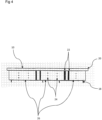
- FIG. 4 a front view of the mould 10 of Figure 1 is shown.
- the mould 10 is approximately 3 metres long.
- Four dividers 22 are inserted into the mould 10.
- the dividers 22 separate the mould 10 into a plurality of sections as described above.
- the mould 10 includes apertures 24 through the front and back of the mould 10 for receiving the divider pins.
- the dividers 22 are provided in pairs. Any number of dividers 22 may be provided depending on the length of the desired panels or sills and/or the length of the mould 10.
- a significant advantage of the method 100 and mould 10 described above is that prefabricated insulated panels or sills can be manufactured quickly and easily on site. Implementing the method 100 can reduce lead times for manufacturing the prefabricated sills and/or panels.
- the size of the prefabricated panels or sills can be controlled using the dividers 22 and are significantly lighter than concrete and stone alternatives.
- the insulation board 12 is pre-formed and manufactured have near identical thermal conductivity.
Landscapes
- Engineering & Computer Science (AREA)
- Mechanical Engineering (AREA)
- Architecture (AREA)
- Civil Engineering (AREA)
- Structural Engineering (AREA)
- Chemical & Material Sciences (AREA)
- Composite Materials (AREA)
- Casting Or Compression Moulding Of Plastics Or The Like (AREA)
Applications Claiming Priority (1)
| Application Number | Priority Date | Filing Date | Title |
|---|---|---|---|
| GB2313179.0A GB2633052A (en) | 2023-08-30 | 2023-08-30 | Method of manufacturing a prefabricated insulated panel or sill |
Publications (1)
| Publication Number | Publication Date |
|---|---|
| EP4516477A1 true EP4516477A1 (de) | 2025-03-05 |
Family
ID=88237161
Family Applications (1)
| Application Number | Title | Priority Date | Filing Date |
|---|---|---|---|
| EP24197763.6A Withdrawn EP4516477A1 (de) | 2023-08-30 | 2024-08-30 | Verfahren zur herstellung einer vorgefertigten isolierten platte oder schwelle |
Country Status (2)
| Country | Link |
|---|---|
| EP (1) | EP4516477A1 (de) |
| GB (1) | GB2633052A (de) |
Citations (8)
| Publication number | Priority date | Publication date | Assignee | Title |
|---|---|---|---|---|
| US3761554A (en) * | 1959-04-24 | 1973-09-25 | S Barnette | Method of making plastic articles with a substantially enveloped core |
| US4712765A (en) * | 1984-12-04 | 1987-12-15 | Stella Werke Ag | Apparatus for producing coated panels |
| JPH08187736A (ja) * | 1995-01-06 | 1996-07-23 | Aica Kogyo Co Ltd | 熱硬化性樹脂化粧パネルならびにその製造方法 |
| EP2335526A1 (de) * | 2009-12-10 | 2011-06-22 | Compositi & Co. s.r.l. | Verfahren zur Beschichtung von Holztafeln oder Ähnlichem und für ein solches Verfahren verwendete Form |
| CN102454248A (zh) * | 2010-10-28 | 2012-05-16 | 中国建筑材料科学研究总院 | 钢筋网纤维混凝土复合外墙板及其制备方法 |
| WO2012089591A1 (en) * | 2010-12-31 | 2012-07-05 | MARTELLONI, Sara | Molding process of a resin panel with drowned insert |
| CN205009463U (zh) * | 2015-09-07 | 2016-02-03 | 山东莱州金声隆节能建材科技有限公司 | 制造复合保温装饰板的模具 |
| CN113027037A (zh) * | 2021-03-11 | 2021-06-25 | 富思特新材料科技发展股份有限公司 | 一种外墙板、其加工方法及建筑物 |
Family Cites Families (3)
| Publication number | Priority date | Publication date | Assignee | Title |
|---|---|---|---|---|
| JPH0669689B2 (ja) * | 1984-12-06 | 1994-09-07 | 三菱自動車工業株式会社 | 樹脂成形方法 |
| FR2999971B1 (fr) * | 2012-12-21 | 2015-10-09 | Saint Gobain Weber | Dispositif de moulage, procede de fabrication et produit d'isolation thermique obtenu |
| KR20200063815A (ko) * | 2018-11-28 | 2020-06-05 | 주식회사 피알테크 | 복합단열패널의 제조방법 |
-
2023
- 2023-08-30 GB GB2313179.0A patent/GB2633052A/en active Pending
-
2024
- 2024-08-30 EP EP24197763.6A patent/EP4516477A1/de not_active Withdrawn
Patent Citations (8)
| Publication number | Priority date | Publication date | Assignee | Title |
|---|---|---|---|---|
| US3761554A (en) * | 1959-04-24 | 1973-09-25 | S Barnette | Method of making plastic articles with a substantially enveloped core |
| US4712765A (en) * | 1984-12-04 | 1987-12-15 | Stella Werke Ag | Apparatus for producing coated panels |
| JPH08187736A (ja) * | 1995-01-06 | 1996-07-23 | Aica Kogyo Co Ltd | 熱硬化性樹脂化粧パネルならびにその製造方法 |
| EP2335526A1 (de) * | 2009-12-10 | 2011-06-22 | Compositi & Co. s.r.l. | Verfahren zur Beschichtung von Holztafeln oder Ähnlichem und für ein solches Verfahren verwendete Form |
| CN102454248A (zh) * | 2010-10-28 | 2012-05-16 | 中国建筑材料科学研究总院 | 钢筋网纤维混凝土复合外墙板及其制备方法 |
| WO2012089591A1 (en) * | 2010-12-31 | 2012-07-05 | MARTELLONI, Sara | Molding process of a resin panel with drowned insert |
| CN205009463U (zh) * | 2015-09-07 | 2016-02-03 | 山东莱州金声隆节能建材科技有限公司 | 制造复合保温装饰板的模具 |
| CN113027037A (zh) * | 2021-03-11 | 2021-06-25 | 富思特新材料科技发展股份有限公司 | 一种外墙板、其加工方法及建筑物 |
Also Published As
| Publication number | Publication date |
|---|---|
| GB202313179D0 (en) | 2023-10-11 |
| GB2633052A (en) | 2025-03-05 |
Similar Documents
| Publication | Publication Date | Title |
|---|---|---|
| US4232494A (en) | Composite construction panel | |
| US8377248B2 (en) | Method and system for forming a complex monolithic thermoset part | |
| WO2010020041A1 (en) | Insulated panel | |
| JPH06504743A (ja) | 引き抜き成形パネルを製造する方法 | |
| WO2012079315A1 (zh) | 轻质泡沫夹芯复合材料绝缘棒及其制备方法 | |
| EP4516477A1 (de) | Verfahren zur herstellung einer vorgefertigten isolierten platte oder schwelle | |
| US6245274B1 (en) | Method for making advanced grid-stiffened structures | |
| CN107143067B (zh) | 一种装配式组合钢板仓混凝土结构保温墙体组件 | |
| CN113738137A (zh) | 一种混凝土冬季施工防冻方法 | |
| GB2522681A (en) | Prefabricated building element | |
| US4087502A (en) | Method of making a collapsible foam mandrel | |
| CN206752765U (zh) | 一种单腔保温墙体组件 | |
| AU4769299A (en) | Method for producing closed composite structures and moulding apparatus to be used by the method | |
| KR20180073354A (ko) | 내화, 부착 성능을 향상시킨 유리섬유강화플라스틱 매립형 콘크리트 구조물 보강방법 | |
| US20240286312A1 (en) | Airforming constructive system | |
| CN206752744U (zh) | 一种双腔保温墙体组件 | |
| RU2720312C1 (ru) | Способ изготовления композитной формообразующей оснастки для формования изделий из полимерных композиционных материалов | |
| Molodin et al. | Work head for 3d printing of insulated walls from one-stage polystyrene concrete | |
| RU2382157C1 (ru) | Способ возведения термоизолированного сооружения из полимерных материалов | |
| ES2685393A1 (es) | Procedimiento de fabricación de un panel aislante térmico y panel así obtenido | |
| WO2003064132A1 (en) | Apparatus and process for forming plastic laminated panels | |
| AT352963B (de) | Plattenfoermiges bauelement sowie vorrichtung und verfahren zu dessen herstellung | |
| KR20170037330A (ko) | 전통 한옥의 프리캐스트 콘크리트 서까래 및 그 성형방법과 성형틀 성형장치 | |
| EP1557503B1 (de) | Kunststoffschaumplatten für Gebäudeisolierung | |
| JP2007190758A (ja) | レジン被覆コンクリート体及びその製造方法 |
Legal Events
| Date | Code | Title | Description |
|---|---|---|---|
| PUAI | Public reference made under article 153(3) epc to a published international application that has entered the european phase |
Free format text: ORIGINAL CODE: 0009012 |
|
| STAA | Information on the status of an ep patent application or granted ep patent |
Free format text: STATUS: THE APPLICATION HAS BEEN PUBLISHED |
|
| AK | Designated contracting states |
Kind code of ref document: A1 Designated state(s): AL AT BE BG CH CY CZ DE DK EE ES FI FR GB GR HR HU IE IS IT LI LT LU LV MC ME MK MT NL NO PL PT RO RS SE SI SK SM TR |
|
| STAA | Information on the status of an ep patent application or granted ep patent |
Free format text: STATUS: THE APPLICATION IS DEEMED TO BE WITHDRAWN |
|
| 18D | Application deemed to be withdrawn |
Effective date: 20250906 |