EP4516398A1 - Eierschalenkatalysator, herstellungsverfahren dafür und verwendung davon in der propylenhydroformylierungsreaktion - Google Patents
Eierschalenkatalysator, herstellungsverfahren dafür und verwendung davon in der propylenhydroformylierungsreaktion Download PDFInfo
- Publication number
- EP4516398A1 EP4516398A1 EP23795017.5A EP23795017A EP4516398A1 EP 4516398 A1 EP4516398 A1 EP 4516398A1 EP 23795017 A EP23795017 A EP 23795017A EP 4516398 A1 EP4516398 A1 EP 4516398A1
- Authority
- EP
- European Patent Office
- Prior art keywords
- type catalyst
- eggshell
- eggshell type
- resin pellet
- ligands
- Prior art date
- Legal status (The legal status is an assumption and is not a legal conclusion. Google has not performed a legal analysis and makes no representation as to the accuracy of the status listed.)
- Pending
Links
Images
Classifications
-
- B—PERFORMING OPERATIONS; TRANSPORTING
- B01—PHYSICAL OR CHEMICAL PROCESSES OR APPARATUS IN GENERAL
- B01J—CHEMICAL OR PHYSICAL PROCESSES, e.g. CATALYSIS OR COLLOID CHEMISTRY; THEIR RELEVANT APPARATUS
- B01J31/00—Catalysts comprising hydrides, coordination complexes or organic compounds
- B01J31/02—Catalysts comprising hydrides, coordination complexes or organic compounds containing organic compounds or metal hydrides
- B01J31/06—Catalysts comprising hydrides, coordination complexes or organic compounds containing organic compounds or metal hydrides containing polymers
-
- C—CHEMISTRY; METALLURGY
- C07—ORGANIC CHEMISTRY
- C07C—ACYCLIC OR CARBOCYCLIC COMPOUNDS
- C07C45/00—Preparation of compounds having >C = O groups bound only to carbon or hydrogen atoms; Preparation of chelates of such compounds
- C07C45/49—Preparation of compounds having >C = O groups bound only to carbon or hydrogen atoms; Preparation of chelates of such compounds by reaction with carbon monoxide
- C07C45/50—Preparation of compounds having >C = O groups bound only to carbon or hydrogen atoms; Preparation of chelates of such compounds by reaction with carbon monoxide by oxo-reactions
-
- B—PERFORMING OPERATIONS; TRANSPORTING
- B01—PHYSICAL OR CHEMICAL PROCESSES OR APPARATUS IN GENERAL
- B01J—CHEMICAL OR PHYSICAL PROCESSES, e.g. CATALYSIS OR COLLOID CHEMISTRY; THEIR RELEVANT APPARATUS
- B01J31/00—Catalysts comprising hydrides, coordination complexes or organic compounds
- B01J31/16—Catalysts comprising hydrides, coordination complexes or organic compounds containing coordination complexes
- B01J31/1691—Coordination polymers, e.g. metal-organic frameworks [MOF]
-
- B—PERFORMING OPERATIONS; TRANSPORTING
- B01—PHYSICAL OR CHEMICAL PROCESSES OR APPARATUS IN GENERAL
- B01J—CHEMICAL OR PHYSICAL PROCESSES, e.g. CATALYSIS OR COLLOID CHEMISTRY; THEIR RELEVANT APPARATUS
- B01J31/00—Catalysts comprising hydrides, coordination complexes or organic compounds
- B01J31/16—Catalysts comprising hydrides, coordination complexes or organic compounds containing coordination complexes
- B01J31/18—Catalysts comprising hydrides, coordination complexes or organic compounds containing coordination complexes containing nitrogen, phosphorus, arsenic or antimony as complexing atoms, e.g. in pyridine ligands, or in resonance therewith, e.g. in isocyanide ligands C=N-R or as complexed central atoms
- B01J31/1845—Catalysts comprising hydrides, coordination complexes or organic compounds containing coordination complexes containing nitrogen, phosphorus, arsenic or antimony as complexing atoms, e.g. in pyridine ligands, or in resonance therewith, e.g. in isocyanide ligands C=N-R or as complexed central atoms the ligands containing phosphorus
- B01J31/185—Phosphites ((RO)3P), their isomeric phosphonates (R(RO)2P=O) and RO-substitution derivatives thereof
-
- B—PERFORMING OPERATIONS; TRANSPORTING
- B01—PHYSICAL OR CHEMICAL PROCESSES OR APPARATUS IN GENERAL
- B01J—CHEMICAL OR PHYSICAL PROCESSES, e.g. CATALYSIS OR COLLOID CHEMISTRY; THEIR RELEVANT APPARATUS
- B01J31/00—Catalysts comprising hydrides, coordination complexes or organic compounds
- B01J31/16—Catalysts comprising hydrides, coordination complexes or organic compounds containing coordination complexes
- B01J31/18—Catalysts comprising hydrides, coordination complexes or organic compounds containing coordination complexes containing nitrogen, phosphorus, arsenic or antimony as complexing atoms, e.g. in pyridine ligands, or in resonance therewith, e.g. in isocyanide ligands C=N-R or as complexed central atoms
- B01J31/1845—Catalysts comprising hydrides, coordination complexes or organic compounds containing coordination complexes containing nitrogen, phosphorus, arsenic or antimony as complexing atoms, e.g. in pyridine ligands, or in resonance therewith, e.g. in isocyanide ligands C=N-R or as complexed central atoms the ligands containing phosphorus
- B01J31/1865—Phosphonites (RP(OR)2), their isomeric phosphinates (R2(RO)P=O) and RO-substitution derivatives thereof
-
- B—PERFORMING OPERATIONS; TRANSPORTING
- B01—PHYSICAL OR CHEMICAL PROCESSES OR APPARATUS IN GENERAL
- B01J—CHEMICAL OR PHYSICAL PROCESSES, e.g. CATALYSIS OR COLLOID CHEMISTRY; THEIR RELEVANT APPARATUS
- B01J31/00—Catalysts comprising hydrides, coordination complexes or organic compounds
- B01J31/16—Catalysts comprising hydrides, coordination complexes or organic compounds containing coordination complexes
- B01J31/18—Catalysts comprising hydrides, coordination complexes or organic compounds containing coordination complexes containing nitrogen, phosphorus, arsenic or antimony as complexing atoms, e.g. in pyridine ligands, or in resonance therewith, e.g. in isocyanide ligands C=N-R or as complexed central atoms
- B01J31/1845—Catalysts comprising hydrides, coordination complexes or organic compounds containing coordination complexes containing nitrogen, phosphorus, arsenic or antimony as complexing atoms, e.g. in pyridine ligands, or in resonance therewith, e.g. in isocyanide ligands C=N-R or as complexed central atoms the ligands containing phosphorus
- B01J31/1875—Phosphinites (R2P(OR), their isomeric phosphine oxides (R3P=O) and RO-substitution derivatives thereof)
-
- B—PERFORMING OPERATIONS; TRANSPORTING
- B01—PHYSICAL OR CHEMICAL PROCESSES OR APPARATUS IN GENERAL
- B01J—CHEMICAL OR PHYSICAL PROCESSES, e.g. CATALYSIS OR COLLOID CHEMISTRY; THEIR RELEVANT APPARATUS
- B01J31/00—Catalysts comprising hydrides, coordination complexes or organic compounds
- B01J31/16—Catalysts comprising hydrides, coordination complexes or organic compounds containing coordination complexes
- B01J31/18—Catalysts comprising hydrides, coordination complexes or organic compounds containing coordination complexes containing nitrogen, phosphorus, arsenic or antimony as complexing atoms, e.g. in pyridine ligands, or in resonance therewith, e.g. in isocyanide ligands C=N-R or as complexed central atoms
- B01J31/1845—Catalysts comprising hydrides, coordination complexes or organic compounds containing coordination complexes containing nitrogen, phosphorus, arsenic or antimony as complexing atoms, e.g. in pyridine ligands, or in resonance therewith, e.g. in isocyanide ligands C=N-R or as complexed central atoms the ligands containing phosphorus
- B01J31/1875—Phosphinites (R2P(OR), their isomeric phosphine oxides (R3P=O) and RO-substitution derivatives thereof)
- B01J31/188—Amide derivatives thereof
-
- B—PERFORMING OPERATIONS; TRANSPORTING
- B01—PHYSICAL OR CHEMICAL PROCESSES OR APPARATUS IN GENERAL
- B01J—CHEMICAL OR PHYSICAL PROCESSES, e.g. CATALYSIS OR COLLOID CHEMISTRY; THEIR RELEVANT APPARATUS
- B01J31/00—Catalysts comprising hydrides, coordination complexes or organic compounds
- B01J31/16—Catalysts comprising hydrides, coordination complexes or organic compounds containing coordination complexes
- B01J31/24—Phosphines, i.e. phosphorus bonded to only carbon atoms, or to both carbon and hydrogen atoms, including e.g. sp2-hybridised phosphorus compounds such as phosphabenzene, phosphole or anionic phospholide ligands
- B01J31/2404—Cyclic ligands, including e.g. non-condensed polycyclic ligands, the phosphine-P atom being a ring member or a substituent on the ring
-
- B—PERFORMING OPERATIONS; TRANSPORTING
- B01—PHYSICAL OR CHEMICAL PROCESSES OR APPARATUS IN GENERAL
- B01J—CHEMICAL OR PHYSICAL PROCESSES, e.g. CATALYSIS OR COLLOID CHEMISTRY; THEIR RELEVANT APPARATUS
- B01J31/00—Catalysts comprising hydrides, coordination complexes or organic compounds
- B01J31/16—Catalysts comprising hydrides, coordination complexes or organic compounds containing coordination complexes
- B01J31/24—Phosphines, i.e. phosphorus bonded to only carbon atoms, or to both carbon and hydrogen atoms, including e.g. sp2-hybridised phosphorus compounds such as phosphabenzene, phosphole or anionic phospholide ligands
- B01J31/2404—Cyclic ligands, including e.g. non-condensed polycyclic ligands, the phosphine-P atom being a ring member or a substituent on the ring
- B01J31/2409—Cyclic ligands, including e.g. non-condensed polycyclic ligands, the phosphine-P atom being a ring member or a substituent on the ring with more than one complexing phosphine-P atom
-
- B—PERFORMING OPERATIONS; TRANSPORTING
- B01—PHYSICAL OR CHEMICAL PROCESSES OR APPARATUS IN GENERAL
- B01J—CHEMICAL OR PHYSICAL PROCESSES, e.g. CATALYSIS OR COLLOID CHEMISTRY; THEIR RELEVANT APPARATUS
- B01J31/00—Catalysts comprising hydrides, coordination complexes or organic compounds
- B01J31/16—Catalysts comprising hydrides, coordination complexes or organic compounds containing coordination complexes
- B01J31/24—Phosphines, i.e. phosphorus bonded to only carbon atoms, or to both carbon and hydrogen atoms, including e.g. sp2-hybridised phosphorus compounds such as phosphabenzene, phosphole or anionic phospholide ligands
- B01J31/2404—Cyclic ligands, including e.g. non-condensed polycyclic ligands, the phosphine-P atom being a ring member or a substituent on the ring
- B01J31/2409—Cyclic ligands, including e.g. non-condensed polycyclic ligands, the phosphine-P atom being a ring member or a substituent on the ring with more than one complexing phosphine-P atom
- B01J31/2414—Cyclic ligands, including e.g. non-condensed polycyclic ligands, the phosphine-P atom being a ring member or a substituent on the ring with more than one complexing phosphine-P atom comprising aliphatic or saturated rings
-
- B—PERFORMING OPERATIONS; TRANSPORTING
- B01—PHYSICAL OR CHEMICAL PROCESSES OR APPARATUS IN GENERAL
- B01J—CHEMICAL OR PHYSICAL PROCESSES, e.g. CATALYSIS OR COLLOID CHEMISTRY; THEIR RELEVANT APPARATUS
- B01J31/00—Catalysts comprising hydrides, coordination complexes or organic compounds
- B01J31/16—Catalysts comprising hydrides, coordination complexes or organic compounds containing coordination complexes
- B01J31/24—Phosphines, i.e. phosphorus bonded to only carbon atoms, or to both carbon and hydrogen atoms, including e.g. sp2-hybridised phosphorus compounds such as phosphabenzene, phosphole or anionic phospholide ligands
- B01J31/2404—Cyclic ligands, including e.g. non-condensed polycyclic ligands, the phosphine-P atom being a ring member or a substituent on the ring
- B01J31/2442—Cyclic ligands, including e.g. non-condensed polycyclic ligands, the phosphine-P atom being a ring member or a substituent on the ring comprising condensed ring systems
- B01J31/2447—Cyclic ligands, including e.g. non-condensed polycyclic ligands, the phosphine-P atom being a ring member or a substituent on the ring comprising condensed ring systems and phosphine-P atoms as substituents on a ring of the condensed system or on a further attached ring
- B01J31/2452—Cyclic ligands, including e.g. non-condensed polycyclic ligands, the phosphine-P atom being a ring member or a substituent on the ring comprising condensed ring systems and phosphine-P atoms as substituents on a ring of the condensed system or on a further attached ring with more than one complexing phosphine-P atom
-
- B—PERFORMING OPERATIONS; TRANSPORTING
- B01—PHYSICAL OR CHEMICAL PROCESSES OR APPARATUS IN GENERAL
- B01J—CHEMICAL OR PHYSICAL PROCESSES, e.g. CATALYSIS OR COLLOID CHEMISTRY; THEIR RELEVANT APPARATUS
- B01J35/00—Catalysts, in general, characterised by their form or physical properties
- B01J35/30—Catalysts, in general, characterised by their form or physical properties characterised by their physical properties
- B01J35/396—Distribution of the active metal ingredient
- B01J35/397—Egg shell like
-
- B—PERFORMING OPERATIONS; TRANSPORTING
- B01—PHYSICAL OR CHEMICAL PROCESSES OR APPARATUS IN GENERAL
- B01J—CHEMICAL OR PHYSICAL PROCESSES, e.g. CATALYSIS OR COLLOID CHEMISTRY; THEIR RELEVANT APPARATUS
- B01J2231/00—Catalytic reactions performed with catalysts classified in B01J31/00
- B01J2231/30—Addition reactions at carbon centres, i.e. to either C-C or C-X multiple bonds
- B01J2231/32—Addition reactions to C=C or C-C triple bonds
- B01J2231/321—Hydroformylation, metalformylation, carbonylation or hydroaminomethylation
-
- B—PERFORMING OPERATIONS; TRANSPORTING
- B01—PHYSICAL OR CHEMICAL PROCESSES OR APPARATUS IN GENERAL
- B01J—CHEMICAL OR PHYSICAL PROCESSES, e.g. CATALYSIS OR COLLOID CHEMISTRY; THEIR RELEVANT APPARATUS
- B01J2531/00—Additional information regarding catalytic systems classified in B01J31/00
- B01J2531/80—Complexes comprising metals of Group VIII as the central metal
- B01J2531/82—Metals of the platinum group
- B01J2531/821—Ruthenium
-
- B—PERFORMING OPERATIONS; TRANSPORTING
- B01—PHYSICAL OR CHEMICAL PROCESSES OR APPARATUS IN GENERAL
- B01J—CHEMICAL OR PHYSICAL PROCESSES, e.g. CATALYSIS OR COLLOID CHEMISTRY; THEIR RELEVANT APPARATUS
- B01J2531/00—Additional information regarding catalytic systems classified in B01J31/00
- B01J2531/80—Complexes comprising metals of Group VIII as the central metal
- B01J2531/82—Metals of the platinum group
- B01J2531/822—Rhodium
-
- B—PERFORMING OPERATIONS; TRANSPORTING
- B01—PHYSICAL OR CHEMICAL PROCESSES OR APPARATUS IN GENERAL
- B01J—CHEMICAL OR PHYSICAL PROCESSES, e.g. CATALYSIS OR COLLOID CHEMISTRY; THEIR RELEVANT APPARATUS
- B01J2531/00—Additional information regarding catalytic systems classified in B01J31/00
- B01J2531/80—Complexes comprising metals of Group VIII as the central metal
- B01J2531/82—Metals of the platinum group
- B01J2531/824—Palladium
-
- B—PERFORMING OPERATIONS; TRANSPORTING
- B01—PHYSICAL OR CHEMICAL PROCESSES OR APPARATUS IN GENERAL
- B01J—CHEMICAL OR PHYSICAL PROCESSES, e.g. CATALYSIS OR COLLOID CHEMISTRY; THEIR RELEVANT APPARATUS
- B01J2531/00—Additional information regarding catalytic systems classified in B01J31/00
- B01J2531/80—Complexes comprising metals of Group VIII as the central metal
- B01J2531/82—Metals of the platinum group
- B01J2531/827—Iridium
-
- B—PERFORMING OPERATIONS; TRANSPORTING
- B01—PHYSICAL OR CHEMICAL PROCESSES OR APPARATUS IN GENERAL
- B01J—CHEMICAL OR PHYSICAL PROCESSES, e.g. CATALYSIS OR COLLOID CHEMISTRY; THEIR RELEVANT APPARATUS
- B01J2531/00—Additional information regarding catalytic systems classified in B01J31/00
- B01J2531/80—Complexes comprising metals of Group VIII as the central metal
- B01J2531/82—Metals of the platinum group
- B01J2531/828—Platinum
-
- B—PERFORMING OPERATIONS; TRANSPORTING
- B01—PHYSICAL OR CHEMICAL PROCESSES OR APPARATUS IN GENERAL
- B01J—CHEMICAL OR PHYSICAL PROCESSES, e.g. CATALYSIS OR COLLOID CHEMISTRY; THEIR RELEVANT APPARATUS
- B01J2531/00—Additional information regarding catalytic systems classified in B01J31/00
- B01J2531/80—Complexes comprising metals of Group VIII as the central metal
- B01J2531/84—Metals of the iron group
- B01J2531/845—Cobalt
Definitions
- the present invention belongs to the field of heterogeneous catalysis, and particularly relates to an eggshell type catalyst, and a preparation method and application thereof in propylene hydroformylation reaction.
- butyraldehyde by propylene hydroformylation reaction is a very important process in industry.
- Propylene can be derived from petroleum cracking, coal chemical industry, etc., and product butyraldehyde, especially n-butyraldehyde, is an important chemical raw material.
- the propylene hydroformylation reaction mainly uses a rhodium complex as a catalyst, including two technologies of homogeneous catalysis and biphasic catalysis.
- the homogeneous technology is successfully developed jointly by Union Carbide Corporation, Davy Company and Johnson Matthey Company (Chemical Technology Market, 2005, 8:15-18 ).
- the name of the catalyst commodity used in this method is ROPAC, which is generally carbonyltris(triphenylphosphine)rhodium(I) hydride, acetylacetonatocarbonyltriphenylp hosphinerhodium(I) and rhodium (triphenylphosphine)carbonylacetylacetonate ligand.
- the biphasic technology was industrially used in 1984, and used a Wilkinson type complex HRh(CO)(TPPTS) 3 of TPPTS and Rh as a catalyst.
- the purpose of the present invention is to provide an eggshell type catalyst for the hydroformylation reaction of olefin and a preparation method and application thereof.
- An eggshell type catalyst is provided. Active components are selected from one, two or more than two of Rh, Co, Ir, Ru and Pd; a carrier of the eggshell type catalyst is a phosphine ligand resin pellet;
- the phosphine ligand resin pellet is formed by autopolymerization of one or more than one of monodentate ligands of vinyl or copolymerization of monodentate ligands of vinyl and polydentate ligands of vinyl; the particle size of the resin pellet ranges from 0.5-7 mm (preferably 0.5-4 mm); metal active components are coordinated on a surface layer of the polymer pellet to form a catalyst eggshell layer; and the thickness (the depth of the metal activity from a carrier surface coordinated to the carrier) of the catalyst eggshell layer (a surface layer of the carrier containing the metal active components is called the eggshell layer) is 0.1-0.2 mm (preferably 0.1-0.15 mm).
- the range of metal load of the eggshell type catalyst is 0.01-8 wt%, and a preferred range is 0.1-2 wt%;
- the preparation of the eggshell type catalyst uses a method of excessive solution impregnation; the phosphine ligand resin pellet is added to a solution containing one or more than one of precursors of the active components Rh, Co, Ir, Ru and Pd, stirred fully and coordinated; and active metal of the eggshell type catalyst is coordinated with the phosphine ligand in a resin skeleton to form the catalyst eggshell layer, thereby obtaining the eggshell type catalyst.
- the monodentate phosphine ligands of vinyl are one or more than one of the following:
- the polydentate ligands of vinyl are one or more than one of the following:
- the specific surface area of the phosphine ligand resin pellet is 50-3000 m 2 /g, and a preferred range is 200-1500 m 2 /g; the pore volume is 0.2-10.0 cm 3 /g, and preferably 0.5-3.0 cm 3 /g; and the pore size is distributed in the range of 0.01-100.0 nm, and preferably 0.2-10.0 nm.
- a preparation method of the phosphine ligand resin pellet comprises: after fully dissolving one or more than one of monodentate phosphine ligands of vinyl, adding or not adding polydentate phosphine ligands of vinyl, adding a free radical initiator and preparing the phosphine ligand resin pellet by suspension polymerization.
- the preparation method of the eggshell type catalyst comprises: firstly, adding the phosphine ligand resin pellet to the solution containing a competitive coordination agent and then removing a solvent; then adding the phosphine ligand resin pellet to a precursor impregnation solution containing active metal components; fully stirring to coordinate the active metal components with the phosphine ligand in the surface layer of the resin pellet; and evaporating the solvent to obtain the eggshell type catalyst.
- An organic solvent in step a) is selected from one or more than one of toluene, xylene, benzene, n-alkane of C 5 -C 15 and cyclohexane.
- the concentration range of the monophosphine ligands of vinyl in the solvent is 0.01-1000 g/L, preferably 1-100 g/L; a molar ratio of the monophosphine ligands to the polydentate ligands is 5:1-200:1 when the monophosphine ligands of vinyl and the polydentate ligands of vinyl are added at the same time; a molar ratio of the monodentate phosphine ligands containing alkylene to the free radical initiator is 500:1-10:1, preferably 100:1-10:1.
- the free radical initiator in step b) is one or more than one of dibenzoyl peroxide, cyclohexanone peroxide, tert-butyl hydroperoxide or azodiisobutyronitrile;
- the suspending agent is selected from one or more than one of N-dodecyl dimethylamine, sodium stearate, calcium dodecylbenzene sulfonate, polyvinyl alcohol and polyvinylpyrrolidone; and a volume ratio of oil phase and aqueous phase in suspension polymerization is 1000:1-1:1000 (preferably 100:1-1:1000).
- the solvent for cleaning the resin pellet in step c) is one or more than one of benzene, toluene, xylene, isopropanol, ethanol, dichloromethane, petroleum ether, trichloromethane, water or tetrahydrofuran.
- the competitive adsorbent and coordination agent in step d) is selected from one or more than one of MgCl 2 , MgSO 4 , AlCl 3 , CaCl 2 , CuSO 4 and ZnSO 4 ; the impregnation of a competitive adsorbent and the active metal uses a method of excessive solution impregnation; and a volume ratio of the resin pellet to an impregnation solution is 1:1.01-1:1000 (preferably 1:1.01-1:500).
- the inert atmosphere gas in steps a), b) and d) are selected from one or more than one of CO 2 , Ar, He and N 2 .
- the active components are one or more than one of Rh, Co, Ir, Ru and Pd, wherein the precursor of Rh is one or more than one of RhH(CO)(PPh 3 ) 3 , Rh(CO) 2 (acac), RhCl 3 and Rh(CH 3 COO) 2 ; the precursor of Co is one or more than one of Co(CH 3 COO) 2 , Co(CO) 2 (acac), Co(acac) 2 and CoCl 2 ; the precursor of Ir is one or more than one of Ir(CO) 3 (acac), Ir(CH 3 COO) 3 , Ir(acac) 3 and IrCl 4 ; the precursors of Ru are dichloride (1,5-cyclooctadiene) ruthenium (II), RuCl 3 , Ru(acac) 3 , triruthenium dodecacarbonyl, [RuAr 2 (benzene)] 2 , [RuAr 2 (p-cymene)] 2
- An application of the eggshell type catalyst in propylene hydroformylation reaction comprising a reaction process of loading an eggshell type into a reactor and introducing raw material propylene and mixed gas containing H 2 and CO for propylene hydroformylation reaction.
- the main components of the mixed gas are H 2 and CO; the volume content of H 2 +CO is 10-100% (preferably 30-100%); a volume ratio of H 2 /CO is 0.1-10.0 (preferably 0.6-1.5); other gas components are one or more than one of CO 2 , N 2 , He and Ar; the purity of the raw propylene is 10-100% (preferably 50-100%), and other gas components are one or more than one of CO 2 , N 2 , He and Ar; reaction temperature is 313-433 K (preferably 343-393 K); reaction pressure is 0.1-6.0 MPa (preferably 0.3-2.0 MPa); airspeed of the mixed gas is 100-10000 h -1 (preferably 300-3000 h -1 ); and propylene airspeed is 0.01-40.0 h -1 (preferably 0.1-10.0).
- the reactor is a slurry bed, a trickle bed, a tank reactor, a radial reactor or a tubular reactor, preferably the slurry bed reactor;
- the eggshell type catalyst has high activity; the proportion of n-butyraldehyde in the product aldehyde is high; and this type of eggshell type catalyst exhibits a strong prospect of industrial application.
- the reaction principle of the present invention is as follows:
- the eggshell type catalyst disclosed by the present invention uses the phosphine ligand resin pellet with developed pore structure as the carrier, and the metal active components are coordinated in the eggshell layer of the resin pellet containing high-concentration phosphine ligands and supported, so as to avoid the loss of the active components and the ligands.
- the distribution of the active metal components in the resin pellet can be effectively regulated by adding the competitive coordination agent and other means.
- the specific distribution state of the active metal components and the confinement effect of porous channels of the resin pellet make the eggshell type catalyst have high selectivity of n-butyraldehyde when applied to the propylene hydroformylation reaction.
- the present invention has the following beneficial effects:
- the active metal components of the eggshell type catalyst provided by the present invention are firmly fixed on the surface layer of the resin pellet to realize the heterogenizing of the catalyst of the propylene hydroformylation reaction.
- the activity of the catalyst is high in the propylene hydroformylation reaction, and the selectivity of n-butyraldehyde is good.
- the eggshell type catalyst has good mass and heat transfer effect and high utilization rate of active center, and is suitable for the industrial application of the propylene hydroformylation reaction.
- Preparation method of phosphine ligand resin pellet In a CO 2 atmosphere at 20°C, 5 g of tri(3-vinylphenyl) phenylphosphine (ligand L9) is weighed, dissolved in 70 ml of cyclohexane, and stirred evenly for use.
- ligand L9 tri(3-vinylphenyl) phenylphosphine
- phosphine ligand resin pellets with a diameter range of 0.5 mm-2.5 mm and an average particle size of 1.8 mm.
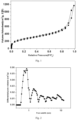
- the N 2 physical adsorption curve of the resin pellets is shown in Fig. 1 . It is calculated that the pore volume of the polymer pellets is 1.82 cm 3 /g and the specific surface area is 908 m 2 /g.
- the pores of the resin pellets are mainly distributed at 0.4-10 nm ( Fig. 2 , a pore size distribution curve of phosphine ligand resin pellets).
- Preparation method of eggshell type catalyst The resin pellets of 1.5-2.0 mm are screened. 1 g of resin pellets of 1.5-2.0 mm are weighed in a CO 2 atmosphere at 30°C, added to 20 mL of 0.6 mol•L -1 MgSO 4 aqueous solution, and stirred for 1 hour. The filtered resin pellets are dried under vacuum at 80°C for 10 hours.
- the solvent is removed under vacuum at 45°C, to obtain the eggshell type catalyst applied to the hydroformylation reaction of olefin.
- the cross section is observed by an electron microscope.
- the active component Rh is uniformly coordinated on the surface layer of the polymer pellets.
- the thickness of the catalyst layer (shell layer) containing metal Rh is 0.15 mm.
- the distribution of Rh in the eggshell layer is uniform.
- the measured metal load of the catalyst is 0.20%.
- the synthesis process and conditions of the resin pellets and the eggshell type catalyst are the same as those of embodiment 1, except that 5 g of phosphine ligands L9 is replaced with 2.5 g of phosphine ligands L1 and 2.5 g of phosphine ligand L10.
- the cross section is observed by an electron microscope.
- the active component Rh is uniformly coordinated on the surface layer of the polymer pellets.
- the thickness of the catalyst layer (shell layer) containing metal Rh is 0.15 mm.
- the distribution of Rh in the eggshell layer is uniform.
- the measured metal load of the catalyst is 0.20%.
- the synthesis process and conditions of the resin pellets and the eggshell type catalyst are the same as those of embodiment 1, except that 5 g of phosphine ligands L9 is replaced with 5 g of phosphine ligands L6.
- the cross section is observed by an electron microscope.
- the active component Rh is uniformly coordinated on the surface layer of the polymer pellets.
- the thickness of the catalyst layer (shell layer) containing metal Rh is 0.15 mm.
- the distribution of Rh in the eggshell layer is uniform.
- the measured metal load of the catalyst is 0.20%.
- the synthesis process and conditions of the resin pellets and the eggshell type catalyst are the same as those of embodiment 1, except that 5 g of phosphine ligands L9 is replaced with 5 g of phosphine ligands L11.
- the cross section is observed by an electron microscope.
- the active component Rh is uniformly coordinated on the surface layer of the polymer pellets.
- the thickness of the catalyst layer (shell layer) containing metal Rh is 0.15 mm.
- the distribution of Rh in the eggshell layer is uniform.
- the measured metal load of the catalyst is 0.20%.
- the synthesis process and conditions of the resin pellets and the eggshell type catalyst are the same as those of embodiment 1, except that 5 g of phosphine ligands L9 is replaced with 4.8 g of phosphine ligands L9 and 0.2 g of phosphine ligand BL2.
- the cross section is observed by an electron microscope.
- the active component Rh is uniformly coordinated on the surface layer of the polymer pellets.
- the thickness of the catalyst layer (shell layer) containing metal Rh is 0.15 mm.
- the distribution of Rh in the eggshell layer is uniform.
- the measured metal load of the catalyst is 0.20%.
- the synthesis process and conditions of the resin pellets and the eggshell type catalyst are the same as those of embodiment 1, except that 5 g of phosphine ligands L9 is replaced with 4.5 g of phosphine ligands L9 and 0.5 g of phosphine ligand BL17.
- the cross section is observed by an electron microscope.
- the active component Rh is uniformly coordinated on the surface layer of the polymer pellets.
- the thickness of the catalyst layer (shell layer) containing metal Rh is 0.15 mm.
- the distribution of Rh in the eggshell layer is uniform.
- the measured metal load of the catalyst is 0.20%.
- the synthesis process and conditions of the resin pellets and the eggshell type catalyst are the same as those of embodiment 1, except that 0.6 mol•L -1 MgSO 4 aqueous solution is replaced with 1.0 mol•L -1 CaCl 2 aqueous solution, when a competitive adsorbent is impregnated.
- the cross section is observed by an electron microscope.
- the active component Rh is uniformly coordinated on the surface layer of the polymer pellets.
- the thickness of the catalyst layer (shell layer) containing metal Rh is 0.15 mm.
- the distribution of Rh in the eggshell layer is uniform.
- the measured metal load of the catalyst is 0.20%.
- the synthesis process and conditions of the resin pellets and the eggshell type catalyst are the same as those of embodiment 1, except that Rh(CO) 2 (acac) is replaced with cobalt octacarbonyl of the same molar number.
- Rh(CO) 2 (acac) is replaced with cobalt octacarbonyl of the same molar number.
- An eggshell type Co-based catalyst can be obtained, and the thickness of an eggshell layer is 0.13 mm.
- the synthesis process and conditions of the resin pellets and the eggshell type catalyst are the same as those of embodiment 1, except that Rh(CO) 2 (acac)is replaced with IrCl4 of the same molar number.
- Rh(CO) 2 (acac) is replaced with IrCl4 of the same molar number.
- An eggshell type Ir-based catalyst can be obtained, and the thickness of a catalyst layer (shell layer) is 0.17 mm.
- the synthesis process and conditions of the resin pellets and the eggshell type catalyst are the same as those of embodiment 1, except that Rh(CO) 2 (acac) is replaced with [( ⁇ -ally)Ru(cod)] 2 of the same molar number.
- the thickness of a catalyst layer (shell layer) is 0.14 mm.
- a specific implementation method is as follows: 50 g of phosphine ligands L9 and 1 g of azodiisobutyronitrile are dissolved in 500 ml of tetrahydrofuran in a 1000 ml enamel high-pressure reactor, stirred for 2 hours, and immobilizd under protection of 373K nitrogen for 24 hours to perform polymerization reaction. Then, the solution is cooled to room temperature, and the solvent is removed at room temperature to obtain a powdered polymer of the phosphine ligand.
- Rh(CO) 2 acac
- 30.0 mL of tetrahydrofuran under the protection atmosphere of 298K and inert gas.
- 1.0 g of powdered polymer carrier of phosphine ligand crushed to 200-300 meshes
- the mixture is stirred under the protection atmosphere of 298K and inert gas for 24 hours.
- the solvent is vacuumed away at room temperature, to obtain a homogeneous powdered catalyst for the hydroformylation reaction.
- the synthesis process and conditions of the resin pellets and the eggshell type catalyst are the same as those of embodiment 1, except that there is no step of impregnating the competitive adsorbent.
- the cross section is observed by an electron microscope.
- the active component Rh is uniformly coordinated on the surface layer of the polymer pellets.
- the thickness of the catalyst layer (shell layer) containing metal Rh is 0.04 mm.
- the distribution of Rh in the eggshell layer is uniform.
- the measured metal load of the catalyst is 0.20%.
- the synthesis process and conditions of the resin pellets and the eggshell type catalyst are the same as those of embodiment 1, except that there is no step of impregnating the competitive adsorbent and 50.0 mL of xylene is replaced with 5.0 mL of xylene for preparing the impregnation solution.
- the cross section is observed by an electron microscope.
- the active component Rh is uniformly coordinated on the surface layer of the polymer pellets.
- the thickness of the catalyst layer (shell layer) containing metal Rh is 0.02 mm.
- the distribution of Rh in the eggshell layer is uniform.
- the measured metal load of the catalyst is 0.20%.
- the solvent is removed under vacuum at 45°C, to obtain the eggshell type catalyst applied to the hydroformylation reaction of olefin.
- the cross section is observed by an electron microscope.
- the active component Rh is uniformly distributed on the surface layer of the polymer pellets.
- the thickness of the catalyst layer (shell layer) containing metal Rh is 0.22 mm, and the distribution of Rh in the eggshell layer is uniform.
- the measured metal load of the catalyst is 0.20%.
- the preparation steps of the eggshell type catalyst are changed to:
- the solvent is removed under vacuum at 45°C, to obtain the eggshell type catalyst applied to the hydroformylation reaction of olefin.
- the cross section is observed by an electron microscope.
- the active component Rh is uniformly distributed on the surface layer of the polymer pellets.
- the thickness of the catalyst layer (shell layer) containing metal Rh is 0.27 mm, and the distribution of Rh in the eggshell layer is uniform.
- the measured metal load of the catalyst is 0.20%.
- 1 g of resin pellets of 1.5-2.0 mm are weighed in a CO 2 atmosphere at 30°C, added to 20 mL of mixed aqueous solution of 0.6 mol•L -1 MgSO 4 , 0.6 mol•L -1 MgCl 2 , 0.6 mol•L -1 MgSO 4 , 0.6 mol•L -1 AlCl 3 , 0.6 mol•L -1 CaCl 2 , 0.6 mol•L -1 CuSO 4 and 0.6 mol•L -1 ZnSO 4 , and stirred for 1 hour.
- the filtered resin pellets are dried under vacuum at 80°C for 10 hours.
- the collected liquid is analyzed by HP-7890N gas chromatography with HP-5 capillary column and FID, and ethanol is used as the internal standard.
- the tail gas is analyzed online by HP-7890N gas chromatography with Porapak-QS column and TCD. Reaction results are listed in Table 1. Table 1.
- Embodiment 1 Performance of Propylene Hydroformylation of Slurry Bed of Catalyst in Embodiment 1- Embodiment 11 and Reference Examples Entry Catalysts S BET /(m 2/ g) Pore Size Distribution (nm) Propylene TOF(h -1 ) Aldehyde Selectivity /% n-butyraldehyde: isobutyraldehyde 1 Embodiment 1 902 0.2-10.0 733.6 99.0 8.7 2 Embodiment 2 873 0.1-8.0 744.5 98.7 10.9 3 Embodiment 3 794 0.3-9.0 953.2 99.0 8.0 4 Embodiment 4 705 0.1-8.0 719.0 99.0 9.8 5 Embodiment 5 897 0.1-10.0 1236.7 98.8 29.7 6 Embodiment 6 840 0.1-9.0 724.4 98.9 33.2 7 Embodiment 7 903 0.2-10.0 716.3 98.7 8.9 8 Embodi
- embodiments 1-11 are the eggshell type catalyst.
- the ratio of n-butyraldehyde to isobutyraldehyde in the product aldehyde can be basically above 8.0, and the value of propylene TOF can be above 700 h -1 .
- the ratio of n-butyraldehyde to isobutyraldehyde in the product butyaldehyde can be about 30 (embodiments 5 and 6).
- the active metals are Co, Ir and Ru, respectively, and have lower reaction performance than the catalysts with the active metal of Rh (embodiment 1) (however, Co, Ir, Ru, etc. have lower price and are more suitable for non-Rh metals in some industrial occasions).
- Rh the active center
- the activity of the propylene hydroformylation reaction of the eggshell type catalyst is higher than that of the homogeneous catalyst of the corresponding reference example (reference example 1) and the selectivity of n-butyraldehyde is similar.
- the ratio of n-butyraldehyde to isobutyraldehyde in the eggshell type catalyst is 2.6.
- the impregnation of the competitive adsorbent can improve the spatial distribution of the active components of the catalyst in the resin pellets, so that the selectivity of n-butyraldehyde is higher in the propylene hydroformylation reaction.
- the eggshell layer (0.02 mm) of the catalyst prepared by reference example 3 is thinner than the eggshell layers of the catalysts prepared by embodiments 1-11.
- the selectivity of the product n-butyraldehyde is significantly lower than that of embodiment 1 and the activity is also lower than that of embodiment 1.
- the thicknesses of the eggshell layers prepared by reference example 4 and reference example 5 are 0.22 mm and 0.27 mm, respectively, which are thicker than that of embodiment 1.
- the selectivity of n-butyraldehyde is not significantly improved compared with embodiment 1, and the reactivity of propylene is lower than that of embodiment 1. This may be because the thickness of the eggshell layer is too thick and deeper active species Rh is unable to come into full contact with a reaction substrate.
- n-butyraldehyde selectivity the ratio of n-butyraldehyde to isobutyraldehyde is greater than 8
- propylene hydroformylation reaction except for non-Rh metals, the TOF value of propylene is basically above 700 h -1 .
- the competitive adsorbent only the competitive adsorbent is impregnated, and it is found from a test that there is no activity of propylene hydroformylation reaction. This proves that the competitive adsorbent only regulates the distribution of the active metal in the eggshell type catalyst during the preparation of the catalyst, but cannot catalyze the hydroformylation reaction of propylene.
- the spatial distribution of the active metal components in the resin pellets is effectively regulated through a method of finely regulating the porous channel structure of carrier resin pellets and adding the competitive coordination agent, so that the prepared eggshell type catalyst has the characteristics of high activity in the propylene hydroformylation reaction and good selectivity of n-butyraldehyde in the product aldehyde.
- the eggshell type catalyst has high mechanical strength of carrier resin pellets (measured as about 40 N/pellet), can exist stably in organic solvents without swelling or powdering, and is suitable for industrial application of propylene hydroformylation.
- the thickness of the eggshell type catalyst can be significantly changed by using different competitive adsorbents of MgCl 2 , AlCl 3 , CaCl 2 , CuSO 4 and ZnSO 4 .
- the ratio of n-butyraldehyde to isobutyraldehyde is significantly changed.
- the ratio of n-butyraldehyde to isobutyraldehyde is as high as 13.5 and as low as 3.2, which could not be achieved by using only monophosphine ligand for preparation of the catalyst in the early stage.
- Salts of monovalent metal of NaCl, KCl, NaNO 3 and NaHCO 3 are used as the competitive adsorbents, which cannot adjust the thickness of the eggshell layer.
- the ratio of n-butyraldehyde to isobutyraldehyde is similar to that of reference example 3 without adding the competitive adsorbents.
- the anion is NO 3 - or HCO 3 -
- the activity of the catalyst may be affected and the TOF value of propylene is only about 200 h -1 .
- the thickness of the monophosphine/diphosphine copolymerization eggshell type catalyst can be significantly changed by using competitive adsorbents of MgCl 2 , AlCl 3 , CaCl 2 , CuSO 4 and ZnSO 4 .
- the TOF value of propylene can be regulated in the range of 1127-1525 h -1 , and the ratio of n-butyraldehyde to isobutyraldehyde can also be regulated in a large range.
- the ratio of n-butyraldehyde to isobutyraldehyde is as high as 42.5 and as low as 3.2.
- Salts of monovalent metal of NaCl, KCl, NaNO 3 and NaHCO 3 are used as the competitive adsorbents, which cannot adjust the thickness of the eggshell layer.
- the ratio of n-butyraldehyde to isobutyraldehyde is much smaller than the results of salts of bivalent and trivalent metals of MgCl 2 , AlCl 3 , CaCl 2 , CuSO 4 and ZnSO 4 .
- the anion is NO 3 - or HCO 3 -
- the activity of the catalyst may be affected and the TOF value of propylene is only about 300 h -1 .
- the synthesis process and conditions of the resin pellets and the eggshell type catalyst are the same as those of embodiment 1, except that the monodentate ligand L9 is replaced with other monodentate ligands/polydentate ligands mentioned in claims for autopolymerization.
- the performance results of propylene hydroformylation are shown in Table 4 by the evaluation method of embodiment 12: Table 4.
- the eggshell type catalysts prepared by autopolymerization of diphosphine ligands BL12, BL14, BL15, BL16 and BL18 containing 4 vinyls have TOF values in the range of 589-833 h -1 and ratios of n-butyraldehyde to isobutyraldehyde in the range of 21-45.
- Other eggshell type catalysts prepared by bisphosphine ligands (BL1-BL11, BL13 and BL17) with two vinyls have higher ratios of n-butyraldehyde to isobutyraldehyde (23-42), but lower specific surface area and less desirable activity (TOF range is 378-459 h -1 ).
- a collection tank at constant temperature of -10°C is used for collection.
- the reaction products and the slurry liquid carried by tail gas are all dissolved in the collection tank.
- the collected liquid is analyzed by HP-7890N gas chromatography with HP-5 capillary column and FID, and ethanol is used as the internal standard.
- the tail gas is analyzed online by HP-7890N gas chromatography with Porapak-QS column and TCD. Reaction results are listed in Table 5. Table 5.
- the implementation process is the same as that of embodiment 16 except that the reaction condition is adjusted to 418K and 1 Mpa.
- the reaction under the condition is measured, and the results are listed in Table 6.
- Table 6 Performance of Propylene Hydroformylation of Slurry Bed of Eggshell Type Catalysts of Different Active Metals at 418K and 1 MPa Entry Catalysts S BET /(m 2/ g) Pore Size Distribution (nm) Propylene TOF(h -1 ) Aldehyde Selectivity /% n-butyraldehyde: isobutyraldehyde 1 Rh in embodiment 1 902 0.2-10.0 1634.2 98.8 8.6 2 Co in 904 0.2-10.0 659.1 97.1 8.2 embodiment 8 3 Ir in embodiment 9 902 0.2-10.0 611.3 97.8 7.9 4 Ru in embodiment 10 903 0.2-10.0 701.4 97.1 7.7 5 Pt in reference example 7 905 0.2-10.0 346.2 97.0 2.2 6 Fe in reference example 8 902 0.
- the TOF value of the Rh eggshell type catalyst can reach 1634, and the ratio of n-butyraldehyde to isobutyraldehyde is still maintained at a high level.
- the TOF values (TOF values range from 611 to 701 h -1 ) of Co, Ir and Ru eggshell type catalysts are also increased significantly.
- the TOF values of Pt and Fe eggshell type catalysts are only increased to about 300 h -1 , which is not a preferred solution of the patent.
- the eggshell type catalyst exhibits better performance, and compared with the slurry bed reactor, the ratio of n-butyraldehyde to isobutyraldehyde is significantly increased (which is more than 10 for the eggshell type catalyst prepared by autopolymerization of monophosphine ligands, and more than 33 for the eggshell type catalyst prepared by monophosphine and diphosphine copolymerization).
- the selectivity of the product aldehyde is slightly increased, while the TOF of propylene is slightly decreased.
- the reactor form can be flexibly selected according to the requirements for the product.
Landscapes
- Chemical & Material Sciences (AREA)
- Organic Chemistry (AREA)
- Chemical Kinetics & Catalysis (AREA)
- Engineering & Computer Science (AREA)
- Materials Engineering (AREA)
- Inorganic Chemistry (AREA)
- Catalysts (AREA)
- Low-Molecular Organic Synthesis Reactions Using Catalysts (AREA)
- Organic Low-Molecular-Weight Compounds And Preparation Thereof (AREA)
- Addition Polymer Or Copolymer, Post-Treatments, Or Chemical Modifications (AREA)
Applications Claiming Priority (2)
| Application Number | Priority Date | Filing Date | Title |
|---|---|---|---|
| CN202210435228.8A CN114797974B (zh) | 2022-04-24 | 2022-04-24 | 一种蛋壳型催化剂及其制备方法和丙烯氢甲酰化反应应用 |
| PCT/CN2023/087737 WO2023207584A1 (zh) | 2022-04-24 | 2023-04-12 | 一种蛋壳型催化剂及其制备方法和丙烯氢甲酰化反应应用 |
Publications (2)
| Publication Number | Publication Date |
|---|---|
| EP4516398A1 true EP4516398A1 (de) | 2025-03-05 |
| EP4516398A4 EP4516398A4 (de) | 2025-08-06 |
Family
ID=82507009
Family Applications (1)
| Application Number | Title | Priority Date | Filing Date |
|---|---|---|---|
| EP23795017.5A Pending EP4516398A4 (de) | 2022-04-24 | 2023-04-12 | Eierschalenkatalysator, herstellungsverfahren dafür und verwendung davon in der propylenhydroformylierungsreaktion |
Country Status (4)
| Country | Link |
|---|---|
| US (1) | US20250269362A1 (de) |
| EP (1) | EP4516398A4 (de) |
| CN (1) | CN114797974B (de) |
| WO (1) | WO2023207584A1 (de) |
Families Citing this family (1)
| Publication number | Priority date | Publication date | Assignee | Title |
|---|---|---|---|---|
| CN114797974B (zh) * | 2022-04-24 | 2023-07-28 | 中国科学院大连化学物理研究所 | 一种蛋壳型催化剂及其制备方法和丙烯氢甲酰化反应应用 |
Family Cites Families (10)
| Publication number | Priority date | Publication date | Assignee | Title |
|---|---|---|---|---|
| US4774215A (en) * | 1987-03-16 | 1988-09-27 | Phillips Petroleum Company | Glass powder promoter for carbonate supported catalyst |
| CN104707660B (zh) | 2013-12-11 | 2017-03-08 | 中国科学院大连化学物理研究所 | 一种用于烯烃氢甲酰化反应的固体多相催化剂及其制备方法和应用 |
| CN106140303B (zh) * | 2015-04-03 | 2018-11-27 | 中国科学院大连化学物理研究所 | 一种含膦有机混聚物-金属多相催化剂及其制备和应用 |
| CN106140301B (zh) * | 2015-04-03 | 2018-11-27 | 中国科学院大连化学物理研究所 | 含膦有机混聚物-金属多相催化剂及其制备方法和应用 |
| CN109806911B (zh) * | 2017-11-21 | 2022-01-21 | 中国科学院大连化学物理研究所 | 一种高选择性制备直链醛的催化剂及其制备和应用 |
| CN109836318B (zh) * | 2017-11-27 | 2022-09-30 | 中国科学院大连化学物理研究所 | 一种烯烃氢甲酰化反应制备醛的方法 |
| CN112264038B (zh) * | 2020-11-11 | 2023-03-24 | 中国科学院宁波材料技术与工程研究所 | 一种贵金属负载的蛋壳型催化剂及其制备方法与应用 |
| CN113416211A (zh) * | 2021-05-28 | 2021-09-21 | 中国科学院大连化学物理研究所 | 一种乙烯基官能团化膦配体合成方法及膦配体和应用 |
| CN114797974B (zh) * | 2022-04-24 | 2023-07-28 | 中国科学院大连化学物理研究所 | 一种蛋壳型催化剂及其制备方法和丙烯氢甲酰化反应应用 |
| CN114797975B (zh) * | 2022-04-24 | 2023-08-01 | 中国科学院大连化学物理研究所 | 一种采用蛋壳型催化剂进行丙烯氢甲酰化反应的方法 |
-
2022
- 2022-04-24 CN CN202210435228.8A patent/CN114797974B/zh active Active
-
2023
- 2023-04-12 WO PCT/CN2023/087737 patent/WO2023207584A1/zh not_active Ceased
- 2023-04-12 US US18/857,924 patent/US20250269362A1/en active Pending
- 2023-04-12 EP EP23795017.5A patent/EP4516398A4/de active Pending
Also Published As
| Publication number | Publication date |
|---|---|
| WO2023207584A1 (zh) | 2023-11-02 |
| CN114797974B (zh) | 2023-07-28 |
| US20250269362A1 (en) | 2025-08-28 |
| CN114797974A (zh) | 2022-07-29 |
| EP4516398A4 (de) | 2025-08-06 |
Similar Documents
| Publication | Publication Date | Title |
|---|---|---|
| CN109806911B (zh) | 一种高选择性制备直链醛的催化剂及其制备和应用 | |
| Gallezot et al. | Selective hydrogenation of α, β-unsaturated aldehydes | |
| Lewis | Chemical catalysis by colloids and clusters | |
| CN107790188B (zh) | 一种金属-含膦有机共聚物催化剂及其制备方法和应用 | |
| Davis et al. | Unsupported small metal particles: preparation, reactivity, and characterization | |
| CN112892602B (zh) | 一种含膦多孔有机聚合物负载型催化剂及其制备方法和应用 | |
| CN104707660B (zh) | 一种用于烯烃氢甲酰化反应的固体多相催化剂及其制备方法和应用 | |
| EP3092072B1 (de) | Verfahren zur dampfphasen-carbonylierung von methanol in methylformiat | |
| CN109836318B (zh) | 一种烯烃氢甲酰化反应制备醛的方法 | |
| CN110215919A (zh) | 一种高分散负载型催化剂及其制备方法和应用 | |
| CN114522735B (zh) | 一种用于乙烯基酯类化合物氢甲酰化反应的固体催化剂及其制备方法 | |
| CN114591159B (zh) | 利用氧化膦聚合物负载型催化剂进行内烯烃氢甲酰化反应的方法 | |
| CN114588949A (zh) | 一种用于烯烃氢甲酰化反应的蛋壳型催化剂及其制备和应用 | |
| Coq et al. | Hydrogenation of substituted acrolein over alumina supported ruthenium catalysts | |
| WO2022105047A1 (zh) | 催化剂以及制备方法、应用 | |
| EP4516398A1 (de) | Eierschalenkatalysator, herstellungsverfahren dafür und verwendung davon in der propylenhydroformylierungsreaktion | |
| CN111054437B (zh) | 一种异辛烯醛选择加氢制备异辛醛的催化剂、制备方法及应用 | |
| CN116408113B (zh) | 一种烯烃氢甲酰化催化剂的制备方法及其应用 | |
| CN114700115B (zh) | 一种氧化膦聚合物负载型催化剂及其制备方法和应用 | |
| CN113477257B (zh) | 一种负载型CoxMy金属间化合物催化剂、其制备和使用方法 | |
| CN114797975B (zh) | 一种采用蛋壳型催化剂进行丙烯氢甲酰化反应的方法 | |
| RU2839722C2 (ru) | Катализатор по типу "яичной скорлупы" и его способ получения и применение в реакции гидроформилирования пропилена | |
| CN116174051B (zh) | 一种α、β-不饱和醛或酮加氢方法 | |
| CN113967473B (zh) | 一种复合氧化物负载单原子Ru的多相催化剂、制备方法及用途 | |
| JP2784930B2 (ja) | 化学反応方法及びその反応のために適当な触媒 |
Legal Events
| Date | Code | Title | Description |
|---|---|---|---|
| STAA | Information on the status of an ep patent application or granted ep patent |
Free format text: STATUS: THE INTERNATIONAL PUBLICATION HAS BEEN MADE |
|
| PUAI | Public reference made under article 153(3) epc to a published international application that has entered the european phase |
Free format text: ORIGINAL CODE: 0009012 |
|
| STAA | Information on the status of an ep patent application or granted ep patent |
Free format text: STATUS: REQUEST FOR EXAMINATION WAS MADE |
|
| 17P | Request for examination filed |
Effective date: 20241009 |
|
| AK | Designated contracting states |
Kind code of ref document: A1 Designated state(s): AL AT BE BG CH CY CZ DE DK EE ES FI FR GB GR HR HU IE IS IT LI LT LU LV MC ME MK MT NL NO PL PT RO RS SE SI SK SM TR |
|
| DAV | Request for validation of the european patent (deleted) | ||
| DAX | Request for extension of the european patent (deleted) | ||
| A4 | Supplementary search report drawn up and despatched |
Effective date: 20250704 |
|
| RIC1 | Information provided on ipc code assigned before grant |
Ipc: B01J 31/06 20060101AFI20250630BHEP Ipc: B01J 31/18 20060101ALI20250630BHEP Ipc: B01J 31/24 20060101ALI20250630BHEP Ipc: C07C 45/50 20060101ALI20250630BHEP |
|
| STAA | Information on the status of an ep patent application or granted ep patent |
Free format text: STATUS: EXAMINATION IS IN PROGRESS |
|
| 17Q | First examination report despatched |
Effective date: 20260218 |