EP4510130A2 - Verfahren zur dekodierung mit bandbreitenerweiterung eines audiosignals - Google Patents
Verfahren zur dekodierung mit bandbreitenerweiterung eines audiosignals Download PDFInfo
- Publication number
- EP4510130A2 EP4510130A2 EP24212481.6A EP24212481A EP4510130A2 EP 4510130 A2 EP4510130 A2 EP 4510130A2 EP 24212481 A EP24212481 A EP 24212481A EP 4510130 A2 EP4510130 A2 EP 4510130A2
- Authority
- EP
- European Patent Office
- Prior art keywords
- signal
- audio signal
- distorted
- spread
- audio
- Prior art date
- Legal status (The legal status is an assumption and is not a legal conclusion. Google has not performed a legal analysis and makes no representation as to the accuracy of the status listed.)
- Granted
Links
Images




Classifications
-
- G—PHYSICS
- G10—MUSICAL INSTRUMENTS; ACOUSTICS
- G10L—SPEECH ANALYSIS TECHNIQUES OR SPEECH SYNTHESIS; SPEECH RECOGNITION; SPEECH OR VOICE PROCESSING TECHNIQUES; SPEECH OR AUDIO CODING OR DECODING
- G10L21/00—Speech or voice signal processing techniques to produce another audible or non-audible signal, e.g. visual or tactile, in order to modify its quality or its intelligibility
- G10L21/02—Speech enhancement, e.g. noise reduction or echo cancellation
- G10L21/038—Speech enhancement, e.g. noise reduction or echo cancellation using band spreading techniques
Definitions
- the present invention relates to the audio signal processing, and in particular, to the audio signal processing in situations in which the available data rate is rather small, or to a bandwidth extension of an audio signal.
- the synthesis filterbank belonging to a special analysis filterbank receives bandpass signals of the audio signal in the lower band and envelope-adjusted bandpass signals of the lower band which were harmonically patched in the upper band.
- the output signal of the synthesis filterbank is an audio signal extended with regard to its bandwidth, which was transmitted from the encoder side to the decoder side with a very low data rate.
- filterbank calculations and patching in the filterbank domain may become a high computational effort.
- Audio bandwidth extension discloses a pitch scaling procedure, where, by doubling the pitch frequency, a version of an excitation signal derived from a speech signal by a speech analysis filter is produced, which has a doubled upper band limit in comparison to the band limited excitation signal.
- the pitch doubling comprises a downsampling of the excitation signal and a subsequently performed time-stretching of the downsampled excitation signal.
- the output of the time-stretching is input into a high-pass filter and the high-pass filter output signal is added to a delay-compensated low band excitation signal.
- the bandwidth extended excitation signal generated by the adding is input into a speech synthesis filter corresponding to the speech analysis filter to obtain a bandwidth extended speech signal.
- US 6,549,884 discloses a phase-vocoder pitch-shifting procedure.
- a signal is converted to a frequency domain representation and, then, a specific region in the frequency domain representation is identified. Then, the region is shifted to a second frequency location to form an adjusted frequency domain representation, and the adjusted frequency domain representation is transformed to a time domain signal representing the input signal with a shifted pitch. This eliminates the expensive time domain resampling stage.
- the inventive concept for a bandwidth extension is based on a temporal signal spreading for generating a version of the audio signal as a time signal which is spread by a spread factor > 1 and a subsequent decimation of the time signal to obtain a transposed signal, which may then for example be filtered by a simple bandpass filter to extract a high-frequency signal portion which may only still be distorted or changed with regard to its amplitude, respectively, to obtain a good approximation for the original high-frequency portion.
- the bandpass filtering may alternatively take place before the signal spreading is performed, so that only the desired frequency range is present after spreading in the spread signal, so that a bandpass filtering after spreading may be omitted.
- harmonic bandwidth extension on the one hand, problems resulting from a copying or mirroring operation, or both, may be prevented based on a harmonic continuation and spreading of the spectrum using the signal spreader for spreading the time signal.
- a temporal spreading and subsequent decimation may be executed easier by simple processors than a complete analysis/synthesis filterbank, as it is for example used with the harmonic transposition, wherein additionally decisions have to be made on how patching within the filterbank domain should take place.
- phase vocoder for signal spreading, a phase vocoder is used for which there are implementations of minor effort.
- phase-vocoders may be used in parallel, which is advantageous, in particular with regard to the delay of the bandwidth extension which has to be low in real time applications.
- PSOLA method Pitch Synchronous Overlap Add
- the LF audio signal is first extended in the direction of time with the maximum frequency LF max with the help of the phase vocoder, i.e. to an integer multiple of the conventional duration of the signal.
- a decimation of the signal by the factor of the temporal extension takes place which in total leads to a spreading of the spectrum. This corresponds to a transposition of the audio signal.
- the resulting signal is bandpass filtered to the range (extension factor - 1) ⁇ LF max to extension factor ⁇ LF max .
- the individual high frequency signals generated by spreading and decimation may be subjected to a bandpass filtering such that in the end they additively overlay across the complete high frequency range (i.e. from LF max to k*LF max ). This is sensible for the case that still a higher spectral density of harmonics is desired.
- the method of harmonic bandwidth extension is executed in a preferred embodiment of the present invention in parallel for several different extension factors.
- a single phase vocoder may be used which is operated serially and wherein intermediate results are buffered.
- any bandwidth extension cut-off frequencies may be achieved.
- the extension of the signal may alternatively also be executed directly in the frequency direction, i.e. in particular by a dual operation corresponding to the functional principle of the phase vocoder.
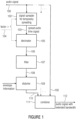
- Fig. 1 shows a schematical illustration of a device or a method, respectively, for a bandwidth extension of an audio signal. Only exemplarily, Fig. 1 is described as a device, although Fig. 1 may simultaneously also be regarded as the flowchart of a method for a bandwidth extension.
- the audio signal is fed into the device at an input 100.
- the audio signal is supplied to a signal spreader 102 which is implemented to generate a version of the audio signal as a time signal spread in time by a spread factor greater than 1.
- the spread factor in the embodiment illustrated in Fig. 1 is supplied via a spread factor input 104.
- the spread audio time signal present at an output 103 of the signal spreader 102 is supplied to a decimator 105 which is implemented to decimate the temporally spread audio time signal 103 by a decimation factor matched to the spread factor 104.
- a decimation factor matched to the spread factor 104 This is schematically illustrated by the spread factor input 104 in Fig. 1 , which is plotted in dashed lines and leads into the decimator 105.
- the spread factor in the signal spreader is equal to the inverse of the decimation factor. If, for example, a spread factor of 2.0 is applied in the signal spreader 102, a decimation with a decimation factor of 0.5 is executed.
- decimation factor is identical to the spread factor.
- Alternative ratios between spread factor and decimation factor for example integer ratios or rational ratios, may also be used depending on the implementation.
- the maximum harmonic bandwidth extension is achieved, however, when the spread factor is equal to the decimation factor, or to the inverse of the decimation factor, respectively.
- the decimator 105 is implemented to, for example, eliminate every second sample (with a spread factor equal to 2) so that a decimated audio signal results which has the same temporal length as the original audio signal 100.
- Other decimation algorithms for example, forming weighted average values or considering the tendencies from the past or the future, respectively, may also be used, although, however, a simple decimation may be implemented with very little effort by the elimination of samples.
- the decimated time signal 106 generated by the decimator 105 is supplied to a filter 107, wherein the filter 107 is implemented to extract a bandpass signal from the decimated audio signal 106, which contains frequency ranges which are not contained in the audio signal 100 at the input of the device.
- the filter 107 may be implemented as a digital bandpass filter, e.g. as an FIR or IIR filter, or also as an analog bandpass filter, although a digital implementation is preferred. Further, the filter 107 is implemented such that it extracts the upper spectral range generated by the operations 102 and 105 wherein, however, the bottom spectral range, which is anyway covered by the audio signal 100, is suppressed as much as possible. In the implementation, the filter 107 may also be implemented such, however, that it also extracts signal portions with frequencies as a bandpass signal contained in the original signal 100, wherein the extracted bandpass signal contains at least one frequency band which was not contained in the original audio signal 100.
- the bandpass signal 108 output by the filter 107, is supplied to a distorter 109, which is implemented to distort the bandpass signals so that the bandpass signal comprises a predetermined envelope.
- This envelope information which may be used for distorting may be input externally, and even come from an encoder or may also be generated internally, for example, by a blind extrapolation from the audio signal 100, or based on tables stored on the decoder side indexed with an envelope of an audio signal 100.
- the distorted bandpass signal 110 output by the distorter 109 is finally supplied to a combiner 111 which is implemented to combine the distorted bandpass signal 110 to the original audio signal 100 which was also distorted depending on the implementation (the delay stage is not indicated in Fig. 1 ), to generate an audio signal extended with regard to its bandwidth at an output 112.
- the sequence of distorter 109 and combiner 111 is inverse to the illustration indicated in Fig. 1 .
- the filter output signal i.e. the bandpass signal 108
- the distorter operates as a distorter for distorting the combination signal so that the combination signal comprises a predetermined envelope.
- the combiner is in this embodiment thus implemented such that it combines the bandpass signal 108 with the audio signal 100 to obtain an audio signal which is extended regarding its bandwidth.
- the distorter 109 in which the distortion only takes place after combination, it is preferable to implement the distorter 109 such that it does not influence the audio signal 100 or the bandwidth of the combination signal, respectively, provided by the audio signal 100, as the lower band of the audio signal was encoded by a high-quality encoder and is, on the decoder side, in the synthesis of the upper band, so to speak the measure of all things and should not be interfered with by the bandwidth extension.
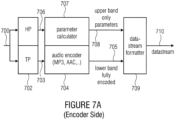
- An audio signal is fed into a lowpass/highpass combination at an input 700.
- the lowpass/highpass combination on the one hand includes a lowpass (LP), to generate a lowpass filtered version of the audio signal 700, illustrated at 703 in Fig. 7a .
- This lowpass filtered audio signal is encoded with an audio encoder 704.
- the audio encoder is, for example, an MP3 encoder (MPEG1 Layer 3) or an AAC encoder, also known as an MP4 encoder and described in the MPEG4 Standard.
- Alternative audio encoders providing a transparent or advantageously psychoacoustically transparent representation of the band-limited audio signal 703 may be used in the encoder 704 to generate a completely encoded or psychoacoustically encoded and preferably psychoacoustically transparently encoded audio signal 705, respectively.
- the upper band of the audio signal is output at an output 706 by the highpass portion of the filter 702, designated by "HP".
- the highpass portion of the audio signal i.e. the upper band or HF band, also designated as the HF portion, is supplied to a parameter calculator 707 which is implemented to calculate the different parameters.
- parameters are, for example, the spectral envelope of the upper band 706 in a relatively coarse resolution, for example, by representation of a scale factor for each psychoacoustic frequency group or for each Bark band on the Bark scale, respectively.
- a further parameter which may be calculated by the parameter calculator 707 is the noise carpet in the upper band, whose energy per band may preferably be related to the energy of the envelope in this band.
- Further parameters which may be calculated by the parameter calculator 707 include a tonality measure for each partial band of the upper band which indicates how the spectral energy is distributed in a band, i.e.
- the parameter calculator 707 is implemented to generate only parameters 708 for the upper band which may be subjected to similar entropy reduction steps as they may also be performed in the audio encoder 704 for quantized spectral values, such as for example differential encoding, prediction or Huffman encoding, etc.
- the parameter representation 708 and the audio signal 705 are then supplied to a datastream formatter 709 which is implemented to provide an output side datastream 710 which will typically be a bitstream according to a certain format as it is for example normalized in the MPEG4 Standard.
- the inventive decoder side is in the following illustrated with regard to Fig. 7b .
- the datastream 710 enters a datastream interpreter 711 which is implemented to separate the parameter portion 708 from the audio signal portion 705.
- the parameter portion 708 is decoded by a parameter decoder 712 to obtain decoded parameters 713.
- the audio signal portion 705 is decoded by an audio decoder 714 to obtain the audio signal which was illustrated at 100 in Fig. 1 .
- the audio signal 100 may be output via a first output 715.
- an audio signal with a small bandwidth and thus also a low quality may then be obtained.
- the inventive bandwidth extension 720 is performed, which is for example implemented as it is illustrated in Fig. 1 to obtain the audio signal 112 on the output side with an extended or high bandwidth, respectively, and a high quality.
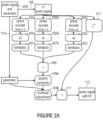
- Fig. 2a firstly includes a block designated by "audio signal and parameter", which may correspond to block 711, 712, and 714 of Fig. 7b , and is designated by 200.
- Block 200 provides the output signal 100 as well as decoded parameters 713 on the output side which may be used for different distortions, like for example for a tonality correction 109a and an envelope adjustment 109b.
- the signal generated or corrected, respectively, by the tonality correction 109a and the envelope adjustment 109b, is supplied to the combiner 111 to obtain the audio signal on the output side with an extended bandwidth 112.
- the signal spreader 102 of Fig. 1 is implemented by a phase vocoder 202a.
- the decimator 105 of Fig. 1 is preferably implemented by a simple sample rate converter 205a.
- the filter 107 for the extraction of a bandpassed signal is preferably implemented by a simple bandpass filter 107a.
- a further "train” consisting of the phase vocoder 202b, decimator 205b and bandpass filter 207b is provided to extract a further bandpass signal at the output of the filter 207b, comprising a frequency range between the upper cut-off frequency of the bandpass filter 207a and three times the maximum frequency of the audio signal 100.
- a k-phase vocoder 202c is provided achieving a spreading of the audio signal by the factor k, wherein k is preferably an integer number greater than 1.
- a decimator 205 is connected downstream to the phase vocoder 202c, which decimates by the factor k.
- the decimated signal is supplied to a bandpass filter 207c which is implemented to have a lower cut-off frequency which is equal to the upper cut-off frequency of the adjacent branch and which has an upper cut-off frequency which corresponds to the k-fold of the maximum frequency of the audio signal 100. All bandpass signals are combined by a combiner 209, wherein the combiner 209 may for example be implemented as an adder.
- the combiner 209 may also be implemented as a weighted adder which, depending on the implementation, attenuates higher bands more strongly than lower bands, independent of the downstream distortion by the elements 109a, 109b.
- the system illustrated in Fig. 2a includes a delay stage 211 which guarantees that a synchronized combination takes place in the combiner 111 which may for example be a sample-wise addition.
- Fig. 3 shows a schematical illustration of different spectrums which may occur in the processing illustrated in Fig. 1 or Fig. 2a .
- the partial image (1) of Fig. 3 shows a band-limited audio signal as it is for example present at 100 in Fig. 1 , or 703 in Fig. 7a .
- This signal is preferably spread by the signal spreader 102 to an integer multiple of the original duration of the signal and subsequently decimated by the integer factor, which leads to an overall spreading of the spectrum as it is illustrated in the partial image (2) of Fig. 3 .
- the HF portion is illustrated in Fig. 3 , as it is extracted by a bandpass filter comprising a passband 300.
- Fig. 3 shows a schematical illustration of different spectrums which may occur in the processing illustrated in Fig. 1 or Fig. 2a .
- the partial image (1) of Fig. 3 shows a band-limited audio signal as it is for example present at 100 in Fig. 1 , or 703 in Fig. 7a
- the LF signal in the partial image (1) has the maximum frequency LF max .
- the phase vocoder 202a performs a transposition of the audio signal such that the maximum frequency of the transposed audio signal is 2LF max .
- the resulting signal in the partial image (2) is bandpass filtered to the range LF max to 2LF max .
- the bandpass filter comprises a passband of (k-1) ⁇ LF max to k ⁇ LF max ).
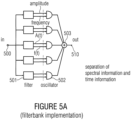
- Fig. 5a shows a filterbank implementation of a phase vocoder, wherein an audio signal is fed in at an input 500 and obtained at an output 510.
- each channel of the schematic filterbank illustrated in Fig. 5a includes a bandpass filter 501 and a downstream oscillator 502. Output signals of all oscillators from every channel are combined by a combiner, which is for example implemented as an adder and indicated at 503, in order to obtain the output signal.
- Each filter 501 is implemented such that it provides an amplitude signal on the one hand and a frequency signal on the other hand.
- the amplitude signal and the frequency signal are time signals illustrating a development of the amplitude in a filter 501 over time, while the frequency signal represents a development of the frequency of the signal filtered by a filter 501.
- FIG. 5b A schematical setup of filter 501 is illustrated in Fig. 5b .
- Each filter 501 of Fig. 5a may be set up as in Fig. 5b , wherein, however, only the frequencies f i supplied to the two input mixers 551 and the adder 552 are different from channel to channel.
- the mixer output signals are both lowpass filtered by lowpasses 553, wherein the lowpass signals are different insofar as they were generated by local oscillator frequencies (LO frequencies), which are out of phase by 90°.
- the upper lowpass filter 553 provides a quadrature signal 554, while the lower filter 553 provides an in-phase signal 555.
- phase unwrapper 558 At the output of the element 558, there is no phase value present any more which is always between 0 and 360°, but a phase value which increases linearly.
- phase/frequency converter 559 which may for example be implemented as a simple phase difference former which subtracts a phase of a previous point in time from a phase at a current point in time to obtain a frequency value for the current point in time.
- This frequency value is added to the constant frequency value f i of the filter channel i to obtain a temporarily varying frequency value at the output 560.
- the phase vocoder achieves a separation of the spectral information and time information.
- the spectral information is in the special channel or in the frequency f i which provides the direct portion of the frequency for each channel, while the time information is contained in the frequency deviation or the magnitude over time, respectively.
- Fig. 5c shows a manipulation as it is executed for the bandwidth increase according to the invention, in particular, in the phase vocoder 202a, and in particular, at the location of the illustrated circuit plotted in dashed lines in Fig. 5a .
- the amplitude signals A(t) in each channel or the frequency of the signals f(t) in each signal may be decimated or interpolated, respectively.
- an interpolation i.e. a temporal extension or spreading of the signals A(t) and f(t) is performed to obtain spread signals A'(t) and f'(t), wherein the interpolation is controlled by the spread factor 104, as it was illustrated in Fig. 1 .
- the interpolation of the phase variation i.e. the value before the addition of the constant frequency by the adder 552
- the frequency of each individual oscillator 502 in Fig. 5a is not changed.
- the temporal change of the overall audio signal is slowed down, however, i.e. by the factor 2.
- the result is a temporally spread tone having the original pitch, i.e. the original fundamental wave with its harmonics.
- the audio signal is shrunk back to its original duration while all frequencies are doubled simultaneously. This leads to a pitch transposition by the factor 2 wherein, however, an audio signal is obtained which has the same length as the original audio signal, i.e. the same number of samples.
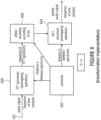
- a transformation implementation of a phase vocoder may also be used.
- the audio signal 100 is fed into an FFT processor, or more generally, into a Short-Time-Fourier-Transformation-Processor 600 as a sequence of time samples.
- the FFT processor 600 is implemented schematically in Fig. 6 to perform a time windowing of an audio signal in order to then, by means of an FFT, calculate both a magnitude spectrum and also a phase spectrum, wherein this calculation is performed for successive spectrums which are related to blocks of the audio signal, which are strongly overlapping.
- a new spectrum may be calculated, wherein a new spectrum may be calculated also e.g. only for each twentieth new sample.
- This distance a in samples between two spectrums is preferably given by a controller 602.
- the controller 602 is further implemented to feed an IFFT processor 604 which is implemented to operate in an overlapping operation.
- the IFFT processor 604 is implemented such that it performs an inverse short-time Fourier Transformation by performing one IFFT per spectrum based on a magnitude spectrum and a phase spectrum, in order to then perform an overlap add operation, from which the time range results.
- the overlap add operation eliminates the effects of the analysis window.
- a spreading of the time signal is achieved by the distance b between two spectrums, as they are processed by the IFFT processor 604, being greater than the distance a between the spectrums in the generation of the FFT spectrums.
- the basic idea is to spread the audio signal by the inverse FFTs simply being spaced apart further than the analysis FFTs. As a result, spectral changes in the synthesized audio signal occur more slowly than in the original audio signal.
- phase rescaling in block 606 Without a phase rescaling in block 606, this would, however, lead to frequency artifacts.
- the time interval here is the time interval between successive FFTs.
- the inverse FFTs are being spaced farther apart from each other, this means that the 45° phase increase occurs across a longer time interval. This means that the frequency of this signal portion was unintentionally reduced.
- the phase is rescaled by exactly the same factor by which the audio signal was spread in time. The phase of each FFT spectral value is thus increased by the factor b/a, so that this unintentional frequency reduction is eliminated.
- the spreading in Fig. 6 is achieved by the distance between two IFFT spectrums being greater than the distance between two FFT spectrums, i.e. b being greater than a, wherein, however, for an artifact prevention a phase rescaling is executed according to b/a.
- phase-vocoders With regard to a detailed description of phase-vocoders reference is made to the following documents: " The phase Vocoder: A tutorial”, Mark Dolson, Computer Music Journal, vol. 10, no. 4, pp. 14 -- 27, 1986 , or " New phase Vocoder techniques for pitch-shifting, harmonizing and other exotic effects", L. Laroche und M. Dolson, Proceedings 1999 IEEE Workshop on applications of signal processing to audio and acoustics, New Paltz, New York, October 17 - 20, 1999, pages 91 to 94 ; “ New approached to transient processing interphase vocoder", A.
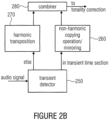
- Fig. 2b shows an improvement of the system illustrated in Fig. 2a , wherein a transient detector 250 is used which is implemented to determine whether a current temporal operation of the audio signal contains a transient portion.
- a transient portion consists in the fact that the audio signal changes a lot in total, i.e. that e.g. the energy of the audio signal changes by more than 50% from one temporal portion to the next temporal portion, i.e. increases or decreases.
- the 50% threshold is only an example, however, and it may also be smaller or greater values.
- the change of energy distribution may also be considered, e.g. in the conversion from a vocal to sibilant.
- the harmonic transposition is left, and for the transient time range, a switch it a non-harmonic copying operation or a non-harmonic mirroring or some other bandwidth extension algorithm is executed, as it is illustrated at 260. If it is then again detected that the audio signal is no longer transient, a harmonic transposition is again performed, as illustrated by the elements 102, 105 in Fig. 1 . This is illustrated at 270 in Fig. 2b .
- the output signals of blocks 270 and 260 which arrive offset in time due to the fact that a temporal portion of the audio signal may be either transient or non-transient, are supplied to a combiner 280 which is implemented to provide a bandpass signal over time which may, e.g., be supplied to the tonality correction in block 109a in Fig. 2a .
- the combination by block 280 may for example also be performed after the adder 111. This would mean, however, that for a whole transformation block of the audio signal, a transient characteristic is assumed, or if the filterbank implementation also operates based on blocks, for a whole such block a decision in favor of either transient or non-transient, respectively, is made.
- phase vocoder 202a, 202b, 202c As illustrated in Fig. 2a and explained in more detail in Figs. 5 and 6 , generates more artifacts in the processing of transient signal portions than in the processing of non-transient signal portions, a switch is performed to a non-harmonic copying operation or mirroring, as it was illustrated in Fig. 2b at 260. Alternatively, also a phase reset to the transient may be performed, as it is for example described in the expert's publication by Laroche cited above, or in the US Patent Number 6,549,884 .
- a spectral formation and an adjustment to the original measure of noise is performed.
- the spectral formation may take place, e.g. with the help of scale factors, dB(A)-weighted scale factors or a linear prediction, wherein there is the advantage in the linear prediction that no time/frequency conversion and no subsequent frequency/time conversion is required.
- the present invention is advantageous insofar that by the use of the phase vocoder, a spectrum with an increasing frequency is further spread and is always correctly harmonically continued by the integer spreading. Thus, the result of coarsenesses at the cut-off frequency of the LF range is excluded and interferences by too densely occupied HF portions of the spectrum are prevented. Further, efficient phase vocoder implementations may be used, which and may be done without filterbank patching operations.
- Pitch Synchronous Overlap Add in short PSOLA, is a synthesis method in which recordings of speech signals are located in the database. As far as these are periodic signals, the same are provided with information on the fundamental frequency (pitch) and the beginning of each period is marked. In the synthesis, these periods are cut out with a certain environment by means of a window function, and added to the signal to be synthesized at a suitable location: Depending on whether the desired fundamental frequency is higher or lower than that of the database entry, they are combined accordingly denser or less dense than in the original. For adjusting the duration of the audible, periods may be omitted or output in double.
- TD-PSOLA This method is also called TD-PSOLA, wherein TD stands for time domain and emphasizes that the methods operate in the time domain.
- MultiBand Resynthesis OverLap Add method in short MBROLA.
- the segments in the database are brought to a uniform fundamental frequency by a pre-processing and the phase position of the harmonic is normalized. By this, in the synthesis of a transition from a segment to the next, less perceptive interferences result and the achieved speech quality is higher.
- the audio signal is already bandpass filtered before spreading, so that the signal after spreading and decimation already contains the desired portions and the subsequent bandpass filtering may be omitted.
- the bandpass filter is set so that the portion of the audio signal which would have been filtered out after bandwidth extension is still contained in the output signal of the bandpass filter.
- the bandpass filter thus contains a frequency range which is not contained in the audio signal 106 after spreading and decimation.
- the signal with this frequency range is the desired signal forming the synthesized high-frequency signal.
- the distorter 109 will not distort a bandpass signal, but a spread and decimated signal derived from a bandpass filtered audio signal.
- the spread signal may also be helpful in the frequency range of the original signal, e.g. by mixing the original signal and spread signal, thus no "strict" passband is required.
- the spread signal may then well be mixed with the original signal in the frequency band in which it overlaps with the original signal regarding frequency, to modify the characteristic of the original signal in the overlapping range.
- distorting 109 and filtering 107 may be implemented in one single filter block or in two cascaded separate filters. As distorting takes place depending on the signal, the amplitude characteristic of this filter block will be variable. Its frequency characteristic is, however, independent of the signal.
- the overall audio signal may be spread, decimated, and then filtered, wherein filtering corresponds to the operations of the elements 107, 109. Distorting is thus executed after or simultaneously to filtering, wherein for this purpose a combined filter/distorter block in the form of a digital filter is suitable.
- a distortion may take place here when two different filter elements are used.
- a bandpass filtering may take place before spreading so that only the distortion (109) follows after the decimation.
- two different elements are preferred here.
- the distortion may take place after the combination of the synthesis signal with the original audio signal such as, for example, with a filter which has no, or only very little effect, on the signal to be filtered in the frequency range of the original filter, which, however, generates the desired envelope in the extended frequency range.
- the original audio signal such as, for example, with a filter which has no, or only very little effect, on the signal to be filtered in the frequency range of the original filter, which, however, generates the desired envelope in the extended frequency range.
- two different elements are preferably used for extraction and distortion.
- the inventive concept is suitable for all audio applications in which the full bandwidth is not available.
- the inventive concept may be used.
- the inventive method for a bandwidth extension of an audio signal may be implemented in hardware or in software.
- the implementation may be executed on a digital storage medium, in particular a floppy disc or a CD, having electronically readable control signals stored thereon, which may cooperate with the programmable computer system, such that the method is performed.
- the invention thus consists in a computer program product with a program code for executing the method stored on a machine-readable carrier, when the computer program product is executed on a computer.
- the invention may thus be realized as a computer program having a program code for performing the method, when the computer program is executed on a computer.
Landscapes
- Engineering & Computer Science (AREA)
- Acoustics & Sound (AREA)
- Computational Linguistics (AREA)
- Signal Processing (AREA)
- Health & Medical Sciences (AREA)
- Audiology, Speech & Language Pathology (AREA)
- Human Computer Interaction (AREA)
- Quality & Reliability (AREA)
- Multimedia (AREA)
- Physics & Mathematics (AREA)
- Compression, Expansion, Code Conversion, And Decoders (AREA)
- Stereophonic System (AREA)
- Transmission Systems Not Characterized By The Medium Used For Transmission (AREA)
- Radio Relay Systems (AREA)
- Reduction Or Emphasis Of Bandwidth Of Signals (AREA)
- Tone Control, Compression And Expansion, Limiting Amplitude (AREA)
Applications Claiming Priority (7)
| Application Number | Priority Date | Filing Date | Title |
|---|---|---|---|
| US2512908P | 2008-01-31 | 2008-01-31 | |
| DE102008015702A DE102008015702B4 (de) | 2008-01-31 | 2008-03-26 | Vorrichtung und Verfahren zur Bandbreitenerweiterung eines Audiosignals |
| EP24189266.0A EP4425492B1 (de) | 2008-01-31 | 2009-01-20 | Vorrichtung und verfahren zur bandbreitenerweiterung eines audiosignals |
| PCT/EP2009/000329 WO2009095169A1 (en) | 2008-01-31 | 2009-01-20 | Device and method for a bandwidth extension of an audio signal |
| EP22183878.2A EP4102503B1 (de) | 2008-01-31 | 2009-01-20 | Vorrichtung und verfahren zur bandbreitenerweiterung eines audiosignals |
| EP17186509.0A EP3264414B1 (de) | 2008-01-31 | 2009-01-20 | Vorrichtung und verfahren zur bandbreitenerweiterung eines audiosignals |
| EP09705824.2A EP2238591B1 (de) | 2008-01-31 | 2009-01-20 | Vorrichtung und verfahren zur bandbreitenerweiterung eines audiosignals |
Related Parent Applications (5)
| Application Number | Title | Priority Date | Filing Date |
|---|---|---|---|
| EP17186509.0A Division EP3264414B1 (de) | 2008-01-31 | 2009-01-20 | Vorrichtung und verfahren zur bandbreitenerweiterung eines audiosignals |
| EP09705824.2A Division EP2238591B1 (de) | 2008-01-31 | 2009-01-20 | Vorrichtung und verfahren zur bandbreitenerweiterung eines audiosignals |
| EP24189266.0A Division-Into EP4425492B1 (de) | 2008-01-31 | 2009-01-20 | Vorrichtung und verfahren zur bandbreitenerweiterung eines audiosignals |
| EP24189266.0A Division EP4425492B1 (de) | 2008-01-31 | 2009-01-20 | Vorrichtung und verfahren zur bandbreitenerweiterung eines audiosignals |
| EP22183878.2A Division EP4102503B1 (de) | 2008-01-31 | 2009-01-20 | Vorrichtung und verfahren zur bandbreitenerweiterung eines audiosignals |
Publications (4)
| Publication Number | Publication Date |
|---|---|
| EP4510130A2 true EP4510130A2 (de) | 2025-02-19 |
| EP4510130A3 EP4510130A3 (de) | 2025-03-26 |
| EP4510130C0 EP4510130C0 (de) | 2025-08-13 |
| EP4510130B1 EP4510130B1 (de) | 2025-08-13 |
Family
ID=40822253
Family Applications (11)
| Application Number | Title | Priority Date | Filing Date |
|---|---|---|---|
| EP17186509.0A Active EP3264414B1 (de) | 2008-01-31 | 2009-01-20 | Vorrichtung und verfahren zur bandbreitenerweiterung eines audiosignals |
| EP24212481.6A Active EP4510130B1 (de) | 2008-01-31 | 2009-01-20 | Verfahren zur dekodierung mit bandbreitenerweiterung eines audiosignals |
| EP24211480.9A Active EP4503027B1 (de) | 2008-01-31 | 2009-01-20 | Decoder zur bandbreitenerweiterung eines audiosignals |
| EP22183878.2A Active EP4102503B1 (de) | 2008-01-31 | 2009-01-20 | Vorrichtung und verfahren zur bandbreitenerweiterung eines audiosignals |
| EP24211471.8A Active EP4503026B1 (de) | 2008-01-31 | 2009-01-20 | Verfahren zur bandbreitenerweiterung eines audiosignals |
| EP24212471.7A Active EP4528731B1 (de) | 2008-01-31 | 2009-01-20 | Verfahren zur dekodierung mit bandbreitenerweiterung eines audiosignals |
| EP24212474.1A Active EP4485460B1 (de) | 2008-01-31 | 2009-01-20 | Vorrichtung und verfahren zur bandbreitenerweiterung eines audiosignals |
| EP09705824.2A Active EP2238591B1 (de) | 2008-01-31 | 2009-01-20 | Vorrichtung und verfahren zur bandbreitenerweiterung eines audiosignals |
| EP24211487.4A Active EP4481736B1 (de) | 2008-01-31 | 2009-01-20 | Verfahren zur bandbreitenerweiterung eines audiosignals |
| EP24212469.1A Active EP4481737B1 (de) | 2008-01-31 | 2009-01-20 | Vorrichtung und verfahren zur bandbreitenerweiterung eines audiosignals |
| EP24189266.0A Active EP4425492B1 (de) | 2008-01-31 | 2009-01-20 | Vorrichtung und verfahren zur bandbreitenerweiterung eines audiosignals |
Family Applications Before (1)
| Application Number | Title | Priority Date | Filing Date |
|---|---|---|---|
| EP17186509.0A Active EP3264414B1 (de) | 2008-01-31 | 2009-01-20 | Vorrichtung und verfahren zur bandbreitenerweiterung eines audiosignals |
Family Applications After (9)
| Application Number | Title | Priority Date | Filing Date |
|---|---|---|---|
| EP24211480.9A Active EP4503027B1 (de) | 2008-01-31 | 2009-01-20 | Decoder zur bandbreitenerweiterung eines audiosignals |
| EP22183878.2A Active EP4102503B1 (de) | 2008-01-31 | 2009-01-20 | Vorrichtung und verfahren zur bandbreitenerweiterung eines audiosignals |
| EP24211471.8A Active EP4503026B1 (de) | 2008-01-31 | 2009-01-20 | Verfahren zur bandbreitenerweiterung eines audiosignals |
| EP24212471.7A Active EP4528731B1 (de) | 2008-01-31 | 2009-01-20 | Verfahren zur dekodierung mit bandbreitenerweiterung eines audiosignals |
| EP24212474.1A Active EP4485460B1 (de) | 2008-01-31 | 2009-01-20 | Vorrichtung und verfahren zur bandbreitenerweiterung eines audiosignals |
| EP09705824.2A Active EP2238591B1 (de) | 2008-01-31 | 2009-01-20 | Vorrichtung und verfahren zur bandbreitenerweiterung eines audiosignals |
| EP24211487.4A Active EP4481736B1 (de) | 2008-01-31 | 2009-01-20 | Verfahren zur bandbreitenerweiterung eines audiosignals |
| EP24212469.1A Active EP4481737B1 (de) | 2008-01-31 | 2009-01-20 | Vorrichtung und verfahren zur bandbreitenerweiterung eines audiosignals |
| EP24189266.0A Active EP4425492B1 (de) | 2008-01-31 | 2009-01-20 | Vorrichtung und verfahren zur bandbreitenerweiterung eines audiosignals |
Country Status (18)
| Country | Link |
|---|---|
| US (1) | US8996362B2 (de) |
| EP (11) | EP3264414B1 (de) |
| JP (1) | JP5192053B2 (de) |
| KR (1) | KR101164351B1 (de) |
| CN (1) | CN101933087B (de) |
| AU (1) | AU2009210303B2 (de) |
| BR (1) | BRPI0905795B1 (de) |
| CA (1) | CA2713744C (de) |
| DE (1) | DE102008015702B4 (de) |
| DK (1) | DK3264414T3 (de) |
| ES (9) | ES3049189T3 (de) |
| HU (2) | HUE070312T2 (de) |
| MX (1) | MX2010008378A (de) |
| PL (3) | PL4102503T3 (de) |
| PT (1) | PT3264414T (de) |
| RU (1) | RU2455710C2 (de) |
| TW (1) | TWI515721B (de) |
| WO (1) | WO2009095169A1 (de) |
Families Citing this family (52)
| Publication number | Priority date | Publication date | Assignee | Title |
|---|---|---|---|---|
| US8880410B2 (en) * | 2008-07-11 | 2014-11-04 | Fraunhofer-Gesellschaft Zur Foerderung Der Angewandten Forschung E.V. | Apparatus and method for generating a bandwidth extended signal |
| USRE47180E1 (en) * | 2008-07-11 | 2018-12-25 | Fraunhofer-Gesellschaft Zur Foerderung Der Angewandten Forschung E.V. | Apparatus and method for generating a bandwidth extended signal |
| PL2945159T3 (pl) | 2008-12-15 | 2018-08-31 | Fraunhofer-Gesellschaft zur Förderung der angewandten Forschung e.V. | Koder audio i dekoder powiększania szerokości pasma |
| EP2953131B1 (de) | 2009-01-28 | 2017-07-26 | Dolby International AB | Verbesserte harmonische transposition |
| ES3010456T3 (en) | 2009-01-28 | 2025-04-03 | Dolby Int Ab | Improved harmonic transposition |
| US8515768B2 (en) * | 2009-08-31 | 2013-08-20 | Apple Inc. | Enhanced audio decoder |
| KR101701759B1 (ko) * | 2009-09-18 | 2017-02-03 | 돌비 인터네셔널 에이비 | 입력 신호를 전위시키기 위한 시스템 및 방법, 및 상기 방법을 수행하기 위한 컴퓨터 프로그램이 기록된 컴퓨터 판독가능 저장 매체 |
| ES2461172T3 (es) * | 2009-10-21 | 2014-05-19 | Dolby International Ab | Aparato y procedimiento para generar una señal de audio de alta frecuencia usando sobremuestreo adaptativo |
| KR102478321B1 (ko) | 2010-01-19 | 2022-12-19 | 돌비 인터네셔널 에이비 | 고조파 전위에 기초하여 개선된 서브밴드 블록 |
| KR101483157B1 (ko) * | 2010-03-09 | 2015-01-15 | 프라운호퍼 게젤샤프트 쭈르 푀르데룽 데어 안겐반텐 포르슝 에. 베. | 오디오 신호들의 대역폭 연장에 기반한 위상 보코더의 개선된 크기 응답과 시간적 정렬을 위한 방법과 장치 |
| BR112012022577B1 (pt) * | 2010-03-09 | 2021-06-29 | Fraunhofer-Gesellschaft Zur Forderung Der Angewandten Forschung E.V. | Aparelho e método para manipular eventos sonoros transientes em sinais de áudio ao alterar a velocidade ou tom da repetição |
| KR101414736B1 (ko) | 2010-03-09 | 2014-08-06 | 프라운호퍼 게젤샤프트 쭈르 푀르데룽 데어 안겐반텐 포르슝 에. 베. | 캐스케이드 필터뱅크들을 이용한 입력 오디오 신호를 처리하는 장치 및 방법 |
| EP2388780A1 (de) | 2010-05-19 | 2011-11-23 | Fraunhofer-Gesellschaft zur Förderung der Angewandten Forschung e.V. | Vorrichtung und Verfahren zur Verlängerung oder Komprimierung von Zeitabschnitten eines Audiosignals |
| MX2012001696A (es) | 2010-06-09 | 2012-02-22 | Panasonic Corp | Metodo de extension de ancho de banda, aparato de extension de ancho de banda, programa, circuito integrado, y aparato de descodificacion de audio. |
| KR102095385B1 (ko) * | 2010-07-19 | 2020-03-31 | 돌비 인터네셔널 에이비 | 고주파 복원 동안 오디오 신호들의 프로세싱 |
| CN102610231B (zh) * | 2011-01-24 | 2013-10-09 | 华为技术有限公司 | 一种带宽扩展方法及装置 |
| ES2715191T3 (es) | 2011-02-14 | 2019-06-03 | Fraunhofer Ges Forschung | Codificación y decodificación de posiciones de impulso de pistas de una señal de audio |
| EP2676270B1 (de) | 2011-02-14 | 2017-02-01 | Fraunhofer-Gesellschaft zur Förderung der angewandten Forschung e.V. | Kodierung eines teils eines audiosignals anhand einer transientendetektion und eines qualitätsergebnisses |
| AU2012217158B2 (en) | 2011-02-14 | 2014-02-27 | Fraunhofer-Gesellschaft Zur Foerderung Der Angewandten Forschung E.V. | Information signal representation using lapped transform |
| ES2534972T3 (es) | 2011-02-14 | 2015-04-30 | Fraunhofer-Gesellschaft zur Förderung der angewandten Forschung e.V. | Predicción lineal basada en esquema de codificación utilizando conformación de ruido de dominio espectral |
| SG192734A1 (en) | 2011-02-14 | 2013-09-30 | Fraunhofer Ges Forschung | Apparatus and method for error concealment in low-delay unified speech and audio coding (usac) |
| EP2676268B1 (de) | 2011-02-14 | 2014-12-03 | Fraunhofer-Gesellschaft zur Förderung der angewandten Forschung e.V. | Vorrichtung und verfahren zur verarbeitung eines dekodierten audiosignals in einem spektralbereich |
| WO2012131438A1 (en) * | 2011-03-31 | 2012-10-04 | Nokia Corporation | A low band bandwidth extender |
| JP2013007944A (ja) * | 2011-06-27 | 2013-01-10 | Sony Corp | 信号処理装置、信号処理方法、及び、プログラム |
| US20130006644A1 (en) * | 2011-06-30 | 2013-01-03 | Zte Corporation | Method and device for spectral band replication, and method and system for audio decoding |
| MX350686B (es) | 2012-01-20 | 2017-09-13 | Fraunhofer Ges Forschung | Aparato y método para la codificación y decodificación de audio que emplea sustitución sinusoidal. |
| MY197538A (en) * | 2012-03-29 | 2023-06-22 | Ericsson Telefon Ab L M | Bandwidth extension of harmonic audio signal |
| EP2709106A1 (de) * | 2012-09-17 | 2014-03-19 | Fraunhofer-Gesellschaft zur Förderung der angewandten Forschung e.V. | Vorrichtung und Verfahren zur Erzeugung eines bandbreitenerweiterten Signals aus einer Bandbreite mit eingeschränktem Audiosignal |
| US9258428B2 (en) | 2012-12-18 | 2016-02-09 | Cisco Technology, Inc. | Audio bandwidth extension for conferencing |
| CN103971693B (zh) * | 2013-01-29 | 2017-02-22 | 华为技术有限公司 | 高频带信号的预测方法、编/解码设备 |
| MX372749B (es) | 2013-01-29 | 2020-05-26 | Fraunhofer Ges Forschung | Decodificador para generar una señal de audio mejorada en frecuencia, metodo de decodificacion, codificador para generar una señal codificada y metodo de codificacion utilizando informacion secundaria de seleccion compacta. |
| BR112015017632B1 (pt) | 2013-01-29 | 2022-06-07 | Fraunhofer-Gesellschaft zur Förderung der angewandten Forschung e. V. | Aparelho e método para gerar um sinal melhorado da frequência utilizando nivelamento temporal de sub-bandas |
| KR101463022B1 (ko) * | 2013-01-31 | 2014-11-18 | (주)루먼텍 | 광대역 가변 대역폭 채널 필터 및 그 필터링 방법 |
| US9666202B2 (en) | 2013-09-10 | 2017-05-30 | Huawei Technologies Co., Ltd. | Adaptive bandwidth extension and apparatus for the same |
| WO2015105775A1 (en) * | 2014-01-07 | 2015-07-16 | Harman International Industries, Incorporated | Signal quality-based enhancement and compensation of compressed audio signals |
| FR3017484A1 (fr) * | 2014-02-07 | 2015-08-14 | Orange | Extension amelioree de bande de frequence dans un decodeur de signaux audiofrequences |
| ES2975073T3 (es) * | 2014-03-31 | 2024-07-03 | Fraunhofer Ges Forschung | Codificador, descodificador, procedimiento de codificación, procedimiento de descodificación y programa |
| US10847170B2 (en) | 2015-06-18 | 2020-11-24 | Qualcomm Incorporated | Device and method for generating a high-band signal from non-linearly processed sub-ranges |
| EP3182411A1 (de) * | 2015-12-14 | 2017-06-21 | Fraunhofer-Gesellschaft zur Förderung der angewandten Forschung e.V. | Vorrichtung und verfahren zur verarbeitung eines codierten audiosignals |
| US10074373B2 (en) * | 2015-12-21 | 2018-09-11 | Qualcomm Incorporated | Channel adjustment for inter-frame temporal shift variations |
| US10008218B2 (en) | 2016-08-03 | 2018-06-26 | Dolby Laboratories Licensing Corporation | Blind bandwidth extension using K-means and a support vector machine |
| EP3382702A1 (de) | 2017-03-31 | 2018-10-03 | Fraunhofer-Gesellschaft zur Förderung der angewandten Forschung e.V. | Vorrichtung und verfahren zur bestimmung einer im voraus bestimmten eigenschaft bezüglich der künstlichen bandbreitenbeschränkungsverarbeitung eines audiosignals |
| EP3435376B1 (de) * | 2017-07-28 | 2020-01-22 | Fujitsu Limited | Audiocodierungsvorrichtung und audiocodierungsverfahren |
| US10872611B2 (en) * | 2017-09-12 | 2020-12-22 | Qualcomm Incorporated | Selecting channel adjustment method for inter-frame temporal shift variations |
| EP3701527B1 (de) | 2017-10-27 | 2023-08-30 | Fraunhofer-Gesellschaft zur Förderung der angewandten Forschung e.V. | Vorrichtung, verfahren oder computerprogramm zur erzeugung eines bandbreitenverstärkten audiosignals unter verwendung eines neuronalen netzwerkprozessors |
| US11771779B2 (en) | 2018-01-26 | 2023-10-03 | Hadasit Medical Research Services & Development Limited | Non-metallic magnetic resonance contrast agent |
| JP7252976B2 (ja) | 2018-04-25 | 2023-04-05 | ドルビー・インターナショナル・アーベー | 後処理遅延低減との高周波再構成技術の統合 |
| IL319703A (en) | 2018-04-25 | 2025-05-01 | Dolby Int Ab | Combining high-frequency reconstruction techniques with reduced post-processing delay |
| CN115132214A (zh) * | 2018-06-29 | 2022-09-30 | 华为技术有限公司 | 立体声信号的编码、解码方法、编码装置和解码装置 |
| US11100941B2 (en) * | 2018-08-21 | 2021-08-24 | Krisp Technologies, Inc. | Speech enhancement and noise suppression systems and methods |
| EP3671741A1 (de) * | 2018-12-21 | 2020-06-24 | FRAUNHOFER-GESELLSCHAFT zur Förderung der angewandten Forschung e.V. | Audioprozessor und verfahren zum erzeugen eines frequenzverbesserten audiosignals mittels impulsverarbeitung |
| CN111786674B (zh) * | 2020-07-09 | 2022-08-16 | 北京大学 | 一种模数转换系统模拟带宽扩展的方法及系统 |
Citations (4)
| Publication number | Priority date | Publication date | Assignee | Title |
|---|---|---|---|---|
| US5455888A (en) | 1992-12-04 | 1995-10-03 | Northern Telecom Limited | Speech bandwidth extension method and apparatus |
| WO1998057436A2 (en) | 1997-06-10 | 1998-12-17 | Lars Gustaf Liljeryd | Source coding enhancement using spectral-band replication |
| US6549884B1 (en) | 1999-09-21 | 2003-04-15 | Creative Technology Ltd. | Phase-vocoder pitch-shifting |
| US6895375B2 (en) | 2001-10-04 | 2005-05-17 | At&T Corp. | System for bandwidth extension of Narrow-band speech |
Family Cites Families (14)
| Publication number | Priority date | Publication date | Assignee | Title |
|---|---|---|---|---|
| JPH10124088A (ja) | 1996-10-24 | 1998-05-15 | Sony Corp | 音声帯域幅拡張装置及び方法 |
| JP3946812B2 (ja) * | 1997-05-12 | 2007-07-18 | ソニー株式会社 | オーディオ信号変換装置及びオーディオ信号変換方法 |
| JPH11215006A (ja) * | 1998-01-29 | 1999-08-06 | Olympus Optical Co Ltd | ディジタル音声信号の送信装置及び受信装置 |
| US20030156624A1 (en) | 2002-02-08 | 2003-08-21 | Koslar | Signal transmission method with frequency and time spreading |
| CN1812280A (zh) | 2000-03-23 | 2006-08-02 | 交互数字技术公司 | 用于扩频通信系统的有效扩频器 |
| EP1431962B1 (de) * | 2000-05-22 | 2006-04-05 | Texas Instruments Incorporated | Vorrichtung und Verfahren zur Breitbandcodierung von Sprachsignalen |
| SE0001926D0 (sv) | 2000-05-23 | 2000-05-23 | Lars Liljeryd | Improved spectral translation/folding in the subband domain |
| DE60230856D1 (de) * | 2001-07-13 | 2009-03-05 | Panasonic Corp | Audiosignaldecodierungseinrichtung und audiosignalcodierungseinrichtung |
| JP4567412B2 (ja) * | 2004-10-25 | 2010-10-20 | アルパイン株式会社 | 音声再生機および音声再生方法 |
| JP2006243043A (ja) * | 2005-02-28 | 2006-09-14 | Sanyo Electric Co Ltd | 高域補間装置及び再生装置 |
| JP2006243041A (ja) * | 2005-02-28 | 2006-09-14 | Yutaka Yamamoto | 高域補間装置及び再生装置 |
| MX2007012185A (es) | 2005-04-01 | 2007-12-11 | Qualcomm Inc | Metodo y aparato para cuantificacion de vector de una representacion de envoltura espectral. |
| JP4701392B2 (ja) * | 2005-07-20 | 2011-06-15 | 国立大学法人九州工業大学 | 高域信号補間方法及び高域信号補間装置 |
| WO2012113035A1 (en) | 2011-02-25 | 2012-08-30 | Polyline Piping Systems Pty Ltd | Mobile plastics extrusion plant |
-
2008
- 2008-03-26 DE DE102008015702A patent/DE102008015702B4/de active Active
-
2009
- 2009-01-20 CA CA2713744A patent/CA2713744C/en active Active
- 2009-01-20 EP EP17186509.0A patent/EP3264414B1/de active Active
- 2009-01-20 EP EP24212481.6A patent/EP4510130B1/de active Active
- 2009-01-20 EP EP24211480.9A patent/EP4503027B1/de active Active
- 2009-01-20 ES ES24211487T patent/ES3049189T3/es active Active
- 2009-01-20 EP EP22183878.2A patent/EP4102503B1/de active Active
- 2009-01-20 MX MX2010008378A patent/MX2010008378A/es active IP Right Grant
- 2009-01-20 EP EP24211471.8A patent/EP4503026B1/de active Active
- 2009-01-20 US US12/865,096 patent/US8996362B2/en active Active
- 2009-01-20 EP EP24212471.7A patent/EP4528731B1/de active Active
- 2009-01-20 DK DK17186509.0T patent/DK3264414T3/da active
- 2009-01-20 ES ES24212471T patent/ES3049191T3/es active Active
- 2009-01-20 PL PL22183878.2T patent/PL4102503T3/pl unknown
- 2009-01-20 EP EP24212474.1A patent/EP4485460B1/de active Active
- 2009-01-20 EP EP09705824.2A patent/EP2238591B1/de active Active
- 2009-01-20 AU AU2009210303A patent/AU2009210303B2/en active Active
- 2009-01-20 HU HUE24189266A patent/HUE070312T2/hu unknown
- 2009-01-20 EP EP24211487.4A patent/EP4481736B1/de active Active
- 2009-01-20 ES ES24189266T patent/ES3017561T3/es active Active
- 2009-01-20 JP JP2010544618A patent/JP5192053B2/ja active Active
- 2009-01-20 WO PCT/EP2009/000329 patent/WO2009095169A1/en not_active Ceased
- 2009-01-20 ES ES17186509T patent/ES2925696T3/es active Active
- 2009-01-20 PT PT171865090T patent/PT3264414T/pt unknown
- 2009-01-20 EP EP24212469.1A patent/EP4481737B1/de active Active
- 2009-01-20 CN CN200980103756.6A patent/CN101933087B/zh active Active
- 2009-01-20 EP EP24189266.0A patent/EP4425492B1/de active Active
- 2009-01-20 ES ES09705824.2T patent/ES2649012T3/es active Active
- 2009-01-20 PL PL24189266.0T patent/PL4425492T3/pl unknown
- 2009-01-20 BR BRPI0905795A patent/BRPI0905795B1/pt active IP Right Grant
- 2009-01-20 HU HUE22183878A patent/HUE067868T2/hu unknown
- 2009-01-20 ES ES24212469T patent/ES3049190T3/es active Active
- 2009-01-20 ES ES24212481T patent/ES3049193T3/es active Active
- 2009-01-20 ES ES22183878T patent/ES2988633T3/es active Active
- 2009-01-20 ES ES24212474T patent/ES3049192T3/es active Active
- 2009-01-20 PL PL17186509.0T patent/PL3264414T3/pl unknown
- 2009-01-20 KR KR1020107017069A patent/KR101164351B1/ko active Active
- 2009-01-20 RU RU2010131420/08A patent/RU2455710C2/ru active
- 2009-01-23 TW TW098102983A patent/TWI515721B/zh active
Patent Citations (4)
| Publication number | Priority date | Publication date | Assignee | Title |
|---|---|---|---|---|
| US5455888A (en) | 1992-12-04 | 1995-10-03 | Northern Telecom Limited | Speech bandwidth extension method and apparatus |
| WO1998057436A2 (en) | 1997-06-10 | 1998-12-17 | Lars Gustaf Liljeryd | Source coding enhancement using spectral-band replication |
| US6549884B1 (en) | 1999-09-21 | 2003-04-15 | Creative Technology Ltd. | Phase-vocoder pitch-shifting |
| US6895375B2 (en) | 2001-10-04 | 2005-05-17 | At&T Corp. | System for bandwidth extension of Narrow-band speech |
Non-Patent Citations (16)
| Title |
|---|
| "Bandwidth Extension", INTERNATIONAL STANDARD ISO/IEC 14496-3:2001/FPDAM 1, 2002 |
| A. RÖBEL: "New approached to transient processing interphase vocoder", PROCEEDING OF THE 6TH INTERNATIONAL CONFERENCE ON DIGITAL AUDIO EFFECTS (DAFX-03, 8 September 2003 (2003-09-08), pages 1 - 6 |
| E. LARSENR.M. AARTS: "Signal Processing and Loudspeaker Design", 2004, JOHN WILEY & SONS, LTD., article "Audio Bandwidth Extension - Application to psychoacoustics" |
| E. LARSENR.M. AARTSM. DANESSIS: "AES 112th Convention", May 2002, article "Efficient high-frequency bandwidth extension of music and speech" |
| E. LARSENR.M. AARTSM. DANESSIS: "Efficient high-frequency bandwidth extension of music and speech", AES 112TH CONVENTION, May 2002 (2002-05-01) |
| ERIK LARSENRONALD M. AARTS: "Audio bandwidth extension", 6 December 2005, JOHN WILEY & SONS |
| J. MAKHOUL: "Spectral Analysis of Speech by Linear Prediction", IEEE TRANSACTIONS ON AUDIO AND ELECTROACOUSTICS, June 1973 (1973-06-01) |
| J. MAKINEN ET AL.: "ICASSP '05", IEEE, article "AMR-WB+: a new audio coding standard for 3rd generation mobile audio services Broadcasts" |
| K. KAVYHKOA ROBUST: "Research Report", 2001, HELSINKI UNIVERSITY OF TECHNOLOGY, article "Wideband Enhancement for Narrowband Speech Signal" |
| L. LAROCHE ,M. DOLSON: "New phase Vocoder techniques for pitch-shifting, harmonizing and other exotic effects", PROCEEDINGS 1999 IEEE WORKSHOP ON APPLICATIONS OF SIGNAL PROCESSING TO AUDIO AND ACOUSTICS, 17 October 1999 (1999-10-17), pages 91 - 94, XP010365068, DOI: 10.1109/ASPAA.1999.810857 |
| M. DIETZL. LILJERYDK. KJORLING0. KUNZ: "Spectral Band Replication, a novel approach in audio coding", 112TH AES CONVENTION, May 2002 (2002-05-01) |
| MARK DOLSON: "The phase Vocoder: A tutorial", COMPUTER MUSIC JOURNAL, vol. 10, no. 4, 1986, pages 14 - 27, XP009029676 |
| MELLER PUCKETTE: "Phase-locked Vocoder", IEEE ASSP, CONFERENCE ON APPLICATIONS OF SIGNAL PROCESSING TO AUDIO AND ACOUSTICS, 1995 |
| R.M. AARTSE. LARSENO. OUWELTJES: "A unified approach to low- and high frequency bandwidth extension", AES 115TH CONVENTION, October 2003 (2003-10-01) |
| S. MELTZERR. BOHMF. HENN: "SBR enhanced audio codecs for digital broadcasting such as ''Digital Radio Mondiale'' (DRM", 112TH AES CONVENTION, May 2002 (2002-05-01) |
| T. ZIEGLERA. EHRETP. EKSTRANDM. LUTZKY: "Enhancing mp3 with SBR: Features and Capabilities of the new mp3PRO Algorithm", 112TH AES CONVENTION, May 2002 (2002-05-01) |
Also Published As
Similar Documents
| Publication | Publication Date | Title |
|---|---|---|
| EP4510130B1 (de) | Verfahren zur dekodierung mit bandbreitenerweiterung eines audiosignals | |
| HK40121687A (en) | Method of decoding comprising a bandwidth extension of an audio signal | |
| HK40119386B (en) | Method of decoding comprising a bandwidth extension of an audio signal | |
| HK40119386A (en) | Method of decoding comprising a bandwidth extension of an audio signal | |
| HK40116426A (en) | Method for a bandwidth extension of an audio signal | |
| HK40119661A (en) | Device and method for a bandwidth extension of an audio signal | |
| HK40119661B (en) | Device and method for a bandwidth extension of an audio signal | |
| HK40117877A (en) | Device and method for a bandwidth extension of an audio signal | |
| HK40117877B (en) | Device and method for a bandwidth extension of an audio signal | |
| HK40118371A (en) | Device and method for a bandwidth extension of an audio signal | |
| HK40118371B (en) | Device and method for a bandwidth extension of an audio signal | |
| HK40119674A (en) | Device for a bandwidth extension of an audio signal | |
| HK40117685A (en) | Device and method for a bandwidth extension of an audio signal | |
| HK40117685B (en) | Device and method for a bandwidth extension of an audio signal | |
| HK40086036A (en) | Device and method for a bandwidth extension of an audio signal | |
| HK1248912B (en) | Device and method for a bandwidth extension of an audio signal | |
| HK1149623A (en) | Device and method for a bandwidth extension of an audio signal | |
| HK1149623B (en) | Device and method for a bandwidth extension of an audio signal |
Legal Events
| Date | Code | Title | Description |
|---|---|---|---|
| PUAI | Public reference made under article 153(3) epc to a published international application that has entered the european phase |
Free format text: ORIGINAL CODE: 0009012 |
|
| STAA | Information on the status of an ep patent application or granted ep patent |
Free format text: STATUS: REQUEST FOR EXAMINATION WAS MADE |
|
| 17P | Request for examination filed |
Effective date: 20241112 |
|
| AC | Divisional application: reference to earlier application |
Ref document number: 2238591 Country of ref document: EP Kind code of ref document: P Ref document number: 3264414 Country of ref document: EP Kind code of ref document: P Ref document number: 4102503 Country of ref document: EP Kind code of ref document: P Ref document number: 4425492 Country of ref document: EP Kind code of ref document: P |
|
| AK | Designated contracting states |
Kind code of ref document: A2 Designated state(s): AT BE BG CH CY CZ DE DK EE ES FI FR GB GR HR HU IE IS IT LI LT LU LV MC MK MT NL NO PL PT RO SE SI SK TR |
|
| PUAL | Search report despatched |
Free format text: ORIGINAL CODE: 0009013 |
|
| STAA | Information on the status of an ep patent application or granted ep patent |
Free format text: STATUS: EXAMINATION IS IN PROGRESS |
|
| AK | Designated contracting states |
Kind code of ref document: A3 Designated state(s): AT BE BG CH CY CZ DE DK EE ES FI FR GB GR HR HU IE IS IT LI LT LU LV MC MK MT NL NO PL PT RO SE SI SK TR |
|
| RIC1 | Information provided on ipc code assigned before grant |
Ipc: G10L 21/038 20130101AFI20250220BHEP |
|
| 17Q | First examination report despatched |
Effective date: 20250310 |
|
| GRAP | Despatch of communication of intention to grant a patent |
Free format text: ORIGINAL CODE: EPIDOSNIGR1 |
|
| STAA | Information on the status of an ep patent application or granted ep patent |
Free format text: STATUS: GRANT OF PATENT IS INTENDED |
|
| GRAS | Grant fee paid |
Free format text: ORIGINAL CODE: EPIDOSNIGR3 |
|
| GRAA | (expected) grant |
Free format text: ORIGINAL CODE: 0009210 |
|
| STAA | Information on the status of an ep patent application or granted ep patent |
Free format text: STATUS: THE PATENT HAS BEEN GRANTED |
|
| INTG | Intention to grant announced |
Effective date: 20250630 |
|
| AC | Divisional application: reference to earlier application |
Ref document number: 4425492 Country of ref document: EP Kind code of ref document: P Ref document number: 4102503 Country of ref document: EP Kind code of ref document: P Ref document number: 3264414 Country of ref document: EP Kind code of ref document: P Ref document number: 2238591 Country of ref document: EP Kind code of ref document: P |
|
| AK | Designated contracting states |
Kind code of ref document: B1 Designated state(s): AT BE BG CH CY CZ DE DK EE ES FI FR GB GR HR HU IE IS IT LI LT LU LV MC MK MT NL NO PL PT RO SE SI SK TR |
|
| REG | Reference to a national code |
Ref country code: GB Ref legal event code: FG4D |
|
| REG | Reference to a national code |
Ref country code: CH Ref legal event code: EP |
|
| REG | Reference to a national code |
Ref country code: DE Ref legal event code: R096 Ref document number: 602009065577 Country of ref document: DE |
|
| REG | Reference to a national code |
Ref country code: IE Ref legal event code: FG4D |
|
| REG | Reference to a national code |
Ref country code: HK Ref legal event code: DE Ref document number: 40121687 Country of ref document: HK |
|
| U01 | Request for unitary effect filed |
Effective date: 20250911 |
|
| REG | Reference to a national code |
Ref country code: CH Ref legal event code: R17 Free format text: ST27 STATUS EVENT CODE: U-0-0-R10-R17 (AS PROVIDED BY THE NATIONAL OFFICE) Effective date: 20251016 |
|
| U07 | Unitary effect registered |
Designated state(s): AT BE BG DE DK EE FI FR IT LT LU LV MT NL PT RO SE SI Effective date: 20250918 |
|
| REG | Reference to a national code |
Ref country code: GR Ref legal event code: EP Ref document number: 20250402310 Country of ref document: GR Effective date: 20251210 |
|
| REG | Reference to a national code |
Ref country code: ES Ref legal event code: FG2A Ref document number: 3049193 Country of ref document: ES Kind code of ref document: T3 Effective date: 20251215 |