EP4503263A1 - Verfahren zur wiederverwertung von positivelektrodenaktivmaterial und daraus recyceltes positivelektrodenaktivmaterial - Google Patents
Verfahren zur wiederverwertung von positivelektrodenaktivmaterial und daraus recyceltes positivelektrodenaktivmaterial Download PDFInfo
- Publication number
- EP4503263A1 EP4503263A1 EP23894987.9A EP23894987A EP4503263A1 EP 4503263 A1 EP4503263 A1 EP 4503263A1 EP 23894987 A EP23894987 A EP 23894987A EP 4503263 A1 EP4503263 A1 EP 4503263A1
- Authority
- EP
- European Patent Office
- Prior art keywords
- active material
- cathode active
- lithium
- recycled
- cathode
- Prior art date
- Legal status (The legal status is an assumption and is not a legal conclusion. Google has not performed a legal analysis and makes no representation as to the accuracy of the status listed.)
- Pending
Links
Images


Classifications
-
- H—ELECTRICITY
- H01—ELECTRIC ELEMENTS
- H01M—PROCESSES OR MEANS, e.g. BATTERIES, FOR THE DIRECT CONVERSION OF CHEMICAL ENERGY INTO ELECTRICAL ENERGY
- H01M10/00—Secondary cells; Manufacture thereof
- H01M10/54—Reclaiming serviceable parts of waste accumulators
-
- C—CHEMISTRY; METALLURGY
- C01—INORGANIC CHEMISTRY
- C01G—COMPOUNDS CONTAINING METALS NOT COVERED BY SUBCLASSES C01D OR C01F
- C01G53/00—Compounds of nickel
- C01G53/40—Complex oxides containing nickel and at least one other metal element
- C01G53/42—Complex oxides containing nickel and at least one other metal element containing alkali metals, e.g. LiNiO2
- C01G53/44—Complex oxides containing nickel and at least one other metal element containing alkali metals, e.g. LiNiO2 containing manganese
- C01G53/50—Complex oxides containing nickel and at least one other metal element containing alkali metals, e.g. LiNiO2 containing manganese of the type (MnO2)n-, e.g. Li(NixMn1-x)O2 or Li(MyNixMn1-x-y)O2
- C01G53/502—Complex oxides containing nickel and at least one other metal element containing alkali metals, e.g. LiNiO2 containing manganese of the type (MnO2)n-, e.g. Li(NixMn1-x)O2 or Li(MyNixMn1-x-y)O2 containing lithium and cobalt
- C01G53/504—Complex oxides containing nickel and at least one other metal element containing alkali metals, e.g. LiNiO2 containing manganese of the type (MnO2)n-, e.g. Li(NixMn1-x)O2 or Li(MyNixMn1-x-y)O2 containing lithium and cobalt with the molar ratio of nickel with respect to all the metals other than alkali metals higher than or equal to 0.5, e.g. Li(MzNixCoyMn1-x-y-z)O2 with x ≥ 0.5
- C01G53/506—Complex oxides containing nickel and at least one other metal element containing alkali metals, e.g. LiNiO2 containing manganese of the type (MnO2)n-, e.g. Li(NixMn1-x)O2 or Li(MyNixMn1-x-y)O2 containing lithium and cobalt with the molar ratio of nickel with respect to all the metals other than alkali metals higher than or equal to 0.5, e.g. Li(MzNixCoyMn1-x-y-z)O2 with x ≥ 0.5 with the molar ratio of nickel with respect to all the metals other than alkali metals higher than or equal to 0.8, e.g. Li(MzNixCoyMn1-x-y-z)O2 with x ≥ 0.8
-
- C—CHEMISTRY; METALLURGY
- C01—INORGANIC CHEMISTRY
- C01G—COMPOUNDS CONTAINING METALS NOT COVERED BY SUBCLASSES C01D OR C01F
- C01G53/00—Compounds of nickel
- C01G53/40—Complex oxides containing nickel and at least one other metal element
-
- C—CHEMISTRY; METALLURGY
- C01—INORGANIC CHEMISTRY
- C01G—COMPOUNDS CONTAINING METALS NOT COVERED BY SUBCLASSES C01D OR C01F
- C01G53/00—Compounds of nickel
- C01G53/40—Complex oxides containing nickel and at least one other metal element
- C01G53/42—Complex oxides containing nickel and at least one other metal element containing alkali metals, e.g. LiNiO2
- C01G53/44—Complex oxides containing nickel and at least one other metal element containing alkali metals, e.g. LiNiO2 containing manganese
- C01G53/50—Complex oxides containing nickel and at least one other metal element containing alkali metals, e.g. LiNiO2 containing manganese of the type (MnO2)n-, e.g. Li(NixMn1-x)O2 or Li(MyNixMn1-x-y)O2
-
- C—CHEMISTRY; METALLURGY
- C22—METALLURGY; FERROUS OR NON-FERROUS ALLOYS; TREATMENT OF ALLOYS OR NON-FERROUS METALS
- C22B—PRODUCTION AND REFINING OF METALS; PRETREATMENT OF RAW MATERIALS
- C22B1/00—Preliminary treatment of ores or scrap
- C22B1/005—Preliminary treatment of scrap
-
- C—CHEMISTRY; METALLURGY
- C22—METALLURGY; FERROUS OR NON-FERROUS ALLOYS; TREATMENT OF ALLOYS OR NON-FERROUS METALS
- C22B—PRODUCTION AND REFINING OF METALS; PRETREATMENT OF RAW MATERIALS
- C22B7/00—Working up raw materials other than ores, e.g. scrap, to produce non-ferrous metals and compounds thereof; Methods of a general interest or applied to the winning of more than two metals
- C22B7/001—Dry processes
-
- H—ELECTRICITY
- H01—ELECTRIC ELEMENTS
- H01M—PROCESSES OR MEANS, e.g. BATTERIES, FOR THE DIRECT CONVERSION OF CHEMICAL ENERGY INTO ELECTRICAL ENERGY
- H01M10/00—Secondary cells; Manufacture thereof
- H01M10/05—Accumulators with non-aqueous electrolyte
- H01M10/052—Li-accumulators
-
- H—ELECTRICITY
- H01—ELECTRIC ELEMENTS
- H01M—PROCESSES OR MEANS, e.g. BATTERIES, FOR THE DIRECT CONVERSION OF CHEMICAL ENERGY INTO ELECTRICAL ENERGY
- H01M4/00—Electrodes
- H01M4/02—Electrodes composed of, or comprising, active material
- H01M4/13—Electrodes for accumulators with non-aqueous electrolyte, e.g. for lithium-accumulators; Processes of manufacture thereof
- H01M4/131—Electrodes based on mixed oxides or hydroxides, or on mixtures of oxides or hydroxides, e.g. LiCoOx
-
- H—ELECTRICITY
- H01—ELECTRIC ELEMENTS
- H01M—PROCESSES OR MEANS, e.g. BATTERIES, FOR THE DIRECT CONVERSION OF CHEMICAL ENERGY INTO ELECTRICAL ENERGY
- H01M4/00—Electrodes
- H01M4/02—Electrodes composed of, or comprising, active material
- H01M4/36—Selection of substances as active materials, active masses, active liquids
- H01M4/362—Composites
- H01M4/366—Composites as layered products
-
- H—ELECTRICITY
- H01—ELECTRIC ELEMENTS
- H01M—PROCESSES OR MEANS, e.g. BATTERIES, FOR THE DIRECT CONVERSION OF CHEMICAL ENERGY INTO ELECTRICAL ENERGY
- H01M4/00—Electrodes
- H01M4/02—Electrodes composed of, or comprising, active material
- H01M4/36—Selection of substances as active materials, active masses, active liquids
- H01M4/48—Selection of substances as active materials, active masses, active liquids of inorganic oxides or hydroxides
- H01M4/50—Selection of substances as active materials, active masses, active liquids of inorganic oxides or hydroxides of manganese
- H01M4/505—Selection of substances as active materials, active masses, active liquids of inorganic oxides or hydroxides of manganese of mixed oxides or hydroxides containing manganese for inserting or intercalating light metals, e.g. LiMn2O4 or LiMn2OxFy
-
- H—ELECTRICITY
- H01—ELECTRIC ELEMENTS
- H01M—PROCESSES OR MEANS, e.g. BATTERIES, FOR THE DIRECT CONVERSION OF CHEMICAL ENERGY INTO ELECTRICAL ENERGY
- H01M4/00—Electrodes
- H01M4/02—Electrodes composed of, or comprising, active material
- H01M4/36—Selection of substances as active materials, active masses, active liquids
- H01M4/48—Selection of substances as active materials, active masses, active liquids of inorganic oxides or hydroxides
- H01M4/52—Selection of substances as active materials, active masses, active liquids of inorganic oxides or hydroxides of nickel, cobalt or iron
- H01M4/525—Selection of substances as active materials, active masses, active liquids of inorganic oxides or hydroxides of nickel, cobalt or iron of mixed oxides or hydroxides containing iron, cobalt or nickel for inserting or intercalating light metals, e.g. LiNiO2, LiCoO2 or LiCoOxFy
-
- H—ELECTRICITY
- H01—ELECTRIC ELEMENTS
- H01M—PROCESSES OR MEANS, e.g. BATTERIES, FOR THE DIRECT CONVERSION OF CHEMICAL ENERGY INTO ELECTRICAL ENERGY
- H01M4/00—Electrodes
- H01M4/02—Electrodes composed of, or comprising, active material
- H01M4/36—Selection of substances as active materials, active masses, active liquids
- H01M4/58—Selection of substances as active materials, active masses, active liquids of inorganic compounds other than oxides or hydroxides, e.g. sulfides, selenides, tellurides, halogenides or LiCoFy; of polyanionic structures, e.g. phosphates, silicates or borates
- H01M4/5825—Oxygenated metallic salts or polyanionic structures, e.g. borates, phosphates, silicates, olivines
-
- H—ELECTRICITY
- H01—ELECTRIC ELEMENTS
- H01M—PROCESSES OR MEANS, e.g. BATTERIES, FOR THE DIRECT CONVERSION OF CHEMICAL ENERGY INTO ELECTRICAL ENERGY
- H01M4/00—Electrodes
- H01M4/02—Electrodes composed of, or comprising, active material
- H01M4/62—Selection of inactive substances as ingredients for active masses, e.g. binders, fillers
-
- C—CHEMISTRY; METALLURGY
- C01—INORGANIC CHEMISTRY
- C01P—INDEXING SCHEME RELATING TO STRUCTURAL AND PHYSICAL ASPECTS OF SOLID INORGANIC COMPOUNDS
- C01P2004/00—Particle morphology
- C01P2004/01—Particle morphology depicted by an image
- C01P2004/03—Particle morphology depicted by an image obtained by SEM
-
- C—CHEMISTRY; METALLURGY
- C01—INORGANIC CHEMISTRY
- C01P—INDEXING SCHEME RELATING TO STRUCTURAL AND PHYSICAL ASPECTS OF SOLID INORGANIC COMPOUNDS
- C01P2004/00—Particle morphology
- C01P2004/80—Particles consisting of a mixture of two or more inorganic phases
-
- C—CHEMISTRY; METALLURGY
- C01—INORGANIC CHEMISTRY
- C01P—INDEXING SCHEME RELATING TO STRUCTURAL AND PHYSICAL ASPECTS OF SOLID INORGANIC COMPOUNDS
- C01P2006/00—Physical properties of inorganic compounds
- C01P2006/40—Electric properties
-
- C—CHEMISTRY; METALLURGY
- C01—INORGANIC CHEMISTRY
- C01P—INDEXING SCHEME RELATING TO STRUCTURAL AND PHYSICAL ASPECTS OF SOLID INORGANIC COMPOUNDS
- C01P2006/00—Physical properties of inorganic compounds
- C01P2006/80—Compositional purity
-
- C—CHEMISTRY; METALLURGY
- C01—INORGANIC CHEMISTRY
- C01P—INDEXING SCHEME RELATING TO STRUCTURAL AND PHYSICAL ASPECTS OF SOLID INORGANIC COMPOUNDS
- C01P2006/00—Physical properties of inorganic compounds
- C01P2006/80—Compositional purity
- C01P2006/82—Compositional purity water content
-
- H—ELECTRICITY
- H01—ELECTRIC ELEMENTS
- H01M—PROCESSES OR MEANS, e.g. BATTERIES, FOR THE DIRECT CONVERSION OF CHEMICAL ENERGY INTO ELECTRICAL ENERGY
- H01M4/00—Electrodes
- H01M4/02—Electrodes composed of, or comprising, active material
- H01M2004/026—Electrodes composed of, or comprising, active material characterised by the polarity
- H01M2004/028—Positive electrodes
-
- Y—GENERAL TAGGING OF NEW TECHNOLOGICAL DEVELOPMENTS; GENERAL TAGGING OF CROSS-SECTIONAL TECHNOLOGIES SPANNING OVER SEVERAL SECTIONS OF THE IPC; TECHNICAL SUBJECTS COVERED BY FORMER USPC CROSS-REFERENCE ART COLLECTIONS [XRACs] AND DIGESTS
- Y02—TECHNOLOGIES OR APPLICATIONS FOR MITIGATION OR ADAPTATION AGAINST CLIMATE CHANGE
- Y02W—CLIMATE CHANGE MITIGATION TECHNOLOGIES RELATED TO WASTEWATER TREATMENT OR WASTE MANAGEMENT
- Y02W30/00—Technologies for solid waste management
- Y02W30/50—Reuse, recycling or recovery technologies
- Y02W30/84—Recycling of batteries or fuel cells
Definitions
- the present invention relates to a method of recycling a cathode active material and a recycled cathode active material prepared using the method. More particularly, the present invention relates to a method of recycling a cathode active material, the method being capable of minimizing the residual amount of fluorine (F) and improving the capacity characteristics of a secondary battery by adjusting the moisture content of a cathode active material immediately before an annealing step within a predetermined range; being environmentally friendly; being capable of preventing generation of toxic gases or explosion; and being capable of greatly improving economics and productivity and a recycled cathode active material prepared using the method and having excellent electrochemical performance, resistance characteristics, and capacity characteristics.
- F fluorine
- a lithium secondary battery consists of a cathode formed by coating a metal foil, such as aluminum, with a cathode active material layer; an anode formed by coating a metal foil, such as copper, with an anode active material layer; a separator for preventing mixing of the cathode and anode; and an electrolyte solution that allows lithium ions to move between the cathode and anode.
- a lithium-based oxide is mainly used as an active material.
- a carbon material is mainly used as an active material.
- the lithium-based oxide contains a rare metal such as cobalt, nickel, or manganese. Accordingly, studies on recovery and recycling of rare metals from the cathodes of lithium secondary batteries that are discarded after use or cathode scraps (hereinafter referred to as "waste cathodes") generated when manufacturing lithium secondary batteries are being actively conducted.
- rare metals such as cobalt, manganese, and nickel are extracted using an organic solvent, and then the extracted metals are used as raw materials for synthesizing a cathode active material.
- the calcination method can be performed in a simple process, but has disadvantages such as formation of foreign substances on the surface of a recycled cathode active material, which degrades the rate performance of a battery. In addition to the above disadvantages, waste gas is generated, and energy consumption is excessive.
- a recycled cathode active material having a relatively clean surface may be obtained.
- a solvent such as N-methyl-2-pyrrolidone (NMP) used to dissolve a binder is a toxic gas and has an explosion hazard, the method has poor stability and requires an expensive solvent recovery process.
- the crushing & screening method can be performed through the simplest process among the above methods.
- it is difficult to completely separate a current collector and a cathode active material the particle size distribution of the cathode active material is changed during a crushing process, and the battery characteristics of the recycled cathode active material are degraded due to a residual binder.
- the present invention has been made in view of the above problems, and it is one object of the present invention to provide a method of recycling a cathode active material, the method being capable of minimizing the residual amount of fluorine (F) and improving the capacity characteristics of a secondary battery by adjusting the moisture content of a cathode active material immediately before an annealing step within a predetermined range; being environmentally friendly; being capable of preventing generation of toxic gases or explosion; and being suitable for mass production by using an easy-to-manage process such as heat treatment or precipitation.
- F fluorine
- the present invention has an effect of providing a method of recycling a cathode active material, the method being capable of minimizing the residual amount of fluorine (F) and greatly improving the capacity characteristics of a secondary battery by adjusting the moisture content of a cathode active material immediately before an annealing step within a predetermined range; being environmentally friendly; being capable of reducing process costs; being capable of preventing loss of metal elements by recycling a cathode active material in an intact state without decomposing the cathode active material; being capable of recovering a current collector by not dissolving the current collector; being capable of preventing generation of toxic gases or explosion by not using organic solvents; being suitable for mass production by using an easy-to-manage process such as heat treatment or precipitation and a recycled cathode active material prepared using the method and having excellent electrochemical performance, resistance characteristics, and capacity characteristics.
- F fluorine
- the present inventors confirmed that, while researching a direct recycling method to obtain a recycled cathode active material having excellent battery performance by directly recycling a cathode active material from a waste cathode without decomposing the cathode active material, when a cathode active material recovered by heat-treating waste cathodes was mixed with a washing solution, filtered, and annealed, when the cathode active material immediately before the annealing step was adjusted to have a predetermined moisture content, the battery characteristics of a recycled cathode active material were further improved. Based on these results, the present inventors conducted further studies to complete the present invention.
- a method of recycling a cathode active material includes step (a) of recovering a cathode active material by heat-treating a waste cathode including a current collector and a cathode active material layer coated thereon at 300 to 650 °C under an air or oxygen atmosphere; step (b) of mixing the recovered cathode active material and a washing solution; step (c) of filtering the cathode active material mixed with the washing solution; and step (d) of adding a lithium precursor to the filtered cathode active material and performing annealing at 400 to 1000 °C in air, wherein, in step (c), the filtered cathode active material has a moisture content of 5 to 10.5 % by weight as calculated by Equation 1 below.
- the amount of fluorine (F) remaining on the surface of the recycled cathode active material may be minimized, and a cathode active material capable of imparting excellent capacity characteristics to a secondary battery may be provided.
- the method may be environmentally friendly, may prevent generation of toxic gases or explosion by not using organic solvents, and may greatly improve economics and productivity.
- Equation 1 A represents the weight (g) of the filtered cathode active material, and B represents the weight (g) of the filtered cathode active material after vacuum drying at 100 °C for 12 hours.
- Step (a) of recovering a cathode active material from a waste cathode according to the present invention may be preferably a step of heating a waste cathode including a current collector and a cathode active material layer coated thereon at 300 to 650 °C under an air or oxygen atmosphere to recover a cathode active material.
- a simple process may be implemented, and a binder, a conductive material, and a current collector may be completely removed.
- the waste cathode may be preferably a cathode separated from a lithium secondary battery discarded after use, or a defective cathode sheet or a cathode scrap generated in a process of manufacturing a lithium secondary battery, more preferably a cathode scrap remaining after blanking a cathode sheet to obtain a cathode plate.
- the cathode active material layer of step (a) may preferably include a cathode active material, a binder, and a conductive material.
- the cathode active material may include one or more selected from the group consisting of a lithium nickel oxide (LNO)-based cathode active material, a nickel ⁇ cobalt ⁇ manganese (NCM)-based cathode active material, a nickel ⁇ cobalt ⁇ aluminum (NCA)-based cathode active material, and a nickel ⁇ cobalt ⁇ manganese ⁇ aluminum (NCMA)-based cathode active material.
- LNO lithium nickel oxide
- NCM nickel ⁇ cobalt ⁇ manganese
- NCA nickel ⁇ cobalt ⁇ aluminum
- NCMA nickel ⁇ cobalt ⁇ manganese ⁇ aluminum
- the cathode active material may include preferably one or more selected from the group consisting of a lithium cobalt oxide such as LiCoO 2 (hereinafter referred to as "LCO") ; a lithium manganese oxide such as LiMnO 2 or LiMn 2 O 4 ; a lithium iron phosphate compound such as LiFePO 4 ; a lithium nickel cobalt aluminum oxide (NCA); a lithium nickel oxide such as LiNiO 2 ; a nickel manganese-based lithium composite metal oxide obtained by replacing a part of nickel (Ni) with manganese (Mn) in the lithium nickel oxide; and an NCM-based lithium composite transition metal oxide obtained by replacing a part of nickel (Ni) with manganese (Mn) and cobalt (Co) in the lithium nickel oxide. More preferably, the cathode active material may be a nickel manganese-based lithium composite metal oxide, an NCM-based lithium composite transition metal oxide, or a mixture thereof. In this case, reversible capacity and thermal stability may be
- the cathode active material may be a compound represented by Chemical Formula 1 below.
- Chemical Formula 1 Li a Ni x Mn y Co z M w O 2+ ⁇
- the conductive material may be a carbon-based conductive material, preferably carbon black, CNT, or a mixture thereof.
- the binder may be a polymer binder, preferably polyvinylidene fluoride (PVdF), acrylonitrile-butadiene rubber (NBR), or a mixture thereof, more preferably polyvinylidene fluoride.
- PVdF polyvinylidene fluoride
- NBR acrylonitrile-butadiene rubber
- the heat treatment may be performed under an air atmosphere or under an oxygen atmosphere, preferably under an air atmosphere.
- the binder and the carbon components in the conductive material react with oxygen to generate gases such as CO and CO 2 and then disappear, the binder and the conductive material may be completely removed.
- the oxygen may have a purity of 59 % or more, preferably 80 % or more, more preferably 90 % or more, still more preferably 90 to 99 %.
- the binder and the conductive material may be completely removed, the stability of Ni in the active material may be increased, and a crystal size may be reduced.
- the purity (%) of the oxygen may be expressed as volume% or mol%.
- the purity of oxygen in the present invention may be measured without particular limitations using measurement methods commonly used in the technical field to which the present invention pertains.
- the heat treatment temperature may be preferably 400 to 600 °C, more preferably 500 to 600 °C, still more preferably 530 to 580 °C. Within this range, since a current collector is not melted and only a binder is removed, a cathode active material may be easily separated from the current collector.
- the heat treatment time may be preferably 10 minutes to 5 hours, more preferably 30 minutes to 5 hours, still more preferably 30 minutes to 2 hours, still more preferably 30 minutes to 1 hour. Within this range, since a current collector is not melted and only a binder is removed, a cathode active material may be easily separated from the current collector.
- the heat treatment time is time of heat treatment performed at the corresponding heat treatment temperature, and does not include time required to reach the corresponding heat treatment temperature.
- the method of recycling a cathode active material of the present invention includes step (b) of mixing the recovered cathode active material and a washing solution.
- metal fluorides such as LiF remaining on the surface of the recycled cathode active material may be removed, and surface modification may be achieved.
- CO 2 and H 2 O in the binder and conductive material in the active material may react with lithium on the surface of the cathode active material to form Li 2 CO 3 and LiOH.
- Fluorine (F) present in a binder such as PVdF may react with metal elements constituting the cathode active material to form LiF or metal fluorides.
- LiF or metal fluorides remain, the battery characteristics deteriorate when the active material is reused.
- washing solution water or a basic aqueous lithium compound solution may be used. More preferably, a basic aqueous lithium compound solution may be used as the washing solution. In this case, metal fluorides such as LiF remaining on the surface of the cathode active material may be removed, and an excellent surface modification effect may be obtained.
- the water may be preferably distilled water or deionized water, more preferably distilled water.
- metal fluorides such as LiF remaining on the surface of the cathode active material may be removed, and an excellent surface modification effect may be obtained.
- the basic aqueous lithium compound solution may include a lithium compound in an amount of preferably greater than 0 % by weight and 15 % by weight or less, more preferably greater than 0 % by weight and 10 % by weight or less.
- metal fluorides such as LiF remaining on the surface of the cathode active material may be removed, and the surface may be modified.
- elution of transition metals present in the cathode active material may be prevented, and lithium that may be eluted during the washing process may be supplemented.
- an excess of LiOH may remain on the surface of the active material even after washing, which may affect the subsequent annealing process.
- the lithium compound may be LiOH, LiNO 3 , or a mixture thereof, preferably LiOH.
- fluorine (F) on the surface of the cathode active material and a lithium precursor not used in the reaction may be removed.
- the weight ratio of the recovered cathode active material to the washing solution may be 1:1 to 1:40, preferably 1:1 to 1:35, more preferably 1:1 to 1:30.
- metal fluorides such as LiF may be efficiently removed.
- the mixing may be performed by immersing the recovered cathode active material in the washing solution.
- the immersing may be performed for a week, preferably within a day, more preferably within 1 hour, still more preferably for 5 minutes to 50 minutes, still more preferably 10 minutes to 40 minutes.
- capacity may decrease due to excessive elution of lithium.
- the mixing may be performed by stirring while immersing the cathode active material in the washing solution.
- the mixing process is performed quickly, elution of lithium may be suppressed and process hours are reduced.
- the method of recycling a cathode active material according to the present invention includes step (c) of filtering the cathode active material mixed with the washing solution.
- metal fluorides such as LiF may be removed more effectively.
- the filtration may be performed using a belt press, a filter press, a screw press, a screw decanter, or a centrifuge, preferably a filter press.
- metal fluorides such as LiF may be removed more effectively.
- a filter press commonly used for filtration in the technical field to which the present invention pertains may be used in the present invention without particular limitation.
- the filtration may be performed for 3 to 14 minutes, preferably 3 to 11 minutes, more preferably 4 to 8 minutes.
- moisture may be efficiently removed, and the content of metal fluorides such as LiF may be greatly reduced.
- the filtration time is less than the range, the moisture content may be high because the washing solution is not sufficiently removed.
- the filtration time exceeds the range, the moisture content may increase somewhat, the content of metal fluorides such as LiF may not decrease, and energy consumption may increase.
- the input amount per time may be 2 to 3.1 kg, preferably 2.5 to 3.1 kg, more preferably 2.7 to 3.0 kg.
- the washing solution may be efficiently removed, and the content of metal fluorides such as LiF may be reduced.
- the filtered cathode active material may have a moisture content of 5 to 10.5 % by weight, preferably 5 to 8 % by weight, more preferably 5 to 7 % by weight as calculated by Equation 1 below.
- metal fluorides such as LiF remaining in the recycled cathode active material may be removed more effectively, process costs may be reduced, and the capacity characteristics of a battery may be excellent.
- moisture content may not be reduced, there may be no change in the residual amount of metal fluorides such as LiF, and a lot of energy and time are consumed.
- Moisture content wt% A ⁇ B / A ⁇ 100
- Equation 1 A represents the weight (g) of the filtered cathode active material, and B represents the weight (g) of the filtered cathode active material after vacuum drying at 100 °C for 12 hours.
- the filtered cathode active material may be in the form of a cake.
- the residual amount of metal fluorides, such as LiF, and drying time may be reduced.
- the cathode active material may be in a slurry state.
- the residual amount of metal fluorides, such as LiF, and drying time may be increased. As a result, lithium may be eluted from the cathode active material.
- the filtered cathode active material may have an F content of 405 ppm or less, preferably 1 to 405 ppm. Within this range, the capacity characteristics of a secondary battery may be improved.
- the fluorine (F) content may be measured using an ICP analysis device.
- ICP analysis devices commonly used in laboratories may be used, but there is no difference depending on the measurement devices or methods.
- ppm is by weight.
- step (c) preferably, a process of drying the filtered cathode active material may be included.
- the crystal structure may be effectively recovered in the subsequent annealing step.
- the drying may preferably be vacuum drying.
- the drying may be performed under vacuum at preferably 70 to 200 °C, more preferably 80 to 130 °C for 1 to 24 hours until there is no further change in weight. Within this range, moisture contained in the washed cathode active material may be efficiently removed.
- Vacuum drying methods commonly used in the technical field to which the present invention pertains may be used in the present invention without particular limitation.
- the vacuum drying may include drying under partial vacuum or low pressure.
- the method of recycling a cathode active material of the present invention includes step (d) of adding a lithium precursor to the filtered cathode active material and performing annealing.
- step (d) of adding a lithium precursor to the filtered cathode active material includes step (d) of adding a lithium precursor to the filtered cathode active material and performing annealing.
- the crystal structure of the recycled cathode active material may be restored or improved to a level similar to that of a fresh cathode active material.
- Annealing step (d) may be a step of adding a lithium precursor to the filtered cathode active material having a moisture content of 5 to 10.5 wt% and performing annealing at 400 to 1000 °C under an air or oxygen atmosphere, preferably under an air atmosphere.
- the battery characteristics of a recycled cathode active material may be improved.
- the annealing time may be 1 to 15 hours, preferably 2 to 10 hours, more preferably 3 to 8 hours, still more preferably 4 to 6 hours.
- the crystallinity of the recycled cathode active material may be further increased, thereby improving the battery characteristics of the recycled cathode active material.
- the annealing temperature may be reached at a heating rate of preferably 1 to 10 °C/min, more preferably 1 to 5 °C/min.
- the crystallinity of the recycled cathode active material may be further increased, thereby improving the battery characteristics of the recycled cathode active material.
- the annealing step may include a cooling process.
- the cooling process may be performed through natural cooling within a furnace.
- the crystallinity of the recycled cathode active material may be further increased, thereby improving the battery characteristics of the recycled cathode active material.
- annealing may follow the definition used in the technical field to which the present invention pertains.
- annealing may be defined as a heat treatment operation that heals deformation or lattice defects and increases crystallinity by heating a cathode active material with a deformed structure or lattice defects for an appropriate period of time at a temperature, i.e., a temperature above a recrystallization temperature, that allows the atoms of main components in the cathode active material to sufficiently diffuse and move.
- the lithium precursor may preferably include one or more selected from the group consisting of LiOH, Li 2 CO 3 , LiNO 3 , and Li 2 O.
- the lithium precursor may be preferably added in an amount corresponding to the reduced amount of lithium based on an amount of lithium in the cathode active material of step (c) based on the amount of lithium in the cathode active material as a raw material or the recovered cathode active material. More preferably, the lithium precursor may be added in an amount corresponding to a molar ratio of lithium of 0.0001 to 0.2, still more preferably 0.001 to 0.2, still more preferably 0.01 to 0.17, still more preferably 0.1 to 0.17, still more preferably 0.12 to 0.17 based on the molar ratio of lithium in the cathode active material of step (a). Within this range, by supplementing lithium in the recycled cathode active material, crystallinity may be increased, or a crystal structure may be recovered, thereby improving crystallinity. Thus, the battery characteristics of the recycled cathode active material may be improved.
- the lithium precursor may be added in an amount corresponding to preferably 1 to 40 mol%, more preferably 1 to 25 mol%, still more preferably 1 to 15 mol%, still more preferably 3 to 15 mol% based on 100 mol% in total of lithium contained in the recovered cathode active material.
- the lithium precursor may be added in an amount corresponding to preferably 1 to 40 mol%, more preferably 1 to 25 mol%, still more preferably 1 to 15 mol%, still more preferably 3 to 15 mol% based on 100 mol% in total of lithium contained in the recovered cathode active material.
- the annealing temperature may be adjusted within a limited range according to the melting point of the lithium precursor.
- the melting point thereof is 723 °C, and thus annealing may be performed at preferably 700 to 900 °C, more preferably 710 to 780 °C.
- the melting point thereof is 462 °C, and thus annealing may be performed at preferably 400 to 600 °C, more preferably 450 to 480 °C.
- a crystal structure may be recovered, and thus the rate performance of a battery may be excellent.
- the annealing temperature may be preferably a temperature exceeding the melting point of the lithium precursor. However, when the annealing temperature exceeds 1000 °C, thermal decomposition of the cathode active material may occur, resulting in deterioration of battery performance. Accordingly, the annealing temperature is preferably 1000 °C or lower.
- the filtered cathode active material may be dried, and then a solid or liquid lithium precursor may be added to thereto.
- a solid lithium precursor may be added to thereto.
- process costs may be reduced.
- the cathode active material and the lithium precursor may be mixed uniformly.
- spray drying may be performed so that drying of the cathode active material and lithium precursor addition are performed in one step. In this case, particle agglomeration due to drying may be reduced, and the process of mixing a solid phase lithium precursor may be omitted.
- a product in the form of powder rather than a lump may be obtained by spray drying.
- the lithium precursor solution may be prepared using a lithium compound that is soluble in an aqueous solution or an organic solvent.
- the lithium precursor solution may have a concentration of 1 to 15 % (weight (g) of solute dissolved in 100 g of solution), preferably 3 to 10 %. Within this range, the lithium precursor may be uniformly sprayed onto the cathode active material.
- the method of recycling a cathode active material according to the present invention optionally includes step (e) of obtaining a reusable cathode active material by coating the surface of the annealed cathode active material with a coating agent.
- step (e) of obtaining a reusable cathode active material by coating the surface of the annealed cathode active material with a coating agent.
- structural stability and electrochemical performance may be improved while maintaining the intrinsic properties of the cathode active material.
- the surface may be coated with a coating agent including one or more of a metal, an organic metal, and a carbon component in a solid or liquid manner, and then may be heat-treated at 100 to 1200 °C.
- a coating agent including one or more of a metal, an organic metal, and a carbon component in a solid or liquid manner, and then may be heat-treated at 100 to 1200 °C.
- structural stability and electrochemical performance may be improved while maintaining the intrinsic properties of the cathode active material.
- the coating agent including a metal may be preferably a coating agent including one or more selected from the group consisting of B, W, Al, Ti, Mg, Ni, Co, Mn, Si, Zr, Ge, Sn, Cr, Fe, V, and Y, more preferably a coating agent including one or more selected from the group consisting of B, W, Al, Ti, and Mg, still more preferably a coating agent including boron (B), tungsten (W), or a mixture thereof, still more preferably a coating agent including tungsten (W) and boron (B), as a specific example, a coating agent including tungsten boride (WB).
- a coating agent including tungsten boride (WB) may be preferably a coating agent including one or more selected from the group consisting of B, W, Al, Ti, and Mg, still more preferably a coating agent including boron (B), tungsten (W), or a mixture thereof, still more preferably a coating agent including tungsten (W)
- the coating agent including a metal may be an oxide or an acid including the metal as an element in the molecule thereof.
- coating agents including an organic metal coating agents including an organic metal compound containing a metal commonly used in the art to which the present invention pertains may be used without particular limitation.
- metal alkoxides may be used.
- coating agents including a carbon component coating agents including a carbon component commonly used in the art to which the present invention pertains may be used without particular limitation.
- sugars such as sucrose may be used.
- the coating agent may be included in an amount of 0.001 to 0.3 mol%, preferably 0.01 to 0.3 mol%, more preferably 0.01 to 0.15 mol%, still more preferably 0.01 to 0.1 mol%, still more preferably 0.01 to 0.05 mol%.
- structural stability and electrochemical performance may be improved while maintaining the intrinsic properties of the cathode active material.
- the heat treatment temperature may preferably 100 to 1000 °C, more preferably 200 to 1000 °C, still more preferably 200 to 500 °C. Within this range, performance degradation due to thermal decomposition of the cathode active material may be prevented, and structural stability and electrochemical performance may be improved.
- the heat treatment time may be preferably 1 to 16 hours, more preferably 3 to 7 hours. Within this range, structural stability and electrochemical performance may be improved while maintaining the intrinsic properties of the cathode active material.
- Coating methods commonly used in the art to which the present invention pertains may be used as the coating method of the present invention without particular limitation.
- a liquid method of mixing a cathode active material and a liquid coating agent a mechanochemical method using the high mechanical energy of ball milling, a fluid bed coating method, a spray drying method, a precipitation method of precipitating a coating agent onto the surface of a cathode active material in an aqueous solution, a method using reaction between a vapor phase coating agent and a cathode active material, or sputtering may be used.
- the metal, organic metal, and carbon component may have a spherical shape, a plate shape, a square shape, or a needle shape.
- a shape may be controlled by changing process conditions in the preparation process.
- Each shape is not particularly limited as long as the shape follows a definition commonly accepted in the art to which the present invention pertains.
- the coating agent may have preferably an average diameter of 1 to 1000 nm and a specific surface area of 10 to 100 m 2 /g, more preferably an average diameter of 10 to 100 nm and a specific surface area of 20 to 100 m 2 /g. Within this range, the coating agent may be uniformly adhered to the surface of the cathode active material, thereby improving the structural stability of the cathode active material. Thus, reduction of the lifespan of the cathode active material and degradation of the electrochemical performance thereof due to lattice deformation or collapse of a crystal structure may be prevented.
- the average diameter may be measured by a measuring method commonly used in the art to which the present invention pertains.
- the average diameter may be measured by a laser diffraction method. Specifically, cathode active material particles are dispersed in a dispersion medium, the dispersed particles are placed in a commercially available laser diffraction particle size measuring device such as Microtrac MT 3000, and the particles are irradiated with an ultrasonic wave of about 28 kHz with an output of 60 W. Then, an average particle diameter (D50) is calculated based on 50 % of the particle size distribution in the measuring device.
- D50 average particle diameter
- the specific surface area may be measured by a measuring method commonly used in the art to which the present invention pertains.
- the specific surface area may be measured by Brunauer-Emmett-Teller (BET) method.
- BET Brunauer-Emmett-Teller
- the specific surface area may be calculated based on the amount of nitrogen gas adsorbed under liquid nitrogen temperature (77 K) using BELSORP-mino II manufactured by BEL Japan Co.
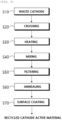
- FIG. 8 below is a flowchart for explaining a process for recycling a cathode active material according to one embodiment of the present invention.
- cathode scraps as waste cathodes are prepared (step S10).
- aluminum foil is coated with slurry prepared by adding N-methyl pyrrolidone (NMP) to an NCM-based lithium composite transition metal oxide, carbon black, and polyvinylidene fluoride and performing mixing, and then drying is performed in a vacuum oven set to about 120 °C to obtain a cathode sheet. Then, the cathode sheet is punched out to obtain a cathode plate of a certain size. In this process, cathode scraps are generated.
- NMP N-methyl pyrrolidone
- the cathode scrap includes aluminum foil and a cathode active material layer formed on the aluminum foil. After volatilizing a solvent, the cathode active material layer has a structure in which a cathode active material and a conductive material are combined by a binder. Accordingly, when the binder is removed, the cathode active material is separated from the aluminum foil.
- the prepared cathode scraps are crushed into pieces of appropriate sizes (step S20).
- the crushing includes cutting or shredding cathode scraps into easy-to-handle sizes.
- the crushed cathode scraps may have a size of 1 cm ⁇ 1 cm.
- the crushing may be performed using a dry crushing device such as a hand-mill, a pin-mill, a disk-mill, a cutting-mill, and a hammer-mill. To increase productivity, a high-speed cutting machine may be used.
- whether to perform the crushing or the size of the pieces may be determined by considering the handling of cathode scraps and the characteristics of equipment used in the subsequent process. For example, when using equipment capable of continuous processing, cathode scraps must be crushed into smaller pieces because the pieces must have good fluidity.
- the cathode scraps are heat-treated to recover a cathode active material (step S30).
- heat treatment is performed to thermally decompose a binder within an active material layer.
- the heat treatment may be performed under an air atmosphere or under an oxygen atmosphere, preferably under an air atmosphere.
- the binder and the conductive material in the active material layer are thermally decomposed into CO 2 and H 2 O and removed. Since the binder is removed, the cathode active material may be separated from a current collector, and the separated cathode active material in powder form may be easily selected. Accordingly, in step S30, the active material layer may be separated from the current collector, and the cathode active material in the active material layer may be recovered in powder form.
- the heat treatment is performed under an air atmosphere.
- the binder and the conductive material are carbonized rather than thermally decomposed.
- carbon components remain on the surface of the cathode active material, resulting in deterioration in the performance of a recycled cathode active material.
- both the binder and the conductive material are removed because carbon components in the binder and conductive material reacts with oxygen, are converted into gases such as CO and CO 2 , and disappears.
- the heat treatment is performed at preferably 300 to 650 °C, as a specific example, 550 °C.
- the heat treatment is performed at a temperature less than 300 °C, since the binder is not removed, separation of the current collector is difficult.
- the heat treatment is performed at a temperature exceeding 650 °C, the current collector melts, making separation of the current collector impossible.
- the heat treatment is performed at a temperature increase rate of preferably 1 to 20 °C/min, more preferably 3 to 10 °C/min, as a specific example, 5 °C/min. Within this range, heat treatment may be performed without causing strain to heat treatment equipment, and thermal shock to scraps may be prevented.
- the heat treatment may be performed until the binder is completely thermally decomposed.
- the heat treatment may be performed for preferably 30 minutes or more, more preferably 30 minutes to 5 hours, as a specific example, 30 minutes. Within this range, the binder may be completely thermally decomposed, and thermal decomposition efficiency may be excellent.
- the heat treatment may be performed using various types of furnaces.
- a box-type furnace may be used.
- a rotary kiln capable of continuous processing may be used.
- slow cooling or rapid cooling may be performed in the air.
- step S40 the recovered cathode active material is mixed with a washing solution.
- the recovered cathode active material may be washed using water or a basic aqueous lithium compound solution as a washing solution.
- the water may be preferably distilled water or deionized water.
- metal fluorides such as LiF may be removed, and surface modification may be achieved.
- the basic aqueous lithium compound solution may include a lithium compound in an amount of greater than 0 % by weight and 15 % by weight or less, preferably greater than 0 % by weight and 10 % by weight or less.
- metal fluorides such as LiF remaining on the surface of the recycled cathode active material may be removed, and surface modification may be achieved.
- an excess of lithium compounds such as LiOH and LiNO 3 may be remained on the surface of the cathode active material, which may affect the subsequent annealing process.
- the lithium compound may be LiOH.
- the reason for mixing the recovered cathode active material with the basic aqueous lithium compound solution is to remove LiF and metal fluorides that may exist on the surface of the recovered active material and perform surface modification.
- the binder and the conductive material in the cathode active material layer are converted to CO 2 and H 2 , and are vaporized and removed.
- CO 2 and H 2 O may react with lithium on the surface of the cathode active material to form Li 2 CO 3 and LiOH
- fluorine (F) present in the binder, such as PVdF may react with metal elements constituting the cathode active material to form LiF or metal fluorides.
- any reactants that may have formed during heat treatment step S30 on the surface of the recycled cathode active material are removed to ensure that no foreign substances remain on the surface of the recycled cathode active material.
- step S40 it is important to mix with a basic aqueous lithium compound solution.
- a basic aqueous lithium compound solution When an aqueous sulfuric acid or hydrochloric acid solution is used rather than a basic aqueous lithium compound solution, although F on the surface of the cathode active material may be removed, transition metals (Co, Mg) present in the cathode active material may be eluted, deteriorating the performance of the recycled cathode active material.
- the basic aqueous lithium compound solution used in the present invention may remove any trace amounts of the binder that may remain after the heat treatment in step S30.
- the basic aqueous lithium compound solution does not elute transition metals present in the cathode active material and also plays a role in replenishing the amount of lithium that may be eluted during the washing process.
- the mixing may be performed by immersing the recovered active material in a washing solution.
- the immersing may be performed within a week, preferably within a day, still more preferably within 1 hour.
- immersing is preferably performed within 1 hour.
- the mixing includes immersing the cathode active material in the washing solution and stirring while immersing the active material in the washing solution. It is preferable to combine stirring and immersing.
- a basic aqueous lithium compound solution is used as a washing solution, when only immersing is performed without stirring, the washing process may be slowed down, and elution of lithium may be caused.
- immersing and stirring are combined, process time may be minimized.
- stirring and immersing are preferably performed at the same time.
- the weight ratio of the recovered cathode active material to the washing solution may be 1:1 to 1:40, preferably 1:1 to 1:35, more preferably 1:1 to 1:30. Within this range, metal fluorides such as LiF may be efficiently removed.
- step S50 the mixed cathode active material is filtered.
- the filtration may preferably include a step of filtering the mixed cathode active material.
- the filtration may be performed using a belt press, a filter press, a screw press, a screw decanter, or a centrifuge, preferably a filter press.
- Equation 1 A represents the weight (g) of the filtered cathode active material, and B represents the weight (g) of the filtered cathode active material after vacuum drying at 100 °C for 12 hours.
- the moisture content of the cathode active material may reach the above range by performing filtration for 3 to 14 minutes, preferably 3 to 11 minutes, more preferably 3 to 8 minutes.
- filtration time is less than 3 minutes, as the washing solution is not sufficiently removed, the moisture content may be high, and the content of metal fluorides such as LiF may increase.
- filtration time exceeds 14 minutes, the moisture content and the content of metal fluorides such as LiF may increase, and energy consumption may increase.
- the one-time input amount of the cathode active material mixed with the washing solution may be 2 to 3.1 kg, preferably 2.5 to 3.1 kg, more preferably 2.7 to 3.1 kg. Within this range, filtration efficiency may be excellent.
- the input amount is less than 2 kg, process costs may increase.
- the input amount exceeds 3.1 kg, the moisture content may increase and the content of metal fluorides such as LiF may increase.
- the cathode active material filtered in a moisture content of 5 to 10.5 % by weight may be obtained in the form of a cake.
- the filtered cathode active material may have an F content of preferably 405 ppm or less, more preferably 1 to 405 ppm. Within this range, the capacity characteristics of a secondary battery may be improved.
- the cathode active material in the form of a cake obtained after the filtration may preferably be dried. In this case, the annealing process may be performed smoothly.
- the drying may be vacuum drying at 70 to 140 °C, preferably 100 to 140 °C, more preferably 120 to 140 °C.
- a lithium precursor is added to the filtered cathode active material and annealing is performed (step S60) .
- annealing step S60 it is important to add the lithium precursor to the filtered cathode active material and perform annealing to have a predetermined moisture content. In this case, during the preceding steps S30 and S40, lithium in the cathode active material may be lost. In step S60, the lost lithium is replenished.
- step S60 through annealing, the crystal structure of the active material may be recovered.
- the properties of the recycled active material may be equal to or better than those of a fresh cathode active material.
- deformation structures may be formed on the surface of the cathode active material.
- a spinel structure may be formed by converting Ni into rock salt such as [NiCO 2 ⁇ 2Ni(OH) 2 )H 2 O] by moisture in step S40.
- the crystal structure may be recovered.
- the cathode active material which is an NCM-based lithium composite transition metal oxide, is restored to a hexagonal structure. Accordingly, the initial characteristics may be restored or improved to the level of a fresh cathode active material.
- the lithium precursor of step S60 may include one or more of LiOH, Li 2 CO 3 , LiNO 3 , and Li 2 O.
- the filtered cathode active material may be dried, and then a solid or liquid lithium precursor may be added to thereto.
- spray drying may be performed so that drying and lithium precursor addition are performed in one step.
- a lithium precursor solution may be prepared by using a lithium compound that is soluble in an aqueous solution or an organic solvent.
- the filtered cathode active material may be dried, and then a solid lithium precursor may be added thereto. In this case, process costs may be reduced.
- cathode active material particles When drying is performed immediately in an oven after the surface modification process by mixing with the washing solution, cathode active material particles may agglomerate to form lumps. To mix the agglomerated particles and the lithium precursor, a process of grinding the lumps is required. As a result, the process becomes complicated and a continuous process may be difficult. In particular, in the case of the NCM-based cathode active material, when the lithium precursor and the powder are mixed and milling is performed in the presence of moisture, the cathode active material absorbs moisture and aggregation occurs severely.
- the concentration of the lithium precursor solution may be 3 to 10 %. Based on 100 mol% in total of lithium contained in the cathode active material, the lithium precursor solution containing lithium equivalent to 1 to 40 mol%, preferably 1 to 15 mol%, more preferably 1 to 10 mol% may be added.
- the surface of the cathode active material is coated with the lithium precursor component, or the lithium precursor component contacts the surface of the cathode active material.
- the particles are agglomerated by capillary force, and the particle size may be adjusted.
- the particles on the surface may be pressed and cracked or broken during a rolling process.
- an NCM-based active material has severe particle splitting due to rolling during electrode formation. Accordingly, compared to a fresh cathode active material, the recovered cathode active material contains many small particles, and the particle size may become uneven.
- an NCM-based active material includes large particles (secondary particles) formed by gathering primary particles having a size of tens to hundreds of nanometers.
- secondary particles are cleaved and converted into primary particles or small particles having a larger size than the primary particles.
- the surface of the active material is coated with the lithium precursor, and the particle size of the active material is controlled. Since lithium precursor addition, granulation, and drying are performed in one step, the effect of process simplification may be obtained.
- the processes may be performed continuously, and lithium precursor coating, drying, and granulation (in other words, particle readjustment) may be performed simultaneously in one step.
- step S60 loss of lithium in the cathode active material occurs during preceding steps S30 and S40.
- step S60 the loss amount of lithium is supplemented.
- a deformed structure e.g., Co 3 O 4 in the case of an LCO active material
- the crystal structure of the cathode active material may be recovered through annealing, thereby improving the battery characteristics of a recycled cathode active material, or restoring the battery characteristics of the recycled cathode active material to the level of battery characteristics of a fresh cathode active material.
- fresh material is a concept opposite to "recycling"
- a fresh material means that the material was made for the first time, and the fresh material is the same word as "raw material” used in the examples.
- LiOH is used as the lithium precursor.
- the lithium precursor is preferably added in a minimum amount corresponding to the lost lithium molar ratio.
- the lithium precursor may be added in an amount such that the molar ratio of lithium is 0.001 to 0.4, preferably 0.01 to 0.4, more preferably 0.09 to 0.2.
- the capacity may be increased to a level equivalent to that of the fresh cathode active material.
- the ICP analysis results have an error value of about ⁇ 0.02.
- the lithium precursor may be added in an amount corresponding to 1 to 40 mol%, preferably 1 to 25 mol%, more preferably 1 to 15 mol%, still more preferably 3 to 15 mol%.
- the annealing may be performed in air at 400 to 1000 °C, preferably at 600 to 900 °C.
- the temperature should be determined within a limited range according to the types of the lithium precursor.
- the annealing temperature is preferably a temperature exceeding the melting point of the lithium precursor. However, since performance degradation occurs due to thermal decomposition of the cathode active material at a temperature exceeding 1000 °C, the annealing temperature should not exceed 1000 °C.
- the annealing temperature is preferably 700 to 900 °C, more preferably 710 to 780 °C, most preferably 750 to 780 °C.
- the annealing temperature is preferably 400 to 600 °C, more preferably 450 to 480 °C, most preferably 470 to 480 °C.
- the annealing time is preferably 1 hour or more, more preferably 15 hours or less, still more preferably 4 to 6 hours.
- the annealing time is long, a crystal structure may be sufficiently recovered, but even long-term annealing does not significantly affect performance.
- the same or similar equipment as in step S30 of performing heat treatment may be used as the annealing equipment.
- the surface of the annealed cathode active material may be coated with a coating agent (step S70).
- the surface is coated with a coating agent containing metals, organic metals, or carbon in a solid or liquid phase and heat-treated.
- a coating agent containing metals, organic metals, or carbon in a solid or liquid phase and heat-treated.
- the heat treatment temperature is too low, formation of a desired surface protection layer by the dissimilar metals may not occur.
- the heat treatment temperature is too high, due to thermal decomposition of the cathode active material, battery performance may deteriorate.
- a surface protection layer such as a lithium boron oxide layer is formed on the surface of the cathode active material.
- the surface coating may be performed using a solid-phase or liquid-phase method, as a specific example, mixing, milling, spray drying, or grinding.
- the capacity of a battery containing the recycled cathode active material may not be fully (up to 100 %) expressed.
- annealing step S60 when an excess of the lithium precursor is added so that lithium is contained in a greater molar ratio of 0.0001 to 0.1 compared to other metals in the cathode active material, a surface protection layer is formed in surface coating step S70, and the molar ratio of lithium to other metals in the cathode active material becomes 1:1, thereby preventing battery capacity degradation.
- a recycled cathode active material of the present invention is prepared by the method of recycling a cathode active material described above.
- the recycled cathode active material may have a fluorine (F) content of 405 ppm or less, preferably 1 to 405 ppm. In this case, the capacity characteristics of a secondary battery may be excellent.
- the recycled cathode active material may be environmentally friendly, may prevent generation of toxic gases or explosion by not using organic solvents, and may greatly improve economics and productivity.
- the recycled cathode active material of the present invention includes one or more selected from the group consisting of a lithium cobalt oxide; a lithium manganese oxide; a lithium iron phosphate compound; a lithium nickel cobalt aluminum oxide; a lithium nickel oxide; a nickel manganese-based lithium composite metal oxide obtained by replacing a part of nickel (Ni) with manganese (Mn) in the lithium nickel oxide; and an NCM-based lithium composite transition metal oxide obtained by replacing a part of nickel (Ni) with manganese (Mn) and cobalt (Co) in the lithium nickel oxide and has a fluorine (F) content of 405 ppm or less.
- the capacity characteristics of a secondary battery may be excellent.
- the recycled cathode active material may be environmentally friendly, may prevent generation of toxic gases or explosion by not using organic solvents, and may greatly improve economics and productivity.
- the recycled cathode active material may include preferably one or more selected from the group consisting of a lithium cobalt oxide such as LiCoO 2 (hereinafter referred to as "LCO") ; a lithium manganese oxide such as LiMnO 2 or LiMn 2 O 4 ; a lithium iron phosphate compound such as LiFePO 4 ; a lithium nickel cobalt aluminum oxide (NCA); a lithium nickel oxide such as LiNiO 2 ; a nickel manganese-based lithium composite metal oxide obtained by replacing a part of nickel (Ni) with manganese (Mn) in the lithium nickel oxide; and an NCM-based lithium composite transition metal oxide obtained by replacing a part of nickel (Ni) with manganese (Mn) and cobalt (Co) in the lithium nickel oxide.
- LCO lithium cobalt oxide
- LiMnO 2 or LiMn 2 O 4 a lithium iron phosphate compound such as LiFePO 4
- NCA lithium nickel cobalt aluminum oxide
- a lithium nickel oxide
- the cathode active material may be a compound represented by Chemical Formula 1 below.
- Chemical Formula 1 Li a Ni x Mn y Co z M w O 2+ ⁇
- the cathode active material has a fluorine (F) content of 405 ppm or less, and the surface thereof is coated with a coating agent containing a metal or carbon. In this case, electrochemical performance, resistance characteristics, and capacity characteristics may be excellent.
- the fluorine (F) content may be preferably 1 to 405 ppm. Within this range, excellent resistance characteristics and capacity characteristics may be implemented.
- the recycled cathode active material may be coated with a coating agent containing metals or carbon, preferably a coating agent containing metals.
- a coating agent containing metals or carbon preferably a coating agent containing metals.
- the structural stability of the cathode active material may be improved without chemical and physical change of the cathode active material, thereby improving rate performance, lifespan characteristics, and electrochemical properties such as capacity.
- substitution with heterogeneous elements occurs on the surface of the cathode active material, and as a result, the amount of residual lithium and pH are reduced, thereby improving physicochemical properties.
- the metal includes preferably one or more selected from the group consisting of B, W, Al, Ti, Mg, Ni, Co, Mn, Si, Zr, Ge, Sn, Cr, Fe, V, and Y, more preferably one or more selected from the group consisting of B, W, Al, Ti, and Mg, still more preferably boron (B), tungsten (W), or a mixture thereof, still more preferably tungsten (W) and boron (B), as a specific example, tungsten boride (WB). In this case, resistance characteristics and lifespan characteristics may be improved.
- the coating agent may be included in an amount of 0.001 to 0.3 mol%, preferably 0.01 to 0.3 mol%, more preferably 0.01 to 0.15 mol%, still more preferably 0.01 to 0.1 mol%, still more preferably 0.01 to 0.05 mol%.
- structural stability and electrochemical performance may be improved while maintaining the intrinsic properties of the cathode active material.
- the coating may be performed by coating a surface with a solid or liquid coating agent containing a metal or carbon and heating the surface at 100 to 1200 °C, preferably 200 to 1000 °C, more preferably 250 to 800 °C. In this case, structural stability and electrochemical performance may be improved while maintaining the intrinsic properties of the cathode active material.
- Description of the recycled cathode active material of the present invention may include all of the description of the method of recycling a cathode active material described above, and thus repeated description is omitted in this specification.
- a secondary battery of the present invention includes a cathode including a current collector for cathodes and a cathode active material layer coated thereon; an anode including a current collector for anodes and an anode active material layer coated thereon; and a separator.
- the cathode active material layer includes the recycled cathode active material according to the present invention.
- a secondary battery having excellent electrochemical performance, resistance characteristics, and capacity characteristics may be provided.
- separators commonly used in the technical field to which the present invention pertains may be used in the present invention without particular limitation.
- separators with pore diameters from 0.01 to 10 ⁇ m and thicknesses from 5 to 300 ⁇ m may be used.
- examples of the separator may include olefin-based polymers such as polypropylene; and sheets or non-woven fabrics made of glass fiber or polyethylene. In this case, high ion permeability, mechanical strength, insulation, chemical resistance, and hydrophobicity may be achieved.
- the pore diameter may be measured using a measurement method commonly used in the technical field to which the present invention pertains.
- the secondary battery may include an electrolyte.
- the secondary battery may include an electrolyte solution.
- the electrolyte solution may include an organic solvent and lithium salt.
- the organic solvent may be an aprotic solvent.
- the organic solvent may include one or more selected from the group consisting of N-methyl-2-pyrrolidinone, propylene carbonate, ethylene carbonate, butylene carbonate, dimethyl carbonate, diethyl carbonate, gamma-butyrolactone, 1,2-dimethoxy ethane, tetrahydroxy franc, 2-methyl tetrahydrofuran, dimethyl sulfoxide, 1,3-dioxolane, formamide, dimethylformamide, dioxolane, acetonitrile, nitromethane, methyl formate, methyl acetate, phosphate triester, trimethoxy methane, dioxolane derivatives, sulfolane, methyl sulfolane, 1,3-dimethyl-2-imidazolidinone, propylene carbonate derivatives, tetrahydrofuran derivatives, ethers, methyl propionat
- the lithium salt may include one or more selected from the group consisting of LiCl, LiBr, LiI, LiClO 4 , LiBF 4 , LiB 10 Cl 10 , LiPF 6 , LiCF 3 SO 3 , LiCF 3 CO 2 , LiAsF 6 , LiAlCl 4 , CH 3 SO 3 Li, CF 3 SO 3 Li, and (CF 3 SO 2 ) 2 NLi.
- the secondary battery may preferably be used as a power source for electric vehicles, hybrid electric vehicles, plug-in hybrid electric vehicles, and power storage systems.
- cathode scraps current collector: aluminum foil, cathode active material: NCM-based lithium composite transition metal oxide
- current collector aluminum foil
- cathode active material NCM-based lithium composite transition metal oxide
- the crushed scraps were heat-treated at 570 °C for 30 minutes in air to remove a binder and a conductive material and separate a current collector and a cathode active material.
- the cathode active material was recovered.
- temperature was increased to the heat treatment temperature at a temperature-increasing rate of 5 °C/min, and air was supplied at a rate of 3 L/min.
- Equation 1 A represents the weight (g) of the filtered cathode active material, and B represents the weight (g) of the filtered cathode active material after vacuum drying at 100 °C for 12 hours.
- the moisture content was lowest when filtered for 5 minutes. In addition, there was no significant difference in the moisture content when the filtration time was 5 and 10 minutes. When the filtration time was increased to 20 minutes, the moisture content increased. Based on the above results, the filtration time was set to 5 minutes and the following experiment was performed.
- the cathode active material recovered in Test Example I was immersed in an aqueous LiOH solution as a washing solution and mixed by stirring for 5 minutes.
- the mixed cathode active material was input into a filter press.
- the one-time input amount of the mixed cathode active material was 2.8 kg, 2.9 kg, 3.0 kg, 3.1 kg, 3.2 kg, or 3.4 kg.
- filtration was performed for 5 minutes, and the moisture content was calculated by Equation 1. Changes in the moisture content depending on the input amounts of the cathode active material are shown in FIG. 2 below.
- the moisture content was lowest when the one-time input amount was 3.0 kg.
- the input amount of the cathode active material was increased from 2.8 kg to 3.0 kg, the moisture content gradually decreased.
- the input amount was 3.2 kg or more, the moisture content increased.
- the cathode active material recovered in Test Example I was immersed in an aqueous LiOH solution as a washing solution and mixed by stirring for 5 minutes. 3.0 kg of the mixed cathode active material was filtered for 1 minute, 2 minutes, 5 minutes, 8 minutes, 10 minutes, 20 minutes, or 30 minutes using a filter press, and the moisture content was calculated by Equation 1 above.
- the content of fluorine (F) remaining in the cathode active material obtained after filtration was measured using an ICP analysis device, and the results are shown in FIG. 3 below. At this time, an ICP analysis device commonly used in laboratories may be used, but there is no difference depending on measurement devices or methods.
- cathode scraps current collector: aluminum foil, cathode active material: NCM-based lithium composite transition metal oxide
- the crushed scraps were subjected to heat treatment at 570 °C for 30 minutes in the air to remove a binder and a conductive material and separate a current collector and a cathode active material.
- the cathode active material was recovered.
- temperature was increased to the heat treatment temperature at a temperature increase rate of 5 °C/min, and the air was supplied at a rate of 3 L/min.
- the recovered cathode active material was immersed in an aqueous LiOH solution as a washing solution and mixed by stirring for 5 minutes.
- the mixed cathode active material was filtered for 5 minutes using a filter press so that the moisture content thereof was 6.8 % by weight, and the cathode active material in the form of a cake was obtained.
- the filtered cathode active material was reduced by 0.1 mol based on 1 mol of lithium in the cathode active material compared to a raw material.
- the annealed cathode active material was coated with boric acid and heated at 300 °C for 5 hours to obtain a recycled cathode active material as a final product.
- boric acid was added in an amount corresponding to 1000 ppm of boron lost in the previous process, temperature was increased to the heat treatment temperature at a temperature increase rate of 2 °C/min, and air was supplied at a rate of 3 L/min.
- the molar ratio of lithium to other metals in the cathode active material and the amount of residual LiF were measured using an ICP analysis device.
- an ICP analysis device commonly used in laboratories may be used, but there is no deviation depending on the measurement device or method.
- a recycled cathode active material was prepared in the same manner as in Example 1 except that, in the filtration step of Example 1, filtration was performed so that the moisture content of a cathode active material was 12.5 % by weight.
- a recycled cathode active material was prepared in the same manner as in Example 1 except that, in the filtration step of Example 1, filtration was performed so that the moisture content of a cathode active material was 17.6 % by weight.
- Comparative Example 2 moisture content: 17.6 % by weight
- the cathode active material obtained after filtration was dried at 100 °C for 12 hours, and the image thereof was captured and analyzed.
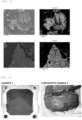
- FIG. 4 shows the image of the cathode active material dried after filtration in Comparative Example 2. It was confirmed that an F compound and various impurities that were not completely removed in the mixing step were mixed with the cathode active material, recrystallized after filtration and drying, and precipitated while mixed with the recycled cathode active material.
- the red arrow indicates the F compound and various impurities that recrystallized and precipitated while mixed with the cathode active material.
- the cathode active materials dried after filtration in Comparative Examples 1 and 2 were analyzed using an SEM, and images obtained by EDS mapping the distribution of the F component are shown in FIG. 5 below.
- the top and bottom images correspond to Comparative Examples 1 and 2, respectively.
- SEM images are shown, and on the right, EDS mapping images showing the distribution of the F component are shown.
- fluorine (F) element derived from LiF was detected overall on the surface of the cathode active material dried after filtration.
- the parts marked in green indicate the F components.
- Example 1 The images of the cathode active materials obtained after filtration in Example 1 and Comparative Example 2 are shown in FIG. 6 below.
- the cathode active material filtered to a moisture content of 6.8 % by weight according to Example 1 is the form of a cake
- the cathode active material filtered to a moisture content of 17.6 % by weight according to Comparative Example 2 is in the form of slurry.
- the cathode active material is in the form of slurry due to high moisture content as in Comparative Example 2
- the remaining F component in the cathode active material increases, reducing the capacity and lifespan of a secondary battery, and a lot of time and energy is consumed in the subsequent drying process.
- the cathode active material recovered after heat treatment had a high fluorine content, but the fluorine content of the cathode active material filtered to have a moisture content of 6.8% by weight according to Example 1 was significantly reduced.
- the fluorine content of Example 1 was reduced compared to Comparative Examples 1 and 2, where the moisture content thereof was 12.5 % by weight and 17.6 % by weight, respectively. That is, it was found that the residual F component was reduced by adjusting the moisture content in the filtration step.
- an electrolyte solution having a weight ratio of ethylene carbonate (EC):ethyl methyl carbonate (EMC) of 3:7 was injected thereto to manufacture a polymer cell-type test mono cell.
- EC ethylene carbonate
- EMC ethyl methyl carbonate
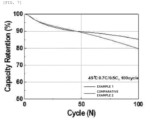
- the recycled cathode active material (Example 1) obtained by controlling the moisture content of the cathode active material just before the annealing step according to the present invention to 6.8 % by weight exhibited excellent capacity maintenance rate even as the number of charge and discharge cycles increased, compared to the recycled cathode active material (Comparative Example 2) obtained by controlling the moisture content to 17.6 % by weight.
Landscapes
- Chemical & Material Sciences (AREA)
- Chemical Kinetics & Catalysis (AREA)
- Electrochemistry (AREA)
- General Chemical & Material Sciences (AREA)
- Engineering & Computer Science (AREA)
- Organic Chemistry (AREA)
- Inorganic Chemistry (AREA)
- Manufacturing & Machinery (AREA)
- Composite Materials (AREA)
- Materials Engineering (AREA)
- Environmental & Geological Engineering (AREA)
- General Life Sciences & Earth Sciences (AREA)
- Geology (AREA)
- Life Sciences & Earth Sciences (AREA)
- Mechanical Engineering (AREA)
- Metallurgy (AREA)
- Crystallography & Structural Chemistry (AREA)
- Geochemistry & Mineralogy (AREA)
- Battery Electrode And Active Subsutance (AREA)
- Processing Of Solid Wastes (AREA)
- Manufacture And Refinement Of Metals (AREA)
- Secondary Cells (AREA)
Applications Claiming Priority (2)
| Application Number | Priority Date | Filing Date | Title |
|---|---|---|---|
| KR1020220158164A KR102826984B1 (ko) | 2022-11-23 | 2022-11-23 | 양극 활물질의 재생 방법 및 이로부터 재생된 양극 활물질 |
| PCT/KR2023/018746 WO2024112059A1 (ko) | 2022-11-23 | 2023-11-21 | 양극 활물질의 재생 방법 및 이로부터 재생된 양극 활물질 |
Publications (2)
| Publication Number | Publication Date |
|---|---|
| EP4503263A1 true EP4503263A1 (de) | 2025-02-05 |
| EP4503263A4 EP4503263A4 (de) | 2026-04-22 |
Family
ID=91196227
Family Applications (1)
| Application Number | Title | Priority Date | Filing Date |
|---|---|---|---|
| EP23894987.9A Pending EP4503263A4 (de) | 2022-11-23 | 2023-11-21 | Verfahren zur wiederverwertung von positivelektrodenaktivmaterial und daraus recyceltes positivelektrodenaktivmaterial |
Country Status (5)
| Country | Link |
|---|---|
| EP (1) | EP4503263A4 (de) |
| JP (1) | JP7799083B2 (de) |
| KR (1) | KR102826984B1 (de) |
| CN (1) | CN119054132A (de) |
| WO (1) | WO2024112059A1 (de) |
Families Citing this family (12)
| Publication number | Priority date | Publication date | Assignee | Title |
|---|---|---|---|---|
| KR102846699B1 (ko) | 2024-06-12 | 2025-08-14 | 에이케이트리(주) | 폐리튬이온이차전지 재활용 방법 및 그로부터 얻을 수 있는 리튬이온전지 양극재용 원료물질 |
| WO2026054104A1 (ja) * | 2024-09-09 | 2026-03-12 | 住友金属鉱山株式会社 | 使用済みリチウムイオン電池を用いたリチウム遷移金属複合酸化物の製造方法 |
| WO2026054105A1 (ja) * | 2024-09-09 | 2026-03-12 | 住友金属鉱山株式会社 | 使用済みリチウムイオン電池を用いたリチウム遷移金属複合酸化物の製造方法 |
| WO2026054102A1 (ja) * | 2024-09-09 | 2026-03-12 | 住友金属鉱山株式会社 | 使用済みリチウムイオン電池を用いたリチウム遷移金属複合酸化物の製造方法 |
| WO2026054101A1 (ja) * | 2024-09-09 | 2026-03-12 | 住友金属鉱山株式会社 | 使用済みリチウムイオン電池を用いたリチウム遷移金属複合酸化物の製造方法 |
| WO2026054103A1 (ja) * | 2024-09-09 | 2026-03-12 | 住友金属鉱山株式会社 | 使用済みリチウムイオン電池を用いたリチウム遷移金属複合酸化物の製造方法 |
| WO2026054100A1 (ja) * | 2024-09-09 | 2026-03-12 | 住友金属鉱山株式会社 | 使用済みリチウムイオン電池を用いたリチウム遷移金属複合酸化物の製造方法 |
| WO2026054099A1 (ja) * | 2024-09-09 | 2026-03-12 | 住友金属鉱山株式会社 | 使用済みリチウムイオン電池を用いたリチウム遷移金属複合酸化物の製造方法 |
| CN119361629B (zh) * | 2024-10-12 | 2025-12-30 | 中国第一汽车股份有限公司 | 一种低温正极材料及其制备方法、正极片和锂离子电池 |
| KR102831607B1 (ko) * | 2024-10-18 | 2025-07-09 | 주식회사 에코앤드림 | 코발트를 포함하지 않는 미드 니켈-망간 폐전구체의 재생 방법 |
| KR102831612B1 (ko) * | 2024-11-21 | 2025-07-09 | 주식회사 에코앤드림 | 코발트를 포함하지 않는 하이 니켈-망간 폐전구체의 재생 방법 |
| KR102822212B1 (ko) * | 2024-12-24 | 2025-06-19 | 주식회사 에코앤드림 | 잔류 나트륨이 감소된, 코발트를 포함하지 않는 니켈-망간 폐전구체의 재생 방법 |
Family Cites Families (15)
| Publication number | Priority date | Publication date | Assignee | Title |
|---|---|---|---|---|
| KR101392616B1 (ko) * | 2012-10-30 | 2014-05-07 | (주)이엠티 | 리튬 이온 전지의 폐 양극재를 이용한 전구체 원료의 재생 방법, 그 방법에 의해 재생된 원료를 사용하여 제조한 전구체, 양극재 및 리튬 이온 전지 |
| KR102273772B1 (ko) * | 2014-05-21 | 2021-07-06 | 삼성에스디아이 주식회사 | 복합 양극 활물질, 이를 포함하는 리튬 전지, 및 이의 제조방법 |
| CN105811041B (zh) * | 2016-05-19 | 2018-05-08 | 株洲鼎端装备股份有限公司 | 一种废旧锂离子动力电池回收处理系统 |
| KR101992715B1 (ko) * | 2017-01-25 | 2019-06-25 | 주식회사 엘지화학 | 리튬 이차전지에서의 양극 활물질 회수방법 |
| KR101997983B1 (ko) * | 2017-10-23 | 2019-07-08 | 타운마이닝리소스주식회사 | 리튬이차전지 폐 양극재를 재생하여 칼슘 농도가 낮은 니켈-코발트-망간 복합 황산염 용액을 제조하는 방법 |
| KR102008582B1 (ko) * | 2017-12-05 | 2019-08-07 | 타운마이닝리소스주식회사 | 용매추출 공정을 적용하여 리튬이차전지 폐 양극재를 니켈-코발트-망간 복합 황산염 용액으로 재생하는 방법 |
| EP3836259B1 (de) * | 2018-09-28 | 2022-07-20 | LG Chem, Ltd. | Aktivmaterial für positivelektrode einer sekundärbatterie, herstellungsverfahren dafür und lithiumsekundärbatterie damit |
| KR102741994B1 (ko) | 2020-05-25 | 2024-12-11 | 주식회사 엘지에너지솔루션 | 양극 스크랩을 이용한 활물질 재사용 방법 |
| KR102887811B1 (ko) * | 2020-05-25 | 2025-11-17 | 주식회사 엘지에너지솔루션 | 양극 스크랩을 이용한 활물질 재사용 방법 |
| KR102909872B1 (ko) * | 2020-06-04 | 2026-01-07 | 주식회사 엘지에너지솔루션 | 양극 스크랩을 이용한 활물질 재사용 방법 |
| KR102940931B1 (ko) | 2020-06-23 | 2026-03-17 | 주식회사 엘지에너지솔루션 | 양극 스크랩을 이용한 활물질 재사용 방법 |
| KR102936351B1 (ko) | 2020-07-06 | 2026-03-06 | 주식회사 엘지에너지솔루션 | 양극 스크랩을 이용한 활물질 재사용 방법 |
| KR102887856B1 (ko) * | 2020-08-24 | 2025-11-17 | 주식회사 엘지에너지솔루션 | 양극 스크랩을 이용한 활물질 재사용 방법 |
| KR102667133B1 (ko) * | 2021-03-26 | 2024-05-20 | 코스모화학 주식회사 | 폐양극활물질로부터 유가 금속을 회수하는 방법 |
| KR102530536B1 (ko) | 2021-05-21 | 2023-05-19 | (주)에버켐텍 | 진공 단열 패널용 복합 필름 |
-
2022
- 2022-11-23 KR KR1020220158164A patent/KR102826984B1/ko active Active
-
2023
- 2023-11-21 EP EP23894987.9A patent/EP4503263A4/de active Pending
- 2023-11-21 JP JP2024560223A patent/JP7799083B2/ja active Active
- 2023-11-21 WO PCT/KR2023/018746 patent/WO2024112059A1/ko not_active Ceased
- 2023-11-21 CN CN202380033905.6A patent/CN119054132A/zh active Pending
Also Published As
| Publication number | Publication date |
|---|---|
| JP2025512355A (ja) | 2025-04-17 |
| KR102826984B1 (ko) | 2025-07-02 |
| WO2024112059A1 (ko) | 2024-05-30 |
| KR20240078442A (ko) | 2024-06-04 |
| CN119054132A (zh) | 2024-11-29 |
| EP4503263A4 (de) | 2026-04-22 |
| JP7799083B2 (ja) | 2026-01-14 |
Similar Documents
| Publication | Publication Date | Title |
|---|---|---|
| EP4503263A1 (de) | Verfahren zur wiederverwertung von positivelektrodenaktivmaterial und daraus recyceltes positivelektrodenaktivmaterial | |
| US20240055597A1 (en) | Method of recycling positive electrode active material and recycled positive electrode active material prepared by the same | |
| KR102675713B1 (ko) | 재생 양극 활물질, 이의 재생 방법 및 이를 포함하는 이차 전지 | |
| EP4266454A1 (de) | Verfahren zur wiederverwertung von kathodenaktivmaterial und daraus recycliertes kathodenaktivmaterial | |
| US20230062492A1 (en) | Method for reusing active material by using positive electrode scrap | |
| CN116194604B (zh) | 利用正极废料的活性材料再利用方法 | |
| EP4428955A1 (de) | Rezykliertes kathodenaktivmaterial, verfahren zur rezyklierung von kathodenaktivmaterial und sekundärbatterie damit | |
| EP4142015A1 (de) | Verfahren zur wiederverwendung von aktivem material unter verwendung von kathodenschrott | |
| EP4164027A1 (de) | Verfahren zur wiederverwendung von aktivem material unter verwendung von kathodenabfällen | |
| KR20230019723A (ko) | 양극 스크랩을 이용한 활물질 재사용 방법 | |
| EP4432423A1 (de) | Recyceltes positivelektrodenaktivmaterial, recyclingverfahren dafür und sekundärbatterie damit | |
| KR20210145455A (ko) | 양극 스크랩을 이용한 활물질 재사용 방법 | |
| KR20240006436A (ko) | 재생 양극 활물질, 이의 재사용 방법 및 이를 포함하는 이차 전지 | |
| EP4421915A1 (de) | Rezykliertes kathodenaktivmaterial, verfahren zur rezyklierung von kathodenaktivmaterial und sekundärbatterie damit | |
| US11901528B2 (en) | Method of making a reusable active material by using positive electrode scrap | |
| CA3256412A1 (en) | Method of recycling cathode active material and recycled cathode active material prepared using method | |
| EP4636905A1 (de) | Verfahren zur regenerierung eines positivelektrodenaktivmaterials, damit hergestelltes regeneriertes positivelektrodenaktivmaterial und sekundärbatterie damit | |
| EP4625613A1 (de) | Verfahren zur wiederverwertung von positivelektrodenaktivmaterial, damit hergestelltes recyceltes positivelektrodenaktivmaterial und sekundärbatterie damit | |
| EP4683041A1 (de) | Verfahren zur regenerierung eines kathodenaktivmaterials und damit hergestelltes regeneriertes kathodenaktivmaterial | |
| EP4645523A9 (de) | Verfahren zur wiederverwertung von positivelektrodenaktivmaterial und daraus hergestelltes recyceltes positivelektrodenaktivmaterial | |
| US20250276911A1 (en) | Positive electrode active material and method for recycling positive electrode active material | |
| EP4715959A1 (de) | Verfahren zur regenerierung eines kathodenaktivmaterials und daraus hergestelltes regeneriertes kathodenaktivmaterial | |
| CN118216018A (zh) | 再生正极活性材料、正极活性材料的再生方法和包含再生正极活性材料的二次电池 | |
| CN118266102A (zh) | 再生正极活性材料、正极活性材料的再生方法以及包括再生正极活性材料的二次电池 | |
| KR20250133169A (ko) | 양극 활물질 재생 방법 및 이로부터 제조된 재생 양극 활물질 |
Legal Events
| Date | Code | Title | Description |
|---|---|---|---|
| STAA | Information on the status of an ep patent application or granted ep patent |
Free format text: STATUS: THE INTERNATIONAL PUBLICATION HAS BEEN MADE |
|
| PUAI | Public reference made under article 153(3) epc to a published international application that has entered the european phase |
Free format text: ORIGINAL CODE: 0009012 |
|
| STAA | Information on the status of an ep patent application or granted ep patent |
Free format text: STATUS: REQUEST FOR EXAMINATION WAS MADE |
|
| 17P | Request for examination filed |
Effective date: 20241030 |
|
| AK | Designated contracting states |
Kind code of ref document: A1 Designated state(s): AL AT BE BG CH CY CZ DE DK EE ES FI FR GB GR HR HU IE IS IT LI LT LU LV MC ME MK MT NL NO PL PT RO RS SE SI SK SM TR |
|
| DAV | Request for validation of the european patent (deleted) | ||
| DAX | Request for extension of the european patent (deleted) | ||
| A4 | Supplementary search report drawn up and despatched |
Effective date: 20260324 |
|
| RIC1 | Information provided on ipc code assigned before grant |
Ipc: H01M 10/54 20060101AFI20260318BHEP Ipc: C22B 7/00 20060101ALI20260318BHEP Ipc: H01M 4/36 20060101ALI20260318BHEP Ipc: H01M 4/525 20100101ALI20260318BHEP Ipc: H01M 4/505 20100101ALI20260318BHEP Ipc: H01M 4/62 20060101ALI20260318BHEP Ipc: H01M 10/052 20100101ALI20260318BHEP Ipc: H01M 4/02 20060101ALI20260318BHEP Ipc: C22B 1/00 20060101ALI20260318BHEP Ipc: H01M 4/131 20100101ALI20260318BHEP Ipc: H01M 4/58 20100101ALI20260318BHEP Ipc: C01G 53/506 20250101ALI20260318BHEP |