EP4501604A1 - Ringförmiges dichtungsmaterial und herstellungsverfahren - Google Patents
Ringförmiges dichtungsmaterial und herstellungsverfahren Download PDFInfo
- Publication number
- EP4501604A1 EP4501604A1 EP23779748.5A EP23779748A EP4501604A1 EP 4501604 A1 EP4501604 A1 EP 4501604A1 EP 23779748 A EP23779748 A EP 23779748A EP 4501604 A1 EP4501604 A1 EP 4501604A1
- Authority
- EP
- European Patent Office
- Prior art keywords
- outer layer
- seal material
- annular seal
- core
- rubber composition
- Prior art date
- Legal status (The legal status is an assumption and is not a legal conclusion. Google has not performed a legal analysis and makes no representation as to the accuracy of the status listed.)
- Pending
Links
Images



Classifications
-
- B—PERFORMING OPERATIONS; TRANSPORTING
- B29—WORKING OF PLASTICS; WORKING OF SUBSTANCES IN A PLASTIC STATE IN GENERAL
- B29D—PRODUCING PARTICULAR ARTICLES FROM PLASTICS OR FROM SUBSTANCES IN A PLASTIC STATE
- B29D99/00—Subject matter not provided for in other groups of this subclass
- B29D99/0053—Producing sealings
-
- F—MECHANICAL ENGINEERING; LIGHTING; HEATING; WEAPONS; BLASTING
- F16—ENGINEERING ELEMENTS AND UNITS; GENERAL MEASURES FOR PRODUCING AND MAINTAINING EFFECTIVE FUNCTIONING OF MACHINES OR INSTALLATIONS; THERMAL INSULATION IN GENERAL
- F16J—PISTONS; CYLINDERS; SEALINGS
- F16J15/00—Sealings
- F16J15/16—Sealings between relatively-moving surfaces
- F16J15/32—Sealings between relatively-moving surfaces with elastic sealings, e.g. O-rings
- F16J15/3284—Sealings between relatively-moving surfaces with elastic sealings, e.g. O-rings characterised by their structure; Selection of materials
-
- B—PERFORMING OPERATIONS; TRANSPORTING
- B29—WORKING OF PLASTICS; WORKING OF SUBSTANCES IN A PLASTIC STATE IN GENERAL
- B29C—SHAPING OR JOINING OF PLASTICS; SHAPING OF MATERIAL IN A PLASTIC STATE, NOT OTHERWISE PROVIDED FOR; AFTER-TREATMENT OF THE SHAPED PRODUCTS, e.g. REPAIRING
- B29C43/00—Compression moulding, i.e. applying external pressure to flow the moulding material; Apparatus therefor
- B29C43/02—Compression moulding, i.e. applying external pressure to flow the moulding material; Apparatus therefor of articles of definite length, i.e. discrete articles
- B29C43/18—Compression moulding, i.e. applying external pressure to flow the moulding material; Apparatus therefor of articles of definite length, i.e. discrete articles incorporating preformed parts or layers, e.g. compression moulding around inserts or for coating articles
-
- B—PERFORMING OPERATIONS; TRANSPORTING
- B29—WORKING OF PLASTICS; WORKING OF SUBSTANCES IN A PLASTIC STATE IN GENERAL
- B29C—SHAPING OR JOINING OF PLASTICS; SHAPING OF MATERIAL IN A PLASTIC STATE, NOT OTHERWISE PROVIDED FOR; AFTER-TREATMENT OF THE SHAPED PRODUCTS, e.g. REPAIRING
- B29C48/00—Extrusion moulding, i.e. expressing the moulding material through a die or nozzle which imparts the desired form; Apparatus therefor
- B29C48/16—Articles comprising two or more components, e.g. co-extruded layers
-
- B—PERFORMING OPERATIONS; TRANSPORTING
- B29—WORKING OF PLASTICS; WORKING OF SUBSTANCES IN A PLASTIC STATE IN GENERAL
- B29C—SHAPING OR JOINING OF PLASTICS; SHAPING OF MATERIAL IN A PLASTIC STATE, NOT OTHERWISE PROVIDED FOR; AFTER-TREATMENT OF THE SHAPED PRODUCTS, e.g. REPAIRING
- B29C65/00—Joining or sealing of preformed parts, e.g. welding of plastics materials; Apparatus therefor
- B29C65/02—Joining or sealing of preformed parts, e.g. welding of plastics materials; Apparatus therefor by heating, with or without pressure
- B29C65/18—Joining or sealing of preformed parts, e.g. welding of plastics materials; Apparatus therefor by heating, with or without pressure using heated tools
-
- B—PERFORMING OPERATIONS; TRANSPORTING
- B29—WORKING OF PLASTICS; WORKING OF SUBSTANCES IN A PLASTIC STATE IN GENERAL
- B29C—SHAPING OR JOINING OF PLASTICS; SHAPING OF MATERIAL IN A PLASTIC STATE, NOT OTHERWISE PROVIDED FOR; AFTER-TREATMENT OF THE SHAPED PRODUCTS, e.g. REPAIRING
- B29C65/00—Joining or sealing of preformed parts, e.g. welding of plastics materials; Apparatus therefor
- B29C65/02—Joining or sealing of preformed parts, e.g. welding of plastics materials; Apparatus therefor by heating, with or without pressure
- B29C65/18—Joining or sealing of preformed parts, e.g. welding of plastics materials; Apparatus therefor by heating, with or without pressure using heated tools
- B29C65/20—Joining or sealing of preformed parts, e.g. welding of plastics materials; Apparatus therefor by heating, with or without pressure using heated tools with direct contact, e.g. using "mirror"
-
- B—PERFORMING OPERATIONS; TRANSPORTING
- B29—WORKING OF PLASTICS; WORKING OF SUBSTANCES IN A PLASTIC STATE IN GENERAL
- B29C—SHAPING OR JOINING OF PLASTICS; SHAPING OF MATERIAL IN A PLASTIC STATE, NOT OTHERWISE PROVIDED FOR; AFTER-TREATMENT OF THE SHAPED PRODUCTS, e.g. REPAIRING
- B29C65/00—Joining or sealing of preformed parts, e.g. welding of plastics materials; Apparatus therefor
- B29C65/48—Joining or sealing of preformed parts, e.g. welding of plastics materials; Apparatus therefor using adhesives, i.e. using supplementary joining material; solvent bonding
- B29C65/4805—Joining or sealing of preformed parts, e.g. welding of plastics materials; Apparatus therefor using adhesives, i.e. using supplementary joining material; solvent bonding characterised by the type of adhesives
- B29C65/483—Reactive adhesives, e.g. chemically curing adhesives
- B29C65/4835—Heat curing adhesives
-
- B—PERFORMING OPERATIONS; TRANSPORTING
- B29—WORKING OF PLASTICS; WORKING OF SUBSTANCES IN A PLASTIC STATE IN GENERAL
- B29C—SHAPING OR JOINING OF PLASTICS; SHAPING OF MATERIAL IN A PLASTIC STATE, NOT OTHERWISE PROVIDED FOR; AFTER-TREATMENT OF THE SHAPED PRODUCTS, e.g. REPAIRING
- B29C65/00—Joining or sealing of preformed parts, e.g. welding of plastics materials; Apparatus therefor
- B29C65/48—Joining or sealing of preformed parts, e.g. welding of plastics materials; Apparatus therefor using adhesives, i.e. using supplementary joining material; solvent bonding
- B29C65/50—Joining or sealing of preformed parts, e.g. welding of plastics materials; Apparatus therefor using adhesives, i.e. using supplementary joining material; solvent bonding using adhesive tape, e.g. thermoplastic tape; using threads or the like
- B29C65/5042—Joining or sealing of preformed parts, e.g. welding of plastics materials; Apparatus therefor using adhesives, i.e. using supplementary joining material; solvent bonding using adhesive tape, e.g. thermoplastic tape; using threads or the like covering both elements to be joined
-
- B—PERFORMING OPERATIONS; TRANSPORTING
- B29—WORKING OF PLASTICS; WORKING OF SUBSTANCES IN A PLASTIC STATE IN GENERAL
- B29C—SHAPING OR JOINING OF PLASTICS; SHAPING OF MATERIAL IN A PLASTIC STATE, NOT OTHERWISE PROVIDED FOR; AFTER-TREATMENT OF THE SHAPED PRODUCTS, e.g. REPAIRING
- B29C66/00—General aspects of processes or apparatus for joining preformed parts
- B29C66/01—General aspects dealing with the joint area or with the area to be joined
- B29C66/02—Preparation of the material, in the area to be joined, prior to joining or welding
-
- B—PERFORMING OPERATIONS; TRANSPORTING
- B29—WORKING OF PLASTICS; WORKING OF SUBSTANCES IN A PLASTIC STATE IN GENERAL
- B29C—SHAPING OR JOINING OF PLASTICS; SHAPING OF MATERIAL IN A PLASTIC STATE, NOT OTHERWISE PROVIDED FOR; AFTER-TREATMENT OF THE SHAPED PRODUCTS, e.g. REPAIRING
- B29C66/00—General aspects of processes or apparatus for joining preformed parts
- B29C66/01—General aspects dealing with the joint area or with the area to be joined
- B29C66/05—Particular design of joint configurations
- B29C66/10—Particular design of joint configurations particular design of the joint cross-sections
- B29C66/11—Joint cross-sections comprising a single joint-segment, i.e. one of the parts to be joined comprising a single joint-segment in the joint cross-section
- B29C66/114—Single butt joints
-
- B—PERFORMING OPERATIONS; TRANSPORTING
- B29—WORKING OF PLASTICS; WORKING OF SUBSTANCES IN A PLASTIC STATE IN GENERAL
- B29C—SHAPING OR JOINING OF PLASTICS; SHAPING OF MATERIAL IN A PLASTIC STATE, NOT OTHERWISE PROVIDED FOR; AFTER-TREATMENT OF THE SHAPED PRODUCTS, e.g. REPAIRING
- B29C66/00—General aspects of processes or apparatus for joining preformed parts
- B29C66/01—General aspects dealing with the joint area or with the area to be joined
- B29C66/05—Particular design of joint configurations
- B29C66/10—Particular design of joint configurations particular design of the joint cross-sections
- B29C66/11—Joint cross-sections comprising a single joint-segment, i.e. one of the parts to be joined comprising a single joint-segment in the joint cross-section
- B29C66/114—Single butt joints
- B29C66/1142—Single butt to butt joints
-
- B—PERFORMING OPERATIONS; TRANSPORTING
- B29—WORKING OF PLASTICS; WORKING OF SUBSTANCES IN A PLASTIC STATE IN GENERAL
- B29C—SHAPING OR JOINING OF PLASTICS; SHAPING OF MATERIAL IN A PLASTIC STATE, NOT OTHERWISE PROVIDED FOR; AFTER-TREATMENT OF THE SHAPED PRODUCTS, e.g. REPAIRING
- B29C66/00—General aspects of processes or apparatus for joining preformed parts
- B29C66/01—General aspects dealing with the joint area or with the area to be joined
- B29C66/05—Particular design of joint configurations
- B29C66/10—Particular design of joint configurations particular design of the joint cross-sections
- B29C66/14—Particular design of joint configurations particular design of the joint cross-sections the joint having the same thickness as the thickness of the parts to be joined
-
- B—PERFORMING OPERATIONS; TRANSPORTING
- B29—WORKING OF PLASTICS; WORKING OF SUBSTANCES IN A PLASTIC STATE IN GENERAL
- B29C—SHAPING OR JOINING OF PLASTICS; SHAPING OF MATERIAL IN A PLASTIC STATE, NOT OTHERWISE PROVIDED FOR; AFTER-TREATMENT OF THE SHAPED PRODUCTS, e.g. REPAIRING
- B29C66/00—General aspects of processes or apparatus for joining preformed parts
- B29C66/01—General aspects dealing with the joint area or with the area to be joined
- B29C66/05—Particular design of joint configurations
- B29C66/20—Particular design of joint configurations particular design of the joint lines, e.g. of the weld lines
- B29C66/24—Particular design of joint configurations particular design of the joint lines, e.g. of the weld lines said joint lines being closed or non-straight
- B29C66/242—Particular design of joint configurations particular design of the joint lines, e.g. of the weld lines said joint lines being closed or non-straight said joint lines being closed, i.e. forming closed contours
- B29C66/2422—Particular design of joint configurations particular design of the joint lines, e.g. of the weld lines said joint lines being closed or non-straight said joint lines being closed, i.e. forming closed contours being circular, oval or elliptical
- B29C66/24221—Particular design of joint configurations particular design of the joint lines, e.g. of the weld lines said joint lines being closed or non-straight said joint lines being closed, i.e. forming closed contours being circular, oval or elliptical being circular
-
- B—PERFORMING OPERATIONS; TRANSPORTING
- B29—WORKING OF PLASTICS; WORKING OF SUBSTANCES IN A PLASTIC STATE IN GENERAL
- B29C—SHAPING OR JOINING OF PLASTICS; SHAPING OF MATERIAL IN A PLASTIC STATE, NOT OTHERWISE PROVIDED FOR; AFTER-TREATMENT OF THE SHAPED PRODUCTS, e.g. REPAIRING
- B29C66/00—General aspects of processes or apparatus for joining preformed parts
- B29C66/01—General aspects dealing with the joint area or with the area to be joined
- B29C66/32—Measures for keeping the burr form under control; Avoiding burr formation; Shaping the burr
- B29C66/322—Providing cavities in the joined article to collect the burr
-
- B—PERFORMING OPERATIONS; TRANSPORTING
- B29—WORKING OF PLASTICS; WORKING OF SUBSTANCES IN A PLASTIC STATE IN GENERAL
- B29C—SHAPING OR JOINING OF PLASTICS; SHAPING OF MATERIAL IN A PLASTIC STATE, NOT OTHERWISE PROVIDED FOR; AFTER-TREATMENT OF THE SHAPED PRODUCTS, e.g. REPAIRING
- B29C66/00—General aspects of processes or apparatus for joining preformed parts
- B29C66/50—General aspects of joining tubular articles; General aspects of joining long products, i.e. bars or profiled elements; General aspects of joining single elements to tubular articles, hollow articles or bars; General aspects of joining several hollow-preforms to form hollow or tubular articles
- B29C66/51—Joining tubular articles, profiled elements or bars; Joining single elements to tubular articles, hollow articles or bars; Joining several hollow-preforms to form hollow or tubular articles
- B29C66/52—Joining tubular articles, bars or profiled elements
- B29C66/522—Joining tubular articles
- B29C66/5221—Joining tubular articles for forming coaxial connections, i.e. the tubular articles to be joined forming a zero angle relative to each other
-
- B—PERFORMING OPERATIONS; TRANSPORTING
- B29—WORKING OF PLASTICS; WORKING OF SUBSTANCES IN A PLASTIC STATE IN GENERAL
- B29C—SHAPING OR JOINING OF PLASTICS; SHAPING OF MATERIAL IN A PLASTIC STATE, NOT OTHERWISE PROVIDED FOR; AFTER-TREATMENT OF THE SHAPED PRODUCTS, e.g. REPAIRING
- B29C66/00—General aspects of processes or apparatus for joining preformed parts
- B29C66/50—General aspects of joining tubular articles; General aspects of joining long products, i.e. bars or profiled elements; General aspects of joining single elements to tubular articles, hollow articles or bars; General aspects of joining several hollow-preforms to form hollow or tubular articles
- B29C66/51—Joining tubular articles, profiled elements or bars; Joining single elements to tubular articles, hollow articles or bars; Joining several hollow-preforms to form hollow or tubular articles
- B29C66/52—Joining tubular articles, bars or profiled elements
- B29C66/522—Joining tubular articles
- B29C66/5221—Joining tubular articles for forming coaxial connections, i.e. the tubular articles to be joined forming a zero angle relative to each other
- B29C66/52211—Joining tubular articles for forming coaxial connections, i.e. the tubular articles to be joined forming a zero angle relative to each other for making endless tubular articles, e.g. endless inner tubes
-
- B—PERFORMING OPERATIONS; TRANSPORTING
- B29—WORKING OF PLASTICS; WORKING OF SUBSTANCES IN A PLASTIC STATE IN GENERAL
- B29C—SHAPING OR JOINING OF PLASTICS; SHAPING OF MATERIAL IN A PLASTIC STATE, NOT OTHERWISE PROVIDED FOR; AFTER-TREATMENT OF THE SHAPED PRODUCTS, e.g. REPAIRING
- B29C66/00—General aspects of processes or apparatus for joining preformed parts
- B29C66/50—General aspects of joining tubular articles; General aspects of joining long products, i.e. bars or profiled elements; General aspects of joining single elements to tubular articles, hollow articles or bars; General aspects of joining several hollow-preforms to form hollow or tubular articles
- B29C66/51—Joining tubular articles, profiled elements or bars; Joining single elements to tubular articles, hollow articles or bars; Joining several hollow-preforms to form hollow or tubular articles
- B29C66/52—Joining tubular articles, bars or profiled elements
- B29C66/526—Joining bars
- B29C66/5261—Joining bars for forming coaxial connections, i.e. the bars to be joined forming a zero angle relative to each other
-
- B—PERFORMING OPERATIONS; TRANSPORTING
- B29—WORKING OF PLASTICS; WORKING OF SUBSTANCES IN A PLASTIC STATE IN GENERAL
- B29C—SHAPING OR JOINING OF PLASTICS; SHAPING OF MATERIAL IN A PLASTIC STATE, NOT OTHERWISE PROVIDED FOR; AFTER-TREATMENT OF THE SHAPED PRODUCTS, e.g. REPAIRING
- B29C66/00—General aspects of processes or apparatus for joining preformed parts
- B29C66/70—General aspects of processes or apparatus for joining preformed parts characterised by the composition, physical properties or the structure of the material of the parts to be joined; Joining with non-plastics material
- B29C66/71—General aspects of processes or apparatus for joining preformed parts characterised by the composition, physical properties or the structure of the material of the parts to be joined; Joining with non-plastics material characterised by the composition of the plastics material of the parts to be joined
-
- B—PERFORMING OPERATIONS; TRANSPORTING
- B29—WORKING OF PLASTICS; WORKING OF SUBSTANCES IN A PLASTIC STATE IN GENERAL
- B29C—SHAPING OR JOINING OF PLASTICS; SHAPING OF MATERIAL IN A PLASTIC STATE, NOT OTHERWISE PROVIDED FOR; AFTER-TREATMENT OF THE SHAPED PRODUCTS, e.g. REPAIRING
- B29C66/00—General aspects of processes or apparatus for joining preformed parts
- B29C66/70—General aspects of processes or apparatus for joining preformed parts characterised by the composition, physical properties or the structure of the material of the parts to be joined; Joining with non-plastics material
- B29C66/72—General aspects of processes or apparatus for joining preformed parts characterised by the composition, physical properties or the structure of the material of the parts to be joined; Joining with non-plastics material characterised by the structure of the material of the parts to be joined
- B29C66/723—General aspects of processes or apparatus for joining preformed parts characterised by the composition, physical properties or the structure of the material of the parts to be joined; Joining with non-plastics material characterised by the structure of the material of the parts to be joined being multi-layered
-
- B—PERFORMING OPERATIONS; TRANSPORTING
- B29—WORKING OF PLASTICS; WORKING OF SUBSTANCES IN A PLASTIC STATE IN GENERAL
- B29C—SHAPING OR JOINING OF PLASTICS; SHAPING OF MATERIAL IN A PLASTIC STATE, NOT OTHERWISE PROVIDED FOR; AFTER-TREATMENT OF THE SHAPED PRODUCTS, e.g. REPAIRING
- B29C66/00—General aspects of processes or apparatus for joining preformed parts
- B29C66/70—General aspects of processes or apparatus for joining preformed parts characterised by the composition, physical properties or the structure of the material of the parts to be joined; Joining with non-plastics material
- B29C66/73—General aspects of processes or apparatus for joining preformed parts characterised by the composition, physical properties or the structure of the material of the parts to be joined; Joining with non-plastics material characterised by the intensive physical properties of the material of the parts to be joined, by the optical properties of the material of the parts to be joined, by the extensive physical properties of the parts to be joined, by the state of the material of the parts to be joined or by the material of the parts to be joined being a thermoplastic or a thermoset
- B29C66/737—General aspects of processes or apparatus for joining preformed parts characterised by the composition, physical properties or the structure of the material of the parts to be joined; Joining with non-plastics material characterised by the intensive physical properties of the material of the parts to be joined, by the optical properties of the material of the parts to be joined, by the extensive physical properties of the parts to be joined, by the state of the material of the parts to be joined or by the material of the parts to be joined being a thermoplastic or a thermoset characterised by the state of the material of the parts to be joined
- B29C66/7375—General aspects of processes or apparatus for joining preformed parts characterised by the composition, physical properties or the structure of the material of the parts to be joined; Joining with non-plastics material characterised by the intensive physical properties of the material of the parts to be joined, by the optical properties of the material of the parts to be joined, by the extensive physical properties of the parts to be joined, by the state of the material of the parts to be joined or by the material of the parts to be joined being a thermoplastic or a thermoset characterised by the state of the material of the parts to be joined uncured, partially cured or fully cured
- B29C66/73751—General aspects of processes or apparatus for joining preformed parts characterised by the composition, physical properties or the structure of the material of the parts to be joined; Joining with non-plastics material characterised by the intensive physical properties of the material of the parts to be joined, by the optical properties of the material of the parts to be joined, by the extensive physical properties of the parts to be joined, by the state of the material of the parts to be joined or by the material of the parts to be joined being a thermoplastic or a thermoset characterised by the state of the material of the parts to be joined uncured, partially cured or fully cured the to-be-joined area of at least one of the parts to be joined being uncured, i.e. non cross-linked, non vulcanized
- B29C66/73752—General aspects of processes or apparatus for joining preformed parts characterised by the composition, physical properties or the structure of the material of the parts to be joined; Joining with non-plastics material characterised by the intensive physical properties of the material of the parts to be joined, by the optical properties of the material of the parts to be joined, by the extensive physical properties of the parts to be joined, by the state of the material of the parts to be joined or by the material of the parts to be joined being a thermoplastic or a thermoset characterised by the state of the material of the parts to be joined uncured, partially cured or fully cured the to-be-joined area of at least one of the parts to be joined being uncured, i.e. non cross-linked, non vulcanized the to-be-joined areas of both parts to be joined being uncured
-
- B—PERFORMING OPERATIONS; TRANSPORTING
- B29—WORKING OF PLASTICS; WORKING OF SUBSTANCES IN A PLASTIC STATE IN GENERAL
- B29C—SHAPING OR JOINING OF PLASTICS; SHAPING OF MATERIAL IN A PLASTIC STATE, NOT OTHERWISE PROVIDED FOR; AFTER-TREATMENT OF THE SHAPED PRODUCTS, e.g. REPAIRING
- B29C69/00—Combinations of shaping techniques not provided for in a single one of main groups B29C39/00 - B29C67/00, e.g. associations of moulding and joining techniques; Apparatus therefore
- B29C69/02—Combinations of shaping techniques not provided for in a single one of main groups B29C39/00 - B29C67/00, e.g. associations of moulding and joining techniques; Apparatus therefore of moulding techniques only
-
- B—PERFORMING OPERATIONS; TRANSPORTING
- B29—WORKING OF PLASTICS; WORKING OF SUBSTANCES IN A PLASTIC STATE IN GENERAL
- B29D—PRODUCING PARTICULAR ARTICLES FROM PLASTICS OR FROM SUBSTANCES IN A PLASTIC STATE
- B29D99/00—Subject matter not provided for in other groups of this subclass
- B29D99/0082—Producing articles in the form of closed loops, e.g. rings
- B29D99/0085—Producing articles in the form of closed loops, e.g. rings for sealing purposes
-
- F—MECHANICAL ENGINEERING; LIGHTING; HEATING; WEAPONS; BLASTING
- F16—ENGINEERING ELEMENTS AND UNITS; GENERAL MEASURES FOR PRODUCING AND MAINTAINING EFFECTIVE FUNCTIONING OF MACHINES OR INSTALLATIONS; THERMAL INSULATION IN GENERAL
- F16J—PISTONS; CYLINDERS; SEALINGS
- F16J15/00—Sealings
- F16J15/02—Sealings between relatively-stationary surfaces
- F16J15/06—Sealings between relatively-stationary surfaces with solid packing compressed between sealing surfaces
- F16J15/10—Sealings between relatively-stationary surfaces with solid packing compressed between sealing surfaces with non-metallic packing
-
- F—MECHANICAL ENGINEERING; LIGHTING; HEATING; WEAPONS; BLASTING
- F16—ENGINEERING ELEMENTS AND UNITS; GENERAL MEASURES FOR PRODUCING AND MAINTAINING EFFECTIVE FUNCTIONING OF MACHINES OR INSTALLATIONS; THERMAL INSULATION IN GENERAL
- F16J—PISTONS; CYLINDERS; SEALINGS
- F16J15/00—Sealings
- F16J15/02—Sealings between relatively-stationary surfaces
- F16J15/06—Sealings between relatively-stationary surfaces with solid packing compressed between sealing surfaces
- F16J15/10—Sealings between relatively-stationary surfaces with solid packing compressed between sealing surfaces with non-metallic packing
- F16J15/102—Sealings between relatively-stationary surfaces with solid packing compressed between sealing surfaces with non-metallic packing characterised by material
-
- F—MECHANICAL ENGINEERING; LIGHTING; HEATING; WEAPONS; BLASTING
- F16—ENGINEERING ELEMENTS AND UNITS; GENERAL MEASURES FOR PRODUCING AND MAINTAINING EFFECTIVE FUNCTIONING OF MACHINES OR INSTALLATIONS; THERMAL INSULATION IN GENERAL
- F16J—PISTONS; CYLINDERS; SEALINGS
- F16J15/00—Sealings
- F16J15/02—Sealings between relatively-stationary surfaces
- F16J15/06—Sealings between relatively-stationary surfaces with solid packing compressed between sealing surfaces
- F16J15/10—Sealings between relatively-stationary surfaces with solid packing compressed between sealing surfaces with non-metallic packing
- F16J15/104—Sealings between relatively-stationary surfaces with solid packing compressed between sealing surfaces with non-metallic packing characterised by structure
-
- F—MECHANICAL ENGINEERING; LIGHTING; HEATING; WEAPONS; BLASTING
- F16—ENGINEERING ELEMENTS AND UNITS; GENERAL MEASURES FOR PRODUCING AND MAINTAINING EFFECTIVE FUNCTIONING OF MACHINES OR INSTALLATIONS; THERMAL INSULATION IN GENERAL
- F16J—PISTONS; CYLINDERS; SEALINGS
- F16J15/00—Sealings
- F16J15/02—Sealings between relatively-stationary surfaces
- F16J15/06—Sealings between relatively-stationary surfaces with solid packing compressed between sealing surfaces
- F16J15/10—Sealings between relatively-stationary surfaces with solid packing compressed between sealing surfaces with non-metallic packing
- F16J15/108—Special methods for making a non-metallic packing
-
- F—MECHANICAL ENGINEERING; LIGHTING; HEATING; WEAPONS; BLASTING
- F16—ENGINEERING ELEMENTS AND UNITS; GENERAL MEASURES FOR PRODUCING AND MAINTAINING EFFECTIVE FUNCTIONING OF MACHINES OR INSTALLATIONS; THERMAL INSULATION IN GENERAL
- F16J—PISTONS; CYLINDERS; SEALINGS
- F16J15/00—Sealings
- F16J15/16—Sealings between relatively-moving surfaces
- F16J15/32—Sealings between relatively-moving surfaces with elastic sealings, e.g. O-rings
- F16J15/328—Manufacturing methods specially adapted for elastic sealings
-
- B—PERFORMING OPERATIONS; TRANSPORTING
- B29—WORKING OF PLASTICS; WORKING OF SUBSTANCES IN A PLASTIC STATE IN GENERAL
- B29C—SHAPING OR JOINING OF PLASTICS; SHAPING OF MATERIAL IN A PLASTIC STATE, NOT OTHERWISE PROVIDED FOR; AFTER-TREATMENT OF THE SHAPED PRODUCTS, e.g. REPAIRING
- B29C43/00—Compression moulding, i.e. applying external pressure to flow the moulding material; Apparatus therefor
- B29C43/02—Compression moulding, i.e. applying external pressure to flow the moulding material; Apparatus therefor of articles of definite length, i.e. discrete articles
- B29C43/18—Compression moulding, i.e. applying external pressure to flow the moulding material; Apparatus therefor of articles of definite length, i.e. discrete articles incorporating preformed parts or layers, e.g. compression moulding around inserts or for coating articles
- B29C2043/189—Compression moulding, i.e. applying external pressure to flow the moulding material; Apparatus therefor of articles of definite length, i.e. discrete articles incorporating preformed parts or layers, e.g. compression moulding around inserts or for coating articles the parts being joined
-
- B—PERFORMING OPERATIONS; TRANSPORTING
- B29—WORKING OF PLASTICS; WORKING OF SUBSTANCES IN A PLASTIC STATE IN GENERAL
- B29C—SHAPING OR JOINING OF PLASTICS; SHAPING OF MATERIAL IN A PLASTIC STATE, NOT OTHERWISE PROVIDED FOR; AFTER-TREATMENT OF THE SHAPED PRODUCTS, e.g. REPAIRING
- B29C66/00—General aspects of processes or apparatus for joining preformed parts
- B29C66/90—Measuring or controlling the joining process
- B29C66/91—Measuring or controlling the joining process by measuring or controlling the temperature, the heat or the thermal flux
- B29C66/919—Measuring or controlling the joining process by measuring or controlling the temperature, the heat or the thermal flux characterised by specific temperature, heat or thermal flux values or ranges
-
- B—PERFORMING OPERATIONS; TRANSPORTING
- B29—WORKING OF PLASTICS; WORKING OF SUBSTANCES IN A PLASTIC STATE IN GENERAL
- B29K—INDEXING SCHEME ASSOCIATED WITH SUBCLASSES B29B, B29C OR B29D, RELATING TO MOULDING MATERIALS OR TO MATERIALS FOR MOULDS, REINFORCEMENTS, FILLERS OR PREFORMED PARTS, e.g. INSERTS
- B29K2019/00—Use of rubber not provided for in a single one of main groups B29K2007/00 - B29K2011/00, as moulding material
-
- B—PERFORMING OPERATIONS; TRANSPORTING
- B29—WORKING OF PLASTICS; WORKING OF SUBSTANCES IN A PLASTIC STATE IN GENERAL
- B29K—INDEXING SCHEME ASSOCIATED WITH SUBCLASSES B29B, B29C OR B29D, RELATING TO MOULDING MATERIALS OR TO MATERIALS FOR MOULDS, REINFORCEMENTS, FILLERS OR PREFORMED PARTS, e.g. INSERTS
- B29K2027/00—Use of polyvinylhalogenides or derivatives thereof as moulding material
- B29K2027/12—Use of polyvinylhalogenides or derivatives thereof as moulding material containing fluorine
-
- B—PERFORMING OPERATIONS; TRANSPORTING
- B29—WORKING OF PLASTICS; WORKING OF SUBSTANCES IN A PLASTIC STATE IN GENERAL
- B29K—INDEXING SCHEME ASSOCIATED WITH SUBCLASSES B29B, B29C OR B29D, RELATING TO MOULDING MATERIALS OR TO MATERIALS FOR MOULDS, REINFORCEMENTS, FILLERS OR PREFORMED PARTS, e.g. INSERTS
- B29K2083/00—Use of polymers having silicon, with or without sulfur, nitrogen, oxygen, or carbon only, in the main chain, as moulding material
-
- B—PERFORMING OPERATIONS; TRANSPORTING
- B29—WORKING OF PLASTICS; WORKING OF SUBSTANCES IN A PLASTIC STATE IN GENERAL
- B29K—INDEXING SCHEME ASSOCIATED WITH SUBCLASSES B29B, B29C OR B29D, RELATING TO MOULDING MATERIALS OR TO MATERIALS FOR MOULDS, REINFORCEMENTS, FILLERS OR PREFORMED PARTS, e.g. INSERTS
- B29K2105/00—Condition, form or state of moulded material or of the material to be shaped
- B29K2105/0005—Condition, form or state of moulded material or of the material to be shaped containing compounding ingredients
- B29K2105/0032—Pigments, colouring agents or opacifiyng agents
-
- B—PERFORMING OPERATIONS; TRANSPORTING
- B29—WORKING OF PLASTICS; WORKING OF SUBSTANCES IN A PLASTIC STATE IN GENERAL
- B29L—INDEXING SCHEME ASSOCIATED WITH SUBCLASS B29C, RELATING TO PARTICULAR ARTICLES
- B29L2031/00—Other particular articles
- B29L2031/26—Sealing devices, e.g. packaging for pistons or pipe joints
Definitions
- the present invention relates to an annular seal material, and further also relates to a method for manufacturing the same.
- annular seal material manufactured by hot press molding often has a linear parting line formed on the surface along the seam of the mold. Attachment of the annular seal material to an apparatus or the like may be able to be carried out accurately and easily by visually checking the parting line for twisting, sagging, or the like.
- the parting line is desirably as small as possible from the viewpoint of ensuring the hermetic closure when the annular seal material is attached to an apparatus or the like, and it may be difficult to visually check the parting line.
- An object of the present invention is to provide an annular seal material having a parting line having improved visibility and a method for manufacturing the same.
- the present invention provides the following annular seal material and method for manufacturing the same.
- annular seal material having a parting line having improved visibility and a method for manufacturing the same.
- the annular seal material of the present invention includes a core and an outer layer covering a periphery of the core, characterized in that the annular seal material has a parting line on each of an outer diameter side and an inner diameter side, and a thickness of the outer layer in at least a part of a portion where the parting line is present is smaller than a thickness of the outer layer in a portion where the parting line is absent.
- Fig. 1(a) shows the shape in a plan view of the annular seal material.
- an annular seal material 1 is shown by a hatched portion.
- Annular seal material 1 has an outer diameter D1, which is the diameter of the outer periphery, and an inner diameter D2, which is the diameter of the inner periphery.
- the outer periphery and the inner periphery are the outer and inner circumferences, respectively, of annular seal material 1 in a plan view.
- the plan view refers to viewing from the thickness direction of annular seal material 1.
- Figs. 1(b) and 1(c) are cross-sectional views of annular seal material 1 perpendicular to the plane thereof.
- An annular seal material 1 includes a core 2 and an outer layer 3 covering the periphery of core 2.
- annular seal material 1 preferably has a circular cross-sectional shape, and may have a further cross-sectional shape depending on the application.
- Annular seal material 1 has a cross-sectional diameter D3 and a thickness T of outer layer 3.
- Annular seal material 1 has a parting line on each of the outer diameter side and the inner diameter side although not shown in Fig. 1 .
- the parting line can be a mark of a seam between two molds or a mark resulting from removing a burr, which is generated on the surface of outer layer 3 in the hot press molding step.
- Annular seal material 1 has a parting line formed along each of the outer periphery and the inner periphery on the surface of outer layer 3.
- the parting line may be formed in such a way as to be outwardly convex in a cross section of annular seal material 1.
- a thickness T1 of outer layer 3 in at least a part of a portion where the parting line is present is smaller than a thickness T2 thereof in a portion where the parting line is absent.
- thickness T1 of outer layer 3 in at least a part of the portion where the parting line is present is smaller than thickness T2 thereof in the portion where the parting line is absent, core 2 is easily visible through outer layer 3 on the parting line, and thus the visibility of the parting line tends to improve easily.
- Outer layer 3 of annular seal material 1 may have thickness T1 in a part of the portion where the parting line is present, or may have thickness T1 in the whole of the portion where the parting line is present.
- the ratio T2/T1 of thickness T2 of outer layer 3 in the portion where the parting line is absent to thickness T1 thereof in the portion where the parting line is present is 1.05 to 40, and from the viewpoint of core 2 being easily visible through outer layer 3, preferably 1.2 to 20.
- core 2 preferably includes a colorant.
- Outer layer 3 may or may not include a colorant.
- outer layer 3 preferably includes a colorant different from the colorant included in core 2.
- Outer layer 3 more preferably does not include a colorant from the viewpoint of the visibility of core 2 (parting line).
- the average ratio of thickness T of outer layer 3 to cross-sectional diameter D3 may be, for example, 1/35 or more and 1/4 or less, and is preferably 1/20 or more and 1/5 or less, from the viewpoint of reducing material cost.
- the average ratio is the average of the ratios measured in cross sections of annular seal material 1 at 5 randomly selected points. The ratio is expressed as, for example, the ratio T/D3 of the maximum thickness T of outer layer 3 to cross-sectional diameter D3 including that thickness in a cross section of annular seal material 1.
- Thickness T of outer layer 3 and thickness T2 thereof in the portion where the parting line is absent may be, for example, 0.3 mm or more and 10 mm or less, and is preferably 0.5 mm or more and 3 mm or less.
- Thickness T1 of outer layer 3 in the portion where the parting line is present may be, for example, 0.1 mm or more and 5 mm or less, and is preferably 0.2 mm or more and 1.5 mm or less.
- Cross-sectional diameter D3 of annular seal material 1 may be, for example, 3 mm or more and 50 mm or less, and is preferably 3 mm or more and 15 mm or less.
- Core 2 and outer layer 3 can include a crosslinked product of a crosslinkable rubber composition.
- the crosslinkable rubber composition forming core 2 will also be referred to as a crosslinkable rubber composition for a core
- the crosslinkable rubber composition forming outer layer 3 will also be referred to as a crosslinkable rubber composition for an outer layer
- a crosslinkable rubber composition for a core and a crosslinkable rubber composition for an outer layer are also collectively referred to as a crosslinkable rubber composition.
- the crosslinkable rubber composition can include a crosslinkable rubber component.
- the crosslinkable rubber component can form an elastomer (crosslinked rubber) having a crosslinked structure through a crosslinking reaction.
- the crosslinkable rubber component can have a crosslinkable site such as a carbon-carbon unsaturated group, a nitrile group, a hydroxyl group, an amino group, a carbonyl group, or a halogen group.
- crosslinkable rubber component examples include a perfluoroelastomer (FFKM), a fluororubber (FKM), silicone rubber, fluorosilicone rubber, ethylene-propylene rubber (EPM), ethylene-propylene-diene rubber (EPDM), nitrile rubber (NBR; acrylonitrile butadiene rubber), hydrogenated nitrile rubber (HNBR; hydrogenated acrylonitrile butadiene rubber), butyl rubber (IIR), and acrylic rubber.
- FFKM perfluoroelastomer
- FKM fluororubber
- silicone rubber fluorosilicone rubber
- fluorosilicone rubber ethylene-propylene rubber
- EPM ethylene-propylene-diene rubber
- NBR nitrile rubber
- HNBR hydrogenated nitrile rubber
- IIR butyl rubber
- acrylic rubber acrylic rubber
- Outer layer 3 includes a crosslinked product of at least one selected from the group consisting of a perfluoroelastomer and a fluororubber
- core 2 includes a crosslinked product of at least one selected from the group consisting of a perfluoroelastomer, a fluororubber, silicone rubber, and fluorosilicone rubber. Therefore, the crosslinkable rubber component in the crosslinkable rubber composition for an outer layer is preferably at least one selected from the group consisting of a perfluoroelastomer and a fluororubber, and more preferably a perfluoroelastomer.
- the crosslinkable rubber component in the crosslinkable rubber composition for a core is preferably at least one selected from the group consisting of a perfluoroelastomer, a fluororubber, silicone rubber, and fluorosilicone rubber.
- Outer layer 3 advantageously includes a crosslinked product of a perfluoroelastomer from the viewpoint of radical resistance.
- Core 2 advantageously includes a crosslinked product of at least one selected from the group consisting of a fluororubber, silicone rubber, and fluorosilicone rubber from the viewpoint of material cost.
- the perfluoroelastomer is not particularly limited, and examples thereof include a tetrafluoroethylene (TFE)-perfluoro(alkyl vinyl ether)-based copolymer and a TFE-perfluoro(alkoxyalkyl vinyl ether)-based copolymer. These copolymers may further include a constitutional unit derived from a further perfluoromonomer. According to a perfluoroelastomer composition including a perfluoroelastomer, ozone resistance can be improved more than a crosslinkable rubber composition including a hydrogen atom-containing fluoroelastomer.
- the crosslinkable rubber composition may include only one perfluoroelastomer, or may include two or more perfluoroelastomers.
- the perfluoro(alkyl vinyl ether) forming a tetrafluoroethylene (TFE)-perfluoro(alkyl vinyl ether)-based copolymer can have 1 to 5 carbon atoms in the alkyl group, and for example, can be perfluoro(methyl vinyl ether), perfluoro(ethyl vinyl ether), perfluoro(propyl vinyl ether), or the like. Perfluoro(methyl vinyl ether) is preferable.
- n is, for example, 1 to 5
- m is, for example, 1 to 3.
- the perfluoroelastomer preferably has crosslinkability, and more specifically, the perfluoroelastomer is preferably one obtained by further copolymerizing a crosslinking site monomer (one further including a constitutional unit derived from a crosslinking site monomer).
- the crosslinking site means a site capable of a crosslinking reaction. Examples of the crosslinking site include a nitrile group, a halogen group (for example, an I group or a Br group), and a perfluorophenyl group.
- a crosslinking site monomer having a nitrile group as a crosslinking site is a nitrile group-containing perfluorovinyl ether.
- a crosslinking site monomer having a halogen group as a crosslinking site is a halogen group-containing perfluorovinyl ether.
- the halogen group-containing perfluorovinyl ether include the above specific examples of the nitrile group-containing perfluorovinyl ether in which the nitrile group is replaced with a halogen group.
- the crosslinkable perfluoroelastomer may have a crosslinked structure that crosslinks two main chains.
- the ratio by mol of constitutional unit derived from TFE/constitutional unit derived from a perfluoro(alkyl vinyl ether) or a perfluoro(alkoxyalkyl vinyl ether)/constitutional unit derived from a crosslinking site monomer in a perfluoroelastomer is usually 50 to 79.6%/20 to 49.8%/0.2 to 5%, and preferably 60 to 74.8%/25 to 39.5%/0.5 to 2%.
- the crosslinkable rubber composition can also include two or more perfluoroelastomers having different ratios of the above constitutional units.
- the fluororubber examples include a binary vinylidene fluoride-based rubber such as a vinylidene fluoride/hexafluoropropylene copolymer, a ternary vinylidene fluoride-based rubber such as a vinylidene fluoride/tetrafluoroethylene/hexafluoropropylene copolymer, a vinylidene fluoride/tetrafluoroethylene/perfluoroalkyl vinyl ether copolymer, or a vinylidene fluoride/tetrafluoroethylene/propylene copolymer, a tetrafluoroethylene/propylene copolymer, an ethylene/tetrafluoroethylene/perfluoromethyl vinyl ether copolymer, a thermoplastic fluororubber, and a liquid fluororubber having a perfluoropolyether skeleton (for example, "SIFEL (registered trademark)" manufactured by Shin-Ets
- the fluororubber may contain a functional group.
- the functional group can be introduced, for example, by copolymerizing a crosslinking site monomer having the functional group.
- the crosslinking site monomer can be a halogen group-containing monomer.
- the crosslinkable rubber composition can optionally include a crosslinking agent depending on the crosslinking system of the crosslinkable rubber component together with a co-crosslinking agent (crosslinking aid).
- a crosslinking system of a perfluoroelastomer include a peroxide crosslinking system, a triazine crosslinking system, an oxazole crosslinking system, an imidazole crosslinking system, a thiazole crosslinking system, and a bisphenol crosslinking system.
- Examples of a crosslinking system of a vinylidene fluoride-based rubber and tetrafluoroethylene-propylene rubber include a peroxide crosslinking system, a polyamine crosslinking system, and a polyol crosslinking system.
- the crosslinkable rubber composition may be crosslinked with any one crosslinking system, or may be crosslinked with two or more crosslinking systems.
- peroxide crosslinking agent examples include 2,5-dimethyl-2,5-di(t-butylperoxy)hexane (examples of a commercially available product: "PERHEXA 25B” and “PERHEXA 25B-40" manufactured by NOF CORPORATION); dicumyl peroxide (example of a commercially available product: "PERCUMYL D” manufactured by NOF CORPORATION); 2,4-dichlorobenzoyl peroxide; di-t-butyl peroxide; t-butyl dicumyl peroxide; benzoyl peroxide (example of a commercially available product: "NYPER B” manufactured by NOF CORPORATION); 2,5-dimethyl-2,5-(t-butylperoxy)hexyne-3 (example of a commercially available product: "PERHEXYNE 25B” manufactured by NOF CORPORATION); 2,5-dimethyl-2,5-di(benzo
- Examples of a co-crosslinking agent used in the peroxide crosslinking system include a compound capable of co-crosslinking with a radical (unsaturated polyfunctional compound) such as a triallyl isocyanurate (example of a commercially available product: "TAIC” manufactured by Mitsubishi Chemical Corporation); a triallyl cyanurate; a triallyl formal; a triallyl trimellitate; N,N'-m-phenylene bismaleimide; dipropargyl terephthalate; a diallyl phthalate; or a tetraallyl terephthalamide. Only one co-crosslinking agent may be used, or two or more co-crosslinking agents may be used in combination. Among the above, from the viewpoint of reactivity and heat resistance (compression set properties), the co-crosslinking agent preferably includes a triallyl isocyanurate.
- a crosslinking catalyst such as an organotin compound, an onium salt such as a quaternary phosphonium salt or a quaternary ammonium salt, urea, or silicon nitride is used.
- Examples of a crosslinking agent used in the oxazole crosslinking system include 2,2-bis(3-amino-4-hydroxyphenyl)hexafluoropropane (BOAP), 4,4'-sulfonylbis(2-aminophenol), and 9,9-bis(3-amino-4-hydroxyphenyl)fluorene.
- BOAP is preferably used.
- crosslinking agent used in the imidazole crosslinking system and the thiazole crosslinking system a conventionally known one can be used.
- examples of a crosslinking agent used in the imidazole crosslinking system include 3,3',4,4'-tetraaminobenzophenone and 3,3'-diaminobenzidine.
- the content of the crosslinking agent (when two or more are used, the total content thereof) in the crosslinkable rubber composition is, for example, 0.1 to 10 parts by mass, and preferably 0.2 to 5 parts by mass, and more preferably 0.3 to 3 parts by mass, per 100 parts by mass in total of the crosslinkable rubber component.
- the content of the co-crosslinking agent (when two or more are used, the total content thereof) in the crosslinkable rubber composition is, for example, 0.5 to 10 parts by mass per 100 parts by mass in total of the crosslinkable rubber component, and from the viewpoint of improving heat resistance, preferably 1 to 8 parts by mass.
- the crosslinkable rubber composition can include, as necessary, an additive such as an anti-aging agent, an antioxidant, a vulcanization accelerator, a processing aid (such as stearic acid), a stabilizer, a tackifier, a silane coupling agent, a plasticizer, a flame retardant, a release agent, a wax, or a lubricant.
- an additive such as an anti-aging agent, an antioxidant, a vulcanization accelerator, a processing aid (such as stearic acid), a stabilizer, a tackifier, a silane coupling agent, a plasticizer, a flame retardant, a release agent, a wax, or a lubricant.
- a tackiness reducing (preventing) agent such as a fluorine-based oil (for example, a perfluoroether). Only one additive may be used, or two or more additives may be used in combination.
- the amount of the additive is preferably as small as possible (for example, 10 parts by mass or less, preferably 5 parts by mass or less, more preferably 2 parts by mass or less, and further preferably 1 part by mass or less per 100 parts by mass in total of the crosslinkable rubber component), and it is desirable not to contain any additive.
- the crosslinkable rubber composition can include, as necessary, at least one selected from the group consisting of a colorant and a filler. Only one colorant and filler may each be used, or two or more colorants and fillers may each be used in combination.
- Examples of the colorant include at least one selected from the group consisting of an inorganic pigment and an organic pigment.
- the inorganic pigment include a white pigment (for example, silica, zinc white, lead white, lithopone, titanium dioxide, precipitated barium sulfate, or a barite powder), a red pigment (for example, red lead or iron oxide red), a yellow pigment (for example, chrome yellow or zinc yellow), a blue pigment (for example, ultramarine blue, Prussian blue, or YInMn blue), and a black pigment (for example, carbon black).
- the organic pigment examples include an azo pigment (an azo lake pigment, an insoluble azo pigment, a condensed azo pigment, or the like); a polycyclic pigment such as an anthraquinone-based pigment, a thioindigo-based pigment, a perinone-based pigment, a perylene-based pigment, a quinacridone-based pigment, an isoindolinone pigment, an isoindoline pigment, a dioxazine pigment, a quinophthalone pigment, or a diketopyrrolopyrrole pigment, and a phthalocyanine-based pigment.
- an organic pigment classified as a pigment in the Color Index can be used.
- a preferably used pigment is an organic pigment that does not contain a metal element.
- the organic pigment that does not contain a metal element does not have the risk of scattering a substance derived from a metal element even if a seal material is used in a harsh ozone environment such as in a semiconductor application and the annular seal material is etched.
- the content of the colorant (when two or more are used, the total content thereof) in the crosslinkable rubber composition may be, for example, 0.01 parts by mass or more and less than 2 parts by mass, and is preferably 0.05 parts by mass or more and 1.5 parts by mass or less, and more preferably 0.1 parts by mass or more and 1 part by mass or less, per 100 parts by mass in total of the crosslinkable rubber component.
- Examples of the filler that can be used include a fluororesin, silica, alumina, zinc oxide, titanium oxide, clay, talc, diatomaceous earth, barium sulfate, calcium carbonate, magnesium carbonate, calcium oxide, mica, graphite, aluminum hydroxide, aluminum silicate, hydrotalcite, a metal powder, a glass powder, and a ceramic powder. Only one filler may be used, or two or more fillers may be used in combination.
- the content of the filler (when two or more are used, the total content thereof) in the crosslinkable rubber composition is, for example, 0.1 parts by mass or more and 40 parts by mass or less per 100 parts by mass in total of the crosslinkable rubber component, and from the viewpoint of improving mechanical strength, preferably 1 part by mass or more and 30 parts by mass or less, and more preferably more than 1 part by mass and 30 parts by mass or less.
- the filler is distinguished from the organic pigment and the inorganic pigment each as a colorant described above, and a type different from the organic pigment and the inorganic pigment can be used.
- the crosslinkable rubber composition includes a fluororesin filler
- the ozone resistance and the mechanical strength of the crosslinked product can be further improved.
- the fluororesin can be contained in the crosslinkable rubber composition, for example, as a fluororesin particle.
- the fluororesin used as a filler is a resin having a fluorine atom in the molecule, and examples thereof include polytetrafluoroethylene (PTFE), a tetrafluoroethylene-perfluoroalkyl vinyl ether copolymer (PFA), a tetrafluoroethylene-hexafluoropropylene copolymer (FEP), a tetrafluoroethylene-ethylene copolymer (ETFE), polychlorotrifluoroethylene (PCTFE), a chlorotrifluoroethylene-ethylene copolymer (ECTFE), polyvinylidene fluoride (PVDF), polyvinyl fluoride (PVF), a vinylidene fluoride-hexafluoropropylene copolymer (VDF-HFP copolymer), and a vinylidene fluoride-hexafluoropropylene-tetrafluoroethylene copolymer (VDF-HFP-TFE
- a fluororesin having a relatively high melting point such as PFA or PTFE is preferably used from the viewpoint of preventing the resin from melting in a high-temperature environment to impair a property such as compression set.
- the fluororesin used as a filler may contain a functional group.
- the functional group can be introduced, for example, by copolymerizing a monomer having the functional group.
- crosslinking between the fluororesin and the perfluoroelastomer also proceeds with the crosslinking agent, and thus it is possible to further improve the mechanical strength or the like of the crosslinked product of the perfluoroelastomer composition.
- An example of a fluororesin containing a functional group is a nitrile group-containing polytetrafluoroethylene disclosed in Japanese Patent Laying-Open No. 2013-177631 .
- the fluororesin can also be a modified fluororesin such as "TFM modified PTFE" (manufactured by Dyneon).
- the crosslinkable rubber composition includes a perfluoroelastomer and a fluororesin filler
- a fluororesin-containing perfluoroelastomer manufactured by, for example, 1) a method involving kneading a perfluoroelastomer powder and a fluororesin powder by using a mixing roll, 2) a method involving melt-kneading a perfluoroelastomer powder or pellet and a fluororesin powder or pellet by using an apparatus such as a mixer or a twin-screw extruder, or even 3) a method involving adding a fluororesin at the preparation stage of a perfluoroelastomer.
- An example of method 3) above includes a method involving mixing an aqueous dispersion of a perfluoroelastomer and an aqueous dispersion of a fluororesin, each obtained by an emulsion polymerization method, followed by co-coagulation to obtain a mixture of the perfluoroelastomer and the fluororesin.
- the crosslinkable rubber composition can be prepared by uniformly kneading a crosslinkable rubber component, a colorant, a crosslinking agent, and a co-crosslinking agent, a filler, and an additive added as necessary.
- a kneading machine a conventionally known kneading machine such as a mixing roll, a pressure kneader, or an internal mixer (Banbury mixer) can be used.
- the components blended may be mixed and kneaded at the same time, or may be kneaded in a plurality of stages such as first uniformly kneading the components other than a component that contributes to the crosslinking reaction (crosslinking accelerator, crosslinking retarder, crosslinking agent, or the like) among the components blended and then kneading the component that contributes to the crosslinking reaction.
- a component that contributes to the crosslinking reaction crosslinking accelerator, crosslinking retarder, crosslinking agent, or the like
- the method for manufacturing annular seal material 1 can include, for example, the following steps.
- the preforming step can include carrying out extrusion using a crosslinkable rubber composition for a core and a crosslinkable rubber composition for an outer layer.
- the rope-like preform can be produced, for example, as follows. First, a crosslinkable rubber composition for a core and a crosslinkable rubber composition for an outer layer are shaped into a sheet by using a roll to produce a sheet-like shaped product. The thickness of the sheet-like shaped product may be, for example, 1 mm or more and 5 mm or less. Next, the sheet-like shaped product is cut into a ribbon-like shaped product having a width of, for example, 5 mm or more and 30 mm or less by using a cutting machine.
- the ribbon-like shaped products of the crosslinkable rubber composition for a core and the crosslinkable rubber composition for an outer layer are fed into a screw type extruder equipped with a crosshead and extruded into a rope, thereby making it possible to obtain a rope-like preform having a two-layer structure consisting of an outer layer constituted of the crosslinkable rubber composition for an outer layer and a core constituted of the crosslinkable rubber composition for a core.
- the speed at which the ribbon-like shaped product is extruded into a rope can be, for example, 100 mm/min or more and 1000 mm/min or less.
- the cross-sectional diameter of the rope-like preform may be, for example, 3 mm or more and 50 mm or less, and is preferably 3 mm or more and 15 mm or less.
- the outer layer thickness of the rope-like preform may be, for example, 0.1 mm or more and 10 mm or less, and is preferably 0.2 mm or more and 3 mm or less.
- the length of the rope-like preform may be, for example, 100 mm or more and 5000 mm or less.
- the ribbon-like shaped product can also be produced by feeding the crosslinkable rubber composition for a core and the crosslinkable rubber composition for an outer layer into a plunger type extruder and extruding these into a ribbon, without producing the sheet-like shaped product described above.
- the number of rope-like preforms provided may be one or two or more, for example 3 to 10, and can be regulated depending on the inner diameter and/or the outer diameter of the annular seal material.
- the hot pressing step by press molding the uncrosslinked core and the uncrosslinked outer layer while heating, it is possible to obtain an annular seal material 1 consisting of core 2 and outer layer 3 including a crosslinked product of the crosslinkable rubber composition.
- the heating temperature in hot press molding may be, for example, about 110°C or more and 220°C or less.
- An example of a method for making thickness T1 of outer layer 3 in at least a part of the portion where the parting line is present smaller than thickness T2 of the portion where the parting line is absent, in annular seal material 1 is a method involving adjusting the shape of the crosshead die to produce a rope-like preform having a smaller thickness of the outer layer at the 0° and 180° positions in a rope cross section, and placing the rope-like preform in a mold such that the 0° and 180° positions serve as the parting line.
- Another method is a method involving adjusting the amount of a material fed such that more burrs are generated from the parting line.
- the annular seal material may be produced by contacting the two end portions of the rope-like preform with each other to carry out hot pressing by using a mold having an annular cavity, or feed press molding involving first hot press molding the rope-like preform except for the end portions thereof by using a mold having a straight or arcuate cavity to obtain a straight or arcuate shaped body and then hot press molding a joint portion where the two end portions of the straight or arcuate shaped body are in contact with each other to produce an annular seal material may be carried out.
- the embodiment in which the two end portions are in contact with each other includes a state in which the two end faces of the rope-like preform are in contact with each other.
- the length in the circumferential direction of the joint portion may be, for example, 100 mm or more and 1200 mm or less.
- the feed press molding will be described later.
- the hot pressing step can further include winding an uncrosslinked thin film layer 30 around a seam between the two end portions of a rope-like preform 11 that have been contacted (hereinafter also referred to as step a), as shown in Fig. 3 , before placed in a mold having an annular cavity or, when feed press molding is carried out, before a second hot pressing step described later (before placed in a mold having a straight or arcuate cavity).
- the thickness of uncrosslinked thin film layer 30 may be, for example, 0.05 mm or more and 5 mm or less, and is preferably 0.1 mm or more and 1 mm or less from the viewpoint of reducing the height difference on the outer periphery of rope-like preform 11.
- the material constituting uncrosslinked thin film layer 30 may be the crosslinkable rubber composition for an outer layer described above, and is preferably the same kind of the crosslinkable rubber composition for an outer layer as the crosslinkable rubber composition for an outer layer constituting an outer layer 12 of rope-like preform 11.
- Uncrosslinked thin film layer 30 can be obtained by shaping the crosslinkable rubber composition for an outer layer into a sheet by using a roll, cutting the sheet into a ribbon-like shaped product having a width of, for example, about 5 mm or more and 100 mm or less by using a cutting machine, and further cutting this according to the length of the ribbon-like shaped product wound around the seam of rope-like preform 11.
- the rope-like preform from which the core material has been removed can also be used as uncrosslinked thin film layer 30.
- uncrosslinked thin film layer 30 may be wound around the seam of rope-like preform 11 one turn, or may be wound therearound two or more turns. From the viewpoint of reducing the height difference on the outer periphery of rope-like preform 11, uncrosslinked thin film layer 30 is preferably wound around the seam of rope-like preform 11 one turn to two turns.
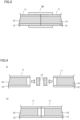
- the method for manufacturing the annular seal material according to the present invention can further include removing an uncrosslinked core 14 from each of the two end portions of rope-like preform 11 (hereinafter also referred to as step b), as shown in Fig. 4 a) , before the hot pressing step or before a second hot pressing step described later.
- step b) by contacting the two end portions (outer layer 12) from which the uncrosslinked core has been removed with each other and placing the same in a mold to carry out hot press molding, protrusion of the core in the joint portion can be easily prevented.
- Step b may be carried out before the hot pressing step, and when feed press molding is carried out, step b may be carried out before a first hot pressing step described later, or may be carried out between the first hot pressing step and the second hot pressing step.
- Uncrosslinked core 14 to be removed can range, for example, from 0.1 mm or more and 20 mm or less inward from the end face. Uncrosslinked core 14 can be removed by using, for example, scissors, a scalpel, or nippers.
- the method for manufacturing the annular seal material according to the present invention can further include heating the two end portions of the rope-like preform (hereinafter also referred to as step c), before the hot pressing step or, when feed press molding is carried out, before a second hot pressing step described later.
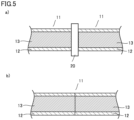
- step c heating the two end portions of the rope-like preform with each other and placing the same in a mold to carry out hot press molding, it is possible to strengthen the joinability between the end portions to prevent protrusion of the core.
- step c as shown in Fig. 5 a) , a heater 20 is sandwiched between the two end portions of rope-like preform 11, and the end faces are heated and melted, and then, as shown in Fig. 5 b) , the melted end portions can be contacted with each other.
- the method for manufacturing the annular seal material according to the present invention can further include disposing a connecting member 40 between the two end portions of rope-like preform 11 to be placed in a mold and placing the same in the mold (hereinafter also referred to as step d), as shown in Fig. 6 , in the hot pressing step or, when feed press molding is carried out, in a second hot pressing step described later.
- step d a connecting member 40 between the two end portions of rope-like preform 11 to be placed in a mold and placing the same in the mold
- the ratio of the thickness of uncrosslinked outer layer 42 of connecting member 40 to the thickness of uncrosslinked outer layer 12 can be, for example, about 1.1 or more and 10 or less.
- the length in the circumferential direction of connecting member 40 can be, for example, about 5 mm or more and 100 mm or less.
- the cross-sectional diameter of connecting member 40 is preferably the same, almost the same, or larger than the cross-sectional diameter of rope-like preform 11 from the viewpoint of reducing the height difference on the outer periphery of the annular seal material.
- Connecting member 40 can include an uncrosslinked core 41 made of a crosslinkable rubber composition for a core described later, and uncrosslinked outer layer 42, made of a crosslinkable rubber composition for an outer layer described later, covering the periphery of uncrosslinked core 41.
- the material constituting uncrosslinked core 41 is preferably the same kind of the crosslinkable rubber composition for a core as the crosslinkable rubber composition for a core that constitutes an uncrosslinked core 13 of rope-like preform 11.
- the material constituting uncrosslinked outer layer 42 is preferably the same kind of the crosslinkable rubber composition for an outer layer as the crosslinkable rubber composition for an outer layer that constitutes uncrosslinked outer layer 12 of rope-like preform 11.
- the method for manufacturing the annular seal material can further include a secondary crosslinking step after the hot pressing step in order to promote crosslinking of an uncrosslinked or insufficiently crosslinked portion.
- the heating temperature in the secondary crosslinking step may be, for example, about 150°C or more and 310°C or less.
- the feed press molding can include the following steps.
- the first hot pressing step a portion other than the end portions of the rope-like preform can be brought into a crosslinked state.
- the first mold in which the rope-like preform is placed in the first hot pressing step can have a straight or arcuate cavity. After the rope-like preform is placed in the first mold, the rope-like preform can be pressed while heating by using a C-type press.
- the temperature of hot press molding in the first hot pressing step may be, for example, about 110°C or more and 220°C or less.
- Examples of a method for hot press molding a portion other than the end portions of the rope-like preform include a method involving cooling sites corresponding to the end portions of the rope-like preform in the first mold by using a cooling apparatus or the like.
- the length of the sites to be cooled can be the length in the circumferential direction of the end portions of the rope-like preform to be brought into an uncrosslinked state or an insufficiently crosslinked state, and may be, for example, 1 mm or more and 600 mm or less.
- the end portions of the rope-like preform can be brought into a crosslinked state and joined.
- An annular seal material can be obtained by repeatedly joining the end portions of two or more rope-like preforms, or by joining the end portions of one rope-like preform to each other.
- the second mold in which the two end portions of the rope-like preform are placed can have a straight and arcuate cavity.
- the two end portions of the rope-like preform to be placed in the second mold may each have a width in the circumferential direction of, for example, 50 mm or more and 600 mm or less.
- the two end portions may be both end portions of one rope-like preform, or may be one end portion of each of two rope-like preforms.
- the temperature of hot press molding in the second hot pressing step may be, for example, about 110°C or more and 220°C or less.
- the temperature of hot press molding in the second hot pressing step is preferably lower than the temperature of hot press molding in the first hot pressing step, and more preferably 5°C or more and 20°C or less lower than the temperature of hot press molding in the first hot pressing step from the viewpoint of preventing cracking and protrusion of the core in the joint portion.
- a perfluoroelastomer, and 1 part by mass of a crosslinking agent (PERHEXA 25B) and 2 parts by mass of a crosslinking aid (TAIC) per 100 parts by mass of the perfluoroelastomer were blended and kneaded by using a kneader to produce a crosslinkable rubber composition for an outer layer.
- a crosslinking agent PERHEXA 25B
- TAIC crosslinking aid
- a fluororubber and 1 part by mass of a crosslinking agent (PERHEXA 25B), 3 parts by mass of a crosslinking aid (TAIC), and 0.1 parts by mass of a colorant (Cromphtal Violet D5700) per 100 parts by mass of the fluororubber were blended and kneaded by using a kneader to produce a crosslinkable rubber composition for a core.
- the crosslinkable rubber composition for an outer layer and the crosslinkable rubber composition for a core were each shaped into a sheet by using a roller in such a way as to have a thickness of about 3 mm, and cut into a ribbon having a width of about 15 mm by using a cutting machine.
- the crosslinkable rubber composition for an outer layer and the crosslinkable rubber composition for a core each shaped into a ribbon were fed into a screw type extruder equipped with a crosshead to produce 5 rope-like preforms having a two-layer structure consisting of an outer layer made of the crosslinkable rubber composition for an outer layer and a core made of the crosslinkable rubber composition for a core.
- the rope-like preforms each had a cross-sectional diameter of about 7.15 mm, an outer layer thickness of about 1.2 mm, and a length of 800 mm.
- each of the 5 rope-like preforms was placed in a first mold of straight type (length of 800 mm, cavity dimension of 7 mm), and the portion other than both end portions was hot press molded by using a C-type press at a temperature of 165°C while both end portions (width of one end portion of 100 mm) were cooled in such a way as to be brought into an uncrosslinked state.
- One end portion of one of the two rope-like preforms after hot press molding was contacted with one end portion of the other, and then the workpiece was placed in the second mold for a joint to hot press mold the joint portion at a temperature of 160°C.
- the same operation was carried out on the end portions of the remaining rope-like preforms to join the 5 rope-like preforms.
- secondary crosslinking was carried out at a temperature of 200°C to obtain an annular seal material.
- the obtained annular seal material has a parting line on each of the outer periphery side and the inner periphery side, and the thickness of the outer layer in the portion where the parting line was present was 200 ⁇ m, the thickness of the outer layer in the portion where the parting line was absent was 1200 ⁇ m, and the ratio of the thickness of the outer layer in the portion where the parting line was absent to the thickness of the outer layer in the portion where the parting line was present was 6/1.
- the obtained annular seal material had an outer diameter of 1194 mm and an inner diameter of 1180 mm in a plan view, and a cross-sectional diameter of 7 mm in a cross section.
- the core was visible through the outer layer at the parting line, and thus the parting line was easily visible, and the annular seal material was able to be easily placed in an apparatus without twisting or sagging.
Landscapes
- Engineering & Computer Science (AREA)
- Mechanical Engineering (AREA)
- General Engineering & Computer Science (AREA)
- Manufacturing & Machinery (AREA)
- Chemical & Material Sciences (AREA)
- Chemical Kinetics & Catalysis (AREA)
- General Chemical & Material Sciences (AREA)
- Compositions Of Macromolecular Compounds (AREA)
- Sealing Devices (AREA)
- Gasket Seals (AREA)
- Moulds For Moulding Plastics Or The Like (AREA)
Applications Claiming Priority (2)
| Application Number | Priority Date | Filing Date | Title |
|---|---|---|---|
| JP2022056238A JP7734109B2 (ja) | 2022-03-30 | 2022-03-30 | 環状シール材および製造方法 |
| PCT/JP2023/010605 WO2023189732A1 (ja) | 2022-03-30 | 2023-03-17 | 環状シール材および製造方法 |
Publications (2)
| Publication Number | Publication Date |
|---|---|
| EP4501604A1 true EP4501604A1 (de) | 2025-02-05 |
| EP4501604A4 EP4501604A4 (de) | 2026-03-11 |
Family
ID=88201074
Family Applications (1)
| Application Number | Title | Priority Date | Filing Date |
|---|---|---|---|
| EP23779748.5A Pending EP4501604A4 (de) | 2022-03-30 | 2023-03-17 | Ringförmiges dichtungsmaterial und herstellungsverfahren |
Country Status (7)
| Country | Link |
|---|---|
| US (1) | US20250198518A1 (de) |
| EP (1) | EP4501604A4 (de) |
| JP (1) | JP7734109B2 (de) |
| KR (1) | KR20240169655A (de) |
| CN (1) | CN118974451A (de) |
| TW (1) | TW202402517A (de) |
| WO (1) | WO2023189732A1 (de) |
Families Citing this family (2)
| Publication number | Priority date | Publication date | Assignee | Title |
|---|---|---|---|---|
| JP2023148299A (ja) * | 2022-03-30 | 2023-10-13 | 株式会社バルカー | 環状シール材および製造方法 |
| JP2025143739A (ja) * | 2024-03-19 | 2025-10-02 | 三菱電線工業株式会社 | シール材 |
Family Cites Families (16)
| Publication number | Priority date | Publication date | Assignee | Title |
|---|---|---|---|---|
| US2961713A (en) * | 1957-05-09 | 1960-11-29 | Parker Hannifin Corp | Molding of o-rings and the like |
| US3586566A (en) * | 1965-10-21 | 1971-06-22 | Chesterton A W Co | Process of encapsulating an o-ring |
| JPS63163071A (ja) * | 1986-12-25 | 1988-07-06 | Mitsubishi Cable Ind Ltd | リングシ−ル |
| JPH08151450A (ja) | 1994-09-29 | 1996-06-11 | Nippon Valqua Ind Ltd | 耐オゾン性フッ素ゴム成形体 |
| JP3757001B2 (ja) * | 1996-08-09 | 2006-03-22 | 株式会社三ツ星 | 二層構造の線状シーリング材及びその製造方法 |
| JPH11201289A (ja) * | 1998-01-09 | 1999-07-27 | Nok Corp | シールリングおよびその製造方法 |
| JP2001150595A (ja) * | 1999-11-30 | 2001-06-05 | Tokai Rubber Ind Ltd | パッキン構造体 |
| US20040157035A1 (en) * | 2003-02-10 | 2004-08-12 | Guizzetti Allen R. | Low permeation gaskets |
| JPWO2006115064A1 (ja) * | 2005-04-22 | 2008-12-18 | Nok株式会社 | ガスケット |
| US20060270780A1 (en) | 2005-05-25 | 2006-11-30 | Ping Xu | High purity perfluoroelastomer composites and a processes to produce the same |
| US20070045967A1 (en) * | 2005-08-31 | 2007-03-01 | Freudenberg-Nok General Partnership | Assemblies sealed with multilayer composite torsion seals having a layer of dispersed fluoroelastomer in thermoplastic |
| WO2009035947A1 (en) * | 2007-09-13 | 2009-03-19 | Cameron International Corporation | Multi-elastomer seal |
| WO2015146851A1 (ja) * | 2014-03-25 | 2015-10-01 | 旭硝子株式会社 | フッ素ゴム成形品 |
| WO2016072397A1 (ja) * | 2014-11-07 | 2016-05-12 | 旭硝子株式会社 | 含フッ素エラストマー、含フッ素エラストマー組成物、含フッ素エラストマー架橋物品 |
| DE102015110944A1 (de) * | 2015-07-07 | 2017-01-12 | W.L. Gore & Associates Gmbh | Ringdichtung |
| CN212717983U (zh) * | 2020-07-11 | 2021-03-16 | 靖江中盛鑫机械制造有限公司 | 一种密封圈及制造密封圈的模具 |
-
2022
- 2022-03-30 JP JP2022056238A patent/JP7734109B2/ja active Active
-
2023
- 2023-03-17 WO PCT/JP2023/010605 patent/WO2023189732A1/ja not_active Ceased
- 2023-03-17 CN CN202380031820.4A patent/CN118974451A/zh active Pending
- 2023-03-17 KR KR1020247035340A patent/KR20240169655A/ko active Pending
- 2023-03-17 US US18/848,590 patent/US20250198518A1/en active Pending
- 2023-03-17 EP EP23779748.5A patent/EP4501604A4/de active Pending
- 2023-03-29 TW TW112111897A patent/TW202402517A/zh unknown
Also Published As
| Publication number | Publication date |
|---|---|
| WO2023189732A1 (ja) | 2023-10-05 |
| JP7734109B2 (ja) | 2025-09-04 |
| US20250198518A1 (en) | 2025-06-19 |
| JP2023148300A (ja) | 2023-10-13 |
| TW202402517A (zh) | 2024-01-16 |
| KR20240169655A (ko) | 2024-12-03 |
| EP4501604A4 (de) | 2026-03-11 |
| CN118974451A (zh) | 2024-11-15 |
Similar Documents
| Publication | Publication Date | Title |
|---|---|---|
| EP4501603A1 (de) | Ringförmiges dichtungselement und herstellungsverfahren | |
| EP4501604A1 (de) | Ringförmiges dichtungsmaterial und herstellungsverfahren | |
| EP3467026B1 (de) | Perfluorelastomerzusammensetzung und dichtungsmaterial | |
| KR101148547B1 (ko) | 불소 고무 조성물, 불소 고무 가교체 및 그 제조 방법 및 o링용 불소 고무 가교체 | |
| TWI735769B (zh) | 積層體及其製造方法、以及閘密封件 | |
| EP4692604A1 (de) | Ringförmiges dichtungsmaterial, vorform und herstellungsverfahren | |
| EP4501602A1 (de) | Ringförmiges dichtmittel und herstellungsverfahren | |
| EP4502431A1 (de) | Material für ringförmige dichtung und herstellungsverfahren |
Legal Events
| Date | Code | Title | Description |
|---|---|---|---|
| STAA | Information on the status of an ep patent application or granted ep patent |
Free format text: STATUS: THE INTERNATIONAL PUBLICATION HAS BEEN MADE |
|
| PUAI | Public reference made under article 153(3) epc to a published international application that has entered the european phase |
Free format text: ORIGINAL CODE: 0009012 |
|
| STAA | Information on the status of an ep patent application or granted ep patent |
Free format text: STATUS: REQUEST FOR EXAMINATION WAS MADE |
|
| 17P | Request for examination filed |
Effective date: 20241027 |
|
| AK | Designated contracting states |
Kind code of ref document: A1 Designated state(s): AL AT BE BG CH CY CZ DE DK EE ES FI FR GB GR HR HU IE IS IT LI LT LU LV MC ME MK MT NL NO PL PT RO RS SE SI SK SM TR |
|
| DAV | Request for validation of the european patent (deleted) | ||
| DAX | Request for extension of the european patent (deleted) | ||
| A4 | Supplementary search report drawn up and despatched |
Effective date: 20260209 |
|
| RIC1 | Information provided on ipc code assigned before grant |
Ipc: B29C 69/02 20060101AFI20260203BHEP Ipc: F16J 15/10 20060101ALI20260203BHEP Ipc: F16J 15/328 20160101ALI20260203BHEP Ipc: F16J 15/3284 20160101ALI20260203BHEP Ipc: B29C 43/18 20060101ALI20260203BHEP Ipc: B29C 48/16 20190101ALI20260203BHEP Ipc: B29C 65/20 20060101ALI20260203BHEP Ipc: B29C 65/50 20060101ALI20260203BHEP Ipc: B29C 65/00 20060101ALI20260203BHEP Ipc: B29C 65/48 20060101ALI20260203BHEP Ipc: B29D 99/00 20100101ALI20260203BHEP |