EP4498502A1 - Endkappe, batteriezelle, batterie und elektrische vorrichtung - Google Patents
Endkappe, batteriezelle, batterie und elektrische vorrichtung Download PDFInfo
- Publication number
- EP4498502A1 EP4498502A1 EP22964032.1A EP22964032A EP4498502A1 EP 4498502 A1 EP4498502 A1 EP 4498502A1 EP 22964032 A EP22964032 A EP 22964032A EP 4498502 A1 EP4498502 A1 EP 4498502A1
- Authority
- EP
- European Patent Office
- Prior art keywords
- connection structure
- end cap
- battery
- electrode terminal
- sealing element
- Prior art date
- Legal status (The legal status is an assumption and is not a legal conclusion. Google has not performed a legal analysis and makes no representation as to the accuracy of the status listed.)
- Pending
Links
Images



Classifications
-
- H—ELECTRICITY
- H01—ELECTRIC ELEMENTS
- H01M—PROCESSES OR MEANS, e.g. BATTERIES, FOR THE DIRECT CONVERSION OF CHEMICAL ENERGY INTO ELECTRICAL ENERGY
- H01M50/00—Constructional details or processes of manufacture of the non-active parts of electrochemical cells other than fuel cells, e.g. hybrid cells
- H01M50/10—Primary casings; Jackets or wrappings
- H01M50/147—Lids or covers
- H01M50/148—Lids or covers characterised by their shape
- H01M50/154—Lid or cover comprising an axial bore for receiving a central current collector
-
- H—ELECTRICITY
- H01—ELECTRIC ELEMENTS
- H01M—PROCESSES OR MEANS, e.g. BATTERIES, FOR THE DIRECT CONVERSION OF CHEMICAL ENERGY INTO ELECTRICAL ENERGY
- H01M50/00—Constructional details or processes of manufacture of the non-active parts of electrochemical cells other than fuel cells, e.g. hybrid cells
- H01M50/10—Primary casings; Jackets or wrappings
- H01M50/147—Lids or covers
- H01M50/155—Lids or covers characterised by the material
- H01M50/157—Inorganic material
- H01M50/159—Metals
-
- H—ELECTRICITY
- H01—ELECTRIC ELEMENTS
- H01M—PROCESSES OR MEANS, e.g. BATTERIES, FOR THE DIRECT CONVERSION OF CHEMICAL ENERGY INTO ELECTRICAL ENERGY
- H01M50/00—Constructional details or processes of manufacture of the non-active parts of electrochemical cells other than fuel cells, e.g. hybrid cells
- H01M50/10—Primary casings; Jackets or wrappings
- H01M50/147—Lids or covers
- H01M50/166—Lids or covers characterised by the methods of assembling casings with lids
- H01M50/169—Lids or covers characterised by the methods of assembling casings with lids by welding, brazing or soldering
-
- H—ELECTRICITY
- H01—ELECTRIC ELEMENTS
- H01M—PROCESSES OR MEANS, e.g. BATTERIES, FOR THE DIRECT CONVERSION OF CHEMICAL ENERGY INTO ELECTRICAL ENERGY
- H01M50/00—Constructional details or processes of manufacture of the non-active parts of electrochemical cells other than fuel cells, e.g. hybrid cells
- H01M50/10—Primary casings; Jackets or wrappings
- H01M50/183—Sealing members
- H01M50/184—Sealing members characterised by their shape or structure
-
- H—ELECTRICITY
- H01—ELECTRIC ELEMENTS
- H01M—PROCESSES OR MEANS, e.g. BATTERIES, FOR THE DIRECT CONVERSION OF CHEMICAL ENERGY INTO ELECTRICAL ENERGY
- H01M50/00—Constructional details or processes of manufacture of the non-active parts of electrochemical cells other than fuel cells, e.g. hybrid cells
- H01M50/10—Primary casings; Jackets or wrappings
- H01M50/183—Sealing members
- H01M50/19—Sealing members characterised by the material
- H01M50/191—Inorganic material
-
- H—ELECTRICITY
- H01—ELECTRIC ELEMENTS
- H01M—PROCESSES OR MEANS, e.g. BATTERIES, FOR THE DIRECT CONVERSION OF CHEMICAL ENERGY INTO ELECTRICAL ENERGY
- H01M50/00—Constructional details or processes of manufacture of the non-active parts of electrochemical cells other than fuel cells, e.g. hybrid cells
- H01M50/50—Current conducting connections for cells or batteries
- H01M50/502—Interconnectors for connecting terminals of adjacent batteries; Interconnectors for connecting cells outside a battery casing
- H01M50/505—Interconnectors for connecting terminals of adjacent batteries; Interconnectors for connecting cells outside a battery casing comprising a single busbar
-
- H—ELECTRICITY
- H01—ELECTRIC ELEMENTS
- H01M—PROCESSES OR MEANS, e.g. BATTERIES, FOR THE DIRECT CONVERSION OF CHEMICAL ENERGY INTO ELECTRICAL ENERGY
- H01M50/00—Constructional details or processes of manufacture of the non-active parts of electrochemical cells other than fuel cells, e.g. hybrid cells
- H01M50/50—Current conducting connections for cells or batteries
- H01M50/543—Terminals
- H01M50/552—Terminals characterised by their shape
- H01M50/559—Terminals adapted for cells having curved cross-section, e.g. round, elliptic or button cells
-
- H—ELECTRICITY
- H01—ELECTRIC ELEMENTS
- H01M—PROCESSES OR MEANS, e.g. BATTERIES, FOR THE DIRECT CONVERSION OF CHEMICAL ENERGY INTO ELECTRICAL ENERGY
- H01M50/00—Constructional details or processes of manufacture of the non-active parts of electrochemical cells other than fuel cells, e.g. hybrid cells
- H01M50/50—Current conducting connections for cells or batteries
- H01M50/543—Terminals
- H01M50/562—Terminals characterised by the material
-
- H—ELECTRICITY
- H01—ELECTRIC ELEMENTS
- H01M—PROCESSES OR MEANS, e.g. BATTERIES, FOR THE DIRECT CONVERSION OF CHEMICAL ENERGY INTO ELECTRICAL ENERGY
- H01M50/00—Constructional details or processes of manufacture of the non-active parts of electrochemical cells other than fuel cells, e.g. hybrid cells
- H01M50/10—Primary casings; Jackets or wrappings
- H01M50/102—Primary casings; Jackets or wrappings characterised by their shape or physical structure
- H01M50/107—Primary casings; Jackets or wrappings characterised by their shape or physical structure having curved cross-section, e.g. round or elliptic
-
- H—ELECTRICITY
- H01—ELECTRIC ELEMENTS
- H01M—PROCESSES OR MEANS, e.g. BATTERIES, FOR THE DIRECT CONVERSION OF CHEMICAL ENERGY INTO ELECTRICAL ENERGY
- H01M50/00—Constructional details or processes of manufacture of the non-active parts of electrochemical cells other than fuel cells, e.g. hybrid cells
- H01M50/50—Current conducting connections for cells or batteries
- H01M50/502—Interconnectors for connecting terminals of adjacent batteries; Interconnectors for connecting cells outside a battery casing
-
- Y—GENERAL TAGGING OF NEW TECHNOLOGICAL DEVELOPMENTS; GENERAL TAGGING OF CROSS-SECTIONAL TECHNOLOGIES SPANNING OVER SEVERAL SECTIONS OF THE IPC; TECHNICAL SUBJECTS COVERED BY FORMER USPC CROSS-REFERENCE ART COLLECTIONS [XRACs] AND DIGESTS
- Y02—TECHNOLOGIES OR APPLICATIONS FOR MITIGATION OR ADAPTATION AGAINST CLIMATE CHANGE
- Y02E—REDUCTION OF GREENHOUSE GAS [GHG] EMISSIONS, RELATED TO ENERGY GENERATION, TRANSMISSION OR DISTRIBUTION
- Y02E60/00—Enabling technologies; Technologies with a potential or indirect contribution to GHG emissions mitigation
- Y02E60/10—Energy storage using batteries
Definitions
- This application relates to the technical field of batteries, and in particular, to an end cap, a battery cell, a battery, and an electrical device.
- some embodiments of this application provide an end cap, a battery cell, a battery, and an electrical device to increase an output current of the battery, and in turn, improve performance of the battery.
- an end cap includes: an end cap body, where a hole is created on the end cap body; a first connection structure, including a first metal, where the first connection structure is disposed on an inner side of the hole and configured to be welded to an electrode terminal located in the hole; and a second connection structure, including a second metal.
- the second connection structure is connected to the first connection structure.
- the second connection structure is configured to be welded to a first sealing element designed for sealing the hole.
- the end cap includes an end cap body, a first connection structure, and a second connection structure.
- the end cap body includes a hole.
- the hole is configured to accommodate the electrode terminal.
- the first connection structure is located on the inner side of the hole, and is welded to the electrode terminal. That is, the first connection structure is contiguous to the hole.
- the second connection structure is connected to the first connection structure, and is welded to the first sealing element designed for sealing the hole.
- this application enables a current to flow directly from the electrode terminal to the first sealing element, and then causes the current to flow to an external circuit connected to the first sealing element, thereby avoiding the current loss caused by the need to pass through the housing of the battery, and in turn, increasing the output current of the battery and improving the performance of the battery.
- the end cap body includes a first step structure disposed at an edge of the hole.
- the first step structure is configured to be embedded into the first connection structure.
- the first connection structure when the first step structure is disposed at the edge of the hole and the first connection structure is embedded in the first step structure, the first connection structure can be positioned on the inner side of the hole, so as to enable welding of the first connection structure to the electrode terminal located in the hole.
- this application connects the first connection structure to the electrode terminal located in the hole, and in turn, allows the current to flow directly from the electrode terminal to the first connection structure.
- the end cap body further includes a second step structure.
- the second step structure is closer to the inner side of the hole than the first step structure.
- the second step structure is configured to lap the electrode terminal.
- the electrode terminal is located in the hole.
- a second step structure is further disposed in the end cap body. Further, the second step structure is closer to the inner side of the hole than the first step structure. That is, the second step structure is also contiguous to the hole.
- the second step structure is configured to lap the electrode terminal, thereby enabling connection of the electrode terminal to the first connection structure in the first step structure.
- the first connection structure includes a third step structure.
- the third step structure is configured to leave a clearance for a welding structure of the first connection structure and the electrode terminal.
- the first connection structure located in the first step structure is welded to the electrode terminal lapped in the second step structure.
- Some welding structures such as weld marks, may result from the welding between the first connection structure and the electrode terminal, thereby causing the surface of the first connection structure to be uneven. If the uneven surface of the first connection structure is in direct contact with other components, the normal use of the other components will be adversely affected.
- a third step structure in the first connection structure, other components can stay clear from the welding structure of the first connection structure and the electrode terminal, thereby ensuring the normal use of other components.
- the end cap body, the first connection structure, and the second connection structure are all annular.
- the end cap body, the first connection structure, and the second connection structure are all annular, the first connection structure and the second connection structure are distributed in the end cap as much as practicable and reasonable, so as to implement smooth transmission of an electric current.
- a dimension of the first connection structure is 0.8 to 1 mm, and the first direction is parallel to an axis of the end cap.
- the first connection structure is not only connected to the second connection structure, but also welded to the electrode terminal located in the hole.
- the welding between the first connection structure and the electrode terminal may be weak.
- the connection between the first connection structure and the electrode terminal is ensured to be firm, and a stable flow of current is achieved.
- a dimension of the second connection structure is 2 to 4 mm.
- the second connection structure is not only connected to the first connection structure, but also connected to the first sealing element designed for sealing the hole.
- the welding between the second connection structure and the first sealing element may be weak.
- the connection between the second connection structure and the first sealing element is ensured to be firm, and a stable flow of current is achieved.
- a dimension of a third step structure is not less than 0.2 mm.
- the third step structure is configured to leave a clearance for the welding structure of the first connection structure and the electrode terminal, so as to ensure normal use of other components around the first connection structure and the electrode terminal.
- a dimension of the first connection structure on one side of an axis of the end cap is not less than 1 mm, and the second direction is perpendicular to the axis of the end cap.
- the dimension of the first connection structure in the first direction needs to meet the specified requirement.
- the first connection structure not only needs to be connected to the electrode terminal, but also needs to be connected to the second connection structure. If the dimension of the first connection structure in the second direction is overly small, the connection between the first connection structure and the second connection structure may be inferior.
- a dimension of the second connection structure on one side of the axis of the end cap is not less than 5 mm.
- the second connection structure of an appropriate dimension can perfectly mate with components such as the electrode terminal and the end cap.
- the dimension of the second connection structure on a single side in the second direction not less than 5 mm, normal functionality of the end cap can be ensured.
- the electrode terminal is made of a material including copper.
- the first metal is nickel-plated steel or copper.
- the electrode terminal when the electrode terminal includes copper and the first metal in the first connection structure is copper or nickel-plated steel, the copper-containing electrode terminal can be directly welded to the first connection structure.
- the electrode terminal can be directly welded to the first connection structure to transmit a current efficiently and avoid current loss, thereby increasing the current flowing to the outside.
- the first sealing element is made of a material including aluminum.
- the second metal is aluminum.
- the aluminum-containing first sealing element when the first sealing element includes aluminum and the second metal in the second connection structure is aluminum, the aluminum-containing first sealing element can be directly welded to the second connection structure.
- Aluminum is cheap and easily available.
- the electrical connection between the battery and the outside can be implemented by the connection between the aluminum-containing end cap the busbar component made of aluminum, thereby reducing the cost of the battery and facilitating use in mass production.
- the second metal in the second connection structure is aluminum, thereby implementing a firm connection between the battery and the outside, avoiding current loss, and increasing the current flowing to the outside.
- the first connection structure is connected to the second connection structure by thermal bonding.
- the end cap structure connected by thermal bonding possesses a relatively low internal resistance.
- the current can be more efficiently transferred from the first connection structure to the second connection structure to implement transfer of a relatively large current between the battery and the outside, thereby improving performance of the battery.
- a battery cell including: an electrode assembly; a housing with a first opening, configured to accommodate the electrode assembly; the end cap according to any one of the foregoing embodiments, where the end cap includes a second opening, and the end cap is configured to seal the first opening; and the first sealing element, configured to seal the second opening.
- the first sealing element in a first direction, includes a protruding portion relative to the end cap.
- the first direction is parallel to an axis of the end cap.
- the second connection structure is welded to a connecting piece designed for sealing the hole of the end cap body.
- Some welding structures such as weld marks, may result from the welding between the second connection structure and the connecting piece, thereby causing the surface of the second connection structure to be uneven.
- the first sealing element also needs to be connected to the busbar component. If the uneven surface of the second connection structure is in direct contact with the busbar component, the normal use of the busbar component will be adversely affected. By disposing a protruding portion on the first sealing element, the busbar component or other components can stay clear from the welding structure of the second connection structure and the first sealing element, thereby ensuring the normal use of the busbar component or other components.
- a dimension of the protruding portion is not less than 0.2 mm.
- the protruding portion located on the first sealing element is configured to leave a clearance for the welding structure of the second connection structure and the first sealing element, so as to ensure normal use of other components around the second connection structure and the first sealing element.
- a battery includes: a plurality of the battery cells according to the foregoing embodiment; and a busbar component, configured to electrically connect the plurality of battery cells.
- this application provides an electrical device.
- the electrical device includes the battery disclosed in the foregoing embodiment.
- the battery is configured to provide electrical energy.
- a plurality of means at least two in number; the terms such as “up”, “down”, “left”, “right”, “in”, and “out” indicating a direction or a position relationship are merely intended for ease or brevity of description of this application, but do not indicate or imply that the mentioned device or component is necessarily located in the specified direction and position or constructed or operated in the specified direction and position. Therefore, such terms are not to be understood as a limitation on this application.
- the terms “first”, “second”, “third”, and so on are merely used for descriptive purposes, but not construed as indicating or implying relative importance.
- Perfect does not means exact perpendicularity, but means perpendicularity falling within an error tolerance range.
- Parallel does not mean exact parallelism, but means parallelism falling within an error tolerance range.
- connection may be a fixed connection, a detachable connection, or an integrated connection, and may be a direct connection or an indirect connection implemented through an intermediary.
- the term "and/or” merely indicates a relationship between related items, and represents three possible relationships.
- “A and/or B” may represent the following three circumstances: A alone, both A and B, and B alone.
- the character “/” herein generally indicates an "or” relationship between the item preceding the character and the item following the character.
- the battery in some embodiments of this application may be a lithium-ion battery, a lithium metal battery, a lead-acid battery, a nickel-cadmium battery, a nickelhydrogen battery, a lithium-sulfur battery, a lithium-air battery, a sodium-ion battery, or the like.
- the type of the battery is not particularly limited herein.
- a plurality of battery cells in a battery may be connected in series, parallel, or series-and-parallel pattern.
- the series-and-parallel pattern means a combination of series connection and parallel connection.
- the plurality of battery cells may be connected in series, parallel, or series-and-parallel pattern to form a battery module, and then a plurality of battery modules may be connected in series, parallel, or series-and-parallel pattern to form the battery.
- the plurality of battery cells may directly form the battery, or form the battery modules that are then used to form the battery.
- the battery is further mounted in the electrical device to provide electrical energy for the electrical device.
- Power batteries are not only used in energy storage power systems such as hydro, thermal, wind, and solar power stations, but also widely used in electric means of transport such as electric bicycles, electric motorcycles, and electric vehicles, and used in many other fields such as military equipment and aerospace.
- the market demand for power batteries keeps soaring with the increase of the application fields of the power batteries.
- an existing cylindrical battery typically includes only one electrode terminal, and a material that is used on the cell for connecting to a busbar component of an external module is nickel-plated steel and aluminum.
- the busbar component of the module is mostly made of an aluminum bar, a nickel sheet, or a nickel-plated material. Therefore, when a current is generated inside the cylindrical battery, the current needs to pass through the housing of the cylindrical battery.
- the internal resistance of the housing is relatively high, thereby causing the output current of the cylindrical battery to be smaller, and in turn, causing a decline in the performance of the cylindrical battery.
- An embodiment of this application provides an end cap.
- a cylindrical battery fitted with two electrode terminals enables both the positive electrode terminal and the negative electrode terminal to be electrically connected to a busbar component directly.
- the current can flow from the electrode terminals to the end cap directly, and then flow to the first sealing element connected to the end cap without a need to pass through the housing of the battery cell, thereby increasing the output current of the battery cell and improving the performance of the battery.
- end cap provided in this application is applicable to, but not limited to use in, cylindrical batteries, especially the 4680 structure of cylindrical batteries.
- the battery cell disclosed in embodiments of this application is applicable to, but not limited to use in, electrical devices such as a vehicle, watercraft, or aircraft.
- the battery cell, the battery, and the like disclosed in this application may be used to form a power supply system of the electrical device to increase the current of the cylindrical battery in the power supply system and improve performance of the cylindrical battery.
- the electric toy may include stationary or mobile electric toys, such as a game console, an electric car toy, an electric ship toy, and an electric airplane toy.
- the spacecraft may include an airplane, a rocket, a space shuttle, a spaceship, and the like.
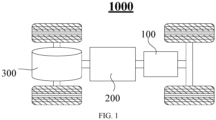
- FIG. 1 is a schematic structural diagram of a vehicle 1000 according to some embodiments of this application.
- the vehicle 1000 may be an oilfueled vehicle, a natural gas vehicle, or a new energy vehicle.
- the new energy vehicle may be a battery electric vehicle, a hybrid electric vehicle, a range-extended electric vehicle, or the like.
- a battery 100 is disposed inside the vehicle 1000.
- the battery 100 may be disposed at the bottom, front, or rear of the vehicle 1000.
- the battery 100 may be configured to supply power to the vehicle 1000.
- the battery 100 may serve as an operating power supply of the vehicle 1000.
- the vehicle 1000 may further include a controller 200 and a motor 300.
- the controller 200 is configured to control the battery 100 to supply power to the motor 300, for example, to meet electrical energy requirements in starting, navigating, or running the vehicle 1000.
- the battery 100 serves not only as an operating power supply of the vehicle 1000, but may also serve as a driving power supply of the vehicle 1000 to provide driving power for the vehicle 1000 in place of or partly in place of fuel oil or natural gas.
- FIG. 2 is a schematic structural diagram of a battery 100 according to an embodiment of this application.
- the battery 100 may include a plurality of battery cells 20.
- the battery 100 may further include a box 10 (or referred to as a casing) in addition to the battery cell.
- the box 10 is hollowed out inside.
- a plurality of battery cells 20 are accommodated in the box 10.
- the box 10 may include two parts, herein referred to as a first part 111 and a second part 112 respectively.
- the first part 111 and the second part 112 are snap-fitted together.
- the shapes of the first part 111 and the second part 112 may depend on the shape of a plurality of battery cells 20 combined.
- first part 111 and the second part 112 each may be a hollow cuboid, and each may include one opened surface.
- the opening of the first part 111 is opposite to the opening of the second part 112.
- the first part 111 and the second part 112 are snap-fitted to each other to form a box 10 that includes a closed cavity.
- the plurality of battery cells 20 are combined and connected in parallel, series, or series-and-parallel pattern, and then placed into the box that is formed by snap-fitting the first part 111 and the second part 112.
- the battery 100 may contain a plurality of battery cells 20.
- the plurality of battery cells 20 may be connected in series, parallel, or series-and-parallel pattern.
- the series-and-parallel pattern means a combination of series connection and parallel connection of the plurality of battery cells 20.
- the plurality of battery cells 20 may be directly connected in series, parallel, or series-and-parallel pattern, and then the whole of the plurality of battery cells 20 may be accommodated in the box.
- the plurality of battery cells 20 may be connected in series, parallel, or series-and-parallel pattern to form a battery module first, and then a plurality of battery modules are connected in series, parallel, or series-and-parallel pattern to form a whole and accommodated in the box.
- the battery 100 may further include other structures.
- the battery 100 may further include a busbar component (not shown in the drawing). The busbar component is configured to implement an electrical connection between the plurality of battery cells 20.
- Each battery cell 20 may be, but is not limited to, a secondary battery or primary battery; or, may be a lithium-sulfur battery, a sodium-ion battery, or a magnesium-ion battery.
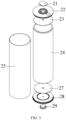
- FIG. 3 is a schematic exploded view of a battery cell according to an embodiment of this application; and FIG. 4 is a schematic structural diagram of a battery cell 20 according to another embodiment of this application.
- the battery cell 20 may include a first sealing element 21, an end cap 22, a negative electrode connection strap 23, an electrode assembly 24, a housing 25, a positive electrode connection strap 27, a bottom cover 28, and a second sealing element 29.
- the housing 25 combines with the first sealing element 21 and the second sealing element 29 to form a shell or a battery case.
- the wall of the housing 25 and the walls of the first sealing element 21 and the second sealing element 29 are all referred to as walls of the battery cell 20.
- the shape of the housing 25 depends on the shape of one or more electrode assemblies 24 combined together.
- an end face of the housing 25 may be an opened face. That is, this end face is not walled so that the inside of the housing 25 communicates with the outside.
- the housing 25 of the cylindrical cell 20 includes two circular end faces. The part between the two circular end face is a cylinder body.
- the cylinder body may include an electrode assembly 24.
- the end cap 22 and the bottom cover 27 cover an upper opening and a lower opening respectively and are connected to the housing 25, and, through the first sealing element 21 and the second sealing element 29, form a closed cavity configured to accommodate the electrode assembly 24.
- the housing 25 is filled with an electrolyte such as an electrolyte solution.
- the battery cell 20 further includes electrode terminals 26.
- the electrode terminals 26 are inserted into the end cap 22 and the bottom cover 28 respectively to get electrically connected to the first sealing element 21 and the second sealing element 29 respectively. More specifically, the electrode terminal 26 includes a first electrode terminal 261 and a second electrode terminal 262. The first electrode terminal 261 is opposite to the second electrode terminal 262.
- the battery cell 20 may further include a current collecting component, configured to electrically connect the electrode assembly 24 to the electrode terminal 26.
- each electrode assembly 24 includes two tabs, such as a first tab and a second tab.
- the first tab and the second tab are of opposite polarities. For example, when the first tab is a positive tab, the second tab is a negative tab.
- the first tab is a copper tab, and the second tab is an aluminum tab.
- the first tabs of one or more electrode assemblies 24 are connected to one electrode terminal 26 by one current collecting component, and the second tabs of one or more electrode assemblies 24 are connected to another electrode terminal 26 by another current collecting component.
- the first tab and the second tab of the battery cell 20 are disposed at two ends respectively.
- the first tab is a copper tab
- the second tab is an aluminum tab.
- the bottom cover 28 may be omitted in the battery cell 20.
- the aluminum tab may be directly connected to the second sealing element 29.
- one or more electrode assemblies 24 may be disposed depending on actual use requirements. As shown in FIG. 4 , one electrode assembly 24 is disposed in the battery cell 20.
- FIG. 5 is a schematic exploded view of an end cap 22 according to an embodiment of this application.
- the end cap 22 includes: an end cap body 221, where a hole 222 is created on the end cap body 221; a first connection structure 223, including a first metal, where the first connection structure 223 is disposed on an outer side of the hole 222 and configured to be welded to an electrode terminal 26 located in the hole 222; and a second connection structure 224, including a second metal.
- the second connection structure 224 is connected to the first connection structure 223.
- the second connection structure 224 is configured to be welded to a first sealing element 21 designed for sealing the hole 222.
- the end cap 22 may further include an upper plastic sheet 225, an end cap strip 226, a sealing ring 227, and a lower plastic sheet 228.
- the electrode terminal 26 passes through the hole 222 to get connected to the end cap 22.
- the electrode terminals 26 are a component used for electrical connection.
- the current generated by the electrode assembly 24 is transmitted to the positive and negative electrodes of the battery cell 20 through the electrode terminals 26.
- the first electrode terminal 261 is connected to the end cap 22.
- the first electrode terminal 261 is electrically connected to the copper tab.
- the current generated by the electrode assembly 24 is transmitted to the end cap 22 through the first electrode terminal 261 at one end, and then transmitted to the first sealing element 21 and is transmitted to the second sealing element 29 at the second electrode terminal 262 through the second electrode terminal 262 at the other end.
- Both the first sealing element 21 and the second sealing element 29 are connected to the busbar component. In this way, the current can flow directly from the electrode assembly 24 to the outside, without passing through the housing 25 of the battery cell 20.
- the first connection structure 223 needs to be connected to the first electrode terminal 261 by welding. If the first connection structure 223 is connected to the first electrode terminal 261 by other means, then the internal resistance between the first connection structure and the first electrode terminal will be relatively large, thereby still causing current loss of the battery cell 20. Therefore, the first metal included in the first connection structure 223 is necessarily a metal that can be welded to the first electrode terminal 261.
- the hole 222 serves to accommodate the first electrode terminal 261. Therefore, the size of the hole 222 needs to be set depending on the size of the electrode assembly 24 or the first electrode terminal 261. This application does not impose any limitation on the specific size of the hole 222.
- the end cap 22 includes an end cap body 221, a first connection structure 223, and a second connection structure 224.
- the end cap body 221 includes a hole 222.
- the hole 222 is configured to accommodate the first electrode terminal 261.
- the first connection structure 223 is located on the inner side of the hole 222, and is welded to the first electrode terminal 261. That is, the first connection structure 223 is contiguous to the hole 222.
- the second connection structure 224 is connected to the first connection structure 223, and is welded to the first sealing element 21 designed for sealing the hole 222.
- connection structure 223 When the first connection structure 223 is connected to the second connection structure 224, electrical connection is implemented between the first connection structure 223 and the second connection structure 224.
- first sealing element 21 When the first sealing element 21 is connected to the second connection structure 224, electrical connection is implemented between the second connection structure 224 and the first sealing element 21.
- this application enables a current to flow directly from the first electrode terminal 261 to the first sealing element 21, and then causes the current to flow to a busbar component connected to the first sealing element 21, thereby avoiding the current loss caused by the need to pass through the housing 25 of the battery, and in turn, increasing the output current of the battery cell 20 and improving the performance of the battery 100.
- FIG. 6 is a cross-sectional view of an end cap 22 according to an embodiment of this application.
- FIG. 7 is a close-up view of a region A shown in FIG. 6 .
- the end cap body 221 includes a first step structure 2211 disposed at an edge of the hole 222.
- the first step structure 2211 is configured to be embedded into the first connection structure 223.
- the first connection structure 223 can be positioned on the inner side of the hole 221, so as to enable welding of the first connection structure 223 to the first electrode terminal 261 located in the hole 221.
- both the inner side of the hole 222 and the edge of the hole 222 are regions that are not physically isolated from the hole 222, but are connected to the hole 222.
- this application connects the first connection structure 223 to the first electrode terminal 261 located in the hole 222, and in turn, allows the current to flow directly from the first electrode terminal 261 to the first connection structure 223.
- the end cap body 221 further includes a second step structure 2212.
- the second step structure 2212 is closer to the inner side of the hole 222 than the first step structure 2211.
- the second step structure 2212 is configured to lap the first electrode terminal 261.
- the first electrode terminal 261 is located in the hole 222.
- a second step structure 2212 is further disposed in the end cap body 221. Further, the second step structure 2212 is closer to the inner side of the hole 222 than the first step structure 2211. That is, the second step structure 2212 is also contiguous to the hole 222. In other words, the second step structure 2212 is connected to the hole 222.
- the second step structure 2212 is configured to lap the first electrode terminal 261, thereby enabling connection of the first electrode terminal 261 to the first connection structure 223 on the first step structure 2211.
- this application can place the first electrode terminal 261 stably in the hole 222 and connect the first electrode terminal to the first connection structure 223 stably, thereby implementing a stable flow of current.
- the first connection structure 223 includes a third step structure 2213.
- the third step structure 2213 is configured to leave a clearance for a welding structure 2214 of the first connection structure 223 and the first electrode terminal 261.
- the first connection structure 223 located in the first step structure 2211 is welded to the first electrode terminal 261 lapped in the second step structure 2212.
- Some welding structures 2214 such as weld marks, may result from the welding between the first connection structure and the electrode terminal, thereby causing the surface of the first connection structure 223 to be uneven. If the uneven surface of the first connection structure 223 is in direct contact with other components, the normal use of the other components will be adversely affected.
- the second connection structure 224 also needs to be welded to the first sealing element 21.
- the first sealing element 21 is in contact with the surface of the first connection structure 223.
- the welding structure may interfere with the welding or normal use of the end cap 22.
- the end cap body 221, the first connection structure 223, and the second connection structure 224 are all annular.
- the current is transmitted to the first electrode terminal 261 first, and then transmitted to the first connection structure 223 by the first electrode terminal 261, and then transmitted to the second connection structure 224 by the first connection structure 223, and then transmitted to the first sealing element 21 by the second connection structure 224, and finally transmitted to other external components such as a busbar component by the first sealing element 21, thereby enabling a plurality of battery cells 20 to form an electrically connected battery module. Therefore, theoretically, the technical solution works as long as the parts that need to transmit the current are set to be the first connection structure 223 and the second connection structure 224, respectively. However, in order to transmit the current more efficiently, both the first connection structure 223 and the second connection structure 224 may be made to be annular. Nevertheless, in practical applications, the producer may dispose the corresponding parts based on the actual production requirements. This application does not limit the specific positions of the first connection structure 223 and the second connection structure 224 and the like in the end cap 22.
- the end cap body 221, the first connection structure 223, and the second connection structure 224 are all annular, the first connection structure 223 and the second connection structure 224 are distributed in the end cap 22 as much as practicable and reasonable, so as to implement smooth transmission of an electric current.
- FIG. 8 is a close-up view of a region B shown in FIG. 7 .
- a dimension D1 of the first connection structure 223 is 0.8 to 1 mm, and the first direction X is parallel to an axis of the end cap 22.
- the first connection structure 223 is not only connected to the second connection structure 224, but also welded to the first electrode terminal 261 located in the hole 222.
- the welding between the first connection structure 223 and the first electrode terminal 261 may be weak.
- the dimension D1 of the first connection structure 223 in the first direction X may be 0.85 mm, 0.9 mm, 1 mm, or the like.
- the value of D1 is not particularly limited herein, as long as the engineering requirements are satisfied.
- the connection between the first connection structure 223 and the first electrode terminal 261 is ensured to be firm, and a stable flow of current is achieved.
- a dimension D2 of the second connection structure 224 is 2 to 4 mm.
- the dimension D2 of the second connection structure 224 in the first direction X may be 2 mm, 3 mm, 3.5 mm, 4 mm, or the like.
- the value of D3 is not particularly limited herein, as long as the engineering requirements are satisfied.
- the second connection structure 224 is not only connected to the first connection structure 223, but also connected to the first sealing element 21 designed for sealing the hole 222.
- the welding between the second connection structure 224 and the first sealing element 21 may be weak.
- the connection between the second connection structure 224 and the first sealing element 21 is ensured to be firm, and a stable flow of current is achieved.
- a dimension D3 of the third step structure 2213 is not less than 0.2 mm.
- the dimension D3 of the third step structure 2213 in the first direction X may be 0.2 mm, 0.3 mm, 0.35 mm, 0.4 mm, or the like.
- the value of D3 is not particularly limited herein, as long as the engineering requirements are satisfied.
- the third step structure 2213 is configured to leave a clearance for the welding structure 2214 of the first connection structure 223 and the first electrode terminal 261, so as to ensure normal use of other components around the first connection structure 223 and the first electrode terminal 261.
- a dimension D4 of the first connection structure 223 on one side of the axis of the first sealing element 21 is not less than 1 mm.
- the second direction Y is perpendicular to the axis of the end cap 22.
- the dimension D1 of the first connection structure 223 in the first direction X needs to meet the specified requirement.
- the first connection structure 223 not only needs to be connected to the first electrode terminal 261, but also needs to be connected to the second connection structure 224. If the dimension D4 of the first connection structure 223 in the second direction Y is overly small, the connection between the first connection structure and the second connection structure 224 may be inferior.
- the end cap body 221, the first connection structure 223, and the second connection structure 224 are all left-right symmetrical.
- the first connection structures 223 existent on both sides are welded to the first electrode terminal 261 separately. Therefore, on a single side, the dimension D4 of the first connection structure 223 in the second direction Y is not less than 1 mm.
- the dimension D4 of the first connection structure 223 on a single side in the second direction Y may be 1 mm, 1.5 mm, 2 mm, or the like.
- the value of D3 is not particularly limited herein, as long as the engineering requirements are satisfied.
- the first connection structure 223 can be connected to the second connection structure 224 stably, and the electric current can be output stably.
- a dimension D5 of the second connection structure 224 on one side of the axis of the end cap 22 is not less than 5 mm.
- the dimension D4 of the second connection structure 224 on a single side in the second direction Y may be 2 mm, 3 mm, 4 mm, or the like.
- the value of D3 is not particularly limited herein, as long as the engineering requirements are satisfied.
- the second connection structure 224 of an appropriate dimension can perfectly mate with components such as the first electrode terminal 261 and the first sealing element 21. Similarly, the second connection structures 224 existent on both sides are welded to the first sealing element 21 separately. Therefore, on a single side, the dimension D5 of the second connection structure 224 in the second direction Y is not less than 5 mm.
- the electrode terminal 26 is made of a material including copper.
- the first metal is nickel-plated steel or copper.
- the first connection structure 223 needs to be connected to the first electrode terminal 261 by welding. Therefore, the first metal in the first connection structure 223 is necessarily a metal that can be welded to the first electrode terminal 261.
- the electrode terminal 26 more specifically, the first electrode terminal 261 is made of a material including copper, and the first metal in the first connection structure 223 is copper or nickel-plated steel, the copper-containing first electrode terminal 261 can be directly welded to the first connection structure 223.
- the electrode terminal 26 can be directly welded to the first connection structure 223 to transmit the current efficiently and avoid current loss, thereby increasing the current flowing to the outside.
- the first sealing element 21 is made of a material including aluminum.
- the second metal is aluminum.
- the aluminum-containing first sealing element 21 can be directly welded to the second connection structure 224.
- the material of the second sealing element 29 also includes aluminum.
- the electrical connection between the battery cell 20 and the outside can be implemented by the connection between the aluminum-containing first sealing element 21 and the busbar component made of aluminum, thereby reducing the cost of the battery 100 and facilitating use in mass production.
- the second metal in the second connection structure 224 is aluminum, thereby implementing a firm connection between the battery cell 20 and the outside, avoiding current loss, and increasing the current flowing to the outside.
- the first tab in the battery cell 20 is made of copper. Therefore, the material of the electrode terminal 26 connected to the first tab needs to include copper. In other words, the material of the first electrode terminal 261 includes copper.
- the second tab is made of aluminum. Therefore, the material of the electrode terminal 26 connected to the second tab needs to include aluminum. In other words, the material of the second electrode terminal 292 includes aluminum. Referring to FIG. 4 , the first tab is electrically connected to the first electrode terminal 261, the first electrode terminal 261 is electrically connected to the end cap 22, and then the end cap 22 is electrically connected to an external busbar component through the first sealing element 21. The second tab is electrically connected to the second electrode terminal 262, the second electrode terminal 262 is electrically connected to the second sealing element 29, and then the second sealing element 29 is electrically connected to the external busbar component.
- the first connection structure 223 is connected to the second connection structure 224 by thermal bonding.
- Hot rolling is a process of rolling performed above a crystallization temperature.
- the metal is of a high plasticity and a low deformation resistance, thereby greatly reducing the energy consumption during metal deformation.
- the hot rolling process can improve the processing performance of a metal and an alloy. This process crushes cast-state coarse grains, promotes healing of cracks, reduces or eliminates casting defects, changes a cast-state structure into a deformation-induced structure, and improves the processing performance of the alloy.
- copper and aluminum are bonded together at the crystallization temperatures of copper and aluminum.
- the end cap 22 structure connected by thermal bonding possesses a relatively low internal resistance.
- the current can be more efficiently transferred from the first connection structure 223 to the second connection structure 224 to implement transfer of a relatively large current between the battery cell 20 and the outside, thereby improving the performance of the battery 100.
- An embodiment of this application further provides a battery cell 20.
- the battery cell 20 includes: an electrode assembly 24; a housing 25 with a first opening, configured to accommodate the electrode assembly 24; the end cap 22 according to any one of the foregoing embodiments, where the end cap includes a second opening, and the end cap 22 is configured to seal the first opening; and a first sealing element 21, configured to seal the second opening.
- the first sealing element 21 in a first direction X, includes a protruding portion 211 relative to the end cap 22.
- the first direction X is parallel to an axis of the end cap 22.
- the second connection structure 224 is welded to the first sealing element 21 designed for sealing the hole 222 of the end cap body 221.
- Some welding structures 2214 such as weld marks, may result from the welding between the second connection structure and the first sealing element, thereby causing the surface of the second connection structure 224 to be uneven.
- the first sealing element 21 also needs to be connected to the busbar component. If the uneven surface of the second connection structure 224 is in direct contact with the busbar component, the normal use of the busbar component will be adversely affected.
- the busbar component or other components can stay clear from the welding structure 2214 of the second connection structure 224 and the first sealing element 21, thereby ensuring the normal use of the busbar component or other components.
- a dimension D6 of the protruding portion 211 is not less than 0.2 mm.
- the protruding portion 211 located on the first sealing element 21 is configured to leave a clearance for the welding structure 2214 of the second connection structure 224 and the first sealing element 21, so as to ensure normal use of other components around the second connection structure 224 and the first sealing element 21.
- the dimension of the protruding portion 211 in the first direction X may be 0.2 mm, 0.25 mm, or 0.3 mm.
- the value of the dimension is not particularly limited herein, as long as the engineering requirements are satisfied.
- the battery cell 20 includes two types of electrode terminals 26: a copper-containing first electrode terminal 261, and an aluminum-containing second electrode terminal 262.
- the two types of electrode terminals 26 are disposed at two ends of the battery cell 20 respectively.
- the first electrode terminal 261 is connected to a copper tab
- the second electrode terminal 262 is connected to an aluminum tab.
- the first electrode terminal 261 is connected to the end cap 22, and then connected to an external busbar component through the first sealing element 21.
- the second electrode terminal 262 is connected to the bottom cover 28, and then connected to the external busbar component through the second sealing element 29.
- An embodiment of this application further provides a battery 100.
- the battery includes the battery cell 20 disclosed in the preceding embodiment.
- An embodiment of this application further provides an electrical device.
- the electrical device may include the battery 100 according to any one of the foregoing embodiments, and the battery is configured to provide electrical energy for the electrical device.
- the electrical device may be a vehicle, watercraft, or spacecraft.
- the first electrode terminal 261 and the second electrode terminal 262 are disposed opposite to each other at two ends of the battery cell 20.
- the first electrode terminal 261 connected to the first tab (that is, the copper tab) is connected to the end cap 22 containing the first connection structure 223 and the second connection structure 224, and is then connected to the first sealing element 21.
- the second electrode terminal 262 connected to the second tab (that is, the aluminum tab) is connected to the second sealing element 29, thereby transmitting the current generated by the electrode assembly 24 to the outside directly, avoiding current loss caused by the need to pass through the housing 25, and in turn, increasing the output current of the battery cell 20 and improving the performance of the battery 100.
Landscapes
- Chemical & Material Sciences (AREA)
- Chemical Kinetics & Catalysis (AREA)
- Electrochemistry (AREA)
- General Chemical & Material Sciences (AREA)
- Inorganic Chemistry (AREA)
- Sealing Battery Cases Or Jackets (AREA)
- Connection Of Batteries Or Terminals (AREA)
Applications Claiming Priority (1)
| Application Number | Priority Date | Filing Date | Title |
|---|---|---|---|
| PCT/CN2022/129897 WO2024092724A1 (zh) | 2022-11-04 | 2022-11-04 | 端盖、电池单体、电池和用电设备 |
Publications (2)
| Publication Number | Publication Date |
|---|---|
| EP4498502A1 true EP4498502A1 (de) | 2025-01-29 |
| EP4498502A4 EP4498502A4 (de) | 2025-06-25 |
Family
ID=90929366
Family Applications (1)
| Application Number | Title | Priority Date | Filing Date |
|---|---|---|---|
| EP22964032.1A Pending EP4498502A4 (de) | 2022-11-04 | 2022-11-04 | Endkappe, batteriezelle, batterie und elektrische vorrichtung |
Country Status (4)
| Country | Link |
|---|---|
| US (1) | US20250046921A1 (de) |
| EP (1) | EP4498502A4 (de) |
| CN (1) | CN118805295A (de) |
| WO (1) | WO2024092724A1 (de) |
Family Cites Families (9)
| Publication number | Priority date | Publication date | Assignee | Title |
|---|---|---|---|---|
| JPH0831402A (ja) * | 1994-07-13 | 1996-02-02 | A T Battery:Kk | 封止電極端子構造 |
| WO2010146701A1 (ja) * | 2009-06-19 | 2010-12-23 | トヨタ自動車株式会社 | 電池,その電池を搭載した車両および機器 |
| JP6498581B2 (ja) * | 2015-09-30 | 2019-04-10 | 株式会社豊田自動織機 | 蓄電装置及び電流遮断装置 |
| CN107123778B (zh) * | 2016-02-25 | 2020-07-10 | 比亚迪股份有限公司 | 单体电池、电池模组、动力电池及电动汽车 |
| CN106299172A (zh) * | 2016-09-30 | 2017-01-04 | 合肥力翔电池科技有限责任公司 | 一种锂离子电池盖板 |
| CN106784445A (zh) * | 2017-02-13 | 2017-05-31 | 宁德时代新能源科技股份有限公司 | 动力电池顶盖结构、动力电池及电池模组 |
| CN113437412A (zh) * | 2021-06-10 | 2021-09-24 | 湖北亿纬动力有限公司 | 一种新型锂离子电芯用顶盖组件结构 |
| CN215578764U (zh) * | 2021-08-23 | 2022-01-18 | 宁德时代新能源科技股份有限公司 | 电池单体、电池以及用电装置 |
| CN216793835U (zh) * | 2022-02-08 | 2022-06-21 | 远景动力技术(江苏)有限公司 | 壳体、圆柱电池和圆柱电池系统 |
-
2022
- 2022-11-04 WO PCT/CN2022/129897 patent/WO2024092724A1/zh not_active Ceased
- 2022-11-04 CN CN202280093081.7A patent/CN118805295A/zh active Pending
- 2022-11-04 EP EP22964032.1A patent/EP4498502A4/de active Pending
-
2024
- 2024-10-18 US US18/919,679 patent/US20250046921A1/en active Pending
Also Published As
| Publication number | Publication date |
|---|---|
| CN118805295A (zh) | 2024-10-18 |
| US20250046921A1 (en) | 2025-02-06 |
| WO2024092724A1 (zh) | 2024-05-10 |
| EP4498502A4 (de) | 2025-06-25 |
Similar Documents
| Publication | Publication Date | Title |
|---|---|---|
| US20240304918A1 (en) | Box of battery, battery, electrical apparatus, and manufacturing device for batteries | |
| EP4510319A1 (de) | Schale, batteriezelle, batterie und elektrische vorrichtung | |
| EP4498488A1 (de) | Endkappe, batteriezelle, batterie und elektrische vorrichtung | |
| US20240363980A1 (en) | Battery cell and manufacturing method thereof, battery, and electric apparatus | |
| KR102912908B1 (ko) | 전지 셀, 전지, 전기기기, 전지 셀의 제조 방법 및 장비 | |
| US20240047836A1 (en) | Battery cell, battery, electrical device, and device and method for manufacturing battery cell | |
| EP4068490A1 (de) | Batteriezelle, batterie, elektrische vorrichtung, herstellungsverfahren und vorrichtung für eine batteriezelle | |
| US20240380039A1 (en) | Battery top cover, top cover assembly, battery cell, battery, and power consuming device | |
| US20250379335A1 (en) | Battery cell, battery, and electrical device | |
| WO2023050888A1 (zh) | 电池和用电装置 | |
| US20260074375A1 (en) | Battery cell, battery, and power consuming apparatus | |
| US20260018690A1 (en) | High-voltage box, battery, and electrical device | |
| US20250233285A1 (en) | Battery cell, battery, and electrical device | |
| US20250158246A1 (en) | Battery cell, battery, and electrical device | |
| US20250030126A1 (en) | Battery cell, battery and electric device | |
| US12166242B2 (en) | Electrode plate, electrode assembly, battery cell, battery, and electric device | |
| EP4498502A1 (de) | Endkappe, batteriezelle, batterie und elektrische vorrichtung | |
| US12592459B2 (en) | Adapter component, battery cell, battery, electrical device, and method and device for manufacturing battery cell | |
| EP4525159A1 (de) | Kofferkörper, kofferkörperanordnung, batterie und elektrische vorrichtung | |
| US20250046967A1 (en) | End cap, battery cell, battery, and electrical device | |
| EP4459771A1 (de) | Batteriezelle, batterie, elektrische vorrichtung und herstellungsvorrichtung und verfahren für batteriezelle | |
| CN219017861U (zh) | 端盖、电池单体、电池和用电设备 | |
| JP7846245B2 (ja) | 電池セル、電池、及び電力消費装置 | |
| US12132230B2 (en) | Battery cell, battery, power consumption device, and method and device for manufacturing battery cell | |
| CN224036472U (zh) | 电池单体、电池装置及用电装置 |
Legal Events
| Date | Code | Title | Description |
|---|---|---|---|
| STAA | Information on the status of an ep patent application or granted ep patent |
Free format text: STATUS: THE INTERNATIONAL PUBLICATION HAS BEEN MADE |
|
| PUAI | Public reference made under article 153(3) epc to a published international application that has entered the european phase |
Free format text: ORIGINAL CODE: 0009012 |
|
| STAA | Information on the status of an ep patent application or granted ep patent |
Free format text: STATUS: REQUEST FOR EXAMINATION WAS MADE |
|
| 17P | Request for examination filed |
Effective date: 20241023 |
|
| AK | Designated contracting states |
Kind code of ref document: A1 Designated state(s): AL AT BE BG CH CY CZ DE DK EE ES FI FR GB GR HR HU IE IS IT LI LT LU LV MC ME MK MT NL NO PL PT RO RS SE SI SK SM TR |
|
| RAP1 | Party data changed (applicant data changed or rights of an application transferred) |
Owner name: CONTEMPORARY AMPEREX TECHNOLOGY(HONG KONG) LIMITED |
|
| A4 | Supplementary search report drawn up and despatched |
Effective date: 20250528 |
|
| RIC1 | Information provided on ipc code assigned before grant |
Ipc: H01M 50/559 20210101ALI20250522BHEP Ipc: H01M 50/184 20210101ALI20250522BHEP Ipc: H01M 50/159 20210101ALI20250522BHEP Ipc: H01M 50/148 20210101ALI20250522BHEP Ipc: H01M 50/553 20210101ALI20250522BHEP Ipc: H01M 50/503 20210101ALI20250522BHEP Ipc: H01M 50/516 20210101AFI20250522BHEP |
|
| DAV | Request for validation of the european patent (deleted) | ||
| DAX | Request for extension of the european patent (deleted) |