EP4498488A1 - Endkappe, batteriezelle, batterie und elektrische vorrichtung - Google Patents
Endkappe, batteriezelle, batterie und elektrische vorrichtung Download PDFInfo
- Publication number
- EP4498488A1 EP4498488A1 EP23778399.8A EP23778399A EP4498488A1 EP 4498488 A1 EP4498488 A1 EP 4498488A1 EP 23778399 A EP23778399 A EP 23778399A EP 4498488 A1 EP4498488 A1 EP 4498488A1
- Authority
- EP
- European Patent Office
- Prior art keywords
- end cap
- housing
- battery
- battery cell
- body portion
- Prior art date
- Legal status (The legal status is an assumption and is not a legal conclusion. Google has not performed a legal analysis and makes no representation as to the accuracy of the status listed.)
- Pending
Links
Images

Classifications
-
- H—ELECTRICITY
- H01—ELECTRIC ELEMENTS
- H01M—PROCESSES OR MEANS, e.g. BATTERIES, FOR THE DIRECT CONVERSION OF CHEMICAL ENERGY INTO ELECTRICAL ENERGY
- H01M50/00—Constructional details or processes of manufacture of the non-active parts of electrochemical cells other than fuel cells, e.g. hybrid cells
- H01M50/10—Primary casings; Jackets or wrappings
- H01M50/147—Lids or covers
- H01M50/166—Lids or covers characterised by the methods of assembling casings with lids
- H01M50/169—Lids or covers characterised by the methods of assembling casings with lids by welding, brazing or soldering
-
- B—PERFORMING OPERATIONS; TRANSPORTING
- B60—VEHICLES IN GENERAL
- B60L—PROPULSION OF ELECTRICALLY-PROPELLED VEHICLES; SUPPLYING ELECTRIC POWER FOR AUXILIARY EQUIPMENT OF ELECTRICALLY-PROPELLED VEHICLES; ELECTRODYNAMIC BRAKE SYSTEMS FOR VEHICLES IN GENERAL; MAGNETIC SUSPENSION OR LEVITATION FOR VEHICLES; MONITORING OPERATING VARIABLES OF ELECTRICALLY-PROPELLED VEHICLES; ELECTRIC SAFETY DEVICES FOR ELECTRICALLY-PROPELLED VEHICLES
- B60L50/00—Electric propulsion with power supplied within the vehicle
- B60L50/50—Electric propulsion with power supplied within the vehicle using propulsion power supplied by batteries or fuel cells
- B60L50/60—Electric propulsion with power supplied within the vehicle using propulsion power supplied by batteries or fuel cells using power supplied by batteries
- B60L50/64—Constructional details of batteries specially adapted for electric vehicles
-
- H—ELECTRICITY
- H01—ELECTRIC ELEMENTS
- H01M—PROCESSES OR MEANS, e.g. BATTERIES, FOR THE DIRECT CONVERSION OF CHEMICAL ENERGY INTO ELECTRICAL ENERGY
- H01M50/00—Constructional details or processes of manufacture of the non-active parts of electrochemical cells other than fuel cells, e.g. hybrid cells
- H01M50/10—Primary casings; Jackets or wrappings
- H01M50/102—Primary casings; Jackets or wrappings characterised by their shape or physical structure
- H01M50/103—Primary casings; Jackets or wrappings characterised by their shape or physical structure prismatic or rectangular
-
- H—ELECTRICITY
- H01—ELECTRIC ELEMENTS
- H01M—PROCESSES OR MEANS, e.g. BATTERIES, FOR THE DIRECT CONVERSION OF CHEMICAL ENERGY INTO ELECTRICAL ENERGY
- H01M50/00—Constructional details or processes of manufacture of the non-active parts of electrochemical cells other than fuel cells, e.g. hybrid cells
- H01M50/10—Primary casings; Jackets or wrappings
- H01M50/147—Lids or covers
- H01M50/148—Lids or covers characterised by their shape
-
- H—ELECTRICITY
- H01—ELECTRIC ELEMENTS
- H01M—PROCESSES OR MEANS, e.g. BATTERIES, FOR THE DIRECT CONVERSION OF CHEMICAL ENERGY INTO ELECTRICAL ENERGY
- H01M50/00—Constructional details or processes of manufacture of the non-active parts of electrochemical cells other than fuel cells, e.g. hybrid cells
- H01M50/10—Primary casings; Jackets or wrappings
- H01M50/147—Lids or covers
- H01M50/148—Lids or covers characterised by their shape
- H01M50/15—Lids or covers characterised by their shape for prismatic or rectangular cells
-
- H—ELECTRICITY
- H01—ELECTRIC ELEMENTS
- H01M—PROCESSES OR MEANS, e.g. BATTERIES, FOR THE DIRECT CONVERSION OF CHEMICAL ENERGY INTO ELECTRICAL ENERGY
- H01M2220/00—Batteries for particular applications
- H01M2220/20—Batteries in motive systems, e.g. vehicle, ship, plane
-
- H—ELECTRICITY
- H01—ELECTRIC ELEMENTS
- H01M—PROCESSES OR MEANS, e.g. BATTERIES, FOR THE DIRECT CONVERSION OF CHEMICAL ENERGY INTO ELECTRICAL ENERGY
- H01M50/00—Constructional details or processes of manufacture of the non-active parts of electrochemical cells other than fuel cells, e.g. hybrid cells
- H01M50/10—Primary casings; Jackets or wrappings
- H01M50/116—Primary casings; Jackets or wrappings characterised by the material
- H01M50/117—Inorganic material
- H01M50/119—Metals
-
- H—ELECTRICITY
- H01—ELECTRIC ELEMENTS
- H01M—PROCESSES OR MEANS, e.g. BATTERIES, FOR THE DIRECT CONVERSION OF CHEMICAL ENERGY INTO ELECTRICAL ENERGY
- H01M50/00—Constructional details or processes of manufacture of the non-active parts of electrochemical cells other than fuel cells, e.g. hybrid cells
- H01M50/10—Primary casings; Jackets or wrappings
- H01M50/131—Primary casings; Jackets or wrappings characterised by physical properties, e.g. gas permeability, size or heat resistance
- H01M50/133—Thickness
-
- H—ELECTRICITY
- H01—ELECTRIC ELEMENTS
- H01M—PROCESSES OR MEANS, e.g. BATTERIES, FOR THE DIRECT CONVERSION OF CHEMICAL ENERGY INTO ELECTRICAL ENERGY
- H01M50/00—Constructional details or processes of manufacture of the non-active parts of electrochemical cells other than fuel cells, e.g. hybrid cells
- H01M50/50—Current conducting connections for cells or batteries
- H01M50/543—Terminals
- H01M50/547—Terminals characterised by the disposition of the terminals on the cells
- H01M50/55—Terminals characterised by the disposition of the terminals on the cells on the same side of the cell
-
- Y—GENERAL TAGGING OF NEW TECHNOLOGICAL DEVELOPMENTS; GENERAL TAGGING OF CROSS-SECTIONAL TECHNOLOGIES SPANNING OVER SEVERAL SECTIONS OF THE IPC; TECHNICAL SUBJECTS COVERED BY FORMER USPC CROSS-REFERENCE ART COLLECTIONS [XRACs] AND DIGESTS
- Y02—TECHNOLOGIES OR APPLICATIONS FOR MITIGATION OR ADAPTATION AGAINST CLIMATE CHANGE
- Y02E—REDUCTION OF GREENHOUSE GAS [GHG] EMISSIONS, RELATED TO ENERGY GENERATION, TRANSMISSION OR DISTRIBUTION
- Y02E60/00—Enabling technologies; Technologies with a potential or indirect contribution to GHG emissions mitigation
- Y02E60/10—Energy storage using batteries
Definitions
- This application relates to the technical field of batteries, and in particular, to an end cap, a battery cell, a battery, and an electrical device.
- connection between an end cap in a battery cell and a housing of the battery cell affects the hermeticity of the battery cell, and in turn, affects the performance of the battery. Therefore, how to provide an end cap to improve the sealing performance of the battery cell is a pressing challenge.
- Some embodiments of this application provide an end cap, a battery cell, a battery, and an electrical device to improve the sealing performance of the battery cell.
- an embodiment of this application provides an end cap.
- the end cap includes a body portion and an edge portion.
- the edge portion is connected to the body portion and surrounds the body portion.
- the edge portion protrudes beyond the body portion along a first direction.
- the first direction is a thickness direction of the body portion.
- the edge portion includes a lap portion.
- the lap portion protrudes beyond the body portion along a second direction.
- the lap portion includes a first surface.
- the first surface is perpendicular to the first direction.
- the first surface is configured to lap a housing of the battery cell.
- the second direction is perpendicular to the first direction.
- the end cap of the battery cell includes a body portion and an edge portion.
- the edge portion is connected to the body portion and surrounds the body portion.
- the edge portion protrudes beyond the body portion along the thickness direction of the body portion.
- the lap portion of the edge portion protrudes along a direction perpendicular to the thickness direction of the body portion.
- the first surface of the lap portion laps the housing of the battery cell. In this way, the end cap is connected to the housing of the battery cell to improve the sealing performance of the battery cell.
- the lap portion further includes a second surface.
- the second surface is perpendicular to the first surface.
- the second surface is flush with an outer surface of the housing. This facilitates the connection between the second surface and the outer surface of the housing, and further improves the hermeticity between the end cap and the housing.
- a dimension r of the lap portion along the second direction and a dimension s of the lap portion along the first direction satisfy: 0.1 mm ⁇ r ⁇ 1 mm and 0.1 mm ⁇ s ⁇ 2 mm, respectively. This makes it convenient to form the lap portion by stamping, and increases the structural strength of the lap portion.
- the edge portion further includes a connecting portion.
- the connecting portion connects the body portion and the lap portion.
- a first groove is provided at one end, close to the connecting portion, of the first surface.
- a fillet is generated at one end, close to the connecting portion, of the first surface.
- the housing of the battery cell interferes with the fillet, thereby impairing the connection performance between the second surface and the outer surface of the housing.
- the first groove can improve the connection performance between the second surface and the outer surface of the housing, and further improve the sealing performance of the battery cell.
- a dimension w of the first groove along the second direction and a dimension p of the first groove along the first direction satisfy: 0.01 mm ⁇ w ⁇ 0.5 mm and 0.01 mm ⁇ p ⁇ 0.5 mm, respectively. This facilitates the processing of the first groove and increases the structural strength of the edge portion.
- the body portion includes a boss protruding along the first direction.
- a protruding direction of the boss is identical to a protruding direction of the edge portion.
- the body portion includes a through-hole.
- the through-hole is configured to accommodate an electrode terminal.
- Two bosses are disposed opposite to each other along a radial direction of the through-hole. The position and movement of the electrode terminal are constrained by the bosses.
- a third groove and a fourth groove corresponding to the boss respectively are provided on one side, oriented away from the boss, of the body portion.
- the third groove and the fourth groove form a step structure.
- a diameter of the third groove is less than a diameter of the boss.
- the diameter of the boss is less than a diameter of the fourth groove. This increases the structural strength of the boss.
- the second surface is connected to the outer surface of the housing by welding. This increases the connection strength between the second surface and the outer surface of the housing.
- the end cap is a steel cover with a thickness of 0.2 mm to 2 mm. In this way, more battery cells that contains a steel cover can be accommodated in a space of the same volume, thereby increasing the energy density of the battery.
- a thickness of the end cap is 0.8 mm. In this way, both high strength of the end cap and a high energy density of the battery can be achieved.
- an embodiment of this application provides a battery cell.
- the battery cell includes: an electrode assembly; a housing, including an opening and configured to accommodate the electrode assembly; and the end cap according to the first aspect or any one of possible embodiments of the first aspect.
- the end cap is configured to cover the opening and seal the electrode assembly in the housing.
- the housing is a steel casing with a thickness of 0.2 mm to 2 mm.
- an embodiment of this application provides a battery.
- the battery includes: the battery cell according to the first aspect or any one of possible embodiments of the first aspect; and a box, configured to accommodate the battery cell.
- an embodiment of this application provides an electrical device.
- the electrical device includes the battery according to the second aspect or any one of possible embodiments of the second aspect.
- the battery is configured to provide electrical energy.
- the end cap of the battery cell includes a body portion and an edge portion.
- the edge portion is connected to the body portion and surrounds the body portion.
- the edge portion protrudes beyond the body portion along the thickness direction of the body portion.
- the lap portion of the edge portion protrudes along a direction perpendicular to the thickness direction of the body portion.
- the first surface of the lap portion laps the housing of the battery cell. In this way, the end cap is connected to the housing of the battery cell to improve the sealing performance of the battery cell.
- a plurality of means at least two in number; the terms such as “up”, “down”, “left”, “right”, “in”, and “out” indicating a direction or a position relationship are merely intended for ease or brevity of description of this application, but do not indicate or imply that the mentioned device or component is necessarily located in the specified direction and position or constructed or operated in the specified direction and position. Therefore, such terms are not to be understood as a limitation on this application.
- the terms “first”, “second”, “third”, and so on are merely used for descriptive purposes, but not construed as indicating or implying relative importance.
- Perfect does not means exact perpendicularity, but means perpendicularity falling within an error tolerance range.
- Parallel does not mean exact parallelism, but means parallelism falling within an error tolerance range.
- connection may be a fixed connection, a detachable connection, or an integrated connection, and may be a direct connection or an indirect connection implemented through an intermediary.
- the same reference numeral denotes the same component.
- detailed descriptions of the same component are omitted in a different embodiment. Understandably, dimensions such as thickness, length, and width of various components in some embodiments of this application shown in the drawings, and dimensions such as overall thickness, length, and width of an integrated device are merely illustrative descriptions, but do not constitute any limitation on this application.
- a plurality of referred to in this application means two or more (including two).
- a battery cell may include a lithium-ion secondary battery, a lithium-ion primary battery, a lithium-sulfur battery, a sodium-lithium-ion battery, a sodium-ion battery, a magnesium-ion battery, or the like, without being limited in embodiments of this application.
- the battery cell may be in various shapes such as cylindrical, flat, cuboidal or other shapes. The shape of the battery cell is not limited herein.
- the battery cell is typically classed into three types: cylindrical battery cell, prismatic battery cell, and pouch-type battery cell. The type of the battery cell is not limited herein.
- the battery mentioned in embodiments of this application means a unitary physical module that includes one or more battery cells to provide a higher voltage and a higher capacity.
- the battery mentioned in this application may include a battery module, a battery pack, or the like.
- a battery typically includes a box configured to package one or more battery cells. The box prevents liquid or other foreign matters from affecting the charging or discharging of the battery cells.
- a battery cell includes an electrode assembly and an electrolyte solution.
- the electrode assembly includes a positive electrode plate, a negative electrode plate, and a separator.
- the battery cell works primarily by relying on shuttling of metal ions between the positive electrode plate and the negative electrode plate.
- the positive electrode plate includes a positive current collector and a positive active material layer. A surface of the positive current collector is coated with the positive active material layer. Of the current collector, a part not coated with the positive active material layer protrudes from a part coated with the positive active material layer, and the part not coated with the positive active material layer serves as a positive tab.
- the positive current collector may be made of aluminum, and a positive active material may be lithium cobalt oxide, lithium iron phosphate, ternary lithium, lithium manganese oxide, or the like.
- the negative electrode plate includes a negative current collector and a negative active material layer. A surface of the negative current collector is coated with the negative active material layer. Of the current collector, a part not coated with the negative active material layer protrudes from a part coated with the negative active material layer, and the part not coated with the negative active material layer serves as a negative tab.
- the negative current collector may be made of copper, and a negative active material may be carbon, silicon, or the like.
- the separator may be made of polypropylene (PP), polyethylene (PE), or another material.
- the electrode assembly may be of a jelly-roll type structure or a stacked type structure, without being limited herein.
- a box of a battery in an embodiment of this application is configured to accommodate a plurality of battery cells, a busbar component, and other components of the battery.
- a structure configured to fix the battery cell may be further disposed in the box.
- the shape of the box may depend on the shape of the plurality of battery cells to be accommodated in the box.
- the box may be in a quadrangular shape with six walls.
- the busbar component referred to herein is configured to implement electrical connection between the plurality of battery cells, such as parallel connection, series connection, or series-and-parallel connection.
- the busbar component may implement electrical connection between the battery cells by connecting electrode terminals of the battery cells.
- the busbar component may be fixed to the electrode terminals of the battery cell by welding.
- the end cap of the battery cell is typically connected to the housing of the battery cell by lapping a step structure of the housing of the battery cell.
- the connection between the end cap and the housing is difficult to implement, thereby impairing the sealing performance of the battery cell.
- an embodiment of this application provides an end cap applicable to a battery cell.
- the end cap includes a body portion and an edge portion.
- the edge portion is connected to the body portion and surrounds the body portion.
- the edge portion protrudes beyond the body portion along the thickness direction of the body portion.
- the lap portion of the edge portion protrudes along a direction perpendicular to the thickness direction of the body portion.
- the first surface of the lap portion laps the housing of the battery cell. In this way, the end cap is connected to the housing of the battery cell to improve the sealing performance of the battery cell.
- the spacecraft includes an airplane, a rocket, a space shuttle, a spaceship, and the like.
- the vehicle 1 may be an oil-fueled vehicle, a natural gas vehicle, or a new energy vehicle.
- the new energy vehicle may be a battery electric vehicle, a hybrid electric vehicle, a range-extended electric vehicle, or the like.
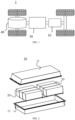
- a motor 40, a controller 30, and a battery 10 may be disposed inside the vehicle 1.
- the controller 30 is configured to control the battery 10 to supply power to the motor 40.
- the battery 10 may be disposed at the bottom, front, or rear of the vehicle 1.
- the battery 10 may be configured to supply power to the vehicle 1.
- the battery 10 may serve as an operating power supply of the vehicle 1 to power a circuit system of the vehicle 1.
- the battery may be configured to meet operating power usage requirements of the vehicle 1 that is being started or navigated or running.
- the battery 10 serves not only as an operating power supply of the vehicle 1, but may also serve as a driving power supply of the vehicle 1 to provide driving power for the vehicle 1 in place of or partly in place of fuel oil or natural gas.
- the battery 10 may include a plurality of battery cells.
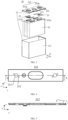
- FIG. 2 which is a schematic structural diagram of a battery 10 according to an embodiment of this application, the battery 10 may include a plurality of battery cells 20.
- the battery 10 may further include a box 11.
- the interior of the box 11 is a hollow structure.
- a plurality of battery cells 20 are accommodated in the box 11.
- the plurality of battery cells 20 are combined and connected in parallel, series, or series-and-parallel pattern, and then placed into the box 11.
- the battery 10 may further include other structures, details of which are omitted here.
- the battery 10 may further include a busbar component.
- the busbar component is configured to implement electrical connection between the plurality of battery cells 20, such as parallel connection, series connection, or series-parallel connection.
- the busbar component may implement the electrical connection between the battery cells 20 by connecting electrode terminals of the battery cells 20.
- the busbar component may be fixed to the electrode terminals of the battery cells 20 by welding. Electrical energy of the plurality of battery cells 20 may be further led out by a conductive mechanism running through the box.
- the conductive mechanism may also belong to the busbar component.
- the number of battery cells 20 may be set to any value.
- a plurality of battery cells 20 may be connected in series, parallel, or series-and-parallel pattern to achieve a relatively high capacity or power.
- Each battery 10 may include a relatively large number of battery cells 20. Therefore, in order to facilitate mounting, the battery cells 20 may be arranged in groups. Each group of battery cells 20 forms a battery module.
- the number of battery cells 20 included in the battery module is not limited, and may be set as required.
- the battery may include a plurality of battery modules. The battery modules may be connected in series, parallel, or series-and-parallel pattern.
- the battery cell 20 includes one or more electrode assemblies 22, a housing 211, and an end cap 212.
- the housing 211 and the end cap 212 form a shell or a battery case 21. Both the wall of the housing 211 and the end cap 212 are referred to as walls of the battery cell 20.
- the walls of the housing 211 include a bottom wall and four sidewalls.
- the shape of the housing 211 is determined depending on the shape of a combination of one or more electrode assemblies 22.
- the housing 211 may be a hollow cuboid or cube or cylinder.
- One surface of the housing 211 is provided with an opening through which one or more electrode assemblies 22 can be placed into the housing 211 conveniently.
- the housing 211 is a hollow cuboid or cube
- one of faces of the housing 211 is an opened face.
- the opened face is not walled so that the inside of the housing 211 communicates with the outside.
- an end face of the housing 211 may be an opened face. That is, this end face is not walled so that the inside of the housing 211 communicates with the outside.
- the end cap 212 covers the opening and is connected to the housing 211 to form a closed cavity that is configured to accommodate the electrode assembly 22.
- the housing 211 is filled with an electrolyte such as an electrolyte solution.
- the battery cell 20 may further include two electrode terminals 214.
- the two electrode terminals 214 may be disposed on the end cap 212.
- the end cap 212 is generally in the shape of a flat plate.
- Two electrode terminals 214 are fixed onto a flat surface of the end cap 212.
- the two electrode terminals 214 are a positive electrode terminal 214a and a negative electrode terminal 214b, respectively.
- a connecting member 23, also referred to as a current collection component 23, is disposed corresponding to each electrode terminal 214, located between the end cap 212 and the electrode assembly 22, and configured to electrically connect the electrode assembly 22 and the electrode terminal 214.
- each electrode assembly 22 includes a first tab 221a and a second tab 222a.
- the polarity of the first tab 221a is opposite to the polarity of the second tab 222a.
- the second tab 222a is a negative tab.
- the first tabs 221a of one or more electrode assemblies 22 are connected to one electrode terminal by one connecting member 23.
- the second tabs 222a of one or more electrode assemblies 22 are connected to another electrode terminal by another connecting member 23.
- the positive electrode terminal 214a is connected to the positive tab by one connection component 23, and the negative electrode terminal 214b is connected to the negative tab by another connection component 23.
- one or more electrode assemblies 22 may be disposed depending on actual use requirements. As shown in FIG. 3, 4 independent electrode assemblies 22 are disposed in the battery cell 20.
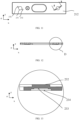
- FIG. 4 is a schematic structural diagram of an end cap of a battery cell according to an embodiment of this application
- FIG. 5 is a cross-sectional view of an end cap sectioned along an A-A line shown in FIG. 4
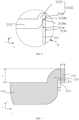
- FIG. 6 is a close-up view of a region C shown in FIG. 5
- the end cap 212 includes a body portion 2121 and an edge portion 2122.
- the edge portion 2122 is connected to the body portion 2121 and surrounds the body portion 2121.
- the edge portion 2122 protrudes beyond the body portion 2121 along a first direction, and the first direction is a thickness direction of the body portion 2121.
- the edge portion 2122 includes a lap portion 2124.
- the lap portion 2124 protrudes beyond the body portion 2121 along a second direction.
- the lap portion 2124 includes a first surface 2124a.
- the first surface 2124a is perpendicular to the first direction.
- the first surface 2124a is configured to lap a housing 211 of the battery cell 20.
- the second direction is perpendicular to the first direction.
- the end cap 212 is configured to fit and cover the opening of the housing 211 of the battery cell 20 to form a sealed cavity that is configured to accommodate the electrode assembly 22.
- the end cap 212 may be a flat plate structure, such as a square flat plate or a circular flat plate.
- the body portion 2121 is a square region or a circular region in the end cap 212.
- the edge portion 2122 Located at the edge of the end cap 212, the edge portion 2122 surrounds and is connected to the body portion 2121. The edge portion 2122 protrudes beyond the body portion 2121 along a first direction.
- the first direction is a thickness direction of the body portion 2121, and the first direction may be the z-direction.
- the edge portion 2122 includes a lap portion 2124.
- the lap portion 2124 protrudes beyond the body portion 2121 along a second direction.
- the second direction may be the x-direction or the y-direction. In other words, the second direction may be a circumferential direction of the end cap 212.
- the lap portion 2124 With the lap portion 2124 disposed, the lap portion 2124 may lap over the housing 211 to implement the connection between the lap portion 2124 and the housing 211, and in turn, implement the connection between the end cap 212 and the housing 211.
- the lap portion 2124 includes a first surface 2124a.
- the first surface 2124a is perpendicular to the first direction.
- the first surface 2124a is configured to lap a housing 211 of the battery cell.
- the second direction is perpendicular to the first direction.
- Both the first surface 2124a and an upper surface of the housing 211 may be flat surfaces.
- the upper surface of the housing 211 may be a surface of lapping between the housing 211 and the first surface 2124a, thereby implementing the connection between the lap portion 2124 and the housing 211, and improving the sealing performance of the battery cell 20.
- the end cap 212 of the battery cell 20 includes a body portion 2121 and an edge portion 2122.
- the edge portion 2122 is connected to the body portion 2121 and surrounds the body portion.
- the edge portion 2122 protrudes beyond the body portion 2121 along the thickness direction of the body portion 2121.
- the lap portion 2124 of the edge portion 2122 protrudes along a direction perpendicular to the thickness direction of the body portion 2121.
- the first surface 2124a of the lap portion 2124 laps the housing 211 of the battery cell 20. In this way, the end cap 212 is connected to the housing 211 of the battery cell 20 to improve the sealing performance of the battery cell 20.
- the lap portion 2124 further includes a second surface 2124b.
- the second surface 2124b is perpendicular to the first surface 2124a.
- the first surface 2124a laps the housing 211
- the second surface is flush with an outer surface 221 of the housing 211.
- the housing 211 includes an inner surface 211a and an outer surface 211b.
- the inner surface 211a of the housing 211 faces the electrode assembly 22, and the outer surface 211b of the housing is farther away from the electrode assembly 22 than the inner surface 211a.
- the lap portion 2124 includes a second surface 2124b perpendicular to the first surface 2124a.
- the second surface 2124b is flush with the outer surface 211b of the housing 211. In this way, it is convenient to connect the second surface 2124b to the outer surface 211b of the housing 211 along the y-direction, thereby further improving the sealing performance of the battery cell 20.
- FIG. 7 is a schematic structural diagram of an end cap according to an embodiment of this application.
- a dimension r of the lap portion 2124 along the second direction and a dimension s of the lap portion along the first direction satisfy: 0.1 mm ⁇ r ⁇ 1 mm and 0.1 mm ⁇ s ⁇ 2 mm, respectively. This makes it convenient to form the lap portion 2124 by stamping, and increases the structural strength of the lap portion 2124.
- the edge portion 2122 further includes a connecting portion 2123.
- the connecting portion 2123 connects the body portion 2121 and the lap portion 2124.
- a first groove 2125 is provided at one end, close to the connecting portion 2123, of the first surface 2124a.
- the connecting portion 2123 is configured to connect the body portion 2121 and the lap portion 2124.
- the connecting portion 2123 may be a quarter-circle structure with a smooth surface, thereby facilitating the processing of the edge portion 2122.
- FIG. 8 is a schematic structural diagram of an end cap without a first groove according to an embodiment of this application
- FIG. 9 is a schematic diagram of interference between an end cap and a housing of a battery cell according to an embodiment of this application.
- the end cap 212 is formed by stamping
- a fillet is formed at one end, close to the connecting portion 2123, of the first surface 2124a.
- the fillet interferes with the housing 211, thereby affecting the connection between the second surface 2124b and the outer surface 211b of the housing 211.
- the second surface 2124b is connected to the outer surface 211b of the housing 211 by welding, the interference between the second surface and the outer surface impairs the yield rate of welding.
- FIG. 10 is a schematic diagram of a fit between an end cap with a first groove and a housing of a battery cell according to an embodiment of this application.
- a first groove 2125 is provided at one end, close to the connecting portion 2123, of the first surface 2124a, so as to avoid interference between the fillet and the housing 211.
- the second surface 2124b can be tightly connected to the outer surface 211b of the housing 211, where the tight connection means a connection without a clearance in between, thereby improving the yield rate of connection between the second surface 2124b and the outer surface 211b, and in turn, further improving the hermeticity of the battery cell 20.
- a dimension w of the first groove 2125 along the second direction and the dimension p of the first groove along the first direction satisfy: 0.01 mm ⁇ w ⁇ 0.5 mm and 0.01 mm ⁇ p ⁇ 0.5 mm, respectively. This facilitates the processing of the first groove 2125 and increases the structural strength of the edge portion 2122.
- FIG. 11 is a schematic structural diagram of an end cap according to an embodiment of this application
- FIG. 12 is a cross-sectional view of an end cap sectioned along a B-B line shown in FIG. 11
- FIG. 13 is a close-up view of a region D shown in FIG. 12
- the body portion 2121 includes a boss 232 protruding along the first direction.
- the protruding direction of the boss 232 is identical to the protruding direction of the edge portion 2122.
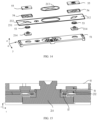
- FIG. 14 is a schematic structural diagram of an end cap assembly according to an embodiment of this application.
- the end cap assembly includes an end cap 212, a first fixing piece 55, a first insulator 54, a first sealing ring 53, and a second insulator 51.
- the first fixing piece 55 is configured to fix the electrode terminal 214 to the end cap 212.
- the first insulator 54 is disposed between the first fixing piece 55 and the electrode terminal 214, and is configured to implement insulation between the first fixing piece 55 and the electrode terminal 214.
- the first insulator 54 may be an upper plastic sheet, and the first fixing piece 55 may be a riveting block.
- the second insulator 51 is disposed between the end cap 212 and the housing 211 of the battery cell 20 to implement insulation between the end cap 212 and the housing 211 as well as insulation between the end cap 212 and the electrode assembly 22, where the second insulator 51 may be a lower plastic sheet.
- the electrode terminal 214 is disposed penetratingly in the through-hole 231.
- the first sealing ring 53 surrounds the electrode terminal 214 and seals the through-hole 231.
- the first sealing ring 53 may be an insulating sealing ring or a conductive sealing ring.
- FIG. 15 is a cross-sectional view of an end cap assembly according to an embodiment of this application.
- the first insulator 54 includes a second groove opposite to the boss 232.
- the second groove is disposed at a position of the first insulator 54, where the position corresponds to the boss 232.
- the second groove is configured to accommodate the boss 232.
- the boss 232 is snap-fitted to the second groove. In this way, along the first direction, the first insulator 54 is disposed between the first fixing piece 55 and the boss 232. Along the second direction, the two ends of the boss 232 fit the two ends of the second groove, respectively.
- the second groove fits the first sealing ring 53, thereby implementing the positioning of the first insulator 54 in the first direction and the second direction, and in turn, implementing the positioning of the electrode terminal 214, preventing the electrode terminal 214 from rotating or moving, and improving the performance of the battery cell 20.
- the body portion 2121 includes a through-hole 231.
- the through-hole 231 is configured to accommodate an electrode terminal 214.
- Two bosses 232 are disposed opposite to each other along a radial direction of the through-hole 231. With two opposite bosses 232 disposed along the radial direction of the through-hole 231, the electrode terminal 214 can be further fixed in the second direction to prevent the electrode terminal 214 from rotating or being dislocated, or the like.
- the number of bosses 232 may be three, four, or even more, and is not particularly limited herein as long as the bosses can constrain the electrode terminal 214.
- a third groove 233 and a fourth groove 234 corresponding to the boss 232 are provided on one side, oriented away from the boss 232, of the body portion 2121.
- the third groove 233 and the fourth groove 234 form a step structure.
- the diameter of the third groove 233 is less than the diameter of the boss 232.
- the diameter of the boss 232 is less than the diameter of the fourth groove 234. The above arrangement prevents the diameters of the third groove 233 and the fourth groove 234 from being the same, and in turn, avoids an excessive depth of the third groove 233 and the fourth groove 234 in the first direction and a decrease in the structural strength of the boss 232.
- the second surface 2124b is connected to the outer surface of the housing 21 by welding. This increases the connection strength between the second surface 2124b and the outer surface of the housing 21.
- the end cap 212 is a steel cover with a thickness of 0.2 mm to 2 mm.
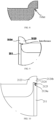
- FIG. 16 is a schematic diagram of connection between a housing and an end cap in the related art.
- a supporting structure 216 may be formed in the housing 211 by a stretching process.
- the end cap 212 is supported on the supporting structure 216. In this way, the end cap 212 can be connected to the housing 211 by top welding along a first direction, such as the direction indicated by the arrow shown in FIG. 16 .
- FIG. 17 is a schematic diagram of connection between a housing and an end cap according to an embodiment of this application.
- the end cap 212 is a steel cover and the housing 211 is a steel casing, it is difficult to stretch the steel casing to form a supporting platform. Therefore, it is difficult to connect, by top welding, the end cap 212 to the housing 211 that contains no supporting platform, and the sealing performance of the battery cell 20 is scarcely improved. Therefore, through the arrangement in the preceding embodiment of this application, as shown in FIG. 17 , the second surface 2124b may be connected to the outer surface 211b of the housing 211 by side welding along the direction indicated by the arrow in the drawing.
- the thickness of the steel end cap 212 is smaller than the thickness of the aluminum end cap 212. Therefore, a larger number of battery cells 20 containing the steel end cap 212 and the steel housing 211 can be accommodated in the space of the same volume, thereby increasing the energy density of the battery 10.
- the thickness of the end cap 212 is 0.8 mm. In this way, the energy density of the battery 10 can be further increased without compromising the strength of the end cap 212.
- An embodiment of this application further provides a battery cell 20.
- the battery cell includes: an electrode assembly 22; a housing 211, including an opening and configured to accommodate the electrode assembly 22; and the end cap 212 disclosed in the preceding embodiment.
- the end cap 212 covers the opening to seal the electrode assembly 22 in the housing 211.
- the housing 211 is a steel casing with a thickness of 0.2 mm to 2 mm.
- the housing 211 is a steel casing, a larger number of battery cells 20 with steel casings can be accommodated in a space of the same volume due to the smaller thickness of the steel casing, thereby increasing the energy density of the battery 10.
- An embodiment of this application further provides a battery.
- the battery includes: the battery cell 20 disclosed in the preceding embodiment; and a box 11, where the box 11 is configured to accommodate the battery cell 20.
- An embodiment of this application further provides an electrical device.
- the electrical device includes the battery 10 disclosed in the preceding embodiment.
- the battery 10 is configured to provide electrical energy.
Landscapes
- Chemical & Material Sciences (AREA)
- Chemical Kinetics & Catalysis (AREA)
- Electrochemistry (AREA)
- General Chemical & Material Sciences (AREA)
- Engineering & Computer Science (AREA)
- Life Sciences & Earth Sciences (AREA)
- Sustainable Development (AREA)
- Sustainable Energy (AREA)
- Power Engineering (AREA)
- Transportation (AREA)
- Mechanical Engineering (AREA)
- Inorganic Chemistry (AREA)
- Sealing Battery Cases Or Jackets (AREA)
Applications Claiming Priority (2)
| Application Number | Priority Date | Filing Date | Title |
|---|---|---|---|
| CN202220770287.6U CN217485584U (zh) | 2022-04-02 | 2022-04-02 | 端盖、电池单体、电池及用电设备 |
| PCT/CN2023/085200 WO2023186034A1 (zh) | 2022-04-02 | 2023-03-30 | 端盖、电池单体、电池及用电设备 |
Publications (2)
| Publication Number | Publication Date |
|---|---|
| EP4498488A1 true EP4498488A1 (de) | 2025-01-29 |
| EP4498488A4 EP4498488A4 (de) | 2025-07-30 |
Family
ID=83307542
Family Applications (1)
| Application Number | Title | Priority Date | Filing Date |
|---|---|---|---|
| EP23778399.8A Pending EP4498488A4 (de) | 2022-04-02 | 2023-03-30 | Endkappe, batteriezelle, batterie und elektrische vorrichtung |
Country Status (4)
| Country | Link |
|---|---|
| US (1) | US20250023157A1 (de) |
| EP (1) | EP4498488A4 (de) |
| CN (1) | CN217485584U (de) |
| WO (1) | WO2023186034A1 (de) |
Families Citing this family (6)
| Publication number | Priority date | Publication date | Assignee | Title |
|---|---|---|---|---|
| CN217485584U (zh) * | 2022-04-02 | 2022-09-23 | 宁德时代新能源科技股份有限公司 | 端盖、电池单体、电池及用电设备 |
| CN117832708B (zh) * | 2023-12-04 | 2025-06-03 | 蜂巢能源科技股份有限公司 | 电芯壳体与盖板配合结构及电芯 |
| CN117691269B (zh) * | 2024-01-31 | 2024-04-16 | 蜂巢能源科技股份有限公司 | 一种电芯 |
| WO2026025400A1 (zh) * | 2024-07-31 | 2026-02-05 | 宁德时代新能源科技股份有限公司 | 一种电池单体、电池装置、用电装置及冲压方法 |
| CN120396377A (zh) * | 2025-04-25 | 2025-08-01 | 深圳恒熙诺科技有限公司 | 一种锂离子电池封口装置 |
| CN120511343B (zh) * | 2025-07-22 | 2025-12-09 | 宁德时代新能源科技股份有限公司 | 电池单体及装置、用电装置、储能装置及系统、充电网络 |
Family Cites Families (10)
| Publication number | Priority date | Publication date | Assignee | Title |
|---|---|---|---|---|
| KR20000069172A (ko) * | 1997-09-30 | 2000-11-25 | 마츠시타 덴끼 산교 가부시키가이샤 | 각형 전지의 제조방법 |
| EP0973211A4 (de) * | 1997-11-07 | 2004-05-26 | Sony Corp | Rechteckförmige geschlossene batterie |
| WO2010070726A1 (ja) * | 2008-12-16 | 2010-06-24 | トヨタ自動車株式会社 | 密閉型電池 |
| US8668998B2 (en) * | 2011-01-31 | 2014-03-11 | Samsung Sdi Co., Ltd. | Secondary battery |
| JP6124175B2 (ja) * | 2013-02-20 | 2017-05-10 | 株式会社Gsユアサ | 蓄電素子 |
| CN105789500A (zh) * | 2014-12-23 | 2016-07-20 | 比亚迪股份有限公司 | 电池的外壳及其制备方法以及电池、电池组、电池包和电动汽车 |
| CN105789492A (zh) * | 2014-12-23 | 2016-07-20 | 比亚迪股份有限公司 | 电池的外壳及其制备方法以及电池、电池组和电动汽车 |
| JP2021097010A (ja) * | 2019-12-19 | 2021-06-24 | 株式会社豊田自動織機 | 蓄電装置 |
| CN217485584U (zh) * | 2022-04-02 | 2022-09-23 | 宁德时代新能源科技股份有限公司 | 端盖、电池单体、电池及用电设备 |
| CN218887348U (zh) * | 2022-10-18 | 2023-04-18 | 宁德时代新能源科技股份有限公司 | 端盖、电池单体、电池及用电设备 |
-
2022
- 2022-04-02 CN CN202220770287.6U patent/CN217485584U/zh active Active
-
2023
- 2023-03-30 EP EP23778399.8A patent/EP4498488A4/de active Pending
- 2023-03-30 WO PCT/CN2023/085200 patent/WO2023186034A1/zh not_active Ceased
-
2024
- 2024-09-30 US US18/900,911 patent/US20250023157A1/en active Pending
Also Published As
| Publication number | Publication date |
|---|---|
| CN217485584U (zh) | 2022-09-23 |
| US20250023157A1 (en) | 2025-01-16 |
| EP4498488A4 (de) | 2025-07-30 |
| WO2023186034A1 (zh) | 2023-10-05 |
Similar Documents
| Publication | Publication Date | Title |
|---|---|---|
| EP4498488A1 (de) | Endkappe, batteriezelle, batterie und elektrische vorrichtung | |
| US20230123940A1 (en) | Battery cell, battery and power consuming device | |
| US11757161B2 (en) | Battery cell, battery and electricity consuming device | |
| US11710872B2 (en) | Battery cell, battery, power consumption device and manufacturing device and method for battery cell | |
| JP7523664B2 (ja) | 電池セル、その製造方法及び製造システム、電池並びに電力消費装置 | |
| US20240283099A1 (en) | Battery cell, battery, power consumption device, and method and device for producing battery cell | |
| US12199315B2 (en) | Battery cell, battery, power consumption device and battery cell manufaturing method and device | |
| KR102820869B1 (ko) | 배터리 셀, 배터리 및 전기 기기 | |
| US20240283109A1 (en) | Battery cell, method and system for manufacturing battery cell, battery and electrical apparatus | |
| US12469936B2 (en) | Battery cell, battery, and electric apparatus with tab including two different connecting portions | |
| CN116491018A (zh) | 电池单体、电池、用电设备、制造电池单体的方法和设备 | |
| US20260018690A1 (en) | High-voltage box, battery, and electrical device | |
| CN218182424U (zh) | 电池单体、电池及用电装置 | |
| EP4425691A1 (de) | Batteriezelle, batterie und elektrische vorrichtung | |
| CN217182341U (zh) | 连接件、含有其的电池单体、电池及用电装置 | |
| EP4254610A1 (de) | Batterie, elektrische vorrichtung, verfahren zur herstellung einer batteriezelle und vorrichtung | |
| EP4354556A1 (de) | Stromsammelkomponente, batteriezelle, batterie und elektrische vorrichtung | |
| EP4683058A1 (de) | Batteriezelle, batterie und elektrische vorrichtung | |
| WO2022226964A1 (zh) | 连接部件、电池单体、电池及用电设备 | |
| CN223967262U (zh) | 电池单体、电池装置及用电设备 | |
| CN222637431U (zh) | 壳体、电池单体、电池以及用电装置 | |
| EP4683103A1 (de) | Batteriezelle und herstellungsverfahren dafür, batterie, elektrische vorrichtung und energiespeichervorrichtung | |
| US12388143B2 (en) | Battery cell, battery, power consumption device and manufacturing device and method for battery cell | |
| EP4510326A1 (de) | Batteriezelle, batterie und elektrische vorrichtung | |
| US20260024888A1 (en) | Adapter sheet, secondary battery, battery assembly and electronic device |
Legal Events
| Date | Code | Title | Description |
|---|---|---|---|
| STAA | Information on the status of an ep patent application or granted ep patent |
Free format text: STATUS: THE INTERNATIONAL PUBLICATION HAS BEEN MADE |
|
| PUAI | Public reference made under article 153(3) epc to a published international application that has entered the european phase |
Free format text: ORIGINAL CODE: 0009012 |
|
| STAA | Information on the status of an ep patent application or granted ep patent |
Free format text: STATUS: REQUEST FOR EXAMINATION WAS MADE |
|
| 17P | Request for examination filed |
Effective date: 20241023 |
|
| AK | Designated contracting states |
Kind code of ref document: A1 Designated state(s): AL AT BE BG CH CY CZ DE DK EE ES FI FR GB GR HR HU IE IS IT LI LT LU LV MC ME MK MT NL NO PL PT RO RS SE SI SK SM TR |
|
| DAV | Request for validation of the european patent (deleted) | ||
| DAX | Request for extension of the european patent (deleted) | ||
| A4 | Supplementary search report drawn up and despatched |
Effective date: 20250630 |
|
| RIC1 | Information provided on ipc code assigned before grant |
Ipc: H01M 50/15 20210101AFI20250624BHEP Ipc: H01M 50/148 20210101ALI20250624BHEP Ipc: H01M 50/169 20210101ALI20250624BHEP Ipc: H01M 50/103 20210101ALI20250624BHEP |