EP4498445A2 - Negativelektrodenfolie, batterie und stromverbrauchsvorrichtung - Google Patents
Negativelektrodenfolie, batterie und stromverbrauchsvorrichtung Download PDFInfo
- Publication number
- EP4498445A2 EP4498445A2 EP24182790.6A EP24182790A EP4498445A2 EP 4498445 A2 EP4498445 A2 EP 4498445A2 EP 24182790 A EP24182790 A EP 24182790A EP 4498445 A2 EP4498445 A2 EP 4498445A2
- Authority
- EP
- European Patent Office
- Prior art keywords
- active material
- negative active
- electrode sheet
- heat release
- battery
- Prior art date
- Legal status (The legal status is an assumption and is not a legal conclusion. Google has not performed a legal analysis and makes no representation as to the accuracy of the status listed.)
- Pending
Links
Images


Classifications
-
- H—ELECTRICITY
- H01—ELECTRIC ELEMENTS
- H01M—PROCESSES OR MEANS, e.g. BATTERIES, FOR THE DIRECT CONVERSION OF CHEMICAL ENERGY INTO ELECTRICAL ENERGY
- H01M4/00—Electrodes
- H01M4/02—Electrodes composed of, or comprising, active material
- H01M4/36—Selection of substances as active materials, active masses, active liquids
- H01M4/58—Selection of substances as active materials, active masses, active liquids of inorganic compounds other than oxides or hydroxides, e.g. sulfides, selenides, tellurides, halogenides or LiCoFy; of polyanionic structures, e.g. phosphates, silicates or borates
- H01M4/583—Carbonaceous material, e.g. graphite-intercalation compounds or CFx
-
- H—ELECTRICITY
- H01—ELECTRIC ELEMENTS
- H01M—PROCESSES OR MEANS, e.g. BATTERIES, FOR THE DIRECT CONVERSION OF CHEMICAL ENERGY INTO ELECTRICAL ENERGY
- H01M10/00—Secondary cells; Manufacture thereof
- H01M10/05—Accumulators with non-aqueous electrolyte
- H01M10/052—Li-accumulators
- H01M10/0525—Rocking-chair batteries, i.e. batteries with lithium insertion or intercalation in both electrodes; Lithium-ion batteries
-
- H—ELECTRICITY
- H01—ELECTRIC ELEMENTS
- H01M—PROCESSES OR MEANS, e.g. BATTERIES, FOR THE DIRECT CONVERSION OF CHEMICAL ENERGY INTO ELECTRICAL ENERGY
- H01M10/00—Secondary cells; Manufacture thereof
- H01M10/05—Accumulators with non-aqueous electrolyte
- H01M10/054—Accumulators with insertion or intercalation of metals other than lithium, e.g. with magnesium or aluminium
-
- H—ELECTRICITY
- H01—ELECTRIC ELEMENTS
- H01M—PROCESSES OR MEANS, e.g. BATTERIES, FOR THE DIRECT CONVERSION OF CHEMICAL ENERGY INTO ELECTRICAL ENERGY
- H01M4/00—Electrodes
- H01M4/02—Electrodes composed of, or comprising, active material
- H01M4/13—Electrodes for accumulators with non-aqueous electrolyte, e.g. for lithium-accumulators; Processes of manufacture thereof
- H01M4/133—Electrodes based on carbonaceous material, e.g. graphite-intercalation compounds or CFx
-
- H—ELECTRICITY
- H01—ELECTRIC ELEMENTS
- H01M—PROCESSES OR MEANS, e.g. BATTERIES, FOR THE DIRECT CONVERSION OF CHEMICAL ENERGY INTO ELECTRICAL ENERGY
- H01M4/00—Electrodes
- H01M4/02—Electrodes composed of, or comprising, active material
- H01M4/36—Selection of substances as active materials, active masses, active liquids
-
- H—ELECTRICITY
- H01—ELECTRIC ELEMENTS
- H01M—PROCESSES OR MEANS, e.g. BATTERIES, FOR THE DIRECT CONVERSION OF CHEMICAL ENERGY INTO ELECTRICAL ENERGY
- H01M4/00—Electrodes
- H01M4/02—Electrodes composed of, or comprising, active material
- H01M4/36—Selection of substances as active materials, active masses, active liquids
- H01M4/58—Selection of substances as active materials, active masses, active liquids of inorganic compounds other than oxides or hydroxides, e.g. sulfides, selenides, tellurides, halogenides or LiCoFy; of polyanionic structures, e.g. phosphates, silicates or borates
- H01M4/583—Carbonaceous material, e.g. graphite-intercalation compounds or CFx
- H01M4/587—Carbonaceous material, e.g. graphite-intercalation compounds or CFx for inserting or intercalating light metals
-
- H—ELECTRICITY
- H01—ELECTRIC ELEMENTS
- H01M—PROCESSES OR MEANS, e.g. BATTERIES, FOR THE DIRECT CONVERSION OF CHEMICAL ENERGY INTO ELECTRICAL ENERGY
- H01M4/00—Electrodes
- H01M4/02—Electrodes composed of, or comprising, active material
- H01M2004/021—Physical characteristics, e.g. porosity, surface area
-
- H—ELECTRICITY
- H01—ELECTRIC ELEMENTS
- H01M—PROCESSES OR MEANS, e.g. BATTERIES, FOR THE DIRECT CONVERSION OF CHEMICAL ENERGY INTO ELECTRICAL ENERGY
- H01M4/00—Electrodes
- H01M4/02—Electrodes composed of, or comprising, active material
- H01M2004/026—Electrodes composed of, or comprising, active material characterised by the polarity
- H01M2004/027—Negative electrodes
-
- H—ELECTRICITY
- H01—ELECTRIC ELEMENTS
- H01M—PROCESSES OR MEANS, e.g. BATTERIES, FOR THE DIRECT CONVERSION OF CHEMICAL ENERGY INTO ELECTRICAL ENERGY
- H01M2220/00—Batteries for particular applications
- H01M2220/20—Batteries in motive systems, e.g. vehicle, ship, plane
-
- H—ELECTRICITY
- H01—ELECTRIC ELEMENTS
- H01M—PROCESSES OR MEANS, e.g. BATTERIES, FOR THE DIRECT CONVERSION OF CHEMICAL ENERGY INTO ELECTRICAL ENERGY
- H01M4/00—Electrodes
- H01M4/02—Electrodes composed of, or comprising, active material
- H01M4/62—Selection of inactive substances as ingredients for active masses, e.g. binders, fillers
-
- Y—GENERAL TAGGING OF NEW TECHNOLOGICAL DEVELOPMENTS; GENERAL TAGGING OF CROSS-SECTIONAL TECHNOLOGIES SPANNING OVER SEVERAL SECTIONS OF THE IPC; TECHNICAL SUBJECTS COVERED BY FORMER USPC CROSS-REFERENCE ART COLLECTIONS [XRACs] AND DIGESTS
- Y02—TECHNOLOGIES OR APPLICATIONS FOR MITIGATION OR ADAPTATION AGAINST CLIMATE CHANGE
- Y02E—REDUCTION OF GREENHOUSE GAS [GHG] EMISSIONS, RELATED TO ENERGY GENERATION, TRANSMISSION OR DISTRIBUTION
- Y02E60/00—Enabling technologies; Technologies with a potential or indirect contribution to GHG emissions mitigation
- Y02E60/10—Energy storage using batteries
Definitions
- This disclosure relates to the technical field of electrode materials, and in particular to a negative electrode sheet, a battery, and an electricity-consumption device.
- a secondary battery such as a lithium-ion battery and a sodium-ion battery
- a secondary battery is widely used in fields such as electric vehicles, portable mobile devices, and aerospace because the secondary battery has high energy density, a long service life, no memory effect, a low self-discharge rate, etc.
- the secondary battery still has serious safety concerns. Smoking, combustion, explosion, and other safety accidents caused by thermal runaway of the battery are the most common concerns.
- the present disclosure is intended to provide a negative electrode sheet, a battery, and an electricity-consumption device, so as to reduce occurrence of thermal runaway of the negative electrode sheet during operation.
- a negative electrode sheet in the present disclosure.
- the negative electrode sheet includes a current collector and a negative active material layer disposed on the current collector.
- the negative active material layer includes a negative active material.
- a differential scanning calorimeter (DSC) curve of the negative active material layer includes: a first exothermic peak from 120 °C to 150 °C, in which the negative active material layer has heat release A1 satisfying 2 J/g ⁇ A1 ⁇ 50 J/g; a second exothermic peak from 220 °C to 260 °C, in which the negative active material layer has heat release A2 satisfying 20 J/g ⁇ A2 ⁇ 100 J/g; and a third exothermic peak from 260 °C to 310 °C, in which the negative active material layer has heat release A3 satisfying 200 J/g ⁇ A3 ⁇ 600 J/g.
- the heat release corresponding to the first exothermic peak is controlled within the above range, so that a content of a solid electrolyte interface (SEI) generated on the negative active material can be ensured to be within an appropriate range, thereby balancing electrochemical performance of the battery. If the heat release A1 corresponding to the first exothermic peak is below the above range, it indicates that the negative active material has a relatively low content and poor quality of the SEI, so that the SEI tends to be broken in the later cycles and side reaction is prone to occur between active ions in the negative active material and the electrolyte, which will affect capacity and cycle life of the battery.
- SEI solid electrolyte interface
- the heat release A1 corresponding to the first exothermic peak is above the above range, it indicates that the negative active material has a relatively high content of the SEI, so that a lot of active ions are consumed in a first cycle. In this case, the capacity of the battery is reduced, and an interface of the negative active material is extremely unstable, so that the thermal runaway is easily aggravated.
- the heat release corresponding to the second exothermic peak is controlled within the above range, so that the negative active material can be ensured to have strong thermal stability in the electrolyte, thereby balancing so that the electrochemical performance of the battery and avoiding the thermal runaway. If the heat release A2 corresponding to the second exothermic peak is below the above range, it indicates that reaction between the negative active material and the electrolyte is relatively weak and dead lithium (inactive alkali metal ion) is too much, so that the battery capacity is poor.
- the heat release corresponding to the third exothermic peak is controlled within the above range, so that the negative active material can be ensured to have strong thermal stability with a binder, thereby balancing the electrochemical performance of the battery and avoiding the thermal runaway. If the heat release A3 corresponding to the third exothermic peak is below t the above range, it indicates that reaction between the binder and lithiated graphite is relatively weak and dead lithium (inactive alkali metal ion) is too much, so that the battery capacity is poor.
- the negative active material satisfying the above relationship can significantly improve high-temperature stability of the negative electrode sheet with the negative active material.
- an assembled battery can be ensured to maintain relatively low heat release in three different heat release stages under a high-temperature operating environment, so that relatively high heat release due to excessive temperature can be avoided in the three heat release stages, and the thermal runaway can be avoided.
- heat release in each temperature range is controlled within a range that the battery can tolerate, so that the battery will not spontaneously combust or explode due to excessive heat, which means that the negative electrode sheet has excellent high-temperature stability.
- peak shapes of the first exothermic peak, the second exothermic peak, and the third exothermic peak include one or any combination of a single characteristic peak shape, a double shoulder peak shape, or a continuous peak shape.
- the heat release A1 corresponding to the first exothermic peak and the heat release A3 corresponding to the third exothermic peak satisfy: 0.003 ⁇ A1 / A3 ⁇ 0.25. If A1 / A3 is less than 0.003, it indicates that the quality of the SEI is poor, and reactivity of the binder and the lithiated graphite is high, so that the battery life will be affected. If A1 / A3 is greater than 0.25, it indicates that the SEI is too thick and extremely unstable, and the SEI is prone to be broken to generate a large amount of heat, so that the thermal runaway is more likely to occur.
- the heat release A2 corresponding to the second exothermic peak and the heat release A3 corresponding to the third exothermic peak satisfy: 0.03 ⁇ A2 / A3 ⁇ 0.5. If A2 / A3 is less than 0.03, it indicates that dead lithium in the lithiated graphite is too much, and the reactivity of the binder and the lithiated graphite is high, so that the battery life will be affected. If A2 / A3 is greater than 0.5, it indicates that reaction between the lithiated graphite and the electrolyte is strong and a large amount of heat is generated, so that the thermal runaway of the battery is triggered.
- a particle diameter Dv50 of the negative active material satisfies 10 ⁇ m ⁇ Dv 50 ⁇ 17 ⁇ m, where the Dv50 refers to a particle diameter when a cumulative volume fraction reaches 50% in measuring a volume-based distribution using a laser scattering method.
- the particle diameter of the negative active material is below the above range, it indicates that the negative active material 11 in the negative active material layer has a relatively small particle diameter, which not only easily causes a lot of side reactions but also increases preparation difficulty of the negative active material. In this case, the negative active material is easily agglomerated and difficultly subdivided. When the particle diameter of the negative active material is above the above range, the particle is too large, so that storage sites of alkali metal ions decrease and capacity of the battery is relatively poor.
- the specific surface area of the negative active material satisfies 1.1 m 2 /g to 4.5 m 2 /g. Since the specific surface area will affect initial coulombic efficiency (ICE) of the negative active material and deintercalation of the active ions (lithium-ions or sodium-ions), a larger specific surface area causes lower ICE, a smaller specific surface area is not conducive to the deintercalation of the active ions, and the specific surface area of the negative active material maintained within the above range can ensure that the negative active material can have excellent electrochemical performance.
- ICE initial coulombic efficiency
- a gram capacity of the negative active material ranges from 330 mAh/g to 360 mAh/g.
- the negative active material is one or more of a graphite particle, a soft carbon particle, or a hard carbon particle.
- the graphite particle may be natural graphite or artificial graphite, which is not limited in the present disclosure.
- a shape of the graphite particle is not limited and may be spherical, plate-shaped, etc.
- a graphite material is the most widely used negative active material.
- the graphite material has good conductivity, which can not only improve conductivity of a silicon material but also increase capacity.
- a battery is further provided in the present disclosure.
- the battery includes electrolyte, a positive electrode sheet, a separator, and the negative electrode sheet of the first aspect.
- the positive electrode sheet is at least partially immersed in the electrolyte.
- the separator is located at one side of the positive electrode sheet and is at least partially immersed in the electrolyte.
- the negative electrode sheet is disposed at one side of the separator away from the positive electrode sheet and at least partially immersed in the electrolyte. It can be understood that the battery has all technical effects of the negative electrode sheet of the first aspect, which is not repeated herein.
- the negative electrode sheet includes a current collector and a negative active material layer disposed on the current collector.
- the negative active material layer includes a negative active material.
- a differential scanning calorimeter (DSC) curve of the negative active material layer includes: a first exothermic peak from 120 °C to 150 °C, in which the negative active material layer has heat release A1 satisfying 2 J/g ⁇ A1 ⁇ 50 J/g; a second exothermic peak from 220 °C to 260 °C, in which the negative active material layer has heat release A2 satisfying 20 J/g ⁇ A2 ⁇ 100 J/g; and a third exothermic peak from 260 °C to 310 °C, in which the negative active material layer has heat release A3 satisfying 200 J/g ⁇ A3 ⁇ 600 J/g.
- an electricity-consumption device is further provided in the present disclosure.
- the electricity-consumption device includes a battery.
- the battery includes electrolyte, a positive electrode sheet, a separator, and the negative electrode sheet of the first aspect.
- the positive electrode sheet is at least partially immersed in the electrolyte.
- the separator is located at one side of the positive electrode sheet and is at least partially immersed in the electrolyte.
- the negative electrode sheet is disposed at one side of the separator away from the positive electrode sheet and at least partially immersed in the electrolyte. It can be understood that the battery has all technical effects of the negative electrode sheet of the first aspect, which is not repeated herein.
- the negative electrode sheet includes a current collector and a negative active material layer disposed on the current collector.
- the negative active material layer includes a negative active material.
- a differential scanning calorimeter (DSC) curve of the negative active material layer includes: a first exothermic peak from 120 °C to 150 °C, in which the negative active material layer has heat release A1 satisfying 2 J/g ⁇ A1 ⁇ 50 J/g; a second exothermic peak from 220 °C to 260 °C, in which the negative active material layer has heat release A2 satisfying 20 J/g ⁇ A2 ⁇ 100 J/g; and a third exothermic peak from 260 °C to 310 °C, in which the negative active material layer has heat release A3 satisfying 200 J/g ⁇ A3 ⁇ 600 J/g.
- the component when a component is “fixed” to another component, the component may be fixed to the other component directly or via an intermediate component.
- the component When a component is “connected” to another component, the component may be connected to the other component directly or via an intermediate component.
- the present disclosure is intended to provide a negative electrode sheet 100, a battery 1000, and an electricity-consumption device 2000, so as to reduce occurrence of thermal runaway of the negative electrode sheet 100 during operation.
- the present disclosure provides the following technical solutions.
- a differential scanning calorimeter (DSC) curve of the negative active material layer includes a first exothermic peak, a second exothermic peak, and a third exothermic peak.
- the DSC curve of the negative active material layer in an immersed electrolyte is a heat release curve of the negative active material layer obtained by a DSC through measurement.
- the preset conditions include but are not limited to a particle diameter and/or a specific surface area of the negative active material.
- the negative active material layer further includes a binder and a conductive agent.
- the negative active material, the conductive agent, and the binder are added to a solvent and mixed to prepare a negative electrode slurry, and then the negative electrode slurry is coated on the negative electrode current collector 20 to prepare the negative electrode sheet 100.
- the negative electrode current collector may be one or more of a copper foil, a porous copper foil, a foamed nickel/copper foil, a galvanized copper foil, a nickel-plated copper foil, a coated-carbon copper foil, a nickel foil, a titanium foil, and a carbonaceous porous copper foil.
- the negative electrode current collector may be one or more of the copper foil, the galvanized copper foil, the nickel-plated copper foil, and the carbon-coated copper foil.
- the binder may be acrylonitrile, vinylidene fluoride, vinyl alcohol, carboxymethyl cellulose, lithium carboxymethyl cellulose, sodium carboxymethyl cellulose, methacryloyl, acrylic acid, lithium acrylate, acrylamide, amide, imide, acrylate, styrene-butadiene rubber, sodium alginate, chitosan, ethanediol, guar gum monomer, polymer, or copolymer.
- the conductive agent may be at least one of conductive carbon black, acetylene black, graphite, graphene, carbon micro-nano linear conductive material, or carbon micro-nano tubular conductive material.
- a specific DSC method for testing the negative active material layer is as follows.
- a fully-charged battery is disassembled in a glove box, to obtain a negative electrode sheet.
- the negative electrode sheet is cut into 2 cm*2 cm sample electrode sheets to be tested, and the sample electrode sheets to be tested are rinsed with dimethyl carbonate (DMC) for 3 minutes and dried at room temperature in the glove box for 8 hours, to obtain a negative active material on the dried sample electrode sheets to be tested.
- 3 mg of the negative active material is put into a crucible of a DSC, 2 mg of electrolyte is added to the crucible, and then the crucible is sealed and waited for testing.
- a condition for the DSC test is set to increase the temperature from 30 °C to 450 °C at a heating rate of 5 °C/min. The test is completed and a test result is obtained.
- the crucible is gold-plated.
- the electrolyte is formed by mixing ethylene carbonate (EC) and ethyl methyl carbonate (EMC) at a volume ratio of 3:7 and adding lithium hexafluorophosphate (LiPF 6 ) to the mixture, where the LiPF 6 has a concentration of 1 mol/L.
- EC ethylene carbonate
- EMC ethyl methyl carbonate
- LiPF 6 lithium hexafluorophosphate
- the DSC can measure a heat-flow-power difference between a sample and a reference with changes in temperature or time under control of a certain temperature program (ascending/descending/constant temperature) and under a certain atmosphere. Based on this, information related to thermal effects such as heat absorption, heat release, and specific heat changes of the sample under the control of the temperature program can be obtained, and the heat absorption/release (enthalpy) and characteristic temperature (a starting point, a peak value, and an ending point) of the thermal effects can be calculated.
- a certain temperature program ascending/descending/constant temperature
- the first exothermic peak appears from 120 °C to 150 °C
- the second exothermic peak appears from 220 °C to 260 °C
- the third exothermic peak appears from 260 °C to 310 °C.
- an apex of the first exothermic peak may be in the temperature range from 120 °C to 150 °C
- an apex of an exothermic peak refers to a maximum point of the exothermic peak in a corresponding temperature range.
- the first exothermic peak actually corresponds to an exothermic peak of reaction of an outer SEI.
- the SEI is formed during a first charging and discharging process of the battery, and the SEI is a passivation film formed on the surface of the negative active material by active ions (lithium-ions or sodium-ions) and the solvent (EC/DMC). Therefore, the first exothermic peak is actually heat release before the SEI is broken.
- heat release corresponding to the SEI can be obtained by integrating the exothermic peak within the range from 120 °C to 150 °C in a DSC test spectrum, where a unit of the heat release is Joule (J).
- the second exothermic peak corresponds to an exothermic peak of reaction between the negative active material and the electrolyte. It can be understood that in the present disclosure, a negative active material in a fully-charged state is provided for the DSC test, and the negative active material is in direct contact with the electrolyte after the SEI is broken, so that the reaction between the negative active material and the electrolyte is intensified, and a large amount of heat is released.
- the third exothermic peak corresponds to an exothermic peak of reaction between the negative active material and the binder. It can be understood that after the reaction between the negative active material and the electrolyte is completed, the electrolyte is consumed, so that the negative active material further reacts with the binder attached to the surface of the negative active material, thereby releasing heat.
- the first exothermic peak appears from 120 °C to 150 °C, in which the negative active material layer has heat release A1 satisfying 2 J/g ⁇ A1 ⁇ 50 J/g.
- the heat release A1 may be, but is not limited to, 2 J/g, 10 J/g, 15 J/g, 20 J/g, 25 J/g, 30 J/g, 35 J/g, 40 J/g, 45 J/g, or 50 J/ g.
- the heat release A1 corresponding to the first exothermic peak actually reflects the heat release generated before the SEI is broken.
- the heat release generated before the SEI is broken is proportional to a content of the SEI.
- a thicker SEI causes a higher exothermic peak in the DSC curve, or a higher heat release obtained represents a higher content of the SEI in a negative active material to be tested.
- the heat release corresponding to the first exothermic peak is controlled within the above range, so that the content of the SEI generated on the negative active material can be ensured to be within an appropriate range, thereby balancing electrochemical performance of the battery. If the heat release A1 corresponding to the first exothermic peak is below the above range, it indicates that the negative active material has a relatively low content of the SEI, so that side reaction is prone to occur between the active ions in the negative active material and the electrolyte and dead lithium (inactive alkali metal ion) in the negative active material is too much, which will affect capacity and cycle life of the battery.
- the heat release A1 corresponding to the first exothermic peak is above the above range, it indicates that the negative active material has a relatively high content of the SEI, so that a large amount of active ions is consumed in a first cycle. In this case, the capacity of the battery is reduced, and an interface of the negative active material is extremely unstable, so that thermal runaway is easily aggravated.
- the second exothermic peak appears from 220 °C to 260 °C, in which the negative active material layer has heat release A2 satisfying 20 J/g ⁇ A2 ⁇ 100 J/g.
- the heat release A2 may be, but is not limited to, 20 J/g, 30 J/g, 40 J/g, 50 J/g, 60 J/g, 70 J/g, 80 J/g, 90 J/g, or 100 J/g.
- the heat release A2 corresponding to the second exothermic peak actually reflects the heat release generated during the reaction between the negative active material and the electrolyte.
- the heat release A2 can reflect intensity of the reaction between the negative active material and the electrolyte. In other words, stronger reaction between the negative active material and the electrolyte causes a higher exothermic peak in the DSC curve, or higher heat release obtained represents poorer thermal stability of the negative active material.
- the heat release corresponding to the second exothermic peak is controlled within the above range, so that the negative active material can be ensured to have strong thermal stability in the electrolyte, thereby balancing the electrochemical performance of the battery and avoiding the thermal runaway. If the heat release A2 corresponding to the second exothermic peak is below the above range, it indicates that the reaction between the negative active material and the electrolyte is relatively weak and dead lithium (inactive alkali metal ion) is too much, so that the battery capacity is poor.
- the third exothermic peak appears from 260 °C to 310 °C, in which the negative active material layer has heat release A3 satisfying 200 J/g ⁇ A3 ⁇ 600 J/g.
- the heat release A3 may be, but is not limited to, 200 J/g, 250 J/g, 300 J/g, 350 J/g, 400 J/g, 450 J/g, 500 J/g, 550 J/g, or 600 J/g.
- the heat release A3 corresponding to the third exothermic peak actually reflects the heat release generated during the reaction between the negative active material and the binder.
- the heat release A3 can reflect intensity of the reaction between the negative active material and the binder. In other words, stronger reaction between the negative active material and the binder causes a higher exothermic peak in the DSC curve, or higher heat release obtained represents poorer thermal stability of the negative active material.
- the heat release corresponding to the third exothermic peak is controlled within the above range, so that the negative active material can be ensured to have strong thermal stability with the binder, thereby balancing the electrochemical performance of the battery and avoiding the thermal runaway. If the heat release A3 corresponding to the third exothermic peak is below the above range, it indicates that the reaction between the negative active material and the binder is relatively weak and dead lithium (inactive alkali metal ion) is too much, so that the battery capacity is poor.
- the negative active material satisfying the above relationship can significantly improve high-temperature stability of the negative electrode sheet with the negative active material.
- an assembled battery can be ensured to maintain relatively low heat release in three different heat release stages under a high-temperature operating environment, so that relatively high heat release due to excessive temperature can be avoided in the three heat release stages, and the thermal runaway can be avoided.
- heat release in each temperature range is controlled within a range that the battery can tolerate, so that the battery will not spontaneously combust or explode due to excessive heat, which means that the negative electrode sheet has excellent high-temperature stability.
- peak shapes of the first exothermic peak, the second exothermic peak, and the third exothermic peak include one or any combination of a single characteristic peak shape, a double shoulder peak shape, or a continuous peak shape.
- the heat release A1 corresponding to the first exothermic peak and the heat release A3 corresponding to the third exothermic peak satisfy: 0.003 ⁇ A1 / A3 ⁇ 0.25.
- A1 / A3 may be, but are not limited to, 0.003, 0.01, 0.02, 0.05, 0.07, 0.1, 0.12, 0.14, 0.18, 0.2, 0.23, or 0.25.
- A1 / A3 is less than 0.003, it indicates that the active ions are not active enough and the battery life will be affected. If A1 / A3 is greater than 0.25, it indicates that the SEI is too thick and extremely unstable, and the SEI is prone to be broken to generate a large amount of heat, so that the thermal runaway is more likely to occur.
- the heat release A2 corresponding to the second exothermic peak and the heat release A3 corresponding to the third exothermic peak satisfy: 0.03 ⁇ A2 / A3 ⁇ 0.5.
- A2 / A3 may be, but is not limited to, 0.03, 0.04, 0.05, 0.06, 0.08, 0.1, 0.15, 0.2, 0.25, 0.3, 0.35, 0.4, or 0.5.
- A2 / A3 is less than 0.03, it indicates that the active ions are not active enough and the battery life will be affected. If A2 / A3 is greater than 0.5, it indicates that the reaction between the negative active material and the electrolyte is strong and a large amount of heat is generated, so that the thermal runaway is triggered.
- a particle diameter Dv 50 of the negative active material satisfies 10 ⁇ m ⁇ Dv 50 ⁇ 17 ⁇ m, where the Dv 50 refers to a particle diameter when a cumulative volume fraction reaches 50% in measuring a volume-based distribution using a laser scattering method.
- the Dv 50 may be measured as follows. According to a GB/T19077-2016 standard, a graphite particle is sampled and measured by a laser-diffraction particle size distribution analyzer (Malvern Mastersizer 3000).
- the particle diameter Dv 50 of the negative active material may be, but is not limited to, 10 ⁇ m, 11 ⁇ m, 12 ⁇ m, 13 ⁇ m, 14 ⁇ m, 15 ⁇ m, 16 ⁇ m, or 17 ⁇ m.
- the particle diameter of the negative active material further needs to be controlled, so that the negative active material is not too large or too small. Since an excessively small negative active material has a relatively large specific surface area, the reactivity between the electrolyte and the negative active material increases, so that side reaction between the negative active material layer and the electrolyte is aggravated and heat accumulation is caused, thereby leading to thermal runaway.
- heat generated by reaction between the negative active material and the electrolyte can be further reduced by controlling the particle diameter while controlling the heat release, so that the negative active material can be ensured to have relatively high thermal stability.
- the particle diameter of the negative active material is below the above range, it indicates that the negative active material in the negative active material layer has a relatively small particle diameter, which not only easily causes a lot of side reactions but also increases preparation difficulty of the negative active material. In this case, the negative active material is easily agglomerated and difficultly subdivided. When the particle diameter of the negative active material is above the above range, the particle is too large, so that storage sites of alkali metal ions decrease and capacity of the battery is relatively poor.
- the specific surface area of the negative active material satisfies 1.1 m 2 /g to 4.5 m 2 /g.
- the specific surface area of the negative active material may be, but is not limited to, 1.1 m 2 /g, 1.15 m 2 /g, 1.2 m 2 /g, 1.25 m 2 /g, 1.3 m 2 /g, 1.35 m 2 /g, 1.4 m 2 /g, or 4.5 m 2 /g.
- the specific surface area will affect initial coulombic efficiency (ICE) of the negative active material and deintercalation of the active ions, a larger specific surface area causes lower ICE, smaller specific surface area is not conducive to the deintercalation of the active ions, and the specific surface area of the negative active material maintained within the above range can ensure that the negative active material can have excellent electrochemical performance.
- ICE initial coulombic efficiency
- a gram capacity of the negative active material ranges from 330 mAh/g to 360 mAh/g.
- the gram capacity of the negative active material may be, but is not limited to, 330 mAh/g, 340 mAh/g, 341 mAh/g, 342 mAh/g, 343 mAh/g, 344 mAh/g, 345 mAh/g, 346 mAh/g, 347 mAh/g, 348 mAh/g, 349 mAh/g, 350 mAh/g, or 360 mAh/g.
- the negative active material is one or more of a graphite particle, a soft carbon particle, or a hard carbon particle.
- the graphite particle may be natural graphite or artificial graphite, which is not limited in the present disclosure.
- a shape of the graphite particle is not limited and may be spherical, plate-shaped, etc.
- a graphite material is the most widely used negative active material.
- the graphite material has good conductivity, which can not only improve conductivity of a silicon material but also increase capacity.
- the negative active material may be one or more of negative active materials that are subject to: surface treatments such as spheroidization or structural modification, oxidation, etching, etc.; or doping with nitrogen, phosphorus, sulfur, iron, cobalt, nickel, aluminum, zinc, or the like; or modification treatments such as being coated with an amorphous carbon layer, etc.
- a battery 1000 is further provided in the present disclosure.
- the battery 1000 includes electrolyte 400, a positive electrode sheet 200, a separator 300, and the negative electrode sheet 100 of the first aspect.
- the positive electrode sheet 200 is at least partially immersed in the electrolyte 400.
- the separator 300 is located at one side of the positive electrode sheet 200 and is at least partially immersed in the electrolyte 400.
- the negative electrode sheet 100 is disposed at one side of the separator 300 away from the positive electrode sheet 200 and at least partially immersed in the electrolyte 400. Since the battery 1000 provided in the present disclosure adopts the negative electrode sheet 100 provided in the present disclosure, the battery 1000 has good high-temperature stability and safety, thereby facilitating application of the battery in various fields.
- an electricity-consumption device 2000 is further provided in the present disclosure.
- the electricity-consumption device 2000 includes the battery 1000 described above.
- the electricity-consumption device 2000 adopting the battery 1000 can have high-temperature stability.
- Preparation of a graphite particle is as follows. A coke raw material is crushed, graphitized, screened and demagnetized, etc., and then artificial graphite is obtained.
- a negative active material layer is prepared with the graphite particle.
- Preparation of a graphite particle is as follows. A coke raw material is crushed, graphitized, screened and demagnetized, etc., and then artificial graphite is obtained.
- a negative active material layer is prepared with the graphite particle.
- Preparation of a graphite particle is as follows. A coke raw material is crushed, graphitized, screened and demagnetized, etc., and then artificial graphite is obtained.
- a negative active material layer is prepared with the graphite particle.
- Preparation of a graphite particle is as follows. A coke raw material is crushed, graphitized, screened and demagnetized, etc., and then artificial graphite is obtained.
- a negative active material layer is prepared with the graphite particle.
- Preparation of a graphite particle is as follows. A coke raw material is crushed, graphitized, screened and demagnetized, etc., and then artificial graphite is obtained.
- a negative active material layer is prepared with the graphite particle.
- Preparation of a graphite particle is as follows. A coke raw material is crushed, graphitized, screened and demagnetized, etc., and then artificial graphite is obtained.
- a negative active material layer is prepared with the graphite particle.
- Preparation of a graphite particle is as follows. A coke raw material is crushed, graphitized, screened and demagnetized, etc., and then artificial graphite is obtained.
- a negative active material layer is prepared with the graphite particle.
- Preparation of a graphite particle is as follows. A coke raw material is crushed, graphitized, screened and demagnetized, etc., and then artificial graphite is obtained.
- a negative active material layer is prepared with the graphite particle.
- the negative active material provided in each of embodiments 1 to 5 and the negative active material provided in one of the comparative embodiments 1 to 3 may be assembled into a negative electrode sheet and a lithium-ion secondary battery in the following methods.
- Positive electrode a positive electrode material is mixed and ball-milled with polyvinylidene fluoride and Super-P (i.e., conductive carbon black) at a mass ratio of 93:3:4 to obtain a positive electrode slurry.
- the positive electrode slurry is coated on a surface of an aluminum foil, is vacuum dried at 110 °C overnight, and is rolled to obtain a positive electrode sheet.
- Negative electrode a negative active material is configured with conductive carbon black, carboxymethyl cellulose (CMC), and styrene-butadiene rubber (SBR) at a mass ratio of 95%:2%: 1.2%: 1.8% to obtain a negative electrode slurry.
- the negative electrode slurry is evenly coated on an aluminum foil to obtain a negative electrode sheet.
- Electrolyte EC is mixed with EMC at a volume ratio of 3:7, and LiPF 6 is added thereto, so as to form the electrolyte.
- LiPF 6 has a concentration of 1 mol/L.
- Separator a polypropylene microporous separator.
- a lithium-ion full battery is assembled in an inert-atmosphere glove box in an order of the negative electrode sheet-the separator-the electrolyte-the positive electrode sheet.
- Condition temperature is 25 °C
- cycle rate is 1C (i.e., both a charging rate and a discharging rate are 1C)
- a charging voltage ranges from 2.5V to 3.65V
- capacity retention rate after cycles is calculated.
- a term "cycle” in the present disclosure refers to the number of times the battery is charged at preset rate and discharged at the preset rate.
- One cycle refers to completion of one charging and discharging process by the battery.
- Capacity retention rate after 500 cycles refers to the capacity retention rate of the battery after 500 cycles of the charging and discharging process at a test temperature of 25 °C, a charging rate of 1C, and a discharging rate of 1C.
- a battery assembled with the negative active material with the heat release provided in the present disclosure still can have relatively high cycle retention rate after multiple cycles.
- the heat release corresponding to the negative active material in the three heat release stages is within the ranges provided in the present disclosure, and the heat release has a relatively small impact on the overall electrical performance of the battery. Therefore, the retention rate after 500 cycles of the battery can reach more than 90%.
- the ratio of A1 / A3 or A2 / A3 will become unbalanced. Therefore, the retention rate after 500 cycles of the battery is less than that of the embodiments 1 to 5. Moreover, while the heat release of the material tested in the comparative embodiment 3 is low, the material will lead to severe lithium precipitation during an overcharge process due to poor dynamics performance of the material, thereby triggering the thermal runaway.
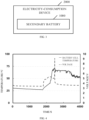
- FIG. 4 illustrates an overcharge curve of a secondary battery of graphite embodiment 1.
- an overcharge voltage reaches 5.475V
- the battery stops being charged and keeps still.
- a voltage of the battery cell can still maintain an initial voltage
- temperature of the battery cell is relatively low (about 53 °C), which indicates that the secondary battery provided in the embodiment 1 passes an overcharge test.
- FIG. 5 illustrates an overcharge curve of a secondary battery of graphite comparative embodiment 2.
- an overcharge voltage reaches 5.475V
- the battery stops being charged and keeps still.
- a voltage of the battery cell drops to 0V
- temperature of the battery cell increases to 253 °C, so that the thermal runaway is triggered, which indicates that the secondary battery provided in the comparative embodiment 2 fails an overcharge test.
Landscapes
- Chemical & Material Sciences (AREA)
- Engineering & Computer Science (AREA)
- Chemical Kinetics & Catalysis (AREA)
- Electrochemistry (AREA)
- General Chemical & Material Sciences (AREA)
- Materials Engineering (AREA)
- Manufacturing & Machinery (AREA)
- Inorganic Chemistry (AREA)
- Battery Electrode And Active Subsutance (AREA)
- Secondary Cells (AREA)
Applications Claiming Priority (1)
| Application Number | Priority Date | Filing Date | Title |
|---|---|---|---|
| CN202310922205.4A CN116666565B (zh) | 2023-07-26 | 2023-07-26 | 负极极片、电池和用电设备 |
Publications (2)
| Publication Number | Publication Date |
|---|---|
| EP4498445A2 true EP4498445A2 (de) | 2025-01-29 |
| EP4498445A3 EP4498445A3 (de) | 2025-04-23 |
Family
ID=87722731
Family Applications (1)
| Application Number | Title | Priority Date | Filing Date |
|---|---|---|---|
| EP24182790.6A Pending EP4498445A3 (de) | 2023-07-26 | 2024-06-18 | Negativelektrodenfolie, batterie und stromverbrauchsvorrichtung |
Country Status (3)
| Country | Link |
|---|---|
| US (1) | US20250038204A1 (de) |
| EP (1) | EP4498445A3 (de) |
| CN (1) | CN116666565B (de) |
Families Citing this family (1)
| Publication number | Priority date | Publication date | Assignee | Title |
|---|---|---|---|---|
| CN117855649A (zh) * | 2023-11-24 | 2024-04-09 | 厦门海辰储能科技股份有限公司 | 电池、储能装置、用电系统及储能系统 |
Family Cites Families (11)
| Publication number | Priority date | Publication date | Assignee | Title |
|---|---|---|---|---|
| JP4883025B2 (ja) * | 2007-10-31 | 2012-02-22 | ソニー株式会社 | 二次電池 |
| KR101124893B1 (ko) * | 2010-06-21 | 2012-03-27 | 지에스칼텍스 주식회사 | 안전성이 향상된 음극활물질 및 이를 포함하는 이차전지 |
| CN103311521B (zh) * | 2012-03-07 | 2016-12-14 | 上海杉杉科技有限公司 | 一种表面改性石墨负极材料及其制备方法和用途 |
| CN108844878A (zh) * | 2018-05-24 | 2018-11-20 | 宁德时代新能源科技股份有限公司 | 负极极片、极片活性比表面积的测试方法及电池 |
| CN112563491B (zh) * | 2019-03-21 | 2023-10-24 | 宁德新能源科技有限公司 | 负极材料及包含该负极材料的负极及电化学装置 |
| CN112447964B (zh) * | 2019-09-02 | 2022-04-19 | 宁德时代新能源科技股份有限公司 | 正极活性材料、正极极片及锂离子二次电池 |
| CN111426724B (zh) * | 2019-10-23 | 2022-08-19 | 蜂巢能源科技有限公司 | 测试电极材料安全性能的方法 |
| CN114384112B (zh) * | 2020-10-22 | 2024-09-17 | 清华大学 | 一种锂离子电池电极表面sei膜的检测方法 |
| WO2022162950A1 (ja) * | 2021-02-01 | 2022-08-04 | 昭和電工マテリアルズ株式会社 | リチウムイオン二次電池用負極材、その評価方法及びその製造方法、リチウムイオン二次電池用負極、並びにリチウムイオン二次電池 |
| CN115425177B (zh) * | 2021-03-29 | 2025-12-02 | 宁德新能源科技有限公司 | 一种负极和包含该负极的电化学装置和电子装置 |
| CN114156446B (zh) * | 2021-11-11 | 2024-09-06 | 珠海冠宇电池股份有限公司 | 一种负极活性材料及含有该负极活性材料的负极片和锂离子电池 |
-
2023
- 2023-07-26 CN CN202310922205.4A patent/CN116666565B/zh active Active
-
2024
- 2024-06-18 EP EP24182790.6A patent/EP4498445A3/de active Pending
- 2024-06-27 US US18/757,061 patent/US20250038204A1/en active Pending
Also Published As
| Publication number | Publication date |
|---|---|
| EP4498445A3 (de) | 2025-04-23 |
| CN116666565B (zh) | 2024-02-09 |
| CN116666565A (zh) | 2023-08-29 |
| US20250038204A1 (en) | 2025-01-30 |
Similar Documents
| Publication | Publication Date | Title |
|---|---|---|
| US12300816B2 (en) | Positive electrode active material, positive electrode plate, lithium-ion secondary battery, and apparatus | |
| CN101515640B (zh) | 一种负极和包括该负极的锂离子二次电池 | |
| KR20210038501A (ko) | 리튬 이차전지용 양극 활물질 및 이를 포함하는 리튬 이차전지 | |
| JP2023506034A (ja) | リチウム二次電池用正極、前記正極を含むリチウム二次電池 | |
| US20110135982A1 (en) | Negative electrode for non-aqueous electrolyte secondary battery and fabrication method thereof, and non-aqueous electrolyte secondary battery | |
| CN114464774A (zh) | 一种负极极片及其应用 | |
| JP3529750B2 (ja) | 非水電解質二次電池 | |
| CN108493419B (zh) | 一种温度敏感复合电极及其制备方法 | |
| WO2021108987A1 (zh) | 复合石墨材料、二次电池、装置及制备方法 | |
| US20250132339A1 (en) | Secondary battery and electronic apparatus | |
| CN115528208A (zh) | 一种补锂负极极片和二次电池 | |
| KR20240137677A (ko) | 분리막 및 그 제조 방법, 이차 전지 및 전기 장치 | |
| EP4498445A2 (de) | Negativelektrodenfolie, batterie und stromverbrauchsvorrichtung | |
| EP2631973B1 (de) | Elektrode für Lithiumsekundärbatterie, Herstellungsverfahren dafür und Lithiumsekundärbatterie damit | |
| WO2025201024A1 (zh) | 一种二次电池及其制备方法以及电子装置 | |
| CN101110477B (zh) | 一种电化学储能与能量转换装置 | |
| EP4517862A1 (de) | Negativelektrodenfolie, sekundärbatterie und stromverbrauchsvorrichtung | |
| JP3111927B2 (ja) | 非水電解液二次電池及びその製造方法 | |
| CN120380630A (zh) | 锂二次电池和用电装置 | |
| CN118435374A (zh) | 电极极片、二次电池及用电装置 | |
| JP2004227931A (ja) | 非水電解質二次電池 | |
| KR102812316B1 (ko) | 리튬 몰리브데늄 화합물이 코팅된 리튬 이차전지용 양극 활물질 및 그 제조 방법 | |
| US12191523B2 (en) | Polymer-modified porous material, membrane electrode, secondary battery, and electric device | |
| US20250006889A1 (en) | Negative electrode and electrochemical apparatus and electronic apparatus using same | |
| WO2025086649A1 (zh) | 负极活性材料、负极极片、钠离子电池及用电装置 |
Legal Events
| Date | Code | Title | Description |
|---|---|---|---|
| PUAI | Public reference made under article 153(3) epc to a published international application that has entered the european phase |
Free format text: ORIGINAL CODE: 0009012 |
|
| STAA | Information on the status of an ep patent application or granted ep patent |
Free format text: STATUS: THE APPLICATION HAS BEEN PUBLISHED |
|
| AK | Designated contracting states |
Kind code of ref document: A2 Designated state(s): AL AT BE BG CH CY CZ DE DK EE ES FI FR GB GR HR HU IE IS IT LI LT LU LV MC ME MK MT NL NO PL PT RO RS SE SI SK SM TR |
|
| PUAL | Search report despatched |
Free format text: ORIGINAL CODE: 0009013 |
|
| RAP1 | Party data changed (applicant data changed or rights of an application transferred) |
Owner name: HITHIUM TECH HK LIMITED |
|
| AK | Designated contracting states |
Kind code of ref document: A3 Designated state(s): AL AT BE BG CH CY CZ DE DK EE ES FI FR GB GR HR HU IE IS IT LI LT LU LV MC ME MK MT NL NO PL PT RO RS SE SI SK SM TR |
|
| RIC1 | Information provided on ipc code assigned before grant |
Ipc: H01M 4/02 20060101ALN20250317BHEP Ipc: H01M 4/62 20060101ALN20250317BHEP Ipc: H01M 10/054 20100101ALI20250317BHEP Ipc: H01M 10/0525 20100101ALI20250317BHEP Ipc: H01M 4/587 20100101ALI20250317BHEP Ipc: H01M 4/36 20060101ALI20250317BHEP Ipc: H01M 4/133 20100101AFI20250317BHEP |
|
| STAA | Information on the status of an ep patent application or granted ep patent |
Free format text: STATUS: REQUEST FOR EXAMINATION WAS MADE |
|
| 17P | Request for examination filed |
Effective date: 20251022 |
|
| RIC1 | Information provided on ipc code assigned before grant |
Ipc: H01M 4/133 20100101AFI20260123BHEP Ipc: H01M 4/36 20060101ALI20260123BHEP Ipc: H01M 4/587 20100101ALI20260123BHEP Ipc: H01M 10/0525 20100101ALI20260123BHEP Ipc: H01M 10/054 20100101ALI20260123BHEP Ipc: H01M 4/62 20060101ALN20260123BHEP Ipc: H01M 4/02 20060101ALN20260123BHEP |
|
| GRAP | Despatch of communication of intention to grant a patent |
Free format text: ORIGINAL CODE: EPIDOSNIGR1 |
|
| STAA | Information on the status of an ep patent application or granted ep patent |
Free format text: STATUS: GRANT OF PATENT IS INTENDED |