EP4497973A1 - Drehaktuatoreinheit und gelenkeinheit für roboter oder schwere ausrüstung damit - Google Patents
Drehaktuatoreinheit und gelenkeinheit für roboter oder schwere ausrüstung damit Download PDFInfo
- Publication number
- EP4497973A1 EP4497973A1 EP23760220.6A EP23760220A EP4497973A1 EP 4497973 A1 EP4497973 A1 EP 4497973A1 EP 23760220 A EP23760220 A EP 23760220A EP 4497973 A1 EP4497973 A1 EP 4497973A1
- Authority
- EP
- European Patent Office
- Prior art keywords
- input
- link member
- shaft
- tip
- output
- Prior art date
- Legal status (The legal status is an assumption and is not a legal conclusion. Google has not performed a legal analysis and makes no representation as to the accuracy of the status listed.)
- Pending
Links
Images





Classifications
-
- F—MECHANICAL ENGINEERING; LIGHTING; HEATING; WEAPONS; BLASTING
- F16—ENGINEERING ELEMENTS AND UNITS; GENERAL MEASURES FOR PRODUCING AND MAINTAINING EFFECTIVE FUNCTIONING OF MACHINES OR INSTALLATIONS; THERMAL INSULATION IN GENERAL
- F16H—GEARING
- F16H37/00—Combinations of mechanical gearings, not provided for in groups F16H1/00 - F16H35/00
- F16H37/12—Gearings comprising primarily toothed or friction gearing, links or levers, and cams, or members of at least two of these types
- F16H37/122—Gearings comprising primarily toothed or friction gearing, links or levers, and cams, or members of at least two of these types for interconverting rotary motion and oscillating motion
-
- B—PERFORMING OPERATIONS; TRANSPORTING
- B25—HAND TOOLS; PORTABLE POWER-DRIVEN TOOLS; MANIPULATORS
- B25J—MANIPULATORS; CHAMBERS PROVIDED WITH MANIPULATION DEVICES
- B25J13/00—Controls for manipulators
- B25J13/08—Controls for manipulators by means of sensing devices, e.g. viewing or touching devices
- B25J13/085—Force or torque sensors
-
- B—PERFORMING OPERATIONS; TRANSPORTING
- B25—HAND TOOLS; PORTABLE POWER-DRIVEN TOOLS; MANIPULATORS
- B25J—MANIPULATORS; CHAMBERS PROVIDED WITH MANIPULATION DEVICES
- B25J19/00—Accessories fitted to manipulators, e.g. for monitoring, for viewing; Safety devices combined with or specially adapted for use in connection with manipulators
- B25J19/0008—Balancing devices
- B25J19/002—Balancing devices using counterweights
-
- B—PERFORMING OPERATIONS; TRANSPORTING
- B25—HAND TOOLS; PORTABLE POWER-DRIVEN TOOLS; MANIPULATORS
- B25J—MANIPULATORS; CHAMBERS PROVIDED WITH MANIPULATION DEVICES
- B25J9/00—Program-controlled manipulators
- B25J9/10—Program-controlled manipulators characterised by positioning means for manipulator elements
- B25J9/106—Program-controlled manipulators characterised by positioning means for manipulator elements with articulated links
-
- B—PERFORMING OPERATIONS; TRANSPORTING
- B25—HAND TOOLS; PORTABLE POWER-DRIVEN TOOLS; MANIPULATORS
- B25J—MANIPULATORS; CHAMBERS PROVIDED WITH MANIPULATION DEVICES
- B25J9/00—Program-controlled manipulators
- B25J9/10—Program-controlled manipulators characterised by positioning means for manipulator elements
- B25J9/12—Program-controlled manipulators characterised by positioning means for manipulator elements electric
- B25J9/126—Rotary actuators
-
- F—MECHANICAL ENGINEERING; LIGHTING; HEATING; WEAPONS; BLASTING
- F16—ENGINEERING ELEMENTS AND UNITS; GENERAL MEASURES FOR PRODUCING AND MAINTAINING EFFECTIVE FUNCTIONING OF MACHINES OR INSTALLATIONS; THERMAL INSULATION IN GENERAL
- F16H—GEARING
- F16H21/00—Gearings comprising primarily only links or levers, with or without slides
- F16H21/10—Gearings comprising primarily only links or levers, with or without slides all movement being in, or parallel to, a single plane
- F16H21/44—Gearings comprising primarily only links or levers, with or without slides all movement being in, or parallel to, a single plane for conveying or interconverting oscillating or reciprocating motions
Definitions
- This invention relates to a rotary actuator unit and a joint unit for robots or heavy machinery having the same.
- robot arms are used in a variety of fields, often to transport heavy loads.
- heavy machinery used for civil engineering and construction work such as cranes and shovels, as well as elevating vehicles and special-purpose vehicles, also requires to drive the joints of working arms, such as robot.
- Patent Document 1 discloses a continuously variable transmission with a crank pivotally supported on a fixed pivot axis, a fulcrum supported on the crank in a sliding manner, and a drive unit that moves the fulcrum.
- the crank can be rotated by moving the fulcrum around the pivot axis of the crank by the drive unit.
- the reduction ratio can be varied by sliding the fulcrum on the crank and changing the distance between the pivot axis and the fulcrum.
- the actuator for driving and the actuator for changing the reduction ratio are not separated as in a general continuously variable transmission, so two identical actuators can be used, and the driving force of each actuator can be distributed efficiently.
- the friction type CVT Continuous Variable Transmission
- the mechanism of Patent Document 1 can transmit the driving force without relying on friction, so the transmission efficiency is high and the mechanism is highly durable.
- Patent Document 1 Patent Publication No. 2012-67809
- Non-Patent document 1 Hiroya Yamada, Development of a star-shaped crank-type continuously variable transmission with torque measurement function and its application to a quadruped walking robot, Abstract of the Robotics and Mechatronics Conference, 2012, 2A2-V05 .
- the present invention was researched and developed in view of these circumstances, and is aimed at providing a rotary actuator unit using a simple link structure and a joint unit for robots and heavy machinery using the same.
- the rotary actuator unit of the invention characterized in that it comprises a first input part having a first actuator, a second input part having a second actuator, an output link member, an intermediate link member, an output side shaft fixed to a base, an intermediate shaft not fixed to the base, and an input side shaft not fixed to the base.
- the first input part and the second input part constitute at least a part of a link mechanism having two or more degrees of freedom.
- a tip of the output link member is rotatably supported around the output side shaft.
- a base end of the output link member and a tip of the intermediate link member are rotatably supported around the intermediate shaft.
- a base end of the intermediate link member and a tip of the link mechanism are rotatably supported around the input side shaft.
- a two-dimensional position of the input side shaft can be freely manipulated by controlling the first actuator and the second actuator to drive the link mechanism, and a rotation of the output link member around the output side shaft can be extracted as an output.
- the term "fixed to the base” means that it is fixed to a base material such as a pedestal or base member of the rotary actuator unit, and is fixed in such a way that its two-dimensional position does not change even when each actuator is driven.
- the term “not fixed to the base” means that its 2-dimensional position changes when each actuator is driven.
- the first input part comprises a first linear actuator as the first actuator, a first shaft fixed to a mover of the first linear actuator, and a first input link member; the first linear actuator is fixed to the base; and a base end of the first input link member is rotatably supported around the first shaft.
- the second input part comprises a second linear actuator as the second actuator, a second shaft fixed to a mover of the second linear actuator, and a second input link member; the second linear actuator is fixed to the base; and a base end of the second input link member is rotatably supported around the second shaft.
- the two-dimensional position of the input side shaft can be freely manipulated by controlling the first linear actuator and the second linear actuator.
- a tip of the link mechanism is a tip of the first input link member and a tip of the second input link member, which are rotatably supported around the input side shaft.
- the first input link member includes a first base end side link element and a first tip side link element; the first base end side link element has a first base end side counterweight portion such that its center of gravity is on the first shaft; and the first tip side link element has a first tip side counterweight portion such that its center of gravity is on the input side shaft.
- the second input link member includes a second base end side link element and a second tip side link element; the second base end side link element has a second base end side counterweight portion such that its center of gravity is on the second shaft; and the second tip side link element has a second tip side counterweight portion such that its center of gravity is on the input side shaft.
- the intermediate link member has an intermediate counterweight portion such that a composite center of gravity of the first tip side link element, the second tip side link element, the input side shaft and the intermediate link member is on the intermediate shaft.
- the output link member has an output side counterweight portion such that a composite center of gravity of the first tip side link element, the second tip side link element, the intermediate link member, and the output link member is on the output side shaft.
- the rotary actuator unit of the first aspect of the present invention further comprises a third input part having a third linear actuator, a third shaft fixed to a mover of the third linear actuator, and a third input link member; and the third input part constitutes at least a part of the link mechanism.
- the rotary actuator unit of the first aspect of the present invention it is preferred that it is equipped with force sensors on the first input link member and the second input link member, respectively, to measure the translational force applied to the members, and the torque around the output side shaft is calculated from the respective measured values of the force sensors.
- the first input part comprises a first shaft fixed to the base, a first linear actuator rotatably supported around the first shaft as the first actuator;
- the second input part comprises a second shaft fixed to the base, a second linear actuator rotatably supported around the second shaft as the second actuator; and the two-dimensional position of the input side shaft can be freely manipulated by controlling the first linear actuator and the second linear actuator.
- the first input part comprises a first rotary motor as the first actuator, a first input first link member, a first shaft not fixed to the base, and a first input second link member; the first rotary motor is fixed to the base; a base end of the first input first link member is fixed to a movable shaft of the first rotary motor; and a tip of the first input first link member and a base end of the first input second link member are rotatably supported around the first shaft.
- the second input part comprises a second rotary motor as the second actuator, a second input first link member, a second shaft not fixed to the base, and a second input second link member;
- the second rotary motor is fixed to the base;
- a base end of the second input first link member is fixed to a movable shaft of the second rotary motor; and a tip of the second input first link member and a base end of the second input second link member are rotatably supported around the second shaft.
- the two-dimensional position of the input side shaft can be freely manipulated by controlling the first rotary motor and second rotary motor.
- tip of the link mechanism is the tip of the first input part and the tip of the second input part, which are rotatably supported around the input side shaft.
- the rotary actuator of the present invention further comprises a drive force transmission mechanism transmitting a rotation of the output link member, and a hollow shaft member that rotates in conjunction with the output link member by means of the drive force transmission mechanism.
- the rotary actuator unit of the present invention further comprises a driving force conversion mechanism that converts the rotation of the output link member into translational.
- the rotary actuator of the other aspect of the invention characterized in that it comprises a first input part having a first linear actuator, a first link member in which a base end is rotatably connected to the first linear actuator around the first shaft; a second input part having a second linear actuator, a second link member in which a base end is rotatably connected to the second linear actuator around the second shaft; an output link member in which a tip is rotatably supported around an output side shaft; and an intermediate link member connecting the first input link member, the output link member, and the second input link member to the output link member; wherein a tip of the intermediate link member and a base end of the output link member are rotatably connected around the intermediate shaft; and wherein a two-dimensional position of the tip of the first input link member, the tip of the second input link member, and the base end of the intermediate link member can be freely manipulated by controlling the first linear actuator and the second linear actuator.
- a tip of the first input link member and a tip of the second input link member are rotatably connected around an input side shaft; and a base end of the intermediate link member is rotatably fixed around the input side shaft.
- the first input link member comprises a first base end side link element, a first tip side link element, a first base end side counterweight portion such that a gravity of a first base end side link element is on the first shaft, a first tip side counter weight portion such that a gravity of a first tip side link element is on the input side shaft.
- the second input link member comprises a second base end side link element, a second tip side link element, a second base end side counterweight portion such that a gravity of a second base end side link element is on the second shaft, a second tip side counterweight portion such that a gravity of a second tip side link element is on the input side shaft.
- the intermediate link member has an intermediate counterweight portion such that a composite center of gravity of the first tip side link element, the second tip side link element, and the intermediate link member is on the intermediate shaft.
- the output link member has an output side counterweight portion such that a composite center of gravity of the first tip side link element, the second tip side link element, the intermediate link member, and the output link member is on the output side shaft.
- rotary actuators of the present invention further comprises a third input part having a third linear actuator, and a third input link member in which a base end is rotatably fixed to the third linear actuator around the third shaft.
- rotary actuator of the present invention it is preferred that it is equipped with force sensors on the members from the mover of the first linear actuator to the tip of the first input link member and from the mover of the second linear actuator to the tip of the second input link member, respectively, to measure the translational force applied to said members, and the torque applied by the output link member around the output side shaft is calculated from the respective measured values of the force sensors.
- the joint unit for robots or heavy machinery of the present invention is characterized in that it includes the rotary actuator unit of the present invention.
- the joint unit for robots of the present invention is used, for example, in robot arms for industrial robots and humanoid robots.
- the joint unit for heavy machinery of the present invention is used for heavy equipment used in civil engineering and construction work, such as cranes and shovels, and for working arms of elevating vehicles.
- the rotary actuator unit of the present invention has the following effects.
- the rotary actuator unit of the invention can infinitely rotate the output link member around the output side shaft by 360 degree or more, by properly controlling the first actuator (e.g., first linear actuator or first rotary motor) of the first input part and the second actuator (e.g., second linear actuator or second rotary motor) of the second input part, and its reduction ratio can also be changed steplessly (first effect).
- first actuator e.g., first linear actuator or first rotary motor
- second actuator e.g., second linear actuator or second rotary motor
- the rotary actuator unit of this invention can transmit large torque because it does not use friction as a means of transmitting driving force, and it has high efficiency in transmitting driving force because of low friction loss (second effect).
- the rotary actuator unit of the present invention does not require the use of gears as reduction means, which dramatically increases the shock resistance of the mechanism (third effect).
- the rotary actuator unit of the present invention can efficiently distribute the driving force of the two actuators to the rotational force around the output side shaft of the output link member because the first actuator (e.g., first linear actuator or first rotary motor) and the second actuator (e.g. second linear actuator or first rotary motor), which are input sources, are not separated for driving and shifting, and both are responsible for driving and shifting (the fourth effect). In particular, efficiency can be further improved by using the same two actuators.
- first actuator e.g., first linear actuator or first rotary motor
- second actuator e.g. second linear actuator or first rotary motor
- the rotary actuator unit of the present invention is composed of a link mechanism of the output side having a plurality of pivot axis and a plurality of links (output link member and intermediate link member) between the tip of the link mechanism of the input side and the output shaft (output side shaft), where the link mechanism of the input side comprises the first input part and the second input part, and have two or more degrees of freedom. Therefore, the sliding shaft which was essential in the Patent Document 1, can be eliminated, simplify parts, and can be structed to be resistant to contamination and foreign matter (fifth effect).
- the parts can be further simplified.
- the rotary actuator unit of the present invention can measure the torque of the output side shaft by a force sensor (load cell, etc.) that measures translational force by properly arranging the force sensors (sixth effect). For example, by installing each force sensor on a member of the first input link member and the second input link member, the wiring of the force sensor can be independent of the infinite rotational motion of the output link member.
- a force sensor load cell, etc.
- the wiring of the force sensor can be independent of the infinite rotational motion of the output link member.
- the rotary actuator unit of present invention can easily design counterweights, because, as described above, it is composed solely of a link mechanism that pivots rather than glides except for the first actuator or the second actuator to be driven (seventh effect). And when counterweight design is properly applied, eccentricity of each link can be completely prevented. In other words, vibration caused by inertia force due to rotation of each eccentric link can be suppressed. Similarly, the possibility of unintended gravity-induced torque being output to the pivot axis, which could affect the rotational output of the rotary actuator unit of the invention can also be eliminated. Furthermore, if the force sensor is properly positioned, the effect of gravity can be completely eliminated from the force sensor measurement as well.
- the tip of the first input part especially the tip of the first input link member
- the tip of the second input part especially the tip of the second input link member
- the base end of the intermediate link member are rotatably connected around the input side shaft, and aligning the input point (input side shaft) and the output shaft (output side shaft) in the same two-dimensional position by operating each actuator, in other word, placing the input side shaft and output side shaft on the same straight line, each actuator and output link member can be separated from each other to achieve a complete output shaft free rotation state (free rotation state of the output link member around the output side shaft)(eighth effect).
- the rotary actuator unit of the present invention can make a complete no-load state of the force sensor (ninth effect), by appropriately providing the force sensor; fixing the tip of the first input part (especially the tip of the first input link member), the tip of the second input part (especially the tip of the second input link member) and the base end of the intermediate link member rotatably around the input side shaft; providing the counterweight design; then aligning the input point (input side shaft) and output shaft (output side shaft) by operating each actuator; and fixing each actuator in that position.
- torque sensors and force sensors need to reset the zero point periodically (zero resetting) because temperature change and residual stress cause steady deviations in the measured values.
- the torque sensor or force sensor had to be separated or disassembled and zero reset to achieve a no-load state.
- this rotary actuator unit can create a complete no-load state of the force sensor only by operating each actuator without separating or disassembling it from the external equipment, and the force sensor can be easily zero reset. Therefore, even if a drift or other problem occurs in the force sensor, the force sensor can be periodically zero reset with little effort, enabling more accurate measurement.
- the first to seventh embodiments are embodiments of the rotary actuator unit of the first aspect of the present invention
- the eighth to tenth embodiments are embodiments of the rotary actuator unit of the second aspect of the present invention
- the eleventh to thirteenth embodiments are embodiments of the rotary actuator unit of the third aspect of the present invention.
- the present invention is not limited to these embodiments.
- the first embodiment of the rotary actuator unit is described below.
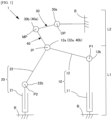
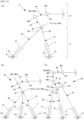
- the rotary actuator unit 1 shown in Fig. 1 has a first input part 10, a second input part 20, an output link member 30, an intermediate link member 40, an output side shaft OP fixed to the base, an intermediate shaft MP not fixed to the base, and an input side shaft IP not fixed to the base.
- the first input part 10 and the second input part 20 constitute the link mechanism L1 of the input side with 2 degrees of freedom and the intermediate link member 40 and the output link member 30 constitute the link mechanism L2 of the output side.
- the tip of the input side link mechanism L1 (tip 12a of the first input link member and tip 22a of the second input link member) and the base end of the output side link mechanism L2 (base 40b of the intermediate link member 40) are rotatably supported around the input side shaft IP.
- the tip of the output side link mechanism L2 (tip 30a of the output link member 30) is rotatably supported around the output side shaft OP.
- This rotary actuator unit 1 uses the linear motion of the first linear actuator 11 of the first input part 10 and the second linear actuator 21 of the second input part 20 as inputs; freely manipulates the two-dimensional position of the input side shaft IP which rotatably supports the base end 40b of the intermediate link member 40; operates the rotation of the output link member 30 around the output side shaft OP via the intermediate link member 40; and uses the rotational motion of the output link member 30 as the output.
- the first shaft P1, second shaft P2, output side shaft OP, input side shaft IP, and intermediate shaft MP are parallel and perpendicular to the paper surface in Fig. 1 .
- the first input part 10 has a first linear actuator 11, a first shaft P1, and a first input link member 12.
- the first linear actuator 11 is fixed to the base B, such as a pedestal or base member of the rotary actuator unit 1.
- the first linear actuator 11, for example, is an existing one equipped with a ball screw, a nut, and a motor that rotates and drives the ball screw.
- the structure is not limited as long as the mover of the first linear actuator 11 can reciprocate on a single linear motion axis.
- the mechanism can be further simplified to reduce sliding parts and increase shock resistance.
- the first shaft P1 is fixed to the mover of the first linear actuator 11.
- the first input link member 12 has a base end 12b that is rotatably supported around the first shaft P1.
- the tip 12a of the first input link member 12 can move freely within a predetermined range in a two-dimensional plane depending on the position of the mover (or base end 12b) of the first linear actuator and the angle between the first linear actuator 11 and the first input link member 12.
- the second input part 20 has a second linear actuator 21, a second shaft P2, and a second input link member 22.
- the second linear actuator 21 is fixed to the base B, such as the pedestal or base member of the rotary actuator unit 1, so that it is parallel (parallel and in the same position in the linear motion direction) to the first linear actuator 11.
- the positions of the first linear actuator 11 and the second linear actuator 21 are not limited and may be arranged appropriately based on the application of the rotary actuator unit.
- both actuators may be arranged to be parallel and shifted in the linear motion direction, or be arranged in a "inverse V" shape so that the distance shrinks toward the tip, or conversely arranged in a "V” shape so that the distance widens toward the tip, or arranged radially around the output side shaft OP.
- the structure of the second linear actuator 21 is not limited as long as the mover of the second linear actuator 21 can reciprocate on a single linear axis. However, by making the first linear actuator 11 and the second linear actuator 21 substantially the same structure, they can be driven efficiently as a whole.
- the second shaft P2 is fixed to the mover of the second linear actuator 21.
- the second input link member 22 has its base end 22b rotatably supported around the second shaft P2.
- the tip 22a of the second input link member 22 can move freely within a predetermined range in a two-dimensional plane, depending on the position of the mover (or base end 22b) of the second linear actuator and the angle between the second linear actuator 21 and the second input link member 22.
- the tip 12a of the first input link member 12 and the tip 22a of the second input link member 22 are rotatably fixed around the same axis around the input side shaft IP, so the input side shaft IP can move in two degrees of freedom on a plane parallel to the paper surface.
- the input side link mechanism L1 having the first input part 10, the second input part 20, and the input side shaft IP is a direct operated fixed type five-bar link mechanism.
- the tip 12a of the first input link member 12 and the tip 22a of the second input link member 22 form the tips of the input side link mechanism L1.
- the two-dimensional position of the input point (input side shaft IP) can be freely manipulated by appropriately controlling the first linear actuator 11 and the second linear actuator 21. Furthermore, when the first linear actuator 11 and the second linear actuator 21 are stopped, the degree of freedom is zero. In other words, by fixing the first linear actuator 11 and the second linear actuator 21, the position of the input point (input side shaft IP) can be completely fixed so that the position does not move.
- the first input part 10 and the second input part 20 constitute a direct operated fixed type five-bar link mechanism, in order to freely manipulate the two-dimensional position of the input point (input side prop axis IP).
- the mechanism is not limited to a direct operated fixed type five-bar link mechanism as long as the two-dimensional position of the input point (input side shaft IP) can be freely manipulated.
- a linear operated type five-bar link mechanism e.g., Fig. 10a
- a rotary type five-bar link mechanism e.g., Fig. 11a
- a mechanism other than the five-bar link mechanism such as the third and fourth embodiments ( Fig. 4a, Fig. 4b ), ninth and tenth embodiments ( Fig. 10b, Fig. 10c ), twelfth and first 3 embodiments ( Fig. 11b, Fig. 11c ), may be used.
- the tip 30a of the output link member 30 is rotatably supported around the output side shaft OP fixed to the base B, such as the pedestal or base member of the rotary actuator unit 1.
- the base end 30b of the output link member 30 is rotatably supported around the intermediate shaft MP and the tip 40a of the intermediate link member.
- the base end 30b of the output link member 30 and the tip 40a of the intermediate link member 40 overlap, with the supporting axis coinciding with the intermediate shaft MP.
- the intermediate link member 40 connects the first input link member 12 to the output link member 30 and the second input link member 22 to the output link member 30.
- the tip 40a of the intermediate link member 40 is rotatably supported around the intermediate shaft MP as described above, together with the base end 30b of the output link member 30.
- the base end 40b of the intermediate link member 40 is rotatably supported around the input side shaft IP, together with the tip 12a of the first input link member and the tip 22a of the second input link member.
- the length of the link of the intermediate link member 40 (distance between the input side shaft IP and the intermediate shaft MP) and the length of the link of the output link member 30 (distance between the output side shaft OP and the intermediate shaft MP) are the same length.
- this rotary actuator unit 1 moves the two-dimensional position of the input point (input side shaft IP) by driving the first linear actuator 11 and the second linear actuator 21, to rotate the output link member 30 around the output side shaft OP.
- the output link member 30 rotates around the output side shaft OP.
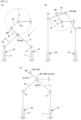
- this rotary actuator unit 1 can vary the reduction ratio for the output link member 30 by controlling the distance X between the input side shaft IP and the output side shaft OP in the rotation plane. For example, as shown in Fig. 2b , by shortening the distance X between the input side shaft IP and the output side shaft OP, the reduction ratio can be reduced from the state of Fig. 2a and the rotation speed of the output link member 30 can be increased. In other words, the distance X between the input side shaft IP and the output side shaft OP and the rotational speed of the output link member 30 are generally inversely proportional.
- the output link member 30 and intermediate link member 40 can be separated from the two actuators by aligning the rotation axes of the input side shaft IP and the output side shaft OP, as shown in Fig. 2c . This allows the output link member 30 and the intermediate link member 40 to achieve a free state, that is they can rotate freely around the output side shaft OP.
- the rotary actuator unit 1 has the following effects.
- the rotary actuator unit 1 can rotate the output link member 30 infinitely more than 360 degrees around the output side shaft OP and can also infinitely change its reduction ratio, by appropriately controlling the first linear actuator 11 of the first input part 10 and the second linear actuator 21 of the second input part 20.
- the rotary actuator unit 1 can transmit a large torque because it does not use friction as a means of transmitting driving force.
- the mechanism since there is no need to use gears between the input point (input side shaft IP) and the output axis (output side shaft OP) as a reduction means, the mechanism has excellent shock resistance.
- the first linear actuator 11 and the second linear actuator 21 of the rotary actuator unit 1 are not separated for driving and speed change, but are both responsible for driving and speed change (reduction ratio change). So, the driving force of the two actuators can be efficiently distributed to the rotation around the output side shaft of the output link member 30. In particular, by using the same two actuators, the efficiency can be further improved.
- the rotary actuator unit 1 is composed of an output side link mechanism L2 having three pivotal axis (input side shaft IP, intermediate shaft MP, and output side shaft OP) and two links (output link member 30 and intermediate link member 40) between the input point (input side shaft IP) and the output axis (output side shaft), which is operated by each linear actuator. Therefore, the rotary actuator unit 1 can eliminate the sliding shaft, which was essential in Patent Document 1, and can simplified the parts. Furthermore, since the output side link mechanism is composed only of a pivot axis, the counterweight design can be easily performed.
- the rotary actuator unit 1 disconnects each linear actuator 11, 21 from the output link member 30 and intermediate link member 40 by aligning the input point (input side shaft IP) with the output axis (output side shaft OP), so that a free state in which the output link member 30 and the intermediate link member 40 rotate freely around the output axis (output side support axis OP) can be easily achieved.
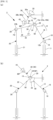
- the rotary actuator unit 2 shown in Fig. 3a is the rotary actuator unit 1 shown in Fig. 1 with a force sensor 50 and a counterweight design so that the gravity of each link member is not applied to the force sensor 50 and the center of gravity of each link member is aligned with the support axis.
- the rotary actuator unit 2 has a first input part 10, a second input part 20, an output link member 30, an intermediate link member 40, an output side shaft OP, an intermediate shaft MP, and an input side shaft IP, and is substantially the same as the rotary actuator unit 1 in Fig. 1 , except for the force sensor 50 and counterweight design. And it shares the same structure with each character or numeral of the rotary actuator unit 1 shown in Fig. 1 .
- the force sensor 50 is a force sensor that measures translational force.
- a load cell can be cited.
- the force sensor 50 is suitably a uniaxial load cell that measures the translational force of tension and compression of each link member.
- the location of the force sensor 50 is not limited as long as it is between the mover (first shaft P1) of the linear actuator 1 1 and the input side shaft IP, and between the mover (second shaft P2) of the linear actuator 21 and the input side shaft IP of the linear actuator 21, respectively.
- the first input link member 12 comprises a first base end side link element 16 from the base end 12b to the measurement reference plane of the force sensor 50 and a first tip side link element 17 from said measurement reference plane to the tip 12a.
- the first base end side link element 16 and the first tip side link element 17 move in unison.
- the first base end side link element 16 of the first input link member 12 has a first base end side counterweight portion 18 at the base end 12b so that its center of gravity is on the first shaft P1.
- the first tip side link element 17 of the first input link member 12 has a first tip side counterweight portion 19 at the tip 12a so that its center of gravity is on the input side shaft IP.
- the second input link member 22 has a second base end side link element 26 from the base end 22b to the measurement reference plane of the force sensor 50 and a second tip side link element 27 from said measurement reference plane to the tip 22a.
- the second base end link element 26 and the second tip link element 27 move in unison.
- the second base side link element 26 of the second input link member 22 has a second base end side counterweight portion 28 at the base end 22b so that its center of gravity is on the second shaft P2.
- the second tip side link element 27 of the second input link member 22 has a second tip side counterweight portion 29 at the tip 22a so that its center of gravity is on the input side shaft IP.
- the intermediate link member 40 has an intermediate counterweight portion 45 at the tip 40a so that the combined center of gravity of the first tip side link element 17, the second tip side link element 27, the input side shaft IP and the intermediate link member 40 is on the intermediate shaft MP.
- the output link member 30 has an output side counterweight portion 35 at the tip 30a so that the composite center of gravity of the first tip side link element 17, second tip side link element 27, input side shaft IP, intermediate link member 40 and output link member 30 is on the output side shaft OP.
- This rotary actuator unit 2 has the same effect as the rotary actuator unit 1 shown in Fig. 1 , that is it does not use friction as a driving force transmission means, the output link member 30 can be rotated indefinitely 360 degrees or more around the output side shaft OP, and it can also change its reduction ratio steplessly.
- the rotary actuator unit 2 has a counterweight design so that the center of gravity of each link is aligned with the axis of rotation and the gravity of each link member is not applied to the force sensor 50, so that link eccentricity does not occur. In other words, vibration due to link eccentricity can be minimized.
- the force sensors 50 installed in the first input link member 11 and the second input link member 12 can measure the torque around the output side shaft OP after completely eliminating the effect of gravity on each link.
- a complete no-load state of the force sensor 50 can be created by operating each linear actuator so that the input side shaft IP and the output side shaft OP of the rotary actuator unit 2 overlap, and fixing each linear actuator at that position.
- the rotary actuator unit 2 can easily reset the zero point of the force sensor 50 without disassembling it, even when it is assembled into a robot arm or the like.
- the rotary actuator unit 3 of Fig. 4a further has a third input part 60 equipped with a third linear actuator 61, a third shaft P3, and a third input link member 62.
- the third linear actuator 61 is fixed to the base B, such as a pedestal or base member of the rotary actuator unit 3.
- the third shaft P3 is fixed to the mover of the third linear actuator 61.
- the base end 62b of the third input link member 62 is rotatably supported around the third shaft P3, and the tip 62a is rotatably supported around the input side shaft IP.
- the third input part 60 constitutes an input side link mechanism, together with the first input part 10 and the second input part 20.
- the first linear actuator 11 of the first input part 10, the second linear actuator 21 of the second input part 20, and the third linear actuator 61 of the third input part 60 are operated to manipulate the two-dimensional position of the input side shaft IP and rotate the output link member 30 around the output side shaft OP.
- Fig. 4a three input parts are shown, but there can be four or more. By increasing the number of inputs, the maximum output can be improved. Also, although three linear actuators are shown here in parallel, their arrangement is not limited. For example, they may be arranged radially around the third shaft P3.
- This rotary actuator unit 3 has the same effect as the rotary actuator unit 1 in Fig. 1 . It can also give the same effect as the rotary actuator unit 2 in Fig. 2 by appropriately designing the counterweight.
- the rotary actuator unit 4 of Fig. 4b has a second intermediate link member 41 between the intermediate link member 40 and the first input link member 12 of the first input part 10 and the second input link member 22 of the second input part 20, and a third input part 60 that controls the orientation of the second intermediate link member 41.
- the third input part 60 has a third linear actuator 61 fixed to the base, a third shaft P3 fixed to the mover of the third linear actuator 61, and a third input link member 62 whose base end 62b is rotatably supported around the third shaft P3.
- the third input part 60 is not limited as long as it is equipped with a third actuator and one degree of freedom of the tip of the third input part 60 can be controlled by the third actuator.
- the third input part 60 of the rotary actuator 8b shown in Fig. 10c the third input part 60 of the rotary actuator 9b shown in Fig. 11c , and etc. may be used.
- the second intermediate link member 41 has a base end 47 that intersects the link body 46 at a predetermined angle (here, perpendicular) and has an overall T-shape.
- the tip 46a of the link body 46 is rotatably supported around the input side shaft IP together with the base end 40b of the intermediate link member 40.
- the base end 47 of the intermediate link member has a seventh shaft P7 that rotatably supports the tip 12a of the first input link member, an eighth shaft P8 that rotatably supports the tip 22a of the second input link member, and a ninth shaft P9 that rotatably supports the tip 62a of the third input link member. Therefore, the tip of the input side link mechanism of the rotary actuator unit 4 is the tip 46a of the link body 46 of the second intermediate link member 41.
- the rotary actuator unit 4 configured in this way can determine the positional relationship of the first shaft P1 and second shaft P2 by appropriately controlling the first linear actuator 11 and the second linear actuator 21, and also determine the posture (angle) of the second intermediate link member 41 by appropriately controlling the third liner actuator 61 to manipulate the two dimensional position of the input side shaft IP, and properly rotates the output link member 30 around the output side shaft OP.
- the output can be increased because the number of actuators increases, and moreover, and moreover, since the input side shaft IP, seventh shaft P7, eighth shaft P8, and ninth shaft P9 can be separated from each other, the machine design can be provided with more leeway.
- This rotary actuator unit 4 has one more link than the rotary actuator unit 1 in Fig. 1 . Therefore, the control operations of the first linear actuator 11, second linear actuator 21, and third linear actuator 61 to properly rotate the output link member 30 around the output side shaft OP becomes more complex. However, other than that, the effect is substantially the same as that of the rotary actuator unit 1 shown in Fig. 1 .
- this rotary actuator unit 4 is composed of only link mechanisms that pivot rather than glide, except for the linear actuators that drive them. Therefore, by appropriately attaching force sensors to the first input link member 12, second input link member 22, and third input link member 62, and by appropriately designing the counterweights so that the gravity of each link member is not applied to these force sensors, the same effect as in the rotary actuator unit 2 in Figure 2 can be achieved.
- T-shaped second intermediate link member 41 Although a T-shaped second intermediate link member 41 is introduced here, its shape is not limited. For example, a cross-shaped one may be used.
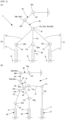
- the rotary actuator units 1a and 1b shown in Fig. 5a and Fig. 5b are the fifth and sixth embodiments of the rotary actuator unit, respectively.
- the rotary actuator unit 1A of Fig. 5a is a rotary actuator unit 1 of Fig. 1 , in which the drive force transmission mechanism 70 which transmit the rotation of the output link member around its output side shaft, and the hollow shaft member 80 which rotates in conjunction with the output link member 30 by drive force transmission mechanism 70, are further provided on the output axis (output side shaft OP) of the output link member 30.
- the drive force transmission mechanism 70 has a first pulley 70a that transmits the rotation of the output link member 30, a second pulley 70b, and a belt 70c that transmits the rotation of the first pulley 70a to the second pulley 70b.
- the mechanism is not limited to pulleys in particular, but can include any known mechanism.
- the drive force transmission mechanism 71 of the rotary actuator unit 1B shown in Fig. 5b is equipped with a first gear 71a that transmits rotation of the output link member 30 and a second gear 71b that meshes with the first gear 71a.
- the rotary actuator unit 1C of Fig. 5c is the seventh embodiment of the rotary actuator unit.
- the rotary actuator unit 1C of Fig. 5c is equipped with a drive force conversion mechanism 72 that converts the rotation of the output link member 30 of the actuator unit 1 of Fig. 1 around its output axis (output side shaft OP) into linear motion.
- This drive force conversion mechanism 72 has a pinion 72a that transmits the rotation of the output link member 30 and a rack 72b that converts the rotation of the pinion 72a into linear motion.
- the rotary actuator unit 1C of Fig. 5c uses a drive force conversion mechanism 72 which comprises a pinion and rack, but it is not particularly limited to a pinion and rack;and any known drive force conversion mechanism that converts rotational motion into linear motion can be applied.
- a drive force conversion mechanism 72 which comprises a pinion and rack, but it is not particularly limited to a pinion and rack;and any known drive force conversion mechanism that converts rotational motion into linear motion can be applied.
- the driving force transmission mechanisms 70, 71 and the driving force conversion mechanism 72 are attached to the rotary actuator unit 1 of Fig. 1 , but they may be attached to other rotary actuator units 2, 3, and 4 shown in Fig. 3 and 4 or to the rotary actuators 8a-8c, and 9a-9c shown in Figures 10 and 11 , respectively.
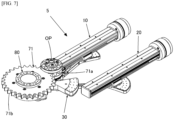
- the rotary actuator unit 5 of Fig. 6 and 7 shows a first prototype of the rotary actuator unit 2 of Fig. 2 with the final output axis offset to the hollow shaft member 80 via the drive force transmission mechanism 71.
- it has a first input part 10, a second input part 20, an output link member 30, an intermediate link member 40, a force sensor 50, an output side shaft OP, an intermediate shaft MP, an input side shaft IP, a drive force transmission mechanism 71, and a hollow shaft member 80 and it is applied with counterweight design.
- the character or numeral 90 is an encoder for measuring the displacement angle of the output axis (output side shaft OP).
- the other characters or numerals are common to the structure of the rotary actuator unit 2 of Fig. 2 .
- the rotation status of the output axis can be monitored by the actuator in the input part.
- the rotation status of the output shaft can continue to be monitored even when the output side shaft OP is aligned with the input side shaft IP, that is the output shaft is disconnected from the linear actuator and the output shaft (output side shaft OP) is left idling in a free state.
- the structure of the first linear actuator 11 and the second linear actuator 21 is not particularly limited, and mentioned that the existing example with a ball screw, a nut, and a motor that rotates and drives the ball screw can be used. However, instead of a ball screw with low friction and good transmission efficiency, a sliding screw with high friction and poor transmission efficiency may be selected.
- the linear actuator will have a so-called self-locking function, and the rotary actuator unit will not reverse drive unless the driving force is actively applied (except when the output axis (output side shaft OP) is in completely free rotation state by aligning the input point (input side shaft IP) with the output axis (output side shaft OP). This means that when a sliding screw is used, a locked state of the output shaft can be achieved except in the free rotation state of the output axis.
- the same locking function can, of course, be achieved by installing a braking mechanism such as an (electromagnetic) brake on the output axis (output side shaft OP), a linear actuator such as a ball screw, or a motor that drives the ball screw or the like.
- a braking mechanism such as an (electromagnetic) brake on the output axis (output side shaft OP), a linear actuator such as a ball screw, or a motor that drives the ball screw or the like.
- an extra brake, etc. must be installed.
- the output axis can be locked while using a ball screw with good transmission efficiency.
- the rotary actuator unit 6 of Fig. 8a through Fig. 8c and Fig. 9a shows a second prototype example of the rotary actuator unit 2 of Fig. 2 with a driving force conversion mechanism 72 attached.
- the rotary actuator unit 6 is also equipped with a brake mechanism 95 that brakes the rotation of the output axis (output side shaft OP), as described above.
- the other characters or numerals share the same structure with the rotary actuator unit 2 in Fig. 2 .
- a lock function can be given to the output axis regardless of the state of the output axis.
- the lock function can be given to the output axis even when the output side shaft OP and the input side shaft IP are stacked state. That is, with the output shaft locked and disconnecting the output shaft from the first and second actuators 11 and 21 by aligning the output shaft and input point, a complete no-load state of the force sensor can be created, and the force sensor zero resetting can be performed. Also, the force sensor zero resetting can be performed with the output axis not free from external force, and with the drive force conversion mechanism 72 and the external mechanism connected to the drive force conversion mechanism 72.
- the brake mechanism 95 of the rotary actuator unit 6 is not particularly limited, but an electromagnetic brake, for example, is preferred.
- the brake mechanism 95 may be attached to other rotary actuator units.
- the brake mechanism 95 of the rotary actuator unit 6 is provided on the output axis (output side shaft OP), but may be provided outside the output axis, such as in the drive force conversion mechanism 72.
- the rotary actuator unit 6 has the rack 72b of the driving force conversion mechanism 72 to move in a straight line parallel to the first linear actuator 11 of the first input part 10 and the second linear actuator 21 of the second input part 20.
- the rack 72b can be made to move straight in any direction by engaging the rack 72b with pinion 72a at any angle around the pinion 72a.
- the rack 72b can be installed at a 90-degree angle to the first linear actuator 11 and the second linear actuator 21, as in the rotary actuator unit 6A of Fig. 9c .
- the rotary actuator unit 7 of Fig. 8d and Fig. 9b is equipped with a drive force conversion mechanism 73.
- the drive force conversion mechanism 73 has a pinion 73a, a first rack 73b, and a second rack 73c, with the first rack 73b and the second rack 73c relative to each other across the pinion 73a.
- the first rack 73b and the second rack 73c move straight in opposite directions.
- the first rack 73b and the second rack 73c may be stacked, for example, in the axial direction. In this case, the two racks travel in the same direction.
- the orientation of the driving force conversion mechanism 73 with respect to the rotary actuator unit may be changed, as in the rotary actuator unit 7A of Fig. 9d .
- the rotary actuator unit 8 (eighth embodiment) shown in Fig. 10a has a first input part 10, a second input part 20, an output link member 30, an intermediate link member 40, an output side shaft OP fixed to the base, an intermediate shaft MP not fixed to the base, and an input side shaft IP not fixed to the base.
- the first input part 10 has a first shaft P1 fixed to the base B and a first linear actuator 11 rotatably supported around the first shaft P1.
- the second input part 20 has a second shaft P2 fixed to the base B and a second linear actuator 21 rotatably supported around the second shaft P2.
- the mover 11a of the first linear actuator 11 and the mover 21a of the second linear actuator 21, together with the base end 40b of the intermediate link member 40, are rotatably supported around the input side shaft IP.
- the first input part 10 and the second input part 20 constitute the input side direct operated type five-bar link mechanism L1.
- the output side link mechanism L2 is substantially the same as the rotary actuator 1 in Fig. 1 .
- the mover 11a of the first linear actuator 11 (the tip of the first input part) and the mover 21a of the second linear actuator 21 (the tip of the second input part) form the tips of direct operated type five-bar link mechanism on the input side.
- the intermediate link member 40 connects the mover 11a of the first linear actuator 11 with the output link member 30, and the mover 21a of the second linear actuator 21 with the output link member 30.
- the two-dimensional position of the input side shaft IP can be freely manipulated to rotate the output link member 30 around the output side shaft OP.
- the force sensor 50 is installed on the stem of the first linear actuator 11 and the second linear actuator 21, and it is preferred to be closer to the input side shaft IP, although it is not particularly limited.
- This rotary actuator 8 does not have a counterweight design. However, it is complicated but theoretically possible to provide counterweights that are linked to the operation of linear actuator, for example, at the base and tip (mover) of each linear actuator, at the base 40b and tip 40a of the intermediate link member, and at the base 30b and tip 30a of the output link member, respectively. This appropriate counterweight design would prevent eccentricity of each link.
- the rotary actuator unit 8a (ninth embodiment) of Fig. 10b is the rotary actuator unit 8 of Fig. 10a with a third input part 60.
- the third input unit 60 has a third linear actuator 61 that is rotatably supported around a third shaft P3 fixed to the base B.
- the mover 61a of the third linear actuator 61 is rotatably supported around the input side shaft IP together with the base end 40b of the intermediate link member.
- the rotary actuator unit 8b (10th embodiment) of Fig. 10c has a second intermediate link member 41 between the intermediate link member 40 of the rotary actuator unit 8 of Fig. 10a and the linear actuators (first linear actuator 11 and the second linear actuator 21); and a third input part 60 controlling the posture of the intermediate link member 41.
- the third input part 60 has a third support shaft P3 fixed to the base B and a third linear actuator 61 rotatably supported around the third shaft P3.
- the second intermediate link member 41 is substantially the same as the second intermediate link member 41 of the rotary actuator unit 4 of Fig. 4b .
- the third input unit 60 is not limited as long as it is equipped with a third actuator (rotary motor or linear actuator), and the two-dimensional position of the tip of the third input unit 60 can be controlled by the third actuator.
- the third input unit 60 of the rotary actuator 4 of Fig. 4b or the third input 60 of rotary actuator 9b, of Fig. 11c may be used.
- the rotary actuator unit 9 (11th embodiment) of Fig. 11a has a first input part 10, a second input part 20, an output link member 30, an intermediate link member 40, an output side shaft OP fixed to the base, an intermediate shaft MP not fixed to the base, and an input side shaft IP not fixed to the base.
- the first input part 10 has a first motor 111, a first input first link member 112, a first shaft P1 not fixed to the base, and a first input second link member 113.
- the first rotary motor 111 is fixed to the base B.
- the base 112b of the first input first link member 112 is fixed to the movable shaft 111a of the first motor 111, and the tip 112a of the first input first link member 112 and the base 113b of the first input second link member 113 are rotatably supported around the first shaft P1.
- the second input part 20 has a second motor 211, a second input first link member 212, a second shaft P2 not fixed to the base, and a second input second link member 213.
- the second motor 211 is fixed to the base B.
- the base end 212b of the second input first link member 212 is fixed to the movable shaft 211a of the second motor 211, and the tip 212a of the second input first link member 212 and the base end 213b of the second input second link member 213 are rotatably supported around the second shaft P2.
- the tip 113a of the first input second link member 113 and the tip 213a of the second input second link member 213, together with the base end 40b of the intermediate link member 40, are rotatably supported around the input side shaft IP.
- the first input part 10 and the second input part 20 constitute the input side rotary type five-bar link mechanism L1.
- the tip 113a of the first input second link member 113 and the tip 213a of the second input second link member 213 forms the tips of the rotary type five-bar link mechanism of the input side.
- the intermediate link member 40 connects the first input second link member 113 to the output link member 30 and the second input second link member 213 to the output link member 30.
- the link mechanism L2 on the output side is substantially the same as the link mechanism L2 of the rotary actuator unit 1 of Fig. 1 .
- the two-dimensional position of the input side shaft IP can be freely manipulated to rotate the output link member 30 around the output side shaft OP.
- the force sensors 50 are provided on the first input second link member 113 and the second input second link member 213, and although this is not particularly limited but it is preferable that they are provided closer to the input side shaft IP.
- This rotary actuator 9 does not have a counterweight design. However, by applying an appropriate counterweight design, the eccentricity of each link can be avoided.
- the rotary actuator unit 9a (12th embodiment) shown in Fig. 11b is the rotary actuator unit 9 of Fig. 11a with the third input part 60.
- the third input part 60 has a third motor 611 fixed to the base B; a third input first link member 612 whose base end 612b is fixed to the pivot axis of the third motor 611; and a third input second link member 613 whose base end is connected to the tip of the third input first link member 612 rotatably around a third shaft P3. Further, the tip 613a of the third input second link member 613 is rotatably supported around the input side shaft IP.
- the rotary actuator unit 9b (13th embodiment) of Fig. 11c has a second intermediate link member 41 which is provided between the intermediate link member 40 of the rotary actuator unit 9 of Fig. 11 and the first input second link member 113 and between the intermediate link member 40 of the rotary actuator unit 9 of Fig. 11 and the second input second link member 213; and a third input part 60 controlling the posture of the second intermediate link member 41.
- the third input part 60 has a third motor 611 fixed to the base, a first input first link member 612, a third shaft P3 not fixed to the base, and a first input second link member 613.
- the base end of the third input first link member 612 is fixed to the movable shaft of the third motor 611, and the tip of the third input first link member 612 and the base end of the third input second link member 613 are rotatably supported around the third shaft P3.
- the intermediate link member 41 is substantially the same as the second intermediate link member 41 and the third input 60 of the rotary actuator unit 4 of Fig. 4b .
- the tip 613a of the third input second link member 613 is rotatably supported around the ninth shaft P9.
- the third input unit 60 is not limited as long as it is equipped with a third actuator (rotary motor or linear actuator), and the two-dimensional position of the tip of the third input unit 60 can be controlled by the third actuator.
- the third input unit 60 of the rotary actuator 4 of Fig. 4b or the third input 60 of rotary actuator may be used.
Landscapes
- Engineering & Computer Science (AREA)
- Mechanical Engineering (AREA)
- Robotics (AREA)
- General Engineering & Computer Science (AREA)
- Human Computer Interaction (AREA)
- Transmission Devices (AREA)
Applications Claiming Priority (2)
| Application Number | Priority Date | Filing Date | Title |
|---|---|---|---|
| JP2022030250 | 2022-02-28 | ||
| PCT/JP2023/007369 WO2023163222A1 (ja) | 2022-02-28 | 2023-02-28 | 回転アクチュエータユニットおよびそれを備えたロボット用または重機用関節ユニット |
Publications (2)
| Publication Number | Publication Date |
|---|---|
| EP4497973A1 true EP4497973A1 (de) | 2025-01-29 |
| EP4497973A4 EP4497973A4 (de) | 2025-09-03 |
Family
ID=87766301
Family Applications (1)
| Application Number | Title | Priority Date | Filing Date |
|---|---|---|---|
| EP23760220.6A Pending EP4497973A4 (de) | 2022-02-28 | 2023-02-28 | Drehaktuatoreinheit und gelenkeinheit für roboter oder schwere ausrüstung damit |
Country Status (4)
| Country | Link |
|---|---|
| US (1) | US20250230864A1 (de) |
| EP (1) | EP4497973A4 (de) |
| JP (1) | JPWO2023163222A1 (de) |
| WO (1) | WO2023163222A1 (de) |
Family Cites Families (5)
| Publication number | Priority date | Publication date | Assignee | Title |
|---|---|---|---|---|
| US6702805B1 (en) * | 1999-11-12 | 2004-03-09 | Microdexterity Systems, Inc. | Manipulator |
| US7219647B1 (en) * | 2005-12-16 | 2007-05-22 | Michael Dennis Brickley | Force transfer mechanism for an engine |
| US20110209569A1 (en) * | 2009-09-01 | 2011-09-01 | Renato Bastos Ribeiro | Power multiplier lever system |
| JP2012067809A (ja) | 2010-09-21 | 2012-04-05 | Tokyo Institute Of Technology | 無段変速機 |
| JP5786697B2 (ja) * | 2011-12-13 | 2015-09-30 | 株式会社デンソー | スライダリンク機構を用いて変速比を調整した無段変速装置 |
-
2023
- 2023-02-28 WO PCT/JP2023/007369 patent/WO2023163222A1/ja not_active Ceased
- 2023-02-28 EP EP23760220.6A patent/EP4497973A4/de active Pending
- 2023-02-28 US US18/841,872 patent/US20250230864A1/en active Pending
- 2023-02-28 JP JP2024503320A patent/JPWO2023163222A1/ja active Pending
Also Published As
| Publication number | Publication date |
|---|---|
| US20250230864A1 (en) | 2025-07-17 |
| WO2023163222A1 (ja) | 2023-08-31 |
| EP4497973A4 (de) | 2025-09-03 |
| JPWO2023163222A1 (de) | 2023-08-31 |
Similar Documents
| Publication | Publication Date | Title |
|---|---|---|
| US9676104B2 (en) | Variable spring constant torque coupler | |
| EP3974122B1 (de) | Arm eines industrieroboters | |
| EP1684950B1 (de) | Parallelkinematikmechanismus mit einem konzentrischen kugelgelenk | |
| KR101662883B1 (ko) | 토크 프리 링키지 유니트 | |
| US9845850B2 (en) | Robotic arm and wrist mechanisms | |
| US5673595A (en) | Four degree-of-freedom manipulator | |
| Fumagalli et al. | The mVSA-UT: A miniaturized differential mechanism for a continuous rotational variable stiffness actuator | |
| EP2999572B1 (de) | Kompakter parallelkinematikroboter | |
| JP2004512187A (ja) | 産業ロボット | |
| WO2006101893A2 (en) | Parallel robot | |
| CN1267586A (zh) | 一种四自由度并联机器人机构 | |
| Parenti-Castelli et al. | Workspace and optimal design of a pure translation parallel manipulator | |
| EP4497973A1 (de) | Drehaktuatoreinheit und gelenkeinheit für roboter oder schwere ausrüstung damit | |
| CN105364942A (zh) | 机械手臂及机器人 | |
| KR20100066578A (ko) | 무단 변속기 기계 | |
| CN106625591B (zh) | 一种三平两转五自由度并联机构 | |
| US10272562B2 (en) | Parallel kinematics robot with rotational degrees of freedom | |
| EP3095563B1 (de) | Vorrichtung zum bewegen und positionieren eines objekts im raum | |
| JP2012067809A (ja) | 無段変速機 | |
| CN110355741A (zh) | 具有3t1r和2t2r两种运动模式的并联机构 | |
| KR102819615B1 (ko) | 고중량을 다룰 수 있는 중력보상장치 | |
| KR101289285B1 (ko) | 등속 조인트 및 이를 이용한 등속 구동축 | |
| ZHANG et al. | JINKI Enterprise Drive: A Parallel-Link Linear-to-Rotary Robotic Actuator for Continuously Variable Transmission | |
| RU2201019C2 (ru) | Поворотное устройство (варианты) | |
| Quaid | A modular actuator with translational motion along an arc |
Legal Events
| Date | Code | Title | Description |
|---|---|---|---|
| STAA | Information on the status of an ep patent application or granted ep patent |
Free format text: STATUS: THE INTERNATIONAL PUBLICATION HAS BEEN MADE |
|
| PUAI | Public reference made under article 153(3) epc to a published international application that has entered the european phase |
Free format text: ORIGINAL CODE: 0009012 |
|
| STAA | Information on the status of an ep patent application or granted ep patent |
Free format text: STATUS: REQUEST FOR EXAMINATION WAS MADE |
|
| 17P | Request for examination filed |
Effective date: 20240927 |
|
| AK | Designated contracting states |
Kind code of ref document: A1 Designated state(s): AL AT BE BG CH CY CZ DE DK EE ES FI FR GB GR HR HU IE IS IT LI LT LU LV MC ME MK MT NL NO PL PT RO RS SE SI SK SM TR |
|
| DAV | Request for validation of the european patent (deleted) | ||
| DAX | Request for extension of the european patent (deleted) | ||
| A4 | Supplementary search report drawn up and despatched |
Effective date: 20250801 |
|
| RIC1 | Information provided on ipc code assigned before grant |
Ipc: F16H 21/10 20060101AFI20250728BHEP Ipc: B25J 11/00 20060101ALI20250728BHEP Ipc: F16H 25/22 20060101ALI20250728BHEP |