EP4497790A2 - Harzzusammensetzung, wässrige tinte, tintenstrahlaufzeichnungsvorrichtung und tintenstrahlaufzeichnungsverfahren - Google Patents
Harzzusammensetzung, wässrige tinte, tintenstrahlaufzeichnungsvorrichtung und tintenstrahlaufzeichnungsverfahren Download PDFInfo
- Publication number
- EP4497790A2 EP4497790A2 EP24190970.4A EP24190970A EP4497790A2 EP 4497790 A2 EP4497790 A2 EP 4497790A2 EP 24190970 A EP24190970 A EP 24190970A EP 4497790 A2 EP4497790 A2 EP 4497790A2
- Authority
- EP
- European Patent Office
- Prior art keywords
- organic solvent
- particles
- resin composition
- aqueous ink
- recording
- Prior art date
- Legal status (The legal status is an assumption and is not a legal conclusion. Google has not performed a legal analysis and makes no representation as to the accuracy of the status listed.)
- Pending
Links
Images
Classifications
-
- C—CHEMISTRY; METALLURGY
- C09—DYES; PAINTS; POLISHES; NATURAL RESINS; ADHESIVES; COMPOSITIONS NOT OTHERWISE PROVIDED FOR; APPLICATIONS OF MATERIALS NOT OTHERWISE PROVIDED FOR
- C09D—COATING COMPOSITIONS, e.g. PAINTS, VARNISHES OR LACQUERS; FILLING PASTES; CHEMICAL PAINT OR INK REMOVERS; INKS; CORRECTING FLUIDS; WOODSTAINS; PASTES OR SOLIDS FOR COLOURING OR PRINTING; USE OF MATERIALS THEREFOR
- C09D11/00—Inks
- C09D11/02—Printing inks
- C09D11/10—Printing inks based on artificial resins
- C09D11/102—Printing inks based on artificial resins containing macromolecular compounds obtained by reactions other than those only involving unsaturated carbon-to-carbon bonds
-
- C—CHEMISTRY; METALLURGY
- C08—ORGANIC MACROMOLECULAR COMPOUNDS; THEIR PREPARATION OR CHEMICAL WORKING-UP; COMPOSITIONS BASED THEREON
- C08F—MACROMOLECULAR COMPOUNDS OBTAINED BY REACTIONS ONLY INVOLVING CARBON-TO-CARBON UNSATURATED BONDS
- C08F20/00—Homopolymers and copolymers of compounds having one or more unsaturated aliphatic radicals, each having only one carbon-to-carbon double bond, and only one being terminated by only one carboxyl radical or a salt, anhydride, ester, amide, imide or nitrile thereof
- C08F20/02—Monocarboxylic acids having less than ten carbon atoms, Derivatives thereof
- C08F20/10—Esters
-
- B—PERFORMING OPERATIONS; TRANSPORTING
- B41—PRINTING; LINING MACHINES; TYPEWRITERS; STAMPS
- B41J—TYPEWRITERS; SELECTIVE PRINTING MECHANISMS, i.e. MECHANISMS PRINTING OTHERWISE THAN FROM A FORME; CORRECTION OF TYPOGRAPHICAL ERRORS
- B41J2/00—Typewriters or selective printing mechanisms characterised by the printing or marking process for which they are designed
- B41J2/005—Typewriters or selective printing mechanisms characterised by the printing or marking process for which they are designed characterised by bringing liquid or particles selectively into contact with a printing material
- B41J2/01—Ink jet
- B41J2/17—Ink jet characterised by ink handling
- B41J2/175—Ink supply systems ; Circuit parts therefor
-
- B—PERFORMING OPERATIONS; TRANSPORTING
- B41—PRINTING; LINING MACHINES; TYPEWRITERS; STAMPS
- B41M—PRINTING, DUPLICATING, MARKING, OR COPYING PROCESSES; COLOUR PRINTING
- B41M5/00—Duplicating or marking methods; Sheet materials for use therein
- B41M5/0023—Digital printing methods characterised by the inks used
-
- C—CHEMISTRY; METALLURGY
- C08—ORGANIC MACROMOLECULAR COMPOUNDS; THEIR PREPARATION OR CHEMICAL WORKING-UP; COMPOSITIONS BASED THEREON
- C08L—COMPOSITIONS OF MACROMOLECULAR COMPOUNDS
- C08L23/00—Compositions of homopolymers or copolymers of unsaturated aliphatic hydrocarbons having only one carbon-to-carbon double bond; Compositions of derivatives of such polymers
- C08L23/02—Compositions of homopolymers or copolymers of unsaturated aliphatic hydrocarbons having only one carbon-to-carbon double bond; Compositions of derivatives of such polymers not modified by chemical after-treatment
- C08L23/04—Homopolymers or copolymers of ethene
- C08L23/06—Polyethylene
-
- C—CHEMISTRY; METALLURGY
- C08—ORGANIC MACROMOLECULAR COMPOUNDS; THEIR PREPARATION OR CHEMICAL WORKING-UP; COMPOSITIONS BASED THEREON
- C08L—COMPOSITIONS OF MACROMOLECULAR COMPOUNDS
- C08L51/00—Compositions of graft polymers in which the grafted component is obtained by reactions only involving carbon-to-carbon unsaturated bonds; Compositions of derivatives of such polymers
- C08L51/08—Compositions of graft polymers in which the grafted component is obtained by reactions only involving carbon-to-carbon unsaturated bonds; Compositions of derivatives of such polymers grafted on to macromolecular compounds obtained otherwise than by reactions only involving unsaturated carbon-to-carbon bonds
- C08L51/085—Compositions of graft polymers in which the grafted component is obtained by reactions only involving carbon-to-carbon unsaturated bonds; Compositions of derivatives of such polymers grafted on to macromolecular compounds obtained otherwise than by reactions only involving unsaturated carbon-to-carbon bonds on to polysiloxanes
-
- C—CHEMISTRY; METALLURGY
- C09—DYES; PAINTS; POLISHES; NATURAL RESINS; ADHESIVES; COMPOSITIONS NOT OTHERWISE PROVIDED FOR; APPLICATIONS OF MATERIALS NOT OTHERWISE PROVIDED FOR
- C09D—COATING COMPOSITIONS, e.g. PAINTS, VARNISHES OR LACQUERS; FILLING PASTES; CHEMICAL PAINT OR INK REMOVERS; INKS; CORRECTING FLUIDS; WOODSTAINS; PASTES OR SOLIDS FOR COLOURING OR PRINTING; USE OF MATERIALS THEREFOR
- C09D11/00—Inks
- C09D11/02—Printing inks
- C09D11/10—Printing inks based on artificial resins
-
- C—CHEMISTRY; METALLURGY
- C09—DYES; PAINTS; POLISHES; NATURAL RESINS; ADHESIVES; COMPOSITIONS NOT OTHERWISE PROVIDED FOR; APPLICATIONS OF MATERIALS NOT OTHERWISE PROVIDED FOR
- C09D—COATING COMPOSITIONS, e.g. PAINTS, VARNISHES OR LACQUERS; FILLING PASTES; CHEMICAL PAINT OR INK REMOVERS; INKS; CORRECTING FLUIDS; WOODSTAINS; PASTES OR SOLIDS FOR COLOURING OR PRINTING; USE OF MATERIALS THEREFOR
- C09D11/00—Inks
- C09D11/02—Printing inks
- C09D11/10—Printing inks based on artificial resins
- C09D11/106—Printing inks based on artificial resins containing macromolecular compounds obtained by reactions only involving carbon-to-carbon unsaturated bonds
- C09D11/107—Printing inks based on artificial resins containing macromolecular compounds obtained by reactions only involving carbon-to-carbon unsaturated bonds from unsaturated acids or derivatives thereof
-
- C—CHEMISTRY; METALLURGY
- C09—DYES; PAINTS; POLISHES; NATURAL RESINS; ADHESIVES; COMPOSITIONS NOT OTHERWISE PROVIDED FOR; APPLICATIONS OF MATERIALS NOT OTHERWISE PROVIDED FOR
- C09D—COATING COMPOSITIONS, e.g. PAINTS, VARNISHES OR LACQUERS; FILLING PASTES; CHEMICAL PAINT OR INK REMOVERS; INKS; CORRECTING FLUIDS; WOODSTAINS; PASTES OR SOLIDS FOR COLOURING OR PRINTING; USE OF MATERIALS THEREFOR
- C09D11/00—Inks
- C09D11/02—Printing inks
- C09D11/12—Printing inks based on waxes or bitumen
-
- C—CHEMISTRY; METALLURGY
- C09—DYES; PAINTS; POLISHES; NATURAL RESINS; ADHESIVES; COMPOSITIONS NOT OTHERWISE PROVIDED FOR; APPLICATIONS OF MATERIALS NOT OTHERWISE PROVIDED FOR
- C09D—COATING COMPOSITIONS, e.g. PAINTS, VARNISHES OR LACQUERS; FILLING PASTES; CHEMICAL PAINT OR INK REMOVERS; INKS; CORRECTING FLUIDS; WOODSTAINS; PASTES OR SOLIDS FOR COLOURING OR PRINTING; USE OF MATERIALS THEREFOR
- C09D11/00—Inks
- C09D11/30—Inkjet printing inks
- C09D11/32—Inkjet printing inks characterised by colouring agents
- C09D11/322—Pigment inks
-
- C—CHEMISTRY; METALLURGY
- C09—DYES; PAINTS; POLISHES; NATURAL RESINS; ADHESIVES; COMPOSITIONS NOT OTHERWISE PROVIDED FOR; APPLICATIONS OF MATERIALS NOT OTHERWISE PROVIDED FOR
- C09D—COATING COMPOSITIONS, e.g. PAINTS, VARNISHES OR LACQUERS; FILLING PASTES; CHEMICAL PAINT OR INK REMOVERS; INKS; CORRECTING FLUIDS; WOODSTAINS; PASTES OR SOLIDS FOR COLOURING OR PRINTING; USE OF MATERIALS THEREFOR
- C09D11/00—Inks
- C09D11/30—Inkjet printing inks
- C09D11/38—Inkjet printing inks characterised by non-macromolecular additives other than solvents, pigments or dyes
Definitions
- the present disclosure relates to a resin composition, an aqueous ink, an inkjet recording device, and an inkjet recording method.
- JP2019-147892A discloses an aqueous ink that uses an organic solvent such as glycerin as a film forming auxiliary.
- a resin composition includes: an organic solvent; fixing resin particles; lubricant particles; and water.
- the lubricant particles each contain an organic compound, a difference (d 1 -d 2 ) between a volume average particle diameter (d 1 ) of the lubricant particles and a volume average particle diameter (d 2 ) of the fixing resin particles is 70 nm or more.
- the organic solvent includes an organic solvent having a boiling point of 190°C to 280°C.
- a content of the lubricant particles is 0.1 wt% to 8.0 wt%, and a content of the organic solvent having a boiling point of 190°C to 280°C is 6.0 wt% to 10.0 wt%.
- an aqueous ink includes: the above-described resin composition; and a pigment.
- an ink jet recording device includes: the above-described resin composition or aqueous ink; a flow path through which the resin composition or aqueous ink flows; and an applying unit connecting to the flow path and configured to apply the resin composition or aqueous ink onto an object for recording.
- an ink jet recording method includes: applying the above-described resin composition or aqueous ink onto a recording medium by an inkjet method.
- an ink jet recording method includes: a recording step of performing recording by applying a resin composition to a recording medium by an ink jet method, in which the resin composition is the above-described resin composition.
- an ink jet recording method includes: a recording step of performing recording by applying an aqueous ink to a recording medium by an inkjet method, in which the aqueous ink is the above-described aqueous ink for ink jet recording.
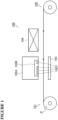
- FIG. 1 is a schematic diagram showing a configuration of an example of an ink jet recording device according to the present disclosure.
- a resin composition an aqueous ink for ink jet recording, an inkjet recording device, and an inkjet recording method, which enable excellent blocking resistance and excellent scratch resistance, are provided.
- the words “a” and “an” and the like carry the meaning of “one or more.”
- an amount, concentration, or other value or parameter is given as a range, and/or its description includes a list of upper and lower values, this is to be understood as specifically disclosing all integers and fractions within the given range, and all ranges formed from any pair of any upper and lower values, regardless of whether subranges are separately disclosed.
- a range of numerical values is recited herein, unless otherwise stated, the range is intended to include the endpoints thereof, as well as all integers and fractions within the range.
- a stated range of 1-10 fully describes and includes the independent subrange 3.4 - 7.2 as does the following list of values: 1, 4, 6, 10.
- mass may be referred to as “weight” unless otherwise specified.
- mass ratio may be referred to as “weight ratio” unless otherwise specified, and “mass%” may be referred to as “wt%” unless otherwise specified.
- HSP means a “Hansen solubility parameter” unless otherwise specified.
- RED means a relative energy difference between a Hansen sphere radius (R 0 ) and a HSP distance (R a ) unless otherwise specified.
- blocking refers to a phenomenon in which stacked printed matters adhere to each other due to the tackiness of the ink unless otherwise specified.
- the resin composition according to the present disclosure contains an organic solvent, fixing resin particles, lubricant particles, and water.
- the organic solvent includes an organic solvent having a boiling point of 190°C to 280°C (hereinafter sometimes referred to as an "organic solvent A").
- the organic solvent A is not particularly limited as long as it is an organic solvent having a boiling point of 190°C to 280°C, and may be, for example, an organic solvent having a boiling point of 200°C or higher, 210°C or higher, 220°C or higher, 230°C or higher, 240°C or higher, 250°C or higher, 260°C or higher, or 270°C or higher, or may be, for example, an organic solvent having a boiling point of 279°C or lower or 278°C or lower.
- Examples of the organic solvent A include a glycol and a glycol ether, and a glycol ether is preferred from the viewpoint of improving the scratch resistance to be described later.
- Examples of the glycol include tripropylene glycol (TPG), ethylene glycol, diethylene glycol, polyethylene glycol 200, polyethylene glycol 400, polyethylene glycol 600, and dipropylene glycol.
- glycol ether examples include triethylene glycol monobutyl ether (BTG), ethylene glycol monobutyl propylene glycol monophenyl ether, diethylene glycol monomethyl ether, diethylene glycol monoethyl ether, diethylene glycol monobutyl ether, triethylene glycol monoethyl ether, triethylene glycol monomethyl ether, dipropylene glycol methyl ether, dipropylene glycol butyl ether, and tripropylene glycol butyl ether.
- the organic solvent A may be used alone or in combination of two or more types thereof.
- the organic solvent may or may not contain, for example, an organic solvent other than the organic solvent A.
- a content of the organic solvent A is 6.0 wt% or more and 10.0 wt% or less, that is, 6.0 wt% to 10.0, wt% in a total weight of the resin composition.
- the content of the organic solvent A may be, for example, 6.5 wt% or more, 7.0 wt% or more, or 7.5 wt% or more, and for example, 9.5 wt% or less, 9.0 wt% or less, 8.5 wt% or less, or 8.0 wt% or less.
- the fixing resin particles may be contained in, for example, a resin emulsion.
- the resin emulsion include an acrylic resin emulsion and a urethane resin emulsion.
- the resin emulsion is formed by, for example, the fixing resin particles and a dispersion medium (for example, water), and the fixing resin particles are not dissolved in the dispersion medium, but are dispersed in a specific particle diameter.
- a commercially available product may be used as the fixing resin particles.
- the fixing resin particles are an acrylic resin emulsion
- the fixing resin particles are not particularly limited as long as they are a resin emulsion having an acrylic component in the molecule, and are, for example, resin particles containing a polyacrylic acid or a polyacrylic acid ester as a main component.
- Examples of a monomer that can be used as the resin particles include (meth)acrylic acid and a (meth)acrylic acid ester such as methyl (meth)acrylate, ethyl (meth)acrylate, propyl (meth)acrylate, isopropyl (meth)acrylate, n-butyl (meth)acrylate, isobutyl (meth)acrylate, tert-butyl (meth)acrylate, pentyl (meth)acrylate, 2-ethylhexyl (meth)acrylate, octyl (meth)acrylate, cyclopropyl (meth)acrylate, cyclopentyl (meth)acrylate, cyclohexyl (meth)acrylate, cycloheptyl (meth)acrylate, cyclooctyl (meth)acrylate, phenyl (meth)acrylate, benzyl (meth)acrylate, tolyl (me
- the term "(meth) acrylic” means “at least one of acrylic and methacrylic".
- the term “(meth)acrylic acid” means “at least one of acrylic acid and methacrylic acid”.
- (meth)acrylate means “at least one of acrylate and methacrylate”.
- the fixing resin particles are a urethane resin emulsion
- the fixing resin particles are not particularly limited as long as they are a resin emulsion having a urethane component in the molecule, and examples thereof include a polyether-based urethane, a polyester-based urethane, and a polycarbonate-based urethane.
- a volume average particle diameter (d 2 ) of the fixing resin particles is not particularly limited, and may be, for example, 10 nm or more, 30 nm or more, 50 nm or more, or 70 nm or more, and may be, for example, 1000 nm or less, 500 nm or less, 300 nm or less, or 150 nm or less.
- the volume average particle diameter (d 2 ) can be measured using, for example, a dynamic light scattering particle size distribution measuring device.
- the dynamic light scattering particle size distribution measuring device is not particularly limited, and for example, "LB-550 (trade name)" manufactured by HORIBA Company can be used.
- a glass transition temperature Tg of the fixing resin particles may be, for example, 35°C or higher, 45°C or higher, or 55°C or higher, and may be, for example, 80°C or lower, 70°C or lower, or 60°C or lower.
- the lubricant particles contain an organic compound.
- organic compound refers to a general term for compounds containing carbon unless otherwise specified. However, carbon oxides, carbonates, and the like are included in inorganic compounds rather than the organic compound in the present disclosure.
- the lubricant particles may be, for example, an organic compound.
- the lubricant particles may include, for example, a hydrophilic portion and a hydrophobic portion.
- the lubricant particles may be contained in, for example, a resin emulsion.
- the resin emulsion is formed of, for example, the lubricant particles and a dispersion medium (for example, water), and the lubricant particles are not dissolved in the dispersion medium, but are dispersed with a specific particle diameter.
- a commercially available product may be used as the lubricant particles.
- the resin emulsion include a silicone acrylic emulsion, a silicone urethane emulsion, a polyolefin emulsion, a paraffin emulsion, an acrylic emulsion, a polyurethane emulsion, a polyester emulsion, a vinyl chloride emulsion, and a vinyl acetate emulsion.
- the lubricant particles may contain, for example, a polyorganosiloxane as a main chain.
- the lubricant particles may contain, for example, at least one of an acrylic component and a urethane component as a side chain.
- the lubricant particles include silicone acrylic particles, silicone urethane particles, polyolefin particles, paraffin particles, acrylic particles, polyurethane particles, polyester particles, and polyvinyl chloride particles.
- lubricant particles examples include: “CHALINE (registered trademark) E-370", “CHALINE (registered trademark) E-790", and “CHALINE (registered trademark) RU-911” manufactured by Nissin Chemical Industry Co., Ltd.; and "SYMAC (registered trademark) US-450” and “SYMAC (registered trademark) US-480” manufactured by TOAGOSEI CO., LTD.
- the lubricant particles may be used alone or in combination of two or more types thereof.
- a content of the lubricant particles is 0.1 wt% or more and 8.0 wt% or less, that is, 0.1 wt% to 8.0, wt% in the total weight of the resin composition.
- the content of the lubricant particles may be, for example, 0.15 wt% or more, 0.2 wt% or more, 0.5 wt% or more, or 1.0 wt% or more, and may be, for example, 7.0 wt% or less, 6.0 wt% or less, 5.0 wt% or less, 4.0 wt% or less, 3.0 wt% or less, or 2.0 wt% or less.
- a volume average particle diameter (d 1 ) of the lubricant particles is not particularly limited, and may be, for example, 50 nm or more, 100 nm or more, 150 nm or more, or 200 nm or more, and may be, for example, 2000 nm or less, 1500 nm or less, 1000 nm or less, 800 nm or less, 500 nm or less, or 300 nm or less.
- the volume average particle diameter (d 1 ) can be measured using, for example, a dynamic light scattering particle size distribution measuring device.
- the dynamic light scattering particle size distribution measuring device is not particularly limited, and for example, "LB-550 (trade name)" manufactured by HORIBA Company can be used.
- a difference (d 1 -d 2 ) between the volume average particle diameter (d 1 ) of the lubricant particles and the volume average particle diameter (d 2 ) of the fixing resin particles is 70 nm or more.
- the difference (d 1 -d 2 ) may be, for example, 80 nm or more, 90 nm or more, 100 nm or more, 120 nm or more, 150 nm or more, 190 nm or more, or 200 nm or more, and may be, for example, 1000 nm or less, 950 nm or less, 900 nm or less, 800 nm or less, 700 nm or less, 600 nm or less, 500 nm or less, 400 nm or less, 300 nm or less, or 200 nm or less.
- the organic solvent A may have an upper limit value of a RED of, for example, less than 2.0, 1.9 or less, 1.5 or less, or 1.0 or less, the RED indicating a relative energy difference (R a /R 0 ) calculated based on the HSP distance (R a ), between the fixing resin particles and the organic solvent A, and the radius (R 0 ) of a sphere (hereinafter, may be referred to as a "Hansen sphere") including only a plot of the organic solvent A in which the fixing resin particles are dissolved in a Hansen space.
- a lower limit value of the HSP distance is not particularly limited since the smaller the value of the HSP distance, the better the solubility of the fixing resin particles in the organic solvent A.
- the HSP distance is calculated based on a HSP value of the fixing resin particles and a HSP value of the organic solvent A.
- the HSP value of the fixing resin particles is calculated based on a center coordinate of the Hansen sphere.
- the HSP distance can be calculated, for example, by the following method.
- the organic solvent A and the fixing resin particles are mixed at any ratio.
- the any ratio is, for example, equivalent.
- a result of the mixing is visually observed to check a change in property of the mixture.
- the change in property is, for example, a change in physical property or appearance before and after the mixing, such as gelling or white clouding.
- the HSP value of the organic solvent A is calculated using a known device in the related art, and is plotted on a three-dimensional coordinate (Hansen space). Note that, the HSP value may be, for example, a measurement value derived from an experiment or the like, or a document value described in a document or the like.
- a Hansen sphere including all the organic solvent A in which the property of the fixing resin particles has been changed by the mixing is formed on the Hansen space.
- the center coordinate of the Hansen sphere is defined as the HSP value of the fixing resin particles.
- the HSP distance (R a ) can be calculated based on the HSP value of the organic solvent A and the HSP value of the fixing resin particles. Note that, the HSP distance (R a ) can be calculated according to the following calculation equation (1).
- R a 2 4 ⁇ dD 1 ⁇ dD 2 2 + dP 1 ⁇ dP 2 2 + dH 1 ⁇ dH 2 2
- dD 1 is energy due to a dispersion force between molecules of the organic solvent A
- dPi is energy due to a dipole interaction between the molecules of the organic solvent A
- dH 1 is energy due to hydrogen bonds between the molecules of the organic solvent A
- dD 2 is energy due to a dispersion force between molecules of the fixing resin particles
- dP 2 is energy due to a dipole interaction between the molecules of the fixing resin particles
- dHz is energy due to hydrogen bonds of the molecules of the fixing resin particles.
- the water may be ion exchange water, pure water, or the like.
- a blending amount (water proportion) of the water with respect to a total amount of the resin composition is appropriately determined according to desired ink characteristics and the like.
- the water proportion may be, for example, the balance except for other components.
- the blending amount of the water may be, for example, 50 mass% or more, 55 mass% or more, or 60 mass% or more, may be 95 mass% or less, 90 mass% or less, or 80 mass% or less, and is, for example, 50 mass% to 95 mass%, 55 mass% to 90 mass%, or 60 mass% to 80 mass%.
- a viscosity of the resin composition may be, for example, 20 mPa ⁇ s or less, 10 mPa ⁇ s or less, 7 mPa.s or less, or 5 mPa.s or less, may be 1 mPa.s or more, or 2 mPa.s or more, and is, for example, 1 mPa.s to 20 mPa.s, or 2 mPa.s to 10 mPa.s.
- the resin composition according to the present disclosure has improved blocking resistance due to, for example, the following mechanism.
- a recording medium on which recording is performed using the resin composition is referred to as a "recording medium A”
- a recording medium stacked on a recording surface of the recording medium A is referred to as a “recording medium B”.
- the lubricant particles in the case where the recording medium B is stacked on the recording surface of the recording medium A, blocking is likely to occur. Therefore, an attempt has been made to eliminate the blocking by blending the lubricant particles into the resin composition according to the present disclosure.
- the particle diameter of the lubricant particles in the case where the particle diameter of the lubricant particles is larger than the particle diameter of the fixing resin particles by a certain amount, even when the recording medium B is stacked on the recording surface of the recording medium A, the lubricant particles prevent contact between the fixing resin particles swollen by the organic solvent and the recording medium B, and thus, the blocking is less likely to occur between the recording medium A and the recording medium B.
- the particle diameter of the lubricant particles is smaller than the particle diameter of the fixing resin particles
- the lubricant particles cannot prevent the contact between the fixing resin particles swollen by the organic solvent and the recording medium B, and as a result, the blocking occurs between the recording medium A and the recording medium B.
- a boiling point of the film forming auxiliary to be used also influences the presence or absence of the blocking.
- an organic solvent that easily evaporates during drying that is, an organic solvent having a boiling point within a certain range
- the blocking is less likely to occur between the recording medium A and the recording medium B even when the recording medium B is stacked on the recording surface of the recording medium A.
- the resin composition may further contain an additive known in the related art, as necessary.
- the additive include a surfactant, a fixing agent, a wetting agent, a pH adjuster, a viscosity modifier, a surface tension regulator, and an antifungal agent.
- the surfactant is not particularly limited and may be appropriately selected depending on a purpose, and, for example, a commercially available product may be used. Specific examples of the surfactant include a silicone-based surfactant and an acetylene-based surfactant.
- silicone-based surfactant examples include "SILFACE (registered trademark) SAG002", “SILFACE (registered trademark) SAG005", and “SILFACE (registered trademark) SAG503A” manufactured by Nissin Chemical Industry Co., Ltd.
- Examples of a commercially available product of the acetylene-based surfactant include: "OLFINE (registered trademark) E1004", “OLFINE (registered trademark) E1008", and “OLFINE (registered trademark) E1010” manufactured by Nissin Chemical Industry Co., Ltd.; “SURFYNOL (registered trademark) 440", “SURFYNOL (registered trademark) 465", and “SURFYNOL (registered trademark) 485" manufactured by Air Products & Chemicals Inc.; and “Acetylenol (registered trademark) E40” and “Acetylenol (registered trademark) E100” manufactured by Kawaken Fine Chemicals Co., Ltd.
- the resin composition may contain other surfactants in addition to or instead of the silicone-based surfactant or the acetylene-based surfactant.
- the other surfactants include: nonionic surfactants “EMULGEN (registered trademark)” series, “RHEODOL (registered trademark)” series, “EMASOL (registered trademark)” series, “EXCEL (registered trademark)” series, “EMANON (registered trademark)” series, “AMIET (registered trademark)” series, and “AMINON (registered trademark)” series manufactured by Kao Corporation; nonionic surfactants “SORBON (registered trademark)” series manufactured by TOHO Chemical Industry Co., Ltd.; nonionic surfactants “DOBANOX (registered trademark)” series, “LEOCOL (registered trademark)” series, “LEOX (registered trademark)” series, “LAOL, LEOCOL (registered trademark)” series, “LIONOL (registered trademark)” series,
- the wetting agent is not particularly limited, and examples thereof include: lower alcohols such as methyl alcohol, ethyl alcohol, n-propyl alcohol, isopropyl alcohol, n-butyl alcohol, sec-butyl alcohol, and tert-butyl alcohol; amides such as dimethylformamide and dimethylacetamide; ketones such as acetone; keto alcohols such as diacetone alcohol; ethers such as tetrahydrofuran and dioxane; polyethers such as a polyalkylene glycol; alkylene glycols; polyhydric alcohols such as glycerin, trimethylolpropane, and trimethylolethane; 2-pyrrolidone; N-methyl-2-pyrrolidone; and 1,3-dimethyl-2-imidazolidinone.
- lower alcohols such as methyl alcohol, ethyl alcohol, n-propyl alcohol, isopropyl alcohol, n-butyl alcohol, sec-butyl
- polyalkylene glycol examples include polyethylene glycol and polypropylene glycol.
- alkylene glycol examples include ethylene glycol, propylene glycol, butylene glycol, diethylene glycol, triethylene glycol, dipropylene glycol, tripropylene glycol, thiodiglycol, and hexylene glycol. These wetting agents may be used alone or in combination of two or more types thereof. Among them, alkylene glycols and polyhydric alcohols such as glycerin are preferred.
- viscosity modifier examples include polyvinyl alcohol, cellulose, and a watersoluble resin.
- the resin composition according to the present disclosure has excellent blocking resistance, and may thus be used, for example, as a resin composition for performing recording on a non-permeable recording medium by a printing device including a winding mechanism.
- aqueous ink for inkjet recording according to the present disclosure (hereinafter, sometimes referred to as an "aqueous ink” or an “ink”) will be described.
- the aqueous ink according to the present disclosure contains the resin composition according to the present disclosure and a pigment.
- the pigment is not particularly limited, and examples thereof include carbon black, an inorganic pigment, and an organic pigment.
- examples of the carbon black include furnace black, lamp black, acetylene black, and channel black.
- examples of the inorganic pigment include titanium oxide, an iron oxide-based inorganic pigment, and a carbon black-based inorganic pigment.
- organic pigment examples include: azo pigments such as azo lake, an insoluble azo pigment, a condensed azo pigment, and a chelate azo pigment; polycyclic pigments such as a phthalocyanine pigment, a perylene and perinone pigment, an anthraquinone pigment, a quinacridone pigment, a dioxazine pigment, a thioindigo pigment, an isoindolinone pigment, and a quinophthalone pigment; dye lake pigments such as a basic dye lake pigment and an acid dye lake pigment; nitro pigments; nitroso pigments; and aniline black daylight fluorescent pigments. Other pigments may be used as long as the pigment can be dispersed in an aqueous phase.
- azo pigments such as azo lake, an insoluble azo pigment, a condensed azo pigment, and a chelate azo pigment
- polycyclic pigments such as a phthalocyanine pigment, a perylene and perinone pigment, an
- pigments include: C.I. Pigment Black 1, 6, and 7; C.I. Pigment Yellow 1, 2, 3, 12, 13, 14, 15, 16, 17, 55, 74, 78, 150, 151, 154, 180, 185, and 194; C.I. Pigment Orange 31 and 43; C.I. Pigment Red 2, 3, 5, 6, 7, 12, 15, 16, 48, 48:1, 53:1, 57, 57:1, 112, 122, 123, 139, 144, 146, 149, 150, 166, 168, 175, 176, 177, 178, 184, 185, 190, 202, 209, 221, 222, 224, and 238; C.I. Pigment Violet 19 and 196; C.I. Pigment Blue 1, 2, 3, 15, 15:1, 15:2, 15:3, 15:4, 16, 22, and 60; C.I. Pigment Green 7 and 36; and solid solutions of these pigments.
- the pigment may be, for example, one that is dispersed in a solvent using a resin dispersant (also referred to as a resin dispersion pigment).
- a resin dispersant for example, a general polymer dispersant (also referred to as a resin for pigment dispersion or a resin dispersant) may be used, and the resin dispersant may be prepared.
- the pigment in the aqueous ink according to the present disclosure, the pigment may be encapsulated with a polymer.
- the resin dispersant for example, those containing at least one of methacrylic acid and acrylic acid as a monomer can be used, and for example, a commercially available product may be used.
- the resin dispersant may be, for example, a block copolymer, a graft copolymer, or a random copolymer made of hydrophobic monomers such as styrene, a styrene derivative, vinylnaphthalene, a vinylnaphthalene derivative, aliphatic alcohol esters of ⁇ , ⁇ -ethylenically unsaturated carboxylic acids, or two or more monomers selected from the group consisting of acrylic acid, an acrylic acid derivative, maleic acid, a maleic acid derivative, itaconic acid, an itaconic acid derivative, fumaric acid, and a fumaric acid derivative, or a salt thereof.
- hydrophobic monomers such as styrene, a styrene derivative, vinylnaphthalene, a vinylnaphthalene derivative, aliphatic alcohol esters of ⁇ , ⁇ -ethylenically unsaturated carboxylic acids, or two or more monomers selected from the group consist
- Examples of the commercially available product include: “Joncryl (registered trademark) 611", “Joncryl (registered trademark) 60", “Joncryl (registered trademark) 586", “Joncryl (registered trademark) 687", “Joncryl (registered trademark) 63", and “Joncryl (registered trademark) HPD296” manufactured by Johnson Polymer Co., Ltd.; “Disperbyk 190” and “Disperbyk 191” manufactured by BYK; and “Solsperse 20000” and “Solsperse 27000” manufactured by Zeneca Corporation.
- Examples of a method for dispersing the pigment using the resin for pigment dispersion include dispersing the pigment using a dispersing device.
- the dispersing device used for dispersing the pigment is not particularly limited as long as the dispersing device is a general disperser, and examples thereof include a ball mill, a roll mill, and a sand mill (for example, a high-speed type sand mill).
- the pigment may be a self-dispersion type pigment.
- the self-dispersion type pigment can be dispersed in water without using a dispersant, for example, by introducing at least one of a hydrophilic functional group such as a carbonyl group, a hydroxy group, a carboxylic acid group, a sulfonic acid group, and a phosphoric acid group, and a salt thereof into pigment particles by chemical bonding, either directly or through other groups.
- a hydrophilic functional group such as a carbonyl group, a hydroxy group, a carboxylic acid group, a sulfonic acid group, and a phosphoric acid group
- the self-dispersion type pigment for example, pigments treated by methods described in JPH08-3498A (corresponding to EP 0688836 ), JP2000-513396A (corresponding to US 5837045 ), JP2008-524400A (corresponding to US 2006/201380 ), JP2009-515007A (corresponding to US 2007/100023 ), and JP2011-515535A (corresponding to US 2009/229489 ) can be used. Note that the contents of these documents are incorporated herein by reference in their entireties.
- a raw material of the self-dispersion type pigment either an inorganic pigment or an organic pigment can be used.
- examples of the pigment suitable for the treatment include carbon black such as "MA8" and "MA100" manufactured by Mitsubishi Chemical Corporation.
- the self-dispersion type pigment may be, for example, a commercially available product.
- the commercially available product include: "CAB-O-JET (registered trademark) 200", “CAB-O-JET (registered trademark) 250C”, “CAB-O-JET (registered trademark) 260M”, “CAB-O-JET (registered trademark) 270Y”, “CAB-O-JET (registered trademark) 300", “CAB-O-JET (registered trademark) 400", “CAB-O-JET (registered trademark) 450C", “CAB-O-JET (registered trademark) 465M", and “CAB-O-JET (registered trademark) 470Y” manufactured by Cabot Corporation; "BONJET (registered trademark) BLACK CW-2” and “BONJET (registered trademark) BLACK CW-3” manufactured by ORIENT CHEMICAL INDUSTRIES CO., LTD; and "LIOJET (registered trademark
- a concentration of the pigment is not particularly limited, and may be, for example, 2 wt% or more, 4 wt% or more, or 6 wt% or more, and may be, for example, 6 wt% or less, 4 wt% or less, or 2 wt% or less.
- a content ratio (A/B) of the content (A) of the organic solvent A to the content (B) of the lubricant particles is, for example, 6 to 24.
- a content ratio (C/B) of the content (C) of the pigment to the content (B) of the lubricant particles is, for example, 3.1 to 12.4.
- the inkjet recording device includes a flow path and an applying unit, in which the resin composition or the aqueous ink supplied to the flow path is applied to an object by the applying unit, the resin composition is the resin composition according to the present disclosure, and the aqueous ink is the aqueous ink for inkjet recording according to the present disclosure.
- an ink jet recording device 100 includes an unwinding unit 101, a conveyance mechanism (not shown) such as a roller, a recording mechanism, a platen 103, a drying unit 104, a winding unit 105, and an ink storage unit (not shown) such as an ink cartridge or an ink tank.
- a conveyance mechanism such as a roller
- a recording mechanism such as a platen 103
- a drying unit 104 such as a winding unit 105
- an ink storage unit such as an ink cartridge or an ink tank.
- Figure shows the ink jet recording device that includes the platen 103.
- the present invention is not limited thereto, and for example, an inkjet recording device that does not include the platen 103 may be used.
- the inkjet recording device according to the present disclosure may include, for example, a maintenance unit (not shown).
- the unwinding unit 101 can set a roll-shaped recording medium P.
- the ink storage unit and an ink ejecting unit (ink jet head 102B) are connected to each other via an ink flow path, the aqueous ink is supplied to the ink flow path from the ink cartridge containing the aqueous ink, and the applying unit applies the aqueous ink to an object (recording medium) P on which an image is to be formed.
- a conveyance path (not shown) is formed by a guide member.
- the recording medium P is conveyed from the unwinding unit 101 toward the winding unit 105 by the conveyance mechanism and the conveyance path, as shown by an arrow in Figure.
- the recording mechanism includes a carriage 102A and the ink jet head (ink ejecting unit) 102B.
- the carriage 102A is supported by two guide rails (not shown) extending perpendicularly to a conveyance direction of the recording medium P.
- the two guide rails are supported by a housing (not shown) of the ink jet recording device 100.
- the carriage 102A is connected to a known belt mechanism (not shown) provided on the two guide rails.
- the belt mechanism is driven by a carriage motor (not shown).
- the carriage 102A connected to the belt mechanism reciprocates in a direction perpendicular to the conveyance direction of the recording medium P by driving of the carriage motor.
- ink tubes that connect the ink storage unit and the inkjet head 102B
- a flexible flat cable that electrically connects a control board (not shown) and the inkjet head 102B extend from the carriage 102A.
- four ink tubes four color aqueous inks of yellow, magenta, cyan, and black contained in the ink storage unit are supplied to the inkjet head 102B.
- At least one of the four color aqueous inks is the aqueous ink for inkjet recording according to the present disclosure.
- the flexible flat cable transmits a control signal output from the control board to the inkjet head 102B.
- the inkjet head 102B is mounted on the carriage 102A, as shown in Figure.
- a plurality of nozzles 102C are formed on a lower surface of the inkjet head 102B. Tips of the plurality of nozzles 102C are exposed from the lower surface of the carriage 102A and the inkjet head 102B.
- the inkjet head 102B includes an actuator (not shown) for applying a force to eject the aqueous ink supplied from the ink storage unit to the inkjet head 102B via the ink tubes.
- the actuator may be of any type, such as a piezoelectric element type, a thermal ink type, or an electrostatic attraction type.
- the inkjet head 102B ejects the aqueous ink as minute ink droplets through the plurality of nozzles 102C. Accordingly, an image is recorded on the recording medium P.
- the platen 103 is disposed to face the recording mechanism, and supports the recording medium P conveyed from the unwinding unit 101. Note that, a roll-to-roll method is used in the device shown in Figure, but the present invention is not limited thereto.
- the inkjet recording device may be a device using a line type inkjet head or a serial type inkjet head.
- the roll-to-roll method is a method for sending out the recording medium and performing printing on the recording medium in a roll shape, and winding the recording medium in a roll shape again.
- the line type inkjet head is an inkjet head that covers the recording medium in the entire width direction thereof.
- the serial type inkjet head is an inkjet head that performs printing while reciprocating the inkjet head in the width direction of the recording medium.
- the drying unit 104 dries a recording portion of the recording medium P.
- the recording medium P is a non-permeable recording medium
- the aqueous ink ejected when the recording medium P is wound up into a roll shape is prevented from being transferred to a back surface of a recording surface.
- the temperature on the recording medium P during the drying is, for example, 0.1 times to 10 times, 0.2 times to 8 times, or 0.5 times to 5 times the Tg of the fixing resin particles.
- the drying unit 104 may be of any type as long as it can dry the recording portion. That is, the drying unit 104 does not need to involve heating as long as it can dry the recording portion.
- the heating method is not particularly limited, and may be any method such as heat transfer, convection, or radiation.
- the drying unit 104 include a dryer (air blower, hot air), an oven, a belt conveyor oven, an iron, a hot press machine, a plate heater, an IR heater, and a microwave.
- non-contact drying units such as a dryer, an oven, a belt conveyor oven, an IR heater, or a microwave, which heat and dry the recording portion of the recording medium P without being in contact with the recording portion.
- the drying unit 104 only needs to be able to heat and dry the recording portion of the recording medium P, and may be disposed, for example, on a side opposite to the recording portion of the recording medium P, that is, on the side facing the nozzles 102C of the inkjet head 102B.
- the recording medium P after recording and drying is conveyed to the winding unit 105.
- the inkjet recording method includes: a recording step of performing recording by applying a resin composition or an aqueous ink to a recording medium by an inkjet method, in which the resin composition is the resin composition according to the present disclosure, and the aqueous ink is the aqueous ink for inkjet recording according to the present disclosure.
- the ink jet recording method according to the present disclosure may further include a drying step of drying the organic solvent contained in the resin composition or the aqueous ink on the recording medium.
- the recording step can be performed using, for example, the ink jet recording device shown in Figure.
- the inkjet recording method may be, for example, a method in which an intermediate transfer body is used as a recording medium on which an image is first recorded, an agglomerated liquid ejecting step and an aqueous ink ejecting step are performed on the intermediate transfer body, an image is formed on the intermediate transfer body, and then a transfer step is performed to transfer the image formed on the intermediate transfer body to a desired final recording medium.
- examples of the recording medium include a roll-shaped recording medium.
- examples of the recording medium include a non-permeable recording medium.
- examples of the non-permeable recording medium include a medium including a film medium.
- examples of the film medium include a biaxially stretched PET resin, an unstretched PET resin, a polyimide resin, a polypropylene, vinyl chloride, a polyethylene, a polystyrene, an AS resin, an ABS resin, an acrylic resin, a methacrylic resin, a PVA resin, a nylon resin, and a polyurethane resin.
- the recording medium may be, for example, coated paper.
- coated paper refers to, for example, one obtained by coating plain paper made of pulp, such as high-grade printing paper or intermediate-grade printing paper, with a coating agent to improve smoothness, whiteness, glossiness, and the like. Specific examples thereof include high-quality coated paper and medium-quality coated paper.
- the drying temperature in the drying step is, for example, 60°C to 120°C.
- the ink jet recording method according to the present disclosure can be performed by, for example, using the inkjet recording device according to the present disclosure.
- the recording includes printing words, printing an image, or printing.
- the aqueous ink in each of Examples 1 to 11 and Comparative Examples 1 to 17 was evaluated for (a) blocking resistance, (b) scratch resistance, and (c) OD value change using the following methods.
- the coating film was prepared as follows. First, the aqueous ink in each of Examples 1 to 11 and Comparative Examples 1 to 17 was applied onto a base material (PET sheet, thickness: 38 ⁇ m, manufactured by TOPPAN Holdings Inc.) using a bar coater (depth: 9 ⁇ m, manufactured by OSG SYSTEM PRODUCTS Co., Ltd.). The obtained base material was dried using a warm air dryer under conditions of 60°C for 1 min to obtain a coating film.
- a base material PET sheet, thickness: 38 ⁇ m, manufactured by TOPPAN Holdings Inc.
- a bar coater depth: 9 ⁇ m, manufactured by OSG SYSTEM PRODUCTS Co., Ltd.
- the blocking resistance of the prepared coating film was evaluated according to the following procedure. First, a sample obtained by overlapping the prepared coating film and a non-printing surface of the base material and being left under a pressure at 40 kPa overnight in an environment at a temperature of 40°C was prepared in N sets (N > 1), which were used as samples for evaluating the blocking resistance. After leaving the samples overnight, the coating film and the non-printing surface of the base material were peeled off, and the number of samples from which the coating film had peeled off was checked. The blocking resistance was evaluated based on the following criteria, using a level that did not contain lubricant particles and had the same components and amounts of the organic solvent and the same components of the fixing resin particles as a comparison target.
- the scratch resistance of the prepared coating film was evaluated according to the following procedure.
- a white friction cloth (Kanakin No. 3) was attached to a friction element of a Gakushin tester (trade name: AB-301, manufactured by TESTER SANGYO CO., LTD.), and the friction element was placed on the coating film and scratched back and forth 300 times under a load of 500 g.
- the scratch resistance was evaluated by visually observing the degree of discoloration of the coating film (exposed portion of the base material) by comparison with a limit sample in which the discolored portion was 30%, based on the following criteria.
- the optical density (OD value) of the prepared coating film was measured using a spectrophotometer exact (filter: M0 (No), light source: D20, viewing angle: 2°, ISO status T) manufactured by X-Rite, Inc. After the measurement, the OD value change from a reference value (not including lubricant particles) was evaluated according to the following criteria. Note that, for Examples 1 to 7 and Comparative Examples 2 to 5, the OD value in Comparative Example 1 was used as the reference value. For Example 8, the OD value in Comparative Example 6 was used as the reference value. For Example 9, the OD value in Comparative Example 7 was used as the reference value. For Example 10, the OD value in Comparative Example 8 was used as the reference value.
- Example 11 the OD value in Comparative Example 9 was used as the reference value.
- Comparative Example 10 the OD value in Comparative Example 11 was used as the reference value.
- Comparative Example 12 the OD value in Comparative Example 13 was used as the reference value.
- Comparative Example 14 the OD value in Comparative Example 15 was used as the reference value.
- Comparative Example 16 the OD value in Comparative Example 17 was used as the reference value.
- Examples 1 to 11 all have blocking resistance of "o” and scratch resistance of "B" or more.
- the fixing resin particles contain at least one of an acrylic resin emulsion and a urethane resin emulsion, and the RED is 1.0 or less, the OD value changes are all evaluated as " ⁇ ".
- a possible reason for the improvement in OD value is considered to be that, for example, when a solvent (organic solvent A) whose RED is close to that of the fixing resin particles is used, the coating film is uniform (smooth), and thereby light scattering on the surface of the coating film is reduced.
- the acrylic component or the urethane component contained the lubricant particles is a hydrophilic portion, the compatibility of the fixing resin particles and the lubricant particles is improved. As a result, the coating film is uniform (smooth), which is also considered as a possible reason for the improvement in OD value.
- the scratch resistance is "A" or more.
- Comparative Example 2 which contains no organic compound as the lubricant particles
- the blocking resistance is " ⁇ ". This is presumed to be because the fixing resin particles, as an organic compound, have poor compatibility with the lubricant particles, and the lubricant particles cannot be retained in the coating film. That is, in the case where an organic compound is contained as the lubricant particles, it is easier to mix with the fixing resin particles, also as an organic compound, and therefore it is easier to retain the lubricant particles in the coating film.
- the lubricant particles do not contain an organic compound (made only of an inorganic compound), it is difficult to mix with the fixing resin particles, as an organic compound, and therefore, it is impossible to retain the lubricant particles in the coating film.
- Comparative Example 4 in which the content of the lubricant particles is less than 0.1 wt%, the blocking resistance is " ⁇ ". This is presumed to be because the content of the lubricant particles does not satisfy the amount required to exhibit the blocking resistance.
- Comparative Example 5 in which the content of lubricant particles is more than 8.0 wt%, the scratch resistance is "C”. This is presumed to be because when excessive lubricant particles are present in the coating film, bonding or fusion between the fixing resin particles, which is necessary for the scratch resistance of the coating film itself to be B or more, is inhibited.
- Comparative Examples 10 and 12 which do not contain the organic solvent having a boiling point of 190°C to 280°C and Comparative Examples 14 and 16 in which the content of the organic solvent having a boiling point of 190°C to 280°C is outside the range of 6.0 wt% to 10.0 wt%, the blocking resistance is " ⁇ ".
- the scratch resistance is "C”. This is presumed to be due to insufficient film formation due to a lack of the organic solvent A, which is a film forming auxiliary, or insufficient drying of the organic solvent.
- Comparative Examples 1, 6 to 9, 11, 13, 15, and 17 do not contain any lubricant particles, that is, the contact between the coating film and the recording medium is not prevented, and therefore have no blocking resistance (no evaluation).
- the resin composition and the aqueous ink according to the present disclosure have excellent blocking resistance and excellent scratch resistance.
- the resin composition and the aqueous ink according to the present disclosure are widely applicable to ink jet recording on various recording media.
Landscapes
- Chemical & Material Sciences (AREA)
- Organic Chemistry (AREA)
- Engineering & Computer Science (AREA)
- Materials Engineering (AREA)
- Wood Science & Technology (AREA)
- Life Sciences & Earth Sciences (AREA)
- Chemical Kinetics & Catalysis (AREA)
- Health & Medical Sciences (AREA)
- Medicinal Chemistry (AREA)
- Polymers & Plastics (AREA)
- Inks, Pencil-Leads, Or Crayons (AREA)
- Ink Jet (AREA)
- Ink Jet Recording Methods And Recording Media Thereof (AREA)
Applications Claiming Priority (1)
| Application Number | Priority Date | Filing Date | Title |
|---|---|---|---|
| JP2023121708A JP2025018199A (ja) | 2023-07-26 | 2023-07-26 | 樹脂組成物、インクジェット記録用水性インク、インクジェット記録装置、及びインクジェット記録方法 |
Publications (2)
| Publication Number | Publication Date |
|---|---|
| EP4497790A2 true EP4497790A2 (de) | 2025-01-29 |
| EP4497790A3 EP4497790A3 (de) | 2025-02-19 |
Family
ID=92043082
Family Applications (1)
| Application Number | Title | Priority Date | Filing Date |
|---|---|---|---|
| EP24190970.4A Pending EP4497790A3 (de) | 2023-07-26 | 2024-07-25 | Harzzusammensetzung, wässrige tinte, tintenstrahlaufzeichnungsvorrichtung und tintenstrahlaufzeichnungsverfahren |
Country Status (3)
| Country | Link |
|---|---|
| US (1) | US20250034295A1 (de) |
| EP (1) | EP4497790A3 (de) |
| JP (1) | JP2025018199A (de) |
Citations (6)
| Publication number | Priority date | Publication date | Assignee | Title |
|---|---|---|---|---|
| EP0688836A2 (de) | 1994-06-20 | 1995-12-27 | Orient Chemical Industries, Ltd. | Wässrige, pigmenthaltige Tinte und Verfahren zu ihrer Herstellung |
| US5837045A (en) | 1996-06-17 | 1998-11-17 | Cabot Corporation | Colored pigment and aqueous compositions containing same |
| US20060201380A1 (en) | 2004-12-17 | 2006-09-14 | Kowalski Mark H | Method of preparing oxidized modified pigments and inkjet ink compositions comprising the same |
| US20070100023A1 (en) | 2005-10-31 | 2007-05-03 | Burns Elizabeth G | Modified colorants and inkjet ink compositions comprising modified colorants |
| US20090229489A1 (en) | 2008-03-17 | 2009-09-17 | Feng Gu | Modified pigments having reduced phosphate release, and dispersions and inkjet ink compositions therefrom |
| JP2019147892A (ja) | 2018-02-27 | 2019-09-05 | キヤノン株式会社 | 水性インク、インクカートリッジ、及びインクジェット記録方法 |
Family Cites Families (5)
| Publication number | Priority date | Publication date | Assignee | Title |
|---|---|---|---|---|
| JP6037111B2 (ja) * | 2012-11-02 | 2016-11-30 | セイコーエプソン株式会社 | インクジェット記録用のインク、インクジェット記録システム |
| JP7480498B2 (ja) * | 2019-11-28 | 2024-05-10 | 京セラドキュメントソリューションズ株式会社 | インクジェット用インク |
| JP7400413B2 (ja) * | 2019-11-29 | 2023-12-19 | セイコーエプソン株式会社 | インクジェット記録方法及びインクジェット記録装置 |
| KR20230170075A (ko) * | 2021-06-30 | 2023-12-18 | 가부시키가이샤 디엔피 파인 케미칼 | 전처리 잉크 및 이것을 포함하는 잉크 세트 |
| KR20230171983A (ko) * | 2021-06-30 | 2023-12-21 | 가부시키가이샤 디엔피 파인 케미칼 | 수성 잉크 및 이것을 포함하는 잉크 세트 |
-
2023
- 2023-07-26 JP JP2023121708A patent/JP2025018199A/ja active Pending
-
2024
- 2024-07-25 US US18/783,861 patent/US20250034295A1/en active Pending
- 2024-07-25 EP EP24190970.4A patent/EP4497790A3/de active Pending
Patent Citations (10)
| Publication number | Priority date | Publication date | Assignee | Title |
|---|---|---|---|---|
| EP0688836A2 (de) | 1994-06-20 | 1995-12-27 | Orient Chemical Industries, Ltd. | Wässrige, pigmenthaltige Tinte und Verfahren zu ihrer Herstellung |
| US5837045A (en) | 1996-06-17 | 1998-11-17 | Cabot Corporation | Colored pigment and aqueous compositions containing same |
| JP2000513396A (ja) | 1996-06-17 | 2000-10-10 | キャボット コーポレイション | 着色顔料およびそれを含む水性組成物 |
| US20060201380A1 (en) | 2004-12-17 | 2006-09-14 | Kowalski Mark H | Method of preparing oxidized modified pigments and inkjet ink compositions comprising the same |
| JP2008524400A (ja) | 2004-12-17 | 2008-07-10 | キャボット コーポレイション | 酸化改質顔料および該顔料を含むジェットインク組成物の調製方法 |
| US20070100023A1 (en) | 2005-10-31 | 2007-05-03 | Burns Elizabeth G | Modified colorants and inkjet ink compositions comprising modified colorants |
| JP2009515007A (ja) | 2005-10-31 | 2009-04-09 | キャボット コーポレイション | 変性着色剤及び変性着色剤を含むインクジェットインキ組成物 |
| US20090229489A1 (en) | 2008-03-17 | 2009-09-17 | Feng Gu | Modified pigments having reduced phosphate release, and dispersions and inkjet ink compositions therefrom |
| JP2011515535A (ja) | 2008-03-17 | 2011-05-19 | キャボット コーポレイション | リン酸塩遊離が低減した改質顔料、ならびにそれからの分散体およびインクジェットインク組成物 |
| JP2019147892A (ja) | 2018-02-27 | 2019-09-05 | キヤノン株式会社 | 水性インク、インクカートリッジ、及びインクジェット記録方法 |
Also Published As
| Publication number | Publication date |
|---|---|
| JP2025018199A (ja) | 2025-02-06 |
| US20250034295A1 (en) | 2025-01-30 |
| EP4497790A3 (de) | 2025-02-19 |
Similar Documents
| Publication | Publication Date | Title |
|---|---|---|
| US7731789B2 (en) | Ink composition and ink jet recording method using the same | |
| EP2272924B1 (de) | Wässrige tinte für tintenstrahlaufzeichnung | |
| EP1818372B1 (de) | Tinten auf Wasserbasis für Tintenstrahldruck | |
| EP3415334B1 (de) | Tintenstrahlaufzeichnungsverfahren | |
| JP7184513B2 (ja) | 水系インク | |
| EP2730419B1 (de) | Druckverfahren | |
| EP3415321B1 (de) | Tintenstrahlaufzeichnungsvorrichtung | |
| WO2019131215A1 (ja) | インクジェット記録方法 | |
| WO2012134783A2 (en) | Inkjet printing ink set | |
| US10647866B2 (en) | Water-based ink for ink-jet recording and ink-jet recording method | |
| JP2009114454A (ja) | インクジェット記録方法 | |
| EP4332184A1 (de) | Tintensatz | |
| JP2024025825A (ja) | インクジェット記録用水性インク | |
| EP4296324A1 (de) | Tintensatz | |
| US12570867B2 (en) | Inkjet ink set, inkjet recording apparatus, and inkjet recording method | |
| WO2021106586A1 (ja) | 水性インク組成物、インクセット、印刷物及び印刷物の製造方法 | |
| US20250034295A1 (en) | Resin composition, aqueous ink, ink jet recording device, and ink jet recording method | |
| KR20120139546A (ko) | 화상 형성 방법 | |
| US20190169451A1 (en) | Water-Based Ink for Ink-Jet Recording and Ink-Jet Recording Method | |
| US20240336796A1 (en) | Aqueous ink for ink jet recording, ink jet recording device, and ink jet recording method | |
| EP4428206A1 (de) | Harzzusammensetzung, wässrige tinte für tintenstrahlaufzeichnung, tintenstrahlaufzeichnungsvorrichtung und tintenstrahlaufzeichnungsverfahren | |
| WO2021106587A1 (ja) | 水性インク組成物、印刷物及び印刷物の製造方法 | |
| US12552191B2 (en) | Image forming method, image-formed article manufacturing method, and image forming system | |
| EP4628317A1 (de) | Tintenstrahlaufzeichnungsverfahren und gedrucktes medium | |
| JP7835540B2 (ja) | 捺染物の製造方法 |
Legal Events
| Date | Code | Title | Description |
|---|---|---|---|
| PUAI | Public reference made under article 153(3) epc to a published international application that has entered the european phase |
Free format text: ORIGINAL CODE: 0009012 |
|
| STAA | Information on the status of an ep patent application or granted ep patent |
Free format text: STATUS: THE APPLICATION HAS BEEN PUBLISHED |
|
| PUAL | Search report despatched |
Free format text: ORIGINAL CODE: 0009013 |
|
| AK | Designated contracting states |
Kind code of ref document: A2 Designated state(s): AL AT BE BG CH CY CZ DE DK EE ES FI FR GB GR HR HU IE IS IT LI LT LU LV MC ME MK MT NL NO PL PT RO RS SE SI SK SM TR |
|
| AK | Designated contracting states |
Kind code of ref document: A3 Designated state(s): AL AT BE BG CH CY CZ DE DK EE ES FI FR GB GR HR HU IE IS IT LI LT LU LV MC ME MK MT NL NO PL PT RO RS SE SI SK SM TR |
|
| RIC1 | Information provided on ipc code assigned before grant |
Ipc: C09D 11/38 20140101ALI20250113BHEP Ipc: C09D 11/322 20140101ALI20250113BHEP Ipc: C09D 11/12 20060101ALI20250113BHEP Ipc: C09D 11/107 20140101ALI20250113BHEP Ipc: C09D 11/102 20140101ALI20250113BHEP Ipc: C09D 11/10 20140101AFI20250113BHEP |
|
| P01 | Opt-out of the competence of the unified patent court (upc) registered |
Free format text: CASE NUMBER: APP_4966/2025 Effective date: 20250129 |
|
| STAA | Information on the status of an ep patent application or granted ep patent |
Free format text: STATUS: REQUEST FOR EXAMINATION WAS MADE |
|
| 17P | Request for examination filed |
Effective date: 20250813 |