EP4497787A1 - Resin composition, insulating resin cured body, laminate, and circuit substrate - Google Patents
Resin composition, insulating resin cured body, laminate, and circuit substrate Download PDFInfo
- Publication number
- EP4497787A1 EP4497787A1 EP23779627.1A EP23779627A EP4497787A1 EP 4497787 A1 EP4497787 A1 EP 4497787A1 EP 23779627 A EP23779627 A EP 23779627A EP 4497787 A1 EP4497787 A1 EP 4497787A1
- Authority
- EP
- European Patent Office
- Prior art keywords
- mass
- resin composition
- meth
- less
- group
- Prior art date
- Legal status (The legal status is an assumption and is not a legal conclusion. Google has not performed a legal analysis and makes no representation as to the accuracy of the status listed.)
- Withdrawn
Links
Images

Classifications
-
- H—ELECTRICITY
- H05—ELECTRIC TECHNIQUES NOT OTHERWISE PROVIDED FOR
- H05K—PRINTED CIRCUITS; CASINGS OR CONSTRUCTIONAL DETAILS OF ELECTRIC APPARATUS; MANUFACTURE OF ASSEMBLAGES OF ELECTRICAL COMPONENTS
- H05K1/00—Printed circuits
- H05K1/02—Details
- H05K1/03—Use of materials for the substrate
- H05K1/0313—Organic insulating material
- H05K1/0353—Organic insulating material consisting of two or more materials, e.g. two or more polymers, polymer + filler, + reinforcement
- H05K1/0373—Organic insulating material consisting of two or more materials, e.g. two or more polymers, polymer + filler, + reinforcement containing additives, e.g. fillers
-
- B—PERFORMING OPERATIONS; TRANSPORTING
- B32—LAYERED PRODUCTS
- B32B—LAYERED PRODUCTS, i.e. PRODUCTS BUILT-UP OF STRATA OF FLAT OR NON-FLAT, e.g. CELLULAR OR HONEYCOMB, FORM
- B32B15/00—Layered products comprising a layer of metal
- B32B15/04—Layered products comprising a layer of metal comprising metal as the main or only constituent of a layer, which is next to another layer of the same or of a different material
- B32B15/08—Layered products comprising a layer of metal comprising metal as the main or only constituent of a layer, which is next to another layer of the same or of a different material of synthetic resin
-
- B—PERFORMING OPERATIONS; TRANSPORTING
- B32—LAYERED PRODUCTS
- B32B—LAYERED PRODUCTS, i.e. PRODUCTS BUILT-UP OF STRATA OF FLAT OR NON-FLAT, e.g. CELLULAR OR HONEYCOMB, FORM
- B32B15/00—Layered products comprising a layer of metal
- B32B15/04—Layered products comprising a layer of metal comprising metal as the main or only constituent of a layer, which is next to another layer of the same or of a different material
- B32B15/08—Layered products comprising a layer of metal comprising metal as the main or only constituent of a layer, which is next to another layer of the same or of a different material of synthetic resin
- B32B15/082—Layered products comprising a layer of metal comprising metal as the main or only constituent of a layer, which is next to another layer of the same or of a different material of synthetic resin comprising vinyl resins; comprising acrylic resins
-
- B—PERFORMING OPERATIONS; TRANSPORTING
- B32—LAYERED PRODUCTS
- B32B—LAYERED PRODUCTS, i.e. PRODUCTS BUILT-UP OF STRATA OF FLAT OR NON-FLAT, e.g. CELLULAR OR HONEYCOMB, FORM
- B32B15/00—Layered products comprising a layer of metal
- B32B15/04—Layered products comprising a layer of metal comprising metal as the main or only constituent of a layer, which is next to another layer of the same or of a different material
- B32B15/08—Layered products comprising a layer of metal comprising metal as the main or only constituent of a layer, which is next to another layer of the same or of a different material of synthetic resin
- B32B15/092—Layered products comprising a layer of metal comprising metal as the main or only constituent of a layer, which is next to another layer of the same or of a different material of synthetic resin comprising epoxy resins
-
- B—PERFORMING OPERATIONS; TRANSPORTING
- B32—LAYERED PRODUCTS
- B32B—LAYERED PRODUCTS, i.e. PRODUCTS BUILT-UP OF STRATA OF FLAT OR NON-FLAT, e.g. CELLULAR OR HONEYCOMB, FORM
- B32B15/00—Layered products comprising a layer of metal
- B32B15/20—Layered products comprising a layer of metal comprising aluminium or copper
-
- B—PERFORMING OPERATIONS; TRANSPORTING
- B32—LAYERED PRODUCTS
- B32B—LAYERED PRODUCTS, i.e. PRODUCTS BUILT-UP OF STRATA OF FLAT OR NON-FLAT, e.g. CELLULAR OR HONEYCOMB, FORM
- B32B27/00—Layered products comprising a layer of synthetic resin
- B32B27/30—Layered products comprising a layer of synthetic resin comprising vinyl (co)polymers; comprising acrylic (co)polymers
-
- C—CHEMISTRY; METALLURGY
- C08—ORGANIC MACROMOLECULAR COMPOUNDS; THEIR PREPARATION OR CHEMICAL WORKING-UP; COMPOSITIONS BASED THEREON
- C08F—MACROMOLECULAR COMPOUNDS OBTAINED BY REACTIONS ONLY INVOLVING CARBON-TO-CARBON UNSATURATED BONDS
- C08F220/00—Copolymers of compounds having one or more unsaturated aliphatic radicals, each having only one carbon-to-carbon double bond, and only one being terminated by only one carboxyl radical or a salt, anhydride ester, amide, imide or nitrile thereof
- C08F220/02—Monocarboxylic acids having less than ten carbon atoms; Derivatives thereof
- C08F220/10—Esters
- C08F220/12—Esters of monohydric alcohols or phenols
- C08F220/16—Esters of monohydric alcohols or phenols of phenols or of alcohols containing two or more carbon atoms
- C08F220/18—Esters of monohydric alcohols or phenols of phenols or of alcohols containing two or more carbon atoms with acrylic or methacrylic acids
- C08F220/1807—C7-(meth)acrylate, e.g. heptyl (meth)acrylate or benzyl (meth)acrylate
-
- C—CHEMISTRY; METALLURGY
- C08—ORGANIC MACROMOLECULAR COMPOUNDS; THEIR PREPARATION OR CHEMICAL WORKING-UP; COMPOSITIONS BASED THEREON
- C08G—MACROMOLECULAR COMPOUNDS OBTAINED OTHERWISE THAN BY REACTIONS ONLY INVOLVING UNSATURATED CARBON-TO-CARBON BONDS
- C08G59/00—Polycondensates containing more than one epoxy group per molecule; Macromolecules obtained by polymerising compounds containing more than one epoxy group per molecule using curing agents or catalysts which react with the epoxy groups
- C08G59/18—Macromolecules obtained by polymerising compounds containing more than one epoxy group per molecule using curing agents or catalysts which react with the epoxy groups ; e.g. general methods of curing
- C08G59/20—Macromolecules obtained by polymerising compounds containing more than one epoxy group per molecule using curing agents or catalysts which react with the epoxy groups ; e.g. general methods of curing characterised by the epoxy compounds used
- C08G59/22—Di-epoxy compounds
- C08G59/24—Di-epoxy compounds carbocyclic
- C08G59/245—Di-epoxy compounds carbocyclic aromatic
-
- C—CHEMISTRY; METALLURGY
- C08—ORGANIC MACROMOLECULAR COMPOUNDS; THEIR PREPARATION OR CHEMICAL WORKING-UP; COMPOSITIONS BASED THEREON
- C08G—MACROMOLECULAR COMPOUNDS OBTAINED OTHERWISE THAN BY REACTIONS ONLY INVOLVING UNSATURATED CARBON-TO-CARBON BONDS
- C08G59/00—Polycondensates containing more than one epoxy group per molecule; Macromolecules obtained by polymerising compounds containing more than one epoxy group per molecule using curing agents or catalysts which react with the epoxy groups
- C08G59/18—Macromolecules obtained by polymerising compounds containing more than one epoxy group per molecule using curing agents or catalysts which react with the epoxy groups ; e.g. general methods of curing
- C08G59/40—Macromolecules obtained by polymerising compounds containing more than one epoxy group per molecule using curing agents or catalysts which react with the epoxy groups ; e.g. general methods of curing characterised by the curing agents used
- C08G59/62—Alcohols or phenols
- C08G59/621—Phenols
-
- C—CHEMISTRY; METALLURGY
- C08—ORGANIC MACROMOLECULAR COMPOUNDS; THEIR PREPARATION OR CHEMICAL WORKING-UP; COMPOSITIONS BASED THEREON
- C08G—MACROMOLECULAR COMPOUNDS OBTAINED OTHERWISE THAN BY REACTIONS ONLY INVOLVING UNSATURATED CARBON-TO-CARBON BONDS
- C08G59/00—Polycondensates containing more than one epoxy group per molecule; Macromolecules obtained by polymerising compounds containing more than one epoxy group per molecule using curing agents or catalysts which react with the epoxy groups
- C08G59/18—Macromolecules obtained by polymerising compounds containing more than one epoxy group per molecule using curing agents or catalysts which react with the epoxy groups ; e.g. general methods of curing
- C08G59/68—Macromolecules obtained by polymerising compounds containing more than one epoxy group per molecule using curing agents or catalysts which react with the epoxy groups ; e.g. general methods of curing characterised by the catalysts used
- C08G59/686—Macromolecules obtained by polymerising compounds containing more than one epoxy group per molecule using curing agents or catalysts which react with the epoxy groups ; e.g. general methods of curing characterised by the catalysts used containing nitrogen
-
- C—CHEMISTRY; METALLURGY
- C08—ORGANIC MACROMOLECULAR COMPOUNDS; THEIR PREPARATION OR CHEMICAL WORKING-UP; COMPOSITIONS BASED THEREON
- C08K—Use of inorganic or non-macromolecular organic substances as compounding ingredients
- C08K3/00—Use of inorganic substances as compounding ingredients
- C08K3/01—Use of inorganic substances as compounding ingredients characterized by their specific function
-
- C—CHEMISTRY; METALLURGY
- C08—ORGANIC MACROMOLECULAR COMPOUNDS; THEIR PREPARATION OR CHEMICAL WORKING-UP; COMPOSITIONS BASED THEREON
- C08K—Use of inorganic or non-macromolecular organic substances as compounding ingredients
- C08K3/00—Use of inorganic substances as compounding ingredients
- C08K3/01—Use of inorganic substances as compounding ingredients characterized by their specific function
- C08K3/013—Fillers, pigments or reinforcing additives
-
- C—CHEMISTRY; METALLURGY
- C08—ORGANIC MACROMOLECULAR COMPOUNDS; THEIR PREPARATION OR CHEMICAL WORKING-UP; COMPOSITIONS BASED THEREON
- C08L—COMPOSITIONS OF MACROMOLECULAR COMPOUNDS
- C08L33/00—Compositions of homopolymers or copolymers of compounds having one or more unsaturated aliphatic radicals, each having only one carbon-to-carbon double bond, and only one being terminated by only one carboxyl radical, or of salts, anhydrides, esters, amides, imides or nitriles thereof; Compositions of derivatives of such polymers
- C08L33/02—Homopolymers or copolymers of acids; Metal or ammonium salts thereof
-
- C—CHEMISTRY; METALLURGY
- C08—ORGANIC MACROMOLECULAR COMPOUNDS; THEIR PREPARATION OR CHEMICAL WORKING-UP; COMPOSITIONS BASED THEREON
- C08L—COMPOSITIONS OF MACROMOLECULAR COMPOUNDS
- C08L33/00—Compositions of homopolymers or copolymers of compounds having one or more unsaturated aliphatic radicals, each having only one carbon-to-carbon double bond, and only one being terminated by only one carboxyl radical, or of salts, anhydrides, esters, amides, imides or nitriles thereof; Compositions of derivatives of such polymers
- C08L33/04—Homopolymers or copolymers of esters
- C08L33/14—Homopolymers or copolymers of esters of esters containing halogen, nitrogen, sulfur, or oxygen atoms in addition to the carboxy oxygen
-
- C—CHEMISTRY; METALLURGY
- C08—ORGANIC MACROMOLECULAR COMPOUNDS; THEIR PREPARATION OR CHEMICAL WORKING-UP; COMPOSITIONS BASED THEREON
- C08L—COMPOSITIONS OF MACROMOLECULAR COMPOUNDS
- C08L63/00—Compositions of epoxy resins; Compositions of derivatives of epoxy resins
-
- H—ELECTRICITY
- H05—ELECTRIC TECHNIQUES NOT OTHERWISE PROVIDED FOR
- H05K—PRINTED CIRCUITS; CASINGS OR CONSTRUCTIONAL DETAILS OF ELECTRIC APPARATUS; MANUFACTURE OF ASSEMBLAGES OF ELECTRICAL COMPONENTS
- H05K1/00—Printed circuits
- H05K1/02—Details
- H05K1/03—Use of materials for the substrate
-
- B—PERFORMING OPERATIONS; TRANSPORTING
- B32—LAYERED PRODUCTS
- B32B—LAYERED PRODUCTS, i.e. PRODUCTS BUILT-UP OF STRATA OF FLAT OR NON-FLAT, e.g. CELLULAR OR HONEYCOMB, FORM
- B32B2264/00—Composition or properties of particles which form a particulate layer or are present as additives
- B32B2264/10—Inorganic particles
- B32B2264/102—Oxide or hydroxide
-
- B—PERFORMING OPERATIONS; TRANSPORTING
- B32—LAYERED PRODUCTS
- B32B—LAYERED PRODUCTS, i.e. PRODUCTS BUILT-UP OF STRATA OF FLAT OR NON-FLAT, e.g. CELLULAR OR HONEYCOMB, FORM
- B32B2307/00—Properties of the layers or laminate
- B32B2307/20—Properties of the layers or laminate having particular electrical or magnetic properties, e.g. piezoelectric
- B32B2307/206—Insulating
-
- B—PERFORMING OPERATIONS; TRANSPORTING
- B32—LAYERED PRODUCTS
- B32B—LAYERED PRODUCTS, i.e. PRODUCTS BUILT-UP OF STRATA OF FLAT OR NON-FLAT, e.g. CELLULAR OR HONEYCOMB, FORM
- B32B2457/00—Electrical equipment
- B32B2457/08—PCBs, i.e. printed circuit boards
-
- C—CHEMISTRY; METALLURGY
- C08—ORGANIC MACROMOLECULAR COMPOUNDS; THEIR PREPARATION OR CHEMICAL WORKING-UP; COMPOSITIONS BASED THEREON
- C08K—Use of inorganic or non-macromolecular organic substances as compounding ingredients
- C08K3/00—Use of inorganic substances as compounding ingredients
- C08K3/38—Boron-containing compounds
- C08K2003/382—Boron-containing compounds and nitrogen
- C08K2003/385—Binary compounds of nitrogen with boron
-
- C—CHEMISTRY; METALLURGY
- C08—ORGANIC MACROMOLECULAR COMPOUNDS; THEIR PREPARATION OR CHEMICAL WORKING-UP; COMPOSITIONS BASED THEREON
- C08K—Use of inorganic or non-macromolecular organic substances as compounding ingredients
- C08K2201/00—Specific properties of additives
- C08K2201/002—Physical properties
- C08K2201/005—Additives being defined by their particle size in general
-
- H—ELECTRICITY
- H05—ELECTRIC TECHNIQUES NOT OTHERWISE PROVIDED FOR
- H05K—PRINTED CIRCUITS; CASINGS OR CONSTRUCTIONAL DETAILS OF ELECTRIC APPARATUS; MANUFACTURE OF ASSEMBLAGES OF ELECTRICAL COMPONENTS
- H05K2201/00—Indexing scheme relating to printed circuits covered by H05K1/00
- H05K2201/02—Fillers; Particles; Fibers; Reinforcement materials
- H05K2201/0203—Fillers and particles
- H05K2201/0206—Materials
- H05K2201/0209—Inorganic, non-metallic particles
Definitions
- the present invention relates to a resin composition that is suitably used for the production of an insulating layer of a circuit substrate (metal base circuit substrate), an insulating resin cured body, a laminate, and a circuit substrate.
- Circuit substrates have been hitherto put to practical use as circuit substrates for mounting electronic and electrical components including semiconductor elements and forming hybrid integrated circuits.
- Circuit substrates are classified into resin circuit substrates, ceramic circuit substrates, metal base circuit substrates, and the like on the basis of the substrate material.
- Resin circuit substrates are inexpensive; however, since the thermal conductivity of the substrates is low, use of the resin circuit substrates is limited to use applications that utilize a relatively small amount of electric power. Ceramic circuit substrates are appropriate for use applications that utilize a relatively large amount of electric power due to the features of ceramics having high electrical insulation properties and high heat resistance; however, the ceramic circuit substrates have a disadvantage of being expensive. On the other hand, metal base circuit substrates have intermediate properties between the two and are suitable for general-purpose use applications that utilize a relatively large amount of electric power, for example, use applications such as inverters for refrigerators, inverters for commercial air conditioners, power sources for industrial robots, and power sources for automobiles.
- Patent Literature 1 discloses a method of obtaining a circuit substrate having excellent stress relaxation properties, heat resistance, moisture resistance, and heat dissipation properties by using a composition for a circuit substrate containing a specific epoxy resin, a curing agent, and an inorganic filler material as essential components.
- Patent Literature 1 Japanese Unexamined Patent Publication No. 2008-266533
- ceramic circuit substrates could be replaced with metal base circuit substrates, improvement of productivity could be expected. Furthermore, ceramic circuit substrates have a problem that solder cracks are easily generated on the substrates during heat cycles; however, suppression of the occurrence of solder cracks can be expected when ceramic circuit substrates are replaced with metal base circuit substrates. On the other hand, since ceramic circuits are suitable for use applications that utilize a relatively large amount of electric power, when replacing ceramic circuit substrates with metal base circuit substrates, metal base circuit substrates are required to have improved insulation reliability (particularly insulation reliability under high temperature conditions) against the application of high direct current voltages.
- the present invention includes embodiments described below.
- An embodiment of the present invention is a resin composition containing a thermosetting resin, an inorganic filler material, a copolymer, and an inorganic ion scavenger.
- thermosetting resin examples include a silicone resin, an epoxy resin, a phenol resin, a cyanate resin, a melamine resin, a urea resin, a thermosetting polyimide resin, and an unsaturated polyester resin.
- the thermosetting resin may include an epoxy resin.
- the thermosetting resin can be used singly or in combination of two or more kinds thereof.
- the content of the thermosetting resin may be 10% by mass or more, 20% by mass or more, or 25% by mass or more, with respect to the total mass of the resin composition.
- the content of the thermosetting resin may be 50% by mass or less, 40% by mass or less, or 30% by mass or less, with respect to the total mass of the resin composition.
- the inorganic filler material may be, for example, a known inorganic filler material used in use applications that require insulation properties and thermal conductivity (provided that those that fall under the category of inorganic ion scavengers as will be described below are excluded).
- the inorganic filler material may include, for example, one or more selected from the group consisting of aluminum oxide (alumina), silicon oxide, silicon nitride, boron nitride, aluminum nitride, and magnesium oxide, and from the viewpoint of having more excellent insulation reliability in a high humidity environment, the inorganic filler material may include one or more selected from the group consisting of aluminum oxide, silicon oxide, silicon nitride, boron nitride, and aluminum nitride, or may include one or more selected from the group consisting of aluminum oxide, boron nitride, and aluminum nitride.
- aluminum oxide alumina
- silicon oxide silicon nitride
- boron nitride aluminum nitride
- magnesium oxide magnesium oxide
- the shape of the inorganic filler material may be, for example, a particulate shape, a flaky shape, or a polygonal shape.
- the average particle size of the inorganic filler material may be 0.05 ⁇ m or more, 0.1 ⁇ m or more, 5 ⁇ m or more, 10 ⁇ m or more, 20 ⁇ m or more, 30 ⁇ m or more, or 40 ⁇ m or more, and from the viewpoint of further improving insulation properties, the average particle size may be 200 ⁇ m or less, 150 ⁇ m or less, 100 ⁇ m or less, 80 ⁇ m or less, 60 ⁇ m or less, or 40 ⁇ m or less.
- the average particle size of the inorganic filler material means the d50 diameter in a volume-based particle size distribution of the inorganic filler material.
- the volume-based particle size distribution of the inorganic filler material is measured using a laser diffraction type particle size distribution analyzer.
- the thermal conductivity of the inorganic filler material may be 20 W/m ⁇ K or greater, 50 W/m ⁇ K or greater, 100 W/m ⁇ K or greater, or 150 W/m ⁇ K or greater, and may be 35000 W/m ⁇ K or less, 2000 W/m ⁇ K or less, 600 W/m ⁇ K or less, 300 W/m ⁇ K or less, or 200 W/m ⁇ K or less.
- the inorganic filler material may contain two or more kinds of inorganic filler materials having average particle sizes that are different from each other.
- the inorganic filler material may include a first inorganic filler material having an average particle size of 25 ⁇ m or more and a second inorganic filler material having an average particle size of 4 ⁇ m or less. According to such an inorganic filler material, when gaps between the first inorganic filler material are filled with the second inorganic filler material, the filling density increases, and this contributes to an improvement in thermal conductivity.
- the average particle size of the first inorganic filler material may be 30 ⁇ m or more or 40 ⁇ m or more, and may be 200 ⁇ m or less or 150 ⁇ m or less.
- the average particle size of the second inorganic filler material may be 3.5 ⁇ m or less or 3 ⁇ m or less, and may be 0.05 ⁇ m or more or 0.1 ⁇ m or more.
- the content of the inorganic filler material may be 30% by mass or more, 40% by mass or more, 50% by mass or more, or 60% by mass or more, with respect to the total mass of the resin composition.
- the content of the inorganic filler material may be 80% by mass or less, 75% by mass or less, 70% by mass or less, or 65% by mass or less, with respect to the total mass of the resin composition, and from the viewpoint of obtaining a metal base substrate having more excellent insulation reliability against high voltages in a high-temperature environment or a high-temperature high-humidity environment, the content is preferably 65% by mass or less.
- the content of the inorganic filler material may be 20% by volume or more, 30% by volume or more, 40% by volume or more, 45% by volume or more, or 50% by volume or more, with respect to the total volume of the resin composition.
- the content of the inorganic filler material may be 80% by volume or less, 70% by volume or less, 60% by volume or less, 55% by volume or less, or 50% by volume or less, with respect to the total volume of the resin composition, and from the viewpoint of obtaining a metal base substrate having more excellent insulation reliability against high voltages in a high-temperature environment or a high-temperature high-humidity environment, the content is preferably 55% by volume or less.
- the content of the inorganic filler material may be 20 to 80% by volume or 30 to 70% by volume with respect to the total volume of the resin composition.
- the copolymer contains a (meth)acrylic monomer unit A having an anionic group (hereinafter also referred to as “unit A” and a monomer giving the unit A is also referred to as “monomer A”), a (meth)acrylic monomer unit B having a cationic group (hereinafter also referred to as “unit B” and a monomer giving the unit B is also referred to as “monomer B"), and a (meth)acrylic monomer unit C other than the (meth)acrylic monomer unit A and the (meth)acrylic monomer unit B (hereinafter also referred to as "unit C” and a monomer giving the unit C is also referred to as "monomer C").
- the copolymer may contain a (meth)acrylic monomer unit (unit X) having both an anionic group and a cationic group.
- unit X corresponds to the unit A and also corresponds to the unit B.
- the copolymer having the unit X is defined as having both the unit A and the unit B.
- the "monomer” means a monomer having a polymerizable group before polymerization.
- the “monomer unit” means a structural unit derived from the monomer and constituting a copolymer.
- the "(meth)acrylic monomer” means a monomer having a (meth)acryloyl group.
- (meth)acrylic monomer means an acrylic monomer and a methacrylic monomer corresponding thereto, and similar expressions such as “(meth)acryloyl group” have the same meaning.
- the copolymer has one type or two or more types of each of the unit A, the unit B, and the unit C.
- the copolymer may be a random copolymer or or may be a block copolymer.
- Each of the monomer A, the monomer B, and the monomer C may be a monomer having one (meth)acryloyl group (monofunctional (meth)acrylic monomer), may be a monomer having two or more (meth)acryloyl groups (polyfunctional (meth)acrylic monomer), and is preferably a monofunctional (meth)acrylic monomer.
- the anionic group contained in the unit A is, for example, one or more selected from the group consisting of a carboxyl group, a phosphoric acid group, a phenolic hydroxy group, and a sulfonic acid group. From the viewpoint of further improving the dispersibility of the inorganic filler, the anionic group is preferably one or more selected from the group consisting of a carboxy group, a phosphoric acid group, and a phenolic hydroxy group.
- the unit A preferably further has an electron withdrawing group bonded to an anionic group.
- the electron withdrawing group has a function of stabilizing the anion of the anionic group.
- the electron withdrawing group include a halogen group (also referred to as halogeno group).
- the anion group to which an electron withdrawing group is bonded include a group in which a halogen group is bonded to the carbon atom at the ⁇ -position of a carboxyl group.
- the unit A may have no electron donating group bonded to an anionic group.
- the electron donating group may destabilize the anion of the anionic group. Examples of the electron donating group include a methyl group.
- Examples of the monomer A include acrylic acid, methacrylic acid, acid phosphoxy propyl methacrylate, acid phosphoxy polyoxyethylene glycol monomethacrylate, acid phosphoxy polyoxypropylene glycol monomethacrylate, phosphoric acid-modified epoxy acrylates, 2-acryloyloxyethyl acid phosphate, 2-methacryloyloxyethyl acid phosphate, 4-hydroxyphenyl acrylate, 4-hydroxyphenyl methacrylate, 2-methacryloyloxyethylsuccinic acid and 2-acrylamido-2-methylpropanesulfonic acid.
- the monomer A is preferably one or more selected from the group consisting of acrylic acid, 2-methacryloyloxyethyl phosphate, 4-hydroxyphenyl methacrylate, and 2-acrylamido-2-methylpropanesulfonic acid, and more preferably acrylic acid.
- the cationic group contained in the unit B is, for example, one or more selected from the group consisting of a primary amino group, a secondary amino group, a tertiary amino group, and a quaternary ammonium salt group.
- the cationic group is preferably a tertiary amino group from the viewpoint of further improving the dispersibility of the inorganic filler.
- the unit B preferably further has an electron donating group bonded to a cationic group.
- the electron donating group has a function of stabilizing the cation of the cationic group.
- Examples of the electron donating group include a methyl group.
- Examples of the cation group to which an electron donating group is bonded include groups in which a methyl group is bonded to the carbon atom at the ⁇ -position of an amino group.
- the unit B may have no electron withdrawing group bonded to the cationic group.
- the electron withdrawing group may destabilize the cation of the cationic group. Examples of the electron withdrawing group include a carboxy group.
- Examples of the monomer B include 1-aminoethyl acrylate, 1-aminopropyl acrylate, 1-aminoethyl methacrylate, 1-aminopropyl methacrylate, dimethylaminoethyl methacrylate, diethylaminoethyl methacrylate, t-butylaminoethyl (meth)acrylate, dimethylaminoethyl methacrylate quaternary salts, 1,2,2,6,6-pentamethyl-4-piperidyl methacrylate, 2,2,6,6-tetramethyl-4-piperidyl methacrylate, and dimethyl aminoethyl acrylate benzylchlrolide quaternary salt.
- the monomer B is preferably one or more selected from the group consisting of 1,2,2,6,6-pentamethyl-4-piperidyl methacrylate and 2,2,6,6-tetramethyl-4-piperidyl methacrylate, and more preferably 1,2,2,6,6-pentamethyl-4-piperidyl methacrylate.
- the unit C is a (meth)acrylic monomer containing neither a cationic group nor an anionic group.
- the unit C may have an amphiphilic group, a hydrophobic group, or a hydrophilic group.
- amphiphilic group include an oxyalkylene group.
- hydrophobic group include a siloxane group and a hydrocarbon group.
- hydrophilic group include a phosphoric acid ester group.
- the hydrocarbon group referred to herein does not include a methyl group constituting a methacryloyl group (hereinafter, the same applies to the hydrocarbon group in the unit C).
- the unit C contains one or more selected from the group consisting of an oxyalkylene group, a siloxane group, and a hydrocarbon group, and more preferably contains one or more selected from the group consisting of a siloxane group and a hydrocarbon group, from the viewpoint of affinity or compatibility between the copolymer and the resin.
- Examples of the (meth)acrylic monomer having an oxyalkylene group include ethoxycarbonylmethyl (meth)acrylate, phenol ethylene oxide-modified (meth)acrylate, phenol (ethylene oxide 2 mol-modified) (meth)acrylate, phenol (ethylene oxide 4 mol-modified) (meth)acrylate, p-cumylphenol ethylene oxide-modified (meth)acrylate, nonylphenol ethylene oxide-modified (meth)acrylate, nonylphenol (ethylene oxide 8 mol-modified) (meth)acrylate, nonylphenol (propylene oxide 2.5 mol-modified) acrylate, 2-ethylhexylcarbitol (meth)acrylate, ethylene oxide-modified phthalic acid (meth)acrylate, ethylene oxide-modified succinic acid (meth)acrylate, and tetrahydrofurfuryl (meth)acrylate.
- Examples of the (meth)acrylic monomer having a siloxane group include ⁇ -butyl- ⁇ -(3-methacryloxypropyl) polydimethylsiloxane.
- Examples of the (meth)acrylic monomer having a hydrocarbon group include methyl (meth)acrylate, ethyl (meth)acrylate, propyl (meth)acrylate, butyl (meth)acrylate, 2-ethylhexyl (meth)acrylate, isooctyl (meth)acrylate, isodecyl (meth)acrylate, lauryl (meth)acrylate, stearyl (meth)acrylate, phenyl (meth)acrylate, cyclohexyl (meth)acrylate, dicyclopentanyl (meth)acrylate, dicyclopentenyl (meth)acrylate, dicyclopentenyloxyethyl (meth)acrylate, isobornyl (meth)acryl
- Examples of the (meth)acrylic monomer having a phosphoric acid ester group include a (meth)acryloyloxyehtyl dialkyl phosphate.
- the monomer C may be, for example, a (meth)acrylic monomer having a hydroxy group.
- the (meth)acrylic monomer having a hydroxy group include 2-hydroxyethyl (meth)acrylate, 2-hydroxypropyl (meth)acrylate, 3-hydroxypropyl (meth)acrylate, 4-hydroxybutyl (meth)acrylate, 2-hydroxy-3-phenoxypropyl (meth)acrylate, and 3-chloro-2-hydroxypropyl (meth)acrylate.
- the monomer C may be, for example, a (meth)acrylic monomer having an amide bond.
- the (meth)acrylic monomer having an amide bond include N,N-dimethyl (meth) acrylamide, N,N-diethyl (meth) acrylamide, N-isopropyl (meth) acrylamide, diacetone (meth) acrylamide, and acryloylmorpholine.
- the monomer C may be, for example, a polyfunctional (meth)acrylic monomer.
- the polyfunctional (meth)acrylic monomer include 1,3-butylene glycol di(meth)acrylate, 1,4-butanediol di(meth)acrylate, 1,6-hexanediol di(meth)acrylate, 1,9-nonanediol di(meth)acrylate, neopentyl glycol di(meth)acrylate, dicyclopentanyl di(meth)acrylate, 2-ethyl-2-butyl-propanediol (meth)acrylate, neopentyl glycol-modified trimethylolpropane di(meth)acrylate, stearic acid-modified pentaerythritol di(meth)acrylate, 2-(1,2-cyclohexacarboximide) ethyl (meth)acrylate, hexanediol di(
- the content of the unit A may be 0.03% by mole or more, 0.1% by mole or more, 0.5% by mole or more, 1% by mole or more, 2% by mole or more, 3% by mole or more, 4% by mole or more, or 5% by mole or more, and may be 70% by mole or less, 60% by mole or less, 50% by mole or less, 40% by mole or less, 30% by mole or less, 20% by mole or less, 15% by mole or less, 10% by mole or less, or 5% by mole or less, based on 100% by mole of the total of the unit A, the unit B, and the unit C (in other words, the total of all monomer units in the copolymer; the same applies hereinafter).
- the content of the unit A When the content of the unit A is 0.03% by mole or more, the dispersibility of the inorganic filler tends to be further improved. When the content of the unit A is 70% by mole or less, the viscosity of the resin composition tends to be further reduced, and the handleability of the resin composition tends to be further improved.
- the content of the unit B may be 0.02% by mole or more, 0.05% by mole or more, 0.07% by mole or more, or 0.1% by mole or more, and may be 20% by mole or less, 10% by mole or less, 5% by mole or less, 3% by mole or less, 1% by mole or less, 0.5% by mole or less, or 0.1% by mole or less, based on 100% by mole of the total of the unit A, the unit B, and the unit C.
- the content of the unit B is 0.02% by mole or more, the affinity of the copolymer for the inorganic filler tends to be more favorable.
- the content of the unit B is 20% by mole or less, there is a tendency that the viscosity of the resin composition is further decreased and the handling property of the resin composition is further improved.
- the content of the unit C may be 10% by mole or more, 20% by mole or more, 30% by mole or more, 40% by mole or more, 50% by mole or more, 60% by mole or more, 70% by mole or more, 80% by mole or more, 90% by mole or more, 92% by mole or more, or 94% by mole or more, and may be 99.8% by mole or less, 99% by mole or less, 98% by mole or less, 97% by mole or less, 96% by mole or less, or 95% by mole or less, based on 100% by mole of the total of the unit A, the unit B, and the unit C.
- the content of the unit C is 10% by mole or more, the viscosity of the resin composition tends to be further reduced, and the handleability of the resin composition tends to be further improved.
- the content of the unit C is 99.8% by mole or less, the affinity of the copolymer for the inorganic filler tends to be more favorable.
- the total content of the unit A and the unit B may be 0.05% by mole or more, 0.2% by mole or more, 1% by mole or more, 2% by mole or more, 3% by mole or more, 4% by mole or more, or 5% by mole or more, and 90% by mole or less, 80% by mole or less, 70% by mole or less, 60% by mole or less, 50% by mole or less, 40% by mole or less, 30% by mole or less, 20% by mole or less, 10% by mole or less, 8% by mole or less, or 6% by mole or less, based on 100% by mole of the total of the unit A, the unit B, and the unit C.
- the dispersibility of the inorganic filler tends to be further improved.
- the handleability of the resin composition tends to be further improved.
- the molar ratio of the unit A to the unit B may be 0.01 or more, 0.9 or more, 1 or more, 5 or more, 10 or more, 20 or more, 30 or more, 40 or more, or 50 or more, and may be 200 or less, 150 or less, 100 or less, 90 or less, 80 or less, 70 or less, 60 or less, 50 or less, 40 or less, 30 or less, 20 or less, 15 or less, or 10 or less.
- the molar ratio of the unit A to the unit B is within the above range, the dispersibility of the inorganic filler tends to be further improved.
- the weight average molecular weight of the copolymer may be 1,000 or more, 5,000 or more, 7,000 or more, 10,000 or more, 20,000 or more, 30,000 or more, 40,000 or more, or 50,000 or more, and may be 1,000,000 or less, 500,000 or less, 300,000 or less, 100,000 or less, 90,000 or less, 80,000 or less, 70,000 or less, or 60,000 or less.
- the weight average molecular weight of the copolymer is 1,000 or more, the dispersibility of the inorganic filler can be maintained and an increase in the hardness of the resin composition can be suppressed even when the resin composition is stored for a long time in a high-temperature environment.
- the shape retention of the resin composition is improved, and when the reisn composition is applied to an inclined surface or a vertical surface, displacement or dripping of the composition is suppressed.
- the weight average molecular weight of the copolymer is 1,000,000 or less, there is a tendency that the viscosity of the resin composition is further reduced and the handling property of the resin composition is further improved.
- the weight average molecular weight of the copolymer is determined as a weight average molecular weight in terms of standard polystyrene by using a gel permeation chromatography (GPC) method.
- the copolymer is obtained by polymerizing the monomer A, the monomer B, and the monomer C by a known polymerization method.
- the polymerization method include radical polymerization and anionic polymerization.
- the polymerization method is preferably radical polymerization.
- the polymerization initiator used for radical polymerization may be a thermal polymerization initiator or a photopolymerization initiator.
- the thermal polymerization initiator include azo compounds such as azobisisobutyronitrile; and organic peroxides such as benzoyl peroxide, tert-butyl hydroperoxide, and di-tert-butyl peroxide.
- the photopolymerization initiator include benzoin derivatives.
- the polymerization initiator may be a known polymerization initiator used for living radical polymerization such as ATRP or RAFT.
- the polymerization conditions can be appropriately adjusted depending on the type of the monomer, the polymerization initiator, and the like.
- each monomer may be mixed in advance and polymerized.
- each monomer may be added sequentially to the polymerization system.
- the content of the copolymer is 0.01 to 10 parts by mass with respect to 100 parts by mass of the inorganic filler material. When the content of the copolymer is within this range, a resin composition capable of forming an insulating layer having excellent insulation reliability against the application of high direct current voltages under high temperature (150°C) conditions, is obtained.
- the content of the copolymer may be 0.05 parts by mass or more, 0.1 parts by mass or more, 0.5 parts by mass or more, 1 part by mass or more, 2 parts by mass or more, 3 parts by mass or more, or 4 parts by mass or more, and may be 9 parts by mass or less, 8 parts by mass or less, 7 parts by mass or less, 6 parts by mass or less, 5 parts by mass or less, or 4 parts by mass or less, with respect to 100 parts by mass of the inorganic filler material.
- the content of the copolymer may be 0.1% by mass or more, 0.5% by mass or more, 1% by mass or more, 2% by mass or more, or 2.5% by mass or more, and may be 10% by mass or less, 8% by mass or less, 6% by mass or less, 5% by mass or less, 4% by mass or less, or 3% by mass or less, with respect to the total mass of the resin composition.
- the inorganic ion scavenger is an inorganic material having a function of trapping at least one of cations and anions (having ion trapping property).
- ion trapping property means a property of adsorbing ions to be trapped onto the surface or the like of an inorganic material, or a property of introducing ions to be trapped into the structure of an inorganic material by ion exchange between ions within the structure of the inorganic material and the ions to be trapped.
- Examples of the ions to be trapped by the inorganic ion scavenger include cations such as Na ion, Cu ion, and Ag ion; and anions such as Cl ion and Br ion.
- the inorganic ion scavenger may include, for example, at least one selected from the group consisting of Al, Mg, Bi, Zr, Sb, Sn, Ti, and Zn, or may include at least one selected from the group consisting of Al, Mg, Bi, Zr, Sb, and Zn.
- the inorganic ion scavenger may also be, for example, an oxide, an acid chloride, or a hydrate thereof containing at least one of these metal elements.
- the inorganic ion scavenger may include two or more kinds of these metal elements.
- Examples of the inorganic ion scavenger include an anion exchanger that traps anions, a cation exchanger that traps cations, and an amphoteric ion exchanger that traps both anions and cations.
- the inorganic ion scavenger may be used singly or in combination of two or more kinds thereof, and for example, the amphoteric ion exchanger may be a mixture of an anion exchanger and a cation exchanger.
- the anion exchanger may be an inorganic material containing at least one selected from the group consisting of Al, Mg, Bi, Zr, and Zn.
- Specific examples of the anion exchanger include IXE-500 (Bi-based), IXE-530 (Bi-based), IXE-550 (Bi-based), IXE-700 (Mg, Al-based), IXE-700F (Mg, Al-based), IXE-770 (Mg, Al-based), IXE-770D (Mg, Al-based), IXE-702 (Al-based), IXE-800 (Zr-based), and IXE-1000 (Zn-based) (all manufactured by TOAGOSEI CO., LTD.).
- the cation exchanger may be an inorganic material containing at least one selected from the group consisting of Zr, Sn, and Ti. Specific examples of the cation exchanger include IXE-100 (Zr-based), IXE-200 (Sn-based), IXE-300 (Sb-based), and IXE-400 (Ti-based) (all manufactured by TOAGOSEI CO., LTD.).
- the amphoteric ion exchanger may be an inorganic material containing at least one selected from the group consisting of Al, Mg, Bi, Zr, and Sb.
- Specific examples of the amphoteric ion exchanger include IXE-1320 (Mg, Al-based), IXE-600 (Sb, Bi-based), IXE-633 (Bi-based), IXE-680 (Bi-based), IXE-6107 (Zr, Bi-based), IXE-6136 (Zr, Bi-based), IXEPLAS-A1 (Zr, Mg, Al-based), IXEPLAS-A2 (Zr, Mg, Al-based), and IXEPLAS-B1 (Zr, Bi-based) (all manufactured by TOAGOSEI CO., LTD.).
- the average particle size of the inorganic ion scavenger may be 0.05 ⁇ m or more, 0.1 ⁇ m or more, 0.15 ⁇ m or more, 0.2 ⁇ m or more, 0.3 ⁇ m or more, 0.4 ⁇ m or more, or 0.5 ⁇ m or more, and may be 10 ⁇ m or less, 5 ⁇ m or less, 3 ⁇ m or less, 2 ⁇ m or less, 1.5 ⁇ m or less, or 1 ⁇ m or less.
- the average particle size of the inorganic ion scavenger may be 0.05 to 10 ⁇ m.
- the average particle size of the inorganic ion scavenger can be measured by a laser diffraction scattering method.
- the content of an inorganic ion scavenger containing at least one selected from the group consisting of Al, Mg, Bi, Zr, Sb, and Zn may be 80% by mass or more, 90% by mass or more, or 95% by mass or more, with respect to the total mass of the inorganic ion scavenger.
- the content of the inorganic ion scavenger containing at least one selected from the group consisting of Al, Mg, Bi, Zr, Sb, and Zn may be substantially 100% by mass with respect to the total mass of the inorganic ion scavenger.
- the content of the inorganic ion scavenger is 0.1 to 50 parts by mass with respect to a total of 100 parts by mass of the thermosetting resin and the copolymer.
- the content of the inorganic ion scavenger may be 0.3 parts by mass or more, 0.5 parts by mass or more, 1 part by mass or more, 2 parts by mass or more, 3 parts by mass or more, or 4 parts by mass or more, and may be 40 parts by mass or less, 30 parts by mass or less, 20 parts by mass or less, 15 parts by mass or less, or 10 parts by mass or less, with respect to a total of 100 parts by mass of the thermosetting resin and the copolymer.
- the content of the inorganic ion scavenger may be 0.05% by mass or more, 0.1% by mass or more, 0.5% by mass or more, 1% by mass or more, 1.2% by mass or more, or 1.4% by mass or more, and may be 30% by mass or less, 20% by mass or less, 15% by mass or less, 10% by mass or less, 8% by mass or less, 6% by mass or less, or 4% by mass or less, with respect to the total mass of the resin composition.
- the mass ratio of the inorganic ion scavenger to the copolymer (content based on the mass of the inorganic ion scavenger/content based on the mass of the copolymer) may be 0.005 or more, 0.01 or more, or 0.05 or more, and may be 1000 or less, 100 or less, or 50 or less.
- the mass ratio of the inorganic ion scavenger to the copolymer may be 25 or less, 10 or less, 5 or less, or 3 or less.
- the mass ratio of the inorganic ion scavenger to the copolymer may be 0.001 to 10000.
- the resin composition may further contain a curing agent that cures the thermosetting resin.
- the curing agent is appropriately selected depending on the type of the thermosetting resin. Examples of the curing agent in a case where the thermosetting resin is an epoxy resin include an amine-based resin, an acid anhydride-based resin, and a phenol-based resin.
- the curing agent is used singly or in combination of two or more kinds thereof.
- the content of the curing agent may be 1% by mass or more or 3% by mass or more, and may be 10% by mass or less or 5% by mass or less, with respect to the total mass of the resin composition.
- the resin composition may further contain other components.
- the other components include a curing accelerator, a coupling agent, a leveling agent, an antioxidant, an antifoaming agent, a wetting agent, a dispersant, and a stabilizer.
- the resin composition is obtained by mixing a thermosetting resin, an inorganic filler material, a copolymer, and an inorganic ion scavenger (additionally, a curing agent and other components that are used as necessary).
- the mixing may be performed using, for example, a planetary stirrer, a universal mixing stirrer, a kneader, or a hybrid mixer.
- the peak position in the X-ray diffraction measurement of the resin composition can be checked by, for example, producing a cured body of the resin composition and performing X-ray diffraction measurement for the cured body.
- an embodiment of the present invention is a cured body of the above-mentioned resin composition (insulating resin cured body).
- the cured body may be in a semi-cured state (B stage) or may be in a completely cured state (C stage).
- the cured body is obtained by, for example, heat-treating the above-mentioned resin composition to be cured.
- the conditions for the heat treatment are appropriately set in accordance with the types of the resin and the curing agent, the desired cured state, and the like.
- the heat treatment may be carried out in one stage or may be carried out in two stages.
- the cured body may be, for example, in a sheet form.
- a cured body in a sheet form is obtained by, for example, applying the above-mentioned resin composition on a substrate and heating (and pressurizing as needed) the resin composition.
- the cured body in a sheet form may be a B-stage sheet in a semi-cured state, or may be a C-stage sheet in a completely cured state.
- the above-mentioned resin composition and a cured body thereof are suitably used for forming an insulating layer of a metal base substrate. That is, the above-described resin composition and a cured body thereof can also be referred to as a resin composition for a metal base substrate and a cured body for a metal base substrate, respectively.
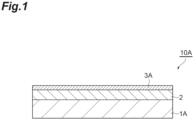
- FIG. 1 is a schematic cross-sectional view illustrating an embodiment of a laminate.
- the laminate 10A according to an embodiment includes a first metal layer 1A, an insulating layer (cured body of the above-mentioned resin composition) 2 disposed on one surface of the first metal layer, and a second metal layer 3A disposed on a surface of the insulating layer 2 on the opposite side from the first metal layer.
- the first metal layer 1A and the second metal layer 3A are separated by the insulating layer 2 and maintain a state of being electrically insulated from each other.
- Examples of a metal material constituting the first metal layer 1A include aluminum, an aluminum alloy, copper, a copper alloy, iron, and stainless steel.
- the first metal layer 1A may be composed of one kind of metal material, or may be composed of two or more kinds of metal materials.
- the first metal layer 1A may be a single-layer structure or may be a multilayer structure.
- Examples of a metal material constituting the second metal layer 3A include copper, aluminum, and nickel.
- the second metal layer 3A may be composed of one kind of metal material, or may be composed of two or more kinds of metal materials.
- the second metal layer 3A may have a single-layer structure, or may have a multilayer structure. In FIG. 1 , the second metal layer 3A is disposed on substantially the entire surface on the insulating layer 2; however, the second metal layer may be disposed on only a portion of the insulating layer 2.
- the thickness of the first metal layer 1A may be, for example, 0.5 mm or more and may be 3 mm or less.
- the thickness of the insulating layer 2 may be, for example, 50 ⁇ m or more and may be 300 ⁇ m or less.
- the thickness of the second metal layer 3A may be, for example, 5 ⁇ m or more and may be 1 mm or less.
- FIG. 2 is a schematic cross-sectional view illustrating an embodiment of a circuit substrate.
- the circuit substrate 10B according to an embodiment includes a metal layer 1B, an insulating layer (cured body of the above-mentioned resin composition) 2 disposed on one surface of the metal layer 1B, and a metal circuit part 3B disposed on a surface of the insulating layer 2 on the opposite side from the metal layer 1B.
- the metal circuit part 3B is, for example, a circuit processed into a predetermined pattern (for example, etching processing).
- Examples of the metal material constituting the metal layer 1B include those similar to the metal material constituting the above-described first metal layer 1A.
- Examples of the metal material constituting the metal circuit part 3B include those similar to the metal material constituting the above-described second metal layer 3A.
- the thickness of the metal layer 1B may be, for example, 0.5 mm or more and may be 3 mm or less.
- the thickness of the insulating layer 2 may be, for example, 50 ⁇ m or more and may be 300 ⁇ m or less.
- the thickness of the metal circuit part 3B may be, for example, 5 ⁇ m or more and may be 1 mm or less.
- (meth)acrylic monomers composed of 5 mol% of acrylic acid, 0.1 mol% of 1,2,2,6,6-pentamethyl-4-piperidyl methacrylate, and 94.9 mol% of benzyl methacrylate were added into an autoclave with a stirrer.
- the polymerization ratio with respect to 100% of the feed amounts of monomers were analyzed by gas chromatography analysis, and the polymerization ratio was 98% or more. From this, the ratio of each monomer unit carried by the copolymer was estimated to be approximately the same as the feed amounts of the monomers.
- the weight average molecular weight of the obtained copolymer 1 was determined as the weight average molecular weight calculated relative to polystyrene standards, by using a GPC (gel permeation chromatography) method.
- the measurement conditions are as follows.
- thermosetting resin 27.9% by mass of a naphthalene type epoxy resin HP-4032D (manufactured by DIC Corporation) as a thermosetting resin and 3.5% by mass of a phenol novolac resin VH-4150 (manufactured by DIC Corporation) as a curing agent were stirred at 170°C, and the curing agent was dissolved in the thermosetting resin.
- HP-4032D manufactured by DIC Corporation
- VH-4150 manufactured by DIC Corporation
- a boron nitride filler manufactured by Denka Company Limited,
- the obtained resin composition was applied on a film made of polyethylene terephthalate (PET) and having a thickness of 0.038 mm such that the thickness after curing would be 0.20 mm, the resin composition was heated and dried at 100°C for 50 minutes, and thereby a cured body in a semi-cured state (sheet in a B-stage state) was produced.
- PET polyethylene terephthalate
- the produced cured body (sheet in a B-stage state) was torn off from the PET film and disposed on a roughened surface of a metal plate (copper plate having a thickness of 2.0 mm), a roughened surface of a metal foil (copper foil having a thickness of 0.5 mm) was disposed on top of the cured body, and the cured body was heated and cured at 180°C for 410 minutes while applying a surface pressure of 10 MPa using a press machine.
- a predetermined position was masked with an etching resist, and then the copper foil was etched by using a sulfuric acid hydrogen peroxide mixed solution as an etching solution.
- the etching resist was removed, and the substrate was washed and dried to obtain a metal base circuit substrate having a circular electrode (copper foil) having a diameter of 20 mm.
- a resin composition, a cured body, and a metal base circuit substrate were produced by a method similar to that of Example 1, except that an inorganic ion scavenger 2 (IXEPLAS-A2 (Zr, Mg, Al-based), average particle size 0.2 ⁇ m, manufactured by TOAGOSEI CO., LTD.) was used as the inorganic ion scavenger.
- IXEPLAS-A2 Zr, Mg, Al-based
- average particle size 0.2 ⁇ m manufactured by TOAGOSEI CO., LTD.
- a resin composition, a cured body, and a metal base circuit substrate were produced by a method similar to that of Example 1, except that an inorganic ion scavenger 3 (IXEPLAS-B1 (Zr, Bi-based), average particle size 0.4 ⁇ m, manufactured by TOAGOSEI CO., LTD.) was used as the inorganic ion scavenger.
- IXEPLAS-B1 Zr, Bi-based
- average particle size 0.4 ⁇ m manufactured by TOAGOSEI CO., LTD.
- a resin composition, a cured body, and a metal base circuit substrate were produced by a method similar to that of Example 1, except that an inorganic ion scavenger 4 (IXE-700F (Mg, Al-based), average particle size 1.5 ⁇ m, manufactured by TOAGOSEI CO., LTD.) was used as the inorganic ion scavenger.
- IXE-700F Mg, Al-based
- average particle size 1.5 ⁇ m manufactured by TOAGOSEI CO., LTD.
- a resin composition, a cured body, and a metal base circuit substrate were produced by a method similar to that of Example 1, except that an inorganic ion scavenger 5 (IXE-550 (Bi-based), average particle size 1.5 ⁇ m, manufactured by TOAGOSEI CO., LTD.) was used as the inorganic ion scavenger.
- IXE-550 Ba-based
- average particle size 1.5 ⁇ m manufactured by TOAGOSEI CO., LTD.
- a resin composition, a cured body, and a metal base circuit substrate were produced by a method similar to that of Example 1, except that an inorganic ion scavenger 6 (IXE-100 (Zr-based), average particle size 1.0 ⁇ m, manufactured by TOAGOSEI CO., LTD.) was used as the inorganic ion scavenger.
- IXE-100 Zr-based
- average particle size 1.0 ⁇ m manufactured by TOAGOSEI CO., LTD.
- a resin composition, a cured body, and a metal base circuit substrate were produced by a method similar to that of Example 1, except that an inorganic ion scavenger 7 (IXE-600 (Sb, Bi-based), average particle size 1.0 ⁇ m, manufactured by TOAGOSEI CO., LTD.) was used as the inorganic ion scavenger.
- an inorganic ion scavenger 7 IXE-600 (Sb, Bi-based), average particle size 1.0 ⁇ m, manufactured by TOAGOSEI CO., LTD.
- a resin composition, a cured body, and a metal base circuit substrate were produced by a method similar to that of Example 1, except that an inorganic ion scavenger 8 (IXE-6107 (Zr, Bi-based), average particle size 1.5 ⁇ m, manufactured by TOAGOSEI CO., LTD.) was used as the inorganic ion scavenger.
- an inorganic ion scavenger 8 IXE-6107 (Zr, Bi-based), average particle size 1.5 ⁇ m, manufactured by TOAGOSEI CO., LTD.
- a resin composition, a cured body, and a metal base circuit substrate were produced by a method similar to that of Example 3, except that the amount of addition of the inorganic ion scavenger or the copolymer was changed as shown in Tables 2 and 3.
- a resin composition, a cured body, and a metal base circuit substrate were produced by a method similar to that of Example 3, except that the amount of addition of the inorganic ion scavenger was changed as shown in Table 4.
- a resin composition, a cured body, and a metal base circuit substrate were produced by a method similar to that of Example 2, except that the amount of addition of the copolymer was changed as shown in Table 4.
- the cured body produced in each of the Examples and the Comparative Examples was subjected to X-ray diffraction measurement using an X-ray diffraction apparatus "Rigaku MiniFlex II" manufactured by Rigaku Corporation.
- the obtained metal base substrates were subjected to a high-temperature high-voltage bias test (V-t) in an environment at 150°C, in which the time until dielectric breakdown was measured under the test conditions of applying a direct current voltage of 10 kV between the metal foil and the metal plate.
- V-t high-temperature high-voltage bias test
- the time until dielectric breakdown was defined as the time taken from the start of voltage application to the time point at which the leakage current value measured by a voltage resistance tester reached 10 mA or more.
- Example 1 Example 2
- Example 3 Example 4
- Example 5 Amount of addition of copolymer [phf] 4 4 4 4 4 Content of copolymer [% by mass] 2.6 2.6 2.6 2.6 2.6
- Inorganic ion scavenger type Amphoteric ion exchanger
- Amphoteric ion exchanger Amphoteric ion exchanger
- Amount of addition of inorganic ion scavenger [phr] 4.5 4.5 4.5 4.5 4.5 Content of inorganic ion scavenger [% by mass] 1.4 1.4 1.4 1.4 1.4 1.4 Mass ratio (inorganic ion scavenger/copolymer) 0.53 0.53 0.53
- 1A first metal layer
- 1B metal layer
- 2 insulating layer
- 3A second metal layer
- 3B metal circuit part
- 10A laminate
- 10B circuit substrate.
Landscapes
- Chemical & Material Sciences (AREA)
- Health & Medical Sciences (AREA)
- Chemical Kinetics & Catalysis (AREA)
- Medicinal Chemistry (AREA)
- Polymers & Plastics (AREA)
- Organic Chemistry (AREA)
- Engineering & Computer Science (AREA)
- Microelectronics & Electronic Packaging (AREA)
- Compositions Of Macromolecular Compounds (AREA)
Applications Claiming Priority (2)
| Application Number | Priority Date | Filing Date | Title |
|---|---|---|---|
| JP2022060139 | 2022-03-31 | ||
| PCT/JP2023/010132 WO2023189609A1 (ja) | 2022-03-31 | 2023-03-15 | 樹脂組成物、絶縁性樹脂硬化体、積層体、及び回路基板 |
Publications (1)
| Publication Number | Publication Date |
|---|---|
| EP4497787A1 true EP4497787A1 (en) | 2025-01-29 |
Family
ID=88201625
Family Applications (1)
| Application Number | Title | Priority Date | Filing Date |
|---|---|---|---|
| EP23779627.1A Withdrawn EP4497787A1 (en) | 2022-03-31 | 2023-03-15 | Resin composition, insulating resin cured body, laminate, and circuit substrate |
Country Status (5)
| Country | Link |
|---|---|
| EP (1) | EP4497787A1 (https=) |
| JP (1) | JPWO2023189609A1 (https=) |
| KR (1) | KR20240167679A (https=) |
| CN (1) | CN118900898A (https=) |
| WO (1) | WO2023189609A1 (https=) |
Families Citing this family (1)
| Publication number | Priority date | Publication date | Assignee | Title |
|---|---|---|---|---|
| JP2026061773A (ja) * | 2024-09-30 | 2026-04-09 | デンカ株式会社 | 積層体及び回路基板 |
Family Cites Families (7)
| Publication number | Priority date | Publication date | Assignee | Title |
|---|---|---|---|---|
| JP2008266533A (ja) | 2007-04-25 | 2008-11-06 | Jfe Steel Kk | コークス炉の建設方法及びコークス炉建設用仮上屋 |
| US8138580B2 (en) * | 2007-09-19 | 2012-03-20 | Toray Industries, Inc. | Adhesive composition for electronic components, and adhesive sheet for electronic components using the same |
| WO2012039324A1 (ja) * | 2010-09-22 | 2012-03-29 | 日立化成工業株式会社 | 熱伝導性樹脂組成物、樹脂シート、樹脂付金属箔、樹脂シート硬化物及び放熱部材 |
| WO2013030998A1 (ja) * | 2011-08-31 | 2013-03-07 | 日立化成工業株式会社 | 樹脂組成物、樹脂シート、金属箔付き樹脂シート、樹脂硬化物シート、構造体、および動力用又は光源用半導体デバイス |
| JP2016155985A (ja) * | 2015-02-26 | 2016-09-01 | 日立化成株式会社 | エポキシ樹脂組成物、半硬化エポキシ樹脂組成物、硬化エポキシ樹脂組成物、及びそれらを用いた樹脂シート、プリプレグ、積層板、金属基板、配線板、パワー半導体装置 |
| JP2017041633A (ja) * | 2015-08-17 | 2017-02-23 | 積水化学工業株式会社 | 半導体装置及び半導体素子保護用材料 |
| JP6686394B2 (ja) * | 2015-12-01 | 2020-04-22 | 味の素株式会社 | 半導体チップパッケージの製造方法 |
-
2023
- 2023-03-15 JP JP2024511760A patent/JPWO2023189609A1/ja active Pending
- 2023-03-15 EP EP23779627.1A patent/EP4497787A1/en not_active Withdrawn
- 2023-03-15 WO PCT/JP2023/010132 patent/WO2023189609A1/ja not_active Ceased
- 2023-03-15 CN CN202380029193.0A patent/CN118900898A/zh active Pending
- 2023-03-15 KR KR1020247035292A patent/KR20240167679A/ko not_active Withdrawn
Also Published As
| Publication number | Publication date |
|---|---|
| KR20240167679A (ko) | 2024-11-27 |
| JPWO2023189609A1 (https=) | 2023-10-05 |
| WO2023189609A1 (ja) | 2023-10-05 |
| CN118900898A (zh) | 2024-11-05 |
Similar Documents
| Publication | Publication Date | Title |
|---|---|---|
| EP2796482B1 (en) | Polymer powder, curable resin composition, and cured product thereof | |
| JP5615608B2 (ja) | 粘着剤組成物および粘着剤、ならびに光学部材用粘着剤、それを用いて得られる粘着剤層付き光学部材 | |
| EP3456779B1 (en) | Prepreg, metal foil with resin, laminate and printed wiring board | |
| US20220186089A1 (en) | Copolymer, dispersant, and resin composition | |
| JP2010065217A (ja) | 光学部材用粘着剤組成物および光学部材用粘着剤ならびにそれを用いて得られる粘着剤層付き光学部材 | |
| EP4497787A1 (en) | Resin composition, insulating resin cured body, laminate, and circuit substrate | |
| EP4497788A1 (en) | Resin composition, insulating resin cured body, laminate, and circuit substrate | |
| JP7589255B2 (ja) | 組成物及びその製造方法、硬化体、並びに金属ベース基板 | |
| JPWO2012039324A1 (ja) | 熱伝導性樹脂組成物、樹脂シート、樹脂付金属箔、樹脂シート硬化物及び放熱部材 | |
| WO2025075098A1 (ja) | 樹脂組成物、絶縁性樹脂硬化体、積層体、及び回路基板 | |
| JP7644137B2 (ja) | 組成物、硬化体及び金属ベース基板 | |
| JP2025063576A (ja) | 樹脂組成物、絶縁性樹脂硬化体、積層体、及び回路基板 | |
| WO2026070957A1 (ja) | 積層体及び回路基板 | |
| JP2026061773A (ja) | 積層体及び回路基板 | |
| JP2026061808A (ja) | 積層体及び回路基板 | |
| JP2026061710A (ja) | 積層体及び回路基板 | |
| JP2026061734A (ja) | 積層体及び回路基板 | |
| WO2026071032A1 (ja) | 積層体及び回路基板 | |
| JPH07266499A (ja) | 銅張積層板の製造方法 |
Legal Events
| Date | Code | Title | Description |
|---|---|---|---|
| STAA | Information on the status of an ep patent application or granted ep patent |
Free format text: STATUS: THE INTERNATIONAL PUBLICATION HAS BEEN MADE |
|
| PUAI | Public reference made under article 153(3) epc to a published international application that has entered the european phase |
Free format text: ORIGINAL CODE: 0009012 |
|
| STAA | Information on the status of an ep patent application or granted ep patent |
Free format text: STATUS: REQUEST FOR EXAMINATION WAS MADE |
|
| 17P | Request for examination filed |
Effective date: 20241023 |
|
| AK | Designated contracting states |
Kind code of ref document: A1 Designated state(s): AL AT BE BG CH CY CZ DE DK EE ES FI FR GB GR HR HU IE IS IT LI LT LU LV MC ME MK MT NL NO PL PT RO RS SE SI SK SM TR |
|
| STAA | Information on the status of an ep patent application or granted ep patent |
Free format text: STATUS: THE APPLICATION HAS BEEN WITHDRAWN |
|
| 18W | Application withdrawn |
Effective date: 20250325 |