EP4497322A1 - Verfahren zur bekämpfung von krankheiten - Google Patents
Verfahren zur bekämpfung von krankheiten Download PDFInfo
- Publication number
- EP4497322A1 EP4497322A1 EP23774952.8A EP23774952A EP4497322A1 EP 4497322 A1 EP4497322 A1 EP 4497322A1 EP 23774952 A EP23774952 A EP 23774952A EP 4497322 A1 EP4497322 A1 EP 4497322A1
- Authority
- EP
- European Patent Office
- Prior art keywords
- plant
- irradiation
- infrared light
- shoot apex
- apex part
- Prior art date
- Legal status (The legal status is an assumption and is not a legal conclusion. Google has not performed a legal analysis and makes no representation as to the accuracy of the status listed.)
- Pending
Links
Images






Classifications
-
- A—HUMAN NECESSITIES
- A01—AGRICULTURE; FORESTRY; ANIMAL HUSBANDRY; HUNTING; TRAPPING; FISHING
- A01G—HORTICULTURE; CULTIVATION OF VEGETABLES, FLOWERS, RICE, FRUIT, VINES, HOPS OR SEAWEED; FORESTRY; WATERING
- A01G7/00—Botany in general
- A01G7/06—Treatment of growing trees or plants, e.g. for preventing decay of wood, for tingeing flowers or wood, for prolonging the life of plants
-
- A—HUMAN NECESSITIES
- A01—AGRICULTURE; FORESTRY; ANIMAL HUSBANDRY; HUNTING; TRAPPING; FISHING
- A01G—HORTICULTURE; CULTIVATION OF VEGETABLES, FLOWERS, RICE, FRUIT, VINES, HOPS OR SEAWEED; FORESTRY; WATERING
- A01G7/00—Botany in general
- A01G7/04—Electric or magnetic or acoustic treatment of plants for promoting growth
- A01G7/045—Electric or magnetic or acoustic treatment of plants for promoting growth with electric lighting
-
- A—HUMAN NECESSITIES
- A01—AGRICULTURE; FORESTRY; ANIMAL HUSBANDRY; HUNTING; TRAPPING; FISHING
- A01P—BIOCIDAL, PEST REPELLANT, PEST ATTRACTANT OR PLANT GROWTH REGULATORY ACTIVITY OF CHEMICAL COMPOUNDS OR PREPARATIONS
- A01P3/00—Fungicides
-
- A—HUMAN NECESSITIES
- A01—AGRICULTURE; FORESTRY; ANIMAL HUSBANDRY; HUNTING; TRAPPING; FISHING
- A01N—PRESERVATION OF BODIES OF HUMANS OR ANIMALS OR PLANTS OR PARTS THEREOF; BIOCIDES, e.g. AS DISINFECTANTS, AS PESTICIDES OR AS HERBICIDES; PEST REPELLANTS OR ATTRACTANTS; PLANT GROWTH REGULATORS
- A01N25/00—Biocides, pest repellants or attractants, or plant growth regulators, characterised by their forms, or by their non-active ingredients or by their methods of application, e.g. seed treatment or sequential application; Substances for reducing the noxious effect of the active ingredients to organisms other than pests
Definitions
- the present invention relates to a method for controlling plant disease.
- Patent Document 1 In a process of cultivating plants, it is known that, in order to control a disease, the plants are irradiated with near-infrared light (Patent Document 1).
- this method requires continuous irradiation all day long, and thus requires a large irradiation device equipped with multiple light sources to irradiate the entire cultivation area, resulting in problems with cost.
- attempts have been made to reduce costs by efficiently utilizing light energy by optimizing near-infrared light irradiation conditions.
- Patent Document 1 Japanese Patent No. 6061124
- an object of the present invention is to provide a novel method for controlling a plant disease, with which light energy is more efficiently utilized and the size of an irradiation device can be further reduced.
- a disease control method includes irradiating a shoot apex part of a plant with near-infrared light.
- the present invention it is possible to effectively control a disease in a plant during cultivation by irradiating the shoot apex part of the plant even when, for example, the entire plant is not irradiated with near-infrared light.
- the present invention includes aspects below.
- a disease control method is characterized by irradiating a shoot apex part of a plant with near-infrared light, and other processes, other conditions, and the like are not particularly limited.
- disease control may mean, for example, prevention or elimination of a disease, and may mean any one or both of prevention and elimination of a disease.
- specific examples of disease control include suppression (prevention) of the development of a disease and suppression of the progress of a disease, and disease control can also be referred to as disease suppression.
- a "part to be irradiated with near-infrared light” means, for example, a plant region that is hit by near-infrared light, and hereinafter, is also referred to as an irradiated part or irradiated region.
- a "near-infrared light irradiation target part” means, for example, an irradiation target part set for an irradiation object plant when the plant is irradiated with near-infrared light, and is also referred to as an irradiation target region. That is, in this specification, the irradiation target part is, for example, a part set by an irradiation device or a part set by an operator of the irradiation device.
- the irradiated part in a plant may be, for example, only a shoot apex part or a vicinity of a shoot apex part including the shoot apex part.
- the vicinity of the shoot apex part is a region including both the shoot apex part and a surrounding portion of the shoot apex part, unless otherwise specified.
- the shoot apex part or the vicinity of the shoot apex part including the shoot apex part it is preferable to set, as the near-infrared light irradiation target part, either the shoot apex part or the vicinity of the shoot apex part including the shoot apex part.
- irradiation of the irradiation target part does not exclude the possibility that a surrounding region of the irradiation target part will be irradiated as a result.
- the shoot apex part may be specifically set as the irradiation target part.
- the shoot apex part in the vicinity of the shoot apex part is set as an irradiation point (also referred to as a "focal point").
- a wider region, i.e., the vicinity of the shoot apex part may be set as the irradiation target part in the near-infrared light irradiation.
- the shoot apex part in the vicinity of the shoot apex part may be set as an irradiation point (also referred to as a "focal point").
- the irradiation point may be set in a region other than the shoot apex part in the vicinity of the shoot apex part, within a range in which the shoot apex part is ultimately irradiated with near-infrared light.
- the irradiation target part (the shoot apex part or the vicinity of the shoot apex part) such that, when a later-described irradiation condition is set, the set irradiation condition is satisfied.
- the irradiation of a surrounding region of the irradiation target part is not excluded as described above, but, for example, the surrounding region other than the irradiation target part does not need to satisfy the set irradiation condition. Therefore, according to the present invention, for example, it is not necessary to use a large irradiation device capable of irradiating the entire plant in one instance of irradiation, perform irradiation while moving an irradiation device from the lowermost part to the uppermost part of the plant, or the like, in order to irradiate the entire plant in a manner that the set irradiation condition is satisfied.
- a shoot apex part is a so-called tip of the stem (main stem), and for example, also refers to a growing point.
- the vicinity of the shoot apex part including the shoot apex part does not refer to the entire plant including the shoot apex part, but refers to, for example, a region on the tip side of the stem in the stem growth direction.
- the vicinity of the shoot apex part can also be defined by, for example, the ratio of the length of the vicinity thereof based on the tip of the stem to the length of the stem in the stem growth direction (e.g., the entire stem length).
- the stem growth direction can be determined as appropriate depending on, for example, a growth method.
- the stem growth direction may be, for example, the height in a vertical direction relative to the ground, the length in a horizontal direction relative to the ground, or may include both directions.
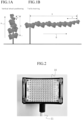
- specific examples of a method for growing a plant include FIG. 1A vertical shoot positioning and FIG. 1B trellis training.
- a support is set up vertically to the ground, and a wire or the like is stretched parallel to the ground on the support, thus creating a hedge.
- the plant stem grows upward from the ground along the support extending in the vertical direction.
- the direction of the plant stem growth is, for example, a vertical direction (direction A) to the ground.
- the length of a stem in the growth direction is not, for example, the length of the stem artificially pulled and stretched in the vertical direction, but the length of the stem in the vertical direction in its natural state during growth.
- the length of a stem can be defined as a length (X) from the tip (e.g., the shoot apex part) of the stem to the position of a leaf on a branch at the other end of the stem in the stem growth direction (direction A).
- a branch at the other end of the stem is, for example, the most distant branch opposite to the tip of the stem in the growth direction, and is, for example, the branch closest to the root (also referred to as the lowest branch for convenience) in FIG. 1A .
- the vicinity of the shoot apex part of a plant is, for example, a region based on the tip in FIG.
- the length of the vicinity of the shoot apex part in the stem growth direction is a distance (Y) based on the tip, i.e., the distance from the tip.
- the ratio of the distance (Y) of the vicinity of the shoot apex part is, for example, 1/3 or less, 1/5 or less, 1/10 or less, 1/50 or less, 1/100 or less, 1/200 or less, 1/400 or less, 1/1000 or less, 1/1500 or less, and 1/2000 or less.
- the length (X) of the stem in the growth direction can be set to, for example, the length from the tip of the stem (e.g., the shoot apex part) to the position of the branch at the other end of the stem, and is also referred to as the total length of the stem hereinafter.
- straight supports having a desired height are set up vertically to the ground, and a trellis parallel to the ground is installed at the desired height.
- the stem of the plant grows to the desired height along the supports extending in the vertical direction, and then creeps up the trellis and extends in a direction parallel to the ground.
- the direction of the plant stem growth is, for example, in a horizontal direction (direction B) to the ground.
- the length of a stem in the growth direction is not, for example, the length of the stem artificially pulled and stretched in the parallel direction, but the length of the stem in the parallel direction in its natural state during growth.
- the length of a stem can be defined as a length (X) from the tip (e.g., the shoot apex part) of the stem to the position of a leaf on a branch at the other end of the stem in the stem growth direction (direction B).
- a branch at the other end of the stem is, for example, the most distant branch opposite to the tip of the stem in the growth direction, i.e., the branch closest to the supports (also referred to as the lowest branch for convenience, as in FIG. 1A ).
- the vicinity of the shoot apex part of a plant is, for example, a region based on the tip in FIG.
- the length of the vicinity of the shoot apex part in the stem growth direction is a distance (Y) based on the tip, i.e., the distance from the tip.
- the ratio of the distance (Y) of the vicinity of the shoot apex part is, for example, 1/3 or less, 1/5 or less, 1/10 or less, 1/50 or less, 1/100 or less, 1/200 or less, 1/400 or less, 1/1000 or less, 1/1500 or less, and 1/2000 or less.
- the length (X) of the stem in the growth direction can be set to, for example, the length from the tip of the stem (e.g., the shoot apex part) to the position of the branch at the other end of the stem, and is also referred to as the total length of the stem hereinafter.
- irradiation of the shoot apex part or the vicinity of the shoot apex part can be set, for example, as follows. That is, in the plant, based on the flower truss closest to the shoot apex part, a region located on the shoot apex part side may be irradiated as the vicinity of the shoot apex part, or the vicinity of the shoot apex part may be irradiated by setting the region to the irradiation target part.
- the region need only include the shoot apex part, and for example, may or need not include the flower truss closest to the shoot apex part.
- the same individual plant is irradiated with near-infrared light once, twice, or more times during a cultivation period of the plant, and is preferably irradiated with near-infrared light twice or more times (multiple times) at any interval.
- a single instance of irradiation is irradiation that reaches any preset integrated light quantity, and the integrated light quantity may be achieved through continuous irradiation or intermittent irradiation.
- the interval between a given instance of irradiation and the next instance of irradiation is not particularly limited, and is, for example, one day, two days or more, and a specific example will be described later.
- Intermittent irradiation is irradiation that repeatedly blinks at short time intervals, and is also referred to as pulse irradiation in which multiple sets of pulse ON (irradiation) and pulse OFF (irradiation) are repeated.
- the pulse ON width (pulse width) and the pulse OFF width are, for example, in units of tens of seconds (e.g., less than 1 minute, 30 seconds or less, 10 seconds or less, 5 seconds or less, or 1 second or less), milliseconds, or microseconds.
- the entire repetition of the above-mentioned multiple sets is referred to as one instance of intermittent irradiation.
- the area of an irradiation object irradiated through one instance of near-infrared light irradiation is not particularly limited, and is, for example, 5 to 20 mm 2 , 4900 to 10000 mm 2 , or the like, and is, for example, 5 to 100 mm in length ⁇ 5 to 100 mm in width.
- an irradiation device having a light source whose effective irradiation area is the above-mentioned area it is possible to use, for example, an irradiation device having a light source whose effective irradiation area is the above-mentioned area.
- the above-mentioned area range is preferably irradiated with near-infrared light that satisfies, for example, Formulae 1, 2, and 3, which will be described later.
- the wavelength of the near-infrared light is, for example, in a range (region) of 800 to 1000 nm.
- Near-infrared light with which a plant is irradiated may include all light within the above-mentioned wavelength range or may include part of light within the wavelength range.
- any wavelength can be set within the above-mentioned wavelength range.
- the central wavelength or peak wavelength of near-infrared light used for irradiation is preferably within a wavelength range, for example, from 800 to 1000 nm.
- the near-infrared light may be, for example, single-wavelength light such as a laser beam, or may be light having a wavelength distribution, such as that from a fluorescent lamp or an LED. Also, the near-infrared light may, for example, have one peak wavelength or a wavelength having two or more different peaks, and the center wavelength of the near-infrared light used for irradiation is preferably present in the wavelength range from 800 to 1000 nm as described above.
- near-infrared light irradiation means, for example, artificial irradiation, not non-artificial irradiation.
- Non-artificial irradiation means that, for example, by simply placing a plant in an environment where the plant receives natural light such as sunlight, the plant non-artificially receives natural light including near-infrared light.
- artificial irradiation means that, for example, the wavelength of light is adjusted and a plant is artificially irradiated with near-infrared light, or a plant is irradiated with separated near-infrared light.
- an irradiation device that emits near-infrared light can be used to adjust the wavelength of light.
- the irradiation device include a light irradiation device having a light source and a light adjustment device that extracts a target light.
- the light adjustment device may, for example, extract target light from an external light source or natural light, or the device may further include a light source and extract target light from light emitted from the light source.
- an irradiation device having a light source or the like can be used to irradiate a plant with near-infrared light.
- the present invention for example, there is no need to irradiate the entire plant and it is sufficient to set the shoot apex part or the vicinity of the shoot apex part as the irradiation target part.
- a small-sized irradiation device having a light source is sufficient instead of a large-sized irradiation device with which the entire plant is irradiated.
- the small-sized irradiation device may be, for example, a handheld device that can be easily carried by an operator, or an attachmenttype device that is detachable from a moving body such as a cart that can be moved in a field or a drone.
- Examples of the light source that emits near-infrared light include light-emitting diodes (LEDs), fluorescent tubes, metal halide lamps, sodium lamps, halogen lamps, xenon lamps, neon tubes, inorganic electroluminescence, organic electroluminescence, chemiluminescence (chemical luminescence), and lasers. It is preferable to set the wavelength of the light source to the above-mentioned wavelength range and emit near-infrared light from the light source.
- a spectroscopic device that extracts target light may be used as the light adjustment device in near-infrared light irradiation.
- the spectroscopic device is, for example, a spectral filter that transmits only near-infrared light, and a spectral filter that transmits only a wavelength set within the above-mentioned wavelength range may be used as a specific example.
- the spectral filter is used, for example, it is possible to use a light source that emits not only near-infrared light but also other light, or natural light such as sunlight.
- the spectral filter By causing light emitted from the light source or natural light to pass through the spectral filter, for example, it is possible to artificially adjust the wavelength of light (separate near-infrared light) and irradiate a plant with near-infrared light.
- irradiation conditions there is no particular limitation on irradiation conditions in the present invention, and examples thereof include the following conditions.
- irradiation conditions for example, WO 2021/049640 and the like can be referenced.
- a relationship between irradiance and irradiation time of near-infrared light radiation, optimum irradiation conditions for disease control, and the like can be applied regardless of the type of plant. Note that the present invention is not limited to the following specific examples.
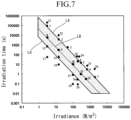
- the irradiation conditions preferably satisfy, for example, Formula 1, Formula 2, and Formula 3, and specifically, the wavelength range and the formulae are satisfied. 644893X ⁇ 1 . 873 ⁇ Y ⁇ 5901 .9X ⁇ 1.856 X ⁇ 1 Y ⁇ 0 .01 where in each of the formulae, X is irradiance (W/m 2 ), and Y is irradiation time (sec).
- the Formula 1, the Formula 2, and the Formula 3 are examples of the relationship between the irradiance X and the irradiation time Y of near-infrared light that effectively exerts a disease control effect in a plant.
- the Formula 1, the Formula 2, and the Formula 3 are preferably, for example, conditions relating to near-infrared light irradiation in the above wavelength range, in near-infrared light.
- a regression line LA in the log-log graph shown in FIG. 7 .
- the irradiance or irradiation time will meet a required amount, and a sufficient disease control effect can also be obtained. This allows further energy conservation of power required to generate near-infrared light, and further extends the lifespan of the light source.
- a regression line LC in the log-log graph shown in FIG. 7 .
- the irradiance or irradiation time will meet a required amount, and a sufficient disease control effect can also be obtained.
- This regression line LB indicates, for example, a relationship between the irradiance and the irradiation time, which is most effective in controlling a plant disease.
- the irradiance is preferably 1 W/m 2 or more and the irradiation time is preferably 0.01 seconds or more in consideration of the irradiation time and the irradiance in terms of operation efficiency and energy conservation.
- the irradiation conditions are expressed using formulae, all of the Formulae 1, 2, and 3 are satisfied.
- the relationship between the irradiance and the irradiation time of near-infrared light is clear.
- one or both of the irradiance and the irradiation time of near-infrared light can be more easily set as irradiation conditions under which a plant disease can be effectively controlled.
- the irradiance at the shoot apex part decreases compared to a case where the distance is shorter, and the irradiation energy received by the shoot apex part decreases even in irradiation for the same period of time.
- the irradiation time can be easily adjusted to be relatively long such that a sufficient disease control effect can be obtained even with low irradiance.
- the shoot apex part of each individual plant is irradiated with near-infrared light while moving a light source, for example, if the light source passes the vicinity of the individual plant for a short period of time, the irradiation energy received by the shoot apex part will be smaller than that when the light source passes the vicinity thereof for a long period of time.
- the irradiation time can be easily adjusted to be relatively long such that a sufficient disease control effect can be obtained even with a short irradiation time.
- one instance of near-infrared light irradiation may be, for example, continuous irradiation or intermittent irradiation of one part.
- Continuous irradiation refers to, for example, continuous irradiation with near-infrared light for a predetermined period of time (e.g., 5 minutes).
- Intermittent irradiation is, for example, pulse irradiation in which a set of irradiation (ON) for a predetermined period of time and non-irradiation (OFF) for a predetermined period of time is repeated multiple times.
- the ON time and OFF time in each set may be the same or different from each other.
- Continuous irradiation and intermittent irradiation can be made to be similar irradiations, for example, by making the total irradiation time of one instance of intermittent irradiation (e.g., ON time in one set ⁇ number of sets) the same as the continuous irradiation time of one instance of continuous irradiation.
- one set may include an ON time of 10 seconds and an OFF time of 10 seconds, and 30 sets may be repeated such that the total ON time is 5 minutes.
- the continuous irradiation time per continuous irradiation and the total irradiation time per intermittent irradiation for example, it is preferable to set the upper limit to 5 minutes or less, 1 minute or less, 30 seconds or less, 10 seconds or less, 1 second or less, or the like, and to set the lower limit to 0.1 seconds or more, 0.5 seconds or more, 1 second or more, 3 seconds or more, 5 seconds or more, or the like, and to set the range thereof to 0.1 seconds to 5 minutes, 0.1 seconds to 1 minute, 0.1 seconds to 30 seconds, 0.1 seconds to 10 seconds, 0.5 seconds to 5 minutes, 0.5 seconds to 1 minute, 0.5 seconds to 30 seconds, 0.5 seconds to 10 seconds, 1 second to 5 minutes, 1 second to 1 minute, 1 second to 30 seconds, 1 second to 10 seconds, or the like. Also, in this case, it is further preferable to set the irradiance such that the relational formulae described above as examples are satisfied.
- the frequency of irradiation of the same individual plant with near-infrared light (also referred to as the above-described irradiation interval), and examples thereof include any period between 1 day and 1 month, any period between 1 day and 30 days, and any period between 1 day and 14 days. That is, specific examples of the frequency of irradiation include once a day to once a month, once a day to once every 30 days, and once a day to once every 14 days.
- a period between instances of irradiation may be, for example, a fixed number of days or a variable number of days.
- the disease control effect of near-infrared light irradiation can be particularly effective and lasts for, for example, about 14 days through one instance of irradiation.
- the frequency of near-infrared light irradiation is preferably, for example, once every 1 to 14 days.
- the disease control effect can also be continuously maintained by periodically repeating near-infrared light irradiation at, for example, the above-mentioned irradiation intervals, preferably at an irradiation interval (irradiation frequency) of 1 to 14 days, during the cultivation period of a plant.
- the number of times that the shoot apex part or the vicinity of the shoot apex part is irradiated at the irradiation interval during the cultivation period is not particularly limited.
- a light environment of a surrounding region of the irradiation object plant may be, for example, dark or bright, and the plant can be artificially irradiated with near-infrared light using an irradiation device described above.
- a light irradiation device having the light source may be used to irradiate the plant with near-infrared light, or the light adjustment device may be used to extract near-infrared light from light with a wide wavelength and to irradiate the plant with artificially adjusted near-infrared light.
- the latter bright state includes, for example, a state in which the irradiation object plant is under artificial lighting such as a fluorescent lamp or an LED, or under natural light such as sunlight.
- the light irradiation device may be used to irradiate the plant with near-infrared light, or the light adjustment device may be used to extract near-infrared light from light of the lighting or natural light and to irradiate the plant with artificially adjusted near-infrared light.
- the irradiance of light other than near-infrared light is weaker than the irradiance of near-infrared light with which a plant is artificially irradiated.
- the shoot apex part or the vicinity of the shoot apex part of the plant may be irradiated with near-infrared light using an irradiation device installed on the ceiling or a wall of the building.
- a mobile irradiation device provided with a near-infrared light source or the like can be used.
- the mobile irradiation device may be, for example, a mobile irradiation device in which a light source is installed on a cart that moves automatically or manually, a device in which a light source is installed on a drone, or a handheld device in which a light source is installed.
- the irradiation object includes, for example, all plants cultivated using an agricultural technique, and the disease control method according to the present invention can be widely applied to, for example, plants under cultivation.
- Specific plant examples thereof include fruits and vegetables (including eggplant, pepino, tomato, cherry tomato, tamarillo, hawkweed, chili pepper, shishito pepper, habanero, green bell pepper, bell pepper, colored pepper, pumpkin, zucchini, cucumber, horned melon, oriental pickling melon, bitter melon, wax gourd, chayote, luffa, bottle gourd, okra, strawberry, watermelon, melon, oriental melon, and the like; cereals such as corn; and beans such as adzuki beans, common beans, peas, edamame, cowpeas, winged beans, broad beans, soybeans, sword beans, peanuts, lentils, and sesame), leaf and stem vegetables (including leaf vegetables such as ice plant, ashitaba, mustard, cabbage, watercress, kale, komatsuna, baby leaf, red leaf lettuce, choy sum, Korean lettuce, Shantung cabbage, perilla, crown daisy, watershield, sh
- plant diseases that can be controlled by the present invention, and examples thereof include plant diseases mainly caused by fungi.
- the pathogenic fungi include Ascomycota, Basidiomycota, flagellated fungi, Oomycota, and fungi imperfecti.
- Ascomycota include powdery mildew fungi, and specific examples thereof include strawberry powdery mildew fungus (Sphaerotheca aphanis) and tomato powdery mildew fungi (Oidium and Oidiopsis fungi).
- Oomycota include downy mildew fungi, and specific examples thereof include cucumber downy mildew fungus (Pseudoperonospora cubensis).
- fungi imperfecti examples include leaf mold fungi and gray mold fungi, and specific examples thereof include tomato leaf mold fungus (Fulvia fulva) and tomato gray mold fungus (Botrytis cinerea). Note that these examples are merely examples, and the present invention is not limited to these examples.
- a disease control effect was checked by irradiating only the vicinities of shoot apex parts of cherry tomato plants with near-infrared light.
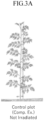
- the near-infrared light irradiation device of a handheld type was used and the device was provided with a light source unit 10 at a leading end of a rod 11 shown in the photograph of FIG. 2 .
- the light source unit 10 was equipped with 10 ⁇ 10 LEDs in an area of 70 mm length ⁇ 70 mm width, and its effective irradiation area was 70 mm ⁇ 70 mm.
- the effective irradiation area is an irradiation object region that receives near-infrared light when the irradiation object is irradiated with near-infrared light using the light source unit 10.
- the wavelength of near-infrared light emitted from the irradiation device was 800 to 900 nm (peak was 850 nm).
- the irradiance was 300 W/m 2 and the irradiation time per area (70 mm ⁇ 70 mm) was 1 second, which were conditions that satisfied the Formulae 1, 2, and 3 shown in FIG. 7 .
- Irradiation was performed once every two weeks (seven times in total), where the first irradiation was performed on the day of planting.
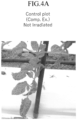
- a position (P) of near-infrared light irradiation for each plot is shown in the schematic diagrams of FIGs. 3A to 3C . In the test plot of the working example, irradiation was performed on only the vicinity of a shoot apex part (growing point).
- irradiation was performed on the vicinity of a shoot apex part as well as on leaves just above a flower truss (compound leaves just above a fruit). That is, when a flower truss appeared at the first time after planting (i.e., the first flower truss), two parts (the shoot apex part and leaves just above the first flower truss) were irradiated. When the second flower truss appeared, three parts (the shoot apex part and leaves just above the first and second flower truss) were irradiated. The number of irradiation parts was increased in this manner as the plant grew.
- control value is an index indicating the control effect (the preventive effect) of a pest control material (a pest preventive material) such as a pesticide.
- a control value is 10 or more, usually, the pest control material has a control effect, and when a control value is 50 or more, a strong control effect equivalent to that of chemical pesticides can be obtained.
- Susceptibility index 0 No lesions are found on the surface of the compound leaves
- Susceptibility index 1 The percentage of lesion area on the entire surface of compound leaves is less than 5%
- Susceptibility index 2 The percentage of lesion area on the entire surface of compound leaves is 5% or more and less than 25%
- Susceptibility index 3 The percentage of lesion area on the entire surface of compound leaves is 25% or more and less than 50%
- Susceptibility index 4 The percentage of lesion area on the entire surface of compound leaves is 50% or more.
- Disease severity [ ⁇ (number of samples by disease status ⁇ susceptibility index)/(number of samples ⁇ 4)] ⁇ 100
- Control value 100 - [(disease severity in test plot or reference plot/disease severity in control plot) ⁇ 100]
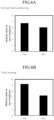
- FIG. 4A is a photograph of the leaves of the lowest branch of the cherry tomato plant in the control plot
- FIG. 4B is a photograph of the leaves of the lowest branch of the cherry tomato plant in the test plot of the working example
- FIG. 4C is a photograph of the leaves of the lowest branch of the cherry tomato plant in the reference plot.
- FIGs. 4A to 4C and Table 2 in the control plot (the comparative example) where near-infrared light irradiation was not performed, lesions were confirmed on many of the leaves on the lowest branch, which were susceptible to disease.
- lesions on plants are likely to develop in a lower part, and in particular on the first leaves that grow near the roots (leaves on the lowest branch).
- the entire plant including the leaves of the lowest branch is irradiated with near-infrared light.
- the present invention even though only the vicinity of the shoot apex part, where the risk of lesion development is thought to be low, was irradiated with near-infrared light, favorable results as described above were obtained.
- test plot (the working example), and the reference plot, plants were all grown at the same time in the same greenhouse with sunlight, but as described above, the test plot artificially irradiated with near-infrared light exhibits favorable results.
- sunlight contains near-infrared light
- Grapevines were irradiated with near-infrared light, and the expression of disease resistance-related genes and disease control effects were checked. Note that the same handheld irradiation device as in Example 1 above was used to perform near-infrared light irradiation, and the irradiation conditions for irradiation object parts of grapevines were also the same as in Example 1.
- a white grape variety (Chardonnay) was grown using trellis training shown in FIG. 1B above, and a black grape variety (Eight Gold) was grown using vertical shoot positioning (Japan, July).
- a control plot (not irradiated, Comparative Example, one plant) and a test plot (irradiated, the working example, one plant) were prepared.
- FIGs. 5A and 5B show an overview of the positions of the leaves collected from the grapevines. As shown in FIG.
- RNA was extracted, and the expression of the following disease resistance-related genes were analyzed through real-time PCR. Then, a relative value (E 1 /E 0 ) of a gene expression level (E 1 ) in the irradiated test plot to a gene expression level (E 0 ) in a non-irradiated control plot was calculated, and an increase in gene expression due to near-infrared light irradiation was evaluated.
- FIGs. 6A and 6B are graphs showing the degree of an increase in gene expression due to near-infrared light irradiation, the degree of an increase being indicated by the relative value (E 1 /E 0 ) of the gene expression level (E 1 ) in the irradiated test plot to the gene expression level (E 0 ) in a non-irradiated control plot.
- FIG. 6A shows the result of vertical shoot positioning
- FIG. 6B shows the result of trellis training.
- irradiation of only the vicinity of a shoot apex part with near-infrared light revealed that the gene expression level of any gene was significantly increased in the lower leaves, which are located away from the vicinity of the shoot apex part and are generally more susceptible to disease.
- the inventors of the present invention found for the first time that, in order to prevent disease in lower leaves, which are more susceptible to disease, irradiation of the vicinity of the shoot apex part located away from the lower leaves, instead of the lower leaves, with near-infrared light can result in an increase in expression of various genes involved in the prevention of disease development. Also, actually, it has already been confirmed in Example 1 above that irradiation of the vicinity of the shoot apex part with near-infrared light can prevent the development of disease in lower leaves on the opposite side.
- a white grape variety of wine grape (Chardonnay) was grown in a field using the trellis training shown in FIG. 1B above (July, Japan), and a control plot (not irradiated, Comparative Example, six plants) and a test plot (irradiated, the working example, six plants) were prepared. Then, as shown in FIG. 8 , regarding the grapevines in the test plot, the vicinity of the shoot apex part (growing point) of a lateral branch (axillary bud) produced from the tip of the main branch was irradiated with near-infrared light.
- Irradiation was performed using the same irradiation device as in (1) above, and the irradiation conditions were as follows: once every two weeks, the irradiance was 300 W/m 2 , the irradiation time was 1 second, and the wavelength was in a range from 800 to 900 nm (peak: 850 nm). On the other hand, near-infrared light irradiation was not performed on any parts of the grapevines in the control plot.
- the control value is an index indicating the control effect of a pest control material such as a pesticide. When a control value is 10 or more, usually a control effect can be obtained, and when a control value is 50 or more, a strong control effect equivalent to that of chemical pesticides can be obtained.
- FIG. 9 is a schematic diagram showing the vicinity of the shoot apex part of a strawberry seedling.
- the third leaves which are representative leaves for measuring growth and have not yet begun to senesce, were collected from the seedlings, and the PAL gene expression was analyzed in the same manner as in Example 2(1) above.
- the collected third leaves were leaves that had not yet begun to senesce but had already reached the stage of full growth in the petiole and leaf area, and were the third leaves counted in order of newness, where the most recent leaf that unfolded in the vicinity of the shoot apex part is the first leaf (new first leaf).
- the relative value (E 1 /E 0 ) of the gene expression level (E 1 ) in the irradiated seedlings was 3.5. It was confirmed that the PAL gene expression was significantly increased by only irradiating the vicinity of the shoot apex part with near-infrared light, even though the third leaves were not irradiated with near-infrared light.
- the missing plant rate was significantly reduced by irradiating the shoot apex parts of strawberry seedlings with near-infrared light.
- test plot (the working example) artificially irradiated with near-infrared light exhibited favorable results.
- the effect in the test plot was not obtained through non-artificial irradiation with sunlight, but by selecting a shoot apex part and artificially irradiating the shoot apex part with near-infrared light.
- Shishito pepper plants were irradiated with near-infrared light, and the expression of disease resistance-related genes was checked.
- FIG. 10 is a schematic diagram showing the vicinity of the shoot apex part of a shishito pepper seedling.
- the relative value (E 1 /E 0 ) of the gene expression level (E 1 ) in the irradiated seedlings to the gene expression level (E 0 ) in the non-irradiated seedlings was calculated, and an increase in gene expression due to near-infrared light irradiation was evaluated.
- the relative value (E 1 /E 0 ) of the gene expression level (E 1 ) in the leaf (X) in the vicinity of the shoot apex part of the unirradiated branch of the irradiated seedling was 17.0
- the relative value (E 1 /E 0 ) of the gene expression level (E 1 ) in the lowest leaf (Y) of the main stem of the irradiated seedling was 4.1.
- the present invention it is possible to effectively control a disease in a plant during cultivation by irradiating the shoot apex part of the plant even when, for example, the entire plant is not irradiated with near-infrared light.
Landscapes
- Life Sciences & Earth Sciences (AREA)
- Biodiversity & Conservation Biology (AREA)
- Ecology (AREA)
- Forests & Forestry (AREA)
- Environmental Sciences (AREA)
- Botany (AREA)
- Engineering & Computer Science (AREA)
- Wood Science & Technology (AREA)
- Microbiology (AREA)
- Mycology (AREA)
- Chemical & Material Sciences (AREA)
- Chemical Kinetics & Catalysis (AREA)
- General Chemical & Material Sciences (AREA)
- Pest Control & Pesticides (AREA)
- Plant Pathology (AREA)
- Zoology (AREA)
- Cultivation Of Plants (AREA)
Applications Claiming Priority (2)
| Application Number | Priority Date | Filing Date | Title |
|---|---|---|---|
| JP2022045376 | 2022-03-22 | ||
| PCT/JP2023/011240 WO2023182357A1 (ja) | 2022-03-22 | 2023-03-22 | 病害防除方法 |
Publications (2)
| Publication Number | Publication Date |
|---|---|
| EP4497322A1 true EP4497322A1 (de) | 2025-01-29 |
| EP4497322A4 EP4497322A4 (de) | 2026-03-04 |
Family
ID=88101574
Family Applications (1)
| Application Number | Title | Priority Date | Filing Date |
|---|---|---|---|
| EP23774952.8A Pending EP4497322A4 (de) | 2022-03-22 | 2023-03-22 | Verfahren zur bekämpfung von krankheiten |
Country Status (4)
| Country | Link |
|---|---|
| US (1) | US20250241247A1 (de) |
| EP (1) | EP4497322A4 (de) |
| JP (1) | JPWO2023182357A1 (de) |
| WO (1) | WO2023182357A1 (de) |
Families Citing this family (2)
| Publication number | Priority date | Publication date | Assignee | Title |
|---|---|---|---|---|
| WO2025220396A1 (ja) * | 2024-04-15 | 2025-10-23 | カゴメ株式会社 | ナス科植物の生産方法、ナス科植物の着果収量低下防止方法、及び、ナス科植物の着果収量低下防止装置 |
| JP7726500B1 (ja) * | 2024-04-15 | 2025-08-20 | カゴメ株式会社 | ナス科植物の生産方法、ナス科植物の着果収量低下防止方法、及び、ナス科植物の着果収量低下防止装置 |
Family Cites Families (10)
| Publication number | Priority date | Publication date | Assignee | Title |
|---|---|---|---|---|
| JP2004275153A (ja) * | 2003-03-19 | 2004-10-07 | Hisashi Nemoto | 熱処理による農産物の病害虫防除方法及びその装置 |
| JP2006271374A (ja) * | 2005-03-04 | 2006-10-12 | Sanko Seiki Kk | 水稲出穂遅延防止装置および水稲出穂遅延防止方法 |
| JP6061124B2 (ja) * | 2012-05-01 | 2017-01-18 | 国立大学法人島根大学 | うどんこ病発生抑制方法 |
| US9439989B2 (en) * | 2014-07-31 | 2016-09-13 | Vital Vio, Inc. | Disinfecting light fixture |
| KR101724351B1 (ko) * | 2014-11-06 | 2017-04-07 | 영남대학교 산학협력단 | Led 조사를 이용한 포도 식물체의 스틸벤 화합물 함량을 증가시키는 방법 |
| US11116143B2 (en) * | 2015-03-25 | 2021-09-14 | Vitabeam Ltd. | Method and an apparatus for stimulation of plant growth and development with near infrared and visible lights |
| EP3280248A4 (de) * | 2015-04-09 | 2018-12-26 | Growx Inc. | Systeme, verfahren und vorrichtungen für leuchtdiodenanordnung und gartenbauvorrichtung |
| US20190140015A1 (en) * | 2017-11-09 | 2019-05-09 | The Green Sunshine Company, LLC | Horticultural lighting devices and methods |
| EP4029373A4 (de) * | 2019-09-12 | 2024-01-03 | Shikoku Research Institute Incorporated | Verfahren und vorrichtung zur bekämpfung von pflanzenbefall |
| JP7481208B2 (ja) | 2020-09-09 | 2024-05-10 | 鹿島建設株式会社 | 土留め構造 |
-
2023
- 2023-03-22 JP JP2024509164A patent/JPWO2023182357A1/ja active Pending
- 2023-03-22 US US18/848,712 patent/US20250241247A1/en active Pending
- 2023-03-22 WO PCT/JP2023/011240 patent/WO2023182357A1/ja not_active Ceased
- 2023-03-22 EP EP23774952.8A patent/EP4497322A4/de active Pending
Also Published As
| Publication number | Publication date |
|---|---|
| JPWO2023182357A1 (de) | 2023-09-28 |
| US20250241247A1 (en) | 2025-07-31 |
| EP4497322A4 (de) | 2026-03-04 |
| WO2023182357A1 (ja) | 2023-09-28 |
Similar Documents
| Publication | Publication Date | Title |
|---|---|---|
| JP6817284B2 (ja) | 近赤外及び可視光による植物の育成及び発育の刺激方法及び装置 | |
| Zieslin et al. | Light on roses. A review | |
| Chen et al. | Growth and quality responses of ‘Green Oak Leaf’lettuce as affected by monochromic or mixed radiation provided by fluorescent lamp (FL) and light-emitting diode (LED) | |
| RU2593905C2 (ru) | Способ культивирования растений и оборудование для культивирования растений | |
| EP4497322A1 (de) | Verfahren zur bekämpfung von krankheiten | |
| ES2727005T3 (es) | Composición en forma de una microemulsión que contiene ácidos grasos libres y/o derivados de ácidos grasos libres | |
| WO2018143407A1 (en) | Method for cultivating plant seedling by artificial light | |
| JP2018121590A (ja) | 人工光による育苗方法 | |
| EP3644707A1 (de) | Verfahren zur verbesserung des ernteertrags und/oder der erntequalität | |
| WO2017164266A1 (ja) | 育苗方法 | |
| Bergstrand et al. | Development and acclimatisation of horticultural plants subjected to narrow-band lighting | |
| Fuadi et al. | Effect of different concentrations of benzyladenine and frequency of watering on growth and quality of Dracaena sanderiana and Codiaeum variegatum | |
| JP4928143B2 (ja) | 花きの栽培方法,植物の栽培方法,花き栽培用照明装置および植物栽培用照明装置 | |
| JPH08225408A (ja) | 植物のクロロフィル含量向上方法 | |
| Rosniza et al. | Effect of different LED wavelengths on growth, chlorophyll and anthocyanin content of purplered pakchoi (Brassica rapa chineensis) in indoor vertical farming | |
| JP2013198484A (ja) | 植物の栽培方法 | |
| EP0310311B1 (de) | Pflanzenzuchtverfahren | |
| JP4974213B2 (ja) | 植物活力剤 | |
| RU2717999C1 (ru) | Способ полевого производства миниклубней из микрорастений картофеля в защищенной среде | |
| CN116438301A (zh) | 用于指导植物发育的设备和方法 | |
| Kisvarga et al. | Effect of Pentakeep-V on Begonia x tuberhybrida ‘Nonstop’line | |
| JP7137739B2 (ja) | 植物における水疱症の抑制方法、植物の生産方法及び植物における水疱症の抑制装置 | |
| Kannan et al. | Protected cultivation and precision farming technologies | |
| Sharma et al. | Effect of different holding solutions on post-harvest keeping quality of chrysanthemum cut stems | |
| EP4523518A1 (de) | Verfahren zum züchten von obstpflanzen, vorrichtung zum züchten von obstpflanzen und tomatenpflanze |
Legal Events
| Date | Code | Title | Description |
|---|---|---|---|
| STAA | Information on the status of an ep patent application or granted ep patent |
Free format text: STATUS: THE INTERNATIONAL PUBLICATION HAS BEEN MADE |
|
| PUAI | Public reference made under article 153(3) epc to a published international application that has entered the european phase |
Free format text: ORIGINAL CODE: 0009012 |
|
| STAA | Information on the status of an ep patent application or granted ep patent |
Free format text: STATUS: REQUEST FOR EXAMINATION WAS MADE |
|
| 17P | Request for examination filed |
Effective date: 20241021 |
|
| AK | Designated contracting states |
Kind code of ref document: A1 Designated state(s): AL AT BE BG CH CY CZ DE DK EE ES FI FR GB GR HR HU IE IS IT LI LT LU LV MC ME MK MT NL NO PL PT RO RS SE SI SK SM TR |
|
| DAV | Request for validation of the european patent (deleted) | ||
| DAX | Request for extension of the european patent (deleted) | ||
| A4 | Supplementary search report drawn up and despatched |
Effective date: 20260202 |
|
| RIC1 | Information provided on ipc code assigned before grant |
Ipc: A01G 7/00 20060101AFI20260127BHEP |