EP4523518A1 - Verfahren zum züchten von obstpflanzen, vorrichtung zum züchten von obstpflanzen und tomatenpflanze - Google Patents
Verfahren zum züchten von obstpflanzen, vorrichtung zum züchten von obstpflanzen und tomatenpflanze Download PDFInfo
- Publication number
- EP4523518A1 EP4523518A1 EP23803393.0A EP23803393A EP4523518A1 EP 4523518 A1 EP4523518 A1 EP 4523518A1 EP 23803393 A EP23803393 A EP 23803393A EP 4523518 A1 EP4523518 A1 EP 4523518A1
- Authority
- EP
- European Patent Office
- Prior art keywords
- fruit vegetable
- vegetable plant
- light
- plant
- fruit
- Prior art date
- Legal status (The legal status is an assumption and is not a legal conclusion. Google has not performed a legal analysis and makes no representation as to the accuracy of the status listed.)
- Pending
Links
Images

Classifications
-
- A—HUMAN NECESSITIES
- A01—AGRICULTURE; FORESTRY; ANIMAL HUSBANDRY; HUNTING; TRAPPING; FISHING
- A01G—HORTICULTURE; CULTIVATION OF VEGETABLES, FLOWERS, RICE, FRUIT, VINES, HOPS OR SEAWEED; FORESTRY; WATERING
- A01G7/00—Botany in general
- A01G7/04—Electric or magnetic or acoustic treatment of plants for promoting growth
- A01G7/045—Electric or magnetic or acoustic treatment of plants for promoting growth with electric lighting
-
- A—HUMAN NECESSITIES
- A01—AGRICULTURE; FORESTRY; ANIMAL HUSBANDRY; HUNTING; TRAPPING; FISHING
- A01G—HORTICULTURE; CULTIVATION OF VEGETABLES, FLOWERS, RICE, FRUIT, VINES, HOPS OR SEAWEED; FORESTRY; WATERING
- A01G7/00—Botany in general
-
- A—HUMAN NECESSITIES
- A01—AGRICULTURE; FORESTRY; ANIMAL HUSBANDRY; HUNTING; TRAPPING; FISHING
- A01G—HORTICULTURE; CULTIVATION OF VEGETABLES, FLOWERS, RICE, FRUIT, VINES, HOPS OR SEAWEED; FORESTRY; WATERING
- A01G22/00—Cultivation of specific crops or plants not otherwise provided for
- A01G22/05—Fruit crops, e.g. strawberries, tomatoes or cucumbers
-
- A—HUMAN NECESSITIES
- A01—AGRICULTURE; FORESTRY; ANIMAL HUSBANDRY; HUNTING; TRAPPING; FISHING
- A01G—HORTICULTURE; CULTIVATION OF VEGETABLES, FLOWERS, RICE, FRUIT, VINES, HOPS OR SEAWEED; FORESTRY; WATERING
- A01G22/00—Cultivation of specific crops or plants not otherwise provided for
- A01G22/40—Fabaceae, e.g. beans or peas
Definitions
- the present disclosure relates to a method of cultivating a fruit vegetable plant, a cultivation apparatus for a fruit vegetable plant, and a tomato plant.
- Cultivation of plants in an artificial light type plant factory is not affected by the climate and the weather, and the problem of labor shortage can be solved. Therefore, plants can be cultivated throughout a year under certain conditions.
- Fruit vegetable plants such as a tomato and a melon have a tall height, and from the viewpoint of space utilization efficiency in a plant factory, the distance from the upper surface direction to the plant body becomes long, thereby likely reducing light utilization efficiency. Therefore, the implementation of light irradiation from the side surface direction instead of light irradiation from the upper surface direction has been studied (see JP2011-050288A ).
- the "fruit vegetable plant” means a plant of which harvested product is a fruit.
- the "fruit setting rate” is obtained by the expression [number of fruit setting/number of buds] ⁇ 100.
- the "number of fruit setting” refers to the number of fruits that have set in a fruit vegetable plant
- the “number of buds” refers to the number of buds that have set in a fruit vegetable plant.
- the determination of the fruit setting is made based on whether or not a ratio (L f /L h ) of the maximum transverse diameter L f in the fruit to the total length L h of the shortest calyx in the fruit is 0.2 or more, and in a case where the ratio is 0.2 or more, it is recognized that the fruit is set.
- the "lowest leaf of a fruit vegetable plant” means the leaf of the fruit vegetable plant where the stem of the basal part of the leaf is closest to the root, and the "central part of the leaf” means the part that is 1/2X from the base of the leaf in a case where the full length of the leaf is X.
- the "growth direction of the stem of the fruit vegetable plant” means the direction in which the growth point of the stem of the fruit vegetable plant extends.
- the fruit vegetable plant is irradiated with artificial light under a light irradiation condition where the fruit setting rate is 80% or more.
- the fruit vegetable plant can be effectively grown, and the fruit setting rate of the method of cultivating the fruit vegetable plant can be improved.
- the method of cultivating a fruit vegetable plant according to the present disclosure is particularly advantageous in that the fruit setting rate can be improved while maintaining high light utilization efficiency and high space utilization efficiency.
- a variation in light intensity between plant parts is generated in the fruit vegetable plant by the irradiation with the artificial light.
- the variation in light intensity between plant parts can be generated by adjusting the angle of the artificial light to be irradiated, the number of irradiation directions of the artificial light, the light intensity of the artificial light, or the like.
- the irradiation with the artificial light under the above-described condition is performed in a period after confirmation of first flower bud differentiation of the fruit vegetable plant until confirmation of last fruit setting.
- the irradiation with the artificial light may be performed such that the variation in light intensity between plant parts is not generated or the irradiation with the artificial light may be performed such that the variation in light intensity between plant parts is generated.
- the irradiation with the artificial light is performed such that the variation in light intensity between plant parts is not generated.
- light intensity It of the artificial light with which a growth point of the fruit vegetable plant is irradiated and the light intensity I b of the artificial light with which a central part of a lowest leaf of the fruit vegetable plant is irradiated satisfy the following relationship.
- I b /I t is also referred to as "light intensity ratio”. I b / I t ⁇ 0.8 .
- the above-described light intensity ratio is preferably 0.7 or less and more preferably 0.5 or less.
- the lower limit of the light intensity ratio is preferably 0.3 or more and more preferably 0.4 or more.
- the light intensity It is the light intensity of the artificial light with which the central part of the uppermost leaf of the fruit vegetable plant.
- the light intensity It is the light intensity of the artificial light with which the growth point farthest from the central part of the lowest leaf of the fruit vegetable plant.
- the above-described light intensity ratio is preferably 0.4 to 0.8.
- each of the plurality of growth points satisfies the above-described condition of the light intensity ratio.
- the light intensity ratio can be adjusted by changing the type of light source used, the number of light sources used, the irradiation angle of the artificial light with which the fruit vegetable plant is irradiated, and the like.
- the light intensity is measured by disposing the light-receiving surface of a measuring instrument toward the light source.
- a measuring instrument for example, a photon sensor (LI-190R, manufactured by LI-COR, Inc.) and the like can be used.
- LI-190R manufactured by LI-COR, Inc.
- the sum of the light intensities measured by disposing the measuring instrument toward respective light sources is defined as the light intensity.
- the irradiation with the artificial light under the above-described condition is performed in a period after confirmation of first flower bud differentiation of the fruit vegetable plant until confirmation of last fruit setting.
- the irradiation with the artificial light may be performed such that the light intensity ratio is more than 0.8, or the irradiation with the artificial light may be performed such that the light intensity ratio is 0.8 or less.
- the irradiation with the artificial light is performed such that the light intensity ratio is more than 0.8.
- the fruit vegetable plant is preferably irradiated with the artificial light from a direction of 0° ⁇ 30° and a direction of 90° ⁇ 30° and the fruit vegetable plant from is more preferably irradiated with the artificial light from a direction of 0° ⁇ 20° and a direction of 90° ⁇ 20° with respect to the growth direction of the stem of the fruit vegetable plant.
- the fruit vegetable plant By irradiating the fruit vegetable plant with the artificial light as described above, a suitable variation in light intensity between plant parts is generated in the irradiated fruit vegetable plant, and the fruit setting rate can be improved.
- the plant height of the fruit vegetable plant can be adjusted, and the space utilization efficiency of the plant factory can be improved.
- the irradiation with the artificial light under the above-described condition is performed in a period after confirmation of first flower bud differentiation of the fruit vegetable plant until confirmation of last fruit setting.
- the fruit vegetable plant is a plurality of tailoring, it is preferable to perform the irradiation of the artificial light on each of the plurality of growth directions.
- the irradiation of the artificial light may be performed from one direction of 0° ⁇ 30° or 90° ⁇ 30° with respect to the growth direction of the stem of the fruit vegetable plant, or the irradiation of the artificial light may be performed from both directions of 0° ⁇ 30° and 90° ⁇ 30° with respect to the growth direction of the stem of the fruit vegetable plant.
- the irradiation of the artificial light is preferably performed from one direction of 0° ⁇ 30° or 90° ⁇ 30° with respect to the growth direction of the stem of the fruit vegetable plant and the irradiation of the artificial light is preferably performed from the direction of 0° ⁇ 30° with respect to the growth direction of the stem of the fruit vegetable plant.
- the light intensity of the artificial light, or the like is adjusted such that a variation in light intensity between plant parts is generated.
- any aspect of cultivation system may be adopted for the growth of the fruit vegetable plants, and the arrangement relationship between the light source and the fruit vegetable plants in a case of irradiating with artificial light can also be appropriately selected.
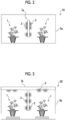
- the cultivation system may be, for example, an aspect as shown in Figs. 1 to 3 .
- Fig. 1 is a schematic top view showing an example of a cultivation system in which an LED light source is disposed between stocks.
- a region partitioned into equal areas on both sides of the lighting device 7a including the LED light source 3 is provided, and the cultivation stock 1 of a fruit vegetable plant is disposed in every other partitioned region. A certain distance is maintained between the plurality of cultivation stocks 1 such that the leaves of adjacent stocks do not overlap. In each partitioned region, the top surface and the side surface are covered with the reflection sheet 5a.
- Fig. 2 is a cross-sectional view taken along the line A-A of Fig. 1 .
- the cultivation stock 1 is disposed on both sides of the lighting device 7a, and the top surface and the side surface of the cultivation stock 1 are covered with the reflection sheet 5a.
- the fruit vegetable plant is directly irradiated with the light emitted from the lighting device 7a from one side surface direction of the fruit vegetable plant, and the light is reflected by the reflection sheet 5a and the fruit vegetable plant is further irradiated with the reflected light from the other side surface direction of the fruit vegetable plant.
- the light emitted from the lighting device 7a to the top surface side is reflected by the reflection sheet 5a of the top surface and then reflected again by the reflection sheet of the side surface, and the fruit vegetable plant is further irradiated from the side surface direction of the fruit vegetable plant.
- the light utilization efficiency can be enhanced by covering the periphery of the cultivation stock with a reflection sheet or the like.
- the workability from the passage is also improved.
- a plurality of LED light sources 3 are attached to the lighting device 7a.
- the cultivation system shown in Fig. 2 may be an embodiment in which a support table (preferably, a cultivation shelf) provided with a support body (such as a urethane sponge) for supporting the root part of a cultivation stock is used, or an embodiment in which a support table (preferably, a cultivation shelf) provided with a cultivation panel where a plurality of holes for fixing the support body are disposed is used and the support body for supporting the root part of the cultivation stock is fixed to each hole of the cultivation panel for cultivation.
- the use of the support table is preferable from the viewpoints of cultivation management and workability, such as lateral bud picking, leaf picking, and harvesting in a period in which a fruit vegetable plant such as a tomato is cultivated.
- Fig. 3 is a modified example of Fig. 2.
- Fig. 3 is a schematic cross-sectional view showing an example of a cultivation system in which a lighting device 7b having a T-shaped cross-section is attached instead of the reflection sheet of the top surface and the lighting device 7a in Fig. 2 .
- the LED light source 3 is also disposed on the top surface, and the fruit vegetable plant is directly irradiated with the irradiation light from both of the side surface direction of the fruit vegetable plant and the top surface.
- the side surface is covered with a reflection sheet 5b.
- a cycle of the light period and dark period (hereinafter, also referred to as a "light-dark cycle") of the artificial light with which the fruit vegetable plant is irradiated may be controlled.
- the "light period” means a period in which the fruit vegetable plant is subjected to irradiation by the light source.
- the “dark period” means a period in which the fruit vegetable plant is not subjected to irradiation by the light source.
- the light-dark cycle can be controlled by changing the use time of the light source.
- a light source for the artificial light to be irradiated is not particularly limited, and examples thereof include semiconductor light sources such as a light emitting diode (LED), discharge lamps such as a fluorescent lamp, and the like. In the method of cultivating a fruit vegetable plant according to the present disclosure, an LED is preferably used.
- LED light emitting diode
- One type of LED may be used, or two or more types of LEDs may be used.
- the LED may emit visible light such as red, blue, and green, or may emit invisible light such as ultraviolet light (wavelength of 380 nm or less) or infrared light (wavelength of 780 nm or more).
- ultraviolet light wavelength of 380 nm or less
- infrared light wavelength of 780 nm or more.
- an LED that emits light in a wavelength range of 400 nm to 700 nm is preferable.
- the selection of the light source wavelength in the seedling raising period in the cultivation period of the tomato contributes to an increase or decrease in fruit yield
- an increase in yield can be expected as compared with a seedling raising period in which a white LED is used, for example.
- the cultivation temperature of the fruit vegetable plant is not particularly limited, but is preferably 23°C to 33°C and more preferably 25°C to 32°C in the light period. By setting the cultivation temperature in the light period within the above-described numerical range, the quality, the weight, and the like of the fruit to be harvested can be improved.
- the cultivation temperature of the fruit vegetable plant in the dark period is preferably 15°C to 22°C and more preferably 16°C to 20°C.
- the cultivation temperature is measured by disposing a thermometer at a position 1 cm away from the fruit vegetable plant.
- a thermometer for example, TR-74Ui manufactured by T & D Co., Ltd. and the attached sensors can be used.
- a method of controlling the light period temperature and the dark period temperature is not particularly limited and the light period temperature and the dark period temperature can be controlled by using a known method in the related art.
- the control of the light period temperature and the dark period temperature can be performed by monitoring the light period temperature and the dark period temperature of the environment with the above-described thermometer, and sending hot air or cold air as necessary.
- the relative humidity in the cultivation environment of the fruit vegetable plant is preferably 40% to 80% and more preferably 50% to 75%. By setting the relative humidity in the cultivation environment of the fruit vegetable plant within the above-described numerical range, the quality, the weight, and the like of the fruit to be harvested can be improved.
- the relative humidity is measured by disposing a hygrometer at a position 1 cm away from the fruit vegetable plant.
- a hygrometer for example, TR-74Ui manufactured by T & D Co., Ltd. and the attached sensors can be used.
- a method of controlling the humidity is not particularly limited, and the humidity can be controlled by a known method in the related art.
- the humidity condition can be controlled by monitoring the humidity of the environment with the above-described hygrometer and using, as necessary, an air conditioning device having a humidifying function and a dehumidifying function.
- a carbon dioxide concentration in the cultivation environment of the fruit vegetable plant is preferably 300 ppm or more, more preferably 400 ppm or more, further more preferably 800 ppm or more, and particularly preferably 1,000 ppm or more.
- the upper limit of the carbon dioxide concentration is not particularly limited and can be set to 4,000 ppm or less.
- the carbon dioxide concentration is measured in a state where a carbon dioxide densitometer is disposed at a position 1 cm away from the fruit vegetable plant.
- a carbon dioxide densitometer for example, an Air Checker 7722 manufactured by SB Environment Corporation can be used.
- the method of controlling the carbon dioxide concentration is not particularly limited, and the carbon dioxide concentration can be controlled by a known method in the related art.
- the carbon dioxide concentration can be controlled by monitoring the carbon dioxide concentration in the environment with the above-described carbon dioxide densitometer and using an air conditioning device or the like, as necessary.
- the fruit vegetable plant may be cultivated by soil cultivation or hydroponic cultivation, but from a viewpoint of improving the hygiene of the cultivation environment, hydroponic cultivation is preferably performed.
- a support table provided with urethane sponge, rockwool, and water-retaining sheet, and the like can be used as the support body for supporting a root part.
- a method of supplying a liquid fertilizer is not particularly limited, and examples of the method include a flooded hydroponic cultivation in which a support body is dipped in the liquid fertilizer for cultivation, a spray type hydroponic cultivation in which a liquid fertilizer is sprayed onto a support body, and a drop type hydroponic cultivation in which a liquid fertilizer is added dropwise onto a root part or a support body, and the like.
- the liquid fertilizer to be used is not particularly limited as long as it is suitable for cultivating fruit vegetable plants.
- commercially available mixed liquid fertilizers such as OAT HOUSE No. 1 manufactured by OAT Agrio Co., Ltd. and Hyponica liquid fertilizer manufactured by KYOWA Co., Ltd.
- a straight fertilizer may be used in combination based on a known fertilizer composition such as the Ensi formulation and the Yamazaki formulation.
- a method suitable for the crop may be appropriately selected from among general methods and performed.
- a hormone treatment may be performed using the Tomato Tone Spray of Sumitomo chemical garden products inc.
- vibration pollination may be performed using a blower or a vibration device.
- pollination may be performed using insects such as bumblebees.
- the lateral buds of the fruit vegetable plant may be appropriately removed (lateral bud picking).
- the fruit vegetable plant is not particularly limited, and examples thereof include Solanaceae family plants such as a tomato, an eggplant, and a sweet pepper, Cucurbitaceae family plants such as a melon, a cucumber, a pumpkin, and a zucchini, Fabaceae family plants such as a green bean, a pea, and a broad bean, Malvaceae family plants such as an okra, Poaceae family plants such as corn, and the like.
- Solanaceae family plants and Cucurbitaceae family plants are suitable for the method of cultivating of the present disclosure, a tomato or a melon is more suitable, and the tomato is still more suitable.
- the tomato includes a medium size tomato, a cherry tomato, a high-sugar tomato, and the like.
- the melon includes netted melons such as green flesh and orange flesh, and non-netted melons.
- the cultivation apparatus for a fruit vegetable plant includes a light source that irradiates with artificial light from side surface direction and from upper surface direction of the fruit vegetable plant, and a control mechanism that controls a light irradiation condition such that a variation in light intensity between plant parts is generated in a case of irradiating the fruit vegetable plant with the artificial light (hereinafter, also referred to as a "light intensity control mechanism").
- the above-described light source can be used as a light source that emits artificial light.
- the above-described cultivation system can be applied as the cultivation apparatus which is provided with a light source.
- the light intensity control mechanism controls the light irradiation conditions of the artificial light with which the fruit vegetable plant is irradiated such that a variation in light intensity between plant parts is generated in the fruit vegetable plant.
- a light quantum sensor that measures light intensity is disposed at the growth point of a fruit vegetable plant and at the central part of the lowest leaf of the fruit vegetable plant.
- the light intensity control mechanism acquires data of the light intensity from the light quantum sensor and calculates a light intensity ratio.
- the light intensity ratio it is preferable that the ratio of the light intensity I b of the artificial light with which the central part of the lowest leaf of the fruit vegetable plant is irradiated to the light intensity It of the artificial light with which the growth point of the fruit vegetable plant is irradiated satisfies the following relationship. As a result, the light intensity at the growth point and its vicinity in the fruit vegetable plant is further increased. I b / I t ⁇ 0.8 .
- the light intensity control mechanism sends a signal for adjusting the angle of the artificial light to be irradiated, the number of irradiation directions of the artificial light to be irradiated, the light intensity of the artificial light, and the like, to the light source to adjust the light intensity ratio to be within the above-described range.
- the light intensity control mechanism controls the light irradiation condition such that the ratio (I b /I t ) of the light intensity of the artificial light with which the central part of the lowest leaf of the fruit vegetable plant is irradiated to the light intensity of the artificial light with which the growth point of the fruit vegetable plant is irradiated is 0.8 or less.
- the light intensity control mechanism controls the light irradiation condition such that the above-described light intensity ratio is more preferably 0.7 or less (still more preferably 0.5 or less).
- the light intensity control mechanism controls the light irradiation condition such that the above-described light intensity ratio is preferably 0.3 or more (more preferably 0.4 or more).
- the light control mechanism can control the above-described light intensity ratio by changing the number of light sources that irradiate the fruit vegetable plant with the artificial light, the irradiation angle of the artificial light with which the fruit vegetable plant is irradiated, and the like.
- Tomato seeds (variety: Momotaro York (registered trademark)) were sown on a 5 cm square urethane sponge (manufactured by Kyowa Limited, yellow medium for fruit and vegetable) sufficiently containing pure water, and stored in the darkness under the conditions of a temperature of 28°C and a relative humidity of 70% for three days.
- the seedlings were raised for 17 days using a flooded hydroponic cultivation.
- a Hyponica liquid fertilizer manufactured by Kyowa Co., Ltd. was used by being diluted with pure water to 500 times.
- the 10 tomato plant seedlings obtained by the above-described seedling raising were grown under the cultivation conditions shown below (hereinafter, a growth step).
- a growth step one-tailoring was performed to arrange (lateral bud nipping, defoliation, and the like) and attract branches, and after three flower clusters (first to third flower clusters) settled on the main branch, and then it was confirmed that three main leaves were developed on an upper side of the third flower cluster, branches were pinched while leaving the main leaves.
- the tomato fruit that had fruited by the third flower cluster was harvested, and the cultivation was completed.
- the buds were pinched from the seventh bud.
- the set fruit were removed from the fifth set fruit.
- the tomato plant was cultivated and evaluated in the same manner as in Example 1-1, except that the light irradiation conditions in the cultivation conditions in the growth step were changed as follows.
- period B a period other than the above-described period
- the irradiation with artificial light from a direction of 0° ⁇ 30° with respect to the growth direction of the stem of the tomato plant was stopped, and the tomato plant was irradiated with artificial light only from a direction of 90° ⁇ 30° with respect to the growth direction of the stem of the tomato plant.
- the light intensity ratio was set to 1.0.
- the light intensity I b of the central part of the lowest leaf of the fruit vegetable plant and the light intensity It of the growth point of the fruit vegetable plant were both set to 120 ⁇ mol/m 2 /s to 130 ⁇ mol/m 2 /s.
- the tomato plant was cultivated and evaluated in the same manner as in Example 1-2, except that the light intensity ratio in the period A was changed to 0.8.
- the light intensity I b of the central part of the lowest leaf of the fruit vegetable plant was 120 ⁇ mol/m 2 /s to 130 ⁇ mol/m 2 /s and the light intensity It of the growth point of the fruit vegetable plant was 150 ⁇ mol/m 2 /s to 163 ⁇ mol/m 2 /s.
- the tomato plant was cultivated and evaluated in the same manner as in Example 1-1, except that at the time of adjusting the light intensity, the amounts of red light (wavelength of 660 nm) and blue light (wavelength of 450 nm) from the above-described LED were adjusted such that the light amount ratio of red to blue was 10: 1 as a light source in the seedling raising period.
- the tomato plant was cultivated and evaluated in the same manner as in Example 1-1, except that a white LED (PGL-NE-200NWD, manufactured by Ryoden corporation) was used as a light source in the seedling raising period.
- a white LED PGL-NE-200NWD, manufactured by Ryoden corporation
- the tomato plant was cultivated and evaluated in the same manner as in Example 1-1, except that the light irradiation conditions in the cultivation conditions in the growth step were changed as follows.
- the tomato plant was cultivated and evaluated in the same manner as in Example 1-1, except that the light irradiation conditions in the cultivation conditions in the growth step were changed as follows.
- Melon seeds (variety: RENON (registered trademark)) were sown on a 5 cm square urethane sponge (manufactured by Kyowa Limited, yellow medium for fruit and vegetable) sufficiently containing pure water, and stored in the darkness under the conditions of a temperature of 28°C and a relative humidity of 70% for three days.
- RENON registered trademark
- the seedlings were raised for 17 days using a flooded hydroponic cultivation (hereinafter, seedling raising step).
- the liquid fertilizer the "Hyponica liquid fertilizer” manufactured by Kyowa Co., Ltd. was used by being diluted with pure water to 500 times.
Landscapes
- Life Sciences & Earth Sciences (AREA)
- Botany (AREA)
- Environmental Sciences (AREA)
- Biodiversity & Conservation Biology (AREA)
- Ecology (AREA)
- Forests & Forestry (AREA)
- Cultivation Of Plants (AREA)
Applications Claiming Priority (3)
| Application Number | Priority Date | Filing Date | Title |
|---|---|---|---|
| JP2022077110 | 2022-05-09 | ||
| JP2023023805 | 2023-02-17 | ||
| PCT/JP2023/016010 WO2023218911A1 (ja) | 2022-05-09 | 2023-04-21 | 果菜植物の栽培方法、果菜植物の栽培装置及びトマト植物 |
Publications (2)
| Publication Number | Publication Date |
|---|---|
| EP4523518A1 true EP4523518A1 (de) | 2025-03-19 |
| EP4523518A4 EP4523518A4 (de) | 2025-08-27 |
Family
ID=88730286
Family Applications (1)
| Application Number | Title | Priority Date | Filing Date |
|---|---|---|---|
| EP23803393.0A Pending EP4523518A4 (de) | 2022-05-09 | 2023-04-21 | Verfahren zum züchten von obstpflanzen, vorrichtung zum züchten von obstpflanzen und tomatenpflanze |
Country Status (6)
| Country | Link |
|---|---|
| US (1) | US20250063993A1 (de) |
| EP (1) | EP4523518A4 (de) |
| JP (2) | JP7743620B2 (de) |
| CN (1) | CN119156129A (de) |
| IL (1) | IL316854A (de) |
| WO (1) | WO2023218911A1 (de) |
Family Cites Families (18)
| Publication number | Priority date | Publication date | Assignee | Title |
|---|---|---|---|---|
| US4109414A (en) * | 1976-06-30 | 1978-08-29 | Gte Laboratories Incorporated | Control of plants abscission processes by using specific light sources |
| US4506474A (en) * | 1980-05-12 | 1985-03-26 | Gte Laboratories Incorporated | Use of night-break lighting to increase fruit set in economically important fruit crops |
| JP2001028947A (ja) * | 1999-07-23 | 2001-02-06 | Yamato Kogyo Kk | 有用植物の育成方法 |
| JP2005192517A (ja) * | 2004-01-09 | 2005-07-21 | Stanley Electric Co Ltd | 植物育成方法 |
| JP4396389B2 (ja) * | 2004-05-18 | 2010-01-13 | パナソニック電工株式会社 | 植物育成用照明装置 |
| WO2007058347A1 (ja) * | 2005-11-21 | 2007-05-24 | National University Corporation Chiba University | 栽培植物の着果・生育促進方法および着果・生育促進装置 |
| JP4877111B2 (ja) * | 2007-07-12 | 2012-02-15 | パナソニック電工株式会社 | 植物照明装置 |
| WO2011007868A1 (ja) * | 2009-07-16 | 2011-01-20 | 四国電力株式会社 | 緑色光照射を利用した果菜類の栽培方法および緑色光照射システム |
| JP5330162B2 (ja) * | 2009-08-31 | 2013-10-30 | 株式会社フジキン | 閉鎖型植物工場 |
| JP5874060B2 (ja) * | 2011-12-16 | 2016-03-01 | パナソニックIpマネジメント株式会社 | 植物育成照明装置 |
| CN104869806B (zh) * | 2012-12-21 | 2019-03-12 | 飞利浦灯具控股公司 | 用于对接至少一个照明系统的园艺照明接口 |
| US9995446B2 (en) * | 2015-07-27 | 2018-06-12 | Douglas H. Powell | Grow light matrix system incorporating blade lighting system |
| US20170311553A1 (en) * | 2016-05-02 | 2017-11-02 | Sensor Electronic Technology, Inc. | Ultraviolet Plant Illumination System |
| US20200000043A1 (en) * | 2018-06-29 | 2020-01-02 | Thrive Agritech | Under canopy electromagnetic radiation device |
| US11212970B1 (en) * | 2018-12-07 | 2022-01-04 | Bloomkeep Inc. | Growing system and method |
| JP7617545B2 (ja) * | 2020-02-10 | 2025-01-20 | パナソニックIpマネジメント株式会社 | 植物育成の光照射方法、照明装置及び照明システム |
| JP7606328B2 (ja) | 2020-11-11 | 2024-12-25 | 住友重機械工業株式会社 | 画像合成装置、画像合成方法、画像合成プログラム |
| JP7567713B2 (ja) | 2021-08-06 | 2024-10-16 | トヨタ自動車株式会社 | ハイブリッド車 |
-
2023
- 2023-04-21 EP EP23803393.0A patent/EP4523518A4/de active Pending
- 2023-04-21 IL IL316854A patent/IL316854A/en unknown
- 2023-04-21 CN CN202380039072.4A patent/CN119156129A/zh active Pending
- 2023-04-21 JP JP2024520349A patent/JP7743620B2/ja active Active
- 2023-04-21 WO PCT/JP2023/016010 patent/WO2023218911A1/ja not_active Ceased
-
2024
- 2024-11-07 US US18/939,561 patent/US20250063993A1/en active Pending
-
2025
- 2025-08-05 JP JP2025130848A patent/JP2025147056A/ja active Pending
Also Published As
| Publication number | Publication date |
|---|---|
| JP7743620B2 (ja) | 2025-09-24 |
| JP2025147056A (ja) | 2025-10-03 |
| WO2023218911A1 (ja) | 2023-11-16 |
| CN119156129A (zh) | 2024-12-17 |
| IL316854A (en) | 2025-01-01 |
| EP4523518A4 (de) | 2025-08-27 |
| US20250063993A1 (en) | 2025-02-27 |
| JPWO2023218911A1 (de) | 2023-11-16 |
Similar Documents
| Publication | Publication Date | Title |
|---|---|---|
| WO2014112189A1 (ja) | 果菜類の栽培方法 | |
| US20230276750A1 (en) | Tomato plant, tomato fruit, and method of cultivating tomato plant | |
| US12507642B2 (en) | Method of cultivating fruit vegetable plant | |
| JP5102190B2 (ja) | 植物栽培方法 | |
| CN114847029A (zh) | 一种降低室内栽培黄瓜化瓜率的光环境调控方法 | |
| EP4523518A1 (de) | Verfahren zum züchten von obstpflanzen, vorrichtung zum züchten von obstpflanzen und tomatenpflanze | |
| US20240099181A1 (en) | Method of cultivating plant and plant cultivation apparatus | |
| JP6005787B2 (ja) | 果菜類の栽培方法 | |
| US20250386782A1 (en) | Cultivation method for fruit vegetable plant, tomato, culture solution for hydroponic cultivation of fruit vegetable plant, and hydroponic cultivation device of fruit vegetable plant | |
| JP7676682B2 (ja) | 果菜植物の栽培方法 | |
| RU2724494C2 (ru) | Способ ускоренного размножения картофеля | |
| Hao et al. | Optimizing vertical light spectral distribution to improve yield and quality in greenhouse fruit vegetable production | |
| WO2025243734A1 (ja) | ナス科果菜類の栽培方法 | |
| US20250359519A1 (en) | Cultivation method for fruit vegetable plant | |
| WO2024176949A1 (ja) | トマト及びトマト植物体の栽培方法 | |
| KR20260016223A (ko) | 조도조절 식물생장 조명(led) | |
| JP2023110612A (ja) | バジルを栽培する方法 | |
| CN119655090A (zh) | 一种茄果类育苗设施及其育苗方法 | |
| JPH1175548A (ja) | セル成形苗の栽培方法 | |
| JP2023110643A (ja) | バジルを栽培する方法 | |
| JP2022184287A (ja) | エディブルフラワー用ビオラの栽培方法 | |
| JP2021177746A (ja) | 小型成熟化ゴボウ及び小型成熟化ゴボウの栽培方法 |
Legal Events
| Date | Code | Title | Description |
|---|---|---|---|
| STAA | Information on the status of an ep patent application or granted ep patent |
Free format text: STATUS: THE INTERNATIONAL PUBLICATION HAS BEEN MADE |
|
| PUAI | Public reference made under article 153(3) epc to a published international application that has entered the european phase |
Free format text: ORIGINAL CODE: 0009012 |
|
| STAA | Information on the status of an ep patent application or granted ep patent |
Free format text: STATUS: REQUEST FOR EXAMINATION WAS MADE |
|
| 17P | Request for examination filed |
Effective date: 20241108 |
|
| AK | Designated contracting states |
Kind code of ref document: A1 Designated state(s): AL AT BE BG CH CY CZ DE DK EE ES FI FR GB GR HR HU IE IS IT LI LT LU LV MC ME MK MT NL NO PL PT RO RS SE SI SK SM TR |
|
| REG | Reference to a national code |
Ref country code: DE Ref legal event code: R079 Free format text: PREVIOUS MAIN CLASS: A01G0007000000 Ipc: A01G0007040000 |
|
| DAV | Request for validation of the european patent (deleted) | ||
| DAX | Request for extension of the european patent (deleted) | ||
| A4 | Supplementary search report drawn up and despatched |
Effective date: 20250728 |
|
| RIC1 | Information provided on ipc code assigned before grant |
Ipc: A01G 7/04 20060101AFI20250722BHEP Ipc: A01G 22/05 20180101ALI20250722BHEP |