EP4488397A1 - Aluminiumlegierung zum giessen und aluminiumlegierungsguss - Google Patents
Aluminiumlegierung zum giessen und aluminiumlegierungsguss Download PDFInfo
- Publication number
- EP4488397A1 EP4488397A1 EP23763431.6A EP23763431A EP4488397A1 EP 4488397 A1 EP4488397 A1 EP 4488397A1 EP 23763431 A EP23763431 A EP 23763431A EP 4488397 A1 EP4488397 A1 EP 4488397A1
- Authority
- EP
- European Patent Office
- Prior art keywords
- mass
- aluminum alloy
- casting
- present
- alloy castings
- Prior art date
- Legal status (The legal status is an assumption and is not a legal conclusion. Google has not performed a legal analysis and makes no representation as to the accuracy of the status listed.)
- Pending
Links
Images


Classifications
-
- C—CHEMISTRY; METALLURGY
- C22—METALLURGY; FERROUS OR NON-FERROUS ALLOYS; TREATMENT OF ALLOYS OR NON-FERROUS METALS
- C22C—ALLOYS
- C22C21/00—Alloys based on aluminium
- C22C21/02—Alloys based on aluminium with silicon as the next major constituent
Definitions
- the present invention relates to a eutectic Al-Si-based alloy for casting having excellent toughness and a casting material thereof.
- Al-Si-based alloys have good castability and the resulting casting materials exhibit excellent mechanical properties, and therefore have been used as alloys for casting.
- there is a strong demand for lower prices for casting alloys and the proportion of scrap material in the raw materials is higher compared to alloys for wrought materials.
- the number of aluminum alloy castings produced from recycled ingots has been increased.
- Fe is easy to be mixed into the Al-Si-based alloy castings produced from recycled ingots as an impurity. Fe has the effect of preventing seizure to a mold during casting and improving tensile strength, but in case that the Fe content increases, coarse Al-Fe-Si-based crystals that become the starting point of fracture when stress is applied are more likely to be formed.
- Mn and Cr are added to form Al-(Fe, Mn, Cr)-Si-based crystallized products, which are less likely to become coarse, instead of Al-Fe-Si-based crystallized products.
- Patent Literature 1 JP 2006-322062 A discloses an aluminum alloy for casting, which contains 2.0 to 6.0% by weight of Si, 0.1 to 1.5% by weight of Mg, 0.1 to 1.3% by weight of Cr, with the balance being Al and inevitable impurities, and which allows up to 0.8% by weight of Fe among the inevitable impurities.
- the blended ration of Si is set in the range of 2.0 to 6.0% by weight to suppress a decrease in elongation of the aluminum alloy
- Cr is blended in an amount of 0.1 to 1.3% by weight to suppress a decrease in elongation of the alloy while preventing seizure between the aluminum alloy and a die during casting even when the casting temperature is high
- Mg is blended in an amount of 0.1 to 1.5% by weight to suppress a decrease in elongation while improving the proof stress of the aluminum alloy.
- Patent Literature 2 JP 2020-158788 A discloses an aluminum alloy which contains, based on 100% by mass in total, 7 to 10% Si, 0.3 to 0.9% Fe, 0.05 to 0.3% V, 0.05 to 0.3% Zr, 0.05 to 0.3% Ti, with the balance being Al and impurities.
- Patent Literature 2 only show die-cast materials, and it is difficult to impart high strength, proof stress, and ductility to the aluminum alloy castings obtained by general casting methods such as sand casting and metal mold casting.
- an object of the present invention is to provide an aluminum alloy for casting in which the Al-(Fe, Mn, Cr)-Si-based crystallized products in the resulting Al-Si-based alloy castings are refined, even when the Fe content is increased, without being limited by the casting method. Further, another object of the present invention is to provide an aluminum alloy castings having excellent proof stress, ductility and toughness even when the Fe content is increased by reducing the effect of Fe contained as an impurity.
- the other objects of the present invention are to reduce the adverse effects of Fe, which is likely to be mixed in from scrap, and accordingly, to provide an aluminum for casting and an aluminum alloy casting that are suitable for horizontal recycling, and the like.
- the present inventors have conducted intensive research as to the composition of the Fe-containing aluminum alloys for casting, and as a result, have found that addition of Mn, Cr and V in combination to a hypoeutectic Al-Si alloy is extremely effective, and then have reached the present invention.
- the present invention provides an aluminum alloy for casting characterized by containing
- Fe contributes to preventing seizure to a mold during casting and to improving the tensile strength of the aluminum alloy castings, however, when the Fe content increases, coarse Al-Fe-Si-based crystallized products that become the starting point of fracture when stress is applied are more likely to be formed.
- Mn and Cr are added to the aluminum alloy for casting of the present invention, the Al-(Fe, Mn, Cr)-Si-based crystallized products, which are less likely to become coarse, are formed instead of Al-Fe-Si-based crystallized products.
- the greatest characteristic of the casting aluminum alloy of the present invention is that the addition of V results in the formation of a fine VSi 2 -based compound.
- the VSi 2 -based compound acts as solidification nuclei to form a fine CrSi 2 , and then Al 13 Si 4 Cr 4 is formed by a peritectic reaction, and finally the Al 13 Si 4 Cr 4 is acts as solidification nuclei to form fine Al-(Fe, Mn, Cr)-Si-based crystallized product. That is, the formation of the fine VSi 2 -based compound acts as a trigger to accomplish remarkable refinement of Al-(Fe, Mn, Cr)-Si-based crystallized product.
- the aluminum alloy for casting of the present invention it is preferable to contain 0.2 to 2.0% by mass of Cu, more than 0.2% by mass and not more than 1.0% by mass of Mg, any one or more of 0.005 to 0.05% by mass of Sr, 0.005 to 0.05% by mass of Sb and 0.005 to 0.25% by mass of Ti, with the balance being Al and inevitable impurities.
- Sr and Sb have the effect of refining the eutectic Si, and this effect becomes significant at 0.005% by mass or more, but even when added 0.05% by mass or more, no improvement in this effect can be obtained.
- Ti has the effect of refining the cast structure (a phase), and this effect becomes significant at 0.005% by mass or more, but even when added 0.25% by mass or more, no improvement in this effect can be obtained.
- the present invention also provides an aluminum alloy for casting, characterized by containing:
- the present invention provides an aluminum alloy castings comprising the aluminum alloy for casting of the present invention.
- the aluminum alloy casting of the present invention is made of the aluminum alloy for casting of the present invention, and the influence of Fe contained as an impurity is reduced, even when the Fe content is increased, it is possible to exhibit excellent proof stress, ductility and toughness.
- the aluminum alloy castings of the present invention means a casting produced by various conventionally known casting methods (sand casting, metal mold casting, gravity casting, low pressure casting, die casting, and the like), and is not limited to one casting produced by a specific casting method.
- the mode of the length of the iron-based compound is 12.5 ⁇ m or less.
- the iron-based compound such as the Al-(Fe, Mn, Cr)-Si-based crystallized product and setting the mode of length to 12.5 ⁇ m or less, it is possible to impart excellent ductility and toughness to the aluminum alloy castings.
- the iron-based compound contains V. By containing V in the Al-(Fe, Mn, Cr)-Si-based crystallized product, the refinement effect caused by the formation of VSi 2 -based compound can be reliably achieved.
- a tensile elongation is 4% or more.
- the aluminum alloy castings has a tensile elongation of 4% or more, it is possible to suitably use in applications where reliability is required.
- the present invention it is possible to provide an aluminum alloy for casting in which the Al-(Fe, Mn, Cr)-Si-based crystallized products in the resulting Al-Si-based alloy castings are refined, even when the Fe content is increased, without being limited by the casting method. Further, it is also possible to provide an aluminum alloy casting having excellent proof stress, ductility and toughness even when the Fe content is increased by reducing the effect of Fe contained as an impurity.
- the aluminum alloy for casting of the present invention is characterized by the combined addition of Mn, Cr and V to the hypoeutectic Al-Si alloy. Each component will be described in detail below.
- Si More than 3.0% by mass and not more than 12.0% by mass
- Si has the effect of improving the castability of the aluminum alloy, and, in addition, the effect of improving mechanical properties such as tensile strength.
- the effect becomes significant when more than 3.0% by mass, but when added more than 12.0% by mass, the eutectic Si crystals and the primary Si crystals tend to become coarse, resulting in decrease in mechanical properties.
- the added amount of Si is preferably set to 5.0 to 10.0% by mass, and more preferably set to 5.0 to 8.0% by mass.
- Fe has the effect of improving the mechanical properties such as tensile strength of the aluminum alloys, and also has the effect of suppressing seizure onto the mold during casting.
- the effect becomes significant when 0.2% by mass or more, but when more than 0.8% by mass, the Al-(Fe, Mn, Cr)-Si-based crystallized product tend to become coarse.
- Fe is contained in an amount of 0.2% by mass or more as an impurity.
- the adverse effects of Fe on mechanical properties can be reliably neutralized in the aluminum alloy castings made from the aluminum alloy for casting of the present invention.
- the Fe content is set to 0.2 to 0.6% by mass.
- the Fe content is set to 0.2 to 0.6% by mass.
- Mn crystallizes as the fine Al-(Fe, Mn, Cr)-Si-based crystallized product and suppresses the formation of the coarse Al-Fe-Si-based crystallized product.
- the effect becomes significant when the content is 0.1% by mass or more, but when added more than 0.7% by mass, the coarse Mn-based compound is likely to be formed.
- the Mn content is preferably set to 0.2 to 0.4% by mass, and more preferably set to 0.2 to 0.3% by mass.
- the Cr crystallizes as the fine Al-(Fe, Mn, Cr)-Si-based crystallized product and suppresses the formation of the coarse Al-Fe-Si-based crystallized product.
- the effect becomes significant when the content is 0.1% by mass or more, but when added more than 0.4% by mass, the coarse Cr-based compound is likely to be formed.
- the Cr content is preferably set to 0.1 to 0.3% by mass, and more preferably set to 0.1 to 0.2% by mass.
- V 0.05 to 0.3% by mass
- V results in the formation of the fine VSi 2 -based compound, and promoting the formation and refinement of the Al-(Fe, Mn, Cr)-Si-based crystallized product.
- the VSi 2 -based compound acts as solidification nuclei to form a fine CrSi 2
- Al 13 Si 4 Cr 4 is formed by a peritectic reaction
- the Al 13 Si 4 Cr 4 is acts as solidification nuclei to form fine Al-(Fe, Mn, Cr)-Si-based crystallized product.
- the effect becomes significant at 0.05% by mass or more, but no improvement in effect is observed even when added more than 0.3% by mass.
- the added amount of Cu is preferably set to 0.2 to 1.0% by mass.
- Mg more than 0.2% by mass and less than 1.0% by mass
- the added amount of Mg is preferably set to 0.2 to 0.6% by mass.
- Sr has the effect of refining eutectic Si.
- the effect becomes significant at 0.005% by mass or more, but no improvement in effect is observed when adding more than 0.05% by mass.
- Sb has the effect of refining eutectic Si.
- the effect becomes significant at 0.005% by mass or more, but no improvement in effect is observed when adding more than 0.05% by mass.
- Ti has the effect of refining the cast structure (a phase). The effect becomes significant at 0.005% by mass or more, but no improvement in effect is observed when adding more than 0.25% by mass. Note, at the time when Ti is added, an Al-Ti-B alloy may be used. At that time, it is necessary that the amount of B is set to 0.05% by mass or less.
- Ni, Zn, Pb, Be and Sn as inevitable impurities it is preferable to restrict the contents of Ni, Zn, Pb, Be and Sn as inevitable impurities to 0.05% by mass or less.
- the other elements are preferably restricted to 0.01% by mass or less.
- the aluminum alloy castings of the present invention is made of the aluminum alloy for casting of the present invention and is characterized in that the iron-based compound is finely divided.
- the microstructure and mechanical properties will be described in detail below.
- the most frequent length of the iron-based compound such as Al-(Fe, Mn, Cr)-Si-based crystallized product is 12.5 ⁇ m or less.
- the mode of the length of the iron-based compound is set to 10 ⁇ m or less.
- the method for measuring the mode of the length of the iron-based compound is not particularly limited, and various conventionally known microstructural observation methods may be used, and, for example, a backscattered electron image of a scanning electron microscope (SEM) may be used to measure the length distribution of the iron-based compound with an appropriate image analysis software.
- the observation field area is preferably set to 1.5 mm 2 or more.
- the iron-based compound in the aluminum alloy castings of the present invention is refined by the formation of VSi 2 -based compound, it is preferable that V exists inside the iron-based compound.
- V exists inside the iron-based compound.
- the method for confirming the V present inside the iron-based compound is not particularly limited, and various conventionally known elemental analysis methods may be used, and, for example, the V can be confirmed by SEM-EDS, EPMA, TEM-EDS, STEM-EDS, and the like.
- the aluminum alloy castings of the present invention has excellent tensile properties that combine high strength, proof stress and ductility.
- the tensile elongation is 4% or more. Further, the tensile strength is preferably 230 MPa or more, and the 0.2% proof stress is preferably 170 MPa or more.
- the aluminum alloy castings of the present invention can be produced by preparing raw materials so that they have the composition of the aluminum alloy for casting of the present invention, and casting according to various conventionally known casting methods (sand casting, metal mold casting, gravity casting, low-pressure casting, die casting, and the like). That is, the aluminum alloy castings of the present invention is not limited to those produced by a specific casting method.
- the aluminum alloy castings of the present invention has less influence of Fe contained as an impurity, it is possible to exhibit excellent proof stress, ductility and toughness even when the Fe content is increased. That is, the proportion of scrap materials in the raw materials may be high, and from the perspective of building a sustainable society, recycled metals can be suitably used.
- Present aluminum alloy castings 1 of the present invention was obtained in the same manner as in Example 1, except that raw materials mixed to obtain the composition shown as Example 2 in Table 1 were used, and no tempering was carried out.
- Comparative aluminum alloy castings 1 was obtained in the same manner as in Example 1, except that raw materials mixed to obtain the composition shown as Comparative Example 1 in Table 1 were used.
- Comparative aluminum alloy castings 2 was obtained in the same manner as in Example 1, except that raw materials mixed to obtain the composition shown as Comparative Example 2 in Table 1 were used.
- Comparative aluminum alloy castings 3 was obtained in the same manner as in Example 1, except that raw materials mixed to obtain the composition shown as Comparative Example 3 in Table 1 were used, and no tempering was carried out.
- Comparative aluminum alloy castings 4 was obtained in the same manner as in Example 1, except that raw materials mixed to obtain the composition shown as Comparative Example 4 in Table 1 were used, and no tempering was carried out.
- Cubes of 1 cm square were cut out from the present aluminum alloy castings and the comparative aluminum alloy castings, so as to be a manner that a position 13 mm from the bottom surface was centered, and the cross sections were buffed to prepare samples for microstructure observation.
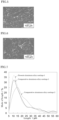
- the microstructures of the present aluminum alloy castings 1 and 2 observed with a scanning electron microscope (SEM) are shown in FIG. 1 and FIG. 2 , respectively.
- the microstructures obtained for the comparative aluminum alloy castings 1 to 4 are shown in FIGS. 3 to 6 , respectively.
- the scanning electron microscope used was ULTRA Plus model available from Carl Zeiss.
- the bright (white) parts observed in FIGS. 1 to 6 are iron-based compounds, it is confirmed that the parts are in the form of fine lumps in the present aluminum alloy castings. Further, the finely divided iron-based compounds are not distributed continuously. On the other hand, in the comparative aluminum alloy castings, the iron-based compounds are coarse and needle-like, and it is confirmed that, with regard to the addition of Mn, Cr and V, when only Mn was added (comparative aluminum alloy casting 3) and when only Mn and Cr were added (comparative aluminum alloy casting 4), the iron-based compounds were hardly refined. From these results, it is clear that the combined addition of Mn, Cr and V is essential for refining the iron-based compounds.
- the distribution of lengths of iron-based compounds was evaluated from SEM backscattered electron images. Specifically, the field area was set to 1.77 mm 2 , the threshold value was set to area > 10 ⁇ m 2 , and the class width was set to 5 ⁇ m, and a histogram of the length distribution of iron-based compounds was obtained. The resulting histogram is shown in FIG. 7 .
- the mode of length of the iron-based compounds in the comparative aluminum alloy casting 2 is 15 ⁇ m, whereas that in the present aluminum alloy castings 1 is 10 ⁇ m, which shows that the iron-based compounds are significantly refined by the combined addition of Mn, Cr, and V.
- the Fe content of the comparative aluminum alloy castings 1 is low at 0.12% by mass, and coarsening of the iron-based compounds does not progress, but the iron-based compounds of the present aluminum alloy castings 1, which contains 0.42% by mass of Fe, are refined to the same extent as those of the comparative aluminum alloy casting 1.
- the distribution of elements in the present aluminum alloy castings 1 was measured by using SEM-EDS.
- the obtained elemental mapping is shown in FIG. 8 .
- the iron-based compound is present in the center of FIG. 8 , and the fine region (regions indicated by arrows in the drawing) where V is concentrated is observed inside the iron-based compound.
- the V is due to the formation of VSi 2 -based compounds.
Landscapes
- Chemical & Material Sciences (AREA)
- Engineering & Computer Science (AREA)
- Materials Engineering (AREA)
- Mechanical Engineering (AREA)
- Metallurgy (AREA)
- Organic Chemistry (AREA)
- Continuous Casting (AREA)
- Mold Materials And Core Materials (AREA)
Applications Claiming Priority (2)
| Application Number | Priority Date | Filing Date | Title |
|---|---|---|---|
| JP2022032697 | 2022-03-03 | ||
| PCT/JP2023/007263 WO2023167174A1 (ja) | 2022-03-03 | 2023-02-28 | 鋳物用アルミニウム合金及びアルミニウム合金鋳物 |
Publications (1)
| Publication Number | Publication Date |
|---|---|
| EP4488397A1 true EP4488397A1 (de) | 2025-01-08 |
Family
ID=87883762
Family Applications (1)
| Application Number | Title | Priority Date | Filing Date |
|---|---|---|---|
| EP23763431.6A Pending EP4488397A1 (de) | 2022-03-03 | 2023-02-28 | Aluminiumlegierung zum giessen und aluminiumlegierungsguss |
Country Status (5)
| Country | Link |
|---|---|
| US (1) | US20250171882A1 (de) |
| EP (1) | EP4488397A1 (de) |
| JP (1) | JPWO2023167174A1 (de) |
| CN (1) | CN118742661A (de) |
| WO (1) | WO2023167174A1 (de) |
Family Cites Families (9)
| Publication number | Priority date | Publication date | Assignee | Title |
|---|---|---|---|---|
| JPH1112705A (ja) * | 1997-06-20 | 1999-01-19 | Sumitomo Light Metal Ind Ltd | 切削性に優れた高強度アルミニウム合金鍛造品の製造方法 |
| FR2827306B1 (fr) * | 2001-07-10 | 2004-10-22 | Pechiney Aluminium | Alliage d'aluminium a haute ductilite pour coulee sous pression |
| JP4511156B2 (ja) * | 2002-11-22 | 2010-07-28 | 昭和電工株式会社 | アルミニウム合金の製造方法と、これにより製造されるアルミニウム合金、棒状材、摺動部品、鍛造成形品および機械加工成形品 |
| JP2005241531A (ja) * | 2004-02-27 | 2005-09-08 | Toshiba Corp | 硝酸塩を含む廃棄物処理装置および方法 |
| JP2006322062A (ja) | 2005-04-19 | 2006-11-30 | Daiki Aluminium Industry Co Ltd | 鋳造用アルミニウム合金および同アルミニウム合金鋳物 |
| JP5655953B2 (ja) * | 2011-10-11 | 2015-01-21 | 日本軽金属株式会社 | Al−Fe−Si系化合物及び初晶Siを微細化させたアルミニウム合金の製造方法 |
| JP2020007596A (ja) * | 2018-07-05 | 2020-01-16 | 昭和電工株式会社 | アルミニウム合金材 |
| JP7152977B2 (ja) | 2019-03-25 | 2022-10-13 | 株式会社豊田中央研究所 | アルミニウム合金 |
| CN111809083B (zh) * | 2019-04-12 | 2022-06-24 | 通用汽车环球科技运作有限责任公司 | 简化半固态铸造工艺的铝合金组合物和半固态铸造方法 |
-
2023
- 2023-02-28 JP JP2024504690A patent/JPWO2023167174A1/ja active Pending
- 2023-02-28 EP EP23763431.6A patent/EP4488397A1/de active Pending
- 2023-02-28 WO PCT/JP2023/007263 patent/WO2023167174A1/ja not_active Ceased
- 2023-02-28 CN CN202380020693.8A patent/CN118742661A/zh active Pending
- 2023-02-28 US US18/842,376 patent/US20250171882A1/en active Pending
Also Published As
| Publication number | Publication date |
|---|---|
| JPWO2023167174A1 (de) | 2023-09-07 |
| US20250171882A1 (en) | 2025-05-29 |
| CN118742661A (zh) | 2024-10-01 |
| WO2023167174A1 (ja) | 2023-09-07 |
Similar Documents
| Publication | Publication Date | Title |
|---|---|---|
| JP3194742B2 (ja) | 改良リチウムアルミニウム合金系 | |
| US5855697A (en) | Magnesium alloy having superior elevated-temperature properties and die castability | |
| EP2112242A1 (de) | Wärmebehandlungsfähige L12 Aluminium-Legierungen | |
| KR101124235B1 (ko) | 알루미늄 합금 및 알루미늄 합금 주물 | |
| EP2675930B1 (de) | Verfahren zur verfeinerung von metalllegierungen | |
| US20040191111A1 (en) | Er strengthening aluminum alloy | |
| EP2241644A1 (de) | Hitzebehandelbare L12-Aluminiumlegierungen | |
| EP2369025B1 (de) | Magnesiumlegierung und magnesiumlegierungsguss | |
| US20110116966A1 (en) | Aluminum alloy, method of casting aluminum alloy, and method of producing aluminum alloy product | |
| JP7152977B2 (ja) | アルミニウム合金 | |
| JP5703881B2 (ja) | 高強度マグネシウム合金およびその製造方法 | |
| EP2840156B1 (de) | Magnesiumlegierung und verfahren zur herstellung davon | |
| JP6229130B2 (ja) | 鋳造用アルミニウム合金及びそれを用いた鋳物 | |
| EP1728882A2 (de) | Aluminiumgusslegierung mit hoher steifigkeit und kleinem linearem ausdehnungskoeffizienten | |
| JPH093610A (ja) | 寸法精度及び延性に優れた薄肉アルミダイカスト製品及び製造方法 | |
| CN113046606A (zh) | 铝合金及其制备方法和铝合金结构件 | |
| KR101499096B1 (ko) | 스칸듐을 첨가한 알루미늄 합금 및 그 제조방법 | |
| EP4488397A1 (de) | Aluminiumlegierung zum giessen und aluminiumlegierungsguss | |
| EP1260600B1 (de) | Aluminiumlegierung geeignet für Bleche und ein Verfahren zu deren Herstellung | |
| KR100909699B1 (ko) | 충격에너지가 향상된 알루미늄 합금 및 이로부터 제조된압출재 | |
| JPH09296245A (ja) | 鋳物用アルミニウム合金 | |
| EP4124668A1 (de) | Gusslegierung | |
| CN111893354A (zh) | 一种Al-Si-Cu-Mg变形铝合金及其制备方法 | |
| EP4516952A1 (de) | Al-mg-si-ni-legierung und al-mg-si-ni-legierungsmaterial | |
| JPH09272940A (ja) | 伸び及び衝撃靭性に優れた亜共晶Al−Siダイカスト合金 |
Legal Events
| Date | Code | Title | Description |
|---|---|---|---|
| STAA | Information on the status of an ep patent application or granted ep patent |
Free format text: STATUS: THE INTERNATIONAL PUBLICATION HAS BEEN MADE |
|
| PUAI | Public reference made under article 153(3) epc to a published international application that has entered the european phase |
Free format text: ORIGINAL CODE: 0009012 |
|
| STAA | Information on the status of an ep patent application or granted ep patent |
Free format text: STATUS: REQUEST FOR EXAMINATION WAS MADE |
|
| 17P | Request for examination filed |
Effective date: 20240903 |
|
| AK | Designated contracting states |
Kind code of ref document: A1 Designated state(s): AL AT BE BG CH CY CZ DE DK EE ES FI FR GB GR HR HU IE IS IT LI LT LU LV MC ME MK MT NL NO PL PT RO RS SE SI SK SM TR |
|
| DAV | Request for validation of the european patent (deleted) | ||
| DAX | Request for extension of the european patent (deleted) |