EP4488028A1 - Verfahren zur herstellung eines pvc-basierten bodenbelags - Google Patents
Verfahren zur herstellung eines pvc-basierten bodenbelags Download PDFInfo
- Publication number
- EP4488028A1 EP4488028A1 EP23183315.3A EP23183315A EP4488028A1 EP 4488028 A1 EP4488028 A1 EP 4488028A1 EP 23183315 A EP23183315 A EP 23183315A EP 4488028 A1 EP4488028 A1 EP 4488028A1
- Authority
- EP
- European Patent Office
- Prior art keywords
- film
- blowing agent
- decomposition temperature
- recycled
- floor covering
- Prior art date
- Legal status (The legal status is an assumption and is not a legal conclusion. Google has not performed a legal analysis and makes no representation as to the accuracy of the status listed.)
- Withdrawn
Links
Images
Classifications
-
- B—PERFORMING OPERATIONS; TRANSPORTING
- B29—WORKING OF PLASTICS; WORKING OF SUBSTANCES IN A PLASTIC STATE IN GENERAL
- B29C—SHAPING OR JOINING OF PLASTICS; SHAPING OF MATERIAL IN A PLASTIC STATE, NOT OTHERWISE PROVIDED FOR; AFTER-TREATMENT OF THE SHAPED PRODUCTS, e.g. REPAIRING
- B29C44/00—Shaping by internal pressure generated in the material, e.g. swelling or foaming ; Producing porous or cellular expanded plastics articles
- B29C44/20—Shaping by internal pressure generated in the material, e.g. swelling or foaming ; Producing porous or cellular expanded plastics articles for articles of indefinite length
- B29C44/22—Shaping by internal pressure generated in the material, e.g. swelling or foaming ; Producing porous or cellular expanded plastics articles for articles of indefinite length consisting of at least two parts of chemically or physically different materials, e.g. having different densities
- B29C44/24—Making multilayered articles
-
- B—PERFORMING OPERATIONS; TRANSPORTING
- B29—WORKING OF PLASTICS; WORKING OF SUBSTANCES IN A PLASTIC STATE IN GENERAL
- B29C—SHAPING OR JOINING OF PLASTICS; SHAPING OF MATERIAL IN A PLASTIC STATE, NOT OTHERWISE PROVIDED FOR; AFTER-TREATMENT OF THE SHAPED PRODUCTS, e.g. REPAIRING
- B29C43/00—Compression moulding, i.e. applying external pressure to flow the moulding material; Apparatus therefor
- B29C43/22—Compression moulding, i.e. applying external pressure to flow the moulding material; Apparatus therefor of articles of indefinite length
- B29C43/24—Calendering
-
- B—PERFORMING OPERATIONS; TRANSPORTING
- B29—WORKING OF PLASTICS; WORKING OF SUBSTANCES IN A PLASTIC STATE IN GENERAL
- B29C—SHAPING OR JOINING OF PLASTICS; SHAPING OF MATERIAL IN A PLASTIC STATE, NOT OTHERWISE PROVIDED FOR; AFTER-TREATMENT OF THE SHAPED PRODUCTS, e.g. REPAIRING
- B29C43/00—Compression moulding, i.e. applying external pressure to flow the moulding material; Apparatus therefor
- B29C43/22—Compression moulding, i.e. applying external pressure to flow the moulding material; Apparatus therefor of articles of indefinite length
- B29C43/28—Compression moulding, i.e. applying external pressure to flow the moulding material; Apparatus therefor of articles of indefinite length incorporating preformed parts or layers, e.g. compression moulding around inserts or for coating articles
-
- B—PERFORMING OPERATIONS; TRANSPORTING
- B29—WORKING OF PLASTICS; WORKING OF SUBSTANCES IN A PLASTIC STATE IN GENERAL
- B29C—SHAPING OR JOINING OF PLASTICS; SHAPING OF MATERIAL IN A PLASTIC STATE, NOT OTHERWISE PROVIDED FOR; AFTER-TREATMENT OF THE SHAPED PRODUCTS, e.g. REPAIRING
- B29C44/00—Shaping by internal pressure generated in the material, e.g. swelling or foaming ; Producing porous or cellular expanded plastics articles
- B29C44/20—Shaping by internal pressure generated in the material, e.g. swelling or foaming ; Producing porous or cellular expanded plastics articles for articles of indefinite length
- B29C44/32—Incorporating or moulding on preformed parts, e.g. linings, inserts or reinforcements
- B29C44/321—Incorporating or moulding on preformed parts, e.g. linings, inserts or reinforcements the preformed part being a lining, e.g. a film or a support lining
-
- B—PERFORMING OPERATIONS; TRANSPORTING
- B29—WORKING OF PLASTICS; WORKING OF SUBSTANCES IN A PLASTIC STATE IN GENERAL
- B29C—SHAPING OR JOINING OF PLASTICS; SHAPING OF MATERIAL IN A PLASTIC STATE, NOT OTHERWISE PROVIDED FOR; AFTER-TREATMENT OF THE SHAPED PRODUCTS, e.g. REPAIRING
- B29C48/00—Extrusion moulding, i.e. expressing the moulding material through a die or nozzle which imparts the desired form; Apparatus therefor
- B29C48/001—Combinations of extrusion moulding with other shaping operations
- B29C48/0021—Combinations of extrusion moulding with other shaping operations combined with joining, lining or laminating
-
- B—PERFORMING OPERATIONS; TRANSPORTING
- B29—WORKING OF PLASTICS; WORKING OF SUBSTANCES IN A PLASTIC STATE IN GENERAL
- B29C—SHAPING OR JOINING OF PLASTICS; SHAPING OF MATERIAL IN A PLASTIC STATE, NOT OTHERWISE PROVIDED FOR; AFTER-TREATMENT OF THE SHAPED PRODUCTS, e.g. REPAIRING
- B29C48/00—Extrusion moulding, i.e. expressing the moulding material through a die or nozzle which imparts the desired form; Apparatus therefor
- B29C48/03—Extrusion moulding, i.e. expressing the moulding material through a die or nozzle which imparts the desired form; Apparatus therefor characterised by the shape of the extruded material at extrusion
- B29C48/07—Flat, e.g. panels
-
- B—PERFORMING OPERATIONS; TRANSPORTING
- B29—WORKING OF PLASTICS; WORKING OF SUBSTANCES IN A PLASTIC STATE IN GENERAL
- B29C—SHAPING OR JOINING OF PLASTICS; SHAPING OF MATERIAL IN A PLASTIC STATE, NOT OTHERWISE PROVIDED FOR; AFTER-TREATMENT OF THE SHAPED PRODUCTS, e.g. REPAIRING
- B29C48/00—Extrusion moulding, i.e. expressing the moulding material through a die or nozzle which imparts the desired form; Apparatus therefor
- B29C48/16—Articles comprising two or more components, e.g. co-extruded layers
- B29C48/18—Articles comprising two or more components, e.g. co-extruded layers the components being layers
- B29C48/21—Articles comprising two or more components, e.g. co-extruded layers the components being layers the layers being joined at their surfaces
-
- B—PERFORMING OPERATIONS; TRANSPORTING
- B32—LAYERED PRODUCTS
- B32B—LAYERED PRODUCTS, i.e. PRODUCTS BUILT-UP OF STRATA OF FLAT OR NON-FLAT, e.g. CELLULAR OR HONEYCOMB, FORM
- B32B27/00—Layered products comprising a layer of synthetic resin
- B32B27/06—Layered products comprising a layer of synthetic resin as the main or only constituent of a layer, which is next to another layer of the same or of a different material
- B32B27/065—Layered products comprising a layer of synthetic resin as the main or only constituent of a layer, which is next to another layer of the same or of a different material of foam
-
- B—PERFORMING OPERATIONS; TRANSPORTING
- B29—WORKING OF PLASTICS; WORKING OF SUBSTANCES IN A PLASTIC STATE IN GENERAL
- B29C—SHAPING OR JOINING OF PLASTICS; SHAPING OF MATERIAL IN A PLASTIC STATE, NOT OTHERWISE PROVIDED FOR; AFTER-TREATMENT OF THE SHAPED PRODUCTS, e.g. REPAIRING
- B29C48/00—Extrusion moulding, i.e. expressing the moulding material through a die or nozzle which imparts the desired form; Apparatus therefor
- B29C48/001—Combinations of extrusion moulding with other shaping operations
- B29C48/0012—Combinations of extrusion moulding with other shaping operations combined with shaping by internal pressure generated in the material, e.g. foaming
-
- B—PERFORMING OPERATIONS; TRANSPORTING
- B29—WORKING OF PLASTICS; WORKING OF SUBSTANCES IN A PLASTIC STATE IN GENERAL
- B29K—INDEXING SCHEME ASSOCIATED WITH SUBCLASSES B29B, B29C OR B29D, RELATING TO MOULDING MATERIALS OR TO MATERIALS FOR MOULDS, REINFORCEMENTS, FILLERS OR PREFORMED PARTS, e.g. INSERTS
- B29K2027/00—Use of polyvinylhalogenides or derivatives thereof as moulding material
- B29K2027/06—PVC, i.e. polyvinylchloride
-
- B—PERFORMING OPERATIONS; TRANSPORTING
- B29—WORKING OF PLASTICS; WORKING OF SUBSTANCES IN A PLASTIC STATE IN GENERAL
- B29K—INDEXING SCHEME ASSOCIATED WITH SUBCLASSES B29B, B29C OR B29D, RELATING TO MOULDING MATERIALS OR TO MATERIALS FOR MOULDS, REINFORCEMENTS, FILLERS OR PREFORMED PARTS, e.g. INSERTS
- B29K2105/00—Condition, form or state of moulded material or of the material to be shaped
- B29K2105/26—Scrap or recycled material
-
- B—PERFORMING OPERATIONS; TRANSPORTING
- B29—WORKING OF PLASTICS; WORKING OF SUBSTANCES IN A PLASTIC STATE IN GENERAL
- B29K—INDEXING SCHEME ASSOCIATED WITH SUBCLASSES B29B, B29C OR B29D, RELATING TO MOULDING MATERIALS OR TO MATERIALS FOR MOULDS, REINFORCEMENTS, FILLERS OR PREFORMED PARTS, e.g. INSERTS
- B29K2827/00—Use of polyvinylhalogenides or derivatives thereof as mould material
- B29K2827/06—PVC, i.e. polyvinylchloride
-
- B—PERFORMING OPERATIONS; TRANSPORTING
- B29—WORKING OF PLASTICS; WORKING OF SUBSTANCES IN A PLASTIC STATE IN GENERAL
- B29L—INDEXING SCHEME ASSOCIATED WITH SUBCLASS B29C, RELATING TO PARTICULAR ARTICLES
- B29L2009/00—Layered products
-
- B—PERFORMING OPERATIONS; TRANSPORTING
- B29—WORKING OF PLASTICS; WORKING OF SUBSTANCES IN A PLASTIC STATE IN GENERAL
- B29L—INDEXING SCHEME ASSOCIATED WITH SUBCLASS B29C, RELATING TO PARTICULAR ARTICLES
- B29L2031/00—Other particular articles
- B29L2031/30—Vehicles, e.g. ships or aircraft, or body parts thereof
- B29L2031/3005—Body finishings
- B29L2031/3017—Floor coverings
-
- B—PERFORMING OPERATIONS; TRANSPORTING
- B29—WORKING OF PLASTICS; WORKING OF SUBSTANCES IN A PLASTIC STATE IN GENERAL
- B29L—INDEXING SCHEME ASSOCIATED WITH SUBCLASS B29C, RELATING TO PARTICULAR ARTICLES
- B29L2031/00—Other particular articles
- B29L2031/732—Floor coverings
-
- B—PERFORMING OPERATIONS; TRANSPORTING
- B32—LAYERED PRODUCTS
- B32B—LAYERED PRODUCTS, i.e. PRODUCTS BUILT-UP OF STRATA OF FLAT OR NON-FLAT, e.g. CELLULAR OR HONEYCOMB, FORM
- B32B2262/00—Composition or structural features of fibres which form a fibrous or filamentary layer or are present as additives
- B32B2262/10—Inorganic fibres
- B32B2262/101—Glass fibres
-
- B—PERFORMING OPERATIONS; TRANSPORTING
- B32—LAYERED PRODUCTS
- B32B—LAYERED PRODUCTS, i.e. PRODUCTS BUILT-UP OF STRATA OF FLAT OR NON-FLAT, e.g. CELLULAR OR HONEYCOMB, FORM
- B32B2266/00—Composition of foam
- B32B2266/02—Organic
- B32B2266/0214—Materials belonging to B32B27/00
- B32B2266/0221—Vinyl resin
- B32B2266/0235—Vinyl halide, e.g. PVC, PVDC, PVF, PVDF
-
- B—PERFORMING OPERATIONS; TRANSPORTING
- B32—LAYERED PRODUCTS
- B32B—LAYERED PRODUCTS, i.e. PRODUCTS BUILT-UP OF STRATA OF FLAT OR NON-FLAT, e.g. CELLULAR OR HONEYCOMB, FORM
- B32B2272/00—Resin or rubber layer comprising scrap, waste or recycling material
-
- B—PERFORMING OPERATIONS; TRANSPORTING
- B32—LAYERED PRODUCTS
- B32B—LAYERED PRODUCTS, i.e. PRODUCTS BUILT-UP OF STRATA OF FLAT OR NON-FLAT, e.g. CELLULAR OR HONEYCOMB, FORM
- B32B2471/00—Floor coverings
Definitions
- the present invention relates to a method for manufacturing a multilayer polyvinyl chloride (PVC) floor covering intermediate sheet and multilayer PVC floor covering, the multilayer PVC floor covering intermediate sheet and multilayer PVC floor covering comprising recycled polyvinyl chloride material.
- the present invention also relates to an apparatus for manufacturing a multilayer PVC floor covering intermediate sheet and a multilayer PVC floor covering, and to a multilayer PVC floor covering intermediate sheet and a multilayer PVC floor covering obtained thereby.
- Cushion floor coverings are a well-known and popular material today. A wide variety of designs, easy installation, long lifespan, and affordable price make them attractive in the market. Cushion floor coverings are typically made of different layers of PVC based compounds with different material properties per layer. Typically, one or more layers are foamed to a certain extent in order to lower weight per unit area as well as to enhance the properties of the cushion floor covering, such as improvement of acoustics, walking comfort, etc.
- foaming of the product during a calender process in order to obtain the typical cushion vinyl nature has its limits, which is more emphasized when using recycled content.
- Technical issues may arise from residual blowing agent and foamed particles, which in compact calendering needs to be removed prior to the extruder, e.g. by using special Banbury mixers or de-gassing on the extruder, or chemical deactivation
- the invention has for its object to remedy or to reduce at least one of the drawbacks of the prior art, or at least provide a useful alternative to prior art.
- the object is achieved through features, which are specified in the description below and in the claims that follow.
- the inventors have found a production method to produce a floor covering intermediate sheet or a floor covering comprising recycled PVC material.
- the floor covering or intermediate sheet is produced using processing technology, such as calendering, wherein two films, comprising recycled PVC material are produced that are combined to the final floor covering.
- processing technology such as calendering
- two films, comprising recycled PVC material are produced that are combined to the final floor covering.
- Typical for the invention is that one or both of the films comprise a blowing agent and that the processing process takes place at a temperature that is below the decomposition temperature of said blowing agent.
- the films are adhered to an intermediate layer, followed by a post-treatment at a higher temperature, in particular at a temperature that is above the decomposition temperature of the blowing agent.
- the recycled PVC material in the film is allowed to foam only in this later stage, thereby maintaining the thickness of the film.
- This method further prevents the technical issues arising from residual blowing agent and foamed particles, which in compact calendering needs to be removed prior to the extruder e.g. by using special Banbury mixers or de-gassing on the extruder, or chemical deactivation.
- the present invention thus allows to produce a floor covering or floor covering intermediate sheet that comprises one or two films with recycled PVC content which have an increased thickness due to the post-treatment foaming.
- a blowing agent is present in one or both films but said blowing agent is only activated after the process during a post-treatment heating step.
- the inventors have found that the invention significantly increased the recycled PVC content that could be used. Therefore, this provides a sustainable method for manufacturing a multilayer PVC floor covering intermediate sheet or multilayer PVC floor covering, working towards a circular economy, thereby reducing the environmental impact. This also provides a sustainable method for manufacturing a multilayer PVC floor covering intermediate sheet or multilayer PVC floor covering that reduces virgin fossil-based resource consumption.
- the inventors have also found that the invention provides a cost-effective way to combine high recycled content into residential CV flooring, with endless potential in different layers of heterogenous CV.
- the inventors have also found that the invention allows for a simplified process, which lowers energy and production costs.
- the formed multilayer PVC floor covering demonstrated improved optimal mechanical properties, as well as improved insulation, and/or acoustic properties.
- the present invention relates to a method for manufacturing a multilayer polyvinyl chloride (PVC) floor covering intermediate sheet, the multilayer PVC floor covering intermediate sheet comprising recycled polyvinyl chloride material.
- the method preferably comprises the steps of:
- the method comprises the steps of:
- the second batch of recycled PVC material is not mixed with a second blowing agent.
- the recycled PVC material comprises at least 20% recycled PVC, based on the total weight of the recycled PVC material. In some embodiments, the recycled PVC material comprises at least 30% recycled PVC, preferably at least 40% recycled PVC, for example at least 50% recycled PVC.
- the recycled PVC material in the first batch and/or in the second batch each independently comprises at least 20% of recycled PVC, based on the total weight of the recycled PVC material, preferably at least 30% of the recycled PVC, preferably at least 40% recycled PVC, for example at least 50% recycled PVC.
- the multilayer PVC floor covering intermediate sheet comprises at least 50% recycled PVC material, based on the total weight of the multilayer PVC floor covering intermediate sheet, preferably at least 60% recycled PVC material, preferably at least 70% recycled PVC material, more preferably at least 80% recycled PVC material, even more preferably at least 90% PVC material, for example at least 95% recycled PVC material or at least 98% recycled PVC material.
- the multilayer PVC floor covering comprises at least 50% recycled PVC material, based on the total weight of the multilayer PVC floor covering, preferably at least 60% recycled PVC material, preferably at least 70% recycled PVC material, for example at least 80% recycled PVC material.
- the first and second film each comprise at least 50% recycled PVC material, based on the total weight of the first or second film respectively, preferably at least 60% recycled PVC material, preferably at least 70% recycled PVC material, more preferably at least 80% recycled PVC material, more preferably at least 90% recycled PVC material, for example at least 95% recycled PVC material or at least 98% recycled PVC material.
- step d1) the first mixture is calendered below the decomposition temperature of the first blowing agent T d1 , to form the first film.
- step d2) the second mixture is calendered below the decomposition temperature of the second blowing agent T d2 , to form the second film.
- step c1) in the method as disclosed herein, in step c1) the first blend is extruded below the decomposition temperature of the first blowing agent T d1 , to form a first extrudate.
- step c2) in the method as disclosed herein, in step c2) the second batch of recycled PVC material or the second blend is extruded below the decomposition temperature of the second blowing agent T d2 , to form a second extrudate.
- the method preferably comprises the steps of:
- the first and/or second blowing agent is selected from the group comprising: azodicarbonamide (AZO), 4,4-oxy-bis(benzenesulfonylhydrazide) (OBSH), P-toluenesulfonyl-hydrazide (TSH), P-tolyenesulfonylsemicarbazide (PTSS), dinitrosopentamethylenetetramine (DNPT), sodium bicarbonate, 5-phenyltetrazole (PT), or any combinations thereof; preferably the first and/or second blowing agent is AZO.
- the blowing agent is essentially free from kickers.
- step e) is performed as a one-step process. In some embodiments, step e) is performed as a two-step process. In some embodiments, step e) is performed as a multi-step process.
- step e) comprises the step of adhering a decorative layer to the second film, to form a multilayer structure, prior to performing step f).
- step e) comprises the step of printing a print layer or a print pattern to the second film or to the decorative layer, to form a multilayer structure, prior to performing step f).
- step e) comprises the step of adhering a wear layer, preferably to the print layer or the print pattern or to the decorative layer, to form a multilayer structure, prior to performing step f). In some further embodiments, step e) comprises the step of adhering a lacquer layer, preferably to the wear layer, to form a multilayer structure, prior to performing step f).
- step e) comprises the step of adhering a backing layer to the first film, to form a multilayer structure, prior to performing step f), and wherein after step f) a multilayer PVC floor covering is formed.
- the methods of the present invention result in the manufacture of a multilayer PVC floor covering intermediate sheet comprising a first film, a second film and an intermediate layer located in between said first and second film.
- the intermediate sheet further comprises a decorative layer, which is preferably adhered to the second film.
- the intermediate sheet further comprises a print layer or print pattern, which is preferably printed on the decorative layer.
- the intermediate sheet does not comprise a decorative layer and the print layer or print pattern is printed on the second film.
- the intermediate sheet comprises a wear layer, which is preferably adhered to the print layer or print pattern.
- the intermediate sheet comprises a lacquer layer, which is preferably adhered to the wear layer.
- the intermediate sheet comprises a backing layer, which is preferably adhered to the first film.
- methods are provided for the manufacture of a multilayer PVC floor covering, said floor covering comprising at least a backing layer, a first film, an intermediate layer, a second film, optionally a print layer or print pattern, and optionally a wear layer.
- the intermediate layer comprises glass fibres or PET.
- the glass fibres are comprised in a glass fibre fabric, web, or fleece, such as for example, a nonwoven.
- the invention in a second aspect, relates to an apparatus or production line for manufacturing a multilayer PVC floor covering intermediate sheet or a multilayer PVC floor covering, wherein the apparatus or production line is configured for performing a method according to the first aspect, and (preferred) embodiments thereof.
- the invention relates to a multilayer PVC floor covering intermediate sheet or a multilayer PVC floor covering obtained by the method according to the first aspect, and (preferred) embodiments thereof; or obtained by using the apparatus or production line according to the second aspect, and (preferred) embodiments thereof.
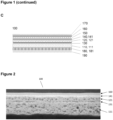
- FIG. 1C illustrates a cross-section of a multilayer PVC floor covering (100) manufactured according an embodiment of the invention.
- the multilayer PVC floor covering (100) comprises, from top to bottom: a lacquer layer (170), a wear layer (160), a print layer (150), a decorative layer which may be optionally foamed (140, 141), an expanded second film comprising recycled PVC (121), an intermediate layer (130) comprising a glass fibre or PET layer (131), an expanded first film comprising recycled PVC (111), and (optionally) a backing layer (180) (optionally) comprising recycled PVC, and optionally a needle felt layer (190).
- the entire multilayer PVC floor covering (100) comprises a percentage of recycled PVC calculated as follows: sum of the weight of recycled PVC in all layers, divided by the total weight of the multilayer PVC floor covering (100).
- FIG. 2 illustrates a microscopic view of a transversal section of a multilayer PVC floor covering intermediate sheet (101) manufactured according to an embodiment of the invention.
- the multilayer cushion vinyl floor covering intermediate sheet (101) comprises an intermediate layer that consists of a glass fibre (131)).
- the multilayer PVC floor covering intermediate sheet (101) comprises an expanded first film (111) on one side of the intermediate layer and an expanded second film (121) on the other side of the intermediate layer.
- the multilayer PVC floor covering intermediate sheet (101) also comprises an expanded decorative layer (141) and a wear layer (160) on top of the decor layer(141).
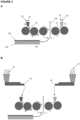
- FIG. 3 illustrates a schematic view of steps a)-d) of method according to an embodiment of the invention.
- a resin means one resin or more than one resin.
- endpoints includes all integer numbers and, where appropriate, fractions subsumed within that range (e.g., 1 to 5 can include 1, 2, 3, 4 when referring to, for example, a number of elements, and can also include 1.5, 2, 2.75 and 3.80, when referring to, for example, measurements).
- the recitation of end points also includes the end point values themselves (e.g., from 1.0 to 5.0 includes both 1.0 and 5.0). Any numerical range recited herein is intended to include all sub-ranges subsumed therein.
- percentages are percentages by weight, based on the total weight of the composition or article referred to.
- a composition comprising 50.0% PVC refers to 50.0 wt% PVC based on the total weight of the composition.
- a floor covering comprising 50.0% PVC refers to 50.0 wt% PVC based on the total weight of the floor covering, including all layers.
- the present invention relates to a method for manufacturing a multilayer PVC floor covering intermediate sheet, the multilayer PVC floor covering intermediate sheet comprising recycled PVC material.
- the method preferably comprises the steps of:
- PVC floor covering may also be referred to as "a floor covering comprising PVC", or “sheet vinyl” or “flexible vinyl”.
- the method comprises the steps of:
- the method preferably comprises the steps of:
- the second batch of recycled PVC material is not mixed with a second blowing agent.
- the method comprises the steps of:
- the methods as disclosed herein in step c1) the first blend is extruded below the decomposition temperature of the first blowing agent T d1 , to form a first extrudate and in step d1) said first extrudate is processed (preferably calendered) below the decomposition temperature of the first blowing agent T d1 , to form the first film.
- the methods as disclosed herein in step c2) the second blend is extruded below the decomposition temperature of the second blowing agent T d2 , to form a second extrudate and in step d2) said second extrudate is processed (preferably calendered) below the decomposition temperature of the second blowing agent T d2 , to form the second film.
- the method comprises the steps of:
- the method comprises the steps of:
- the method preferably comprises the steps of:
- the processing of the first or second mixture or of the first or second extrudate in steps d1) or d2) can be performed by any technology that results in the formation of a film.
- the processing of the first or second mixture or of the first or second extrudate in steps d1) or d2) is performed using calendering technology or double-belt press technology. In some preferred embodiments, calendering technology is used.
- the method comprises the steps of:
- the method comprises the steps of:
- the method preferably comprises the steps of:
- the method comprises the steps of:
- the method comprises the steps of:
- the method preferably comprises the steps of:
- the first batch of recycled PVC material has the same source and/or composition as the second batch of recycled PVC material. In some embodiments, the first batch of recycled PVC material has a different source and/or composition as the second batch of recycled PVC material.
- the recycled PVC material comprises at least 20% recycled PVC, based on the total weight of the recycled PVC material. In some preferred embodiments, the recycled PVC material comprises at least 30% recycled PVC, based on the total weight of the recycled PVC material, preferably at least 40% recycled PVC, more preferably at least 50% recycled PVC, more preferably at least 60% recycled PVC. For example, the recycled PVC material may comprise 20%, 30%, 40%, or 50% recycled PVC based on the total weight of the recycled PVC material.
- the recycled PVC material comprises recycled PVC and one or more other compounds, such as fillers and/or plasticizers.
- the multilayer PVC floor covering intermediate sheet or the multilayer PVC floor covering comprises at least 50% recycled PVC material, based on the total weight of the multilayer PVC floor covering intermediate sheet or the multilayer PVC floor covering, preferably at least 60% recycled PVC material, preferably at least 70% recycled PVC material, more preferably at least 80% recycled PVC material, even more preferably at least 90% recycled PVC material, such as for example 90%, or 95% or 98% recycled PVC material.
- the multilayer PVC floor covering intermediate sheet or the multilayer PVC floor covering comprises at least 50% total recycled content, based on the total weight of the multilayer PVC floor covering intermediate sheet or the multilayer PVC floor covering, preferably at least 60% total recycled content, preferably at least 70% total recycled content, more preferably at least 80% total recycled content, even more preferably at least 90% total recycled content, such as for example 90%, or 95% or 98% total recycled content.
- the entire multilayer PVC floor covering comprises a percentage of recycled PVC material calculated as follows: sum of the weight of recycled PVC material in the expanded first film, in the expanded second film, and in the backing layer, divided by the total weight of the multilayer PVC floor covering.
- the first film comprises at least 50% recycled PVC material, based on the total weight of the first film, preferably at least 60% recycled PVC material, preferably at least 70% recycled PVC material, more preferably at least 80% recycled PVC material, even more preferably at least 90% recycled PVC material, such as for example at least 95% or at least 98% recycled PVC material.
- the second film comprises at least 50% recycled PVC material, based on the total weight of the second film, preferably at least 60% recycled PVC material, preferably at least 70% recycled PVC material, more preferably at least 80% recycled PVC material, even more preferably at least 90% recycled PVC material, such as for example at least 95% or at least 98% recycled PVC material.
- the first and second film each comprise at least 50% recycled PVC material, based on the total weight of the first or second film respectively, preferably at least 60% recycled PVC material, preferably at least 70% recycled PVC material, more preferably at least 80% recycled PVC material, even more preferably at least 90% recycled PVC material, such as for example at least 95% or at least 98% recycled PVC material.
- the first and/or second film each comprise at least 50% total recycled content, based on the total weight of the first and/or second film respectively, preferably at least 60% total recycled content, preferably at least 70% total recycled content, more preferably at least 80% total recycled content, even more preferably at least 90% total recycled content, such as for example at least 95% or at least 98% total recycled content.
- blowing agent and “foaming agent” may be used interchangeable, and refer to a chemical substance or mixture that is capable of generating gas, typically carbon dioxide, nitrogen, or water vapor, within a polymer matrix or other material, resulting in the formation of a cellular structure.
- This cellular structure also referred to as foam, reduces the density of the material and provides desirable properties such as thermal and acoustic insulation, cushioning, and impact resistance.
- the blowing agent is preferably activated by heat.
- the first blowing agent is the same as the second blowing agent. In some embodiments, the first blowing agent is different from the second blowing agent. In some embodiments, the decomposition temperature T d1 is the same as the decomposition temperature T d2 .
- the first and/or second blowing agent is selected from the group comprising: azodicarbonamide (AZO), 4,4-oxy-bis(benzenesulfonylhydrazide) (OBSH), P-toluenesulfonyl-hydrazide (TSH), P-tolyenesulfonylsemicarbazide (PTSS), dinitrosopentamethylenetetramine (DNPT), sodium bicarbonate, 5-phenyltetrazole (PT), or any combinations thereof; preferably the first and/or second blowing agent is AZO.
- AZO azodicarbonamide
- OBSH 4,4-oxy-bis(benzenesulfonylhydrazide)
- TSH P-toluenesulfonyl-hydrazide
- PTSS P-tolyenesulfonylsemicarbazide
- DNPT dinitrosopentamethylenetetramine
- PT sodium bicarbon
- the decomposition temperatures T d1 and/or T d2 are higher than the working temperatures in steps c1), c2), d1), and d2). In some embodiments, the decomposition temperatures T d1 is higher than the working temperatures in steps c1), c2), d1), and d2). In some embodiments, the decomposition temperatures T d1 and T d2 are higher than the working temperatures in steps c1), c2), d1), and d2).
- the decomposition temperatures T d1 and/or T d2 are at least 5°C higher than the working temperatures in steps c1), c2), d1), and d2), preferably at least 10°C higher, preferably at least 15°C higher, for example at least 20°C higher.
- the first and/or second films are essentially free from kickers. In some embodiments, the blowing agent does not comprise a kicker.
- kicker refers to a chemical substance or mixture that is used in combination with the blowing agent to promote the reaction that generates gas within the material. In the presence of a kicker, the activation temperature or decomposition temperature of a blowing agent is lowered. Examples of kickers include catalysts, activators, initiators, accelerators, and crosslinkers.
- the inventors have found that if a kicker is added to the blowing agent, the blend may already start foaming in (or after) the extruder. Since the film forming process, such as the calendering process still needs to take place, it will degenerate the foam structure that has already been formed, resulting in a compact film that has lost all advantageous properties of the foam. In the absence of a kicker, the decomposition temperature of the blowing agent remains higher, and activation will not yet occur in the extruder or calender, allowing the film to start activation only in a later stage in the process, thereby fully maintaining the foam structure.
- the first and/or second films comprise a kicker.
- the blowing agent comprises a kicker.
- the method comprises the step of adhering further layers to the first film and/or the second film, thereby forming a multilayer PVC floor covering.
- step e) comprises the step of adhering further layers to the first film and/or the second film, to form a multilayer structure, prior to performing step f).
- the method comprises the step of adhering a decorative layer to the first film or the second film.
- step e) comprises the step of adhering a decorative layer to the first film or the second film, to form a multilayer structure, prior to performing step f).
- the floor covering or floor covering intermediate sheet may comprise a decorative layer.
- the term "decorative layer”, “décor layer”, “decorative sheet”, or “decorative film” refers to a layer to which a print layer or print pattern can be applied.
- the decorative layer is typically white.
- the decorative layer comprises PVC and one or more plasticizers.
- the decorative layer comprises recycled PVC material.
- a print layer or a print pattern is printed to the decorative layer.
- the printing layer or printing pattern is printed on the second film.
- a white layer may be printed as an alternative to providing a decorative layer.
- the printing layer or printing pattern can for example be applied to the decorative layer by rotogravure, digital printing, etc.
- a wear layer is applied on the printing layer or the printing pattern that is printed on the decorative layer or on the second film.
- high transparency and lack of own colour are preferred features.
- Such a film allows to protect a printed layer from wearing out. Lack of base film colour is important to obtain a design without any colour deviations.
- the wear layer and/or the decorative layer comprise PVC.
- the method thus comprises the step of adhering a print layer or a print pattern to the decorative layer or to the second film.
- step e) comprises the step of adhering a print layer or print pattern to the decorative layer or to the second film, to form a multilayer structure, prior to performing step f).
- the method thus comprises the step of adhering a wear layer to the print layer or print pattern.
- step e) comprises the step of adhering a wear layer to the print layer or print pattern, to form a multilayer structure, prior to performing step f).
- a lacquer layer is applied onto the wear layer prior to or after manufacturing of the floor covering according to the invention.
- the lacquer layer may be seen as an additional layer, or as part of the decorative layer.
- the lacquer layer may be a polyurethane (PU) lacquer layer.
- a lacquer layer may enhance scratch resistance, peeling resistance, UV resistance, and/or reduce gloss.
- the method comprises the step of adhering a backing layer to the first film or the second film.
- step e) comprises the step of adhering a backing layer to the first film or the second film, to form a multilayer structure, prior to performing step f).
- the backing layer is adhered to the first film.
- backing layer refers to a layer that may be used as a backing.
- the backing layer is preferably not a calendered layer.
- the backing layer may comprise an additional PVC based layer, optionally foamed.
- the floor covering may comprise a non-woven layer, such as a non-woven polyester layer, PVC based layer, polypropylene based layer, in addition to the backing layer.
- the backing layer may comprise additional sublayers as a back print.
- Non-woven polyester backing layers of any desired density and colour are very well known by those skilled in the art.
- non-woven refers to a sheet of fibres, continuous filaments, or chopped yams of any nature or origin, that have been formed into a web by any means, and bonded together by any means.
- Composite structures may be considered non-woven provided their mass is constituted of at least 50% of non-woven as per to the above definition, or if the non-woven component plays a prevalent role.
- the method comprises the step of adhering a needle felt layer to the backing layer.
- step e) comprises the step of adhering a needle felt layer to the backing layer, to form a multilayer structure, prior to performing step f).
- the presence of the needle felt layer provides several advantages, such as improved acoustic properties and no need to use an adhesive for installation of the floor covering.
- the intermediate layer may act as a carrier or substrate material for the first film and the second film.
- the carrier or substrate material becomes a core layer of the product and may serve two main purposes:
- the intermediate layer may comprise any material, such as a thermoplastic polymer that has a melting temperature that is higher than the melting temperature of the recycled polyvinyl material, or a thermoplastic polymer that has a melting temperature that is higher than the melting temperature of the first film and higher than the melting temperature of the second film, for example at least 160°C.
- the intermediate layer comprises material selected from the group comprising: glass fibres, polyamides, or polyesters, such as PET.
- the intermediate layer comprises glass fibres or PET.
- the intermediate layer comprises multiple materials, such as glass fibres combined with paper pulp, or a blend of paper, glass, and polyester glass.
- the intermediate layer comprises a continuous layer, such as a glass fibre webbing. In some embodiments, the intermediate layer comprises a discontinuous layer, such individually dispersed glass fibres, which are adhered to the first and/or second film.
- the intermediate layer preferably a continuous or dispersed glass fibre layer, has a weight of at least 5 g/m 2 to at most 100 g/m 2 , preferably at least 10 g/m 2 to at most 60 g/m 2 , preferably at least 20 g/m 2 to at most 40 g/m 2 , for example about 30 g/m 2 .
- the intermediate layer preferably a continuous or dispersed glass fibre layer, has a thickness of at least 0.05 mm to at most 0.80 mm, preferably at least 0.10 mm to at most 0.60 mm, preferably at least 0.20 mm to at most 0.40 mm, for example about 0.28 mm.
- the intermediate layer preferably a continuous or dispersed glass fibre layer, has an air permeability of at least 0 l/m 2 .s to at most 15 000 l/m 2 .s.
- the glass fibres have a length of at least 4 mm to at most 12 mm, preferably at least 6 mm to at most 10 mm, for example about 8 mm.
- the glass fibres have a diameter of at least 4 ⁇ m to at most 20 ⁇ m, preferably at least 6 ⁇ m to at most 18 ⁇ m, for example about 12 ⁇ m.
- the intermediate layer is impregnated with a binder.
- the intermediate layer comprises at least 0% to at most 40% by weight binder, based on the total weight of the intermediate layer, preferably at least 10% by weight to at most 30% by weight, for example about 20% by weight.
- the method preferably comprises the step of: a) providing a first batch of recycled PVC material and a second batch of recycled PVC material.
- the recycled PVC material may come from mechanical recycled PVC waste, such as from flooring, windows, and/or cables.
- the preparation of the recycled PVC material occurs at ambient temperature.
- the preparation of the recycled PVC material is done by mechanical recycling, thereby generating the recycled PVC material as shredded material, as pellets or as powder.
- the recycled PVC material is in the form of a powder, preferably a powder with a microparticle size between 10-1000 ⁇ m.
- the preparation of the recycled PVC material is done by chemical recycling.
- the origin of the recycled PVC material is post-industrial waste, pre-consumer waste (before/after installation), post-consumer waste, flooring waste, waste from cables or window profiles.
- the first and second blends are extruded together with the blowing agent to form a first and second extrudate. In some preferred embodiments, extrusion will be done with granules of the first and second blend. In some further embodiments, the blowing agent and the first and/or second blend are mixed together to form the granule. In some other embodiments, the first and/or second blends are prepared as granules and are together with the blowing agent, which is not part of the granules, provided to the extruder.
- the blend of recycled PVC material may be granulated, shredded, and/or powdered into fragments that are smaller than the original size of the recycled PVC material.
- the blend may be powdered into micronized powder.
- the granulated recycled PVC material may be densified into pelletized recycled PVC material.
- the blend may be enriched with virgin material, such as PVC, filler, and plasticizer; and/or may be enriched with additives.
- the method preferably comprises the steps of: b1) mixing the first batch of recycled PVC material with a first blowing agent, the first blowing agent having a predetermined decomposition temperature Td1, to form a first blend; and b2) optionally, mixing the second batch of recycled PVC material with a second blowing agent, the second blowing agent having a predetermined decomposition temperature T d2 , to form a second blend.
- the mixing step involves dosing the correct weight percentages and distributing them homogeneously with a hot/cold mixer.
- the blend is mixed to a temperature of 120°C and cooled back to room temperature.
- the method preferably comprises the steps of: c1) mixing and melting, preferably extruding, the first blend, below the decomposition temperature of the first blowing agent T d1 , to form a first mixture, preferably a first extrudate; and c2) mixing and melting, preferably extruding the second batch of recycled polyvinyl material or the second blend, below the decomposition temperature of the second blowing agent T d2 if present, to form a second mixture, preferably a second extrudate.
- the working temperature in steps c1) and/or c2) is preferably from at least 150°C to at most 190°C, for example to at most 185°C, for example to at most 180°C, for example to at most 175°C, for example to at most 170°C.
- the decomposition temperatures T d1 and/or T d2 are higher than the working temperatures in steps c1) and c2).
- the first and/or second extrudate may be pelletised.
- the pellets may be stored and/or transported prior to performing steps d1) and/or d2).
- steps d1) and or d2) are performed on previously formed pellets.
- the process may be a continuous process or a discontinuous process.
- the method preferably comprises the steps of: d1) processing, preferably calendering, the first mixture or extrudate, below the decomposition temperature of the first blowing agent T d1 , to form a first film; d2) processing, preferably calendering, the second mixture or extrudate, below the decomposition temperature of the second blowing agent T d2 if present, to form a second film.
- the processing steps d1) and/or d2) are preferably pressing steps, preferably calendering steps; even though other pressing methods may be suitable as well.
- the working temperature in steps d1) and/or d2) is preferably at least 160°C, but below the decomposition temperature T d1 and/or T d2 .
- the decomposition temperatures T d1 and/or T d2 are higher than the working temperatures in steps d1) and d2).
- the thickness of the films is defined by the parameters of the process, such as the calendering process, in particular by the slit opening of the calender rolls.
- the first and/or second mixture may be pelletised.
- the pellets may be stored and/or transported prior to performing steps d1) and/or d2).
- steps d1) and or d2) are performed on previously formed pellets.
- the process may be a continuous process or a discontinuous process.
- the method preferably comprises the step of: e) adhering the first film to one side of an intermediate layer, and the second film to the opposing side of the intermediate layer, thereby forming a multilayer structure.
- This step may be performed using lamination rolls or cooling rolls.
- the two calendered films or layers are laminated to the glass fibre by high temperature and pressure of the laminating rolls.
- the method preferably comprises the step of: f) heating the multilayer structure to a temperature that is higher than decomposition temperature T d1 and higher than the decomposition temperature T d2 , thereby causing the first film and the second film to expand.
- step f) the first blowing agent is decomposed, resulting in a foamed structure, with increased layer thickness of the first film.
- step f) when present, the second blowing agent is decomposed, resulting in a foamed structure, with increased layer thickness of the second film.
- step f) is performed in an oven, such as a thermal-oil oven, or an infrared-heated oven. In a preferred embodiment, step f) is performed in a thermal-oil oven.
- the temperature in step f) is at least 1°C higher than T d1 , and at least 1°C higher than T d2 if a second blowing agent is present; preferably at least 2°C higher, preferably at least 5°C higher, preferably at least 10°C higher.
- the temperature in step f) is at least 180°C to at most 210°C, for example at least 190°C to at most 200°C, for example about 195°C.
- the temperature in step f) is lower than the melting temperature of the recycled PVC material. In some embodiments, the temperature in step f) is lower than the melting temperature of the first film. In some embodiments, the temperature in step f) is lower than the melting temperature of the second film. In some embodiments, the temperature in step f) is lower than the melting temperature of the first film and lower than the melting temperature of the second film.
- a multilayer PVC floor covering is formed after step f) of the methods as disclosed herein.
- the multilayer PVC floor covering comprises at least a backing layer, a first film, an intermediate layer, and a second layer, preferably also a print layer or print pattern and a wear layer.
- the multilayer PVC floor covering further comprises a decorative layer, a lacquer layer and/or a needle felt layer.
- the final blow ratio may be at least 2.0, preferably at least 2.5, for example at least 3.0 for example at most 4.0.
- the decorative layer is adhered using a knife over roll or a roll over roll or a reverse roll coating method using plastisol as PVC compound.
- the decorative layer is adhered at a gelling drum temperature of at least 140°C to at most 170°C.
- the decorative layer is adhered with a plastisol temperature at coating of at least 24°C to at most 35°C.
- the decorative layer is adhered with tension of substrate of at least 500 N/m to at most 2000 N/m.
- the decorative layer is adhered with a line speed of at least 5 m/min to at most 50 m/min.
- the decorative layer is adhered with push roll pressure of at least 3 bar to at most 10 bar.
- the wear layer is adhered using a knife over roll or a roll over roll or a reverse roll coating method using a PVC plastisol.
- the wear layer is adhered at a gelling drum temperature of at least 140°C to at most 170°C.
- the wear layer is adhered with a plastisol temperature at coating of at least 24°C to at most 35°C.
- the wear layer is adhered with tension of substrate of at least 500 N/m to at most 2000 N/m.
- the wear layer is adhered with a line speed of at least 5 m/min to at most 50 m/min.
- the wear layer is adhered with push roll pressure of at least 3 bar to at most 10 bar.
- the backing layer is adhered in an oven, preferably an oven with adjustable zones, for example an oven with 7 adjustable zones or more, such as 14 adjustable zones.
- the backing layer is adhered using a knife over roll or a roll over roll or a reverse roll coating method.
- the backing layer is adhered at a gelling drum temperature of at least 140°C to at most 170°C.
- the backing layer is adhered with a plastisol temperature at coating of at least 24°C to at most 35°C.
- the backing layer is adhered with tension of substrate of at least 500 N/m to at most 2000 N/m.
- the backing layer is adhered with a line speed of at least 5 m/min to at most 50 m/min.
- the backing layer is adhered with push roll pressure of at least 3 bar to at most 10 bar.
- the invention in a second aspect, relates to an apparatus or production line for manufacturing a multilayer PVC floor covering intermediate sheet or a multilayer PVC floor covering, wherein the apparatus or production line is configured for performing a method according to the first aspect, and (preferred) embodiments thereof.
- (Preferred) embodiments of the second aspect are also (preferred) embodiments of the first aspect, and vice versa.
- the apparatus or production line preferably comprises a section configured for mixing and melting the first and/or second blend.
- the apparatus or production line preferably comprises a first extruder and a second extruder, optionally also comprising a pelletiser.
- the apparatus or production line preferably comprises a section configured for processing the first and/or second mixture (preferably the first and/or second extrudate).
- the apparatus or production line preferably comprises calender rolls following the first extruder, for example 2 calender rolls.
- the apparatus or production line preferably comprises calender rolls following the second extruder, for example 2 or 3 calender rolls.
- the apparatus or production line preferably comprises a guiding system to a lamination point, preferably following the calender rolls.
- the apparatus or production line preferably comprises a lamination station, preferably configured to laminate the layers at the lamination point.
- the lamination station may comprise lamination rolls or cooling rolls.
- the invention in a third aspect, relates to a multilayer PVC floor covering intermediate sheet or a multilayer PVC floor covering obtained by the method according to the first aspect, and (preferred) embodiments thereof; or obtained by using the apparatus or production line according to the second aspect, and (preferred) embodiments thereof.
- (Preferred) embodiments of the third aspect are also (preferred) embodiments of the first aspect and/or the second aspect, and vice versa.
- the multilayer PVC floor covering intermediate sheet comprises:
- these 3 layers are the minimal number of layers. It is understood that various additional layers may be added, and/or that each of these layers may comprise various sublayers.
- the multilayer PVC floor covering intermediate sheet may also comprise a decorative layer, a print layer and/or a wear layer on one side of the PVC floor covering intermediate sheet, thereby forming the multilayer PVC floor covering.
- the multilayer PVC floor covering or multilayer PVC floor covering intermediate sheet may also comprise a backing layer on another side of the cushion vinyl floor covering.
- the PVC floor covering intermediate sheet or the PVC floor covering has a weight of at least 500 g/m 2 to at most 10000 g/m 2 , preferably at least 1000 g/m 2 to at most 5000 g/m 2 .
- the PVC floor covering intermediate sheet or the PVC floor covering has a thickness of at least 0.8 mm to at most 10 mm, preferably at least 0.8 mm to at most 4.10 mm.
- the PVC floor covering intermediate sheet and the PVC floor covering as disclosed herein are both compliant with any of the following standards (non-limitative list): EN ISO 24346 (total thickness), EN ISO 23997 (total weight), EN ISO 23999 (dimensional stability), EN ISO 23999 (curling), EN ISO 24343-1 (residual indentation), DIN 51130 (slip resistance).
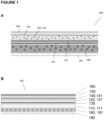
- FIG. 1A illustrates a cross-section of a multilayer cushion vinyl floor covering (100') manufactured according to the prior art.
- the multilayer cushion vinyl floor covering (100') comprises, from top to bottom: a wear layer (160), a print layer (150), a decorative layer which may be optionally foamed (140, 141), an intermediate layer (130) comprising a glass fibre (131) or PET layer and an impregnation layer (132) on the side of the decorative layer (140, 141), a backing layer (180), and optionally a needle felt layer (190).
- FIG. 1B illustrates a cross-section of a multilayer PVC floor covering (100) manufactured according an embodiment of the invention.
- the multilayer cushion vinyl floor covering (100) comprises, from top to bottom: a wear layer (160), a print layer (150), a decorative layer which may be optionally foamed (140, 141), an expanded second film comprising recycled PVC together with plasticizer, filler, additives (121), an intermediate layer (130) comprising a glass fibre or PET layer (131), an expanded first film comprising recycled PVC (111), and optionally, a backing layer (180) that can optionally comprise recycled PVC, and optionally a needle felt layer (190).
- the entire multilayer cushion vinyl floor covering (100) comprises a percentage of recycled PVC calculated as follows: sum of the weight of recycled PVC in all layers divided by the total weight of the multilayer PVC floor covering (100).
- FIG. 1C illustrates a cross-section of a multilayer PVC floor covering (100) manufactured according an embodiment of the invention.
- the multilayer PVC floor covering (100) comprises, from top to bottom: a lacquer layer (170), a wear layer (160), a print layer (150), a decorative layer which may be optionally foamed (140, 141), an expanded second film comprising recycled PVC (121), an intermediate layer (130) comprising a glass fibre or PET layer (131), an expanded first film comprising recycled PVC (111), and (optionally) a backing layer (180) (optionally) comprising recycled PVC, and optionally a needle felt layer (190).
- the entire multilayer PVC floor covering (100) comprises a percentage of recycled PVC calculated as follows: sum of the weight of recycled PVC in all layers, divided by the total weight of the multilayer PVC floor covering (100).
- FIG. 2 illustrates a microscopic view of a transversal section of a multilayer PVC floor covering intermediate sheet (101) manufactured according to an embodiment of the invention.
- the multilayer PVC floor covering intermediate sheet (101) comprises an intermediate layer (130) that consists of a glass fibre layer (131).
- the multilayer PVC floor covering intermediate sheet (101) further comprises a first film (111) and a second film (121) that are adhered to the glass fibre intermediate layer (131) by calendering the two films onto the glass fibre using pressure and heat.
- a decorative layer (141) and a wear layer (160) were then adhered to the second film (121) using knife-over-roll coating.
- the multilayer structure was placed in an oven at a temperature between 195°C to 210°C to expand/foam the first film and the second film and the decorative layer; thereby forming a multilayer structure (100) comprising an expanded first film (111) on one side of the intermediate layer (131) and an expanded second film (121), and expanded decorative layer (141) and a wear layer (160) on the other side of the intermediate layer (131).
- the decor layer is foamed simultaneously with the other layers in the oven.
- FIG. 3 illustrates a schematic view of steps a)-d) of method according to an embodiment of the invention.
- a first batch of recycled PVC material (10) is mixed with a first blowing agent (51) to form a first blend (12).
- This first blend (12) is extruded to form a first extrudate (14), for example with a diameter of 8 cm.
- This first extrudate (14) is calendered over 2 rolls to form a first film (110) and guided to a lamination point.
- a second batch of recycled PVC material (20) is mixed with a second blowing agent (52) to form a second blend (22).
- This second blend (22) is extruded to form a second extrudate (24), for example also with a diameter of 8 cm.
- This second extrudate (24) is calendered over 3 rolls to form a second film (120) and guided to a lamination point. At the lamination point, the first film (110) and the second film (120) are laminated onto the intermediate layer (130). The lamination may be assisted by using lamination rolls or cooling rolls (not illustrated in FIG. 3 ).
- FIG. 3A illustrates how the blends (12,22) are formed in the extruders by feeding the blowing agents (51,52) and recycled PVC material (10,20) separately to the extruders.
- FIG. 3B illustrates how premixed blends (12,22), already comprising the blowing agent and recycled material, may be fed directly into the extruders. The first extrudate and the second extrudate go directly into the calender bank.
- FIG. 3 illustrates a vertical process
- any other angle may be used, for example a horizontal process is also possible.
- glass fibres or filaments may be scattered on the first or second film to form a discontinuous intermediate layer, after which the other of the first or second film is laminated on top.
Landscapes
- Engineering & Computer Science (AREA)
- Mechanical Engineering (AREA)
- Laminated Bodies (AREA)
- Extrusion Moulding Of Plastics Or The Like (AREA)
Priority Applications (3)
| Application Number | Priority Date | Filing Date | Title |
|---|---|---|---|
| EP23183315.3A EP4488028A1 (de) | 2023-07-04 | 2023-07-04 | Verfahren zur herstellung eines pvc-basierten bodenbelags |
| CN202480044536.5A CN121419874A (zh) | 2023-07-04 | 2024-07-04 | 用于制造基于pvc的地板覆盖物的方法 |
| PCT/EP2024/068801 WO2025008437A1 (en) | 2023-07-04 | 2024-07-04 | Method for manufacturing a pvc based floor covering |
Applications Claiming Priority (1)
| Application Number | Priority Date | Filing Date | Title |
|---|---|---|---|
| EP23183315.3A EP4488028A1 (de) | 2023-07-04 | 2023-07-04 | Verfahren zur herstellung eines pvc-basierten bodenbelags |
Publications (1)
| Publication Number | Publication Date |
|---|---|
| EP4488028A1 true EP4488028A1 (de) | 2025-01-08 |
Family
ID=87136929
Family Applications (1)
| Application Number | Title | Priority Date | Filing Date |
|---|---|---|---|
| EP23183315.3A Withdrawn EP4488028A1 (de) | 2023-07-04 | 2023-07-04 | Verfahren zur herstellung eines pvc-basierten bodenbelags |
Country Status (3)
| Country | Link |
|---|---|
| EP (1) | EP4488028A1 (de) |
| CN (1) | CN121419874A (de) |
| WO (1) | WO2025008437A1 (de) |
Citations (6)
| Publication number | Priority date | Publication date | Assignee | Title |
|---|---|---|---|---|
| US20010016244A1 (en) * | 1994-02-09 | 2001-08-23 | Preston Lynn E. | Process of recycling waste polymeric material and an article utilizing the same |
| WO2002002310A1 (en) * | 2000-06-29 | 2002-01-10 | Interface, Inc. | Process for manufacturing flooring using recycled materials |
| CA2340555A1 (en) * | 2000-07-21 | 2002-01-21 | Collins & Aikman Floorcoverings, Inc. | A process for manufacturing a floor covering having a foamed backing formed from recycled polymeric material |
| WO2002102582A2 (en) * | 2001-06-15 | 2002-12-27 | Interface, Inc. | Floor covering with woven face |
| EP2727725A1 (de) * | 2012-10-31 | 2014-05-07 | Tarkett GDL S.A. | Kostengünstiger synthetischer Fußbodenbelag |
| US20230158772A1 (en) * | 2020-04-29 | 2023-05-25 | Kcc Glass Corporation | Multilayered Flooring Decorative Material |
-
2023
- 2023-07-04 EP EP23183315.3A patent/EP4488028A1/de not_active Withdrawn
-
2024
- 2024-07-04 CN CN202480044536.5A patent/CN121419874A/zh active Pending
- 2024-07-04 WO PCT/EP2024/068801 patent/WO2025008437A1/en active Pending
Patent Citations (6)
| Publication number | Priority date | Publication date | Assignee | Title |
|---|---|---|---|---|
| US20010016244A1 (en) * | 1994-02-09 | 2001-08-23 | Preston Lynn E. | Process of recycling waste polymeric material and an article utilizing the same |
| WO2002002310A1 (en) * | 2000-06-29 | 2002-01-10 | Interface, Inc. | Process for manufacturing flooring using recycled materials |
| CA2340555A1 (en) * | 2000-07-21 | 2002-01-21 | Collins & Aikman Floorcoverings, Inc. | A process for manufacturing a floor covering having a foamed backing formed from recycled polymeric material |
| WO2002102582A2 (en) * | 2001-06-15 | 2002-12-27 | Interface, Inc. | Floor covering with woven face |
| EP2727725A1 (de) * | 2012-10-31 | 2014-05-07 | Tarkett GDL S.A. | Kostengünstiger synthetischer Fußbodenbelag |
| US20230158772A1 (en) * | 2020-04-29 | 2023-05-25 | Kcc Glass Corporation | Multilayered Flooring Decorative Material |
Also Published As
| Publication number | Publication date |
|---|---|
| WO2025008437A1 (en) | 2025-01-09 |
| CN121419874A (zh) | 2026-01-27 |
Similar Documents
| Publication | Publication Date | Title |
|---|---|---|
| US12180720B2 (en) | Floor panel for forming a floor covering | |
| JP7280669B2 (ja) | 再循環された架橋ポリオレフィンフォーム材料からの同時押出された架橋多層ポリオレフィンフォーム構造体の製造方法 | |
| US5407617A (en) | Method of forming latex-, PVC- and plasticizer-free foamed floor or wall coverings | |
| JP2005519178A (ja) | ポリプロピレンフォーム及びフォームコアの構造体 | |
| EP3802105A1 (de) | Co-schäumbare pvc-plastisol-zusammensetzung und co-geschäumte pvc-schicht für bodenbeläge | |
| CN116442618A (zh) | 一种装饰板及其制造方法 | |
| JP2002524299A (ja) | 発泡した配向可能な熱可塑性ポリマーから成る二軸配向性フィルムを製造する方法 | |
| CN114133713A (zh) | 一种PET基材及其制备方法和PET基Non-PVC弹性地板及其制备方法 | |
| EP4488028A1 (de) | Verfahren zur herstellung eines pvc-basierten bodenbelags | |
| JP3915555B2 (ja) | 木質樹脂発泡成形体及び化粧材 | |
| WO2025238235A1 (en) | Floor covering comprising recycled pvc and method for the manufacture of such covering | |
| JP3814091B2 (ja) | 木目調低発泡樹脂組成物及び木目模様形成建材 | |
| EP3817921B1 (de) | Verfahren zur bereitstellung eines pvc bodenbelags | |
| JP2007210339A (ja) | 被覆シート付発泡樹脂押出成形体の製造方法 | |
| JP4123915B2 (ja) | 木質樹脂発泡成形体及び化粧材 | |
| KR100982359B1 (ko) | 천연 또는 합성 섬유와 발포층이 조화된 바닥재 | |
| JP3172281B2 (ja) | 自動車用内装材の製造法 | |
| KR102681591B1 (ko) | 다층 적층물 및 이를 포함하는 차량용 내장재 | |
| JP2003112354A (ja) | 被覆シート付発泡樹脂押出成形体の製造方法 | |
| JP4573612B2 (ja) | 壁紙及びその製造方法 | |
| JP2002301781A (ja) | プラスチック複合パネルおよびその製造方法 | |
| JPS62212137A (ja) | 成形用複合材及びその製造方法 | |
| JP2002019046A (ja) | 表皮材付き成形用熱可塑性樹脂シート及び所定形状を有する表皮材付き熱可塑性樹脂発泡成形体 |
Legal Events
| Date | Code | Title | Description |
|---|---|---|---|
| PUAI | Public reference made under article 153(3) epc to a published international application that has entered the european phase |
Free format text: ORIGINAL CODE: 0009012 |
|
| STAA | Information on the status of an ep patent application or granted ep patent |
Free format text: STATUS: THE APPLICATION HAS BEEN PUBLISHED |
|
| AK | Designated contracting states |
Kind code of ref document: A1 Designated state(s): AL AT BE BG CH CY CZ DE DK EE ES FI FR GB GR HR HU IE IS IT LI LT LU LV MC ME MK MT NL NO PL PT RO RS SE SI SK SM TR |
|
| STAA | Information on the status of an ep patent application or granted ep patent |
Free format text: STATUS: THE APPLICATION IS DEEMED TO BE WITHDRAWN |
|
| 18D | Application deemed to be withdrawn |
Effective date: 20250709 |