EP4485138A1 - Batteriepack, elektronische vorrichtung, kommunikationssystem und kommunikationsverfahren - Google Patents
Batteriepack, elektronische vorrichtung, kommunikationssystem und kommunikationsverfahren Download PDFInfo
- Publication number
- EP4485138A1 EP4485138A1 EP23803280.9A EP23803280A EP4485138A1 EP 4485138 A1 EP4485138 A1 EP 4485138A1 EP 23803280 A EP23803280 A EP 23803280A EP 4485138 A1 EP4485138 A1 EP 4485138A1
- Authority
- EP
- European Patent Office
- Prior art keywords
- electronic device
- battery
- communicator
- battery pack
- power
- Prior art date
- Legal status (The legal status is an assumption and is not a legal conclusion. Google has not performed a legal analysis and makes no representation as to the accuracy of the status listed.)
- Pending
Links
Images



Classifications
-
- H—ELECTRICITY
- H04—ELECTRIC COMMUNICATION TECHNIQUE
- H04W—WIRELESS COMMUNICATION NETWORKS
- H04W4/00—Services specially adapted for wireless communication networks; Facilities therefor
- H04W4/80—Services using short range communication, e.g. near-field communication [NFC], radio-frequency identification [RFID] or low energy communication
-
- H—ELECTRICITY
- H02—GENERATION; CONVERSION OR DISTRIBUTION OF ELECTRIC POWER
- H02J—ELECTRIC POWER NETWORKS; CIRCUIT ARRANGEMENTS OR SYSTEMS FOR SUPPLYING OR DISTRIBUTING ELECTRIC POWER; SYSTEMS FOR STORING ELECTRIC ENERGY
- H02J7/00—Circuit arrangements for charging or discharging batteries or for supplying loads from batteries
- H02J7/855—Circuit arrangements for charging or discharging batteries or for supplying loads from batteries with circuits adapted for supplying loads from the battery
-
- H—ELECTRICITY
- H01—ELECTRIC ELEMENTS
- H01M—PROCESSES OR MEANS, e.g. BATTERIES, FOR THE DIRECT CONVERSION OF CHEMICAL ENERGY INTO ELECTRICAL ENERGY
- H01M10/00—Secondary cells; Manufacture thereof
- H01M10/42—Methods or arrangements for servicing or maintenance of secondary cells or secondary half-cells
- H01M10/425—Structural combination with electronic components, e.g. electronic circuits integrated to the outside of the casing
-
- H—ELECTRICITY
- H02—GENERATION; CONVERSION OR DISTRIBUTION OF ELECTRIC POWER
- H02J—ELECTRIC POWER NETWORKS; CIRCUIT ARRANGEMENTS OR SYSTEMS FOR SUPPLYING OR DISTRIBUTING ELECTRIC POWER; SYSTEMS FOR STORING ELECTRIC ENERGY
- H02J7/00—Circuit arrangements for charging or discharging batteries or for supplying loads from batteries
- H02J7/40—Circuit arrangements for charging or discharging batteries or for supplying loads from batteries characterised by the exchange of charge or discharge related data
-
- H—ELECTRICITY
- H04—ELECTRIC COMMUNICATION TECHNIQUE
- H04B—TRANSMISSION
- H04B5/00—Near-field transmission systems, e.g. inductive or capacitive transmission systems
- H04B5/40—Near-field transmission systems, e.g. inductive or capacitive transmission systems characterised by components specially adapted for near-field transmission
- H04B5/43—Antennas
-
- H—ELECTRICITY
- H04—ELECTRIC COMMUNICATION TECHNIQUE
- H04B—TRANSMISSION
- H04B5/00—Near-field transmission systems, e.g. inductive or capacitive transmission systems
- H04B5/70—Near-field transmission systems, e.g. inductive or capacitive transmission systems specially adapted for specific purposes
- H04B5/79—Near-field transmission systems, e.g. inductive or capacitive transmission systems specially adapted for specific purposes for data transfer in combination with power transfer
-
- G—PHYSICS
- G06—COMPUTING OR CALCULATING; COUNTING
- G06F—ELECTRIC DIGITAL DATA PROCESSING
- G06F1/00—Details not covered by groups G06F3/00 - G06F13/00 and G06F21/00
- G06F1/16—Constructional details or arrangements
- G06F1/1613—Constructional details or arrangements for portable computers
- G06F1/1632—External expansion units, e.g. docking stations
-
- G—PHYSICS
- G06—COMPUTING OR CALCULATING; COUNTING
- G06F—ELECTRIC DIGITAL DATA PROCESSING
- G06F1/00—Details not covered by groups G06F3/00 - G06F13/00 and G06F21/00
- G06F1/26—Power supply means, e.g. regulation thereof
-
- H—ELECTRICITY
- H01—ELECTRIC ELEMENTS
- H01M—PROCESSES OR MEANS, e.g. BATTERIES, FOR THE DIRECT CONVERSION OF CHEMICAL ENERGY INTO ELECTRICAL ENERGY
- H01M10/00—Secondary cells; Manufacture thereof
- H01M10/42—Methods or arrangements for servicing or maintenance of secondary cells or secondary half-cells
- H01M10/425—Structural combination with electronic components, e.g. electronic circuits integrated to the outside of the casing
- H01M2010/4278—Systems for data transfer from batteries, e.g. transfer of battery parameters to a controller, data transferred between battery controller and main controller
-
- H—ELECTRICITY
- H01—ELECTRIC ELEMENTS
- H01M—PROCESSES OR MEANS, e.g. BATTERIES, FOR THE DIRECT CONVERSION OF CHEMICAL ENERGY INTO ELECTRICAL ENERGY
- H01M2220/00—Batteries for particular applications
- H01M2220/30—Batteries in portable systems, e.g. mobile phone, laptop
-
- H—ELECTRICITY
- H02—GENERATION; CONVERSION OR DISTRIBUTION OF ELECTRIC POWER
- H02J—ELECTRIC POWER NETWORKS; CIRCUIT ARRANGEMENTS OR SYSTEMS FOR SUPPLYING OR DISTRIBUTING ELECTRIC POWER; SYSTEMS FOR STORING ELECTRIC ENERGY
- H02J2207/00—Details of circuit arrangements for charging or discharging batteries or supplying loads from batteries
- H02J2207/10—Control circuit supply, e.g. means for supplying power to the control circuit
-
- Y—GENERAL TAGGING OF NEW TECHNOLOGICAL DEVELOPMENTS; GENERAL TAGGING OF CROSS-SECTIONAL TECHNOLOGIES SPANNING OVER SEVERAL SECTIONS OF THE IPC; TECHNICAL SUBJECTS COVERED BY FORMER USPC CROSS-REFERENCE ART COLLECTIONS [XRACs] AND DIGESTS
- Y02—TECHNOLOGIES OR APPLICATIONS FOR MITIGATION OR ADAPTATION AGAINST CLIMATE CHANGE
- Y02E—REDUCTION OF GREENHOUSE GAS [GHG] EMISSIONS, RELATED TO ENERGY GENERATION, TRANSMISSION OR DISTRIBUTION
- Y02E60/00—Enabling technologies; Technologies with a potential or indirect contribution to GHG emissions mitigation
- Y02E60/10—Energy storage using batteries
Definitions
- the present disclosure relates to a battery pack, an electronic device, a communication system, and a communication method.
- Patent Document 1 describes an electronic device that, when unlocking between a personal computer and a docker is detected, supplies power to a wireless communicator to enable wireless communication, and enables wireless communication with an external wireless device.
- Patent Document 1 JP-A-2002-108521
- Patent Document 1 has a problem that the wireless communication function cannot be used when the electronic device is powered off.
- the present disclosure provides a battery pack, an electronic device, an asset management system, and a method of managing an electronic device capable of using a communication function even when the electronic device is powered off.
- a battery pack is a battery pack mounted on an electronic device, the battery pack including: a battery that supplies power to the electronic device; a communicator that receives power from the battery and performs near field communication; and a setting storage that stores a setting related to power supply from the battery to the communicator, in which when the battery pack is connected to the electronic device, the communicator is supplied with power from the battery on the basis of the setting stored in the setting storage and performs near field communication.
- An electronic device is an electronic device capable of being driven by a battery, the electronic device including a battery pack including: a battery that supplies power to the electronic device; a communicator that receives power from the battery and performs near field communication; and a setting storage that stores a setting related to power supply from the battery to the communicator, in which when the battery pack is connected to the electronic device, the communicator is supplied with power from the battery on the basis of the setting stored in the setting storage and performs near field communication.
- a communication system includes: an electronic device; a battery pack that includes a battery that supplies power to the electronic device, a communicator that receives power from the battery and performs near field communication, and a setting storage that stores a setting related to power supply from the battery to the communicator, the battery pack being mounted on the electronic device; and an information processing terminal that includes a position information detector and performs near field communication with the communicator, in which the communicator is supplied with power from the battery on the basis of a setting stored in the setting storage when the electronic device and the battery pack are connected, and the information processing terminal detects a position of the electronic device on the basis of position information detected by the position information detector when performing near field communication with the communicator.
- a communication method is a communication method of a communication system including an information processing terminal and an electronic device, the communication method including the steps of: supplying power from a battery included in a battery pack to a communicator included in the battery pack on the basis of a setting stored in a setting storage included in the battery pack mounted on the electronic device; performing near field communication by the information processing terminal with the communicator of the battery pack; acquiring position information by the information processing terminal; and detecting a position of the electronic device on the basis of the position information by the information processing terminal.
- the present disclosure provides a battery pack, an electronic device, a communication system, and a communication method capable of using a communication function even when the electronic device is powered off.
- Some electronic devices such as PCs and tablets have a near field communication function.
- a communicator that provides a near field communication function is mounted on a main body of an electronic device, and can be used when the electronic device is powered on.
- the near field communication function even when the electronic device is powered off.
- the electronic device there is a case where it is desired to grasp the position of the electronic device in a power-off state by using the near field communication function.
- the conventional electronic device has a problem that the near field communication function cannot be used when the power is turned off.
- the present inventors have studied a battery pack, an electronic device, a communication system, and a communication method capable of performing near field communication in a case where a power supply of the electronic device is turned off, and have reached the following invention.
- Fig. 1 is a schematic block diagram illustrating a configuration of an electronic device according to a first embodiment of the present disclosure.
- the electronic device 10 can detachably attach a battery pack 20, and is supplied with electric power from a battery 21 of the battery pack 20.
- the battery pack 20 is detachably mounted on the electronic device 10 and supplies power to the electronic device 10.
- the battery pack 20 includes a battery 21, a first communicator 22, and a setting storage 23.
- the battery 21 is constituted by, for example, a secondary battery such as a lithium ion battery.
- the battery 21 supplies power to the electronic device 10 and also supplies power to the first communicator 22. Note that the supply of power from the battery 21 to the first communicator 22 is performed on the basis of the setting stored in the setting storage 23 when the battery pack 20 is connected to the electronic device 10.
- the first communicator 22 includes a circuit that performs near field communication with a device (not illustrated) outside the electronic device 10 in conformity with a predetermined communication standard.
- the predetermined communication standard includes, for example, Bluetooth (registered trademark).
- the near field communication means, for example, wireless communication within several meters.
- the near field communication may be wireless communication within 50 m, preferably wireless communication within 10 m, and more preferably wireless communication within 5 m.
- the first communicator 22 corresponds to a "communicator" of the present disclosure.
- the setting storage 23 stores settings related to power supply from the battery 21 to the first communicator 22.
- the setting related to power supply is a value indicating whether or not to supply power from the battery 21 to the first communicator 22 when the battery pack 20 is connected to the electronic device 10.
- the setting related to power is stored in the setting storage 23 as, for example, a flag indicating that power is supplied from the battery 21 to the first communicator 22 (ON) or power is not supplied (OFF).
- the setting storage 23 includes, for example, a storage medium such as RAM, ROM, PROM, PROM, EPROM, or flash memory.
- the electronic device 10 is, for example, an electronic device that can be driven by a battery such as a laptop PC.
- the electronic device 10 includes the battery pack 20, a first processor 11, a switch 12, and an antenna 13, and is supplied with electric power by the battery 21 of the battery pack 20.
- the first processor 11 controls each component of the electronic device 10.
- the first processor 11 can be implemented by a semiconductor element or the like.
- the first processor 11 can be configured by a microcomputer, a CPU, an MPU, a GPU, a DSP, an FPGA, or an ASIC.
- the first processor 11 reads data and programs stored in a storage medium, which is not illustrated, and performs various arithmetic processing to implement a predetermined function.
- the first processor 11 controls the switch 12 on the basis of the setting stored in the setting storage 23. In a case where the setting stored in the setting storage 23 is changed to "ON”, the first processor 11 controls the switch 12 to connect the battery 21 and the first communicator 22 when the battery pack 20 is connected to the electronic device 10. In addition, in a case where the setting stored in the setting storage 23 is changed to "OFF”, the first processor 11 controls the switch 12 so as not to connect the battery 21 and the first communicator 22 when the battery pack 20 is connected to the electronic device 10. In addition, the first processor 11 can update the setting stored in the setting storage 23 of the battery pack 20 when the battery pack 20 is connected to the electronic device 10. For example, the first processor 11 can update the setting stored in the setting storage 23 by executing a program such as an operating system (OS) or a basic input output system (BIOS). Note that the first processor 11 corresponds to a "processor" of the present disclosure.
- OS operating system
- BIOS basic input output system
- the switch 12 is a circuit that changes over the electrical connection between the battery 21 and the first communicator 22 when the battery pack 20 is connected to the electronic device 10.
- the switch 12 performs switching as to whether or not to electrically connect the battery 21 and the first communicator 22 on the basis of the setting stored in the setting storage 23 included in the battery pack 20. For example, in a case where the setting stored in the setting storage 23 is "ON", when the battery pack 20 is connected to the electronic device 10, the switch 12 electrically connects the battery 21 and the first communicator 22, so that power can be supplied from the battery 21 to the first communicator 22.
- the switch 12 disconnects the electrical connection between the battery 21 and the first communicator 22, so that power is not supplied from the battery 21 to the first communicator 22.
- the battery 21 and the first communicator 22 are not electrically connected in the battery pack 20, but are electrically connected via the switch 12 when the battery pack 20 is connected to the electronic device 10.
- the switch 12 changes whether or not to connect the battery 21 and the first communicator 22 on the basis of the setting stored in the setting storage 23.
- the antenna 13 is connected to the first communicator 22 and transmits and receives a radio wave of near field communication. Since the first communicator 22 uses the antenna 13 disposed in the main body of the electronic device 10, it is not necessary to mount an antenna on the battery pack 20, so that the battery pack 20 can be downsized. Note that the antenna 13 may be disposed in the battery pack 20.
- the battery 21 and the first communicator 22 are not electrically connected.
- the battery pack 20 is connected to the electronic device 10
- the battery 21 and the first communicator 22 are connected via the switch 12.
- the battery 21 and the first communicator 22 are electrically connected via the electronic device 10.
- the switch 12 changes over to "on” or “off” of the connection between the battery 21 and the first communicator 22 on the basis of the setting stored in the setting storage 23 of the battery pack 20.
- the setting stored in the setting storage 23 is "ON (to connect the battery 21 and the first communicator 22)"
- the battery 21 and the first communicator 22 are electrically connected via the switch 12.
- the setting stored in the setting storage 23 is "OFF (to disconnect the battery 21 and the first communicator 22)"
- the battery 21 and the first communicator 22 are not electrically connected.
- the first communicator 22 of the battery pack 20 can be used when the power of the electronic device 10 is off.
- the first communicator 22 and the antenna 13 are connected via the switch 12.
- the first communicator 22 can perform near field communication with a device outside the electronic device 10 using the antenna 13.
- the outside device is, for example, an information processing terminal that can be carried by the user, such as a smartphone or a tablet.
- the information processing terminal can determine that the electronic device 10 is near the information processing terminal. Being near the information processing terminal is within a range of a distance in which proximity wireless communication is possible, and is, for example, within several meters, preferably within 5 meters. Therefore, the information processing terminal can detect the position of the electronic device 10 on the basis of position information of a GPS mounted on the information processing terminal and the like. Since the first communicator 22 of the battery pack 20 and the information processing terminal can perform near field communication when the electronic device 10 is powered off, the position of the electronic device 10 can be detected even when the electronic device 10 is powered off.
- the first communicator 22 By disposing the first communicator 22 in the battery pack 20, even when the power supply of the electronic device 10 is turned off, power can be supplied from the battery 21 to the first communicator 22 to use the near field communication function. Since the near field wireless communication function can be used even when the power of the electronic device 10 is off, it is possible to detect the position of the electronic device 10 in the off state using an information processing terminal such as a smartphone, for example. In addition, since power is supplied from the battery 21 to the first communicator 22 on the basis of the setting stored in the setting storage 23, power saving can be achieved without supplying power when the first communicator 22 is not used.
- a second embodiment will be described with reference to Fig. 2 .
- the same or equivalent components as those in the first embodiment are denoted by the same reference numerals.
- the description overlapping with the second embodiment is omitted.
- Fig. 2 is a schematic block diagram illustrating an asset management system according to a second embodiment of the present disclosure.
- an asset management system 100 including the electronic device 10 and the battery pack 20 described in the first embodiment will be described.
- the asset management system 100 includes an electronic device 10, a battery pack 20, and an information processing terminal 30. Since the electronic device 10 and the battery pack 20 are similar to those described in the first embodiment, the description thereof is omitted.
- the information processing terminal 30 is a mobile terminal that can be carried by the user and can perform near field communication.
- the information processing terminal 30 includes a position information detector 31.
- the information processing terminal 30 includes a second communicator 32 and a second processor 33.
- the position information detector 31 detects position information of the information processing terminal 30.
- the position information detector 31 is, for example, a global positioning system (GPS).
- GPS global positioning system
- the position information is, for example, information including latitude and longitude.
- the second communicator 32 includes a circuit that performs near field communication with the first communicator 22 of the battery pack 20 in conformity with a predetermined communication standard.
- the predetermined communication standard includes, for example, Bluetooth (registered trademark).
- the second processor 33 controls each component of the information processing terminal 30.
- the second processor 33 can be implemented by a semiconductor element or the like.
- the second processor 33 can be configured by a microcomputer, a CPU, an MPU, a GPU, a DSP, an FPGA, an ASIC, or the like.
- the first communicator 22 is supplied with electric power from the battery 21 and enters a state capable of near field communication.
- the information processing terminal 30 acquires the position information by the position information detector 31.
- the information processing terminal 30 detects the position of the electronic device 10 on the basis of the acquired position information and the fact that the second communicator 32 and the first communicator 22 of the information processing terminal 30 perform proximity communication.
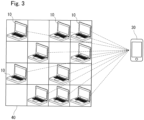
- Fig. 3 is a schematic diagram illustrating the asset management system in Fig. 2 .
- An example in which a plurality of electronic devices 10 are housed and managed in a housing rack 40 will be described with reference to Fig. 3 .
- the electronic device 10 is a device such as an inspection laptop PC that is removed from the housing rack 40, used, and then returned to the housing rack by an inspector, it is possible to confirm whether or not the electronic device 10 has been returned using the asset management system 100.
- a plurality of electronic devices 10 can be accommodated in the housing rack 40.
- the information processing terminal 30 is operated near the housing rack 40 to detect the electronic device 10 capable of performing near field communication with the information processing terminal 30.
- the information processing terminal 30 can determine that the electronic device 10 capable of performing near field communication with the information processing terminal 30 is near the information processing terminal 30.
- the second communicator 32 of the information processing terminal 30 and the first communicator 22 of the battery pack 20 perform near field communication.
- the information processing terminal 30 can determine that the electronic device 10 capable of performing near field communication is accommodated in the housing rack 40.
- the battery pack 20 is provided with the first communicator 22, near field communication between the electronic device 10 and the information processing terminal 30 is enabled even when the power of the electronic device 10 is turned off. Therefore, it is possible to easily determine whether or not the electronic device 10 is accommodated in the housing rack 40, and it is possible to improve convenience in managing the electronic device 10.
- Fig. 4 is a control flowchart of the asset management system in Fig. 2 . An operation of the asset management system 100 will be described with reference to Fig. 4 .
- step S1 the battery pack 20 is attached to the electronic device 10.
- the electronic device 10 and the battery pack 20 are connected.
- the battery pack 20 When the battery pack 20 is connected to the electronic device 10, power is supplied from the battery 21 of the battery pack 20 to the first communicator 22 in a case where the power supply of the electronic device 10 is turned off in step S2. Power is supplied from the battery 21 to the first communicator 22 via the electronic device 10. Specifically, as illustrated in Fig. 2 , the battery 21 and the first communicator 22 are electrically connected via the switch 12 of the electronic device 10, and power is supplied from the battery 21 to the first communicator 22.
- the switch 12 connects the battery 21 and the first communicator 22 on the basis of the setting stored in the setting storage 23 of the battery pack 20.
- the battery pack 20 When power is supplied from the battery 21 to the first communicator 22, the battery pack 20 enters a state capable of near field communication.
- the information processing terminal 30 performs near field communication with the first communicator 22 of the battery pack 20.
- the second communicator 32 of the information processing terminal 30 and the first communicator 22 of the battery pack 20 perform near field communication.
- the information processing terminal 30 can perform near field communication with the first communicators 22 of the plurality of electronic devices 10.
- step S4 the information processing terminal 30 acquires the position information by the position information detector 31.
- the information processing terminal 30 detects the position of the electronic device 10 in step S5 on the basis of the detected position information.
- the information processing terminal 30 can determine that the electronic device 10 is near the information processing terminal 30 by being able to perform near field communication with the first communicator 22 of the battery pack 20. Therefore, the position information of the information processing terminal 30 can be used as the position information of the electronic device 10.
- the information processing terminal 30 can detect the position information of the electronic devices 10 as the position information of the information processing terminal 30.
- the first communicator 22 of the battery pack 20 can perform near field communication. Therefore, in a case where the information processing terminal 30 and the electronic device 10 perform near field communication, it is possible to grasp that the electronic device 10 is at a predetermined position by using the position information of the information processing terminal.
- the information processing terminal 30 is a smartphone
- the information processing terminal 30 only needs to be a mobile terminal having a near field communication function and a position information detection function.
- the information processing terminal 30 may be a tablet PC or the like.
- the present disclosure can be applied to a battery pack, an electronic device powered by a battery, a communication system, and a communication method.
Landscapes
- Engineering & Computer Science (AREA)
- Computer Networks & Wireless Communication (AREA)
- Signal Processing (AREA)
- Power Engineering (AREA)
- Chemical & Material Sciences (AREA)
- Manufacturing & Machinery (AREA)
- Microelectronics & Electronic Packaging (AREA)
- Chemical Kinetics & Catalysis (AREA)
- Electrochemistry (AREA)
- General Chemical & Material Sciences (AREA)
- Battery Mounting, Suspending (AREA)
- Power Sources (AREA)
- Charge And Discharge Circuits For Batteries Or The Like (AREA)
Applications Claiming Priority (2)
| Application Number | Priority Date | Filing Date | Title |
|---|---|---|---|
| JP2022077116A JP7792574B2 (ja) | 2022-05-09 | 2022-05-09 | バッテリパック、電子機器、通信システム、および通信方法 |
| PCT/JP2023/013829 WO2023218797A1 (ja) | 2022-05-09 | 2023-04-03 | バッテリパック、電子機器、通信システム、および通信方法 |
Publications (2)
| Publication Number | Publication Date |
|---|---|
| EP4485138A1 true EP4485138A1 (de) | 2025-01-01 |
| EP4485138A4 EP4485138A4 (de) | 2025-08-27 |
Family
ID=88730114
Family Applications (1)
| Application Number | Title | Priority Date | Filing Date |
|---|---|---|---|
| EP23803280.9A Pending EP4485138A4 (de) | 2022-05-09 | 2023-04-03 | Batteriepack, elektronische vorrichtung, kommunikationssystem und kommunikationsverfahren |
Country Status (5)
| Country | Link |
|---|---|
| US (1) | US20250023373A1 (de) |
| EP (1) | EP4485138A4 (de) |
| JP (1) | JP7792574B2 (de) |
| CN (1) | CN119013637A (de) |
| WO (1) | WO2023218797A1 (de) |
Family Cites Families (8)
| Publication number | Priority date | Publication date | Assignee | Title |
|---|---|---|---|---|
| JP4634590B2 (ja) | 2000-09-27 | 2011-02-16 | 株式会社東芝 | 電子機器システム、電子機器及び通信手段切換え方法 |
| JP2005165545A (ja) | 2003-12-01 | 2005-06-23 | Sony Corp | 電子機器及びバッテリーパック |
| JP5282347B2 (ja) | 2005-09-27 | 2013-09-04 | 株式会社デンソーウェーブ | 情報読取システム |
| KR101030781B1 (ko) * | 2006-04-24 | 2011-04-27 | 노키아 코포레이션 | 다기능 모바일 기기가 충전되지 않거나 단지 부분적으로만 충전될 때 그 기기의 근거리 통신을 관리하고 제어하는 시스템 및 방법 |
| JP4843658B2 (ja) | 2008-10-09 | 2011-12-21 | フェリカネットワークス株式会社 | バッテリパック及び情報処理装置 |
| JP6250918B2 (ja) | 2012-06-13 | 2017-12-20 | 京セラ株式会社 | 携帯電子機器、位置確認方法、及び位置確認プログラム |
| JP6723808B2 (ja) | 2015-08-28 | 2020-07-15 | 株式会社マキタ | 情報設定機器、バッテリパックおよび電動作業機 |
| EP3610532A4 (de) * | 2017-04-13 | 2021-01-13 | Scott Technologies, Inc. | Eigensichere batterie |
-
2022
- 2022-05-09 JP JP2022077116A patent/JP7792574B2/ja active Active
-
2023
- 2023-04-03 CN CN202380034076.3A patent/CN119013637A/zh active Pending
- 2023-04-03 WO PCT/JP2023/013829 patent/WO2023218797A1/ja not_active Ceased
- 2023-04-03 EP EP23803280.9A patent/EP4485138A4/de active Pending
-
2024
- 2024-09-27 US US18/899,751 patent/US20250023373A1/en active Pending
Also Published As
| Publication number | Publication date |
|---|---|
| WO2023218797A1 (ja) | 2023-11-16 |
| JP2023166215A (ja) | 2023-11-21 |
| US20250023373A1 (en) | 2025-01-16 |
| JP7792574B2 (ja) | 2025-12-26 |
| EP4485138A4 (de) | 2025-08-27 |
| CN119013637A (zh) | 2024-11-22 |
Similar Documents
| Publication | Publication Date | Title |
|---|---|---|
| EP3652612B1 (de) | Verfahren und elektronische vorrichtung zur bereitstellung von moduswechsel und speichermedium dafür | |
| US9003212B2 (en) | Information processing device, non-transitory, computer readable storage medium, and method of controlling information processing device | |
| US20130245946A1 (en) | High Precision Hand-held Engineering Survey/Position Data Collector Tablet Computer | |
| US20100235822A1 (en) | System and method for updating portable electronic devices using a rechargeable battery | |
| JP6007531B2 (ja) | 情報処理装置、情報処理方法及び情報処理プログラム | |
| US20160165537A1 (en) | Portable terminal device | |
| KR102813618B1 (ko) | 전력 공급 방법 및 그 전자 장치 | |
| JP2013172277A (ja) | 情報処理システムの制御方法、サーバ装置、サーバ装置の制御プログラム、クライアント装置及びクライアント装置の制御プログラム | |
| CN103576172A (zh) | 终端设备以及报警消息产生方法 | |
| EP4485138A1 (de) | Batteriepack, elektronische vorrichtung, kommunikationssystem und kommunikationsverfahren | |
| US11054483B2 (en) | Terminal device, method for leakage detection therefor | |
| WO2019015422A1 (zh) | 终端设备及其电池安全监控方法、系统 | |
| CN103329180A (zh) | 测定装置及测定系统 | |
| CN106300496B (zh) | 电子设备以及电子设备的电池连接方法 | |
| US20230232197A1 (en) | Information processing apparatus and control method | |
| US7999671B2 (en) | Radio communication apparatus and information processing apparatus | |
| CN120222509A (zh) | 控制充电的方法、装置、充电设备及计算机可读存储介质 | |
| CN212463222U (zh) | 一种无线信号检测装置 | |
| US10459503B2 (en) | Electronic system, terminal device, and function expansion device | |
| CN114697871A (zh) | 追踪器终端设备系统、终端设备及其功耗控制方法 | |
| JP2015053747A (ja) | 電池劣化判定アプリケーションプログラム | |
| Alegria et al. | Implementation details of an automatic monitoring system used on a Vodafone radiocommunication base station | |
| KR20210045768A (ko) | 전력 관리 집적 회로를 포함하는 전자 장치 및 상기 전자 장치의 이상 상태를 회복하기 위한 방법 | |
| US20160370472A1 (en) | Portable electronic device and method for locating vehicle | |
| US20100114486A1 (en) | Computer system and control method for receiving satellite positioning signal at power-off state |
Legal Events
| Date | Code | Title | Description |
|---|---|---|---|
| STAA | Information on the status of an ep patent application or granted ep patent |
Free format text: STATUS: THE INTERNATIONAL PUBLICATION HAS BEEN MADE |
|
| PUAI | Public reference made under article 153(3) epc to a published international application that has entered the european phase |
Free format text: ORIGINAL CODE: 0009012 |
|
| STAA | Information on the status of an ep patent application or granted ep patent |
Free format text: STATUS: REQUEST FOR EXAMINATION WAS MADE |
|
| 17P | Request for examination filed |
Effective date: 20240925 |
|
| AK | Designated contracting states |
Kind code of ref document: A1 Designated state(s): AL AT BE BG CH CY CZ DE DK EE ES FI FR GB GR HR HU IE IS IT LI LT LU LV MC ME MK MT NL NO PL PT RO RS SE SI SK SM TR |
|
| DAV | Request for validation of the european patent (deleted) | ||
| DAX | Request for extension of the european patent (deleted) | ||
| A4 | Supplementary search report drawn up and despatched |
Effective date: 20250725 |
|
| RIC1 | Information provided on ipc code assigned before grant |
Ipc: G06F 1/26 20060101AFI20250721BHEP Ipc: H01M 10/44 20060101ALI20250721BHEP Ipc: H02J 7/00 20060101ALI20250721BHEP |
|
| STAA | Information on the status of an ep patent application or granted ep patent |
Free format text: STATUS: EXAMINATION IS IN PROGRESS |
|
| 17Q | First examination report despatched |
Effective date: 20260303 |