EP4482035A2 - Durchführung eines kalibrierungsprozesses in einem quantendatenverarbeitungssystem - Google Patents
Durchführung eines kalibrierungsprozesses in einem quantendatenverarbeitungssystem Download PDFInfo
- Publication number
- EP4482035A2 EP4482035A2 EP24211809.9A EP24211809A EP4482035A2 EP 4482035 A2 EP4482035 A2 EP 4482035A2 EP 24211809 A EP24211809 A EP 24211809A EP 4482035 A2 EP4482035 A2 EP 4482035A2
- Authority
- EP
- European Patent Office
- Prior art keywords
- qubit
- quantum
- domain
- measurements
- flux
- Prior art date
- Legal status (The legal status is an assumption and is not a legal conclusion. Google has not performed a legal analysis and makes no representation as to the accuracy of the status listed.)
- Pending
Links
Images


Classifications
-
- G—PHYSICS
- G06—COMPUTING OR CALCULATING; COUNTING
- G06N—COMPUTING ARRANGEMENTS BASED ON SPECIFIC COMPUTATIONAL MODELS
- G06N10/00—Quantum computing, i.e. information processing based on quantum-mechanical phenomena
- G06N10/70—Quantum error correction, detection or prevention, e.g. surface codes or magic state distillation
-
- G—PHYSICS
- G06—COMPUTING OR CALCULATING; COUNTING
- G06N—COMPUTING ARRANGEMENTS BASED ON SPECIFIC COMPUTATIONAL MODELS
- G06N10/00—Quantum computing, i.e. information processing based on quantum-mechanical phenomena
-
- G—PHYSICS
- G06—COMPUTING OR CALCULATING; COUNTING
- G06N—COMPUTING ARRANGEMENTS BASED ON SPECIFIC COMPUTATIONAL MODELS
- G06N10/00—Quantum computing, i.e. information processing based on quantum-mechanical phenomena
- G06N10/40—Physical realisations or architectures of quantum processors or components for manipulating qubits, e.g. qubit coupling or qubit control
-
- H—ELECTRICITY
- H03—ELECTRONIC CIRCUITRY
- H03K—PULSE TECHNIQUE
- H03K19/00—Logic circuits, i.e. having at least two inputs acting on one output; Inverting circuits
- H03K19/02—Logic circuits, i.e. having at least two inputs acting on one output; Inverting circuits using specified components
- H03K19/195—Logic circuits, i.e. having at least two inputs acting on one output; Inverting circuits using specified components using superconductive devices
-
- G—PHYSICS
- G06—COMPUTING OR CALCULATING; COUNTING
- G06N—COMPUTING ARRANGEMENTS BASED ON SPECIFIC COMPUTATIONAL MODELS
- G06N10/00—Quantum computing, i.e. information processing based on quantum-mechanical phenomena
- G06N10/20—Models of quantum computing, e.g. quantum circuits or universal quantum computers
Definitions
- the following description relates to performing a calibration process in a quantum computing system.
- qubits are implemented in superconducting circuits.
- the qubits can be implemented, for example, in circuit devices that include Josephson junctions.
- circuit devices in a superconducting circuit are controlled by an external control module.
- FIG. 1 shows an example quantum processor cell 102A that includes a superconducting quantum circuit system 104.
- the example superconducting quantum circuit system 104 includes circuit devices 105 arranged in a two-dimensional device array. Eight circuit devices are shown in FIG. 1 .
- some of the circuit devices 105 are qubit devices that each store a single qubit of information, and the qubits can collectively represent the computational state of a quantum processor.
- the superconducting quantum circuit system 104 may include resonator devices coupled to the respective qubit devices, for instance, where each qubit device includes a superconducting quantum interference device (SQUID) loop and is capacitively coupled to a neighboring resonator device.
- SQUID superconducting quantum interference device
- the readout devices may be configured to generate readout signals that indicate the computational state of the quantum processor or quantum memory.
- some of the circuit devices 105 are coupler devices that selectively operate on individual qubits or pairs of qubits.
- the coupler devices may produce entanglement or other multi-qubit states over two or more qubits.
- the superconducting quantum circuit system 104 may include additional devices (e.g., additional qubit devices, coupler devices and other types of devices).
- the example quantum circuit system 104 also includes connections 103 between neighboring pairs of the circuit devices 105.
- the connections 103 can provide electromagnetic communication between the connected circuit devices.
- the connections 103 are implemented as capacitive or conductive connections.
- the connections 103 may include metal traces, capacitors and other components.
- the superconducting circuit devices 105 may be operated by microwave signals delivered in the quantum circuit system 104, for example, from the control system 110. Signals may be exchanged among the circuit devices 105 through the connections 103 or other signal pathways in the quantum circuit system 104.
- the example quantum processor cell 102A includes multiple domains.
- a first domain 101A and a second domain 101B are shown.
- the quantum processor cell may include additional domains or different types of domains.
- Each domain includes a subset of the circuit devices 105.
- the first domain 101A may include a first subset of qubit devices, a first subset of coupler devices, and a first subset of readout devices
- the second domain 101A may include a second subset of qubit devices, a second subset of coupler devices, and a second subset of readout devices.
- Each subset may include, for example, two, five, ten or more such devices.
- the domains may be defined by hardware, by control logic, by connections, by software or otherwise.
- the signal delivery system 106 provides communication between the control system 110 and the quantum processor cell 102.
- the signal delivery system 106 can receive control signals from the control system 110 and deliver the control signals to the quantum processor cell 102.
- the signal delivery system 106 performs preprocessing, signal conditioning, or other operations to the control signals before delivering them to the quantum processor cell 102.
- the signal delivery system 106 receives qubit readout signals from the quantum processor cell and delivers the qubit readout signals to the control system 110. In some instances, the signal delivery system 106 performs preprocessing, signal conditioning or other operations on the readout signals before delivering them to the control system 110. In some implementations, the signal delivery system 106 includes include input and output processing hardware, input and output connections, and other components.
- the input and processing hardware may include, for example, filters, attenuators, directional couplers, multiplexers, diplexers, bias components, signal channels, isolators, amplifiers, power dividers and other types of components.
- the signal delivery system 106 and the quantum processor cell 102 are maintained in a controlled QPC environment.
- the QPC environment can be provided, for example, by shielding equipment, cryogenic equipment, and other types of environmental control systems.
- the components in the QPC environment operate in a cryogenic temperature regime and are subject to very low electromagnetic and thermal noise.
- magnetic shielding can be used to shield the system components from stray magnetic fields
- optical shielding can be used to shield the system components from optical noise
- thermal shielding and cryogenic equipment can be used to maintain the system components at controlled temperature, etc.
- the levels and types of noise that are tolerated or controlled in the QPC environment can vary, for example, based on the features and operational requirements of the quantum processor cell 102 and the signal delivery system 106.
- control system 110 controls operation of the quantum processor cell 102.
- the example control system 110 may include data processors, signal generators, interface components and other types of systems or subsystems.
- control system 110 includes one or more classical computers or classical computing components.
- FIG. 1 shows an example control system 110A that includes one or more processors 112, memory 114, radio frequency (RF) or microwave ( ⁇ W) generators 116, radio frequency (RF) or microwave ( ⁇ W) receivers 118 and DC sources 120.
- a control system may include additional or different features and components.
- components of the control system 110A operate in a room temperature regime, an intermediate temperature regime, or both.
- the control system 110A can be configured to operate at much higher temperatures and be subject to much higher levels of noise than are present in the QPC environment.
- the control system 110 includes a classical computing cluster, servers, databases, networks, or other types of classical computing equipment.
- the memory 114 can include, for example, a random access memory (RAM), a storage device (e.g., a read-only memory (ROM) or others), a hard disk, or another type of storage medium.
- RAM random access memory
- ROM read-only memory
- the memory 114 can include various forms of memory, media and memory devices, including by way of example semiconductor memory devices (e.g., EPROM, EEPROM, flash memory devices, and others), magnetic disks (e.g., internal hard disks, removable disks, and others), magneto optical disks, and CD ROM and DVD-ROM disks.
- the processors 112 may include one or more single- or multi-core microprocessors, one or more FPGAs or ASICs, one or more other types of data processing apparatus.
- the processors 112 can generate control information, for example, based on a quantum program (e.g., a quantum logic circuit, a quantum simulation, a quantum algorithm, etc.) to be performed by the quantum computing system 100 or based on other types of information.
- a quantum program e.g., a quantum logic circuit, a quantum simulation, a quantum algorithm, etc.
- the radio frequency (RF) or microwave ( ⁇ W) generators 116 and the DC sources 120 can each generate control signals based on control information provided by the processors 112.
- the control signals can be delivered to the quantum processor cell 102 by the signal delivery system 106, for example, and interact with the circuit devices 105.
- the radio frequency (RF) or microwave ( ⁇ W) receivers 118 can receive and process signals from the quantum processor cell 102.
- receivers 118 can include a digitizer, a microwave source, and other types of signal processing components.
- the receivers 118 can process (e.g., digitize, or otherwise process) the signals from the quantum processor cell 102 and provide the processed information to the processors 112.
- the processors 112 can extract data, for example, to identify the quantum states of qubits in the quantum processor cell 102 or for other purposes.
- Each domain control subsystem in the example control system 110A can communicate with the devices in the associated domain in the quantum processor cell 102A.
- a generator 116 and DC source 120 in the first domain control subsystem can send signals to the subset of the circuit devices 105 in the first domain 101A, and a receiver 118 in the first domain control subsystem can receive signals from the subset of the circuit devices 105 in the first domain 101A;
- a generator 116 and DC source 120 in the second domain control subsystem can send signals to the subset of the circuit devices 105 in the second domain 101B, and a receiver 118 in the second domain control subsystem can receive signals from the subset of the circuit devices 105 in the second domain 101B.
- control system 110 generates classical signals, including electrical waveforms or laser fields, which interact with devices in the quantum processor cell 102 to operate the quantum computing system 100; and the control system 110 may also receive classical signals back from the devices. To ensure that the classical signals are precisely tuned to the relevant device to give the desired device behavior and system operation, the control system 110 can be calibrated to the device.
- control system 110 implements a calibration process that performs measurements on a quantum computing device and interprets those measurements to extract control parameters and device characteristics.
- the device characteristics can be physical attributes of the device, for example, the resonance frequency between the two lowest energy levels of a qubit. Device characteristics can be used to describe the performance of the device, for example, with respect to design goals.
- Control parameters can be parameters of the control system 110 that are calibrated to the device, for example, the optimal power setting for applying a read-out pulse. Correct determination of control parameters can be important, for example, to enable operation of the quantum computing system 100.
- domains of the quantum computing system 100 can be identified by operation of the control system 110.
- the domains can include respective domain control subsystems and respective subsets of quantum circuit devices 105 in a quantum processor 112 of the quantum computing system 100.
- a first set of measurements can be obtained from a first domain 101A.
- the first set of measurements can be stored in a memory 114 of the control system 110.
- Device characteristics of the quantum circuit devices 105 of the first domain 101A can be determined by operation of the control system 110 based on the first set of measurements.
- the device characteristics can be stored in a memory 114 of the control system 110.
- the control system 110 can then determine (i.e., decide or make a determination) to obtain a second set of measurements from the first domain 101A based on the device characteristics.
- the determination to obtain a second set of measurements can be made automatically, for example, based on the device characteristics (and possibly other data) meeting a predefined criterion or set of criteria. For instance, the "example success criteria" described below for various experiments and measurements may be used as criteria for determining to obtain the second set of measurements.
- the second set of measurements can be obtained from the first domain 101A.
- the second set of measurements can be stored in the memory 114 of the control system 110.
- Quantum logic control parameters for the subset of quantum circuit devices 105 of the first domain 101A can be determined by operation of the control system 110A, based on the second set of measurements.
- the quantum logic control parameters can be stored in a database (e.g., a database defined in the memory 114) of the control system 110A for use in operating the first domain.
- a database e.g., a database defined in the memory 114
- An example of such a database is shown and described in connection with FIG. 4 , described below.
- the control system 110 may perform the same process or a similar process for the other domain 101B (e.g., in parallel or otherwise).
- the domains 101A, 101B can be defined in part by hardware, control logic, physical connections, or software in the quantum computing system 100.
- the quantum circuit devices 105 of the first domain can include qubit devices and readout devices.
- the control system 110 can include a controller (where the controller includes a cache), signal conversion circuitry, a filter, and an amplifier, as further shown and described in connection with FIG. 4 .
- the control system 110 can include an embedded operating system (OS) configured to communicate with the database and the controller, as further shown and described in connection with FIG. 4 .
- the device characteristics can include resonance frequencies and coherence times for qubit devices in the first domain.
- the quantum logic control parameters can include read-out pulse parameters or quantum logic gate pulse parameters for qubit devices in the first domain.
- the quantum logic control parameters may include the duration, power, frequency, or other parameters of a ⁇ pulse, a ⁇ /2 pulse, a two-qubit gate pulse, a readout pulse, etc.
- the first set of measurements or the second set of measurements can be repeated based on a success or a failure of a calibration of the first domain of the quantum computing system 100, for example, as discussed below with respect to FIG. 2 .
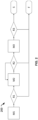
- FIG. 2 is a block diagram of an example calibration process 200.
- the example calibration process 200 can determine device characteristics and control parameters in a quantum computer system.
- the calibration process 200 will, in general, depend on the design and architecture of the quantum computing system used.
- the example calibration process 200 includes a set of logical blocks, each representing an experimental measurement (e.g. M1-M3), and a procedure to determine the result of the measurement (e.g. R1-R3).
- the procedure specifies the measurements themselves, and a map from each measurement result to: (a) a new measurement (R1, R2); (b) a repetition of the same measurement, possibly with new parameters (e.g. R2); or (c) a terminal state, indicating success (R3) or failure of the procedure (R1-R3).
- the computer may notify one or more external systems or recipients (e.g., via email or instant message (e.g. Slack, etc.)).
- the first experimental measurement M1 is obtained, and the first measurement result R1 (e.g., a device characteristic of a quantum circuit device) can be determined from the first experimental measurement M1. Based on the first measurement result R1, it can be determined to obtain a second experimental measurement M2. For instance, if a device characteristic (e.g., coherence time, qubit frequency, anharmonicity, etc.) determined from the first experimental measurement M1 meets a predefined criterion, then the process 200 may automatically determine to obtain the second experimental measurement M2; but if the device characteristic determined from the first experimental measurement M1 does not satisfy the quality criterion, the process 200 may automatically determine to move to a terminal state indicating failure F.
- a device characteristic e.g., coherence time, qubit frequency, anharmonicity, etc.
- the second experimental measurement M2 can then be obtained, and the second measurement result R2 (e.g., quantum logic control parameters for a quantum circuit device) can be determined from the second experimental measurement M2. For instance, if a quantum logic parameter determined from the second experimental measurement M2 meets a predefined criterion, then the process 200 may automatically determine to obtain the third experimental measurement M3; but otherwise, the process 200 may automatically determine to move to a terminal state indicating failure F, or to repeat the second experimental measurement M2 (e.g., using different parameters, etc.).
- the second measurement result R2 e.g., quantum logic control parameters for a quantum circuit device
- the process 200 can continue in a similar, automated manner for one or more further experimental measurements (e.g., the third experimental measurement M3) and one or more further measurement result determinations (e.g., measurement result R3) until reaching a state representing success S or failure F.
- the predefined criteria used at R1, R2, R3 can include the "example success criteria" described below or other types of criteria.
- the example calibration process 200 is modular in that it may include several sub-procedures.
- a modular sub-procedure may be reused to implement a characterization or calibration procedure for different kinds of devices that share a common component.
- the sub-procedure terminates it returns control to the main procedure which uses the result to determine what to do next.
- the modular sub-procedures may also be used independently of the full experimental procedure. For example, a certain set of control parameters optimal values may drift over time and a sub-procedure to re-calibrate just those parameters that have drifted need not require a full run of the experimental procedure. This enables on-line calibration, where the operation of the device does not need to be completely paused in order to recalibrate.
- the experimental procedure can take this into account, for instance, by only allowing such measurements downstream from the measurement(s) that determine the parameters or characteristics required.
- Each measurement can determine one or more device characteristics or control parameters (possibly to finite precision).
- the measured characteristics or parameters can be committed to the memory.
- a store of the characteristics and parameters is constructed. In some implementations, all the characteristics and parameters of interest can be measured and stored.
- the logical measurement block includes a procedure that takes as an input the measurement data and outputs: (a) extracted values for the characteristics and parameters, and (b) a member of the discrete set of outputs used to select the next measurement.
- the possibility that the measurement failed to produce meaningful results can be accounted for. If the problem is recoverable, like an insufficient scan range, or additional averaging is necessary, the measurement may be repeated with new parameters. If the error is not recoverable, the experimental procedure may exit to a failure state.
- Techniques for determining whether the measurement has succeeded or failed may be statistical in nature, based on some goodness of fit metric for fitted data (e.g. reduced residual chi-squared statistic, Akaike Information Criterion, Bayesian Information Criterion, etc.), based on machine learning, or some combination thereof.
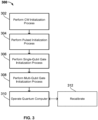
- FIG. 3 is a block diagram of an example calibration process 300.
- the example calibration process can be performed in a quantum computing system, for example, to characterize and tune up components of the quantum computing system.
- the example calibration process 300 may be used to calibrate one or more domains, subsystems or devices in the example quantum computing system 100 shown in FIG. 1 .
- the calibration process 300 is controlled by a control system of the quantum computing system.
- the process 300 may include additional or different operations, and the operations may be performed in the order shown or in another order. In some cases, multiple operations are combined, performed in parallel or divided into additional operations.
- multiple instances of the process 300 are applied in parallel in the respective domains of a quantum computing system.
- portions of the process 300 may be iterated periodically during operation of the quantum computer system.
- the quantum computer system is operated.
- the quantum computer system may execute quantum logic circuits or other types of quantum algorithms.
- one or more of the domains, subsystems or devices in the quantum computing system is recalibrated.
- the recalibration may include one or more iterations of the operations (302, 304, 306, 308) applied to the whole quantum computing system or to a specific domain, subsystem or device in the quantum computing system.
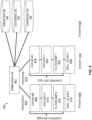
- FIG. 4 is a block diagram of an example quantum computing system 400.
- an embedded operating system (OS) 401 serves as a central controller of the system.
- the embedded operating system 401 may be a real-time operating system embedded on a chip, for example, a field-programmable gate array (FPGA).
- the embedded operating system 401 may be a kernel (for example, a Linux kernel) embedded on a chip (for example, the FPGA).
- the embedded operating system 401 may run on a physical CPU with a low-latency connection to the rest of the hardware system of quantum computing system.
- QPU ELEM 0 414 and QPU ELEM 1 424) may include couplings to other parts of the QPU which may be relevant to the execution of particular operations.
- an automated process is used for discovering the parameters for such entangling gates.
- such parameters can include quantum logic control parameters; as an example, the quantum logic control parameters can include a parameter for a flux pulse configured to implement a controlled-phase (CPHASE) interaction.
- CPHASE controlled-phase
- a calibration process includes one or more of the following steps performed in the following order or in another order:
- the above technique can be adapted to other physical implementations of CPHASE interactions, beside the use of a flux pulse on a tunable qubit.
- additional implementations can include considerations of how the underlying zeta depends on the implementation.
- phase tomography which can be used to find the 101> and 110> phases, can also be extended to another CPHASE gate discovery procedure.
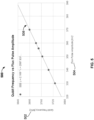
- FIG. 5 shows a plot 500 of the qubit frequency in units of megahertz on the y-axis 502 versus the flux pulse amplitude in units of millivolts on the x-axis 504.
- the flux pulse amplitude can range from approximately 320 millivolts to approximately 390 millivolts
- the qubit frequency can range from approximately 3680 megahertz to approximately 3840 megahertz.
- FIG. 6 shows a diagram 600 representing example CZ gate tune-up processes 601 and 603.
- the processes can use phase tomography to obtain phases for qubits.
- the x-axis can represent phase
- the y-axis can represent amplitude.
- process 601 can include a +X/2 phase 602, a +F variable duration ⁇ phase 604, a +X/2 phase 606, and a readout (RO) phase 608.
- process 603 can include a +X/2 phase 612, a +F variable duration ⁇ phase 614, a +Y/2 phase 616, and a RO phase 618.
- phase tomography on fixed transmons can be performed. Accordingly, the phase tomography on fixed transmons can be tunable in the zero state. This can allow for the determination of ⁇ 10 ( ⁇ ).
- phase tomography on fixed transmons can be performed. Accordingly, the phase tomography on fixed transmons can be tunable in the one state. This can allow for the determination of ⁇ 10 ( ⁇ ) + ⁇ CZ ( ⁇ ).
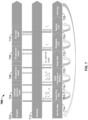
- flux bias automation can refer to a set of measurements that are performed in a specific sequence within a loop over DC flux bias values, with a specific data flow, as shown in FIG. 7 (described in further detail below).
- FIG. 7 shows a diagram 700 of a process for flux bias automation.
- domains can be updated, where the domains can include at least one flux-tunable qubit device; further, sets of measurements can be obtained by performing a measurement sequence within a loop over multiple flux bias values for the flux-tunable qubit device.
- repark flux bias when the flux bias is changed, a subset of measurements is performed which can be referred to as repark flux bias and can include (reference to various elements in FIG. 7 are made herein):
- the T2 measurements are constructed such that the fitting returns valid results.
- this process can provide optimizing gates and performing benchmarking.
- the gates can be optimized, and benchmarking can be performed using one or more of the following steps in the order described or in another order:
- the measured parameters can be stored in a flux dependence table in the database. This can allow for the improvement of interpolation and/or extrapolation, and initial parameter guessing procedures.
- additional measurements can be included in the flux bias automation, for example:
- retrying schemes can be implemented for many of the measurements in the flux bias automation, for example:
- tunable qubits can be characterized as a function of fast flux amplitude (with fixed slow flux) and as a function of flux modulation frequency (with fixed slow flux and fast flux amplitude). This allows determination of the following:
- current on one flux bias line can change the frequencies of other qubits on the same chip, which can be characterized by a DC crosstalk matrix.
- steps may be performed in the following order or in another order:
- the frequency measurements are bootstrapped, for example, using one or more of the following steps in the following order or in another order:
- a Ramsey measurement is built, for example, using one or more of the following operations:
- FIG. 7 shows a diagram 700 of a process for flux bias automation.
- the process includes performing a set of measurements in a particular sequence within a loop over DC flux bias values and with a specific data flow.
- diagram 700 includes an analysis 702 process, a resonator spectrum model 704, a f 01 spectrum model 706, a f 12 spectrum model 708, and a flux noise model 710.
- Diagram 700 further includes a database 712.
- Diagram 700 further includes a set flux bias 714 process, cavity frequency spectroscopy 716 process, qubit frequency spectroscopy or Ramsey spectroscopy 718 process, a power Rabi spectroscopy 720 process, a relaxation (T1) 722 process, a Ramsey (T2) 724 process, and an end loop 726 process.
- FIG. 7 Some processes shown in FIG. 7 include performing a low-power readout from a low-power cavity spectroscopy 716 and updating the readout frequency to a given point relative to cavity peaks associated with the qubit. Additionally, FIG. 7 includes a process of performing a low-power readout from a low-power cavity spectroscopy 716. Moreover, FIG. 7 can further include determining a resonance frequency f r , a quality factor (Q r ), a readout frequency (f ro ), a readout power (P ro ), and a coupling parameter ⁇ . The various parameters, including the readout power and the readout frequency can be saved to the database 712.
- FIG. 7 includes a process of performing a qubit spectroscopy or Ramsey frequency measurement 718, for example, to obtain the qubit frequency at a given flux bias. Additionally, a frequency f 01 , a frequency f 02 /2, the circuit bandwidth (or linewidth) Q q , the qubit-qubit dispersive shift ⁇ , and anharmonicity ⁇ can be obtained.
- the various parameters, for example, the qubit frequency at the flux bias can be saved to the database 712.
- FIG. 7 further includes a process of performing a power Rabi measurement 720 and identifying the optimal readout quadrature. Additionally, the Rabi oscillation rate ⁇ can be determined.
- the updated optimal quadrature data can be saved to the database 712.
- FIG. 7 additionally shows that T1 can be measured 722 and stored in the database 712. Further, T2* can be measured (using Ramsey technique 724) and stored in the database 712.
- the database 712 can be in communication with a processor that can perform or apply one or more of an analysis 702 process, a resonator spectrum model 704, a f 01 spectrum model 706, a f 12 spectrum model 708, and a flux noise model 710.
- the database 712 can supply the processor and the models described above with various parameters obtained in processes 714-726.
- a calibration process can provide technical advantages for operating a quantum computing system.
- the calibration process may provide reliable results by applying well-defined criteria for pass/fail during calibration of superconducting qubits. Design expectations may be used to execute an automated calibration process, providing initial values and the basis of several pass/fail criteria.
- a calibration routine may be implemented in a manner that is robust to many types of device failure.
- a computer program with a defined experimental procedure may control the calibration process, which can increase efficiency and consistency while reducing opportunities for error.
- the calibration process can be applied to a very large number of qubits simultaneously, which can enable large-scale quantum computing in some systems.
- the calibration process may reduce the time used to characterize a device and shorten the design-fabricate-measure cycle.
- a computer system controls one or several instruments to generate or measure signals, and an automated calibration process determines one or several control parameters or device characteristics of a specific device under test.
- the control parameters and device characteristics can be stored in a database.
- One or more measurement steps can be performed.
- An experimental procedure can define the order of measurement steps.
- the experimental procedure can include modular sub-procedures that can be reused or run independently.
- a measurement step can further include a computerized routine to extract relevant control parameters and device characteristics.
- a measurement step can further include a computerized routine that determines the "result" of the measurement, where the result includes one or more of: a pointer to the next measurement step in the experimental procedure; a repetition of the current measurement with different parameters; a failure condition which terminates the characterization and calibration cycle; or a success condition which terminates the characterization cycle. Termination in success or failure can trigger a human-readable alert to a configurable set of people. The alert can be sent via email (e.g. SMTP), instant message (e.g. Skype, IRC, Slack), or otherwise.
- the routine can further include a statistical goodness of fit metric with a defined threshold.
- the quality of fit metric can include the reduced residual chi-square statistic, the Akaike Information Criterion statistic, the Bayesian Information Criterion statistic or another fit metric.
- the routine can further include a machine learning algorithm that has been trained, for example, on human-classified measurement results from the same system.
- the routine can further include one or more statistical goodness of fit metrics with machine learning.
- Some of the subject matter and operations described in this specification can be implemented in digital electronic circuitry, or in computer software, firmware, or hardware, including the structures disclosed in this specification and their structural equivalents, or in combinations of one or more of them.
- Some of the subject matter described in this specification can be implemented as one or more computer programs, i.e., one or more modules of computer program instructions, encoded on a computer storage medium for execution by, or to control the operation of, data-processing apparatus.
- a computer storage medium can be, or can be included in, a computer-readable storage device, a computer-readable storage substrate, a random or serial access memory array or device, or a combination of one or more of them.
- a computer storage medium is not a propagated signal
- a computer storage medium can be a source or destination of computer program instructions encoded in an artificially generated propagated signal.
- the computer storage medium can also be, or be included in, one or more separate physical components or media (e.g., multiple CDs, disks, or other storage devices).
- Some of the operations described in this specification can be implemented as operations performed by a data processing apparatus on data stored on one or more computer-readable storage devices or received from other sources.
Landscapes
- Engineering & Computer Science (AREA)
- Physics & Mathematics (AREA)
- General Physics & Mathematics (AREA)
- Theoretical Computer Science (AREA)
- Mathematical Physics (AREA)
- General Engineering & Computer Science (AREA)
- Computing Systems (AREA)
- Condensed Matter Physics & Semiconductors (AREA)
- Mathematical Analysis (AREA)
- Mathematical Optimization (AREA)
- Pure & Applied Mathematics (AREA)
- Evolutionary Computation (AREA)
- Data Mining & Analysis (AREA)
- Computational Mathematics (AREA)
- Software Systems (AREA)
- Artificial Intelligence (AREA)
- Computer Hardware Design (AREA)
- Superconductor Devices And Manufacturing Methods Thereof (AREA)
- Testing Or Measuring Of Semiconductors Or The Like (AREA)
Applications Claiming Priority (3)
| Application Number | Priority Date | Filing Date | Title |
|---|---|---|---|
| US201762469648P | 2017-03-10 | 2017-03-10 | |
| EP18764972.8A EP3593298B1 (de) | 2017-03-10 | 2018-03-09 | Durchführung eines kalibrierungsprozesses in einem quantendatenverarbeitungssystem |
| PCT/US2018/021652 WO2018165500A1 (en) | 2017-03-10 | 2018-03-09 | Performing a calibration process in a quantum computing system |
Related Parent Applications (1)
| Application Number | Title | Priority Date | Filing Date |
|---|---|---|---|
| EP18764972.8A Division EP3593298B1 (de) | 2017-03-10 | 2018-03-09 | Durchführung eines kalibrierungsprozesses in einem quantendatenverarbeitungssystem |
Publications (2)
| Publication Number | Publication Date |
|---|---|
| EP4482035A2 true EP4482035A2 (de) | 2024-12-25 |
| EP4482035A3 EP4482035A3 (de) | 2025-03-19 |
Family
ID=63445546
Family Applications (2)
| Application Number | Title | Priority Date | Filing Date |
|---|---|---|---|
| EP24211809.9A Pending EP4482035A3 (de) | 2017-03-10 | 2018-03-09 | Durchführung eines kalibrierungsprozesses in einem quantendatenverarbeitungssystem |
| EP18764972.8A Active EP3593298B1 (de) | 2017-03-10 | 2018-03-09 | Durchführung eines kalibrierungsprozesses in einem quantendatenverarbeitungssystem |
Family Applications After (1)
| Application Number | Title | Priority Date | Filing Date |
|---|---|---|---|
| EP18764972.8A Active EP3593298B1 (de) | 2017-03-10 | 2018-03-09 | Durchführung eines kalibrierungsprozesses in einem quantendatenverarbeitungssystem |
Country Status (4)
| Country | Link |
|---|---|
| US (5) | US10282675B2 (de) |
| EP (2) | EP4482035A3 (de) |
| AU (3) | AU2018230440B2 (de) |
| WO (1) | WO2018165500A1 (de) |
Families Citing this family (119)
| Publication number | Priority date | Publication date | Assignee | Title |
|---|---|---|---|---|
| SG11201803545QA (en) | 2015-10-29 | 2018-05-30 | Google Llc | Removing leakage in a quantum bit |
| US20180275224A1 (en) * | 2017-03-24 | 2018-09-27 | Lockheed Martin Corporation | Generation of magnetic field proxy through rf frequency dithering |
| US9940212B2 (en) * | 2016-06-09 | 2018-04-10 | Google Llc | Automatic qubit calibration |
| EP4482035A3 (de) | 2017-03-10 | 2025-03-19 | Rigetti & Co, LLC | Durchführung eines kalibrierungsprozesses in einem quantendatenverarbeitungssystem |
| EP4282813A3 (de) * | 2017-06-19 | 2024-02-21 | Rigetti & Co, LLC | Parametrisch aktivierte quantenlogikgatter |
| US11875222B1 (en) | 2017-09-18 | 2024-01-16 | Rigetti & Co, Llc | Maintaining calibration in a quantum computing system |
| US10885678B2 (en) * | 2017-09-29 | 2021-01-05 | International Business Machines Corporation | Facilitating quantum tomography |
| US10872021B1 (en) | 2017-12-06 | 2020-12-22 | Rigetti & Co, Inc. | Testing hardware in a quantum computing system |
| AU2017443044C1 (en) * | 2017-12-15 | 2021-07-22 | Google Llc | Refining qubit calibration models using supervised learning |
| US10423888B1 (en) * | 2018-06-07 | 2019-09-24 | International Business Machines Corporation | Frequency allocation in multi-qubit circuits |
| US11214484B2 (en) * | 2018-06-20 | 2022-01-04 | equal1.labs Inc. | Planar quantum structures utilizing quantum particle tunneling through local depleted well |
| US10903413B2 (en) | 2018-06-20 | 2021-01-26 | Equal!.Labs Inc. | Semiconductor process optimized for quantum structures |
| US11450760B2 (en) | 2018-06-20 | 2022-09-20 | equal1.labs Inc. | Quantum structures using aperture channel tunneling through depletion region |
| US11423322B2 (en) * | 2018-06-20 | 2022-08-23 | equal1.labs Inc. | Integrated quantum computer incorporating quantum core and associated classical control circuitry |
| WO2020069623A1 (en) * | 2018-10-03 | 2020-04-09 | Anyon Systems Inc. | Qubit circuit and method for topological protection |
| EP3861489B1 (de) * | 2018-10-03 | 2026-03-18 | Rigetti & Co, LLC | Parzellierte quantenressourcen |
| US11121302B2 (en) | 2018-10-11 | 2021-09-14 | SeeQC, Inc. | System and method for superconducting multi-chip module |
| US10333503B1 (en) | 2018-11-26 | 2019-06-25 | Quantum Machines | Quantum controller with modular and dynamic pulse generation and routing |
| US11194642B2 (en) * | 2018-11-29 | 2021-12-07 | International Business Machines Corporation | Noise and calibration adaptive compilation of quantum programs |
| US10454459B1 (en) | 2019-01-14 | 2019-10-22 | Quantum Machines | Quantum controller with multiple pulse modes |
| CN116629371B (zh) * | 2019-02-02 | 2025-12-12 | 阿里巴巴集团控股有限公司 | 量子比特校准装置、测控系统及测控方法 |
| CN114072819B (zh) * | 2019-03-05 | 2025-12-30 | 谷歌有限责任公司 | iSWAP量子逻辑门的非绝热实施方式 |
| US10505524B1 (en) | 2019-03-06 | 2019-12-10 | Quantum Machines | Synchronization in a quantum controller with modular and dynamic pulse generation and routing |
| US11580433B2 (en) | 2019-03-09 | 2023-02-14 | International Business Machines Corporation | Validating and estimating runtime for quantum algorithms |
| US11940392B2 (en) * | 2019-04-18 | 2024-03-26 | International Business Machines Corporation | Measurement scheme for superconducting qubits using low-frequency microwave signals within a dilution refrigerator |
| US11164100B2 (en) | 2019-05-02 | 2021-11-02 | Quantum Machines | Modular and dynamic digital control in a quantum controller |
| US11537925B2 (en) | 2019-06-19 | 2022-12-27 | International Business Machines Corporation | System and method for latency-aware mapping of quantum circuits to quantum chips |
| US11011693B2 (en) * | 2019-06-24 | 2021-05-18 | Intel Corporation | Integrated quantum circuit assemblies for cooling apparatus |
| WO2020263300A1 (en) * | 2019-06-28 | 2020-12-30 | Google Llc | Measuring quantum state purity |
| US11748648B2 (en) * | 2019-07-01 | 2023-09-05 | International Business Machines Corporation | Quantum pulse optimization using machine learning |
| US10931267B1 (en) | 2019-07-31 | 2021-02-23 | Quantum Machines | Frequency generation in a quantum controller |
| US11321619B2 (en) * | 2019-08-14 | 2022-05-03 | International Business Machines Corporation | State dependent calibration of qubit measurements |
| US12579462B1 (en) | 2019-08-14 | 2026-03-17 | Q.M Technologies Ltd. | Controlling a quantum processor via quantum programming field payloads |
| US11245390B2 (en) | 2019-09-02 | 2022-02-08 | Quantum Machines | Software-defined pulse orchestration platform |
| US10862465B1 (en) | 2019-09-02 | 2020-12-08 | Quantum Machines | Quantum controller architecture |
| US12431879B2 (en) | 2019-09-25 | 2025-09-30 | Q.M Technologies Ltd. | Classical processor for quantum control |
| WO2021067666A1 (en) * | 2019-10-04 | 2021-04-08 | Virginia Tech Intellectual Properties Inc. | Generating error-resistant quantum control pulses from geometrical curves |
| JP7413714B2 (ja) * | 2019-10-18 | 2024-01-16 | 日本電気株式会社 | 較正方法、較正装置、及びプログラム |
| US11004896B1 (en) | 2019-11-06 | 2021-05-11 | International Business Machines Corporation | System and method for non-invasive large-scale qubit device characterization technique |
| US11775854B2 (en) | 2019-11-08 | 2023-10-03 | International Business Machines Corporation | Characterizing crosstalk of a quantum computing system based on sparse data collection |
| FI4062332T3 (fi) * | 2019-11-22 | 2026-01-16 | Rigetti & Co Llc | Kvanttiohjaus viritettävien laitteiden moduloinnilla suprajohtavassa piirissä |
| US11816535B1 (en) * | 2019-12-03 | 2023-11-14 | Google Llc | Multi-state qubit readout with permutation sequences |
| US12260157B1 (en) * | 2019-12-03 | 2025-03-25 | Google Llc | Qubit-coupler-qubit model for system calibration |
| US11621720B2 (en) | 2019-12-09 | 2023-04-04 | International Business Machines Corporation | Quantum processing apparatus with downsampling analog-to-digital converter |
| US10997522B1 (en) * | 2019-12-10 | 2021-05-04 | Honeywell International Inc. | Suppressing/transforming leakage errors in hyperfine qubits |
| US11588472B1 (en) | 2019-12-13 | 2023-02-21 | Google Llc | Purcell filter having prescribed transfer characteristics |
| US11507873B1 (en) | 2019-12-16 | 2022-11-22 | Quantum Machines | Highly scalable quantum control |
| US11900144B2 (en) | 2019-12-17 | 2024-02-13 | Quantinuum Llc | Quantum computer phase tracking and correction |
| US11544613B2 (en) | 2019-12-26 | 2023-01-03 | International Business Machines Corporation | Controlling a quantum computing device based on predicted operation time |
| US10956829B1 (en) * | 2020-01-29 | 2021-03-23 | International Business Machines Corporation | Simultaneously driving adjacent qubit pairs |
| CN113255921A (zh) * | 2020-02-11 | 2021-08-13 | 阿里巴巴集团控股有限公司 | 测量系统、方法、装置及设备 |
| US11695483B2 (en) | 2020-02-19 | 2023-07-04 | International Business Machines Corporation | Target qubit decoupling in an echoed cross-resonance gate |
| US11790261B2 (en) * | 2020-03-04 | 2023-10-17 | The Regents Of The University Of Colorado, A Body Corporate | Tunable coupling between a readout cavity and a parametric amplifier to enhance qubit measurements |
| US11126926B1 (en) | 2020-03-09 | 2021-09-21 | Quantum Machines | Concurrent results processing in a quantum control system |
| EP3933717A1 (de) * | 2020-07-02 | 2022-01-05 | Oxford University Innovation Limited | Fehlerabschwächungsverfahren |
| US11526796B2 (en) * | 2020-07-15 | 2022-12-13 | International Business Machines Corporation | Qubit pulse calibration via canary parameter monitoring |
| US11043939B1 (en) | 2020-08-05 | 2021-06-22 | Quantum Machines | Frequency management for quantum control |
| US12056573B2 (en) * | 2020-08-28 | 2024-08-06 | IonQ, Inc. | Amplitude, frequency, and phase modulated entangling gates for ion trap quantum computers |
| US11221364B1 (en) | 2020-08-28 | 2022-01-11 | International Business Machines Corporation | Detection of leakage of a qubit without directly measuring the qubit |
| CN112149832B (zh) * | 2020-10-09 | 2022-05-10 | 腾讯科技(深圳)有限公司 | 量子比特的频率控制信号处理方法、超导量子芯片 |
| US11281524B1 (en) | 2020-11-11 | 2022-03-22 | International Business Machines Corporation | Stretch factor error mitigation enabled quantum computers |
| US20220147824A1 (en) | 2020-11-12 | 2022-05-12 | equal1.labs Inc. | Accelerated Learning In Neural Networks Incorporating Quantum Unitary Noise And Quantum Stochastic Rounding Using Silicon Based Quantum Dot Arrays |
| CN114594306B (zh) * | 2020-12-07 | 2024-04-05 | 本源量子计算科技(合肥)股份有限公司 | 超导量子比特频率的校准方法以及装置、可读存储介质 |
| US12277477B2 (en) * | 2020-12-14 | 2025-04-15 | International Business Machines Corporation | Quantum circuit optimization routine evaluation and knowledge base generation |
| CN114970867B (zh) * | 2021-02-20 | 2024-04-05 | 本源量子计算科技(合肥)股份有限公司 | 量子计算机系统以及任务调度方法 |
| CN114970866B (zh) * | 2021-02-20 | 2023-12-12 | 本源量子计算科技(合肥)股份有限公司 | 一种量子计算任务计算方法、装置及可读存储介质 |
| US11868847B2 (en) | 2021-03-16 | 2024-01-09 | International Business Machines Corporation | Mitigating cross-talk in a flux tunable coupler architecture |
| US12132486B2 (en) | 2021-04-08 | 2024-10-29 | Quantum Machines | System and method for pulse generation during quantum operations |
| US11671180B2 (en) | 2021-04-28 | 2023-06-06 | Quantum Machines | System and method for communication between quantum controller modules |
| US12079689B1 (en) * | 2021-04-30 | 2024-09-03 | Wells Fargo Bank, N.A. | Systems and methods for low-code utilization of a computing system |
| US12242406B2 (en) | 2021-05-10 | 2025-03-04 | Q.M Technologies Ltd. | System and method for processing between a plurality of quantum controllers |
| CN113300781B (zh) * | 2021-05-11 | 2022-09-06 | 山东浪潮科学研究院有限公司 | 一种超导量子比特读取脉冲的优化方法 |
| US12505375B2 (en) * | 2021-05-20 | 2025-12-23 | IonQ, Inc. | Debugging of quantum circuits |
| US11695418B2 (en) | 2021-06-04 | 2023-07-04 | Anyon Systems Inc. | Topologically protected quantum circuit with superconducting qubits |
| WO2022261523A1 (en) | 2021-06-11 | 2022-12-15 | SeeQC, Inc. | System and method of flux bias for superconducting quantum circuits |
| US12292980B2 (en) * | 2021-06-17 | 2025-05-06 | Bank Of America Corporation | System and method for performing dynamic exposure analysis based on quantum simulations |
| US12165011B2 (en) | 2021-06-19 | 2024-12-10 | Q.M Technologies Ltd. | Error detection mechanism for quantum bits |
| CN115577784B (zh) * | 2021-07-06 | 2024-04-05 | 本源量子计算科技(合肥)股份有限公司 | 量子比特调控信号的校准方法和装置、可读存储介质 |
| US12332682B2 (en) | 2021-07-21 | 2025-06-17 | Q.M Technologies Ltd. | System and method for clock synchronization and time transfer between quantum orchestration platform elements |
| EP4325230A4 (de) * | 2021-07-28 | 2025-04-09 | Origin Quantum Computing Technology (Hefei) Co., Ltd | Verfahren zur bestimmung des übersprechens von quantenbits, quantenmessungs- und steuerungssystem und quantencomputer |
| CN115700613B (zh) * | 2021-07-28 | 2024-04-05 | 本源量子计算科技(合肥)股份有限公司 | 量子比特控制信号的优化方法、装置、以及量子计算机 |
| CN115700386B (zh) * | 2021-07-28 | 2024-06-14 | 本源量子计算科技(合肥)股份有限公司 | 量子比特之间的ac串扰系数获取方法 |
| US11934920B2 (en) | 2021-08-19 | 2024-03-19 | Quantinuum Llc | Quantum system controller configured for quantum error correction |
| US11774478B2 (en) | 2021-08-20 | 2023-10-03 | International Business Machines Corporation | Low power wideband multitone generator |
| US11620562B2 (en) | 2021-08-23 | 2023-04-04 | International Business Machines Corporation | Driving dark modes to facilitate entanglement |
| CN115729753B (zh) * | 2021-08-31 | 2024-04-05 | 本源量子计算科技(合肥)股份有限公司 | 一种信号采集装置、测控系统以及量子计算机 |
| CN117980922A (zh) * | 2021-09-13 | 2024-05-03 | 谷歌有限责任公司 | 使用时间度量来操作量子设备 |
| US11869561B2 (en) | 2021-09-23 | 2024-01-09 | International Business Machines Corporation | Spin orbit-torque magnetic random-access memory (SOT-MRAM) with cross-point spin hall effect (SHE) write lines and remote sensing read magnetic tunnel-junction (MTJ) |
| US11789812B2 (en) * | 2021-11-15 | 2023-10-17 | International Business Machines Corporation | Pulsed stark tones for collision mitigation |
| US12229634B2 (en) | 2021-11-15 | 2025-02-18 | International Business Machines Corporation | Stark shift cancellation |
| US11751489B2 (en) | 2021-12-03 | 2023-09-05 | International Business Machines Corporation | Quantum entangling gate between multi-mode qubits |
| CN116266281B (zh) * | 2021-12-17 | 2024-07-16 | 本源量子计算科技(合肥)股份有限公司 | 量子比特控制信号的参数标定方法、装置及量子计算机 |
| US12531116B2 (en) | 2021-12-17 | 2026-01-20 | International Business Machines Corporation | TLS-based optimization of stark tone tuning |
| US12111352B2 (en) | 2022-01-24 | 2024-10-08 | Quantum Machines | Machine learning for syncing multiple FPGA ports in a quantum system |
| US12475397B1 (en) * | 2022-01-27 | 2025-11-18 | Rigetti & Co, Llc | Calibrating an augmented group of operations for execution on a quantum processing unit |
| US11637582B1 (en) * | 2022-02-08 | 2023-04-25 | Qualcomm Incorporated | Machine learning-based radio frequency (RF) front-end calibration |
| CN114548414B (zh) * | 2022-02-22 | 2023-10-10 | 合肥本源量子计算科技有限责任公司 | 一种编译量子线路的方法、装置、存储介质及编译系统 |
| US12314815B2 (en) | 2022-02-28 | 2025-05-27 | Q.M Technologies Ltd. | Auto-calibrating mixers in a quantum orchestration platform |
| CN114757225B (zh) * | 2022-03-31 | 2023-05-30 | 北京百度网讯科技有限公司 | 信号采样质量的确定方法、装置、设备及存储介质 |
| US12197945B2 (en) | 2022-04-01 | 2025-01-14 | International Business Machines Corporation | Quantum computer performance enhancement |
| CA3250200A1 (en) * | 2022-04-22 | 2023-10-26 | Google Llc | QUANTUM BIT FAST MULTI-LEVEL RESET |
| CN117010514B (zh) * | 2022-04-27 | 2026-01-13 | 本源量子计算科技(合肥)股份有限公司 | 量子比特参数发生漂移的判断方法、装置 |
| US12493810B2 (en) | 2022-05-09 | 2025-12-09 | Q.M Technologies Ltd. | Pulse generation in a quantum device operator |
| US12488275B1 (en) | 2022-05-10 | 2025-12-02 | Q.M Technologies Ltd. | Buffering the control of a quantum device |
| EP4500409A2 (de) * | 2022-05-20 | 2025-02-05 | Google LLC | Quantensignalverarbeitungsverfahren und systeme zur kalibrierung von zusammengesetzten quantengattern |
| CN117196046A (zh) * | 2022-05-30 | 2023-12-08 | 本源量子计算科技(合肥)股份有限公司 | 量子比特相位驰豫时间参数的测试方法和量子控制系统 |
| US20230385675A1 (en) * | 2022-05-30 | 2023-11-30 | ColdQuanta, Inc. | Quantum reinforcement learning for target quantum system control |
| CN117196054B (zh) * | 2022-05-30 | 2025-08-12 | 本源量子计算科技(合肥)股份有限公司 | 一种量子比特信息读取的优化方法、装置及量子计算机 |
| CN117196047A (zh) * | 2022-05-30 | 2023-12-08 | 本源量子计算科技(合肥)股份有限公司 | 量子比特能量驰豫时间参数的测试方法、量子控制系统 |
| US12450513B2 (en) * | 2022-05-31 | 2025-10-21 | Q.M Technologies Ltd. | Quantum controller validation |
| US12511562B2 (en) | 2022-06-23 | 2025-12-30 | International Business Machines Corporation | Protocol for T1 estimator for qubits |
| CN115144736B (zh) * | 2022-09-01 | 2022-12-06 | 合肥本源量子计算科技有限责任公司 | 量子芯片的测试方法、装置以及量子计算机 |
| US12260298B2 (en) | 2022-09-21 | 2025-03-25 | Red Hat, Inc. | Real time qubit allocation for error correction |
| US12505373B2 (en) | 2023-06-22 | 2025-12-23 | International Business Machines Corporation | Calibration of two qubit gates involved in parallel operations |
| CN119227827B (zh) * | 2023-06-30 | 2025-11-18 | 本源量子计算科技(合肥)股份有限公司 | 量子比特的校准方法、装置、量子控制系统和量子计算机 |
| US20250028991A1 (en) * | 2023-07-17 | 2025-01-23 | International Business Machines Corporation | Generating optimal samples in quantum optimization algorithms |
| CN117149138B (zh) * | 2023-10-31 | 2024-03-08 | 中电信量子科技有限公司 | 降低量子随机数偏置的高效后处理方法及系统 |
| US12549161B2 (en) | 2023-11-29 | 2026-02-10 | Q.M Technologies Ltd. | High resolution, direct synthesis of qubit control signals |
| WO2026020225A1 (en) * | 2024-07-25 | 2026-01-29 | Nord Quantique inc. | System and method for minimizing a storage mode dephasing error and improved auxiliary qubit reset method using same |
Family Cites Families (37)
| Publication number | Priority date | Publication date | Assignee | Title |
|---|---|---|---|---|
| US2653243A (en) | 1948-08-17 | 1953-09-22 | Westinghouse Electric Corp | Automatic tuning of resonant circuits |
| US3406353A (en) | 1965-05-17 | 1968-10-15 | Varian Associates | Automatic tuning of quantum resonance circuits |
| US6900454B2 (en) | 2002-04-20 | 2005-05-31 | D-Wave Systems, Inc. | Resonant controlled qubit system |
| US7135701B2 (en) * | 2004-03-29 | 2006-11-14 | D-Wave Systems Inc. | Adiabatic quantum computation with superconducting qubits |
| US8089286B2 (en) * | 2008-04-15 | 2012-01-03 | Nec Laboratories America, Inc. | System and method for quantum computer calibration and performance estimation |
| WO2009143166A2 (en) | 2008-05-20 | 2009-11-26 | D-Wave Systems Inc. | Systems, methods, and apparatus for calibrating, controlling, and operating a quantum processor |
| US7932514B2 (en) | 2008-05-23 | 2011-04-26 | International Business Machines Corporation | Microwave readout for flux-biased qubits |
| US7969178B2 (en) | 2008-05-29 | 2011-06-28 | Northrop Grumman Systems Corporation | Method and apparatus for controlling qubits with single flux quantum logic |
| US8642998B2 (en) | 2011-06-14 | 2014-02-04 | International Business Machines Corporation | Array of quantum systems in a cavity for quantum computing |
| JP6300830B2 (ja) | 2013-02-08 | 2018-03-28 | ディー−ウェイブ システムズ,インコーポレイテッド | 量子プロセッサの要素を較正するためのシステムおよび方法 |
| AU2014373701C1 (en) | 2014-01-06 | 2019-06-20 | Google Llc | Constructing and programming quantum hardware for quantum annealing processes |
| US10192168B2 (en) | 2014-02-28 | 2019-01-29 | Rigetti & Co, Inc. | Processing signals in a quantum computing system |
| US10127499B1 (en) | 2014-08-11 | 2018-11-13 | Rigetti & Co, Inc. | Operating a quantum processor in a heterogeneous computing architecture |
| US10552755B2 (en) | 2014-08-22 | 2020-02-04 | D-Wave Systems Inc. | Systems and methods for improving the performance of a quantum processor to reduce intrinsic/control errors |
| JP6682507B2 (ja) | 2014-09-24 | 2020-04-15 | クオンタム ヴァリー インベストメント ファンド リミテッド パートナーシップ | 量子制御のための制御シーケンスの生成 |
| US9755133B1 (en) | 2016-03-03 | 2017-09-05 | The United States Of America As Represented By Secretary Of The Navy | Reconfigurable, tunable quantum qubit circuits with internal, nonvolatile memory |
| US11410067B2 (en) | 2015-08-19 | 2022-08-09 | D-Wave Systems Inc. | Systems and methods for machine learning using adiabatic quantum computers |
| GB201515318D0 (en) | 2015-08-20 | 2015-10-14 | Servicepower Business Solutions Ltd | Infeasible schedules in a quantum annealing optimisation process |
| US9438246B1 (en) | 2015-09-04 | 2016-09-06 | Northrop Grumman Systems Corporation | System and method for qubit readout |
| US10133984B2 (en) | 2015-09-30 | 2018-11-20 | Microsoft Technology Licensing, Llc | Adiabatic phase gates in parity-based quantum computers |
| WO2017075246A1 (en) | 2015-10-27 | 2017-05-04 | D-Wave Systems Inc. | Systems and methods for degeneracy mitigation in a quantum processor |
| EP3371752B1 (de) | 2015-11-06 | 2025-04-16 | Google LLC | In-situ-quantenfehlerkorrektur |
| US10817796B2 (en) | 2016-03-07 | 2020-10-27 | D-Wave Systems Inc. | Systems and methods for machine learning |
| CA3010686C (en) | 2016-03-09 | 2024-03-26 | Socpra Sciences Et Genie S.E.C. | Controlled-phase quantum logic gate |
| US11170317B2 (en) | 2016-03-14 | 2021-11-09 | International Business Machines Corporation | Procedure for systematic tune up of crosstalk in a cross-resonance gate and system performing the procedure and using results of the same |
| GB2570988B (en) | 2016-05-03 | 2020-04-29 | D Wave Systems Inc | Systems and methods for superconducting devices used in superconducting circuits and scalable computing |
| US10176433B2 (en) | 2016-05-13 | 2019-01-08 | Microsoft Technology Licensing, Llc | Training a quantum optimizer |
| AU2016407222B2 (en) | 2016-05-17 | 2020-03-19 | Google Llc | Fidelity estimation for quantum computing systems |
| US10275717B2 (en) | 2016-06-02 | 2019-04-30 | Google Llc | Training quantum evolutions using sublogical controls |
| US9940212B2 (en) | 2016-06-09 | 2018-04-10 | Google Llc | Automatic qubit calibration |
| US10296352B2 (en) | 2016-06-15 | 2019-05-21 | University Of Southern California | Nested quantum annealing correction |
| US10529416B2 (en) | 2016-09-23 | 2020-01-07 | The Government Of The United States Of America, As Represented By The Secretary Of The Navy | Quantum metrology and quantum memory using defect states with spin-3/2 or higher half-spin multiplets |
| US11042811B2 (en) | 2016-10-05 | 2021-06-22 | D-Wave Systems Inc. | Discrete variational auto-encoder systems and methods for machine learning using adiabatic quantum computers |
| WO2018160674A1 (en) | 2017-02-28 | 2018-09-07 | Yale University | Techniques for coupling qubits to acoustic resonators and related systems and methods |
| EP4482035A3 (de) | 2017-03-10 | 2025-03-19 | Rigetti & Co, LLC | Durchführung eines kalibrierungsprozesses in einem quantendatenverarbeitungssystem |
| KR102582515B1 (ko) | 2017-06-26 | 2023-09-26 | 구글 엘엘씨 | 양자 컴퓨팅 장치의 비선형 교정 |
| CA3075897A1 (en) | 2017-09-15 | 2019-03-21 | President And Fellows Of Harvard College | Device-tailored model-free error correction in quantum processors |
-
2018
- 2018-03-09 EP EP24211809.9A patent/EP4482035A3/de active Pending
- 2018-03-09 EP EP18764972.8A patent/EP3593298B1/de active Active
- 2018-03-09 WO PCT/US2018/021652 patent/WO2018165500A1/en not_active Ceased
- 2018-03-09 AU AU2018230440A patent/AU2018230440B2/en active Active
- 2018-03-09 US US15/916,367 patent/US10282675B2/en active Active
-
2019
- 2019-04-22 US US16/390,964 patent/US10643143B2/en active Active
-
2020
- 2020-04-06 US US16/841,300 patent/US11164103B2/en active Active
-
2021
- 2021-06-03 US US17/338,024 patent/US11593698B2/en active Active
-
2023
- 2023-01-18 US US18/155,903 patent/US11977956B2/en active Active
- 2023-02-16 AU AU2023200904A patent/AU2023200904B2/en active Active
-
2024
- 2024-06-27 AU AU2024204410A patent/AU2024204410B2/en active Active
Non-Patent Citations (1)
| Title |
|---|
| S. CALDWELL ET AL.: "Parametrically Activated Entangling Gates Using Transmon Qubits", ARXIV:1706.06562 [QUANT-PH, 20 June 2017 (2017-06-20) |
Also Published As
| Publication number | Publication date |
|---|---|
| EP3593298A4 (de) | 2021-01-20 |
| US10282675B2 (en) | 2019-05-07 |
| AU2023200904B2 (en) | 2024-04-04 |
| US20220092461A1 (en) | 2022-03-24 |
| AU2018230440A1 (en) | 2019-10-24 |
| US20180260732A1 (en) | 2018-09-13 |
| EP3593298A1 (de) | 2020-01-15 |
| US20210056454A1 (en) | 2021-02-25 |
| US11164103B2 (en) | 2021-11-02 |
| AU2024204410B2 (en) | 2025-12-18 |
| AU2018230440B2 (en) | 2022-11-17 |
| AU2023200904A1 (en) | 2023-03-16 |
| US11977956B2 (en) | 2024-05-07 |
| US11593698B2 (en) | 2023-02-28 |
| WO2018165500A1 (en) | 2018-09-13 |
| EP3593298B1 (de) | 2024-11-20 |
| AU2024204410A1 (en) | 2024-07-18 |
| EP4482035A3 (de) | 2025-03-19 |
| US20250045618A1 (en) | 2025-02-06 |
| US10643143B2 (en) | 2020-05-05 |
| US20230394342A1 (en) | 2023-12-07 |
| US20200050958A1 (en) | 2020-02-13 |
Similar Documents
| Publication | Publication Date | Title |
|---|---|---|
| AU2024204410B2 (en) | Performing a calibration process in a quantum computing system | |
| US11677402B2 (en) | Parametrically activated quantum logic gates | |
| US20250278665A1 (en) | Compensation pulses for qubit readout | |
| US8089286B2 (en) | System and method for quantum computer calibration and performance estimation | |
| JP2022536063A (ja) | ロバストな振幅推定のための工学的尤度関数を用いたベイズ推論のためのハイブリッド量子古典コンピュータ | |
| US11875222B1 (en) | Maintaining calibration in a quantum computing system | |
| AU2019297413A1 (en) | Preparing superpositions of computational basis states on a quantum computer | |
| US20240054379A1 (en) | Parallel Data Processing using Hybrid Computing System for Machine Learning Applications | |
| CN113449870B (zh) | 用于确定磁场在预定方向上的分量的方法、设备和计算机程序产品 | |
| WO2019161032A1 (en) | Systems and methods for performing counting and summing using a quantum computer | |
| Krisnanda et al. | Demonstrating efficient and robust bosonic state reconstruction via optimized excitation counting | |
| US12591800B2 (en) | Performing a calibration process in a quantum computing system | |
| Oi et al. | Quantum system characterization with limited resources | |
| González-García et al. | Multi-target density matrix renormalization group X algorithm and its application to circuit quantum electrodynamics | |
| Wang et al. | Noise-Resilient Quantum Metrology with Quantum Computing | |
| Terashima et al. | Neural networks for a quick access to a digital twin of scanning physical property measurements | |
| Haukisalmi et al. | Noisy quantum simulation: Performance and resource considerations for the Tavis-Cummings and Heisenberg models | |
| WO2025004357A1 (ja) | 量子情報処理方法、量子情報処理プログラム、古典コンピュータ、及びハイブリッドシステム | |
| CN119790408A (zh) | 经由非时间有序相关器学习量子系统 | |
| CN120893591A (zh) | 超导量子比特的标定方法和装置 | |
| WO2025128070A2 (en) | Quantum processor calibration with memory and feedback | |
| CN117371547A (zh) | 离子阱芯片参数确定方法及装置、电子设备和介质 |
Legal Events
| Date | Code | Title | Description |
|---|---|---|---|
| PUAI | Public reference made under article 153(3) epc to a published international application that has entered the european phase |
Free format text: ORIGINAL CODE: 0009012 |
|
| STAA | Information on the status of an ep patent application or granted ep patent |
Free format text: STATUS: REQUEST FOR EXAMINATION WAS MADE |
|
| 17P | Request for examination filed |
Effective date: 20241108 |
|
| AC | Divisional application: reference to earlier application |
Ref document number: 3593298 Country of ref document: EP Kind code of ref document: P |
|
| AK | Designated contracting states |
Kind code of ref document: A2 Designated state(s): AL AT BE BG CH CY CZ DE DK EE ES FI FR GB GR HR HU IE IS IT LI LT LU LV MC MK MT NL NO PL PT RO RS SE SI SK SM TR |
|
| REG | Reference to a national code |
Ref country code: DE Ref legal event code: R079 Free format text: PREVIOUS MAIN CLASS: H03K0019195000 Ipc: G06N0010400000 |
|
| PUAL | Search report despatched |
Free format text: ORIGINAL CODE: 0009013 |
|
| AK | Designated contracting states |
Kind code of ref document: A3 Designated state(s): AL AT BE BG CH CY CZ DE DK EE ES FI FR GB GR HR HU IE IS IT LI LT LU LV MC MK MT NL NO PL PT RO RS SE SI SK SM TR |
|
| RIC1 | Information provided on ipc code assigned before grant |
Ipc: G06N 10/20 20220101ALN20250210BHEP Ipc: H03K 19/195 20060101ALI20250210BHEP Ipc: G06N 10/70 20220101ALI20250210BHEP Ipc: G06N 10/40 20220101AFI20250210BHEP |
|
| GRAP | Despatch of communication of intention to grant a patent |
Free format text: ORIGINAL CODE: EPIDOSNIGR1 |
|
| STAA | Information on the status of an ep patent application or granted ep patent |
Free format text: STATUS: GRANT OF PATENT IS INTENDED |
|
| INTG | Intention to grant announced |
Effective date: 20260216 |
|
| RIC1 | Information provided on ipc code assigned before grant |
Ipc: G06N 10/40 20220101AFI20260209BHEP Ipc: G06N 10/70 20220101ALI20260209BHEP Ipc: H03K 19/195 20060101ALI20260209BHEP Ipc: G06N 10/20 20220101ALN20260209BHEP |