EP4481419A1 - Measurement device, measurement method, and measurement program - Google Patents
Measurement device, measurement method, and measurement program Download PDFInfo
- Publication number
- EP4481419A1 EP4481419A1 EP24745878.9A EP24745878A EP4481419A1 EP 4481419 A1 EP4481419 A1 EP 4481419A1 EP 24745878 A EP24745878 A EP 24745878A EP 4481419 A1 EP4481419 A1 EP 4481419A1
- Authority
- EP
- European Patent Office
- Prior art keywords
- phase
- wireway
- leakage current
- measurement unit
- measured
- Prior art date
- Legal status (The legal status is an assumption and is not a legal conclusion. Google has not performed a legal analysis and makes no representation as to the accuracy of the status listed.)
- Pending
Links
Images









Classifications
-
- G—PHYSICS
- G01—MEASURING; TESTING
- G01R—MEASURING ELECTRIC VARIABLES; MEASURING MAGNETIC VARIABLES
- G01R21/00—Arrangements for measuring electric power or power factor
- G01R21/06—Arrangements for measuring electric power or power factor by measuring current and voltage
-
- H—ELECTRICITY
- H02—GENERATION; CONVERSION OR DISTRIBUTION OF ELECTRIC POWER
- H02J—ELECTRIC POWER NETWORKS; CIRCUIT ARRANGEMENTS OR SYSTEMS FOR SUPPLYING OR DISTRIBUTING ELECTRIC POWER; SYSTEMS FOR STORING ELECTRIC ENERGY
- H02J3/00—Circuit arrangements for AC mains or AC distribution networks
- H02J3/26—Arrangements for eliminating or reducing asymmetry in polyphase networks
-
- G—PHYSICS
- G01—MEASURING; TESTING
- G01R—MEASURING ELECTRIC VARIABLES; MEASURING MAGNETIC VARIABLES
- G01R31/00—Arrangements for testing electric properties; Arrangements for locating electric faults; Arrangements for electrical testing characterised by what is being tested not provided for elsewhere
- G01R31/50—Testing of electric apparatus, lines, cables or components for short-circuits, continuity, leakage current or incorrect line connections
- G01R31/52—Testing for short-circuits, leakage current or ground faults
-
- G—PHYSICS
- G01—MEASURING; TESTING
- G01R—MEASURING ELECTRIC VARIABLES; MEASURING MAGNETIC VARIABLES
- G01R19/00—Arrangements for measuring currents or voltages or for indicating presence or sign thereof
- G01R19/25—Arrangements for measuring currents or voltages or for indicating presence or sign thereof using digital measurement techniques
- G01R19/2513—Arrangements for monitoring electric power systems, e.g. power lines or loads; Logging
-
- G—PHYSICS
- G01—MEASURING; TESTING
- G01R—MEASURING ELECTRIC VARIABLES; MEASURING MAGNETIC VARIABLES
- G01R27/00—Arrangements for measuring resistance, reactance, impedance, or electric characteristics derived therefrom
- G01R27/02—Measuring real or complex resistance, reactance, impedance, or other two-pole characteristics derived therefrom, e.g. time constant
- G01R27/025—Measuring very high resistances, e.g. isolation resistances, i.e. megohm-meters
-
- G—PHYSICS
- G01—MEASURING; TESTING
- G01R—MEASURING ELECTRIC VARIABLES; MEASURING MAGNETIC VARIABLES
- G01R27/00—Arrangements for measuring resistance, reactance, impedance, or electric characteristics derived therefrom
- G01R27/02—Measuring real or complex resistance, reactance, impedance, or other two-pole characteristics derived therefrom, e.g. time constant
- G01R27/16—Measuring impedance of element or network through which a current is passing from another source, e.g. cable, power line
- G01R27/18—Measuring resistance to earth, i.e. line to ground
-
- G—PHYSICS
- G01—MEASURING; TESTING
- G01R—MEASURING ELECTRIC VARIABLES; MEASURING MAGNETIC VARIABLES
- G01R29/00—Arrangements for measuring or indicating electric quantities not covered by groups G01R19/00 - G01R27/00
- G01R29/16—Measuring asymmetry of polyphase networks
-
- G—PHYSICS
- G01—MEASURING; TESTING
- G01R—MEASURING ELECTRIC VARIABLES; MEASURING MAGNETIC VARIABLES
- G01R31/00—Arrangements for testing electric properties; Arrangements for locating electric faults; Arrangements for electrical testing characterised by what is being tested not provided for elsewhere
- G01R31/50—Testing of electric apparatus, lines, cables or components for short-circuits, continuity, leakage current or incorrect line connections
- G01R31/58—Testing of lines, cables or conductors
Definitions
- the present disclosure relates to a measurement apparatus, a measurement method, and a measurement program for measuring a value related to electricity of a wireway.
- a system for supplying electricity to each home or factory includes a three-phase AC system (hereinafter referred to as a three-phase system) and a single-phase AC system (hereinafter referred to as a single-phase system).
- the single-phase system is a system often used in general homes where a voltage is low and a high voltage is not required because the number of wires is small. Since the three-phase system can obtain the same power with smaller current than that in the single-phase system, is a system often used in, for example, factories where much electricity is used, with less electric loss because the same power can be obtained with a smaller current than that in the single-phase system.
- Patent Document 1 discloses a technique of converting a three-phase AC output from a three-phase three-wire AC power source into a single-phase AC by a phase conversion transformer. It is important to measure a value (hereinafter referred to as a wireway electricity related value) related to electricity of a wireway and check whether or not the wireway electricity related value is within a normal range in order to constantly ensure safety.
- a wireway electricity related value a value related to electricity of a wireway
- Patent Document 1 Japanese Unexamined Patent Publication No. 2021-162234
- the present disclosure provides the following configurations.
- the wireway electricity related value can be accurately measured.
- Embodiments of the present disclosure will be described below.
- the embodiments described below do not unreasonably limit the contents of the present disclosure recited in the appended claims. Not all the configurations described in the embodiments are essential constituent elements of the present disclosure.
- a method of branching a single-phase circuit from a three-phase AC connection to operate a load is used by private electric utility customers in Japan. Usually in overseas, the load is operated by this method, and the technique of the present proposal can be applied to the overseas.
- FIG. 1 is a diagram illustrating a first configuration example of a measurement apparatus 1.
- the measurement apparatus 1 includes a measurement unit 2 and a selection processor 51.
- the measurement unit 2 includes a first measurement unit 11, a second measurement unit 21, a third measurement unit 31, and a fourth measurement unit 41.
- the measurement apparatus 1 will be described with reference to the first configuration example illustrated in FIG 1 , but is not limited to this configuration example.
- the measurement unit 2 includes any two or more of the first measurement unit 11, the second measurement unit 21, the third measurement unit 31, and the fourth measurement unit 41.
- a measurement apparatus 1a may include a measurement unit 2a including only a first measurement unit 11 and a second measurement unit 21 (second configuration example), as illustrated in FIG. 2 .
- a measurement apparatus 1b may include a measurement unit 2b including only a third measurement unit 31 and a fourth measurement unit 41 (third configuration example), as illustrated in FIG. 3 .
- the first measurement unit 11 measures, by the first configuration, a wireway electricity related value which is a value related to electricity of a wireway branched from a wireway to be measured to which a star-connected three-phase AC power source is connected and branched from a three-phase AC to a single-phase AC and distributed.
- the second measurement unit 21 measures, by the second configuration, a wireway electricity related value which is a value related to electricity of a wireway branched from a wireway to be measured to which a star-connected three-phase AC power source is connected and branched from a three-phase AC to a single-phase AC and distributed.
- the third measurement unit 31 measures, by the third configuration, a wireway electricity related value which is a value related to electricity of a wireway branched from a wireway to be measured to which a delta-connected three-phase AC power source is connected and branched from a three-phase AC to a single-phase AC and distributed.
- the fourth measurement unit 41 measures, by the fourth configuration, a wireway electricity related value which is a value related to electricity of a wireway branched from a wireway to be measured to which a delta-connected three-phase AC power source is connected and branched from a three-phase AC to a single-phase AC and distributed.
- the selection processor 51 selects any one of the first measurement unit 11, the second measurement unit 21, the third measurement unit 31, or the fourth measurement unit 41.
- the selection processor 51 selects the first measurement unit 11 in the case of the first state in which the three-phase AC power source in which the first phase, the second phase, the third phase, and the neutral line are star-connected is connected to the wireway to be measured and the load (load used in a single phase) is connected to any one of the first phase, the second phase, or the third phase and the neutral line.
- the load corresponds to, for example, a lighting circuit and a device connected to a single-phase outlet.
- the selection processor 51 selects the second measurement unit 21 in the case of the second state in which the three-phase AC power source in which the first phase, the second phase, and the third phase are star-connected is connected to the wireway to be measured and the load is in the second state in which the load is connected to any two of the first phase, the second phase, and the third phase.
- the selection processor 51 selects the third measurement unit 31 when the three-phase AC power source in which the first phase, the second phase, and the third phase are delta-connected and any one of these phases is grounded is connected to the wireway to be measured and the load is in the third state in which the load is connected to the grounded phase and any one of the non-grounded phases.
- the selection processor 51 selects the fourth measurement unit 41 when the three-phase AC power source in which the first phase, the second phase, and the third phase are delta-connected and any one of these phases is grounded is connected to the wireway to be measured and the load is in the fourth state in which the load is connected to the non-grounded two phases.
- the selection processor 51 may include, for example, a rotary switch. When the switch is operated by an operational personnel, the selection processor 51 selects the measurement unit specified by the switch. The measurement unit selected by the selection processor 51 operates.
- the selection processor 51 may be configured to automatically recognize the state (first to fourth states) of the connection of the load and select the measurement unit according to a recognition result.
- the case in which the wireway to be measured on the secondary side includes four wires will be described as an example, but the present disclosure is also applicable to the case in which the wireway to be measured includes three wires.
- FIG. 4 is a diagram illustrating the configuration in which the selection processor 51 automatically recognizes the state (first to fourth states) of the connection of the load.
- the selection processor 51 includes a switcher 52, a voltage detector 53, a leakage current detector 54, and a controller 55.
- the voltage detector 53 may be implemented using any one of voltage detectors 13, 23, 33, 43 described later.
- the leakage current detector 54 may be implemented using any one of leakage current detectors 12, 22, 32, 42 described later.
- All the four line wires a, b, c, d to be measured in the wireway to be measured are connected to the switcher 52.
- the switcher 52 connects any two of the connected line wires in the wireway to be measured based on a switching instruction from the controller 55.
- the switcher 52 and the voltage detector 53 are connected via two line wires.
- the voltage detector 53 detects a voltage applied to the line wires switched by the switcher 52.
- zero-phase current transformers 61a to 61f are connected to line wires (six locations in the example illustrated in FIG. 4 ) drawn from the wireway to be measured.
- the zero-phase current transformers 61a to 61f are connected to the leakage current detector 54.
- the controller 55 switches the switcher 52 to select the line wire c and the line wire d
- the controller 55 stores a voltage applied between the line wire c and the line wire d and detected by the voltage detector 53 and a leakage current detected from the zero-phase current transformer 61f clamped to wireways drawn from the line wire c and the line wire d in association with each other.
- the controller 55 determines, from the stored voltage, whether the star connection (the first state or the second state) or the delta connection (the third state or the fourth state) is made. For example, the controller 55 determines that the star connection is made when a voltage between the R-phase and the neutral line N (or the earth (E)), a voltage between the S-phase and the neutral line N (or the earth (E)), and a voltage between the T-phase and the neutral line N (or the earth (E)) are substantially the same as each other.
- the controller 55 determines that the star connection is made, when the load is connected to any of the phases and the neutral line N, the controller 55 recognizes such a state as the first state, and when the load is not connected to any of the phases and the neutral line N, the controller 55 recognizes such a state as the second state.
- the measurement apparatus 1 may include a first switch configured to indicate whether or not the load is connected to any of the phases and the neutral line N. A user checks a connection state, and turns ON or OFF the first switch. The controller 55 determines that the load is connected to any of the phases and the neutral line N when the first switch is ON, and determines that the load is not connected to any of the phases and the neutral line N when the first switch is OFF.
- the selection processor 51 may be configured to connect only any two line wires (for example, the line wire a and the line wire b) of the wireways forming the wireway to be measured to the voltage detector 53. In the case of such a configuration, the selection processor 51 does not include the switcher 52, and performs arithmetic operation of shifting the phase of the leakage current detected by the zero-phase current transformer clamping the line wires other than the two connected line wires (for example, by 120°) to recognize the state (first to fourth states) of the connection of the load.
- the measurement apparatus 1 includes a first selector configured to select whether the power source side is in the star connection or the delta connection, a second selector configured to select which two line wires (phases) are connected to the voltage detector 53, and a third selector configured to select which two phases are clamped by the zero-phase current transformer.
- the selection processor 51 recognizes the state of the connection of the load based on the states selected by the first selector, the second selector, and the third selector, and calculates the Ior.
- the state of the connection of the load is recognized as the second state.
- the state of the connection of the load is recognized as the third state.
- the first selector may further have a configuration for selecting whether or not the power source side is the single phase.
- the selection processor 51 measures all the voltages between the phases and the voltages between the phases and the ground, recognizes the wireways from these voltages, automatically recognizes the state (first to fourth states) of the connection of the load from the phases clamped by the zero-phase current transformer (ZCT), and selects the measurement unit according to the recognition result.
- ZCT zero-phase current transformer
- the measurement apparatus 1 can select the measurement unit (the above-described first measurement unit 11 to fourth measurement unit 41) suitable for the state (the above-described first to fourth states) of the three-phase AC power source and accurately calculate the wireway electricity related value (particularly, the leakage current component (Ior) caused by the ground insulation resistance included in the leakage current) of the wireway.
- the first measurement unit 11 operates in the case of the first state in which the three-phase AC power source in which the first phase, the second phase, the third phase, and the neutral line are star-connected is connected to the wireway to be measured and the load is connected to any one of the first phase, the second phase, or the third phase and the neutral line.
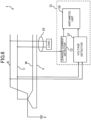
- FIG. 5 is a block diagram illustrating the configuration of the first measurement unit 11. Specifically, FIG. 5 is a block diagram illustrating the configuration of the first measurement unit 11 and a diagram illustrating a connection state between the first measurement unit 11 and the wireway to be measured in the state in which the controller 55 recognizes the first state and the selection processor 51 selects the first measurement unit 11.
- the first measurement unit 11 includes the leakage current detector 12, the voltage detector 13, a phase angle calculator 14, and an ground insulation resistance leakage current component calculator (hereinafter referred to as a leakage current component calculator) 15.
- the leakage current detector 12 detects a leakage current flowing in the wireway to be measured to which the load is connected.
- the leakage current detector 12 detects a leakage current flowing in a single-phase circuit branched from the star connection (Y-connection) of the first phase, the second phase, and the third phase. While the first, second, and third phases will be hereinafter referred to as "U-phase,” “V-phase,” and “W-phase,” respectively, the names are not limited thereto. While the leakage current measured by the leakage current detector 12 will be hereinafter referred to as "Io,” the name is not limited thereto.
- a zero-phase current transformer (ZCT) 10 is connected to the leakage current detector 12.
- the zero-phase current transformer 10 is configured to clamp the wireways collectively.
- the zero-phase current transformer 10 may be configured as a handy-type split-core zero-phase current transformer, which makes it possible for an operator to easily place the current transformer to the wireways on site.
- the leakage current detector 12 detects (calculates) a leakage current (Io) flowing in the wireway to be measured, from a signal measured by the zero-phase current transformer 10.
- the voltage detector 13 detects a voltage applied between the neutral line and any one of the first phase, the second phase, or the third phase to which the load is connected.
- FIG. 5 illustrates an example in which the load is disposed between the U-phase and the neutral line N.
- the voltage detector 13 detects a voltage applied between the U-phase and the neutral line N.
- the load may be disposed between the V-phase and the neutral line N or between the W-phase and the neutral line N. In the case in which the load is disposed between the V-phase and the neutral line N, the voltage detector 13 detects a voltage applied between the V-phase and the neutral line N. In the case in which the load is disposed between the W-phase and the neutral line N, the voltage detector 13 detects a voltage applied between the W-phase and the neutral line N.
- the phase angle calculator 14 calculates a phase angle based on the leakage current detected by the leakage current detector 12 and the voltage detected by the voltage detector 13. Specifically, the phase angle calculator 14 detects the phase angle ( ⁇ ) through arithmetic processing of the waveform of the leakage current (Io) detected by the leakage current detector 12 and the waveform of the voltage (e.g., reference voltage V N-U ) detected by the voltage detector 13. For example, the phase angle calculator 14 detects the phase angle ( ⁇ ) between the reference voltage V N-U and the leakage current (Io) based on the zero-crossing point of the reference voltage V N-U and the zero-crossing point of the leakage current (Io).
- the arithmetic processing for calculating the phase angle may be performed by synchronous detection or discrete Fourier transform (DFT). The configuration in the case of using the synchronous detection will be described later.
- DFT discrete Fourier transform
- the leakage current component calculator 15 calculates, according to the equation (1) above, a leakage current component (Ior) caused by a ground insulation resistance included in the leakage current from the leakage current (Io) detected by the leakage current detector 12 and the phase angle ⁇ calculated by the phase angle calculator 14.
- Ior the leakage current component caused by the ground insulation resistance
- leakage current, voltage, phase angle, and leakage current component caused by the ground insulation resistance are included in the wireway electricity related value.
- the measurement apparatus 1 including the first measurement unit 11 can accurately calculate the Ior caused in the single-phase circuit branched from the star connection based on the leakage current (Io) detected by the leakage current detector 12 and the phase angle (phase difference) calculated by the phase angle calculator 14. That is, the first measurement unit 11 is a measurement unit used in the case in which the load is disposed between the neutral line N and the U-phase, between the neutral line N and the V-phase, or between the neutral line N and the W-phase in the star connection and is operated as the single-phase circuit.
- a potential difference between E (earth) and the neutral line N is basically 0 [V], and a predetermined voltage (for example, 100 [V]) is applied between the E and the U-phase, between the E and the V-phase, or between the E and the W-phase (between each phase and the ground).
- the load is disposed between the neutral line N and the U-phase, between the neutral line N and the V-phase, or between the neutral line N and the W-phase to which the single-phase circuit is connected.
- the first measurement unit 11 detects a voltage V between the phases between which the load is disposed, obtains a phase difference ( ⁇ ) between the waveform (sine wave) of the voltage V and the waveform of a leakage current (Io) input from the zero-phase current transformer (ZCT) 10, and calculates the Ior by substituting the leakage current (Io) and the phase difference ( ⁇ ) into the equation (1).
- the measurement apparatus 1 can measure and calculate, as wireway electricity related values, various numerical values including the above-described leakage current (Io) and Ior, such as a current value, a power value, and the temporal histories and temporal variations thereof.
- the measurement apparatus 1 can also inspect or monitor the wireway to be measured using the wireway electricity related value.
- the configuration of the first measurement unit 11 is one example, and is not limited to the above-described configuration. As illustrated in FIG. 6 , the first measurement unit 11 may include an arithmetic unit 16 instead of the phase angle detector 14 and the leakage current component calculator 15.
- the arithmetic unit 16 calculates a leakage current component Ior(Io ⁇ cos ⁇ ) caused by a ground insulation resistance by integration by synchronous detection based on (the waveform of) the leakage current detected by the leakage current detector 12 and (the waveform of) the voltage detected by the voltage detector 13.
- the integration by the synchronous detection is to calculate Io ⁇ cos ⁇ by integrating the waveform in a predetermined range such as 0 to 180 degrees, and one specific example will be described below.
- the integration by the synchronous detection is not limited to the following calculation.
- the arithmetic unit 16 performs predetermined processing on the voltage value (voltage waveform) detected by the voltage detector 13 and the leakage current (current waveform) detected by the leakage current detector 12, outputs a parameter signal of a logical signal, performs full-wave rectification on the leakage current (current waveform) detected by the leakage current detector 12, performs quantized transform on the full-wave rectified current waveform by a continuous ⁇ ADC, and measures parameters of logical signals of sin and cos parts generated by the quantized transform and the average of the current waveform obtained by the continuous ⁇ ADC.
- the arithmetic unit 16 performs logical processing on the voltage value (voltage waveform) detected by the voltage detector 13 to generate a first logical signal, performs logical processing on the leakage current (current waveform) detected by the leakage current detector 12 to generate a second logical signal, performs arithmetic processing on the first logical signal and the second logical signal, and outputs a positive/negative or Hi/Lo signal (first signal).
- the arithmetic unit 16 generates zero-crossing points when the first logical signal changes, stores a time between the generated zero-crossing points, inverts the first logical signal during a period in which a time from a next zero-crossing point is the half of the stored time or less, performs phase conversion on the first logical signal, performs arithmetic processing on the phase-converted voltage waveform and the second logical signal, and outputs a positive/negative or Hi/Lo signal (second signal).
- the arithmetic unit 16 can obtain the average of a desired type of current value by performing counting by the quantized transform by the continuous ⁇ ADC based on the first signal and the second signal.
- the second measurement unit 21 operates in the case of the second state in which the three-phase AC power source in which the first phase, the second phase, and the third phase are star-connected is connected to the wireway to be measured and the load is connected to any two of the first phase, the second phase, and the third phase.
- the arithmetic unit 26 performs predetermined processing on the voltage value (voltage waveform) detected by the voltage detector 23 and the leakage current (current waveform) detected by the leakage current detector 22, outputs a parameter signal of a logical signal, performs full-wave rectification on the leakage current (current waveform) detected by the leakage current detector 22, performs quantized transform on the full-wave rectified current waveform by a continuous ⁇ ADC, and measures parameters of logical signals of sin and cos parts generated by the quantized transform and the average of the current waveform obtained by the continuous ⁇ ADC.
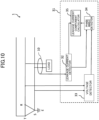
- the voltage detector 33 detects a voltage applied between the phases to which the load is connected.
- FIG. 10 illustrates an example in which the load is disposed between the R-phase and the S-phase.
- the voltage detector 33 detects a voltage applied between the R-phase and the S-phase.
- the load may be disposed between the T-phase and the S-phase. In the case in which the load is disposed between the T-phase and the S-phase, the voltage detector 33 detects a voltage applied between the T-phase and the S-phase.
- leakage current, voltage, phase angle, and leakage current component caused by the ground insulation resistance are included in the wireway electricity related value.
- the measurement apparatus 1 including the third measurement unit 31 can accurately calculate the Ior caused in the single-phase circuit branched from the delta connection based on the leakage current (Io) detected by the leakage current detector 32 and the phase angle (phase difference) calculated by the phase angle calculator 34. That is, the third measurement unit 31 is a measurement unit used in a case where the load is disposed between the R-phase and the S-phase (grounded phase) or between the T-phase and the S-phase (grounded phase) in the delta connection and is operated as the single-phase circuit.
- a potential difference between E (earth) and the S-phase (grounded phase) (between the S-phase and the ground) is basically 0 [V], and a predetermined voltage (for example, 200 [V]) is applied between the E and the R-phase and between the E and the T-phase (between each phase and the ground).
- the load is disposed between the S-phase and the R-phase or between the S-phase and the T-phase to which the single-phase circuit is connected.
- the configuration of the third measurement unit 31 is one example, and is not limited to the above-described configuration. As illustrated in FIG. 11 , the third measurement unit 31 may include an arithmetic unit 36 instead of the phase angle detector 34 and the leakage current component calculator 35.
- the arithmetic unit 36 calculates a leakage current component Ior(Io ⁇ cos ⁇ ) caused by a ground insulation resistance by integration by synchronous detection based on (the waveform of) the leakage current detected by the leakage current detector 32 and (the waveform of) the voltage detected by the voltage detector 33.
- the integration by the synchronous detection is to calculate Io ⁇ cos ⁇ by integrating the waveform in a predetermined range such as 0 to 180 degrees, and one specific example will be described below.
- the integration by the synchronous detection is not limited to the following calculation.
- the arithmetic unit 36 performs predetermined processing on the voltage value (voltage waveform) detected by the voltage detector 33 and the leakage current (current waveform) detected by the leakage current detector 32, outputs a parameter signal of a logical signal, performs full-wave rectification on the leakage current (current waveform) detected by the leakage current detector 32, performs quantized transform on the full-wave rectified current waveform by a continuous ⁇ ADC, and measures parameters of logical signals of sin and cos parts generated by the quantized transform and the average of the current waveform obtained by the continuous ⁇ ADC.
- the arithmetic unit 36 performs logical processing on the voltage value (voltage waveform) detected by the voltage detector 33 to generate a first logical signal, performs logical processing on the leakage current (current waveform) detected by the leakage current detector 32 to generate a second logical signal, performs arithmetic processing on the first logical signal and the second logical signal, and outputs a positive/negative or Hi/Lo signal (first signal).
- the fourth measurement unit 41 operates in the fourth state in which the three-phase AC power source in which the first phase, the second phase, and the third phase are delta-connected and any one of these phases is grounded is connected to the wireway to be measured and the load is connected to the non-grounded two phases.
- FIG. 12 is a block diagram illustrating the configuration of the fourth measurement unit 41.
- FIG. 12 is a block diagram illustrating the configuration of the fourth measurement unit 41 and a diagram illustrating a connection state between the fourth measurement unit 41 and the wireway to be measured in a state in which the controller 55 recognizes the fourth state and the selection processor 51 selects the fourth measurement unit 41.
- the fourth measurement unit 41 includes the leakage current detector 42, the voltage detector 43, a phase angle calculator 44, and an ground insulation resistance leakage current component calculator (hereinafter referred to as a leakage current component calculator) 45.
- the leakage current detector 42 detects a leakage current flowing in the wireway to be measured to which the load is connected.
- the leakage current detector 42 detects a leakage current flowing in a single-phase circuit branched from the delta ( ⁇ ) connection of the first phase, the second phase, and the third phase. While the first, second, and third phases are hereinafter referred to as "R-phase,” “S-phase,” and “T-phase,” respectively, the names are not limited thereto. While the leakage current measured by the leakage current detector 42 will be hereinafter referred to as "Io,” the name is not limited thereto. In the present embodiment, the S-phase is grounded, but the R-phase or the T-phase may be grounded.
- the voltage detector 43 detects a voltage applied between the phases to which the load is connected.
- FIG. 12 illustrates an example where the load is disposed between the R-phase and the T-phase.
- the voltage detector 43 detects a voltage applied between the R-phase and the T-phase.
- the phase angle calculator 44 calculates a phase angle based on the leakage current detected by the leakage current detector 42 and the voltage detected by the voltage detector 43. Specifically, the phase angle calculator 44 detects the phase angle ( ⁇ ) through arithmetic processing of the waveform of the leakage current (Io) detected by the leakage current detector 42 and the waveform of the voltage (e.g., reference voltage V R-T ) detected by the voltage detector 43. For example, the phase angle calculator 44 detects the phase angle ( ⁇ ) between the reference voltage V R-T and the leakage current (Io) based on the zero-crossing point of the reference voltage V R-T and the zero-crossing point of the leakage current (Io).
- the arithmetic processing for calculating the phase angle may be performed by synchronous detection or discrete Fourier transform (DFT). The configuration in the case of using the synchronous detection will be described later.
- DFT discrete Fourier transform
- the leakage current component calculator 45 calculates, according to equation (4) above, a leakage current component Ior caused by a ground insulation resistance included in the leakage current from the leakage current (Io) detected by the leakage current detector 42 and the phase angle ⁇ calculated by the phase angle calculator 44.
- leakage current, voltage, phase angle, and leakage current component caused by the ground insulation resistance are included in the wireway electricity related value.
- the measurement apparatus 1 including the fourth measurement unit 41 can accurately calculate the Ior caused in the single-phase circuit branched from the delta connection based on the leakage current (Io) detected by the leakage current detector 42 and the phase angle (phase difference) calculated by the phase angle calculator 44. That is, the fourth measurement unit 41 is a measurement unit used in a case where the load is disposed between the non-grounded phases (between the R-phase and the T-phase in the delta connection and is operated as the single-phase circuit.
- the voltage between the E (earth) and the R-phase and the voltage between the E and the T-phase are the same as each other (for example, 200 [V]).
- the load is disposed between the R-phase and the T-phase.
- the fourth measurement unit 41 detects a voltage V between the phases between which the load is disposed, obtains a phase difference ( ⁇ ) between the waveform (sine wave) of the voltage V and the waveform of a leakage current (Io) input from the zero-phase current transformer (ZCT) 10, and calculates the Ior by substituting the leakage current (Io) and the phase difference ( ⁇ ) into the equation (4).
- the R-phase and the T-phase have the same potential difference with respect to the ground.
- the same amount of floating capacitance is caused in both phases, and the floating capacitances are not unbalanced.
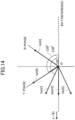
- the axis of the R-phase is at a position of 60 degrees from the reference point, and the axis of the T-phase is at a position of 120 degrees from the reference point, as illustrated in FIG. 14 .
- the Ior(r) since a phase difference between the Ior (hereinafter referred to as Ior(r)) of the R-phase and the reference point is 60 degrees, the Ior(r) is caused on the axis of the R-phase.
- a phase difference between the Ior (hereinafter referred to as Ior(t)) of the T-phase and the reference point is 120 degrees, the Ior(t) is caused on the axis of the T-phase.
- the Ioc (hereinafter referred to as Ioc(r)) of the R-phase is caused at a position of 90 degrees from the axis of the R-phase, and therefore, is caused at a position of 150 degrees.
- the Ioc (hereinafter referred to as Ioc(t)) of the T-phase is caused at a position of 90 degrees from the axis of the T-phase, and therefore, is caused at a position of 210 degrees.
- an Ioc(rt) obtained by combining the Ioc(r) and the Ioc(t) (vector combination) is caused in a direction of 180 degrees from the reference axis ("-X" direction in FIG. 14 ). That is, the Ioc(r) caused in the R-phase and the Ioc(t) caused in the T-phase are not unbalanced.
- the measurement apparatus 1 can measure and calculate, as wireway electricity related values, various numerical values including the above-described leakage current (Io) and Ior, such as a current value, a power value, and the temporal histories and temporal variations thereof.
- the measurement apparatus 1 can also inspect or monitor the wireway to be measured using the wireway electricity related value.
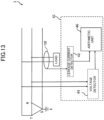
- the configuration of the fourth measurement unit 41 is one example, and is not limited to the above-described configuration. As illustrated in FIG. 13 , the fourth measurement unit 41 may include an arithmetic unit 46 instead of the phase angle detector 44 and the leakage current component calculator 45.
- the arithmetic unit 46 calculates a leakage current component Ior(Io ⁇ sin ⁇ /cos30°) caused by a ground insulation resistance by integration by synchronous detection based on (the waveform of) the leakage current detected by the leakage current detector 42 and (the waveform of) the voltage detected by the voltage detector 43.
- the integration by the synchronous detection is to calculate Io ⁇ sin ⁇ by integrating the waveform in a predetermined range such as 90 to 270 degrees and divide Io ⁇ sin ⁇ by cos30°, and one specific example will be described below.
- the integration by the synchronous detection is not limited to the following calculation.
- the arithmetic unit 46 performs predetermined processing on the voltage value (voltage waveform) detected by the voltage detector 43 and the leakage current (current waveform) detected by the leakage current detector 42, outputs a parameter signal of a logical signal, performs full-wave rectification on the leakage current (current waveform) detected by the leakage current detector 42, performs quantized transform on the full-wave rectified current waveform by a continuous ⁇ ADC, and measures parameters of logical signals of sin and cos parts generated by the quantized transform and the average of the current waveform obtained by the continuous ⁇ ADC.
- the arithmetic unit 46 performs logical processing on the voltage value (voltage waveform) detected by the voltage detector 43 to generate a first logical signal, performs logical processing on the leakage current (current waveform) detected by the leakage current detector 42 to generate a second logical signal, performs arithmetic processing on the first logical signal and the second logical signal, and outputs a positive/negative or Hi/Lo signal (first signal).
- the arithmetic unit 46 generates zero-crossing points when the first logical signal changes, stores a time between the generated zero-crossing points, inverts the first logical signal during a period in which a time from a next zero-crossing point is the half of the stored time or less, performs phase conversion on the first logical signal, performs arithmetic processing on the phase-converted voltage waveform and the second logical signal, and outputs a positive/negative or Hi/Lo signal (second signal).
- the arithmetic unit 46 can obtain the average of a desired type of current value by performing counting by the quantized transform by the continuous ⁇ ADC based on the first signal and the second signal.
- the first measurement unit 11, the second measurement unit 21, the third measurement unit 31, and the fourth measurement unit 41 are independently configured, but the present disclosure is not limited thereto.
- the leakage current detectors 12, 22, 32, 42 may be configured as one unit
- the voltage detectors 13, 23, 33, 43 may be configured as one unit
- the phase angle calculators 14, 24, 34, 44 may be configured as one unit
- the leakage current component calculators 15, 25, 35, 45 may be configured as one unit.
- FIG. 15 is a diagram showing another configuration of a measurement apparatus 1c.
- the measurement apparatus 1c includes a measurement unit 101 and a selection processor 102.
- the measurement unit 101 measures a wireway electricity related value which is a value related to electricity of a wireway branched from a wireway to be measured to which a star-connected or delta-connected three-phase AC power source is connected and branched from a three-phase AC to a single-phase AC and distributed.
- the selection processor 102 selects one state from two or more of a first state in which a three-phase AC power source in which a first phase, a second phase, a third phase, and a neutral line are star-connected is connected to a wireway to be measured and a load is connected to any one of the first phase, the second phase, or the third phase and the neutral line, a second state in which a three-phase AC power source in which a first phase, a second phase, and a third phase are star-connected is connected to a wireway to be measured and a load is connected to any two of the first phase, the second phase, and the third phase, a third state in which a three-phase AC power source in which a first phase, a second phase, and a third phase are delta-connected and any one of the phases is grounded is connected to a wireway to be measured and a load is connected to the grounded phase and any one of the non-grounded phases, and a fourth state in which a three-phase AC power source in which a first phase
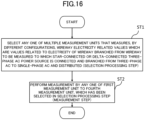
- the selection processor 51 selects any one of the plurality of measurement units configured to measure, by different configurations, wireway electricity related values which are values related to electricity of a wireway branched from a wireway to be measured to which a star-connected or delta-connected three-phase AC power source is connected and branched from a three-phase AC to a single-phase AC and distributed (selection processing step).
- leakage current, voltage, phase angle, and leakage current component caused by the ground insulation resistance are included in the wireway electricity related value.
- the measurement unit 101 measures a wireway electricity related value which is a value related to electricity of a wireway branched from a wireway to be measured to which a star-connected or delta-connected three-phase AC power source is connected and branched from a three-phase AC to a single-phase AC and distributed (measurement step).
- a measurement program for switching a measurement unit to a measurement unit suitable for the state of a three-phase AC power source and accurately calculating the Ior of a wireway in a case where a three-phase AC output from the three-phase AC power source is converted into a single-phase AC and a load is connected to the wireway in which the single-phase AC flows mainly includes the following steps, and is implemented by a computer 500 (hardware).
- Step 1 selecting any one of a plurality of measurement units configured to measure, by different configurations, wireway electricity related values which are values related to electricity of a wireway branched from a wireway to be measured to which a star-connected or delta-connected three-phase AC power source is connected and branched from a three-phase AC to a single-phase AC and distributed (selection processing step).
- Step 2 performing measurement by any one of the first measurement unit 11 to the fourth measurement unit 41, which has been selected in the selection processing step (measurement step).
- the fourth measurement unit 41 measures, by the fourth configuration, the wireway electricity related value which is the value related to the electricity of the wireway branched from the wireway to be measured to which the delta-connected three-phase AC power source is connected and branched from the three-phase AC to the single-phase AC and distributed (fourth measurement step).
- a display for displaying various types of information, a touch panel operated by the user, and other devices are connected to the input/output I/F 504.
- the touch panel is disposed on the front surface of the display. This configuration allows an intuitive operation of the user through a touch or any other suitable operation of icons on the display with a finger.
- the touch panel does not have to be disposed on the front surface of the display.
- a keyboard or a pointing device, such as a mouse may be connected to the input/output I/F 504.
- a speaker configured to output sound to the outside, or a microphone configured to receive external sound may be connected to the input/output I/F 504.
- the display is a liquid crystal display, an organic electroluminescence (EL) display, or any other suitable display that displays various types of information under control by the processor 501.
- EL organic electroluminescence
- the memory 502 is composed of a random-access memory (RAM).
- the RAM is composed of a volatile or non-volatile memory.
- the storage 503 is composed of a read-only memory (ROM).
- the ROM is composed of a non-volatile memory and may be configured as, for example, a hard disk drive (HDD) or a solid-state drive (SSD).
- the storage 503 stores various types of programs, such as the measurement program executed in Steps 1 to 2 described above.
- the processor 501 controls the overall operation of the computer 500.
- the processor 501 is an arithmetic device that loads an operating system and various programs fulfilling various functions, from the storage 503 into the memory 502 and executes commands included in the loaded programs.
- the processor 501 reads out a program (e.g., the measurement program of the present embodiment) stored in the storage 503, deploys the read program in the memory 502, and executes the program.
- the processor 501 executes the measurement program to implement the functions of the first measurement unit 11, the leakage current detectors 12, 22, 32, 42, the voltage detectors 13, 23, 33, 43, the phase angle calculators 14, 24, 34, 44, the ground insulation resistance leakage current component calculators (leakage current component calculators) 15, 25, 35, 45, the second measurement unit 21, the third measurement unit 31, the fourth measurement unit 41, and the selection processor 51.
- the processor 501 is, for example, a central processing unit (CPU), a micro-processing unit (MPU), a graphics processing unit (GPU), any of other various arithmetic devices, or a combination thereof.
- CPU central processing unit
- MPU micro-processing unit
- GPU graphics processing unit
- a part or all of the functions of the processor 501, the memory 502, the storage 503, and other components may be configured by a processing circuit 601 which is dedicated hardware, as shown in FIG. 19 .
- the processing circuit 601 is, for example, a single circuit, a composite circuit, a programmed processor, a parallel-programmed processor, an application specific integrated circuit (ASIC), a field-programmable gate array (FPGA), or a combination thereof.
- the processor 501 has been described as a single component, the configuration is not limited thereto.
- the processor 501 may be a group of a plurality of physically separate processors.
- a program or commands included in the program has/have been described as being executed by the processor 501.
- the program or commands may be executed by the single processor 501 or may be distributed to a plurality of processors for execution.
- the program or commands included in the program, which is/are executed by the processor 501 may be executed by a plurality of virtual processors.
- the communication I/F 505 conforms to a predetermined communication protocol and establishes wired or wireless communication with an external device.
- the step (the above-described first measurement step to the fourth measurement step) suitable for the state (the above-described first to fourth states) of the three-phase AC power source can be selected, and the Ior of such a wireway can be accurately calculated.
- the first measurement unit 11 is selected in the case of the first state in which the three-phase AC power source in which the first phase, the second phase, the third phase, and the neutral line are star-connected is connected to the wireway to be measured and the load is connected to any one of the first phase, the second phase, or the third phase and the neutral line.
- the second measurement unit 21 is selected in the case of the second state in which the three-phase AC power source in which the first phase, the second phase, and the third phase are star-connected is connected to the wireway to be measured and the load is connected to any two of the first phase, the second phase, and the third phase.
- the third measurement unit 31 is selected in the case of the third state in which the three-phase AC power source in which the first phase, the second phase, and the third phase are delta-connected and any one of these phases is grounded is connected to the wireway to be measured and the load is connected to the grounded phase and any one of the non-grounded phases.
- leakage current, voltage, phase angle, and leakage current component caused by the ground insulation resistance are included in the wireway electricity related value.
- leakage current, voltage, phase angle, and leakage current component caused by the ground insulation resistance are included in the wireway electricity related value.
- leakage current, voltage, phase angle, and leakage current component caused by the ground insulation resistance are included in the wireway electricity related value.
- leakage current, voltage, phase angle, and leakage current component caused by the ground insulation resistance are included in the wireway electricity related value.
- the measurement program is not limited to one described above, and may mainly include the following steps and be executed by the computer 500 (hardware).
- Step 101 measuring a wireway electricity related value which is a value related to electricity of a wireway branched from a wireway to be measured to which a star-connected or delta-connected three-phase AC power source is connected and branched from a three-phase AC to a single-phase AC and distributed (measurement step).
- Step 102 selecting one state from two or more of a first state in which a three-phase AC power source in which a first phase, a second phase, a third phase, and a neutral line are star-connected is connected to a wireway to be measured and a load is connected to any one of the first phase, the second phase, or the third phase and the neutral line, a second state in which a three-phase AC power source in which a first phase, a second phase, and a third phase are star-connected is connected to a wireway to be measured and a load is connected to any two of the first phase, the second phase, and the third phase, a third state in which a three-phase AC power source in which a first phase, a second phase, and a third phase are delta-connected and any one of the phases is grounded is connected to a wireway to be measured and a load is connected to the grounded phase and any one of the non-grounded phases, and a fourth state in which a three-phase AC power source in which a first phase, a
Landscapes
- Physics & Mathematics (AREA)
- General Physics & Mathematics (AREA)
- Engineering & Computer Science (AREA)
- Power Engineering (AREA)
- Testing Of Short-Circuits, Discontinuities, Leakage, Or Incorrect Line Connections (AREA)
- Measurement Of Resistance Or Impedance (AREA)
- Locating Faults (AREA)
- Measurement Of Current Or Voltage (AREA)
- Remote Monitoring And Control Of Power-Distribution Networks (AREA)
Abstract
Description
- The present disclosure relates to a measurement apparatus, a measurement method, and a measurement program for measuring a value related to electricity of a wireway.
- A system for supplying electricity to each home or factory includes a three-phase AC system (hereinafter referred to as a three-phase system) and a single-phase AC system (hereinafter referred to as a single-phase system). The single-phase system is a system often used in general homes where a voltage is low and a high voltage is not required because the number of wires is small. Since the three-phase system can obtain the same power with smaller current than that in the single-phase system, is a system often used in, for example, factories where much electricity is used, with less electric loss because the same power can be obtained with a smaller current than that in the single-phase system.
- In, e.g., a factory where a three-phase AC power source is used, in a case where an apparatus to be driven with a single-phase power is used, it is necessary to convert a three-phase power into a single-phase power and distribute the single-phase power.
Patent Document 1 discloses a technique of converting a three-phase AC output from a three-phase three-wire AC power source into a single-phase AC by a phase conversion transformer. It is important to measure a value (hereinafter referred to as a wireway electricity related value) related to electricity of a wireway and check whether or not the wireway electricity related value is within a normal range in order to constantly ensure safety. - Patent Document 1:
Japanese Unexamined Patent Publication No. 2021-162234 - Here, even in a case where the three-phase power is converted into the single-phase power and the single-phase power is distributed as described above, there is a demand for accurately measuring the wireway electricity related value.
- It is an object of the present disclosure to provide a measurement apparatus, a measurement method, and a measurement program capable of accurately measuring a wireway electricity related value of a single-phase circuit in a case where a three-phase power is converted into a single-phase power and the single-phase power is distributed and a load is disposed on the single-phase circuit.
- In order to achieve the objective, the present disclosure provides the following configurations.
- (1) A measurement apparatus includes a measurement unit including any two or more of a first measurement unit configured to measure, by a first configuration, a wireway electricity related value which is a value related to electricity of a wireway branched from a wireway to be measured to which a star-connected three-phase AC power source is connected and branched from a three-phase AC to a single-phase AC and distributed, a second measurement unit configured to measure, by a second configuration, a wireway electricity related value which is a value related to electricity of a wireway branched from a wireway to be measured to which a star-connected three-phase AC power source is connected and branched from a three-phase AC to a single-phase AC and distributed, a third measurement unit configured to measure, by a third configuration, a wireway electricity related value which is a value related to electricity of a wireway branched from a wireway to be measured to which a delta-connected three-phase AC power source is connected and branched from a three-phase AC to a single-phase AC and distributed, and a fourth measurement unit configured to measure, by a fourth configuration, a wireway electricity related value which is a value related to electricity of a wireway branched from a wireway to be measured to which a delta-connected three-phase AC power source is connected and branched from a three-phase AC to a single-phase AC and distributed, and
a selection processor configured to select any one of the measurement units in the measurement unit. - (2) The selection processor
- selects the first measurement unit in a case of a first state in which a three-phase AC power source in which a first phase, a second phase, a third phase, and a neutral line are star-connected is connected to the wireway to be measured and a load is connected to any one of the first phase, the second phase, or the third phase and the neutral line,
- selects the second measurement unit in a case of a second state in which a three-phase AC power source in which a first phase, a second phase, and a third phase are star-connected is connected to the wireway to be measured and a load is connected to any two of the first phase, the second phase, and the third phase,
- selects the third measurement unit in a case of a third state in which a three-phase AC power source in which a first phase, a second phase, and a third phase are delta-connected and any one of the phases is grounded is connected to the wireway to be measured and a load is connected to the grounded phase and any one of the non-grounded phases, and
- (3) The first measurement unit calculates, as the first configuration, a leakage current component caused by a ground insulation resistance included in a leakage current flowing in the wireway to be measured based on the leakage current and a voltage applied between any one of the first phase, the second phase, or the third phase to which the load is connected and the neutral line,
- the second measurement unit calculates, as the second configuration, a leakage current component caused by a ground insulation resistance included in a leakage current flowing in the wireway to be measured based on the leakage current and a voltage applied between the two phases to which the load is connected,
- the third measurement unit calculates, as the third configuration, a leakage current component caused by a ground insulation resistance included in a leakage current flowing in the wireway to be measured based on the leakage current and a voltage applied between the phases to which the load is connected, and
- the fourth measurement unit calculates, as the fourth configuration, a leakage current component caused by a ground insulation resistance included in a leakage current flowing in the wireway to be measured based on the leakage current and a voltage applied between the phases to which the load is connected.
- (4) A measurement apparatus includes a measurement unit configured to measure a wireway electricity related value which is a value related to electricity of a wireway branched from a wireway to be measured to which a star-connected or delta-connected three-phase AC power source is connected and branched from a three-phase AC to a single-phase AC and distributed, and
- a selection processor configured to select one state from two or more of a first state in which a three-phase AC power source in which a first phase, a second phase, a third phase, and a neutral line are star-connected is connected to the wireway to be measured and a load is connected to any one of the first phase, the second phase, or the third phase and the neutral line, a second state in which a three-phase AC power source in which a first phase, a second phase, and a third phase are star-connected is connected to the wireway to be measured and a load is connected to any two of the first phase, the second phase, and the third phase, a third state in which a three-phase AC power source in which a first phase, a second phase, and a third phase are delta-connected and any one of the phases is grounded is connected to the wireway to be measured and a load is connected to the grounded phase and any one of the non-grounded phases, and a fourth state in which a three-phase AC power source in which a first phase, a second phase, and a third phase are delta-connected and any one of the phases is grounded is connected to the wireway to be measured and a load is connected to the non-grounded two phases, and
- the measurement unit calculates,
- in a case in which the selection processor selects the first state or the third state, a leakage current component caused by a ground insulation resistance included in a leakage current, which is one of the wireway electricity related values, flowing in the wireway to be measured based on the leakage current and a voltage applied between any one of the first phase, the second phase, or the third phase to which the load is connected and the neutral line,
- in a case in which the selection processor selects the second state, a leakage current component caused by a ground insulation resistance included in a leakage current, which is one of the wireway electricity related values, flowing in the wireway to be measured based on the leakage current and a voltage applied between the two phases to which the load is connected, and
- in a case in which the selection processor selects the fourth state, a leakage current component caused by a ground insulation resistance included in a leakage current, which is one of the wireway electricity related values, flowing in the wireway to be measured based on the leakage current and a voltage applied between the phases to which the load is connected.
- (5) A measurement method includes selecting, in a selection processing step, any one of a plurality of measurement units configured to measure, by different configurations, wireway electricity related values which are values related to electricity of a wireway branched from a wireway to be measured to which a star-connected or delta-connected three-phase AC power source is connected and branched from a three-phase AC to a single-phase AC and distributed, and
- performing, in a measurement step, measurement by the measurement unit having been selected in the selection processing step, and
- the measurement unit includes any two or more of,
- a first measurement unit configured to measure, by a first configuration, a wireway electricity related value which is a value related to electricity of a wireway branched from a wireway to be measured to which a star-connected three-phase AC power source is connected and branched from a three-phase AC to a single-phase AC and distributed,
- a second measurement unit configured to measure, by a second configuration, a wireway electricity related value which is a value related to electricity of a wireway branched from a wireway to be measured to which a star-connected three-phase AC power source is connected and branched from a three-phase AC to a single-phase AC and distributed,
- a third measurement unit configured to measure, by a third configuration, a wireway electricity related value which is a value related to electricity of a wireway branched from a wireway to be measured to which a delta-connected three-phase AC power source is connected and branched from a three-phase AC to a single-phase AC and distributed, and
- a fourth measurement unit configured to measure, by a fourth configuration, a wireway electricity related value which is a value related to electricity of a wireway branched from a wireway to be measured to which a delta-connected three-phase AC power source is connected and branched from a three-phase AC to a single-phase AC and distributed.
- (6) A measurement program causes a computer to execute
- selecting, in a selection processing step, any one of a plurality of measurement units configured to measure, by different configurations, wireway electricity related values which are values related to electricity of a wireway branched from a wireway to be measured to which a star-connected or delta-connected three-phase AC power source is connected and branched from a three-phase AC to a single-phase AC and distributed, and
- performing, in a measurement step, measurement by the measurement unit having been selected in the selection processing step, and
- the plurality of measurement units include any two or more of,
- a first measurement unit configured to measure, by a first configuration, a wireway electricity related value which is a value related to electricity of a wireway branched from a wireway to be measured to which a star-connected three-phase AC power source is connected and branched from a three-phase AC to a single-phase AC and distributed,
- a second measurement unit configured to measure, by a second configuration, a wireway electricity related value which is a value related to electricity of a wireway branched from a wireway to be measured to which a star-connected three-phase AC power source is connected and branched from a three-phase AC to a single-phase AC and distributed,
- a third measurement unit configured to measure, by a third configuration, a wireway electricity related value which is a value related to electricity of a wireway branched from a wireway to be measured to which a delta-connected three-phase AC power source is connected and branched from a three-phase AC to a single-phase AC and distributed, and
- a fourth measurement unit configured to measure, by a fourth configuration, a wireway electricity related value which is a value related to electricity of a wireway branched from a wireway to be measured to which a delta-connected three-phase AC power source is connected and branched from a three-phase AC to a single-phase AC and distributed.
- According to the present disclosure, even in a case where the three-phase power is converted into the single-phase power and the single-phase power is distributed, the wireway electricity related value can be accurately measured.
-
-
FIG. 1 is a diagram illustrating a first configuration example of a measurement apparatus. -
FIG. 2 is a diagram illustrating a second configuration example of the measurement apparatus. -
FIG. 3 is a diagram illustrating a third configuration example of the measurement apparatus. -
FIG. 4 is a diagram illustrating a configuration in which a selection processor automatically recognizes the state (first to fourth states) of connection of a load. -
FIG. 5 is a block diagram illustrating the configuration of a first measurement unit. -
FIG. 6 is a block diagram illustrating a variation of the first measurement unit. -
FIG. 7 is a block diagram illustrating the configuration of a second measurement unit. -
FIG. 8 is a block diagram illustrating a variation of the second measurement unit. -
FIG. 9 is a diagram schematically illustrating vector representations of Ior and Ioc of each phase in star connection. -
FIG. 10 is a block diagram illustrating the configuration of a third measurement unit. -
FIG. 11 is a block diagram illustrating a variation of the third measurement unit. -
FIG. 12 is a block diagram illustrating the configuration of a fourth measurement unit. -
FIG. 13 is a block diagram illustrating a variation of the fourth measurement unit. -
FIG. 14 is a diagram schematically illustrating vector representations of Ior and Ioc of each phase in delta connection. -
FIG. 15 is a diagram showing another configuration of the measurement apparatus. -
FIG. 16 is a flowchart for describing a procedure of a measurement method. -
FIG. 17 is a flowchart for describing another procedure of the measurement method. -
FIG. 18 is a block diagram illustrating a first configuration example of a computer. -
FIG. 19 is a block diagram illustrating a second configuration example of the computer. - Embodiments of the present disclosure will be described below. The embodiments described below do not unreasonably limit the contents of the present disclosure recited in the appended claims. Not all the configurations described in the embodiments are essential constituent elements of the present disclosure. A method of branching a single-phase circuit from a three-phase AC connection to operate a load is used by private electric utility customers in Japan. Mostly in overseas, the load is operated by this method, and the technique of the present proposal can be applied to the overseas.
-
FIG. 1 is a diagram illustrating a first configuration example of ameasurement apparatus 1. Themeasurement apparatus 1 includes ameasurement unit 2 and aselection processor 51. Themeasurement unit 2 includes afirst measurement unit 11, asecond measurement unit 21, athird measurement unit 31, and afourth measurement unit 41. In this example, themeasurement apparatus 1 will be described with reference to the first configuration example illustrated inFIG 1 , but is not limited to this configuration example. Themeasurement unit 2 includes any two or more of thefirst measurement unit 11, thesecond measurement unit 21, thethird measurement unit 31, and thefourth measurement unit 41. For example, ameasurement apparatus 1a may include ameasurement unit 2a including only afirst measurement unit 11 and a second measurement unit 21 (second configuration example), as illustrated inFIG. 2 . Ameasurement apparatus 1b may include ameasurement unit 2b including only athird measurement unit 31 and a fourth measurement unit 41 (third configuration example), as illustrated inFIG. 3 . - The
first measurement unit 11 measures, by the first configuration, a wireway electricity related value which is a value related to electricity of a wireway branched from a wireway to be measured to which a star-connected three-phase AC power source is connected and branched from a three-phase AC to a single-phase AC and distributed. Although details of the configuration (first configuration) of thefirst measurement unit 11 will be described later, thefirst measurement unit 11 calculates, according to the following equation, a leakage current component Ior caused by a ground insulation resistance included in a leakage current Io, which is one of the wireway electricity related values, flowing in the wireway to be measured based on a phase angle θ calculated from the leakage current Io and a voltage applied between any one of a first phase, a second phase, or a third phase to which a load is connected and a neutral line,
- The
second measurement unit 21 measures, by the second configuration, a wireway electricity related value which is a value related to electricity of a wireway branched from a wireway to be measured to which a star-connected three-phase AC power source is connected and branched from a three-phase AC to a single-phase AC and distributed. Although details of the configuration (second configuration) of thesecond measurement unit 21 will be described later, thesecond measurement unit 21 calculates, according to the following equation, a leakage current component Ior caused by a ground insulation resistance included in a leakage current Io, which is one of the wireway electricity related values, flowing in the wireway to be measured based on a phase angle θ calculated from the leakage current Io and a voltage applied between two phases to which a load is connected,
- The
third measurement unit 31 measures, by the third configuration, a wireway electricity related value which is a value related to electricity of a wireway branched from a wireway to be measured to which a delta-connected three-phase AC power source is connected and branched from a three-phase AC to a single-phase AC and distributed. Although details of the configuration (third configuration) of thethird measurement unit 31 will be described later, thethird measurement unit 31 calculates, according to the following equation, a leakage current component Ior caused by a ground insulation resistance included in a leakage current Io, which is one of the wireway electricity related values, flowing in the wireway to be measured based on a phase angle θ calculated from the leakage current Io and a voltage applied between phases to which a load is connected,
- The
fourth measurement unit 41 measures, by the fourth configuration, a wireway electricity related value which is a value related to electricity of a wireway branched from a wireway to be measured to which a delta-connected three-phase AC power source is connected and branched from a three-phase AC to a single-phase AC and distributed. Although details of the configuration (fourth configuration) of thefourth measurement unit 41 will be described later, thefourth measurement unit 41 calculates, according to the following equation, a leakage current component Ior caused by a ground insulation resistance included in a leakage current Io, which is one of the wireway electricity related values, flowing in the wireway to be measured based on a phase angle θ calculated from the leakage current Io and a voltage applied between phases to which a load is connected,
- The
selection processor 51 selects any one of thefirst measurement unit 11, thesecond measurement unit 21, thethird measurement unit 31, or thefourth measurement unit 41. - Here, the operation of the
selection processor 51 will be described. Theselection processor 51 selects thefirst measurement unit 11 in the case of the first state in which the three-phase AC power source in which the first phase, the second phase, the third phase, and the neutral line are star-connected is connected to the wireway to be measured and the load (load used in a single phase) is connected to any one of the first phase, the second phase, or the third phase and the neutral line. Here, the load corresponds to, for example, a lighting circuit and a device connected to a single-phase outlet. - The
selection processor 51 selects thesecond measurement unit 21 in the case of the second state in which the three-phase AC power source in which the first phase, the second phase, and the third phase are star-connected is connected to the wireway to be measured and the load is in the second state in which the load is connected to any two of the first phase, the second phase, and the third phase. - The
selection processor 51 selects thethird measurement unit 31 when the three-phase AC power source in which the first phase, the second phase, and the third phase are delta-connected and any one of these phases is grounded is connected to the wireway to be measured and the load is in the third state in which the load is connected to the grounded phase and any one of the non-grounded phases. - The
selection processor 51 selects thefourth measurement unit 41 when the three-phase AC power source in which the first phase, the second phase, and the third phase are delta-connected and any one of these phases is grounded is connected to the wireway to be measured and the load is in the fourth state in which the load is connected to the non-grounded two phases. - The
selection processor 51 may include, for example, a rotary switch. When the switch is operated by an operational personnel, theselection processor 51 selects the measurement unit specified by the switch. The measurement unit selected by theselection processor 51 operates. - The
selection processor 51 may be configured to automatically recognize the state (first to fourth states) of the connection of the load and select the measurement unit according to a recognition result. The case in which the wireway to be measured on the secondary side includes four wires will be described as an example, but the present disclosure is also applicable to the case in which the wireway to be measured includes three wires.FIG. 4 is a diagram illustrating the configuration in which theselection processor 51 automatically recognizes the state (first to fourth states) of the connection of the load. - The
selection processor 51 includes aswitcher 52, avoltage detector 53, a leakagecurrent detector 54, and acontroller 55. Thevoltage detector 53 may be implemented using any one ofvoltage detectors current detector 54 may be implemented using any one of leakagecurrent detectors - All the four line wires a, b, c, d to be measured in the wireway to be measured are connected to the
switcher 52. Theswitcher 52 connects any two of the connected line wires in the wireway to be measured based on a switching instruction from thecontroller 55. Theswitcher 52 and thevoltage detector 53 are connected via two line wires. Thevoltage detector 53 detects a voltage applied to the line wires switched by theswitcher 52. - Further, zero-phase
current transformers 61a to 61f are connected to line wires (six locations in the example illustrated inFIG. 4 ) drawn from the wireway to be measured. The zero-phasecurrent transformers 61a to 61f are connected to the leakagecurrent detector 54. - Here, the operation of the
controller 55 will be described. In the case in which thecontroller 55 switches theswitcher 52 to select the line wire a and the line wire b, thecontroller 55 stores a voltage applied between the line wire a and the line wire b and detected by thevoltage detector 53 and a leakage current detected from the zero-phasecurrent transformer 61a clamped to wireways drawn from the line wire a and the line wire b in association with each other. In the case in which thecontroller 55 switches theswitcher 52 to select the line wire a and the line wire c, thecontroller 55 stores a voltage applied between the line wire a and the line wire c and detected by thevoltage detector 53 and a leakage current detected from the zero-phasecurrent transformer 61b clamped to wireways drawn from the line wire a and the line wire c in association with each other. In the case in which thecontroller 55 switches theswitcher 52 to select the line wire a and the line wire d, thecontroller 55 stores a voltage applied between the line wire a and the line wire d and detected by thevoltage detector 53 and a leakage current detected from the zero-phasecurrent transformer 61c clamped to wireways drawn from the line wire a and the line wire d in association with each other. In the case in which thecontroller 55 switches theswitcher 52 to select the line wire b and the line wire c, thecontroller 55 stores a voltage applied between the line wire b and the line wire c and detected by thevoltage detector 53 and a leakage current detected from the zero-phasecurrent transformer 61d clamped to wireways drawn from the line wire b and the line wire c in association with each other. In the case in which thecontroller 55 switches theswitcher 52 to select the line wire b and the line wire d, thecontroller 55 stores a voltage applied between the line wire b and the line wire d and detected by thevoltage detector 53 and a leakage current detected from the zero-phasecurrent transformer 61e clamped to wireways drawn from the line wire b and the line wire d in association with each other. In the case in which thecontroller 55 switches theswitcher 52 to select the line wire c and the line wire d, thecontroller 55 stores a voltage applied between the line wire c and the line wire d and detected by thevoltage detector 53 and a leakage current detected from the zero-phasecurrent transformer 61f clamped to wireways drawn from the line wire c and the line wire d in association with each other. - The
controller 55 determines, from the stored voltage, whether the star connection (the first state or the second state) or the delta connection (the third state or the fourth state) is made. For example, thecontroller 55 determines that the star connection is made when a voltage between the R-phase and the neutral line N (or the earth (E)), a voltage between the S-phase and the neutral line N (or the earth (E)), and a voltage between the T-phase and the neutral line N (or the earth (E)) are substantially the same as each other. Thecontroller 55 determines that the delta connection is made when there is a difference between the voltage between the R-phase and the earth (E) and the voltage between the S-phase and the earth (E) or when there is a difference between the voltage between the T-phase and the earth (E) and the voltage between the S-phase and the earth (E). - In the case in which the
controller 55 determines that the star connection is made, when the load is connected to any of the phases and the neutral line N, thecontroller 55 recognizes such a state as the first state, and when the load is not connected to any of the phases and the neutral line N, thecontroller 55 recognizes such a state as the second state. Here, themeasurement apparatus 1 may include a first switch configured to indicate whether or not the load is connected to any of the phases and the neutral line N. A user checks a connection state, and turns ON or OFF the first switch. Thecontroller 55 determines that the load is connected to any of the phases and the neutral line N when the first switch is ON, and determines that the load is not connected to any of the phases and the neutral line N when the first switch is OFF. In the case in which thecontroller 55 determines that the delta connection is made, when the phases including the S-phase are clamped by the zero-phase current transformer, thecontroller 55 recognizes such a state as the third state, and when the phases including the S-phase are not clamped by the zero-phase current transformer, thecontroller 55 recognizes such a state as the fourth state. Here, themeasurement apparatus 1 may include a second switch configured to indicate whether or not the phases including the S-phase are clamped by the zero-phase current transformer. The user checks the state of clamping by the zero-phase current transformer, and turns ON or OFF the second switch. Thecontroller 55 determines that the phases including the S-phase are clamped by the zero-phase current transformer when the second switch is ON, and determines that the phases including the S-phase are not clamped by the zero-phase current transformer when the second switch is OFF. - The direction of the leakage current is an angle when the leakage current is represented by a vector. Here, in the case of the single-phase AC, the phase of a leakage current component (Ioc) caused by a ground capacitance and the phase of a leakage current component (Ior) caused by a ground insulation resistance directly related to an insulation resistance are different from each other by 90 degrees. The leakage current (Io) detected by the zero-phase current transformer is a combination of Ioc and Ior, and therefore appears somewhere in the range of 90 degrees.
- As will be described later with reference to
FIG. 9 , for example, in the case of the star connection, when the Ior of the U-phase is caused at a position of 30 degrees, the Ior of the V-phase is caused at a position of 150 degrees, and the Ior of the W-phase is caused at a position of 270 degrees. Since the Ioc of the U-phase is caused at a position of 120 degrees, the Io of the U-phase is caused in a range of 30 degrees to 120 degrees. Similarly, since the Ioc of the V-phase is caused at a position of 240 degrees, the Io of the U-phase is caused in a range of 150 degrees to 240 degrees, and since the Ioc of the W-phase is caused at a position of 360 (0) degrees, the Io of the U-phase is caused in a range of 270 degrees to 360 (0) degrees.
Thecontroller 55 can recognize, from the direction of the leakage current Io detected by the zero-phase current transformer, which line wires are clamped together. - The
selection processor 51 may be configured to connect only any two line wires (for example, the line wire a and the line wire b) of the wireways forming the wireway to be measured to thevoltage detector 53. In the case of such a configuration, theselection processor 51 does not include theswitcher 52, and performs arithmetic operation of shifting the phase of the leakage current detected by the zero-phase current transformer clamping the line wires other than the two connected line wires (for example, by 120°) to recognize the state (first to fourth states) of the connection of the load. - For example, the
measurement apparatus 1 includes a first selector configured to select whether the power source side is in the star connection or the delta connection, a second selector configured to select which two line wires (phases) are connected to thevoltage detector 53, and a third selector configured to select which two phases are clamped by the zero-phase current transformer. Theselection processor 51 recognizes the state of the connection of the load based on the states selected by the first selector, the second selector, and the third selector, and calculates the Ior. - Specifically, in the case in which the first selector selects the star connection, the second selector selects that the R-phase and the T-phase are connected to the
voltage detector 53, and the third selector selects that the R-phase and the T-phase are clamped by the zero-phase current transformer, the state of the connection of the load is recognized as the second state, and the Ior is calculated according to the following equation:
- In the case in which the first selector selects the star connection, the second selector selects that the R-phase and the T-phase are connected to the
voltage detector 53, and the third selector selects that the S-phase and the T-phase are clamped by the zero-phase current transformer, the state of the connection of the load is recognized as the second state. However, since the phases connected to thevoltage detector 53 are different from the phases clamped by the zero-phase current transformer, the phase of the leakage current detected by the zero-phase current transformer is shifted by 120°, and the Ior is calculated according to the following equation:
- In the case in which the first selector selects the delta connection, the second selector selects that the R-phase and the T-phase are connected to the
voltage detector 53, and the third selector selects that the S-phase and the T-phase are clamped by the zero-phase current transformer, the state of the connection of the load is recognized as the third state. However, since the phases connected to thevoltage detector 53 are different from the phases clamped by the zero-phase current transformer, the phase of the leakage current detected by the zero-phase current transformer is shifted by 120°, and the Ior is calculated according to the following equation:
- The first selector may further have a configuration for selecting whether or not the power source side is the single phase.
- As described above, the
selection processor 51 measures all the voltages between the phases and the voltages between the phases and the ground, recognizes the wireways from these voltages, automatically recognizes the state (first to fourth states) of the connection of the load from the phases clamped by the zero-phase current transformer (ZCT), and selects the measurement unit according to the recognition result. - In this manner, in the case where the three-phase AC output from the three-phase AC power source is converted into the single-phase AC and the load is connected to the wireway in which the single-phase AC flows, the
measurement apparatus 1 can select the measurement unit (the above-describedfirst measurement unit 11 to fourth measurement unit 41) suitable for the state (the above-described first to fourth states) of the three-phase AC power source and accurately calculate the wireway electricity related value (particularly, the leakage current component (Ior) caused by the ground insulation resistance included in the leakage current) of the wireway. - Here, specific configuration and operation of the
first measurement unit 11 will be described. Thefirst measurement unit 11 operates in the case of the first state in which the three-phase AC power source in which the first phase, the second phase, the third phase, and the neutral line are star-connected is connected to the wireway to be measured and the load is connected to any one of the first phase, the second phase, or the third phase and the neutral line. -
FIG. 5 is a block diagram illustrating the configuration of thefirst measurement unit 11. Specifically,FIG. 5 is a block diagram illustrating the configuration of thefirst measurement unit 11 and a diagram illustrating a connection state between thefirst measurement unit 11 and the wireway to be measured in the state in which thecontroller 55 recognizes the first state and theselection processor 51 selects thefirst measurement unit 11. Thefirst measurement unit 11 includes the leakagecurrent detector 12, thevoltage detector 13, aphase angle calculator 14, and an ground insulation resistance leakage current component calculator (hereinafter referred to as a leakage current component calculator) 15. - The leakage
current detector 12 detects a leakage current flowing in the wireway to be measured to which the load is connected. The leakagecurrent detector 12 detects a leakage current flowing in a single-phase circuit branched from the star connection (Y-connection) of the first phase, the second phase, and the third phase. While the first, second, and third phases will be hereinafter referred to as "U-phase," "V-phase," and "W-phase," respectively, the names are not limited thereto. While the leakage current measured by the leakagecurrent detector 12 will be hereinafter referred to as "Io," the name is not limited thereto. - A zero-phase current transformer (ZCT) 10 is connected to the leakage
current detector 12. The zero-phasecurrent transformer 10 is configured to clamp the wireways collectively. For example, the zero-phasecurrent transformer 10 may be configured as a handy-type split-core zero-phase current transformer, which makes it possible for an operator to easily place the current transformer to the wireways on site. The leakagecurrent detector 12 detects (calculates) a leakage current (Io) flowing in the wireway to be measured, from a signal measured by the zero-phasecurrent transformer 10. - The
voltage detector 13 detects a voltage applied between the neutral line and any one of the first phase, the second phase, or the third phase to which the load is connected.FIG. 5 illustrates an example in which the load is disposed between the U-phase and the neutral line N. Thevoltage detector 13 detects a voltage applied between the U-phase and the neutral line N. The load may be disposed between the V-phase and the neutral line N or between the W-phase and the neutral line N. In the case in which the load is disposed between the V-phase and the neutral line N, thevoltage detector 13 detects a voltage applied between the V-phase and the neutral line N. In the case in which the load is disposed between the W-phase and the neutral line N, thevoltage detector 13 detects a voltage applied between the W-phase and the neutral line N. - The
phase angle calculator 14 calculates a phase angle based on the leakage current detected by the leakagecurrent detector 12 and the voltage detected by thevoltage detector 13. Specifically, thephase angle calculator 14 detects the phase angle (θ) through arithmetic processing of the waveform of the leakage current (Io) detected by the leakagecurrent detector 12 and the waveform of the voltage (e.g., reference voltage VN-U) detected by thevoltage detector 13. For example, thephase angle calculator 14 detects the phase angle (θ) between the reference voltage VN-U and the leakage current (Io) based on the zero-crossing point of the reference voltage VN-U and the zero-crossing point of the leakage current (Io). The arithmetic processing for calculating the phase angle may be performed by synchronous detection or discrete Fourier transform (DFT). The configuration in the case of using the synchronous detection will be described later. - The leakage
current component calculator 15 calculates, according to the equation (1) above, a leakage current component (Ior) caused by a ground insulation resistance included in the leakage current from the leakage current (Io) detected by the leakagecurrent detector 12 and the phase angle θ calculated by thephase angle calculator 14. Hereinafter, the leakage current component caused by the ground insulation resistance may be referred to as "Ior." - The above-described leakage current, voltage, phase angle, and leakage current component caused by the ground insulation resistance are included in the wireway electricity related value.
- In this manner, the
measurement apparatus 1 including thefirst measurement unit 11 can accurately calculate the Ior caused in the single-phase circuit branched from the star connection based on the leakage current (Io) detected by the leakagecurrent detector 12 and the phase angle (phase difference) calculated by thephase angle calculator 14. That is, thefirst measurement unit 11 is a measurement unit used in the case in which the load is disposed between the neutral line N and the U-phase, between the neutral line N and the V-phase, or between the neutral line N and the W-phase in the star connection and is operated as the single-phase circuit. - Here, a potential difference between E (earth) and the neutral line N (between the N-phase and the ground) is basically 0 [V], and a predetermined voltage (for example, 100 [V]) is applied between the E and the U-phase, between the E and the V-phase, or between the E and the W-phase (between each phase and the ground). The load is disposed between the neutral line N and the U-phase, between the neutral line N and the V-phase, or between the neutral line N and the W-phase to which the single-phase circuit is connected. The
first measurement unit 11 detects a voltage V between the phases between which the load is disposed, obtains a phase difference (θ) between the waveform (sine wave) of the voltage V and the waveform of a leakage current (Io) input from the zero-phase current transformer (ZCT) 10, and calculates the Ior by substituting the leakage current (Io) and the phase difference (θ) into the equation (1). - The
measurement apparatus 1 can measure and calculate, as wireway electricity related values, various numerical values including the above-described leakage current (Io) and Ior, such as a current value, a power value, and the temporal histories and temporal variations thereof. Themeasurement apparatus 1 can also inspect or monitor the wireway to be measured using the wireway electricity related value. - The configuration of the
first measurement unit 11 is one example, and is not limited to the above-described configuration. As illustrated inFIG. 6 , thefirst measurement unit 11 may include anarithmetic unit 16 instead of thephase angle detector 14 and the leakagecurrent component calculator 15. - The
arithmetic unit 16 calculates a leakage current component Ior(Io × cosθ) caused by a ground insulation resistance by integration by synchronous detection based on (the waveform of) the leakage current detected by the leakagecurrent detector 12 and (the waveform of) the voltage detected by thevoltage detector 13. The integration by the synchronous detection is to calculate Io × cosθ by integrating the waveform in a predetermined range such as 0 to 180 degrees, and one specific example will be described below. The integration by the synchronous detection is not limited to the following calculation. - The
arithmetic unit 16 performs predetermined processing on the voltage value (voltage waveform) detected by thevoltage detector 13 and the leakage current (current waveform) detected by the leakagecurrent detector 12, outputs a parameter signal of a logical signal, performs full-wave rectification on the leakage current (current waveform) detected by the leakagecurrent detector 12, performs quantized transform on the full-wave rectified current waveform by a continuous ΔΣ ADC, and measures parameters of logical signals of sin and cos parts generated by the quantized transform and the average of the current waveform obtained by the continuous ΔΣ ADC. Specifically, thearithmetic unit 16 performs logical processing on the voltage value (voltage waveform) detected by thevoltage detector 13 to generate a first logical signal, performs logical processing on the leakage current (current waveform) detected by the leakagecurrent detector 12 to generate a second logical signal, performs arithmetic processing on the first logical signal and the second logical signal, and outputs a positive/negative or Hi/Lo signal (first signal). Moreover, thearithmetic unit 16 generates zero-crossing points when the first logical signal changes, stores a time between the generated zero-crossing points, inverts the first logical signal during a period in which a time from a next zero-crossing point is the half of the stored time or less, performs phase conversion on the first logical signal, performs arithmetic processing on the phase-converted voltage waveform and the second logical signal, and outputs a positive/negative or Hi/Lo signal (second signal). Thearithmetic unit 16 can obtain the average of a desired type of current value by performing counting by the quantized transform by the continuous ΔΣ ADC based on the first signal and the second signal. The desired type of current value includes an AC value measurement, and an input current I [A], an active current Ir = Icosθ [A], and a reactive current IL - IC = Isinθ [A] can be obtained. Here, the above-described "active current Ir = Icosθ" is the leakage current component Ior caused by the ground insulation resistance. - According to such a configuration, there is an advantage that the leakage current component Ior caused by the ground insulation resistance can be calculated without calculation of the vector of the phase difference.
- Next, specific configuration and operation of the
second measurement unit 21 will be described. Thesecond measurement unit 21 operates in the case of the second state in which the three-phase AC power source in which the first phase, the second phase, and the third phase are star-connected is connected to the wireway to be measured and the load is connected to any two of the first phase, the second phase, and the third phase. -
FIG. 7 is a block diagram illustrating the configuration of thesecond measurement unit 21. Specifically,FIG. 7 is a block diagram illustrating the configuration of thesecond measurement unit 21 and a diagram illustrating a connection state between thesecond measurement unit 21 and the wireway to be measured in a state in which thecontroller 55 recognizes the second state and theselection processor 51 selects thesecond measurement unit 21. Thesecond measurement unit 21 includes the leakagecurrent detector 22, thevoltage detector 23, aphase angle calculator 24, and an ground insulation resistance leakage current component calculator (hereinafter referred to as a leakage current component calculator) 25. - The leakage
current detector 22 detects a leakage current flowing in the wireway to be measured to which the load is connected. The leakagecurrent detector 22 detects a leakage current flowing in a single-phase circuit branched from the star connection (Y-connection) of the first phase, the second phase, and the third phase. While the first, second, and third phases will be hereinafter referred to as "U-phase," "V-phase," and "W-phase," respectively, the names are not limited thereto. While the leakage current measured by the leakagecurrent detector 22 will be hereinafter referred to as "Io," the name is not limited thereto. - A zero-phase current transformer (ZCT) 10 is connected to the leakage
current detector 22. The zero-phasecurrent transformer 10 is configured to clamp the wireways collectively. For example, the zero-phasecurrent transformer 10 may be configured as a handy-type split-core zero-phase current transformer, which makes it possible for an operator to easily place the current transformer to the wireways on site. The leakagecurrent detector 22 detects (calculates) an Io flowing in the wireway to be measured, from a signal measured by the zero-phasecurrent transformer 10. - The
voltage detector 23 detects a voltage applied between two phases to which the load is connected.FIG. 7 illustrates an example in which the load is disposed between the U-phase and the W-phase. Thevoltage detector 23 detects a voltage applied between the U-phase and the W-phase. The load may be disposed between the V-phase and the U-phase or between the V-phase and the W-phase. In the case in which the load is disposed between the V-phase and the U-phase, thevoltage detector 23 detects a voltage applied between the V-phase and the U-phase. In the case in which the load is disposed between the V-phase and the W-phase, thevoltage detector 23 detects a voltage applied between the V-phase and the W-phase. - The
phase angle calculator 24 calculates a phase angle based on the leakage current detected by the leakagecurrent detector 22 and the voltage detected by thevoltage detector 23. Specifically, thephase angle calculator 24 detects the phase angle (θ) through arithmetic processing of the waveform of the leakage current (Io) detected by the leakagecurrent detector 22 and the waveform of the voltage (e.g., reference voltage Vu-w) detected by thevoltage detector 23. For example, thephase angle calculator 24 detects the phase angle (θ) between the reference voltage Vu-w and the leakage current (Io) based on the zero-crossing point of the reference voltage Vu-w and the zero-crossing point of the leakage current (Io). The arithmetic processing for calculating the phase angle may be performed by synchronous detection or discrete Fourier transform (DFT). The configuration in the case of using the synchronous detection will be described later. - The leakage
current component calculator 25 calculates, according to the equation (2) above, a leakage current component Ior caused by a ground insulation resistance included in the leakage current from the leakage current (Io) detected by the leakagecurrent detector 22 and the phase angle θ calculated by thephase angle calculator 24. - The above-described leakage current, voltage, phase angle, and leakage current component caused by the ground insulation resistance are included in the wireway electricity related value.
- In this manner, the
measurement apparatus 1 including thesecond measurement unit 21 can accurately calculate the Ior caused in the single-phase circuit branched from the star connection based on the leakage current (Io) detected by the leakagecurrent detector 22 and the phase angle (phase difference) calculated by thephase angle calculator 24. That is, thesecond measurement unit 21 is a measurement unit used in a case where the load is disposed between the U-phase and the V-phase, between the V-phase and the W-phase, or between the U-phase and the W-phase in the star connection and is operated as the single-phase circuit. - For example, in a case where the load is connected as the single-phase circuit between the U-phase and the V-phase, the voltage between the E (earth) and the U-phase and the voltage between the E and the V-phase are the same as each other (for example, 100 [V]), and the voltage between the U-phase and the V-phase is different (for example, 200 [V]). The load is disposed between the U-phase and the V-phase, between the V-phase and the W-phase, or between the U-phase and the W-phase. The
second measurement unit 21 detects a voltage V between the phases between which the load is disposed, obtains a phase difference (θ) between the waveform (sine wave) of the voltage V and the waveform of a leakage current (Io) input from the zero-phase current transformer (ZCT) 10, and calculates the Ior by substituting the leakage current (Io) and the phase difference (θ) into the equation (2). - Here, the U-phase and the V-phase have the same potential difference with respect to the ground in a normal state. In this case, even if floating capacitances are caused in the U-phase and the V-phase, the same amount of floating capacitance is caused in both phases, and the floating capacitances are not unbalanced.
- Here, a reason why the unbalance does not occur will be described below. The leakage current (Io) includes a leakage current component (hereinafter referred to as "Ioc") caused by a ground capacitance and a leakage current component (hereinafter referred to as "Ior") caused by a ground insulation resistance directly related to an insulation resistance.
- Vector representations of the Ioc and the Ior will be described with reference to
FIG. 9. FIG. 9 is a diagram schematically illustrating the vector representations of the Ior and the Ioc of each phase. - Relative to a reference voltage of 0 degrees, in a case where a resistance component leakage current (hereinafter may be referred to as "Ior(u)") flowing in the U-phase is caused at a position of 30 degrees in the vector representation, a resistance component leakage current (hereinafter may be referred to as "Ior(v)") flowing in the V-phase is caused at a position of 150 degrees, and a resistance component leakage current (hereinafter may be referred to as "Ior(w)") flowing in the W-phase is caused at a position of 270 degrees. Hereinafter, the vector Ior(u) will be simply referred to as "Ior(u)," the vector Ior(v) will be simply referred to as "Ior(v)," and the vector Ior(w) will be simply referred to as "Ior(w)." In this embodiment, the potential between the U-phase and the V-phase is regarded as the reference voltage, which is set to 0 degrees.
- A capacitive component leakage current (hereinafter referred to as "Ioc(u)") flowing in the U-phase is caused at a position of 120 degrees which is advanced from the Ior(u) by 90 degrees (π/2). A capacitive component leakage current (hereinafter referred to as "Ioc(v)") flowing in the V-phase is caused at a position of 240 degrees which is advanced from the Ior(v) by 90 degrees (π/2). A capacitive component leakage current (hereinafter may be referred to as "Ioc(s)") flowing in the W-phase is caused at a position of 0 degrees (360 degrees) which is advanced from the Ior(w) by 90 degrees (π/2).
- Hereinafter, the vector Ioc(u) will be simply referred to as "Ioc(u)," the vector Ioc(v) will be simply referred to as "Ioc(v)," and the vector Ioc(s) will be simply referred to as "Ioc(s)."
- A vector (Ioc(uv)) obtained by combining the Ioc(u) and the Ioc(v) is caused at a position of 180 degrees. That is, the Ioc(u) caused in the U-phase and the Ioc(v) caused in the V-phase are not unbalanced.
- In a case where the Ioc(u), the Ioc(v), and the Ioc(w) are balanced, the Ioc(uv) and the Ioc(w) are combined and cancel each other, and the Ioc is not caused.
- The
measurement apparatus 1 can measure and calculate, as wireway electricity related values, various numerical values including the above-described leakage current (Io) and Ior, such as a current value, a power value, and the temporal histories and temporal variations thereof. Themeasurement apparatus 1 can also inspect or monitor the wireway to be measured using the wireway electricity related value. - The configuration of the
second measurement unit 21 is one example, and is not limited to the above-described configuration. As illustrated inFIG. 8 , thesecond measurement unit 21 may include anarithmetic unit 26 instead of thephase angle detector 24 and the leakagecurrent component calculator 25. - The
arithmetic unit 26 calculates a leakage current component Ior(Io × sinθ/cos60°) caused by a ground insulation resistance by integration by synchronous detection based on (the waveform of) the leakage current detected by the leakagecurrent detector 22 and (the waveform of) the voltage detected by thevoltage detector 23. The integration by the synchronous detection is to calculate Io × sinθ by integrating the waveform in a predetermined range such as 90 to 270 degrees and divide Io × sinθ by cos60°, and one specific example will be described below. The integration by the synchronous detection is not limited to the following calculation. - The
arithmetic unit 26 performs predetermined processing on the voltage value (voltage waveform) detected by thevoltage detector 23 and the leakage current (current waveform) detected by the leakagecurrent detector 22, outputs a parameter signal of a logical signal, performs full-wave rectification on the leakage current (current waveform) detected by the leakagecurrent detector 22, performs quantized transform on the full-wave rectified current waveform by a continuous ΔΣ ADC, and measures parameters of logical signals of sin and cos parts generated by the quantized transform and the average of the current waveform obtained by the continuous ΔΣ ADC. Specifically, thearithmetic unit 26 performs logical processing on the voltage value (voltage waveform) detected by thevoltage detector 23 to generate a first logical signal, performs logical processing on the leakage current (current waveform) detected by the leakagecurrent detector 22 to generate a second logical signal, performs arithmetic processing on the first logical signal and the second logical signal, and outputs a positive/negative or Hi/Lo signal (first signal). Moreover, thearithmetic unit 26 generates zero-crossing points when the first logical signal changes, stores a time between the generated zero-crossing points, inverts the first logical signal during a period in which a time from a next zero-crossing point is the half of the stored time or less, performs phase conversion on the first logical signal, performs arithmetic processing on the phase-converted voltage waveform and the second logical signal, and outputs a positive/negative or Hi/Lo signal (second signal). Thearithmetic unit 26 can obtain the average of a desired type of current value by performing counting by the quantized transform by the continuous ΔΣ ADC based on the first signal and the second signal. The desired type of current value includes an AC value measurement, and an input current I [A], an active current Ir = Icosθ [A], and a reactive current IL - IC = Isinθ [A] can be obtained. Thearithmetic unit 26 divides the "reactive current IL - IC = Isinθ" by cos60° to calculate the leakage current component Ior caused by the ground insulation resistance. - According to such a configuration, there is an advantage that the leakage current component Ior caused by the ground insulation resistance can be calculated without calculation of the phase angle.
- Next, specific configuration and operation of the
third measurement unit 31 will be described. Thethird measurement unit 31 operates in the case of the third state in which the three-phase AC power source in which the first phase, the second phase, and the third phase are delta-connected and any one of these phases is grounded is connected to the wireway to be measured and the load is connected to the grounded phase and any one of the non-grounded phases. -
FIG. 10 is a block diagram illustrating the configuration of thethird measurement unit 31. Specifically,FIG. 10 is a block diagram illustrating the configuration of thethird measurement unit 31 and a diagram illustrating a connection state between thethird measurement unit 31 and the wireway to be measured in a state in which thecontroller 55 recognizes the third state and theselection processor 51 selects thethird measurement unit 31. Thethird measurement unit 31 includes the leakagecurrent detector 32, thevoltage detector 33, aphase angle calculator 34, and an ground insulation resistance leakage current component calculator (hereinafter referred to as a leakage current component calculator) 35. - The leakage
current detector 32 detects a leakage current flowing in the wireway to be measured to which the load is connected. The leakagecurrent detector 32 detects a leakage current flowing in a single-phase circuit branched from the delta (Δ) connection of the first phase, the second phase, and the third phase. While the first, second, and third phases are hereinafter referred to as "R-phase," "S-phase," and "T-phase," respectively, the names are not limited thereto. While the leakage current measured by the leakagecurrent detector 32 will be hereinafter referred to as "Io," the name is not limited thereto. In the present embodiment, the S-phase is grounded, but the R-phase or the T-phase may be grounded. - A zero-phase current transformer (ZCT) 10 is connected to the leakage
current detector 32. The zero-phasecurrent transformer 10 is configured to clamp the wireways collectively. For example, the zero-phasecurrent transformer 10 may be configured as a handy-type split-core zero-phase current transformer, which makes it possible for an operator to easily place the current transformer to the wireways on site. The leakagecurrent detector 32 detects (calculates) an Io flowing in the wireway to be measured, from a signal measured by the zero-phasecurrent transformer 10. - The
voltage detector 33 detects a voltage applied between the phases to which the load is connected.FIG. 10 illustrates an example in which the load is disposed between the R-phase and the S-phase. Thevoltage detector 33 detects a voltage applied between the R-phase and the S-phase. The load may be disposed between the T-phase and the S-phase. In the case in which the load is disposed between the T-phase and the S-phase, thevoltage detector 33 detects a voltage applied between the T-phase and the S-phase. - The
phase angle calculator 34 calculates a phase angle based on the leakage current detected by the leakagecurrent detector 32 and the voltage detected by thevoltage detector 33. Specifically, thephase angle calculator 34 detects the phase angle (θ) through arithmetic processing of the waveform of the leakage current (Io) detected by the leakagecurrent detector 32 and the waveform of the voltage (e.g., reference voltage VR-S) detected by thevoltage detector 33. For example, thephase angle calculator 34 detects the phase angle (θ) between the reference voltage VR-S and the leakage current (Io) based on the zero-crossing point of the reference voltage VR-S and the zero-crossing point of the leakage current (Io). The arithmetic processing for calculating the phase angle may be performed by synchronous detection or discrete Fourier transform (DFT). The configuration in the case of using the synchronous detection will be described later. - The leakage
current component calculator 35 calculates, according to the equation (3) above, a leakage current component Ior caused by a ground insulation resistance included in the leakage current from the leakage current (Io) detected by the leakagecurrent detector 32 and the phase angle θ calculated by thephase angle calculator 34. - The above-described leakage current, voltage, phase angle, and leakage current component caused by the ground insulation resistance are included in the wireway electricity related value.
- In this manner, the
measurement apparatus 1 including thethird measurement unit 31 can accurately calculate the Ior caused in the single-phase circuit branched from the delta connection based on the leakage current (Io) detected by the leakagecurrent detector 32 and the phase angle (phase difference) calculated by thephase angle calculator 34. That is, thethird measurement unit 31 is a measurement unit used in a case where the load is disposed between the R-phase and the S-phase (grounded phase) or between the T-phase and the S-phase (grounded phase) in the delta connection and is operated as the single-phase circuit. - Here, a potential difference between E (earth) and the S-phase (grounded phase) (between the S-phase and the ground) is basically 0 [V], and a predetermined voltage (for example, 200 [V]) is applied between the E and the R-phase and between the E and the T-phase (between each phase and the ground). The load is disposed between the S-phase and the R-phase or between the S-phase and the T-phase to which the single-phase circuit is connected. The
second measurement unit 21 detects a voltage V between the phases between which the load is disposed, obtains a phase difference (θ) between the waveform (sine wave) of the voltage V and the waveform of a leakage current (Io) input from the zero-phase current transformer (ZCT) 10, and calculates the Ior by substituting the leakage current (Io) and the phase difference (θ) into the equation (3). - The
measurement apparatus 1 can measure and calculate, as wireway electricity related values, various numerical values including the above-described leakage current (Io) and Ior, such as a current value, a power value, and the temporal histories and temporal variations thereof. Themeasurement apparatus 1 can also inspect or monitor the wireway to be measured using the wireway electricity related value. - The configuration of the
third measurement unit 31 is one example, and is not limited to the above-described configuration. As illustrated inFIG. 11 , thethird measurement unit 31 may include anarithmetic unit 36 instead of thephase angle detector 34 and the leakagecurrent component calculator 35. - The
arithmetic unit 36 calculates a leakage current component Ior(Io × cosθ) caused by a ground insulation resistance by integration by synchronous detection based on (the waveform of) the leakage current detected by the leakagecurrent detector 32 and (the waveform of) the voltage detected by thevoltage detector 33. The integration by the synchronous detection is to calculate Io × cosθ by integrating the waveform in a predetermined range such as 0 to 180 degrees, and one specific example will be described below. The integration by the synchronous detection is not limited to the following calculation. - The
arithmetic unit 36 performs predetermined processing on the voltage value (voltage waveform) detected by thevoltage detector 33 and the leakage current (current waveform) detected by the leakagecurrent detector 32, outputs a parameter signal of a logical signal, performs full-wave rectification on the leakage current (current waveform) detected by the leakagecurrent detector 32, performs quantized transform on the full-wave rectified current waveform by a continuous ΔΣ ADC, and measures parameters of logical signals of sin and cos parts generated by the quantized transform and the average of the current waveform obtained by the continuous ΔΣ ADC. Specifically, thearithmetic unit 36 performs logical processing on the voltage value (voltage waveform) detected by thevoltage detector 33 to generate a first logical signal, performs logical processing on the leakage current (current waveform) detected by the leakagecurrent detector 32 to generate a second logical signal, performs arithmetic processing on the first logical signal and the second logical signal, and outputs a positive/negative or Hi/Lo signal (first signal). Moreover, thearithmetic unit 36 generates zero-crossing points when the first logical signal changes, stores a time between the generated zero-crossing points, inverts the first logical signal during a period in which a time from a next zero-crossing point is the half of the stored time or less, performs phase conversion on the first logical signal, performs arithmetic processing on the phase-converted voltage waveform and the second logical signal, and outputs a positive/negative or Hi/Lo signal (second signal). Thearithmetic unit 36 can obtain the average of a desired type of current value by performing counting by the quantized transform by the continuous ΔΣ ADC based on the first signal and the second signal. The desired type of current value includes an AC value measurement, and an input current I [A], an active current Ir = Icosθ [A], and a reactive current IL - IC = Isinθ [A] can be obtained. Here, the above-described "active current Ir = Icosθ" is the leakage current component Ior caused by the ground insulation resistance. - According to such a configuration, there is an advantage that the leakage current component Ior caused by the ground insulation resistance can be calculated without calculation of the phase angle.
- Specific configuration and operation of the
fourth measurement unit 41 will be described. Thefourth measurement unit 41 operates in the fourth state in which the three-phase AC power source in which the first phase, the second phase, and the third phase are delta-connected and any one of these phases is grounded is connected to the wireway to be measured and the load is connected to the non-grounded two phases. -
FIG. 12 is a block diagram illustrating the configuration of thefourth measurement unit 41. Specifically,FIG. 12 is a block diagram illustrating the configuration of thefourth measurement unit 41 and a diagram illustrating a connection state between thefourth measurement unit 41 and the wireway to be measured in a state in which thecontroller 55 recognizes the fourth state and theselection processor 51 selects thefourth measurement unit 41. Thefourth measurement unit 41 includes the leakagecurrent detector 42, thevoltage detector 43, aphase angle calculator 44, and an ground insulation resistance leakage current component calculator (hereinafter referred to as a leakage current component calculator) 45. - The leakage
current detector 42 detects a leakage current flowing in the wireway to be measured to which the load is connected. The leakagecurrent detector 42 detects a leakage current flowing in a single-phase circuit branched from the delta (Δ) connection of the first phase, the second phase, and the third phase. While the first, second, and third phases are hereinafter referred to as "R-phase," "S-phase," and "T-phase," respectively, the names are not limited thereto. While the leakage current measured by the leakagecurrent detector 42 will be hereinafter referred to as "Io," the name is not limited thereto. In the present embodiment, the S-phase is grounded, but the R-phase or the T-phase may be grounded. - A zero-phase current transformer (ZCT) 10 is connected to the leakage
current detector 42. The zero-phasecurrent transformer 10 is configured to clamp the wireways collectively. For example, the zero-phasecurrent transformer 10 may be configured as a handy-type split-core zero-phase current transformer, which makes it possible for an operator to easily place the current transformer to the wireways on site. The leakagecurrent detector 42 detects (calculates) an Io flowing in the wireway to be measured, from a signal measured by the zero-phasecurrent transformer 10. - The
voltage detector 43 detects a voltage applied between the phases to which the load is connected.FIG. 12 illustrates an example where the load is disposed between the R-phase and the T-phase. Thevoltage detector 43 detects a voltage applied between the R-phase and the T-phase. - The
phase angle calculator 44 calculates a phase angle based on the leakage current detected by the leakagecurrent detector 42 and the voltage detected by thevoltage detector 43. Specifically, thephase angle calculator 44 detects the phase angle (θ) through arithmetic processing of the waveform of the leakage current (Io) detected by the leakagecurrent detector 42 and the waveform of the voltage (e.g., reference voltage VR-T) detected by thevoltage detector 43. For example, thephase angle calculator 44 detects the phase angle (θ) between the reference voltage VR-T and the leakage current (Io) based on the zero-crossing point of the reference voltage VR-T and the zero-crossing point of the leakage current (Io). The arithmetic processing for calculating the phase angle may be performed by synchronous detection or discrete Fourier transform (DFT). The configuration in the case of using the synchronous detection will be described later. - The leakage
current component calculator 45 calculates, according to equation (4) above, a leakage current component Ior caused by a ground insulation resistance included in the leakage current from the leakage current (Io) detected by the leakagecurrent detector 42 and the phase angle θ calculated by thephase angle calculator 44. - The above-described leakage current, voltage, phase angle, and leakage current component caused by the ground insulation resistance are included in the wireway electricity related value.
- In this manner, the
measurement apparatus 1 including thefourth measurement unit 41 can accurately calculate the Ior caused in the single-phase circuit branched from the delta connection based on the leakage current (Io) detected by the leakagecurrent detector 42 and the phase angle (phase difference) calculated by thephase angle calculator 44. That is, thefourth measurement unit 41 is a measurement unit used in a case where the load is disposed between the non-grounded phases (between the R-phase and the T-phase in the delta connection and is operated as the single-phase circuit. - For example, in a case where the load is connected as the single-phase circuit between the R-phase and the T-phase, the voltage between the E (earth) and the R-phase and the voltage between the E and the T-phase are the same as each other (for example, 200 [V]). The load is disposed between the R-phase and the T-phase. The
fourth measurement unit 41 detects a voltage V between the phases between which the load is disposed, obtains a phase difference (θ) between the waveform (sine wave) of the voltage V and the waveform of a leakage current (Io) input from the zero-phase current transformer (ZCT) 10, and calculates the Ior by substituting the leakage current (Io) and the phase difference (θ) into the equation (4). - Here, the R-phase and the T-phase have the same potential difference with respect to the ground. In this case, even if floating capacitances are caused in the R-phase and the T-phase, the same amount of floating capacitance is caused in both phases, and the floating capacitances are not unbalanced.
- Here, a reason why the unbalance does not occur will be described below. When the voltage between the R-phase and the T-phase is detected by the
voltage detector 43 and a reference point is obtained from the detected voltage, the axis of the R-phase is at a position of 60 degrees from the reference point, and the axis of the T-phase is at a position of 120 degrees from the reference point, as illustrated inFIG. 14 . Further, since a phase difference between the Ior (hereinafter referred to as Ior(r)) of the R-phase and the reference point is 60 degrees, the Ior(r) is caused on the axis of the R-phase. Since a phase difference between the Ior (hereinafter referred to as Ior(t)) of the T-phase and the reference point is 120 degrees, the Ior(t) is caused on the axis of the T-phase. - The Ioc (hereinafter referred to as Ioc(r)) of the R-phase is caused at a position of 90 degrees from the axis of the R-phase, and therefore, is caused at a position of 150 degrees. The Ioc (hereinafter referred to as Ioc(t)) of the T-phase is caused at a position of 90 degrees from the axis of the T-phase, and therefore, is caused at a position of 210 degrees. In a case where the Ioc(r) and the Ioc(t) are balanced, an Ioc(rt) obtained by combining the Ioc(r) and the Ioc(t) (vector combination) is caused in a direction of 180 degrees from the reference axis ("-X" direction in
FIG. 14 ). That is, the Ioc(r) caused in the R-phase and the Ioc(t) caused in the T-phase are not unbalanced. - The
measurement apparatus 1 can measure and calculate, as wireway electricity related values, various numerical values including the above-described leakage current (Io) and Ior, such as a current value, a power value, and the temporal histories and temporal variations thereof. Themeasurement apparatus 1 can also inspect or monitor the wireway to be measured using the wireway electricity related value. - The configuration of the
fourth measurement unit 41 is one example, and is not limited to the above-described configuration. As illustrated inFIG. 13 , thefourth measurement unit 41 may include anarithmetic unit 46 instead of thephase angle detector 44 and the leakagecurrent component calculator 45. - The
arithmetic unit 46 calculates a leakage current component Ior(Io × sinθ/cos30°) caused by a ground insulation resistance by integration by synchronous detection based on (the waveform of) the leakage current detected by the leakagecurrent detector 42 and (the waveform of) the voltage detected by thevoltage detector 43. The integration by the synchronous detection is to calculate Io × sinθ by integrating the waveform in a predetermined range such as 90 to 270 degrees and divide Io × sinθ by cos30°, and one specific example will be described below. The integration by the synchronous detection is not limited to the following calculation. - The
arithmetic unit 46 performs predetermined processing on the voltage value (voltage waveform) detected by thevoltage detector 43 and the leakage current (current waveform) detected by the leakagecurrent detector 42, outputs a parameter signal of a logical signal, performs full-wave rectification on the leakage current (current waveform) detected by the leakagecurrent detector 42, performs quantized transform on the full-wave rectified current waveform by a continuous ΔΣ ADC, and measures parameters of logical signals of sin and cos parts generated by the quantized transform and the average of the current waveform obtained by the continuous ΔΣ ADC. Specifically, thearithmetic unit 46 performs logical processing on the voltage value (voltage waveform) detected by thevoltage detector 43 to generate a first logical signal, performs logical processing on the leakage current (current waveform) detected by the leakagecurrent detector 42 to generate a second logical signal, performs arithmetic processing on the first logical signal and the second logical signal, and outputs a positive/negative or Hi/Lo signal (first signal). Moreover, thearithmetic unit 46 generates zero-crossing points when the first logical signal changes, stores a time between the generated zero-crossing points, inverts the first logical signal during a period in which a time from a next zero-crossing point is the half of the stored time or less, performs phase conversion on the first logical signal, performs arithmetic processing on the phase-converted voltage waveform and the second logical signal, and outputs a positive/negative or Hi/Lo signal (second signal). Thearithmetic unit 46 can obtain the average of a desired type of current value by performing counting by the quantized transform by the continuous ΔΣ ADC based on the first signal and the second signal. The desired type of current value includes an AC value measurement, and an input current I [A], an active current Ir = Icosθ [A], and a reactive current IL - IC = Isinθ [A] can be obtained. Thearithmetic unit 46 divides the "reactive current IL - IC = Isinθ" by cos30° to calculate the leakage current component Ior caused by the ground insulation resistance. - According to such a configuration, there is an advantage that the leakage current component Ior caused by the ground insulation resistance can be calculated without calculation of the phase angle.
- In the present embodiment, the
first measurement unit 11, thesecond measurement unit 21, thethird measurement unit 31, and thefourth measurement unit 41 are independently configured, but the present disclosure is not limited thereto. For example, the leakagecurrent detectors voltage detectors phase angle calculators current component calculators -
FIG. 15 is a diagram showing another configuration of ameasurement apparatus 1c. Themeasurement apparatus 1c includes ameasurement unit 101 and aselection processor 102. - The
measurement unit 101 measures a wireway electricity related value which is a value related to electricity of a wireway branched from a wireway to be measured to which a star-connected or delta-connected three-phase AC power source is connected and branched from a three-phase AC to a single-phase AC and distributed. - The selection processor 102 selects one state from two or more of a first state in which a three-phase AC power source in which a first phase, a second phase, a third phase, and a neutral line are star-connected is connected to a wireway to be measured and a load is connected to any one of the first phase, the second phase, or the third phase and the neutral line, a second state in which a three-phase AC power source in which a first phase, a second phase, and a third phase are star-connected is connected to a wireway to be measured and a load is connected to any two of the first phase, the second phase, and the third phase, a third state in which a three-phase AC power source in which a first phase, a second phase, and a third phase are delta-connected and any one of the phases is grounded is connected to a wireway to be measured and a load is connected to the grounded phase and any one of the non-grounded phases, and a fourth state in which a three-phase AC power source in which a first phase, a second phase, and a third phase are delta-connected and any one of the phases is grounded is connected to a wireway to be measured and a load is connected to the non-grounded two phases.
- In a case where the
selection processor 102 selects the first state or the third state, themeasurement unit 101 calculates, according to the following equation, a leakage current component Ior caused by a ground insulation resistance included in a leakage current Io, which is one of the wireway electricity related values, flowing in the wireway to be measured based on a phase angle θ calculated from the leakage current Io and a voltage applied between any one of the first phase, the second phase, or the third phase to which the load is connected and the neutral line:
- In a case where the
selection processor 102 selects the second state, themeasurement unit 101 calculates, according to the following equation, a leakage current component Ior caused by a ground insulation resistance included in a leakage current Io, which is one of the wireway electricity related values, flowing in the wireway to be measured based on a phase angle θ calculated from the leakage current Io and a voltage applied between the two phases to which the load is connected:
- In a case where the
selection processor 102 selects the fourth state, themeasurement unit 101 calculates, according to the following equation, a leakage current component Ior caused by a ground insulation resistance included in a leakage current Io, which is one of the wireway electricity related values, flowing in the wireway to be measured based on a phase angle θ calculated from the leakage current Io and a voltage applied between the phases to which the load is connected:
- Here, a measurement method by the
measurement apparatus 1 will be described.FIG. 16 is a flowchart for describing a procedure of the measurement method. - In a step ST1, the
selection processor 51 selects any one of the plurality of measurement units configured to measure, by different configurations, wireway electricity related values which are values related to electricity of a wireway branched from a wireway to be measured to which a star-connected or delta-connected three-phase AC power source is connected and branched from a three-phase AC to a single-phase AC and distributed (selection processing step). - In a step ST2, the
measurement unit 2 performs measurement by any one of thefirst measurement unit 11 to thefourth measurement unit 41, which has been selected in the selection processing step (measurement step). - Here, the
first measurement unit 11 measures, by the first configuration, the wireway electricity related value which is the value related to the electricity of the wireway branched from the wireway to be measured to which the star-connected three-phase AC power source is connected and branched from the three-phase AC to the single-phase AC and distributed. - The
second measurement unit 21 measures, by the second configuration, a wireway electricity related value which is a value related to electricity of a wireway branched from a wireway to be measured to which a star-connected three-phase AC power source is connected and branched from a three-phase AC to a single-phase AC and distributed. - The
third measurement unit 31 measures, by the third configuration, a wireway electricity related value which is a value related to electricity of a wireway branched from a wireway to be measured to which a delta-connected three-phase AC power source is connected and branched from a three-phase AC to a single-phase AC and distributed. - The
fourth measurement unit 41 measures, by the fourth configuration, a wireway electricity related value which is a value related to electricity of a wireway branched from a wireway to be measured to which a delta-connected three-phase AC power source is connected and branched from a three-phase AC to a single-phase AC and distributed. - The
measurement unit 2 includes any two or more of thefirst measurement unit 11 to thefourth measurement unit 41. In the measurement method, in a case where the three-phase AC output from the three-phase AC power source is converted into the single-phase AC and the load is connected to the wireway in which the single-phase AC flows, the measurement unit can be switched to the measurement unit (the above-describedfirst measurement unit 11 to fourth measurement unit 41) suitable for the state (the above-described first to fourth states) of the three-phase AC power source, and the Ior of such a wireway can be accurately calculated. - In the selection processing step, the
first measurement unit 11 is selected in the case of the first state in which the three-phase AC power source in which the first phase, the second phase, the third phase, and the neutral line are star-connected is connected to the wireway to be measured and the load is connected to any one of the first phase, the second phase, or the third phase and the neutral line. - In the selection processing step, the
second measurement unit 21 is selected in the case of the second state in which the three-phase AC power source in which the first phase, the second phase, and the third phase are star-connected is connected to the wireway to be measured and the load is connected to any two of the first phase, the second phase, and the third phase. - In the selection processing step, the
third measurement unit 31 is selected in the case of the third state in which the three-phase AC power source in which the first phase, the second phase, and the third phase are delta-connected and any one of these phases is grounded is connected to the wireway to be measured and the load is connected to the grounded phase and any one of the non-grounded phases. - In the selection processing step, the
fourth measurement unit 41 is selected in the case of the fourth state in which the three-phase AC power source in which the first phase, the second phase, and the third phase are delta-connected and any one of these phases is grounded is connected to the wireway to be measured and the load is connected to the non-grounded two phases. - As the first configuration, the
first measurement unit 11 calculates, according to the following equation, the leakage current component Ior caused by the ground insulation resistance included in the leakage current Io flowing in the wireway to be measured based on the phase angle θ calculated from the leakage current Io and the voltage applied between any one of the first phase, the second phase, or the third phase to which the load is connected and the neutral line:
- The above-described leakage current, voltage, phase angle, and leakage current component caused by the ground insulation resistance are included in the wireway electricity related value.
- As the second configuration, the
second measurement unit 21 calculates, according to the following equation, the leakage current component Ior caused by the ground insulation resistance included in the leakage current Io flowing in the wireway to be measured based on the phase angle θ calculated from the leakage current Io and the voltage applied between the two phases to which the load is connected:
- The above-described leakage current, voltage, phase angle, and leakage current component caused by the ground insulation resistance are included in the wireway electricity related value.
- As the third configuration, the
third measurement unit 31 calculates, according to the following equation, the leakage current component Ior caused by the ground insulation resistance included in the leakage current Io flowing in the wireway to be measured based on the phase angle θ calculated from the leakage current Io and the voltage applied between the phases to which the load is connected:
- The above-described leakage current, voltage, phase angle, and leakage current component caused by the ground insulation resistance are included in the wireway electricity related value.
- As the fourth configuration, the
fourth measurement unit 41 calculates, according to the following equation, the leakage current component Ior caused by the ground insulation resistance included in the leakage current Io flowing in the wireway to be measured based on the phase angle θ calculated from the leakage current Io and the voltage applied between the phases to which the load is connected:
- The above-described leakage current, voltage, phase angle, and leakage current component caused by the ground insulation resistance are included in the wireway electricity related value.
- Next, another measurement method by the
measurement apparatus 1 will be described.FIG. 17 is a flowchart for describing a procedure of the another measurement method. - In a step ST101, the
measurement unit 101 measures a wireway electricity related value which is a value related to electricity of a wireway branched from a wireway to be measured to which a star-connected or delta-connected three-phase AC power source is connected and branched from a three-phase AC to a single-phase AC and distributed (measurement step). - In a step ST102, the selection processor 102 selects one state from two or more of a first state in which a three-phase AC power source in which a first phase, a second phase, a third phase, and a neutral line are star-connected is connected to a wireway to be measured and a load is connected to any one of the first phase, the second phase, or the third phase and the neutral line, a second state in which a three-phase AC power source in which a first phase, a second phase, and a third phase are star-connected is connected to wireway to be measured and a load is connected to any two of the first phase, the second phase, and the third phase, a third state in which a three-phase AC power source in which a first phase, a second phase, and a third phase are delta-connected and any one of the phases is grounded is connected to a wireway to be measured and a load is connected to the grounded phase and any one of the non-grounded phases, and a fourth state in which a three-phase AC power source in which a first phase, a second phase, and a third phase are delta-connected and any one of the phases is grounded is connected to a wireway to be measured and a load is connected to the non-grounded two phases (selection processing step).
- In a case where the first state or the third state is selected in the selection processing step, the
measurement unit 101 calculates, according to the following equation, a leakage current component Ior caused by a ground insulation resistance included in a leakage current Io, which is one of the wireway electricity related values, flowing in the wireway to be measured based on a phase angle θ calculated from the leakage current Io and a voltage applied between any one of the first phase, the second phase, or the third phase to which the load is connected and the neutral line:
- In a case where the second state is selected in the selection processing step, the
measurement unit 101 calculates, according to the following equation, a leakage current component Ior caused by a ground insulation resistance included in a leakage current Io, which is one of the wireway electricity related values, flowing in the wireway to be measured based on a phase angle θ calculated from the leakage current Io and a voltage applied between the two phases to which the load is connected:
- In a case where the fourth state is selected in the selection processing step, the
measurement unit 101 calculates, according to the following equation, a leakage current component Ior caused by a ground insulation resistance included in a leakage current Io, which is one of the wireway electricity related values, flowing in the wireway to be measured based on a phase angle θ calculated from the leakage current Io and a voltage applied between the phases to which the load is connected:
- A measurement program for switching a measurement unit to a measurement unit suitable for the state of a three-phase AC power source and accurately calculating the Ior of a wireway in a case where a three-phase AC output from the three-phase AC power source is converted into a single-phase AC and a load is connected to the wireway in which the single-phase AC flows mainly includes the following steps, and is implemented by a computer 500 (hardware).
- Step 1: selecting any one of a plurality of measurement units configured to measure, by different configurations, wireway electricity related values which are values related to electricity of a wireway branched from a wireway to be measured to which a star-connected or delta-connected three-phase AC power source is connected and branched from a three-phase AC to a single-phase AC and distributed (selection processing step).
- Step 2: performing measurement by any one of the
first measurement unit 11 to thefourth measurement unit 41, which has been selected in the selection processing step (measurement step). - Here, the
first measurement unit 11 measures, by the first configuration, the wireway electricity related value which is the value related to the electricity of the wireway branched from the wireway to be measured to which the star-connected three-phase AC power source is connected and branched from the three-phase AC to the single-phase AC and distributed (first measurement step). - The
second measurement unit 21 measures, by the second configuration, the wireway electricity related value which is the value related to the electricity of the wireway branched from the wireway to be measured to which the star-connected three-phase AC power source is connected and branched from the three-phase AC to the single-phase AC and distributed (second measurement step). - The
third measurement unit 31 measures, by the third configuration, the wireway electricity related value which is the value related to the electricity of the wireway branched from the wireway to be measured to which the delta-connected three-phase AC power source is connected and branched from the three-phase AC to the single-phase AC and distributed (third measurement step). - The
fourth measurement unit 41 measures, by the fourth configuration, the wireway electricity related value which is the value related to the electricity of the wireway branched from the wireway to be measured to which the delta-connected three-phase AC power source is connected and branched from the three-phase AC to the single-phase AC and distributed (fourth measurement step). - The
measurement unit 2 includes any two or more of thefirst measurement unit 11 to thefourth measurement unit 41. - Here, the configuration and operation of the
computer 500 will be described with reference toFIG. 18 . As illustrated inFIG. 18 , thecomputer 500 is configured by connecting aprocessor 501, amemory 502, astorage 503, an input/output I/F 504, and a communication I/F 505 on a bus A. These components cooperate with each other to fulfill the functions and/or method described in the present disclosure. - For example, a display for displaying various types of information, a touch panel operated by the user, and other devices are connected to the input/output I/
F 504. The touch panel is disposed on the front surface of the display. This configuration allows an intuitive operation of the user through a touch or any other suitable operation of icons on the display with a finger. The touch panel does not have to be disposed on the front surface of the display. Instead of or in addition to the touch panel, a keyboard or a pointing device, such as a mouse, may be connected to the input/output I/F 504. A speaker configured to output sound to the outside, or a microphone configured to receive external sound may be connected to the input/output I/F 504. - The display is a liquid crystal display, an organic electroluminescence (EL) display, or any other suitable display that displays various types of information under control by the
processor 501. - The
memory 502 is composed of a random-access memory (RAM). The RAM is composed of a volatile or non-volatile memory. - The
storage 503 is composed of a read-only memory (ROM). The ROM is composed of a non-volatile memory and may be configured as, for example, a hard disk drive (HDD) or a solid-state drive (SSD). Thestorage 503 stores various types of programs, such as the measurement program executed inSteps 1 to 2 described above. - For example, the
processor 501 controls the overall operation of thecomputer 500. Theprocessor 501 is an arithmetic device that loads an operating system and various programs fulfilling various functions, from thestorage 503 into thememory 502 and executes commands included in the loaded programs. - Specifically, upon input of operation by the user, the
processor 501 reads out a program (e.g., the measurement program of the present embodiment) stored in thestorage 503, deploys the read program in thememory 502, and executes the program. Theprocessor 501 executes the measurement program to implement the functions of thefirst measurement unit 11, the leakagecurrent detectors voltage detectors phase angle calculators second measurement unit 21, thethird measurement unit 31, thefourth measurement unit 41, and theselection processor 51. - Here, a configuration of the
processor 501 will be described. Theprocessor 501 is, for example, a central processing unit (CPU), a micro-processing unit (MPU), a graphics processing unit (GPU), any of other various arithmetic devices, or a combination thereof. - In order to fulfill the functions and/or method described in the present disclosure, a part or all of the functions of the
processor 501, thememory 502, thestorage 503, and other components may be configured by aprocessing circuit 601 which is dedicated hardware, as shown inFIG. 19 . Theprocessing circuit 601 is, for example, a single circuit, a composite circuit, a programmed processor, a parallel-programmed processor, an application specific integrated circuit (ASIC), a field-programmable gate array (FPGA), or a combination thereof. - While the
processor 501 has been described as a single component, the configuration is not limited thereto. Theprocessor 501 may be a group of a plurality of physically separate processors. In the present specification, a program or commands included in the program has/have been described as being executed by theprocessor 501. The program or commands may be executed by thesingle processor 501 or may be distributed to a plurality of processors for execution. The program or commands included in the program, which is/are executed by theprocessor 501, may be executed by a plurality of virtual processors. - The communication I/
F 505 conforms to a predetermined communication protocol and establishes wired or wireless communication with an external device. - In the case in which the three-phase AC output from the three-phase AC power source is converted into the single-phase AC and the load is connected to the wireway in which the single-phase AC flows, by executing the measurement program by the
computer 500, the step (the above-described first measurement step to the fourth measurement step) suitable for the state (the above-described first to fourth states) of the three-phase AC power source can be selected, and the Ior of such a wireway can be accurately calculated. - In the selection processing step, the
first measurement unit 11 is selected in the case of the first state in which the three-phase AC power source in which the first phase, the second phase, the third phase, and the neutral line are star-connected is connected to the wireway to be measured and the load is connected to any one of the first phase, the second phase, or the third phase and the neutral line. - In the selection processing step, the
second measurement unit 21 is selected in the case of the second state in which the three-phase AC power source in which the first phase, the second phase, and the third phase are star-connected is connected to the wireway to be measured and the load is connected to any two of the first phase, the second phase, and the third phase. - In the selection processing step, the
third measurement unit 31 is selected in the case of the third state in which the three-phase AC power source in which the first phase, the second phase, and the third phase are delta-connected and any one of these phases is grounded is connected to the wireway to be measured and the load is connected to the grounded phase and any one of the non-grounded phases. - In the selection processing step, the
fourth measurement unit 41 is selected in the case of the fourth state in which the three-phase AC power source in which the first phase, the second phase, and the third phase are delta-connected and any one of these phases is grounded is connected to the wireway to be measured and the load is connected to the non-grounded two phases. - As the first configuration, the
first measurement unit 11 calculates, according to the following equation, the leakage current component Ior caused by the ground insulation resistance included in the leakage current Io flowing in the wireway to be measured based on the phase angle θ calculated from the leakage current Io and the voltage applied between any one of the first phase, the second phase, or the third phase to which the load is connected and the neutral line:
- The above-described leakage current, voltage, phase angle, and leakage current component caused by the ground insulation resistance are included in the wireway electricity related value.
- As the second configuration, the
second measurement unit 21 calculates, according to the following equation, the leakage current component Ior caused by the ground insulation resistance included in the leakage current Io flowing in the wireway to be measured based on the phase angle θ calculated from the leakage current Io and the voltage applied between the two phases to which the load is connected:
- The above-described leakage current, voltage, phase angle, and leakage current component caused by the ground insulation resistance are included in the wireway electricity related value.
- As the third configuration, the
third measurement unit 31 calculates, according to the following equation, the leakage current component Ior caused by the ground insulation resistance included in the leakage current Io flowing in the wireway to be measured based on the phase angle θ calculated from the leakage current Io and the voltage applied between the phases to which the load is connected:
- The above-described leakage current, voltage, phase angle, and leakage current component caused by the ground insulation resistance are included in the wireway electricity related value.
- As the fourth configuration, the
fourth measurement unit 41 calculates, according to the following equation, the leakage current component Ior caused by the ground insulation resistance included in the leakage current Io flowing in the wireway to be measured based on the phase angle θ calculated from the leakage current Io and the voltage applied between the phases to which the load is connected:
- The above-described leakage current, voltage, phase angle, and leakage current component caused by the ground insulation resistance are included in the wireway electricity related value.
- The measurement program is not limited to one described above, and may mainly include the following steps and be executed by the computer 500 (hardware).
- Step 101: measuring a wireway electricity related value which is a value related to electricity of a wireway branched from a wireway to be measured to which a star-connected or delta-connected three-phase AC power source is connected and branched from a three-phase AC to a single-phase AC and distributed (measurement step).
- Step 102: selecting one state from two or more of a first state in which a three-phase AC power source in which a first phase, a second phase, a third phase, and a neutral line are star-connected is connected to a wireway to be measured and a load is connected to any one of the first phase, the second phase, or the third phase and the neutral line, a second state in which a three-phase AC power source in which a first phase, a second phase, and a third phase are star-connected is connected to a wireway to be measured and a load is connected to any two of the first phase, the second phase, and the third phase, a third state in which a three-phase AC power source in which a first phase, a second phase, and a third phase are delta-connected and any one of the phases is grounded is connected to a wireway to be measured and a load is connected to the grounded phase and any one of the non-grounded phases, and a fourth state in which a three-phase AC power source in which a first phase, a second phase, and a third phase are delta-connected and any one of the phases is grounded is connected to a wireway to be measured and a load is connected to the non-grounded two phases (selection processing step).
- In a case where the first state or the third state is selected in the selection processing step, the
measurement unit 101 calculates, according to the following equation, a leakage current component Ior caused by a ground insulation resistance included in a leakage current Io, which is one of the wireway electricity related values, flowing in the wireway to be measured based on a phase angle θ calculated from the leakage current Io and a voltage applied between any one of the first phase, the second phase, or the third phase to which the load is connected and the neutral line:
- In a case where the second state is selected in the selection processing step, the
measurement unit 101 calculates, according to the following equation, a leakage current component Ior caused by a ground insulation resistance included in a leakage current Io, which is one of the wireway electricity related values, flowing in the wireway to be measured based on a phase angle θ calculated from the leakage current Io and a voltage applied between the two phases to which the load is connected:
- In a case where the fourth state is selected in the selection processing step, the
measurement unit 101 calculates, according to the following equation, a leakage current component Ior caused by a ground insulation resistance included in a leakage current Io, which is one of the wireway electricity related values, flowing in the wireway to be measured based on a phase angle θ calculated from the leakage current Io and a voltage applied between the phases to which the load is connected:
-
- 1 Measurement Apparatus
- 2 Measurement Unit
- 10 Zero-Phase Current Transformer (ZCT)
- 11 First Measurement Unit
- 12, 22, 32, 42 Leakage Current Detector
- 13, 23, 33, 43 Voltage Detector
- 14, 24, 34, 44 Phase Angle Calculator
- 15, 25, 35, 45 Ground Insulation Resistance Leakage Current Component Calculator (Leakage Current Component Calculator)
- 16, 26, 36, 46 Arithmetic Unit
- 21 Second Measurement Unit
- 31 Third Measurement Unit
- 41 Fourth Measurement Unit
- 51 Selection Processor
Claims (6)
- A measurement apparatus comprising:a measurement unit including any two or more of a first measurement unit configured to measure, by a first configuration, a wireway electricity related value which is a value related to electricity of a wireway branched from a wireway to be measured to which a star-connected three-phase AC power source is connected and branched from a three-phase AC to a single-phase AC and distributed, a second measurement unit configured to measure, by a second configuration, a wireway electricity related value which is a value related to electricity of a wireway branched from a wireway to be measured to which a star-connected three-phase AC power source is connected and branched from a three-phase AC to a single-phase AC and distributed, a third measurement unit configured to measure, by a third configuration, a wireway electricity related value which is a value related to electricity of a wireway branched from a wireway to be measured to which a delta-connected three-phase AC power source is connected and branched from a three-phase AC to a single-phase AC and distributed, and a fourth measurement unit configured to measure, by a fourth configuration, a wireway electricity related value which is a value related to electricity of a wireway branched from a wireway to be measured to which a delta-connected three-phase AC power source is connected and branched from a three-phase AC to a single-phase AC and distributed; anda selection processor configured to select any one of the measurement units in the measurement unit.
- The measurement apparatus of claim 1, wherein
the selection processor is configured toselect the first measurement unit in a case of a first state in which a three-phase AC power source in which a first phase, a second phase, a third phase, and a neutral line are star-connected is connected to the wireway to be measured and a load is connected to any one of the first phase, the second phase, or the third phase and the neutral line,select the second measurement unit in a case of a second state in which a three-phase AC power source in which a first phase, a second phase, and a third phase are star-connected is connected to the wireway to be measured and a load is connected to any two of the first phase, the second phase, and the third phase,select the third measurement unit in a case of a third state in which a three-phase AC power source in which a first phase, a second phase, and a third phase are delta-connected and any one of the phases is grounded is connected to the wireway to be measured and a load is connected to the grounded phase and any one of the non-grounded phases, andselect the fourth measurement unit in a case of a fourth state in which a three-phase AC power source in which a first phase, a second phase, and a third phase are delta-connected and any one of the phases is grounded is connected to the wireway to be measured and a load is connected to the non-grounded two phases. - The measurement apparatus of claim 2, whereinthe first measurement unit calculates, as the first configuration, a leakage current component caused by a ground insulation resistance included in a leakage current flowing in the wireway to be measured based on the leakage current and a voltage applied between any one of the first phase, the second phase, or the third phase to which the load is connected and the neutral line,the second measurement unit calculates, as the second configuration, a leakage current component caused by a ground insulation resistance included in a leakage current flowing in the wireway to be measured based on the leakage current and a voltage applied between the two phases to which the load is connected,the third measurement unit calculates, as the third configuration, a leakage current component caused by a ground insulation resistance included in a leakage current flowing in the wireway to be measured based on the leakage current and a voltage applied between the phases to which the load is connected, andthe fourth measurement unit calculates, as the fourth configuration, a leakage current component caused by a ground insulation resistance included in a leakage current flowing in the wireway to be measured based on the leakage current and a voltage applied between the phases to which the load is connected.
- A measurement apparatus comprising:a measurement unit configured to measure a wireway electricity related value which is a value related to electricity of a wireway branched from a wireway to be measured to which a star-connected or delta-connected three-phase AC power source is connected and branched from a three-phase AC to a single-phase AC and distributed; anda selection processor configured to select one state from two or more of a first state in which a three-phase AC power source in which a first phase, a second phase, a third phase, and a neutral line are star-connected is connected to the wireway to be measured and a load is connected to any one of the first phase, the second phase, or the third phase and the neutral line, a second state in which a three-phase AC power source in which a first phase, a second phase, and a third phase are star-connected is connected to the wireway to be measured and a load is connected to any two of the first phase, the second phase, and the third phase, a third state in which a three-phase AC power source in which a first phase, a second phase, and a third phase are delta-connected and any one of the phases is grounded is connected to the wireway to be measured and a load is connected to the grounded phase and any one of the non-grounded phases, and a fourth state in which a three-phase AC power source in which a first phase, a second phase, and a third phase are delta-connected and any one of the phases is grounded is connected to the wireway to be measured and a load is connected to the non-grounded two phases, andthe measurement unit calculates,in a case in which the selection processor selects the first state or the third state, a leakage current component caused by a ground insulation resistance included in a leakage current, which is one of the wireway electricity related values, flowing in the wireway to be measured based on the leakage current and a voltage applied between any one of the first phase, the second phase, or the third phase to which the load is connected and the neutral line,in a case in which the selection processor selects the second state, a leakage current component caused by a ground insulation resistance included in a leakage current, which is one of the wireway electricity related values, flowing in the wireway to be measured based on the leakage current and a voltage applied between the two phases to which the load is connected, andin a case in which the selection processor selects the fourth state, a leakage current component caused by a ground insulation resistance included in a leakage current, which is one of the wireway electricity related values, flowing in the wireway to be measured based on the leakage current and a voltage applied between the phases to which the load is connected.
- A measurement method comprising:selecting, in a selection processing step, any one of a plurality of measurement units configured to measure, by different configurations, wireway electricity related values which are values related to electricity of a wireway branched from a wireway to be measured to which a star-connected or delta-connected three-phase AC power source is connected and branched from a three-phase AC to a single-phase AC and distributed, andperforming, in a measurement step, measurement by the measurement unit having been selected in the selection processing step, andthe plurality of measurement units includes any two or more ofa first measurement unit configured to measure, by a first configuration, a wireway electricity related value which is a value related to electricity of a wireway branched from a wireway to be measured to which a star-connected three-phase AC power source is connected and branched from a three-phase AC to a single-phase AC and distributed,a second measurement unit configured to measure, by a second configuration, a wireway electricity related value which is a value related to electricity of a wireway branched from a wireway to be measured to which a star-connected three-phase AC power source is connected and branched from a three-phase AC to a single-phase AC and distributed,a third measurement unit configured to measure, by a third configuration, a wireway electricity related value which is a value related to electricity of a wireway branched from a wireway to be measured to which a delta-connected three-phase AC power source is connected and branched from a three-phase AC to a single-phase AC and distributed, anda fourth measurement unit configured to measure, by a fourth configuration, a wireway electricity related value which is a value related to electricity of a wireway branched from a wireway to be measured to which a delta-connected three-phase AC power source is connected and branched from a three-phase AC to a single-phase AC and distributed.
- A measurement program causing a computer to executeselecting, in a selection processing step, any one of a plurality of measurement units configured to measure, by different configurations, wireway electricity related values which are values related to electricity of a wireway branched from a wireway to be measured to which a star-connected or delta-connected three-phase AC power source is connected and branched from a three-phase AC to a single-phase AC and distributed, andperforming, in a measurement step, measurement by the measurement unit having been selected in the selection processing step, andthe plurality of measurement units includes any two or more ofa first measurement unit configured to measure, by a first configuration, a wireway electricity related value which is a value related to electricity of a wireway branched from a wireway to be measured to which a star-connected three-phase AC power source is connected and branched from a three-phase AC to a single-phase AC and distributed,a second measurement unit configured to measure, by a second configuration, a wireway electricity related value which is a value related to electricity of a wireway branched from a wireway to be measured to which a star-connected three-phase AC power source is connected and branched from a three-phase AC to a single-phase AC and distributed,a third measurement unit configured to measure, by a third configuration, a wireway electricity related value which is a value related to electricity of a wireway branched from a wireway to be measured to which a delta-connected three-phase AC power source is connected and branched from a three-phase AC to a single-phase AC and distributed, anda fourth measurement unit configured to measure, by a fourth configuration, a wireway electricity related value which is a value related to electricity of a wireway branched from a wireway to be measured to which a delta-connected three-phase AC power source is connected and branched from a three-phase AC to a single-phase AC and distributed.
Applications Claiming Priority (2)
| Application Number | Priority Date | Filing Date | Title |
|---|---|---|---|
| JP2023076502A JP7353002B1 (en) | 2023-05-08 | 2023-05-08 | Measuring device, measuring method and measuring program |
| PCT/JP2024/016652 WO2024232310A1 (en) | 2023-05-08 | 2024-04-30 | Measurement device, measurement method, and measurement program |
Publications (2)
| Publication Number | Publication Date |
|---|---|
| EP4481419A1 true EP4481419A1 (en) | 2024-12-25 |
| EP4481419A4 EP4481419A4 (en) | 2025-06-18 |
Family
ID=88143974
Family Applications (1)
| Application Number | Title | Priority Date | Filing Date |
|---|---|---|---|
| EP24745878.9A Pending EP4481419A4 (en) | 2023-05-08 | 2024-04-30 | MEASURING DEVICE, MEASURING METHOD AND MEASURING PROGRAM |
Country Status (7)
| Country | Link |
|---|---|
| US (2) | US12461169B2 (en) |
| EP (1) | EP4481419A4 (en) |
| JP (5) | JP7353002B1 (en) |
| KR (2) | KR102881669B1 (en) |
| CN (1) | CN121219600A (en) |
| TW (2) | TWI860222B (en) |
| WO (1) | WO2024232310A1 (en) |
Family Cites Families (31)
| Publication number | Priority date | Publication date | Assignee | Title |
|---|---|---|---|---|
| JP2705219B2 (en) * | 1989-06-06 | 1998-01-28 | 株式会社明電舎 | Ground fault detection protection device |
| FI94508C (en) | 1991-03-18 | 1995-09-25 | Masa Yards Oy | Icebreaking vessels |
| JPH0577784U (en) * | 1992-03-24 | 1993-10-22 | 日新電機株式会社 | Vacuum leak detection device for vacuum switch |
| JP2774443B2 (en) * | 1993-12-28 | 1998-07-09 | 財団法人 関西電気保安協会 | Ground fault monitoring method and device for electrical equipment |
| JP3324387B2 (en) * | 1996-04-08 | 2002-09-17 | 三菱電機株式会社 | Ground fault detecting circuit and circuit breaker provided with ground fault detecting circuit |
| JP2000037010A (en) | 1998-07-15 | 2000-02-02 | Meidensha Corp | Ground detection method of gas-insulated switchgear |
| JP4268314B2 (en) * | 2000-04-27 | 2009-05-27 | パナソニック電工電路株式会社 | Cable failure display device |
| JP2002243787A (en) * | 2001-02-19 | 2002-08-28 | Hitachi Engineering & Services Co Ltd | Insulation monitoring device |
| GB2412511B (en) | 2001-06-08 | 2005-11-30 | Eaton Electric Ltd | Measuring devices |
| JP4563144B2 (en) | 2004-11-11 | 2010-10-13 | 株式会社ネットインデックス | Leakage current detection method and leak current detection device |
| KR100817890B1 (en) * | 2006-08-16 | 2008-03-31 | 김보경 | Insulation detection device and insulation detection method of cable line |
| JP5396675B2 (en) | 2009-04-17 | 2014-01-22 | ネッツエスアイ東洋株式会社 | Insulation monitoring device |
| JP2011015583A (en) * | 2009-07-06 | 2011-01-20 | Fuji Electric Fa Components & Systems Co Ltd | Leakage detection method, leakage detection device, and earth leakage breaker |
| JP5449895B2 (en) | 2009-07-22 | 2014-03-19 | 日置電機株式会社 | Leakage current measuring device |
| JP5494929B2 (en) | 2009-09-07 | 2014-05-21 | 富士電機機器制御株式会社 | Ground fault current detection method and detection apparatus |
| JP5418219B2 (en) | 2009-12-28 | 2014-02-19 | 株式会社Gsユアサ | High voltage insulation monitoring device |
| JP5544517B2 (en) | 2010-01-27 | 2014-07-09 | 株式会社三和技術総合研究所 | Leakage current measuring device and measuring method in electrical equipment |
| JP2012215423A (en) | 2011-03-31 | 2012-11-08 | Patokkusu Japan Kk | Leak current measuring device and leak current measuring method in power supply system |
| JP6289846B2 (en) * | 2013-09-25 | 2018-03-07 | 株式会社関電工 | Leakage current detection apparatus and method |
| KR101517159B1 (en) * | 2013-11-13 | 2015-05-04 | 주식회사 에렐 | Three phase electric leakage current circuit braker with electric shock protection |
| JP5770903B1 (en) * | 2014-09-26 | 2015-08-26 | タナシン電機株式会社 | Leakage current calculation device and leakage current calculation method |
| JP5743296B1 (en) | 2014-12-14 | 2015-07-01 | 修 板本 | Leakage location exploration method and apparatus |
| JP6503322B2 (en) | 2016-07-08 | 2019-04-17 | 東北電力株式会社 | Ground fault detection device |
| JP6704368B2 (en) * | 2017-03-16 | 2020-06-03 | 佐鳥電機株式会社 | Insulation monitoring device, method and program |
| EP3598153B1 (en) * | 2017-03-16 | 2023-06-07 | Yorikazu Kashiramoto | Leakage current detection device, method, and program for detecting leakage current |
| WO2018221619A1 (en) | 2017-05-30 | 2018-12-06 | 株式会社 シーディエヌ | Electricity leakage detecting method |
| JP7013086B2 (en) * | 2017-10-17 | 2022-01-31 | 株式会社関電工 | Leakage current suppressor |
| JP7064237B2 (en) | 2018-02-27 | 2022-05-10 | 日本電波株式会社 | Insulation monitoring device |
| US11662394B2 (en) | 2019-08-27 | 2023-05-30 | Intermountain Electronics, Inc. | Ground monitor with smart frequency selection |
| JP2021162234A (en) | 2020-03-31 | 2021-10-11 | ダイキン工業株式会社 | Heat pump device |
| CN115166595B (en) * | 2022-06-17 | 2025-12-19 | 河南省高压电器研究所有限公司 | Short circuit bearing capacity measuring device of power transformer |
-
2023
- 2023-05-08 JP JP2023076502A patent/JP7353002B1/en active Active
- 2023-09-05 JP JP2023143713A patent/JP7394506B1/en active Active
- 2023-11-20 JP JP2023196686A patent/JP7465034B1/en active Active
-
2024
- 2024-01-03 TW TW113100272A patent/TWI860222B/en active
- 2024-01-03 TW TW113113481A patent/TWI888090B/en active
- 2024-03-22 JP JP2024046380A patent/JP7503876B1/en active Active
- 2024-04-30 CN CN202480030903.6A patent/CN121219600A/en active Pending
- 2024-04-30 KR KR1020247025640A patent/KR102881669B1/en active Active
- 2024-04-30 EP EP24745878.9A patent/EP4481419A4/en active Pending
- 2024-04-30 US US18/834,816 patent/US12461169B2/en active Active
- 2024-04-30 KR KR1020257036700A patent/KR20250159291A/en active Pending
- 2024-04-30 WO PCT/JP2024/016652 patent/WO2024232310A1/en not_active Ceased
- 2024-06-04 JP JP2024090490A patent/JP7527078B1/en active Active
-
2025
- 2025-10-10 US US19/355,286 patent/US20260036647A1/en active Pending
Also Published As
| Publication number | Publication date |
|---|---|
| CN121219600A (en) | 2025-12-26 |
| TW202445168A (en) | 2024-11-16 |
| JP2024161877A (en) | 2024-11-20 |
| US20260036647A1 (en) | 2026-02-05 |
| JP2024161664A (en) | 2024-11-20 |
| KR20240163600A (en) | 2024-11-19 |
| JP7527078B1 (en) | 2024-08-02 |
| TWI860222B (en) | 2024-10-21 |
| TW202534341A (en) | 2025-09-01 |
| JP2024161921A (en) | 2024-11-20 |
| US20250231254A1 (en) | 2025-07-17 |
| JP7353002B1 (en) | 2023-09-29 |
| JP7503876B1 (en) | 2024-06-21 |
| JP7465034B1 (en) | 2024-04-10 |
| WO2024232310A1 (en) | 2024-11-14 |
| KR20250159291A (en) | 2025-11-10 |
| KR102881669B1 (en) | 2025-11-05 |
| TWI888090B (en) | 2025-06-21 |
| JP7394506B1 (en) | 2023-12-08 |
| US12461169B2 (en) | 2025-11-04 |
| EP4481419A4 (en) | 2025-06-18 |
| TW202445167A (en) | 2024-11-16 |
| JP2024161887A (en) | 2024-11-20 |
| JP2024161872A (en) | 2024-11-20 |
Similar Documents
| Publication | Publication Date | Title |
|---|---|---|
| JP5544517B2 (en) | Leakage current measuring device and measuring method in electrical equipment | |
| KR101235182B1 (en) | Diagnosis apparatus of the open-circuit fault in 3-phase AC/DC PWM converter and method thereof | |
| US9857406B2 (en) | Three-phase wiring detection device and coincidence phase detection method | |
| CN107710008A (en) | Method and apparatus for commissioning a voltage sensor and a branch current sensor for a branch circuit monitoring system | |
| EP3304099A1 (en) | Method and apparatus to commission voltage sensors and branch circuit current sensors for branch circuit monitoring systems | |
| JP5380702B2 (en) | Leakage current measuring device and measuring method | |
| KR101782078B1 (en) | Grid simulator and the control method of the same | |
| JP5477020B2 (en) | Leakage current measuring device and measuring method in electrical equipment | |
| JP2006014546A (en) | Power failure detection device | |
| EP4481419A1 (en) | Measurement device, measurement method, and measurement program | |
| TWI923420B (en) | Measurement device, measurement method and measurement program | |
| JP2010060329A (en) | Apparatus and method for measuring leakage current of electrical path and electric instrument | |
| JP2008032633A (en) | Insulation monitoring apparatus and method for electrical equipment | |
| JPH11287836A (en) | Compound measuring device of power supply circuit | |
| JP2014010077A (en) | Testing device for insulation monitoring device, insulation monitoring device and testing method for insulation monitoring device | |
| JP2001133496A (en) | Multi power-measuring instrument | |
| JP3191652B2 (en) | Power converter | |
| CN212780991U (en) | A nuclear phase equipment | |
| CN203490297U (en) | Phase failure detection circuit based on harmonic wave detection | |
| JPH08194552A (en) | Power factor control device | |
| JPH0552124B2 (en) | ||
| JPH10150719A (en) | Protective relay method in cogeneration linkage |
Legal Events
| Date | Code | Title | Description |
|---|---|---|---|
| STAA | Information on the status of an ep patent application or granted ep patent |
Free format text: STATUS: UNKNOWN |
|
| STAA | Information on the status of an ep patent application or granted ep patent |
Free format text: STATUS: THE INTERNATIONAL PUBLICATION HAS BEEN MADE |
|
| PUAI | Public reference made under article 153(3) epc to a published international application that has entered the european phase |
Free format text: ORIGINAL CODE: 0009012 |
|
| STAA | Information on the status of an ep patent application or granted ep patent |
Free format text: STATUS: REQUEST FOR EXAMINATION WAS MADE |
|
| 17P | Request for examination filed |
Effective date: 20240814 |
|
| AK | Designated contracting states |
Kind code of ref document: A1 Designated state(s): AL AT BE BG CH CY CZ DE DK EE ES FI FR GB GR HR HU IE IS IT LI LT LU LV MC ME MK MT NL NO PL PT RO RS SE SI SK SM TR |
|
| A4 | Supplementary search report drawn up and despatched |
Effective date: 20250516 |
|
| RIC1 | Information provided on ipc code assigned before grant |
Ipc: H02J 3/26 20060101ALI20250512BHEP Ipc: G01R 27/18 20060101ALI20250512BHEP Ipc: G01R 19/25 20060101ALI20250512BHEP Ipc: G01R 31/08 20200101ALI20250512BHEP Ipc: G01R 31/52 20200101AFI20250512BHEP |