EP4480908A1 - Adsorptionsmittel und verfahren zur herstellung eines adsorptionsmittels - Google Patents
Adsorptionsmittel und verfahren zur herstellung eines adsorptionsmittels Download PDFInfo
- Publication number
- EP4480908A1 EP4480908A1 EP22930903.4A EP22930903A EP4480908A1 EP 4480908 A1 EP4480908 A1 EP 4480908A1 EP 22930903 A EP22930903 A EP 22930903A EP 4480908 A1 EP4480908 A1 EP 4480908A1
- Authority
- EP
- European Patent Office
- Prior art keywords
- powder
- less
- hydroxyapatite
- column
- adsorbent
- Prior art date
- Legal status (The legal status is an assumption and is not a legal conclusion. Google has not performed a legal analysis and makes no representation as to the accuracy of the status listed.)
- Pending
Links
Images


Classifications
-
- B—PERFORMING OPERATIONS; TRANSPORTING
- B01—PHYSICAL OR CHEMICAL PROCESSES OR APPARATUS IN GENERAL
- B01D—SEPARATION
- B01D15/00—Separating processes involving the treatment of liquids with solid sorbents; Apparatus therefor
- B01D15/08—Selective adsorption, e.g. chromatography
-
- B—PERFORMING OPERATIONS; TRANSPORTING
- B01—PHYSICAL OR CHEMICAL PROCESSES OR APPARATUS IN GENERAL
- B01D—SEPARATION
- B01D15/00—Separating processes involving the treatment of liquids with solid sorbents; Apparatus therefor
- B01D15/08—Selective adsorption, e.g. chromatography
- B01D15/26—Selective adsorption, e.g. chromatography characterised by the separation mechanism
- B01D15/38—Selective adsorption, e.g. chromatography characterised by the separation mechanism involving specific interaction not covered by one or more of groups B01D15/265 and B01D15/30 - B01D15/36, e.g. affinity, ligand exchange or chiral chromatography
- B01D15/3804—Affinity chromatography
- B01D15/3809—Affinity chromatography of the antigen-antibody type, e.g. protein A, G or L chromatography
-
- B—PERFORMING OPERATIONS; TRANSPORTING
- B01—PHYSICAL OR CHEMICAL PROCESSES OR APPARATUS IN GENERAL
- B01J—CHEMICAL OR PHYSICAL PROCESSES, e.g. CATALYSIS OR COLLOID CHEMISTRY; THEIR RELEVANT APPARATUS
- B01J20/00—Solid sorbent compositions or filter aid compositions; Sorbents for chromatography; Processes for preparing, regenerating or reactivating thereof
- B01J20/02—Solid sorbent compositions or filter aid compositions; Sorbents for chromatography; Processes for preparing, regenerating or reactivating thereof comprising inorganic material
- B01J20/04—Solid sorbent compositions or filter aid compositions; Sorbents for chromatography; Processes for preparing, regenerating or reactivating thereof comprising inorganic material comprising compounds of alkali metals, alkaline earth metals or magnesium
- B01J20/048—Solid sorbent compositions or filter aid compositions; Sorbents for chromatography; Processes for preparing, regenerating or reactivating thereof comprising inorganic material comprising compounds of alkali metals, alkaline earth metals or magnesium containing phosphorus, e.g. phosphates, apatites, hydroxyapatites
-
- B—PERFORMING OPERATIONS; TRANSPORTING
- B01—PHYSICAL OR CHEMICAL PROCESSES OR APPARATUS IN GENERAL
- B01J—CHEMICAL OR PHYSICAL PROCESSES, e.g. CATALYSIS OR COLLOID CHEMISTRY; THEIR RELEVANT APPARATUS
- B01J20/00—Solid sorbent compositions or filter aid compositions; Sorbents for chromatography; Processes for preparing, regenerating or reactivating thereof
- B01J20/28—Solid sorbent compositions or filter aid compositions; Sorbents for chromatography; Processes for preparing, regenerating or reactivating thereof characterised by their form or physical properties
- B01J20/28002—Solid sorbent compositions or filter aid compositions; Sorbents for chromatography; Processes for preparing, regenerating or reactivating thereof characterised by their form or physical properties characterised by their physical properties
- B01J20/28004—Sorbent size or size distribution, e.g. particle size
-
- B—PERFORMING OPERATIONS; TRANSPORTING
- B01—PHYSICAL OR CHEMICAL PROCESSES OR APPARATUS IN GENERAL
- B01J—CHEMICAL OR PHYSICAL PROCESSES, e.g. CATALYSIS OR COLLOID CHEMISTRY; THEIR RELEVANT APPARATUS
- B01J20/00—Solid sorbent compositions or filter aid compositions; Sorbents for chromatography; Processes for preparing, regenerating or reactivating thereof
- B01J20/28—Solid sorbent compositions or filter aid compositions; Sorbents for chromatography; Processes for preparing, regenerating or reactivating thereof characterised by their form or physical properties
- B01J20/28002—Solid sorbent compositions or filter aid compositions; Sorbents for chromatography; Processes for preparing, regenerating or reactivating thereof characterised by their form or physical properties characterised by their physical properties
- B01J20/28011—Other properties, e.g. density, crush strength
-
- B—PERFORMING OPERATIONS; TRANSPORTING
- B01—PHYSICAL OR CHEMICAL PROCESSES OR APPARATUS IN GENERAL
- B01J—CHEMICAL OR PHYSICAL PROCESSES, e.g. CATALYSIS OR COLLOID CHEMISTRY; THEIR RELEVANT APPARATUS
- B01J20/00—Solid sorbent compositions or filter aid compositions; Sorbents for chromatography; Processes for preparing, regenerating or reactivating thereof
- B01J20/28—Solid sorbent compositions or filter aid compositions; Sorbents for chromatography; Processes for preparing, regenerating or reactivating thereof characterised by their form or physical properties
- B01J20/28014—Solid sorbent compositions or filter aid compositions; Sorbents for chromatography; Processes for preparing, regenerating or reactivating thereof characterised by their form or physical properties characterised by their form
- B01J20/28016—Particle form
- B01J20/28019—Spherical, ellipsoidal or cylindrical
-
- B—PERFORMING OPERATIONS; TRANSPORTING
- B01—PHYSICAL OR CHEMICAL PROCESSES OR APPARATUS IN GENERAL
- B01J—CHEMICAL OR PHYSICAL PROCESSES, e.g. CATALYSIS OR COLLOID CHEMISTRY; THEIR RELEVANT APPARATUS
- B01J20/00—Solid sorbent compositions or filter aid compositions; Sorbents for chromatography; Processes for preparing, regenerating or reactivating thereof
- B01J20/28—Solid sorbent compositions or filter aid compositions; Sorbents for chromatography; Processes for preparing, regenerating or reactivating thereof characterised by their form or physical properties
- B01J20/28014—Solid sorbent compositions or filter aid compositions; Sorbents for chromatography; Processes for preparing, regenerating or reactivating thereof characterised by their form or physical properties characterised by their form
- B01J20/28052—Several layers of identical or different sorbents stacked in a housing, e.g. in a column
-
- B—PERFORMING OPERATIONS; TRANSPORTING
- B01—PHYSICAL OR CHEMICAL PROCESSES OR APPARATUS IN GENERAL
- B01J—CHEMICAL OR PHYSICAL PROCESSES, e.g. CATALYSIS OR COLLOID CHEMISTRY; THEIR RELEVANT APPARATUS
- B01J20/00—Solid sorbent compositions or filter aid compositions; Sorbents for chromatography; Processes for preparing, regenerating or reactivating thereof
- B01J20/28—Solid sorbent compositions or filter aid compositions; Sorbents for chromatography; Processes for preparing, regenerating or reactivating thereof characterised by their form or physical properties
- B01J20/28054—Solid sorbent compositions or filter aid compositions; Sorbents for chromatography; Processes for preparing, regenerating or reactivating thereof characterised by their form or physical properties characterised by their surface properties or porosity
- B01J20/28057—Surface area, e.g. B.E.T specific surface area
- B01J20/28059—Surface area, e.g. B.E.T specific surface area being less than 100 m2/g
-
- B—PERFORMING OPERATIONS; TRANSPORTING
- B01—PHYSICAL OR CHEMICAL PROCESSES OR APPARATUS IN GENERAL
- B01J—CHEMICAL OR PHYSICAL PROCESSES, e.g. CATALYSIS OR COLLOID CHEMISTRY; THEIR RELEVANT APPARATUS
- B01J20/00—Solid sorbent compositions or filter aid compositions; Sorbents for chromatography; Processes for preparing, regenerating or reactivating thereof
- B01J20/28—Solid sorbent compositions or filter aid compositions; Sorbents for chromatography; Processes for preparing, regenerating or reactivating thereof characterised by their form or physical properties
- B01J20/28054—Solid sorbent compositions or filter aid compositions; Sorbents for chromatography; Processes for preparing, regenerating or reactivating thereof characterised by their form or physical properties characterised by their surface properties or porosity
- B01J20/28078—Pore diameter
- B01J20/28083—Pore diameter being in the range 2-50 nm, i.e. mesopores
-
- B—PERFORMING OPERATIONS; TRANSPORTING
- B01—PHYSICAL OR CHEMICAL PROCESSES OR APPARATUS IN GENERAL
- B01J—CHEMICAL OR PHYSICAL PROCESSES, e.g. CATALYSIS OR COLLOID CHEMISTRY; THEIR RELEVANT APPARATUS
- B01J20/00—Solid sorbent compositions or filter aid compositions; Sorbents for chromatography; Processes for preparing, regenerating or reactivating thereof
- B01J20/28—Solid sorbent compositions or filter aid compositions; Sorbents for chromatography; Processes for preparing, regenerating or reactivating thereof characterised by their form or physical properties
- B01J20/28054—Solid sorbent compositions or filter aid compositions; Sorbents for chromatography; Processes for preparing, regenerating or reactivating thereof characterised by their form or physical properties characterised by their surface properties or porosity
- B01J20/28078—Pore diameter
- B01J20/28085—Pore diameter being more than 50 nm, i.e. macropores
-
- B—PERFORMING OPERATIONS; TRANSPORTING
- B01—PHYSICAL OR CHEMICAL PROCESSES OR APPARATUS IN GENERAL
- B01J—CHEMICAL OR PHYSICAL PROCESSES, e.g. CATALYSIS OR COLLOID CHEMISTRY; THEIR RELEVANT APPARATUS
- B01J20/00—Solid sorbent compositions or filter aid compositions; Sorbents for chromatography; Processes for preparing, regenerating or reactivating thereof
- B01J20/281—Sorbents specially adapted for preparative, analytical or investigative chromatography
- B01J20/282—Porous sorbents
-
- B—PERFORMING OPERATIONS; TRANSPORTING
- B01—PHYSICAL OR CHEMICAL PROCESSES OR APPARATUS IN GENERAL
- B01J—CHEMICAL OR PHYSICAL PROCESSES, e.g. CATALYSIS OR COLLOID CHEMISTRY; THEIR RELEVANT APPARATUS
- B01J20/00—Solid sorbent compositions or filter aid compositions; Sorbents for chromatography; Processes for preparing, regenerating or reactivating thereof
- B01J20/30—Processes for preparing, regenerating, or reactivating
- B01J20/3078—Thermal treatment, e.g. calcining or pyrolizing
-
- C—CHEMISTRY; METALLURGY
- C01—INORGANIC CHEMISTRY
- C01B—NON-METALLIC ELEMENTS; COMPOUNDS THEREOF; METALLOIDS OR COMPOUNDS THEREOF NOT COVERED BY SUBCLASS C01C
- C01B25/00—Phosphorus; Compounds thereof
- C01B25/16—Oxyacids of phosphorus; Salts thereof
- C01B25/26—Phosphates
- C01B25/32—Phosphates of magnesium, calcium, strontium, or barium
-
- C—CHEMISTRY; METALLURGY
- C01—INORGANIC CHEMISTRY
- C01B—NON-METALLIC ELEMENTS; COMPOUNDS THEREOF; METALLOIDS OR COMPOUNDS THEREOF NOT COVERED BY SUBCLASS C01C
- C01B32/00—Carbon; Compounds thereof
- C01B32/15—Nano-sized carbon materials
- C01B32/158—Carbon nanotubes
- C01B32/168—After-treatment
-
- C—CHEMISTRY; METALLURGY
- C07—ORGANIC CHEMISTRY
- C07K—PEPTIDES
- C07K1/00—General methods for the preparation of peptides, i.e. processes for the organic chemical preparation of peptides or proteins of any length
- C07K1/14—Extraction; Separation; Purification
-
- C—CHEMISTRY; METALLURGY
- C07—ORGANIC CHEMISTRY
- C07K—PEPTIDES
- C07K1/00—General methods for the preparation of peptides, i.e. processes for the organic chemical preparation of peptides or proteins of any length
- C07K1/14—Extraction; Separation; Purification
- C07K1/16—Extraction; Separation; Purification by chromatography
- C07K1/22—Affinity chromatography or related techniques based upon selective absorption processes
-
- B—PERFORMING OPERATIONS; TRANSPORTING
- B01—PHYSICAL OR CHEMICAL PROCESSES OR APPARATUS IN GENERAL
- B01J—CHEMICAL OR PHYSICAL PROCESSES, e.g. CATALYSIS OR COLLOID CHEMISTRY; THEIR RELEVANT APPARATUS
- B01J2220/00—Aspects relating to sorbent materials
- B01J2220/50—Aspects relating to the use of sorbent or filter aid materials
- B01J2220/52—Sorbents specially adapted for preparative chromatography
-
- C—CHEMISTRY; METALLURGY
- C01—INORGANIC CHEMISTRY
- C01P—INDEXING SCHEME RELATING TO STRUCTURAL AND PHYSICAL ASPECTS OF SOLID INORGANIC COMPOUNDS
- C01P2004/00—Particle morphology
- C01P2004/60—Particles characterised by their size
- C01P2004/61—Micrometer sized, i.e. from 1-100 micrometer
-
- C—CHEMISTRY; METALLURGY
- C01—INORGANIC CHEMISTRY
- C01P—INDEXING SCHEME RELATING TO STRUCTURAL AND PHYSICAL ASPECTS OF SOLID INORGANIC COMPOUNDS
- C01P2006/00—Physical properties of inorganic compounds
- C01P2006/12—Surface area
-
- C—CHEMISTRY; METALLURGY
- C01—INORGANIC CHEMISTRY
- C01P—INDEXING SCHEME RELATING TO STRUCTURAL AND PHYSICAL ASPECTS OF SOLID INORGANIC COMPOUNDS
- C01P2006/00—Physical properties of inorganic compounds
- C01P2006/16—Pore diameter
- C01P2006/17—Pore diameter distribution
-
- C—CHEMISTRY; METALLURGY
- C01—INORGANIC CHEMISTRY
- C01P—INDEXING SCHEME RELATING TO STRUCTURAL AND PHYSICAL ASPECTS OF SOLID INORGANIC COMPOUNDS
- C01P2006/00—Physical properties of inorganic compounds
- C01P2006/21—Attrition-index or crushing strength of granulates
-
- C—CHEMISTRY; METALLURGY
- C07—ORGANIC CHEMISTRY
- C07K—PEPTIDES
- C07K1/00—General methods for the preparation of peptides, i.e. processes for the organic chemical preparation of peptides or proteins of any length
- C07K1/14—Extraction; Separation; Purification
- C07K1/16—Extraction; Separation; Purification by chromatography
- C07K1/165—Extraction; Separation; Purification by chromatography mixed-mode chromatography
Definitions
- the present invention relates to an adsorbent having improved durability and improved adsorbability of a substance to be adsorbed, and a method for manufacturing the adsorbent.
- hydroxyapatite because of its high biocompatibility and excellent safety, for example, has been widely used as a material for stationary layer of chromatography, i.e., an adsorbent, for use in purification and isolation of bio-based pharmaceuticals such as antibodies and vaccines.
- Hydroxyapatite (HAP) used as a material for stationary layer of chromatography is manufactured, for example, as follows.
- a first liquid containing calcium hydroxide and a second liquid containing phosphoric acid are reacted under stirring to obtain primary particles of hydroxyapatite, a slurry containing the primary particles and agglomerates thereof is dried and granulated, thereby obtaining secondary particles (powder) of hydroxyapatite.
- This powder (dried powder) is baked to obtain a sintered powder, and the green powder or sintered powder is charged into a column (adsorption apparatus), etc. so as to be used as a material for stationary layer (adsorbent) (see, for example, Patent Document 1).
- Patent Document 1 JP 2011-68539 A
- An object of the present invention is to provide an adsorbent having improved durability and improved adsorbability of a substance to be adsorbed, and a method for manufacturing the adsorbent.
- the sintered powder has improved durability and improved adsorbability to a substance to be adsorbed.
- the isolation material (substance to be adsorbed) is a relatively large protein such as antibodies (antibody molecules), it can be said that sintered powder has the surface area necessary to adsorb a sufficient amount of the isolation material. Therefore, the sintered powder can have further improved adsorbability of the substance to be adsorbed.
- the isolation material (substance to be adsorbed) is a relatively large protein such as antibodies (antibody molecules), it can be said that sintered powder has the surface area necessary to adsorb a sufficient amount of the isolation material. Therefore, the sintered powder can have further improved adsorbability of the substance to be adsorbed.
- An adsorbent which is to be packed in a column, and is composed of sintered powder obtained by baking particles whose surface is made of hydroxyapatite or fluorapatite in which at least some of the hydroxyl groups of the hydroxyapatite have been replaced with fluorine atoms,
- the isolation material is a relatively large protein such as antibodies (antibody molecules)
- the sintered powder has the surface area necessary to adsorb a sufficient amount of the isolation material. Therefore, the sintered powder can have further improved adsorbability of the substance to be adsorbed.
- An adsorbent which is to be packed in a column, and is composed of powder containing particles whose surface is made of hydroxyapatite or fluorapatite in which at least some of hydroxyl groups of the hydroxyapatite have been replaced with fluorine atoms,
- the isolation material is a relatively large protein such as antibodies (antibody molecules)
- the sintered powder has the surface area necessary to adsorb a sufficient amount of the isolation material. Therefore, the sintered powder can have further improved adsorbability of the substance to be adsorbed.
- the resultant sintered powder can be relatively easily made to have an average particle compressive strength of 7.4 MPa or more and 8.9 MPa or less, and a modal pore size in the pore size distribution of the pores of the sintered powder of 32.0 nm or more and 60.0 nm or less. Therefore, the sintered powder has improved durability and improved adsorbability to a substance to be adsorbed.
- a method for manufacturing an adsorbent comprising:
- the resultant sintered powder has improved durability and improved adsorbability to a substance to be adsorbed.
- a method for manufacturing an adsorbent comprising:
- the resultant sintered powder has improved durability and improved adsorbability to a substance to be adsorbed.
- a method for manufacturing an adsorbent comprising:
- An adsorbent which is to be packed in a column, and is composed of powder containing particles whose surface is made of hydroxyapatite or fluorapatite in which at least some of hydroxyl groups of the hydroxyapatite have been replaced with fluorine atoms, wherein when a sample liquid is prepared by dissolving ⁇ -Globulins from bovine blood, as a substance to be adsorbed, in 10 mM sodium phosphate buffer (pH 6.5) so that the concentration is 1.0 mg/mL, and the prepared sample liquid is supplied into the column ( ⁇ 6.0 ⁇ 35 mm) at flow rates of 150 cm/h and 300 cm/h, and when for each flow rate, an absorbance value X (280 nm) of the sample liquid to be supplied into the column and an absorbance value Y (wavelength: 280 nm) of an eluate eluted from the column are measured, and adsorption amounts A (mg/mL) and D (mg/mL) of
- the adsorption amount of antibodies to the sintered powder is independent of the flow rate supplied into the column of the test liquid containing the antibodies. Therefore, during isolation and purification of antibodies using the adsorption apparatus including the sintered powder as the adsorbent, when supplying the sample liquid containing antibodies to the adsorption apparatus, even if the sample liquid cannot be supplied at a constant rate and thus non-uniformity occurs in the initial and final stages, the antibodies can be reliably adsorbed onto the sintered powder at a constant range of adsorption amount.
- An adsorbent which is to be packed in a column, and is composed of powder obtained by baking particles whose surface is made of hydroxyapatite or fluorapatite in which at least some of the hydroxyl groups of the hydroxyapatite have been replaced with fluorine atoms, wherein when a sample liquid is prepared by dissolving ⁇ -Globulins from bovine blood, as a substance to be adsorbed, in 10 mM sodium phosphate buffer (pH 6.5) so that the concentration is 1.0 mg/mL, and the prepared sample liquid is supplied into the column ( ⁇ 6.0 ⁇ 35 mm) at flow rates of 200 cm/h and 300 cm/h, and when for each flow rate, an absorbance value X (280 nm) of the sample liquid to be supplied into the column and an absorbance value Y (wavelength: 280 nm) of an eluate eluted from the column are measured, and adsorption amounts B (mg/mL) and D (mg/mL
- the adsorption amount of antibodies to the sintered powder is independent of the flow rate supplied into the column of the test liquid containing the antibodies. Therefore, during isolation and purification of antibodies using the adsorption apparatus including the sintered powder as the adsorbent, when supplying the sample liquid containing antibodies to the adsorption apparatus, even if the sample liquid cannot be supplied at a constant rate and thus non-uniformity occurs in the initial and final stages, the antibodies can be reliably adsorbed onto the sintered powder at a constant range of adsorption amount.
- An adsorbent which is to be packed in a column, and is composed of powder obtained by baking particles whose surface is made of hydroxyapatite or fluorapatite in which at least some of the hydroxyl groups of the hydroxyapatite have been replaced with fluorine atoms, wherein when a sample liquid is prepared by dissolving ⁇ -Globulins from bovine blood, as a substance to be adsorbed, in 10 mM sodium phosphate buffer (pH 6.5) so that the concentration is 1.0 mg/mL, and the prepared sample liquid is supplied into the column ( ⁇ 6.0 ⁇ 35 mm) at flow rates of 200 cm/h and 250 cm/h, and when for each flow rate, an absorbance value X (280 nm) of the sample liquid to be supplied into the column and an absorbance value Y (wavelength: 280 nm) of an eluate eluted from the column are measured, and adsorption amounts B (mg/mL) and C (mg/mL
- the adsorption amount of antibodies to the sintered powder is independent of the flow rate supplied into the column of the test liquid containing the antibodies. Therefore, during isolation and purification of antibodies using the adsorption apparatus including the sintered powder as the adsorbent, when supplying the sample liquid containing antibodies to the adsorption apparatus, even if the sample liquid cannot be supplied at a constant rate and thus non-uniformity occurs in the initial and final stages, the antibodies can be reliably adsorbed onto the sintered powder at a constant range of adsorption amount.
- Buffer Type Supply Amount Supply Time (CV) (mL) (hr) 1 10 mM NaP pH 6.5 15 18.8 0.63 2 10 mM NaP + 1 M NaCl pH 6.5 10 12.6 0.42 3 0.4 M NaP pH 6.5 10 12.6 0.42 4 3 M NaOH 10 12.6 0.42 5 0.4 M NaP pH 6.5 10 12.6 0.42 SUM 55 69.1 2.30 Flow rate (mL/min) 0.50 Linear velocity (cm/hr) 239
- the sintered powder has improved durability because it can perform 60 or more cycles in the durability test.
- antibodies are preferably selected as the substance to be adsorbed.
- the adsorbent of the present invention has improved durability and improved adsorbability to a substance to be adsorbed.
- the adsorbent manufacturing method of the present invention is capable of manufacturing the adsorbent.
- FIG. 1 is a vertical cross-sectional view illustrating an example of an adsorption apparatus including the adsorbent of the present invention. Note that, in the following description, the upper side in FIG. 1 is referred to as “inflow side” and the lower side is referred to as “outflow side”.
- the inflow side refers to a side where, for example, a liquid such as a sample liquid (a liquid containing a substance to be adsorbed) or an eluate (such as a phosphoric acid-based buffer solution or water) is supplied into the adsorption apparatus
- the outflow side refers to a side opposite the inflow side, that is, a side where the liquid flows out of the adsorption apparatus, when the substance to be adsorbed, as an isolation material such as a biopharmaceutical, i.e., a protein to be separated is separated (purified).
- An adsorption apparatus 1 which separates (purifies) an isolation material (substance to be adsorbed) such as a protein from a sample liquid includes a column 2, a granular adsorbent 3 (filler), and two filter members 4 and 5.
- the column 2 includes a column main body 21 and a cover portion 22 (first port) and a cover portion 23 (second port) attached to an inflow side end and an outflow side end of the column main body 21, respectively.
- the column main body 21 is composed of a cylindrical member, for example.
- Examples of constituent materials of each component (each member) constituting the column 2 including the column main body 21 include various glass materials, various resin materials, various metal materials, and various ceramic materials.
- the cover portions 22 and 23 are attached to the inflow side end and the outflow side end thereof, respectively, in a state in which the filter members 4 and 5 are disposed so as to close an inflow side opening and an outflow side opening of the column main body 21, respectively.
- the column main body 21 and the filter members 4 and 5 define an adsorbent filling space 20. Additionally, the column main body 21 and the cover portions 22 and 23 ensure liquid tightness of the adsorbent filling space 20.
- the adsorbent 3 is charged into at least part (substantially a full volume, in the present embodiment) of the adsorbent filling space 20.
- An inner diameter of the adsorbent filling space 20 (column inner diameter) is set appropriately in accordance with a volume of a sample liquid, and is not particularly limited, but is, for example, preferably approximately 3.0 mm or more and 70.0 mm or less, and more preferably approximately 5.0 mm or more and 50.0 mm or less.
- a lower limit value of the inner diameter of the adsorbent filling space 20 is preferably 3.0 mm or more, and more preferably 5.0 mm or more, and its upper limit value is preferably 70.0 mm or less, and more preferably 50.0 mm or less.
- a length of the adsorbent filling space 20 is, for example, preferably approximately 10.0 mm or more and 300.0 mm or less, and more preferably approximately 20.0 mm or more and 200.0 mm or less.
- a lower limit value of the length of the adsorbent filling space 20 is preferably 10.0 mm or more, and more preferably 20.0 mm or more, and its upper limit value is preferably 300.0 mm or less, and more preferably 200.0 mm or less.
- the dimensions of the adsorbent filling space 20 By setting the dimensions of the adsorbent filling space 20 to the values as described above and setting the dimensions of the adsorbent 3 described later to values as will be described below, it is possible to selectively isolate (purify) the target material to be isolated from the sample liquid, that is, to reliably separate an isolation material (substance to be adsorbed) such as a protein and contamination substances other than the isolation material contained in the sample liquid from each other.
- an isolation material substance to be adsorbed
- the isolation material to be isolated (purified) using the adsorbent 3 is not limited to proteins such as albumin, acidic proteins such as antibodies (antibody molecules), and basic proteins, and that examples thereof include negatively charged substances such as acidic amino acids, DNA, RNA, and negatively charged liposomes; and positively charged substances such as basic amino acids, positively charged cholesterol, and positively charged liposomes, in which proteins are preferably selected. That is, various substances including bio-based pharmaceuticals such as antibodies and vaccines can be purified and isolated, as substances to be adsorbed, using the adsorbent 3.
- cover portions 22 and 23 are attached to the column main body 21 to ensure liquid tightness therebetween.
- the cover portion 22 (first port) and the cover portion 23 (second port) include a cap 28 and a cap 29, an inlet pipe 24 (first flow path) and an outlet pipe 25 (second flow path), and a lid 26 and a lid 27, respectively.
- the caps 28 and 29 are attached by screwing to the inflow side end (one end) and the outflow side end (the other end) of the column main body 21, with the inflow side end of the column main body 21 being located vertically above and the outflow side end being located vertically below.
- the caps 28 and 29 and the column main body 21 ensure liquid tightness therebetween.
- the inlet pipe 24 and the outlet pipe 25 are composed of a tube body through which the liquid flows, and are adhered (fixed) liquid-tightly to substantially centers of the caps 28 and 29, respectively.
- the lids 26 and 27 include flow paths 41 and 51, disposed between the filter members 4 and 5 and the caps 28 and 29 and communicating with the inlet pipe 24 and the outlet pipe 25.
- the liquid is supplied to the adsorbent 3 via the inlet pipe 24, the lid 26, and the filter member 4.
- the sample liquid supplied to the adsorbent 3 passes (gaps) between the adsorbents 3 and flows out of the column 2 via the filter member 5, the lid 27, and the outlet pipe 25.
- the isolation material (substance to be adsorbed) and the contamination substances other than the isolation material, contained in the sample liquid (sample), are separated from each other based on a difference in adsorbability to the adsorbent 3 and a difference in affinity for the eluate.
- the adsorption apparatus 1 supplies the liquid to the adsorbent filling space 20 via the inlet pipe 24, adsorbs the isolation material by the adsorbent 3 charged in the adsorbent filling space 20, and uses the adsorption of this isolation material to separate the isolation material.
- Each of the filter members 4 and 5 has a function of preventing the adsorbent 3 from flowing out of the adsorbent filling space 20, that is, a function of retaining the adsorbent 3 within the adsorbent filling space 20.
- These filter members 4 and 5 are each composed of, for example, a polypropylene mesh, a sintered filter of polyethylene particles, a stainless mesh filter, or a sintered filter of stainless particles.
- the adsorbent 3 is made of sintered powder, which is obtained by sintering an unbaked powder (unsintered powder) including hydroxyapatite primary particles and secondary particles, as powder formed from a mass of fine particles having a non-constant particle size, and thus has adsorption capability to the isolation material (substance to be adsorbed) contained in the sample liquid (sample).
- the unbaked powder (unsintered powder) including hydroxyapatite primary particles and secondary particles is called “hydroxyapatite powder (or simply called “powder (unsintered powder)")
- the baked hydroxyapatite powder is called “sintered hydroxyapatite powder” (or simply called “sintered powder”).
- the sintered hydroxyapatite powder is charged in the adsorbent filling space 20 of the column main body 21 as the adsorbent 3.
- the sintered hydroxyapatite powder is obtained by baking the hydroxyapatite powder at a sintering temperature (baking temperature) of 480°C or higher and 645°C or lower.
- a sintering temperature 480°C or higher and 645°C or lower.
- sintered hydroxyapatite powder sintered powder as the adsorbent 3 will be described in detail below.
- the sintered hydroxyapatite powder is, as described above, obtained by baking the hydroxyapatite powder at a sintering temperature of 480°C or higher and 645°C or lower.
- the hydroxyapatite powder (powder) is porous bodies with fine pores which contains secondary particles thereof, further primary particles and multi-order particles, and is composed mainly of secondary particles thereof.
- the secondary particles of hydroxyapatite (Ca 10 (PO 4 ) 6 (OH) 2 ), that is, hydroxyapatite powder, are porous bodies mainly composed of hydroxyapatite, which are obtained by drying a slurry containing the primary particles and their aggregates so as to granulate them.
- Hydroxyapatite has a chemically stable apatite structure. It is intended that a ratio Ca/P of the hydroxyapatite is about 1.64 or more and 1.70 or less.
- the hydroxyapatite secondary particle may be constituted by a secondary particle of fluoroapatite [Ca 10 (PO 4 ) 6 (OH) 2-2x F 2x , wherein x is 0 ⁇ x ⁇ 1] formed by replacing at least part of a hydroxyl group on its surface with fluorine atom.
- hydroxyapatite (Ca 10 (PO 4 ) 6 (OH) 2 ) and fluoroapatite [Ca 10 (PO 4 ) 6 (OH) 2-2x F 2x wherein x is 0 ⁇ x ⁇ 1] formed by replacing at least part of its hydroxyl group with fluorine atom are collectively called "hydroxyapatite" as described above.
- the hydroxyapatite secondary particles i.e., the hydroxyapatite powder is obtained by baking the hydroxyapatite powder at a sintering temperature of 480°C or higher and 645°C or lower.
- the resultant sintered hydroxyapatite powder, i.e., the adsorbent 3 which is composed of porous bodies with fine pores has improved durability and improved adsorbability of a substance to be adsorbed, and specifically has the following configuration.
- an average particle compressive strength of the sintered powder (adsorbent 3) satisfies the range of 7.4 MPa or more and 8.9 MPa or less, and a modal pore size in the pore size distribution of the pores of the sintered powder satisfies the range of 32.0 nm or more and 60.0 nm or less.
- the average particle size of the sintered powder is set within the range of 10 ⁇ m or more and 90 ⁇ m or less, preferably 20 ⁇ m or more and 80 ⁇ m or less, and more preferably 40 ⁇ m or more and 70 ⁇ m or less.
- the average particle size of the sintered powder is within the above ranges, and when the average particle compressive strength and modal pore size are set within the above range, the effect obtained by setting the average particle compressive strength and modal pore size within the above ranges can be more prominently achieved.
- the average particle compressive strength of the sintered powder may be 7.4 MPa or more and 8.9 MPa or less, but is preferably 8.0 MPa or more and 8.9 MPa or less, and more preferably 8.2 MPa or more and 8.7 MPa or less.
- a lower limit value of the average particle compressive strength of the sintered powder may be 7.4 MPa or more, but is preferably 8.0 MPa or more, and more preferably 8.2 MPa or more, and its upper limit value may be 8.9 MPa or less, but is preferably 8.9 MPa or less, and more preferably 8.7 MPa or less.
- the modal pore size in the pore size distribution of the pores of the sintered powder (porous bodies) may be 32.0 nm or more and 60.0 nm or less, but is preferably 35.0 nm or more and 60.0 nm or less, and more preferably 42.0 nm or more and 58.0 nm or less.
- a lower limit value of the modal pore size may be 32.0 nm or more, but is preferably 35.0 nm or more, and more preferably 42.0 nm or more, and its upper limit value may be 60.0 nm or less, but is preferably 60.0 nm or less, and more preferably 58.0 nm or less.
- the modal pore size within the above range, even relatively large proteins such as antibodies (antibody molecules) can be reliably adsorbed to the sintered powder by capturing them in the pores of the sintered powder as the isolation material. Therefore, it can be said that the sintered powder, i.e., the adsorbent 3 has more improved adsorbability of the isolation material (substance to be adsorbed).
- a frequency of the modal pore size in the pore size distribution of the pores of the sintered powder (porous bodies) is preferably 21.0% or more and 60.0% or less, and more preferably 25.0% or more and 55.0% or less.
- a lower limit value of the frequency of the modal pore size is preferably 21.0% or more, and more preferably 25.0% or more, and its upper limit value is preferably 60.0% or less, and more preferably 55.0% or less.
- the half-width of the mountain-shaped waveform around the modal pore size (half-width of the modal pore size) is 1.0 nm or more and 10.0 nm or less, more preferably 2.0 nm or more and 10.0 nm or less, further preferably 3.0 nm or more and 10.0 nm or less, and particularly preferably 5.0 nm or more and 10.0 nm or less.
- a lower limit value of the half-width is preferably 1.0 nm or more, and more preferably 2.0 nm or more, further preferably 3.0 nm or more, and particularly preferably 5.0 nm or more, and its upper limit value is preferably 10.0 nm or less.
- An average pore size of the pores of the sintered powder is preferably 37.0 nm or more and 75.0 nm or less, and more preferably 41.0 nm or more and 58.0 nm or less.
- a lower limit value of the average pore size is preferably 37.0 nm or more, and more preferably 41.0 nm or more, and its upper limit value is preferably 75.0 nm or less, and more preferably 58.0 nm or less.
- the specific surface area of the sintered powder may be 41 m 2 /g or more and 51 m 2 /g or less, and is preferably 41 m 2 /g or more and 49 m 2 /g or less, and more preferably 41 m 2 /g or more and 47 m 2 /g or less.
- a lower limit value of the specific surface area may be 41 m 2 /g or more, and its upper limit value may be 51 m 2 /g or less, and is preferably 49 m 2 /g or less, and more preferably 47 m 2 /g or less.
- the surface area of the sintered powder per 1 mL of the column may be 25.3 m 2 /mL or more and 36.0 m 2 /mL or less, but is preferably 25.3 m 2 /mL or more and 34.0 m 2 /mL or less, and more preferably 25.3 m 2 /mL or more and 33.0 m 2 /mL or less.
- the surface area may have a lower limit value of 5.3 m 2 /mL or more and an upper limit value of 36.0 m 2 /mL or less, but the upper limit value is preferably 34.0 m 2 /mL or less, and more preferably 33.0 m 2 /mL or less.
- the isolation material (substance to be adsorbed) is a relatively large protein such as antibodies (antibody molecules)
- the sintered powder has the surface area necessary to adsorb a sufficient amount of the isolation material. Therefore, the sintered powder, i.e., the adsorbent 3 can have improved adsorbability of the isolation material (substance to be adsorbed).
- the hydroxyapatite powder used in the calcination to obtain sintered hydroxyapatite powder i.e., the secondary particles of hydroxyapatite
- its bulk density is preferably set to 0.65 g/mL or more, and more preferably approximately 0.70 g/mL or more and 0.95 g/mL or less.
- a lower limit value of the bulk density is preferably 0.65 g/mL or more, and more preferably 0.70 g/mL or more, and its upper limit value is more preferably 0.95 g/mL or less.
- Secondary particles having a bulk density within such a range are considered to have a high weight and less voids in the particles, and can be said to be particles having a high filling density, and therefore exhibit high strength. Therefore, the hydroxyapatite powder obtained by baking the hydroxyapatite powder containing the secondary particles also has high strength, so the average particle compressive strength of the sintered powder can be set relatively easily within the above range.
- the specific surface area of hydroxyapatite powder is preferably set to 70 m 2 /g or more, and more preferably approximately 75 m 2 /g or more and 100 m 2 /g or less.
- a lower limit value of the specific surface area is preferably 70 m 2 /g or more, and more preferably 75 m 2 /g or more, and its upper limit value is more preferably approximately 100 m 2 /g or less.
- a form (shape) of the hydroxyapatite powder is preferably particulate (granular), but a sphericity thereof is more preferably approximately 0.95 or greater and 1.00 or less, and further preferably 0.97 or greater and 1.00 or less.
- a lower limit value of the sphericity is preferably 0.95 or more, and more preferably 0.97 or more, and its upper limit value is preferably 1.00or less.
- the sintered powder (adsorbent 3) satisfies that the average particle compressive strength is 7.4 MPa or more and 8.9 MPa or less, and that the modal pore size in the pore size distribution of the pores of the sintered powder is 32.0 nm or more and 60.0 nm or less, thereby having improved durability and improved adsorbability of the substance to be adsorbed.
- the durability and adsorbability exhibit the following characteristics.
- the durability test shown below when the durability test shown below is carried out on the sintered hydroxyapatite powder, the durability test can be carried out for 60 or more cycles, so it can be said that the sintered hydroxyapatite powder has improved durability.
- this durability test comprises preparing a column ( ⁇ 4.0 ⁇ 100 mm) which is dry-packed with the sintered hydroxyapatite powder as the adsorbent, and sending each buffer through this column in the order of step numbers shown in Table 2 below. Steps 1 to 5 in Table 2 below are counted as one cycle, and the cycle is repeated until the pressure inside the column exceeds 200 psi.
- the number of cycles repeated can be 60 or more.
- Buffer Type Supply Amount (CV) (mL) Supply Time (hr) 1 10 mM NaP pH 6.5 15 18.8 0.63 2 10 mM NaP + 1 M NaCl pH 6.5 10 12.6 0.42 3 0.4 M NaP pH 6.5 10 12.6 0.42 4 3 M NaOH 10 12.6 0.42 5 0.4 M NaP pH 6.5 10 12.6 0.42 SUM 55 69.1 2.30 Flow rate (mL/min) 0.50 Linear velocity (cm/hr) 239
- the sintered hydroxyapatite powder has improved durability because it can perform 60 or more cycles in the durability test.
- the number of the cycles may be 60 or more, but is preferably 80 or more, and more preferably 100 or more, which indicates that the sintered hydroxyapatite powder has improved durability.
- the sintered hydroxyapatite powder satisfied the following relationship, and the adsorption amount of antibodies as a substance to be adsorbed by the sintered hydroxyapatite powder was independent of the flow rate (flow amount) supplied into the column of the test liquid containing antibodies, so it can be said that the sintered hydroxyapatite powder has improved adsorbability of the substance to be adsorbed.
- a column ( ⁇ 6.0 ⁇ 35 mm) is prepared in which the sintered hydroxyapatite powder is dry-packed as an adsorbent, and a sample liquid is prepared by dissolving ⁇ -Globulins from bovine blood, as the substance to be adsorbed, in 10 mM sodium phosphate buffer (pH 6.5) so that the concentration is 1.0 mg/mL. Then, the prepared sample liquid was supplied into this column at flow rates of 150 cm/h, 200 cm/h, 250 cm/h, and 300 cm/h.
- the absorbance value X (280 nm) of the sample liquid to be supplied into the column and the absorbance value Y (wavelength: 280 nm) of the eluate eluted from the column are measured, and the adsorption amounts A (mg/mL), B (mg/mL), C (mg/mL), and D (mg/mL) of the substance to be adsorbed to the sintered hydroxyapatite powder are calculated based on the amount of the sample liquid sent until the absorbance value Y (wavelength: 280 nm) becomes 10% of the absorbance value X (wavelength: 280 nm).
- the relational expression D/A satisfies at least one of A ⁇ 31 mg/mL or more and 0.60 ⁇ D/A ⁇ 1.00, and 0.60 ⁇ D/A ⁇ 0.92
- the relational expression D/B satisfies at least one of B ⁇ 30 mg/mL or more and 0.75 ⁇ D/B ⁇ 1.00, and 0.75 ⁇ D/B ⁇ 0.96
- the relational expression C/B satisfies at least one of B ⁇ 30 mg/mL or more and 0.89 ⁇ C/B ⁇ 1.00, and 0.89 ⁇ C/B ⁇ 0.96.
- the antibodies can be reliably adsorbed onto the sintered hydroxyapatite powder at a constant range of adsorption amount.
- the relational expression D/A may satisfy at least one of A ⁇ 31 mg/mL or more and 0.60 ⁇ D/A ⁇ 1.00, and 0.60 ⁇ D/A ⁇ 0.92, but preferably satisfies 0.61 ⁇ D/A ⁇ 0.88.
- the relational expression D/B may satisfy at least one of B ⁇ 30 mg/mL or more and 0.75 ⁇ D/B ⁇ 1.00, and 0.75 ⁇ D/B ⁇ 0.96, but preferably satisfies 0.76 ⁇ D/B ⁇ 0.90.
- the relational expression C/B satisfies at least one of B ⁇ 30 mg/mL or more and 0.89 ⁇ CB ⁇ 1.00, and 0.89 ⁇ C/B ⁇ 0.96, but preferably satisfies 0.89 ⁇ C/B ⁇ 0.95. It can be said that these allow the sintered hydroxyapatite powder to have improved adsorbability of the substance to be adsorbed.
- the adsorption amounts A to D of the substance to be adsorbed are preferably approximately 30 to 31 mg/mL or more, more preferably approximately 34 mg/mL or more, and further preferably approximately 37 mg/mL or more and 45 mg/mL or less.
- a lower limit value of each of the adsorption amounts A to D is preferably approximately 30 to 31 mg/mL or more, more preferably approximately 34 mg/mL or more, and further preferably approximately 37 mg/mL, and its upper limit value is further preferably approximately 45 mg/mL or less.
- isolation material (substance to be adsorbed) to be isolated using the adsorbent 3 is relatively large proteins such as antibodies (antibody molecules), it can be said that a sufficient amount of isolation material can be adsorbed by the adsorbent 3.
- the above sintered hydroxyapatite powder i.e., the adsorbent 3 is manufactured, for example, by the following adsorbent manufacturing method.
- the hydroxyapatite powder with a bulk density of 0.65 g/mL or more and a specific surface area of 70 m 2 /g or more is prepared.
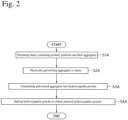
- the method for manufacturing powder includes a step [S1A] of reacting a first liquid containing a calcium source such as calcium hydroxide and a second liquid containing a phosphoric source such as phosphoric acid while stirring to obtain a slurry containing primary particles of hydroxyapatite and aggregates thereof; a step [S2A] of physically pulverizing the aggregates contained in the slurry and dispersing the pulverized aggregates in the slurry; a step [S3A] of drying the slurry to granulate the pulverized aggregates, thereby obtaining a hydroxyapatite powder composed of particles mainly containing secondary particles of hydroxyapatite; and a step [S4A] of baking the hydroxyapatite powder to obtain a sintered hydroxyapatite powder.
- a calcium hydroxide dispersion (first liquid) containing calcium hydroxide and a phosphoric acid solution (second liquid) containing phosphoric acid calcium hydroxide are reacted with phosphoric acid to form a slurry containing hydroxyapatite primary particles and their aggregates. That is, a slurry containing hydroxyapatite primary particles and their aggregates is prepared.
- a slurry containing hydroxyapatite primary particles and their aggregates is obtained by dropping a phosphoric acid solution (second liquid) into a calcium hydroxide dispersion (first liquid) while being stirred in a container (not shown) to form a mixed liquid of the calcium hydroxide dispersion and the phosphoric acid solution, so that calcium hydroxide are reacted with phosphoric acid in the mixed liquid.
- This method employs a wet synthesis method using a phosphoric acid solution containing phosphoric acid, which does not need an expensive manufacture equipment and can synthesize hydroxyapatite (compound) more easily and effectively.
- this reaction has an advantage in that any by-products do not remain in the resultant secondary particles and sintered powder because the reaction between calcium hydroxide and phosphoric acid generates only water as a by-product.
- this reaction is an acid-base reaction, this reaction can be easily controlled by adjusting the pHs of the calcium hydroxide dispersion and the phosphoric acid solution.
- the phosphoric acid solution containing phosphoric acid may be a phosphoric acid aqueous solution, in which a small amount of other liquid such as alcohol may be added.
- the force of stirring the mixed liquid containing the calcium hydroxide dispersion and the phosphoric acid solution is not particularly limited, but is preferably approximately 0.75 W or more and 2.0 W or less, and more preferably approximately 0.925 W or more and 1.85 W or less, per 1 L of the mixed liquid (slurry).
- a lower limit value of the stirring force is preferably 0.75 W or more, and more preferably 0.925 W or more, and its upper limit value is preferably 2.0 W or less, and more preferably 1.85 W or less, per 1 L of the mixed liquid (slurry).
- the content of calcium hydroxide in the calcium hydroxide dispersion is preferably approximately 5% by mass or more and 15% by mass or less, and more preferably approximately 10% by mass or more and 12% by mass or less.
- a lower limit value of the content of calcium hydroxide is preferably 5% by mass or more, and more preferably 10% by mass or more, and its upper limit value is preferably 15% by mass or less, and more preferably 12% by mass or less.
- the content of phosphoric acid in the phosphoric acid solution is preferably approximately 10% by mass or more and 25% by mass or less, and more preferably approximately 15% by mass or more and 20% by mass or less.
- a lower limit value of the content of phosphoric acid is preferably 10% by mass or more, and more preferably 15% by mass or more, and its upper limit value is preferably 25% by mass or less, and more preferably 20% by mass or less.
- the dropping rate of the phosphoric acid solution is preferably approximately 1 L/hr or more and 40 L/hr or less, and more preferably approximately 3 L/hr or more and 30 L/hr or less.
- a lower limit value of the dropping rate of the phosphoric acid solution is preferably 1 L/hr or more, and more preferably 3 L/hr or more, and its upper limit value is preferably 40 L/hr or less, and more preferably 30 L/hr or less.
- the dropping time (adding time) of the phosphoric acid solution is preferably approximately 5 hours or more and 32 hours or less, and more preferably approximately 6 hours or more and 30 hours or less.
- a lower limit value of the dropping time of the phosphoric acid solution is preferably 5 hours or more, and more preferably 6 hours or more, and its upper limit value is preferably 32 hours or less, and more preferably 30 hours or less.
- fine particles of hydroxyapatite (compound) (hereinafter, simply called “fine particles”) are generated in the slurry.
- the fine particles then aggregate by van der Waals force (intermolecular force) generated between the positively charged portion of one fine particle (primary particle) and the negatively charged portion of the other fine particle, so as to form aggregates of hydroxyapatite (compound) (hereinafter, simply called “aggregates”).
- aggregates the viscosity of the slurry gradually increases.
- step [S1A] the aggregates of primary particles of hydroxyapatite contained in the slurry obtained in step [S1A] are physically pulverized, and the pulverized aggregates are dispersed in the slurry.
- the particle size of the aggregates contained in the slurry becomes smaller, and as a result, the secondary particles of hydroxyapatite obtained in the subsequent step [S3A] can be set to have a bulk density of 0.65 g/mL or more and a specific surface area of 70 m 2 /g or more.
- the method for physically pulverizing aggregates of primary particles of hydroxyapatite is not particularly limited, but includes, for example, a wet jet milling method, in which droplets of slurry sprayed at high pressure are collided with each other, and a ball mill method, in which the slurry is placed in a closed vessel in the presence of spheres made of ceramics such as zirconia and the closed vessel is rotated.
- a wet jet milling method in which droplets of slurry sprayed at high pressure are collided with each other
- a ball mill method in which the slurry is placed in a closed vessel in the presence of spheres made of ceramics such as zirconia and the closed vessel is rotated.
- the wet jet milling method is preferable.
- the wet jet milling method is a method in which high pressure is applied to a slurry in which aggregates of primary particles of hydroxyapatite are dispersed, and the slurry is sprayed into droplets, which are then introduced into an opposed collision chamber, a ball collision chamber, or a single nozzle chamber, where the aggregates are pulverized by the collision between them.
- the secondary particles of hydroxyapatite obtained in the subsequent step [S3A] can be set to have a bulk density of 0.65 g/mL or more.
- the average particle size of the pulverized aggregates is preferably 1 ⁇ m or less, and more preferably 0.1 ⁇ m or more and 0.6 ⁇ m or less.
- the bulk density and specific surface area of the secondary particles of hydroxyapatite obtained in the subsequent step [S3A] can be set within the above ranges.
- the secondary particles of hydroxyapatite obtained in the subsequent step [S3A] are not set to have a bulk density of 0.65 g/mL or more and a specific surface area of 70 m 2 /g or more, the physical pulverization of the aggregates in this step [S2A] can be omitted.
- the resultant sintered hydroxyapatite powder can reliably have both improved durability and improved adsorbability of the substance to be adsorbed.
- the sintered hydroxyapatite powder can satisfy an average particle compressive strength of 7.4 MPa or more and 8.9 MPa or less, and a modal pore size of 32.0 nm or more and 60.0 nm or less.
- the slurry which is prepared in step [S2A] and contains pulverized aggregates is dried so as to granulate the pulverized aggregates into unsintered powder (dried powder) mainly composed of hydroxyapatite secondary particles, that is, hydroxyapatite powder.
- step [S2A] the aggregates of primary particles of hydroxyapatite are pulverized, and thus the size of the aggregates is small, which can provide the hydroxyapatite powder obtained in step [S3A] with a bulk density of 0.65 g/mL or more, and a specific surface area of 70 m 2 /g or more.
- the method of drying the slurry is not particularly limited, but is preferably a spray-drying method. According to this method, pulverized aggregates are granulated so that powder with a desired particle size can be obtained more reliably and in a shorter time.
- the drying temperature of the slurry is preferably about 75°C or higher and 250°C or lower, and more preferably about 95°C or higher and 220°C or lower.
- a lower limit value of the drying temperature is preferably 75°C or higher, and more preferably 95°C or higher, and its upper limit value is preferably 250°C or lower, and more preferably 220°C or lower.
- steps [S1A] to [S3A] constitute a first step of preparing hydroxyapatite powder.
- the hydroxyapatite secondary particles obtained in the subsequent step [S3A] are not set to have a bulk density of 0.65 g/mL or more and a specific surface area of 70 m 2 /g or more, the hydroxyapatite powder does not need to be adjusted by the above steps [S1A] to [S3A], and may be prepared, for example, according to the method described in the specification of JP 7-88205 A .
- the hydroxyapatite powder produced in the above step [S3A] is sintered by baking to produce a sintered powder composed of hydroxyapatite secondary particles, i.e., sintered hydroxyapatite powder (second step).
- the sintering temperature for baking the powder may be set to approximately 480°C or higher and 645°C or lower, but preferably approximately 500°C or higher and 630°C or lower, and more preferably 550°C or higher and 610°C or lower.
- a lower limit value of the sintering temperature may be 480°C or higher, but is preferably 500°C or higher, and more preferably 550°C or higher, and its upper limit value may be 645°C or lower, but is preferably 630°C or lower, and more preferably 610°C or lower.
- the time of holding the sintering temperature for baking the powder is not particularly limited, but is preferably about 60 minutes or more and 230 minutes or less, and more preferably about 90 minutes or more and 180 minutes or less.
- a lower limit value of the holding time is preferably 60 minutes or more, and more preferably 90 minutes or more, and its upper limit value is preferably 230 minutes or less, and more preferably 180 minutes or less.
- the resultant sintered hydroxyapatite powder (adsorbent 3) can be relatively easily made to have an average particle compressive strength of 7.4 MPa or more and 8.9 MPa or less, and a modal pore size in the pore size distribution of the pores of the sintered powder of 32.0 nm or more and 60.0 nm or less.
- sintered powder composed of sintered particles mainly containing hydroxyapatite secondary particles, i.e., sintered hydroxyapatite powder, is obtained.
- the adsorption apparatus 1 By filling this sintered hydroxyapatite powder in the adsorbent filling space 20 of the column 2 as the adsorbent 3, the adsorption apparatus 1 can be obtained.
- the sintered hydroxyapatite powder to be filled is classified, the sintered hydroxyapatite powder may have, for example, the average particle size and particle size distribution of 20 ⁇ 4 ⁇ m, 40 ⁇ 4 ⁇ m, 60 ⁇ 4 ⁇ m, 80 ⁇ 4 ⁇ m, etc.
- the present invention is not restricted thereto.
- each component of the adsorbent of the present invention may be replaced with whatever exhibits the same function, and the adsorbent of the present invention may be added with arbitrary components.
- the method of producing the adsorbent of the present invention may be added with one or more steps for any purpose.
- the atmosphere temperature during dropping was a room temperature (25°C).
- the average particle size of the aggregates contained in the slurry after pulverization was measured using a particle size distribution analyzer ("MT3300" manufactured by Microtrac Inc.).
- slurry containing the pulverized (dispersed) aggregates was spray-dried at 210°C using a spray drier ("MAD-6737R" manufactured by MATSUBO Corporation) to granulate hydroxyapatite contained in the slurry, thereby obtaining spherical secondary particles (dried powder).
- the resultant dried powder i.e., hydroxyapatite powder, was classified using an ultrasonic sieve to obtain hydroxyapatite powder with an average particle size of approximately 40 ⁇ m, more specifically, hydroxyapatite powder with a particle size of 40 ⁇ m ⁇ 4.0 ⁇ m.
- the powder (secondary particles) was confirmed to be hydroxyapatite by a powder X-ray diffractometry.
- the sintered hydroxyapatite powder of Example 2 was obtained in the same manner as in Example 1, except that, in step [4A], the sintering temperature for baking the hydroxyapatite powder was changed to 600°C.
- the sintered hydroxyapatite powder of Comparative Example 1 was obtained in the same manner as in Example 1, except that, in step [4A], the sintering temperature for baking the hydroxyapatite powder was changed to 400°C.
- the sintered hydroxyapatite powder of Comparative Example 2 was obtained in the same manner as in Example 1, except that, in step [4A], the sintering temperature for baking the hydroxyapatite powder was changed to 700°C.
- the average particle compressive strength of the sintered hydroxyapatite powder of each Example and Comparative Example was determined using a micro compression testing machine ("MCT-W200-J" manufactured by Shimadzu Corporation).
- the average particle compressive strength of the sintered hydroxyapatite powder of each Example and Comparative Example was obtained by measuring the particle compressive strength 10 times and calculating the average value. The calculating results are shown in Table 3. [Table 3] Sintering Temperature (°C) Average Particle Compressive Strength (MPa) Comparative Example 1 400 6.180 Example 1 500 7.611 Example 2 600 8.570 Comparative Example 2 700 9.827
- the pore size distribution of the pores on their surfaces was measured by a mercury porosimetry using a pore distribution measuring device ("Micromeritics AutoPore 9200" manufactured by Shimadzu Corporation). From this pore size distribution, the modal pore size, the frequency of the modal pore size, the half-width of the mountain-shaped waveform around the modal pore size (half-width of the modal pore size), and the average pore size were calculated. The calculating results are shown in Table 4.
- the specific surface area (average specific surface area) of the sintered hydroxyapatite powder of each Example and Comparative Example was determined using a fully auto BET specific surface area measuring device ("Macsorb HM1201" manufactured by Mountech Co.,Ltd.). The measuring results are shown in Table 5. [Table 5] Sintering Temperature (°C) Average Specific Surface Area (m 2 /g) Comparative Example 1 400 51.66 Example 1 500 42.41 Example 2 600 29.69 Comparative Example 2 700 20.75
- sample liquid containing antibodies was supplied into the columns at flow rates of 150, 200, 250, and 300 cm/hr, respectively, and the antibody adsorption amount to the adsorbent was measured using the method shown below.
- ⁇ -Globulins from bovine blood were dissolved in 10 mM NaP (sodium phosphate buffer) at pH 6.5 to a concentration of 1.0 mg/mL to prepare a sample liquid (bIgG solution).
- the adsorption amounts A to D (mg/mL) of bIgG to the sintered hydroxyapatite powder of each Example and Comparative Example were calculated. Based on the calculated adsorption amounts A to D (mg/mL), the adsorption amount ratios D/A, D/B, and C/B were also calculated. The calculating results are shown in Table 7 and Fig.3 .
- Buffer Type Supply Amount Supply Time (CV) (mL) (hr) 1 10 mM NaP pH 6.5 15 18.8 0.63 2 10 mM NaP + 1 M NaCl pH 6.5 10 12.6 0.42 3 0.4 M NaP pH 6.5 10 12.6 0.42 4 3 M NaOH 10 12.6 0.42 5 0.4 M NaP pH 6.5 10 12.6 0.42 SUM 55 69.1 2.30 Flow rate (mL/min) 0.50 Linear velocity (cm/hr) 239 [Table 9] Sintering Temperature (°C) Durability of Adsorbent (cycle) Comparative Example 1 400 50 Example 1 500 62 Example 2 600 103 Comparative Example 2 700 153
- step [4A] by setting the sintering temperature in a process of sintering the hydroxyapatite powder to a temperature in the range of 480°C or higher and 645°C or lower, it has been found that the resultant sintered powder has an average particle compressive strength of 7.4 MPa or more, and the modal pore size in the pore size distribution of the pores of the sintered powder of 32.0 nm or more and 60.0 nm or less.
Landscapes
- Chemical & Material Sciences (AREA)
- Organic Chemistry (AREA)
- Analytical Chemistry (AREA)
- Chemical Kinetics & Catalysis (AREA)
- Inorganic Chemistry (AREA)
- Nanotechnology (AREA)
- Engineering & Computer Science (AREA)
- Materials Engineering (AREA)
- Molecular Biology (AREA)
- Health & Medical Sciences (AREA)
- Life Sciences & Earth Sciences (AREA)
- Genetics & Genomics (AREA)
- Medicinal Chemistry (AREA)
- Proteomics, Peptides & Aminoacids (AREA)
- General Health & Medical Sciences (AREA)
- Biophysics (AREA)
- Biochemistry (AREA)
- Physics & Mathematics (AREA)
- Thermal Sciences (AREA)
- Immunology (AREA)
- Solid-Sorbent Or Filter-Aiding Compositions (AREA)
- Peptides Or Proteins (AREA)
Applications Claiming Priority (1)
| Application Number | Priority Date | Filing Date | Title |
|---|---|---|---|
| PCT/JP2022/010908 WO2023170922A1 (ja) | 2022-03-11 | 2022-03-11 | 吸着剤および吸着剤の製造方法 |
Publications (2)
| Publication Number | Publication Date |
|---|---|
| EP4480908A1 true EP4480908A1 (de) | 2024-12-25 |
| EP4480908A4 EP4480908A4 (de) | 2025-12-03 |
Family
ID=83192300
Family Applications (1)
| Application Number | Title | Priority Date | Filing Date |
|---|---|---|---|
| EP22930903.4A Pending EP4480908A4 (de) | 2022-03-11 | 2022-03-11 | Adsorptionsmittel und verfahren zur herstellung eines adsorptionsmittels |
Country Status (6)
| Country | Link |
|---|---|
| US (1) | US20250205674A1 (de) |
| EP (1) | EP4480908A4 (de) |
| JP (1) | JP7133747B1 (de) |
| KR (1) | KR20240163113A (de) |
| CN (1) | CN118748981A (de) |
| WO (1) | WO2023170922A1 (de) |
Family Cites Families (7)
| Publication number | Priority date | Publication date | Assignee | Title |
|---|---|---|---|---|
| JPH0788205A (ja) | 1993-09-24 | 1995-04-04 | Kumagai Gumi Co Ltd | 対向流エアーバリアによる防煙方法及び該防煙方法に用いる装置 |
| JP5458230B2 (ja) * | 2007-08-30 | 2014-04-02 | HOYA Technosurgical株式会社 | フッ素アパタイトの製造方法、フッ素アパタイトおよび吸着装置 |
| JP5354562B2 (ja) * | 2008-02-07 | 2013-11-27 | 学校法人明治大学 | セメント用材料、セメント用材料の製造方法、セメントの製造方法及びセメント |
| US20100226956A1 (en) * | 2009-03-06 | 2010-09-09 | Per Kjellin | Production of moldable bone substitute |
| JP5724050B2 (ja) * | 2009-09-28 | 2015-05-27 | Hoya株式会社 | 粉体、粉体の製造方法、吸着装置 |
| JP7100615B2 (ja) * | 2019-11-01 | 2022-07-13 | HOYA Technosurgical株式会社 | 生産方法およびハイドロキシアパタイトの粒子 |
| EP4144749A4 (de) * | 2020-05-01 | 2023-07-05 | Hoya Technosurgical Corporation | Reinigungsverfahren für geladene substanzen |
-
2022
- 2022-03-11 US US18/845,694 patent/US20250205674A1/en active Pending
- 2022-03-11 EP EP22930903.4A patent/EP4480908A4/de active Pending
- 2022-03-11 WO PCT/JP2022/010908 patent/WO2023170922A1/ja not_active Ceased
- 2022-03-11 JP JP2022533066A patent/JP7133747B1/ja active Active
- 2022-03-11 KR KR1020247033782A patent/KR20240163113A/ko active Pending
- 2022-03-11 CN CN202280093377.9A patent/CN118748981A/zh active Pending
Also Published As
| Publication number | Publication date |
|---|---|
| JPWO2023170922A1 (de) | 2023-09-14 |
| EP4480908A4 (de) | 2025-12-03 |
| CN118748981A (zh) | 2024-10-08 |
| KR20240163113A (ko) | 2024-11-18 |
| WO2023170922A1 (ja) | 2023-09-14 |
| JP7133747B1 (ja) | 2022-09-08 |
| US20250205674A1 (en) | 2025-06-26 |
Similar Documents
| Publication | Publication Date | Title |
|---|---|---|
| US12161988B2 (en) | Powder, method of producing powder and adsorption apparatus | |
| EP3114080B1 (de) | Verfahren zur herstellung einer hydroxyapatitzusammensetzung | |
| JPH0397610A (ja) | 多孔質リン酸カルシウム系化合物粒子及びその製造方法 | |
| EA028588B1 (ru) | Сферические агломераты на основе цеолитов, способ их получения и их применение в процессах адсорбции или в катализе | |
| EP4480908A1 (de) | Adsorptionsmittel und verfahren zur herstellung eines adsorptionsmittels | |
| EP1948564B1 (de) | Trockene flüssigkeiten und verfahren zu ihrer herstellung | |
| EP4480909A1 (de) | Adsorptionsmittel und adsorptionsvorrichtung | |
| US20110081379A1 (en) | Purification method and method of producing vaccine | |
| JP7100615B2 (ja) | 生産方法およびハイドロキシアパタイトの粒子 | |
| US20250196023A1 (en) | Column and adsorption apparatus | |
| JP2014059306A (ja) | 粉体の製造方法、粉体および吸着装置 | |
| WO2011043278A1 (ja) | 粉体、粉体の製造方法、吸着装置 | |
| JPH06300746A (ja) | 液体クロマトグラフィー用充填剤 |
Legal Events
| Date | Code | Title | Description |
|---|---|---|---|
| STAA | Information on the status of an ep patent application or granted ep patent |
Free format text: STATUS: THE INTERNATIONAL PUBLICATION HAS BEEN MADE |
|
| PUAI | Public reference made under article 153(3) epc to a published international application that has entered the european phase |
Free format text: ORIGINAL CODE: 0009012 |
|
| STAA | Information on the status of an ep patent application or granted ep patent |
Free format text: STATUS: REQUEST FOR EXAMINATION WAS MADE |
|
| 17P | Request for examination filed |
Effective date: 20240919 |
|
| AK | Designated contracting states |
Kind code of ref document: A1 Designated state(s): AL AT BE BG CH CY CZ DE DK EE ES FI FR GB GR HR HU IE IS IT LI LT LU LV MC MK MT NL NO PL PT RO RS SE SI SK SM TR |
|
| DAV | Request for validation of the european patent (deleted) | ||
| DAX | Request for extension of the european patent (deleted) | ||
| REG | Reference to a national code |
Ref country code: DE Ref legal event code: R079 Free format text: PREVIOUS MAIN CLASS: C01B0032168000 Ipc: B01J0020040000 |
|
| A4 | Supplementary search report drawn up and despatched |
Effective date: 20251103 |
|
| RIC1 | Information provided on ipc code assigned before grant |
Ipc: B01J 20/04 20060101AFI20251028BHEP Ipc: B01J 20/28 20060101ALI20251028BHEP Ipc: B01J 20/282 20060101ALI20251028BHEP Ipc: B01D 15/08 20060101ALI20251028BHEP Ipc: C01B 32/168 20170101ALI20251028BHEP Ipc: C01B 25/32 20060101ALI20251028BHEP Ipc: C07K 1/14 20060101ALI20251028BHEP Ipc: C07K 1/16 20060101ALI20251028BHEP |