EP4478469A1 - Lithium-ionen-batterie - Google Patents
Lithium-ionen-batterie Download PDFInfo
- Publication number
- EP4478469A1 EP4478469A1 EP24182170.1A EP24182170A EP4478469A1 EP 4478469 A1 EP4478469 A1 EP 4478469A1 EP 24182170 A EP24182170 A EP 24182170A EP 4478469 A1 EP4478469 A1 EP 4478469A1
- Authority
- EP
- European Patent Office
- Prior art keywords
- lithium
- solid electrolyte
- electrolyte membrane
- ion battery
- composite solid
- Prior art date
- Legal status (The legal status is an assumption and is not a legal conclusion. Google has not performed a legal analysis and makes no representation as to the accuracy of the status listed.)
- Pending
Links
Images






Classifications
-
- H—ELECTRICITY
- H01—ELECTRIC ELEMENTS
- H01M—PROCESSES OR MEANS, e.g. BATTERIES, FOR THE DIRECT CONVERSION OF CHEMICAL ENERGY INTO ELECTRICAL ENERGY
- H01M10/00—Secondary cells; Manufacture thereof
- H01M10/05—Accumulators with non-aqueous electrolyte
- H01M10/056—Accumulators with non-aqueous electrolyte characterised by the materials used as electrolytes, e.g. mixed inorganic/organic electrolytes
-
- H—ELECTRICITY
- H01—ELECTRIC ELEMENTS
- H01M—PROCESSES OR MEANS, e.g. BATTERIES, FOR THE DIRECT CONVERSION OF CHEMICAL ENERGY INTO ELECTRICAL ENERGY
- H01M10/00—Secondary cells; Manufacture thereof
- H01M10/04—Construction or manufacture in general
- H01M10/0468—Compression means for stacks of electrodes and separators
-
- H—ELECTRICITY
- H01—ELECTRIC ELEMENTS
- H01M—PROCESSES OR MEANS, e.g. BATTERIES, FOR THE DIRECT CONVERSION OF CHEMICAL ENERGY INTO ELECTRICAL ENERGY
- H01M10/00—Secondary cells; Manufacture thereof
- H01M10/05—Accumulators with non-aqueous electrolyte
- H01M10/052—Li-accumulators
- H01M10/0525—Rocking-chair batteries, i.e. batteries with lithium insertion or intercalation in both electrodes; Lithium-ion batteries
-
- H—ELECTRICITY
- H01—ELECTRIC ELEMENTS
- H01M—PROCESSES OR MEANS, e.g. BATTERIES, FOR THE DIRECT CONVERSION OF CHEMICAL ENERGY INTO ELECTRICAL ENERGY
- H01M10/00—Secondary cells; Manufacture thereof
- H01M10/05—Accumulators with non-aqueous electrolyte
- H01M10/056—Accumulators with non-aqueous electrolyte characterised by the materials used as electrolytes, e.g. mixed inorganic/organic electrolytes
- H01M10/0564—Accumulators with non-aqueous electrolyte characterised by the materials used as electrolytes, e.g. mixed inorganic/organic electrolytes the electrolyte being constituted of organic materials only
- H01M10/0565—Polymeric materials, e.g. gel-type or solid-type
-
- H—ELECTRICITY
- H01—ELECTRIC ELEMENTS
- H01M—PROCESSES OR MEANS, e.g. BATTERIES, FOR THE DIRECT CONVERSION OF CHEMICAL ENERGY INTO ELECTRICAL ENERGY
- H01M10/00—Secondary cells; Manufacture thereof
- H01M10/05—Accumulators with non-aqueous electrolyte
- H01M10/058—Construction or manufacture
- H01M10/0583—Construction or manufacture of accumulators with folded construction elements except wound ones, i.e. folded positive or negative electrodes or separators, e.g. with "Z"-shaped electrodes or separators
-
- H—ELECTRICITY
- H01—ELECTRIC ELEMENTS
- H01M—PROCESSES OR MEANS, e.g. BATTERIES, FOR THE DIRECT CONVERSION OF CHEMICAL ENERGY INTO ELECTRICAL ENERGY
- H01M10/00—Secondary cells; Manufacture thereof
- H01M10/05—Accumulators with non-aqueous electrolyte
- H01M10/058—Construction or manufacture
- H01M10/0585—Construction or manufacture of accumulators having only flat construction elements, i.e. flat positive electrodes, flat negative electrodes and flat separators
-
- H—ELECTRICITY
- H01—ELECTRIC ELEMENTS
- H01M—PROCESSES OR MEANS, e.g. BATTERIES, FOR THE DIRECT CONVERSION OF CHEMICAL ENERGY INTO ELECTRICAL ENERGY
- H01M50/00—Constructional details or processes of manufacture of the non-active parts of electrochemical cells other than fuel cells, e.g. hybrid cells
- H01M50/40—Separators; Membranes; Diaphragms; Spacing elements inside cells
- H01M50/409—Separators, membranes or diaphragms characterised by the material
- H01M50/411—Organic material
- H01M50/414—Synthetic resins, e.g. thermoplastics or thermosetting resins
-
- H—ELECTRICITY
- H01—ELECTRIC ELEMENTS
- H01M—PROCESSES OR MEANS, e.g. BATTERIES, FOR THE DIRECT CONVERSION OF CHEMICAL ENERGY INTO ELECTRICAL ENERGY
- H01M50/00—Constructional details or processes of manufacture of the non-active parts of electrochemical cells other than fuel cells, e.g. hybrid cells
- H01M50/40—Separators; Membranes; Diaphragms; Spacing elements inside cells
- H01M50/409—Separators, membranes or diaphragms characterised by the material
- H01M50/411—Organic material
- H01M50/414—Synthetic resins, e.g. thermoplastics or thermosetting resins
- H01M50/426—Fluorocarbon polymers
-
- H—ELECTRICITY
- H01—ELECTRIC ELEMENTS
- H01M—PROCESSES OR MEANS, e.g. BATTERIES, FOR THE DIRECT CONVERSION OF CHEMICAL ENERGY INTO ELECTRICAL ENERGY
- H01M50/00—Constructional details or processes of manufacture of the non-active parts of electrochemical cells other than fuel cells, e.g. hybrid cells
- H01M50/40—Separators; Membranes; Diaphragms; Spacing elements inside cells
- H01M50/409—Separators, membranes or diaphragms characterised by the material
- H01M50/431—Inorganic material
-
- H—ELECTRICITY
- H01—ELECTRIC ELEMENTS
- H01M—PROCESSES OR MEANS, e.g. BATTERIES, FOR THE DIRECT CONVERSION OF CHEMICAL ENERGY INTO ELECTRICAL ENERGY
- H01M50/00—Constructional details or processes of manufacture of the non-active parts of electrochemical cells other than fuel cells, e.g. hybrid cells
- H01M50/40—Separators; Membranes; Diaphragms; Spacing elements inside cells
- H01M50/409—Separators, membranes or diaphragms characterised by the material
- H01M50/446—Composite material consisting of a mixture of organic and inorganic materials
-
- H—ELECTRICITY
- H01—ELECTRIC ELEMENTS
- H01M—PROCESSES OR MEANS, e.g. BATTERIES, FOR THE DIRECT CONVERSION OF CHEMICAL ENERGY INTO ELECTRICAL ENERGY
- H01M50/00—Constructional details or processes of manufacture of the non-active parts of electrochemical cells other than fuel cells, e.g. hybrid cells
- H01M50/40—Separators; Membranes; Diaphragms; Spacing elements inside cells
- H01M50/463—Separators, membranes or diaphragms characterised by their shape
- H01M50/466—U-shaped, bag-shaped or folded
-
- H—ELECTRICITY
- H01—ELECTRIC ELEMENTS
- H01M—PROCESSES OR MEANS, e.g. BATTERIES, FOR THE DIRECT CONVERSION OF CHEMICAL ENERGY INTO ELECTRICAL ENERGY
- H01M4/00—Electrodes
- H01M4/02—Electrodes composed of, or comprising, active material
- H01M2004/026—Electrodes composed of, or comprising, active material characterised by the polarity
- H01M2004/027—Negative electrodes
-
- H—ELECTRICITY
- H01—ELECTRIC ELEMENTS
- H01M—PROCESSES OR MEANS, e.g. BATTERIES, FOR THE DIRECT CONVERSION OF CHEMICAL ENERGY INTO ELECTRICAL ENERGY
- H01M4/00—Electrodes
- H01M4/02—Electrodes composed of, or comprising, active material
- H01M2004/026—Electrodes composed of, or comprising, active material characterised by the polarity
- H01M2004/028—Positive electrodes
-
- H—ELECTRICITY
- H01—ELECTRIC ELEMENTS
- H01M—PROCESSES OR MEANS, e.g. BATTERIES, FOR THE DIRECT CONVERSION OF CHEMICAL ENERGY INTO ELECTRICAL ENERGY
- H01M2300/00—Electrolytes
- H01M2300/0017—Non-aqueous electrolytes
- H01M2300/0065—Solid electrolytes
-
- H—ELECTRICITY
- H01—ELECTRIC ELEMENTS
- H01M—PROCESSES OR MEANS, e.g. BATTERIES, FOR THE DIRECT CONVERSION OF CHEMICAL ENERGY INTO ELECTRICAL ENERGY
- H01M2300/00—Electrolytes
- H01M2300/0017—Non-aqueous electrolytes
- H01M2300/0065—Solid electrolytes
- H01M2300/0068—Solid electrolytes inorganic
-
- H—ELECTRICITY
- H01—ELECTRIC ELEMENTS
- H01M—PROCESSES OR MEANS, e.g. BATTERIES, FOR THE DIRECT CONVERSION OF CHEMICAL ENERGY INTO ELECTRICAL ENERGY
- H01M2300/00—Electrolytes
- H01M2300/0017—Non-aqueous electrolytes
- H01M2300/0065—Solid electrolytes
- H01M2300/0082—Organic polymers
-
- Y—GENERAL TAGGING OF NEW TECHNOLOGICAL DEVELOPMENTS; GENERAL TAGGING OF CROSS-SECTIONAL TECHNOLOGIES SPANNING OVER SEVERAL SECTIONS OF THE IPC; TECHNICAL SUBJECTS COVERED BY FORMER USPC CROSS-REFERENCE ART COLLECTIONS [XRACs] AND DIGESTS
- Y02—TECHNOLOGIES OR APPLICATIONS FOR MITIGATION OR ADAPTATION AGAINST CLIMATE CHANGE
- Y02E—REDUCTION OF GREENHOUSE GAS [GHG] EMISSIONS, RELATED TO ENERGY GENERATION, TRANSMISSION OR DISTRIBUTION
- Y02E60/00—Enabling technologies; Technologies with a potential or indirect contribution to GHG emissions mitigation
- Y02E60/10—Energy storage using batteries
-
- Y—GENERAL TAGGING OF NEW TECHNOLOGICAL DEVELOPMENTS; GENERAL TAGGING OF CROSS-SECTIONAL TECHNOLOGIES SPANNING OVER SEVERAL SECTIONS OF THE IPC; TECHNICAL SUBJECTS COVERED BY FORMER USPC CROSS-REFERENCE ART COLLECTIONS [XRACs] AND DIGESTS
- Y02—TECHNOLOGIES OR APPLICATIONS FOR MITIGATION OR ADAPTATION AGAINST CLIMATE CHANGE
- Y02P—CLIMATE CHANGE MITIGATION TECHNOLOGIES IN THE PRODUCTION OR PROCESSING OF GOODS
- Y02P70/00—Climate change mitigation technologies in the production process for final industrial or consumer products
- Y02P70/50—Manufacturing or production processes characterised by the final manufactured product
Definitions
- the present disclosure relates to a lithium-ion battery.
- the solid electrolyte In the current preparation process of lithium-ion batteries, the solid electrolyte is in a fluid state and can be formed on a surface of an electrode sheet by injecting or coating method.
- a coating machine is required for flow control, and the preparation process is complex and difficult to Control the process.
- a conventional lithium-ion battery is composed of a positive electrode sheet, a negative electrode sheet and a separator.
- stacking equipment is often used to stack the positive electrode sheet, the negative electrode sheet, and the separator alternately in the positioning space, and there is no surface bonding preparation process between the them.
- wrinkles in the separator causing the battery to precipitate lithium during the charging and discharging process, which produces lithium dendrites and causes safety accidents.
- the positive electrode sheet, the negative electrode sheet, and the separator need to be accurately aligned, which requires high dimensional accuracy.
- the prepared lithium-ion battery is prone to interference with the packaging aluminum foil.
- substantially is defined to be essentially conforming to the particular dimension, shape, or other feature which is described, such that the component need not be exactly or strictly conforming to such a feature.
- the term “comprise,” when utilized, means “comprise, but not necessarily limited to”; it specifically indicates open-ended inclusion or membership in the so-described combination, group, series, and the like.
- One embodiment of the present disclosure provides a method for preparing a lithium-ion battery, which comprises the following steps:
- the positive electrode sheet 10 comprises a positive electrode current collector 1 and two positive electrode material layers 2.
- the two positive electrode material layers 2 are separately disposed on two opposite surfaces of the positive electrode current collector 1, as shown in FIG. 1 .
- the positive electrode current collector 1 is a metal foil sheet, such as an aluminum sheet, a copper sheet, etc.
- the positive electrode material layer 2 comprises a positive electrode material, which can be an existing commonly used positive electrode material.
- the positive electrode material can be at least one of a lithium-transition metal oxide with a layered structure, a lithium-transition metal oxide with a spinel structure, and a lithium-transition metal oxide with an olivine structure.
- the positive electrode material can be at least one selected from olivine Type lithium iron phosphate, layered structure lithium cobalt oxide, layered structure lithium manganate, spinel type lithium manganate, lithium nickel manganese oxide and lithium nickel cobalt manganese oxide.
- the positive electrode material layer 2 can further comprise a conductive agent and a binder, which can be binders and conductive agents commonly used in the prior art.
- the positive electrode material layer 2 is formed on the positive electrode current collector by slurry coating.
- step S1 the composite solid electrolyte membrane 3 is laminated and disposed on the surface of the positive electrode material layer 2 away from the positive electrode current collector 1 through a hot pressing process.
- the composite solid electrolyte membrane 3 is a formed layered structure, which means that the composite solid electrolyte membrane 3 is already an independent layered structure before it is formed on the positive electrode material layer 2.
- the composite solid electrolyte membrane 3 can be directly laid flat. It is obtained by placing the paint of the composite solid electrolyte membrane 3 on the surface of the positive electrode material layer 2 and then drying it, instead of by coating or other methods.
- the composite solid electrolyte membrane 3 comprises polymer materials and inorganic solid electrolytes. Furthermore, the composite solid electrolyte membrane 3 can be a composite membrane composed of polymer materials and inorganic solid electrolytes.
- the polymer material can be polyvinylidene fluoride, polymethyl methacrylate, polyethylene oxide, etc.
- the polymer material can be softened by heating, causing local softening on the surface, and has surface microviscosity and thermoplasticity. Therefore, the polymer material can also improve the ductility and toughness of the composite solid electrolyte membrane 3.
- the inorganic solid electrolyte can be lithium lanthanum zirconium oxide, lithium aluminum titanium phosphate, lithium lanthanum titanium oxide, etc.
- the inorganic solid electrolyte can improve ionic conductivity, avoid puncture of lithium dendrites, and at the same time improve the mechanical strength of the composite solid electrolyte membrane 3.
- the surface of the composite solid electrolyte membrane 3 has micro plasticity and surface micro viscosity.
- the composite solid electrolyte membrane 3 and the positive electrode material layer 2 have transitional dimensions. In the bonded state, a better bonding effect can be achieved without damaging the surface morphology of the positive electrode material layer 2 and maintaining the material properties.
- the composite solid electrolyte membrane 3 can be shaped after cooling, which is beneficial to subsequent manufacturing operations.
- a thickness of the composite solid electrolyte membrane 3 can be ranged from 5 microns to 100 microns.
- a transition layer 5 is formed between the composite solid electrolyte membrane 3 and the positive electrode material layer 2.
- the transition layer 5 is an uneven surface staggered interval structure formed by fitting the contact portions of the composite solid electrolyte membrane 3 and the positive electrode material layer 2 with each other after the composite solid electrolyte membrane 3 is heated.
- a thickness of the transition layer is ranged from 0.1 microns to 5.0 microns.
- the thickness of the transition layer 5 is less than 0.1 micron, because the interval of the transition layer 5 is too thin, during the subsequent hot pressing process of the battery preform 4, the composite solid electrolyte membrane 3 and its adjacent positive electrode sheet 10 or the negative electrode sheet 20 cannot achieve good bonding, resulting in poor bonding and peeling.
- the hot pressing process can be performed by a flat pressing device.
- a hot pressing temperature is ranged from 50°C to 250°C
- a pressing speed is about 0.1 ⁇ m/second
- a fixed output force is ranged from 0.01Kg/cm 2 to 20.0Kg/cm 2
- a movement time of a single pressing process is controlled at within 10 seconds.
- the thickness of the positive electrode composite structure 11 formed by the positive electrode sheet 10 and the composite solid electrolyte membrane 3 can be obtained by controlling the hot pressing temperature, predetermined force and pressing time.
- the pressing speed can be pressurization at a constant speed, or pressurization at a non-constant speed, for example, decelerating the pressurization from fast to slow.
- the thickness of the transition layer 5 is ranged from 0.1 microns to 5.0 microns. This thickness range can make the electrode sheets adjacent to the composite solid electrolyte membrane 3 have good surface morphology, and also ensure that the composite solid electrolyte membrane 3 and its adjacent electrode sheet are well adhered, so that the formed electrode sheet and the composite solid electrolyte membrane have good cycle performance.
- the negative electrode sheet 20 comprises a negative electrode current collector 1" and two negative electrode material layers 2' separately disposed on two opposite surfaces of the negative electrode current collector 1".
- the negative electrode material layer 2" comprises a negative electrode material, the negative electrode material is an existing commonly used negative electrode material.
- the negative electrode material can be a carbon material, such as graphite; or it can also be a non-carbon material, such as a silicon-carbon composite material.
- the negative electrode material layer can further comprise a conductive agent and a binder, which can be binders and conductive agents commonly used in the prior art.
- the composite solid electrolyte membrane 3 is disposed on the surface of the negative electrode sheet 20 to prepare the negative electrode composite structure 12. Specifically, the composite solid electrolyte membrane 3 is hot pressed and laminated on the negative electrode material layer 2" away from the negative electrode current collector 1" assembly.
- the preparation method of the negative electrode composite structure 12 is the same as the preparation method of the positive electrode composite structure 11, except that the positive electrode sheet 10 is replaced by the negative electrode sheet 20.
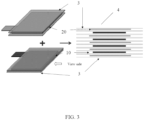
- step S3 at least one positive electrode composite structure 11 and at least one negative electrode composite structure 12 are stacked to form a battery prefabricated body 4.
- FIGS. 3-4 battery prefabrication schematic diagram of the structure of body prefabricated 4 from the right side perspective and the front side perspective.
- the number of the positive electrode composite structure 11 and the negative electrode composite structure 12 contained in the battery preform 4 can be selected according to actual needs.
- the composite solid electrolyte membrane 3 is configured to insulate and separate the positive electrode sheet 10 and the negative electrode sheet 20.
- the area of the composite solid electrolyte membrane 3 is larger than the area of the positive electrode sheet 10 or the negative electrode sheet 20, that is, the composite solid electrolyte membrane 3 can completely cover the positive electrode sheet 10 or the negative electrode sheet 20.
- the composite solid electrolyte membrane 3 can still isolate the positive electrode sheet 10 and the negative electrode sheet 20.
- the composite solid electrolyte membrane 3 since an area of the composite solid electrolyte membrane 3 is larger than an area of the positive electrode sheet 10 or the negative electrode sheet 20, the composite solid electrolyte membrane 3 does not need to be aligned with the positive electrode sheet 10 or the negative electrode sheet 20, as long as it is ensured that the positive electrode sheet 10 and the negative electrode sheet 20 in the battery preform 4 are insulated, and there is at least one composite solid electrolyte membrane 3 between the positive electrode sheet 10 and the negative electrode sheet 20.
- the preparation method can further comprise a step of removing the composite solid electrolyte membrane 3 in the at least one positive electrode composite structure 11 or the at least one negative electrode composite structure 12.
- the position of the removed composite solid electrolyte membrane 3 can be selected according to actual needs, as long as the insulation between the positive electrode sheet 10 and the negative electrode sheet 20 in the battery preform 4 is ensured.
- the battery preform 4 comprises one positive electrode composite structure 11 and one negative electrode composite structure 12 stacked with each other.
- the battery preform 4 comprises a plurality of positive electrode composite structures 11 and a plurality of negative electrode composite structures 12, and the plurality of positive electrode composite structures 11 and a plurality of negative electrode composite structures 12 are alternately stacked with each other.
- step S4 during the pressing process of the battery preform 4, the battery preform 4 is placed horizontally, and pressure is applied to the battery preform 4 in the vertical direction.
- the applied pressure is perpendicular to the surface of the battery preform 4, an upper surface and a lower surface of the battery preform 4 can always remain horizontally during the pressing process. Since the area of the composite solid electrolyte membrane 3 in the battery preform 4 is different from that of the positive electrode sheet 10 or the negative electrode sheet 20, the composite solid electrolyte membrane 3 protrudes beyond the positive electrode sheet 10 or the negative electrode sheet 20. After pressing, the side edges of the battery preform 4 are still uneven.
- the edge shaping and fixing of the battery preform 4 is to fold the uneven side edges of the battery preform 4 in a unified direction to keep the side edges neat and at the same time fix the folded structure of the battery preform 4, thereby obtaining a battery with neat side edges and stable structure.
- the uneven side edges of the battery preform 4 refer to the composite solid electrolyte membrane 3 protruding from the positive electrode sheet 10 or the negative electrode sheet 20.
- the processes of pressing, trimming, shaping and fixing the battery preform 4 can all be completed by a battery forming device 6.
- the battery forming device 6 comprises an upper platform 61, a lower platform 62, a side edge pressing plate 63, and a lower folding plate 64.
- the upper platform 61 and the lower platform 62 are spaced apart and used to provide pressure for pressing the battery preform 4.
- the side edge pressing plate 63 and the lower edge folding plate 64 are used to trim and shape the side edges of the battery preform 4.
- the battery forming device 6 can further glue and fix the battery preform 4, so that the structure after folding the side edges remains stable and not deformed.
- the steps of using the battery forming device 6 to press, trim, shape and fix the battery preform 4 can comprise the steps:
- the side edge pressing plate and the lower edge folding plate of the present invention can be produced in the required size and shape according to the size and shape of the battery.
- the purpose is to close the composite solid electrolyte membrane 3 with protruding dimensions, so as to achieve aims that the volumetric energy density can be increased without wasting the internal space of the battery.
- This embodiment uses a prismatic battery for implementation description, but is not limited to use on prismatic batteries.
- the battery preform 4 is glued and fixed.
- the battery forming device 6 can further comprise a rubber supply wheel and a rubber applying clamp (not shown).
- the rubber wheel is used to feed glue and automatically cut to a specified length, and then the glue application clamping claws clamp the sealing structure 65 on the battery.
- the lower slot of the battery preform 4 is positioned and attached. After the lower glue is completed, the glue clamp continues to move upward to the fixed length position, and the glue clamp is pressed down to complete the glue. Once one dispensing point is completed in this way, the cycle will be repeated for the remaining dispensing points until all dispensing points are completed.
- the composite solid electrolyte membrane 3 can be directly laminated and pressed with the positive electrode sheet 10 and the negative electrode sheet 20 to form a lithium-ion battery 100, without any need of precisely aligning the composite solid electrolyte membrane 3 with the positive electrode sheet 10 and the negative electrode sheet 20.
- the preparation method of lithium-ion battery allows for large dimensional errors.
- the preparation method of lithium-ion battery is simple, easy to control the process, and is suitable for industrial production.
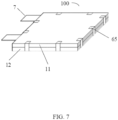
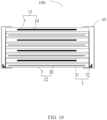
- the lithium-ion battery 100 comprises the positive electrode composite structure 11 and the negative electrode composite structure 12 in the above embodiments.
- the positive electrode composite structure 11 and the negative electrode composite structure 12 are stacked.
- the positive electrode composite structure 11 comprises a positive electrode sheet 10 and two composite solid electrolyte membranes 3 separately disposed on two opposite surfaces of the positive electrode sheet 10.
- the negative electrode composite structure 12 comprises a negative electrode sheet 20 and two composite solid electrolyte membranes 3 separately disposed on two opposite surfaces of the negative electrode sheet 20.
- the composite solid electrolyte membrane 3 is a continuous membrane structure and is divided into two parts.
- a first part of composite solid electrolyte membrane 31 is located between the positive electrode sheet 10 and the negative electrode sheet 20 and is arranged parallel to the positive electrode sheet 10 and the negative electrode sheet 20.
- a second part of composite solid electrolyte membrane 32 is folded on the lithium-ion battery 100 side.
- the lithium-ion battery 100 comprises a plurality of positive electrode composite structures 11 and a plurality of negative electrode composite structures 12.
- the plurality of positive electrode composite structures 11 and the plurality of negative electrode composite structures 12 are stacked at intervals.
- the lithium-ion battery 100 comprises N positive electrode composite structures 11 and N negative electrode composite structures 12, where N ⁇ 2, N can be 2, 3, 4, 5, 6, etc. It can be understood that the value of N is a positive integer with no upper limit, and the value of N can be set according to the structural size of the lithium-ion battery 100.
- the composite solid electrolyte membrane 3 is provided on both surfaces of the positive electrode sheet 10 and the negative electrode sheet 20.
- the area of the composite solid electrolyte membrane 3 is larger than the area of the positive electrode sheet 10 or the negative electrode sheet 20, that is, the composite solid electrolyte membrane 3 can completely cover the positive electrode sheet 10 or the negative electrode sheet 20.
- the part of the composite solid electrolyte membrane 3 that protrudes from the positive electrode sheet 10 or the negative electrode sheet 20 is the second part of composite solid electrolyte membrane 32.
- the second part of composite solid electrolyte membrane 32 extends to the side of the lithium-ion battery 100.
- the second part of composite solid electrolyte membrane 32 is collected and folded in the side area of the lithium-ion battery 100 in a unified direction, which can make the overall structure of the lithium-ion battery 100 neater and facilitate subsequent processing.
- the second composite solid electrolyte membrane 32 in the side area of the lithium-ion battery 100 is beneficial to the utilization of the internal space of the battery, and at the same time will not interfere with the upper and lower planes of the battery.
- the overall structure of the battery is improved.
- the two-part arrangement of the composite solid electrolyte membrane 3 strengthens the side strength of the battery, so that the combination between the cell body and the battery packaging aluminum foil will not be interfered. It also improves the overall structural strength and stability of the battery.
- the lithium-ion battery 100 further comprises a sealing structure 65.
- the sealing structure 65 comprises at least one adhesive tape. Each tape extends from the lower platform to the upper platform of the lithium-ion battery 100 and is used to fix the second part of composite solid electrolyte membrane 32 folded in the side area.
- the sealing structure 65 comprises a plurality of adhesive tapes
- the plurality of adhesive tapes are arranged on the lithium-ion battery 100 at intervals. Specifically, the plurality of adhesive tapes are distributed around the lithium-ion battery 100 and evenly spaced from each other. Extending from the lower platform of the lithium-ion battery 100 to the upper platform, a fixed support point is provided for the second part of the solid electrolyte membrane folded in the side area.
- the lithium-ion battery provided by this application comprises a composite solid electrolyte membrane, and a part of composite solid electrolyte membrane is arranged in the side area of the lithium-ion battery.
- This structure is conducive to the utilization of the internal space of the battery, while strengthening the side strength of the battery, so that the connection between the core body and the battery packaging aluminum foil will not be interfered, and also improving the overall structural strength and stability of the battery, making the lithium-ion battery have good cycle performance.
Landscapes
- Chemical & Material Sciences (AREA)
- Chemical Kinetics & Catalysis (AREA)
- Electrochemistry (AREA)
- General Chemical & Material Sciences (AREA)
- Engineering & Computer Science (AREA)
- Manufacturing & Machinery (AREA)
- Inorganic Chemistry (AREA)
- Materials Engineering (AREA)
- Physics & Mathematics (AREA)
- Condensed Matter Physics & Semiconductors (AREA)
- Dispersion Chemistry (AREA)
- General Physics & Mathematics (AREA)
- Composite Materials (AREA)
- Secondary Cells (AREA)
Applications Claiming Priority (1)
| Application Number | Priority Date | Filing Date | Title |
|---|---|---|---|
| CN202310703881.2A CN119153760A (zh) | 2023-06-14 | 2023-06-14 | 锂离子电池电芯 |
Publications (1)
| Publication Number | Publication Date |
|---|---|
| EP4478469A1 true EP4478469A1 (de) | 2024-12-18 |
Family
ID=91581043
Family Applications (1)
| Application Number | Title | Priority Date | Filing Date |
|---|---|---|---|
| EP24182170.1A Pending EP4478469A1 (de) | 2023-06-14 | 2024-06-14 | Lithium-ionen-batterie |
Country Status (3)
| Country | Link |
|---|---|
| US (1) | US20240421343A1 (de) |
| EP (1) | EP4478469A1 (de) |
| CN (1) | CN119153760A (de) |
Citations (5)
| Publication number | Priority date | Publication date | Assignee | Title |
|---|---|---|---|---|
| US20200328449A1 (en) * | 2019-04-10 | 2020-10-15 | Honda Motor Co., Ltd. | Battery electrode group, wound type battery including same electrode group, and method of manufacturing battery electrode group |
| CN111910283A (zh) * | 2020-08-14 | 2020-11-10 | 浙江理工大学 | 氧化物型陶瓷复合纳米纤维固态电解质及其静电纺丝制备方法 |
| EP3910717A1 (de) * | 2019-05-08 | 2021-11-17 | Lg Energy Solution, Ltd. | Festkörperbatterie mit verbundelektrode |
| CN114361575A (zh) * | 2021-12-31 | 2022-04-15 | 海南大学 | 一种有机-无机复合电解质及其制备方法 |
| EP3985771A1 (de) * | 2020-10-14 | 2022-04-20 | Volkswagen Ag | Lithium-ionen-batteriezelle sowie herstellungsverfahren für eine solche |
-
2023
- 2023-06-14 CN CN202310703881.2A patent/CN119153760A/zh active Pending
-
2024
- 2024-06-14 EP EP24182170.1A patent/EP4478469A1/de active Pending
- 2024-06-14 US US18/743,159 patent/US20240421343A1/en active Pending
Patent Citations (5)
| Publication number | Priority date | Publication date | Assignee | Title |
|---|---|---|---|---|
| US20200328449A1 (en) * | 2019-04-10 | 2020-10-15 | Honda Motor Co., Ltd. | Battery electrode group, wound type battery including same electrode group, and method of manufacturing battery electrode group |
| EP3910717A1 (de) * | 2019-05-08 | 2021-11-17 | Lg Energy Solution, Ltd. | Festkörperbatterie mit verbundelektrode |
| CN111910283A (zh) * | 2020-08-14 | 2020-11-10 | 浙江理工大学 | 氧化物型陶瓷复合纳米纤维固态电解质及其静电纺丝制备方法 |
| EP3985771A1 (de) * | 2020-10-14 | 2022-04-20 | Volkswagen Ag | Lithium-ionen-batteriezelle sowie herstellungsverfahren für eine solche |
| CN114361575A (zh) * | 2021-12-31 | 2022-04-15 | 海南大学 | 一种有机-无机复合电解质及其制备方法 |
Also Published As
| Publication number | Publication date |
|---|---|
| US20240421343A1 (en) | 2024-12-19 |
| CN119153760A (zh) | 2024-12-17 |
Similar Documents
| Publication | Publication Date | Title |
|---|---|---|
| US12438179B2 (en) | Cell preparation apparatus and method | |
| CN104681858B (zh) | 一种超薄柔性锂离子电池及其制备方法 | |
| US20110162198A1 (en) | Method of producing solid electrolyte-electrode assembly | |
| CN105355962B (zh) | 一种卷绕式叠片电池的制备方法 | |
| TWI517476B (zh) | 電極組、電極組之製備方法、以及包含電極組之電化學電池 | |
| JP5515267B2 (ja) | 非水電解質二次電池 | |
| JP2005011660A (ja) | 二次電池用電極及びその製造方法並びにこれを用いた二次電池 | |
| KR20140004573A (ko) | 전극조립체, 전극조립체의 제조공정 및 전극조립체를 포함하는 전기화학소자 | |
| JP2002015773A (ja) | 電池およびその製造方法 | |
| CN213520076U (zh) | 一种锂离子电芯 | |
| EP4625567A2 (de) | Sekundärbatterie und elektronische vorrichtung | |
| CN110911734A (zh) | 一种软包锂离子电池 | |
| CN116914269A (zh) | 电芯、具有该电芯的电池以及制作方法 | |
| CN105895860A (zh) | 一种卷绕式叠片电池电极组件制作方法 | |
| EP4478469A1 (de) | Lithium-ionen-batterie | |
| EP4478438A1 (de) | Verfahren zur herstellung einer lithium-ionen-batterie | |
| CN102024990A (zh) | 功率型锂离子电池电芯制作方法 | |
| JP2015032495A (ja) | 固体電池の製造方法 | |
| KR20250132360A (ko) | 고체 전지 및 그 제조 방법, 그리고 전지 모듈 | |
| CN111129607B (zh) | 一种锂硫电池制袋叠片方法及装置 | |
| TWI872574B (zh) | 鋰離子電池電芯的製備方法 | |
| CN119029278A (zh) | 二次电池、用电装置及二次电池的制造方法 | |
| TWI900861B (zh) | 鋰離子電池電芯 | |
| CN201741765U (zh) | 功率型锂离子电池电芯 | |
| CN114204105A (zh) | 一种软包新型叠片锂离子电池 |
Legal Events
| Date | Code | Title | Description |
|---|---|---|---|
| PUAI | Public reference made under article 153(3) epc to a published international application that has entered the european phase |
Free format text: ORIGINAL CODE: 0009012 |
|
| STAA | Information on the status of an ep patent application or granted ep patent |
Free format text: STATUS: THE APPLICATION HAS BEEN PUBLISHED |
|
| AK | Designated contracting states |
Kind code of ref document: A1 Designated state(s): AL AT BE BG CH CY CZ DE DK EE ES FI FR GB GR HR HU IE IS IT LI LT LU LV MC ME MK MT NL NO PL PT RO RS SE SI SK SM TR |
|
| STAA | Information on the status of an ep patent application or granted ep patent |
Free format text: STATUS: REQUEST FOR EXAMINATION WAS MADE |
|
| 17P | Request for examination filed |
Effective date: 20250616 |