EP4478053A2 - Polymère à base de protéine insoluble dans l'eau et pliable à conductivité ionique - Google Patents
Polymère à base de protéine insoluble dans l'eau et pliable à conductivité ionique Download PDFInfo
- Publication number
- EP4478053A2 EP4478053A2 EP24209612.1A EP24209612A EP4478053A2 EP 4478053 A2 EP4478053 A2 EP 4478053A2 EP 24209612 A EP24209612 A EP 24209612A EP 4478053 A2 EP4478053 A2 EP 4478053A2
- Authority
- EP
- European Patent Office
- Prior art keywords
- parts
- silk fibroin
- flexible
- weight
- motion sensor
- Prior art date
- Legal status (The legal status is an assumption and is not a legal conclusion. Google has not performed a legal analysis and makes no representation as to the accuracy of the status listed.)
- Pending
Links
Images





Classifications
-
- G—PHYSICS
- G01—MEASURING; TESTING
- G01P—MEASURING LINEAR OR ANGULAR SPEED, ACCELERATION, DECELERATION, OR SHOCK; INDICATING PRESENCE, ABSENCE, OR DIRECTION, OF MOVEMENT
- G01P13/00—Indicating or recording presence, absence, or direction, of movement
-
- A—HUMAN NECESSITIES
- A61—MEDICAL OR VETERINARY SCIENCE; HYGIENE
- A61B—DIAGNOSIS; SURGERY; IDENTIFICATION
- A61B5/00—Measuring for diagnostic purposes; Identification of persons
- A61B5/103—Measuring devices for testing the shape, pattern, colour, size or movement of the body or parts thereof, for diagnostic purposes
- A61B5/11—Measuring movement of the entire body or parts thereof, e.g. head or hand tremor or mobility of a limb
-
- A—HUMAN NECESSITIES
- A61—MEDICAL OR VETERINARY SCIENCE; HYGIENE
- A61B—DIAGNOSIS; SURGERY; IDENTIFICATION
- A61B5/00—Measuring for diagnostic purposes; Identification of persons
- A61B5/103—Measuring devices for testing the shape, pattern, colour, size or movement of the body or parts thereof, for diagnostic purposes
- A61B5/11—Measuring movement of the entire body or parts thereof, e.g. head or hand tremor or mobility of a limb
- A61B5/1107—Measuring contraction of parts of the body, e.g. organ or muscle
-
- A—HUMAN NECESSITIES
- A61—MEDICAL OR VETERINARY SCIENCE; HYGIENE
- A61B—DIAGNOSIS; SURGERY; IDENTIFICATION
- A61B5/00—Measuring for diagnostic purposes; Identification of persons
- A61B5/68—Arrangements of detecting, measuring or recording means, e.g. sensors, in relation to patient
- A61B5/6801—Arrangements of detecting, measuring or recording means, e.g. sensors, in relation to patient specially adapted to be attached to or worn on the body surface
-
- A—HUMAN NECESSITIES
- A61—MEDICAL OR VETERINARY SCIENCE; HYGIENE
- A61B—DIAGNOSIS; SURGERY; IDENTIFICATION
- A61B5/00—Measuring for diagnostic purposes; Identification of persons
- A61B5/68—Arrangements of detecting, measuring or recording means, e.g. sensors, in relation to patient
- A61B5/6801—Arrangements of detecting, measuring or recording means, e.g. sensors, in relation to patient specially adapted to be attached to or worn on the body surface
- A61B5/683—Means for maintaining contact with the body
- A61B5/6832—Means for maintaining contact with the body using adhesives
- A61B5/6833—Adhesive patches
-
- A—HUMAN NECESSITIES
- A61—MEDICAL OR VETERINARY SCIENCE; HYGIENE
- A61B—DIAGNOSIS; SURGERY; IDENTIFICATION
- A61B5/00—Measuring for diagnostic purposes; Identification of persons
- A61B5/68—Arrangements of detecting, measuring or recording means, e.g. sensors, in relation to patient
- A61B5/6846—Arrangements of detecting, measuring or recording means, e.g. sensors, in relation to patient specially adapted to be brought in contact with an internal body part, i.e. invasive
- A61B5/6847—Arrangements of detecting, measuring or recording means, e.g. sensors, in relation to patient specially adapted to be brought in contact with an internal body part, i.e. invasive mounted on an invasive device
-
- C—CHEMISTRY; METALLURGY
- C08—ORGANIC MACROMOLECULAR COMPOUNDS; THEIR PREPARATION OR CHEMICAL WORKING-UP; COMPOSITIONS BASED THEREON
- C08K—Use of inorganic or non-macromolecular organic substances as compounding ingredients
- C08K3/00—Use of inorganic substances as compounding ingredients
- C08K3/16—Halogen-containing compounds
-
- C—CHEMISTRY; METALLURGY
- C08—ORGANIC MACROMOLECULAR COMPOUNDS; THEIR PREPARATION OR CHEMICAL WORKING-UP; COMPOSITIONS BASED THEREON
- C08K—Use of inorganic or non-macromolecular organic substances as compounding ingredients
- C08K3/00—Use of inorganic substances as compounding ingredients
- C08K3/34—Silicon-containing compounds
- C08K3/346—Clay
-
- C—CHEMISTRY; METALLURGY
- C08—ORGANIC MACROMOLECULAR COMPOUNDS; THEIR PREPARATION OR CHEMICAL WORKING-UP; COMPOSITIONS BASED THEREON
- C08L—COMPOSITIONS OF MACROMOLECULAR COMPOUNDS
- C08L89/00—Compositions of proteins; Compositions of derivatives thereof
-
- G—PHYSICS
- G06—COMPUTING OR CALCULATING; COUNTING
- G06F—ELECTRIC DIGITAL DATA PROCESSING
- G06F3/00—Input arrangements for transferring data to be processed into a form capable of being handled by the computer; Output arrangements for transferring data from processing unit to output unit, e.g. interface arrangements
- G06F3/01—Input arrangements or combined input and output arrangements for interaction between user and computer
- G06F3/03—Arrangements for converting the position or the displacement of a member into a coded form
- G06F3/041—Digitisers, e.g. for touch screens or touch pads, characterised by the transducing means
- G06F3/044—Digitisers, e.g. for touch screens or touch pads, characterised by the transducing means by capacitive means
-
- G—PHYSICS
- G06—COMPUTING OR CALCULATING; COUNTING
- G06F—ELECTRIC DIGITAL DATA PROCESSING
- G06F3/00—Input arrangements for transferring data to be processed into a form capable of being handled by the computer; Output arrangements for transferring data from processing unit to output unit, e.g. interface arrangements
- G06F3/01—Input arrangements or combined input and output arrangements for interaction between user and computer
- G06F3/03—Arrangements for converting the position or the displacement of a member into a coded form
- G06F3/041—Digitisers, e.g. for touch screens or touch pads, characterised by the transducing means
- G06F3/044—Digitisers, e.g. for touch screens or touch pads, characterised by the transducing means by capacitive means
- G06F3/0444—Digitisers, e.g. for touch screens or touch pads, characterised by the transducing means by capacitive means using a single conductive element covering the whole sensing surface, e.g. by sensing the electrical current flowing at the corners
-
- G—PHYSICS
- G06—COMPUTING OR CALCULATING; COUNTING
- G06F—ELECTRIC DIGITAL DATA PROCESSING
- G06F3/00—Input arrangements for transferring data to be processed into a form capable of being handled by the computer; Output arrangements for transferring data from processing unit to output unit, e.g. interface arrangements
- G06F3/01—Input arrangements or combined input and output arrangements for interaction between user and computer
- G06F3/03—Arrangements for converting the position or the displacement of a member into a coded form
- G06F3/041—Digitisers, e.g. for touch screens or touch pads, characterised by the transducing means
- G06F3/044—Digitisers, e.g. for touch screens or touch pads, characterised by the transducing means by capacitive means
- G06F3/0445—Digitisers, e.g. for touch screens or touch pads, characterised by the transducing means by capacitive means using two or more layers of sensing electrodes, e.g. using two layers of electrodes separated by a dielectric layer
-
- A—HUMAN NECESSITIES
- A61—MEDICAL OR VETERINARY SCIENCE; HYGIENE
- A61B—DIAGNOSIS; SURGERY; IDENTIFICATION
- A61B2562/00—Details of sensors; Constructional details of sensor housings or probes; Accessories for sensors
- A61B2562/02—Details of sensors specially adapted for in-vivo measurements
- A61B2562/0209—Special features of electrodes classified in A61B5/24, A61B5/25, A61B5/283, A61B5/291, A61B5/296, A61B5/053
- A61B2562/0214—Capacitive electrodes
-
- A—HUMAN NECESSITIES
- A61—MEDICAL OR VETERINARY SCIENCE; HYGIENE
- A61B—DIAGNOSIS; SURGERY; IDENTIFICATION
- A61B2562/00—Details of sensors; Constructional details of sensor housings or probes; Accessories for sensors
- A61B2562/02—Details of sensors specially adapted for in-vivo measurements
- A61B2562/0261—Strain gauges
-
- A—HUMAN NECESSITIES
- A61—MEDICAL OR VETERINARY SCIENCE; HYGIENE
- A61B—DIAGNOSIS; SURGERY; IDENTIFICATION
- A61B2562/00—Details of sensors; Constructional details of sensor housings or probes; Accessories for sensors
- A61B2562/12—Manufacturing methods specially adapted for producing sensors for in-vivo measurements
-
- A—HUMAN NECESSITIES
- A61—MEDICAL OR VETERINARY SCIENCE; HYGIENE
- A61B—DIAGNOSIS; SURGERY; IDENTIFICATION
- A61B5/00—Measuring for diagnostic purposes; Identification of persons
- A61B5/103—Measuring devices for testing the shape, pattern, colour, size or movement of the body or parts thereof, for diagnostic purposes
- A61B5/11—Measuring movement of the entire body or parts thereof, e.g. head or hand tremor or mobility of a limb
- A61B5/1121—Determining geometric values, e.g. centre of rotation or angular range of movement
-
- C—CHEMISTRY; METALLURGY
- C08—ORGANIC MACROMOLECULAR COMPOUNDS; THEIR PREPARATION OR CHEMICAL WORKING-UP; COMPOSITIONS BASED THEREON
- C08K—Use of inorganic or non-macromolecular organic substances as compounding ingredients
- C08K3/00—Use of inorganic substances as compounding ingredients
- C08K3/16—Halogen-containing compounds
- C08K2003/162—Calcium, strontium or barium halides, e.g. calcium, strontium or barium chloride
-
- C—CHEMISTRY; METALLURGY
- C08—ORGANIC MACROMOLECULAR COMPOUNDS; THEIR PREPARATION OR CHEMICAL WORKING-UP; COMPOSITIONS BASED THEREON
- C08K—Use of inorganic or non-macromolecular organic substances as compounding ingredients
- C08K3/00—Use of inorganic substances as compounding ingredients
- C08K3/16—Halogen-containing compounds
- C08K2003/166—Magnesium halide, e.g. magnesium chloride
-
- C—CHEMISTRY; METALLURGY
- C08—ORGANIC MACROMOLECULAR COMPOUNDS; THEIR PREPARATION OR CHEMICAL WORKING-UP; COMPOSITIONS BASED THEREON
- C08K—Use of inorganic or non-macromolecular organic substances as compounding ingredients
- C08K2201/00—Specific properties of additives
- C08K2201/001—Conductive additives
-
- C—CHEMISTRY; METALLURGY
- C08—ORGANIC MACROMOLECULAR COMPOUNDS; THEIR PREPARATION OR CHEMICAL WORKING-UP; COMPOSITIONS BASED THEREON
- C08K—Use of inorganic or non-macromolecular organic substances as compounding ingredients
- C08K2201/00—Specific properties of additives
- C08K2201/011—Nanostructured additives
-
- C—CHEMISTRY; METALLURGY
- C08—ORGANIC MACROMOLECULAR COMPOUNDS; THEIR PREPARATION OR CHEMICAL WORKING-UP; COMPOSITIONS BASED THEREON
- C08L—COMPOSITIONS OF MACROMOLECULAR COMPOUNDS
- C08L2201/00—Properties
- C08L2201/10—Transparent films; Clear coatings; Transparent materials
-
- C—CHEMISTRY; METALLURGY
- C08—ORGANIC MACROMOLECULAR COMPOUNDS; THEIR PREPARATION OR CHEMICAL WORKING-UP; COMPOSITIONS BASED THEREON
- C08L—COMPOSITIONS OF MACROMOLECULAR COMPOUNDS
- C08L2203/00—Applications
- C08L2203/20—Applications use in electrical or conductive gadgets
-
- G—PHYSICS
- G06—COMPUTING OR CALCULATING; COUNTING
- G06F—ELECTRIC DIGITAL DATA PROCESSING
- G06F2203/00—Indexing scheme relating to G06F3/00 - G06F3/048
- G06F2203/041—Indexing scheme relating to G06F3/041 - G06F3/045
- G06F2203/04102—Flexible digitiser, i.e. constructional details for allowing the whole digitising part of a device to be flexed or rolled like a sheet of paper
-
- G—PHYSICS
- G06—COMPUTING OR CALCULATING; COUNTING
- G06F—ELECTRIC DIGITAL DATA PROCESSING
- G06F2203/00—Indexing scheme relating to G06F3/00 - G06F3/048
- G06F2203/041—Indexing scheme relating to G06F3/041 - G06F3/045
- G06F2203/04103—Manufacturing, i.e. details related to manufacturing processes specially suited for touch sensitive devices
Definitions
- an ionic conductive, stretchable, and flexible transparent material comprising silk fibroin; a nanomaterial, such as a nano clay, a carbon nanomaterial, or a Mxene; and an electrolyte, and a method of recycling said material. Additionally disclosed is a flexible surface capacitive touch panel and a flexible motion sensor both based on the ionic conductive, stretchable, and flexible transparent material.
- Ionic conductors can generate a number of exciting electronic devices, and many organic electronic materials has been transformed into such mediators of electricity. This was thought as a solution for the above bottleneck through the manufacture of water-insoluble, thermally and chemically stable protein films with high ionic conductivity.
- ionic conductors can be defined as materials that conduct electricity through the passage of ionic carries such as Li + , Na + , K + , Cl - , Mg 2+ , and Ca 2+ .
- Ionic conductors have e.g. been used in Li-lon battery technology. Even though ionic conductors has pushed the field of electronics, there is still drawbacks that need to be addressed in the future.
- polyacrylamide is hazardous for habitats and for humans. This is due to the release of acrylamide into the environment.
- Polyacrylamide is a synthetic polymer and it is therefore not considered a green option.
- Polysaccharides such as alginate, starch, hyaluronic acid, and chitosan are possible alternatives. Unfortunately, some of these polymers typically display a number of mechanical shortcomings in a cross-linked and solidified state.
- an ionic conductive, stretchable, and flexible transparent material comprising silk fibroin, a nanomaterial, and an electrolyte, wherein the nanomaterial is present in an amount of 3 to 24 parts by weight for every 100 parts by weight of the silk fibroin.
- an ionic conductive material' is to be understood as a material, which is able to conduct electrical current through the material and the electrical current is transported by means of ions.
- An ionic conductive material as disclosed here is normally a material, which can conduct at least 1 ⁇ A of electrical current through the material.
- a stretchable material' is to be understood as a material, which is able to stretch at least 1% of its length before breaking.
- a stretchable material as disclosed here is normally a material, which has an average modulus of at least 100 kPa.
- a flexible material' is to be understood as a material, which is capable of being bent without breaking.
- a flexible material as disclosed here is normally a material, which is capable of being bent at least 30 degrees without breaking.
- a flexible material as disclosed here is normally a material, which has an average flexible modulus of at least 100 kPa.
- a transparent material' is to be understood as a material, which allows light to pass through so that objects behind can be distinctly seen.
- a transparent material as disclosed here is normally a material, which allows at least 50% of light with a wavelength at 400 nm to pass through the material.
- the material according to the first aspect shows many of the desired properties within the field of ionic conductors. These properties include a good crystallinity, transparency, mechanical strength, recyclability, optical transparency, and electrical sensitivity. Additional, the disclosed material shows chemical and thermal stability, in addition to excellent dimensional stability.
- the material further shows stable performance in aqueous and chemically active environments.
- Proteins are considered a greener choice than many of the hazardous components currently used in the field of electronics.
- a combination of proteins with other properties such as flexibility, transparency, mechanical toughness, electrical conductivity, chemical and thermal stability, uncover a range of ground-breaking opportunities in the field of flexible and green electronics.
- Protein-based silk fibers has an enormous portfolio of properties. These include good biocompatibility, nontoxicity, recyclability, thermoelectricity, transparency, thermal stability, and immense mechanical strength.
- Nanomaterial such as e.g. nano clay
- Nano clay is relatively cheap materials and in combination with various proteins they can improve the mechanical strength, electrical conductivity, and water stability of the final protein film.
- Nano clay is also biocompatible and nontoxic.
- a method of recycling an ionic conductive, stretchable, and flexible transparent material comprising silk fibroin, a nanomaterial, and an electrolyte, wherein the nanomaterial is present in an amount of 3 to 24 parts by weight for every 100 parts by weight of the silk fibroin
- the recycling method comprises the steps of:
- a method wherein the materiel is recycled is a green option, as the recycled material can be reused in the production of new materiel, hereby saving resources and not throwing out unnecessary amounts of precious materiel. Additionally, reusing parts of the material may contribute to a lower manufacturing cost of the material. Additionally, a method wherein the materiel is recycled, is also considered a green option because the recycling process can minimize the accumulation of electronic waste materials, which pose a huge environmental threat.
- a flexible surface capacitive touch panel comprising a touch panel material defining a touch panel surface area, wherein the touch panel material comprises:
- the touch panel material shows many of the desired properties within the field of ionic conductors. These properties were also described in regards to the material disclosed in the first aspect.
- the touch panel materials can be configured in to a plain or patterned form and can be used for touch or hovering touch applications.
- the casting solution containing silk fibroin and a nanomaterial can be injected into the patterned channels of elastomer films e.g. polydimethylsiloxane (PDMS).
- PDMS polydimethylsiloxane
- the current or capacitance change can be measured while touch or hovering touch using a single layer or multi-layered films separated by a dielectric material.
- the material disclosed in the third aspect shows excellent flexibility, while maintaining good conductivity, hereby creating a flexible touch panel.
- a flexible motion sensor comprising a flexible motion sensor material defining a flexible motion sensor surface area, wherein the flexible motion sensor material comprises:
- the flexible motion sensor material shows many of the desired properties within the field of ionic conductors. These properties were also described in regards to the material disclosed in the first aspect. The material furthermore provides good flexibility and conductivity.
- a flexible motion sensor comprising a flexible motion sensor material defining a flexible motion sensor surface area for measuring/detecting movement of a joint, wherein the flexible motion sensor material comprises:
- a flexible motion sensor material as disclosed herein is flexible and may be attached to any part of the body. Here through, it maybe monitor the motion of almost any part of the body.
- its application may include healthcare monitoring, virtual gaming, or disease diagnosis. It can also be expanded into a motion-sensitive glove, which may assist surgeons, e.g. for monitoring the Parkinson's disease, piano players, or concert players to improve their performance.
- this glove may be used to transmit motions into movements in the game and hereby hold the promise of interfacing the use with the virtual world of gaming.
- it can be used inside the body to monitor the movements of the organs.
- the flexible motion sensor may be attached/adhered to the heart with or without the aid of an adhesive layer, which can monitor the physiological movements (expansion and contraction) of the cardiac tissue.
- a sixth aspect is a method for production of an ionic conductive, stretchable, and flexible transparent material comprising steps of:
- the naturally derived polymer, silk fibroin may be transformed via a simple casting procedure into a flexible and eco-friendly ionic film.
- Silk proteins retrieved from bombyx mori cocoons may be used for producing the silk fibroin.
- Silk fibroin can interact with nanomaterial to improve the mechanical properties of the ionic conductive, stretchable, and flexible transparent material.
- the process disclosed herein may additionally aid the silk fibroin to be more stable in water.
- a seventh aspect is a method for production of a flexible surface capacitive touch panel, the method comprising the step of:
- a flexible surface capacitive touch panel as disclosed herein operates at very low voltage and works at different frequencies, which means that it delivers stable performances in the kilohertz regime.
- Disclosed here in an eighth aspect is a method for production of a flexible motion sensor comprising the steps of:
- a flexible motion sensor as disclosed herein works at a low voltage and a low frequency.
- the electrolyte is a zwitterion.
- the electrolyte is a salt.
- the salt is selected from the group of potassium chloride, sodium chloride, lithium chloride, calcium chloride, magnesium chloride, or a combination hereof.
- the electrolyte is in an amount high enough to make the material conductive.
- the electrolyte is present in an amount above 2 parts by weight for every 100 parts by weight of the silk fibroin.
- the electrolyte is present in an amount of 2.5 to 15 parts by weight for every 100 parts by weight of the silk fibroin.
- the electrolyte is present in an amount of 2.5 to 15 parts, such as 3.5 to 10 parts, such as 4 to 8 parts, such as 4 to 6 parts by weight for every 100 parts by weight of the silk fibroin.
- the electrolyte is present in an amount of 5 parts by weight for every 100 parts by weight of the silk fibroin.
- the nanomaterial is a nano clay, a carbon nanomaterial, a Mxene or a combination hereof.
- the carbon nanomaterial may be selected from the group of graphene, carbon nanotubes or a combination hereof.
- Mxene is normally meant a two dimensional nanomaterial comprising a multiple of arrangements of carbides, nitrides and transition metals, such as molybdenum or titanium.
- Nano clay may be described as a nacre-mimetic nanomaterial with two-dimensions. Nano clays are a type of layered silicates with nonmetric thickness and diameter in the nano range. These nano plates have previously shown many applications such as antibacterial activity, sterilizing effect, adsorption of toxins, and membrane coating. The incorporation of nano clays into polymeric matrixes could enhance the mechanical, physical, and barrier properties of polymers. Montmorillonite and kaolinite are examples of nano clays that have been used as fillers in food systems.
- nano clays are organized into several classes such as montmorillonite, bentonite, kaolinite, hectorite, and halloysite.
- the nano clay is selected from the group of montmorillonite, bentonite, kaolinite, hectorite, halloysite, or a combination hereof.
- the nano clay is hectorite.
- the hectorite is laponite.
- Laponite is a synthetic clay mineral known to have widespread applications as a rheology modifier and as a reinforcement in a variety of industries such as mining, petroleum, home and personal care, pharmaceutical, agrochemical, and paint polymer.
- the primary particle of laponite possesses anisotropic nanometric shape that has dissimilar charge distribution.
- Laponite has a chemical formula Na 0.7 Si 8 Mg 5.5 Li 0.3 O 20 (OH) 4 .
- Laponite particles are disk shaped with a thickness of 1 nm and diameter of 25 ⁇ 2 nm.
- two tetrahedral silica sheets sandwich one octahedral magnesia sheet.
- In the middle octahedral sheet few magnesium atoms are substituted by lithium atoms (isomorphic substitution) creating a deficiency of positive charge within the sheet. Consequently, in a dry state, the faces of laponite particles, that are electron rich, share the electrons with sodium atoms that reside in the interlayer space.
- the Na + ions dissociate rendering a permanent negative charge to the faces of laponite particles.
- the edge of laponite particle predominantly contains MgOH groups from the octahedral magnesia sheets.
- the point of zero charge (PZC), for oxides and hydroxides of magnesium is above pH 10.
- PZC point of zero charge
- the edge of laponite particle, which contains predominantly MgOH is positive below pH 11 indicating pH of 11 to be a point of zero charge for the edges of laponite particles ( Applied Clay Science 97-98 (2014) 72-77 ).
- the nanomaterial is present in an amount of 6 to 20 parts, such 6 to 18 parts, such as 8 to 16 parts, or such as 10 to 14 parts by weight for every 100 parts by weight of the silk fibroin.
- the nanomaterial is present in an amount of 12 parts by weight for every 100 parts by weight of the silk fibroin.
- the nanomaterial is present in an amount of 6 to 20 parts, such 6 to 18 parts, such as 8 to 16 parts, or such as 10 to 14 parts by weight for every 100 parts by weight of the silk fibroin.
- the nanomaterial is present in an amount of 12 parts by weight for every 100 parts by weight of the silk fibroin.
- an optical transmittance of light through the flexible motion sensor material at a wavelength within the wavelength range between 400 nm and 800 nm is at least 50%, such as at least 60%, such as at least 70%.
- an optical transmittance of light through the touch panel material at a wavelength within the wavelength range between 400 nm and 800 nm is at least 50%, such as at least 60%, such as at least 70%.
- an optical transmittance of light through the ionic conductive, stretchable, and flexible transparent material at a wavelength within the wavelength range between 400 nm and 800 nm is at least 50%, such as at least 60%, such as at least 70%.
- an optical transmittance of light through the flexible motion sensor material at a wavelength above 400 nm is at least 50%, such as at least 60%, such as at least 70%.
- an optical transmittance of light through the touch panel material at a wavelength above 400 nm is at least 50%, such as at least 60%, such as at least 70%.
- an optical transmittance of light through the ionic conductive, stretchable, and flexible transparent material at a wavelength above 400 nm is at least 50%, such as at least 60%, such as at least 70%.
- a dimensional stability of the flexible motion sensor material has a thermal expansion coefficient between 25 ppm/K and 100 ppm/K, such as between 30 ppm/K and 80 ppm/K, such as between 40 ppm/K and 60 ppm/K, such as between 40 ppm/K and 50 ppm/K.
- a dimensional stability of the touch panel material has a thermal expansion coefficient between 25 ppm/K and 100 ppm/K, such as between 30 ppm/K and 80 ppm/K, such as between 40 ppm/K and 60 ppm/K, such as between 40 ppm/K and 50 ppm/K.
- a dimensional stability of the ionic conductive, stretchable, and flexible transparent material has a thermal expansion coefficient between 25 ppm/K and 100 ppm/K, such as between 30 ppm/K and 80 ppm/K, such as between 40 ppm/K and 60 ppm/K, such as between 40 ppm/K and 50 ppm/K.
- the flexible motion sensor material has a thermostability between 260 °C and 290 °C, such as between 270 °C and 280 °C, when measured via thermogravimetric analysis (TGA).
- TGA thermogravimetric analysis
- Thermogravimetric analysis is a method of thermal analysis in which the mass of a sample is measured over time as the temperature changes. TGA is conducted on an instrument referred to as a thermogravimetric analyzer. A thermogravimetric analyzer continuously measures mass while the temperature of a sample is changed over time. Mass, temperature, and time in TGA are considered base measurements while many additional measures may be derived from these three base measurements. The thermogravimetric data collected from a thermal reaction is compiled into a plot of mass or percentage of initial mass on the y-axis versus either temperature or time on the x-axis. This plot is referred to as a TGA curve.
- the touch panel material has a thermostability between 260 °C and 290 °C, such as between 270 °C and 280 °C, when measured via thermogravimetric analysis (TGA).
- TGA thermogravimetric analysis
- the ionic conductive, stretchable, and flexible transparent material has a thermostability between 260 °C and 290 °C, such as between 270 °C and 280 °C, when measured via thermogravimetric analysis (TGA).
- TGA thermogravimetric analysis
- the flexible motion sensor material has a crystallization temperature between 230 °C and 250 °C, such as between 240 °C and 250 °C, when measured via differential scanning calorimetry (DSC).
- DSC differential scanning calorimetry
- DSC Differential scanning calorimetry
- the temperature program for a DSC analysis is designed such that the sample holder temperature increases linearly as a function of time.
- the reference sample should have a well-defined heat capacity over the range of temperatures to be scanned.
- the basic principle underlying this technique is that when the sample undergoes a physical transformation such as phase transitions, more or less heat will need to flow to it than the reference to maintain both at the same temperature. Whether less or more heat must flow to the sample depends on whether the process is exothermic or endothermic.
- the touch panel material has a crystallization temperature between 230 °C and 250 °C, such as between 240 °C and 250 °C, when measured via differential scanning calorimetry (DSC).
- DSC differential scanning calorimetry
- the ionic conductive, stretchable, and flexible transparent material has a crystallization temperature between 230 °C and 250 °C, such as between 240 °C and 250 °C, when measured via differential scanning calorimetry (DSC).
- DSC differential scanning calorimetry
- the flexible motion sensor material is dissolvable in a dissolving solution, the dissolving solution comprising:
- the touch panel material is dissolvable in a dissolving solution, the dissolving solution comprising:
- the ionic conductive, stretchable, and flexible transparent material is dissolvable in a dissolving solution, the dissolving solution comprising:
- the flexible motion sensor material is dissolvable in a dissolving solution, the dissolving solution comprising:
- the touch panel material is dissolvable in a dissolving solution, the dissolving solution comprising:
- the ionic conductive, stretchable, and flexible transparent material is dissolvable in a dissolving solution, the dissolving solution comprising:
- the flexible motion sensor material has a tensile strength of at least 10 MPa when measured with an Instron mechanical tester.
- Instron is a manufacturer of test equipment designed to evaluate the mechanical properties of materials and components, such as universal testing machines.
- a universal testing machine (UTM - an Instron mechanical tester), also known as a universal tester, materials testing machine, or materials test frame, is used to test the tensile strength and compressive strength of materials.
- An earlier name for a tensile testing machine is a tensometer.
- a specimen is placed in the machine between the grips and the grips are pulled apart while measuring the stress applied and the distance moved. This measures how strong it is (tensile strength) how stretchable it is (stretched length before breaking), and how stiff it is (Young Modulus).
- the touch panel material has a tensile strength of at least 10 MPa when measured with an Instron mechanical tester.
- the ionic conductive, stretchable, and flexible transparent material has a tensile strength of at least 10 MPa when measured with an Instron mechanical tester.
- the flexible motion sensor material has a Young Modulus of at least 2.0 GPa when measured with an Instron mechanical tester.
- the touch panel material has a Young Modulus of at least 2.0 GPa when measured with an Instron mechanical tester.
- the ionic conductive, stretchable, and flexible transparent material has a Young Modulus of at least 2.0 GPa when measured with an Instron mechanical tester.
- the flexible motion sensor material has a maximum strain before breakage of at least 1.5% when measured with an Instron mechanical tester.
- the touch panel material has a maximum strain before breakage of at least 1.5% when measured with an Instron mechanical tester.
- the ionic conductive, stretchable, and flexible transparent material has a maximum strain before breakage of at least 1.5% when measured with an Instron mechanical tester.
- the dissolving solution further comprises sodium hydroxide in a concentration of at least 0.3 molar.
- the dissolving solution is heated to a temperature of at least 40 °C, such as at least 50 °C, such as at least 60 °C, prior to adding the ionic conductive, stretchable, and flexible transparent material to the dissolving solution.
- the dissolving solution is heated to a temperature of at least 40 °C, such as at least 50 °C, such as at least 60 °C, after adding the ionic conductive, stretchable, and flexible transparent material to the dissolving solution.
- the touch panel surface area has a square shape and wherein the touch panel further comprises at least three, four, five, six, seven or eight electrodes connected to and positioned at opposite corners or edges of the touch panel.
- an electric sensitivity is unchanged when bending the touch panel material from a plane surface, such as 0 degrees, to a u-shaped surface, such as 180 degrees.
- an electric sensitivity is unchanged when touching the touch panel material a multiple of times, such as 100 times, such as 1,000 times, such as 10,000 times, such as 100,000 times, such as 1,000,000 times.
- the flexible motion sensor further comprises at least one selected from the group of a silver paste, a copper wire, a cloth adhesive tape, or combinations hereof.
- the motion sensor is cable of detecting changes in the flexible motion sensor material when bending the flexible motion sensor material from a plane surface, such as 0 degrees, all the way to a u-shaped surface, such as ⁇ 180 degrees.
- the motion sensor is cable of detecting changes in the flexible motion sensor material when gradually bending the flexible motion sensor material in from a plane surface, such as 0 degrees, all the way to a u-shaped surface, such as ⁇ 180 degrees, such as bending from 0 degrees to 30 degrees to 80 degrees.
- the joint is a shoulder joint, a wrist joint, a finger joint, an elbow joint, a knee joint, or an ankle joint.
- the motion sensor can be attached to a glove or any wearable devices to use in various sectors such as health care, gaming, or sportswear. It can also be used on shoes to help runners improve their performances.
- the motion sensor can be attached to a glove to use in training as a training tool for training surgeons.
- the motion sensor can be attached to a glove to use in assessing Parkinson's disease.
- a glove may be worn at home by a patient for a longer time period, e.g. one or more days, during which the shaking connected to Parkinson's disease comes and goes.
- health care personal is able to obtain information allowing them to assess the effect of e.g. Parkinson's disease medicine and its effect.
- Silk fibroin was extracted from Bombyx Mori silk cocoons. Briefly, 10 g of sliced silk cocoons were boiled in an aqueous solution of 0.02 M sodium carbonate (Sigma-Aldrich) for 30 minutes in order to remove all traces of sericin. The obtained silk fibroin fibers were subsequently dried at room temperature for 24 hours. The fibroin fibers were then dissolved in 9.3 M lithium bromide (Honeywell) at 60 °C for 6 hours and dialyzed against deionized water for 3 days. Finally, the fibroin solution was centrifuged for 20 minutes (three times) at 12000 rpm and 4 °C to remove any impurities.
- 0.02 M sodium carbonate Sigma-Aldrich
- the silk fibroin solution of example 1 was diluted to 2.7% wt/vol in 25ml MQ water.
- the pH of the solution was adjusted to 11 with 0.35 M ammonium hydroxide solution (28.0-30.0%, Sigma-Aldrich) and 10 mM potassium chloride (KCI, Sigma-Aldrich), and different concentrations (0%, 3%, 6%, 12% and 18%) of laponite RD (BYK additives, UK) were incorporated into the silk solution.
- the finalized solution was subsequently casted onto a plastic petri dish and dried at 40 °C for 24 hours.
- Example 3 Characterization of the thin films -
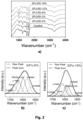
- Cross-sectional images of the SiPo films of example 2 were obtained from a FEI Quanta 200 ESEM FEG Scanning Electron Microscopy (SEM, USA) fitted with field emission gun electron source, in which the acceleration voltage was set at 10 kV and emission current at 10 mA. All SiPo films were cut, mounted on SEM stub and sputter coated with gold (10nm) prior to the SEM imaging. Three examples of cross-sectional images are shown in figure 1 , where the difference in layered structures between 0% (a), 6% (b), and 12% (c) laponite can be observed.
- FTIR Fourier transform infrared
- ATR diamond crystal attenuated total reflectance
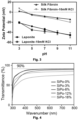
- the Zeta potential of silk fibroin and laponite solutions was measured with a Malvern Zetasizer ZS apparatus (United Kingdom) equipped with a 4 mW HeNe laser operating at 632.8 nm. All measurements were performed at 25 °C for dilute solutions of silk fibroin and laponite by adjusting the pH of the solutions using NaOH and HCl. The values are reported as the average of 10 measurements and can be observed in figure 3 .
- the zeta potential has been measured through the phase analysis light scattering technique and the obtained values are plotted as a function of pH in the range between 3 and 11.
- Silk fibroin is a polyampholyte with an isoelectric pH of approximately 4, and laponite displays a negative surface charge and a small positive rim charge. These two compounds can therefore potentially join into small agglomerates making it difficult to prepare a uniform and stable film.
- a study showed jellification of the SiPo film at acidic pH-values, which may be caused by a more positive charge distribution on the silk fibroin at lower pH-values, which will result in more intensified electrostatic interactions with the negatively charged surface of the laponite. This phenomena can be prevented by increasing the pH to generate a surplus of negative charge (decreasing zeta-potential) on the silk fibroin. Further the addition of potassium chloride (KCI) to the silk fibroin solution may further screen the electrostatic interactions.
- KCI potassium chloride
- UV-Vis spectroscopic analysis were carried out using a Shimadzu UV-2600 series (Ver. 1.03) UV-Vis spectrophotometer (Japan). Specifically, the spectra were collected using UVProbe (Ver. 2.43) software by placing the SiPo films in a film holder (P/N 204-58909). The transmittance spectra were recorded using air as the reference between 300 and 800 nm at slow scan speed with 1 nm interval. The results can be observed in figure 4 , where films containing 0%, 3%, 6%, 12%, and 18% laponite are all analyzed.
- Figure 4 shows that most of the SiPo films exhibit high transparency without nano clay (transparency around 88% at 400 nm).
- the addition of nano clay also exhibit good transparency (transparency around or above 75% at 400 nm), except for SiPo-18%.
- Further addition of laponite above 18% shows slight decrease in transparency to 60% at 400 nm (results not shown).
- Example 7 Thermal stability of the thin films
- the thermal stability of our SiPo composite was characterized using TA TGA Q500 Thermogravimetric analyzer (TA instruments, USA) and a TA DSC Q200 Differential scanning calorimeter (TA instruments, USA).
- Thermogravimetric analysis (TGA) was carried out inside a nitrogen saturated chamber, by linearly increasing the quartz lined furnace temperature from 30 °C to 900 °C with the ramp of 10 °C min -1 under nitrogen flow (60 mL min -1 ). The mass loss as a function of temperature was monitored with an ultra-sensitive thermobalance.
- the onset temperature of the thermal decomposition in the range between 200 and 300 °C was determined using Universal analysis 2000 software (TA instruments) and reported as the thermal stability of the SiPo films.
- thermal stability is one of most important characteristic for polymeric films as a promising material in high performance electronics.
- the main thermal degradation of silk fibroin films is due the decomposition of the molecular back bone of the silk proteins starting around 250 °C.
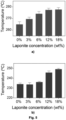
- the determined thermal stability is approximately at 265 °C, which is increased to 278 °C by the addition of laponite concentration of 12% and above.
- the strong interfacial ionic bonding between laponite and the silk fibroin may be attributed as the key factor for enhanced thermal stability.
- the differential scanning calorimetric (DSC) analysis were performed by increasing the chamber temperature linearly from 25 to 280 °C at the heating rate of 10 °C min -1 under a dynamic nitrogen flow (50 mL min -1 ) .
- DSC differential scanning calorimetric
- the SiPo films were encapsulated into Tzero aluminum pans (Switzerland) and an empty Tzero pan was used as reference.
- the change in heat flow as a function of temperature was monitored.
- the exothermic peak temperature between 200 and 250 °C was reported as the crystallization temperature.
- SiPo-0% film possesses a glass transition temperature (Tg) of 178 °C, and displays a large endothermic peak at 227 °C as a result of non-isothermal crystallization of its amorphous chains. By addition of laponite an increased crystallization temperature is observed.
- Tg glass transition temperature
- Example 8 Dimensional stability of the thin films
- Dynamic temperature ramp test was performed using a RSA II Rheometrics solid analyzer (USA) to determine the coefficient of thermal expansion (CTE) of the SiPo films.
- the test was conducted on a 50 mm ⁇ 5mm films by increasing the temperature from 25 to 100 °C under nitrogen atmosphere with a heating rate of 5 °C min -1 .
- a constant force of 0.03N was applied in tensile mode at a frequency of 1.0 Hz and constant strain of 1.0%.
- the displacement in length ( ⁇ L/L) as a function of temperature was collected using Rhios V4.3.2 software.
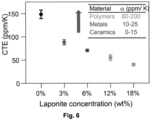
- CTE values were determined from the slope of the linear dimensional change in the temperature range of 25-75 °C. These values are shown in figure 6 .
- the CTE values are important in various sectors including electronics, where the thermal mismatch between the metal electrodes and the polymeric substrates cause dimensional shape changes and leads to failure of the components.
- the dimensional stability of the SiPo films is good and outcompetes that of conventional polymers as shown in figure 6 .
- the CTE of the SiPo films are more similar to the value of metals.
- the CTE value of the silk fibroin films (150 ppm/K) decreased almost 3-fold as the laponite mass concentration increased from 0 % to 18 % and the value reached 40 ppm/K.
- W o (d) is the initial dry weight
- W t (d) is the dry weight of the samples at the respective time points.
- the results can be observed in figure 7 .
- One obstacle for the integration of natural biopolymers into electronic applications is their instability with chemically demanding environments.
- silk its secondary structure, which mainly consists of random coils and ⁇ -helices, makes it highly soluble in aqueous solutions.
- To enhance the stability of silk films at ambient conditions methods of increasing the ⁇ -sheet content have been pursued.
- an increased ⁇ -sheet content through laponite incorporation, as well as the increased stability of these SiPo films both within aqueous environments and under harsh chemical conditions (pH 2 and pH 11).
- the control sample in the analysis is silk fibroin film without addition of salt at pH 7
- the mechanical properties of the composites were measured with an Instron 5967 mechanical testing machine. Samples were cut into 30 mm ⁇ 2 mm pieces and the thickness of each film was measured using a calibrated digital electronic vernier caliper. The gauge length was set at 10 mm and the load and extension were balanced prior to the testing. The samples were strained at the rate of 1 mm min -1 with a 500 N load-cell capacity until failure. Tensile strength, young modulus, and strain at break were calculated from the obtained stress-strain curve. The Young modulus was calculated by drawing a tangent to the initial linear portion of the stress-strain curve in the strain range between 0.0 and 0.4%. Figure 8 shows the tensile strength (a), young modulus (b), strain break (c), and stress-strain curve (d) of a thin film comprising varying amounts of laponite RD.
- the recycling of the SiPo films was examined in two steps.
- 500 mg of the films were dissolved in 9.3M LiBr at 60 °C for 2 hours and followed by adding 0.5 M NaOH in order to increase the alkaline pH.
- the final solution was diluted 20 times with deionized water and was centrifuged at 12000 rpm for 20 min.
- the denser laponite layer was collected at the bottom and silk fibroin was remained in supernatant.
- the sediments were washed several times with deionized water and both sediment and supernatant were dialyzed against deionized water using 1 ml dialysis cassettes for 24 hours.
- the obtained solutions were dried at 60 °C and the presence of laponite and silk fibroin was confirmed by FTIR.
- the fluorescent laponite in the supernatant and sediment was also imaged using fluorescence microscopy.
- the fluorescence microscopy and FTIR spectroscopy were performed for pristine samples of laponite RD powder and freeze dried silk fibroin as control (data not shown).
- the recycling process of silk fibroin with laponite composites are safe and easy-to-use. Complete separation between the heavier laponite and more lightweight silk fibroin was achieved with this process.
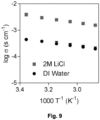
- SiPo films can be transformed into high fidelity capacitive touch sensors by simply dipping them into a lithium chloride (LiCI) solution, as LiCI ( ⁇ 10 -3 Scm -1 ) can increase the ionic conductivity compared to DI water ( ⁇ 10 -4 Scm -1 ). Even though, the ionic conductivity of the films slightly decreased at higher temperatures, the capacitive touch sensors can be operate at higher temperatures.
- LiCI lithium chloride
- Example 13 Current measurements of the flexible surface capacitive touch panel
- a SiPo ionic electrode was fabricated using 5 cm ⁇ 1cm ionic strips. Platinum plates were attached to both ends of the strips by applying silver epoxy paste by keeping electrode-to-electrode distance as 3 cm. These Pt electrodes were connected to an oscilloscope (Kesight MSOS104A mixed signal Oscilloscope 1 GHz, 20 Gsa/s, 10-bit ADC, Infiniium series) through a N2820A 3 MHz/Custom (1 ⁇ A) high sensitivity current probe (2-ch) with a user defined resistor tip (1 ⁇ ). To apply AC voltage at different frequencies, a function generator (Model 3312A, Hewlett Packard) was connected on both sides of the SiPo ionic system.
- the touch sensitivity of the touchscreen was measured at different frequencies ranging from 10 kHz to 40 kHz, using a function generator with an AC voltage ranging from -0.5 to 0.5 V. Prior to these sensitivity measurements samples were fixed with customized polymer clamps and the touch sensing capacity of the device was subsequently recorded by measuring the "finger touch" facilitated current change across the screen. The resultant AC current was recorded using Keysight oscilloscope and the absolute current and peak envelope was extracted using MATLAB 2016a. The current difference ( ⁇ I) was calculated by subtracting baseline current from each value. In order to demonstrate the correlation between the touch-point location and the current, the one dimensional (1D) ionic touchscreen was touched at different distances from the measuring electrode, as shows in figure 10 (a) .
- Example 14 Impedance measurements of the flexible motion sensor
- SiPo ID ionic strips immersed in LiCI were investigated as a motion sensor.
- the motion-sensing device was fabricated by connecting copper wires to both ends of SiPo ionics using conductive silver epoxy paste.
- the sensor was attached to various moving parts of the body, such as finger, wrist, shoulder, ankle, elbow, and knee, using cloth adhesive tape, in order to minimize the drying effect of the SiPo ionics.
- the 1D ionic strips were varied in length (3 cm to 6 cm); depending on which part of the body they were applied to, but were kept constant in width (1cm).
- the working-principle of the sensors was simple, as it relied on real-time monitoring of motion-facilitated changes in relative resistance.
Landscapes
- Health & Medical Sciences (AREA)
- Engineering & Computer Science (AREA)
- Life Sciences & Earth Sciences (AREA)
- Chemical & Material Sciences (AREA)
- Physics & Mathematics (AREA)
- General Engineering & Computer Science (AREA)
- Theoretical Computer Science (AREA)
- Public Health (AREA)
- General Health & Medical Sciences (AREA)
- Veterinary Medicine (AREA)
- Surgery (AREA)
- Animal Behavior & Ethology (AREA)
- Molecular Biology (AREA)
- Biophysics (AREA)
- Pathology (AREA)
- Biomedical Technology (AREA)
- Heart & Thoracic Surgery (AREA)
- Medical Informatics (AREA)
- Organic Chemistry (AREA)
- Polymers & Plastics (AREA)
- Medicinal Chemistry (AREA)
- Chemical Kinetics & Catalysis (AREA)
- General Physics & Mathematics (AREA)
- Human Computer Interaction (AREA)
- Physiology (AREA)
- Dentistry (AREA)
- Oral & Maxillofacial Surgery (AREA)
- Dispersion Chemistry (AREA)
- Manufacture Of Macromolecular Shaped Articles (AREA)
- Compositions Of Macromolecular Compounds (AREA)
- Position Input By Displaying (AREA)
- Laminated Bodies (AREA)
- Non-Insulated Conductors (AREA)
Applications Claiming Priority (3)
| Application Number | Priority Date | Filing Date | Title |
|---|---|---|---|
| EP18195996 | 2018-09-21 | ||
| EP19769526.5A EP3833255B1 (fr) | 2018-09-21 | 2019-09-20 | Polymère cintrable et insoluble dans l'eau et à base de protéines avec conductivité ionique |
| PCT/EP2019/075339 WO2020058481A1 (fr) | 2018-09-21 | 2019-09-20 | Polymère à base de protéines insoluble dans l'eau et pliable à conductivité ionique |
Related Parent Applications (2)
| Application Number | Title | Priority Date | Filing Date |
|---|---|---|---|
| EP19769526.5A Division EP3833255B1 (fr) | 2018-09-21 | 2019-09-20 | Polymère cintrable et insoluble dans l'eau et à base de protéines avec conductivité ionique |
| EP19769526.5A Division-Into EP3833255B1 (fr) | 2018-09-21 | 2019-09-20 | Polymère cintrable et insoluble dans l'eau et à base de protéines avec conductivité ionique |
Publications (2)
| Publication Number | Publication Date |
|---|---|
| EP4478053A2 true EP4478053A2 (fr) | 2024-12-18 |
| EP4478053A3 EP4478053A3 (fr) | 2025-03-19 |
Family
ID=63798778
Family Applications (2)
| Application Number | Title | Priority Date | Filing Date |
|---|---|---|---|
| EP19769526.5A Active EP3833255B1 (fr) | 2018-09-21 | 2019-09-20 | Polymère cintrable et insoluble dans l'eau et à base de protéines avec conductivité ionique |
| EP24209612.1A Pending EP4478053A3 (fr) | 2018-09-21 | 2019-09-20 | Polymère à base de protéine insoluble dans l'eau et pliable à conductivité ionique |
Family Applications Before (1)
| Application Number | Title | Priority Date | Filing Date |
|---|---|---|---|
| EP19769526.5A Active EP3833255B1 (fr) | 2018-09-21 | 2019-09-20 | Polymère cintrable et insoluble dans l'eau et à base de protéines avec conductivité ionique |
Country Status (3)
| Country | Link |
|---|---|
| US (1) | US11427709B2 (fr) |
| EP (2) | EP3833255B1 (fr) |
| WO (1) | WO2020058481A1 (fr) |
Families Citing this family (15)
| Publication number | Priority date | Publication date | Assignee | Title |
|---|---|---|---|---|
| KR102761502B1 (ko) * | 2019-03-29 | 2025-02-04 | 미쯔비시 케미컬 주식회사 | 점착 시트, 적층 시트, 화상 표시 장치 |
| CN114076785B (zh) * | 2020-08-11 | 2023-06-27 | 北京化工大学 | 一种基于MXene/丝素蛋白材料的传感器及其制备方法与应用 |
| CN112111131B (zh) * | 2020-09-25 | 2021-11-30 | 河海大学 | 一种MXene改善的碳纤维-环氧树脂复合材料及改善方法 |
| CN112326743B (zh) * | 2020-11-05 | 2024-01-16 | 重庆医科大学 | 基于丝素蛋白的c-sf-fa柔性导电薄膜和可穿戴式伤口监测传感器及其制备方法 |
| CN112844065B (zh) * | 2021-01-15 | 2023-03-14 | 赵梓俨 | MXene复合膜制备方法及MXene复合膜 |
| CN113433190B (zh) * | 2021-05-18 | 2023-05-30 | 重庆医科大学 | 一种生物导电复合膜及其在检测葡萄糖中的应用 |
| CN113293655B (zh) * | 2021-05-27 | 2022-08-02 | 电子科技大学 | 一种厚度可控新型结构MXene复合薄膜的制备方法 |
| CN114705734A (zh) * | 2022-04-30 | 2022-07-05 | 陕西云康智汇科技有限公司 | 湿度传感器及其制作方法 |
| CN114869245B (zh) * | 2022-06-07 | 2025-11-18 | 厦门大学深圳研究院 | 电阻/电容双响应的MXene基水凝胶柔性传感器制备 |
| CN114739561B (zh) * | 2022-06-09 | 2022-09-06 | 之江实验室 | 基于蚕丝蛋白的抗汗湿柔性压力传感器及其方法、应用 |
| CN116119667B (zh) * | 2023-02-23 | 2024-04-30 | 安徽工程大学 | 一种丝胶蛋白改性Ti3C2Tx MXene提升其水溶液稳定性的方法 |
| WO2024215783A1 (fr) * | 2023-04-10 | 2024-10-17 | University Of Connecticut | Bioplastiques recyclables, leurs procédés de fabrication et articles les comprenant |
| WO2024215777A1 (fr) * | 2023-04-10 | 2024-10-17 | University Of Connecticut | Composites bioplastiques recyclables, leurs procédés de fabrication et articles les comprenant |
| WO2024227146A2 (fr) * | 2023-04-27 | 2024-10-31 | Trustees Of Tufts College | Plateforme adhésive à base de soie pour chaussure et mode |
| CN116858898B (zh) * | 2023-07-13 | 2026-02-03 | 嘉兴南湖学院 | 一种离子传感浆液及其制备方法、纺织离子传感器及其制备方法和应用 |
Family Cites Families (4)
| Publication number | Priority date | Publication date | Assignee | Title |
|---|---|---|---|---|
| KR101266985B1 (ko) * | 2012-08-14 | 2013-05-22 | 엔젯 주식회사 | 터치스크린 패널 제조방법 |
| CN103762014A (zh) * | 2013-12-24 | 2014-04-30 | 苏州大学 | 一种基于丝素蛋白的柔性透明电极薄膜及其制备方法和应用 |
| CN106580256B (zh) | 2016-12-15 | 2019-06-18 | 清华大学 | 一种柔性压力传感器及其制备方法 |
| CN108396425A (zh) * | 2018-03-16 | 2018-08-14 | 青岛大学 | 一种丝素蛋白/碳纳米管连续化长丝纱及其制备方法 |
-
2019
- 2019-09-20 EP EP19769526.5A patent/EP3833255B1/fr active Active
- 2019-09-20 WO PCT/EP2019/075339 patent/WO2020058481A1/fr not_active Ceased
- 2019-09-20 EP EP24209612.1A patent/EP4478053A3/fr active Pending
- 2019-09-20 US US17/277,974 patent/US11427709B2/en active Active
Non-Patent Citations (1)
| Title |
|---|
| APPLIED CLAY SCIENCE, 2014, pages 97 - 98 |
Also Published As
| Publication number | Publication date |
|---|---|
| WO2020058481A1 (fr) | 2020-03-26 |
| US20210309857A1 (en) | 2021-10-07 |
| EP3833255A1 (fr) | 2021-06-16 |
| EP3833255C0 (fr) | 2024-12-04 |
| EP3833255B1 (fr) | 2024-12-04 |
| US11427709B2 (en) | 2022-08-30 |
| EP4478053A3 (fr) | 2025-03-19 |
Similar Documents
| Publication | Publication Date | Title |
|---|---|---|
| EP3833255B1 (fr) | Polymère cintrable et insoluble dans l'eau et à base de protéines avec conductivité ionique | |
| Yang et al. | Superhydrophobic MXene@ carboxylated carbon nanotubes/carboxymethyl chitosan aerogel for piezoresistive pressure sensor | |
| Cheng et al. | Maximizing electron channels enabled by MXene aerogel for high-performance self-healable flexible electronic skin | |
| Lin et al. | All-nanofibrous ionic capacitive pressure sensor for wearable applications | |
| Wei et al. | Highly sensitive, flexible, green synthesized graphene/biomass aerogels for pressure sensing application | |
| Zhang et al. | Three-dimensional binary-conductive-network silver nanowires@ thiolated graphene foam-based room-temperature self-healable strain sensor for human motion detection | |
| Shengbo et al. | Highly sensitive wearable strain sensor based on silver nanowires and nanoparticles | |
| Saeidi-Javash et al. | All-printed MXene–graphene nanosheet-based bimodal sensors for simultaneous strain and temperature sensing | |
| Jiang et al. | Flexible strain sensor with tunable sensitivity via microscale electrical breakdown in graphene/polyimide thin films | |
| Wang et al. | Double-layered conductive network design of flexible strain sensors for high sensitivity and wide working range | |
| Wei et al. | Flexible capacitive pressure sensor with sensitivity and linear measuring range enhanced based on porous composite of carbon conductive paste and polydimethylsiloxane | |
| Fu et al. | High-performance structural flexible strain sensors based on graphene-coated glass fabric/silicone composite | |
| Cai et al. | Stretchable Ti3C2T x MXene/carbon nanotube composite based strain sensor with ultrahigh sensitivity and tunable sensing range | |
| Gao et al. | Design of a superhydrophobic strain sensor with a multilayer structure for human motion monitoring | |
| Costa et al. | Highly sensitive piezoresistive graphene-based stretchable composites for sensing applications | |
| Tewari et al. | Highly exfoliated MWNT–rGO ink-wrapped polyurethane foam for piezoresistive pressure sensor applications | |
| Kadumudi et al. | A Protein‐Based, Water‐Insoluble, and Bendable Polymer with Ionic Conductivity: A Roadmap for Flexible and Green Electronics | |
| Zhao et al. | Highly sensitive flexible strain sensor based on threadlike spandex substrate coating with conductive nanocomposites for wearable electronic skin | |
| Huang et al. | Highly stretchable strain sensor based on polyurethane substrate using hydrogen bond-assisted laminated structure for monitoring of tiny human motions | |
| Ouyang et al. | Versatile sensing devices for self-driven designated therapy based on robust breathable composite films | |
| Tang et al. | In-situ reduction of graphene oxide-wrapped porous polyurethane scaffolds: Synergistic enhancement of mechanical properties and piezoresistivity | |
| Su et al. | Layered MXene/aramid composite film for a soft and sensitive pressure sensor | |
| Yang et al. | Water-tolerant MXene epidermal sensors with high sensitivity and reliability for healthcare monitoring | |
| del Bosque et al. | Highly flexible strain sensors based on CNT-reinforced ecoflex silicone rubber for wireless facemask breathing monitoring via bluetooth | |
| Cho et al. | Robust, ultrathin, and highly sensitive reduced graphene oxide/silk fibroin wearable sensors responded to temperature and humidity for physiological detection |
Legal Events
| Date | Code | Title | Description |
|---|---|---|---|
| PUAI | Public reference made under article 153(3) epc to a published international application that has entered the european phase |
Free format text: ORIGINAL CODE: 0009012 |
|
| STAA | Information on the status of an ep patent application or granted ep patent |
Free format text: STATUS: THE APPLICATION HAS BEEN PUBLISHED |
|
| AC | Divisional application: reference to earlier application |
Ref document number: 3833255 Country of ref document: EP Kind code of ref document: P |
|
| AK | Designated contracting states |
Kind code of ref document: A2 Designated state(s): AL AT BE BG CH CY CZ DE DK EE ES FI FR GB GR HR HU IE IS IT LI LT LU LV MC MK MT NL NO PL PT RO RS SE SI SK SM TR |
|
| REG | Reference to a national code |
Ref country code: DE Ref legal event code: R079 Free format text: PREVIOUS MAIN CLASS: G01P0003000000 Ipc: A61B0005110000 |
|
| PUAL | Search report despatched |
Free format text: ORIGINAL CODE: 0009013 |
|
| AK | Designated contracting states |
Kind code of ref document: A3 Designated state(s): AL AT BE BG CH CY CZ DE DK EE ES FI FR GB GR HR HU IE IS IT LI LT LU LV MC MK MT NL NO PL PT RO RS SE SI SK SM TR |
|
| RIC1 | Information provided on ipc code assigned before grant |
Ipc: G01P 3/00 20060101ALI20250213BHEP Ipc: C08L 89/00 20060101ALI20250213BHEP Ipc: A61B 5/11 20060101AFI20250213BHEP |
|
| STAA | Information on the status of an ep patent application or granted ep patent |
Free format text: STATUS: REQUEST FOR EXAMINATION WAS MADE |
|
| 17P | Request for examination filed |
Effective date: 20250916 |