EP4467982A2 - Wärmesensoranordnung zur moleküldetektion und zugehörige detektionsschemen - Google Patents
Wärmesensoranordnung zur moleküldetektion und zugehörige detektionsschemen Download PDFInfo
- Publication number
- EP4467982A2 EP4467982A2 EP24204066.5A EP24204066A EP4467982A2 EP 4467982 A2 EP4467982 A2 EP 4467982A2 EP 24204066 A EP24204066 A EP 24204066A EP 4467982 A2 EP4467982 A2 EP 4467982A2
- Authority
- EP
- European Patent Office
- Prior art keywords
- temperature
- temperature sensors
- detection device
- fluidic channel
- mnp
- Prior art date
- Legal status (The legal status is an assumption and is not a legal conclusion. Google has not performed a legal analysis and makes no representation as to the accuracy of the status listed.)
- Pending
Links
Images







Classifications
-
- C—CHEMISTRY; METALLURGY
- C12—BIOCHEMISTRY; BEER; SPIRITS; WINE; VINEGAR; MICROBIOLOGY; ENZYMOLOGY; MUTATION OR GENETIC ENGINEERING
- C12Q—MEASURING OR TESTING PROCESSES INVOLVING ENZYMES, NUCLEIC ACIDS OR MICROORGANISMS; COMPOSITIONS OR TEST PAPERS THEREFOR; PROCESSES OF PREPARING SUCH COMPOSITIONS; CONDITION-RESPONSIVE CONTROL IN MICROBIOLOGICAL OR ENZYMOLOGICAL PROCESSES
- C12Q1/00—Measuring or testing processes involving enzymes, nucleic acids or microorganisms; Compositions therefor; Processes of preparing such compositions
- C12Q1/68—Measuring or testing processes involving enzymes, nucleic acids or microorganisms; Compositions therefor; Processes of preparing such compositions involving nucleic acids
- C12Q1/6869—Methods for sequencing
-
- G—PHYSICS
- G01—MEASURING; TESTING
- G01K—MEASURING TEMPERATURE; MEASURING QUANTITY OF HEAT; THERMALLY-SENSITIVE ELEMENTS NOT OTHERWISE PROVIDED FOR
- G01K1/00—Details of thermometers not specially adapted for particular types of thermometer
- G01K1/02—Means for indicating or recording specially adapted for thermometers
- G01K1/026—Means for indicating or recording specially adapted for thermometers arrangements for monitoring a plurality of temperatures, e.g. by multiplexing
-
- G—PHYSICS
- G01—MEASURING; TESTING
- G01K—MEASURING TEMPERATURE; MEASURING QUANTITY OF HEAT; THERMALLY-SENSITIVE ELEMENTS NOT OTHERWISE PROVIDED FOR
- G01K13/00—Thermometers specially adapted for specific purposes
- G01K13/02—Thermometers specially adapted for specific purposes for measuring temperature of moving fluids or granular materials capable of flow
-
- G—PHYSICS
- G01—MEASURING; TESTING
- G01N—INVESTIGATING OR ANALYSING MATERIALS BY DETERMINING THEIR CHEMICAL OR PHYSICAL PROPERTIES
- G01N33/00—Investigating or analysing materials by specific methods not covered by groups G01N1/00 - G01N31/00
- G01N33/48—Biological material, e.g. blood, urine; Haemocytometers
- G01N33/50—Chemical analysis of biological material, e.g. blood, urine; Testing involving biospecific ligand binding methods; Immunological testing
- G01N33/53—Immunoassay; Biospecific binding assay; Materials therefor
- G01N33/543—Immunoassay; Biospecific binding assay; Materials therefor with an insoluble carrier for immobilising immunochemicals
- G01N33/54313—Immunoassay; Biospecific binding assay; Materials therefor with an insoluble carrier for immobilising immunochemicals the carrier being characterised by its particulate form
- G01N33/54326—Magnetic particles
-
- G—PHYSICS
- G01—MEASURING; TESTING
- G01N—INVESTIGATING OR ANALYSING MATERIALS BY DETERMINING THEIR CHEMICAL OR PHYSICAL PROPERTIES
- G01N33/00—Investigating or analysing materials by specific methods not covered by groups G01N1/00 - G01N31/00
- G01N33/48—Biological material, e.g. blood, urine; Haemocytometers
- G01N33/50—Chemical analysis of biological material, e.g. blood, urine; Testing involving biospecific ligand binding methods; Immunological testing
- G01N33/53—Immunoassay; Biospecific binding assay; Materials therefor
- G01N33/543—Immunoassay; Biospecific binding assay; Materials therefor with an insoluble carrier for immobilising immunochemicals
- G01N33/54313—Immunoassay; Biospecific binding assay; Materials therefor with an insoluble carrier for immobilising immunochemicals the carrier being characterised by its particulate form
- G01N33/54326—Magnetic particles
- G01N33/54333—Modification of conditions of immunological binding reaction, e.g. use of more than one type of particle, use of chemical agents to improve binding, choice of incubation time or application of magnetic field during binding reaction
-
- G—PHYSICS
- G01—MEASURING; TESTING
- G01N—INVESTIGATING OR ANALYSING MATERIALS BY DETERMINING THEIR CHEMICAL OR PHYSICAL PROPERTIES
- G01N33/00—Investigating or analysing materials by specific methods not covered by groups G01N1/00 - G01N31/00
- G01N33/48—Biological material, e.g. blood, urine; Haemocytometers
- G01N33/50—Chemical analysis of biological material, e.g. blood, urine; Testing involving biospecific ligand binding methods; Immunological testing
- G01N33/53—Immunoassay; Biospecific binding assay; Materials therefor
- G01N33/543—Immunoassay; Biospecific binding assay; Materials therefor with an insoluble carrier for immobilising immunochemicals
- G01N33/54313—Immunoassay; Biospecific binding assay; Materials therefor with an insoluble carrier for immobilising immunochemicals the carrier being characterised by its particulate form
- G01N33/54346—Nanoparticles
-
- G—PHYSICS
- G01—MEASURING; TESTING
- G01N—INVESTIGATING OR ANALYSING MATERIALS BY DETERMINING THEIR CHEMICAL OR PHYSICAL PROPERTIES
- G01N33/00—Investigating or analysing materials by specific methods not covered by groups G01N1/00 - G01N31/00
- G01N33/48—Biological material, e.g. blood, urine; Haemocytometers
- G01N33/50—Chemical analysis of biological material, e.g. blood, urine; Testing involving biospecific ligand binding methods; Immunological testing
- G01N33/53—Immunoassay; Biospecific binding assay; Materials therefor
- G01N33/543—Immunoassay; Biospecific binding assay; Materials therefor with an insoluble carrier for immobilising immunochemicals
- G01N33/54366—Apparatus specially adapted for solid-phase testing
- G01N33/54373—Apparatus specially adapted for solid-phase testing involving physiochemical end-point determination, e.g. wave-guides, FETS, gratings
-
- C—CHEMISTRY; METALLURGY
- C12—BIOCHEMISTRY; BEER; SPIRITS; WINE; VINEGAR; MICROBIOLOGY; ENZYMOLOGY; MUTATION OR GENETIC ENGINEERING
- C12Q—MEASURING OR TESTING PROCESSES INVOLVING ENZYMES, NUCLEIC ACIDS OR MICROORGANISMS; COMPOSITIONS OR TEST PAPERS THEREFOR; PROCESSES OF PREPARING SUCH COMPOSITIONS; CONDITION-RESPONSIVE CONTROL IN MICROBIOLOGICAL OR ENZYMOLOGICAL PROCESSES
- C12Q2563/00—Nucleic acid detection characterized by the use of physical, structural and functional properties
- C12Q2563/107—Nucleic acid detection characterized by the use of physical, structural and functional properties fluorescence
-
- G—PHYSICS
- G01—MEASURING; TESTING
- G01N—INVESTIGATING OR ANALYSING MATERIALS BY DETERMINING THEIR CHEMICAL OR PHYSICAL PROPERTIES
- G01N27/00—Investigating or analysing materials by the use of electric, electrochemical, or magnetic means
- G01N27/72—Investigating or analysing materials by the use of electric, electrochemical, or magnetic means by investigating magnetic variables
- G01N27/74—Investigating or analysing materials by the use of electric, electrochemical, or magnetic means by investigating magnetic variables of fluids
- G01N27/745—Investigating or analysing materials by the use of electric, electrochemical, or magnetic means by investigating magnetic variables of fluids for detecting magnetic beads used in biochemical assays
Definitions
- Embodiments of the present disclosure generally relate to temperature sensor arrays for detection of molecules coupled to magnetic nanoparticles (MNPs), such as for nucleic acid sequencing such as deoxyribonucleic acid (DNA) sequencing, and methods of using such temperature sensor arrays for molecule detection.
- MNPs magnetic nanoparticles
- DNA deoxyribonucleic acid
- SBS sequencing by synthesis
- dNTP deoxynucleoside triphosphate
- Gradual increases in SBS throughput have been accomplished in two ways, the first being an outward scaling, where the size and the number of flow cells in the sequencers is increased. This approach increases both the cost of reagents and the price of the sequencing system, as more high-power lasers and high-precision nano-positioners must be employed.
- the second approach involves inward scaling, where the density of DNA testing sites is increased so that the total number of sequenced DNA strands in a fixed-size flow cell is higher
- NA numerical aperture
- the Rayleigh criterion currently represents the fundamental limitation for inward scaling of optical SBS systems, which can only be overcome by applying super-resolution imaging techniques (see A. M. Sydor, K. J. Czymmek, E. M. Puchner, and V. Mannella, "Super-Resolution Microscopy: From Single Molecules to Supramolecular Assemblies," Special Issue: Quantitative Cell Biology, Vol. 25, 730, 2015 ) and has not yet been achieved in highly multiplexed systems.
- increasing throughput and decreasing cost of optical SBS sequencers has been slow due to the need to build bigger flow cells and implement more expensive optical scanning and imaging systems.
- a detection device comprises at least one fluidic channel configured to receive a plurality of molecules to be detected, a plurality of temperature sensors, and an insulating material encapsulating the plurality of temperature sensors and for providing a barrier between the plurality of temperature sensors and contents of the at least one fluidic channel.
- a surface of the insulating material within the fluidic channel provides a plurality of sites for binding the plurality of molecules to be detected, the plurality of sites being located among the plurality of temperature sensors, and each of the plurality of temperature sensors is configured to detect, in the presence of an alternating magnetic field, a temperature change (e.g., in the vicinity of the temperature sensor) indicating the presence or the absence of one or more magnetic nanoparticles (MNPs) coupled to at least one of the plurality of molecules to be detected at a respective subset of the plurality of sites.
- a temperature change e.g., in the vicinity of the temperature sensor
- each of the plurality of temperature sensors comprises a bi-metal sensing junction.
- each of the plurality of temperature sensors comprises vanadium oxide.
- the vanadium oxide comprises a dopant (e.g., chromium, niobium, tungsten, iron).
- each of the plurality of temperature sensors comprises a nanoscale thermometer.
- the plurality of temperature sensors comprises a thermocouple, a thermistor, a metal resistor, a bi-metal sensing junction (e.g., sensor made of two strips of dissimilar metal bonded into one element), or a tunnel junction.
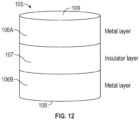
- the tunnel junction comprises an insulator layer (e.g., comprising an oxide and/or a nitride) disposed between two conducting metal layers (e.g., comprising platinum, tantalum, tungsten, copper, and/or titanium).
- the detection device is a sequencing device, and wherein the plurality of molecules to be detected includes biologic molecules (e.g., nucleic acid molecules).
- biologic molecules e.g., nucleic acid molecules
- the detection device further comprises detection circuitry comprising a plurality of selector devices, each of the plurality of selector devices coupled to a respective one of the plurality of temperature sensors.
- detection circuitry comprising a plurality of selector devices, each of the plurality of selector devices coupled to a respective one of the plurality of temperature sensors.
- at least one of the plurality of selector devices comprises a transistor or an in-stack selector.
- a first subset of the plurality of temperature sensors is arranged in a first row
- a second subset of the plurality of temperature sensors is arranged in a second row, the second row being substantially parallel to the first row
- the at least one fluidic channel is disposed between the first and second rows.
- the detection device further comprises detection circuitry coupled to each of the plurality of temperature sensors.
- the detection circuitry comprises (a) a first line coupled to a first end of each of a first subset of the plurality of temperature sensors, the first subset comprising a first temperature sensor, and (b) a second line coupled to a second end of each of a second subset of the plurality of temperature sensors, the second subset including the first temperature sensor.
- the first temperature sensor is the only temperature sensor of the plurality of temperature sensors that is included in both the first and second subsets.
- a method of using this detection device comprises subjecting the detection device to the alternating magnetic field, and detecting a temperature of the first temperature sensor using the first and second lines.
- the detection device further comprises detection circuitry coupled to and configured to read a respective temperature of each of the plurality of temperature sensors by detecting one or more of a resistance, current, or voltage, or a change in the resistance, current, or voltage, across each of the plurality of sensors.
- the detection circuitry comprises at least a portion of a bridge circuit.
- the detection device further comprises at least one temperature control element for setting a temperature of at least a portion of the plurality of temperature sensors or the contents of the fluidic channel.
- the at least one temperature control element comprises at least one heater.
- a detection device comprises at least one fluidic channel configured to receive a plurality of molecules to be detected, a plurality of temperature sensors disposed in a cross-point array, and an insulating material disposed between the plurality of temperature sensors and contents of the at least one fluidic channel.
- a surface of the insulating material within the fluidic channel provides a plurality of sites located among the plurality of temperature sensors for binding the plurality of molecules to be detected, and each of the plurality of temperature sensors is configured to detect, in the presence of an alternating magnetic field, a temperature change indicating the presence or the absence of one or more magnetic nanoparticles (MNPs) coupled to at least one of the plurality of molecules to be detected at a respective subset of the plurality of sites.
- MNPs magnetic nanoparticles
- the cross-point array comprises a first top line, a second top line, a first bottom line, and a second bottom line, wherein the first top line is coupled to the first bottom line at a first location, the first top line is coupled to the second bottom line at a second location, the second top line is coupled to the first bottom line at a third location, and the second top line is coupled to the second bottom line at a fourth location.
- the first and second top lines are substantially parallel to each other, the first and second bottom lines are substantially parallel to each other, and the first and second top lines are substantially perpendicular to the first and second bottom lines.
- the first top line is in contact with the first bottom line at the first location, thereby forming a first temperature sensor of the plurality of temperature sensors; the first top line is in contact with the second bottom line at the second location, thereby forming a second temperature sensor of the plurality of temperature sensors; the second top line is in contact with the first bottom line at the third location, thereby forming a third temperature sensor of the plurality of temperature sensors; and the second top line is in contact with the second bottom line at the fourth location, thereby forming a fourth temperature sensor of the plurality of temperature sensors.
- first and second top lines comprise a first metal
- first and second bottom lines comprise a second metal
- the first metal is platinum and the second metal is tungsten, or vice versa.
- the first top line is coupled to the first bottom line at the first location through a first portion of insulator material, thereby forming a first temperature sensor of the plurality of temperature sensors; the first top line is coupled to the second bottom line at the second location through a second portion of the insulator material, thereby forming a second temperature sensor of the plurality of temperature sensors; the second top line is coupled to the first bottom line at the third location through a third portion of the insulator material, thereby forming a third temperature sensor of the plurality of temperature sensors; and the second top line is coupled to the second bottom line at the fourth location through a fourth portion of the insulator material, thereby forming a fourth temperature sensor of the plurality of temperature sensors.
- the first and second top lines comprise at least one of platinum, tungsten, tantalum, copper, or titanium; the first and second bottom lines comprise at least one of platinum, tungsten, tantalum, copper, or titanium; and the insulator material comprises at least one of an oxide or a nitride.
- Some embodiments are of a method of using a detection device comprising a plurality of temperature sensors and a fluidic channel having a surface for binding molecules for detection by the plurality of temperature sensors.
- the method comprise adding a plurality of molecules to be detected to the fluidic channel of the detection device, wherein at least some of the plurality of molecules to be detected are coupled to a first type of magnetic nanoparticle (MNP), applying an alternating magnetic field to the detection device, obtaining a temperature or temperature change at at least one temperature sensor of the plurality of temperature sensors, and, for the at least one temperature sensor of the plurality of temperature sensors, detecting, based on the obtained temperature, the presence or absence of the first type of MNP (e.g., in a vicinity of the at least one temperature sensor).
- MNP magnetic nanoparticle
- the method further comprises, in response to detecting the presence of the first type of MNP (e . g ., in the vicinity of the at least one temperature sensor), recording, in a record, an identity of at least one of the plurality of molecules to be detected.
- the first type of MNP e . g ., in the vicinity of the at least one temperature sensor
- the method further comprises heating or cooling an environment of the plurality of temperature sensors such that each of the plurality of temperature sensors is at a substantially same temperature, the substantially same temperature selected to achieve a target temperature sensitivity of the plurality of temperature sensors, and obtaining the temperature or temperature change at the at least one temperature sensor of the plurality of temperature sensors comprises performing a temperature measurement while each of the plurality of temperature sensors is at the substantially same temperature.
- heating or cooling the environment of the plurality of temperature sensors comprises one or more of heating or cooling a fluid containing the plurality of molecules to be detected, heating or cooling the detection device, or heating or cooling an environment of the detection device.
- heating or cooling the environment of the plurality of temperature sensors comprises applying a voltage or current to each temperature sensor of the plurality of temperature sensors.
- a detection system comprises at least one fluidic channel configured to receive a plurality of molecules to be detected, a plurality of temperature sensors, an insulating material encapsulating the plurality of temperature sensors and for providing a barrier between the plurality of temperature sensors and contents of the at least one fluidic channel, and one or more magnetic components configured to subject the contents of the at least one fluidic channel to an alternating magnetic field.
- a surface of the insulating material within the fluidic channel provides a plurality of sites located among the plurality of temperature sensors for binding the plurality of molecules to be detected, and each of the plurality of temperature sensors is configured to detect, in the presence of the alternating magnetic field, a temperature or temperature change indicating the presence or absence of one or more magnetic nanoparticles (MNPs) coupled to at least one of the plurality of molecules to be detected at a respective subset of the plurality of sites.
- the one or more magnetic components comprise an electromagnet, a distributed coil, a solenoid, a permanent magnet, or a super-conducting magnet.
- the detection system further comprises an alternating current (AC) current driver, and the at least one of the one or more magnetic components comprises an AC magnetic coil coupled to the AC current driver and to each of the plurality of temperature sensors.
- the one or more magnetic components are configured to provide a static magnetic field to align respective magnetic moments of respective MNPs in a substantially same direction.
- a method of using the detection system comprises subjecting the contents of the fluidic channel to the alternating magnetic field, and detecting the temperature or temperature change at each of the plurality of temperature sensors.
- Embodiments of the present disclosure generally relate to temperature sensor arrays for detection of molecules coupled to magnetic nanoparticles (MNPs), such as for nucleic acid sequencing such as deoxyribonucleic acid (DNA) sequencing, and methods of using such temperature sensor arrays for molecule detection.
- a DNA sequencing method may use a flow cell composed of microfluidic channels with an array of temperature sensors and sequencing chemistries using magnetic nanoparticles as identifying tags for DNA bases.
- the magnetic nanoparticles may be subjected to an alternating magnetic field and the magnetic nanoparticles may be magnetically heated due to relaxation losses. Some of the relaxation losses can be detected by temperature sensors to identify whether a particular molecule (e.g., a base) has been incorporated with a target DNA strand.
- nucleic acid sequencing has several over conventional technologies involving optical detection methods.
- methods involving electrical detection are, at least, not limited in terms of scaling flow cell dimensions in the same manner that optical detection is limited due to optical imaging being diffraction-limited.
- electrical detection can enable for simultaneous detection of all four bases using MNPs that, when exposed to an alternating magnetic field, cause distinguishable changes in the local temperature.
- a single base in the target DNA strand can be read using only one chemistry step.
- the approaches disclosed herein can significantly speed up sequencing without reducing the read error rates.
- the terms “over,” “under,” “between,” “on,” and other similar terms as used herein refer to a relative position of one layer with respect to other layers.
- one layer disposed over or under another layer may be directly in contact with the other layer or may have one or more intervening layers.
- one layer disposed between layers may be directly in contact with the two layers or may have one or more intervening layers.
- a first layer "on” a second layer is in contact with the second layer.
- the relative position of the terms does not define or limit the layers to a vector space orientation of the layers.
- Coupled is used herein to refer to elements that are either directly connected or connected through one or more intervening elements.
- a line e.g., for selecting or reading a characteristic of a temperature sensor
- a temperature sensor may be directly connected to a temperature sensor, or it may be connected via intervening elements.
- sensing and detecting are used interchangeably herein to mean obtain information from a physical stimulus. Sensing and detecting include measuring.
- alternating alternating
- oscillating and “AC” are used interchangeably herein when used to describe a magnetic field that varies with time.
- static and “DC” are used interchangeably herein when used to describe a magnetic field that remains substantially constant with time.
- vanadium oxide and “VO x " refer to any oxide or combination of oxides of vanadium that can be used in the context.
- Vanadium oxide includes, for example, VO (vanadium monoxide), VO 2 (vanadium dioxide), V 2 O 3 (divanadium trioxide), V 2 O 5 (divanadium pentoxide), V 3 O 5 (trivanadium pentoxide), V 4 O 7 (tetravanadium septoxide), etc.
- Vanadium oxide may comprise a dopant, such as, for example, chromium, niobium, tungsten, or iron.
- the disclosures herein may be used to detect any type of molecule to which a magnetic particle can be attached.
- any molecule type that can be labeled by a magnetic nanoparticle may be detected using the detection devices disclosed herein.
- Such molecule types may be biologic molecule types, such as proteins, antibodies, etc.
- the disclosures herein may be used to detect nucleic acids (e.g., in DNA sequencing).
- the disclosures herein may also be used to detect non-biologic (inorganic or non-living) molecules, such as contaminants, minerals, chemical compounds, etc.
- the presentation of portions of the disclosure in the context of nucleic acid sequencing is solely exemplary and is not intended to limit the scope of the present disclosure.
- fluorescence-based technologies used to differentiate between different bases in a sample e.g., in fluorescence-based nucleic acid sequencing technologies
- fluorescence-based nucleic acid sequencing technologies rely on, for example, the quality of a signal generated by a detection moiety that is associated with a particular type of nucleotide.
- conventional fluorescent sequencing technologies utilize identifiably-distinct fluorescent moieties, each attached to one of the four nucleotides A, T, C, and G that are utilized in a sequencing reaction.
- One conventional method of DNA sequencing involves adapting single-strand DNA (ssDNA) for attachment to a solid support of a sequencing apparatus and amplifying the quantity of the ssDNA using techniques such as the polymerase chain reaction to create many DNA molecules with a short leader. An oligo complementary to the short leader may then be added so that there is a short section of double-stranded DNA (dsDNA) at the leader.
- dsDNA double-stranded DNA
- the double stranded portion of the bound molecule is a primer for a suitable DNA polymerase, such as, for example, Taq polymerase, which is operable at high temperatures.
- the sequencing can then take one of several approaches.
- the sequencing can use a mixture of four fluorescently-labeled 3'-blocked dNTPs (fluorescently labeled dideoxynucleotide terminators), where the fluorescent label is part of the 3'-blocking group.
- the fluorescent label serves as a "reversible terminator" for polymerization.
- Each of the NTPs is labeled by a different label (i.e., each of the A, G, C, and T nucleotides has a different label), and the different labels are distinguishable by fluorescent spectroscopy or by other optical means.
- DNA polymerase catalyzes the incorporation of fluorescently-labeled dNTPs into a DNA template strand during sequential cycles of DNA synthesis. In each sequencing cycle, the bound double strand DNA molecule is exposed to DNA polymerase and a mixture of the four fluorescently-labeled 3'-blocked NTPs. The polymerase adds one of the four dNTPs to the growing oligonucleotide chain (whichever dNTP is complementary to the next unpaired base in the ssDNA).
- the unincorporated dNTPs and other impurities that are either left unreacted or generated during the reactions are then separated from the vicinity of the support-bound DNA by washing at a temperature that prevents the free dNTPs from binding to the ssDNA but is not so high as to dehybridize the dsDNA.
- the identity of the incorporated dNTP can be identified through laser excitation and imaging. Specifically, each of four filters is used to determine whether light of a particular wavelength (e.g., color) is emitted. The fluorescent label can then be enzymatically cleaved to allow the next round of incorporation. Because each base type can pair with one and only one other base type, the identity of the just-paired base in the unknown sequence of the ssDNA is known from the identity of the incorporated dNTP (which is known from the wavelength of emitted light). Thus, the base is identified directly from fluorescence measurements during each cycle.
- a particular wavelength e.g., color
- Embodiments of this disclosure include various thermometer device embodiments used as heat detectors, and detection method embodiments designed to determine (e.g., measure or obtain) variations in temperature in response to heating from a magnetic nanoparticle label exposed to an AC magnetic field.
- the disclosures herein may be used to detect any type of molecule (e.g., biologic, organic, inorganic, or non-living) to which a magnetic particle (e.g., a MNP) can be attached.
- a magnetic particle e.g., a MNP
- Apparatuses and methods disclosed herein use MNPs and temperature sensors to perform detection of molecules, such as in nucleic acid sequencing (e.g., DNA sequencing using SBS chemistry methods).
- embodiments of this disclosure include temperature sensors that can be used to detect localized heating caused by MNPs subjected to an alternating magnetic field.
- Embodiments of the present disclosure may also include various detection methods to obtain or determine (e.g., measure) characteristics of the temperature sensors (e.g., voltage, current, and/or resistance) and/or localized variations in temperature caused by MNPs in response to an applied alternating magnetic field. Knowledge of which particular molecule type (e.g., in DNA sequencing applications, the type of base) to which the particular MNP label has been attached may then be used to identify the particular molecule type (e.g., in DNA sequencing applications, the next base of the ssDNA strand).
- the particular molecule type e.g., in DNA sequencing applications, the type of base
- an apparatus for molecule detection comprises an array of temperature sensors.
- the term "temperature sensor” is used herein to refer to an element or combination of elements that senses at least one thermal stimulus such as, for example, heat, temperature, or random kinetic energy of molecules, atoms, or smaller components of matter.
- Each of the temperature sensors of the temperature sensor array is capable of detecting localized heating (e.g ., an absolute temperature or a temperature change) in the vicinity of the temperature sensor caused by one or more MNPs in a fluidic channel of the apparatus.
- MNPs localized heating
- MNPs may be used for molecule detection (e.g ., for applications such as DNA sequencing). Accordingly, some embodiments of this disclosure are directed to using MNPs as tags (which may also be referred to as labels) to enable a detection device to detect molecules (e.g ., DNA bases, or more generally nucleic acid bases).
- MNPs as tags (which may also be referred to as labels) to enable a detection device to detect molecules (e.g ., DNA bases, or more generally nucleic acid bases).
- the MNPs may be, for example, magnetic molecules, superparamagnetic nanoparticles, or ferromagnetic particles.
- the MNPs may be cleavable.
- nucleotide precursors to be sequenced may comprise cleavable MNPs.
- the unpaired core electrons throughout the lattice of the materials typically tend to align substantially parallel to one another, thereby producing what is commonly known as a single domain or "macrospin" state with a spontaneous magnetic moment (or magnetization) oriented along a direction defined by some type of anisotropy energy.
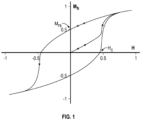
- FIG. 1 shows the response of the measured particle magnetization as shown in FIG. 1 , which shows the hysteresis curve for a magnetic nanoparticle.
- the particle moment switches the direction in which it is oriented when the magnetic field is large enough (as evidenced by the change in sign of the magnetization in the graph).
- the applied magnetic field at which the measured magnetization is 0 is known as the coercive field H c of the MNP, whereas the measured magnetization when the applied field is zero is known as the remanent magnetization M rs .
- the switching of the nanoparticle's moment generates a loop (called a hysteresis curve or loop) for which the energy loss per unit volume is ⁇ H ⁇ dB or the area contained within the hysteresis loop (as magnetization is proportional to B ).
- SLP specific loss power
- the SLP in this case is 7 kW/g (calculation obtained from Silvio Dutz and Rudolf Hergt, "Magnetic nanoparticle heating and heat transfer on a microscale: Basic principles, realities and physical limitations of hyperthermia for tumour therapy," International Journal of Hyperthermia 29, 790-800 (2013 )).
- a local temperature increase of 5-40 K can be sufficient to allow detection of heating in a particular area of a fluidic channel but does not cause the contents of the fluidic channel to reach high enough temperatures to damage biologic molecules (e.g., DNA).
- biologic molecules e.g., DNA
- Various embodiments of the current disclosure take advantage of the properties of MNPs in the presence of alternating magnetic fields to detect and identify different molecules in the fluidic channel(s), such as to detect the identity of DNA bases as they incorporate into a DNA strand being sequenced.
- the MNPs may be attached to a base or a molecule to be detected, in which case the MNPs may be cleaved chemically.
- the MNPs may be attached to a phosphate, in which case the MNPs may be cleaved by, for example, polymerase or, if attached via a linker, by cleaving the linker.
- the MNP is linked to the nitrogenous base (e.g ., A, C, T, G, or a derivative) of the nucleotide precursor.
- the MNP may be cleaved from the incorporated nucleotide.
- the MNP is attached via a cleavable linker.
- Cleavable linkers are known in the art and have been described, e . g ., in U.S. Pat. Nos. 7,057,026 , 7,414,116 and continuations and improvements thereof.
- the MNP is attached to the 5-position in pyrimidines or the 7-position in purines via a linker comprising an allyl or azido group.
- the linker comprises a disulfide, indole, a Sieber group, a t-butyl Sieber group, and/or a dialkoxybenzyl group.
- the linker may further contain one or more substituents selected from alkyl (such as C 1-6 ) or alkoxy (such as C 1-6 ), nitro, cyano, fluoro groups or groups with similar properties.
- alkyl such as C 1-6
- alkoxy such as C 1-6
- nitro, cyano, fluoro groups or groups with similar properties can be cleaved by water-soluble phosphines and/or phosphine-based transition metal-containing catalysts.
- Other linkers and linker cleavage mechanisms are known in the art.
- linkers comprising trityl groups, p-alkoxybenzyl ester groups, p-alkoxybenzyl amide groups, tert-butyloxycarbonyl (Boc) groups, and acetal-based groups can be cleaved under acidic conditions by a proton-releasing cleavage agent such as an acid.
- a thioacetal or other sulfur-containing linker can be cleaved using a thiophilic metals, such as nickel, silver, and/or mercury.
- the cleavage protecting groups can also be considered for the preparation of suitable linker molecules. Ester- and disulfide containing linkers can be cleaved under reductive conditions.
- Linkers containing triisopropyl silane (TIPS) or t-butyldimethyl silane (TBDMS) can be cleaved in the presence of F ions.
- Photocleavable linkers cleaved by a wavelength that does not affect other components of the reaction mixture include linkers comprising o-nitrobenzyl groups.
- Linkers comprising benzyloxycarbonyl groups can be cleaved by Pd-based catalysts.
- the nucleotide precursor comprises a MNP label attached to a polyphosphate moiety as described in, e . g ., U.S. Patent Nos. 7,405,281 and 8,058,031 .
- the nucleotide precursor comprises a nucleoside moiety and a chain of 3 or more phosphate groups where one or more of the oxygen atoms are optionally substituted, e . g ., with S.
- the label may be attached to the ⁇ , ⁇ , ⁇ or higher phosphate group (if present) directly or via a linker.
- the MNP label is attached to a phosphate group via a non-covalent linker as described, e .
- the linker is a hydrocarbon selected from substituted or unsubstituted alkyl, substituted or unsubstituted heteroalkyl, substituted or unsubstituted aryl, substituted or unsubstituted heteroaryl, substituted or unsubstituted cycloalkyl, and substituted or unsubstituted heterocycloalkyl; see , e.g. , U.S. Patent No. 8,367,813 .
- the linker may also comprise a nucleic acid strand; see , e.g. , U.S. Patent No. 9,464,107 .
- the nucleotide precursor may be incorporated into the nascent chain by the nucleic acid polymerase, which also cleaves and releases the detectable MNP.
- the MNP is removed by cleaving the linker, e.g. , as described in U.S. Patent No. 9,587,275 .
- the nucleotide precursors are non-extendable "terminator" nucleotides, i.e. , the nucleotides that have a 3'-end blocked from addition of the next nucleotide by a blocking "terminator” group.
- the blocking groups are reversible terminators that can be removed in order to continue the strand synthesis process as described herein. Attaching removable blocking groups to nucleotide precursors is known in the art. See , e.g. , U.S. Pat. Nos. 7,541,444 , 8,071,739 and continuations and improvements thereof. Briefly, the blocking group may comprise an allyl group that can be cleaved by reacting in aqueous solution with a metal-allyl complex in the presence of phosphine or nitrogen-phosphine ligands.
- Some embodiments are directed to a detection device that takes advantage of magnetic hyperthermia techniques to magnetically heat MNPs coupled to molecules to be detected (e.g., dNTPs in DNA sequencing applications) and detect the presence of MNPs using temperature sensors (e.g., nanoscale temperature sensors, described in detail below) arranged to detect MNPs in a fluidic channel of a detection device.
- temperature sensors e.g., nanoscale temperature sensors, described in detail below
- an alternating magnetic field is applied across the fluidic channel so that the MNPs within the fluidic channel are subjected to the alternating magnetic field.
- the alternating magnetic field causes the MNP tags coupled to the introduced bases to heat their surrounding areas.
- the temperature sensors can detect temperatures and/or changes (e.g., increases) in temperature in their vicinities and thus can indicate whether a MNP is present in the vicinity of the temperature sensors.
- the presence or absence of a MNP can indicate whether a base labeled by that MNP has been incorporated in a DNA strand being sequenced.
- the process of DNA detection may be performed in a sequential binary method in which, for example, the four nucleotide precursors (A, T, C, and G) are all labeled by the same type of MNP, and they are introduced and detected one by one.
- a detection step follows the introduction of each nucleotide precursor to detect whether that nucleotide precursor was incorporated. For example, a binary (yes/no, 1/0, etc.) determination may be made as to whether the magnetically-labeled nucleotide precursor being tested has been incorporated.
- the MNPs may then be cleaved from the incorporated sub-strand, and the next nucleotide precursor may be introduced and detected in a similar manner.
- each type of molecule e.g., in DNA sequencing applications, each dNTP type
- each MNP type causes different amounts or levels of localized heating when exposed to an alternating magnetic field that distinguishes it from the magnetic fields generated by all other MNPs being used as magnetic labels.
- A can be labeled using MNP1, T using MNP2, C using MNP3, and G either using MNP4 or left unlabeled, where the amounts of localized heating caused by MNP1, MNP2, MNP3, and (if used) MNP4 are all different enough that the three or four types of particles can be distinguished. Then all four bases can be introduced into the fluidic channel at the same time, and changes in temperature in the vicinities of temperature sensors of the detection device can be used to identify which MNP (and therefore base), if any, is incorporated in the vicinity of each temperature sensor.
- a first molecule type e.g., adenine (A) in a DNA sequencing application
- a second molecule type e.g., cytosine (C) in a DNA sequencing application
- a third molecule type e.g., guanine (G) in a DNA sequencing application
- G guanine
- g ., thymine (T) in a DNA sequencing application is tagged by a fourth MNP type that causes a fourth localized temperature increase in the presence of the alternating magnetic field, where the fourth localized temperature increase is distinguishable from the first, second, and third localized temperature increases.
- each temperature sensor is expected to vary from a starting temperature in accordance with the following table in the presence of four different MNPs: Magnetic nanoparticle identity Expected minimum temperature increase Expected maximum temperature increase Base labeled MNP1 ⁇ T 1 ⁇ T 2 A MNP2 ⁇ T 2 ⁇ T 3 T MNP3 ⁇ T 3 ⁇ T 4 C MNP4 ⁇ T 4 ⁇ T 5 G
- one of the bases is unlabeled.
- the table becomes: Magnetic nanoparticle identity Expected minimum temperature increase Expected maximum temperature increase Base labeled MNP1 ⁇ T 1 ⁇ T 2 A MNP2 ⁇ T 2 ⁇ T 3 T MNP3 ⁇ T 3 ⁇ T 4 C MNP4 0 0 G
- detection of the incorporation of A, T, and C is done as previously described, but the incorporation of G is detected by detecting that the temperature of the contents of the fluidic channel in the vicinity of a temperature sensor is approximately unchanged (e.g., it remains substantially at a starting value).
- a tolerance can be used to create the detection range for the unlabeled base to account for variations in temperature in the vicinity of a temperature sensor that is not near any M
- the magnetic field can be turned off and the MNPs may be cleaved from the incorporated magnetically-labeled nucleotide precursor using, for example, enzymatic or chemical cleavage, as is known in the art.
- the process can then be repeated for the next unpaired base in the strand being sequenced.
- this embodiment allows for a single chemistry step per base read.
- FIGS. 2A through 2D illustrate an exemplary detection process for DNA sequencing in accordance with some embodiments.
- the sequencing process involves using multiple types of MNPs (for example, MNP types 1, 2, 3, and 4), and each base is labeled by a different MNP type.
- MNP types for example, MNP types 1, 2, 3, and 4
- Each of the MNP types has a different SLP so that in the presence of an alternating magnetic field, each MNP type heats its local environment a different amount.
- the MNPs can be ferromagnetic or superparamagnetic.
- Magnetic nanoparticles are said to be “superparamagnetic” when the loop area of their hysteresis loop, when measured under quasi-static conditions, is zero, which occurs when the nanoparticle cores are small enough to support only one magnetic domain per core, in which case they are single-domain particles.
- each individual base can be labeled by a different type of MNP (e.g ., base A with MNP 1, base T with MNP 2, base C with MNP 3, and base G with MNP 4) by either tagging each base separately and mixing them together or functionalizing each type of MNP differently so that it has an affinity for a particular ( e.g ., its assigned) base.
- a different type of MNP e.g ., base A with MNP 1, base T with MNP 2, base C with MNP 3, and base G with MNP 4
- all tagged (labeled) bases may be introduced into a microfluidic cell (e.g ., the fluidic channel of the detection device described in detail below) in which DNA strands ( e.g ., fragments) to be sequenced have been attached within the microfluidic cell ( e.g ., as described in the discussion below of the detection device).
- a microfluidic cell e.g ., the fluidic channel of the detection device described in detail below
- DNA strands e.g ., fragments
- FIG. 2A the labeled nucleotides that are complementary to the next unpaired bases in the target DNA strands are incorporated into the DNA strands.
- an "A" base with MNP 1 is incorporated at one site (left portion of FIG. 2A )
- a "C" base with MNP 2 is incorporated at a second site (right portion of FIG. 2A ).
- the temperature sensors are characterized by a sensitivity that varies with temperature. Accordingly, in some embodiments, the ambient temperature (e . g ., the temperature of the detection device, the temperature of the contents of the microfluidic cell, etc.) is adjusted to be at a target temperature or within a target range that corresponds to a target sensitivity (e.g., a desired sensitivity, which may be at or near a maximum known or theoretical sensitivity).
- a target sensitivity e.g., a desired sensitivity, which may be at or near a maximum known or theoretical sensitivity
- an alternating (i.e. , oscillating in time) magnetic field His applied across the microfluidic cell (e.g. , the fluidic channel described herein).
- the alternating magnetic field has an amplitude of 10s or 100s of Oersteds and a frequency in the kHz to MHz range.
- the alternating magnetic field may be generated, for example, by an electromagnet.
- a second magnet can also be used to provide a small DC (i.e., substantially constant in time) magnetic field if it is desired to orient all of the MNPs' moments in the same direction.
- the incorporated MNPs magnetically heat their surrounding environments, as illustrated in FIG. 2C . Because each MNP type labels a different base, and each MNP type has a different SLP, the local temperature increases will depend on which of the MNP types labels the nucleotide that has been incorporated. In the example illustrated in FIG. 2C , the MNP on the right portion of the figure heats its environment more than the MNP on the left portion of the figure heats its environment. Once the MNPs have had sufficient time to heat their local environments, some or all of the temperature sensors may be read to determine the temperatures or the temperature increases in their local areas. By analyzing the absolute temperatures or the temperature increases, the type of MNP at or near a particular site can be determined, and by extension, the base that was incorporated into the target strand can be determined.
- a chemistry step may then be run to cleave and flush the MNPs. The process can then be repeated to identify the next unpaired base in the target DNA strands.
- the number of chemistry steps required is reduced to speed up the read process. The time required for each sequencing cycle is in part dependent on the heating time of the MNPs in the microfluidic cell.
- FIGS. 2A through 2D illustrate an exemplary DNA sequencing embodiment in which a single chemistry step enables detection of all four bases in a single step
- a similar process may be performed using one type of MNP and introducing each individual base one at a time, as previously described.
- detection may be accomplished in a binary manner, where the temperature sensors detect whether or not there is a local temperature increase indicative of the presence of the MNP type in the proximities of the temperature sensors. This method may then be repeated for the remaining bases before flushing the MNPs from the detection device and repeating the process for the next unpaired base.
- the MNPs are cleaved prior to introducing the next nucleotide precursor to be tested so that temperature changes caused by MNPs labeling already-incorporated bases do not continue to cause localized heating. In other embodiments, the MNPs need not be cleaved prior to introducing the next nucleotide precursor to be tested. In such embodiments, the determination of whether the introduced nucleotide precursor has been incorporated can take into account the incorporation of previously-introduced nucleotide precursors (and the MNPs labeling them).
- the temperature or temperature change following introduction of a magnetically-labeled nucleotide precursor and the decision as to whether a particular nucleotide precursor labeled by a MNP has been incorporated in the target DNA strand may be dependent on the results of previous steps in the sequencing procedure.
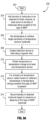
- FIG. 3A is a flowchart illustrating a method 200 of detecting molecules (e.g., DNA bases) in accordance with some embodiments.
- the method begins.
- a plurality of molecules to be detected is added to the fluidic channel. At least some of the plurality of molecules are coupled to MNPs of a first type.
- the temperature of the contents of the fluidic channel may be set to achieve a target sensitivity of the temperature sensors.
- an alternating magnetic field is applied to the detection device (which results in the alternating magnetic field being applied to the contents of the fluidic channel).
- the temperature or temperature change of the contents of the fluidic channel in the vicinity of at least one of the temperature sensors is detected (e.g., by detecting a voltage, current, and/or resistance or a change in voltage, current, and/or resistance).
- the identity of the detected molecule (or, in some embodiments, the identity of a complementary molecule) may be recorded based on the presence or absence of the first type of MNP in the vicinity of the temperature sensor(s).
- FIG. 3B is a flowchart illustrating another method 250 of detecting molecules in accordance with some embodiments.
- the method begins.
- the detection device is subjected to an alternating magnetic field.
- a local temperature change is detected at each temperature sensor.
- the local temperature change may be zero or close to zero (e.g., below a threshold) if there is no MNP near the temperature sensor.
- it is determined based on the detected temperature change whether a MNP is present in the vicinity of the at least one temperature sensor.
- the identity of the detected molecule may be recorded based on the presence or absence of the MNP in the vicinity of the temperature sensor(s).
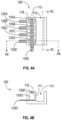
- FIGS. 4A, 4B , and 4C illustrate an exemplary detection device 100 in accordance with some embodiments.
- the exemplary detection device 100 includes a plurality of temperature sensors 105 arranged in an array 110 disposed adjacent to a fluidic channel 115.
- FIG. 4A is a top view of the apparatus
- FIG. 4B is a cross-section view at the position indicated by the dashed line labeled "4B" in FIG. 4A
- FIG. 4C is another cross-section view at the position indicated by the dashed line labeled "4C" in FIG. 4A .
- Exemplary embodiments of the temperature sensors 105 are described below (e.g., with reference to FIGS. 12 , 13A, and 13B ).
- the exemplary detection device 100 comprises a temperature sensor array 110 that includes a plurality of temperature sensors 105, with four temperature sensors 105A, 105B, 105C, and 105D shown in FIG. 4A .
- a temperature sensor array 110 that includes a plurality of temperature sensors 105, with four temperature sensors 105A, 105B, 105C, and 105D shown in FIG. 4A .
- this document refers generally to the temperature sensors by the reference number 105. Individual temperature sensors are given the reference number 105 followed by a letter.
- the detection device 100 may include more or fewer than four temperature sensors 105.
- the temperature sensor array 110 illustrated in the exemplary embodiment of FIG. 4A is a linear array.
- each of the plurality of temperature sensors 105 is coupled to at least one line 120 for reading a characteristic of one or more of the temperature sensors 105.
- the characteristic provides an indication of temperature or a change in temperature and may comprise, for example, a voltage, current, resistance, and/or a change in resistance, current, and/or voltage drop across the temperature sensor 105.
- each temperature sensor 105 of the temperature sensor array 110 is coupled to two lines 120.
- the temperature sensor 105A is coupled to the lines 120A and 120E
- the temperature sensor 105B is coupled to the lines 120B and 120E
- the temperature sensor 105C is coupled to the lines 120C and 120E
- the temperature sensor 105D is coupled to the lines 120D and 120E.
- the lines 120A, 120B, 120C, and 120D reside under the temperature sensors 105A, 105B, 105C, and 105D, respectively, and the line 120E resides over the temperature sensors 105.
- FIG. 4B shows the temperature sensor 105D in relation to the lines 120D and 120E.
- the detection device 100 also includes a fluidic channel 115 that is adjacent to the temperature sensor array 110.
- the fluidic channel 115 is configured to hold fluids (e.g., liquids, gases, plasmas) when the detection device 100 is in use.
- the fluidic channel 115 may by open (e.g., if its shape is rectangular, it may have three sides; if its shape is curved, it may have a shape that is a portion of a cylinder; etc.) or closed (e.g., if its shape is cuboid, it may have six sides; if its shape is curved, it may be cylindrical; etc.).
- the fluidic channel 115 may include at least one movable piece (e.g., a stopper, a flap, etc.) to allow fluid to enter into and/or exit the fluidic channel 115.
- the shape of the fluidic channel 115 may be regular or irregular.
- the fluidic channel 115 may include or may be coupled to a pump that forces fluids into and/or out of the fluidic channel 115 (e.g., through a membrane, opening, etc.).
- the fluidic channel 115 may be a passive receptacle (e.g., it merely receives fluids but is not coupled to a device that injects or removes fluids).
- the fluidic channel 115 has a wall 117 that is adjacent to the temperature sensor array 110.
- the wall 117 may be substantially vertical as illustrated in FIG. 4B .
- the wall 117 may be sloped at least in part ( e . g ., some or all of the interior of the fluidic channel 115 may be curved (e.g., in the shape of a portion or all of a cylinder) or non-vertical in part or in whole).
- the fluidic channel 115 and wall 117 may have any shapes that allow the temperature sensors 105 to detect the presence of MNPs near or attached to the wall 117, within the fluidic channel 115.
- the temperature sensors 105 are able to detect temperature increases that result when MNPs that are in the fluidic channel 115 are exposed to an alternating magnetic field. Similarly, the temperature sensors 105 are able to detect temperature decreases that result when MNPs that had previously caused localized temperature increases no longer do so ( e . g ., when the MNPs are cleaved and washed away, or when they are not in close enough proximity to the temperature sensors 105 for any temperature increase they cause to be detected). In some embodiments, the temperature sensors 105 are able to detect absolute temperatures of contents of the fluidic channel 115 in the vicinity of the temperature sensors 105.
- the wall 117 has properties and characteristics that protect the temperature sensors 105 from whatever fluid is in the fluidic channel 115 while still allowing the temperature sensors 105 to detect temperature changes in their vicinities due to localized heating caused by MNPs that are within the fluidic channel 115.
- the material of the wall 117 (and potentially of the rest of the fluidic channel 115) may be or comprise an insulator.
- a surface of the wall 117 comprises polypropylene, gold, glass, and/or silicon.
- the thickness of the wall 117 may be selected so that the temperature sensors 105 can detect localized heating caused by MNPs within the fluidic channel 115.
- the wall 117 is approximately 2 nm to approximately 20 nm thick.
- the MNPs coupled to molecules being detected may be close to the sensors 105 but separated from them by enough insulator to electrically passivate the temperature sensors 105.
- the thickness of the wall 117 can be selected to meet this objective. Those having ordinary skill in the art will be able to select a suitable material and a suitable thickness of the wall 117.
- FIG. 4C is a cross-section view of the detection device 100 along the dashed line labeled "4C" in FIG. 4A . Because the cross-section is taken at a point within the fluidic channel 115, the temperature sensors 105 and lines 120 would not be visible and are, therefore, shown using dashed lines to illustrate their positions within the detection device 100. As shown in FIG. 4C , in some embodiments, the wall 117 has a support structure 114 (or multiple support structures 114) configured to anchor molecules to be sensed (e.g., nucleic acid or molecules of a nucleic acid polymerase) to the wall 117 near the temperature sensors 105.
- FIG. 1 is a cross-section view of the detection device 100 along the dashed line labeled "4C" in FIG. 4A . Because the cross-section is taken at a point within the fluidic channel 115, the temperature sensors 105 and lines 120 would not be visible and are, therefore, shown using dashed lines to illustrate their positions within the detection device 100. As shown
- FIG. 4C illustrates four individual support structures 114A, 114B, 114C, and 114D, each of which corresponds to a temperature sensor 105 (e.g., support structure 114A corresponds to temperature sensor 105A, support structure 114B corresponds to temperature sensor 105B, etc.).
- the support structure 114 (or support structures 114) of the wall 117 may include a cavity or a ridge to which molecules may be attached or anchored.
- FIG. 4C shows individual support structures 114 corresponding to each of the temperature sensors 105, the detection device 100 may have fewer or more support structures 114 than shown.
- each temperature sensor 105 may be near multiple support structures 114
- multiple temperature sensors 105 may share a single support structure 114.
- multiple temperature sensors 105 may share multiple support structures 114.
- those support structures 114 may be the same as or similar to each other, or they may be different from each other.
- each temperature sensor 105 may be advantageous for each temperature sensor 105 to detect MNPs coupled to a single respective support structure 114.
- a long strand of DNA is (or a plurality of long strands of DNA from a single donor organism are) cut into smaller, random-length segments prior to sequencing. All of these smaller strands, which are from the same donor, are randomized sub-strands of the complete strand to be sequenced.
- the smaller strands could include, for example, distinct sub-strands (e.g., TGGCTT and CCATACCGA) as well as, if a plurality of the longer strands are cut into sub-strands, sub-strands that partially or completely overlap other sub-strands (e.g., CTTAGCCAT and ATGGCTTAGCC). All of the smaller, randomized sub-strands may be sequenced at the same time, potentially after being amplified.
- distinct sub-strands e.g., TGGCTT and CCATACCGA
- CTTAGCCAT and ATGGCTTAGCC e.g., CTTAGCCAT and ATGGCTTAGCC
- each temperature sensor 105 may be desirable for each temperature sensor 105 to detect temperature changes caused by single MNPs because the sequencing of the sub-strands will not be coordinated (or synchronized) amongst sub-strands.
- a first sub-strand may incorporate cytosine
- a second sub-strand might incorporate thymine
- a third sub-strand might incorporate adenine.
- FIGS. 4A, 4B , and 4C illustrate an exemplary detection device 100 with a single fluidic channel 115 and only four temperature sensors 105A, 105B, 105C, 105D in the temperature sensor array 110.
- the detection device 100 may have many more temperature sensors 105 in the temperature sensor array 110, and it may have either additional fluidic channels 115 or a more intricate single fluidic channel 115 (e.g., with a different shape or with interconnected channels).
- any configuration of temperature sensors 105 and fluidic channel(s) 115 that allows the temperature sensors 105 to detect temperature changes caused by MNPs in the fluidic channel(s) 115 may be used.
- FIG. 4D is a block diagram showing an exemplary detection system 300 for molecule detection in accordance with some embodiments.
- the system 300 includes a detection device 100 (as shown, comprising detection circuitry 130 coupled to the temperature sensor array 110 via the lines 120).
- the detection system 300 may also include one or more temperature control elements 140 (e.g., one or more heaters), one or more magnetic components 150, and/or a current driver 160.
- the magnetic component(s) 150 may comprise, for example, an electromagnet, a distributed coil, a solenoid, a permanent magnet, or a superconducting magnet.
- the magnetic component(s) 150 may include a magnetic component 150 that provides a static (e . g ., constant in time or DC) magnetic field to align the magnetic moments of the MNPs in the fluidic channel 115 in substantially the same direction.
- FIG. 4D illustrates the temperature controller(s) 140, magnetic component(s) 150, and/or current driver 160 as being separate from the detection device 100, one or more of the temperature controller(s) 140, magnetic component(s) 150, and/or current driver 160, if present, may be included in the detection device 100, or some or all of the temperature controller(s) 140, magnetic component(s) 150, and/or current driver 160 may be separate from the detection device 100.
- the current driver 160 causes the magnetic component(s) 150 to generate an alternating magnetic field to which the contents of the fluidic channel 115 are subjected.
- MNPs in the fluidic channel 115 heat their surrounding environments.
- the detection circuitry 130 applies a current or voltage to one or more of the lines 120 to detect a characteristic of at least one of the plurality of temperature sensors 105 in the temperature sensor array 110, where the characteristic is a proxy for temperature (or temperature change) and indicates the presence or an absence of a MNP in the fluidic channel 115.
- the characteristic is a voltage, current, and/or resistance, or a change in voltage, current, and/or resistance.
- the temperature sensors 105 are most sensitive in a particular temperature range. Thus, in some such embodiments, it can be desirable to keep the temperature sensors 105 within this temperature range. One way to do so is by using temperature gradient correction. Accordingly, in some embodiments, the system 300 includes one or more temperature control elements 140, which may comprise, for example, one or more heating elements.
- the system 300 may include a heat spreader, which may be coupled to the detection device 100.
- the detection device 100 itself includes one or more heating elements 142 coupled, for example, to its bottom surface 119.
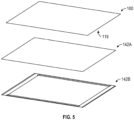
- FIG. 5 is an exploded view of exemplary heating elements 142 suitable for incorporation in or use with a detection device 100 in accordance with some embodiments. The detection device 100 shown in FIG.
- the detection device 100 shown in FIG. 5 includes or is coupled to a surface heater 142A that provides substantially uniform heating across the bottom surface 119 of the detection device 100.
- the detection device 100 shown in FIG. 5 also includes linear heaters 142B at or near the edges of the bottom surface 119, which may be used to remove a temperature gradient caused by the surrounding environment being at a different (e.g., cooler) temperature.
- the detection device 100 may include an array of heating elements 142, which may be useful if fine temperature control is desirable.
- FIG. 6 illustrates an array 144 of heating elements 142 that may be coupled, for example, to the bottom surface 119 of the detection device 100. To avoid obscuring the drawing, only a few of the heating elements 142 are shown with reference numbers.
- the temperature sensors 105 are kept within a desired temperature range ( e . g ., to provide a desired sensitivity) by applying a current to the temperature sensors 105.
- the temperature of a temperature sensor 105 may be obtained/determined ( e . g ., measured) by applying a voltage to the lines 120 coupled to that temperature sensor 105 and measuring the current, and if the temperature sensor 105 is not within the desired temperature range, its temperature can be adjusted by increasing or decreasing the applied current.
- the temperature-adjustment procedure may be performed between molecule detection cycles. Alternatively, it may be performed at the same time as molecule detection. If the changes made to the current for purposes of temperature-adjustment are small, the detection circuitry 130 should still be able to detect changes in temperature caused by MNPs in the vicinities of the temperature sensors 105.
- the temperature sensors 105 which are described in further detail below, are arranged in bridge circuits, and temperature changes caused by the presence of MNPs in the fluidic channel 115 are detected through measurement of voltage changes in the bridge circuits due to resistance changes in the temperature sensors 105.
- FIG. 7 illustrates an exemplary bridge circuit 180 in accordance with some embodiments.
- the temperature sensor 105 (shown as a resistor having a resistance R x ) is disposed as one leg of the bridge circuit 180.
- the other legs of the bridge circuit 180 may be considered to be included in the detection circuitry 130.
- the other legs of the bridge circuit 180 may include, for example, low-temperature coefficient resistors, which may be fabricated (e.g., on the detection device 100) using the same material(s) as the temperature sensor 105 (in which case their resistances change at substantially the same rate as the resistance of the temperature sensor 105).
- a variable resistor (labeled R 2 ) may be used, as shown in FIG. 7 , to balance the bridge.
- FIG. 7 is merely exemplary, and other bridge configurations are possible.
- the bridge circuit 180 may include two temperature sensors 105 to determine or obtain temperature changes caused by MNPs and two reference resistors to track (e.g., measure) background temperature changes.
- Bridge configurations with interleaved resistors (to reduce gradients) or with only two resistors are possible.
- the exemplary configuration of FIG. 7 is not intended to be limiting.
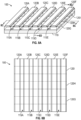
- FIGS. 8A, 8B , 8C, and 8D illustrate portions of an exemplary detection device 100 that includes several fluidic channels 115, one or more of which may be a separate fluidic channel 115 in accordance with some embodiments, or the aggregation of which may be considered a single fluidic channel 115.
- the plurality of temperature sensors 105 of the temperature sensor array 110 is arranged in a rectangular grid pattern.
- Each of the lines 120 identifies a row or a column of the temperature sensor array 110. It is to be understood that FIGS.
- FIGS. 8A, 8B , 8C, and 8D show only a portion of the detection device 100 to avoid obscuring the parts of the detection device 100 being discussed. It is to be understood that the various illustrated components (e.g., lines 120, temperature sensors 105, fluidic channels 115, etc.) might not be visible in a physical instantiation of the detection device 100 (e.g., some or all may be covered by protective material, such as an insulator). Moreover, as discussed herein, the detection device 100 may include other components not illustrated in FIGS. 8A, 8B , 8C, and 8D .
- FIG. 8A is a perspective view of the exemplary detection device 100 in accordance with some embodiments.
- the exemplary detection device 100 includes nine lines 120, labeled as 120A, 120B, 120C, 120D, 120E, 120F, 120G, 120H, and 1201. It also includes five fluidic channels, labeled as 115A, 115B, 115C, 115D, and 115E. As explained above, the fluidic channels 115A, 115B, 115C, 115D, and 115E may be considered to be separate fluidic channels 115 or a single fluidic channel 115.
- the detection device 100 also has a bottom surface 119.
- FIG. 8B is a top view of the exemplary detection device 100 shown in FIG. 8A .
- the lines 120G, 120H, and 120I which are not visible from the top view, are shown using dashed lines to indicate their locations.
- the lines 120A-120F are shown in solid lines but, as explained above, the lines 120A-120F might also not be visible in the top view (e.g., they may be covered by protective material, such as an insulator).
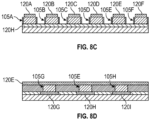
- FIG. 8C is a cross-sectional view of the detection device 100 along the line labeled "8C" in FIG. 8A .
- each of the lines 120A, 120B, 120C, 120D, 120E, and 120F is in contact with the top of one of the temperature sensors 105 along the cross-section (namely, line 120A is in contact with temperature sensor 105A, line 120B is in contact with temperature sensor 105B, line 120C is in contact with temperature sensor 105C, line 120D is in contact with temperature sensor 105D, line 120E is in contact with temperature sensor 105E, and line 120F is in contact with temperature sensor 105F).
- the line 120H is in contact with the bottom of each of the temperature sensors 105A, 105B, 105C, 105D, 105E, and 105F. It is to be appreciated that although FIGS. 8A-8D illustrate the lines 120 in contact with the temperature sensors 105, the lines 120 may, in general, be coupled to the temperature sensors 105 (i.e., they may be directly connected, or there may be intervening components disposed between the lines 120 and the temperature sensors 105). Moreover, although FIGS. 8A-8D illustrate the lines 120 and temperature sensors 105 as distinct from one another, as discussed in further detail below in the context of FIGS. 13A and 13B , the lines 120 may themselves form part or all the temperature sensors 105.
- the temperature sensors 105A and 105B are separated by the fluidic channel 115A (unlabeled in FIG. 8C but shown in FIG. 8A ).
- the temperature sensors 105B and 105C are separated by the fluidic channel 115B
- the temperature sensors 105C and 105D are separated by the fluidic channel 115C
- the temperature sensors 105D and 105E are separated by the fluidic channel 115D
- the temperature sensors 105E and 105F are separated by the fluidic channel 115E.
- either or both of the vertical walls of each fluidic channel 115 may be the wall 117.
- each temperature sensor 105 is assigned to a single fluidic channel 115.
- the temperature sensors 105 coupled to the line 120A may be configured to sense the presence or absence of MNPs in the fluidic channel 115A
- the temperature sensors 105 coupled to the line 120B may be configured to sense MNPs in the fluidic channel 115B
- the temperature sensors 105 coupled to the line 120C may be configured to sense MNPs in the fluidic channel 115C
- the temperature sensors 105 coupled to the line 120D may be configured to sense MNPs in the fluidic channel 115D
- the temperature sensors 105 coupled to the line 120E may be configured to sense MNPs in the fluidic channel 115E.
- each wall of one fluidic channel 115 may be the wall 117.
- a single fluidic channel 115 may be sensed by twice as many temperature sensors 105 as each of the other fluidic channels 115
- any of the fluidic channels 115 may be sensed by two columns of temperature sensors 105.
- the fluidic channel 115B may be sensed by the temperature sensors 105 coupled to both lines 120B and 120C.
- the temperature sensors 105 coupled to the line 120A would be assigned to sense the contents of the fluidic channel 120A
- the temperature sensors 105 coupled to the line 120D would be assigned to sense the contents of the fluidic channel 120C
- the temperature sensors 105 coupled to the line 120E would be assigned to sense the contents of the fluidic channel 120D
- the temperature sensors 105 coupled to the line 120F would be assigned to sense the contents of the fluidic channel 120E.
- FIG. 8D is a cross-sectional view of the detection device 100 along the line labeled "8D" in FIG. 8A .
- the line 120E is in contact with the top of each of the sensors 105G, 105E, and 105H along the cross-section.
- Each of the lines 120G, 120H, and 1201 is in contact with the bottom of one of the temperature sensors 105 along the cross-section (namely, line 120G is in contact with temperature sensor 105G, line 120H is in contact with temperature sensor 105E, and line 1201 is in contact with temperature sensor 105H).
- the temperature sensors 105 comprise vanadium oxide or a material with similar properties (e.g., niobium oxide).
- the lines 120 use the selectivity of the temperature sensor 105 itself to detect the temperature or change in temperature.
- the lines 120 shown in FIG. 8D need not be in direct contact with the temperature sensors 105; instead, they may be connected through intervening components.
- the detection device 100 includes a plurality of selector elements 111, each of which is coupled to a respective one of the temperature sensors 105, where each of the selector elements 111 exhibits thresholding behavior such that for voltages above a particular value (V th ), the selector element 111 has high conductivity, and below that voltage the conductivity of the selector element 111 is effectively zero.
- the selector elements 111 may comprise, for example, transistors, diodes, etc.
- selector elements 111 may be used reduce the chances of "sneak" currents that could transmit through neighboring elements and degrade the performance of the detection device 100.
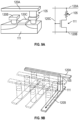
- FIG. 9A illustrates an exemplary approach for selecting temperature sensors 105 in accordance with some embodiments.
- a respective selector element 111 shown in the exemplary embodiment as a CMOS transistor
- three lines 120A, 120B, and 120C allow a characteristic of the temperature sensor 105 to be sensed.
- the line 120A may be considered to be a read-out line
- the line 120C may be considered to be a control line
- the line 120B may be considered to be either or both a read-out line and a control line.
- Each temperature sensor 105 of an array 110 may be coupled in series to a respective selector element 111.
- FIG. 9B illustrates another exemplary temperature sensor 105 selection approach in accordance with some embodiments.
- a selector element 111 e.g. , a diode or a similar thresholding element, as is known in the art, such as semiconductor diodes, operational transconductance amplifiers (OTAs), vanadium oxide layers, capacitive threshold-logic gates, etc.
- OTAs operational transconductance amplifiers
- FIG. 9B illustrates another exemplary temperature sensor 105 selection approach in accordance with some embodiments.
- a selector element 111 e.g. , a diode or a similar thresholding element, as is known in the art, such as semiconductor diodes, operational transconductance amplifiers (OTAs), vanadium oxide layers, capacitive threshold-logic gates, etc.
- CMOS transistors may be used to turn on the individual lines 120A, 120B to address/access individual temperature sensors 105 in the detection device 100.
- the use of CMOS select transistors may be simple due to the prevalence of foundries available to fabricate the front end (e.g.
- entire columns or entire rows may be read simultaneously to improve the accuracy of the detection.
- the exemplary detection device(s) 100 shown and described in reference to FIGS. 4A-9B can be used with methods using SBS protocols that use magnetically-labeled nucleotide precursors.
- SBS involves binding of primer-hybridized template DNA, incorporation of a deoxynucleoside triphosphate (dNTP), and detection of incorporated dNTP.
- the detection device 100 can be used to expose the temperature sensors 105 to sequencing reagents in the fluidic channel(s) 115 while protecting the temperature sensors 105 using, for example, an electrically-insulating material.
- DNA synthesis may be performed using polymerase molecules placed in the proximity of the temperature sensors 105, which detect the presence of MNPs.
- either molecules of polymerase or fragments of single-strand nucleic acid may be attached to the side wall(s) 117 of the fluidic channel(s) 115 in the proximity of one or more of the temperature sensors 105.
- Sequencing can then be performed by adding, to the fluidic channel(s) 115, a nucleic acid template (having a primer binding site and an extendable primer) and magnetically-labeled nucleotide precursors (at least some types of nucleotide precursor labeled by a distinguishable MNP), and sequencing the nucleic acid template by using the lines 120 to detect a characteristic of the temperature sensors 105.
- the characteristic may indicate which of the magnetically-labeled nucleotide precursors has been incorporated into the extendable primer (e.g., if multiple nucleotide precursors, each labeled by a different MNP type, are added to the fluidic channel(s) 115 at substantially the same time), or it may indicate whether a particular magnetically-labeled nucleotide precursor has been incorporated into the extendable primer (e.g., if different nucleotide precursors labeled by MNPs (which may be the same type of MNP for each type of nucleotide precursor) are added to the fluidic channel(s) 115 sequentially).
- MNPs For DNA sequencing specifically, because adenine (A) pairs only with thymine (T), and cytosine (C) pairs only with guanine (G), detection of the MNPs enables the determination of which of the magnetically-labeled nucleotide precursors has been incorporated. In particular, if the MNP labeling A is detected, the recorded base is T (and vice versa), and if the MNP labeling C is detected, the recorded base is G (and vice versa).
- the temperature sensors 105 can have any of a number of configurations, and they may comprise a variety of suitable materials.
- the temperature sensors 105 may comprise thermocouples made from two different metals ( see , e.g. , U.S. Patent No. 6,905,736 , "Fabrication of nano-scale temperature sensors and heaters," which is hereby incorporated by reference in its entirety for all purposes), semiconductor diodes ( see , e.g. , U.S. Pat. No. 6,969,679 , “Fabrication of nanoscale thermoelectric devices,” which is hereby incorporated by reference in its entirety for all purposes), thermistors, metal resistors, and/or tunnel junctions (magnetic or nonmagnetic).
- the temperature sensors 105 may comprise, for example, resistive thermal sensors.
- a resistive thermal sensor is a thermal sensor with an electrical resistance that varies with the thermal stimulus that it senses (where the variation in resistance can include both linear and nonlinear variations).
- the term "thermistor” is used herein to refer to an electrically resistive component that includes semiconductor material with resistance that varies in response to a thermal change. Thus, a thermistor may be used in a resistive thermal sensor.
- Resistive thermal sensors may be made, for example, from materials with a high temperature coefficient of resistivity. Examples of such materials include, but are not limited to, amorphous silicon, vanadium oxide (VO x ), niobium oxide, yttrium barium copper oxide, and mercury cadmium telluride.
- Resistive thermal sensors may also or alternatively include other materials having a high temperature coefficient of resistivity, such as, for example, platinum, nickel, copper, iron-nickel alloys, tungsten, iridium, oxides of nickel, manganese, iron, cobalt, copper, magnesium, and titanium, and other metals, metal alloys, and oxides of metal.
- materials having a high temperature coefficient of resistivity such as, for example, platinum, nickel, copper, iron-nickel alloys, tungsten, iridium, oxides of nickel, manganese, iron, cobalt, copper, magnesium, and titanium, and other metals, metal alloys, and oxides of metal.
- the temperature sensors 105 may comprise, for example, thermocouples, which are electrical devices having two dissimilar electrical conductors forming electrical junctions at differing temperatures. As is known in the art, a thermocouple produces a temperature-dependent voltage caused by the thermoelectric effect. The produced voltage is a proxy for the measured temperature.
- the temperature sensors 105 may comprise, for example, thermopiles.
- a thermopile comprises a plurality of thermocouples, which may be connected in series or in parallel, and converts thermal energy into electrical energy.
- a thermopile produces a voltage when its thermocouples are exposed to a temperature difference.
- the temperature sensors 105 comprise materials that provide a relatively large change in resistance for a small temperature change (e.g., 5% per degree Celsius over a wide range of temperatures and 200% per degree Celsius at the transition temperature).
- the temperature sensors 105 comprise vanadium oxide. Vanadium oxide has properties beneficial for use in the temperature sensors 105, including a relatively high temperature coefficient of resistance and low resistivity, as well as low electrical 1/f noise.
- FIG. 10 illustrates the resistivity of various vanadium oxides as a function of the inverse of temperature. As an example, as shown in FIG.
- VO 2 has a transition temperature of 68 degrees Celsius, and there are many other vanadium oxides having different temperatures above and below 68 degrees Celsius that can be tuned over a wide range.
- the transition temperature may be adjusted by doping, as illustrated in FIG. 11 .
- Suitable dopants that may be used in the temperature sensors include, for example, chromium and niobium.
- the temperature sensors 105 comprise amorphous silicon (a-Si). In some embodiments, the temperature sensors 105 comprise amorphous silicon-germanium (a-SiGe).
- the temperature sensors 105 comprise a tunnel junction that includes an insulator layer 107 between two conducting metal layers 106A and 106B, as shown in the exemplary temperature sensor of FIG. 12 .
- the insulator layer 107 may be, for example, an oxide or nitride (e.g., aluminum oxide (AlO x ), magnesium oxide (MgO), tantalum oxide (TaO x ), titanium oxide (TiO x ), HfO 2 , SiN, TaN, etc.).
- the metal layers 106A and 106B may comprise, for example, platinum, tantalum, tungsten, copper, titanium, etc.
- the lines 120 themselves form a portion or all of the temperature sensors 105.
- FIG. 13A shows an exemplary embodiment in which the temperature sensors 105 are tunnel junctions such as those shown and described in the context of FIG. 12 , and the lines 120 themselves are the metal layers 106A and 106B.
- the insulator layer 107 is deposited between the top lines 120A, 120B, and 120C and the bottom lines 120D, 120E, and 120F where they would otherwise intersect.
- the metal layers 106A and 106B may comprise platinum, and the insulator layer 107 may comprise aluminum oxide.
- An insulating material may be deposited between the top lines 120 ( e .
- the resistance of the tunnel junction formed by the lines 120 and the insulator layer 107 changes in response to changes in the temperature.
- the embodiment of FIG. 13A may be used in conjunction with the selector elements 111 described in the context of FIGS. 9A and 9B above.
- FIG. 13B is an example of a cross-point array architecture in which the temperature sensors 105 are formed at the junctions of the top lines 120A, 120B, 120C and the bottom lines 120D, 120E, 120F.
- the top lines 120 may comprise, for example, platinum (Pt)
- the bottom lines 120 may comprise, for example, titanium (W), or vice versa.
- the interfaces where the Pt and W overlap are the active regions in which the Seebeck effect produces a voltage signal. These interfaces are the regions of highest sensitivity to increases in temperature.
- Each temperature sensor 105 in such an architecture is a thermocouple formed at every location where a top line 120A, 120B, or 120C crosses a bottom line 120D, 120E, or 120F.
- An insulating material may be deposited between adjacent top lines 120 (e.g., between lines 120A and 120B and between lines 120B and 120C) to form the fluidic channel(s) 115 and to prevent MNPs in the fluidic channel(s) 115 from electrically shorting the temperature sensors 105.
- the embodiment of FIG. 13B may be used in conjunction with the selector elements described in the context of FIGS. 9A and 9B above.
- CMOS select transistors may be used to address the individual thermocouple junctions to mitigate or prevent sneak currents and/or leakage current.
- temperature sensors 105 may be any temperature sensors capable of detecting temperature changes caused by MNPs exposed to an alternating magnetic field.
- the exemplary configurations and materials described herein are not intended to be limiting.
- the detection device 100 is fabricated using photolithographic processes and thin film deposition.
- FIG. 14 illustrates an exemplary method 450 of manufacturing the detection device 100
- FIG. 15 illustrates the results of each step of the fabrication process 450 with a final panel showing polymerase bound to the wall 117 proximate to a temperature sensor 105 in accordance with some embodiments (e.g., when the detection device 100 is used for nucleic acid sequencing).
- the method begins.
- one or more lines 120 are fabricated on a substrate, for example, by depositing one or more metal layers, using, for example, photolithography to pattern an array of lines and spaces in a polymer layer applied on top of the metal layers, using that polymer layer as a mask for etching the metal layers into an array of lines, depositing an insulating dielectric material, stripping the polymer layer and dielectric material over the lines, and performing chemical mechanical polishing to planarize the surface.
- additional material e.g., the insulator layer 107 forming at least a portion of the temperature sensor array 110 is fabricated on the one or more lines 120.
- each temperature sensor 105 of the temperature sensor array 110 has a bottom 108 and a top 109. (See FIG. 12 .)
- the bottom 108 is coupled to (or indistinguishable from) at least one of the one or more lines 120.
- the bottom 108 of each temperature sensor 105 is in contact with at least one of the one or more lines 120.
- at least one of the one or more lines 120 forms part of at least one of the temperature sensors 105.
- dielectric material is deposited between the temperature sensors 105 of the temperature sensor array 110.
- additional lines 120 are fabricated. Each of these additional lines 120 is coupled to (or forms) the top 109 of at least one temperature sensor 105 in the temperature sensor array 110. In some embodiments, the top 109 of each temperature sensor 105 is in contact with a line 120. In some embodiments, the bottom 108 of a temperature sensor 105 is in contact with a first line 120A, and the top 109 of the temperature sensor 105 is in contact with a second line 120B. In some embodiments, the first line 120A and the second line 120B form part or all of the temperature sensor 105. At 462, a portion of the dielectric material adjacent to the temperature sensors 105 is removed (e.g., by milling, etching, or any other suitable removal process) to create the fluidic channel(s) 115. At 464, the process 450 ends.
- FIGS. 14 and 15 illustrate and describe exemplary steps in the fabrication process 450
- the fabrication process 450 may include any suitable techniques for depositing materials, such as, for example, growth of epitaxial material, physical vapor deposition (PVD), chemical vapor deposition (CVD), evaporation techniques, plating techniques, and/or spin coating.
- the fabrication process 450 may include any suitable techniques for patterning materials, such as, for example, etching or otherwise removing exposed regions of thin films through a photolithographically-patterned resist layer or other patterned layer.
- the fabrication process 450 may include techniques for polishing, planarizing, or otherwise modifying exposed surfaces of materials.
- the fabrication process can include fabricating the temperature sensors 105 on a substrate made of p+ amorphous silicon so that the fabrication can incorporate higher-temperature fabrication for more sensitive thermal sensors, as well as enabling tighter tolerances that provide better balanced resistivity.
- nucleic acid sequencing may have several advantages over conventional technologies involving optical detection methods.
- methods involving electrical detection are not limited in terms of scaling flow cell dimensions in the same manner that optical detection is limited due to optical imaging being diffraction-limited.
- the terms “over,” “under,” “between,” “on”, and other similar terms as used herein refer to a relative position of one layer with respect to other layers.
- one layer disposed over or under another layer may be directly in contact with the other layer or may have one or more intervening layers.
- one layer disposed between layers may be directly in contact with the two layers or may have one or more intervening layers.
- a first layer "on” a second layer is in contact with the second layer.
- the relative position of the terms does not define or limit the layers to a vector space orientation of the layers.
- first,” “second,” etc. are used to distinguish between multiple instances of an item (e.g ., a line, a temperature sensor, etc.). Unless the context indicates otherwise, the terms “first,” “second,” etc. are not used to convey a particular ordering of items. Likewise, the words “top” and “bottom” are used to distinguish between multiple instances of an item ( e.g ., lines). It is to be appreciated that in some contexts, “top” and “bottom” are interchangeable.
- Disjunctive language such as the phrase "at least one of X, Y, Z," unless specifically stated otherwise, is otherwise understood with the context as used in general to present that an item, term, etc., may be either X, Y, or Z, or any combination thereof ( e . g ., X, Y, and/or Z). Thus, such disjunctive language is not generally intended to, and should not, imply that certain embodiments require at least one of X, at least one of Y, or at least one of Z to each be present.
- phrases of the form "at least one of A, B, and C,” “at least one of A, B, or C,” “one or more of A, B, or C,” and “one or more of A, B, and C” are interchangeable, and each encompasses all of the following meanings: “A only,” “B only,” “C only,” “A and B but not C,” “A and C but not B,” “B and C but not A,” and “all of A, B, and C.”
- a device configured to are intended to include one or more recited devices. Such one or more recited devices can also be collectively configured to carry out the stated recitations.
- a processor configured to carry out recitations A, B and C can include a first processor configured to carry out recitation A working in conjunction with a second processor configured to carry out recitations B and C.
Landscapes
- Health & Medical Sciences (AREA)
- Life Sciences & Earth Sciences (AREA)
- Immunology (AREA)
- Engineering & Computer Science (AREA)
- Chemical & Material Sciences (AREA)
- Molecular Biology (AREA)
- Hematology (AREA)
- Urology & Nephrology (AREA)
- Biomedical Technology (AREA)
- Physics & Mathematics (AREA)
- General Physics & Mathematics (AREA)
- General Health & Medical Sciences (AREA)
- Microbiology (AREA)
- Biochemistry (AREA)
- Analytical Chemistry (AREA)
- Biotechnology (AREA)
- Pathology (AREA)
- Medicinal Chemistry (AREA)
- Food Science & Technology (AREA)
- Cell Biology (AREA)
- Proteomics, Peptides & Aminoacids (AREA)
- Organic Chemistry (AREA)
- Zoology (AREA)
- Wood Science & Technology (AREA)
- Nanotechnology (AREA)
- Genetics & Genomics (AREA)
- Biophysics (AREA)
- General Engineering & Computer Science (AREA)
- Bioinformatics & Cheminformatics (AREA)
- Chemical Kinetics & Catalysis (AREA)
- Measuring Or Testing Involving Enzymes Or Micro-Organisms (AREA)
- Apparatus Associated With Microorganisms And Enzymes (AREA)
- Investigating Or Analyzing Materials Using Thermal Means (AREA)
Applications Claiming Priority (4)
| Application Number | Priority Date | Filing Date | Title |
|---|---|---|---|
| US201962833222P | 2019-04-12 | 2019-04-12 | |
| US16/697,013 US11327073B2 (en) | 2019-04-12 | 2019-11-26 | Thermal sensor array for molecule detection and related detection schemes |
| EP19924603.4A EP3953701B1 (de) | 2019-04-12 | 2019-12-26 | Wärmesensoranordnung zur moleküldetektion und zugehörige detektionsschemen |
| PCT/US2019/068535 WO2020209912A1 (en) | 2019-04-12 | 2019-12-26 | Thermal sensor array for molecule detection and related detection schemes |
Related Parent Applications (1)
| Application Number | Title | Priority Date | Filing Date |
|---|---|---|---|
| EP19924603.4A Division EP3953701B1 (de) | 2019-04-12 | 2019-12-26 | Wärmesensoranordnung zur moleküldetektion und zugehörige detektionsschemen |
Publications (2)
| Publication Number | Publication Date |
|---|---|
| EP4467982A2 true EP4467982A2 (de) | 2024-11-27 |
| EP4467982A3 EP4467982A3 (de) | 2025-02-19 |
Family
ID=72749194
Family Applications (2)
| Application Number | Title | Priority Date | Filing Date |
|---|---|---|---|
| EP19924603.4A Active EP3953701B1 (de) | 2019-04-12 | 2019-12-26 | Wärmesensoranordnung zur moleküldetektion und zugehörige detektionsschemen |
| EP24204066.5A Pending EP4467982A3 (de) | 2019-04-12 | 2019-12-26 | Wärmesensoranordnung zur moleküldetektion und zugehörige detektionsschemen |
Family Applications Before (1)
| Application Number | Title | Priority Date | Filing Date |
|---|---|---|---|
| EP19924603.4A Active EP3953701B1 (de) | 2019-04-12 | 2019-12-26 | Wärmesensoranordnung zur moleküldetektion und zugehörige detektionsschemen |
Country Status (4)
| Country | Link |
|---|---|
| US (2) | US11327073B2 (de) |
| EP (2) | EP3953701B1 (de) |
| CN (1) | CN114041045A (de) |
| WO (1) | WO2020209912A1 (de) |
Families Citing this family (4)
| Publication number | Priority date | Publication date | Assignee | Title |
|---|---|---|---|---|
| CN113905822B (zh) | 2019-04-12 | 2023-09-22 | 西部数据技术公司 | 使用磁传感器阵列边合成边核酸测序 |
| US11747329B2 (en) | 2019-11-22 | 2023-09-05 | Western Digital Technologies, Inc. | Magnetic gradient concentrator/reluctance detector for molecule detection |
| KR102702693B1 (ko) * | 2019-12-13 | 2024-09-05 | 에스케이하이닉스 주식회사 | 전자 장치 |
| CN112684388B (zh) * | 2020-12-10 | 2021-10-15 | 大连理工大学 | 一种基于涡流效应的中高频交变磁场强度的测量方法 |
Citations (10)
| Publication number | Priority date | Publication date | Assignee | Title |
|---|---|---|---|---|
| US6905736B1 (en) | 2001-02-28 | 2005-06-14 | University Of Central Florida | Fabrication of nano-scale temperature sensors and heaters |
| US6969679B2 (en) | 2003-11-25 | 2005-11-29 | Canon Kabushiki Kaisha | Fabrication of nanoscale thermoelectric devices |
| US7057026B2 (en) | 2001-12-04 | 2006-06-06 | Solexa Limited | Labelled nucleotides |
| US7405281B2 (en) | 2005-09-29 | 2008-07-29 | Pacific Biosciences Of California, Inc. | Fluorescent nucleotide analogs and uses therefor |
| US7414116B2 (en) | 2002-08-23 | 2008-08-19 | Illumina Cambridge Limited | Labelled nucleotides |
| US7541444B2 (en) | 2002-08-23 | 2009-06-02 | Illumina Cambridge Limited | Modified nucleotides |
| US8252910B2 (en) | 2008-11-19 | 2012-08-28 | Pacific Biosciences Of California, Inc. | Modular nucleotide compositions and uses therefor |
| US8367813B2 (en) | 2008-11-17 | 2013-02-05 | Pacific Biosciences Of California, Inc. | Phospholink nucleotides for sequencing applications |
| US9464107B2 (en) | 2008-03-13 | 2016-10-11 | Pacific Biosciences Of California, Inc. | Labeled nucleotide analogs |
| US9587275B2 (en) | 2010-02-18 | 2017-03-07 | Pacific Biosciences Of California, Inc. | Single molecule sequencing with two distinct chemistry steps |
Family Cites Families (91)
| Publication number | Priority date | Publication date | Assignee | Title |
|---|---|---|---|---|
| US5302509A (en) | 1989-08-14 | 1994-04-12 | Beckman Instruments, Inc. | Method for sequencing polynucleotides |
| US5200084A (en) | 1990-09-26 | 1993-04-06 | Immunicon Corporation | Apparatus and methods for magnetic separation |
| US6037167A (en) | 1994-10-03 | 2000-03-14 | Ericomp | Magnetic polynucleotide separation and analysis |
| US6654505B2 (en) | 1994-10-13 | 2003-11-25 | Lynx Therapeutics, Inc. | System and apparatus for sequential processing of analytes |
| JP4294740B2 (ja) | 1997-05-23 | 2009-07-15 | ソレクサ・インコーポレイテッド | 分析物の系列的プロセシングのためのシステムおよび装置 |
| US6969488B2 (en) | 1998-05-22 | 2005-11-29 | Solexa, Inc. | System and apparatus for sequential processing of analytes |
| US6046585A (en) | 1997-11-21 | 2000-04-04 | Quantum Design, Inc. | Method and apparatus for making quantitative measurements of localized accumulations of target particles having magnetic particles bound thereto |
| AR021833A1 (es) | 1998-09-30 | 2002-08-07 | Applied Research Systems | Metodos de amplificacion y secuenciacion de acido nucleico |
| US6197520B1 (en) | 1999-08-13 | 2001-03-06 | University Of Utah Research Foundation | Solution-based color compensation adjusted for temperature and electronic gains |
| AU7537200A (en) | 1999-09-29 | 2001-04-30 | Solexa Ltd. | Polynucleotide sequencing |
| US20040043479A1 (en) * | 2000-12-11 | 2004-03-04 | Briscoe Cynthia G. | Multilayerd microfluidic devices for analyte reactions |
| GB0125436D0 (en) | 2001-10-23 | 2001-12-12 | Deltadot Ltd | Analysis of temperature-dependent molecular configurations |
| GB0129012D0 (en) | 2001-12-04 | 2002-01-23 | Solexa Ltd | Labelled nucleotides |
| DE60211555T2 (de) | 2001-12-21 | 2007-02-22 | Koninklijke Philips Electronics N.V. | Sensor und methode zur messung der flächendichte von magnetischen nanopartikeln auf einem mikroarray |
| US20040219695A1 (en) | 2002-01-19 | 2004-11-04 | Fox John Stewart | High sensitivity detection of and manipulation of biomolecules and cells with magnetic particles |
| US7473031B2 (en) | 2002-04-01 | 2009-01-06 | Palo Alto Research Center, Incorporated | Resistive thermal sensing |
| US20050118102A1 (en) | 2003-04-28 | 2005-06-02 | Intematix Corporation | Spin resonance heating and/or imaging in medical applications |
| FI20040159A0 (fi) | 2003-10-20 | 2004-02-02 | Bio Mobile Oy | Magneettinen siirtomenetelmä, mikropartikkelien siirtolaite, ja reaktioyksikkö |
| US7906345B2 (en) | 2003-11-12 | 2011-03-15 | The Board Of Trustees Of The Leland Stanford Junior University | Magnetic nanoparticles, magnetic detector arrays, and methods for their use in detecting biological molecules |
| US20050136408A1 (en) | 2003-12-19 | 2005-06-23 | May Tom-Moy | Methods and systems for characterizing a polymer |
| JP2005315677A (ja) * | 2004-04-28 | 2005-11-10 | Canon Inc | 検出装置および検出方法 |
| GB0413752D0 (en) | 2004-06-19 | 2004-07-21 | Hall Effect Technologies Ltd | Method of determining the presence and/or concentration of substances of interest in fluids |
| EP1781820B1 (de) | 2004-08-20 | 2018-04-04 | Magnomics, SA | Eine bioelektronische vorrichtung |
| WO2006132531A1 (en) | 2005-02-18 | 2006-12-14 | Stichting Voor De Technische Wetenschappen | Oscillator based on thermal diffusion |
| US7382586B2 (en) | 2005-03-31 | 2008-06-03 | Hitachi Global Storage Technologies Netherlands B.V. | Magnetic read sensor employing oblique etched underlayers for inducing uniaxial magnetic anisotropy in a self biased free layer |
| US7749445B2 (en) | 2005-05-02 | 2010-07-06 | Bioscale, Inc. | Method and apparatus for analyzing bioprocess fluids |
| US7648844B2 (en) | 2005-05-02 | 2010-01-19 | Bioscale, Inc. | Method and apparatus for detection of analyte using an acoustic device |
| EP1926994A1 (de) | 2005-09-08 | 2008-06-04 | Koninklijke Philips Electronics N.V. | Mikrosensorvorrichtung |
| US8512559B2 (en) | 2005-11-18 | 2013-08-20 | Intel Corporation | Device, method, and system for separation and detection of biomolecules and cells |
| US8241573B2 (en) | 2006-03-31 | 2012-08-14 | Illumina, Inc. | Systems and devices for sequence by synthesis analysis |
| CN101490576A (zh) | 2006-07-11 | 2009-07-22 | 皇家飞利浦电子股份有限公司 | 磁传感器装置 |
| US8133439B2 (en) | 2006-08-01 | 2012-03-13 | Magic Technologies, Inc. | GMR biosensor with enhanced sensitivity |
| US7729093B1 (en) | 2006-09-28 | 2010-06-01 | Headway Technologies, Inc. | Detection of magnetic beads using a magnetoresistive device together with ferromagnetic resonance |
| CN201016817Y (zh) * | 2007-03-07 | 2008-02-06 | 重庆大学 | 温度传感器实验箱 |
| WO2008119054A1 (en) | 2007-03-27 | 2008-10-02 | Abqmr, Inc. | System and method for detecting labeled entities using microcoil magnetic mri |
| US20080241569A1 (en) | 2007-03-30 | 2008-10-02 | Haoyu Qin | Encapsulation of raman active nanoparticles |
| WO2009001280A2 (en) | 2007-06-27 | 2008-12-31 | Koninklijke Philips Electronics N.V. | A method for the production of a microelectronic sensor device |
| EP2017619A1 (de) | 2007-07-20 | 2009-01-21 | Koninklijke Philips Electronics N.V. | Magnetsensorvorrichtung |
| US8513029B2 (en) | 2007-09-11 | 2013-08-20 | Headway Technologies, Inc. | Discrete contact MR bio-sensor with magnetic label field alignment |
| EP2200727B1 (de) | 2007-09-20 | 2014-08-13 | Magarray, Inc. | Nachweis von analyten mit magnetischen sensoren |
| WO2009040712A2 (en) | 2007-09-24 | 2009-04-02 | Koninklijke Philips Electronics N. V. | Microelectronic sensor device with an array of detection cells |
| WO2009073201A2 (en) | 2007-12-04 | 2009-06-11 | Pacific Biosciences Of California, Inc. | Alternate labeling strategies for single molecule sequencing |
| US8053244B2 (en) | 2008-08-13 | 2011-11-08 | Seagate Technology Llc | Magnetic oscillator based biosensor |
| US8236532B2 (en) | 2008-12-23 | 2012-08-07 | Illumina, Inc. | Multibase delivery for long reads in sequencing by synthesis protocols |
| KR20100122366A (ko) | 2009-05-12 | 2010-11-22 | 삼성전자주식회사 | 핵산 서열의 결정을 위한 자성 입자 및 이를 이용한 핵산 서열 결정 방법 |
| US8130072B2 (en) | 2009-05-14 | 2012-03-06 | Palo Alto Research Center Incorporated | Vanadium oxide thermal microprobes |
| US8432644B2 (en) | 2009-06-25 | 2013-04-30 | HGST Netherlands B.V. | Spin torque oscillator sensor enhanced by magnetic anisotropy |
| US8259409B2 (en) | 2009-06-25 | 2012-09-04 | Hitachi Global Storage Technologies Netherlands B.V. | Spin torque oscillator sensor |
| WO2011112929A2 (en) | 2010-03-12 | 2011-09-15 | The Board Of Trustees Of The Leland Stanford Junior University | Magnetic sensor based quantitative binding kinetics analysis |
| US20140099663A1 (en) | 2010-11-15 | 2014-04-10 | Regents Of The University Of Minnesota | Gmr sensor |
| US20130060482A1 (en) | 2010-12-30 | 2013-03-07 | Life Technologies Corporation | Methods, systems, and computer readable media for making base calls in nucleic acid sequencing |
| CA2827880A1 (en) | 2011-02-23 | 2012-08-30 | Eve Biomedical, Inc. | Rotation-dependent transcriptional sequencing systems and methods of using |
| US9926596B2 (en) | 2011-05-27 | 2018-03-27 | Genapsys, Inc. | Systems and methods for genetic and biological analysis |
| US8462461B2 (en) | 2011-07-05 | 2013-06-11 | HGST Netherlands B.V. | Spin-torque oscillator (STO) with magnetically damped free layer |
| CA2859660C (en) | 2011-09-23 | 2021-02-09 | Illumina, Inc. | Methods and compositions for nucleic acid sequencing |
| US9823316B2 (en) | 2011-10-19 | 2017-11-21 | Regents Of The University Of Minnesota | Magnetic biomedical sensors and sensing system for high-throughput biomolecule testing |
| US8570677B2 (en) | 2011-12-09 | 2013-10-29 | HGST Netherlands B.V. | Implementing spin-torque oscillator sensing with enhanced integrated demodulator for hard disk drives |
| US8553346B2 (en) | 2011-12-09 | 2013-10-08 | HGST Netherlands B.V. | Implementing spin-torque oscillator sensing with enhanced delay control feedback circuit for hard disk drives |
| US8654465B2 (en) | 2011-12-09 | 2014-02-18 | HGST Netherlands B.V. | Implementing spin-torque oscillator sensing with enhanced demodulator for hard disk drives |
| DE102012105241A1 (de) | 2012-06-15 | 2013-12-19 | Hitec Zang Gmbh | Roboter mit Werkzeugwechsler |
| CN102928596B (zh) | 2012-10-18 | 2015-01-21 | 上海交通大学 | 血清肿瘤标志物检测的巨磁阻抗效应生物传感器 |
| EP2843433A4 (de) | 2012-11-16 | 2015-04-15 | Korea Basic Science Inst | Drehmoment-magnetsensor |
| CA2897133C (en) | 2013-01-07 | 2018-10-09 | Anpac Bio-Medical Science (Lishui) Co., Ltd. | Apparatus for improved disease detection |
| WO2014189624A1 (en) | 2013-05-20 | 2014-11-27 | Silicon Biodevices, Inc. | Digital control of on-chip magnetic particle assay |
| GB2514615A (en) | 2013-05-31 | 2014-12-03 | Ibm | Thermal oscillator |
| WO2014197891A2 (en) | 2013-06-07 | 2014-12-11 | Cornell University | Floating gate based sensor apparatus and related floating gate based sensor applications |
| KR102536833B1 (ko) | 2013-08-28 | 2023-05-26 | 벡톤 디킨슨 앤드 컴퍼니 | 대량의 동시 단일 세포 분석 |
| CN103885000B (zh) | 2014-03-31 | 2016-08-17 | 哈尔滨工业大学深圳研究生院 | 具有测量频率扫描功能的交流感应磁场传感器 |
| US9435791B2 (en) * | 2014-06-27 | 2016-09-06 | Verily Life Sciences, LLC | Method for using nanodiamonds to detect nearby magnetic nanoparticles |
| WO2016044244A1 (en) | 2014-09-15 | 2016-03-24 | The Trustees Of The University Of Pennsylvania | Apparatus and methods for manufacturing a microfluidic device |
| CN106153207A (zh) * | 2015-03-12 | 2016-11-23 | 中科鼎源(北京)科技有限公司 | 一种柔性温度传感器及其制备工艺 |
| JP6692831B2 (ja) | 2015-05-12 | 2020-05-13 | イラミーナ インコーポレーテッド | 核酸をシーケンシングするための電界効果装置および方法 |
| EP3854884A1 (de) * | 2015-08-14 | 2021-07-28 | Illumina, Inc. | Systeme und verfahren mit magnetempfindlichen sensoren zur bestimmung eines genetischen merkmals |
| CN105112516A (zh) | 2015-08-14 | 2015-12-02 | 深圳市瀚海基因生物科技有限公司 | 一种单分子靶向测序方法、装置、系统及应用 |
| US20190154676A1 (en) | 2015-08-19 | 2019-05-23 | Tdk Corporation | Detection system, detection apparatus, and detection method |
| US10261076B2 (en) | 2015-10-02 | 2019-04-16 | The Board Of Trustees Of The Leland Stanford Junior University | Method for detecting small molecule analytes using magnetoresistant sensors |
| WO2017061129A1 (en) | 2015-10-08 | 2017-04-13 | Quantum Biosystems Inc. | Devices, systems and methods for nucleic acid sequencing |
| EP3405285A4 (de) * | 2016-01-20 | 2019-06-19 | Triv Tech, LLC | Nukleinsäureamplifikation und -nachweis am versorgungsort |
| EP3208627B1 (de) | 2016-02-19 | 2021-09-01 | Université de Montpellier | Messsystem und verfahren zur charakterisierung von zumindest einem einzigen magnetischen objekt |
| WO2018017884A1 (en) | 2016-07-20 | 2018-01-25 | Genapsys, Inc. | Systems and methods for nucleic acid sequencing |
| US10591440B2 (en) | 2016-08-01 | 2020-03-17 | Roche Sequencing Solutions, Inc. | Tunnel junctions in microfluidic arrays for molecular recognition |
| US10060880B2 (en) | 2016-09-15 | 2018-08-28 | Qualcomm Incorporated | Magnetoresistive (MR) sensors employing dual MR devices for differential MR sensing |
| US10534047B2 (en) * | 2017-03-30 | 2020-01-14 | Qualcomm Incorporated | Tunnel magneto-resistive (TMR) sensors employing TMR devices with different magnetic field sensitivities for increased detection sensitivity |
| KR101852719B1 (ko) * | 2017-04-06 | 2018-04-27 | 인제대학교 산학협력단 | 박막을 이용하여 분리 가능한 구조를 갖는 미세 유체 유속 측정장치 |
| EP3635412B1 (de) | 2017-06-06 | 2025-10-08 | The Regents of The University of California | Systeme und verfahren zur schnellen erzeugung von tröpfchenbibliotheken |
| CN111566224A (zh) | 2017-09-21 | 2020-08-21 | 吉纳普赛斯股份有限公司 | 用于核酸测序的系统和方法 |
| CA3078114C (en) | 2017-10-06 | 2022-10-18 | Jin Zhang | Giant magnetoresistance-based biosensors |
| CN112292461B (zh) | 2018-06-21 | 2024-05-17 | 豪夫迈·罗氏有限公司 | 用于测序的隧穿结 |
| CN113905822B (zh) | 2019-04-12 | 2023-09-22 | 西部数据技术公司 | 使用磁传感器阵列边合成边核酸测序 |
| US20210047681A1 (en) | 2019-08-13 | 2021-02-18 | Seagate Technology Llc | Methods of sequencing nucleic acids on magnetic sensor |
| US11591648B2 (en) | 2019-08-13 | 2023-02-28 | Seagate Technology Llc | Nanochannel with magnetic sensor for the detection of molecules |
-
2019
- 2019-11-26 US US16/697,013 patent/US11327073B2/en active Active
- 2019-12-26 WO PCT/US2019/068535 patent/WO2020209912A1/en not_active Ceased
- 2019-12-26 CN CN201980085444.0A patent/CN114041045A/zh active Pending
- 2019-12-26 EP EP19924603.4A patent/EP3953701B1/de active Active
- 2019-12-26 EP EP24204066.5A patent/EP4467982A3/de active Pending
-
2022
- 2022-05-02 US US17/661,578 patent/US12306179B2/en active Active
Patent Citations (12)
| Publication number | Priority date | Publication date | Assignee | Title |
|---|---|---|---|---|
| US6905736B1 (en) | 2001-02-28 | 2005-06-14 | University Of Central Florida | Fabrication of nano-scale temperature sensors and heaters |
| US7057026B2 (en) | 2001-12-04 | 2006-06-06 | Solexa Limited | Labelled nucleotides |
| US7414116B2 (en) | 2002-08-23 | 2008-08-19 | Illumina Cambridge Limited | Labelled nucleotides |
| US7541444B2 (en) | 2002-08-23 | 2009-06-02 | Illumina Cambridge Limited | Modified nucleotides |
| US8071739B2 (en) | 2002-08-23 | 2011-12-06 | Illumina Cambridge Limited | Modified nucleotides |
| US6969679B2 (en) | 2003-11-25 | 2005-11-29 | Canon Kabushiki Kaisha | Fabrication of nanoscale thermoelectric devices |
| US7405281B2 (en) | 2005-09-29 | 2008-07-29 | Pacific Biosciences Of California, Inc. | Fluorescent nucleotide analogs and uses therefor |
| US8058031B2 (en) | 2005-09-29 | 2011-11-15 | Pacific Biosciences Of California, Inc. | Labeled nucleotide analogs and uses therefor |
| US9464107B2 (en) | 2008-03-13 | 2016-10-11 | Pacific Biosciences Of California, Inc. | Labeled nucleotide analogs |
| US8367813B2 (en) | 2008-11-17 | 2013-02-05 | Pacific Biosciences Of California, Inc. | Phospholink nucleotides for sequencing applications |
| US8252910B2 (en) | 2008-11-19 | 2012-08-28 | Pacific Biosciences Of California, Inc. | Modular nucleotide compositions and uses therefor |
| US9587275B2 (en) | 2010-02-18 | 2017-03-07 | Pacific Biosciences Of California, Inc. | Single molecule sequencing with two distinct chemistry steps |
Non-Patent Citations (6)
| Title |
|---|
| A. M. SYDORK. J. CZYMMEKE. M. PUCHNERV. MANNELLA: "Super-Resolution Microscopy: From Single Molecules to Supramolecular Assemblies", SPECIAL ISSUE: QUANTITATIVE CELL BIOLOGY, vol. 25, no. 730, 2015 |
| ANDRÄ ET AL.: "Temperature distribution as function of time around a small spherical heat source of local magnetic hyperthermia", JOURNAL OF MAGNETISM AND MAGNETIC MATERIALS, vol. 194, 1999, pages 197 - 203, XP004166666, DOI: 10.1016/S0304-8853(98)00552-6 |
| B. N. ENGELJ. AKERMANB. BUTCHERR. W. DAVEM. DEHERRERAM. DURLAMG. GRYNKEWICHJ. JANESKYS. V. PIETAMBARAMN. D. RIZZO: "IEEE Transactions on Magnetics", vol. 41, 2005, article "A 4-Mb Toggle MRAM Based on a Novel Bit and Switching Method", pages: 132 |
| C. CHAPPERTA. FERTF. N. VAN DAUL: "The emergence of spin electronics in data storage", NATURE MATERIALS, vol. 6, 2007, pages 813, XP055051858, DOI: 10.1038/nmat2024 |
| DUTZRUDOLF HERGT: "Magnetic nanoparticle heating and heat transfer on a microscale: Basic principles, realities and physical limitations of hyperthermia for tumour therapy", INTERNATIONAL JOURNAL OF HYPERTHERMIA, vol. 29, 2013, pages 790 - 800 |
| J. WOO ET AL.: "Selector-less RRAM with non-linearity of device for cross-point array applications", MICROELECTRONIC ENGINEERING, vol. 109, 2013, pages 360 - 363, XP028558731, DOI: 10.1016/j.mee.2013.03.130 |
Also Published As
| Publication number | Publication date |
|---|---|
| US12306179B2 (en) | 2025-05-20 |
| EP3953701B1 (de) | 2024-10-02 |
| EP3953701A4 (de) | 2022-07-20 |
| US20220252587A1 (en) | 2022-08-11 |
| WO2020209912A1 (en) | 2020-10-15 |
| EP4467982A3 (de) | 2025-02-19 |
| EP3953701A1 (de) | 2022-02-16 |
| US11327073B2 (en) | 2022-05-10 |
| US20200326335A1 (en) | 2020-10-15 |
| CN114041045A (zh) | 2022-02-11 |
Similar Documents
| Publication | Publication Date | Title |
|---|---|---|
| US12306179B2 (en) | Thermal sensor array for molecule detection and related detection schemes | |
| EP3953698B1 (de) | Vorrichtung und verfahren zur moleküldetektion basierend auf thermischen stabilitäten von magnetischen nanopartikeln | |
| CN113905822B (zh) | 使用磁传感器阵列边合成边核酸测序 | |
| US11112468B2 (en) | Magnetoresistive sensor array for molecule detection and related detection schemes | |
| CN113227817B (zh) | 用于分子检测的设备、进行核酸测序的方法和系统 | |
| US20230294085A1 (en) | Spin torque oscillator (sto) sensors used in nucleic acid sequencing arrays and detection schemes for nucleic acid sequencing | |
| US11747329B2 (en) | Magnetic gradient concentrator/reluctance detector for molecule detection | |
| Kim et al. | Real-time temperature correction for magnetoresistive biosensors integrated with temperature modulator | |
| WO2021183403A2 (en) | Magnetic sensor arrays for nucleic acid sequencing and methods of making and using them |
Legal Events
| Date | Code | Title | Description |
|---|---|---|---|
| PUAI | Public reference made under article 153(3) epc to a published international application that has entered the european phase |
Free format text: ORIGINAL CODE: 0009012 |
|
| STAA | Information on the status of an ep patent application or granted ep patent |
Free format text: STATUS: THE APPLICATION HAS BEEN PUBLISHED |
|
| AC | Divisional application: reference to earlier application |
Ref document number: 3953701 Country of ref document: EP Kind code of ref document: P |
|
| AK | Designated contracting states |
Kind code of ref document: A2 Designated state(s): AL AT BE BG CH CY CZ DE DK EE ES FI FR GB GR HR HU IE IS IT LI LT LU LV MC MK MT NL NO PL PT RO RS SE SI SK SM TR |
|
| RAP1 | Party data changed (applicant data changed or rights of an application transferred) |
Owner name: SANDISK TECHNOLOGIES, INC. |
|
| REG | Reference to a national code |
Ref country code: DE Ref legal event code: R079 Free format text: PREVIOUS MAIN CLASS: G01N0033543000 Ipc: G01N0027900000 |
|
| PUAL | Search report despatched |
Free format text: ORIGINAL CODE: 0009013 |
|
| AK | Designated contracting states |
Kind code of ref document: A3 Designated state(s): AL AT BE BG CH CY CZ DE DK EE ES FI FR GB GR HR HU IE IS IT LI LT LU LV MC MK MT NL NO PL PT RO RS SE SI SK SM TR |
|
| RIC1 | Information provided on ipc code assigned before grant |
Ipc: G01N 33/543 20060101ALI20250116BHEP Ipc: G01N 27/74 20060101ALI20250116BHEP Ipc: G01K 13/02 20210101ALI20250116BHEP Ipc: G01K 1/02 20210101ALI20250116BHEP Ipc: C12Q 1/6869 20180101ALI20250116BHEP Ipc: B82Y 25/00 20110101ALI20250116BHEP Ipc: G01R 33/12 20060101ALI20250116BHEP Ipc: G01R 33/00 20060101ALI20250116BHEP Ipc: G01N 25/20 20060101ALI20250116BHEP Ipc: G01N 27/90 20210101AFI20250116BHEP |
|
| RAP1 | Party data changed (applicant data changed or rights of an application transferred) |
Owner name: WESTERN DIGITAL TECHNOLOGIES, INC. |
|
| STAA | Information on the status of an ep patent application or granted ep patent |
Free format text: STATUS: REQUEST FOR EXAMINATION WAS MADE |
|
| 17P | Request for examination filed |
Effective date: 20250818 |