EP4460044A1 - Verfahren und vorrichtung zur bestimmung der erfassungssignalperiode sowie kommunikationsvorrichtung und speichermedium - Google Patents
Verfahren und vorrichtung zur bestimmung der erfassungssignalperiode sowie kommunikationsvorrichtung und speichermedium Download PDFInfo
- Publication number
- EP4460044A1 EP4460044A1 EP22914408.4A EP22914408A EP4460044A1 EP 4460044 A1 EP4460044 A1 EP 4460044A1 EP 22914408 A EP22914408 A EP 22914408A EP 4460044 A1 EP4460044 A1 EP 4460044A1
- Authority
- EP
- European Patent Office
- Prior art keywords
- sensing
- target
- signal period
- sensing signal
- information
- Prior art date
- Legal status (The legal status is an assumption and is not a legal conclusion. Google has not performed a legal analysis and makes no representation as to the accuracy of the status listed.)
- Pending
Links
Images




Classifications
-
- H—ELECTRICITY
- H04—ELECTRIC COMMUNICATION TECHNIQUE
- H04W—WIRELESS COMMUNICATION NETWORKS
- H04W4/00—Services specially adapted for wireless communication networks; Facilities therefor
- H04W4/02—Services making use of location information
- H04W4/023—Services making use of location information using mutual or relative location information between multiple location based services [LBS] targets or of distance thresholds
-
- G—PHYSICS
- G01—MEASURING; TESTING
- G01S—RADIO DIRECTION-FINDING; RADIO NAVIGATION; DETERMINING DISTANCE OR VELOCITY BY USE OF RADIO WAVES; LOCATING OR PRESENCE-DETECTING BY USE OF THE REFLECTION OR RERADIATION OF RADIO WAVES; ANALOGOUS ARRANGEMENTS USING OTHER WAVES
- G01S13/00—Systems using the reflection or reradiation of radio waves, e.g. radar systems; Analogous systems using reflection or reradiation of waves whose nature or wavelength is irrelevant or unspecified
- G01S13/02—Systems using reflection of radio waves, e.g. primary radar systems; Analogous systems
- G01S13/06—Systems determining position data of a target
- G01S13/08—Systems for measuring distance only
- G01S13/10—Systems for measuring distance only using transmission of interrupted, pulse modulated waves
-
- G—PHYSICS
- G01—MEASURING; TESTING
- G01S—RADIO DIRECTION-FINDING; RADIO NAVIGATION; DETERMINING DISTANCE OR VELOCITY BY USE OF RADIO WAVES; LOCATING OR PRESENCE-DETECTING BY USE OF THE REFLECTION OR RERADIATION OF RADIO WAVES; ANALOGOUS ARRANGEMENTS USING OTHER WAVES
- G01S13/00—Systems using the reflection or reradiation of radio waves, e.g. radar systems; Analogous systems using reflection or reradiation of waves whose nature or wavelength is irrelevant or unspecified
- G01S13/02—Systems using reflection of radio waves, e.g. primary radar systems; Analogous systems
- G01S13/50—Systems of measurement based on relative movement of target
- G01S13/58—Velocity or trajectory determination systems; Sense-of-movement determination systems
- G01S13/581—Velocity or trajectory determination systems; Sense-of-movement determination systems using transmission of interrupted pulse modulated waves and based upon the Doppler effect resulting from movement of targets
-
- G—PHYSICS
- G01—MEASURING; TESTING
- G01S—RADIO DIRECTION-FINDING; RADIO NAVIGATION; DETERMINING DISTANCE OR VELOCITY BY USE OF RADIO WAVES; LOCATING OR PRESENCE-DETECTING BY USE OF THE REFLECTION OR RERADIATION OF RADIO WAVES; ANALOGOUS ARRANGEMENTS USING OTHER WAVES
- G01S7/00—Details of systems according to groups G01S13/00, G01S15/00, G01S17/00
- G01S7/003—Transmission of data between radar, sonar or lidar systems and remote stations
- G01S7/006—Transmission of data between radar, sonar or lidar systems and remote stations using shared front-end circuitry, e.g. antennas
-
- G—PHYSICS
- G01—MEASURING; TESTING
- G01S—RADIO DIRECTION-FINDING; RADIO NAVIGATION; DETERMINING DISTANCE OR VELOCITY BY USE OF RADIO WAVES; LOCATING OR PRESENCE-DETECTING BY USE OF THE REFLECTION OR RERADIATION OF RADIO WAVES; ANALOGOUS ARRANGEMENTS USING OTHER WAVES
- G01S7/00—Details of systems according to groups G01S13/00, G01S15/00, G01S17/00
- G01S7/02—Details of systems according to groups G01S13/00, G01S15/00, G01S17/00 of systems according to group G01S13/00
- G01S7/023—Interference mitigation, e.g. reducing or avoiding non-intentional interference with other HF-transmitters, base station transmitters for mobile communication or other radar systems, e.g. using electro-magnetic interference [EMI] reduction techniques
-
- G—PHYSICS
- G01—MEASURING; TESTING
- G01S—RADIO DIRECTION-FINDING; RADIO NAVIGATION; DETERMINING DISTANCE OR VELOCITY BY USE OF RADIO WAVES; LOCATING OR PRESENCE-DETECTING BY USE OF THE REFLECTION OR RERADIATION OF RADIO WAVES; ANALOGOUS ARRANGEMENTS USING OTHER WAVES
- G01S7/00—Details of systems according to groups G01S13/00, G01S15/00, G01S17/00
- G01S7/02—Details of systems according to groups G01S13/00, G01S15/00, G01S17/00 of systems according to group G01S13/00
- G01S7/41—Details of systems according to groups G01S13/00, G01S15/00, G01S17/00 of systems according to group G01S13/00 using analysis of echo signal for target characterisation; Target signature; Target cross-section
-
- G—PHYSICS
- G01—MEASURING; TESTING
- G01S—RADIO DIRECTION-FINDING; RADIO NAVIGATION; DETERMINING DISTANCE OR VELOCITY BY USE OF RADIO WAVES; LOCATING OR PRESENCE-DETECTING BY USE OF THE REFLECTION OR RERADIATION OF RADIO WAVES; ANALOGOUS ARRANGEMENTS USING OTHER WAVES
- G01S7/00—Details of systems according to groups G01S13/00, G01S15/00, G01S17/00
- G01S7/02—Details of systems according to groups G01S13/00, G01S15/00, G01S17/00 of systems according to group G01S13/00
- G01S7/41—Details of systems according to groups G01S13/00, G01S15/00, G01S17/00 of systems according to group G01S13/00 using analysis of echo signal for target characterisation; Target signature; Target cross-section
- G01S7/415—Identification of targets based on measurements of movement associated with the target
-
- H—ELECTRICITY
- H04—ELECTRIC COMMUNICATION TECHNIQUE
- H04W—WIRELESS COMMUNICATION NETWORKS
- H04W4/00—Services specially adapted for wireless communication networks; Facilities therefor
- H04W4/02—Services making use of location information
- H04W4/025—Services making use of location information using location based information parameters
-
- H—ELECTRICITY
- H04—ELECTRIC COMMUNICATION TECHNIQUE
- H04W—WIRELESS COMMUNICATION NETWORKS
- H04W4/00—Services specially adapted for wireless communication networks; Facilities therefor
- H04W4/02—Services making use of location information
- H04W4/025—Services making use of location information using location based information parameters
- H04W4/027—Services making use of location information using location based information parameters using movement velocity, acceleration information
Definitions
- This application pertains to the field of communication technologies and specifically relates to a method and apparatus for determining sensing signal period, a communication device, and a storage medium.
- sensing signals are used for radar detection in integrated sensing and communication scenarios.
- a sensing signal is used in such scenario, it is necessary to generate, transmit, and receive a sensing signal based on a sensing signal period value.
- no specific solution has been given for how a sensing signal period value is determined. Therefore, how a sensing signal period is determined is a problem to be solved urgently.
- Embodiments of this application provide a method and apparatus for determining sensing signal period, a communication device, and a storage medium, so as to solve the problem of how a sensing signal period is determined in integrated sensing and communication scenarios.
- a method for determining sensing signal period includes: obtaining, by a first device, first information, where the first information includes at least one of the following: sensing prior information, coverage requirement information, sensing object type information, and motion parameter of a sensing object; and determining, by the first device based on the first information, a target sensing signal period value from a sensing signal period parameter set, where the sensing signal period parameter set includes at least one sensing signal period value; where the sensing prior information is used to indicate a motion parameter range of the sensing object, the coverage requirement information is used to indicate a range coverage of the sensing object, and the sensing object type information is used to indicate a velocity range of the sensing object.
- an apparatus for determining sensing signal period includes an obtaining module and a determining module.
- the obtaining module is configured to obtain first information, where the first information includes at least one of the following: sensing prior information, coverage requirement information, sensing object type information, and motion parameter of a sensing object.
- the sensing prior information is used to indicate a motion parameter range of the sensing object
- the coverage requirement information is used to indicate a range coverage of the sensing object
- the sensing object type information is used to indicate a velocity range of the sensing object.
- the determining module is configured to determine, based on the first information obtained by the obtaining module, a target sensing signal period value from a sensing signal period parameter set, where the sensing signal period parameter set includes at least one sensing signal period value.
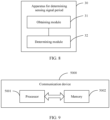
- a communication device includes a processor and a memory.
- the memory stores a program or instructions executable on the processor. When the program or instructions are executed by the processor, the steps of the method according to the first aspect are implemented.
- a communication device including a processor and a communication interface.
- the processor is configured to: obtain first information, where the first information includes at least one of the following: sensing prior information, coverage requirement information, sensing object type information, and motion parameter of a sensing object; and determine, based on the first information, a target sensing signal period value from a sensing signal period parameter set, where the sensing signal period parameter set includes at least one sensing signal period value; where the sensing prior information is used to indicate a motion parameter range of the sensing object, the coverage requirement information is used to indicate a range coverage of the sensing object, and the sensing object type information is used to indicate a velocity range of the sensing object.
- a readable storage medium stores a program or instructions, and when the program or instructions are executed by a processor, the steps of the method according to the first aspect are implemented.
- a chip includes a processor and a communication interface.
- the communication interface is coupled to the processor, and the processor is configured to run a program or instructions to implement the method according to the first aspect.
- a computer program/program product is provided.
- the computer program/program product is stored in a storage medium, and the computer program/program product is executed by at least one processor to implement the steps of the method for determining sensing signal period according to the first aspect.
- the first device can determine a sensing signal period value based on sensing prior information to be sensed, coverage requirement information to be sensed, sensing object type information to be sensed, and/or motion parameter of a sensing object, so as to adaptively adjust the sensing signal period value, so that sensing object detection performance of radar can satisfy a changing sensing requirement and/or motion parameter, and optimize time resource allocation for integrated sensing and communication.
- first, second, and the like in the specification and claims of this application are used to distinguish between similar objects rather than to describe a specific order or sequence. It should be understood that the terms used in this way are interchangeable in appropriate circumstances such that the embodiments of this application can be implemented in other orders than the order illustrated or described herein.
- objects distinguished by “first” and “second” are generally of a same type, and the quantities of the objects are not limited. For example, there may be one or more first objects.
- “and/or” indicates at least one of the connected objects, and the character “/” generally indicates an "or” relationship between the contextually associated objects.
- technologies described in the embodiments of this application are not limited to a long term evolution (Long Term Evolution, LTE) or LTE-Advanced (LTE-Advanced, LTE-A) system, and may also be applied to other wireless communication systems, for example, code division multiple access (Code Division Multiple Access, CDMA), time division multiple access (Time Division Multiple Access, TDMA), frequency division multiple access (Frequency Division Multiple Access, FDMA), orthogonal frequency division multiple access (Orthogonal Frequency Division Multiple Access, OFDMA), single-carrier frequency division multiple access (Single-carrier Frequency Division Multiple Access, SC-FDMA), and other systems.
- code division multiple access Code Division Multiple Access
- TDMA time division multiple access
- FDMA frequency division multiple access
- OFDMA Orthogonal frequency division multiple access
- SC-FDMA single-carrier Frequency Division Multiple Access
- system and “network” in the embodiments of this application are often used interchangeably, and the technology described herein may be used in the above-mentioned systems and radio technologies as well as other systems and radio technologies.
- NR New Radio
- NR terms are used in most of the following descriptions, although these technologies may also be applied to other applications than an NR system application, for example, the 6th generation (6th Generation, 6G) communication system.
- FIG. 1 is a block diagram of a wireless communication system to which the embodiments of this application may be applied.
- the wireless communication system includes a terminal 11 and a network-side device 12.
- the terminal 11 may be a terminal-side device, such as a mobile phone, a tablet personal computer (Tablet Personal Computer), a laptop computer (Laptop Computer) or a notebook computer, a personal digital assistant (Personal Digital Assistant, PDA), a palmtop computer, a netbook, an ultra-mobile personal computer (ultra-mobile personal computer, UMPC), a mobile Internet device (Mobile Internet Device, MID), an augmented reality (Augmented Reality, AR)/virtual reality (Virtual Reality, VR) device, a robot, a wearable device (Wearable Device), vehicle user equipment (VUE), or pedestrian user equipment (PUE), a smart appliance (a home appliance with a wireless communication function, for example, a refrigerator, a television, a washing machine, or furniture), a game console, a personal computer (personal computer
- the wearable device includes a smart watch, a smart band, a smart earphone, smart glasses, smart jewelry (a smart bangle, a smart bracelet, a smart ring, a smart necklace, a smart foot bangle, a smart anklet, or the like), a smart wristband, smart clothing, or the like.
- the network-side device 12 can include an access network device or core network device, where the access network device can also be referred to as a radio access network device, radio access network (Radio Access Network, RAN), radio access network function, or radio access network unit.
- RAN Radio Access Network
- the access network device can include base stations, wireless local area network (Wireless Local Area Network, WLAN) access points, wireless fidelity (Wireless Fidelity, WiFi) nodes, or the like.
- the base station can be referred to as Node B, evolved Node B (eNB), access point, base transceiver station (Base Transceiver Station, BTS), radio base station, radio transceiver, basic service set (Basic Service Set, BSS), extended service set (Extended Service Set, ESS), home Node B, home evolved Node B, transmitting receiving point (Transmitting Receiving Point, TRP), or other appropriate terms in the field.
- the base station is not limited to any specific technical terminology.
- the core network device can include but is not limited to at least one of the following: core network node, core network function, mobility management entity (Mobility Management Entity, MME), access and mobility management function (Access and Mobility Management Function, AMF), session management function (Session Management Function, SMF), user plane function (User Plane Function, UPF), policy control function
- MME mobility management entity
- AMF Access and Mobility Management Function
- SMF Session Management Function
- UPF User Plane Function
- Policy Control Function Policy Control Function
- Policy and Charging Rules Function Policy and Charging Rules Function
- edge application server discovery function Edge Application Server Discovery Function, EASDF
- unified data management Unified Data Management, UDM
- unified data repository Unified Data Repository, UDR
- home subscriber server Home Subscriber Server, HSS
- centralized network configuration Centralized network configuration, CNC
- network repository function Network Repository Function, NRF
- network exposure function Network Exposure Function, NEF
- local NEF Local NEF
- BSF Binding Support Function
- Application Function Application Function, AF
- Future 5th generation (5th Generation, 5G) and 6G wireless communication systems are expected to provide various high-precision sensing services, such as indoor positioning for robot navigation, Wi-Fi sensing for smart home devices, and radar sensing for self-driving vehicles. Sensing and communication systems are often designed separately and occupy different bands.
- a communication signal in a future wireless communication system usually has high resolution in both time domain and angle domain. This makes it possible to implement high-precision sensing by using a communication signal. Therefore, it is best to co-design sensing and communication systems so that they can share a same band and hardware to improve frequency efficiency and reduce hardware costs.
- ISAC Integrated Sensing And Communication
- a self-driving vehicle obtains a large amount of information from the network, including an ultra-high-resolution map and near real-time information, so as to perform navigation and avoid an upcoming traffic congestion.
- a radar sensor in a self-driving vehicle should provide a powerful, high-resolution obstacle detection function at a resolution of the order of centimeters.
- the ISAC technology for self-driving vehicles provides the possibility of high data rate communication and high resolution obstacle detection using the same hardware and spectrum resources.
- ISAC Advanced reality
- XR Extended Reality
- Mix reality mixed reality
- ISAC has attracted tremendous research interest and attention from the academia and industry. For example, there are a growing number of recent academic publications on ISAC, ranging from transceiver architecture design, ISAC waveform design, joint coding design, time-frequency-spatial signal processing, experimental performance latency, prototype design, and field testing.
- ISAC achieves the low-cost implementation of integrated communication and sensing through hardware device sharing and software-defined functions, and has the following characteristics: unified and simplified architecture, reconfigurable and expandable functions, and improved efficiency and reduced costs.
- Three advantages of integrated sensing and communication are reduced device costs and size, increased spectrum utilization, and improved system performance.
- ISAC development of ISAC is usually divided into four stages: coexistence, co-operation, co-design, and collaboration.
- Coexistence Communication and sensing are two separate systems that interfere with each other.
- the main ways to solve such interference include: isolation by range, isolation by band, time division, MIMO technology, pre-coding, and the like.
- Co-operation Communication and sensing share a hardware platform and use common information to enhance their common performance. Power allocation between the two has a significant influence on system performance.
- the main problems are a low signal-to-noise ratio, mutual interference, and a low throughput.
- Co-design Communication and sensing become a completely joint system, including joint signal design, waveform design, coding design, and the like.
- the focus is on linear frequency modulation waveforms, spread spectrum waveforms, and the like, and in a later stage, the focus is on orthogonal frequency division multiplexing (Orthogonal Frequency Division Multiplexing, OFDM) waveforms, MIMO technology, and the like.
- OFDM Orthogonal Frequency Division Multiplexing
- Table 1 (typical scenarios of integrated sensing and communication) Wireless sensing category Sensing function
- Table 1 Large-scale macro sensing Weather, air quality, and others Meteorology, agriculture, and life services
- Vehicle flow intersections
- pedestrian flow subway entrances
- Animal activities migration, and others Livestock industry, ecological environment protection, and others
- Target tracking ranging, velocity measurement, shape contour, and others
- Radar Radio Detection and Ranging
- radar detection not only measures a range of a target, but also includes measuring a velocity, azimuth, and pitch angle of the target, and extracting more information about the target from the above information, including a size and a shape of the target.
- the radar technology was initially used for military purposes to detect targets such as aircraft, missiles, vehicles, and ships. With the development of technology and the evolution of society, radar is increasingly used in civilian scenarios. Atypical application is weather radar which measures an echo of meteorological targets such as clouds and rain to determine information about a location and intensity of clouds and rain for weather forecasting. Furthermore, with the booming development of the electronics information industry, internet of things, communication technology, and the like, the radar technology has started to enter people's daily life application, greatly improving the convenience and safety of work and life. For example, automotive radar provides early warning information for vehicle driving by measuring a range and relative velocity between vehicles, between vehicles and surrounding environmental objects, and between vehicles and pedestrians, greatly improving the safety level of road traffic.
- radar By location relationship between radar transmitting and receiving sites, radar may be classified into: single-site radar and double-site radar.
- single-site radar a signal transmitter and receiver are integrated and share an antenna.
- the advantage is that a target echo signal and a local oscillator of the receiver are naturally coherent and thus signal processing is convenient.
- the disadvantage is that signal transmission and reception cannot be performed at the same time, and only signal waveforms with a certain duty cycle can be adopted. Consequently, a detection blind spot is caused and a complex algorithm needs to be adopted for compensation.
- signal transmission and reception are performed at the same time, and transmission and reception are strictly separated, but this is difficult for high-power military radar.
- a signal transmitter and receiver are located at different locations.
- the advantage is that a signal can be transmitted and received at the same time, and continuous wave waveforms can be used for detection.
- the disadvantage is that it is difficult to achieve co-frequency and coherence between the receiver and the transmitter, leading to complex signal processing.
- the radar technology may adopt either a single-site radar mode or a double-site radar mode.
- signal transmission and reception share an antenna, and a to-be-received signal and a to-be-transmitted signal enter different radio frequency processing links via a circulator.
- continuous wave signal waveforms can be used to achieve blind spot-free detection, on the premise that the to-be-received signal and the to-be-transmitted signal need to be well separated, usually requiring an isolation of about 100 dB, to avoid flooding of the to-be-received signal by the leakage of the to-be transmitted signal.
- signal processing may be carried out by matching filtering (pulse compression) to obtain a high signal processing gain.
- synchronization signal for example, primary synchronization signal (Primary Synchronization Signal, PSS)/secondary synchronization signal (Secondary Synchronization Signal, SSS)
- reference signal for example, demodulation reference signal (Demodulation Reference Signal, DMRS)/channel state information reference signal (Channel State Information Reference Signal, CSI-RS)
- PSS Primary Synchronization Signal
- SSS secondary synchronization signal
- reference signal for example, demodulation reference signal (Demodulation Reference Signal, DMRS)/channel state information reference signal (Channel State Information Reference Signal, CSI-RS)
- DMRS demodulation Reference Signal
- CSI-RS Channel State Information Reference Signal
- an ambiguity diagram of signal waveforms is no longer a thumbtack shape, but a thumbtack board shape, the ambiguity of latency and Doppler will increase, and the gain of a main lobe is much lower than that in the single-site radar mode, reducing the measurement range of distance and velocity.
- the measurement range of distance and velocity can satisfy measurement requirements of common targets such as vehicles and pedestrians.
- the measurement accuracy of double-site radar is related to a location of a target relative to transmitting and receiving sites, and therefore, an appropriate transmitting and receiving site pair needs to be selected to improve the detection performance.
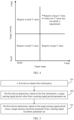
- FIG. 2 is a flowchart of a method for determining sensing signal period according to an embodiment of this application. As shown in FIG. 2 , the method for determining sensing signal period provided in this embodiment of this application may include the following steps 201 and 202.
- Step 201 A first device obtains first information.
- the first information includes at least one of the following: sensing prior information, coverage requirement information, sensing object type information, and motion parameter of a sensing object.
- the sensing prior information is used to indicate a motion parameter range of the sensing object
- the coverage requirement information is used to indicate a range coverage of the sensing object
- the sensing object type information is used to indicate a velocity range of the sensing object.
- the first information may be pre-configured, predefined, agreed in a protocol, autonomously determined by the first device, generated in real time, sent by another device, or the like.
- step 201 may be specifically implemented by the following step 2001 or step 2002.
- Step 2001 The first device receives the first information.
- the first information includes at least one of the following: sensing prior information, coverage requirement information, sensing object type information, and motion parameter of a sensing object.
- the motion parameter of the sensing object may be a motion parameter obtained by another device by processing a radar signal, and the motion parameter is sent to the first device.
- the first device may receive the first information from the another device.
- the another device may be a sensing function network element, another application server, or the like.
- the another device may be UE, another application server, or the like.
- Step 2002 The first device processes a radar signal to obtain the first information.
- the first information includes the motion parameter of the sensing object.
- the first device may receive the first information from another device.
- the first device may process the radar signal to obtain the first information used for determining a sensing signal period of a next sensing signal frame.
- a sensing node may perform radar signal processing on obtained echo data (that is, echo data obtained by sending, in the initial search stage or tracking stage, a generated sensing signal, and receiving a reflected echo signal corresponding to the sensing signal, such as target echo data mentioned in the following embodiment) to obtain the motion parameter of the sensing object.
- obtained echo data that is, echo data obtained by sending, in the initial search stage or tracking stage, a generated sensing signal, and receiving a reflected echo signal corresponding to the sensing signal, such as target echo data mentioned in the following embodiment
- a sensing node may perform radar signal processing on obtained echo data to obtain the motion parameter of the sensing object, and send the motion parameter of the sensing object to a sensing function network element.
- a sensing node may send obtained echo data to a sensing function network element, so that the sensing function network element performs radar signal processing on the echo data to obtain the motion parameter of the sensing object.
- a sensing node may send obtained echo data to a sensing function network element, so that the sensing function network element performs radar signal processing on the echo data to obtain the motion parameter of the sensing object, and sends the motion parameter of the sensing object to the sensing node.
- a sensing node may perform partial calculation of radar signal processing on obtained echo data to obtain an intermediate sensing result of the sensing object, and send the intermediate sensing result to a sensing function network element, so that the sensing function network element performs remaining calculation of the radar signal processing on the intermediate sensing result to obtain the motion parameter of the sensing object.
- a sensing node may perform partial calculation of radar signal processing on obtained echo data to obtain an intermediate sensing result of the sensing object, and send the intermediate sensing result to a sensing function network element, so that the sensing function network element performs remaining calculation of the radar signal processing on the intermediate sensing result to obtain the motion parameter of the sensing object, and sends the motion parameter of the sensing object to the sensing node.
- the initial search stage refers to a process, at the beginning of radar detection, of discovering a target (that is, the sensing object) by traversing each angle interval, range interval and/or velocity interval in a scope specified by sensing prior information in a sensing requirement. In a case that a specified target parameter is obtained, the search stage ends.
- the tracking stage refers to that after discovering the sensing object through the initial search stage and obtaining the specified target parameter, radar continuously detects the sensing object by using the target parameter or a certain range containing the target parameter, and updates the target parameter based on the detection result.
- the first device may be an integrated sensing and communication node (hereinafter referred to as a sensing node) or a sensing function network element.
- a sensing node an integrated sensing and communication node
- a sensing function network element a sensing function network element
- the sensing node in this embodiment of this application refers to a device that transmits and/or receives a sensing signal.
- the sensing function network element refers to a network node in a core network and/or wireless access network that is responsible for at least one of the functions of sensing request processing, sensing resource scheduling, sensing information exchange, sensing data processing, and the like, and may be a network element upgraded from an AMF or location management function (Location Management Function, LMF) in an existing 5G network, or may be another network node or newly defined network node. This is not limited in this embodiment of this application.
- LMF Location Management Function
- the sensing node may be any of the following: base station, user equipment (User Equipment, UE), TRP, reconfigurable intelligent surface (Reconfigurable Intelligent Surface, RIS), access point (Access Point, AP), and the like.
- the sensing prior information refers to information, provided to the sensing node, about a spatial scope and/or motion characteristic of a sensing target or sensing area, and such information helps the sensing node to narrow down a search scope.
- the sensing prior information may include at least one of the following: spatial scope prior information: range or location scope, angle interval, and/or the like of target to be sensed or sensing area; and motion characteristic prior information: velocity range, acceleration range, and/or the like of target to be sensed.
- the sensing prior information includes at least one of the following: sensing velocity prior information and sensing range prior information.
- the coverage requirement information is determined by at least one of the following: regional range of sensing object, location information of sensing node, and range coverage capability of sensing node.
- the coverage requirement information may be determined based on all of regional range of sensing object, location information of sensing node, and range coverage capability of sensing node.
- the location information of sensing node includes the following two cases.
- the location information of sensing node is known.
- the location information of sensing node may be obtained by accessing a network function storing the location information of sensing node (for example, reporting by a network management system, unified data management UDM, or the sensing node).
- a sensing function network element may first obtain the location information of sensing node.
- the method for obtaining the location information may be requesting a positioning management function or another service function to obtain location information.
- the positioning management function may be a location management function LMF, or a network function that receives location information for minimization of drive test (Minimization of Drive Test, MDT).
- the positioning service function may be an application function (Application Function, AF), and the AF may be a positioning server such as a Wi-Fi, bluetooth (Bluetooth), Zigbee (Zigbee) network, or ultra wideband (Ultra Wideband, UWB), or may be an application function (for example, a map application) that can obtain positioning information from the global positioning system (Global Positioning System, GPS) and the like.
- Application Function Application Function
- AF Application Function
- the AF may be a positioning server such as a Wi-Fi, bluetooth (Bluetooth), Zigbee (Zigbee) network, or ultra wideband (Ultra Wideband, UWB)
- an application function for example, a map application that can obtain positioning information from the global positioning system (Global Positioning System, GPS) and the like.
- the range coverage capability of sensing node refers to a coverage capability of a sensing node to satisfy a sensing indicator in a sensing requirement by using software and hardware capabilities not used by a high-priority task.
- the range coverage capability of sensing node is a coverage capability of a sensing node to satisfy a sensing indicator requirement by using all software and hardware capabilities.
- the velocity range of the sensing object indicated by the sensing object type information includes at least one of the following: low-velocity target: the type of the sensing object is pedestrian, with a movement velocity of below 15 km/h; medium-velocity target: the type of the sensing object is bicycle, with a movement velocity of below 30 km/h; and high-velocity target: the type of the sensing object is vehicle, with a movement velocity of above 30 km/h.
- the motion parameter of the sensing object includes at least one of the following: range information, velocity information, and motion direction, where the motion direction is the sensing object approaching the sensing node or the sensing object leaving the sensing node.
- sensing objects have large diversity and variability in range and velocity. For example, a movement velocity of high-velocity vehicles may reach 30 m/s, while a movement velocity of pedestrians on the side of a road is usually at an order of magnitude of 1 m/s or below. A speeding car may move from thousands of kilometers away to just a few meters away. Therefore, in the application of integrated sensing and communication, a value of a sensing signal period for radar detection may be adaptively adjusted with a motion parameter of a sensing object.
- Step 202 The first device determines, based on the first information, a target sensing signal period value from a sensing signal period parameter set.
- the sensing signal period parameter set includes at least one sensing signal period value.
- the sensing signal period value in this embodiment of this application refers to a time length of a sensing signal corresponding to one fast time-domain radar signal processing performed by a sensing node.
- the sensing signal period parameter set may be pre-designed and stored in a sensing function network element, or in a network node that a sensing function network element can access.
- the sensing signal period parameter set has at least one of the following characteristics:
- a target part of the sensing signal period values in the sensing signal period parameter set satisfies both the preset maximum sensing object range requirement and the preset maximum sensing object velocity requirement, and the target part of the sensing signal period values includes at least one of the following: some of the first part of the sensing signal period values, and some of the second part of the sensing signal period values.
- the sensing signal period parameter set includes at least two first sensing signal period subsets, each first sensing signal period subset corresponds to one type of motion mode, each first sensing signal period subset includes at least one sensing signal period value, the sensing signal period values included in the at least two first sensing signal period subsets are different, and the sensing signal period values included in the at least two first sensing signal period subsets either intersect or do not intersect.
- the sensing signal period values of the at least two first sensing signal period subsets either intersect or do not intersect may be understood as: sensing signal period values of all of the at least two first sensing signal period subsets are completely different; sensing signal period values of all of the at least two first sensing signal period subsets are partially the same; or sensing signal period values of some of the at least two first sensing signal period subsets are partially the same.
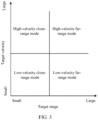
- the sensing signal period parameter set may be classified into four motion modes by magnitude of the range (that is, target range) of the sensing object and magnitude of the velocity (that is, target velocity) of the sensing object.
- these four motion modes include: low-velocity close-range mode, low-velocity far-range mode, high-velocity close-range mode, and high-velocity far-range mode.
- the high-velocity far-range mode includes at least one sensing signal period value pair used in a case that a first constraint condition and a second constraint condition cannot be satisfied at the same time.
- the sensing signal period value pair is two sensing signal period values that are coprime to each other. One of the sensing signal period values satisfies the first constraint condition, and the other of the sensing signal period values satisfies the second constraint condition.
- a range threshold and/or velocity threshold for the motion mode division may vary with device characteristics.
- a range threshold for a macro base station with wide area coverage differs from a range threshold of a micro base station with hotspot coverage.
- the sensing signal period parameter set includes at least one of the following: a sensing signal period parameter subset of a sensing-oriented signal, a sensing signal period parameter subset of a communication-oriented signal, and a sensing signal period parameter subset of an integrated sensing and communication signal.
- a subset to which a value of each sensing signal period belongs may be at least one of sensing signal period parameter subset for sensing-oriented signal, sensing signal period parameter subset for communication-oriented signal, and sensing signal period parameter subset for integrated sensing and communication signal.
- the sensing signal period parameter subset for sensing-oriented signal may be a sensing signal period parameter set consisting of multiple sensing signal periods designed based on multiple typical targets in integrated sensing and communication applications and a typical coverage in integrated sensing and communication scenarios and having the foregoing attribute requirements taken into consideration.
- the sensing-oriented signal may include at least one of the following: linear frequency modulation (Linear Frequency Modulation, LFM) pulse signal, frequency modulated continuous wave (Frequency Modulated Continuous Wave, FMCW) radar signal, OFDM radar signal, phase-coded radar signal, spread spectrum coded radar signal, and the like.
- LFM Linear Frequency Modulation
- FMCW Frequency Modulated Continuous Wave
- OFDM radar signal phase-coded radar signal
- spread spectrum coded radar signal and the like.
- the communication-oriented signal may include at least one of the following: NR signal, Wi-Fi signal, and the like.
- the sensing signal period may be any of the following: pulse repetition period of pulse radar signal, and chirp (chirp) period of FMCW radar signal.
- the sensing signal period may be any of the following: signal period of NR synchronization signal and PBCH block (Synchronization Signal and PBCH Block, SSB), integer multiple of symbol duration of NR demodulation reference signal (Demodulation Reference Signal, DM-RS), and sequence period of Wi-Fi preamble (Preamble).
- the sensing signal period may be pulse repetition period.
- a period value of the sensing-oriented signal is any value that satisfies a preset maximum unambiguous velocity (Maximum Unambiguous Velocity, MUV) requirement and/or a preset maximum unambiguous range (Maximum Unambiguous Range, MUR) requirement.
- MUV intervals in radar detection are classified into the following two cases.
- a positive or negative velocity indicates that the sensing object is leaving or approaching the radar.
- the positive or negative velocity may be defined by polarities of a coordinate system in specific application. It may be defined that the sensing object leaving the radar is positive velocity, or it may be defined that the sensing object leaving the radar is negative velocity.
- an MUR in radar detection is cT /2.
- sensing signal period requirements of MUV and MUR are contrary in radar detection.
- magnitude of velocity (that is, target velocity) of the sensing object and magnitude of range (target range) of the sensing object there may be four classified cases as shown in FIG. 4 .
- a period value of the communication-oriented signal includes any one of the following: a sum of any integer number of symbol periods corresponding to the communication-oriented signal; and any combination of synchronization signal period value and/or reference signal time domain interval.
- the communication-oriented signal being an NR signal is used as an example.
- the communication-oriented signal uses an OFDM signal waveform, with a smallest unit of time domain resource allocation being OFDM symbol period. Therefore, a sensing signal period includes an integer number of symbol periods, and a value of the sensing signal period is a sum of the integer number of the symbol periods.
- a receiving end knows all sent information, and any signal may be used as a sensing signal, for example, synchronization signal, reference signal, or data signal.
- a value of a sensing signal period may be a sum of any integer number of symbol periods.
- a period value of the integrated sensing and communication signal takes into account both communication and sensing requirements.
- the value of the sensing signal period is flexible on the one hand, as in the case of a sensing-oriented signal, and is limited by a communication function to some extent on the other hand, as in the case of a communication-oriented signal.
- the sensing signal period includes multiple communication symbols; and secondly, with reference to a duty cycle design, the sensing signal period may take continuous values within a certain range.
- step 202 may be specifically implemented by the following step 202a and step 202b.
- Step 202a The first device determines a target MUV and a target MUR based on the first information.
- the target sensing signal period value is related to an MUV interval and an MUR in radar detection, that is, the first device may first determine the MUV interval and the MUR, and then determine the target sensing signal period value based on the MUV interval and the MUR.
- the first information includes the coverage requirement information and the sensing object type information.
- Step 202a may be specifically implemented by the following step 202a1 and step 202a2.
- Step 202a The first device determines the target MUV based on the sensing object type information.
- Step 202a2 The first device determines the target MUR based on the coverage requirement information.
- the first device may set/determine a value of MUV (that is, the target MUV) based on a motion velocity range corresponding to the sensing object type information in a sensing requirement, with a certain redundancy taken into account. Moreover, the first device may set a value of MUR (that is, the target MUR) based on a range coverage corresponding to the coverage requirement information in the sensing requirement, with a certain redundancy taken into account.
- the first information includes the sensing prior information and the coverage requirement information
- the sensing prior information includes sensing velocity prior information.
- Step 202a may be specifically implemented by the following step 202a3 and step 202a4.
- the first device determines the target MUV based on the sensing velocity prior information.
- Step 202a4 The first device determines the target MUR based on the coverage requirement information.
- the first device may set a value of MUV based on the sensing velocity prior information, with a certain redundancy taken into account. Moreover, the first device may set a value of MUR based on a range coverage corresponding to the coverage requirement information in the sensing requirement, with a certain redundancy taken into account.
- the first information includes the sensing prior information and the sensing object type information
- the sensing prior information includes sensing range prior information.
- Step 202a may be specifically implemented by the following step 202a5 and step 202a6.
- Step 202a5. The first device determines the target MUV based on the sensing object type information.
- Step 202a6 The first device determines the target MUR based on the sensing range prior information.
- the first device may set a value of MUV based on a motion velocity range corresponding to the sensing object type information in a sensing requirement, with a certain redundancy taken into account. Moreover, the first device may set a value of MUR based on the sensing range prior information, with a certain redundancy taken into account.
- the first information includes the sensing prior information
- the sensing prior information includes sensing velocity prior information and sensing range prior information.
- Step 202a may be specifically implemented by the following step 202a7 and step 202a8.
- Step 202a7 The first device determines the target MUV based on the sensing velocity prior information.
- Step 202a8 The first device determines the target MUR based on the sensing range prior information.
- the first device may set a value of MUV based on the sensing velocity prior information, with a certain redundancy taken into account. Moreover, the first device may set a value of MUR based on the sensing range prior information, with a certain redundancy taken into account.
- the first information includes the motion parameter of the sensing object.
- Step 202a may be specifically implemented by the following step 202a9 and step 202a10.
- the first device determines the target MUV based on velocity information in the motion parameter of the sensing object.
- Step 202a10 The first device determines the target MUR based on range information in the motion parameter of the sensing object.
- the first device may set a value of MUV based on a real-time velocity of the sensing object, with a certain redundancy taken into account. Moreover, the first device may set a value of MUR based on a real-time range of the sensing object, with a certain redundancy taken into account.
- the real-time velocity of the sensing object may be any of the following: velocity measured for current sensing signal frame, and predicted value of velocity for next sensing signal frame using prediction method.
- the real-time range of the sensing object may be any of the following: range measured for current sensing signal frame, and predicted value of range for next sensing signal frame using prediction method.
- the sensing signal frame includes multiple sensing signal period time lengths, and in radar detection, range and/or velocity and/or angle values of a set of targets are output at the end of signal processing for one sensing signal frame.
- Specific content of the prediction method is implementation content of a sensing node, which is not described in this embodiment of this application.
- the prediction method may be executed by a sensing node or a sensing function network element.
- Step 202b The first device determines, based on the target MUV and the target MUR, the target sensing signal period value from the sensing signal period parameter set.
- step 202b may be specifically implemented by the following step 202b1 and step 202b2.
- Step 202b1 The first device determines a first constraint condition based on the target MUV, and determines a second constraint condition based on the target MUR.
- the first constraint condition in a case that a velocity direction of the sensing object is unknown, is that the sensing signal period value is less than or equal to 1 2 ⁇ max ; or in a case that a velocity direction of the sensing object is known, the first constraint condition is that the sensing signal period value is less than or equal to 1 ⁇ max .
- v max is the target MUV
- a velocity direction of the sensing object being unknown may be applicable to a case of being in an initial search stage and having no sensing velocity prior information.
- a velocity direction of the sensing object being known may be applicable to a case of being in an initial search stage and having sensing velocity prior information, or may be applicable to a case of being in a tracking stage.
- the second constraint condition is that the sensing signal period value is greater than or equal to 2 R max c .
- R max is the target MUR
- c is the velocity of light.
- Step 202b2. The first device determines, based on the first constraint condition and the second constraint condition, the target sensing signal period value from the sensing signal period parameter set.
- step 202b2 may be specifically implemented by the following step 202b21 or step 202b22.
- Step 202b21 In a case that a sensing signal period value that satisfies both the first constraint condition and the second constraint condition is present in the sensing signal period parameter set, the first device determines the sensing signal period value, in the sensing signal period parameter set, that satisfies both the first constraint condition and the second constraint condition as the target sensing signal period value.
- one sensing signal period value is selected from the sensing signal period value that satisfies the condition as the target sensing signal period value.
- a sensing signal period value that satisfies both the first constraint condition and the second constraint condition is present in the sensing signal period parameter set: values of MUV and MUR cannot both be large simultaneously, that is, either the value of MUV or the value of MUR takes a larger value; or values of MUV and MUR are both small.
- Step 202b22 In a case that a sensing signal period value that satisfies both the first constraint condition and the second constraint condition is absent from the sensing signal period parameter set, the first device determines that the target sensing signal period value includes one of the following: two period values of coprime sensing signal period values in the sensing signal period parameter set, and one sensing signal period value, in the sensing signal period parameter set, that satisfies the first constraint condition or the second constraint condition.
- a sensing signal period value that satisfies both the first constraint condition and the second constraint condition is absent from the sensing signal period parameter set can be understood as: values of MUV and MUR are both large.
- one of the two period values (the two period values of coprime sensing signal period values) satisfies the first constraint condition (that is, the MUV requirement), and the other of the two period values satisfies the second constraint condition (that is, the MUR requirement).
- the one sensing signal period value (a sensing signal period value that satisfies the first constraint condition or the second constraint condition) satisfies one of target constraint conditions, and a difference between the one sensing signal period value and a sensing signal period value required by the other of the target constraint conditions is less than or equal to a first preset threshold;
- the target constraint conditions include the first constraint condition and the second constraint condition.
- the one sensing signal period value satisfies one of target constraint conditions
- a difference between the one sensing signal period value and a sensing signal period value required by the other of the target constraint conditions is less than or equal to a second preset threshold
- a motion parameter corresponding to the other constraint condition has prior information and/or a motion parameter value that satisfies a sensing requirement, where the motion parameter value is any one of the following: measured value of the motion parameter and predicted value of the motion parameter.
- the target constraint conditions include the first constraint condition and the second constraint condition.
- one sensing signal period value may still be used.
- the sensing signal period value can be used.
- the sensing signal period T can be used in a case that a sensing signal period T can satisfy the first constraint condition but cannot satisfy the second constraint condition, while kT can satisfy the second constraint condition.
- a sensing signal period T can satisfy the second constraint condition but cannot satisfy the first constraint condition, while T/k can satisfy the first constraint condition, the sensing signal period T can be used.
- k is a value greater than 1 and less than or equal to 1.2.
- a sensing signal period value can satisfy one of the first constraint condition and the second constraint condition, and the ambiguity of range and/or velocity measurement value brought about by using one sensing signal period can be eliminated by using a range and/or velocity prediction method.
- the sensing signal period value can be used.
- sensing range prior information and/or sensing velocity prior information that is, a motion parameter corresponding to a constraint condition has prior information that satisfies a sensing requirement.
- a sensing signal period value can satisfy one of the first constraint condition and second constraint condition and has a small deviation from the other constraint condition (that is, a difference between the sensing signal period value and a sensing signal period value required by the other constraint condition is less than or equal to the second preset threshold), and one of the first constraint condition and second constraint conditions that is not satisfied (that is, a motion parameter corresponding to the constraint condition unmet has prior information that satisfies a sensing requirement) has relatively accurate prior information.
- the sensing signal period T can be used in a case that a sensing signal period T can satisfy the first constraint condition but cannot satisfy the second constraint condition, while kT can satisfy the second constraint condition, and there is relatively accurate range prior information.
- the sensing signal period T can be used in a case that a sensing signal period T can satisfy the second constraint condition but cannot satisfy the first constraint condition, while T/k can satisfy the first constraint condition, and there is relatively accurate velocity prior information.
- the motion parameter corresponding to the other constraint condition in a case that the motion parameter corresponding to the first constraint condition is velocity, the motion parameter corresponding to the second constraint condition is range.
- the first device may determine a sensing signal period value based on sensing prior information to be sensed, coverage requirement information to be sensed, sensing object type information to be sensed, and/or motion parameter of a sensing object, to adaptively adjust the sensing signal period value, so that sensing object detection performance of radar can satisfy a changing sensing requirement and/or motion parameter, and optimize time resource allocation for integrated sensing and communication.
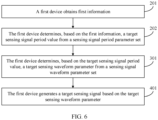
- the method for determining sensing signal period provided in this embodiment of this application further includes the following step 301.
- Step 301 The first device determines, based on the target sensing signal period value, a target sensing waveform parameter from a sensing signal waveform parameter set.
- the sensing signal waveform parameter set includes at least one sensing signal waveform parameter.
- the target sensing waveform parameter is used by the sensing node to generate a target sensing signal.
- the sensing signal waveform parameter mentioned in this embodiment of this application is a parameter corresponding to a sensing signal period and used for generating a sensing signal.
- One group of sensing signal waveform parameters corresponds to one sensing signal waveform, and all sensing signal waveform parameters constitute a sensing signal waveform parameter set.
- the sensing signal waveform parameter mentioned in this embodiment of this application is a waveform parameter for a time dimension or strongly related to a time dimension.
- the sensing signal waveform parameter in the sensing signal waveform parameter set corresponds one-to-one with the sensing signal period values, or multiple groups of sensing signal waveform parameters correspond to one sensing signal period value in the sensing signal waveform parameter set.
- the sensing signal waveform parameter set includes at least one of the following: a sensing signal waveform parameter subset of a sensing-oriented signal, a sensing signal waveform parameter subset of a communication-oriented signal, and a sensing signal waveform parameter subset of an integrated sensing and communication signal.
- the sensing signal waveform parameter subset of the sensing-oriented signal includes at least one of the following: sensing signal period, pulse width, duty cycle, bandwidth and frequency slope, OFDM subcarrier spacing and subcarrier number, spread spectrum code sequence, and phase coding sequence.
- the pulse width refers to a pulse time length of within one sensing signal period of a pulse waveform.
- the duty cycle refers to a ratio of a pulse time length to a sensing signal period within one sensing signal period of a pulse waveform.
- the bandwidth and frequency slope refer to a frequency modulation slope of an LFM signal or FMCW signal, measured in Hz/s.
- the sensing signal waveform parameter subset of the communication-oriented signal includes at least one of the following: configuration information of the communication-oriented signal, number of OFDM symbol periods included in sensing signal period, and offset of sensing signal period relative to subframe start position.
- the configuration information of communication-oriented signal includes OFDM subcarrier spacing configuration information and cyclic prefix (Cyclic Prefix, CP) configuration information.
- the number of OFDM symbol periods included in the sensing signal period may include the following two cases.
- the offset of sensing signal period relative to subframe start position is measured in OFDM symbol. Considering that a CP length of the first symbol of two 0.5 ms in a normal CP NR signal subframe is different from other symbols, in a case that the sensing signal periods include the same number of OFDM symbol periods but offsets relative to subframe start position are different, the sensing signal periods are different.
- the sensing signal waveform parameter of integrated sensing and communication signal has some of the sensing-oriented signal waveform parameters and some of the communication-oriented signal waveform parameters.
- the method for determining sensing signal period provided in this embodiment of this application further includes the following step 401.
- Step 401 The first device generates a target sensing signal based on the target sensing waveform parameter.
- the first device in step 401 is a sensing node.
- the target sensing signal is used by the sensing node to sense the sensing object.
- the method for determining sensing signal period provided in this embodiment of this application further includes the following steps 402 and 403.
- Step 402. The first device sends the target sensing waveform parameter to a sensing node.
- the first device in step 402 is a sensing function network element, and the target sensing waveform parameter is used by the sensing node to generate a target sensing signal.
- the sensing node receives the target sensing waveform parameter sent by the first device, and generates a target sensing signal based on the target sensing waveform parameter.
- the sensing node may directly generate the target sensing signal based on the target sensing waveform parameter after determining the target sensing waveform parameter.
- the sensing function network element needs to send the target sensing waveform parameter to the sensing node after determining the target sensing waveform parameter, so that the sensing node generates the target sensing signal based on the target sensing waveform parameter received.
- the method for determining sensing signal period provided in this embodiment of this application further includes the following step 501.
- Step 501 The first device sends the target sensing signal, and receives a target reflected echo signal to obtain target echo data.
- the target echo data is used for determining the sensing result of the sensing object
- the first device in step 501 is a sensing node.
- the sensing node may perform the sensing process, that is, transmit the target sensing signal, and receive the target reflected echo signal, so as to analyze the data of the target reflected echo signal to obtain the target echo data, and then determine the sensing result of the sensing object based on the target echo data.
- the sensing node may transmit the target sensing signal and receive the target reflected echo signal in a self-transmit and self-receive mode.
- step 501 may be specifically implemented by the following step 501a and step 501b.
- Step 501a The first device obtains a target transmit waveform parameter and a target receive waveform parameter from the target sensing waveform parameter.
- the target sensing waveform parameter includes at least one of the following: transmit waveform parameter, receive waveform parameter, and signal processing parameter.
- Step 501b The first device sends the target sensing signal by using the target transmit waveform parameter, and receives the target reflected echo signal by using the target receive waveform parameter, so as to obtain the target echo data.
- the method for determining sensing signal period provided in this embodiment of this application further includes any one of the following steps 601 to 606.
- Step 601. The first device performs radar signal processing on the target echo data to obtain the sensing result of the sensing object.
- Step 602. The first device performs radar signal processing on the target echo data to obtain the sensing result of the sensing object, and sends the sensing result of the sensing object to a sensing function network element.
- Step 603. The first device sends the target echo data to a sensing function network element, where the target echo data is used by the sensing function network element to perform radar signal processing so as to obtain the sensing result of the sensing object.
- Step 604. The first device sends the target echo data to a sensing function network element, where the target echo data is used by the sensing function network element to perform radar signal processing so as to obtain the sensing result of the sensing object and send the sensing result of the sensing object to the first device.
- Step 605. The first device performs partial calculation of radar signal processing on the target echo data to obtain an intermediate sensing result of the sensing object, and sends the intermediate sensing result to a sensing function network element, where the intermediate sensing result is used by the sensing function network element to perform remaining calculation of the radar signal processing so as to obtain the sensing result of the sensing object.
- Step 606 The first device performs partial calculation of radar signal processing on the target echo data to obtain an intermediate sensing result of the sensing object, and sends the intermediate sensing result to a sensing function network element, where the intermediate sensing result is used by the sensing function network element to perform remaining calculation of the radar signal processing so as to obtain the sensing result of the sensing object and send the sensing result of the sensing object to the first device.
- the first device may perform radar signal processing on the target echo data to obtain the sensing result of the sensing object, thereby realizing the sensing process of the sensing object.
- sensing signal period provided in this embodiment of this application and the sensing process are described below through specific implementation processes (that is, the initial search stage and tracking stage).
- Step 1 In the initial search stage, a sensing function network element or sensing node sets values of MUV and MUR in radar detection based on a sensing requirement; selects, based on the set values of MUV and MUR and a sensing signal type supported by a sensing node, a sensing signal period value from a sensing signal period parameter set; and selects, based on the sensing signal period value, a sensing signal waveform parameter from a sensing signal waveform parameter set.
- a method for the sensing function network element to obtain the sensing signal type supported by the sensing node is one of the following options:
- the sensing function network element reads information from itself or another accessible network node to obtain the sensing signal type supported by the sensing node.
- the sensing function network element sends a message to the sensing node to instruct the sensing node to report the sensing signal type supported by the sensing node, so that the sensing node reports the sensing signal type supported by the sensing node to the sensing function network element.
- the sensing signal period parameter set and the sensing signal waveform parameter set are pre-stored in the sensing function network element or the network node accessible by the sensing function network element, or pre-stored in the sensing node.
- Step 2 The sensing node generates a target sensing signal based on the sensing signal waveform parameter, and the sensing node sends the target sensing signal, and receives a target reflected echo signal corresponding to the target sensing signal to obtain target echo data.
- step 1 the process in step 1 is executed by the sensing function network element, before the sensing node generates the target sensing signal, the sensing node receives the sensing signal waveform parameter sent by the sensing function network element.
- the target sensing signal may be a sensing-oriented signal, a communication-oriented signal, or a communication-sensing integrated signal, which is specifically determined by the sensing signal type supported by the sensing node, and is consistent with a sensing signal type in the sensing signal waveform parameter received.
- the sensing node may perform radar signal processing on the target echo data, or may send the target echo data to the sensing function network element for radar signal processing.
- the specific method may be any one of the following.
- the sensing node performs radar signal processing on the target echo data to obtain the sensing result.
- the sensing node performs radar signal processing on the target echo data to obtain the sensing result, and sends the sensing result to the sensing function network element.
- the sensing node sends the target echo data to the sensing function network element, and the sensing function network element performs radar signal processing to obtain the sensing result.
- the sensing node performs partial calculations of radar signal processing to obtain an intermediate sensing result, and sends the intermediate sensing result to the sensing function network element.
- the sensing function network element performs remaining calculation of the radar signal processing on the intermediate sensing result to obtain the sensing result.
- Step 4 The sensing node and/or sensing function network element may repeatedly execute steps 1 to 3 until the sensing object is detected, and then enter the tracking stage, or the search fails and the sensing process ends.
- the search failure refers to that finding no sensing object that matches the sensing requirement after a preset time length of searching.
- Step 5 the sensing function network element or sensing node sets values of MUV and MUR in radar detection based on a motion parameter of the sensing objects; selects, based on the set values of MUV and MUR and the sensing signal type supported by the sensing node, a sensing signal period value from the sensing signal period parameter set to update the foregoing sensing signal period value; and selects, based on the sensing signal period value, a sensing signal waveform parameter from a sensing signal waveform parameter set to update the foregoing sensing signal waveform parameter.
- step 5 is executed by a sensing function network element, after the process in step 5 is completed, the sensing function network element sends to the sensing node the sensing signal waveform parameter updated.
- Step 6 The sensing node adjusts, based on the sensing signal waveform parameter updated, configuration information corresponding to the target sensing signal, and the sensing node generates and sends the target sensing signal, and receives a target reflected echo signal of the target sensing signal, to obtain target echo data.
- the configuration information corresponding to the target sensing signal may include at least one of the following: a transmit waveform parameter of the target sensing signal, a receive waveform parameter of the target reflected echo signal corresponding to the target sensing signal, and a signal processing parameter of the target echo data.
- step 5 the process in step 5 is executed by the sensing function network element, before the sensing node generates the target sensing signal, the sensing node receives the sensing signal waveform parameter updated.
- Step 7 After the sensing node obtains the target echo data, reference may be made to step 3 for the radar signal processing process.
- Step 8 The sensing node and/or sensing function network element may repeatedly execute steps 5 to 7 until the sensing process ends.
- the method for determining sensing signal period provided in this embodiment of this application may also be performed by an apparatus for determining sensing signal period, or a control module configured to perform the method for determining sensing signal period in the apparatus for determining sensing signal period.
- FIG. 8 is a possible schematic structural diagram of an apparatus for determining sensing signal period according to an embodiment of this application.
- the apparatus 30 for determining sensing signal period may include an obtaining module 31 and a determining module 32.
- the obtaining module 31 is configured to obtain first information, where the first information includes at least one of the following: sensing prior information, coverage requirement information, sensing object type information, and motion parameter of a sensing object.
- the determining module 32 is configured to determine, based on the first information obtained by the obtaining module 31, a target sensing signal period value from a sensing signal period parameter set, where the sensing signal period parameter set includes at least one sensing signal period value.
- the sensing prior information is used to indicate a motion parameter range of the sensing object
- the coverage requirement information is used to indicate a range coverage of the sensing object
- the sensing object type information is used to indicate a velocity range of the sensing object.
- An embodiment of this application provides an apparatus for determining sensing signal period.
- the apparatus for determining sensing signal period may determine a sensing signal period value based on sensing prior information to be sensed, coverage requirement information to be sensed, sensing object type information to be sensed, and/or motion parameter of a sensing object, to adaptively adjust the sensing signal period value, so that sensing object detection performance of radar can satisfy a changing sensing requirement and/or motion parameter, and optimize time resource allocation for integrated sensing and communication.
- the sensing prior information includes at least one of the following: sensing velocity prior information and sensing range prior information;
- the coverage requirement information is determined by at least one of the following: regional range of sensing object, location information of sensing node, and range coverage capability of sensing node;
- the motion parameter of the sensing object include at least one of the following: range information, velocity information, and motion direction, where the motion direction is the sensing object approaching the sensing node or the sensing object leaving the sensing node.
- the obtaining module 31 is specifically configured to: receive the first information, where the first information includes at least one of the following: the sensing prior information, the coverage requirement information, the sensing object type information, and the motion parameter of the sensing object; or process a radar signal to obtain the first information, where the first information includes the motion parameter of the sensing object.
- the determining module 32 is specifically configured to: determine a target MUV and a target MUR based on the first information; and determine, based on the target MUV and the target MUR, the target sensing signal period value from the sensing signal period parameter set.
- the first information includes the coverage requirement information and the sensing object type information; and the determining module 32 is specifically configured to determine the target MUV based on the sensing object type information and determine the target MUR based on the coverage requirement information.
- the first information includes the sensing prior information and the coverage requirement information
- the sensing prior information includes sensing velocity prior information
- the determining module 32 is specifically configured to determine the target MUV based on the sensing velocity prior information and determine the target MUR based on the coverage requirement information.
- the first information includes the sensing prior information and the sensing object type information
- the sensing prior information includes sensing range prior information
- the determining module 32 is specifically configured to determine the target MUV based on the sensing object type information and determine the target MUR based on the sensing range prior information.
- the first information includes the sensing prior information
- the sensing prior information includes sensing velocity prior information and sensing range prior information
- the determining module 32 is specifically configured to determine the target MUV based on the sensing velocity prior information and determine the target MUR based on the sensing range prior information.
- the first information includes the motion parameter of the sensing object; and the determining module 32 is specifically configured to determine the target MUV based on velocity information in the motion parameter of the sensing object and determine the target MUR based on range information in the motion parameter of the sensing object.
- the determining module 32 is specifically configured to: determine a first constraint condition based on the target MUV and determine a second constraint condition based on the target MUR; and determine, based on the first constraint condition and the second constraint condition, the target sensing signal period value from the sensing signal period parameter set.
- the first constraint condition in a case that a velocity direction of the sensing object is unknown, is that the sensing signal period value is less than or equal to 1 2 ⁇ max ; or in a case that a velocity direction of the sensing object is known, the first constraint condition is that the sensing signal period value is less than or equal to 1 ⁇ max ; and
- the determining module 32 is specifically configured to: in a case that a sensing signal period value that satisfies both the first constraint condition and the second constraint condition is present in the sensing signal period parameter set, determine the sensing signal period value, in the sensing signal period parameter set, that satisfies both the first constraint condition and the second constraint condition as the target sensing signal period value; or in a case that a sensing signal period value that satisfies both the first constraint condition and the second constraint condition is absent from the sensing signal period parameter set, determine that the target sensing signal period value includes one of the following: two period values of coprime sensing signal period values in the sensing signal period parameter set, and one sensing signal period value, in the sensing signal period parameter set, that satisfies the first constraint condition or the second constraint condition.
- one of the two period values satisfies the first constraint condition, and the other of the two period values satisfies the second constraint condition.
- the one sensing signal period value satisfies one of target constraint conditions, and a difference between the one sensing signal period value and a sensing signal period value required by the other of the target constraint conditions is less than or equal to a first preset threshold; or the one sensing signal period value satisfies one of target constraint conditions, a difference between the one sensing signal period value and a sensing signal period value required by the other of the target constraint conditions is less than or equal to a second preset threshold, and a motion parameter corresponding to the other constraint condition has prior information and/or a motion parameter value that satisfies a sensing requirement, where the motion parameter value is any one of the following: measured value of the motion parameter and predicted value of the motion parameter.
- the target constraint conditions include the first constraint condition and the second constraint condition.
- the sensing signal period parameter set includes at least one of the following: a sensing signal period parameter subset of a sensing-oriented signal, a sensing signal period parameter subset of a communication-oriented signal, and a sensing signal period parameter subset of an integrated sensing and communication signal;
- the sensing signal period parameter set includes at least two first sensing signal period subsets, each first sensing signal period subset corresponds to one type of motion mode, each first sensing signal period subset includes at least one sensing signal period value, the sensing signal period values included in the at least two first sensing signal period subsets are different, and the sensing signal period values included in the at least two first sensing signal period subsets either intersect or do not intersect.
- the sensing signal period parameter set has at least one of the following characteristics: the sensing signal period parameter set includes multiple different sensing signal period values; a first part of sensing signal period values in the sensing signal period parameter set satisfies a preset maximum sensing object range requirement, and a second part of the sensing signal period values in the sensing signal period parameter set satisfies a preset maximum sensing object velocity requirement; and at least two coprime sensing signal period values are present in the sensing signal period parameter set.
- a target part of the sensing signal period values in the sensing signal period parameter set satisfies both the preset maximum sensing object range requirement and the preset maximum sensing object velocity requirement, and the target part of the sensing signal period values includes at least one of the following: some of the first part of the sensing signal period values, and some of the second part of the sensing signal period values.
- the determining module 32 is further configured to determine, based on the target sensing signal period value, a target sensing waveform parameter from a sensing signal waveform parameter set, where the sensing signal waveform parameter set includes at least one sensing signal waveform parameter.
- the apparatus 30 for determining sensing signal period provided in this embodiment of this application further includes a generating module.
- the generating module is configured to: after the determining module 32 determines, based on the target sensing signal period value, the target sensing waveform parameter from the sensing signal waveform parameter set, generate a target sensing signal based on the target sensing waveform parameter, where the first device is a sensing node.
- the apparatus 30 for determining sensing signal period provided in this embodiment of this application further includes a sending module.
- the sending module is configured to: after the determining module 32 determines, based on the target sensing signal period value, the target sensing waveform parameter from the sensing signal waveform parameter set, send the target sensing waveform parameter to a sensing node, where the first device is a sensing function network element, and the target sensing waveform parameter is used by the sensing node to generate a target sensing signal.
- the target sensing signal is used by the sensing node to sense the sensing object.
- the apparatus 30 for determining sensing signal period further includes a sending module and a receiving module.
- the sending module is configured to: after the sensing node generating the target sensing signal, send the target sensing signal.
- the receiving module is configured to receive a target reflected echo signal to obtain target echo data, where the target echo data is used for determining a sensing result of the sensing object, and the first device is the sensing node.
- the sending module is specifically configured to: obtain a target transmit waveform parameter and a target receive waveform parameter from the target sensing waveform parameter; and send the target sensing signal by using the target transmit waveform parameter.
- the receiving module is specifically configured to receive the target reflected echo signal by using the target receive waveform parameter, so as to obtain the target echo data.
- the apparatus 30 for determining sensing signal period further includes a processing module.
- the processing module is configured to: after the receiving module receives the target reflected echo signal, perform radar signal processing on the target echo data to obtain the sensing result of the sensing object; perform radar signal processing on the target echo data to obtain the sensing result of the sensing object, and send the sensing result of the sensing object to a sensing function network element; send the target echo data to a sensing function network element, where the target echo data is used by the sensing function network element to perform radar signal processing so as to obtain the sensing result of the sensing object; send the target echo data to a sensing function network element, where the target echo data is used by the sensing function network element to perform radar signal processing so as to obtain the sensing result of the sensing object and send the sensing result of the sensing object to the first device; perform partial calculation of radar signal processing on the target echo data to obtain an intermediate sensing result of the sensing object, and send the intermediate sensing result to
- the sensing signal waveform parameter set includes at least one of the following: a sensing signal waveform parameter subset of a sensing-oriented signal, a sensing signal waveform parameter subset of a communication-oriented signal, and a sensing signal waveform parameter subset of an integrated sensing and communication signal.
- the sensing signal waveform parameter subset of the sensing-oriented signal includes at least one of the following: sensing signal period, pulse width, duty cycle, bandwidth and frequency slope, OFDM subcarrier spacing and subcarrier number, spread spectrum code sequence, and phase coding sequence.
- the sensing signal waveform parameter subset of the communication-oriented signal includes at least one of the following: configuration information of the communication-oriented signal, number of OFDM symbol periods included in sensing signal period, and offset of sensing signal period relative to subframe start position.
- the apparatus for determining sensing signal period provided in this embodiment of this application can implement the processes implemented by the first device in the foregoing method embodiment, with the same technical effects achieved. To avoid repetition, details are not described herein again.
- the apparatus for determining sensing signal period may be a sensing function network element or a sensing node (for example, UE) for example, UE having an operating system, or may be a component of UE, for example, an integrated circuit or a chip.
- the UE may be a terminal or another device than a terminal.
- the UE may include but is not limited to the types of the UE 11 listed above, and the another device may be servers, network attached storage (Network Attached Storage, NAS), or the like. This is not specifically limited in the embodiments of this application.
- an embodiment of this application further provides a communication device 5000 including a processor 5001 and a memory 5002.
- the memory 5002 stores a program or instructions executable on the processor 5001.
- the communication device 5000 is a sensing node or a sensing function network element
- the program or the instructions are executed by the processor 5001
- the steps of the foregoing method embodiment on the first device side are implemented, with the same technical effects achieved. To avoid repetition, details are not described herein again.
- the sensing node in this embodiment of this application may be a base station, UE, a TRP, a RIS, an AP, or the like.
- the sensing node being UE or a base station is used as an example herein to describe a hardware structure of the sensing node.
- An embodiment of this application further provides UE including a processor and a communication interface.
- the processor is configured to: obtain first information, where the first information includes at least one of the following: sensing prior information, coverage requirement information, sensing object type information, and motion parameter of a sensing object; and determine, based on the first information, a target sensing signal period value from a sensing signal period parameter set, where the sensing signal period parameter set includes at least one sensing signal period value; where the sensing prior information is used to indicate a motion parameter range of the sensing object, the coverage requirement information is used to indicate a range coverage of the sensing object, and the sensing object type information is used to indicate a velocity range of the sensing object.
- This UE embodiment corresponds to the foregoing sensing node-side method embodiment. All processes and implementations in the foregoing method embodiment can be applicable to this UE station embodiment, with the same technical effects achieved.
- FIG. 10 is a schematic diagram of a hardware structure of UE according to an embodiment of this application.
- the UE 7000 includes but is not limited to at least part of these components: a radio frequency unit 7001, a network module 7002, an audio output unit 7003, an input unit 7004, a sensor 7005, a display unit 7006, a user input unit 7007, an interface unit 7008, a memory 7009, a processor 7010, and the like.
- the UE 7000 may further include a power supply (for example, battery) supplying power to the components.
- the power supply may be logically connected to the processor 7010 via a power management system, so that functions such as charge management, discharge management, and power consumption management are implemented via the power management system.
- the structure of the UE shown in FIG. 10 does not constitute a limitation on the UE.
- the UE may include more or fewer components than shown in the figure, or some components are combined, or component arrangements are different. Details are not described herein.
- the input unit 7004 may include a graphics processing unit (Graphics Processing Unit, GPU) 7041 and a microphone 7042.
- the graphics processing unit 7041 processes image data of still pictures or videos that are obtained by an image capture apparatus (for example, camera) in an image or video capture mode.
- the display unit 7006 may include a display panel 7061.
- the display panel 7061 may be configured in a form of a liquid crystal display, an organic light-emitting diode display, or the like.
- the user input unit 7007 includes at least one of a touch panel 7071 and other input devices 7072.
- the touch panel 7071 is also referred to as a touchscreen.
- the touch panel 7071 may include two parts: a touch detection apparatus and a touch controller.
- the other input devices 7072 may include but are not limited to a physical keyboard, a function button (for example, volume control button or on/off button), a trackball, a mouse, and a joystick. Details are not described herein.
- the radio frequency unit 7001 receives downlink data from a network-side device and transfers the data to the processor 7010 for processing; and the radio frequency unit 7001 can additionally send uplink data to the network-side device.
- the radio frequency unit 7001 includes but is not limited to an antenna, an amplifier, a transceiver, a coupler, a low noise amplifier, a duplexer, and the like.
- the memory 7009 may be configured to store software programs or instructions and various data.
- the memory 7009 may include a first storage area for storing programs or instructions and a second storage area for storing data.
- the first storage area may store an operating system, an application program or instructions required by at least one function (for example, a sound playback function or an image playback function), and the like.
- the memory 7009 may include a volatile memory or a non-volatile memory, or the memory 7009 may include a volatile memory and a non-volatile memory.
- the non-volatile memory may be a read-only memory (Read-Only Memory, ROM), a programmable read-only memory (Programmable ROM, PROM), an erasable programmable read-only memory (Erasable PROM, EPROM), an electrically erasable programmable read-only memory (Electrically EPROM, EEPROM), or a flash memory.
- ROM Read-Only Memory
- PROM programmable read-only memory
- Erasable PROM Erasable PROM
- EPROM electrically erasable programmable read-only memory
- EEPROM electrically erasable programmable read-only memory
- the volatile memory may be a random access memory (Random Access Memory, RAM), a static random access memory (Static RAM, SRAM), a dynamic random access memory (Dynamic RAM, DRAM), a synchronous dynamic random access memory (Synchronous DRAM, SDRAM), a double data rate synchronous dynamic random access memory (Double Data Rate SDRAM, DDRSDRAM), an enhanced synchronous dynamic random access memory (Enhanced SDRAM, ESDRAM), a synchronous link dynamic random access memory (Synch link DRAM, SLDRAM), and a direct rambus random access memory (Direct Rambus RAM, DRRAM).
- RAM Random Access Memory
- SRAM static random access memory
- DRAM dynamic random access memory
- DRAM synchronous dynamic random access memory
- SDRAM double data rate synchronous dynamic random access memory
- Enhanced SDRAM, ESDRAM enhanced synchronous dynamic random access memory
- Synch link DRAM, SLDRAM synchronous link dynamic random access memory
- Direct Rambus RAM Direct Rambus RAM
- the processor 7010 may include one or more processing units.
- the processor 7010 may integrate an application processor and a modem processor.
- the application processor primarily processes operations involving an operating system, user interface, application program, or the like.
- the modem processor primarily processes radio communication signals, for example, being a baseband processor. It can be understood that the modem processor may alternatively be not integrated in the processor 7010.
- the processor 7010 is configured to: obtain first information, where the first information includes at least one of the following: sensing prior information, coverage requirement information, sensing object type information, and motion parameter of a sensing object; and determine, based on the first information, a target sensing signal period value from a sensing signal period parameter set, where the sensing signal period parameter set includes at least one sensing signal period value; where the sensing prior information is used to indicate a motion parameter range of the sensing object, the coverage requirement information is used to indicate a range coverage of the sensing object, and the sensing object type information is used to indicate a velocity range of the sensing object.
- the UE may determine a sensing signal period value based on sensing prior information to be sensed, coverage requirement information to be sensed, sensing object type information to be sensed, and/or motion parameter of a sensing object, to adaptively adjust the sensing signal period value, so that sensing object detection performance of radar can satisfy a changing sensing requirement and/or motion parameter, and optimize time resource allocation for integrated sensing and communication.
- the UE provided in this embodiment of this application can implement the processes implemented by the sensing node in the foregoing method embodiment, with the same technical effects achieved. To avoid repetition, details are not repeated herein.
- An embodiment of this application further provides a base station including a processor and a communication interface.
- the processor is configured to: obtain first information, where the first information includes at least one of the following: sensing prior information, coverage requirement information, sensing object type information, and motion parameter of a sensing object; and determine, based on the first information, a target sensing signal period value from a sensing signal period parameter set; where the sensing prior information is used to indicate a motion parameter range of the sensing object, the coverage requirement information is used to indicate a range coverage of the sensing object, and the sensing object type information is used to indicate a velocity range of the sensing object.
- This base station embodiment corresponds to the foregoing sensing node method embodiment. All processes and implementations in the foregoing method embodiment can be applicable to this base station embodiment, with the same technical effects achieved.
- the base station 8000 includes an antenna 8001, a radio frequency apparatus 8002, and a baseband apparatus 8003, a processor 8004, and a memory 8005.
- the antenna 8001 is connected to the radio frequency apparatus 8002.
- Uplink the radio frequency apparatus 8002 receives information through the antenna 8001, and sends the received information to the baseband apparatus 8003 for processing.
- Downlink the baseband apparatus 8003 processes to-be-sent information, and sends the information to the radio frequency apparatus 8002; and the radio frequency apparatus 8002 processes the received information and then sends the information out through the antenna 8001.
- the method executed by the sensing node in the foregoing embodiments may be implemented on the baseband apparatus 8003.
- the baseband apparatus 8003 includes a baseband processor.
- the baseband apparatus 8003 may include, for example, at least one baseband board, where a plurality of chips are disposed on the baseband board. As shown in FIG. 11 , one of the chips is, for example, a baseband processor, and connected to the memory 8005 through a bus interface, to invoke the program in the memory 8005 to perform the operations of the sensing node shown in the foregoing method embodiment.
- the base station may further include a network interface 8006.
- the interface is, for example, a common public radio interface (Common Public Radio Interface, CPRI).
- CPRI Common Public Radio Interface
- the base station 8000 in this embodiment of the present invention further includes an instruction or program stored in the memory 8005 and executable on the processor 8004.
- the processor 8004 invokes the instruction or program in the memory 8005 to execute the method executed by the modules, with the same technical effects achieved. To avoid repetition, details are not described herein again.
- the sensing function network element 1200 includes a processor 1201, a network interface 1202, and a memory 1203.
- the network interface 1202 is, for example, a common public radio interface (Common Public Radio Interface, CPRI).
- the sensing function network element 1200 in this embodiment of the present invention further includes an instruction or a program stored in the memory 1203 and executable on the processor 1201.
- the processor 1201 invokes the instruction or the program in the memory 1203 to perform the method performed by the foregoing modules, with the same technical effects achieved. To avoid repetition, details are not described herein again.
- An embodiment of this application further provides a readable storage medium.
- the readable storage medium stores a program or instructions, and when the program or instructions are executed by a processor, the processes of the foregoing method embodiments are implemented, with the same technical effects achieved. To avoid repetition, details are not described herein again.
- the processor is the processor in the communication device in the foregoing embodiment.
- the readable storage medium includes a computer-readable storage medium such as a computer read-only memory ROM, a random access memory RAM, a magnetic disk, or an optical disc.
- An embodiment of this application further provides a chip.
- the chip includes a processor and a communication interface, the communication interface is coupled to the processor, and the processor is configured to run a program or instructions to implement the processes of the foregoing method embodiments, with the same technical effects achieved. To avoid repetition, details are not described herein again.
- the chip mentioned in this embodiment of this application may also be referred to as a system-level chip, a system chip, a chip system, a system-on-chip, or the like.
- An embodiment of this application further provides a computer program/program product, where the computer program/program product is stored in a storage medium, and the computer program/program product is executed by at least one processor to implement the processes of the foregoing method embodiments, with the same technical effects achieved. To avoid repetition, details are not described herein again.
- the technical solutions of this application essentially, or the part contributing to the prior art may be implemented in a form of a computer software product.
- the computer software product is stored in a storage medium (for example, a ROM/RAM, a magnetic disk, or an optical disc), and includes several instructions for instructing a terminal (which may be a mobile phone, a computer, a server, an air conditioner, a network device, or the like) to perform the method described in the embodiments of this application.
Landscapes
- Engineering & Computer Science (AREA)
- Computer Networks & Wireless Communication (AREA)
- Radar, Positioning & Navigation (AREA)
- Remote Sensing (AREA)
- Signal Processing (AREA)
- Physics & Mathematics (AREA)
- General Physics & Mathematics (AREA)
- Radar Systems Or Details Thereof (AREA)
- Mobile Radio Communication Systems (AREA)
Applications Claiming Priority (2)
| Application Number | Priority Date | Filing Date | Title |
|---|---|---|---|
| CN202111644152.1A CN116419144A (zh) | 2021-12-29 | 2021-12-29 | 感知信号周期的确定方法、装置、通信设备及存储介质 |
| PCT/CN2022/140400 WO2023125154A1 (zh) | 2021-12-29 | 2022-12-20 | 感知信号周期的确定方法、装置、通信设备及存储介质 |
Publications (2)
| Publication Number | Publication Date |
|---|---|
| EP4460044A1 true EP4460044A1 (de) | 2024-11-06 |
| EP4460044A4 EP4460044A4 (de) | 2025-04-23 |
Family
ID=86997760
Family Applications (1)
| Application Number | Title | Priority Date | Filing Date |
|---|---|---|---|
| EP22914408.4A Pending EP4460044A4 (de) | 2021-12-29 | 2022-12-20 | Verfahren und vorrichtung zur bestimmung der erfassungssignalperiode sowie kommunikationsvorrichtung und speichermedium |
Country Status (4)
| Country | Link |
|---|---|
| US (1) | US20240357319A1 (de) |
| EP (1) | EP4460044A4 (de) |
| CN (1) | CN116419144A (de) |
| WO (1) | WO2023125154A1 (de) |
Cited By (1)
| Publication number | Priority date | Publication date | Assignee | Title |
|---|---|---|---|---|
| CN120896609A (zh) * | 2025-09-29 | 2025-11-04 | 广东世炬网络科技股份有限公司 | 基于多点协作的环境感知方法、装置、基站及存储介质 |
Families Citing this family (10)
| Publication number | Priority date | Publication date | Assignee | Title |
|---|---|---|---|---|
| WO2025010689A1 (zh) * | 2023-07-12 | 2025-01-16 | Oppo广东移动通信有限公司 | 感知信息的发送方法、接收方法、装置、设备及存储介质 |
| CN119383641A (zh) * | 2023-07-25 | 2025-01-28 | 维沃移动通信有限公司 | 信号测量方法、装置及设备 |
| CN119450711A (zh) * | 2023-07-31 | 2025-02-14 | 中兴通讯股份有限公司 | 信号发送方法、信号接收方法、通信装置及存储介质 |
| CN116744449B (zh) * | 2023-08-09 | 2023-11-21 | 中国电信股份有限公司 | 数据传输方法、装置、设备及存储介质 |
| CN121079948A (zh) * | 2023-09-05 | 2025-12-05 | 北京小米移动软件有限公司 | 感知方法、感知发射机、感知接收机和系统 |
| CN119676855A (zh) * | 2023-09-19 | 2025-03-21 | 华为技术有限公司 | 一种数据上报方法、数据接收方法及相关设备 |
| CN118102373A (zh) * | 2024-03-21 | 2024-05-28 | 中国联合网络通信集团有限公司 | 传感信号的检测方法、装置及存储介质 |
| TWI902324B (zh) * | 2024-07-01 | 2025-10-21 | 中華電信股份有限公司 | Isac系統的資源分配和干擾指示系統及其方法 |
| CN121357696A (zh) * | 2024-07-16 | 2026-01-16 | 中国移动通信有限公司研究院 | 一种感知信号配置方法、装置及电子设备 |
| CN119767419B (zh) * | 2024-12-27 | 2026-01-06 | 中国电信股份有限公司技术创新中心 | 时隙配置方法、基站、终端及相关装置 |
Family Cites Families (8)
| Publication number | Priority date | Publication date | Assignee | Title |
|---|---|---|---|---|
| CN103546888A (zh) * | 2012-07-11 | 2014-01-29 | 华为技术有限公司 | 一种在lte系统中的感知实现方法及装置 |
| CN109565497A (zh) * | 2016-09-28 | 2019-04-02 | 华为技术有限公司 | 环境感知方法以及基站 |
| CN108061881A (zh) * | 2017-10-25 | 2018-05-22 | 中国第汽车股份有限公司 | 扩大智能驾驶车载雷达感知范围的装置和控制方法 |
| US11178691B2 (en) * | 2019-09-09 | 2021-11-16 | Huawei Technologies Co., Ltd. | Systems and methods for sensing in half duplex networks |
| US11474197B2 (en) * | 2020-03-13 | 2022-10-18 | Huawei Technologies Co., Ltd. | Method and apparatus for communication and sensing in wireless communication network operating in half-duplex mode |
| US11800376B2 (en) * | 2020-06-11 | 2023-10-24 | Qualcomm Incorporated | Wireless communications-based sensing for location detection across carriers |
| CN112687107B (zh) * | 2021-03-15 | 2021-05-25 | 中智行科技有限公司 | 感知数据获取方法和装置 |
| CN113452498B (zh) * | 2021-06-23 | 2022-08-16 | 东南大学 | 单站全双工通信感知一体化信号设计与处理方法 |
-
2021
- 2021-12-29 CN CN202111644152.1A patent/CN116419144A/zh active Pending
-
2022
- 2022-12-20 EP EP22914408.4A patent/EP4460044A4/de active Pending
- 2022-12-20 WO PCT/CN2022/140400 patent/WO2023125154A1/zh not_active Ceased
-
2024
- 2024-06-28 US US18/758,098 patent/US20240357319A1/en active Pending
Cited By (1)
| Publication number | Priority date | Publication date | Assignee | Title |
|---|---|---|---|---|
| CN120896609A (zh) * | 2025-09-29 | 2025-11-04 | 广东世炬网络科技股份有限公司 | 基于多点协作的环境感知方法、装置、基站及存储介质 |
Also Published As
| Publication number | Publication date |
|---|---|
| WO2023125154A1 (zh) | 2023-07-06 |
| US20240357319A1 (en) | 2024-10-24 |
| CN116419144A (zh) | 2023-07-11 |
| EP4460044A4 (de) | 2025-04-23 |
Similar Documents
| Publication | Publication Date | Title |
|---|---|---|
| EP4460044A1 (de) | Verfahren und vorrichtung zur bestimmung der erfassungssignalperiode sowie kommunikationsvorrichtung und speichermedium | |
| US20250016624A1 (en) | Sensing processing method and apparatus, communication device, and readable storage medium | |
| CN116456326A (zh) | 无线感知方法、装置、设备及存储介质 | |
| US20250132787A1 (en) | Sensing processing method and apparatus, terminal, and device | |
| US20240337726A1 (en) | Sensing method and apparatus, sensing configuration method and apparatus, and a communication device | |
| US20250286637A1 (en) | Signal transmission method, apparatus, and communication device | |
| WO2024012252A1 (zh) | 感知处理方法、装置、终端、网络侧设备及可读存储介质 | |
| EP4455715A1 (de) | Parameterbestimmungsverfahren, vorrichtung und vorrichtung zur drahtlosen erfassung | |
| US20240340806A1 (en) | Transmit power determining method and apparatus, and device | |
| WO2023174342A1 (zh) | 感知处理方法、装置、通信设备及可读存储介质 | |
| US20250280399A1 (en) | Signal transmission method and apparatus, and communication device | |
| WO2024012237A1 (zh) | 感知处理方法、装置、终端及设备 | |
| US20250301362A1 (en) | Information processing method, information transmission method, and communication device | |
| CN118075900A (zh) | 信号传输方法、装置及通信设备 | |
| EP4507351A1 (de) | Verfahren und vorrichtung zur verarbeitung eines erfassungssignals und kommunikationsvorrichtung | |
| WO2024012253A1 (zh) | 感知处理方法、装置、终端、网络侧设备及可读存储介质 | |
| US20250286635A1 (en) | Measurement method and apparatus, and device | |
| CN117440399A (zh) | 感知处理方法、装置、终端、网络侧设备及可读存储介质 | |
| US20250024302A1 (en) | Sensing signal processing method, device, and readable storage medium | |
| WO2024131758A1 (zh) | 感知融合方法、装置及通信设备 | |
| EP4496409B1 (de) | Erfassungsverarbeitungsverfahren und -vorrichtung | |
| WO2025241324A1 (en) | Method, apparatus and system for reference point indication in integrated sensing and communication networks | |
| WO2025241322A1 (en) | Method, apparatus, and system for coherence distance definition and indication for user equipment sensing and tracking | |
| CN118075903A (zh) | 信号传输方法、装置及通信设备 | |
| CN120197692A (zh) | 模型推理方法及装置 |
Legal Events
| Date | Code | Title | Description |
|---|---|---|---|
| STAA | Information on the status of an ep patent application or granted ep patent |
Free format text: STATUS: THE INTERNATIONAL PUBLICATION HAS BEEN MADE |
|
| PUAI | Public reference made under article 153(3) epc to a published international application that has entered the european phase |
Free format text: ORIGINAL CODE: 0009012 |
|
| STAA | Information on the status of an ep patent application or granted ep patent |
Free format text: STATUS: REQUEST FOR EXAMINATION WAS MADE |
|
| 17P | Request for examination filed |
Effective date: 20240725 |
|
| AK | Designated contracting states |
Kind code of ref document: A1 Designated state(s): AL AT BE BG CH CY CZ DE DK EE ES FI FR GB GR HR HU IE IS IT LI LT LU LV MC ME MK MT NL NO PL PT RO RS SE SI SK SM TR |
|
| DAV | Request for validation of the european patent (deleted) | ||
| DAX | Request for extension of the european patent (deleted) | ||
| A4 | Supplementary search report drawn up and despatched |
Effective date: 20250325 |
|
| RIC1 | Information provided on ipc code assigned before grant |
Ipc: G01S 13/58 20060101ALI20250319BHEP Ipc: G01S 13/10 20060101ALI20250319BHEP Ipc: G01S 7/00 20060101ALI20250319BHEP Ipc: G01S 7/41 20060101ALI20250319BHEP Ipc: G01S 7/02 20060101ALI20250319BHEP Ipc: H04W 4/02 20180101AFI20250319BHEP |