EP4459512A2 - Layouts für fehlertolerante quantencomputer - Google Patents
Layouts für fehlertolerante quantencomputer Download PDFInfo
- Publication number
- EP4459512A2 EP4459512A2 EP24201171.6A EP24201171A EP4459512A2 EP 4459512 A2 EP4459512 A2 EP 4459512A2 EP 24201171 A EP24201171 A EP 24201171A EP 4459512 A2 EP4459512 A2 EP 4459512A2
- Authority
- EP
- European Patent Office
- Prior art keywords
- qubits
- qubit
- target
- ancilla
- quantum
- Prior art date
- Legal status (The legal status is an assumption and is not a legal conclusion. Google has not performed a legal analysis and makes no representation as to the accuracy of the status listed.)
- Pending
Links
Images







Classifications
-
- G—PHYSICS
- G06—COMPUTING OR CALCULATING; COUNTING
- G06N—COMPUTING ARRANGEMENTS BASED ON SPECIFIC COMPUTATIONAL MODELS
- G06N5/00—Computing arrangements using knowledge-based models
- G06N5/01—Dynamic search techniques; Heuristics; Dynamic trees; Branch-and-bound
-
- G—PHYSICS
- G06—COMPUTING OR CALCULATING; COUNTING
- G06F—ELECTRIC DIGITAL DATA PROCESSING
- G06F30/00—Computer-aided design [CAD]
- G06F30/30—Circuit design
- G06F30/39—Circuit design at the physical level
- G06F30/392—Floor-planning or layout, e.g. partitioning or placement
-
- G—PHYSICS
- G06—COMPUTING OR CALCULATING; COUNTING
- G06N—COMPUTING ARRANGEMENTS BASED ON SPECIFIC COMPUTATIONAL MODELS
- G06N10/00—Quantum computing, i.e. information processing based on quantum-mechanical phenomena
- G06N10/20—Models of quantum computing, e.g. quantum circuits or universal quantum computers
-
- G—PHYSICS
- G06—COMPUTING OR CALCULATING; COUNTING
- G06N—COMPUTING ARRANGEMENTS BASED ON SPECIFIC COMPUTATIONAL MODELS
- G06N10/00—Quantum computing, i.e. information processing based on quantum-mechanical phenomena
- G06N10/40—Physical realisations or architectures of quantum processors or components for manipulating qubits, e.g. qubit coupling or qubit control
-
- G—PHYSICS
- G06—COMPUTING OR CALCULATING; COUNTING
- G06N—COMPUTING ARRANGEMENTS BASED ON SPECIFIC COMPUTATIONAL MODELS
- G06N10/00—Quantum computing, i.e. information processing based on quantum-mechanical phenomena
- G06N10/70—Quantum error correction, detection or prevention, e.g. surface codes or magic state distillation
-
- H—ELECTRICITY
- H03—ELECTRONIC CIRCUITRY
- H03K—PULSE TECHNIQUE
- H03K19/00—Logic circuits, i.e. having at least two inputs acting on one output; Inverting circuits
- H03K19/20—Logic circuits, i.e. having at least two inputs acting on one output; Inverting circuits characterised by logic function, e.g. AND, OR, NOR, NOT circuits
-
- G—PHYSICS
- G06—COMPUTING OR CALCULATING; COUNTING
- G06N—COMPUTING ARRANGEMENTS BASED ON SPECIFIC COMPUTATIONAL MODELS
- G06N5/00—Computing arrangements using knowledge-based models
- G06N5/02—Knowledge representation; Symbolic representation
- G06N5/022—Knowledge engineering; Knowledge acquisition
Definitions
- Disclosed herein are example layouts and layout generation techniques for fault-tolerant quantum computers.
- the particular embodiments described should not be construed as limiting, as the disclosed method acts can be performed alone, in different orders, or at least partially simultaneously with one another. Further, any of the disclosed methods or method acts can be performed with any other methods or method acts disclosed herein. Likewise, the disclosed combinations of features can include rearrangements of any novel or nonobvious combination or subcombination of features.
- One example embodiment comprises a method for performing a layout reduction technique for fault-tolerant quantum computing.
- the method is performed by one or more classical computing devices, at least some of which are in a configuration that can operate a quantum computer.
- a layout of an arbitrary quantum circuit is reduced to a layout of exponents of a multiple qubit Pauli matrix and measurements of a multiple qubit Pauli matrix; and a quantum computer is configured to implement the reduced layout.
- qubits of the quantum computer comprise data qubits, interface qubits, and ancilla qubits.
- a graph of qubit connectivity satisfies a condition of providing an ancilla-path from one or more data qubits to the interface qubits.
- Another example embodiment comprises another method for performing a layout technique for fault-tolerant quantum computing.
- the method is performed by one or more classical computing devices, at least some of which are in a configuration that can operate a quantum computer.
- qubits are marked as one of a data, interface, or ancilla qubit for a 2D nearest neighbor graph of qubit connectivity; an ancilla-path is provided from a respective data qubit to a respective interface qubit; and a quantum computer is configured to implement the ancilla-path from a respective data qubit to a respective interface qubit.
- the method accounts for and avoids any broken qubits and satisfies a condition of providing an ancilla-path from a data qubit to the interface qubits.
- any of the methods described above can be performed in a system, comprising a quantum computing device; and one or more classical-computing devices, at least some of the one or more classical computing devices being programmed to perform any of the disclosed methods.
- any of the methods described above can be implemented as one or more classical-computer-readable-media storing classical-computer-executable instructions, which when executed by a classical computer cause the classical computer to perform any of the disclosed methods.
- a quantum circuit configured to apply an exponent of a multiple qubit Pauli matrix and measure a multiple qubit Pauli matrix.
- an ancilla-path is provided from data qubits to the interface qubits.
- the quantum circuit has a depth not depending on the number of vertexes.
- the quantum circuit uses single or low-depth multiple-target CNOT gates as a sub-circuits.
- Some embodiments comprise a quantum circuit configured to (a) provide a multi-target CNOT gate using a single-qubit and two-qubit Pauli measurements and single qubit Clifford gates; or (b) provide a multi-target CNOT gate using a single-qubit, Pauli measurements, single qubit Clifford gates and Controlled-Z gates.
- the quantum circuit provides a multi-target CNOT gate using a single-qubit and two-qubit Pauli measurements and single qubit Clifford gates, wherein the quantum circuit works with qubits for which a graph of qubit connectivity satisfies a condition of providing an ancilla-path from a target qubit to the control qubit.
- the quantum circuit provides a multi-target CNOT gate using a single-qubit and two-qubit Pauli measurements and single qubit Clifford gates, wherein the quantum circuit has a depth not depending on the number of vertexes.
- the quantum circuit is configured to provide a multi-target CNOT gate using a single-qubit, Pauli measurements, single qubit Clifford gates and Controlled-Z gates, and wherein the quantum circuit works with qubits for which graph of qubit connectivity satisfies a condition of providing an ancilla-path from a target qubit to the control qubit.
- the quantum circuit is configured to provide a multi-target CNOT gate using a single-qubit, Pauli measurements, single qubit Clifford gates and Controlled-Z gates, wherein the quantum circuit has a depth not depending on the number of vertexes.
- I, X, Y and Z denote single qubit Pauli matrices. All single qubit Pauli matrices are Hermitian matrices. Square of every Pauli matrix is equal to I.
- a multiple qubit Pauli matrix is a tensor product (denoted as ⁇ ) of single qubit Pauli matrices.
- Notation X k , Y k , Z k refers to a multiple qubit Pauli matrix with X, Y and Z on qubit k and I on all other qubits.
- X 2 as 3 qubit Pauli matrix refers to the matrix: I ⁇ X ⁇ I .
- Multiple qubit Pauli matrices are also Hermitian and their square is the identity matrix. Below, the multiple qubit Pauli matrix will simply be called a Pauli matrix. I is used for the identity matrix on any number of qubits. The dimension of I will be clear from the context.
- k is used for the k -th component of the multi-qubit Pauli matrix.
- P X a Y b Z c
- a X
- b Y
- c Z.
- Tr( A ) is the sum of the diagonal elements of A.
- Tr(AB) Tr(BA).
- Tr( A ⁇ B ) Tr( A ) ⁇ Tr( B ).
- H k is the Hadamard gate on qubit k . It is equal to X k + Z k / 2 .
- One-qubit Clifford gates also include Pauli matrix X, Y, Z .
- CZ ij is Controlled-Z gate on qubits i and j. It is equal to ( I + Z i + Z j - Z i Z j ) .
- Hermitian matrix M stabilizes state
- ⁇ ⁇
- n -qubit cat state is the state 0 ⁇ n + 1 ⁇ n / 2 also known as GHZ state.
- V rot comprises one element r and ( V , E ) is a tree with the root r. Indeed, for any graph ( V , E ) one can compute a spanning tree with root r. First, the solution for this case is described.
- the first part of an example solution is to transform quantum computation to a canonical from.
- C k are some Clifford operators.
- product CPC ⁇ is a Pauli matrix.
- the Clifford gate in the end does not need to be executed because information is not extracted from the quantum computer after executing it.
- Section 5 a description is provided as to how to construct a tree with a high ratio of the number of leaves to the number of vertexes in 2D nearest neighbor architecture. Also considered is the case when fraction of the qubits in 2D nearest neighbor architecture is broken. It was found that when the fraction of broken is above 90%, one can still utilize good amount of qubits for computation.
- This section describes two ways of performing low-depth multi-target Controlled-Z gates.
- One is suitable for an architecture that has native Controlled-Z gates.
- Another one is for the architecture with two qubit operations restricted to only measurements of two qubit Pauli matrices. Notable for both is low depth circuit for cat state preparation and low depth circuit for fanout gate.
- qubits are considered to be vertexes of a tree and two qubit operations are allowed only
- the label assignment can be found by one tree traversal, for example, using a depth first search.
- the label of the tree root can be chosen to be zero.
- the label of each vertex is computed based on the label of the parent and the label of the edge connecting the vertex and its parent.
- edges of each color do not share vertexes. For this reason, measurements on corresponding qubits can all be performed in parallel. This implies that the depth of the measurement part of the cat state preparation is equal to the chromatic number of the tree which is the largest vertex degree plus one. ⁇
- Proposition 4.2 Unitary operations via measurement. Let
- ⁇ ⁇
- ⁇ ⁇ via measurement: ⁇ ⁇ I + Q 2 ⁇ exp ⁇ 4 QP ⁇
- MeasurePlusOne can be used to perform fanout gate.
- Proposition 4.4 (Low depth multiple target Controlled-Z). Let ( V, E ) be a tree. Vertexes of the tree correspond to qubits. Qubits that are not tree leaves are in a plus state. Measurements of observable Z ⁇ Z and Controlled-Z gates can only be applied to qubits connected by an edge. Programs given on Table 6 perform multiple target Controlled-Z gate with tree root being control and the rest of the leaves being targets. The rest of the tree vertices are returned back to plus state.
- the depth of joint measurements is at most the largest vertex degree.
- the depth of Controlled-Z gates is at most the largest vertex degree.
- the total number of joint measurements and Controlled-Z operations applied equals to the total number of edges.
- the depth of X measurements is one.
- control and targets are leaves of the tree.
- the state transforms as: c , t 1 , ... , t n ⁇ + ⁇ m ⁇ Fanout c , t 1 , ... , t n ⁇ c ⁇ m
- Proposition 4.5 Consider three qubits a, b, c, with qubit a in
- Step 2 it is (up to normalization by 2 ): ⁇ t 00 + ⁇ t 01 + ⁇ t 10 ⁇ ⁇ t 11
- measuring X a transform the state into ⁇ t ⁇ c 0 + 0 + ⁇ t ⁇ c 0 + 1 + ⁇ t ⁇ c 1 + 0 ⁇ ⁇ t ⁇ c 1 + 1 .
- the state of the second qubit is
- + ⁇ and the joint state of the first and the third qubits is ⁇ t ⁇ c 00 + ⁇ t ⁇ c 01 + ⁇ t ⁇ c 10 ⁇ ⁇ t ⁇ c 11 CZ tc ⁇ b 0 + ⁇ t 1 ⁇ ⁇ t 0 + ⁇ c 1 . ⁇
- Proposition 4 . 7 (Low depth multiple target Controlled-Z by measurement).
- V, E be a tree such that all it leaves except the root are connected to a vertex of degree two. In other words, non of these leaves connected to the same vertex. Vertexes correspond to qubits. All non-leaf qubits are in a plus state.
- the program MultipleTargetControlledZMeasure in Table 7 performs multiple target controlled Z gate with root being control and the rest of the leaves being targets. The measurement depth is at most the largest vertex degree plus two.
- the last two foreach loops can be performed in parallel because they involve different qubits.
- Each of foreach loops has measurement depth one. Therefore the overall measurement depth is the measurement depth of fanout operation plus two. ⁇
- All data qubits should be connected to an interface qubit with a path of ancillas. Thus, only a fraction of all qubits can be data qubits, with the rest being used as ancillas for connectivity. Given a rectangular field of qubits with a nearest neighbor (each internal qubit has 4 neighbors) architecture, the most data qubits one can get is 2/3 of the total number of qubits. This is because an ancilla (barring the edges) can have at most 2 data qubits attached to it with the other two connections being used up to attach to two other ancillas.
- An ideal field configuration would be a 3 ⁇ N grid of qubits where the center row consists of ancillas and top and bottom rows are data qubits. This would achieve a perfect 2/3 ratio of data qubits to total qubits.
- the best configuration to achieve the highest data qubits ratio is a comb, where the second column and qubits 2 to N in every third row of qubits, starting from row #2, are ancillas.
- the first row is reserved for interface qubits, and the rest are data qubits.
- interface qubits to be data qubits are counted.
- the ratio of data qubits to total qubits is (2 N - 1)/3 N , or 2/3 - 1/3 N which is very close to 2/3.
- the physical qubits have some probability of failure. Some of the qubits in a perfect rectangular grid may be dead (unsuitable for use). This not only decreases the number of available qubits, but also breaks connectivity between the remaining ones. For example, a path of ancillas may have a dead qubit in it, severing part of the line and breaking connectivity of the corresponding data qubits to the interface qubit.
- the algorithm determines pieces of the graph disconnected from the interface qubits and tries to reconnect them enabling as many data qubits as possible.
- the interface qubit one can mark continuous horizontal ancilla line segments as powered if they are connected to the interface.
- For each powered segment one can queue all possible vertical routes that can extend from it. The routes that start at the ends of the segments go into the high-priority queue, and the rest into normal priority queue.
- Each dead data qubit causes a loss of one data qubit in our ratio.
- Each dead ancilla causes two data qubits to be unpowered, and an ancilla segment to be detached. Reattaching the ancilla segment requires use of two data qubits and is likely to power back one of the disconnected qubits. Thus, each dead ancilla is likely to result in a loss of 3 data qubits.
- a CNOT gate can implemented by a sequence of four measurements using an ancilla qubit. Applying this circuit sequentially, one can implement a mutli-target CNOT gate with m targets in time linear in m, in depth 4m.
- a constant depth implementation for a multi-target CNOT gate based on single-qubit and two-qubit measurements is disclosed.
- the circuit has depth five in term of the number of levels of measurements (three two-qubit measurements and two single-qubit measurement). It requires one ancilla per target. This implementation is well suited for a grid of Majorana qubits.
- Each measurement M is a followed by a Clifford update U ( P ) which means that the Clifford operation P is a classically controlled gate that is applied only if the outcome of the measurement M is 1.
- the update U ( P ) is represented in the circuit as a box identical to the preceding measurement box for M but it does not necessarily acts only on the support of M.
- single-qubit Clifford operations can be realized without any physical action on the qubits by a change of frame. In particular all Clifford updates are free. This is why the depth is considered as the number of levels of measurement.
- FIG. 1 is a schematic block diagram 100 that represents the circuit realizing a CNOT gate between the top qubit and the bottom qubit.
- the middle qubit is an ancilla require for the CNOT gate. More specifically, the blue gates prepare the ancilla qubit, and the purple gates entangle it with the control qubit and the red gates act on the ancilla and the target qubits.
- a mutli-target CNOT gate applies a X gate to a set of m qubits q 1 , ... , q m , controlled on the state of a unique control qubit q 0 .
- the depth of the multi-target CNOT gate is therefore at most linear in the number of targets.
- Figure 2 is a schematic block diagram 200 showing an example of providing a multi-target CNOT gate by measurement.
- block diagram 200 illustrates an example sequential application of the CNOT circuit.
- Figure 3 is a schematic block diagram 300 illustrating a modified version of block diagram 200 after moving the purple measurement M Z 1 Z 4 to the left to parallelize the final red block between the ancillas and the targets.
- Figure 4 is a schematic block diagram 400 illustrating further modifying the initial measurements to parallelize the purple block between the control qubit and the ancillas (The effect of this parallelization appears only when more than two targets are present).
- this transformation can be performed in two steps. First, one moves the join measurement M ZZ between the control qubit and the ancillas to the past. This allows one to parallelize the final block of the circuit acting on the ancillas and the targets. In the second step, one can replace the m measurements M Z q 0 Z q i involving the control qubit by a single measurement involving the control qubit q 0 and m - 1 measurements on the ancilla qubits that can be realized in depth two.
- Figure 6 is a schematic block diagram 600 of a circuit that propagates the Pauli operator X C through the circuit.
- One can check that the circuit maps X C onto X C ⁇ i 1 m X T i as expected
- This multi-target CNOT gate can be implemented in a grid of Majorana qubits where all single-qubit measurement M X , M Z are available, as well as two-qubit measurement M P 1 P 2 of Pauli operators P 1 P 2 between neighbors qubits.
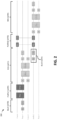
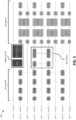
- FIG. 7 is a block diagram 700 representing the planar layout for the multi-target CNOT gate of Figure 6 .
- example methods for performing aspects of the disclosed embodiments are disclosed.
- the particular embodiments described should not be construed as limiting, as the disclosed method acts can be performed alone, in different orders, or at least partially simultaneously with one another. Further, any of the disclosed methods or method acts can be performed with any other methods or method acts disclosed herein.
- Figure 8 is an example method for performing a layout reduction technique for fault-tolerant quantum computing in accordance with an embodiment of the disclosed technology.
- the method is performed by one or more classical computing devices, at least some of which are in a configuration that can operate a quantum computer.
- a layout of an arbitrary quantum circuit is reduced to a layout of exponents of a multiple qubit Pauli matrix and measurements of a multiple qubit Pauli matrix.
- a quantum computer is configured to implement the reduced layout.
- qubits of the quantum computer comprise data qubits, interface qubits, and ancilla qubits.
- a graph of qubit connectivity satisfies a condition of providing an ancilla-path from one or more data qubits to the interface qubits.
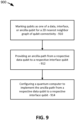
- Figure 9 is an example method for performing a layout technique for fault-tolerant quantum computing in accordance with an embodiment of the disclosed technology.
- the method is performed by one or more classical computing devices, at least some of which are in a configuration that can operate a quantum computer.
- qubits are marked as one of a data, interface, or ancilla qubit for a 2D nearest neighbor graph of qubit connectivity.
- an ancilla-path is provided from a respective data qubit to a respective interface qubit.
- a quantum computer is configured to implement the ancilla-path from a respective data qubit to a respective interface qubit.
- the method accounts for and avoids any broken qubits and satisfies a condition of providing an ancilla-path from a data qubit to the interface qubits.
- any of the methods described above can be performed in a system, comprising a quantum computing device; and one or more classical-computing devices, at least some of the one or more classical computing devices being programmed to perform any of the disclosed methods.
- any of the methods described above can be implemented as one or more classical-computer-readable-media storing classical-computer-executable instructions, which when executed by a classical computer cause the classical computer to perform any of the disclosed methods.
- a quantum circuit configured to apply an exponent of a multiple qubit Pauli matrix and measure a multiple qubit Pauli matrix.
- an ancilla-path is provided from data qubits to the interface qubits.
- the quantum circuit has a depth not depending on the number of vertexes.
- the quantum circuit uses single or low-depth multiple-target CNOT gates as a sub-circuits.
- Some embodiments comprise a quantum circuit configured to (a) provide a multi-target CNOT gate using a single-qubit and two-qubit Pauli measurements and single qubit Clifford gates; or (b) provide a multi-target CNOT gate using a single-qubit, Pauli measurements, single qubit Clifford gates and Controlled-Z gates.
- the quantum circuit provides a multi-target CNOT gate using a single-qubit and two-qubit Pauli measurements and single qubit Clifford gates, wherein the quantum circuit works with qubits for which a graph of qubit connectivity satisfies a condition of providing an ancilla-path from a target qubit to the control qubit.
- the quantum circuit provides a multi-target CNOT gate using a single-qubit and two-qubit Pauli measurements and single qubit Clifford gates, wherein the quantum circuit has a depth not depending on the number of vertexes.
- the quantum circuit is configured to provide a multi-target CNOT gate using a single-qubit, Pauli measurements, single qubit Clifford gates and Controlled-Z gates, and wherein the quantum circuit works with qubits for which graph of qubit connectivity satisfies a condition of providing an ancilla-path from a target qubit to the control qubit.
- the quantum circuit is configured to provide a multi-target CNOT gate using a single-qubit, Pauli measurements, single qubit Clifford gates and Controlled-Z gates, wherein the quantum circuit has a depth not depending on the number of vertexes.
- a further embodiment is a method that comprises implementing a product of exponents of commuting multiple-qubit Pauli matrices in low depth where non-clifford gates can be executed in parallel.
- An additional embodiment is a quantum circuit for providing a multi-target CNOT gate using a single-qubit and two-qubit Pauli measurements.
- the quantum circuit further comprises a 2-d nearest neighbor architecture.
- the quantum circuit comprises a 3-N grid of qubits with a center row or center column of data qubits, each respective data qubit further being directly connected to two ancilla qubits.
- the quantum circuit comprises a comb architecture with a center row or center column of data qubits, each respective data qubit further being directly connected to one ancilla qubits to thereby form the comb architecture.
- the quantum circuit is a low-constant-depth quantum circuit.
- the quantum circuit has a depth equal to a largest vertex degree of a tree describing the quantum circuit.
- a further embodiment comprises a quantum circuit for computing an exponent of a multiple qubit Pauli matrix.
- the multiple qubit Pauli matrix is a two-qubit Pauli matrix.
- the quantum circuit is a low-constant-depth quantum circuit.
- the quantum circuit has a depth equal to a largest vertex degree of a tree describing the quantum circuit.
- An additional embodiment is a method comprising: reducing a layout of an arbitrary quantum circuit to a layout of exponents of a multiple qubit Pauli matrix.
- a further embodiment is a method comprising implementing a product of exponents of commuting multiple-qubit Pauli matrices in low depth where non-clifford gates can be executed in parallel.
- An additional embodiment is a computer-implemented method that builds a data/ancilla qubit layout for a given graph of qubit connectivity and satisfies a condition of providing an ancilla-path from every data qubit to the interface qubits.
- the method accounts for and avoids any broken qubits.
- any of the methods described above can be implemented as one or more classical-computer-readable-media storing classical-computer-executable instructions, which when executed by a classical computer cause the classical computer to perform any of the disclosed methods.
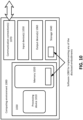
- FIG. 10 illustrates a generalized example of a suitable classical computing environment 1000 in which several of the described embodiments can be implemented.
- the computing environment 1000 is not intended to suggest any limitation as to the scope of use or functionality of the disclosed technology, as the techniques and tools described herein can be implemented in diverse general-purpose or special-purpose environments that have computing hardware.
- the computing environment 1000 includes at least one processing device 1010 and memory 1020.
- the processing device 1010 e.g., a CPU or microprocessor
- the memory 1020 may be volatile memory (e.g., registers, cache, RAM, DRAM, SRAM), non-volatile memory (e.g., ROM, EEPROM, flash memory), or some combination of the two.
- the memory 1020 stores software 1080 implementing tools for peforming any of the layout techniques for fault-tolerant quantum computers disclosed herein, using a classical computer and/or quantum computer.
- the memory 1020 can store software for controlling a quantum circuit to implement an embodiment of the disclosed approximation technique.
- the memory 1020 can also store software 1080 for synthesizing, generating (or compiling), and/or controlling quantum circuits as described herein.
- the computing environment 1000 includes storage 1040, one or more input devices 1050, one or more output devices 1060, and one or more communication connections 1070.
- An interconnection mechanism (not shown), such as a bus, controller, or network, interconnects the components of the computing environment 1000.
- operating system software provides an operating environment for other software executing in the computing environment 1000, and coordinates activities of the components of the computing environment 1000.
- the storage 1040 can be removable or non-removable, and includes one or more magnetic disks (e.g., hard drives), solid state drives (e.g., flash drives), magnetic tapes or cassettes, CD-ROMs, DVDs, or any other tangible non-volatile storage medium which can be used to store information and which can be accessed within the computing environment 1000.
- the storage 1040 can also store instructions for the software 1080 implementing tools for peforming any of the layout techniques for fault-tolerant quantum computers disclosed herein using a classical computer and/or quantum computer.
- the memory 1020 can store software for controlling a quantum circuit to implement an embodiment of the disclosed layout techniques.
- the storage 1040 can also store instructions for the software 1080 for synthesizing, generating (or compiling), and/or controlling quantum circuits as described herein.
- the input device(s) 1050 can be a touch input device such as a keyboard, touchscreen, mouse, pen, trackball, a voice input device, a scanning device, or another device that provides input to the computing environment 1000.
- the output device(s) 1060 can be a display device (e.g., a computer monitor, laptop display, smartphone display, tablet display, netbook display, or touchscreen), printer, speaker, or another device that provides output from the computing environment 1000.
- the communication connection(s) 1070 enable communication over a communication medium to another computing entity.
- the communication medium conveys information such as computer-executable instructions or other data in a modulated data signal.
- a modulated data signal is a signal that has one or more of its characteristics set or changed in such a manner as to encode information in the signal.
- communication media include wired or wireless techniques implemented with an electrical, optical, RF, infrared, acoustic, or other carrier.
- Computer-readable media are any available media (e.g., memory or storage device) that can be accessed within or by a computing environment.
- Computer-readable media include tangible computer-readable memory or storage devices, such as memory 1020 and/or storage 1040, and do not include propagating carrier waves or signals per se (tangible computer-readable memory or storage devices do not include propagating carrier waves or signals per se).
- program modules include routines, programs, libraries, objects, classes, components, data structures, and so on, that perform particular tasks or implement particular abstract data types.
- the functionality of the program modules may be combined or split between program modules as desired in various embodiments.
- Computer-executable instructions for program modules may be executed within a local or distributed computing environment.
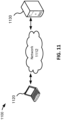
- Networked computing device 1120 can be, for example, a computer running a browser or other software connected to a network 1112.
- the computing device 1120 can have a computer architecture as shown in Figure 10 and discussed above.
- the computing device 1120 is not limited to a traditional personal computer but can comprise other computing hardware configured to connect to and communicate with a network 1112 (e.g., smart phones, laptop computers, tablet computers, or other mobile computing devices, servers, network devices, dedicated devices, and the like). Further, the computing device 1120 can comprise an FPGA or other programmable logic device.
- the computing device 1120 is configured to communicate with a computing device 1130 (e.g., a remote server, such as a server in a cloud computing environment) via a network 1112.
- a computing device 1130 e.g., a remote server, such as a server in a cloud computing environment
- the computing device 1120 is configured to transmit input data to the computing device 1130
- the computing device 1130 is configured to implement a quantum circuit control technique according to any of the disclosed embodiments and/or a circuit generation or compilation/synthesis methods for generating qunatum circuits for use with any of the techniques disclosed herein.
- the computing device 1130 can output results to the computing device 1120. Any of the data received from the computing device 1130 can be stored or displayed on the computing device 1120 (e.g., displayed as data on a graphical user interface or web page at the computing devices 1120).
- the illustrated network 1112 can be implemented as a Local Area Network (LAN) using wired networking (e.g., the Ethernet IEEE standard 802.3 or other appropriate standard) or wireless networking (e.g. one of the IEEE standards 802.11a, 802.11b, 802.11g, or 802.11n or other appropriate standard).
- wired networking e.g., the Ethernet IEEE standard 802.3 or other appropriate standard
- wireless networking e.g. one of the IEEE standards 802.11a, 802.11b, 802.11g, or 802.11n or other appropriate standard.
- at least part of the network 1112 can be the Internet or a similar public network and operate using an appropriate protocol (e.g., the HTTP protocol).
- Networked computing device 1220 can be, for example, a computer running a browser or other software connected to a network 1212.
- the computing device 1220 can have a computer architecture as shown in Figure 10 and discussed above.
- the computing device 1220 is configured to communicate with multiple computing devices 1230, 1231, 1232 (e.g., remote servers or other distributed computing devices, such as one or more servers in a cloud computing environment) via the network 1212.
- each of the computing devices 1230, 1231, 1232 in the computing environment 1200 is used to perform at least a portion of a quantum circuit control technique according to any of the disclosed embodiments and/or a circuit generation or compilation/synthesis methods for generating quantum circuits for use with any of the techniques disclosed herein.
- the computing devices 1230, 1231, 1232 form a distributed computing environment in which the quantum circuit control and/or generation/compilation/synthesis processes are shared across multiple computing devices.
- the computing device 1220 is configured to transmit input data to the computing devices 1230, 1231, 1232, which are configured to distributively implement such as process, including performance of any of the disclosed methods or creation of any of the disclosed circuits, and to provide results to the computing device 1220.
- Any of the data received from the computing devices 1230, 1231, 1232 can be stored or displayed on the computing device 1220 (e.g., displayed as data on a graphical user interface or web page at the computing devices 1220).
- the illustrated network 1212 can be any of the networks discussed above with respect to Figure 11 .
- an exemplary system for implementing the disclosed technology includes computing environment 1300.
- a compiled quantum computer circuit description (including quantum circuits generated by any of the disclosed layout techniques) can be used to program (or configure) one or more quantum processing units such that the quantum processing unit(s) implement the circuit described by the quantum computer circuit description.
- the environment 1300 includes one or more quantum processing units 1302 and one or more readout device(s) 1308.
- the quantum processing unit(s) execute quantum circuits that are precompiled and described by the quantum computer circuit description.
- the quantum processing unit(s) can be one or more of, but are not limited to: (a) a superconducting quantum computer; (b) an ion trap quantum computer; (c) a fault-tolerant architecture for quantum computing; and/or (d) a topological quantum architecture (e.g., a topological quantum computing device using Majorana zero modes).
- the precompiled quantum circuits, including any of the disclosed circuits can be sent into (or otherwise applied to) the quantum processing unit(s) via control lines 1306 at the control of quantum processor controller 1320.
- the quantum processor controller (CaP controller) 1320 can operate in conjunction with a classical processor 1310 (e.g., having an architecture as described above with respect to Figure 10 ) to implement the desired quantum computing process.
- the CaP controller 1320 further implements the desired quantum computing process via one or more CaP subcontrollers 1304 that are specially adapted to control a corresponding one of the quantum processor(s) 1302.
- the quantum controller 1320 facilitates implementation of the compiled quantum circuit by sending instructions to one or more memories (e.g., lower-temperature memories), which then pass the instructions to low-temperature control unit(s) (e.g., CaP subcontroller(s) 1304) that transmit, for instance, pulse sequences representing the gates to the quantum processing unit(s) 1302 for implementation.
- the CaP controller(s) 1320 and CaP subcontroller(s) 1304 operate to provide appropriate magnetic fields, encoded operations, or other such control signals to the quantum processor(s) to implement the operations of the compiled quantum computer circuit description.
- the quantum controller(s) can further interact with readout devices 1308 to help control and implement the desired quantum computing process (e.g., by reading or measuring out data results from the quantum processing units once available, etc.)
- compilation is the process of translating a high-level description of a quantum algorithm into a quantum computer circuit description comprising a sequence of quantum operations or gates, which can include the circuits as disclosed herein.
- the compilation can be performed by a compiler 1322 using a classical processor 1310 (e.g., as shown in Figure 10 ) of the environment 1300 which loads the high-level description from memory or storage devices 1312 and stores the resulting quantum computer circuit description in the memory or storage devices 1312.
- compilation and/or verification can be performed remotely by a remote computer 1360 (e.g., a computer having a computing environment as described above with respect to Figure 10 ) which stores the resulting quantum computer circuit description in one or more memory or storage devices 1362 and transmits the quantum computer circuit description to the computing environment 1300 for implementation in the quantum processing unit(s) 1302. Still further, the remote computer 1300 can store the high-level description in the memory or storage devices 1362 and transmit the high-level description to the computing environment 1300 for compilation and use with the quantum processor(s). In any of these scenarios, results from the computation performed by the quantum processor(s) can be communicated to the remote computer after and/or during the computation process.
- a remote computer 1360 e.g., a computer having a computing environment as described above with respect to Figure 10
- the remote computer 1300 can store the high-level description in the memory or storage devices 1362 and transmit the high-level description to the computing environment 1300 for compilation and use with the quantum processor(s).
- the remote computer can communicate with the CaP controller(s) 1320 such that the quantum computing process (including any compilation, verification, and CaP control procedures) can be remotely controlled by the remote computer 1360.
- the remote computer 1360 communicates with the CaP controller(s) 1320, compiler/synthesizer 1322, and/or verification tool 1323 via communication connections 1350.
- the environment 1300 can be a cloud computing environment, which provides the quantum processing resources of the environment 1300 to one or more remote computers (such as remote computer 1360) over a suitable network (which can include the internet).
- a cloud computing environment which provides the quantum processing resources of the environment 1300 to one or more remote computers (such as remote computer 1360) over a suitable network (which can include the internet).
Landscapes
- Engineering & Computer Science (AREA)
- Physics & Mathematics (AREA)
- Theoretical Computer Science (AREA)
- General Physics & Mathematics (AREA)
- General Engineering & Computer Science (AREA)
- Evolutionary Computation (AREA)
- Computing Systems (AREA)
- Mathematical Physics (AREA)
- Data Mining & Analysis (AREA)
- Software Systems (AREA)
- Artificial Intelligence (AREA)
- Condensed Matter Physics & Semiconductors (AREA)
- Mathematical Optimization (AREA)
- Computational Mathematics (AREA)
- Mathematical Analysis (AREA)
- Pure & Applied Mathematics (AREA)
- Computer Hardware Design (AREA)
- Architecture (AREA)
- Geometry (AREA)
- Computational Linguistics (AREA)
- Design And Manufacture Of Integrated Circuits (AREA)
- Management, Administration, Business Operations System, And Electronic Commerce (AREA)
- Semiconductor Integrated Circuits (AREA)
Applications Claiming Priority (3)
| Application Number | Priority Date | Filing Date | Title |
|---|---|---|---|
| US201862681540P | 2018-06-06 | 2018-06-06 | |
| PCT/US2019/035595 WO2019236712A2 (en) | 2018-06-06 | 2019-06-05 | Layouts for fault-tolerant quantum computers |
| EP19732200.1A EP3788564B1 (de) | 2018-06-06 | 2019-06-05 | Layouts für fehlertolerante quantencomputer |
Related Parent Applications (2)
| Application Number | Title | Priority Date | Filing Date |
|---|---|---|---|
| EP19732200.1A Division EP3788564B1 (de) | 2018-06-06 | 2019-06-05 | Layouts für fehlertolerante quantencomputer |
| EP19732200.1A Division-Into EP3788564B1 (de) | 2018-06-06 | 2019-06-05 | Layouts für fehlertolerante quantencomputer |
Publications (2)
| Publication Number | Publication Date |
|---|---|
| EP4459512A2 true EP4459512A2 (de) | 2024-11-06 |
| EP4459512A3 EP4459512A3 (de) | 2025-02-26 |
Family
ID=66998515
Family Applications (2)
| Application Number | Title | Priority Date | Filing Date |
|---|---|---|---|
| EP24201171.6A Pending EP4459512A3 (de) | 2018-06-06 | 2019-06-05 | Layouts für fehlertolerante quantencomputer |
| EP19732200.1A Active EP3788564B1 (de) | 2018-06-06 | 2019-06-05 | Layouts für fehlertolerante quantencomputer |
Family Applications After (1)
| Application Number | Title | Priority Date | Filing Date |
|---|---|---|---|
| EP19732200.1A Active EP3788564B1 (de) | 2018-06-06 | 2019-06-05 | Layouts für fehlertolerante quantencomputer |
Country Status (4)
| Country | Link |
|---|---|
| US (1) | US20190378032A1 (de) |
| EP (2) | EP4459512A3 (de) |
| CN (1) | CN112272833B (de) |
| WO (1) | WO2019236712A2 (de) |
Families Citing this family (21)
| Publication number | Priority date | Publication date | Assignee | Title |
|---|---|---|---|---|
| US12430399B2 (en) | 2016-03-30 | 2025-09-30 | International Business Machines Corporation | Selection of pauli strings for variational quantum eigensolver |
| US11275816B2 (en) * | 2019-02-25 | 2022-03-15 | International Business Machines Corporation | Selection of Pauli strings for Variational Quantum Eigensolver |
| US11507872B2 (en) | 2018-08-17 | 2022-11-22 | Zapata Computing, Inc. | Hybrid quantum-classical computer system and method for performing function inversion |
| CN112789629A (zh) | 2018-10-02 | 2021-05-11 | 札帕塔计算股份有限公司 | 用于对线性系统求解的混合量子经典计算机 |
| US11537928B2 (en) * | 2019-05-03 | 2022-12-27 | Zapata Computing, Inc. | Quantum-classical system and method for matrix computations |
| KR102406312B1 (ko) * | 2019-12-30 | 2022-06-10 | 한국과학기술원 | 양자회로 에러 보정 방법 및 그 장치 |
| US11568297B2 (en) | 2020-03-05 | 2023-01-31 | International Business Machines Corporation | Efficient synthesis of a random uniformly distributed Clifford unitary |
| US11886380B2 (en) | 2020-04-27 | 2024-01-30 | Red Hat, Inc. | Quantum file management system |
| US11416221B2 (en) | 2020-05-12 | 2022-08-16 | Red Hat, Inc. | Quantum entanglement protection |
| US12293259B2 (en) * | 2020-05-27 | 2025-05-06 | Red Hat, Inc. | Qubit allocation service |
| CN112016691B (zh) * | 2020-08-14 | 2024-02-23 | 本源量子计算科技(合肥)股份有限公司 | 一种量子线路的构建方法及装置 |
| CN114511093B (zh) * | 2020-11-16 | 2023-06-09 | 中国人民解放军国防科技大学 | 玻色子系统模拟方法 |
| US20220237489A1 (en) * | 2021-01-27 | 2022-07-28 | International Business Machines Corporation | Quantum processor architecture with compiler support |
| CA3212467A1 (en) | 2021-03-23 | 2022-09-29 | Guoming WANG | Classically-boosted quantum optimization |
| US11379752B1 (en) * | 2021-05-27 | 2022-07-05 | Red Hat, Inc. | Qubit reservation service |
| US11714692B2 (en) | 2021-05-27 | 2023-08-01 | Red Hat, Inc. | Classical management of qubit requests |
| EP4181032A1 (de) * | 2021-11-12 | 2023-05-17 | Robert Bosch GmbH | Quantengesteuerte operationen in zweidimensionalen quantenrechnersystemen |
| US20230162077A1 (en) * | 2021-11-17 | 2023-05-25 | Electronics And Telecommunications Research Institute | Computing device and operating method of computing device for mapping quantum circuit |
| US20230222374A1 (en) * | 2022-01-07 | 2023-07-13 | Microsoft Technology Licensing, Llc | Interval testing with reduced complexity |
| CN114943199B (zh) * | 2022-05-24 | 2023-04-18 | 北京百度网讯科技有限公司 | 连通特征确定方法、装置、设备及存储介质 |
| US12387128B2 (en) * | 2023-10-11 | 2025-08-12 | Microsoft Technology Licensing, Llc | Reduction of qubit lattice that includes dead data qubits and auxiliary qubits |
Family Cites Families (12)
| Publication number | Priority date | Publication date | Assignee | Title |
|---|---|---|---|---|
| CN101118608B (zh) * | 2007-08-23 | 2011-07-20 | 清华大学 | 任意量子比特门的分解方法 |
| EP3129923B1 (de) * | 2014-04-09 | 2021-10-27 | Microsoft Technology Licensing, LLC | Effiziente synthese von wiederholung-bis-erfolg-schaltungen in clifford+t-basis |
| US10320360B2 (en) * | 2014-06-06 | 2019-06-11 | Microsoft Technology Licensing, Llc | Quantum algorithms for arithmetic and function synthesis |
| US11010682B2 (en) * | 2014-09-11 | 2021-05-18 | Microsoft Technology Licensing, Llc | Efficient synthesis of probabilistic quantum circuits with fallback |
| CN107004161B (zh) * | 2014-11-21 | 2020-06-02 | 微软技术许可有限责任公司 | 针对clifford+t基上的对角算子的高效实现的方法 |
| US11113084B2 (en) * | 2015-04-10 | 2021-09-07 | Microsoft Technology Licensing, Llc | Method and system for approximate quantum circuit synthesis using quaternion algebra |
| WO2016164325A1 (en) * | 2015-04-10 | 2016-10-13 | Microsoft Technology Licensing, Llc | Method and system for quantum circuit synthesis using quaternion algebra |
| WO2017127923A1 (en) * | 2016-01-26 | 2017-08-03 | Mosca Michele | Decoding-based method for quantum circuit optimization |
| US10311370B2 (en) * | 2016-08-17 | 2019-06-04 | International Business Machines Corporation | Efficient reduction of resources for the simulation of Fermionic Hamiltonians on quantum hardware |
| EP3300004A1 (de) * | 2016-09-27 | 2018-03-28 | Nederlandse Organisatie voor toegepast- natuurwetenschappelijk onderzoek TNO | Verfahren zur ausführung eines quantenfehlerkorrekturzyklus in einem quantencomputer |
| US10972133B2 (en) * | 2017-08-07 | 2021-04-06 | Microsoft Technology Licensing, Llc | Flag fault-tolerant error correction with arbitrary distance codes |
| US10846608B2 (en) * | 2017-09-08 | 2020-11-24 | Microsoft Technology Licensing, Llc | Codes and protocols for distilling T, controlled-S, and toffoli gates |
-
2019
- 2019-05-31 US US16/428,913 patent/US20190378032A1/en active Pending
- 2019-06-05 WO PCT/US2019/035595 patent/WO2019236712A2/en not_active Ceased
- 2019-06-05 EP EP24201171.6A patent/EP4459512A3/de active Pending
- 2019-06-05 CN CN201980037739.0A patent/CN112272833B/zh active Active
- 2019-06-05 EP EP19732200.1A patent/EP3788564B1/de active Active
Non-Patent Citations (2)
| Title |
|---|
| CHEN LI-BING ET AL: "Nonlocal multi-target controlled-controlled gate using Greenberger-Horne-Zeilinger channel and qutrit catalysis", CHINESE PHYSICS B, no. 7, 29 May 2015 (2015-05-29), Bristol GB, pages 1 - 5, XP093367675, ISSN: 1674-1056, Retrieved from the Internet <URL:https://iopscience.iop.org/article/10.1088/1674-1056/24/7/070307/pdf> [retrieved on 20260217], DOI: 10.1088/1674-1056/24/7/070307 * |
| ZHAO NING BO ET AL: "Combined local implementation of nonlocal operations using GHZ states", ARXIV.ORG, 4 April 2008 (2008-04-04), pages 1 - 5, XP093367673, Retrieved from the Internet <URL:https://arxiv.org/pdf/0804.0714> [retrieved on 20260217] * |
Also Published As
| Publication number | Publication date |
|---|---|
| EP3788564A2 (de) | 2021-03-10 |
| CN112272833A (zh) | 2021-01-26 |
| WO2019236712A2 (en) | 2019-12-12 |
| CN112272833B (zh) | 2025-07-15 |
| EP4459512A3 (de) | 2025-02-26 |
| EP3788564B1 (de) | 2024-10-30 |
| WO2019236712A3 (en) | 2020-02-06 |
| US20190378032A1 (en) | 2019-12-12 |
Similar Documents
| Publication | Publication Date | Title |
|---|---|---|
| EP3788564B1 (de) | Layouts für fehlertolerante quantencomputer | |
| EP3837645B1 (de) | Ein quantum-walk-basierter algorithmus für klassische optimierungsprobleme | |
| Whitfield et al. | Local spin operators for fermion simulations | |
| Raussendorf et al. | Contextuality and Wigner-function negativity in qubit quantum computation | |
| US11494684B2 (en) | Short-depth syndrome extraction circuits for Calderbank Shor Steane (CSS) stabilizer codes | |
| US10885457B2 (en) | Quantum optimization system | |
| EP3877917B1 (de) | Quantenverfahren zur näherungsweisen optimierung durch quenchen | |
| US12242927B2 (en) | Magic state factory constructions for producing CCZ and T states | |
| US10997337B2 (en) | Trading t-gates for qubits in arbitrary state and unitary synthesis | |
| US20210256416A1 (en) | Training of variational quantum classifiers by parametric coordinate ascent | |
| Tomesh et al. | Divide and conquer for combinatorial optimization and distributed quantum computation | |
| Chowdhury et al. | Hypergraph co-optimal transport: Metric and categorical properties | |
| WO2023082436A1 (zh) | 量子计算任务处理方法、系统及计算机设备 | |
| EP3711003B1 (de) | Quantumsimulation der echtzeitevolution von gitter-hamiltonians | |
| Maksymov et al. | Optimal calibration of gates in trapped-ion quantum computers | |
| CN107545509A (zh) | 一种多关系社交网络的社团划分方法 | |
| Xiang et al. | Choco-q: Commute hamiltonian-based qaoa for constrained binary optimization | |
| US20240289664A1 (en) | Method and apparatus for processing a data simulation task, electronic device, and storage medium | |
| Kelany et al. | Quantum annealing approaches to the phase-unwrapping problem in synthetic-aperture radar imaging | |
| US20240135216A1 (en) | Solving optimization problems on shallow circuits using a quantum computer | |
| Abdelghani et al. | QFed: Parameter-Compact Quantum-Classical Federated Learning | |
| Fang et al. | Quantum Gibbs sampling through the detectability lemma | |
| Decker | Implementation of a Classical Simulation of Quantum Cellular Automata on 1-D Lattices and using it to Improve the Tensor Network Algorithm TDVP | |
| de Beaudrap et al. | Quadratic form expansions for unitaries | |
| US12511563B2 (en) | Quantum computing task processing method and system and computer device |
Legal Events
| Date | Code | Title | Description |
|---|---|---|---|
| PUAI | Public reference made under article 153(3) epc to a published international application that has entered the european phase |
Free format text: ORIGINAL CODE: 0009012 |
|
| STAA | Information on the status of an ep patent application or granted ep patent |
Free format text: STATUS: REQUEST FOR EXAMINATION WAS MADE |
|
| 17P | Request for examination filed |
Effective date: 20240918 |
|
| AC | Divisional application: reference to earlier application |
Ref document number: 3788564 Country of ref document: EP Kind code of ref document: P |
|
| AK | Designated contracting states |
Kind code of ref document: A2 Designated state(s): AL AT BE BG CH CY CZ DE DK EE ES FI FR GB GR HR HU IE IS IT LI LT LU LV MC MK MT NL NO PL PT RO RS SE SI SK SM TR |
|
| REG | Reference to a national code |
Ref country code: DE Ref legal event code: R079 Free format text: PREVIOUS MAIN CLASS: G06N0005010000 Ipc: G06N0010200000 |
|
| PUAL | Search report despatched |
Free format text: ORIGINAL CODE: 0009013 |
|
| AK | Designated contracting states |
Kind code of ref document: A3 Designated state(s): AL AT BE BG CH CY CZ DE DK EE ES FI FR GB GR HR HU IE IS IT LI LT LU LV MC MK MT NL NO PL PT RO RS SE SI SK SM TR |
|
| RIC1 | Information provided on ipc code assigned before grant |
Ipc: G06N 5/022 20230101ALN20250122BHEP Ipc: G06F 30/392 20200101ALI20250122BHEP Ipc: G06N 5/01 20230101ALI20250122BHEP Ipc: G06N 10/70 20220101ALI20250122BHEP Ipc: G06N 10/20 20220101AFI20250122BHEP |
|
| STAA | Information on the status of an ep patent application or granted ep patent |
Free format text: STATUS: EXAMINATION IS IN PROGRESS |
|
| 17Q | First examination report despatched |
Effective date: 20260303 |