EP4459290A1 - Chemical analysis apparatus and chemical analysis method - Google Patents
Chemical analysis apparatus and chemical analysis method Download PDFInfo
- Publication number
- EP4459290A1 EP4459290A1 EP22915586.6A EP22915586A EP4459290A1 EP 4459290 A1 EP4459290 A1 EP 4459290A1 EP 22915586 A EP22915586 A EP 22915586A EP 4459290 A1 EP4459290 A1 EP 4459290A1
- Authority
- EP
- European Patent Office
- Prior art keywords
- electrical impedance
- reaction vessel
- chemical analysis
- measured
- piezoelectric element
- Prior art date
- Legal status (The legal status is an assumption and is not a legal conclusion. Google has not performed a legal analysis and makes no representation as to the accuracy of the status listed.)
- Pending
Links
Images



Classifications
-
- G—PHYSICS
- G01—MEASURING; TESTING
- G01N—INVESTIGATING OR ANALYSING MATERIALS BY DETERMINING THEIR CHEMICAL OR PHYSICAL PROPERTIES
- G01N35/00—Automatic analysis not limited to methods or materials provided for in any single one of groups G01N1/00 - G01N33/00; Handling materials therefor
-
- G—PHYSICS
- G01—MEASURING; TESTING
- G01F—MEASURING VOLUME, VOLUME FLOW, MASS FLOW OR LIQUID LEVEL; METERING BY VOLUME
- G01F23/00—Indicating or measuring liquid level or level of fluent solid material, e.g. indicating in terms of volume or indicating by means of an alarm
- G01F23/22—Indicating or measuring liquid level or level of fluent solid material, e.g. indicating in terms of volume or indicating by means of an alarm by measuring physical variables, other than linear dimensions, pressure or weight, dependent on the level to be measured, e.g. by difference of heat transfer of steam or water
- G01F23/26—Indicating or measuring liquid level or level of fluent solid material, e.g. indicating in terms of volume or indicating by means of an alarm by measuring physical variables, other than linear dimensions, pressure or weight, dependent on the level to be measured, e.g. by difference of heat transfer of steam or water by measuring variations of capacity or inductance of capacitors or inductors arising from the presence of liquid or fluent solid material in the electric or electromagnetic fields
- G01F23/261—Indicating or measuring liquid level or level of fluent solid material, e.g. indicating in terms of volume or indicating by means of an alarm by measuring physical variables, other than linear dimensions, pressure or weight, dependent on the level to be measured, e.g. by difference of heat transfer of steam or water by measuring variations of capacity or inductance of capacitors or inductors arising from the presence of liquid or fluent solid material in the electric or electromagnetic fields for discrete levels
-
- G—PHYSICS
- G01—MEASURING; TESTING
- G01F—MEASURING VOLUME, VOLUME FLOW, MASS FLOW OR LIQUID LEVEL; METERING BY VOLUME
- G01F23/00—Indicating or measuring liquid level or level of fluent solid material, e.g. indicating in terms of volume or indicating by means of an alarm
- G01F23/22—Indicating or measuring liquid level or level of fluent solid material, e.g. indicating in terms of volume or indicating by means of an alarm by measuring physical variables, other than linear dimensions, pressure or weight, dependent on the level to be measured, e.g. by difference of heat transfer of steam or water
- G01F23/28—Indicating or measuring liquid level or level of fluent solid material, e.g. indicating in terms of volume or indicating by means of an alarm by measuring physical variables, other than linear dimensions, pressure or weight, dependent on the level to be measured, e.g. by difference of heat transfer of steam or water by measuring the variations of parameters of electromagnetic or acoustic waves applied directly to the liquid or fluent solid material
- G01F23/296—Acoustic waves
- G01F23/2968—Transducers specially adapted for acoustic level indicators
-
- G—PHYSICS
- G01—MEASURING; TESTING
- G01N—INVESTIGATING OR ANALYSING MATERIALS BY DETERMINING THEIR CHEMICAL OR PHYSICAL PROPERTIES
- G01N35/00—Automatic analysis not limited to methods or materials provided for in any single one of groups G01N1/00 - G01N33/00; Handling materials therefor
- G01N2035/00465—Separating and mixing arrangements
- G01N2035/00534—Mixing by a special element, e.g. stirrer
- G01N2035/00554—Mixing by a special element, e.g. stirrer using ultrasound
-
- G—PHYSICS
- G01—MEASURING; TESTING
- G01N—INVESTIGATING OR ANALYSING MATERIALS BY DETERMINING THEIR CHEMICAL OR PHYSICAL PROPERTIES
- G01N35/00—Automatic analysis not limited to methods or materials provided for in any single one of groups G01N1/00 - G01N33/00; Handling materials therefor
- G01N35/10—Devices for transferring samples or any liquids to, in, or from, the analysis apparatus, e.g. suction devices, injection devices
- G01N35/1009—Characterised by arrangements for controlling the aspiration or dispense of liquids
- G01N2035/1025—Fluid level sensing
Definitions
- the present invention relates to a configuration of a chemical analysis apparatus and a failure diagnosis method thereof, and particularly to an effective technique applied to a chemical analysis apparatus having a stirring function of stirring a reagent or the like and a sample to be measured using ultrasonic waves generated by vibration of a piezoelectric element.
- a stirring means for a reagent and a sample to be measured As a stirring means for a reagent and a sample to be measured, a system has been used in which a stirring rod having a distal end of a spatula shape for mixing a reagent with a sample is inserted into a reaction vessel, in which the reagent and the sample are mixed, and the stirring rod is rotated or reciprocated.
- the stirring means using ultrasonic waves is a system of generating a flow in a sample and a reagent by the ultrasonic waves to mix and stir a reaction liquid thereof without using a stirring rod or the like, and thus is a technique capable of avoiding carry-over of the sample and the reagent caused by use of the stirring rod and avoiding contamination of cleaning water into a reaction vessel.
- the piezoelectric element itself may be damaged by heat generation of the piezoelectric element.
- this method may cause a decrease in reliability and an increase in cost due to complication of the mechanism.
- a non-operation time of a stirring mechanism is used to detect an abnormality of a piezoelectric element and predict and warn against a failure in advance, and thus it is possible to prevent an unexpected stop of the apparatus.
- temperature information reflected in a state where a piezoelectric element or a piezoelectric element driving circuit is normally operating is stored, and is compared with temperature information reflected during the operation of a stirring mechanism, thereby performing a determination regarding an abnormality of the piezoelectric element or the piezoelectric element driving circuit.
- PTL 3 discloses a method of estimating a surrounding condition before outputting sound waves from a piezoelectric element, and stopping output of sound waves when an abnormality is detected, which improves reliability of the piezoelectric element.
- PTL 3 discloses an automatic analysis apparatus including: a stirring portion configured to stir, by a sound wave having a piezoelectric element as a sound source, a reagent and a sample to be measured that are discharged to a reaction vessel; a power supply unit capable of changing a voltage and a frequency that drive the piezoelectric element; an analysis unit configured to perform component analysis by causing the reagent and the sample to be measured to react with each other; and a control unit configured to control the stirring portion, the power supply unit, and the analysis unit.
- a surrounding condition of the piezoelectric element at the time of sound wave output is estimated by measuring an electrical impedance from a voltage or a current waveform driving the piezoelectric element.
- the piezoelectric element itself serving as a sound source is used as a sensor. Accordingly, it is possible to confirm the presence or absence of the reaction vessel and the reaction liquid or the presence or absence of the medium, through which the sound wave propagates, when generating the sound wave from the piezoelectric element without complicating the configuration.
- PTL 3 discloses a method of detecting a change in temperature of the medium, through which the sound wave propagates, based on a change in electrical impedance of the piezoelectric element.
- an object of the invention is to provide a chemical analysis apparatus and a chemical analysis method using the chemical analysis apparatus which has a stirring function of stirring, by using an ultrasonic element, a reagent or the like and a sample to be measured, and which is capable of estimating presence or absence of a reaction liquid and a liquid level height of the reaction liquid without using a means such as a sensor and a visual inspection.
- the invention provides a chemical analysis apparatus including an ultrasonic stirring mechanism.
- the ultrasonic stirring mechanism includes a piezoelectric element, a plurality of electrodes arranged on the piezoelectric element, a power supply unit configured to apply a voltage to each of the electrodes, a detection unit configured to measure an electrical impedance for each of the plurality of electrodes or for any combination of the electrodes, and an analysis unit configured to determine a liquid level height in a reaction vessel based on the electrical impedance detected by the detection unit.
- the detection unit measures the electrical impedance in a state where a reaction vessel into which two or more different liquid amounts are dispensed faces the piezoelectric element.
- the analysis unit estimates the liquid level height in the reaction vessel based on an amount of change in the electrical impedance measured by the detection unit.
- the invention provides a chemical analysis method including the following steps: (a), a step of dispensing a sample to be measured into a reaction vessel; (b), a step of dispensing a reagent into the reaction vessel; (c), a step of moving the reaction vessel to a stirring portion and measuring an electrical impedance in a state in which the reaction vessel faces a piezoelectric element of the stirring portion; and (d), a step of estimating a liquid level height in the reaction vessel based on an amount of change in the electrical impedance measured in the step (c).
- the invention it is possible to implement a chemical analysis apparatus and a chemical analysis method using the chemical analysis apparatus which has a stirring function of stirring, by using an ultrasonic element, a reagent or the like and a sample to be measured, and which is capable of estimating presence or absence of a reaction liquid and a liquid level height of the reaction liquid without using a means such as a sensor and a visual inspection.
- FIG. 1 is a diagram illustrating a part of the chemical analysis apparatus according to the embodiment and illustrates a schematic configuration of an ultrasonic stirring mechanism.
- FIG. 2 is a top view illustrating a schematic configuration of the chemical analysis apparatus according to the embodiment.
- the chemical analysis apparatus (also referred to as an automatic analysis apparatus) according to the embodiment includes a sample holding portion 11, a reagent storage portion 12, a reaction portion 13, a stirring portion 14, a measurement unit 15, and a cleaning portion 16.
- An analysis device control unit 23 controls specific operations of the components.
- a sample 17 to be measured held in the sample holding portion 11 is collected by a sample dispensing mechanism 18 by an amount required for analysis, and is discharged to a reaction vessel 6 at a sample discharging position 20.
- An amount of reagent required for analysis is collected from the reagent storage portion 12 by a reagent dispensing mechanism 19, and is added, at a reagent discharging position 21, to the reaction vessel 6 to which the sample 17 to be measured is discharged.
- the sample and the reagent discharged to the reaction vessel 6 are moved to a stirring position 22 and are stirred and mixed by ultrasonic waves output from a piezoelectric element of the stirring portion 14. Thereafter, the sample 17 to be measured mixed sufficiently by the stirring portion 14 is subjected to component analysis in the measurement unit 15. After completion of the analysis, the reaction vessel 6 is cleaned by the cleaning portion 16 and is ready for another analysis.
- the stirring portion 14 includes, as main components, a stirring control unit 1, a power supply unit 2, an electrode selector 3, a piezoelectric element 4, an electrode 5, a detection unit 9, and a recording unit 10.
- a plurality of electrodes 5 are arranged in a height direction of the reaction vessel 6 at the time when the reaction vessel 6 is mounted to the chemical analysis apparatus.
- the piezoelectric element 4 When a voltage is applied from the power supply unit 2 controlled by the stirring control unit 1 to the electrode 5 of the piezoelectric element 4 via the electrode selector 3, the piezoelectric element 4 outputs ultrasonic waves that propagate to the reaction vessel 6 via a ultrasonic wave propagation medium 8, and a reaction liquid 7 in the reaction vessel 6 is stirred by the ultrasonic waves.
- a plurality of electrodes 5 of the piezoelectric element 4 are provided in the height direction of the reaction vessel 6 to detect presence or absence of the reaction liquid 7 in the reaction vessel 6 and a liquid level height of the reaction liquid 7.
- the electrode 5 to be measured is selected by the electrode selector 3, a voltage is applied from the power supply unit 2 to the selected electrode 5 via the electrode selector 3, and the piezoelectric element 4 outputs ultrasonic waves.
- the detection unit 9 measures an electrical impedance of the piezoelectric element 4, and records a measurement result in the recording unit 10.
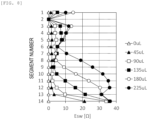
- FIG. 3 illustrates a measurement result example of the electrical impedance.
- a vertical axis corresponds to segments of the piezoelectric element (positions of the electrode 5 in the height direction of the reaction vessel 6), and a horizontal axis indicates an electrical impedance Esw obtained from an electrical impedance Z.
- the Esw is calculated by integrating, in a measured frequency range of the ultrasonic waves (from a frequency f1 to a frequency f2), a difference between measurement results of the electrical impedance at different reaction liquid amounts.
- An electrical impedance Z (f) is a measured value of each reaction liquid amount
- Z base (f) is a certain measured value of the reaction liquid.
- FIG. 3 illustrates a result obtained by calculation with a measured value in a case of the reaction liquid amount of 0 ul as Z base .
- a segment 1 is an opening side of the reaction vessel 6, and a segment 14 is a bottom side of the reaction vessel 6.
- the electrical impedance Esw is 0 ul in each segment.
- the electrical impedance Esw also changes in an upper segment where the boundary of reflection of the ultrasonic waves is not filled with the reaction liquid. This is due to the fact that an apparent mass of the reaction vessel 6 changes as a result of the reaction liquid being dispensed into the reaction vessel 6, and detection is possible by using Formula 1.
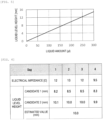
- FIG. 4 illustrates a relationship between the electrical impedance Z and the liquid amount.
- Results of the segment 1 to the segment 4 in a state where there is no reaction liquid in the reaction vessel 6 (the reaction vessel 6 is empty) are shown.
- a horizontal axis indicates the electrical impedance Esw, and a vertical axis indicates the liquid amount.
- the results are each a calibration curve up to 225 ul, and indicate values of the segment 1 to the segment 4 in a state where there is no reaction liquid in the reaction vessel 6.
- a change in the electrical impedance Esw is different from a change in the electrical impedance Esw in a case where the reaction liquid fills a reflection region of the ultrasonic waves.
- the electrical impedance Esw and the reaction liquid have one-to-one correspondence from 0 ⁇ to 8 ⁇ of the electrical impedance, and the liquid amount can be calculated by calculating the electrical impedance Esw.
- the correspondence between the electrical impedance Esw and the liquid amount may not be 1:1. This is due to a vibration mode of the reaction vessel 6, which is a reflector of ultrasonic waves, and the electrical impedance Esw does not monotonically increase with an increase in the liquid amount.
- candidate values of the liquid amount are obtained from the electrical impedance Esw measured in each segment, and the liquid amount is estimated by combining liquid amounts obtained from the candidate values. For example, a candidate value with a small variance or standard deviation is selected as an estimated value of the liquid amount.
- FIG. 5 illustrates a relationship between the liquid amount and the liquid level height. Since the reaction vessel 6 has a structure in a rectangular parallelepiped shape or a cylindrical shape that is not deformed, the shape of the reaction vessel 6 can be grasped in advance, and a calibration curve of the liquid level height with respect to the liquid amount is created.
- FIG. 5 illustrates a calibration curve of the liquid amount and the liquid level height taking a reaction vessel structure of a rectangular parallelepiped as an example, which shows a relationship that the liquid level height monotonically increases with an increase in the liquid amount.
- FIG. 6 shows an estimated result of the liquid level height.
- the measurement result of the electrical impedance Esw shown in FIG. 3 is displayed for each segment, the liquid amount is calculated by using the relationship between the electrical impedance Esw and the liquid amount as illustrated in FIG. 4 , and the liquid level height is calculated based on the liquid amount using the calibration curve shown in FIG. 5 and the calculated value is listed as a candidate value.
- Standard deviations for a candidate 1 and a candidate 2 are calculated and compared, the candidate 2 having a smaller value of the standard deviation is estimated as the reaction liquid amount, and an average value of the candidate values is displayed as a final estimated value (10.0 mm).
- the chemical analysis apparatus it is also possible to measure the electrical impedance of the piezoelectric element 4 by performing frequency sweeping of the voltage to be applied from the power supply unit 2 to the electrode 5 and integrating electrical impedances in a measurement range of the swept frequency.
- the “sweeping” refers to an operation of generating vibration while gradually changing the frequency (vibration frequency) of the voltage.
- the electrical impedance measured in advance when there is no reaction liquid 7 in the reaction vessel 6 is set as a reference value and a difference between the electrical impedance measured by the detection unit 9 and the reference value is integrated, making it possible to measure the electrical impedance.
- FIG. 7 illustrates an operation example of the chemical analysis apparatus according to the embodiment.
- step S701 a necessary amount of the sample 17 to be measured used for analysis is dispensed into the reaction vessel 6.
- step S702 a necessary amount of reagent used for analysis is dispensed into the reaction vessel 6.
- step S703 the reaction vessel 6 into which the sample 17 to be measured and the reagent are dispensed is moved to the stirring portion 14.
- step S711 After the reaction vessel 6 is moved to the stirring portion 14, the electrical impedance of the piezoelectric element 4 is measured in step S711.
- step S712 based on a value of the electrical impedance measured in step S711, presence or absence of the reaction liquid 7 is diagnosed, and a liquid level height of the reaction liquid 7 is estimated.
- reaction liquid 7 If the reaction liquid 7 is present in the reaction vessel 6 (present), the process proceeds to step S713. If the reaction liquid 7 is not present (absent), the process proceeds to S706.
- step S713 a measured value of the electrical impedance is compared with a normal value measured in advance. In a normal case, the process proceeds to step S704, and in an abnormal case, the process proceeds to step S706.
- step S704 ultrasonic waves are applied to the reaction vessel 6 to stir the sample 17 to be measured and the reagent.
- step S705 the measurement unit 15 analyzes components of a liquid mixture (reaction liquid 7) .
- step S706 the cleaning portion 16 cleans the reaction vessel 6 after completion of the analysis and after abnormality diagnosis.
- step S707 it is confirmed whether another analysis item is programmed, and it is determined whether to end the process or perform next measurement. If there is no other analysis item, the process is ended. If there is another analysis item, the process returns to step S701, and the processing of step S701 and subsequent steps are repeated.
- step S703 In a chemical analysis apparatus in the related art to which the invention is not applied, the process proceeds from step S703 to step S704 without going through steps S711 to S713. (Current Processing)
- the chemical analysis apparatus includes an ultrasonic stirring mechanism (stirring portion 14).
- the ultrasonic stirring mechanism (stirring portion 14) includes the piezoelectric element 4, the plurality of electrodes 5 arranged on the piezoelectric element 4, the power supply unit 2 configured to apply a voltage to each of the electrodes 5, the detection unit 9 configured to measure an electrical impedance for each of the plurality of electrodes 5 or for any combination of the electrodes 5, and an analysis unit (stirring control unit 1) configured to determine a liquid level height in the reaction vessel 6 based on the electrical impedance detected by the detection unit 9.
- the detection unit 9 measures the electrical impedance in a state where the reaction vessel 6 into which two or more different liquid amounts are dispensed faces the piezoelectric element 4.
- the analysis unit (stirring control unit 1) estimates the liquid level height in the reaction vessel 6 based on an amount of change, in a height direction of the reaction vessel 6, of the electrical impedance measured by the detection unit 9.
- the electrode selector 3 is connected between the power supply unit 2 and the electrode 5, and a voltage is applied from the power supply unit 2 to the electrode 5 selected by the electrode selector 3.
- the detection unit 9 measures the electrical impedance for the electrode 5 selected by the electrode selector 3.
- the analysis unit (stirring control unit 1) estimates the liquid level height in the reaction vessel 6 based on a relationship set in advance between the electrical impedance and the liquid level height.
- the chemical analysis apparatus and the chemical analysis method of the embodiment by measuring the electrical impedance of the piezoelectric element 4 and processing the measured value, it is possible to estimate the presence or absence of the reaction liquid 7 and the liquid level height without using a sensor, visual inspection or the like for confirming the presence or absence of the reaction liquid 7.
- FIG. 8 is a graph illustrating a measurement result example of an electrical impedance of the embodiment.
- the configuration of the chemical analysis apparatus and the chemical analysis method according to the embodiment are basically the same as those of Embodiment 1.
- failure diagnosis of the stirring portion 14 is further performed.
- a failure is determined based on comparison with the amount of change in the electrical impedance of a nearby segment.
- a timing of performing the failure diagnosis can be set at the same timing as the step of diagnosing the presence or absence of the reaction liquid 7 in step S712 of FIG. 7 .
- an estimated value of the liquid level height of a segment greatly differs from that of a surrounding (adjacent) segment based on the measurement result of the electrical impedance of the piezoelectric element 4, the segment is diagnosed as failed.
- the diagnosis of the presence or absence of the reaction liquid 7 is performed based on measurement results of segments other than the segment diagnosed as failed.
- the analysis unit (stirring control unit 1) performs failure diagnosis of the piezoelectric element 4 based on the relationship set in advance between the electrical impedance and the liquid level height.
- the chemical analysis apparatus and the chemical analysis method of the embodiment by measuring the electrical impedance of the piezoelectric element 4 and processing the measured value, it is possible to estimate the presence or absence of the reaction liquid 7 and the liquid level height without using a sensor, a visual inspection or the like for confirming the presence or absence of the reaction liquid 7. Further, abnormality diagnosis of the piezoelectric element 4, which is an ultrasonic element, can be easily performed.
- the invention is not limited to the embodiments described above, and includes various modifications.
- the embodiments described above have been described in detail to facilitate understanding of the invention, and the invention is not necessarily limited to those including all the configurations described above.
- a part of the configuration of one embodiment can be replaced with the configuration of another embodiment, and the configuration of another embodiment can be added to the configuration of one embodiment.
- a part of a configuration according to each embodiment may be added to, deleted from, or replaced with another configuration.
Landscapes
- Physics & Mathematics (AREA)
- General Physics & Mathematics (AREA)
- Electromagnetism (AREA)
- Thermal Sciences (AREA)
- Fluid Mechanics (AREA)
- Power Engineering (AREA)
- Engineering & Computer Science (AREA)
- Health & Medical Sciences (AREA)
- Acoustics & Sound (AREA)
- Life Sciences & Earth Sciences (AREA)
- Chemical & Material Sciences (AREA)
- Analytical Chemistry (AREA)
- Biochemistry (AREA)
- General Health & Medical Sciences (AREA)
- Immunology (AREA)
- Pathology (AREA)
- Automatic Analysis And Handling Materials Therefor (AREA)
- Investigating Or Analyzing Materials By The Use Of Electric Means (AREA)
- Sampling And Sample Adjustment (AREA)
Applications Claiming Priority (2)
| Application Number | Priority Date | Filing Date | Title |
|---|---|---|---|
| JP2021214289A JP2023097912A (ja) | 2021-12-28 | 2021-12-28 | 化学分析装置、化学分析方法 |
| PCT/JP2022/043104 WO2023127355A1 (ja) | 2021-12-28 | 2022-11-22 | 化学分析装置、化学分析方法 |
Publications (1)
| Publication Number | Publication Date |
|---|---|
| EP4459290A1 true EP4459290A1 (en) | 2024-11-06 |
Family
ID=86998849
Family Applications (1)
| Application Number | Title | Priority Date | Filing Date |
|---|---|---|---|
| EP22915586.6A Pending EP4459290A1 (en) | 2021-12-28 | 2022-11-22 | Chemical analysis apparatus and chemical analysis method |
Country Status (5)
| Country | Link |
|---|---|
| US (1) | US20250067588A1 (enExample) |
| EP (1) | EP4459290A1 (enExample) |
| JP (1) | JP2023097912A (enExample) |
| CN (1) | CN118302673A (enExample) |
| WO (1) | WO2023127355A1 (enExample) |
Families Citing this family (1)
| Publication number | Priority date | Publication date | Assignee | Title |
|---|---|---|---|---|
| WO2025154360A1 (ja) * | 2024-01-15 | 2025-07-24 | 株式会社日立ハイテク | 自動分析装置、診断システム及び診断方法 |
Family Cites Families (9)
| Publication number | Priority date | Publication date | Assignee | Title |
|---|---|---|---|---|
| JP3812219B2 (ja) * | 1999-05-27 | 2006-08-23 | 株式会社日立製作所 | 化学分析装置 |
| JP3746239B2 (ja) * | 2002-02-28 | 2006-02-15 | 株式会社日立ハイテクノロジーズ | 自動分析装置 |
| JP3828818B2 (ja) * | 2002-03-01 | 2006-10-04 | 株式会社日立ハイテクノロジーズ | 化学分析装置及び化学分析方法 |
| ES2587590T3 (es) * | 2007-07-18 | 2016-10-25 | Beckman Coulter, Inc. | Aparato de análisis y su método de eliminación de anomalías |
| JP2009036666A (ja) * | 2007-08-02 | 2009-02-19 | Olympus Corp | 液量検出装置及び自動分析装置 |
| JP2010096638A (ja) * | 2008-10-17 | 2010-04-30 | Hitachi High-Technologies Corp | 自動分析装置 |
| JP6966337B2 (ja) * | 2018-01-17 | 2021-11-17 | 株式会社日立ハイテク | 化学分析装置、及び、当該化学分析装置に用いる音波攪拌機構 |
| JP7061525B2 (ja) * | 2018-06-29 | 2022-04-28 | 株式会社日立ハイテク | 化学分析装置 |
| JP7474644B2 (ja) * | 2020-06-18 | 2024-04-25 | 株式会社日立ハイテク | 自動化学分析装置および電気インピーダンススペクトル測定器 |
-
2021
- 2021-12-28 JP JP2021214289A patent/JP2023097912A/ja active Pending
-
2022
- 2022-11-22 WO PCT/JP2022/043104 patent/WO2023127355A1/ja not_active Ceased
- 2022-11-22 CN CN202280078176.1A patent/CN118302673A/zh active Pending
- 2022-11-22 US US18/723,771 patent/US20250067588A1/en active Pending
- 2022-11-22 EP EP22915586.6A patent/EP4459290A1/en active Pending
Also Published As
| Publication number | Publication date |
|---|---|
| CN118302673A (zh) | 2024-07-05 |
| JP2023097912A (ja) | 2023-07-10 |
| US20250067588A1 (en) | 2025-02-27 |
| WO2023127355A1 (ja) | 2023-07-06 |
Similar Documents
| Publication | Publication Date | Title |
|---|---|---|
| EP3594693B1 (en) | Device for detecting leading end of pipette tip, and program for detecting leading end of pipette tip | |
| JP7474644B2 (ja) | 自動化学分析装置および電気インピーダンススペクトル測定器 | |
| JP7665406B2 (ja) | 自動化学分析装置、自動化学分析装置用メンテナンスキット、及び自動化学分析装置のメンテナンス方法 | |
| EP2172779B1 (en) | Analyzing apparatus and its abnormality eliminating method | |
| WO2012014620A1 (ja) | 自動分析装置 | |
| EP4459290A1 (en) | Chemical analysis apparatus and chemical analysis method | |
| JP2010096638A (ja) | 自動分析装置 | |
| JP2009031203A (ja) | 自動分析装置 | |
| EP3581937B1 (en) | Automatic analysis device | |
| EP4071482B1 (en) | Chemical analyzer | |
| JP2001188070A (ja) | 自動分析装置及び自動分析方法 | |
| JP6224371B2 (ja) | 自動分析装置 | |
| JP5219461B2 (ja) | 攪拌判定方法及び分析装置 | |
| WO2024154427A1 (ja) | 自動分析装置、及び異常診断方法 | |
| JP2023097912A5 (enExample) | ||
| JP2013185912A (ja) | 自動分析装置 | |
| EP4664088A1 (en) | Abnormality detection method for ultrasonic vibrator | |
| JP2023022610A (ja) | 化学分析装置 | |
| JP7649873B2 (ja) | 自動分析装置及びその状態判定方法 | |
| JP4855978B2 (ja) | 自動分析装置 | |
| WO2025154360A1 (ja) | 自動分析装置、診断システム及び診断方法 | |
| WO2025258137A1 (ja) | 自動分析装置及びその位置測定方法 |
Legal Events
| Date | Code | Title | Description |
|---|---|---|---|
| STAA | Information on the status of an ep patent application or granted ep patent |
Free format text: STATUS: THE INTERNATIONAL PUBLICATION HAS BEEN MADE |
|
| PUAI | Public reference made under article 153(3) epc to a published international application that has entered the european phase |
Free format text: ORIGINAL CODE: 0009012 |
|
| STAA | Information on the status of an ep patent application or granted ep patent |
Free format text: STATUS: REQUEST FOR EXAMINATION WAS MADE |
|
| 17P | Request for examination filed |
Effective date: 20240613 |
|
| AK | Designated contracting states |
Kind code of ref document: A1 Designated state(s): AL AT BE BG CH CY CZ DE DK EE ES FI FR GB GR HR HU IE IS IT LI LT LU LV MC ME MK MT NL NO PL PT RO RS SE SI SK SM TR |
|
| DAV | Request for validation of the european patent (deleted) | ||
| DAX | Request for extension of the european patent (deleted) | ||
| REG | Reference to a national code |
Ref country code: DE Ref legal event code: R079 Free format text: PREVIOUS MAIN CLASS: G01N0035020000 Ipc: G01N0035000000 |