EP4458486A1 - Tragbares elektrowerkzeug zum biegen länglicher objekte - Google Patents
Tragbares elektrowerkzeug zum biegen länglicher objekte Download PDFInfo
- Publication number
- EP4458486A1 EP4458486A1 EP24173682.6A EP24173682A EP4458486A1 EP 4458486 A1 EP4458486 A1 EP 4458486A1 EP 24173682 A EP24173682 A EP 24173682A EP 4458486 A1 EP4458486 A1 EP 4458486A1
- Authority
- EP
- European Patent Office
- Prior art keywords
- power tool
- abutment
- abutment portion
- post
- electric power
- Prior art date
- Legal status (The legal status is an assumption and is not a legal conclusion. Google has not performed a legal analysis and makes no representation as to the accuracy of the status listed.)
- Pending
Links
Images






Classifications
-
- B—PERFORMING OPERATIONS; TRANSPORTING
- B21—MECHANICAL METAL-WORKING WITHOUT ESSENTIALLY REMOVING MATERIAL; PUNCHING METAL
- B21D—WORKING OR PROCESSING OF SHEET METAL OR METAL TUBES, RODS OR PROFILES WITHOUT ESSENTIALLY REMOVING MATERIAL; PUNCHING METAL
- B21D7/00—Bending rods, profiles, or tubes
- B21D7/06—Bending rods, profiles, or tubes in press brakes or between rams and anvils or abutments; Pliers with forming dies
-
- B—PERFORMING OPERATIONS; TRANSPORTING
- B21—MECHANICAL METAL-WORKING WITHOUT ESSENTIALLY REMOVING MATERIAL; PUNCHING METAL
- B21D—WORKING OR PROCESSING OF SHEET METAL OR METAL TUBES, RODS OR PROFILES WITHOUT ESSENTIALLY REMOVING MATERIAL; PUNCHING METAL
- B21D37/00—Tools as parts of machines covered by this subclass
- B21D37/02—Die constructions enabling assembly of the die parts in different ways
-
- B—PERFORMING OPERATIONS; TRANSPORTING
- B21—MECHANICAL METAL-WORKING WITHOUT ESSENTIALLY REMOVING MATERIAL; PUNCHING METAL
- B21D—WORKING OR PROCESSING OF SHEET METAL OR METAL TUBES, RODS OR PROFILES WITHOUT ESSENTIALLY REMOVING MATERIAL; PUNCHING METAL
- B21D7/00—Bending rods, profiles, or tubes
- B21D7/08—Bending rods, profiles, or tubes by passing between rollers or through a curved die
- B21D7/085—Bending rods, profiles, or tubes by passing between rollers or through a curved die by passing through a curved die
-
- B—PERFORMING OPERATIONS; TRANSPORTING
- B25—HAND TOOLS; PORTABLE POWER-DRIVEN TOOLS; MANIPULATORS
- B25F—COMBINATION OR MULTI-PURPOSE TOOLS NOT OTHERWISE PROVIDED FOR; DETAILS OR COMPONENTS OF PORTABLE POWER-DRIVEN TOOLS NOT PARTICULARLY RELATED TO THE OPERATIONS PERFORMED AND NOT OTHERWISE PROVIDED FOR
- B25F5/00—Details or components of portable power-driven tools not particularly related to the operations performed and not otherwise provided for
- B25F5/001—Gearings, speed selectors, clutches or the like specially adapted for rotary tools
-
- B—PERFORMING OPERATIONS; TRANSPORTING
- B21—MECHANICAL METAL-WORKING WITHOUT ESSENTIALLY REMOVING MATERIAL; PUNCHING METAL
- B21D—WORKING OR PROCESSING OF SHEET METAL OR METAL TUBES, RODS OR PROFILES WITHOUT ESSENTIALLY REMOVING MATERIAL; PUNCHING METAL
- B21D11/00—Bending not restricted to forms of material mentioned in only one of groups B21D5/00, B21D7/00, B21D9/00; Bending not provided for in groups B21D5/00 - B21D9/00; Twisting
- B21D11/10—Bending specially adapted to produce specific articles, e.g. leaf springs
- B21D11/12—Bending specially adapted to produce specific articles, e.g. leaf springs the articles being reinforcements for concrete
-
- B—PERFORMING OPERATIONS; TRANSPORTING
- B25—HAND TOOLS; PORTABLE POWER-DRIVEN TOOLS; MANIPULATORS
- B25B—TOOLS OR BENCH DEVICES NOT OTHERWISE PROVIDED FOR, FOR FASTENING, CONNECTING, DISENGAGING OR HOLDING
- B25B21/00—Portable power-driven screw or nut setting or loosening tools; Attachments for drilling apparatus serving the same purpose
Definitions
- This specification relates to portable electric power tools for bending elongate objects such as rebar or linear conduits such as pipes or tubes.
- Rebar is a term used for steel reinforcement bars around which concrete is poured during construction. The presence of rebar embedded within concrete improves the integrity of a concrete structure. Prior to concrete pouring rebar is arranged in a predetermined manner. Rebar is generally provided in the form of straight of rods having a range of standard diameters (thicknesses) to enable mass production, making it incumbent on construction workers to select rebar of the required thickness for their building project and bend such rods into required shapes. Different specifications of rebar each have a different bend radius which is the minimum radius which the rebar can be bent without compromising the rebar, in other words rebar of different diameters can be bent to different extents without compromising the rebar.
- a portable electric power tool for bending elongate objects according to claim 1, wherein optional features thereof are defined in claims 2 to 15.
- an abutment portion according to claim 16.
- Fig. 1 shows a side cross-sectional view of a portable electric rebar bending power tool 10.
- the tool 10 has a housing 12 part of which is formed of a plastic clam shell type construction 12a having two halves which are fastened together.
- a battery 14 is releasably connected to the base 16 of the handle 18 via a battery attachment feature.
- the tool 10 has a bend mechanism 20 for bending rebar in use.
- a support portion 22 of the bend mechanism 20 is fixed relative to the tool housing 12, specifically to a metal part 12b of the housing 12.
- a bias portion 24 of the bend mechanism 20 is moveable relative to the tool housing 12.
- Fig. 2 shows that the support portion 22 has an upper frame portion 26 and a lower frame portion 28.
- a first abutment portion 30 and a second abutment portion 32 each extend between the upper and lower frame portions 26, 28.
- the first abutment portion 30 and the second abutment portion 32 are arranged so as to be rotatable relative to the upper and lower frame portions 26, 28.
- the first and second abutment portions 30, 32 are separated by a gap 34 and a notional axis 36 extends between the first and second abutment portions 30, 32.
- the bias portion 24 has a finger 38 which supports a third abutment portion 40.
- Figs. 1 and 2 show that the first, second and third abutment potions 30, 32, 40 each have a circumferential depression 30a, 32a, 40a.
- the first, second and third abutment potions 30, 32, 40 are arranged so that the circumferential depressions 30a, 32a, 40a are in the same plane so that in use rebar is received in such depressions for enhancing stability of rebar during a bending operation.
- the bias portion 24 is operatively coupled to an electric motor of the rebar bending power tool 10 so that the third abutment portion 40 can be linearly moved relative to the first and second abutment portions 30, 32 along a direction (denoted B-B in Fig. 2 ) perpendicular to the notional axis 36 for causing the first to third abutment portions 30, 32, 40 to bend a piece of rebar.
- Fig. 3 shows a piece of rebar 42 placed on the finger 38 so it lies in the same plane as the circumferential depressions 30a, 32a, 40a provided on the first to third abutment portions 30, 32, 40.
- the first and second abutment portions 30, 32 are located on a first side of the rebar 42 and the third abutment portion 40 is located on a second, opposite, side of the rebar 42.
- the bias portion 24 of the bend mechanism 20 is movably driven relative to the support portion 22 of the bend mechanism 20 as shown in Fig. 4 . More specifically the third abutment portion 40 is forced axially along a direction (denoted B-B in Fig. 2 ) perpendicular to the notional axis 36, whereby the third abutment portion 40 is moved towards the gap 34 extending between the first and second abutment portions 30, 32.
- the third abutment portion 40 exerts a force F1 on the rebar 42
- the first abutment portion 30 exerts a force F2 on the rebar 42
- the second abutment portion 32 exerts a force F3 on the rebar 42; in the embodiment described the force F1 arises from pulling the bias portion 24 and thus retracting the finger 38 into the tool 10 whereas the forces F2 and F3 are reaction forces arising due to the rebar 42 being pressed against the first and second abutment portions 30, 32.
- Fig. 5 shows that the third abutment portion 40 can be moved through the gap 34 between the first and second abutment portions 30, 32.
- the extent to which the rebar 42 is bent can thus be selectively controlled by a user of the portable rebar bending power tool 10.
- moving the third abutment portion 40 in the reverse direction releases the rebar 42.
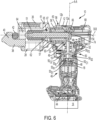
- Fig. 6 shows a side cross-sectional view of such power tool.
- the tool 10 has a controller 44 for determining that the trigger 19 has been pulled. In response to the controller 44 determining that the trigger 19 has been pulled the controller 44 generates a signal to activate an electric motor 46, which is a DC brushless motor.
- an electric motor 46 which is a DC brushless motor.
- an example of a suibale electric motor 46 is the BL41 DC brushless motor designed by Stanley Black & Decker Inc. and used in some commercially available DEWALT ® branded power tools.
- the motor 46 is located in the handle 18 and has a motor output shaft 48.
- Torque from the motor output shaft 48 is transferred via a transmission 50 to an input pinion 52 of a bevel gear arrangement 49.
- the transmission 50 comprises at least one planetary gear arrangement for reducing output speed while increasing torque.
- the motor output shaft 48 drives an input sun gear 50 S1 of the first stage of the transmission 50.
- the input sun gear 50 S1 meshes with a plurality of first stage planet gears 50 P1 which mesh with a stationary outer ring gear 50 R and are coupled to a first stage carrier 50 C1 .
- An axial extension of the first stage carrier 50 C1 is the input sun gear 50 S2 of the second stage of the transmission 50.
- the input sun gear 50 S2 meshes with a plurality of second stage planet gears 50 P2 which mesh with the stationary outer ring gear 50 R and are coupled to a second stage carrier 50 C2 .
- An axial extension of the second stage carrier 50 C2 is rotationally fixed to the input pinion 52 of the bevel gear arrangement.
- the input pinion 52 of the bevel gear arrangement 49 thus rotates at a lower speed than the motor output shaft 48 however with an increased torque relative to the motor output shaft 48.
- the motor output shaft 48, transmission 50 and input pinion 52 of the bevel gear arrangement 49 are aligned along a first axis A-A which extends along a longitudinal length of the handle 18.
- a first axis A-A which extends along a longitudinal length of the handle 18.
- planetary gear stages step down rotation speed while stepping up torque persons skilled in the art, based on the disclosure given herein, will be able to decide upon a suitable transmission arrangement which achives the required gear ratio for thier tool to function; wherein the appropriate gear ratio depends on multiple factors including maximum achievable motor output torque, pitch of the ball screw arrangement described below, friction between moveable features within the tool 10 and the maximum permissible bending force (such as up to 100kN).
- a suitable transmisison 50 may only have a single planetary gear stage, whereas for other tools a suitable transmisison 50 may have a plurality of planetary gear stages arranged in series.
- a bevel gear 53 of the bevel gear arrangement 49 which is meshed with the input pinion 52 for receiving torque therefrom, is provided.
- An axial extension of the bevel gear 53, hereafter the driving sleeve 54 is rotationally fixed relative to an input sleeve 56 of a ball screw arrangement 58.
- the driving sleeve 54 and input sleeve 56 are fixed relative to each other due to a friction fit arrangement.
- An internal surface of the input sleeve 56 comprises a threaded surface.
- the outer surface of the input sleeve 56 is supported by bearings 60 which enable rotation of the input sleeve 56 with respect to the housing 12.
- the bearings 60 are located between the input sleeve 56 and the inner surface of the housing 12, whereas in an axial direction the bearings 60 are located between the driving sleeve 54 and a bearing engagement sleeve 57 which is rotatably fixed to the input sleeve 56 via a friction fit engagement; part of the bearing engagement sleeve 57 lips around the outer edge of an axial bearing 67 for preventing the axial bearing 67 from touching the inner side of the housing 12.
- a threaded rod 62 is mounted within the input sleeve 56, which extends through the input sleeve 56.
- the threaded rod 62 is configured to move along a second longitudinal axis B-B of the tool 10.
- the threaded rod 62 can move forwards or backwards along the axis B-B depending on the motor driving direction, whereby the bias portion 24 moves with the threaded rod 62.
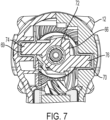
- Fig. 7 shows that an anti-rotation bar 66 is engaged with the threaded rod 62 in a manner whereby the anti-rotation bar 66 is axially and rotationally fixed to the threaded rod 62.
- the anti-rotation bar 66 cooperates with the threaded rod 62 and slots 69, 70 within the housing 12 for causing the threaded rod 62 to move axially along the axis B-B.
- the anti-rotation bar 66 is rotationally fixed with respect to the housing 12 so it slides relative to the housing 12 through the slots 69, 70 during axial movement of the threaded rod 62.
- the anti-rotation bar 66 comprises a central hole 72 with a threaded inner surface which is tightly threadably engaged with a reciprocal threaded portion 74 at an end of the threaded rod 62 as shown in Fig. 6 .
- the anti-rotation bar 66 comprises a first arm 74 and a second arm 76.
- the first and second arms 74, 76 are mounted in first and second slots 69, 70 within the housing 12.
- the threaded rod 62 moves along the second longitudinal axis B-B
- the first and second arms 74, 76 slide along the first and second slots 69, 70.
- the first and second slots 69, 70 extend along longitudinal axes which are parallel to the second longitudinal axis B-B.
- the finger 38 of the moveable bias portion 24 is fixed to the threaded rod 62 by a connector 64, wherein suitable connectors will be apparent to persons skilled in the art.
- suitable connectors will be apparent to persons skilled in the art.
- the nature of the connection between the finger 38 and the threaded rod 62 is not essential and persons skilled in the art will understand that this can be achieved in various different ways (in some embodiments the finger may be fixed directly to the threaded rod).
- the threaded rod 62 extends through an opening 65 defined by the housing 12, specifically through an opening 65 defined by the metal part 12b of the housing 12.
- Fig. 6 shows an axial bearing 67 provided inside the housing 12 for supporting the threaded rod 62.
- the ingress of dirt and moisture through the opening 65 and into the housing 12 is blocked by a flexible bellow 51 provided between the front rim of the opening 65 and the connector 64 (the flexible bellow 51 is omitted from Figs. 1 to 5 for purposes of illustration).
- the flexible bellow 51 contracts and expands in length depending on the extent to which the threaded rod 62 is retracted into the tool 10.
- the exterior of the section of the metal tool housing part 12b defining the opening 65 is threaded and forms a threaded connection with a frame support 61.
- the frame support 61 is part of the support portion 22 and carries the upper frame portion 26 and the lower frame portion 28, which can be formed integrally with the frame support 61 or be fixed thereto.
- a volume 68 is provided within the housing 12 for accommodating the threaded rod 62 when retracted into the tool 10.
- Designers are free to select a suitable way for the controller 44 to control operation of the motor 46 in use to implement a bending operation. In other words designers are free to select a suitable way for the controller 44 to determine when the bend mechanism 20 has been actuated sufficiently for rebar 42 to be bent by a predetermined angle, in other words designers are free to select a suitable way for the controller 44 to determine when the third abutment portion 40 has been moved far enough linearly relative to the first and second abutment portions 30, 32 for rebar 42 to be bent by a predetermined angle.
- the third abutment portion 40 is located in front of the first and second abutment portions 30, 32 so that a user can place a piece of rebar 42 between said features as already described.
- the bias portion 24 is located in a home position, which is a predetermined starting position along the second longitudinal axis B-B relative to the support portion 22.
- the controller 44 Upon the controller 44 determining that the trigger 19 is pulled the controller 44 causes the electric motor 46 to rotate in a forward rotational direction for causing the third abutment portion 40 to be linearly moved along the second longitudinal axis B-B towards the first and second abutment portions 30, 32 whereby the rebar 42 is bent.
- users are required to manually judge when their rebar is bent enough and thus are required to release the trigger 19 when their rebar 42 has been bent a required amount, wherein upon the controller 44 detecting that the trigger 19 is released it causes the motor 46 to drive in a reverse direction for causing the bias portion 24 to be returned to its home position thereby releasing the bent rebar 42.
- a mechanical switch may be provided within the power tool 10 for causing a reset operation upon the threaded rod 62 becoming retracted into the tool 10 by a predetermined amount.
- the threaded rod 62 is retracted into the tool 10. If the user does not release the trigger 19 eventually an arm 74, 76 of the anti-rotation bar 66 will engage a mechanical switch, whereby upon the controller 44 detecting that the mechanical switch is activated it causes the motor 46 to reverse direction and returns the bias portion 24 to the home position; a user must then release the trigger 19 before a subsequent bending operation can be implemented.
- an optical sensor can be used for detecting the presence of the anti-rotation bar 66 or threaded rod 62 for initiating a reset operation.
- a magnetic sensor is provided for detecting the presence of a magnet carried by the anti-rotation bar 66 for initiating a reset operation.
- the controller 44 is configured to receive user input via a user interface of the tool 10 which is indicative of the thickness of the rebar 42 and the required bend angle, wherein based on this user input the controller 44 determines the extent to which the bias portion 24 should be retracted upon pulling the trigger 19.
- the controller 44 will cause movement of the bias portion 24 for bending the rebar the required amount and then will reverse motor direction and return the bias portion 24 to the home position, whereby the trigger 19 must be released before a subsequent bending operation can be performed.
- the controller 44 will cause reverse movement of the motor 46 and will return the bias portion 24 to the home position.
- designers are free to select a suitable way for the controller 44 to control operation of the motor 46 to implement a reset operation.
- designers are free to select a suitable way for the controller 44 to determine when the bias portion 24 (and thus the third abutment portion 40) has returned to the home position at which point in time reverse movement of the bias portion 24 is ceased.
- a mechanical switch may be provided within the tool 10. Following a bending operation, upon initiation of reverse movement of the motor 46 for causing a reset operation, the controller 44 is configured to detect output from the mechanical switch indicative that an arm 74, 76 of the anti-rotation bar 66 actuates the mechanical swich, thereby indicating that the bias portion 24 (and thus the third abutment portion 40) has returned to the home position.
- an optical sensor may be provided within the tool 10 which generates output based on the presence or absence of the anti-rotation bar 66 or threaded rod 62 wherein based on output from the optical sensor the controller 44 can determine that the bias portion 24 (and thus the third abutment portion 40) has reached the home position.
- a magnetic sensor is provided for detecting the presence of a magnet carried by the anti-rotation bar 66 for generating output indicative that the bias portion 24 (and thus the third abutment portion 40) has reached the home position.
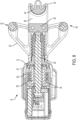
- Figs. 9 and 10 show another embodiment of the portable electric rebar bending power tool 210, wherein corresponding features to the first embodiment described herein are labelled with like reference numerals increased by 200.
- the portable electric power tool 210 is an inline version wherein the battery attachment feature (and thus battery 214), the electric motor 246, the transmission 250, the ball screw mechanism 258 and the bend mechanism 220 are arranged in axial sequence one after the other.
- the motor output shaft 248 extends along the axis C-C and drives an input sun gear 250 S1 of the first stage of the transmission 250.
- the input sun gear 250 S1 meshes with a plurality of first stage planet gears 250 P1 which mesh with a stationary outer ring gear 250 R (which extends along the axis C-C) and are coupled to a first stage carrier 250 C1 .
- An axial extension of the first stage carrier 250 C1 is the input sun gear 250 S2 of the second stage of the transmission 250.
- the input sun gear 250 S2 meshes with a plurality of second stage planet gears 250 P2 which mesh with the stationary outer ring gear 250 R and are coupled to a second stage carrier 250 C2 .
- An axial extension of the second stage carrier 250 C2 is the input sun gear 250 S3 of the third stage of the transmission 250.
- the input sun gear 250 S3 meshes with a plurality of third stage planet gears 250 P3 which mesh with the stationary outer ring gear 250 R and are coupled to a third stage carrier 250 C3 .
- An axial extension of the third stage carrier 250 C3 cooperates with a drive sleeve 254 of the ball screw mechanism 258, wherein such features are rotationally locked such that rotation of the third stage carrier 250 C3 rotatably drives the drive sleeve 254.
- the driving sleeve 254 is fixed to an input sleeve 256 due to a friction fit arrangement and an internal surface of the input sleeve 256 comprises a threaded surface for cooperating with a threaded surface of the threaded rod 262.
- a plurality of balls ride in the opposing threaded surfaces of the input sleeve 256 and threaded rod 262, thereby defining a ball screw arrangement 258.
- a metal inner housing 213 supports the ball screw arrangement 258.
- a first axial bearing 267 is received between the internal surface of a first step portion 213a of the metal inner housing 213 and an external surface of a step portion 254a of the drive sleeve 254.
- a second axial bearing 269 is received between the internal surface of a second step portion 213b of the metal inner housing 213 and an end surface of the input sleeve 256.
- the input sleeve 256 is thus axially supported between the second axial bearing 269 and an inner surface of the drive sleeve 254. Additionally the input sleeve 256 is supported in a radial direction by one or more bearings 260 which permit rotation of the input sleeve 256.
- the (or each) bearing 260 In a radial direction the (or each) bearing 260 is (or are) located between the input sleeve 256 and the inner surface of the metal inner housing 213, whereby an outer race of the (or each) bearing 260 is friction fit with an inner surface of the metal inner housing 213 and an inner race of the (or each) bearing 260 is friction fit with the input sleeve 256.
- the input sleeve 254 is axially supported between the axial bearing 267 and the bearing 260, wherein the input sleeve 254 extends though an opening defined by the axial bearing 267. The input sleeve 254 rotates in use without touching the inner surface of the metal inner housing 213.
- torque from the electric motor 246 is transferred through the transmission 250 to the input sleeve 254, whereby rotation thereof drives rotation of the driving sleeve 246 for causing axial movement of the threaded rod 262.
- the threaded rod 262 is configured to move along the longitudinal axis C-C of the tool 210.
- the threaded rod 262 can move forwards or backwards along the axis C-C depending on the motor driving direction, whereby the bias portion 224 moves with the threaded rod 262 causing actuation of the bend mechanism 220.
- the finger 238 of the moveable bias portion 224 is fixed to the threaded rod 262 by a connector 264, wherein suitable connectors will be apparent to persons skilled in the art.
- suitable connectors will be apparent to persons skilled in the art.
- the nature of the connection between the finger 238 and the threaded rod 262 is not essential and persons skilled in the art will understand that this can be achieved in various different ways (in some embodiments the finger may be fixed directly to the threaded rod).
- the threaded rod 262 is rotatably and axially fixed to the connector 264 and thereby to the finger.
- bias portion 224 and support portion 222 of the bend mechanism 220 must permit movement relative to each other they are shaped and cooperate to enable axial movement between the bias portion 224 and support portion 222 but restrict rotational movement of the bias portion 224 and support portion 222 relative to each other; whereby in use the threaded rod 262 is able to move axially within the tool 210 but is restricted from rotating.
- the threaded rod 262 extends through an opening 265 defined by the inner metal housing 213.
- An exterior section of the metal inner housing 213 forms a threaded connection with the frame support 261.
- the frame support 261 is part of the support portion 222 and carries the upper frame portion and the lower frame portion, which can be formed integrally with the frame support 261 or be fixed thereto.
- a volume 268 is provided for accommodating the threaded rod 262 when retracted into the tool 210.
- the ingress of dirt and moisture through the opening 265 and into the metal inner housing 213 is blocked by a flexible bellow 251 provided between the front rim of the opening 265 and the connector 264.
- the flexible bellow 251 contracts and expands in length depending on the extent to which the threaded rod 262 is retracted into the tool 210. Comparing Figs. 9 and 10 , these drawings illustrate the same tool 210 however differ by the axial position of the threaded rod 262 and thereby the consequential configuration of the bend mechanism 220.
- Designers are free to select a suitable way for the controller 244 to control operation of the motor 246 in use to implement a bending operation. In other words designers are free to select a suitable way for the controller 244 to determine when the bend mechanism 220 has been actuated sufficiently for rebar to be bent by a predetermined angle, in other words designers are free to select a suitable way for the controller 244 to determine when the third abutment portion 240 has been moved far enough linearly relative to the first and second abutment portions 230, 232 for rebar to be bent by a predetermined angle.
- the third abutment portion 240 is located in front of the first and second abutment portions 230, 232 so that a user can place a piece of rebar between said features as already described.
- the bias portion 224 is located in a home position, which is a predetermined starting position along the longitudinal axis C-C relative to the support portion 222.
- the controller 244 Upon the controller 244 determining that a trigger of the tool 210 is actuated the controller 244 causes the electric motor 246 to rotate in a forward rotational direction for causing the third abutment portion 240 to be linearly moved along the longitudinal axis C-C towards the first and second abutment portions 230, 232 whereby the rebar is bent.
- users are required to manually judge when their rebar is bent enough and thus are required to release the trigger when their rebar has been bent a required amount, wherein upon the controller 244 detecting that the trigger is released it causes the motor 246 to drive in a reverse direction for causing the bias portion 224 to be returned to its home position thereby releasing the bent rebar.
- a mechanical switch may be provided within the power tool 210 for causing a reset operation upon the threaded rod 262 becoming retracted into the tool 210 by a predetermined amount.
- the threaded rod 262 is retracted into the tool 210. If the user does not release the trigger eventually the threaded rod 262 (or a feature provided thereon) will engage a mechanical switch, whereby upon the controller 244 detecting that the mechanical switch is activated it causes the motor 246 to reverse direction and returns the bias portion 224 to the home position; a user must then release the trigger before a subsequent bending operation can be implemented.
- an optical sensor can be used for detecting the presence of the threaded rod 262 for initiating a reset operation.
- a magnetic sensor is provided for detecting the presence of a magnet carried by the threaded rod 262 for initiating a reset operation.
- the controller 244 is configured to receive user input via a user interface of the tool 210 which is indicative of the thickness of the rebar and the required bend angle, wherein based on this user input the controller 244 determines the extent to which the bias portion 224 should be retracted upon actuating the trigger.
- the controller 244 will cause movement of the bias portion 224 for bending the rebar the required amount and then will reverse motor direction and return the bias portion 224 to the home position, whereby the trigger must be released before a subsequent bending operation can be performed.
- the controller 244 will cause reverse movement of the motor 246 and will return the bias portion 224 to the home position.
- designers are free to select a suitable way for the controller 244 to control operation of the motor 246 to implement a reset operation.
- designers are free to select a suitable way for the controller 244 to determine when the bias portion 224 (and thus the third abutment portion 240) has returned to the home position at which point in time reverse movement of the bias portion 224 is ceased.
- a mechanical switch may be provided within the tool 210.
- the controller 244 is configured to detect output from the mechanical switch indicative that threaded rod 262 (or a feature provided thereon) actuates the mechanical swich, thereby indicating that the bias portion 224 (and thus the third abutment portion 240) has returned to the home position.
- an optical sensor may be provided within the tool 210 which generates output based on the presence or absence of the threaded rod 262 wherein based on output from the optical sensor the controller 244 can determine that the bias portion 224 (and thus the third abutment portion 240) has reached the home position.
- a magnetic sensor is provided for detecting the presence of a magnet carried by the threaded rod 262 for generating output indicative that the bias portion 224 (and thus the third abutment portion 240) has reached the home position.
- bias portions 24, 224 More specific aspects of the bias portions 24, 224 will now be described with reference to Figs. 11 to 22 wherein corresponding features to those heretofore described will be denoted with like reference numerals increased by 100.
- the bias portion 324 in Fig. 11 has a finger 338 one end of which is configured to be coupled to the threaded rod 62, 262 and persons skilled in the art will appreciate that there are various ways of achieving this so no further technical detail will be provided in this respect (the finger 338 can be fixed directly or indirectly to the threaded rod 62, 262).
- a third abutment portion 340 is provided adjacent the other end of the finger 338 in such a manner that the rotational position of the third abutment portion 340 can be selectively changed by a user.
- Fig. 12 illustrates that the finger 338 is provided with a post 380.
- the cross-sectional shape of the post is non-circular.
- a circular opening 381 extends through the post 380 and finger 338 along an axis Z.
- a fastener 382 extends through the circular opening 381 and is coupled to a cap 383 in such a manner that the cap 383 can be rotated relative to the post 380 but it is restricted from moving axially relative to the post 380.
- the cap 383 has a cross-sectional profile similar to that of the post 380. The cap 383 can thus be rotated between a position in which the cross-sectional profile of the cap 383 and post 380 are aligned and another position in which the cross-sectional profile of the cap 383 and post 380 are not aligned.
- the upper end of the post 380 is provided with holes 384 which do not extend all the way through the post 380 and are configured to receive spring loaded pins 385.
- the lower side of the cap 383 is provided with a first set of depressions for receiving the spring loaded pins 385 when the cross-sectional profile of the cap 383 and post 380 are aligned and another set of depressions for receiving the spring loaded pins 385 when the cap 383 has been rotated 90 degrees away from such position.
- tactile and audible (a click) feedback when the cross-sectional profile of the cap 383 and post 380 are rotated into alignment and when the cap 383 has been rotated 90 degrees away from such position.
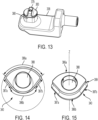
- Figs. 14 and 15 illustrate the third abutment portion 340 which has a non-circular opening 388 extending entirely through it which extends along the axis Z (see Fig. 12 ) in use, wherein the profile of such non-circular opening is similar to the outer cross-sectional profile of the post 380.
- the third abutment portion 340 has a first bending surface portion 386a and a second bending surface portion 386b. Looking along the axis Z, which extends through the opening 388, the radius of curvature of the first bending surface portion 386a is larger than the radius of curvature of the second bending surface portion 386b which is illustrated by the dotted lines in Fig. 14 .
- the radius of curvature of the first bending surface portion 386a can range between 24 and 40 mm and in a specific example is 32mm.
- the radius of curvature of the second bending surface portion 386b can range between 15 and 24 mm and in a specific example is 22mm.
- the surface portions 387a, 387b between either end of the first and second bending surface portions 386a, 386b are not curved around the axis Z.
- a user can mount the third abutment portion 340 to the finger 338 by sliding the opening 388 of the third abutment portion 340 around the post 380 and turning the cap 383 to axially lock the third abutment portion 340 to the finger 338; the cap 383 is provided with a projection 379 for facilitating gripping by a user.
- a user has flexibility to select which of the first and second bending surface portions 386a, 386b engages rebar during a bending operation as described in connection with Figs. 3 to 5 by rotating the cap 383 into alignment with the post 380 thereby permitting the third abutment portion 340 to be removed from the post and subsequently replaced in the required direction.
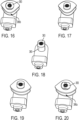
- Fig. 16 illustrates the third abutment portion 340 in a configuration such that the second bending surface portion 386b will engage rebar in use.
- the radius of curvature of the second bending surface portion 386b is smaller than the first bending surface portion 386a. If a user wants to bend a thicker piece of rebar, thereby requiring a larger radius of curvature, the user can reconfigure the direction of the third abutment portion 340 by rotating the cap 383 into alignment with the post 380 as shown in Fig. 17 .
- the third abutment portion 340 can then be lifted from the post as shown in Fig. 18 and subsequently replaced upon being rotated 180 degrees as shown in Fig. 19 .
- Fig. 16 illustrates the third abutment portion 340 in a configuration such that the second bending surface portion 386b will engage rebar in use.
- the radius of curvature of the second bending surface portion 386b is smaller than the first bending surface portion 386a.
- the cap 383 is rotated out of alignment with the post 380 (e.g. 90 degrees) so the third abutment portion 340 is locked in place around the post 380 but now in the opposite direction such that the first bending surface portion 386a will engage rebar during a bending operation as described in connection with Figs. 3 to 5 .
- the third abutment portion 340 illustrated has a circumferential groove 399 the purpose of which is equivalent to the depressions 30a, 32a, 40a heretofore described, namely the depressions 30a, 32a of the first and second abutment potions 30, 32 in addition to the circumferential groove 399 are arranged so that in use they are in the same plane for partially receiving rebar during a bending operation for enhancing stability of rebar during a bending operation.
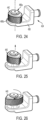
- Fig. 21 illustrates the third abutment portion 340 with the second bending surface portion 386b bending a piece of rebar (other featuires of the power tool are omitted for purposes of illustration).
- Fig. 22 illustrates the third abutment portion 340 with the first bending surface portion 386a bending a piece of rebar (other feateries of the power tool are omitted for purposes of illustration).
- the rebar is bent to the same angle, however, the radius of curvature of the bend introduced into the rebar differs.
- the bias portion 424 has a third abutment portion 440 on the finger 438 which does not need to be removed in order to enable a user to select a specific bending radius, wherein such selection is enabled by rotating the third abutment portion 440 around the axis denoted Z.
- the third abutment portion 440 has a first bending surface portion 486a and a second bending surface portion 486b.
- the radius of curvature of the first bending surface portion 486a is larger than the radius of curvature of the second bending surface portion 486b.
- a user pulls the third abutment portion 440 upwards along the axis Z until they encounter resistance.
- the third abutment portion 440 will be rotationally locked but now with the first and second bending surface portions 486a, 486b reversed such that, in use, rebar will be engaged by the second bending surface portion 486b during a bending operation.
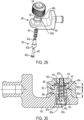
- Figs. 29 and 30 illustrate that the third abutment portion 440 defines an inner volume which receives a post 480 extending from the finger 438.
- the finger 438 and post 480 themselves define an opening which receives a fastener 482, a sleeve 483 and a spring 484.
- the post 480 has a first post section 480a and a second post section 480b.
- the outer surface 481a of the first post section 480a is non-circular.
- the outer surface 481b of the second post section 480b is circular and is narrower than the first post section 480a such that a step 482 is provided between the outer surface 481a of the first post section 480a and the outer surface 481b of the second post section 480b.
- the inner surface 483a of the first post section 480a defines a volume with a circular cross-sectional profile.
- the inner surface 483b of the second post section 480b also defines a volume though having a width less than the diameter of the volume defined by the inner surface 483a such that a step 484 s is provided between the inner surface 483a of the first post section 480a and the inner surface 483b of the second post section 480b; the portion of the inner surface 483a of the first post section 480a defining such step 484 s is hereafter referred to as the inner step part 485.
- the uppermost part of the second post section 480b defines a circular opening 490 and the portion of the inner surface of the second post section 480b adjacent the opening 490 is hereafter referred to as the lip 487.
- the shape of the inner volume of the third abutment portion 440 is such that the third abutment portion 440 can receive and thus mate with the post 480. More specifically the third abutment portion 440 defines a first inner volume part and a second inner volume part.
- the first inner volume part defines a first inner surface 488 which can cooperate with the first post section 480a such that when the first post section 480a is received by the first inner volume part such features cooperate to block rotation of the third abutment portion 440 relative to the post 480; in other words the outer surface 481a of the first post section 480a cooperates with the first inner surface 488 of the third abutment portion 440 to block rotation of the third abutment portion 440 relative to the post 480.
- the second inner volume part of the third abutment portion 440 defines a second inner surface 489 such that the second post section 480b can be received by the second inner volume part of the third abutment portion 440.
- the third abutment portion 440 is provided around the post 480 such that the first and second post sections 480a, 480b are received by and thus mate with the first and second inner volume parts of the third abutment portion 440.
- the spring 484 is then inserted to the opening extending through the post 480 such that the spring 484 abuts the lip 487.
- the sleeve 483 is then inserted into the opening, with the shaft part 483a of the sleeve 483 leading and the head part 483b of the sleeve 483 trailing.
- Both the head part 483b and the shaft part 483a of the sleeve 483 are circular in cross-section, though the head part 483b has a bigger diameter than the shaft part 483a whereby such features can slide against the circular inner surface 483a of the first post section 480a and the rim of the circular opening 490 respectively.
- the fastener 482 is inserted through the opening defined by the sleeve 483.
- the head 482a of the fastener is drawn towards the third abutment portion 440 and thus urges against an internally extending lip 483c within the sleeve 483 whereby the sleeve 483 is urged against the spring 484.
- the fastener 482 is tightened against the third abutment portion 440 it causes the head part 483b of the sleeve 483 to compress the spring 484 against the lip 487.
- Such fastener 482 tightening/ spring 485 compression is limited by engagement of the shaft part 483a of the sleeve 483 against the third abutment portion 440.
- Fig. 30 the third abutment portion 440 is urged by the spring 484 against the post 480. More specifically since one end of the spring 484 engages the lip 487 and the other end of the spring 484 engages the head part 483b of the sleeve 483 the spring 484 urges the sleeve 483 downwards in Fig. 30 , however, cooperation between the sleeve 483 and head 482a of the fastener 482 causes the fastener 482 to pull the third abutment portion 440 downwards in Fig. 30 also.
- the arrangement of features in Fig. 30 corresponds to the arrangement of Fig. 24 . In other words Fig. 30 shows what internal components of the arrangement in Fig. 24 look like.
- cooperation between the non-circular outer surface 481a of the first post section 480a and the correspondingly shaped first inner surface 488 of the third abutment portion 440 cooperate to block rotation of the third abutment portion 440 relative to the post 480.
- the third abutment portion 440 In order to rotate the third abutment portion 440 around the post 480 the third abutment portion 440 must first be pulled against bias of the spring 484 so that the first inner surface 488 of the third abutment portion 440 separated from the non-circular outer surface 481a of the first post section 480a; in other words the first inner surface 488 is moved above the non-circular outer surface 481a of the first post section 480a in Fig. 30 .
- the extent to which a user can pull the third abutment portion 440 is limited by engagement between the head part 483b of the sleeve 483 and the inner step part 485. The third abutment portion 440 can then be rotated around the post 480.
- the first inner surface 488 of the third abutment portion 440 will again rotationally align with the correspondingly shaped non-circular outer surface 481a of the first post section 480a and the spring 484 will pull the third abutment portion 440 towards the finger 438 so that the post 480 is again received within the volume defined by the third abutment portion 440.
- the male/female nature of the mechanism rotationally locking the third abutment portion 340 to the finger 338 may differ. Instead of the male feature (the post 380) being on the finger 338 and the female feature (the non-circular opening 388) being on the third abutment portion 340 these can be reversed such that a post is provided on the third abutment portion 340 instead of the non-circular opening 388 wherein such post is configured to be received in a non-circular opening defined by the finger 338.
- non-circular cross-sectional profile of the post 380, cap 383 and opening 388 illustrated in the drawings is just one example and it will be appreciated that a different non-circular shape could be used instead for example a square shaped cross-sectional profile.
- the shape of the third abutment portion 340 illustrated in Figs. 11 to 22 of the drawings is merely an example and persons skilled in the art will understand that it can be shaped differently and still achieve the same effect.
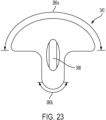
- the nature of the surface portions 387a, 387b between either end of the first and second bending surface portions 386a, 386b can be different as illustrated in Fig. 23 . Comparing Figs. 14 and 23 it will be apparent that less material is used to form the third abutment portion 340 in Fig. 23 .
- the cap 383 is different.
- the cap 383 may not cooperate with spring loaded pins 385 wherein such spring loaded pins 385 are omitted.
- the cap 383 may not have a cross-sectional profile similar to that of the post 380 and instead the cap 383 may have a cross-sectional profile different to that of the post 380 such that regardless of the rotational position of the cap 383 and post 380 the cap 383 blocks linear movement of the third abutment portion 340 when the cap 383 is coupled to the post 380; in such embodiments the cap 383 needs to be separated from the post 380 in order to permit relative linear movement between the post 380 and the third abutment portion 340 and persons skilled in the art will be able to envisage suitable releasable coupling mechanisms between the cap 383 and the post 380, for example the cap 383 may have an externally threaded projection which is configured to cooperate with a threaded opening in the post 380.
- the depressions 30a, 32a, 40a are omitted.
- circumferential groove 399 is omitted.
- the support portion 22 has a different configuration.
- the drawings show the first and second abutment portions 30, 32 to be fingers coupled to, and extending between, the upper frame portion 26 and lower frame portion 28.
- the support portion 22 is formed as a single piece, wherein the first and second abutment portions 30, 32 are formed by the edges of walls extending between the upper frame portion 26 and lower frame portion 28, wherein the walls are integrally formed with the upper frame portion 26 and lower frame portion 28.
- the angle between the first longitudinal axis A-A and the second longitudinal axis B-B may not be 90 degrees and instead may range between 45 degrees to 145 degrees, which is achievable by adjusting the angle at which the input pinion 52 and the bevel gear 53 of the bevel gear arrangement 49 mesh.
- the motor 46 is only partially received within the handle 18.
- At least one planetary gear stage of the transmission 50 is received in the handle 18.
- the motor 46 and the transmission 50 are received in the handle 18.
- the battery 14, 214 is removable from the tool 10, 210 or alternatively the battery 14, 214 is integral to the tool 10, 210. Alternatively or additionally the tool 10, 210 may be configured to receive electric power from a mains power supply.
- the driving sleeve 54, 254 and input sleeve 56, 256 are fixed to each other due to a friction fit arrangement.
- the driving sleeve 54, 254 and input sleeve 56, 256 can be fixed via an interlocking arrangement such as a spline fit arrangement or other male and female interlocking-type arrangement.
- the electric motor 46, 246 has been described as being a brushless motor and the controller 44, 244 cooperates with the brushless motor (in particular with its control electronics) in order to control the brushless motor.
- the motor 46, 246 may be a brushed motor having a motor output shaft driven by a stator and having at least one magnet on the motor output shaft. It is here mentioned that in battery operated embodiments the motor 46, 246 is configured to operate using DC current, whereas in mains operated embodiments the motor is configured to operate using AC current.
- the tool 10, 210 may have a roller screw mechanism (sometimes known as a planetary roller screw mechanism) instead of a ball screw mechanism 58, 258 for converting torque into linear force.
- a roller screw mechanism sometimes known as a planetary roller screw mechanism
- this can be achieved by rotationally fixing the driving sleeve 54, 254 to an input sleeve of the roller screw mechanism; wherein a set of rollers (sometimes called planetary rollers) are provided between the internal surface of the input sleeve and an external surface of the threaded rod 62, 262.
- the connector 64, 264 has a first attachment portion for attaching to the finger 38, 238, 338, 438 and also a second attachment portion for attaching to the threaded rod 62, 262.
- the first attachment portion may be a plug and socket-type attachment arrangement for mating with an appropriately shaped part of the finger 38, 238, 338, 438 or a threaded attachment arrangement for threadably engaging with part of the finger 38, 238, 338, 438 or alternatively the first attachment portion may be attached to the finger 38, 238, 338, 438 via adhesive or welding.
- the second attachment portion may be a plug and socket-type attachment arrangement for mating with an appropriately shaped part of the threaded rod 62, 262, or a threaded attachment arrangement for threadably engaging with the threaded rod 62, 262 or alternatively the second attachment portion may be attached to the threaded rod via adhesive or welding.
- the connector 64, 264 is omitted and instead the threaded rod 62, 262 is fixed directly to the finger 38, 238, 338, 438 of the bias portion 24, 224, 324, 424 such as via a plug and socket-type attachment whereby one of the threaded rod 62, 262 and finger 38, 238, 338, 438 plugs into the other, or via a threaded attachment arrangement whereby one of the threaded rod 62, 262 and finger 38, 238, 338, 438 is threadably received by the other, or via an adhesive arrangement whereby the threaded rod 62, 262 is bonded to the finger 38, 238, 338, 438 ; in some embodiments the threaded rod 62, 262 and finger 38, 238, 338, 438 are welded together.
- the frame support 61 is fixed relative to the housing 12 in a manner different to threadably engaging the frame support 61 to the metal part 12b of the housing 12 as heretofore described.
- the frame support 61 may be fixed to the metal part 12b of the housing 12 via adhesive, welding, or one or more bolts or screws.
- one or more bolts extend between the frame support 61 and an internal frame (backbone) of the tool 10 located within the housing 12 for fixing the frame support 61 to the frame and thus relative to the housing 12.
- bias portion 24, 224, 324, 424 has been described as being driven relative to the stationary support portion 22, 222 for implementing a bending operation.
- such relative motion, and thus bending operation can be achieved by alternatively configuring the tool 10, 210 so that the support portion 22, 222 is driven relative to a stationary bias portion 24, 224.
- the embodiment of the tool 10 described in connection with Figs. 6 to 8 has an anti-rotation bar 66 for preventing rotation of the threaded rod 62.
- the embodiment of the tool 210 described in connection with Figs. 9 and 10 omits an anti-rotation bar whereas rotation of the threaded rod 62 is prevented by configuring the bias portion 224 and support portion 222 of the bend mechanism 220 so as to permit relative axial movement between the bias portion 224 and support portion 222 but restrict rotational movement of the bias portion 224 and support portion 222 relative to each other; whereby in use the threaded rod 262 is able to move axially within the tool 210 but is restricted from rotating.
- the tool 10 can omit an anti-rotation bar 66 whereas rotation of the threaded rod 62 is prevented by cooperation between the bias portion 24 and support portion 22 of the bend mechanism 20 which permit relative axial movement but not relative rotational movement; wherein operation of the tool 10 can be controlled in a manner similar to that heretofore described in connection with the tool 210.
- the tool 210 can have an anti-rotation bar for preventing rotation of the threaded rod 262; wherein operation of the tool 210 can be controlled in a manner similar to that heretofore described in connection with the tool 10.
Landscapes
- Engineering & Computer Science (AREA)
- Mechanical Engineering (AREA)
- Bending Of Plates, Rods, And Pipes (AREA)
- Shearing Machines (AREA)
- Manipulator (AREA)
Priority Applications (1)
| Application Number | Priority Date | Filing Date | Title |
|---|---|---|---|
| US18/653,244 US20240367211A1 (en) | 2023-05-05 | 2024-05-02 | Portable electric power tool for bending elongate objects |
Applications Claiming Priority (2)
| Application Number | Priority Date | Filing Date | Title |
|---|---|---|---|
| GBGB2306685.5A GB202306685D0 (en) | 2023-05-05 | 2023-05-05 | Portable electric power tool for bending elongate objects |
| GBGB2308631.7A GB202308631D0 (en) | 2023-05-05 | 2023-06-09 | Portable electric power tool for bending elongate objects |
Publications (1)
| Publication Number | Publication Date |
|---|---|
| EP4458486A1 true EP4458486A1 (de) | 2024-11-06 |
Family
ID=90362050
Family Applications (2)
| Application Number | Title | Priority Date | Filing Date |
|---|---|---|---|
| EP24161415.5A Pending EP4458485A1 (de) | 2023-05-05 | 2024-03-05 | Tragbares elektrowerkzeug zum biegen länglicher objekte |
| EP24173682.6A Pending EP4458486A1 (de) | 2023-05-05 | 2024-05-01 | Tragbares elektrowerkzeug zum biegen länglicher objekte |
Family Applications Before (1)
| Application Number | Title | Priority Date | Filing Date |
|---|---|---|---|
| EP24161415.5A Pending EP4458485A1 (de) | 2023-05-05 | 2024-03-05 | Tragbares elektrowerkzeug zum biegen länglicher objekte |
Country Status (2)
| Country | Link |
|---|---|
| US (2) | US20240367212A1 (de) |
| EP (2) | EP4458485A1 (de) |
Families Citing this family (3)
| Publication number | Priority date | Publication date | Assignee | Title |
|---|---|---|---|---|
| JP1768705S (ja) * | 2023-06-13 | 2024-04-22 | 鉄筋結束機 | |
| JP1766305S (ja) * | 2023-06-13 | 2024-03-25 | 鉄筋結束機本体 | |
| GB202318725D0 (en) * | 2023-12-07 | 2024-01-24 | Black & Decker Inc | A portable electric pressing tool |
Citations (12)
| Publication number | Priority date | Publication date | Assignee | Title |
|---|---|---|---|---|
| DE164182C (de) * | 1904-07-06 | 1905-11-02 | Bastians Johann H | Zange zum Biegen von Isolierröhren mit Metallmantel |
| CH580995A5 (en) * | 1975-02-06 | 1976-10-29 | Ruf Ag Herzogenbuchsee | Motor driven mobile tube bending fixture - has operating spindle coupled to electric hand drilling machine |
| FR2591918A1 (fr) * | 1985-12-19 | 1987-06-26 | Moquet Gerald | Presse de depannage a galber les petits tubes acier |
| JPH11192513A (ja) * | 1997-12-26 | 1999-07-21 | Kyoto Tool Co Ltd | 可搬型電動式パイプベンダー |
| CN101085458A (zh) * | 2006-06-07 | 2007-12-12 | 车王电子股份有限公司 | 手提电动弯管机 |
| US20100000288A1 (en) * | 2006-09-11 | 2010-01-07 | Gualtiero Barezzani | Hydraulic pressing and/or cutting tool and mechanism for coverting a rotary motion into a translational oscillating motion for this tool |
| US9162273B1 (en) * | 2014-08-20 | 2015-10-20 | Sheng-Chih Chiu | Pipe bender |
| US20180009098A1 (en) * | 2016-07-05 | 2018-01-11 | Makita Corporation | Rechargeable electric power tool |
| US20210001466A1 (en) * | 2019-07-01 | 2021-01-07 | Guido Valentini | Electric power tool with two or more battery units and electric power tool arrangement comprising such an electric power tool and a voltage converter unit |
| CN217018110U (zh) * | 2022-03-09 | 2022-07-22 | 浙江飞越机电有限公司 | 一种弯管机的转轮调节结构 |
| CN217422078U (zh) * | 2022-03-09 | 2022-09-13 | 浙江飞越机电有限公司 | 一种小型电动弯管机的驱动装置 |
| CN115383011A (zh) * | 2022-09-30 | 2022-11-25 | 中交路桥建设有限公司 | 用于桩头钢筋的电驱动精确制弯装置及方法 |
Family Cites Families (9)
| Publication number | Priority date | Publication date | Assignee | Title |
|---|---|---|---|---|
| US7058291B2 (en) * | 2000-01-07 | 2006-06-06 | Black & Decker Inc. | Brushless DC motor |
| EP2388107B1 (de) * | 2009-12-18 | 2019-09-04 | Techtronic Power Tools Technology Limited | Multifunktionswerkzeugsystem |
| US9038745B2 (en) * | 2010-12-20 | 2015-05-26 | Brigham Young University | Hand power tool and drive train |
| US9718108B2 (en) * | 2014-09-11 | 2017-08-01 | Huskie Tools, Inc. | Powered bending tool |
| US10076376B2 (en) * | 2015-05-27 | 2018-09-18 | Medos International Sàrl | Devices and methods for bending or cutting implants |
| US11007565B2 (en) * | 2017-01-13 | 2021-05-18 | Makita Corporation | Fastening tool |
| WO2020128597A1 (en) * | 2018-12-21 | 2020-06-25 | Cembre S.P.A. | Compression or cutting tool |
| JP7079877B1 (ja) * | 2021-06-07 | 2022-06-02 | マクセルイズミ株式会社 | 電動工具 |
| US20230241660A1 (en) * | 2022-02-03 | 2023-08-03 | Milwaukee Electric Tool Corporation | Conduit bender |
-
2024
- 2024-03-05 EP EP24161415.5A patent/EP4458485A1/de active Pending
- 2024-03-22 US US18/613,823 patent/US20240367212A1/en active Pending
- 2024-05-01 EP EP24173682.6A patent/EP4458486A1/de active Pending
- 2024-05-02 US US18/653,244 patent/US20240367211A1/en active Pending
Patent Citations (12)
| Publication number | Priority date | Publication date | Assignee | Title |
|---|---|---|---|---|
| DE164182C (de) * | 1904-07-06 | 1905-11-02 | Bastians Johann H | Zange zum Biegen von Isolierröhren mit Metallmantel |
| CH580995A5 (en) * | 1975-02-06 | 1976-10-29 | Ruf Ag Herzogenbuchsee | Motor driven mobile tube bending fixture - has operating spindle coupled to electric hand drilling machine |
| FR2591918A1 (fr) * | 1985-12-19 | 1987-06-26 | Moquet Gerald | Presse de depannage a galber les petits tubes acier |
| JPH11192513A (ja) * | 1997-12-26 | 1999-07-21 | Kyoto Tool Co Ltd | 可搬型電動式パイプベンダー |
| CN101085458A (zh) * | 2006-06-07 | 2007-12-12 | 车王电子股份有限公司 | 手提电动弯管机 |
| US20100000288A1 (en) * | 2006-09-11 | 2010-01-07 | Gualtiero Barezzani | Hydraulic pressing and/or cutting tool and mechanism for coverting a rotary motion into a translational oscillating motion for this tool |
| US9162273B1 (en) * | 2014-08-20 | 2015-10-20 | Sheng-Chih Chiu | Pipe bender |
| US20180009098A1 (en) * | 2016-07-05 | 2018-01-11 | Makita Corporation | Rechargeable electric power tool |
| US20210001466A1 (en) * | 2019-07-01 | 2021-01-07 | Guido Valentini | Electric power tool with two or more battery units and electric power tool arrangement comprising such an electric power tool and a voltage converter unit |
| CN217018110U (zh) * | 2022-03-09 | 2022-07-22 | 浙江飞越机电有限公司 | 一种弯管机的转轮调节结构 |
| CN217422078U (zh) * | 2022-03-09 | 2022-09-13 | 浙江飞越机电有限公司 | 一种小型电动弯管机的驱动装置 |
| CN115383011A (zh) * | 2022-09-30 | 2022-11-25 | 中交路桥建设有限公司 | 用于桩头钢筋的电驱动精确制弯装置及方法 |
Also Published As
| Publication number | Publication date |
|---|---|
| US20240367211A1 (en) | 2024-11-07 |
| US20240367212A1 (en) | 2024-11-07 |
| EP4458485A1 (de) | 2024-11-06 |
Similar Documents
| Publication | Publication Date | Title |
|---|---|---|
| EP4458486A1 (de) | Tragbares elektrowerkzeug zum biegen länglicher objekte | |
| EP2320118B1 (de) | Anschlussvorrichtung für flüssigkeitsleitung | |
| CN1319667C (zh) | 弯管器和使用它的方法 | |
| CN201190709Y (zh) | 伸缩管凸轮连接锁紧机构 | |
| RS61130B1 (sr) | Uređaj za podešavanje visine kabineta | |
| CN104416523B (zh) | 动力工具 | |
| SG186694A1 (en) | Insertion tool for tangless spiral coil insert | |
| WO2025223241A1 (zh) | 一种多功能组合工具 | |
| CN118031059A (zh) | 一步锁紧式脚架 | |
| US20250327320A1 (en) | Portable electric power tool for bending elongate objects | |
| EP2743033A1 (de) | Schraubendreher mit automatischem kopfwechsel | |
| CN100546771C (zh) | 水管钳结构 | |
| CN110695294B (zh) | 带安全侧把的动力铆接工具附件及动力铆接工具 | |
| EP4663321A1 (de) | Tragbare elektrische knockout-stanze | |
| CN110743946B (zh) | 一种手动机械式弯管钳 | |
| US20240001432A1 (en) | Power tool for setting fasteners | |
| CN216543121U (zh) | 一种可调节的胶管用锁管机 | |
| CN201176991Y (zh) | 伸缩管凸轮连接锁紧机构 | |
| US20250326019A1 (en) | Portable electric power tool for bending elongate objects | |
| CN212115058U (zh) | 一种离合顺畅的线性致动器 | |
| JP6864201B2 (ja) | 多サイズの曲がり矯正装置 | |
| EP4566758A1 (de) | Tragbares elektrisches presswerkzeug | |
| CN223563954U (zh) | 一种黄油枪的抽油装置 | |
| CN220957751U (zh) | 锁紧结构及脚架 | |
| CN2350166Y (zh) | 棘轮驱动机构 |
Legal Events
| Date | Code | Title | Description |
|---|---|---|---|
| PUAI | Public reference made under article 153(3) epc to a published international application that has entered the european phase |
Free format text: ORIGINAL CODE: 0009012 |
|
| STAA | Information on the status of an ep patent application or granted ep patent |
Free format text: STATUS: THE APPLICATION HAS BEEN PUBLISHED |
|
| AK | Designated contracting states |
Kind code of ref document: A1 Designated state(s): AL AT BE BG CH CY CZ DE DK EE ES FI FR GB GR HR HU IE IS IT LI LT LU LV MC ME MK MT NL NO PL PT RO RS SE SI SK SM TR |
|
| STAA | Information on the status of an ep patent application or granted ep patent |
Free format text: STATUS: REQUEST FOR EXAMINATION WAS MADE |
|
| 17P | Request for examination filed |
Effective date: 20250430 |