EP4455094A1 - Kathodenaktivmaterial für lithiumsekundärbatterie und lithiumsekundärbatterie damit - Google Patents
Kathodenaktivmaterial für lithiumsekundärbatterie und lithiumsekundärbatterie damit Download PDFInfo
- Publication number
- EP4455094A1 EP4455094A1 EP24170905.4A EP24170905A EP4455094A1 EP 4455094 A1 EP4455094 A1 EP 4455094A1 EP 24170905 A EP24170905 A EP 24170905A EP 4455094 A1 EP4455094 A1 EP 4455094A1
- Authority
- EP
- European Patent Office
- Prior art keywords
- active material
- particle
- lithium
- cathode
- cobalt
- Prior art date
- Legal status (The legal status is an assumption and is not a legal conclusion. Google has not performed a legal analysis and makes no representation as to the accuracy of the status listed.)
- Pending
Links
Images

Classifications
-
- C—CHEMISTRY; METALLURGY
- C01—INORGANIC CHEMISTRY
- C01G—COMPOUNDS CONTAINING METALS NOT COVERED BY SUBCLASSES C01D OR C01F
- C01G53/00—Compounds of nickel
- C01G53/40—Complex oxides containing nickel and at least one other metal element
- C01G53/42—Complex oxides containing nickel and at least one other metal element containing alkali metals, e.g. LiNiO2
-
- H—ELECTRICITY
- H01—ELECTRIC ELEMENTS
- H01M—PROCESSES OR MEANS, e.g. BATTERIES, FOR THE DIRECT CONVERSION OF CHEMICAL ENERGY INTO ELECTRICAL ENERGY
- H01M4/00—Electrodes
- H01M4/02—Electrodes composed of, or comprising, active material
- H01M4/36—Selection of substances as active materials, active masses, active liquids
-
- C—CHEMISTRY; METALLURGY
- C01—INORGANIC CHEMISTRY
- C01G—COMPOUNDS CONTAINING METALS NOT COVERED BY SUBCLASSES C01D OR C01F
- C01G53/00—Compounds of nickel
- C01G53/40—Complex oxides containing nickel and at least one other metal element
- C01G53/42—Complex oxides containing nickel and at least one other metal element containing alkali metals, e.g. LiNiO2
- C01G53/44—Complex oxides containing nickel and at least one other metal element containing alkali metals, e.g. LiNiO2 containing manganese
- C01G53/50—Complex oxides containing nickel and at least one other metal element containing alkali metals, e.g. LiNiO2 containing manganese of the type (MnO2)n-, e.g. Li(NixMn1-x)O2 or Li(MyNixMn1-x-y)O2
-
- H—ELECTRICITY
- H01—ELECTRIC ELEMENTS
- H01M—PROCESSES OR MEANS, e.g. BATTERIES, FOR THE DIRECT CONVERSION OF CHEMICAL ENERGY INTO ELECTRICAL ENERGY
- H01M10/00—Secondary cells; Manufacture thereof
- H01M10/05—Accumulators with non-aqueous electrolyte
- H01M10/052—Li-accumulators
-
- H—ELECTRICITY
- H01—ELECTRIC ELEMENTS
- H01M—PROCESSES OR MEANS, e.g. BATTERIES, FOR THE DIRECT CONVERSION OF CHEMICAL ENERGY INTO ELECTRICAL ENERGY
- H01M10/00—Secondary cells; Manufacture thereof
- H01M10/05—Accumulators with non-aqueous electrolyte
- H01M10/052—Li-accumulators
- H01M10/0525—Rocking-chair batteries, i.e. batteries with lithium insertion or intercalation in both electrodes; Lithium-ion batteries
-
- H—ELECTRICITY
- H01—ELECTRIC ELEMENTS
- H01M—PROCESSES OR MEANS, e.g. BATTERIES, FOR THE DIRECT CONVERSION OF CHEMICAL ENERGY INTO ELECTRICAL ENERGY
- H01M4/00—Electrodes
- H01M4/02—Electrodes composed of, or comprising, active material
- H01M4/13—Electrodes for accumulators with non-aqueous electrolyte, e.g. for lithium-accumulators; Processes of manufacture thereof
- H01M4/131—Electrodes based on mixed oxides or hydroxides, or on mixtures of oxides or hydroxides, e.g. LiCoOx
-
- H—ELECTRICITY
- H01—ELECTRIC ELEMENTS
- H01M—PROCESSES OR MEANS, e.g. BATTERIES, FOR THE DIRECT CONVERSION OF CHEMICAL ENERGY INTO ELECTRICAL ENERGY
- H01M4/00—Electrodes
- H01M4/02—Electrodes composed of, or comprising, active material
- H01M4/36—Selection of substances as active materials, active masses, active liquids
- H01M4/362—Composites
- H01M4/364—Composites as mixtures
-
- H—ELECTRICITY
- H01—ELECTRIC ELEMENTS
- H01M—PROCESSES OR MEANS, e.g. BATTERIES, FOR THE DIRECT CONVERSION OF CHEMICAL ENERGY INTO ELECTRICAL ENERGY
- H01M4/00—Electrodes
- H01M4/02—Electrodes composed of, or comprising, active material
- H01M4/36—Selection of substances as active materials, active masses, active liquids
- H01M4/362—Composites
- H01M4/366—Composites as layered products
-
- H—ELECTRICITY
- H01—ELECTRIC ELEMENTS
- H01M—PROCESSES OR MEANS, e.g. BATTERIES, FOR THE DIRECT CONVERSION OF CHEMICAL ENERGY INTO ELECTRICAL ENERGY
- H01M4/00—Electrodes
- H01M4/02—Electrodes composed of, or comprising, active material
- H01M4/36—Selection of substances as active materials, active masses, active liquids
- H01M4/48—Selection of substances as active materials, active masses, active liquids of inorganic oxides or hydroxides
- H01M4/50—Selection of substances as active materials, active masses, active liquids of inorganic oxides or hydroxides of manganese
- H01M4/505—Selection of substances as active materials, active masses, active liquids of inorganic oxides or hydroxides of manganese of mixed oxides or hydroxides containing manganese for inserting or intercalating light metals, e.g. LiMn2O4 or LiMn2OxFy
-
- H—ELECTRICITY
- H01—ELECTRIC ELEMENTS
- H01M—PROCESSES OR MEANS, e.g. BATTERIES, FOR THE DIRECT CONVERSION OF CHEMICAL ENERGY INTO ELECTRICAL ENERGY
- H01M4/00—Electrodes
- H01M4/02—Electrodes composed of, or comprising, active material
- H01M4/36—Selection of substances as active materials, active masses, active liquids
- H01M4/48—Selection of substances as active materials, active masses, active liquids of inorganic oxides or hydroxides
- H01M4/52—Selection of substances as active materials, active masses, active liquids of inorganic oxides or hydroxides of nickel, cobalt or iron
- H01M4/525—Selection of substances as active materials, active masses, active liquids of inorganic oxides or hydroxides of nickel, cobalt or iron of mixed oxides or hydroxides containing iron, cobalt or nickel for inserting or intercalating light metals, e.g. LiNiO2, LiCoO2 or LiCoOxFy
-
- C—CHEMISTRY; METALLURGY
- C01—INORGANIC CHEMISTRY
- C01P—INDEXING SCHEME RELATING TO STRUCTURAL AND PHYSICAL ASPECTS OF SOLID INORGANIC COMPOUNDS
- C01P2002/00—Crystal-structural characteristics
- C01P2002/50—Solid solutions
- C01P2002/52—Solid solutions containing elements as dopants
-
- C—CHEMISTRY; METALLURGY
- C01—INORGANIC CHEMISTRY
- C01P—INDEXING SCHEME RELATING TO STRUCTURAL AND PHYSICAL ASPECTS OF SOLID INORGANIC COMPOUNDS
- C01P2004/00—Particle morphology
- C01P2004/01—Particle morphology depicted by an image
- C01P2004/03—Particle morphology depicted by an image obtained by SEM
-
- C—CHEMISTRY; METALLURGY
- C01—INORGANIC CHEMISTRY
- C01P—INDEXING SCHEME RELATING TO STRUCTURAL AND PHYSICAL ASPECTS OF SOLID INORGANIC COMPOUNDS
- C01P2004/00—Particle morphology
- C01P2004/30—Particle morphology extending in three dimensions
- C01P2004/45—Aggregated particles or particles with an intergrown morphology
-
- C—CHEMISTRY; METALLURGY
- C01—INORGANIC CHEMISTRY
- C01P—INDEXING SCHEME RELATING TO STRUCTURAL AND PHYSICAL ASPECTS OF SOLID INORGANIC COMPOUNDS
- C01P2004/00—Particle morphology
- C01P2004/50—Agglomerated particles
-
- C—CHEMISTRY; METALLURGY
- C01—INORGANIC CHEMISTRY
- C01P—INDEXING SCHEME RELATING TO STRUCTURAL AND PHYSICAL ASPECTS OF SOLID INORGANIC COMPOUNDS
- C01P2004/00—Particle morphology
- C01P2004/51—Particles with a specific particle size distribution
- C01P2004/53—Particles with a specific particle size distribution bimodal size distribution
-
- C—CHEMISTRY; METALLURGY
- C01—INORGANIC CHEMISTRY
- C01P—INDEXING SCHEME RELATING TO STRUCTURAL AND PHYSICAL ASPECTS OF SOLID INORGANIC COMPOUNDS
- C01P2004/00—Particle morphology
- C01P2004/54—Particles characterised by their aspect ratio, i.e. the ratio of sizes in the longest to the shortest dimension
-
- C—CHEMISTRY; METALLURGY
- C01—INORGANIC CHEMISTRY
- C01P—INDEXING SCHEME RELATING TO STRUCTURAL AND PHYSICAL ASPECTS OF SOLID INORGANIC COMPOUNDS
- C01P2004/00—Particle morphology
- C01P2004/60—Particles characterised by their size
- C01P2004/61—Micrometer sized, i.e. from 1-100 micrometer
-
- C—CHEMISTRY; METALLURGY
- C01—INORGANIC CHEMISTRY
- C01P—INDEXING SCHEME RELATING TO STRUCTURAL AND PHYSICAL ASPECTS OF SOLID INORGANIC COMPOUNDS
- C01P2004/00—Particle morphology
- C01P2004/60—Particles characterised by their size
- C01P2004/62—Submicrometer sized, i.e. from 0.1-1 micrometer
-
- C—CHEMISTRY; METALLURGY
- C01—INORGANIC CHEMISTRY
- C01P—INDEXING SCHEME RELATING TO STRUCTURAL AND PHYSICAL ASPECTS OF SOLID INORGANIC COMPOUNDS
- C01P2006/00—Physical properties of inorganic compounds
- C01P2006/40—Electric properties
-
- H—ELECTRICITY
- H01—ELECTRIC ELEMENTS
- H01M—PROCESSES OR MEANS, e.g. BATTERIES, FOR THE DIRECT CONVERSION OF CHEMICAL ENERGY INTO ELECTRICAL ENERGY
- H01M4/00—Electrodes
- H01M4/02—Electrodes composed of, or comprising, active material
- H01M2004/021—Physical characteristics, e.g. porosity, surface area
-
- H—ELECTRICITY
- H01—ELECTRIC ELEMENTS
- H01M—PROCESSES OR MEANS, e.g. BATTERIES, FOR THE DIRECT CONVERSION OF CHEMICAL ENERGY INTO ELECTRICAL ENERGY
- H01M4/00—Electrodes
- H01M4/02—Electrodes composed of, or comprising, active material
- H01M2004/026—Electrodes composed of, or comprising, active material characterised by the polarity
- H01M2004/028—Positive electrodes
-
- Y—GENERAL TAGGING OF NEW TECHNOLOGICAL DEVELOPMENTS; GENERAL TAGGING OF CROSS-SECTIONAL TECHNOLOGIES SPANNING OVER SEVERAL SECTIONS OF THE IPC; TECHNICAL SUBJECTS COVERED BY FORMER USPC CROSS-REFERENCE ART COLLECTIONS [XRACs] AND DIGESTS
- Y02—TECHNOLOGIES OR APPLICATIONS FOR MITIGATION OR ADAPTATION AGAINST CLIMATE CHANGE
- Y02E—REDUCTION OF GREENHOUSE GAS [GHG] EMISSIONS, RELATED TO ENERGY GENERATION, TRANSMISSION OR DISTRIBUTION
- Y02E60/00—Enabling technologies; Technologies with a potential or indirect contribution to GHG emissions mitigation
- Y02E60/10—Energy storage using batteries
Definitions
- the disclosed technology relates to a cathode active material for a lithium secondary battery and a lithium secondary battery including the same.
- Secondary batteries can be charged and discharged repeatedly, and with the developments of the information and communication industries, they are widely used as a power source of mobile electronic devices such as camcorders, mobile phones, and laptop computers. Recently, battery packs including the secondary batteries are being developed and applied as a power source of eco-friendly vehicles such as electric vehicles.
- the secondary battery includes a lithium secondary battery, a nickelcadmium battery, a nickel-hydrogen battery, etc.
- the lithium secondary battery is being actively developed and applied due to high operational voltage and energy density per unit weight, a high charging rate, a compact dimension, etc.
- the disclosed technology can be implemented in some embodiments to provide a cathode active material for lithium secondary batteries that exhibits improved high-temperature stability and charging/discharging properties.
- a lithium secondary battery including the cathode active material.
- a cathode active material for a lithium secondary battery includes a first active material particle having a structure of a secondary particle that includes first primary particles that are agglomerated or aggregated, and a second active material particle having a secondary particle structure that includes second primary particles that are agglomerated or aggregated, wherein a particle diameter of the second active material particle is smaller than a particle diameter of the first active material particle, and an aspect ratio of the second primary particles is smaller than an aspect ratio of the first primary particles.
- each of the first active material particle and the second active material particle includes a lithium-nickel-cobalt-based metal oxide, and a mass ratio of cobalt to an active metal excluding lithium, nickel and cobalt in the lithium-nickel-cobalt-based metal oxide is in a range from 0.7 to 2.0.
- the active metal includes at least one element from Mn, Al, Ti, V, Zr, Nb, Sb and Ta.
- the aspect ratio of the first primary particles may be in a range from 2 to 10.
- the aspect ratio of the first primary particles may be in a range from 2.5 to 9.5.
- the aspect ratio of the second primary particles may be in a range from 1 to 1.9.
- the aspect ratio of the second primary particles may be in a range from 1 to 1.8.
- the active metal may include Mn.
- a molar ratio of Co relative to Mn in the lithium-nickel-cobalt-based metal oxide may be in a range from 0.6 to 1.5.
- a mole fraction of nickel relative to total moles of metals except for lithium in the lithium-nickel-cobalt-based metal oxide may be 0.8 or more.
- the lithium-nickel-cobalt-based metal oxide may include a layered structure or a chemical structure represented by Chemical Formula 1.
- Chemical Formula 1 Li a Ni x Co y M1 z M2 w O 2
- M1 represents the active metal
- M2 represents a heterogeneous element different from Ni, Co and M1.
- M2 may include at least one element from B, Ca, W, Mg, Na, Y, Hf, Ba, Ra, Sr, Sn, Ru, Fe, Zn, Cr, Ga, V and Bi.
- a difference between particle diameters of the first active material particle and the second active material particle may be 10 ⁇ m or more.
- the particle diameter of the first active material particle may be in a range from 11 ⁇ m to 25 ⁇ m.
- the particle diameter of the second active material particle may be in a range from 0.5 ⁇ m to 5 ⁇ m.
- a lithium secondary battery includes a cathode including the cathode active material for a lithium secondary battery discussed above, and an anode facing the cathode.
- a cathode for a lithium secondary battery based on some embodiments of the disclosed technology may include a first active material particle corresponding to a large diameter particle and a second active material particle corresponding to a small diameter particle.
- An aspect ratio of primary particles included in the second active material particle may be smaller than an aspect ratio of primary particles included in the first active material particle, so that thermal stability and chemical stability may be improved by the small diameter particles.
- the large diameter particle and/or the small diameter particle may include a lithium-nickel metal oxide in which a cobalt content is adjusted to a desirable range.
- a cobalt content is adjusted to a desirable range.
- an aspect ratio of the large diameter particle may be increased, so that both life-span properties and thermal stability of the active material may be improved.
- the cathode active material and the lithium secondary battery based on some embodiments of the disclosed technology may be widely applied in green technology fields such as an electric vehicle, a battery charging station, a solar power generation, a wind power generation, etc., using a battery, etc.
- the cathode active material and the lithium secondary battery based on some embodiments of the disclosed technology may be used for eco-friendly electric vehicles and hybrid vehicles to prevent a climate change by suppressing air pollution and greenhouse gas emissions, etc.
- Lithium nickel manganese cobalt oxide (NCM)-based active materials containing nickel, cobalt and manganese are used as cathode active materials for lithium secondary batteries.
- NCM lithium nickel manganese cobalt oxide
- high-nickel (High-Ni)-based lithium oxides are being developed as a cathode active material to achieve high capacity of lithium secondary batteries.
- the content of nickel in the cathode active materials increases, the stability of the chemical structure and the crystal structure of active material particles may be deteriorated.
- a cation mixing phenomenon that nickel cations are transferred to lithium sites may occur, which may reduce the stability and lifespan characteristics of lithium secondary batteries during repeated charging/discharging operations.
- the disclosed technology can be implemented in some embodiments to provide cathode active materials for lithium secondary batteries that include active material particles with a secondary particle structure and lithium secondary batteries including the cathode active materials.
- the disclosed technology can be implemented in some embodiments to provide cathode active materials for lithium secondary batteries including nickel and secondary particles.
- lithium secondary batteries including the cathode active materials can exhibit improved capacity, efficiency and stability.
- a cathode active material for a lithium secondary battery (hereinafter referred to as "cathode active material") based on some embodiments of the disclosed technology may include a first active material particle and a second active material particle having different particle diameters.
- the first active material particle may be included as a large diameter particle having a particle diameter greater than a particle diameter of the second active material particle.
- the second active material particle may be included as a small diameter particle.
- a difference between the particle diameter of the first active material particle and the particle diameter of the second active material particle may be 10 ⁇ m or more. In some embodiments, a difference between the particle diameter of the first active material particle and the particle diameter of the second active material particle may be in a range from 10 ⁇ m to 20 ⁇ m.
- the particle diameter of the first active material particle may be in a range from 11 ⁇ m to 25 ⁇ m.
- the particle diameter of the second active material particle may be in a range from 0.5 ⁇ m to 5 ⁇ m.
- particle diameter may refer to an average particle diameter (D50) of a plurality of particles.
- D50 may be an average particle diameter obtained from a volume cumulative distribution of the active material particles.
- the particle diameters of the first active material particle and the second active material particle may each be measured from an SEM image of a particle cross-section.
- a difference of the particle sizes may be calculated from a scanning electron microscope (SEM) image of a cross-section of a cathode active material layer formed using the cathode active material above. If the difference of the particle sizes between randomly selected large diameter particle and small diameter particle in the cross-sectional image is 10 ⁇ m or more, the particles may correspond to the first active material particle and the second active material particle.
- SEM scanning electron microscope
- the "particle diameter” measured from the SEM image may refer to the largest linear length among linear lengths measured from the cross-section of the particle.
- Each of the first active material particle and the second active material particle may have a structure of a secondary particle formed by an aggregation of primary particles.
- the primary particles included in the secondary particle may have different particle sizes that may form a particle size distribution.
- the term "secondary particle" can be used to indicate an aggregate including smaller primary particles therein.
- the first active material particle may have a secondary particle shape including a plurality of first primary particles
- the second active material particles may have a secondary particle shape including a plurality of second primary particles.
- the term "secondary particle shape" can be used to indicate a shape of a secondary particle, such as a spherically shaped particle.
- the first active material particle may include a first secondary particle including the first primary particles agglomerated or aggregated therein
- the second active material particle may include a second secondary particle including the second primary particles agglomerated or aggregated therein.
- the first active material particles may include 20 or more, 30 or more, 50 or more, 60 or more, 70 or more, 80 or more, 90 or more, or 100 or more of the first primary particles.
- the second active material particles may include 20 or more, 30 or more, or 40 or more of the second primary particles.
- the number of the first primary particles included in the first active material particle may be greater than the number of the second primary particles included in the second active material particle.
- the number of the second primary particles included in the second active material particle may be 100 or lessor 80 or less.
- an aspect ratio of the first primary particle included in the first active material particle may be greater than an aspect ratio of the second primary particle of the second active material particle.
- an aspect ratio of the first primary particle may be in a range from 2 to 10. In some embodiments, the aspect ratio of the first primary particle may be in a range from 2.5 to 9.5. In an embodiment, the aspect ratio of the first primary particle may be in a range from of 2.5 to 7.
- An aspect ratio of the second primary particle may be in a range from 1 to 1.9. In an embodiment, the aspect ratio of the second primary particle may be in a range from 1 to 1.8. In an embodiment, the aspect ratio of the second primary particle may be in a range from 1.1 to 1.7, from 1.1 to 1.6, or from 1.1 to 1.5.
- the term "aspect ratio" used herein may refer to a ratio of a major axis length to a minor axis length of a particle in, e.g., a bounding ellipse model.
- the major axis length may be the largest of linear lengths measured in a cross-section of a primary particle
- the minor axis length may refer to the smallest of the linear lengths measured in the cross-section of the primary particle.
- the aspect ratio of the first primary particle and the second primary particle may be an average value of aspect ratios of five primary particles selected from an SEM cross-sectional image of the particle.
- five of the first primary particles may be selected in a region within 0.5R in a radial direction from a surface of the first active material particle toward a center of the particle to calculate the aspect ratio.
- the aspect ratio may be calculated by dividing ae sum of the major axis lengths of the selected five particles by the sum of the minor axis lengths.
- Each of the first active material particle and the second active material particle may include a lithium-nickel-cobalt-based metal oxide.
- a mole fraction of nickel relative to total moles of metals excluding lithium included in the lithium-nickel-cobalt-based metal oxide may be 0.8 or more.
- the mole fraction of nickel may be 0.88 or more, 0.89 or more, 0.90 or more, or 0.91 or more.
- the above-described high-nickel (high-Ni) composition may be employed, so that capacity characteristics generated from the cathode active material may be increased.
- the cathode active material may be efficiently applied to a high-capacity secondary battery such as a vehicle battery pack.
- the mole fraction of nickel may be adjusted to be 0.98 or less, 0.97 or less, or 0.96 or less.
- a mole fraction of cobalt (Co) relative to total moles of metals except for lithium included in the lithium-nickel-cobalt-based metal oxide may be greater than 0 and 0.3 or less.
- the mole fraction of cobalt may be in a range from 0.01 to 0.1, from 0.02 to 0.1, or from 0.03 to 0.1.
- the lithium-nickel-cobalt-based metal oxide may further include an active metal in addition to nickel and cobalt.
- the active metal may include at least one of Al, Ti, V, Mn, Zr, Nb, Sb and Ta.
- the active metal may include Mn.
- a mass ratio of cobalt to the active metal in the lithium-nickel-cobalt-based metal oxide may be in a range from 0.7 to 2.0. In an embodiment, the mass ratio of cobalt to the active metal may be in a range from 0.7 to 1.5, from 0.7 to 1.45, or from 0.9 to 1.45.
- a molar ratio of cobalt to the active metal in the lithium-nickel-cobalt-based metal oxide may be in a range from 0.6 to 1.5.
- a molar ratio (Co/Mn) of cobalt to manganese may be in a range from 0.6 to 1.5.
- the molar ratio of cobalt to the active metal may be in a range from 0.7 to 1.5. In an embodiment, the molar ratio of cobalt to the active metal may be in a range from 0.8 to 1.4.
- the lithium-nickel-cobalt-based metal oxide may include a layered structure or a chemical structure represented by Chemical Formula 1.
- Chemical Formula 1 Li a Ni x Co y M1 z M2 w O 2
- M1 may include at least one element from Mn, Al, Ti, V, Zr, Nb, Sb and Ta.
- M2 may be a heterogeneous element different from Ni, Co and M1.
- M2 may include at least one element from B, Ca, W, Mg, Na, Y, Hf, Ba, Sr, Sn, Ru, Fe, Zn, Cr, Ga, V and Bi.
- M1 may include Mn.
- a sum of x, y and z in Chemical Formula 1 may be substantially 1.
- the cathode active material above or the lithium-nickel-cobalt-based metal oxide above may further include an additional doping or coating element.
- the doping or coating element may exist on a surface of the lithium-transition metal oxide particle, or may penetrate through the surface of the lithium-transition metal oxide particle to be included in a bonding structure represented by Chemical Formula 1.
- an auxiliary element for enhancing the chemical stability of the cathode active material or the layered structure/crystal structure in addition to the active metal may be further included.
- the auxiliary element may be incorporated into the layered structure/crystal structure to form a bond, and this chemical structure is to be understood within the range of the chemical structure represented by Chemical Formula 1.
- the first active material particle may include first primary particles having a relatively large aspect ratio.
- the first primary particles may be arranged and aggregated radially from a particle center.
- the first primary particles of the radial high aspect ratio may be aggregated in the first active material particle having a relatively large particle size, so that lithium ion transfer characteristics of lithium ions may be improved and capacity characteristics of the cathode active material may be improved.
- the aspect ratio of the primary particles decreases in the large diameter secondary particle, contraction/expansion in a c-axis direction may increase during repeated charging/discharging.
- the aspect ratio of the first primary particles decreases in the large diameter secondary particle
- contraction/expansion in a c-axis direction may increase during repeated charging/discharging.
- the aspect ratio of the first primary particles decreases in the large diameter secondary particle
- contraction/expansion in a c-axis direction may increase during repeated charging/discharging.
- the aspect ratio of the first primary particles decreases in the large diameter secondary particle
- contraction/expansion in a c-axis direction may increase during repeated charging/discharging.
- active material properties may be easily deteriorated due to a side reaction between an electrolyte and the surface of the active material.
- the aspect ratio of the second primary particles may be adjusted in a range from 1 to 1.9 to reduce a specific surface area of the particle.
- the side reaction with the electrolyte may be reduced or suppressed.
- the aspect ratio in the second active material particle serving as the small diameter particle may be reduced to increase a particle strength.
- the second active material particles may fill voids between the first active material particles to enhance overall mechanical strength of the cathode active material layer.
- the mass ratio of Co/M1 in structure of the lithium-nickel-cobalt-based metal oxide included in the first active material particle and the second active material particle may be adjusted in a range from 0.7 to 2.0.
- a conductivity of the cathode active material may be excessively lowered to degrade a power of the secondary battery, and the layered structure may be collapsed and thermal stability may be degraded due to the reduction of Co.
- Co/M1 ratio is excessively increased, an amount of relatively high cost Co may increase to degrade an overall economic aspect of the secondary battery. Additionally, a content of M1 (e.g., Mn) may not be sufficient, and instability due to the introduction of a high-nickel (High-Ni) composition may not be sufficiently reduced/suppressed.
- M1 e.g., Mn
- High-Ni high-nickel
- the Co/M1 ratio may be controlled within the above range, so that the collapse of the layered structure of the lithium-nickel-cobalt-based metal oxide may be effectively prevented. Further, cracks of the active material particles may be prevented by the combination of the above-described first and second active material particles.
- the cathode active material may include a plurality of the first active material particles and a plurality of the second active material particles.
- a sum of the weights of the first active material particles and the second active material particles may be 50 wt% or more, 70 wt% or more, 80 wt% or more, 90 wt% or more, or 95 wt% or more based on a total weight of the cathode active material.
- the cathode active material may substantially consist of the first active material particles and the second active material particles.
- a weight ratio of the first active material particles and the second active material particles may be in a range from 3:7 to 7:3, from 4:6 to 6:4, or from 4.5:5.5 to 5.5:4.5.
- a stability and a cathode activity may be effectively balanced and improved by the construction of the structure and aspect ratio of the above-described first and second active material particles.
- an active material metal source may be prepared or formed.
- the active material metal source may include a nickel source and a cobalt source.
- a manganese source may be used together as an M1 source.
- nickel source may include nickel sulfate (NiSO 4 ), nickel hydroxide (Ni(OH) 2 ), nickel nitrate (Ni(NO 3 ) 2 ), nickel acetate (Ni(CH 3 CO 2 ) 2 ) , a hydrate thereof, etc.
- manganese source may include manganese sulfate (MnSO 4 ), manganese hydroxide (Mn(OH) 2 ), manganese nitrate (Mn(NO 3 ) 2 ), manganese acetate (Mn(CH 3 CO 2 ) 2 ), a hydrate thereof, etc.
- cobalt source may include cobalt sulfate (CoSO 4 ), cobalt hydroxide (Co(OH) 2 ), cobalt nitrate (Co(NO 3 ) 2 ), cobalt carbonate (CoCO3), a hydrate thereof, etc.
- nickel sulfate, manganese sulfate, and cobalt sulfate may be used as the nickel source, the manganese source and the cobalt source, respectively.
- an active material precursor may be obtained by mixing the above-described active material metal sources and reacting them through, e.g., a coprecipitation method.
- the active material precursor may be prepared in the form of a nickel-manganese-cobalt hydroxide.
- a precipitating agent and/or a chelating agent may be used to promote the coprecipitation reaction.
- the precipitating agent may include an alkaline compound such as sodium hydroxide (NaOH), sodium carbonate (Na 2 CO 3 ), etc.
- the chelating agent may include, e.g., ammonia water, ammonium carbonate, etc.
- the active material precursor may be mixed with a lithium source and reacted through a heat treatment (firing) to prepare particles of a lithium-nickel-cobalt-based metal oxide.
- a temperature of the heat treatment may be adjusted in a range from about 600°C to 1000°C.
- the lithium source may include, e.g., lithium carbonate (Li 2 CO 3 ), lithium nitrate (LiNO 3 ), lithium acetate (CH 3 COOLi), lithium oxide (Li 2 O), lithium hydroxide (LiOH), etc. These may be used alone or in a combination of two or more therefrom. In an embodiment, lithium hydroxide may be used as the lithium source.
- sources e.g., a hydroxide or an oxide
- sources containing the above-described M2 element or the auxiliary element may also be used.
- impurities such as LiOH and Li 2 CO 3 may remain on the surface of the particle of the lithium-nickel-cobalt-based metal oxide.
- the impurities may be removed by washing with an aqueous or organic solvent.
- a post-firing process may be further performed.
- the post-firing process may be performed at a temperature of, e.g., about 250°C to 500°C.
- particle diameters and aspect ratios of the first active material particle and the second active material particle may be controlled by adjusting a firing temperature and a firing time in the firing process.
- the firing process for forming the first active material particle may increase the aspect ratio of the first primary particles and the particle diameter of the secondary particle by lowering the firing temperature and increasing the firing time.
- the firing temperature for forming the first active material particle may be adjusted in a range from 650°C to 750°C, and the firing time may be adjusted in a range from 20 hours to 32 hours.
- the firing process for forming the second active material particle may reduce the aspect ratio of the second primary particles and the particle diameter of the secondary particle by increasing the firing temperature and reducing the firing time.
- the firing temperature for forming the second active material particles above may be adjusted in a range from 680°C to 850°C, and the firing time may be adjusted in a range from 16 hours to 28 hours.
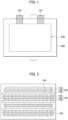
- FIGS. 1 and 2 are a schematic plan view and a schematic cross-sectional view, respectively, illustrating a lithium secondary battery in accordance with example embodiments.
- FIG. 2 is a cross-sectional view taken along a line I-I' of FIG. 1 in a thickness direction.
- a cathode for a lithium secondary battery (hereinafter, abbreviated as a cathode) and a lithium secondary battery including the same will be described with reference to FIGS. 1 and 2 .
- the lithium secondary battery may include an electrode assembly including a cathode 100, an anode 130, and a separator 140 interposed between the cathode and the anode.
- the electrode assembly may be accommodated together with an electrolyte solution in a case 160 to be impregnated therein.
- the cathode 100 may include a cathode current collector 105 and a cathode active material layer 110 formed on at least one surface of the cathode current collector 105.
- the cathode active material layer 110 may include a cathode active material including first and second active material particles based on some embodiments of the disclosed technology as described above.
- the cathode active material may be mixed and stirred with a binder, a conductive material, and/or a dispersant in a solvent to prepare a slurry.
- the slurry may be coated on the cathode current collector 105, and then dried and pressed to prepare the cathode 100.
- the cathode current collector 105 may include, e.g., stainless steel, nickel, aluminum, titanium, copper, or an alloy thereof, and may include, e.g., aluminum or an aluminum alloy.
- the binder may include an organic based binder such as polyvinylidenefluoride (PVDF), a polyvinylidene fluoride-hexafluoropropylene copolymer (PVDF-co-HFP), , polyacrylonitrile, polymethylmethacrylate, etc., or an aqueous based binder such as styrene-butadiene rubber (SBR) that may be used with a thickener such as carboxymethyl cellulose (CMC).
- PVDF polyvinylidenefluoride
- PVDF-co-HFP polyvinylidene fluoride-hexafluoropropylene copolymer
- SBR styrene-butadiene rubber
- CMC carboxymethyl cellulose
- a PVDF-based binder may be used as a cathode binder.
- an amount of the binder for forming the cathode active material layer 110 may be reduced, and an amount of the cathode active material may be relatively increased.
- capacity and power of the lithium secondary battery may be further improved.
- the conductive material may be added to facilitate electron mobility between active material particles.
- the conductive material may include a carbon-based material such as graphite, carbon black, graphene, carbon nanotube, etc., and/or a metal-based material such as tin, tin oxide, titanium oxide, a perovskite material such as LaSrCoO 3 or LaSrMnO 3 , etc.
- the anode 130 may include an anode current collector 125 and an anode active material layer 120 including an anode active material on the anode current collector 125.
- the anode active material may include a carbon-based material such as a crystalline carbon, an amorphous carbon, a carbon complex, a carbon fiber, etc.
- the amorphous carbon may include a hard carbon, cokes, a mesocarbon microbead (MCMB), a mesophase pitch-based carbon fiber (MPCF), etc.
- the crystalline carbon may include natural graphite, artificial graphite, graphitized cokes, graphitized MCMB, graphitized MPCF, etc.
- natural graphite and/or artificial graphite may be used as the carbon-based active material.
- the anode active material above may further include a silicon-based active material.
- the silicon-based active material may include Si, SiOx (0 ⁇ x ⁇ 2), a silicon-carbon composite, a metal-doped silicate, etc.
- the silicon-based active material may provide a much greater capacity than, e.g., the carbon-based material.
- the silicon-based active material may excessively expand in a high temperature environment or during repeated charging/discharging to deteriorate a battery stability.
- the carbon-based active material may be used together with the silicon-based active material as the anode active material.
- an amount of the carbon-based active material (e.g., the graphite-based active material) may be greater than an amount of the silicon-based active material in the total weight of the anode active material.
- a weight ratio of silicon elements to a total weight of carbon elements (C) and the silicon elements (Si) included in the anode active material above may be in a range from 1% to 10%.
- a high capacity/high stability structure may be provided from the anode together with the above-described high capacity/high stability design of the cathode.
- the weight ratio of the silicon element in the anode active material may be in a range from 1% to 9%, from 1% to 8%, from 1% to 7%, from 1% to 6%, or from 1% to 5%.
- the anode active material may be mixed with a binder, a conductive material, a thickener, etc., in a solvent to form a slurry.
- the slurry may be coated on at least one side of the anode current collector 125, and then dried and pressed to form the anode 130.
- the binder and the conductive material substantially the same as or similar to those used in the cathode active material layer 110 may also be used.
- the binder for forming the anode 130 may include an aqueous binder such as styrene-butadiene rubber (SBR) for a compatibility with, e.g., the carbon-based active material, and carboxymethyl cellulose (CMC) may also be used as a thickener.
- SBR styrene-butadiene rubber
- CMC carboxymethyl cellulose
- the separator 140 may be interposed between the cathode 100 and the anode 130.
- the separator 140 may include a porous polymer film prepared from, e.g., a polyolefin-based polymer such as an ethylene homopolymer, a propylene homopolymer, an ethylene/butene copolymer, an ethylene/hexene copolymer, an ethylene/methacrylate copolymer, etc.
- the separator 140 may also include a non-woven fabric formed from a glass fiber with a high melting point, a polyethylene terephthalate fiber, etc.
- an area e.g., a contact area with the separator 140
- a volume of the anode 130 may be greater than that of the cathode 100. Accordingly, transfer of lithium ions generated from the cathode 100 to the anode 130 may be facilitated without being precipitated.
- an electrode cell may be defined by the cathode 100, the anode 130 and the separator 140, and a plurality of the electrode cells may be repeatedly arranged to form an electrode assembly 150 having, e.g., a jelly-roll shape.
- the electrode assembly 150 may be fabricated by winding, stacking or folding of the separation layer 140.
- the electrode assembly 150 may be accommodated within a case 160 together with an electrolyte to define a lithium secondary battery.
- a non-aqueous electrolyte may be used as the electrolyte.
- the non-aqueous electrolyte may include a lithium salt and an organic solvent.
- the lithium salt may be represented by Li + X - , and an anion of the lithium salt X' may include, e.g., F - , Cl - , Br - , I - , NO 3 - , N(CN) 2 - , BF 4 - , ClO 4 - , PF 6 - , (CF 3 ) 2 PF 4 - , (CF 3 ) 3 PF 3 - , (CF 3 ) 4 PF 2 - , (CF 3 ) 5 PF - , (CF 3 ) 6 P - , CF 3 SO 3 - , CF 3 CF 2 SO 3 - , (CF 3 SO 2 ) 2 N - , (FSO 2 ) 2 N - , CF 3 CF 2 (CF 3 ) 2 CO - , (CF 3 SO 2 ) 2 CH - , (SF
- the organic solvent may include, e.g., propylene carbonate (PC), ethylene carbonate (EC), diethyl carbonate (DEC), dimethyl carbonate (DMC), ethylmethyl carbonate (EMC), methylpropyl carbonate, dipropyl carbonate, dimethyl sulfoxide, acetonitrile, dimethoxy ethane, diethoxy ethane, vinylene carbonate, sulfolane, gamma-butyrolactone, propylene sulfite, tetrahydrofuran, etc. These may be used alone or in a combination of two or more therefrom.
- PC propylene carbonate
- EC ethylene carbonate
- DEC diethyl carbonate
- DMC dimethyl carbonate
- EMC ethylmethyl carbonate
- methylpropyl carbonate dipropyl carbonate
- dimethyl sulfoxide acetonitrile
- dimethoxy ethane diethoxy
- electrode tabs may protrude from the cathode current collector 105 and the anode current collector 125 included in each electrode cell to one side of the case 160.
- the electrode tabs may be welded together with the one side of the case 160 to be connected to an electrode lead (a cathode lead 107 and an anode lead 127) that may be extended or exposed to an outside of the case 160.
- the lithium secondary battery may be manufactured in, e.g., a cylindrical shape using a can, a prismatic shape, a pouch shape or a coin shape.
- NiSO 4 , CoSO 4 and MnSO 4 were mixed in a composition as shown in Table 1 using distilled water from which dissolved oxygen was removed by bubbling with N 2 for 24 hours.
- the solution was added to a reactor at a temperature of 60°C, and NaOH and NH 3 H 2 O were used as a precipitating agent and a chelating agent, respectively, to perform a coprecipitation reaction for 48 hours.
- Products from the coprecipitation reaction was separated by a centrifuge to remove impurities, and the precipitate was washed with distilled water to prepare an active material precursor.
- LiOH as a lithium source was mixed with the active material precursor in substantially corresponding moles, and then the mixture was fired at 750°C for 30 hours to obtain first active material particles (large diameter particles, particle diameter: 12 ⁇ m).
- Second active material particles (small diameter particles, particle diameter: 2 ⁇ m) were obtained by substantially the same process as that as described above, except that the firing temperature and firing time were adjusted to 770°C and 27 hours, respectively.
- a cathode active material including the first active material particles and the second active material particles mixed in a weight ratio of 1:1, Denka Black as a conductive material, and PVDF as a binder were mixed in a weight ratio of 96:1:2, respectively to prepare a cathode mixture.
- the cathode mixture was coated on an aluminum current collector, and then dried and pressed to prepare a cathode having an electrode density of 3.6 g/cc.
- a graphite-based anode active material and a silicon-based anode active material (SiOx,0 ⁇ x ⁇ 2) was mixed so that a weight ratio of silicon and carbon analyzed by an ICP became 1:99 to prepare an anode active material.
- the anode active material, a flake type conductive material KS6 as a conductive material, and a styrene-butadiene rubber (SBR) as a binder were mixed in a weight ratio of 94:3:3 to prepare an anode slurry.
- the anode slurry was coated, dried and pressed on a copper substrate to prepare an anode.
- the cathodes and anodes prepared as described above were notches by a predetermined sized, and stacked with a separator (polyethylene, thickness: 25 ⁇ m) interposed therebetween to form an electrode cell. Tab portions of the cathodes were welded and tab portions of the anodes were welded.
- the prepared assemble of the cathode/separator/anode was placed in a pouch, and three surfaces were sealed except for an electrolyte injection side. The tab portions were positioned in the sealing portion. An electrolyte was injected through the electrolyte injection side, the electrolyte injection side was also sealed, and then impregnation was performed for 12 hours or more.
- a 1M LiPF6 using a mixed solvent of EC/EMC/DEC (25/45/30; volume ratio) was used as the electrolyte. Further, 1 wt% of vinylene carbonate (VC), 0.5 wt% of 1,3-propensultone (PRS) and 0.5 wt% of lithium bis(oxalato)borate (LiBOB) were added.
- VC vinylene carbonate
- PRS 1,3-propensultone
- LiBOB lithium bis(oxalato)borate
- cathode active materials and lithium secondary batteries including the first active material particles and the second active material particles were prepared by the same method as that in Example 1, except that the ratio of active material metal contents, the firing temperature and the firing time were adjusted.
- Me refers to metals excluding lithium.
- Example 1 mol ratio element content (ppm) aspect ratio of primary particle (particle diameter: ⁇ m) Ni/Me Co/Me Ni Co M1(Mn) Co/M1 (molar ratio) Co/M1 (mass ratio) second active material particle first active material particle
- Example 1 0.80 0.09 483,624 53,667 59,185 0.85 0.91 1.1 (2 ⁇ m) 2.6 (12 ⁇ m)
- Example 2 0.80 0.09 482,800 50,500 48,500 0.97 1.04 1.2 (2.5 ⁇ m) 4.0 (13 ⁇ m)
- Example 3 0.89 0.05 550,754 32,898 43,862 0.70 0.75 1.1 (2.8 ⁇ m) 22 (13 ⁇ m)
- Example 4 0.89 0.06 542,728 34,825 34,763 0.93 1.00 1.1 (2.6 ⁇ m) 2.8 (13.3 ⁇ m)
- Example 5 0.90 0.06 560,268 39,087 30,800 1.18 1.27 1.5 (2.5 ⁇ m) 3.7
- the particle diameters and the aspect ratios of the first active material particles and the second active material particles were measured from an SEM cross-sectional image of the cathode active material prepared according to each of Examples and Comparative Examples.
- the particle diameters of the secondary particles were measured by selecting the first active material particle and the second active material particle in the above-described particle diameter range from the SEM cross-sectional image. Five primary particles included in the selected particle were selected within a radius of 0.5R, and an average of aspect ratios of the selected primary particles was used as the aspect ratio of the corresponding particle.
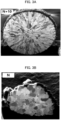
- FIGS. 3A and 3B are scanning electron microscope (SEM) images of a first active material particle (designated as N+10) and a second active material particle (designated as N) of Example 6, respectively.
- the aspect ratio was calculated from the five primary particles selected from the first active material particles and the second active material particles of Example 6 as shown in Table 3 below.
- FIGS. 4A and 4B are scanning electron microscope (SEM) images of a first active material particle (designated as N+10) and a second active material particle (designated as N) of Comparative Example 3, respectively.
- the aspect ratio was calculated from the five primary particles selected from the first active material particles and the second active material particles of Comparative Example 3 as shown in Table 4 below.
- charging CC/CV 0.5C 4.3V 0.05C CUT-OFF
- discharging CC 0.5C 3.0V CUT-OFF
- a discharge capacity at the first cycle was measured as an initial discharge capacity.
- a capacity retention rate was evaluated by a ratio (percentage) of a discharge capacity at the SOOth cycles to the initial discharge capacity.
- a cathode thickness after the above-described formation discharge and a cathode thickness after the 500 cycles of charging/discharging performed in the above (1) were each measured.
- the cathode thickness was measured using a flat plate thickness measuring device (Mitutoyo, 543-490B).
- a cathode BET after the above-described formation discharge and a cathode BET after the 500 cycles of charging/discharging performed in the above (1) were each measured.
- the cathodes were cut so that a weight of the cathode from which a weight of the cathode current collector was subtracted (i.e., a weight of the cathode active material layer) was in a range from about 1.5 g to 1.7 g to from samples, and then a BET value was measured for each sample.
- the BET value was measured according to a gas adsorption and desorption method using a BET measurement device (ASAP2420, Micrometrics Co., Ltd.).
- the first and second primary particles of Comparative Example 4 satisfied with the above-described aspect ratio range, but the capacity retention was explicitly reduced as the cobalt ratio increased.
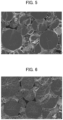
- FIG. 5 is an SEM image of a cross-section of a cathode active material layer according to Example 6.
- FIG. 6 is an SEM image of a cross-section of a cathode active material layer according to Comparative Example 3.
- FIGS. 5 and 6 are cross-sectional SEM images of cathode active material layers after repeating 500 cycles of charging/discharging at 41°C under the above-described conditions.
- the disclosed technology can be implemented in rechargeable secondary batteries that are widely used in battery-powered devices or systems, including, e.g., digital cameras, mobile phones, notebook computers, hybrid vehicles, electric vehicles, uninterruptible power supplies, battery storage power stations, and others including battery power storage for solar panels, wind power generators and other green tech power generators.
- the disclosed technology can be implemented in some embodiments to provide improved electrochemical devices such as a battery used in various power sources and power supplies, thereby mitigating climate changes in connection with uses of power sources and power supplies.
- Lithium secondary batteries based on the disclosed technology can be used to address various adverse effects such as air pollution and greenhouse emissions by powering electric vehicles (EVs) as alternatives to vehicles using fossil fuel-based engines and by providing battery-based energy storage systems (ESSs) to store renewable energy such as solar power and wind power.
- EVs electric vehicles
- ESSs battery-based energy storage systems
Landscapes
- Chemical & Material Sciences (AREA)
- Chemical Kinetics & Catalysis (AREA)
- Electrochemistry (AREA)
- General Chemical & Material Sciences (AREA)
- Inorganic Chemistry (AREA)
- Engineering & Computer Science (AREA)
- Organic Chemistry (AREA)
- Manufacturing & Machinery (AREA)
- Materials Engineering (AREA)
- Composite Materials (AREA)
- Battery Electrode And Active Subsutance (AREA)
Applications Claiming Priority (1)
| Application Number | Priority Date | Filing Date | Title |
|---|---|---|---|
| KR1020230051996A KR20240155552A (ko) | 2023-04-20 | 2023-04-20 | 리튬 이차 전지용 양극 활물질 및 이를 포함하는 리튬 이차 전지 |
Publications (1)
| Publication Number | Publication Date |
|---|---|
| EP4455094A1 true EP4455094A1 (de) | 2024-10-30 |
Family
ID=90789269
Family Applications (1)
| Application Number | Title | Priority Date | Filing Date |
|---|---|---|---|
| EP24170905.4A Pending EP4455094A1 (de) | 2023-04-20 | 2024-04-17 | Kathodenaktivmaterial für lithiumsekundärbatterie und lithiumsekundärbatterie damit |
Country Status (4)
| Country | Link |
|---|---|
| US (1) | US20240356020A1 (de) |
| EP (1) | EP4455094A1 (de) |
| KR (1) | KR20240155552A (de) |
| CN (1) | CN118825217A (de) |
Citations (4)
| Publication number | Priority date | Publication date | Assignee | Title |
|---|---|---|---|---|
| EP1876664A1 (de) * | 2005-04-28 | 2008-01-09 | Nissan Motor Co., Ltd. | Positiv-elektrodenmaterial für eine lithiumionenbatterie mit wasserfreiem elektrolyt und batterie damit |
| US20120258369A1 (en) * | 2011-04-07 | 2012-10-11 | Ngk Insulators, Ltd. | Lithium secondary battery and cathode active material therefor |
| EP3828139A1 (de) * | 2019-11-29 | 2021-06-02 | Ecopro Bm Co., Ltd. | Positivelektrodenaktivmaterial und lithiumsekundärbatterie damit |
| EP3890060A1 (de) * | 2018-11-29 | 2021-10-06 | Kabushiki Kaisha Toshiba | Elektrode, zelle und zellenpackung |
Family Cites Families (1)
| Publication number | Priority date | Publication date | Assignee | Title |
|---|---|---|---|---|
| KR100821523B1 (ko) | 2006-08-30 | 2008-04-14 | 주식회사 엘 앤 에프 | 리튬 이차 전지용 양극 활물질, 이의 제조방법 및 이를포함하는 리튬 이차 전지 |
-
2023
- 2023-04-20 KR KR1020230051996A patent/KR20240155552A/ko active Pending
-
2024
- 2024-04-17 EP EP24170905.4A patent/EP4455094A1/de active Pending
- 2024-04-17 US US18/638,348 patent/US20240356020A1/en active Pending
- 2024-04-18 CN CN202410467081.XA patent/CN118825217A/zh active Pending
Patent Citations (4)
| Publication number | Priority date | Publication date | Assignee | Title |
|---|---|---|---|---|
| EP1876664A1 (de) * | 2005-04-28 | 2008-01-09 | Nissan Motor Co., Ltd. | Positiv-elektrodenmaterial für eine lithiumionenbatterie mit wasserfreiem elektrolyt und batterie damit |
| US20120258369A1 (en) * | 2011-04-07 | 2012-10-11 | Ngk Insulators, Ltd. | Lithium secondary battery and cathode active material therefor |
| EP3890060A1 (de) * | 2018-11-29 | 2021-10-06 | Kabushiki Kaisha Toshiba | Elektrode, zelle und zellenpackung |
| EP3828139A1 (de) * | 2019-11-29 | 2021-06-02 | Ecopro Bm Co., Ltd. | Positivelektrodenaktivmaterial und lithiumsekundärbatterie damit |
Also Published As
| Publication number | Publication date |
|---|---|
| US20240356020A1 (en) | 2024-10-24 |
| CN118825217A (zh) | 2024-10-22 |
| KR20240155552A (ko) | 2024-10-29 |
Similar Documents
| Publication | Publication Date | Title |
|---|---|---|
| KR102543109B1 (ko) | 리튬 이차 전지 및 이의 제조 방법 | |
| KR102436308B1 (ko) | 리튬 이차 전지 | |
| KR102293034B1 (ko) | 리튬 이차 전지용 양극 활물질 및 이를 포함하는 리튬 이차 전지 | |
| KR20250154347A (ko) | 리튬 이차 전지 | |
| KR102539669B1 (ko) | 리튬 이차 전지 | |
| CN113964299A (zh) | 用于锂二次电池的正极和包含其的锂二次电池 | |
| KR20200107843A (ko) | 리튬 이차전지 | |
| EP3995455A1 (de) | Kathodenaktivmaterial für eine lithiumsekundärbatterie und lithiumsekundärbatterie damit | |
| KR102930406B1 (ko) | 리튬 이차 전지용 양극 활물질 및 이를 포함하는 리튬 이차 전지 | |
| CN117954693A (zh) | 锂二次电池 | |
| KR20220036072A (ko) | 리튬 이차 전지용 양극 활물질 및 이를 포함하는 리튬 이차 전지 | |
| KR20230046771A (ko) | 리튬 이차 전지용 양극 활물질 및 이를 포함하는 리튬 이차 전지 | |
| US20240170669A1 (en) | Lithium secondary battery | |
| EP4455094A1 (de) | Kathodenaktivmaterial für lithiumsekundärbatterie und lithiumsekundärbatterie damit | |
| KR20220045651A (ko) | 리튬 이차 전지용 양극 활물질 및 이를 포함하는 리튬 이차 전지 | |
| EP4656599A1 (de) | Kathodenaktivmaterial für eine sekundärbatterie und lithiumsekundärbatterie damit | |
| US20230246181A1 (en) | Cathode active material for lithium secondary battery and lithium secondary battery including the same | |
| US20260116781A1 (en) | Cathode active material for lithium secondary battery and lithium secondary battery including the same | |
| EP4379854A1 (de) | Kathodenaktivmaterial für lithiumsekundärbatterie und lithiumsekundärbatterie damit | |
| EP4660149A1 (de) | Kathodenaktivmaterial für lithiumsekundärbatterie, kathode damit und lithiumsekundärbatterie damit | |
| KR20190031977A (ko) | 리튬 이차 전지 및 이의 제조 방법 | |
| KR20230156993A (ko) | 리튬 이차 전지용 양극 활물질 및 이를 포함하는 리튬 이차 전지 | |
| CN121909526A (zh) | 锂二次电池用正极及锂二次电池 | |
| KR20250035321A (ko) | 리튬 이차 전지용 양극 활물질, 이를 포함하는 양극 및 이를 포함하는 리튬 이차 전지 | |
| KR20260000860A (ko) | 리튬 이차 전지용 양극 활물질 및 이를 포함하는 리튬 이차 전지 |
Legal Events
| Date | Code | Title | Description |
|---|---|---|---|
| PUAI | Public reference made under article 153(3) epc to a published international application that has entered the european phase |
Free format text: ORIGINAL CODE: 0009012 |
|
| STAA | Information on the status of an ep patent application or granted ep patent |
Free format text: STATUS: REQUEST FOR EXAMINATION WAS MADE |
|
| 17P | Request for examination filed |
Effective date: 20240417 |
|
| AK | Designated contracting states |
Kind code of ref document: A1 Designated state(s): AL AT BE BG CH CY CZ DE DK EE ES FI FR GB GR HR HU IE IS IT LI LT LU LV MC ME MK MT NL NO PL PT RO RS SE SI SK SM TR |