EP4455080A1 - Phosphor-kohlenstoff-verbundmaterial, herstellungsverfahren für phosphor-kohlenstoff-verbundmaterial, negativelektrodenaktivmaterial, negativelektrode für lithiumsekundärbatterie und lithiumsekundärbatterie - Google Patents
Phosphor-kohlenstoff-verbundmaterial, herstellungsverfahren für phosphor-kohlenstoff-verbundmaterial, negativelektrodenaktivmaterial, negativelektrode für lithiumsekundärbatterie und lithiumsekundärbatterie Download PDFInfo
- Publication number
- EP4455080A1 EP4455080A1 EP22911425.1A EP22911425A EP4455080A1 EP 4455080 A1 EP4455080 A1 EP 4455080A1 EP 22911425 A EP22911425 A EP 22911425A EP 4455080 A1 EP4455080 A1 EP 4455080A1
- Authority
- EP
- European Patent Office
- Prior art keywords
- phosphorus
- carbon
- composite material
- carbon composite
- negative electrode
- Prior art date
- Legal status (The legal status is an assumption and is not a legal conclusion. Google has not performed a legal analysis and makes no representation as to the accuracy of the status listed.)
- Pending
Links
Images


Classifications
-
- H—ELECTRICITY
- H01—ELECTRIC ELEMENTS
- H01M—PROCESSES OR MEANS, e.g. BATTERIES, FOR THE DIRECT CONVERSION OF CHEMICAL ENERGY INTO ELECTRICAL ENERGY
- H01M4/00—Electrodes
- H01M4/02—Electrodes composed of, or comprising, active material
- H01M4/36—Selection of substances as active materials, active masses, active liquids
- H01M4/362—Composites
- H01M4/366—Composites as layered products
-
- H—ELECTRICITY
- H01—ELECTRIC ELEMENTS
- H01M—PROCESSES OR MEANS, e.g. BATTERIES, FOR THE DIRECT CONVERSION OF CHEMICAL ENERGY INTO ELECTRICAL ENERGY
- H01M4/00—Electrodes
- H01M4/02—Electrodes composed of, or comprising, active material
- H01M4/13—Electrodes for accumulators with non-aqueous electrolyte, e.g. for lithium-accumulators; Processes of manufacture thereof
- H01M4/133—Electrodes based on carbonaceous material, e.g. graphite-intercalation compounds or CFx
-
- C—CHEMISTRY; METALLURGY
- C01—INORGANIC CHEMISTRY
- C01B—NON-METALLIC ELEMENTS; COMPOUNDS THEREOF; METALLOIDS OR COMPOUNDS THEREOF NOT COVERED BY SUBCLASS C01C
- C01B25/00—Phosphorus; Compounds thereof
-
- C—CHEMISTRY; METALLURGY
- C01—INORGANIC CHEMISTRY
- C01B—NON-METALLIC ELEMENTS; COMPOUNDS THEREOF; METALLOIDS OR COMPOUNDS THEREOF NOT COVERED BY SUBCLASS C01C
- C01B25/00—Phosphorus; Compounds thereof
- C01B25/02—Preparation of phosphorus
-
- H—ELECTRICITY
- H01—ELECTRIC ELEMENTS
- H01M—PROCESSES OR MEANS, e.g. BATTERIES, FOR THE DIRECT CONVERSION OF CHEMICAL ENERGY INTO ELECTRICAL ENERGY
- H01M10/00—Secondary cells; Manufacture thereof
- H01M10/05—Accumulators with non-aqueous electrolyte
- H01M10/052—Li-accumulators
-
- H—ELECTRICITY
- H01—ELECTRIC ELEMENTS
- H01M—PROCESSES OR MEANS, e.g. BATTERIES, FOR THE DIRECT CONVERSION OF CHEMICAL ENERGY INTO ELECTRICAL ENERGY
- H01M10/00—Secondary cells; Manufacture thereof
- H01M10/05—Accumulators with non-aqueous electrolyte
- H01M10/052—Li-accumulators
- H01M10/0525—Rocking-chair batteries, i.e. batteries with lithium insertion or intercalation in both electrodes; Lithium-ion batteries
-
- H—ELECTRICITY
- H01—ELECTRIC ELEMENTS
- H01M—PROCESSES OR MEANS, e.g. BATTERIES, FOR THE DIRECT CONVERSION OF CHEMICAL ENERGY INTO ELECTRICAL ENERGY
- H01M4/00—Electrodes
- H01M4/02—Electrodes composed of, or comprising, active material
- H01M4/13—Electrodes for accumulators with non-aqueous electrolyte, e.g. for lithium-accumulators; Processes of manufacture thereof
- H01M4/136—Electrodes based on inorganic compounds other than oxides or hydroxides, e.g. sulfides, selenides, tellurides, halogenides or LiCoFy
-
- H—ELECTRICITY
- H01—ELECTRIC ELEMENTS
- H01M—PROCESSES OR MEANS, e.g. BATTERIES, FOR THE DIRECT CONVERSION OF CHEMICAL ENERGY INTO ELECTRICAL ENERGY
- H01M4/00—Electrodes
- H01M4/02—Electrodes composed of, or comprising, active material
- H01M4/36—Selection of substances as active materials, active masses, active liquids
- H01M4/362—Composites
-
- H—ELECTRICITY
- H01—ELECTRIC ELEMENTS
- H01M—PROCESSES OR MEANS, e.g. BATTERIES, FOR THE DIRECT CONVERSION OF CHEMICAL ENERGY INTO ELECTRICAL ENERGY
- H01M4/00—Electrodes
- H01M4/02—Electrodes composed of, or comprising, active material
- H01M4/36—Selection of substances as active materials, active masses, active liquids
- H01M4/38—Selection of substances as active materials, active masses, active liquids of elements or alloys
-
- H—ELECTRICITY
- H01—ELECTRIC ELEMENTS
- H01M—PROCESSES OR MEANS, e.g. BATTERIES, FOR THE DIRECT CONVERSION OF CHEMICAL ENERGY INTO ELECTRICAL ENERGY
- H01M4/00—Electrodes
- H01M4/02—Electrodes composed of, or comprising, active material
- H01M4/36—Selection of substances as active materials, active masses, active liquids
- H01M4/58—Selection of substances as active materials, active masses, active liquids of inorganic compounds other than oxides or hydroxides, e.g. sulfides, selenides, tellurides, halogenides or LiCoFy; of polyanionic structures, e.g. phosphates, silicates or borates
- H01M4/583—Carbonaceous material, e.g. graphite-intercalation compounds or CFx
-
- H—ELECTRICITY
- H01—ELECTRIC ELEMENTS
- H01M—PROCESSES OR MEANS, e.g. BATTERIES, FOR THE DIRECT CONVERSION OF CHEMICAL ENERGY INTO ELECTRICAL ENERGY
- H01M4/00—Electrodes
- H01M4/02—Electrodes composed of, or comprising, active material
- H01M4/36—Selection of substances as active materials, active masses, active liquids
- H01M4/58—Selection of substances as active materials, active masses, active liquids of inorganic compounds other than oxides or hydroxides, e.g. sulfides, selenides, tellurides, halogenides or LiCoFy; of polyanionic structures, e.g. phosphates, silicates or borates
- H01M4/583—Carbonaceous material, e.g. graphite-intercalation compounds or CFx
- H01M4/587—Carbonaceous material, e.g. graphite-intercalation compounds or CFx for inserting or intercalating light metals
-
- H—ELECTRICITY
- H01—ELECTRIC ELEMENTS
- H01M—PROCESSES OR MEANS, e.g. BATTERIES, FOR THE DIRECT CONVERSION OF CHEMICAL ENERGY INTO ELECTRICAL ENERGY
- H01M4/00—Electrodes
- H01M4/02—Electrodes composed of, or comprising, active material
- H01M2004/021—Physical characteristics, e.g. porosity, surface area
-
- H—ELECTRICITY
- H01—ELECTRIC ELEMENTS
- H01M—PROCESSES OR MEANS, e.g. BATTERIES, FOR THE DIRECT CONVERSION OF CHEMICAL ENERGY INTO ELECTRICAL ENERGY
- H01M4/00—Electrodes
- H01M4/02—Electrodes composed of, or comprising, active material
- H01M2004/026—Electrodes composed of, or comprising, active material characterised by the polarity
- H01M2004/027—Negative electrodes
-
- Y—GENERAL TAGGING OF NEW TECHNOLOGICAL DEVELOPMENTS; GENERAL TAGGING OF CROSS-SECTIONAL TECHNOLOGIES SPANNING OVER SEVERAL SECTIONS OF THE IPC; TECHNICAL SUBJECTS COVERED BY FORMER USPC CROSS-REFERENCE ART COLLECTIONS [XRACs] AND DIGESTS
- Y02—TECHNOLOGIES OR APPLICATIONS FOR MITIGATION OR ADAPTATION AGAINST CLIMATE CHANGE
- Y02E—REDUCTION OF GREENHOUSE GAS [GHG] EMISSIONS, RELATED TO ENERGY GENERATION, TRANSMISSION OR DISTRIBUTION
- Y02E60/00—Enabling technologies; Technologies with a potential or indirect contribution to GHG emissions mitigation
- Y02E60/10—Energy storage using batteries
Definitions
- the present invention relates to a phosphorus-carbon composite material, a method of producing a phosphorus-carbon composite material, a negative electrode active material, a negative electrode for a lithium secondary battery, and a lithium secondary battery.
- a lithium secondary battery is used as a power source of small electronic devices such as mobile phones and notebook computers.
- the lithium secondary battery has also been put into practical use in medium or large power sources, such as for automobiles power storage, and the like.
- a negative electrode active material of the lithium secondary battery As a negative electrode active material of the lithium secondary battery, a carbon material is known.
- a negative electrode active material in which phosphorus is further contained in a carbon material for the purpose of improving battery performance has been known (for example, refer to Patent Document 1).
- the negative electrode active material described in Patent Document 1 since the negative electrode active material containing the carbon material further contains phosphorus, a negative electrode having excellent charge and discharge capacities can be obtained.
- Patent Document 1 Japanese Unexamined Patent Application, First Publication No. H11-67207
- the present invention has been made in view of such circumstances, and an object of the present invention is to provide a novel phosphorus-carbon composite material containing phosphorus and carbon.
- another object is to provide a method of producing a phosphorus-carbon composite material, which enables favorable production of such a novel phosphorus-carbon composite material.
- still another object is to provide a negative electrode active material containing such a novel phosphorus-carbon composite material, a negative electrode for a lithium secondary battery, and a lithium secondary battery.
- an aspect of the present invention includes the following aspects.
- a novel phosphorus-carbon composite material including phosphorus and carbon.
- a method of producing a phosphorus-carbon composite material which suitably enables the production of such a novel phosphorus-carbon composite material.
- a negative electrode active material including such a novel phosphorus-carbon composite material, a negative electrode for a lithium secondary battery, and a lithium secondary battery.
- FIGS. 1 to 6 a method of producing a phosphorus-carbon composite material, a negative electrode active material, a negative electrode for a lithium secondary battery, and a lithium secondary battery according to the present embodiment will be described with reference to FIGS. 1 to 6 .
- the dimensions and ratios of each constituent element are appropriately modified in order to make the drawings easier to see.
- a phosphorus-carbon composite material includes phosphorus atoms and carbon atoms.
- the "phosphorus-carbon composite material” may be simply referred to as "P-C material”.
- a content ratio of the phosphorus atoms in the P-C material is 10 mass% or more and 95 mass% or less.
- a content ratio of the carbon atoms in the P-C material is 5 mass% or more and 90 mass% or less.
- the "content ratio of a certain atom in the P-C material” means “the content ratio (mass%) of a certain atom when the entire P-C material is 100 mass%".
- a sum of the content ratio of the carbon atoms and the content ratio of the phosphorus atoms in the P-C material is 100 mass%. Even in the case where the P-C material consists of the carbon atoms and the phosphorus atoms, impurities that are inevitably mixed in from raw materials or production steps of the P-C material are allowed.
- the P-C material may have 60 mass% or more of the entire P-C material consist of the phosphorus atoms and the carbon atoms, and may further include elements other than the phosphorus atoms and the carbon atoms.
- Examples of the element other than the phosphorus atoms and the carbon atoms included in the P-C material include lithium, silicon, germanium, tin, aluminum, zinc, magnesium, transition metals, nitrogen, oxygen, fluorine, silicon, titanium, niobium, sulfur, and chlorine.
- the P-C material includes these elements
- a metal oxide, a composite metal oxide, a metal fluoride, a metal sulfide, a metal chloride, silicon oxide, silicate, titanate, or aluminate of these elements can be used as a raw material of the P-C material.
- the content ratio of the phosphorus atoms, the content ratio of the carbon atoms, and a content ratio of any other atoms which can be further included in the P-C material can be determined by known ICP analysis.
- the content ratio of the phosphorus atoms is preferably 20 mass% or more, more preferably 30 mass% or more, and still more preferably 50 mass% or more.
- a higher content ratio of phosphorus can increase initial charge and discharge capacities of the P-C material.
- the content ratio of the phosphorus atoms is preferably 90 mass% or less, more preferably 80 mass% or less, and still more preferably 75 mass% or less. The reason is that, in a case where the content ratio of the phosphorus atoms is too high, cycle characteristics of the P-C material deteriorate. An upper limit and a lower limit of the content ratio of the phosphorus atoms can be combined at will.
- the content ratio of the carbon atoms is preferably 10 mass% or more, more preferably 20 mass% or more, and still more preferably 25 mass% or more.
- a content ratio of the carbon atoms can enhance the cycle characteristics of the P-C material.
- the content ratio of the carbon atoms is preferably 80 mass% or less, more preferably 70 mass% or less, and still more preferably 50 mass% or less. This is because, in a case where the content ratio of the carbon atom is too high, the initial charge and discharge capacities of the P-C material decrease. An upper limit and a lower limit of the content ratio of the carbon atoms can be combined at will.
- the P-C material can be produced by performing ball mill mixing on phosphorus and a carbon material.
- the inventors conducted detailed analysis and examination on the obtained P-C material, and confirmed that the P-C material is not a mixture simply obtained by mixing phosphorus and the carbon material, which are raw materials, but is a novel material in which phosphorus atoms and carbon atoms are chemically bonded (covalently bonded) and provide physical properties different from those of phosphorus and the carbon material of the raw materials.
- P-C mixture the mixture of phosphorus and the carbon material
- the raw materials of the P-C material and the raw materials of the P-C mixture both contain black phosphorus and the carbon material in a ratio of 6:4 (mass ratio).
- CSCNT cup-stacked carbon nanotubes
- Other carbon materials that can be used as the raw material of the P-C material in addition to CSCNT will be described below.
- a ratio WL 620 /WL 780 of a weight loss ratio WL 620 at a measurement temperature of 620°C and a weight loss ratio WL 780 at a measurement temperature of 780°C which are obtained by thermogravimetric measurement under the following conditions, is 0.1 or more and 0.9 or less.
- 10 mg of the phosphorus-carbon composite material is accurately weighed to prepare a sample, and using a thermogravimetric measuring device, a weight change when the sample is heated from 50°C to 800°C at a temperature rising rate of 10 °C/min in a nitrogen stream is measured.
- a ratio of a weight of the sample at the measurement temperature to a weight of the accurately weighed sample is defined as a weight loss ratio (weight%) at the measurement temperature.
- weight loss ratio weight%
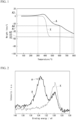
- FIG. 1 is a graph showing results of the above thermogravimetric measurement performed on the P-C material and the P-C mixture.
- FIG. 1 shows a heating temperature (°C) on a horizontal axis and the weight loss ratio (weight%) with respect to the weight of the sample on a vertical axis.
- reference sign A indicates a behavior of the P-C material
- reference sign X indicates a behavior of the P-C mixture.
- the weight loss ratio WL 620 (indicated by reference sign X1 in FIG. 1 ) at the measurement temperature of 620°C and the weight loss ratio WL 780 (indicated by reference sign X2 in FIG. 1 ) at the measurement temperature of 780°C are both less than 58%.
- the P-C mixture shows a steep weight loss at a measurement temperature of about 350°C to 450°C, and at 620°C, about 60% of the weight of the sample is lost from the initial weight.
- the ratio WL 620 /WL 780 between WL 620 and WL 780 is more than 0.9.
- the loss in weight in the thermogravimetric measurement of the P-C mixture is considered to correspond to a weight of black phosphorus, which is the raw material.
- black phosphorus included in the P-C mixture is lost by heating.
- black phosphorus is changed to red phosphorus, which is an allotrope of black phosphorus, when heated to 125°C.
- red phosphorus is sublimated at 416°C under normal pressure.
- the P-C material continues to lose weight from the measurement temperature of about 350°C until 800°C, which is an upper limit of a measurement temperature range, is reached.
- a weight loss is also observed between the measurement temperature of 620°C and the measurement temperature of 780°C.
- the ratio WL 620 /WL 780 of the weight loss ratio WL 620 (indicated by reference sign A1 in FIG. 1 ) at the measurement temperature of 620°C to the weight loss ratio WL 780 (indicated by reference sign A2 in FIG. 1 ) at the measurement temperature of 780°C is included in a range of 0.1 or more and 0.9 or less.
- a ratio WL 300 /WL 600 of a weight loss ratio WL 300 (indicated by reference sign A3 in FIG. 1 ) at a measurement temperature of 300°C to the weight loss ratio WL 600 (indicated by reference sign A4 in FIG. 1 ) at the measurement temperature of 600°C, which are obtained by the thermogravimetric measurement described above, is included in a range of -0.1 or more and 0.1 or less.
- the P-C material has no substantial weight loss up to the measurement temperature of 300°C, and is thermally stable at the measurement temperature of 300°C. Therefore, WL 300 is extremely small, and WL 300 /WL 600 is also a value near zero, that is, in a range of -0.1 or more and 0.1 or less.
- WL 620 /WL 780 is preferably 0.1 or more, more preferably 0.3 or more, and still more preferably 0.5 or more. In addition, WL 620 /WL 780 is preferably 0.9 or less and more preferably 0.8 or less. An upper limit and a lower limit of WL 620 /WL 780 may be combined at will.
- WL 300 /WL 600 is preferably -0.1 or more and more preferably -0.08 or more. In addition, WL 300 /WL 600 is preferably 0.1 or less and more preferably 0.08 or less. An upper limit and a lower limit of WL 300 /WL 600 may be combined at will.
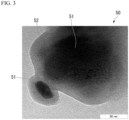
- the P-C material has a peak showing a bond between the phosphorus atom and the carbon atom in an XPS spectrum. It is known that the "peak showing the bond between the phosphorus atom and the carbon atom" appears in a range of 132 to 136 eV in the XPS spectrum. In the following description, the bond between the phosphorus atom and the carbon atom may be simply referred to as a "P-C bond".
- FIG. 2 shows XPS spectra of the P-C material and the P-C mixture.
- FIG. 2 shows a binding energy (eV) on a horizontal axis and the number of detected photoelectrons (counts per second (cps)) on a vertical axis.
- eV binding energy
- cps counts per second
- reference sign A indicates the P-C material
- reference sign X indicates the P-C mixture.
- the XPS spectrum is measured under the following measurement conditions.
- the obtained XPS spectrum may include noise in the analysis. Therefore, in the present embodiment, in a case where a line connecting two adjacent local minima in the XPS spectrum is set as a baseline, and a half-width of a local curve including a local maximum sandwiched between the two local minima is 0.5 eV or less, the curve is determined to be "noise". In a case where the presence or absence of the P-C bond is determined using the XPS spectrum, the presence or absence of a peak in the range of 132 to 136 eV is confirmed after excluding the "noise" according to the above definition.
- the P-C material is a material having chemical bonds between the phosphorus atoms and the carbon atoms.
- the P-C material includes a core particle containing the phosphorus atom, and a carbon film covering a surface of the core particle.
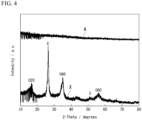
- FIG. 3 is a transmission electron microscope (TEM) photograph of the P-C material.
- TEM transmission electron microscope
- EDX energy dispersive X-ray spectroscopy
- the phosphorus atom which is a heavier atom, appears darker in the TEM photograph. Therefore, based on the TEM photograph, the presence of the core-shell structure in which the phosphorus atom is included in the core particle 51 and is covered with the carbon film 52 including the carbon atom can be simply determined.
- the TEM photograph is taken under the following imaging conditions.
- the P-C material preferably has the above-described core-shell structure in addition to satisfying the requirements for [Behavior with Respect to Heat] described above.
- FIG. 4 shows X-ray diffraction (XRD) profiles of the P-C material and the P-C mixture.
- FIG. 4 shows a diffraction angle (2 ⁇ , °) on a horizontal axis and a diffraction X-ray intensity (a.u.) on a vertical axis.
- the XRD profile indicated by reference sign A indicates the P-C material
- the XRD profile indicated by reference sign X indicates the P-C mixture.
- the XRD profile is measured under the following measurement conditions.
- each of the carbon material and black phosphorus has a certain crystallinity and shows a diffraction peak.
- the diffraction peaks observed in the P-C mixture is not observed, and only noise is confirmed in the entire measurement range. That is, from the results shown in FIG. 4 , it is considered that, in the P-C material, the carbon material used as the raw material either loses crystallinity and becomes amorphous, or has become a carbon material so fine that a crystalline state cannot be confirmed.
- P represented by Expression (2) above is a difference between the intensity I 40 at the reference point and the intensity I 26.3 at the position at which the peak of the carbon material is present, and indicates a difference in the peak from the reference point.
- the P-C material is a novel material that is different from the mixture obtained by mixing phosphorus (black phosphorus in FIGS. 1 to 4 ) and the carbon material as the raw materials in behavior with respect to heat, bonding state, external appearance, and crystalline state.
- the P-C material can be produced by a production method that includes a step of compositing the carbon material and phosphorus through a mixing and grinding process accompanied by compression.
- the carbon material which is the raw material at least one selected from the group consisting of amorphous carbon, graphite, porous carbon, mesocarbon microbeads (MCMB), fullerenes, carbon nanotubes, graphene, graphene oxide, carbon nitride (C 3 N 4 ), and layered carbon nanofibers (carbon nanofibers platelets) can be used. All of these carbon materials have a graphite structure.
- amorphous carbon examples include carbon black (CB), acetylene black (AB), Ketjen black, hard carbon, and soft carbon.
- Examples of the fullerenes include C 60 , C 72 , and C 84 .
- Examples of the carbon nanotubes include single-walled carbon nanotubes (SWCNT), multi-walled carbon nanotubes (MWCNT), cup-stacked carbon nanotubes (CSCNT), and carbon nanofiber vapor grown carbon fibers (VGCF). These have a structure (one-dimensional structure) extending in one axial direction.
- SWCNT single-walled carbon nanotubes
- MWCNT multi-walled carbon nanotubes
- CSCNT cup-stacked carbon nanotubes
- VGCF carbon nanofiber vapor grown carbon fibers
- the graphene, the graphene oxide, the carbon nitride (C 3 N 4 ), and the layered carbon nanofibers (carbon nanofibers platelets) have a structure (two-dimensional structure) that spreads in a planar direction.
- an end portion (edge site) of the graphite structure has a higher activity than portions other than the edge site because conjugation of sp 2 hybrid orbitals is interrupted. Therefore, it is assumed that most of the P-C bonds are formed at the edge sites of the carbon material. Therefore, from the viewpoint of facilitating the formation of the P-C bonds, it is considered that the carbon material to be used is preferably a material having many edge sites.
- Examples of the carbon material having many edge sites include CSCNT, graphite, mesocarbon microbeads (MCMB), graphene, graphene oxide, carbon nitride (C 3 N 4 ), and layered carbon nanofibers.
- CSCNT is preferable as the carbon material.
- any known phosphorus allotropes can be used as the raw phosphorus material.
- Phosphorus is preferably black phosphorus, which is the most chemically stable and a good conductor of electricity among the phosphorus allotropes.
- the "mixing and grinding process accompanied by compression” is a process of applying a compression force to a plurality of kinds of powder raw materials to mix and grind the raw materials. It is considered that, by performing the mixing and grinding process accompanied by compression on the carbon material and phosphorus, a strong impact force is applied to the carbon material and phosphorus, and thus a chemical change that cannot be obtained in a normal mixture occurs while the raw material powders are mixed and ground. As a result, it is considered that a P-C material in which a P-C bond that is not present in the raw material is formed and a crystalline state that is observed in the raw material is not observed is obtained as a product.
- the “mixing and grinding process accompanied by compression” may be performed until a peak derived from the raw material disappears in the XRD profile of the mixed material.
- the “mixing and grinding process accompanied by compression” may be performed until the occurrence of the P-C bond can be confirmed in the XPS spectrum of the mixed material.
- Examples of a processing device (grinder) capable of performing the mixing and grinding process accompanied by compression include a roller mill, a jet mill, a hammer mill, a pin mill, a disk mill, a rod mill, a ball mill, a vibratory mill, an attritor, and a beads mill.
- a roller mill a jet mill, a hammer mill, a pin mill, a disk mill, a rod mill, a ball mill, a vibratory mill, an attritor, and a beads mill.
- a stirred type grinder equipped with a grinding container and a rotating body, particularly from the viewpoint that mixing and grinding can be performed at the same time.
- Examples of the stirred type grinder include a pin mill, a disk mill, a rod mill, a ball mill, a vibratory mill, an attritor, and a beads mill.
- a medium-stirred type grinder is preferable because the raw material powders can be mixed and ground and a strong impact force can be applied to the carbon material and phosphorus at the same time.
- the medium-stirred type grinder include a ball mill, a vibratory mill, an attritor, and a beads mill.
- a ball mill is a particularly preferable grinder from the viewpoint that property conditions can be easily controlled.
- production conditions can be controlled by adjusting a rotation speed of a ball mill device, an amount of media (balls) with respect to the raw materials (ball powder ratio), and a mixing time. That is, by adjusting conditions such as increasing the rotation speed of the ball mill device, increasing the amount of media with respect to the raw materials, and increasing the mixing time, the mixing of phosphorus and the carbon material is promoted, and the P-C material is easily obtained.
- the generation of the P-C bond is promoted, and a P-C material satisfying a WL 620 /WL 780 of 0.1 or more and 0.9 or less is easily produced.
- Balls are grinding media for grinding a metal material.
- a diameter of the balls is an average particle diameter of the balls.
- the balls flow at a high speed in the grinding container by the rotation of the grinding container itself within the grinder, and collide with the powder raw materials including the carbon material and phosphorus, thereby grinding the powder raw materials into particles having a smaller average particle diameter. It is preferable that in a grinding step, the grinding container and beads are not excessively worn. Therefore, a shape of the ball is preferably spherical or ellipsoidal.
- the diameter of the balls is preferably larger than an average particle diameter of the P-C material after the grinding.
- a large grinding energy can be imparted to the metal material, so that it is possible to efficiently obtain metal particles within a short period of time.
- the diameter of the balls is too large, re-agglomeration of the P-C material is promoted, and the P-C material having a wide particle size distribution is generated.
- the diameter of the balls is preferably 0.1 to 10 mm and more preferably 1 to 10 mm. In a case where the diameter of the balls is within this range, the generation of the P-C bond can be promoted, and the re-agglomeration can be suppressed.
- the diameters of the balls to be put into the grinding container may be uniform or different from each other.
- Examples of a material of the ball include glass, agate, alumina, zirconia, stainless steel, chrome steel, tungsten carbide, silicon carbide, and silicon nitride.
- zirconia is preferable because of its relatively high hardness, which makes it resistant to wear, and of its relatively high specific gravity, which makes it possible to obtain a high grinding energy.
- a weight ratio of the balls to the raw material powders of the P-C material (a weight of the balls when a weight of the raw material powders of the P-C material is set to 1) is referred to as a ball-to-powder ratio.
- a ball-to-powder ratio By increasing the ball-to-powder ratio, a strong impact force can be imparted to the raw material powders of the P-C material at a high frequency, so that the generation of the P-C bond can be further promoted.
- the ball-to-powder ratio is too high, the amount of the P-C material produced per unit operation is reduced. Therefore, a preferable ball-to-powder ratio is 0.5 to 500, more preferably 1 to 200, and still more preferably 10 to 200.
- the balls are separated from the P-C material using a filter or the like.
- the fact that the above-described P-C material is obtained by the ball mill mixing can be confirmed by measuring an XRD profile of the mixed material and confirming that a peak derived from the raw material disappears as shown in FIG. 4 .
- a duration of the ball mill mixing may be determined by conducting a preliminary experiment on a correspondence between the mixing time and the time until the peak derived from the raw material disappears. In other words, the ball mill mixing may be performed until the peak derived from the raw material disappears in the XRD profile of the mixed material.
- the P-C material may be confirmed by measuring an XPS spectrum of the mixed material and observing the presence of the P-C bond as shown in FIG. 2 .
- the duration of the ball mill mixing may be determined by conducting a preliminary experiment on a correspondence between the mixing time and the time until the P-C bond is generated.
- the ball mill mixing may be performed until the generation of the P-C bond can be confirmed in the XPS spectrum of the mixed material.
- the carbon material or phosphorus is interposed between the media colliding with each other or between the media and the ball mill container, so that a strong local impact (pressure) is applied to the carbon material or phosphorus.
- a strong local impact pressure
- the details are not clear, but it is considered that, by applying such an impact, a chemical change that cannot be obtained in a normal mixture occurs, a P-C bond which is not present in the raw material is formed, and a P-C material that does not have the crystalline state observed in the raw materials is obtained.
- the above-described P-C material can be easily produced by performing the mixing and grinding process accompanied by compression on the carbon material and phosphorus.
- the above-described P-C material can be easily produced by a simple method of performing ball mill mixing on the carbon material and phosphorus.
- a negative electrode active material includes the above-described P-C material.
- the negative electrode active material may solely use the above-described P-C material, or may include a known material used as a negative electrode active material in addition to the P-C material.
- a material include (i) a carbon material capable of inserting and extracting lithium ions, (ii) an alloy-based negative electrode active material which involves the formation of a lithium alloy phase, (iii) a transition metal oxide which undergoes decomposition and regeneration reactions (conversion reactions) with lithium ions, and (iv) an oxide or a composite oxide which has an activity as a negative electrode material active material.
- Examples of (i) the carbon material include graphite, hard carbon, soft carbon, and carbon nanotubes.
- alloy-based negative electrode active material examples include a metal of silicon, germanium, tin, aluminum, zinc, or magnesium, or an alloy of these metals.
- transition metal oxide examples include a manganese oxide, an iron oxide, a cobalt oxide, a nickel oxide, a copper oxide, and a magnesium oxide. These oxides may be composite metal oxides further containing another metal (for example, lithium).
- Examples of (iv) the oxide or composite oxide include titanium oxide, lithium titanate, and silicon oxide.
- a negative electrode for a lithium secondary battery includes the above-described negative electrode active material.
- the negative electrode for a lithium secondary battery includes, in addition to the negative electrode active material, a current collector and a binder for binding the negative electrode active material to the current collector.
- the current collector and the binder can adopt a known configuration.
- copper or a copper alloy can be suitably used as a material of the current collector.
- PVdF polyvinylidene fluoride
- a lithium secondary battery includes the above-described negative electrode for a lithium secondary battery (hereinafter, negative electrode).
- An example of a lithium secondary battery that is suitable in a case where the above-described negative electrode active material is used has a positive electrode, a negative electrode, a separator interposed between the positive electrode and the negative electrode, and an electrolytic solution disposed between the positive electrode and the negative electrode.
- An example of the lithium secondary battery has a positive electrode, a negative electrode, a separator interposed between the positive electrode and the negative electrode, and an electrolytic solution disposed between the positive electrode and the negative electrode.
- FIG. 5 is a schematic view showing an example of the lithium secondary battery.
- a cylindrical lithium secondary battery 10 is produced as follows.
- a pair of separators 1 having a strip shape, a strip-shaped positive electrode 2 having a positive electrode lead 21 at one end, and a strip-shaped negative electrode 3 having a negative electrode lead 31 at one end are stacked in order of the separator 1, the positive electrode 2, the separator 1, and the negative electrode 3 and are wound to form an electrode group 4.
- the electrode group 4 and an insulator are accommodated in a battery can 5, a can bottom is then sealed, the electrode group 4 is impregnated with an electrolytic solution 6, and an electrolyte is disposed between the positive electrode 2 and the negative electrode 3. Furthermore, an upper portion of the battery can 5 is sealed with a top insulator 7 and a sealing body 8, whereby the lithium secondary battery 10 can be produced.
- Examples of a shape of the electrode group 4 include a columnar shape in which a cross-sectional shape when the electrode group 4 is cut in a direction perpendicular to a winding axis becomes a circle, an ellipse, a rectangle, or a rectangle with rounded corners.
- a shape defined by IEC60086 which is a standard for a battery defined by the International Electrotechnical Commission (IEC), or by JIS C 8500 can be adopted. Examples thereof include shapes such as a cylindrical shape or a square shape.
- the lithium secondary battery is not limited to the wound type configuration, and may have a stacked type configuration in which a stacked structure of a positive electrode, a separator, a negative electrode, and a separator is repeatedly stacked.
- a so-called coin type battery, a button type battery, and a paper type (or sheet type) battery are exemplary examples of the stacked type lithium secondary battery.
- the positive electrode can be produced by preparing a positive electrode mixture containing a positive electrode active material, a conductive material, and a binder, and supporting the positive electrode mixture by a positive electrode current collector.
- a lithium-containing compound or a compound containing another metal can be used as the positive electrode active material.
- the lithium-containing compound include a lithium cobalt composite oxide having a layered structure, a lithium nickel composite oxide having a layered structure, a lithium manganese composite oxide having a spinel structure, and a lithium iron phosphate having an olivine structure.
- Examples of the compound containing another metal include oxides such as titanium oxide, vanadium oxide, and manganese dioxide, and sulfides such as titanium sulfide and molybdenum sulfide.
- a carbon material As the conductive material included in the positive electrode, a carbon material can be used.
- the carbon material include graphite powder, carbon black (for example, acetylene black), and a fibrous carbon material.
- a proportion of the conductive material in the positive electrode mixture is preferably 5 to 20 parts by mass with respect to 100 parts by mass of the positive electrode active material.
- thermoplastic resin As the binder in the positive electrode, a thermoplastic resin can be used.
- the thermoplastic resin include a polyimide resin; a fluororesin such as polyvinylidene fluoride (PVdF) and polytetrafluoroethylene; and a polyolefin resin such as polyethylene and polypropylene and a resin described in WO2019/098384A1 or US2020/0274158A1 .
- a strip-shaped member formed of a metal material such as Al, Ni, or stainless steel as a forming material can be used.
- a method for supporting the positive electrode mixture by the positive electrode current collector a method in which a paste of the positive electrode mixture is prepared using an organic solvent, the obtained paste of the positive electrode mixture is applied to at least one surface side of the positive electrode current collector and dried, and the paste is fixed by performing an electrode pressing step is an exemplary example.
- NMP N-methyl-2-pyrrolidone
- Examples of a method of applying the paste of the positive electrode mixture to the positive electrode current collector include a slit die coating method, a screen coating method, a curtain coating method, a knife coating method, a gravure coating method, and an electrostatic spraying method.
- the positive electrode can be manufactured by the method mentioned above.
- the negative electrode included in the lithium secondary battery uses the negative electrode for a lithium secondary battery described above.
- a material that is made of a material such as a polyolefin resin such as polyethylene or polypropylene, a fluororesin, or a nitrogen-containing aromatic polymer and has a form such as a porous film, a non-woven fabric, or a woven fabric can be used.
- a separator described in JP-A-2000-030686 or US2009/0111025A1 may be used.
- the electrolytic solution included in the lithium secondary battery contains an electrolyte and an organic solvent.
- Examples of the electrolyte contained in the electrolytic solution include lithium salts such as LiClO 4 , LiPF 6 , LiAsF 6 , LiSbF 6 , LiBF 4 , LiCF 3 SO 3 , LiN(SO 2 CF 3 ) 2 , LiN(SO 2 C 2 F 5 ) 2 , LiN(SO 2 CF 3 )(COCF 3 ), Li(C 4 F 9 SO 3 ), LiC(SO 2 CF 3 ) 3 , Li 2 B 10 Cl 10 , LiBOB (here, BOB refers to bis(oxalato)borate), LiFSI (here, FSI refers to bis(fluorosulfonyl)imide), lower aliphatic carboxylic acid lithium salts, and LiAlCl 4 , and a mixture of two or more of these may be used.
- lithium salts such as LiClO 4 , LiPF 6 , LiAsF 6 , LiSbF 6 , LiBF 4
- the electrolyte it is preferable to use at least one selected from the group consisting of LiPF 6 , LiAsF 6 , LiSbF 6 , LiBF 4 , LiCF 3 SO 3 , LiN(SO 2 CF 3 ) 2 , and LiC(SO 2 CF 3 ) 3 , which contain fluorine.
- organic solvent that is contained in the electrolytic solution for example, carbonates such as propylene carbonate, ethylene carbonate, dimethyl carbonate, diethyl carbonate, ethyl methyl carbonate, 4-trifluoromethyl-1,3-dioxolan-2-one, and 1,2-di(methoxycarbonyloxy)ethane; ethers such as 1,2-dimethoxyethane, 1,3-dimethoxypropane, pentafluoropropyl methyl ether, 2,2,3,3-tetrafluoropropyl difluoromethyl ether, tetrahydrofuran, and 2-methyltetrahydrofuran; esters such as methyl formate, methyl acetate, propyl propionate, and ⁇ -butyrolactone; nitriles such as acetonitrile and butyronitrile; amides such as N,N-dimethylformamide and N,N-dimethylacetamide; carb
- the electrolytic solution may contain additives such as tris(trimethylsilyl) phosphate and tris(trimethylsilyl) borate.
- the organic solvent it is preferable to use a mixture of two or more thereof.
- a mixed solvent containing a carbonate is preferable, and a mixed solvent of a cyclic carbonate and a non-cyclic carbonate and a mixed solvent of a cyclic carbonate and an ether are more preferable.
- the electrolytic solution it is preferable to use an electrolytic solution containing a lithium salt containing fluorine such as LiPF 6 and an organic solvent having a fluorine substituent in order to enhance the safety of the obtained lithium secondary battery.
- a lithium salt containing fluorine such as LiPF 6
- an organic solvent having a fluorine substituent in order to enhance the safety of the obtained lithium secondary battery.
- the electrolyte and the organic solvent that are contained in the electrolytic solution the electrolytes and the organic solvents described in WO2019/098384A1 or US2020/0274158A1 may be used.
- FIG. 6 is a schematic view showing an example of the all-solid-state lithium secondary battery.
- An all-solid-state lithium secondary battery (lithium secondary battery) 1000 shown in FIG. 6 includes a laminate 100 including a positive electrode 110, a negative electrode 120, and a solid electrolyte layer 130, and an exterior body 200 that accommodates the laminate 100.
- the all-solid-state lithium secondary battery 1000 may have a bipolar structure in which a positive electrode active material and a negative electrode active material are disposed on both sides of a current collector.
- the bipolar structure for example, the structures described in JP-A-2004-95400 are exemplary examples. A material that configures each member will be described below.
- the laminate 100 may have an external terminal 113 that is connected to a positive electrode current collector 112 and an external terminal 123 that is connected to a negative electrode current collector 122.
- the all-solid-state lithium secondary battery 1000 may have a separator between the positive electrode 110 and the negative electrode 120.
- the all-solid-state lithium secondary battery 1000 further has an insulator (not shown) that insulates the laminate 100 and the exterior body 200 from each other and a sealant (not shown) that seals an opening portion 200a of the exterior body 200.
- a container formed of a highly corrosion-resistant metal material such as aluminum, stainless steel, or nickel-plated steel can be used as the exterior body 200.
- a container obtained by processing a laminate film having at least one surface subjected to a corrosion resistant process into a bag shape can also be used as the exterior body 200.
- Example of a shape of the all-solid-state lithium secondary battery 1000 include shapes such as a coin type, a button type, a paper type (or a sheet type), a cylindrical type, a square type, and a laminate type (pouch type).
- the all-solid-state lithium secondary battery 1000 may have a configuration in which the laminate 100 is used as a unit cell and a plurality of unit cells (laminates 100) is sealed inside the exterior body 200.
- the positive electrode 110 has a positive electrode active material layer 111 and the positive electrode current collector 112.
- the positive electrode active material layer 111 contains a positive electrode active material and a solid electrolyte.
- the positive electrode active material layer 111 may contain a conductive material and a binder.
- a solid electrolyte that has lithium ion conductivity and is used in well-known all-solid-state lithium secondary batteries can be adopted.
- the solid electrolyte include an inorganic electrolyte and an organic electrolyte.
- the inorganic electrolyte include an oxide-based solid electrolyte, a sulfide-based solid electrolyte, and a hydride-based solid electrolyte.
- the organic electrolyte include a polymer-based solid electrolyte.
- each electrolyte include the compounds described in WO 2020/208872A1 , US2016/0233510A1 , US2012/0251871A1 , and US2018/0159169A1 , and examples thereof include the following compounds.
- oxide-based solid electrolyte examples include a perovskite-type oxide, a NASICON-type oxide, a LISICON-type oxide, and a garnet-type oxide.
- specific examples of each oxide include the compounds described in WO 2020/208872A1 , US2016/0233510A1 , and US2020/0259213A1 , and examples thereof include the following compounds.
- perovskite-type oxide examples include Li-La-Ti-based oxides such as Li a La 1-a TiO 3 (0 ⁇ a ⁇ 1), Li-La-Ta-based oxides such as Li b La 1-b TaO 3 (0 ⁇ b ⁇ 1), and Li-La-Nb-based oxides such as Li c La 1-c NbO 3 (0 ⁇ c ⁇ 1).
- the NASICON-type oxide examples include Li 1+d Al d Ti 2-d (PO 4 ) 3 (0 ⁇ d ⁇ 1).
- the NASICON-type oxide is an oxide represented by Li m M 1 n M 2 o P p O q (in the formula, M 1 is one or more elements selected from the group consisting of B, Al, Ga, In, C, Si, Ge, Sn, Sb, and Se, M 2 is one or more elements selected from the group consisting of Ti, Zr, Ge, In, Ga, Sn, and Al, and m, n, o, p, and q areany positive numbers).
- LISICON-type oxide examples include an oxide represented by Li 4 M 3 O 4 -Li 3 M 4 O 4 (M 3 is one or more elements selected from the group consisting of Si, Ge, and Ti, and M 4 is one or more elements selected from the group consisting of P, As, and V).
- garnet-type oxide examples include an Li-La-Zr-based oxide such as Li 7 La 3 Zr 2 O 12 (also referred to as LLZ).
- the oxide-based solid electrolyte may be a crystalline material or an amorphous material.
- Examples of the sulfide-based solid electrolyte include Li 2 S-P 2 S 5 -based compounds, Li 2 S-SiS 2 -based compounds, Li 2 S-GeS 2 -based compounds, Li 2 S-B 2 S 3 -based compounds, LiI-Si 2 S-P 2 S 5 -based compounds, LiI-Li 2 S-P 2 O 5 -based compounds, LiI-Li 3 PO 4 -P 2 S 5 -based compounds, and Li 10 GeP 2 S 12 -based compounds.
- the expression "-based compound” indicating the sulfide-based solid electrolyte is used as a general term for solid electrolytes primarily containing raw materials such as "Li 2 S” and "P 2 S 5 " described before the "-based compound".
- the Li 2 S-P 2 S 5 -based compounds include solid electrolytes primarily containing Li 2 S and P 2 S 5 and further containing a different raw material.
- a proportion of Li 2 S that is contained in the Li 2 S-P 2 S 5 -based compound is, for example, 50 to 90 mass% with respect to the entire Li 2 S-P 2 S 5 -based compound.
- a proportion of P 2 S 5 that is contained in the Li 2 S-P 2 S 5 -based compound is, for example, 10 to 50 mass% with respect to the entire Li 2 S-P 2 S 5 -based compound.
- a proportion of the different raw material that is contained in the Li 2 S-P 2 S 5 -based compound is, for example, 0 to 30 mass% with respect to the entire Li 2 S-P 2 S 5 -based compound.
- the Li 2 S-P 2 S 5 -based compound also includes a solid electrolyte having a different mixing ratio of Li 2 S and P 2 S 5 .
- Li 2 S-P 2 S 5 -based compounds include Li 2 S-P 2 S 5 , Li 2 S-P 2 S 5 -LiI, Li 2 S-P 2 S 5 -LiCl, Li 2 S-P 2 S 5 -LiBr, Li 2 S-P 2 S 5 -LiI-LiBr, Li 2 S-P 2 S 5 -Li 2 O, Li 2 S-P 2 S 5 -Li 2 O-LiI, and Li 2 S-P 2 S 5 -Z m S n (m and n are positive numbers, and Z is Ge, Zn, or Ga).
- Li 2 S-SiS 2 -based compounds include Li 2 S-SiS 2 , Li 2 S-SiS 2 -LiI, Li 2 S-SiS 2 -LiBr, Li 2 S-SiS 2 -LiCl, Li 2 S-SiS 2 -B 2 S 3 -LiI, Li 2 S-SiS 2 -P 2 S 5 -LiI, Li 2 S-SiS 2 -P 2 S 5 -LiCl, Li 2 S-SiS 2 -Li 3 PO 4 , Li 2 S-SiS 2 -Li 2 SO 4 , and Li 2 S-SiS 2 -Li x MO y (x and y are positive numbers, and M is P, Si, Ge, B, Al, Ga, or In).
- Li 2 S-GeS 2 -based compounds examples include Li 2 S-GeS 2 and Li 2 S-GeS 2 -P 2 S 5 .
- the sulfide-based solid electrolyte may be a crystalline material or an amorphous material.
- Examples of a hydride-based solid electrolyte material include LiBH 4 , LiBH 4 -3KI, LiBH 4 -PI 2 , LiBH 4 -P 2 S 5 , LiBH 4 -LiNH 2 , 3LiBH 4 -LiI, LiNH 2 , Li 2 AlH 6 , Li(NH 2 ) 2 I, Li 2 NH, LiGd(BH 4 ) 3 Cl, Li 2 (BH 4 )(NH 2 ), Li 3 (NH 2 )I, and Li 4 (BH 4 )(NH 2 ) 3 .
- polymer-based solid electrolyte examples include organic polymer electrolytes such as polymer compounds containing one or more selected from the group consisting of a polyethylene oxide-based polymer compound, a polyorganosiloxane chain, and a polyoxyalkylene chain.
- organic polymer electrolytes such as polymer compounds containing one or more selected from the group consisting of a polyethylene oxide-based polymer compound, a polyorganosiloxane chain, and a polyoxyalkylene chain.
- gel type in which a non-aqueous electrolytic solution is held in a polymer compound can also be used.
- Two or more kinds of solid electrolytes can be used in combination as long as the effects of the invention are not impaired.
- the materials described in the above-described (conductive material) can be used.
- the proportion of the conductive material in the positive electrode mixture the proportions described in the above-described (conductive material) can be applied in the same manner.
- the binder that the positive electrode has the materials described in the above-described (binder) can be used.
- the materials described in the above-described can be used.
- Examples of a method for supporting the positive electrode active material layer 111 by the positive electrode current collector 112 include a method of pressure-molding the positive electrode active material layer 111 on the positive electrode current collector 112.
- a cold press or a hot press can be used for the pressure molding.
- the positive electrode active material layer 111 may be supported by the positive electrode current collector 112 by preparing a paste of a mixture of the positive electrode active material, the solid electrolyte, the conductive material, and the binder using an organic solvent to produce a positive electrode mixture, applying and drying the obtained positive electrode mixture on at least one surface of the positive electrode current collector 112, and fixing the positive electrode mixture by pressing.
- the positive electrode active material layer 111 may be supported by the positive electrode current collector 112 by preparing a paste of a mixture of the positive electrode active material, the solid electrolyte, and the conductive material using an organic solvent to produce a positive electrode mixture, applying and drying the obtained positive electrode mixture on at least one surface of the positive electrode current collector 112, and sintering the positive electrode mixture.
- the positive electrode active material that can be used for the positive electrode mixture the same material as the positive electrode active material described above in (Positive Electrode Active Material) can be used.
- the organic solvent that can be used for the positive electrode mixture the same organic solvent as the organic solvent that can be used in a case of preparing the paste of the positive electrode mixture described above in (Positive Electrode Current Collector) can be used.
- Examples of a method of applying the positive electrode mixture to the positive electrode current collector 112 include the methods described above in (Positive Electrode Current Collector).
- the positive electrode 110 can be produced by the methods mentioned above.
- Examples of a combination of specific materials that are used for the positive electrode 110 include combinations shown in Table 1 with the positive electrode active material.
- Table 1 Solid electrolyte Binder Conductive material Perovskite-type oxide Polyimide-based resin Graphite powder Carbon black Fibrous carbon material Fluororesin Graphite powder Carbon black Fibrous carbon material Polyolefin resin Graphite powder Carbon black Fibrous carbon material NASICON-type oxide Polyimide-based resin Graphite powder Carbon black Fibrous carbon material Fluororesin Graphite powder Carbon black Fibrous carbon material Polyolefin resin Graphite powder Carbon black Fibrous carbon material LISICON-type oxide Polyimide-based resin Graphite powder Carbon black Fibrous carbon material Fluororesin Graphite powder Carbon black Fibrous carbon material Polyolefin resin Graphite powder Carbon black Fibrous carbon material Garnet-type oxide Polyimide-based resin Graphite powder Carbon black Fibrous carbon material Fluororesin Graphite powder Carbon black
- the negative electrode 120 has a negative electrode active material layer 121 and the negative electrode current collector 122.
- the negative electrode active material layer 121 contains the negative electrode active material of the present embodiment.
- the solid electrolyte layer 130 has the above-described solid electrolyte.
- Examples of a method for producing the solid electrolyte layer 130 include a sputtering method in which an inorganic solid electrolyte is sputtered onto a surface of the positive electrode active material layer 111 included in the positive electrode 110 and a method of applying and drying a paste-form mixture containing a solid electrolyte.
- the solid electrolyte layer 130 may be formed by pressing the dried paste-form mixture and further pressurizing the paste-form mixture by a cold isostatic pressure method (CIP).
- CIP cold isostatic pressure method
- the laminate 100 can be produced by laminating the negative electrode 120 on the solid electrolyte layer 130 provided on the positive electrode 110 as described above using a well-known method in a form in which the negative electrode active material layer 121 is in contact with the surface of the solid electrolyte layer 130.
- the negative electrode active material including the above-described P-C material is used for the negative electrode. Therefore, a lithium battery having a high capacity and excellent cycle characteristics is achieved.
- the present invention also includes the following aspects.
- 10 mg of the phosphorus-carbon composite material is accurately weighed to prepare a sample, and using a thermogravimetric measuring device, a weight change when the sample is heated from 50°C to 780°C at a temperature rising rate of 10 °C/min in a nitrogen stream is measured.
- Imaging was performed according to (Imaging Conditions of TEM Photograph) described above.
- Black phosphorus and the carbon material were weighed in the ratios shown in Table 4 (total amount 0.5 g), and mixed using a ball mill under the following conditions to obtain P-C materials.
- evaluation batteries were produced by the following method, and evaluation was performed.
- the evaluation results are shown in Table 5.
- the materials used are as follows.
- the above-described mixture and a solvent (N-methyl-2-pyrrolidone (NMP)) were kneaded using an agate mortar to prepare a negative electrode slurry.
- NMP N-methyl-2-pyrrolidone
- a slurry concentration was adjusted to set a content ratio of the negative electrode active material (sum of the P-C material or the P-C mixture, the conductive material, and the binder) in the negative electrode slurry to 30% to 60 mass%.
- the negative electrode slurry was applied onto a copper foil current collector using a doctor blade, and then air-dried at 120°C for 1 hour to remove the solvent, thereby obtaining a laminate.
- the obtained laminate was pressed at a pressure of 10 mPa for 10 seconds and then further vacuum-dried at 120°C for 12 hours to obtain a negative electrode.
- the preparation of the negative electrode slurry and the preparation of the negative electrode described above were performed in a glove box with an argon atmosphere.
- a lithium-ion secondary battery (coin type battery R2032) was produced by combining the negative electrode produced in (1), a counter electrode, an electrolytic solution, and a separator. The battery was assembled in a glove box with an argon atmosphere.
- a metal lithium foil was used as the counter electrode.
- electrolytic solution a mixed solution obtained by adding 10 mass% of fluoroethylene carbonate (FEC) to a LiPF 6 solution (manufactured by Kishida Chemical Co., Ltd.) was used.
- FEC fluoroethylene carbonate
- LiPF 6 solution a solution obtained by dissolving LiPF 6 in a mixed solvent in which ethylene carbonate (EC), diethyl carbonate (DEC), and ethyl methyl carbonate (EMC) were mixed in a volume ratio of 30:35:35 such that a concentration of LiPF 6 was 1 mol/L was used.
- EC ethylene carbonate
- DEC diethyl carbonate
- EMC ethyl methyl carbonate
- a laminated film separator (16 ⁇ m thick) in which a heatresistant porous layer was laminated on a polyethylene porous film was used.
- a charge/discharge test was conducted under the following conditions at 25°C.
- a theoretical capacity of phosphorus was set to 2600 mAh/g
- a 1C current at which an electrode capacity was charged or discharged for 1 hour was set to 2600 mAh/g.
- the 1C current was calculated from the mass of phosphorus included in the negative electrode.
- cycle characteristics were evaluated by repeating charging and discharging under the following conditions while held at 25°C. Cycle characteristics were evaluated using a ratio (D100/D1) of a discharge capacity D 100 in a 100th cycle at a 1C-rate current to a charge capacity D 1 in a first cycle. The larger D100/D1 is, the higher a retention ratio of the discharge capacity over the cycles is, so that it can be determined that the negative electrode active material is excellent.
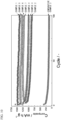
- FIG. 7 is a graph showing the results of the thermogravimetric measurement of the P-C materials produced in Examples 1 and 4 to 7 and the P-C mixture produced in Comparative Example 2. As shown in FIG. 7 , all of the P-C materials satisfied a WL 620 /WL 780 of 0. 1 or more and 0.9 or less.
- the P-C material of Example 7 had a WL 620 /WL 780 of 0.75, which was larger than that of the P-C materials of the other examples. It is considered that SWCNT, which is the carbon material used in Example 7, has a smaller amount of edge sites with respect to the amount of carbon atoms than other carbon materials. In such a carbon material having fewer edge sites, it is considered that the amount of P-C bonds generated is smaller than that in the carbon material having many edge sites. It is considered that such a difference in the amount of P-C bonds is shown as a difference in the results of the thermogravimetric measurement between the P-C material of Example 7 and the P-C materials of the other examples.
- the P-C mixtures of Comparative Examples 1 and 2 had a WL 620 /WL 780 of more than 0.9, showed a steep weight loss at a measurement temperature of about 350°C to 450°C, and showed almost no weight loss at a temperature of 500°C or higher. Therefore, it can be said that the P-C mixtures of Comparative Examples 1 and 2 did not form new bonds capable of withstanding a temperature as high as 620°C or higher and were in a state of a mixture of phosphorus and the carbon material as the raw materials. For WL 300 /WL 600 , both measurement samples satisfied -0.1 or more and 0.1 or less.
- FIG. 8 shows XPS spectra of the P-C materials produced in Examples 1 to 5 and 7. As shown in FIG. 8 , a peak had occurred in a range of 132 to 136 eV in all of the P-C materials, so that the formation of P-C bonds could be confirmed. A peak was observed in a range of 132 to 136 eV also in the P-C material of Example 6.
- FIG. 10 is a graph showing discharge capacities of the lithium secondary batteries using the P-C materials of Examples 1 to 7 and Comparative Example 2 up to 100 cycles. Evaluation of battery performance showed that the P-C materials of Examples 1 to 7 had a high discharge capacity and excellent cycle characteristics when used as a negative electrode active material. In contrast, the P-C mixture of Comparative Example 2 did not obtain a sufficient discharge capacity and had extremely low cycle characteristics compared to those of the examples.
Landscapes
- Chemical & Material Sciences (AREA)
- Chemical Kinetics & Catalysis (AREA)
- Electrochemistry (AREA)
- General Chemical & Material Sciences (AREA)
- Engineering & Computer Science (AREA)
- Inorganic Chemistry (AREA)
- Composite Materials (AREA)
- Materials Engineering (AREA)
- Organic Chemistry (AREA)
- Manufacturing & Machinery (AREA)
- Battery Electrode And Active Subsutance (AREA)
Applications Claiming Priority (2)
| Application Number | Priority Date | Filing Date | Title |
|---|---|---|---|
| JP2021211116A JP2023095306A (ja) | 2021-12-24 | 2021-12-24 | リン-炭素複合材料、リン-炭素複合材料の製造方法、負極活物質、リチウム二次電池用負極及びリチウム二次電池 |
| PCT/JP2022/047738 WO2023120724A1 (ja) | 2021-12-24 | 2022-12-23 | リン-炭素複合材料、リン-炭素複合材料の製造方法、負極活物質、リチウム二次電池用負極及びリチウム二次電池 |
Publications (2)
| Publication Number | Publication Date |
|---|---|
| EP4455080A1 true EP4455080A1 (de) | 2024-10-30 |
| EP4455080A4 EP4455080A4 (de) | 2026-02-18 |
Family
ID=86902877
Family Applications (1)
| Application Number | Title | Priority Date | Filing Date |
|---|---|---|---|
| EP22911425.1A Pending EP4455080A4 (de) | 2021-12-24 | 2022-12-23 | Phosphor-kohlenstoff-verbundmaterial, herstellungsverfahren für phosphor-kohlenstoff-verbundmaterial, negativelektrodenaktivmaterial, negativelektrode für lithiumsekundärbatterie und lithiumsekundärbatterie |
Country Status (6)
| Country | Link |
|---|---|
| US (1) | US20250158030A1 (de) |
| EP (1) | EP4455080A4 (de) |
| JP (2) | JP2023095306A (de) |
| KR (1) | KR20240123803A (de) |
| CN (1) | CN118679120A (de) |
| WO (1) | WO2023120724A1 (de) |
Families Citing this family (9)
| Publication number | Priority date | Publication date | Assignee | Title |
|---|---|---|---|---|
| CN115621445B (zh) * | 2022-10-25 | 2024-11-12 | 湖北三峡实验室 | 一种基于红磷的磷碳负极材料及制备方法 |
| WO2025033314A1 (ja) * | 2023-08-04 | 2025-02-13 | 住友化学株式会社 | リン-炭素複合負極材料、負極活物質、リチウム二次電池用負極及びリチウム二次電池 |
| WO2025033284A1 (ja) * | 2023-08-04 | 2025-02-13 | 住友化学株式会社 | リン-炭素複合負極材料、負極活物質、リチウム二次電池用負極、リチウム二次電池及びリン-炭素複合負極材料の製造方法 |
| WO2025033290A1 (ja) * | 2023-08-04 | 2025-02-13 | 住友化学株式会社 | 電池、負極材料及び積層体 |
| JP2025117901A (ja) * | 2024-01-31 | 2025-08-13 | 住友化学株式会社 | 負極組成物、リチウム二次電池用負極及びリチウム二次電池 |
| JP2025130316A (ja) * | 2024-02-27 | 2025-09-08 | 住友化学株式会社 | リチウム二次電池用負極及びリチウム二次電池 |
| WO2026005013A1 (ja) * | 2024-06-28 | 2026-01-02 | 住友化学株式会社 | リン-炭素複合負極材料、負極活物質、リチウム二次電池用負極、リチウム二次電池及びリン-炭素複合負極材料の製造方法 |
| WO2026005024A1 (ja) * | 2024-06-28 | 2026-01-02 | 住友化学株式会社 | 組成物、負極活物質、リチウム二次電池用負極、リチウム二次電池及び組成物の製造方法 |
| CN119993987A (zh) * | 2025-03-06 | 2025-05-13 | 中国科学技术大学 | 负极片及其制备方法、锂离子二次电池 |
Family Cites Families (11)
| Publication number | Priority date | Publication date | Assignee | Title |
|---|---|---|---|---|
| JPH1167207A (ja) | 1997-08-12 | 1999-03-09 | Toyota Central Res & Dev Lab Inc | リチウム二次電池用負極 |
| JP3175730B2 (ja) | 1998-04-27 | 2001-06-11 | 住友化学工業株式会社 | 非水電解質電池セパレーターとリチウム二次電池 |
| JP2004095400A (ja) | 2002-08-30 | 2004-03-25 | Nissan Motor Co Ltd | バイポーラ電池とその制御方法 |
| KR100775310B1 (ko) | 2004-12-22 | 2007-11-08 | 주식회사 엘지화학 | 유/무기 복합 다공성 분리막 및 이를 이용한 전기 화학소자 |
| US20120251871A1 (en) | 2011-03-29 | 2012-10-04 | Tohoku University | All-solid-state battery |
| US20160233510A1 (en) | 2013-11-08 | 2016-08-11 | Hitachi, Ltd. | All-solid state battery, electrode for all-solid state battery, and method of manufacturing the same |
| US10522872B2 (en) | 2015-10-30 | 2019-12-31 | Lg Chem, Ltd. | Polymer electrolyte having multi-layer structure, and all-solid battery comprising same |
| JP6992818B2 (ja) | 2017-11-13 | 2022-01-13 | 株式会社村田製作所 | 全固体電池 |
| JP6495997B1 (ja) | 2017-11-20 | 2019-04-03 | 住友化学株式会社 | リチウム二次電池用正極活物質、リチウム二次電池用正極及びリチウム二次電池 |
| JP6630863B1 (ja) | 2019-04-12 | 2020-01-15 | 住友化学株式会社 | リチウム金属複合酸化物粉末、リチウム二次電池用正極活物質 |
| CN112018363A (zh) * | 2020-08-31 | 2020-12-01 | 中国科学技术大学 | 黑磷基复合负极材料、其制备方法及在金属二次电池中的应用 |
-
2021
- 2021-12-24 JP JP2021211116A patent/JP2023095306A/ja active Pending
-
2022
- 2022-12-23 CN CN202280084539.2A patent/CN118679120A/zh active Pending
- 2022-12-23 KR KR1020247020914A patent/KR20240123803A/ko active Pending
- 2022-12-23 US US18/723,340 patent/US20250158030A1/en active Pending
- 2022-12-23 EP EP22911425.1A patent/EP4455080A4/de active Pending
- 2022-12-23 WO PCT/JP2022/047738 patent/WO2023120724A1/ja not_active Ceased
-
2024
- 2024-09-24 JP JP2024164964A patent/JP2024173980A/ja active Pending
Also Published As
| Publication number | Publication date |
|---|---|
| EP4455080A4 (de) | 2026-02-18 |
| KR20240123803A (ko) | 2024-08-14 |
| JP2024173980A (ja) | 2024-12-13 |
| CN118679120A (zh) | 2024-09-20 |
| US20250158030A1 (en) | 2025-05-15 |
| JP2023095306A (ja) | 2023-07-06 |
| WO2023120724A1 (ja) | 2023-06-29 |
Similar Documents
| Publication | Publication Date | Title |
|---|---|---|
| EP4455080A1 (de) | Phosphor-kohlenstoff-verbundmaterial, herstellungsverfahren für phosphor-kohlenstoff-verbundmaterial, negativelektrodenaktivmaterial, negativelektrode für lithiumsekundärbatterie und lithiumsekundärbatterie | |
| CN111095650B (zh) | 锂离子二次电池 | |
| EP3026736B1 (de) | Aktives anodenmaterial für eine lithiumsekundärbatterie | |
| EP2960971B1 (de) | Aktivmaterialverbundstoff für lithium-sekundärbatterien und verfahren zur herstellung davon | |
| US10205165B2 (en) | Negative electrode active material for nonaqueous electrolyte secondary batteries and nonaqueous electrolyte secondary battery | |
| EP2675002A1 (de) | Positives Aktivmaterial, Verfahren zu seiner Herstellung und Lithium-Sekundärbatterie mit dem positiven Aktivmaterial | |
| KR20210150399A (ko) | 리튬 금속 복합 산화물 분말 및 리튬 이차 전지용 정극 활물질 | |
| US20170352885A1 (en) | Positive electrode active material for nonaqueous electrolyte secondary battery, method for producing same, and nonaqueous electrolyte secondary battery using said positive electrode active material | |
| EP3208872A1 (de) | Positivelektrodenaktivmaterial für lithiumsekundärbatterie, positivelektrode für lithiumsekundärbatterie und lithiumsekundärbatterie | |
| EP3467912B1 (de) | Negativelektrodenaktivmaterial, gemischtes negativelektrodenaktivmaterial und verfahren zur herstellung eines negativelektrodenaktivmaterials | |
| JPWO2015182665A1 (ja) | リチウム二次電池用正極活物質、リチウム二次電池用正極及びリチウム二次電池 | |
| EP3467913B1 (de) | Negativelektrodenaktivmaterial, gemischtes negativelektrodenaktivmaterial und verfahren zur herstellung eines negativelektrodenaktivmaterials | |
| EP3954659A1 (de) | Lithiummetallverbundoxidpulver, positivelektrodenaktivmaterial für lithiumsekundärbatterie, positivelektrode und lithiumsekundärbatterie | |
| CN114744183B (zh) | 负极活性物质及制造方法、混合负极活性物质材料、负极、锂离子二次电池及制造方法 | |
| EP3067321B1 (de) | Aktivmaterial, batterie mit nichtwässrigem elektrolyten, batteriepack und batteriemodul | |
| EP4230586A1 (de) | Elektrodenaktivmaterial für ein elektrochemisches element und verfahren zur herstellung davon, elektrodenmaterial für ein elektrochemisches element, elektrochemisches element und mobiler gegenstand | |
| WO2013151209A1 (ko) | 리튬 이온 커패시터용 양극 활물질 및 그의 제조 방법a | |
| EP4134350A1 (de) | Positivelektrodenmaterial und batterie | |
| EP3509142A1 (de) | Positivelektrodenaktivmaterial für lithiumsekundärbatterien, positivelektrode für lithiumsekundärbatterien und lithiumsekundärbatterie | |
| WO2019193691A1 (ja) | 正極、電極群及び非水電解質電池 | |
| EP3954657A1 (de) | Lithium-metall-komplex-oxidpulver, positivelektrodenaktivsubstanz für lithiumsekundärbatterie und verfahren zur herstellung von lithium-metall-komplex-oxidpulver | |
| EP4187639A1 (de) | Positivelektrodenmaterial und batterie | |
| EP3683865B1 (de) | Elektrode und batterie mit wasserfreiem elektrolyt | |
| WO2023234351A1 (ja) | 全固体リチウムイオン二次電池及び全固体リチウムイオン二次電池の製造方法 | |
| EP4535447A1 (de) | Elektrodenzusammensetzung für festkörpersekundärbatterien, elektrodenfolie für festkörpersekundärbatterien und verfahren zur herstellung einer elektrodenfolie |
Legal Events
| Date | Code | Title | Description |
|---|---|---|---|
| STAA | Information on the status of an ep patent application or granted ep patent |
Free format text: STATUS: THE INTERNATIONAL PUBLICATION HAS BEEN MADE |
|
| PUAI | Public reference made under article 153(3) epc to a published international application that has entered the european phase |
Free format text: ORIGINAL CODE: 0009012 |
|
| STAA | Information on the status of an ep patent application or granted ep patent |
Free format text: STATUS: REQUEST FOR EXAMINATION WAS MADE |
|
| 17P | Request for examination filed |
Effective date: 20240624 |
|
| AK | Designated contracting states |
Kind code of ref document: A1 Designated state(s): AL AT BE BG CH CY CZ DE DK EE ES FI FR GB GR HR HU IE IS IT LI LT LU LV MC ME MK MT NL NO PL PT RO RS SE SI SK SM TR |
|
| DAV | Request for validation of the european patent (deleted) | ||
| DAX | Request for extension of the european patent (deleted) |