EP4454994A1 - Aussenbordmotor und boot - Google Patents
Aussenbordmotor und boot Download PDFInfo
- Publication number
- EP4454994A1 EP4454994A1 EP24153176.3A EP24153176A EP4454994A1 EP 4454994 A1 EP4454994 A1 EP 4454994A1 EP 24153176 A EP24153176 A EP 24153176A EP 4454994 A1 EP4454994 A1 EP 4454994A1
- Authority
- EP
- European Patent Office
- Prior art keywords
- cooling chamber
- control board
- motor
- flow path
- outboard motor
- Prior art date
- Legal status (The legal status is an assumption and is not a legal conclusion. Google has not performed a legal analysis and makes no representation as to the accuracy of the status listed.)
- Pending
Links
Images


Classifications
-
- B—PERFORMING OPERATIONS; TRANSPORTING
- B63—SHIPS OR OTHER WATERBORNE VESSELS; RELATED EQUIPMENT
- B63H—MARINE PROPULSION OR STEERING
- B63H21/00—Use of propulsion power plant or units on vessels
- B63H21/12—Use of propulsion power plant or units on vessels the vessels being motor-driven
- B63H21/17—Use of propulsion power plant or units on vessels the vessels being motor-driven by electric motor
-
- B—PERFORMING OPERATIONS; TRANSPORTING
- B63—SHIPS OR OTHER WATERBORNE VESSELS; RELATED EQUIPMENT
- B63H—MARINE PROPULSION OR STEERING
- B63H20/00—Outboard propulsion units, e.g. outboard motors or Z-drives; Arrangements thereof on vessels
- B63H20/28—Arrangements, apparatus and methods for handling cooling-water in outboard drives, e.g. cooling-water intakes
-
- B—PERFORMING OPERATIONS; TRANSPORTING
- B63—SHIPS OR OTHER WATERBORNE VESSELS; RELATED EQUIPMENT
- B63H—MARINE PROPULSION OR STEERING
- B63H21/00—Use of propulsion power plant or units on vessels
- B63H21/21—Control means for engine or transmission, specially adapted for use on marine vessels
-
- B—PERFORMING OPERATIONS; TRANSPORTING
- B63—SHIPS OR OTHER WATERBORNE VESSELS; RELATED EQUIPMENT
- B63H—MARINE PROPULSION OR STEERING
- B63H21/00—Use of propulsion power plant or units on vessels
- B63H21/38—Apparatus or methods specially adapted for use on marine vessels, for handling power plant or unit liquids, e.g. lubricants, coolants, fuels or the like
-
- B—PERFORMING OPERATIONS; TRANSPORTING
- B63—SHIPS OR OTHER WATERBORNE VESSELS; RELATED EQUIPMENT
- B63H—MARINE PROPULSION OR STEERING
- B63H21/00—Use of propulsion power plant or units on vessels
- B63H21/21—Control means for engine or transmission, specially adapted for use on marine vessels
- B63H2021/216—Control means for engine or transmission, specially adapted for use on marine vessels using electric control means
Definitions
- the technology disclosed herein relates to an outboard motor and a boat.
- a boat is provided with a hull and an outboard motor mounted to a rear portion of the hull.
- the outboard motor is a device that generates thrust to propel the boat.
- the outboard motor has a drive source, a propeller, and a transmission mechanism that has a propeller shaft and transmits the drive power of the drive source to the propeller.
- An outboard motor including an electric motor as a drive source and a motor control board that controls the electric motor has been disclosed.
- the outboard motor is also provided with a water jacket through which cooling water is passed to cool the electric motor (see, e.g., JP 2016 - 37256 A ).
- control board such as the motor control board
- the control board is covered by a waterproof cover, e.g., and easily increases the temperature due to heat generated by the drive source (such as the electric motor). Therefore, it is necessary to cool not only the drive source but also the control board.
- the drive source such as the electric motor
- This problem is not limited to electric motors and motor control boards but is common to outboard motors provided with a drive source such as an engine and a control board.
- said object is solved by an outboard motor having the features of the independent claim 1. Moreover, said object is also solved by an outboard motor having the features of the independent claim 10. Preferred embodiments are laid down in the dependent claims.
- An outboard motor includes: an electric motor; a motor control board, one end of which is positioned higher than the other end and is configured to control the electric motor; a control case located between the electric motor and the motor control board and having a cooling chamber formed therein; a supply flow path that connects to the cooling chamber of the control case and is configured to supply refrigerant to the cooling chamber; and a discharge flow path that connects to the cooling chamber of the control case and is configured to discharge the refrigerant from the cooling chamber.
- a discharge port of the discharge flow path in the cooling chamber is located at one end of the motor control board, a supply port of the supply flow path in the cooling chamber is located at the other end of the motor control board, the lower end of the discharge port is higher than the lower end of the supply port, and a first wall surface on the motor control board side in the cooling chamber extends along the motor control board.
- the lower end of the discharge port of the cooling chamber to which refrigerant is supplied is higher than the lower end of the supply port so that the cooling chamber can be filled with refrigerant to a height near the discharge port of the cooling chamber.
- the first wall surface on the motor control board side in the cooling chamber extends along the motor control board. Therefore, the entire motor control board can be effectively cooled (e.g., over the entire surface), compared to a configuration in which the first wall surface in the cooling chamber does not extend along the motor control board, for example.
- the motor control board and the first wall surface in the cooling chamber may be configured to be inclined with respect to the horizontal direction.
- This outboard motor can effectively cool the motor control board while placing the motor control board at an angle.
- a second wall surface of the cooling chamber located on the opposite side of the motor control board may be configured to be inclined in the same direction as the first wall surface of the cooling chamber with respect to the horizontal direction.
- the motor control board and the first wall surface in the cooling chamber may be configured to be arranged along an upper-lower direction. This outboard motor can effectively cool the motor control board while placing the motor control board vertically.
- a supply direction of the refrigerant from the supply flow path to the cooling chamber and the discharge direction of the refrigerant from the cooling chamber to the discharge flow path may be configured to be opposite to each other.
- This outboard motor can effectively cool the motor control board while reducing turbulence caused by the momentum of the refrigerant flow from the supply flow path to the cooling chamber and discharging the refrigerant from the cooling chamber.
- the supply port may be configured to be located at the highest position in the supply flow path.
- This outboard motor can smoothly fill the cooling chamber with refrigerant, compared to a configuration in which, e.g., the supply port is not located at the highest position in the supply flow path.
- the discharge port may be configured to be located at the lowest position in the discharge flow path. This outboard motor can vent air in the cooling chamber more smoothly, compared to a configuration in which the discharge port is not located at the lowest position in the discharge flow path.
- the outboard motor may be configured to further include an air vent located at a higher position than the discharge port, and the discharge flow path may be configured to be connected to the air vent. According to this outboard motor, air mixed with refrigerant can be extracted from the air vent connected to the discharge flow path to the outside while effectively cooling the motor control board.
- An outboard motor disclosed herein includes: a control board arranged so that one end is lower than the other end; a control case arranged along the control board and having a cooling chamber formed therein; a supply flow path that connects to the cooling chamber of the control case and is configured to supply a refrigerant to the cooling chamber; and a discharge flow path that connects to the cooling chamber of the control case and is configured to discharge the refrigerant from the cooling chamber.
- a discharge port of the discharge flow path in the cooling chamber is located higher than a supply port of the supply flow path in the cooling chamber, and a wall surface on the control board side in the cooling chamber extends from the discharge port to the supply port.
- the technology disclosed herein can be implemented in various aspects, including, e.g., an outboard motor, a boat provided with an outboard motor and a hull, among other forms.
- the outboard motor disclosed herein can effectively cool the entire control board provided in an outboard motor.
- FIG. 1 is a perspective view schematically illustrating a configuration of a boat 10 in the first embodiment.
- FIG. 1 and other drawings described below show arrows representing each direction with respect to the position of the boat 10. More specifically, each drawing shows arrows representing the front direction (FRONT), rear direction (REAR), left direction (LEFT), right direction (RIGHT), upper direction (UPPER), and lower direction (LOWER), respectively.
- the front-rear direction, left-right direction, and upper-lower (vertical) direction are orthogonal to each other.
- the boat 10 includes a hull 200 and an outboard motor 100.
- the boat 10 has only one outboard motor 100, but the boat 10 may have multiple outboard motors 100.
- the hull 200 is a part of the boat 10 for occupants to ride.
- the hull 200 includes a hull main body 202 including a living space 204, a pilot seat 240 installed in the living space 204, and an operating device 250 installed near the pilot seat 240.
- the operating device 250 is a device for steering the boat and includes, e.g., a steering wheel 252, a shift/throttle lever 254, a joystick 255, a monitor 256, and an input device 258.
- the hull 200 includes a partition wall 220 to partition the rear end of the living space 204 and a transom 210 positioned at the rear end of the hull 200. In the front-rear direction, a space 206 is provided between the transom 210 and the partition wall 220.
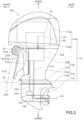
- FIG. 2 is a side view schematically illustrating a configuration of an outboard motor 100 in this embodiment.
- the outboard motor 100 in the reference attitude will be described below unless otherwise specified.
- the reference attitude is an attitude in which the rotation axis Ac of the output shaft 123 of the electric motor 122, which will be described later, extends in the upper-lower direction and the rotation axis Ap of the propeller shaft 137, which will be described later, extends in the front-rear direction.
- the front-rear direction, the left-right direction, and the upper-lower direction are respectively defined based on the outboard motor 100 in the reference attitude.
- the outboard motor 100 is a device that generates thrust to propel the boat 10.
- the outboard motor 100 is attached to the transom 210 at a rear portion of the hull 200.
- the outboard motor 100 includes an outboard motor main body 110 and a suspension device 150.
- the outboard motor main body 110 includes a motor assembly 120, a transmission mechanism 130, a propeller 112, a cowl 114, a casing 116, a water pump 140, and a pump shaft 134.
- the cowl 114 is a housing located on top of the outboard motor main body 110.
- the cowl 114 includes an upper cowl 114a constituting the upper part of the cowl 114 and a lower cowl 114b constituting the lower part of the cowl 114.
- the upper cowl 114a is detachably attached to the lower cowl 114b.
- the casing 116 is a housing located below the cowl 114 and provided in the lower part of the outboard motor main body 110.
- the casing 116 includes a lower case 116b and an upper case 116a.
- the lower case 116b accommodates at least a portion of the drive shaft 133 and the propeller shaft 137 described below.
- the lower case 116b is connected to the upper case 116a so as to be pivotable around the drive shaft 133.
- the upper case 116a is located above the lower case 116b and accommodates a gearbox assembly 300 described below.
- a motor assembly 120 is accommodated within the cowl 114.
- the motor assembly 120 has an electric motor 122.
- the electric motor 122 is an example of the drive source in the claims.
- the electric motor 122 has an output shaft 123 that outputs the drive power generated by the electric motor 122.
- the transmission mechanism 130 is a mechanism that transmits the driving force of the electric motor 122 to the propeller 112. At least a portion of the transmission mechanism 130 is accommodated in the casing 116.
- the transmission mechanism 130 has a gearbox assembly 300, a drive shaft 133, and a propeller shaft 137.
- the propeller shaft 137 is a rod-shaped member and is positioned in a forward and backward extending orientation relatively below the outboard motor main body 110.
- the propeller shaft 137 rotates with the propeller 112.
- the front end of the propeller shaft 137 is accommodated in the lower case 116b, and the rear end of the propeller shaft 137 protrudes rearward from the lower case 116b.
- the front end of the propeller shaft 137 has a gear 138.
- the gearbox assembly 300 is connected to the output shaft 123 of the electric motor 122 and the drive shaft 133.
- the gearbox assembly 300 reduces the driving force of the electric motor 122 and transmits the reduced driving force to the propeller shaft 137. This allows the electric motor 122 to rotate at a desired torque.
- the propeller 112 is a rotor with multiple blades and is attached to the rear end of the propeller shaft 137.
- the propeller 112 rotates along with the rotation of the propeller shaft 137 around the rotation axis Ap.
- the propeller 112 generates thrust by rotating.
- the propeller 112 since the lower case 116b is pivotable, the propeller 112 pivots about the drive shaft 133 along with the lower case 116b. Therefore, the boat 10 is steered by pivoting the lower case 116b.
- the water pump 140 pumps water from outside the outboard motor 100, e.g., to cool the electric motor 122.
- the pump shaft 134 extends in an upper-lower direction.
- the pump shaft 134 is driven by the drive power of the electric motor 122 and transmits power to the water pump 140.
- the water pump 140 is driven by the driving force of the electric motor 122 transmitted by the pump shaft 134.
- the suspension device 150 is a device to suspend the outboard motor main body 110 to the hull 200.
- the suspension device 150 includes a pair of left and right clamp brackets 152, a tilt shaft 160, and a swivel bracket 156.
- the pair of left and right clamp brackets 152 are disposed behind the hull 200 in a state separated from each other in the left-right direction and are fixed to the transom 210 of the hull 200 by using, e.g., bolts.
- Each clamp bracket 152 has a cylindrical supporting portion 152a provided with a through-hole extending in the left-right direction.
- the tilt shaft 160 is a rod-shaped member and is rotatably supported within the through-hole in the supporting portion 152a of the clamp bracket 152.
- the tilt axis At which is the centerline of the tilt shaft 160, constitutes the horizontal (left-right) axis in the tilting operation of the outboard motor 100.
- the swivel bracket 156 is positioned so as to be sandwiched between the pair of clamp brackets 152 and is supported by the supporting portion 152a of the clamp brackets 152 via the tilt shaft 160 so as to be rotatable around the tilt axis At.
- the swivel bracket 156 is driven to rotate about the tilt axis At with respect to the clamp bracket 152 by a tilt device (not shown) that includes an actuator, such as a hydraulic cylinder, for example.
- the outboard motor main body 110 supported by the swivel bracket 156 also rotates about the tilt axis At. This achieves the tilting operation of rotating the outboard motor main body 110 in the upper-lower direction with respect to the hull 200.
- the outboard motor 100 can change the angle of the outboard motor main body 110 around the tilt axis At in the range from the tilt-down state in which the propeller 112 is located under the water (the state in which the outboard motor 100 is in the reference attitude) to the tilt-up state in which the propeller 112 is located above the water surface. Trimming operation for adjusting the attitude of the boat 10 during travel can also be performed by adjusting the angle around the tilt axis At of the outboard motor main body 110.
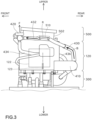
- FIG. 3 is a side view schematically illustrating a part of an internal configuration of an outboard motor main body 110.
- FIG. 3 shows the internal structure accommodated in the cowl 114 and the upper portion of the upper case 116a.
- the motor assembly 120 is located above the gearbox assembly 300, and the control assembly 500 is located above the motor assembly 120.
- the motor assembly 120 has the electric motor 122 described above.
- the electric motor 122 is placed vertically in the motor assembly 120.
- Vertical placement means that the output shaft 123 of the electric motor 122 is arranged in an attitude in which the output shaft 123 of the electric motor 122 extends in the upper-lower direction.
- the control assembly 500 has an MCU (Motor Control Unit) 510 accommodated in a control case 502.
- the MCU 510 is a circuit board that controls the rotation, among others, of the electric motor 122.
- the MCU 510 is an example of the motor control board and the control board in the claims.
- the internal configuration of the outboard motor main body 110 further includes a cooling mechanism 400.
- the cooling mechanism has a heat exchanger (not shown), a pump 410, an air vent 420, a first refrigerant tube 430, a second refrigerant tube 432, a third refrigerant tube 434, a fourth refrigerant tube 436, and a seawater tube (not shown).
- the seawater pumped by the water pump 140 is sent to the heat exchanger through the seawater pipe and discharged back to the sea.
- a cooling water B (coolant) is cooled by heat exchange with seawater in the heat exchanger and is sent to the pump 410 via the fourth refrigerant tube 436.
- the pump 410 pumps the cooling water B to the first refrigerant tube 430.
- the pumped cooling water B is supplied to the cooling chamber R formed in the control case 502 via the first refrigerant tube 430.
- the cooling chamber R is located directly under the MCU 510, and the MCU 510 is cooled by the cooling water B supplied to the cooling chamber R.
- the cooling water B is an example of the refrigerant in the claims and may be, e.g., seawater.
- the cooling water B supplied to the cooling chamber R is discharged into the second refrigerant tube 432.
- the discharged cooling water B returns to the heat exchanger via the third refrigerant tube 434.
- the third refrigerant tube 434 is located around the electric motor 122. Therefore, the electric motor 122 is cooled by the cooling water B passing through the third refrigerant tube 434.
- An air vent 420 is provided at the connecting portion between the second refrigerant tube 432 and the third refrigerant tube 434. The air vent 420 removes air contained in the second refrigerant tube 432 and the third refrigerant tube 434 or in the cooling water B that passes through them to the outside.
- FIG. 4 is a cross-sectional view illustrating a peripheral configuration of the MCU 510
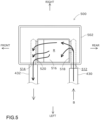
- FIG. 5 is a top view illustrating a configuration of the cooling chamber R in the control case 502.
- the MCU 510 is a rectangular flat control board and is arranged along a direction inclined by an angle ⁇ (0 degrees ⁇ ⁇ ⁇ 90 degrees) with respect to the horizontal direction in the control case 502.
- the angle ⁇ may be 3 degrees or more, 5 degrees or more, 10 degrees or more, 15 degrees or more, 20 degrees or more, or 30 degrees or more, for example.
- the angle ⁇ may be 5 degrees or less, 10 degrees or less, 15 degrees or less, 20 degrees or less, or 30 degrees or less.
- the control case 502 is an example of the case in the claims.
- the cooling chamber R is formed in the portion of the control case 502 between the MCU 510 and the electric motor 122.
- the cooling chamber R is a rectangular flat space and is open to the MCU 510 side.
- the cooling chamber R is inclined to be parallel to the MCU 510.
- a heat sink plate 530 is provided under the MCU 510.
- the heat sink plate 530 has a rectangular plate-shaped base 532 and a plurality of projections 534 protruding from the lower surface 533 of the base 532.
- the heat sink plate 530 is arranged to cover the upper opening of the cooling chamber R.
- the lower surface 533 of the base 532 constitutes the ceiling surface of the cooling chamber R.
- the upper surface of base 532 is in contact with the entire lower surface of MCU 510.
- the heat sink plate 530 is also inclined to be parallel to the MCU 510.
- the cooling chamber R has a supply port 512 and a discharge port 514.
- the lower end of the discharge port 514 is located higher than the lower end of the supply port 512.
- the supply port 512 is located at the lowest end of the cooling chamber R (right end of the cooling chamber R in FIG. 4 , for example) and is connected to the flow path in the first refrigerant tube 430.
- the discharge port 514 is located at the highest end of the cooling chamber R (left end of the cooling chamber R in FIG. 4 , for example) and is connected to the flow path in the second refrigerant tube 432.
- the flow path in the first refrigerant tube 430 is an example of the supply flow path in the claims
- the flow path in the second refrigerant tube 432 is an example of the discharge flow path in the claims.
- the lower surface 533 of the base 532 of the heat sink plate 530 which constitutes the ceiling surface of the cooling chamber R (the surface on which the projections 534 are not formed), extends along the MCU 510 in a direction inclined by the angle ⁇ with respect to the horizontal direction.
- the floor surface 516 of the cooling chamber R also extends along the MCU 510 in a direction inclined by the angle ⁇ with respect to the horizontal direction.
- the lower surface 533 of the base 532 and the floor surface 516 are parallel.
- the lower surface 533 of the base 532 is an example of the first wall surface in the claims, and the floor surface 516 is an example of the second wall surface in the claims.
- the supply direction of the cooling water B from the first refrigerant tube 430 to the cooling chamber R (right direction) and the discharge direction of the cooling water B from the cooling chamber R to the second refrigerant tube 432 (left direction) are opposite to each other.
- both the supply port 512 and the discharge port 514 open from the cooling chamber R in the same direction (left direction). Therefore, the cooling water B supplied from the first refrigerant tube 430 flows toward the right side wall of the cooling chamber R.
- the cooling water B supplied to the cooling chamber R flows out toward the discharge port 514 formed on the left side wall of the cooling chamber R. This allows the MCU 510 to be effectively cooled while reducing turbulence caused by the momentum of the flow of the cooling water B from the first refrigerant tube 430 to the cooling chamber R and discharging the cooling water B from the cooling chamber R.
- the cooling chamber R has a first partition wall 518 and a second partition wall 520.
- the first partition wall 518 is positioned closer to the supply port 512 and extends continuously from the inner wall surface (left side wall) where the supply port 512 is formed to the middle of the cooling chamber R along the supply direction of the first refrigerant tube 430.
- the cooling water B supplied from the first refrigerant tube 430 is guided by the first partition wall 518 to the far side (right side) of the cooling chamber R. Since the cooling water B is supplied to the far side of the cooling chamber R, the entire surface of the MCU 510 can be effectively cooled.
- the second partition wall 520 is positioned closer to the discharge port 514 and extends continuously from the inner wall surface (left side wall) where the discharge port 514 is formed to the middle of the cooling chamber R along the supply direction described above.
- the second partition wall 520 reduces the amount of cooling water B that is discharged without going to the far side of the cooling chamber R.
- the extended length of the second partition wall 520 is shorter than the extended length of the first partition wall 518. Therefore, it is possible to prevent the cooling water B from being difficult to discharge from the cooling chamber R due to the presence of the second partition wall 520.
- the supply port 512 is located at the highest position in the first refrigerant tube 430 (see FIGS. 3 and 4 ). Therefore, the cooling water B is filled from the first refrigerant tube 430 to the cooling chamber R in turn. Therefore, the cooling chamber R can be filled smoothly with cooling water B, compared to a configuration in which, e.g., the supply port 512 is not located at the highest position in the first refrigerant tube 430.
- the discharge port 514 is located at the lowest position in the second refrigerant tube 432. This prevents the cooling water B from being discharged into the second refrigerant tube 432 without the cooling chamber R being sufficiently filled with the cooling water B. This configuration can vent air in the cooling chamber more smoothly, compared to a configuration in which the discharge port is not located at the lowest position in the discharge flow path.
- axes, members, and the like extending in the front-rear direction need not necessarily be parallel to the front-rear direction.
- Axes and members extending in the front-rear direction include axes and members that are inclined in the range of ⁇ 45° to the front-rear direction.
- axes and members extending in the upper-lower direction include axes and members inclined within a range of ⁇ 45° to the upper-lower direction
- axes and members extending in the left-right direction include axes and members inclined within a range of ⁇ 45° to the left-right direction.
- the configuration of the boat 10 and outboard motor 100 of the preferred embodiment is only an example and is variously deformable.
- the drive shaft 133 is positioned in front of the output shaft 123, but the drive shaft 133 may be positioned behind the output shaft 123.
- an electric motor 122 with the output shaft 123 disposed along the upper-lower direction is shown as the drive source, but the drive source may be an electric motor with the output shaft 123 disposed along a direction other than the upper-lower direction (e.g., horizontal direction) or an engine such as internal combustion engine.
- the MCU 510 is illustrated as a control board, but the control board may be a board that controls components other than the electric motor 122.
- the control board need not be located near the electric motor 122.
- the lower surface 533 of the heat sink plate 530 and the bottom surface of the MCU 510 are parallel, but they may be non-parallel.
- the lower surface 533 of the base 532 and the floor surface 516 are parallel, but they may be non-parallel.
- the first wall surface (lower surface 533 of the heat sink plate 530) of the control board (motor control board) may be a flat surface or may have an uneven or curved surface. It is sufficient if the first wall as a whole extends along the control board.
- the supply direction of refrigerant B from the supply flow path (first refrigerant tube 430) to the cooling chamber R and the discharge direction of refrigerant B from the cooling chamber R to the discharge flow path (second refrigerant tube 432) may be in the same direction or cross each other.
- the supply port 512 may not be located at the highest position in the supply flow path, or the discharge port 514 may not be located at the lowest position in the discharge flow path.
- at least one of the first partition wall 518 and the second partition wall 520 may not be formed in the cooling chamber R.
- the MCU 510 is arranged along a direction inclined by an angle ⁇ (0 degrees ⁇ ⁇ ⁇ 90 degrees) with respect to the horizontal direction, but the configuration is not limited to this, e.g., the MCU 510 may be arranged along an upper-lower direction. In this case, it is preferable that the face of the heat sink plate 530 on the cooling chamber R is also parallel to the MCU 510.
- the lowercase 116b is connected to the uppercase 116a so that the lower case 116b is rotatable, but the lower case 116b does not necessarily have to be rotatable.
- the casing 116 need not have an upper case 116a and a lower case 116b but may be composed of a single member.
- the outboard motor 100 is provided with the water pump 140 as a driven device, but it may not be provided with the water pump 140 or may be provided with another driven device instead of the water pump 140.
Landscapes
- Chemical & Material Sciences (AREA)
- Engineering & Computer Science (AREA)
- Combustion & Propulsion (AREA)
- Mechanical Engineering (AREA)
- Ocean & Marine Engineering (AREA)
- Motor Or Generator Frames (AREA)
- Motor Or Generator Cooling System (AREA)
Applications Claiming Priority (1)
| Application Number | Priority Date | Filing Date | Title |
|---|---|---|---|
| JP2023072163A JP2024157676A (ja) | 2023-04-26 | 2023-04-26 | 船外機および船舶 |
Publications (1)
| Publication Number | Publication Date |
|---|---|
| EP4454994A1 true EP4454994A1 (de) | 2024-10-30 |
Family
ID=89663426
Family Applications (1)
| Application Number | Title | Priority Date | Filing Date |
|---|---|---|---|
| EP24153176.3A Pending EP4454994A1 (de) | 2023-04-26 | 2024-01-22 | Aussenbordmotor und boot |
Country Status (3)
| Country | Link |
|---|---|
| US (1) | US20240359786A1 (de) |
| EP (1) | EP4454994A1 (de) |
| JP (1) | JP2024157676A (de) |
Citations (5)
| Publication number | Priority date | Publication date | Assignee | Title |
|---|---|---|---|---|
| CN101353082A (zh) * | 2008-09-08 | 2009-01-28 | 苏州百胜动力机器有限公司 | 水冷电动舷外机 |
| JP2016037256A (ja) | 2014-08-11 | 2016-03-22 | スズキ株式会社 | 電動船外機 |
| US20220089261A1 (en) * | 2020-09-23 | 2022-03-24 | Yanmar Marine International B.V. | Supporting Structure for an Outboard Engine |
| CN216332688U (zh) * | 2021-11-10 | 2022-04-19 | 深圳市锐钜科技有限公司 | 一种舷外机 |
| JP2023072163A (ja) | 2021-11-12 | 2023-05-24 | 株式会社ミツモア | サーバ装置、方法及びプログラム |
-
2023
- 2023-04-26 JP JP2023072163A patent/JP2024157676A/ja active Pending
-
2024
- 2024-01-22 EP EP24153176.3A patent/EP4454994A1/de active Pending
- 2024-02-12 US US18/438,614 patent/US20240359786A1/en active Pending
Patent Citations (5)
| Publication number | Priority date | Publication date | Assignee | Title |
|---|---|---|---|---|
| CN101353082A (zh) * | 2008-09-08 | 2009-01-28 | 苏州百胜动力机器有限公司 | 水冷电动舷外机 |
| JP2016037256A (ja) | 2014-08-11 | 2016-03-22 | スズキ株式会社 | 電動船外機 |
| US20220089261A1 (en) * | 2020-09-23 | 2022-03-24 | Yanmar Marine International B.V. | Supporting Structure for an Outboard Engine |
| CN216332688U (zh) * | 2021-11-10 | 2022-04-19 | 深圳市锐钜科技有限公司 | 一种舷外机 |
| JP2023072163A (ja) | 2021-11-12 | 2023-05-24 | 株式会社ミツモア | サーバ装置、方法及びプログラム |
Also Published As
| Publication number | Publication date |
|---|---|
| US20240359786A1 (en) | 2024-10-31 |
| JP2024157676A (ja) | 2024-11-08 |
Similar Documents
| Publication | Publication Date | Title |
|---|---|---|
| US9862470B2 (en) | Large outboard motor for marine vessel application and related methods of making and operating same | |
| JP2022034677A (ja) | 船舶推進機 | |
| JP7809938B2 (ja) | ハイブリッド船舶推進機 | |
| US20230415874A1 (en) | Outboard motor and boat | |
| JP2024065430A (ja) | 船外機および船舶 | |
| US20220242544A1 (en) | Watercraft with Electric Propulsion System | |
| CN114829249A (zh) | 船用推进单元和海上船舶 | |
| EP2075192B1 (de) | Aussenbordmotor | |
| EP4454994A1 (de) | Aussenbordmotor und boot | |
| EP2075191A2 (de) | Aussenbordmotor | |
| US20240359785A1 (en) | Outboard motor and boat | |
| EP4563459A1 (de) | Aussenbordmotor und boot | |
| US20250153830A1 (en) | Outboard motor and boat | |
| JP7797862B2 (ja) | 船外機 | |
| EP4390077B1 (de) | Aussenbordmotor | |
| US20260055721A1 (en) | Electric propulsion machine | |
| EP4707157A1 (de) | Schiffsantriebsvorrichtung | |
| EP4442560A1 (de) | Schiffsantriebsvorrichtung | |
| US20230415876A1 (en) | Outboard motor and boat | |
| EP4389588A1 (de) | Aussenbordmotor | |
| US20240359783A1 (en) | Outboard motor and boat | |
| US20250206432A1 (en) | Boat propulsion device, boat, and movable body | |
| JP2023128203A (ja) | 船外機および船舶 | |
| JP2542680Y2 (ja) | 双胴型ダブルエンダー船 | |
| JP2024152242A (ja) | 船外機および船舶 |
Legal Events
| Date | Code | Title | Description |
|---|---|---|---|
| PUAI | Public reference made under article 153(3) epc to a published international application that has entered the european phase |
Free format text: ORIGINAL CODE: 0009012 |
|
| STAA | Information on the status of an ep patent application or granted ep patent |
Free format text: STATUS: THE APPLICATION HAS BEEN PUBLISHED |
|
| AK | Designated contracting states |
Kind code of ref document: A1 Designated state(s): AL AT BE BG CH CY CZ DE DK EE ES FI FR GB GR HR HU IE IS IT LI LT LU LV MC ME MK MT NL NO PL PT RO RS SE SI SK SM TR |
|
| P01 | Opt-out of the competence of the unified patent court (upc) registered |
Free format text: CASE NUMBER: APP_64537/2024 Effective date: 20241205 |
|
| STAA | Information on the status of an ep patent application or granted ep patent |
Free format text: STATUS: REQUEST FOR EXAMINATION WAS MADE |
|
| 17P | Request for examination filed |
Effective date: 20250428 |