EP4454897A1 - Verfahren zur herstellung eines dekorativen substrats für eine dekorative platte und verfahren zur herstellung einer dekorativen platte - Google Patents
Verfahren zur herstellung eines dekorativen substrats für eine dekorative platte und verfahren zur herstellung einer dekorativen platte Download PDFInfo
- Publication number
- EP4454897A1 EP4454897A1 EP24168653.4A EP24168653A EP4454897A1 EP 4454897 A1 EP4454897 A1 EP 4454897A1 EP 24168653 A EP24168653 A EP 24168653A EP 4454897 A1 EP4454897 A1 EP 4454897A1
- Authority
- EP
- European Patent Office
- Prior art keywords
- master image
- printing
- pixels
- color tone
- substrate
- Prior art date
- Legal status (The legal status is an assumption and is not a legal conclusion. Google has not performed a legal analysis and makes no representation as to the accuracy of the status listed.)
- Pending
Links
Images


Classifications
-
- B—PERFORMING OPERATIONS; TRANSPORTING
- B41—PRINTING; LINING MACHINES; TYPEWRITERS; STAMPS
- B41M—PRINTING, DUPLICATING, MARKING, OR COPYING PROCESSES; COLOUR PRINTING
- B41M5/00—Duplicating or marking methods; Sheet materials for use therein
-
- B—PERFORMING OPERATIONS; TRANSPORTING
- B44—DECORATIVE ARTS
- B44C—PRODUCING DECORATIVE EFFECTS; MOSAICS; TARSIA WORK; PAPERHANGING
- B44C5/00—Processes for producing special ornamental bodies
- B44C5/04—Ornamental plaques, e.g. decorative panels, decorative veneers
-
- B—PERFORMING OPERATIONS; TRANSPORTING
- B41—PRINTING; LINING MACHINES; TYPEWRITERS; STAMPS
- B41J—TYPEWRITERS; SELECTIVE PRINTING MECHANISMS, i.e. MECHANISMS PRINTING OTHERWISE THAN FROM A FORME; CORRECTION OF TYPOGRAPHICAL ERRORS
- B41J2/00—Typewriters or selective printing mechanisms characterised by the printing or marking process for which they are designed
- B41J2/005—Typewriters or selective printing mechanisms characterised by the printing or marking process for which they are designed characterised by bringing liquid or particles selectively into contact with a printing material
- B41J2/01—Ink jet
- B41J2/21—Ink jet for multi-colour printing
- B41J2/2132—Print quality control characterised by dot disposition, e.g. for reducing white stripes or banding
- B41J2/2139—Compensation for malfunctioning nozzles creating dot place or dot size errors
-
- B—PERFORMING OPERATIONS; TRANSPORTING
- B41—PRINTING; LINING MACHINES; TYPEWRITERS; STAMPS
- B41J—TYPEWRITERS; SELECTIVE PRINTING MECHANISMS, i.e. MECHANISMS PRINTING OTHERWISE THAN FROM A FORME; CORRECTION OF TYPOGRAPHICAL ERRORS
- B41J2/00—Typewriters or selective printing mechanisms characterised by the printing or marking process for which they are designed
- B41J2/005—Typewriters or selective printing mechanisms characterised by the printing or marking process for which they are designed characterised by bringing liquid or particles selectively into contact with a printing material
- B41J2/01—Ink jet
- B41J2/21—Ink jet for multi-colour printing
- B41J2/2132—Print quality control characterised by dot disposition, e.g. for reducing white stripes or banding
- B41J2/2142—Detection of malfunctioning nozzles
-
- B—PERFORMING OPERATIONS; TRANSPORTING
- B41—PRINTING; LINING MACHINES; TYPEWRITERS; STAMPS
- B41J—TYPEWRITERS; SELECTIVE PRINTING MECHANISMS, i.e. MECHANISMS PRINTING OTHERWISE THAN FROM A FORME; CORRECTION OF TYPOGRAPHICAL ERRORS
- B41J2/00—Typewriters or selective printing mechanisms characterised by the printing or marking process for which they are designed
- B41J2/005—Typewriters or selective printing mechanisms characterised by the printing or marking process for which they are designed characterised by bringing liquid or particles selectively into contact with a printing material
- B41J2/01—Ink jet
- B41J2/21—Ink jet for multi-colour printing
- B41J2/2132—Print quality control characterised by dot disposition, e.g. for reducing white stripes or banding
- B41J2/2146—Print quality control characterised by dot disposition, e.g. for reducing white stripes or banding for line print heads
-
- B—PERFORMING OPERATIONS; TRANSPORTING
- B41—PRINTING; LINING MACHINES; TYPEWRITERS; STAMPS
- B41M—PRINTING, DUPLICATING, MARKING, OR COPYING PROCESSES; COLOUR PRINTING
- B41M3/00—Printing processes to produce particular kinds of printed work, e.g. patterns
- B41M3/12—Transfer pictures or the like, e.g. decalcomanias
-
- B—PERFORMING OPERATIONS; TRANSPORTING
- B44—DECORATIVE ARTS
- B44F—SPECIAL DESIGNS OR PICTURES
- B44F9/00—Designs imitating natural patterns
- B44F9/02—Designs imitating natural patterns wood grain effects
-
- B—PERFORMING OPERATIONS; TRANSPORTING
- B44—DECORATIVE ARTS
- B44F—SPECIAL DESIGNS OR PICTURES
- B44F9/00—Designs imitating natural patterns
- B44F9/04—Designs imitating natural patterns of stone surfaces, e.g. marble
-
- B—PERFORMING OPERATIONS; TRANSPORTING
- B41—PRINTING; LINING MACHINES; TYPEWRITERS; STAMPS
- B41J—TYPEWRITERS; SELECTIVE PRINTING MECHANISMS, i.e. MECHANISMS PRINTING OTHERWISE THAN FROM A FORME; CORRECTION OF TYPOGRAPHICAL ERRORS
- B41J3/00—Typewriters or selective printing or marking mechanisms characterised by the purpose for which they are constructed
- B41J3/407—Typewriters or selective printing or marking mechanisms characterised by the purpose for which they are constructed for marking on special material
-
- B—PERFORMING OPERATIONS; TRANSPORTING
- B41—PRINTING; LINING MACHINES; TYPEWRITERS; STAMPS
- B41M—PRINTING, DUPLICATING, MARKING, OR COPYING PROCESSES; COLOUR PRINTING
- B41M2205/00—Printing methods or features related to printing methods; Location or type of the layers
- B41M2205/16—Correction processes or materials
-
- B—PERFORMING OPERATIONS; TRANSPORTING
- B41—PRINTING; LINING MACHINES; TYPEWRITERS; STAMPS
- B41M—PRINTING, DUPLICATING, MARKING, OR COPYING PROCESSES; COLOUR PRINTING
- B41M5/00—Duplicating or marking methods; Sheet materials for use therein
- B41M5/50—Recording sheets characterised by the coating used to improve ink, dye or pigment receptivity, e.g. for ink-jet or thermal dye transfer recording
- B41M5/52—Macromolecular coatings
Definitions
- the present invention relates to a method for manufacturing a decorative substrate, preferably a printed paper sheet or a printed thermoplastic foil, to be used in the manufacturing of decorative panels, preferably floor, wall or furniture panels.
- the invention may further relate to a method for manufacturing a decorative panel.
- Paper sheets or plastic foils are usually printed using gravure printing for forming decorative substrates for decorative panels.
- the demand of decorative substrates being printed using digital inkjet printing, instead of analog printing, is increased because of the higher flexibility and higher variation of decor that inkjet printing can guarantee over gravure printing.
- inkjet printing is performed by jetting droplets of inks through tiny nozzles in printheads of the printer. Every printhead can comprise hundreds or thousands of nozzles and every printer can comprise dozens of printheads. Said nozzles are susceptible to clogging and or to resonance depending on the printing condition thereby causing printing defects, like for example missing printing nozzles or banding defects.
- WO 2020/104912 provides a method for solving missing nozzle or banding defect by modifying the dimension of printed dots.
- Decorative panels usually have a décor imitating a wood, stone, ceramic and/or cement décor.
- these kinds of décors are characterized by a substantially uniform base color, like for example, brown in case of wood or grey in case of stone and cement, they are also more prone to certain printing defects, especially banding, where any variation of the printing performances is highlighted by said uniform base color.
- the present invention aims in the first place to provide an alternative method for manufacturing a decorative substrate for decorative panels, which, in accordance with several of its preferred embodiments, is directed to solve one or more of the problems arising in the state of the art.
- the invention in accordance with its first independent aspect, relates to a method for manufacturing a decorative substrate for decorative panels that comprises the steps of:
- the method of the first independent aspect has the characteristic that said error correction operation at least involves adding an intentional defect to the corrected master image.
- adding said intentional defects can lead to forming a visual noise that can hide other kind of printing errors.
- the inventors have found that these intentional defects can work in combination with software for the correction of printing defects thereby improving the efficacy of said software.
- These kinds of software are normally directed to analyze the printing error and intervene on the master image and or on the printer in order to remove the cause of the printing defect itself. Nevertheless, during private research, inventors have found that said software may not be always sufficiently effective to obtain the desired quality required in decorative panels.
- the software may correct the defects only temporarily so that during a production batch it may be necessary to intervene with the software more than once.
- adding the intentional defects, or noise may lead to a more efficient disguising of other printing defects in a permanent way as they are independent from the cause of the printing defects.
- the intentional defects can be included in the corrected master image so that they depend on the master image itself and not on the printing condition thereby disguising other printing defects permanently in a production batch.
- the printing defect in step c) can be selected from the group comprising, preferably consisting, of: missing nozzle, banding defects, deflected nozzles, printhead stitch issues, .
- the inventors have found that the addition of intentional defects in the master image is particularly efficient in disguising these kinds of defect.
- an apparently imperceptible variation of the color tonality in a certain point, for example in a certain pixel, of the printed décor can hide a near missing printed pixel caused by a missing printing nozzle.
- a substantially or apparently random distribution of pixel with different color tonality from the color tonality of the surrounding pixels can make the printed image less flat and hide a banding defect.
- the correction in step d) can further comprise one or more of the following operations: modifying drop sizes at predetermined spots and/or modifying the number of droplets at predetermined spots.
- These corrections can be performed using dedicated software like Meteor Metcal or GIS . These corrections can provide for a good and at least temporary, remedy to printing defects, and can be further improved by adding the additional defects as explained above.
- said intentional defect comprises additional droplets of inks of a first color tone jetted in an area of the printed décor having a predominant second color tone.
- said intentional defect can comprise a pixel or a group of pixels having the first color tone being surrounded by pixels having the second color tone.
- said group is formed by less than 5 pixel, more preferably less than 3 pixels. In this way the defect is sufficiently small to be apparently imperceptible so that can contribute to the disguising of other defects without affecting the quality of the print.
- said area of the second color tone can be adjacent to an area having predominant first color tone.
- the said additional droplets are present in the 20, preferably 10 pixels, adjacent to said area having the first color tone.
- said additional droplets can be less evident and perceptible as they are disposed around an area of the décor having the same, or similar color tone.
- said area having predominant first color tone can be formed by a group of pixels comprising at least 20 pixels, preferably at least 50 pixels.
- said area of the second color tone is an unprinted area.
- the droplets may have a dimension below 7pl, more preferable below 5pl, even more preferable below 3,5pl.
- the defect is sufficiently small to be apparently imperceptible so that can contribute to the disguising of other defects without affecting the quality of the print.
- said additional droplets have an optical density (M0) below 5%, or on optical density (M0) below 0.2 In this way the defects are less visible to the human eye so that their effect on the quality of the printed décor is limited.
- Said additional droplets may substantially correspond to pixels of the corrected master image which are not present in the first master image.
- Said intentional defects can be generated by a software running on a computer.
- Said software can be configured to analyze the master image and create the intentional defect on the basis of said analysis.
- said first master image represents a uniform color, or a cement décor, a stone décor or a wood décor.
- Said décors have the characteristic of showing a predominant color, and in this condition the printing operation is more prone to develop certain printing defects like, in particular, banding or missing printing nozzles. Therefore, the inventors have found that it is in particular with this kind of décors that the invention is more effective.
- the printing substrate can be a paper sheet or a thermoplastic foil.
- the printing substrate can be a rigid material like for example a board for forming the base of the decorative panel. This is particularly the case when the board is made of a plastic material, preferably thermoplastic, for example PVC (polyvinylchloride) or PP (polypropylene), or thermosetting material, as well as mineral boards or cement-based board.
- the printing substrate can comprise an ink receiver layer on at least one of its surfaces.
- the printing substrate may be a colored, for example pigmented and/or dyed base. It is noted that the inventors have found that using a colored printing substrate can reduce the risk of forming the banding defect.
- the color of the printing substrate can be selected to be the same or similar to the predominant color of the décor so that the décor itself is provided on a uniformly colored background and the and banding defect, or missing printing nozzle, are less evident.
- an ink receiver substance on the surface of the printable substrate is colored.
- the printing substrate is a paper sheet
- it is preferably made of a paper of the type suitable for being impregnated with a thermosetting resin.
- said paper sheet comprises a base paper weight, i.e. without ink receiving layer, higher than 20 grams per square meter, preferably between 50 to 100 grams per square meter, e.g. between 60 and 80 grams per square meter.
- the paper sheet in case it comprises an ink receiver layer shows a resin penetration time lower than 3 sec.
- the paper sheet can show a mean air resistance as expressed in Gurley value below 40 sec, preferably below 25 sec. Paper showings said mean air resistance are more prone to impregnation with resins.
- the paper sheet can be opaque and/or contains titanium oxide as a whitening agent and/or other inorganic fillers.
- the printing substrate is a thermoplastic foil it can be made of, for example, vinyl-based plastics, polyolefins, or polyesters, preferably selected from the group consisting of: polyvinyl chloride (PVC), polyethylene (PE) and polypropylene (PP), polyurethane (PU), polystyrene (PS), acrylonitrile-butadiene-styrene (ABS), polymethyl methacrylate (PMMA), polycarbonate (PC), polyethylene terephthalate (PET), PETG, or mixtures or co-polymers thereof.
- PVC polyvinyl chloride
- PE polyethylene
- PP polypropylene
- PU polyurethane
- PS polystyrene
- ABS acrylonitrile-butadiene-styrene
- PMMA polymethyl methacrylate
- PC polycarbonate
- PET polyethylene terephthalate
- PETG PETG
- the ink receiver coating can comprise a binder a flocculant and optionally a pigment.
- the ink receiver coating can be on the base printing substrate in an amount up to 5 g/sqm dry weight (grams per square meter).
- said binder can preferably comprise a water-based dispersion of terpolymer vinyl chloride and vinyl acetate ethylene; a water-based dispersion of vinyl chloride -vinyl acetate; a water-based aliphatic PU dispersion; other non-blocking water-based acrylics dispersions.
- the binder is mainly composed of polyvinyl alcohol. The binder can form from the 20 to the 90 % of the dry weight of the ink receiver coating.
- the flocculant is preferably a metal salt.
- the metal salt can comprise a cationic metal salt, for example CaCl 2 .
- the flocculant can form from the 10 to the 80 % of the dry weight of the ink receiver coating.
- the ink receiver coating can comprise a pigment, preferably in form of inorganic pigment, especially silica particles.
- the pigment can form from the 10 to the 80 % of the dry weight of the ink receiver coating.
- the inkjet receiving layer can further comprise a cross linker and/or other additives like dispersant, coupling agent, wetting agent or PH modifiers.
- the ink can be a water-based ink, a solvent-based ink, or a UV curable ink.
- the ink is water-based especially when the substrate is made of paper, whereas can be UV curable especially when the substrate is made of plastic or mineral.
- the ink preferably comprises a colorant element in the form of a pigment.
- first printable substrate and the second printable substrate can have one or more characteristics in common. It is also possible that the first and the second substrate are substantially identical.
- the printing operation is performed using an inkjet printer of the single pass type or of the multi-pass type.
- the first printable substrate can be printed with a first printing equipment and the second printable substrate can be printed using a different printing equipment.
- the first printing equipment is a sampling printer, preferably a multi-pass or a plotter
- the second printer is a production printer, for example a single pass printer or a multi-pass printer.
- the obtained second decorative sheet can be used in manufacturing of decorative panels having a support layer and top layer, said top layer comprising the decorative sheet and, optionally, a wear layer.
- the first and the second substrate as well as the first and the second printer can coincide.
- the image correction can be performed contemporarily to the printing operation so that when a defect is detected it can it is immediately corrected.
- the invention may relate to a method for manufacturing a decorative substrate for decorative panels that comprises the steps of:
- the method of the second independent aspect has the characteristic that said image processing operation at least involves adding an intentional defect to the modified master image.
- the method of said second independent aspect in particular of said intentional defects, of the master image and of the printable substrate, can show one or more of the characteristics already described in relation to the first independent aspect.
- the invention further relates to a method of manufacturing a panel using the decorative substrate obtained or obtainable from the method according to the first and/or the second independent aspect.
- the method of manufacturing a panel comprises one or more steps which substantially depend on the kind of decorative substrate.
- the decorative substrate is in form of a paper sheet
- said paper is impregnated with a thermosetting resin, preferably melamine-based resin, and is fixed on the support layer via heat and pressure, for example in a short cycle press.
- the wear layer is in form of an overlay paper sheet is impregnated with a thermosetting resin and that it is fixed on to the decorative substrate via heat and pressure.
- the decorative substrate is in the form of a plastic foil
- said foil is fixed on the support layer via gluing and or via thermal lamination.
- the wear layer is a transparent plastic sheet and fixed to the decorative substrate via thermal lamination or gluing.
- the method of manufacturing the panel can comprise providing a wear layer above the printed décor, thereby obtaining a panel wherein the decorative substrate is also the support of the panel.
- the wear layer can be in form of a transparent plastic sheet and fixed to the decorative substrate via thermal lamination or gluing.
- the wear layer can be in form of one or more coating layer which may be provided, for example poured, in form of a radiation curable substance and then cured, for example via UV or EB.
- the first printable substrate and the second printable substrate can be in form of a board and the printing operations can be performed directly on the board.
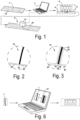
- the printer 4 is a multi-pass inkjet printer configured for printing water-based inks on a first printable substrate 6.
- the printable substrate is a paper for rotogravure printing having a weight higher than 20 grams per square meter, preferably between 50 to 100 grams per square meter, e.g. between 60 and 80 grams per square meter.
- the base paper sheet shows a mean air resistance as expressed in Gurley value below 40 sec, preferably below 25 sec.
- the printable substrate 6 further comprises an ink receiver layer.
- the master image 1 is printed using the printer 4 on the first printable substrate 6 to obtain a first decorative substrate 8 having a first printed décor 10.
- the first printed décor 10 is then scanned using a scanner 12 connected to the computer 2 for the evaluation of the printing quality and for the identification of printing errors like, especially, banding.
- the first master image 1 is subjected to an image processing operation, using a software running on the computer 2.
- a modified master image 14 is obtained that comprises added intentional defects 16 as better shown in figure 3 .
- Figures 2 and 3 respectively show an enlarged view of the same portion the first master image 1 and in the modified master image 14.
- the selected portion comprises a first area 18 having a predominant first color, for example black, and a second area 20, having a predominant second color, for example white.
- first and second area 18, 20 are well defined.
- the modified master image 14 comprises additional defects 16 in the form of first pixels or a group of firsts pixels 22 having the first color tone, for example black, present in the second area 20. Said firsts pixels 22 of the first color tone are surrounded by second pixels 24 having the second color tone, for example white.
- the first pixels 22 forming the intentional defects 16 are present in the 20, preferably 10 pixels, adjacent to said first area 18 having the first color tone.
- the first pixels 22 have an optical density (M0) below 5%. Or below an optical density M0 ⁇ 0.2
- the modified master image 14 is configured such that during printing the intentional defects 16 are printed in form of droplets of ink that have a dimension below 7pl, more preferable below 5pl, even more preferable below 3,5pl.
- the modified master image 14 is then printed using a second printer 26, for example a single pass inkjet printer configured for printing water-based inks on a second printable substrate 28 to obtain a second decorative substrate 30.
- the second printable substrate 28 can be the same of the first printable substrate 6.
- the second decorative substrate 30 is then impregnated with a melamine-based thermosetting resin, and is sandwiched between a wood-based board 32 and a melamine-based thermosetting resin impregnated overlay paper 34 to form a floor panel 36 shown in figure 4 .
- Figure 5 shows a special embodiment of the invention wherein the first and the second substrate as well as the second substrate coincide, so that the correction is performed contemporarily to the printing operation.
- the first printer 4 is a single pass printer which works in a roll-to-roll configuration, i.e. wherein the first printable substrate 6 is uncoiled from a roll, printed and then the obtained decorative substrate 8 is coiled in a second roll.
- the scanner 12 identifies and evaluate printing defects in the first decorative substrate 8 downstream the first printer 4 which is connected to the computer 2 add the intentional defect to the first master image during the same printer operation so that the resulting first decorative substrate 8 will have a portion with the defect, which can be discarded later on, and a second portion without the printing defect.
- the first decorative substrate 8, and in particular, the portion free from the defect is subsequently impregnated and laminated on a substrate 32 as described in relation to figure 4 .
- Figure 6 shows some steps of the method according to its second aspect.
- the method of this second aspect differs from the first substantially in that the image processing operation that leads from the first master image 1 to the modified master image 14 is performed directly without the necessity of printing the first master image 1 on the first printable substrate 6, and without the evaluation thereof.
- the invention is further disclosed by the following item list as defined by the below numbered items.
Landscapes
- Engineering & Computer Science (AREA)
- Quality & Reliability (AREA)
- Life Sciences & Earth Sciences (AREA)
- Wood Science & Technology (AREA)
- Ink Jet (AREA)
- Application Of Or Painting With Fluid Materials (AREA)
Applications Claiming Priority (1)
| Application Number | Priority Date | Filing Date | Title |
|---|---|---|---|
| US202363496422P | 2023-04-17 | 2023-04-17 |
Publications (1)
| Publication Number | Publication Date |
|---|---|
| EP4454897A1 true EP4454897A1 (de) | 2024-10-30 |
Family
ID=90718736
Family Applications (1)
| Application Number | Title | Priority Date | Filing Date |
|---|---|---|---|
| EP24168653.4A Pending EP4454897A1 (de) | 2023-04-17 | 2024-04-05 | Verfahren zur herstellung eines dekorativen substrats für eine dekorative platte und verfahren zur herstellung einer dekorativen platte |
Country Status (2)
| Country | Link |
|---|---|
| US (1) | US20240343060A1 (de) |
| EP (1) | EP4454897A1 (de) |
Citations (3)
| Publication number | Priority date | Publication date | Assignee | Title |
|---|---|---|---|---|
| WO2020079067A1 (en) * | 2018-10-17 | 2020-04-23 | Agfa Nv | Method of color correct manufacturing decorative panels |
| WO2020104912A1 (en) | 2018-11-20 | 2020-05-28 | Unilin, Bvba | Decor paper or foil |
| US20210309020A1 (en) * | 2018-08-13 | 2021-10-07 | Landa Corporation Ltd. | Correcting distortions in digital printing by implanting dummy pixels in a digital image |
Family Cites Families (7)
| Publication number | Priority date | Publication date | Assignee | Title |
|---|---|---|---|---|
| EP3057803A1 (de) * | 2013-10-14 | 2016-08-24 | Corning Incorporated | Verfahren zum drucken von dekorationen auf substraten |
| US11691413B2 (en) * | 2014-06-13 | 2023-07-04 | Electronics For Imaging, Inc. | Integration of a line-scan camera on a single pass inkjet printer |
| DE102018201674A1 (de) * | 2017-03-15 | 2018-09-20 | Heidelberger Druckmaschinen Ag | Missing-Nozzle-Korrektur durch Mehrfachraster |
| CN111148633B (zh) * | 2017-10-02 | 2022-02-18 | 爱克发有限公司 | 制造装饰表面的方法 |
| EP3628500B1 (de) * | 2018-09-28 | 2023-07-26 | NEOS S.r.l. | Verfahren und system zur detektion und korrektur von druckdefekten und/oder zur einrichtung während der startphase einer digitaldruckvorrichtung |
| EP3680106B1 (de) * | 2019-01-11 | 2023-08-23 | Heidelberger Druckmaschinen AG | Mn-detektion im druckbild |
| JP2023129792A (ja) * | 2022-03-07 | 2023-09-20 | 株式会社Screenホールディングス | 印刷システムおよび欠陥ノズル検出方法 |
-
2024
- 2024-04-05 EP EP24168653.4A patent/EP4454897A1/de active Pending
- 2024-04-17 US US18/637,637 patent/US20240343060A1/en active Pending
Patent Citations (3)
| Publication number | Priority date | Publication date | Assignee | Title |
|---|---|---|---|---|
| US20210309020A1 (en) * | 2018-08-13 | 2021-10-07 | Landa Corporation Ltd. | Correcting distortions in digital printing by implanting dummy pixels in a digital image |
| WO2020079067A1 (en) * | 2018-10-17 | 2020-04-23 | Agfa Nv | Method of color correct manufacturing decorative panels |
| WO2020104912A1 (en) | 2018-11-20 | 2020-05-28 | Unilin, Bvba | Decor paper or foil |
Also Published As
| Publication number | Publication date |
|---|---|
| US20240343060A1 (en) | 2024-10-17 |
Similar Documents
| Publication | Publication Date | Title |
|---|---|---|
| JP6457949B2 (ja) | デジタル結合剤及び粉体印刷 | |
| CN108883647B (zh) | 用于在基底上形成装饰物的方法 | |
| US9290040B2 (en) | Methods for manufacturing panels and panel | |
| EP2872260B1 (de) | Verfahren zur beschichtung einer bauplatte mit einer digitaldruck-/beschichtungstechnik | |
| EP2695745B1 (de) | Verfahren zur Herstellung von Tafeln mit einer dekorativen Oberfläche | |
| EP1556561B1 (de) | Flächenabdeckplatte mit gedrucktem muster | |
| CN108394228B (zh) | 相互对准的数码压花表面 | |
| KR20160077099A (ko) | 장식용 내마모 층을 형성하는 방법 | |
| US20050249929A1 (en) | Digitally printed surface covering | |
| WO2014109702A1 (en) | Digital printing with transparent blank ink | |
| JP6580491B2 (ja) | デジタル印刷用乾燥インク | |
| WO2014024101A1 (en) | Printed paper sheet, decorative panel, item of furniture and method for manufacturing an item of furniture | |
| CN111148633B (zh) | 制造装饰表面的方法 | |
| EP4454897A1 (de) | Verfahren zur herstellung eines dekorativen substrats für eine dekorative platte und verfahren zur herstellung einer dekorativen platte | |
| JP6911068B2 (ja) | デジタル印刷用乾燥インク | |
| KR100958851B1 (ko) | 가구용 엣지몰딩스트립의 제조방법 및 이에 사용되는 장식필름 | |
| AU2024289664A1 (en) | Method for creating a digitally printed décor comprising a concealed code | |
| LU504655B1 (en) | Decorative surface coverings digitally embossed | |
| EP4291413B1 (de) | Verfahren zur formulierung einer tinte und verfahren zur herstellung eines dekorpapiers | |
| KR200364191Y1 (ko) | 마루판 | |
| EP4665593A1 (de) | Folie, dekorative bedruckte folie, rolle mit solch einer folie und verfahren zur herstellung der folie und/oder rolle | |
| KR20070001130U (ko) | 유브이 프린터를 이용한 문양 겹침인쇄의 강화 마루판재 |
Legal Events
| Date | Code | Title | Description |
|---|---|---|---|
| PUAI | Public reference made under article 153(3) epc to a published international application that has entered the european phase |
Free format text: ORIGINAL CODE: 0009012 |
|
| STAA | Information on the status of an ep patent application or granted ep patent |
Free format text: STATUS: THE APPLICATION HAS BEEN PUBLISHED |
|
| AK | Designated contracting states |
Kind code of ref document: A1 Designated state(s): AL AT BE BG CH CY CZ DE DK EE ES FI FR GB GR HR HU IE IS IT LI LT LU LV MC ME MK MT NL NO PL PT RO RS SE SI SK SM TR |
|
| STAA | Information on the status of an ep patent application or granted ep patent |
Free format text: STATUS: REQUEST FOR EXAMINATION WAS MADE |
|
| 17P | Request for examination filed |
Effective date: 20250424 |