EP4450583A1 - Haftbeschichtungszusammensetzung für elektrostahlblech, elektrostahlblechlaminat und verfahren zur herstellung eines elektrostahlblechprodukts - Google Patents
Haftbeschichtungszusammensetzung für elektrostahlblech, elektrostahlblechlaminat und verfahren zur herstellung eines elektrostahlblechprodukts Download PDFInfo
- Publication number
- EP4450583A1 EP4450583A1 EP22908027.0A EP22908027A EP4450583A1 EP 4450583 A1 EP4450583 A1 EP 4450583A1 EP 22908027 A EP22908027 A EP 22908027A EP 4450583 A1 EP4450583 A1 EP 4450583A1
- Authority
- EP
- European Patent Office
- Prior art keywords
- group
- unsubstituted
- substituted
- electrical steel
- steel sheet
- Prior art date
- Legal status (The legal status is an assumption and is not a legal conclusion. Google has not performed a legal analysis and makes no representation as to the accuracy of the status listed.)
- Pending
Links
- 229910000976 Electrical steel Inorganic materials 0.000 title claims abstract description 102
- 239000000853 adhesive Substances 0.000 title claims abstract description 99
- 230000001070 adhesive effect Effects 0.000 title claims abstract description 99
- 239000008199 coating composition Substances 0.000 title claims abstract description 52
- 238000000034 method Methods 0.000 title claims abstract description 23
- 238000004519 manufacturing process Methods 0.000 title claims abstract description 12
- 229920005749 polyurethane resin Polymers 0.000 claims abstract description 44
- 239000001023 inorganic pigment Substances 0.000 claims abstract description 26
- 239000000178 monomer Substances 0.000 claims abstract description 21
- 229920005862 polyol Polymers 0.000 claims abstract description 20
- 150000003077 polyols Chemical class 0.000 claims abstract description 19
- 230000004927 fusion Effects 0.000 claims description 52
- 239000010410 layer Substances 0.000 claims description 43
- 239000000126 substance Substances 0.000 claims description 39
- IQPQWNKOIGAROB-UHFFFAOYSA-N isocyanate group Chemical group [N-]=C=O IQPQWNKOIGAROB-UHFFFAOYSA-N 0.000 claims description 32
- TZCXTZWJZNENPQ-UHFFFAOYSA-L barium sulfate Chemical compound [Ba+2].[O-]S([O-])(=O)=O TZCXTZWJZNENPQ-UHFFFAOYSA-L 0.000 claims description 26
- 239000012948 isocyanate Substances 0.000 claims description 23
- 239000003795 chemical substances by application Substances 0.000 claims description 20
- 239000011247 coating layer Substances 0.000 claims description 20
- 150000002513 isocyanates Chemical class 0.000 claims description 19
- 239000003054 catalyst Substances 0.000 claims description 17
- 229920005989 resin Polymers 0.000 claims description 15
- 239000011347 resin Substances 0.000 claims description 15
- 239000007822 coupling agent Substances 0.000 claims description 14
- 239000000080 wetting agent Substances 0.000 claims description 14
- 125000000008 (C1-C10) alkyl group Chemical group 0.000 claims description 10
- 125000006832 (C1-C10) alkylene group Chemical group 0.000 claims description 10
- 125000004419 alkynylene group Chemical group 0.000 claims description 10
- 229910052739 hydrogen Inorganic materials 0.000 claims description 8
- 239000001257 hydrogen Substances 0.000 claims description 8
- YZCKVEUIGOORGS-OUBTZVSYSA-N Deuterium Chemical group [2H] YZCKVEUIGOORGS-OUBTZVSYSA-N 0.000 claims description 7
- 229910052805 deuterium Inorganic materials 0.000 claims description 7
- 150000002431 hydrogen Chemical group 0.000 claims description 7
- VTYYLEPIZMXCLO-UHFFFAOYSA-L Calcium carbonate Chemical compound [Ca+2].[O-]C([O-])=O VTYYLEPIZMXCLO-UHFFFAOYSA-L 0.000 claims description 6
- 150000001875 compounds Chemical class 0.000 claims description 5
- VYPSYNLAJGMNEJ-UHFFFAOYSA-N Silicium dioxide Chemical compound O=[Si]=O VYPSYNLAJGMNEJ-UHFFFAOYSA-N 0.000 claims description 3
- GWEVSGVZZGPLCZ-UHFFFAOYSA-N Titan oxide Chemical compound O=[Ti]=O GWEVSGVZZGPLCZ-UHFFFAOYSA-N 0.000 claims description 3
- 229910000019 calcium carbonate Inorganic materials 0.000 claims description 3
- 239000004927 clay Substances 0.000 claims description 3
- 229910001649 dickite Inorganic materials 0.000 claims description 3
- 229910052621 halloysite Inorganic materials 0.000 claims description 3
- 229910052622 kaolinite Inorganic materials 0.000 claims description 3
- 239000000454 talc Substances 0.000 claims description 3
- 229910052623 talc Inorganic materials 0.000 claims description 3
- 239000011248 coating agent Substances 0.000 description 21
- 238000000576 coating method Methods 0.000 description 21
- 230000000052 comparative effect Effects 0.000 description 19
- 229920001451 polypropylene glycol Polymers 0.000 description 19
- 238000009413 insulation Methods 0.000 description 18
- RAXXELZNTBOGNW-UHFFFAOYSA-N imidazole Natural products C1=CNC=N1 RAXXELZNTBOGNW-UHFFFAOYSA-N 0.000 description 15
- 239000011229 interlayer Substances 0.000 description 11
- 238000010168 coupling process Methods 0.000 description 9
- -1 methacryloxy Chemical group 0.000 description 9
- 239000006087 Silane Coupling Agent Substances 0.000 description 8
- 125000000217 alkyl group Chemical group 0.000 description 8
- 239000000243 solution Substances 0.000 description 7
- UPMLOUAZCHDJJD-UHFFFAOYSA-N 4,4'-Diphenylmethane Diisocyanate Chemical compound C1=CC(N=C=O)=CC=C1CC1=CC=C(N=C=O)C=C1 UPMLOUAZCHDJJD-UHFFFAOYSA-N 0.000 description 6
- XEEYBQQBJWHFJM-UHFFFAOYSA-N Iron Chemical group [Fe] XEEYBQQBJWHFJM-UHFFFAOYSA-N 0.000 description 6
- 238000003466 welding Methods 0.000 description 6
- 230000008878 coupling Effects 0.000 description 5
- 238000005859 coupling reaction Methods 0.000 description 5
- 230000007547 defect Effects 0.000 description 5
- 229920001296 polysiloxane Polymers 0.000 description 5
- 229910000831 Steel Inorganic materials 0.000 description 4
- 238000000137 annealing Methods 0.000 description 4
- 235000010290 biphenyl Nutrition 0.000 description 4
- 239000004305 biphenyl Substances 0.000 description 4
- 238000006243 chemical reaction Methods 0.000 description 4
- QGBSISYHAICWAH-UHFFFAOYSA-N dicyandiamide Chemical compound NC(N)=NC#N QGBSISYHAICWAH-UHFFFAOYSA-N 0.000 description 4
- 238000005259 measurement Methods 0.000 description 4
- ZUOUZKKEUPVFJK-UHFFFAOYSA-N phenylbenzene Natural products C1=CC=CC=C1C1=CC=CC=C1 ZUOUZKKEUPVFJK-UHFFFAOYSA-N 0.000 description 4
- 238000004080 punching Methods 0.000 description 4
- 239000010959 steel Substances 0.000 description 4
- 239000000654 additive Substances 0.000 description 3
- 230000000996 additive effect Effects 0.000 description 3
- 230000000694 effects Effects 0.000 description 3
- 238000000691 measurement method Methods 0.000 description 3
- 239000002904 solvent Substances 0.000 description 3
- 238000012360 testing method Methods 0.000 description 3
- 238000009736 wetting Methods 0.000 description 3
- 229910000565 Non-oriented electrical steel Inorganic materials 0.000 description 2
- 230000006866 deterioration Effects 0.000 description 2
- 125000001495 ethyl group Chemical group [H]C([H])([H])C([H])([H])* 0.000 description 2
- 238000011156 evaluation Methods 0.000 description 2
- 238000010438 heat treatment Methods 0.000 description 2
- 125000000959 isobutyl group Chemical group [H]C([H])([H])C([H])(C([H])([H])[H])C([H])([H])* 0.000 description 2
- 125000001449 isopropyl group Chemical group [H]C([H])([H])C([H])(*)C([H])([H])[H] 0.000 description 2
- 125000002496 methyl group Chemical group [H]C([H])([H])* 0.000 description 2
- 230000008569 process Effects 0.000 description 2
- 125000001436 propyl group Chemical group [H]C([*])([H])C([H])([H])C([H])([H])[H] 0.000 description 2
- 230000009257 reactivity Effects 0.000 description 2
- 230000001629 suppression Effects 0.000 description 2
- 125000000999 tert-butyl group Chemical group [H]C([H])([H])C(*)(C([H])([H])[H])C([H])([H])[H] 0.000 description 2
- 125000000391 vinyl group Chemical group [H]C([*])=C([H])[H] 0.000 description 2
- 229920002554 vinyl polymer Polymers 0.000 description 2
- LZMNXXQIQIHFGC-UHFFFAOYSA-N 3-[dimethoxy(methyl)silyl]propyl 2-methylprop-2-enoate Chemical compound CO[Si](C)(OC)CCCOC(=O)C(C)=C LZMNXXQIQIHFGC-UHFFFAOYSA-N 0.000 description 1
- LFQSCWFLJHTTHZ-UHFFFAOYSA-N Ethanol Chemical compound CCO LFQSCWFLJHTTHZ-UHFFFAOYSA-N 0.000 description 1
- UFHFLCQGNIYNRP-UHFFFAOYSA-N Hydrogen Chemical compound [H][H] UFHFLCQGNIYNRP-UHFFFAOYSA-N 0.000 description 1
- BLRPTPMANUNPDV-UHFFFAOYSA-N Silane Chemical group [SiH4] BLRPTPMANUNPDV-UHFFFAOYSA-N 0.000 description 1
- 238000005299 abrasion Methods 0.000 description 1
- 125000003545 alkoxy group Chemical group 0.000 description 1
- 150000001343 alkyl silanes Chemical group 0.000 description 1
- 230000004075 alteration Effects 0.000 description 1
- 150000004982 aromatic amines Chemical class 0.000 description 1
- 125000004429 atom Chemical group 0.000 description 1
- 230000005540 biological transmission Effects 0.000 description 1
- 125000000484 butyl group Chemical group [H]C([*])([H])C([H])([H])C([H])([H])C([H])([H])[H] 0.000 description 1
- 125000004432 carbon atom Chemical group C* 0.000 description 1
- 125000001995 cyclobutyl group Chemical group [H]C1([H])C([H])([H])C([H])(*)C1([H])[H] 0.000 description 1
- 125000000113 cyclohexyl group Chemical group [H]C1([H])C([H])([H])C([H])([H])C([H])(*)C([H])([H])C1([H])[H] 0.000 description 1
- 125000001511 cyclopentyl group Chemical group [H]C1([H])C([H])([H])C([H])([H])C([H])(*)C1([H])[H] 0.000 description 1
- 125000001559 cyclopropyl group Chemical group [H]C1([H])C([H])([H])C1([H])* 0.000 description 1
- ZBCBWPMODOFKDW-UHFFFAOYSA-N diethanolamine Chemical compound OCCNCCO ZBCBWPMODOFKDW-UHFFFAOYSA-N 0.000 description 1
- GAURFLBIDLSLQU-UHFFFAOYSA-N diethoxy(methyl)silicon Chemical compound CCO[Si](C)OCC GAURFLBIDLSLQU-UHFFFAOYSA-N 0.000 description 1
- 239000004205 dimethyl polysiloxane Substances 0.000 description 1
- FWDBOZPQNFPOLF-UHFFFAOYSA-N ethenyl(triethoxy)silane Chemical compound CCO[Si](OCC)(OCC)C=C FWDBOZPQNFPOLF-UHFFFAOYSA-N 0.000 description 1
- NKSJNEHGWDZZQF-UHFFFAOYSA-N ethenyl(trimethoxy)silane Chemical compound CO[Si](OC)(OC)C=C NKSJNEHGWDZZQF-UHFFFAOYSA-N 0.000 description 1
- 239000012530 fluid Substances 0.000 description 1
- 125000005842 heteroatom Chemical group 0.000 description 1
- 125000004051 hexyl group Chemical group [H]C([H])([H])C([H])([H])C([H])([H])C([H])([H])C([H])([H])C([H])([H])* 0.000 description 1
- 229910052742 iron Inorganic materials 0.000 description 1
- 230000007774 longterm Effects 0.000 description 1
- 239000000203 mixture Substances 0.000 description 1
- 238000012986 modification Methods 0.000 description 1
- 230000004048 modification Effects 0.000 description 1
- 125000004108 n-butyl group Chemical group [H]C([H])([H])C([H])([H])C([H])([H])C([H])([H])* 0.000 description 1
- 229910052757 nitrogen Inorganic materials 0.000 description 1
- 239000012074 organic phase Substances 0.000 description 1
- 229910052760 oxygen Inorganic materials 0.000 description 1
- 125000001147 pentyl group Chemical group C(CCCC)* 0.000 description 1
- 229910052698 phosphorus Inorganic materials 0.000 description 1
- 229920000435 poly(dimethylsiloxane) Polymers 0.000 description 1
- 229920000642 polymer Polymers 0.000 description 1
- 239000002244 precipitate Substances 0.000 description 1
- 238000012545 processing Methods 0.000 description 1
- 238000005096 rolling process Methods 0.000 description 1
- 125000002914 sec-butyl group Chemical group [H]C([H])([H])C([H])([H])C([H])(*)C([H])([H])[H] 0.000 description 1
- 238000005728 strengthening Methods 0.000 description 1
- 238000006467 substitution reaction Methods 0.000 description 1
- 229910052717 sulfur Inorganic materials 0.000 description 1
- 239000012085 test solution Substances 0.000 description 1
- DVKJHBMWWAPEIU-UHFFFAOYSA-N toluene 2,4-diisocyanate Chemical compound CC1=CC=C(N=C=O)C=C1N=C=O DVKJHBMWWAPEIU-UHFFFAOYSA-N 0.000 description 1
- QQQSFSZALRVCSZ-UHFFFAOYSA-N triethoxysilane Chemical compound CCO[SiH](OCC)OCC QQQSFSZALRVCSZ-UHFFFAOYSA-N 0.000 description 1
- YUYCVXFAYWRXLS-UHFFFAOYSA-N trimethoxysilane Chemical compound CO[SiH](OC)OC YUYCVXFAYWRXLS-UHFFFAOYSA-N 0.000 description 1
- XLYOFNOQVPJJNP-UHFFFAOYSA-N water Substances O XLYOFNOQVPJJNP-UHFFFAOYSA-N 0.000 description 1
- 238000004804 winding Methods 0.000 description 1
Images

Classifications
-
- C—CHEMISTRY; METALLURGY
- C09—DYES; PAINTS; POLISHES; NATURAL RESINS; ADHESIVES; COMPOSITIONS NOT OTHERWISE PROVIDED FOR; APPLICATIONS OF MATERIALS NOT OTHERWISE PROVIDED FOR
- C09J—ADHESIVES; NON-MECHANICAL ASPECTS OF ADHESIVE PROCESSES IN GENERAL; ADHESIVE PROCESSES NOT PROVIDED FOR ELSEWHERE; USE OF MATERIALS AS ADHESIVES
- C09J175/00—Adhesives based on polyureas or polyurethanes; Adhesives based on derivatives of such polymers
- C09J175/04—Polyurethanes
- C09J175/08—Polyurethanes from polyethers
-
- C—CHEMISTRY; METALLURGY
- C09—DYES; PAINTS; POLISHES; NATURAL RESINS; ADHESIVES; COMPOSITIONS NOT OTHERWISE PROVIDED FOR; APPLICATIONS OF MATERIALS NOT OTHERWISE PROVIDED FOR
- C09J—ADHESIVES; NON-MECHANICAL ASPECTS OF ADHESIVE PROCESSES IN GENERAL; ADHESIVE PROCESSES NOT PROVIDED FOR ELSEWHERE; USE OF MATERIALS AS ADHESIVES
- C09J175/00—Adhesives based on polyureas or polyurethanes; Adhesives based on derivatives of such polymers
- C09J175/04—Polyurethanes
-
- B—PERFORMING OPERATIONS; TRANSPORTING
- B32—LAYERED PRODUCTS
- B32B—LAYERED PRODUCTS, i.e. PRODUCTS BUILT-UP OF STRATA OF FLAT OR NON-FLAT, e.g. CELLULAR OR HONEYCOMB, FORM
- B32B15/00—Layered products comprising a layer of metal
- B32B15/01—Layered products comprising a layer of metal all layers being exclusively metallic
- B32B15/011—Layered products comprising a layer of metal all layers being exclusively metallic all layers being formed of iron alloys or steels
-
- B—PERFORMING OPERATIONS; TRANSPORTING
- B32—LAYERED PRODUCTS
- B32B—LAYERED PRODUCTS, i.e. PRODUCTS BUILT-UP OF STRATA OF FLAT OR NON-FLAT, e.g. CELLULAR OR HONEYCOMB, FORM
- B32B7/00—Layered products characterised by the relation between layers; Layered products characterised by the relative orientation of features between layers, or by the relative values of a measurable parameter between layers, i.e. products comprising layers having different physical, chemical or physicochemical properties; Layered products characterised by the interconnection of layers
- B32B7/04—Interconnection of layers
- B32B7/12—Interconnection of layers using interposed adhesives or interposed materials with bonding properties
-
- C—CHEMISTRY; METALLURGY
- C08—ORGANIC MACROMOLECULAR COMPOUNDS; THEIR PREPARATION OR CHEMICAL WORKING-UP; COMPOSITIONS BASED THEREON
- C08G—MACROMOLECULAR COMPOUNDS OBTAINED OTHERWISE THAN BY REACTIONS ONLY INVOLVING UNSATURATED CARBON-TO-CARBON BONDS
- C08G18/00—Polymeric products of isocyanates or isothiocyanates
- C08G18/06—Polymeric products of isocyanates or isothiocyanates with compounds having active hydrogen
- C08G18/28—Polymeric products of isocyanates or isothiocyanates with compounds having active hydrogen characterised by the compounds used containing active hydrogen
- C08G18/40—High-molecular-weight compounds
- C08G18/48—Polyethers
- C08G18/4825—Polyethers containing two hydroxy groups
-
- C—CHEMISTRY; METALLURGY
- C08—ORGANIC MACROMOLECULAR COMPOUNDS; THEIR PREPARATION OR CHEMICAL WORKING-UP; COMPOSITIONS BASED THEREON
- C08G—MACROMOLECULAR COMPOUNDS OBTAINED OTHERWISE THAN BY REACTIONS ONLY INVOLVING UNSATURATED CARBON-TO-CARBON BONDS
- C08G18/00—Polymeric products of isocyanates or isothiocyanates
- C08G18/06—Polymeric products of isocyanates or isothiocyanates with compounds having active hydrogen
- C08G18/70—Polymeric products of isocyanates or isothiocyanates with compounds having active hydrogen characterised by the isocyanates or isothiocyanates used
- C08G18/72—Polyisocyanates or polyisothiocyanates
- C08G18/74—Polyisocyanates or polyisothiocyanates cyclic
- C08G18/76—Polyisocyanates or polyisothiocyanates cyclic aromatic
-
- C—CHEMISTRY; METALLURGY
- C08—ORGANIC MACROMOLECULAR COMPOUNDS; THEIR PREPARATION OR CHEMICAL WORKING-UP; COMPOSITIONS BASED THEREON
- C08G—MACROMOLECULAR COMPOUNDS OBTAINED OTHERWISE THAN BY REACTIONS ONLY INVOLVING UNSATURATED CARBON-TO-CARBON BONDS
- C08G18/00—Polymeric products of isocyanates or isothiocyanates
- C08G18/06—Polymeric products of isocyanates or isothiocyanates with compounds having active hydrogen
- C08G18/70—Polymeric products of isocyanates or isothiocyanates with compounds having active hydrogen characterised by the isocyanates or isothiocyanates used
- C08G18/72—Polyisocyanates or polyisothiocyanates
- C08G18/74—Polyisocyanates or polyisothiocyanates cyclic
- C08G18/76—Polyisocyanates or polyisothiocyanates cyclic aromatic
- C08G18/7657—Polyisocyanates or polyisothiocyanates cyclic aromatic containing two or more aromatic rings
- C08G18/7664—Polyisocyanates or polyisothiocyanates cyclic aromatic containing two or more aromatic rings containing alkylene polyphenyl groups
- C08G18/7671—Polyisocyanates or polyisothiocyanates cyclic aromatic containing two or more aromatic rings containing alkylene polyphenyl groups containing only one alkylene bisphenyl group
-
- C—CHEMISTRY; METALLURGY
- C09—DYES; PAINTS; POLISHES; NATURAL RESINS; ADHESIVES; COMPOSITIONS NOT OTHERWISE PROVIDED FOR; APPLICATIONS OF MATERIALS NOT OTHERWISE PROVIDED FOR
- C09D—COATING COMPOSITIONS, e.g. PAINTS, VARNISHES OR LACQUERS; FILLING PASTES; CHEMICAL PAINT OR INK REMOVERS; INKS; CORRECTING FLUIDS; WOODSTAINS; PASTES OR SOLIDS FOR COLOURING OR PRINTING; USE OF MATERIALS THEREFOR
- C09D175/00—Coating compositions based on polyureas or polyurethanes; Coating compositions based on derivatives of such polymers
- C09D175/04—Polyurethanes
- C09D175/08—Polyurethanes from polyethers
-
- C—CHEMISTRY; METALLURGY
- C09—DYES; PAINTS; POLISHES; NATURAL RESINS; ADHESIVES; COMPOSITIONS NOT OTHERWISE PROVIDED FOR; APPLICATIONS OF MATERIALS NOT OTHERWISE PROVIDED FOR
- C09J—ADHESIVES; NON-MECHANICAL ASPECTS OF ADHESIVE PROCESSES IN GENERAL; ADHESIVE PROCESSES NOT PROVIDED FOR ELSEWHERE; USE OF MATERIALS AS ADHESIVES
- C09J11/00—Features of adhesives not provided for in group C09J9/00, e.g. additives
- C09J11/02—Non-macromolecular additives
- C09J11/04—Non-macromolecular additives inorganic
-
- C—CHEMISTRY; METALLURGY
- C08—ORGANIC MACROMOLECULAR COMPOUNDS; THEIR PREPARATION OR CHEMICAL WORKING-UP; COMPOSITIONS BASED THEREON
- C08G—MACROMOLECULAR COMPOUNDS OBTAINED OTHERWISE THAN BY REACTIONS ONLY INVOLVING UNSATURATED CARBON-TO-CARBON BONDS
- C08G2190/00—Compositions for sealing or packing joints
-
- C—CHEMISTRY; METALLURGY
- C08—ORGANIC MACROMOLECULAR COMPOUNDS; THEIR PREPARATION OR CHEMICAL WORKING-UP; COMPOSITIONS BASED THEREON
- C08K—Use of inorganic or non-macromolecular organic substances as compounding ingredients
- C08K3/00—Use of inorganic substances as compounding ingredients
- C08K3/30—Sulfur-, selenium- or tellurium-containing compounds
- C08K2003/3045—Sulfates
-
- C—CHEMISTRY; METALLURGY
- C08—ORGANIC MACROMOLECULAR COMPOUNDS; THEIR PREPARATION OR CHEMICAL WORKING-UP; COMPOSITIONS BASED THEREON
- C08K—Use of inorganic or non-macromolecular organic substances as compounding ingredients
- C08K3/00—Use of inorganic substances as compounding ingredients
- C08K3/30—Sulfur-, selenium- or tellurium-containing compounds
-
- C—CHEMISTRY; METALLURGY
- C09—DYES; PAINTS; POLISHES; NATURAL RESINS; ADHESIVES; COMPOSITIONS NOT OTHERWISE PROVIDED FOR; APPLICATIONS OF MATERIALS NOT OTHERWISE PROVIDED FOR
- C09J—ADHESIVES; NON-MECHANICAL ASPECTS OF ADHESIVE PROCESSES IN GENERAL; ADHESIVE PROCESSES NOT PROVIDED FOR ELSEWHERE; USE OF MATERIALS AS ADHESIVES
- C09J2301/00—Additional features of adhesives in the form of films or foils
- C09J2301/30—Additional features of adhesives in the form of films or foils characterized by the chemical, physicochemical or physical properties of the adhesive or the carrier
- C09J2301/312—Additional features of adhesives in the form of films or foils characterized by the chemical, physicochemical or physical properties of the adhesive or the carrier parameters being the characterizing feature
-
- C—CHEMISTRY; METALLURGY
- C09—DYES; PAINTS; POLISHES; NATURAL RESINS; ADHESIVES; COMPOSITIONS NOT OTHERWISE PROVIDED FOR; APPLICATIONS OF MATERIALS NOT OTHERWISE PROVIDED FOR
- C09J—ADHESIVES; NON-MECHANICAL ASPECTS OF ADHESIVE PROCESSES IN GENERAL; ADHESIVE PROCESSES NOT PROVIDED FOR ELSEWHERE; USE OF MATERIALS AS ADHESIVES
- C09J2475/00—Presence of polyurethane
Definitions
- An exemplary embodiment of the present disclosure relates to an electrical steel sheet adhesive coating composition, an electrical steel sheet laminate, and a method for manufacturing the same. More particularly, an exemplary embodiment of the present disclosure relates to an electrical steel sheet adhesive coating composition for forming a fusion layer capable of bonding (coupling) electrical steel sheets without using the existing coupling method such as welding, clamping, or interlocking, an electrical steel sheet laminate, and a method for manufacturing the same. Still more particularly, an exemplary embodiment of the present disclosure relates to an electrical steel sheet adhesive coating composition that improves adhesive strength and noise suppression characteristics of an electrical steel sheet laminate by controlling components of a fusion layer formed between electrical steel sheets, an electrical steel sheet laminate, and a method for manufacturing the same.
- a non-oriented electrical steel sheet is a steel sheet of which a magnetic characteristic is uniform in all directions on a rolling plate, and is widely used for a motor, an iron core of a generator, an electric motor, and a small transformer.
- the electrical steel sheet may be classified into two types, including a type in which stress relief annealing (SRA) should be performed to improve a magnetic characteristic after punching, and a type in which stress relief annealing is omitted when a cost of a heat treatment is greater than an effect of the magnetic characteristic obtained by the stress relief annealing.
- SRA stress relief annealing
- An insulation film is a film coated in a final manufacturing process for a laminate such as a motor, an iron core of a generator, an electric motor, or a small transformer, and generally requires an electrical characteristic of suppressing generation of an eddy current.
- continuous punching workability refers to an ability of suppressing abrasion of a mold when punching is performed with a predetermined shape and a plurality of steel sheets are stacked to form an iron core.
- the adhesion resistance refers to an ability of not allowing the steel sheets of the iron core to be adhered to each other after a stress relief annealing process for recovering the magnetic characteristic by eliminating a processing stress of the steel sheet.
- the insulation film may be manufactured into an electrical steel sheet laminate when an additional coupling method such as welding, clamping, or interlocking should be used.
- the present disclosure has been made in an effort to provide an electrical steel sheet laminate in which a fusion layer capable of bonding (coupling) electrical steel sheets is formed without using the existing coupling method such as welding, clamping, or interlocking. More particularly, the present disclosure has been made in an effort to provide an electrical steel sheet adhesive coating composition that improves adhesive strength between electrical steel sheets by controlling components of a fusion layer formed between the electrical steel sheets, an electrical steel sheet laminate, and a method for manufacturing the same.
- An exemplary embodiment of the present disclosure provides an electrical steel sheet adhesive coating composition containing a polyurethane resin and an inorganic pigment, wherein the inorganic pigment is contained in an amount of 20 to 150 parts by weight with respect to 100 parts by weight of the polyurethane resin, and the polyurethane resin is formed by reacting an aromatic diisocyanate monomer represented by the following Chemical Formula 1 and a polyol.
- R 1 to R 10 are each independently hydrogen, deuterium, a substituted or unsubstituted C1 to C10 alkyl group, a substituted or unsubstituted C6 to C20 aryl group, a substituted or unsubstituted C5 to C20 heteroaryl group, or an isocyanate group
- any one of R 1 to R 5 is an isocyanate group
- any one of R 6 to R 10 is an isocyanate group
- L is a substituted or unsubstituted C1 to C10 alkylene group, a substituted or unsubstituted C2 to C10 alkynylene group, a substituted or unsubstituted C6 to C20 arylene group, or a substituted or unsubstituted C5 to C20 heteroarylene group
- n is any integer from 1 to 10.
- any one of R 1 to R 5 may be an isocyanate
- any one of R 6 to R 10 may be an isocyanate
- a case where R 3 and R 8 are simultaneously isocyanates may be excluded
- a case where R 1 and R 10 are simultaneously isocyanates may be further excluded.
- any one of R 1 to R 5 may be an isocyanate
- any one of R 6 to R 10 may be an isocyanate
- a case where any one of R 1 to R 5 and any one of R 6 to R 10 are simultaneously isocyanates symmetrically around L may be further excluded.
- the aromatic diisocyanate monomer represented by Chemical Formula 1 may be represented by the following Chemical Formula 2.
- L is a substituted or unsubstituted C1 to C10 alkylene group, a substituted or unsubstituted C2 to C10 alkynylene group, a substituted or unsubstituted C6 to C20 arylene group, or a substituted or unsubstituted C5 to C20 heteroarylene group.
- the polyol may be a compound represented by the following Chemical Formula 3. [Chemical Formula 3] HO-R'-OH
- R' is a substituted or unsubstituted C1 to C10 alkyl group, a substituted or unsubstituted C6 to C20 aryl group, or a substituted or unsubstituted C5 to C20 heteroaryl group.
- the polyurethane resin may contain 30 to 50 wt% of the aromatic diisocyanate monomer and 50 to 70 wt% of the polyol.
- the inorganic pigment may be one or more selected from the group consisting of barium sulfate (Ba 2 SO 4 ), titanium dioxide (TiO 2 ), clay (Al 2 Si 2 O 5 (OH) 4 ), calcium carbonate (CaCOs), silica (SiO 2 ), and talc (3MgO ⁇ 4SiO 2 ⁇ H 2 O).
- the electrical steel sheet adhesive coating composition according to an exemplary embodiment of the present disclosure may further contain one or more selected from the group consisting of a coupling agent, a wetting agent, a curing agent, and a curing catalyst.
- the coupling agent may be contained in an amount of 0.2 parts by weight to 3 parts by weight with respect to 100 parts by weight of the mixed resin.
- the curing agent may be contained in an amount of 0.5 parts by weight to 2 parts by weight with respect to 100 parts by weight of the mixed resin.
- the curing catalyst may be contained in an amount of 0.1 parts by weight to 1 part by weight with respect to 100 parts by weight of the mixed resin.
- the wetting agent may be contained in an amount of 0.05 parts by weight to 0.5 parts by weight with respect to 100 parts by weight of the mixed resin.
- R 1 to R 10 are each independently hydrogen, deuterium, a substituted or unsubstituted C1 to C10 alkyl group, a substituted or unsubstituted C6 to C20 aryl group, a substituted or unsubstituted C5 to C20 heteroaryl group, or an isocyanate group
- any one of R 1 to R 5 is an isocyanate group
- any one of R 6 to R 10 is an isocyanate group
- L is a substituted or unsubstituted C1 to C10 alkylene group, a substituted or unsubstituted C2 to C10 alkynylene group, a substituted or unsubstituted C6 to C20 arylene group, or a substituted or unsubstituted C5 to C20 heteroarylene group
- n is any integer from 1 to 10.
- Still another exemplary embodiment of the present disclosure provides a method for manufacturing an electrical steel sheet laminate, the method including applying an adhesive coating composition to one surface or both surfaces of an electrical steel sheet and then curing the adhesive coating composition to form an adhesive coating layer; and stacking a plurality of electrical steel sheets in which the adhesive coating layer is formed and performing heat fusion to form a fusion layer, wherein the adhesive coating composition contains a polyurethane resin and an inorganic pigment, the inorganic pigment is contained in an amount of 20 to 150 parts by weight with respect to 100 parts by weight of the polyurethane resin, and the polyurethane resin is formed by reacting an aromatic diisocyanate monomer represented by the following Chemical Formula 1 and a polyol.
- the adhesive strength between the electrical steel sheets may be improved by controlling the components of the fusion layer formed between the electrical steel sheets.
- the electrical steel sheets may be adhered without using the existing coupling method such as welding, clamping, or interlocking, and therefore, the noise and vibration suppression effect of the electrical steel sheet laminate is more excellent.
- first”, “second”, “third”, and the like are used to describe various parts, components, regions, layers, and/or sections, but are not limited thereto. These terms are only used to differentiate a specific part, component, region, layer, or section from another part, component, region, layer, or section. Accordingly, a first part, component, region, layer, or section which will be described hereinafter may be referred to as a second part, component, region, layer, or section without departing from the scope of the present disclosure.
- any part When any part is positioned “on” or “above” another part, it means that the part may be directly on or above the other part or another part may be interposed therebetween. In contrast, when any part is positioned "directly on” another part, it means that there is no part interposed therebetween.
- substitution means that at least one hydrogen in a compound is substituted with a C1 to C30 alkyl group; a C1 to C10 alkoxy group; a silane group; an alkylsilane group; an alkoxysilane group; or an ethyleneoxyl group, unless otherwise defined.
- hetero means an atom selected from the group consisting of N, O, S, and P, unless otherwise defined.
- the alkyl group may be a C1 to C20 alkyl group, and specifically a C1 to C6 lower alkyl group, a C7 to C10 intermediate alkyl group, or a C11 to C20 higher alkyl group.
- a C1 to C4 alkyl group means that 1 to 4 carbon atoms are present in an alkyl chain, and is selected from the group consisting of methyl, ethyl, propyl, iso-propyl, n-butyl, iso-butyl, sec-butyl, and t-butyl.
- Examples of a typical alkyl group include a methyl group, an ethyl group, a propyl group, an isopropyl group, a butyl group, an isobutyl group, a t-butyl group, a pentyl group, a hexyl group, a cyclopropyl group, a cyclobutyl group, a cyclopentyl group, and a cyclohexyl group.
- An electrical steel sheet adhesive coating composition contains a polyurethane resin and an inorganic pigment, wherein the inorganic pigment is contained in an amount of 20 to 150 parts by weight with respect to 100 parts by weight of the polyurethane resin, and the polyurethane resin is formed by reacting an aromatic diisocyanate monomer represented by the following Chemical Formula 1 and a polyol.
- R 1 to R 10 are each independently hydrogen, deuterium, a substituted or unsubstituted C1 to C10 alkyl group, a substituted or unsubstituted C6 to C20 aryl group, a substituted or unsubstituted C5 to C20 heteroaryl group, or an isocyanate group
- any one of R 1 to R 5 is an isocyanate group
- any one of R 6 to R 10 is an isocyanate group
- L is a substituted or unsubstituted C1 to C10 alkylene group, a substituted or unsubstituted C2 to C10 alkynylene group, a substituted or unsubstituted C6 to C20 arylene group, or a substituted or unsubstituted C5 to C20 heteroarylene group
- n is any integer from 1 to 10.
- the inorganic pigment may be contained in an amount of 20 to 150 parts by weight with respect to 100 parts by weight of the polyurethane resin.
- the amount of the inorganic pigment added is too large, peeling adhesive strength may be deteriorated due to an increase in hard characteristics of the fusion layer, and when the amount of the polyurethane resin added is too small, interlayer insulation may be deteriorated due to an increase in soft characteristics of the fusion layer.
- any one of R 1 to R 5 may be an isocyanate
- any one of R 6 to R 10 may be an isocyanate
- a case where R 3 and R 8 are simultaneously isocyanates may be excluded
- a case where R 1 and R 10 are simultaneously isocyanates may be further excluded.
- any one of R 1 to R 5 may be an isocyanate
- any one of R 6 to R 10 may be an isocyanate
- a case where any one of R 1 to R 5 and any one of R 6 to R 10 are simultaneously isocyanates symmetrically around L may be further excluded.
- the aromatic diisocyanate monomer represented by Chemical Formula 1 may be represented by the following Chemical Formula 2.
- L is a substituted or unsubstituted C1 to C10 alkylene group, a substituted or unsubstituted C2 to C10 alkynylene group, a substituted or unsubstituted C6 to C20 arylene group, or a substituted or unsubstituted C5 to C20 heteroarylene group.
- the polyol may be a compound represented by the following Chemical Formula 3. [Chemical Formula 3] HO-R'-OH
- R' is a substituted or unsubstituted C1 to C10 alkyl group, a substituted or unsubstituted C6 to C20 aryl group, or a substituted or unsubstituted C5 to C20 heteroaryl group.
- the polyol may be polypropylene glycol.
- the polyol may have a number average molecular weight of 400 to 1,000 g/mol.
- the polyurethane resin may contain 30 to 50 wt% of the aromatic diisocyanate monomer and 50 to 70 wt% of the polyol.
- a ratio of the aromatic diisocyanate monomer is too small, high-temperature coupling force of the polyurethane resin may be deteriorated, and when the ratio of the aromatic diisocyanate monomer is too large, heat fusibility may be deteriorated.
- a ratio of the polyol is too small, the heat fusibility may be deteriorated, and when the ratio of the polyol is too large, due to tacky properties, sticky defects may occur when stored in a coiled form for a long time.
- the inorganic pigment may be one or more selected from the group consisting of barium sulfate (Ba 2 SO 4 ), titanium dioxide (TiO 2 ), clay (Al 2 Si 2 O 5 (OH) 4 ), calcium carbonate (CaCOs), silica (SiO 2 ), and talc (3MgO ⁇ 4SiO 2 ⁇ H 2 O).
- the inorganic pigment may be barium sulfate (Ba 2 SO 4 ).
- the electrical steel sheet adhesive coating composition according to an exemplary embodiment of the present disclosure may further contain one or more selected from the group consisting of a coupling agent, a wetting agent, a curing agent, and a curing catalyst.
- the electrical steel sheet adhesive coating composition according to an exemplary embodiment of the present disclosure may further contain a coupling agent to strengthen interfacial adhesive strength between an electrical steel sheet 10 and a fusion layer 20.
- the coupling agent may include a silane coupling agent, and more specifically, may include one or more of a vinyl-based silane coupling agent and a methacryloxy-based silane coupling agent.
- Examples of the vinyl-based silane coupling agent include vinyl trimethoxy silane and vinyl triethoxy silane.
- methacryloxy-based silane coupling agent examples include 3-methacryloxypropyl methyldimethoxysilane, 3-methacryloxpropyl trimethoxysilane, 3-methacyloxypropyl methyldiethoxysilane, and 3-methacryloxpropyl triethoxysilane.
- the electrical steel sheet adhesive coating composition according to an exemplary embodiment of the present disclosure may further contain a silicone-based wetting agent in the adhesive coating composition to strengthen the interfacial adhesive strength between the electrical steel sheet 10 and the fusion layer 20.
- a silicone-based wetting additive include polyethermodified polydimethylsiloxane.
- the wetting agent may be added to a bonding composition for an electrical steel sheet to strengthen the interfacial adhesive strength between the electrical steel sheet and the fusion layer.
- the electrical steel sheet adhesive coating composition according to an exemplary embodiment of the present disclosure may further contain a curing agent to adjust reactivity of a surface of the adhesive coating layer.
- the curing agent may include an aliphatic amine-based, aromatic amine-based, amino amine-based, or imidazole-based curing agent. More specifically, the curing agent may include a dicyandiamide-based curing agent.
- the electrical steel sheet adhesive coating composition according to an exemplary embodiment of the present disclosure may further contain a curing catalyst to solve sticky defects caused by non-curing due to a rapid curing reaction during coil coating.
- the curing catalyst may include an imidazole-based curing catalyst.
- the electrical steel sheet adhesive coating composition according to an exemplary embodiment of the present disclosure may contain the coupling agent in an amount of 0.2 parts by weight to 3 parts by weight with respect to 100 parts by weight of the mixed resin. Specifically, the coupling agent may be contained in an amount of 0.2 parts by weight to 1 part by weight. When the amount of the coupling agent added is too small, the effect of strengthening the interfacial adhesive strength between the electrical steel sheet and the fusion layer may not be sufficiently achieved. When the amount of the coupling agent added is too large, a precipitate may be formed in the adhesive coating composition due to a reaction between the coupling agents.
- the electrical steel sheet adhesive coating composition according to an exemplary embodiment of the present disclosure may contain the curing agent in an amount of 0.5 parts by weight to 2 parts by weight with respect to 100 parts by weight of the mixed resin. Specifically, the curing agent may be contained in an amount of 0.8 parts by weight to 1.2 parts by weight.
- the curing agent serves to control the reactivity of the surface of the adhesive coating layer. When the amount of the curing agent added is too small, as the curing reaction of the fusion layer is deteriorated, sticky properties of the surface of the fusion layer may become poor. Conversely, when the amount of the curing agent added is too large, the coupling force may be deteriorated after low-temperature fusion.
- the electrical steel sheet adhesive coating composition according to an exemplary embodiment of the present disclosure may contain the curing catalyst in an amount of 0.1 parts by weight to 1 part by weight with respect to 100 parts by weight of the mixed resin.
- the curing catalyst may be contained in an amount of 0.3 parts by weight to 0.8 parts by weight.
- the electrical steel sheet adhesive coating composition according to an exemplary embodiment of the present disclosure may contain the wetting agent in an amount of 0.05 parts by weight to 0.5 parts by weight with respect to 100 parts by weight of the mixed resin.
- the wetting agent may be contained in an amount of 0.05 parts by weight to 0.15 parts by weight.
- the adhesive coating composition may contain a solvent to facilitate application and to uniformly disperse the components.
- the solvent may include water, alcohol, and the like.
- the solvent may be contained in an amount of 1 to 20 parts by weight with respect to 100 parts by weight of the mixed resin.
- an electrical steel sheet laminate is provided.
- the electrical steel sheet laminate according to an exemplary embodiment of the present disclosure includes a plurality of electrical steel sheets; and a fusion layer located between the plurality of electrical steel sheets.
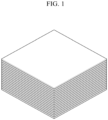
- FIG. 1 illustrates a schematic view of the electrical steel sheet laminate according to an exemplary embodiment of the present disclosure. As illustrated in FIG. 1 , the plurality of electrical steel sheets are stacked.
- FIG. 2 illustrates a schematic view of a cross section of the electrical steel sheet laminate according to an exemplary embodiment of the present disclosure.
- an electrical steel sheet laminate 100 according to an exemplary embodiment of the present disclosure includes a plurality of electrical steel sheets 10 and a fusion layer 20 located between the plurality of electrical steel sheets.
- the electrical steel sheet laminate according to an exemplary embodiment of the present disclosure may be a laminate in which different electrical steel sheets are heat-fused by simply forming a fusion layer using the adhesive coating composition described above without using the existing method such as welding, clamping, or interlocking.
- the electrical steel sheet laminate has excellent high-temperature adhesion and high-temperature oil resistance even after heat fusion.
- the electrical steel sheet 10 a general non-oriented or oriented electrical steel sheet may be used without limitation.
- the main configuration is to manufacture the electrical steel sheet laminate 100 by forming the fusion layer 20 between the plurality of electrical steel sheets 10, a detailed description of the electrical steel sheet 10 will be omitted.
- the fusion layer 20 is formed between the plurality of electrical steel sheets 10, and has strong adhesive strength so that the plurality of electrical steel sheets 10 may be adhered together without using the existing method such as welding, clamping, or interlocking.
- the fusion layer 20 is formed by coating the adhesive coating composition to the surface of the electrical steel sheet and curing the adhesive coating composition to form an adhesive coating layer, stacking the electrical steel sheets, and performing heat fusion.
- the resin components in the adhesive coating layer is heat-fused to form a fusion layer.
- the fusion layer 20 contains a polyurethane resin and an inorganic pigment. Since the polyurethane resin and the inorganic pigment have been described in detail above in relation to the adhesive coating composition, redundant descriptions will be omitted. During the process of forming the fusion layer, the polyurethane resin and the inorganic pigment remain as they are. In addition, the coupling agent, the curing agent, the curing catalyst, and the wetting additive also remain, and content ranges thereof may be the same as those of the adhesive coating composition. Since the coupling agent, the curing agent, the curing catalyst, and the wetting additive are described in detail above in relation to the adhesive coating composition, redundant descriptions will be omitted.
- the fusion layer may contain 100 parts by weight of a mixed resin, 0.5 parts by weight of a silane coupling agent, 0.1 parts by weight of a silicone-based wetting agent, 1 part by weight of a dicyandiamide-based curing agent, and 0.5 parts by weight of an imidazole-based curing catalyst.
- a thickness of the fusion layer 20 may be 5 ⁇ m to 20 ⁇ m. When the thickness of the fusion layer is too thin, the adhesive strength may decrease rapidly, and when the thickness of the fusion layer is too thick, defects due to sticky properties after coating winding become a problem. More specifically, the thickness of the fusion layer 20 may be 7 ⁇ m to 15 ⁇ m.
- a method for manufacturing an electrical steel sheet laminate according to an exemplary of the present disclosure includes applying an adhesive coating composition to one surface or both surfaces of an electrical steel sheet and then curing the adhesive coating composition to form an adhesive coating layer; and stacking a plurality of electrical steel sheets in which the adhesive coating layer is formed and performing heat fusion to form a fusion layer.
- an adhesive coating composition is prepared. Since the adhesive coating composition is described above, a redundant description will be omitted.
- the adhesive coating composition is coated to a surface of an electrical steel sheet and then cured to form an adhesive coating layer.
- This step may be performed at a temperature range of 150 to 250°C to cure the adhesive coating composition.
- a plurality of electrical steel sheets in which the adhesive coating layer is formed are stacked and heat-fused to form a fusion layer 20.
- the polymer components in the adhesive coating layer are heat-fused and form a fusion layer.
- the heat fusion step may be performed under pressurization conditions of a temperature of 150 to 250°C and a pressure of 0.05 to 5.0 MPa for 0.1 to 120 minutes.
- the above conditions may be satisfied independently, and two or more conditions may be satisfied simultaneously.
- the temperature, pressure, and time conditions are controlled in the heat fusion step, such that the electrical steel sheets may be heat-fused densely without gaps or organic phases.
- a non-oriented electrical steel sheet (80 ⁇ 250 mm, 0.35 mmt) was prepared as a blank specimen.
- An adhesive coating solution was applied to an upper portion and a lower portion of each prepared blank specimen at a certain thickness using a bar coater and a roll coater, cured at 200°C based on a plate temperature for 20 seconds, and then slowly cooled in the air to form an adhesive coating layer.
- the content ratios of the polyurethane resin and barium sulfate (Ba 2 SO 4 ) used, and the types and content ratios of the isocyanate monomer and polyol used are as shown in Table 1.
- a silane coupling agent, a silicone-based wetting agent, a dicyandiamide-based curing agent, and an imidazole-based curing catalyst were contained in amounts of 0.5 parts by weight, 0.1 parts by weight, 1 part by weight, and 0.5 parts by weight, respectively, with respect to 100 parts by weight of the polyurethane resin.
- MDI represents methylene diphenyl diisocyanate
- TDI represents toluene diisocyanate
- PPG represents polypropylene glycol (number molecular weight of 425 g/mol).
- the electrical steel sheets coated with the adhesive coating layer were stacked to a height of 20 mm, pressurized with a force of 1.0 MPa, and then heat-fused at 160°C for 10 minutes to manufacture an electrical steel sheet laminate.
- a thickness of the fusion layer after heat fusion was about 10 ⁇ m.
- the heat-fused laminate was evaluated according to the content ratios of the polyurethane resin and barium sulfate in the coating composition and the type of aromatic diisocyanate monomer used. Specifically, the coating adhesion, peeling adhesive strength (T-peel, N/mm), ATF resistance, and interlayer insulation were evaluated and shown in Table 1.
- the measurement method for each property is as follows.
- Coating adhesion measurement method A specimen standard for measuring coating adhesion was prepared in accordance with ISO 1519. The coated specimen was prepared as a sample of 30 ⁇ 300 mm, the sample was bent at 180° on an iron cylinder having a diameter of 10 mm, a tape was attached to the portion, and then it was visually observed whether the coating layer was peeled off. A case where peeling was observed was evaluated as NG, and a case where peeling was not observed was determined as OK.
- Peeling adhesive strength (T-peel, N/mm): A specimen standard for peeling method (T-peel off) measurement was prepared in accordance with ISO 11339. Two sheets of a specimen of 25 ⁇ 200 mm were adhered with an area of 25 ⁇ 150 mm 2 , and then a non-adhesive region was bent at 90° to prepare a T-shaped tensile specimen. The specimen prepared by the peeling method (T-peel off) was fixed to upper and lower jigs with a certain force, and then peeling adhesive strength was measured using a device for measuring a tensile force of the stacked sample while pulling the specimen at a certain speed.
- the measured value was measured at a point at which an interface having a minimum adhesive strength in the interface of the stacked sample was released.
- the temperature of the specimen was maintained at 60°C using a heating device, and then the adhesive strength was measured.
- ATF resistance evaluation method In a case where a drive motor is used in an automobile, a lot of heat is generated when the drive motor rotates at a high speed for a long time, and automotive transmission fluid (ATF) is used to cool the drive motor. Therefore, in order to secure adhesion reliability during long-term use, it is important that the adhesive strength of the stacked coil is maintained while being impregnated with high-temperature ATF. Accordingly, the ATF resistance was evaluated. The manufactured stacked coil was immersed in the ATF at a temperature of 150°C for 500 hours and then tested for shear adhesive strength. The shear adhesive strength for measuring the ATF resistance was measured by a shear strength method. A specimen standard for the shear strength method measurement was prepared in accordance with ISO 4587.
- Two sheets of a specimen of 25 ⁇ 100 mm were adhered with an area of 12.5 ⁇ 25 mm 2 and then heat-fused under the above conditions to prepare a specimen for a shear strength method.
- the specimen prepared by the shear strength method was fixed to upper and lower jigs with a certain force, and then ATF resistance was measured using a device for measuring a tensile force of the stacked sample while pulling the specimen at a certain speed. At this time, in the case of the shear strength method, the measured value was measured at a point at which an interface having a minimum adhesive strength in the interface of the stacked sample was released.
- Comparative Example 1 in which only the polyurethane resin was used without mixing barium sulfate (Ba 2 SO 4 ), it was confirmed that the coating adhesion and peeling adhesive strength were excellent, but the value of the interlayer insulation was less than 50 ⁇ cm 2 /lam., which showed that the interlayer insulation was inferior to the high insulation quality required for a generator and an industrial motor, and the ATF resistance was inferior to those of Examples.
- an adhesive coating layer was prepared by changing the aromatic diisocyanate monomer to a compound other than 2,4-methylene diphenyl diisocyanate (2,4'-MDI).
Landscapes
- Chemical & Material Sciences (AREA)
- Organic Chemistry (AREA)
- Health & Medical Sciences (AREA)
- Polymers & Plastics (AREA)
- Medicinal Chemistry (AREA)
- Chemical Kinetics & Catalysis (AREA)
- Wood Science & Technology (AREA)
- Life Sciences & Earth Sciences (AREA)
- Materials Engineering (AREA)
- Engineering & Computer Science (AREA)
- Inorganic Chemistry (AREA)
- Laminated Bodies (AREA)
- Adhesives Or Adhesive Processes (AREA)
- Soft Magnetic Materials (AREA)
- Chemical Treatment Of Metals (AREA)
- Manufacturing Of Steel Electrode Plates (AREA)
- Paints Or Removers (AREA)
Applications Claiming Priority (2)
| Application Number | Priority Date | Filing Date | Title |
|---|---|---|---|
| KR1020210181911A KR20230092483A (ko) | 2021-12-17 | 2021-12-17 | 전기강판 접착 코팅 조성물, 전기강판 적층체 및 이의 제조 방법 |
| PCT/KR2022/020650 WO2023113562A1 (ko) | 2021-12-17 | 2022-12-16 | 전기강판 접착 코팅 조성물, 전기강판 적층체 및 이의 제조 방법 |
Publications (2)
| Publication Number | Publication Date |
|---|---|
| EP4450583A1 true EP4450583A1 (de) | 2024-10-23 |
| EP4450583A4 EP4450583A4 (de) | 2025-03-26 |
Family
ID=86773192
Family Applications (1)
| Application Number | Title | Priority Date | Filing Date |
|---|---|---|---|
| EP22908027.0A Pending EP4450583A4 (de) | 2021-12-17 | 2022-12-16 | Haftbeschichtungszusammensetzung für elektrostahlblech, elektrostahlblechlaminat und verfahren zur herstellung eines elektrostahlblechprodukts |
Country Status (8)
| Country | Link |
|---|---|
| US (1) | US20250051622A1 (de) |
| EP (1) | EP4450583A4 (de) |
| JP (1) | JP7812926B2 (de) |
| KR (1) | KR20230092483A (de) |
| CN (1) | CN118414398A (de) |
| CA (1) | CA3243059A1 (de) |
| MX (1) | MX2024007514A (de) |
| WO (1) | WO2023113562A1 (de) |
Family Cites Families (17)
| Publication number | Priority date | Publication date | Assignee | Title |
|---|---|---|---|---|
| JP3117846B2 (ja) * | 1993-07-26 | 2000-12-18 | 新日本製鐵株式会社 | 皮膜特性の優れる無方向性電磁鋼板及びその鋼板用表面処理剤 |
| JP2791455B2 (ja) * | 1993-12-22 | 1998-08-27 | 株式会社神戸製鋼所 | 打ち抜き加工性にすぐれる樹脂塗装金属板 |
| JPH07336969A (ja) * | 1994-06-09 | 1995-12-22 | Nkk Corp | 接着鉄心用電磁鋼板およびその製造方法 |
| DE10150722A1 (de) * | 2001-10-13 | 2003-04-30 | Henkel Kgaa | Reaktive Polyurethan-Zusammensetzungen mit niedrigem Restmonomergehalt |
| EP1770107A1 (de) * | 2005-09-30 | 2007-04-04 | Sika Technology AG | Feuchtigkeitshärtende Polyurethanzusammensetzung |
| JP4562753B2 (ja) * | 2007-06-28 | 2010-10-13 | 住化バイエルウレタン株式会社 | 屋内外施設用常温硬化性表面仕上げ材 |
| JP4784715B2 (ja) * | 2009-12-10 | 2011-10-05 | Dic株式会社 | ウレタン樹脂組成物、コーティング剤及び接着剤、ならびにそれを用いて得られる硬化物及び硬化物の製造方法 |
| JP5062502B2 (ja) * | 2011-02-16 | 2012-10-31 | Dic株式会社 | 水性ウレタン樹脂組成物、それを含むコーティング剤、接着剤、インクジェット印刷インク用バインダー、インクジェット印刷用インク及び印刷物 |
| KR101797129B1 (ko) * | 2015-12-21 | 2017-11-13 | 주식회사 포스코 | 무방향성 전기강판 접착 코팅 조성물, 무방향성 전기강판 제품, 및 이의 제조 방법 |
| KR102077485B1 (ko) * | 2016-03-25 | 2020-02-17 | 디아이씨 가부시끼가이샤 | 우레탄 수지 조성물, 코팅제 및 물품 |
| JP6368733B2 (ja) * | 2016-03-31 | 2018-08-01 | Jfeスチール株式会社 | 耐熱接着性絶縁被膜用組成物および絶縁被膜付き電磁鋼板 |
| JP6404977B2 (ja) * | 2016-03-31 | 2018-10-17 | Jfeスチール株式会社 | 耐熱接着性絶縁被膜用組成物および絶縁被膜付き電磁鋼板 |
| KR102010256B1 (ko) * | 2016-05-24 | 2019-08-13 | 주식회사 아모그린텍 | 코일부품 |
| CN108610934B (zh) * | 2017-01-18 | 2021-05-25 | 河北强凌防水材料集团有限公司 | 单组份聚氨酯防水涂料及其制备方法和用于制备该单组份聚氨酯防水涂料的组合物 |
| JP6344877B1 (ja) * | 2017-10-26 | 2018-06-20 | 太陽精機株式会社 | 湿気硬化性ポリウレタンホットメルト接着剤及びその製造方法 |
| KR102176342B1 (ko) * | 2018-09-28 | 2020-11-09 | 주식회사 포스코 | 전기강판 제품의 제조 방법 |
| KR102513318B1 (ko) * | 2020-12-22 | 2023-03-22 | 주식회사 포스코 | 전기강판 및 이의 적층체 |
-
2021
- 2021-12-17 KR KR1020210181911A patent/KR20230092483A/ko active Pending
-
2022
- 2022-12-16 CN CN202280083210.4A patent/CN118414398A/zh active Pending
- 2022-12-16 WO PCT/KR2022/020650 patent/WO2023113562A1/ko not_active Ceased
- 2022-12-16 US US18/719,879 patent/US20250051622A1/en active Pending
- 2022-12-16 CA CA3243059A patent/CA3243059A1/en active Pending
- 2022-12-16 EP EP22908027.0A patent/EP4450583A4/de active Pending
- 2022-12-16 MX MX2024007514A patent/MX2024007514A/es unknown
- 2022-12-16 JP JP2024536315A patent/JP7812926B2/ja active Active
Also Published As
| Publication number | Publication date |
|---|---|
| US20250051622A1 (en) | 2025-02-13 |
| JP7812926B2 (ja) | 2026-02-10 |
| EP4450583A4 (de) | 2025-03-26 |
| WO2023113562A1 (ko) | 2023-06-22 |
| MX2024007514A (es) | 2024-07-04 |
| CA3243059A1 (en) | 2025-02-26 |
| KR20230092483A (ko) | 2023-06-26 |
| CN118414398A (zh) | 2024-07-30 |
| JP2025500285A (ja) | 2025-01-09 |
Similar Documents
| Publication | Publication Date | Title |
|---|---|---|
| JP7704865B2 (ja) | 電磁鋼板接着コーティング組成物、電磁鋼板積層体およびその製造方法 | |
| EP4269515A1 (de) | Elektrisches stahlblech und elektrisches stahlblechlaminat | |
| JP7701979B2 (ja) | 電磁鋼板接着コーティング組成物、電磁鋼板積層体およびその製造方法 | |
| JP7701978B2 (ja) | 電磁鋼板接着コーティング組成物、電磁鋼板積層体およびその製造方法 | |
| EP4450583A1 (de) | Haftbeschichtungszusammensetzung für elektrostahlblech, elektrostahlblechlaminat und verfahren zur herstellung eines elektrostahlblechprodukts | |
| EP4265698A1 (de) | Elektrisches stahlblech und laminat daraus | |
| EP4450582A1 (de) | Haftbeschichtungszusammensetzung für elektrostahlblech, elektrostahlblechlaminat und verfahren zur herstellung davon | |
| EP4640782A1 (de) | Haftbeschichtungszusammensetzung für elektrostahlblech, elektrostahlblechlaminat und verfahren zur herstellung davon | |
| KR20250092778A (ko) | 전기강판 접착 코팅 조성물, 전기강판 적층체 및 이의 제조 방법 |
Legal Events
| Date | Code | Title | Description |
|---|---|---|---|
| STAA | Information on the status of an ep patent application or granted ep patent |
Free format text: STATUS: THE INTERNATIONAL PUBLICATION HAS BEEN MADE |
|
| PUAI | Public reference made under article 153(3) epc to a published international application that has entered the european phase |
Free format text: ORIGINAL CODE: 0009012 |
|
| STAA | Information on the status of an ep patent application or granted ep patent |
Free format text: STATUS: REQUEST FOR EXAMINATION WAS MADE |
|
| 17P | Request for examination filed |
Effective date: 20240704 |
|
| AK | Designated contracting states |
Kind code of ref document: A1 Designated state(s): AL AT BE BG CH CY CZ DE DK EE ES FI FR GB GR HR HU IE IS IT LI LT LU LV MC ME MK MT NL NO PL PT RO RS SE SI SK SM TR |
|
| A4 | Supplementary search report drawn up and despatched |
Effective date: 20250221 |
|
| DAV | Request for validation of the european patent (deleted) | ||
| DAX | Request for extension of the european patent (deleted) | ||
| RIC1 | Information provided on ipc code assigned before grant |
Ipc: C09J 175/08 20060101ALI20250217BHEP Ipc: C09D 175/08 20060101ALI20250217BHEP Ipc: C08K 3/30 20060101ALI20250217BHEP Ipc: C08G 18/48 20060101ALI20250217BHEP Ipc: B32B 15/01 20060101ALI20250217BHEP Ipc: B32B 7/12 20060101ALI20250217BHEP Ipc: C08G 18/76 20060101ALI20250217BHEP Ipc: C09J 11/04 20060101ALI20250217BHEP Ipc: C09J 175/04 20060101AFI20250217BHEP |