EP4449979A2 - Vorrichtungen, systeme und verfahren zur verwendung und überwachung von implantaten - Google Patents
Vorrichtungen, systeme und verfahren zur verwendung und überwachung von implantaten Download PDFInfo
- Publication number
- EP4449979A2 EP4449979A2 EP24198731.2A EP24198731A EP4449979A2 EP 4449979 A2 EP4449979 A2 EP 4449979A2 EP 24198731 A EP24198731 A EP 24198731A EP 4449979 A2 EP4449979 A2 EP 4449979A2
- Authority
- EP
- European Patent Office
- Prior art keywords
- implant
- sensors
- data
- sensor
- implants
- Prior art date
- Legal status (The legal status is an assumption and is not a legal conclusion. Google has not performed a legal analysis and makes no representation as to the accuracy of the status listed.)
- Pending
Links
Images



Classifications
-
- A—HUMAN NECESSITIES
- A61—MEDICAL OR VETERINARY SCIENCE; HYGIENE
- A61B—DIAGNOSIS; SURGERY; IDENTIFICATION
- A61B5/00—Measuring for diagnostic purposes; Identification of persons
- A61B5/0002—Remote monitoring of patients using telemetry, e.g. transmission of vital signals via a communication network
- A61B5/0031—Implanted circuitry
-
- A—HUMAN NECESSITIES
- A61—MEDICAL OR VETERINARY SCIENCE; HYGIENE
- A61B—DIAGNOSIS; SURGERY; IDENTIFICATION
- A61B5/00—Measuring for diagnostic purposes; Identification of persons
- A61B5/01—Measuring temperature of body parts ; Diagnostic temperature sensing, e.g. for malignant or inflamed tissue
-
- A—HUMAN NECESSITIES
- A61—MEDICAL OR VETERINARY SCIENCE; HYGIENE
- A61B—DIAGNOSIS; SURGERY; IDENTIFICATION
- A61B5/00—Measuring for diagnostic purposes; Identification of persons
- A61B5/06—Devices, other than using radiation, for detecting or locating foreign bodies ; Determining position of diagnostic devices within or on the body of the patient
- A61B5/065—Determining position of the probe employing exclusively positioning means located on or in the probe, e.g. using position sensors arranged on the probe
- A61B5/067—Determining position of the probe employing exclusively positioning means located on or in the probe, e.g. using position sensors arranged on the probe using accelerometers or gyroscopes
-
- A—HUMAN NECESSITIES
- A61—MEDICAL OR VETERINARY SCIENCE; HYGIENE
- A61B—DIAGNOSIS; SURGERY; IDENTIFICATION
- A61B5/00—Measuring for diagnostic purposes; Identification of persons
- A61B5/43—Detecting, measuring or recording for evaluating the reproductive systems
- A61B5/4306—Detecting, measuring or recording for evaluating the reproductive systems for evaluating the female reproductive systems, e.g. gynaecological evaluations
- A61B5/4312—Breast evaluation or disorder diagnosis
-
- A—HUMAN NECESSITIES
- A61—MEDICAL OR VETERINARY SCIENCE; HYGIENE
- A61B—DIAGNOSIS; SURGERY; IDENTIFICATION
- A61B5/00—Measuring for diagnostic purposes; Identification of persons
- A61B5/48—Other medical applications
- A61B5/4851—Prosthesis assessment or monitoring
-
- A—HUMAN NECESSITIES
- A61—MEDICAL OR VETERINARY SCIENCE; HYGIENE
- A61B—DIAGNOSIS; SURGERY; IDENTIFICATION
- A61B5/00—Measuring for diagnostic purposes; Identification of persons
- A61B5/48—Other medical applications
- A61B5/4866—Evaluating metabolism
-
- A—HUMAN NECESSITIES
- A61—MEDICAL OR VETERINARY SCIENCE; HYGIENE
- A61B—DIAGNOSIS; SURGERY; IDENTIFICATION
- A61B5/00—Measuring for diagnostic purposes; Identification of persons
- A61B5/68—Arrangements of detecting, measuring or recording means, e.g. sensors, in relation to patient
- A61B5/6846—Arrangements of detecting, measuring or recording means, e.g. sensors, in relation to patient specially adapted to be brought in contact with an internal body part, i.e. invasive
- A61B5/6847—Arrangements of detecting, measuring or recording means, e.g. sensors, in relation to patient specially adapted to be brought in contact with an internal body part, i.e. invasive mounted on an invasive device
- A61B5/686—Permanently implanted devices, e.g. pacemakers, other stimulators, biochips
-
- A—HUMAN NECESSITIES
- A61—MEDICAL OR VETERINARY SCIENCE; HYGIENE
- A61B—DIAGNOSIS; SURGERY; IDENTIFICATION
- A61B5/00—Measuring for diagnostic purposes; Identification of persons
- A61B5/68—Arrangements of detecting, measuring or recording means, e.g. sensors, in relation to patient
- A61B5/6846—Arrangements of detecting, measuring or recording means, e.g. sensors, in relation to patient specially adapted to be brought in contact with an internal body part, i.e. invasive
- A61B5/6885—Monitoring or controlling sensor contact pressure
-
- A—HUMAN NECESSITIES
- A61—MEDICAL OR VETERINARY SCIENCE; HYGIENE
- A61F—FILTERS IMPLANTABLE INTO BLOOD VESSELS; PROSTHESES; DEVICES PROVIDING PATENCY TO, OR PREVENTING COLLAPSING OF, TUBULAR STRUCTURES OF THE BODY, e.g. STENTS; ORTHOPAEDIC, NURSING OR CONTRACEPTIVE DEVICES; FOMENTATION; TREATMENT OR PROTECTION OF EYES OR EARS; BANDAGES, DRESSINGS OR ABSORBENT PADS; FIRST-AID KITS
- A61F2/00—Filters implantable into blood vessels; Prostheses, i.e. artificial substitutes or replacements for parts of the body; Appliances for connecting them with the body; Devices providing patency to, or preventing collapsing of, tubular structures of the body, e.g. stents
- A61F2/0059—Cosmetic or alloplastic implants
-
- A—HUMAN NECESSITIES
- A61—MEDICAL OR VETERINARY SCIENCE; HYGIENE
- A61F—FILTERS IMPLANTABLE INTO BLOOD VESSELS; PROSTHESES; DEVICES PROVIDING PATENCY TO, OR PREVENTING COLLAPSING OF, TUBULAR STRUCTURES OF THE BODY, e.g. STENTS; ORTHOPAEDIC, NURSING OR CONTRACEPTIVE DEVICES; FOMENTATION; TREATMENT OR PROTECTION OF EYES OR EARS; BANDAGES, DRESSINGS OR ABSORBENT PADS; FIRST-AID KITS
- A61F2/00—Filters implantable into blood vessels; Prostheses, i.e. artificial substitutes or replacements for parts of the body; Appliances for connecting them with the body; Devices providing patency to, or preventing collapsing of, tubular structures of the body, e.g. stents
- A61F2/02—Prostheses implantable into the body
-
- A—HUMAN NECESSITIES
- A61—MEDICAL OR VETERINARY SCIENCE; HYGIENE
- A61F—FILTERS IMPLANTABLE INTO BLOOD VESSELS; PROSTHESES; DEVICES PROVIDING PATENCY TO, OR PREVENTING COLLAPSING OF, TUBULAR STRUCTURES OF THE BODY, e.g. STENTS; ORTHOPAEDIC, NURSING OR CONTRACEPTIVE DEVICES; FOMENTATION; TREATMENT OR PROTECTION OF EYES OR EARS; BANDAGES, DRESSINGS OR ABSORBENT PADS; FIRST-AID KITS
- A61F2/00—Filters implantable into blood vessels; Prostheses, i.e. artificial substitutes or replacements for parts of the body; Appliances for connecting them with the body; Devices providing patency to, or preventing collapsing of, tubular structures of the body, e.g. stents
- A61F2/02—Prostheses implantable into the body
- A61F2/08—Muscles; Tendons; Ligaments
-
- A—HUMAN NECESSITIES
- A61—MEDICAL OR VETERINARY SCIENCE; HYGIENE
- A61F—FILTERS IMPLANTABLE INTO BLOOD VESSELS; PROSTHESES; DEVICES PROVIDING PATENCY TO, OR PREVENTING COLLAPSING OF, TUBULAR STRUCTURES OF THE BODY, e.g. STENTS; ORTHOPAEDIC, NURSING OR CONTRACEPTIVE DEVICES; FOMENTATION; TREATMENT OR PROTECTION OF EYES OR EARS; BANDAGES, DRESSINGS OR ABSORBENT PADS; FIRST-AID KITS
- A61F2/00—Filters implantable into blood vessels; Prostheses, i.e. artificial substitutes or replacements for parts of the body; Appliances for connecting them with the body; Devices providing patency to, or preventing collapsing of, tubular structures of the body, e.g. stents
- A61F2/02—Prostheses implantable into the body
- A61F2/12—Mammary prostheses
-
- A—HUMAN NECESSITIES
- A61—MEDICAL OR VETERINARY SCIENCE; HYGIENE
- A61F—FILTERS IMPLANTABLE INTO BLOOD VESSELS; PROSTHESES; DEVICES PROVIDING PATENCY TO, OR PREVENTING COLLAPSING OF, TUBULAR STRUCTURES OF THE BODY, e.g. STENTS; ORTHOPAEDIC, NURSING OR CONTRACEPTIVE DEVICES; FOMENTATION; TREATMENT OR PROTECTION OF EYES OR EARS; BANDAGES, DRESSINGS OR ABSORBENT PADS; FIRST-AID KITS
- A61F2/00—Filters implantable into blood vessels; Prostheses, i.e. artificial substitutes or replacements for parts of the body; Appliances for connecting them with the body; Devices providing patency to, or preventing collapsing of, tubular structures of the body, e.g. stents
- A61F2/02—Prostheses implantable into the body
- A61F2/18—Internal ear or nose parts, e.g. ear-drums
- A61F2/186—Nose parts
-
- A—HUMAN NECESSITIES
- A61—MEDICAL OR VETERINARY SCIENCE; HYGIENE
- A61F—FILTERS IMPLANTABLE INTO BLOOD VESSELS; PROSTHESES; DEVICES PROVIDING PATENCY TO, OR PREVENTING COLLAPSING OF, TUBULAR STRUCTURES OF THE BODY, e.g. STENTS; ORTHOPAEDIC, NURSING OR CONTRACEPTIVE DEVICES; FOMENTATION; TREATMENT OR PROTECTION OF EYES OR EARS; BANDAGES, DRESSINGS OR ABSORBENT PADS; FIRST-AID KITS
- A61F2/00—Filters implantable into blood vessels; Prostheses, i.e. artificial substitutes or replacements for parts of the body; Appliances for connecting them with the body; Devices providing patency to, or preventing collapsing of, tubular structures of the body, e.g. stents
- A61F2/02—Prostheses implantable into the body
- A61F2/08—Muscles; Tendons; Ligaments
- A61F2002/0894—Muscles
-
- A—HUMAN NECESSITIES
- A61—MEDICAL OR VETERINARY SCIENCE; HYGIENE
- A61F—FILTERS IMPLANTABLE INTO BLOOD VESSELS; PROSTHESES; DEVICES PROVIDING PATENCY TO, OR PREVENTING COLLAPSING OF, TUBULAR STRUCTURES OF THE BODY, e.g. STENTS; ORTHOPAEDIC, NURSING OR CONTRACEPTIVE DEVICES; FOMENTATION; TREATMENT OR PROTECTION OF EYES OR EARS; BANDAGES, DRESSINGS OR ABSORBENT PADS; FIRST-AID KITS
- A61F2/00—Filters implantable into blood vessels; Prostheses, i.e. artificial substitutes or replacements for parts of the body; Appliances for connecting them with the body; Devices providing patency to, or preventing collapsing of, tubular structures of the body, e.g. stents
- A61F2/02—Prostheses implantable into the body
- A61F2/28—Bones
- A61F2/2803—Bones for mandibular reconstruction
- A61F2002/2807—Chin implants
-
- A—HUMAN NECESSITIES
- A61—MEDICAL OR VETERINARY SCIENCE; HYGIENE
- A61F—FILTERS IMPLANTABLE INTO BLOOD VESSELS; PROSTHESES; DEVICES PROVIDING PATENCY TO, OR PREVENTING COLLAPSING OF, TUBULAR STRUCTURES OF THE BODY, e.g. STENTS; ORTHOPAEDIC, NURSING OR CONTRACEPTIVE DEVICES; FOMENTATION; TREATMENT OR PROTECTION OF EYES OR EARS; BANDAGES, DRESSINGS OR ABSORBENT PADS; FIRST-AID KITS
- A61F2250/00—Special features of prostheses classified in groups A61F2/00 - A61F2/26 or A61F2/82 or A61F9/00 or A61F11/00 or subgroups thereof
- A61F2250/0001—Means for transferring electromagnetic energy to implants
- A61F2250/0002—Means for transferring electromagnetic energy to implants for data transfer
-
- A—HUMAN NECESSITIES
- A61—MEDICAL OR VETERINARY SCIENCE; HYGIENE
- A61F—FILTERS IMPLANTABLE INTO BLOOD VESSELS; PROSTHESES; DEVICES PROVIDING PATENCY TO, OR PREVENTING COLLAPSING OF, TUBULAR STRUCTURES OF THE BODY, e.g. STENTS; ORTHOPAEDIC, NURSING OR CONTRACEPTIVE DEVICES; FOMENTATION; TREATMENT OR PROTECTION OF EYES OR EARS; BANDAGES, DRESSINGS OR ABSORBENT PADS; FIRST-AID KITS
- A61F2250/00—Special features of prostheses classified in groups A61F2/00 - A61F2/26 or A61F2/82 or A61F9/00 or A61F11/00 or subgroups thereof
- A61F2250/0058—Additional features; Implant or prostheses properties not otherwise provided for
- A61F2250/0096—Markers and sensors for detecting a position or changes of a position of an implant, e.g. RF sensors, ultrasound markers
Definitions
- the present invention relates generally to implants, and more specifically, to devices and methods for monitoring the placement, efficacy, and performance of implants, including for example, aesthetic implants.
- Implantable prosthesis have been utilized to augment or replace tissue in humans for over a century.
- the first recorded description of a breast implant was by Vincenz Czerny in 1895, who moved a benign lipoma into a breast during reconstruction surgery in order to avoid asymmetry in the breast.
- injectables e.g., injection of paraffin wax, liquid silicone
- other materials e.g., sponges and various plastics
- injectables e.g., injection of paraffin wax, liquid silicone
- other materials e.g., sponges and various plastics
- implants have been utilized in a wide variety of aesthetic applications, including for example, facial (e.g., lips, chin, nasal, nasal/labial fold and malar implants), penile, and body contouring (e.g., breast, pectoral, calf, buttocks, abdomen and biceps/triceps) implants.
- facial e.g., lips, chin, nasal, nasal/labial fold and malar implants
- penile e.g., a wide variety of aesthetic applications
- body contouring e.g., breast, pectoral, calf, buttocks, abdomen and biceps/triceps
- the surgeon may wish to confirm correct anatomical alignment of the implant, symmetry with the implant on the contralateral side, and/or any motion between the implant and the surrounding tissue so that adjustments can be made during the procedure.
- Post-procedure the patient may experience a large number of complications, including implant leakage or rupture, capsular contraction (i.e., the build-up of fibrous scar tissue around the implant, causing a contracture - hardening around the implant and apparent shrinkage of the implant itself), seromas and hematomas, inflammation, infection and pain.
- Over 20% of breast augmentations and 50% of breast reconstructions will require explanation within 10 years for one or more of the above complications.
- the present invention discloses novel implants which overcome many of the difficulties of previous implants, methods for constructing and monitoring these novel implants, and further provides other related advantages.
- implants also sometimes referred to as 'devices' or ⁇ medical devices'
- implants comprising an implant along with one or more sensors to monitor the integrity, position and efficaciousness of the implant.
- the sensors may be positioned on the inside of the implant, within the body of the implant, or on the outer surface (or surfaces) of the implant, and/or between the implant and any device that might be utilized to deliver the implant (e.g., another implant, catheter, tunneling catheter, endoscope, balloon implant, or other medical device).
- the sensors are of the type that are passive and thus do not require their own power supply.
- sensors suitable for use within the present invention include accelerometers (acceleration, tilt, vibration, shock and rotation sensors), pressure sensors, contact sensors, position sensors, chemical sensors, tissue metabolic sensors, mechanical stress sensors and temperature sensors.
- the sensor is a wireless sensor, or a sensor connected to a wireless microprocessor.
- the implant or delivery device can have more than one type of the above-noted sensors.
- sensors are placed at different locations in the implant in order to monitor the operation, movement, medical imaging (both of the implant and the surrounding tissues), function, wear, performance, potential side effects, medical status of the patient and the medical status of the implant and its interface with the live tissue of the patient.
- Live, continuous, in situ, monitoring of patient activity, patient function, implant activity, implant function, implant performance, implant placement, implant forces and mechanical stresses, implant and surrounding tissue anatomy (imaging), mechanical and physical integrity of the implant, and potential local and systemic side effects is provided.
- information is available on many aspects of the implant and its interaction with the patient's own body tissues, including clinically important measurements not currently available through physical examination, medical imaging and diagnostic medical studies.
- the sensors provide evaluation data of any motion or movement of the implant.
- Motion sensors and accelerometers can be used to accurately determine the movement of the implant during surgical placement, during medical and physical examination post-operatively and during normal daily activities after the patient returns home.
- the implant can contain sensors at specified densities in specific locations.
- the implant can have a density of sensors of greater than one, two, three, four, five, six, seven, eight, nine, or ten sensors (e.g., accelerometers (acceleration, tilt, vibration, shock and rotation sensors), pressure sensors, contact sensors, position sensors, chemical sensors, tissue metabolic sensors, mechanical stress sensors and temperature sensors, or any combination of these) per square centimeter of the device/implant.
- the implant can have a density of sensors of greater than one, two, three, four, five, six, seven, eight, nine, or ten sensors (e.g., accelerometers (acceleration, tilt, vibration, shock and rotation sensors), pressure sensors, contact sensors, position sensors, chemical sensors, tissue metabolic sensors, mechanical stress sensors and temperature sensors, or any combination of these) per cubic centimeter of the device.
- sensors e.g., accelerometers (acceleration, tilt, vibration, shock and rotation sensors), pressure sensors, contact sensors, position sensors, chemical sensors, tissue metabolic sensors, mechanical stress sensors and temperature sensors, or any combination of these) per cubic centimeter of the device.
- the implant is provided with a specific unique identifying number, and within further embodiments, each of the sensors on, in or around the implant each have either a specific unique identification number, or a group identification number (e.g., an identification number that identifies the sensor as accelerometers (acceleration, tilt, vibration, shock and rotation sensors), pressure sensors, contact sensors, position sensors, chemical sensors, tissue metabolic sensors, mechanical stress sensors and temperature sensors).
- a specific unique identification number or group identification number is specifically associated with a position on, in or around the implant.
- methods for monitoring an implant comprising the steps of transmitting a wireless electrical signal from a location outside the body to a location inside the body; receiving the signal at a sensor positioned on, in or around an implant located inside the body; powering the sensor using the received signal; sensing data at the sensor; and outputting the sensed data from the sensor to a receiving unit located outside of the body.
- methods for imaging an implant as provided herein, comprising the steps of (a) detecting the location of one or more sensors in the implant, associated medical and/or associated medical delivery device or surgical tool; and (b) visually displaying the relative anatomical location (either surface or radiographic landmarks) of said one or more sensors, such that an image of the implant is created.
- the step of detecting may be done over time, and the visual display may thus show relative positional movement of the sensors and implant over time.
- the image which is displayed is a three-dimensional image.
- the imaging techniques provided herein may be utilized for a wide variety of purposes.
- the imaging techniques may be utilized during a surgical procedure in order to ensure proper anatomical placement, bilaterally symmetry and functioning of the implant.
- the imaging techniques may be utilized post-operatively in order to examine the implant, and/or to compare operation, integrity and/or movement of the device/implant over time.
- the integrity of the implant can be wirelessly interrogated and the results reported on a regular basis. This permits the health and status of the patient to be checked on a regular basis or at any time as desired by the patient and/or physician. Furthermore, the implant can be wirelessly interrogated when signaled by the patient to do so (via an external signaling/triggering device) as part of "event recording" - i.e. when the patient experiences a particular event (e.g. pain, injury, instability, etc.) she/he signals/triggers the device/implant to obtain a simultaneous reading in order to allow the comparison of subjective/symptomatic data to objective/sensor data.
- a particular event e.g. pain, injury, instability, etc.
- Matching event recording data with sensor data can be used as part of an effort to better understand the underlying cause or specific triggers of a patient's particular symptoms.
- methods are provided for detecting and/or recording an event in a subject with one of the implants provided herein, comprising the device/implant interrogation at a desired point in time.
- methods are provided for detecting and/or recording an event in a subject with the implant as provided herein, comprising the step of interrogating at a desired point in time the activity of one or more sensors within the implant, and recording said activity.
- interrogation may be accomplished by the subject and/or by a health care professional.
- the step of recording may be performed with one or more wired devices, or, wireless devices that can be carried, or worn (e.g., a cellphone, watch or wristband, and/or glasses).
- each of the sensors contains a signal-receiving circuit and a signal output circuit.
- the signal-receiving circuit receives an interrogation signal that includes both power and data collection request components. Using the power from the interrogation signal, the sensor powers up the parts of the circuitry needed to conduct the sensing, carries out the sensing, and then outputs the data to the interrogation module.
- the interrogation module acts under control of a control unit which contains the appropriate I/O circuitry, memory, a controller in the form of a microprocessor, and other circuitry in order to drive the interrogation module.
- the sensors e.g., accelerometers (acceleration, tilt, vibration, shock and rotation sensors), pressure sensors, contact sensors, position sensors, chemical sensors, tissue metabolic sensors, mechanical stress sensors and temperature sensors are constructed such that they may readily be incorporated into, or otherwise mechanically attached to, the implant (e.g., by way of a an opening or other appendage that provides permanent attachment of the sensor to the implant) and/or readily incorporated into body of the implant.
- devices suitable for transmitting a wireless electrical signal from a location outside the body to a location inside the body; receiving the signal at one of the aforementioned sensors positioned on, in or around the implant located inside the body; powering the sensor using the received signal; sensing data at the sensor; and outputting the sensed data from the sensor to a receiving unit located outside of the body.
- the receiving unit can provide an analysis of the signal provided by the sensor.
- the data collected by the sensors can be stored in a memory located within the implant, or on an associated device (e.g., an associated medical device, or an external device such as a bra, cellphone, watch, wristband, and/or glasses.
- an associated device e.g., an associated medical device, or an external device such as a bra, cellphone, watch, wristband, and/or glasses.
- the data can be downloaded via a wireless sensor, and the doctor is able to obtain data representative of real-time performance of the implant, and any associated medical device (e.g., a support bra).
- the present invention provides a variety of implants that can be utilized to monitor the placement, performance, integrity and /or efficaciousness of the implant. Prior to setting forth the invention however, it may be helpful to an understanding thereof to first set forth definitions of certain terms that are used hereinafter.
- Implant refers to an artificial or synthetic prosthesis that has, or can be, implanted into a body. Implants are typically utilized to augment or replace a structure within the body, and have been utilized in a wide variety of aesthetic applications, including for example, for facial (e.g., lips, chin, nasal, nasal/labial fold and malar implants), penile, and body contouring (e.g., breast, pectoral, calf, buttocks, abdomen and biceps/triceps) implants.
- facial e.g., lips, chin, nasal, nasal/labial fold and malar implants
- penile e.g., penile, and body contouring implants.
- “Surrounding Implant” refers to an artificial or synthetic implant or implanted material that is placed into the implant pocket where the aesthetic implant will ultimately be inserted.
- a "pocket,” or surgically created anatomical space is first dissected into the tissue which will receive the aesthetic implant.
- a “surrounding implant” is typically a gel, adhesion barrier, hemostat, glue, and/or adhesive that is placed into the implant pocket such that it lies between the aesthetic implant and the host tissue (bags or other devices can placed around the aesthetic implant for the same purpose).
- the role of the "surrounding implant” is to prevent or minimize (at least initially) the contact between the aesthetic implant and the host tissue in an attempt to reduce scarring and capsular contraction.
- Implants can be composed of a wide variety of materials, but utilizing breast implants as an example, they are typically comprised of an elastomeric outer surface or 'shell', and an interior 'filling'. With respect to the shell, silicone is the most commonly used elastomer, which may be either smooth, or textured. With respect to the filling, most implants are filled with either silicone, or saline (although other compositions have been suggested, including for example, peanut oil, sunflower oil, soy oil and polypropylene string).
- the implants may contain more than one internal filling (e.g., in different compartments), and may be coated (polymers, gels, drugs) and/or textured on the outer shell or provided with a bag in order to reduce the incidence of capsular contractions.
- implants can be provided in different sizes, and different shapes, and even customized to specific anatomical requirements.
- one implant can be delivered to one location in the breast (e.g., subfascially), and another implant delivered to a different location (e.g., subglandularly).
- Implant delivery devices include U.S. Patent No. 8,550,090 and U.S. Publication Nos. 2014/0074235 , and 2014/0074236 .
- the implants and medical devices provided herein are preferably sterile, non-pyrogenic, and/or suitable for use and/or implantation into humans.
- the medical devices and/or kits may be made in a non-sterilized environment (or even customized or "printed" for an individual subject), and sterilized at a later point in time.
- Sensor refers to a device that can be utilized to measure one or more different aspects of a body tissue (anatomy, physiology, metabolism, and/or function), one or more aspects of the implant, one or more aspects of a surrounding implant (e.g. barriers, gels, adhesives, etc.) placed into the implant pocket, and/or one or more aspects of any associated delivery devices.
- sensors suitable for use within the present invention include, for example, fluid pressure sensors, fluid volume sensors, contact sensors, position sensors, pulse pressure sensors, blood volume sensors, blood flow sensors, chemistry sensors (e.g., for blood and/or other fluids), metabolic sensors (e.g., for blood and/or other fluids), accelerometers, mechanical stress sensors and temperature sensors.
- the senor can be a wireless sensor, or, within other embodiments, a sensor connected to a wireless microprocessor.
- one or more (including all) of the sensors can have a Unique Sensor Identification number ("USI") which specifically identifies the sensor.
- USI Unique Sensor Identification number
- MEMS Microelectromechanical Systems
- NEMS Nanoelectromechanical Systems
- BioMEMS or BioNEMS see generally https://en.wikipedia.org/wiki/MEMS
- Representative patents and patent applications include U.S. Patent Nos. 7,383,071 , 7,450,332 ; 7,463,997 , 7,924,267 and 8,634,928 , and U.S. Publication Nos. 2010/0285082 , and 2013/0215979 .
- Representative publications include " Introduction to BioMEMS” by Albert Foch, CRC Press, 2013 ; " From MEMS to Bio-MEMS and Bio-NEMS: Manufacturing Techniques and Applications by Marc J.
- the sensors described herein may be placed at a variety of locations and in a variety of configurations, on the inside (i.e. in the "filling") of the implant, within the body of the implant shell, on the outer surface of the implant shell, on the inner surface of the implant shell, and/or on, within or outside of any surrounding implant (e.g., a gel, adhesion barrier, hemostat, glue, and/or adhesive placed in the implant pocket; and/or a bag or other device placed around the aesthetic implant), as well as between the implant and any device that might carry or deliver it (e.g., a delivery device or surgical instrument).
- any surrounding implant e.g., a gel, adhesion barrier, hemostat, glue, and/or adhesive placed in the implant pocket; and/or a bag or other device placed around the aesthetic implant
- the implant, surrounding implant, and/or delivery device comprises sensors at a density of greater than 1, 2, 3, 4, 5, 6, 7, 8, 9, 10 or greater than 10 sensors per square centimeter.
- the implant, surrounding implant, and/or delivery device comprises sensors at a density of greater than 1, 2, 3, 4, 5, 6, 7, 8, 9, 10 or greater than 10 sensors per cubic centimeter.
- at least one or more of the sensors may be placed randomly, or at one or more specific locations within the implant, surrounding implant and/or delivery device as described herein.
- the sensors may be placed within specific locations and/or randomly throughout the implant, surrounding implant and/or associated devices.
- the sensors may be placed in specific patterns (e.g., they may be arranged in the pattern of an X, as oval or concentric rings around the implant, surrounding implant, and/or associated devices.
- A. Implants and their Use B. Use of Implants to Deliver Therapeutic Agent(s); C. Methods for Monitoring Infection in Implants; D. Further Uses of Sensor-containing Implants in Healthcare; E. Generation of Power from Implants; F. Medical Imaging and Self-Diagnosis of Assemblies Comprising Implants, Predictive Analysis and Predictive Maintenance; G. Methods of Monitoring Assemblies Comprising Implants; and H. Collection, Transmission, Analysis, and Distribution of Data from Assemblies Comprising Implants.
- implants which comprise one or more sensors.
- implants are provided comprising a variety of sensors.
- one or more position sensors and/or accelerometers are placed within the 'filling', or on or within the 'shell' of an implant.
- Such sensors are capable of providing: a) an image of the implant (or 'real-time' imaging of the implant); b) assistance during placement of the implant, and confirmation subsequent to implant of the correct anatomical location (e.g., by way of the aforementioned imaging, or by comparison with external markers); and c) confirmation of full inflation (i.e. not folded or wrinkled in situ).
- sensors are useful in confirming that the implant is operating as expected [e.g.., a) confirming that it has not moved or migrated; b) confirming that scarring or capsular contraction has not begun; c) confirming that the integrity of the implant is sound (i.e., that there are no leaks) as determined from within the implant, or by determination of a leak from the surface of the implant; and d) confirming that the implant is not wrinkled or folded].
- Sensors can also be utilized to ensure that acute complications are not developing (e.g., the development of a hematoma, seroma, granuloma, abscess, or other mass in the tissues surrounding the implant that applies external pressure to the implant itself).
- implants are provided with one or more contact sensors and/or pressure sensors.
- the contact and/or pressure sensors can be placed within the 'filling', or, on or within the 'shell' of the implant.
- Such sensors are capable of providing: a) an image of the implant (or 'real-time' imaging of the implant); b) assistance during placement of the implant, and confirmation subsequent to implant of the correct anatomical location (e.g., by way of the aforementioned imaging, or by comparison with external markers); and c) confirmation of full inflation (i.e. not folded or wrinkled in situ ) .
- sensors are useful in confirming that the implant is operating as expected [e.g., a) confirming that it has not moved or migrated; b) confirming that scarring or capsular contraction has not begun; and c) confirming that the integrity of the implant is sound (i.e., that there are no leaks) as determined from within the implant, or by determination of a leak from the surface of the implant; and d) confirming that the implant is not wrinkled or folded].
- Sensors can also be utilized to ensure that acute complications are not developing (e.g., the development of a hematoma, seroma, granuloma, abscess, or other mass in the tissues surrounding the implant that applies external pressure to the implant itself).
- implants are provided with one or more accelerometers.
- accelerometers can be utilized to a) determine the durability of the implant based upon 'real-world' conditions; b) determine if different implants are better in certain patients (based upon activity levels, impact, forces, weight, etc.); and c) assist manufacturers in the design of new implants, product improvements, and collection of clinical data. Moreover, it would allow the evaluation of performance of different devices under similar conditions, and the ability of the patient to monitor their progress at home.
- implants are provided with one or more temperature sensors and/or chemical or metabolic sensors.
- sensors can be utilized to detect the presence of infection, seroma, hematoma and inflammation and allow for rapid or preemptive intervention (e.g., administration of antibiotics before a full-blown infection has developed, drainage of a subclinical hematoma or seroma, or undertake measures to reduce inflammation in an effort to lower the chance of a capsular contracture developing).
- sensors may also be utilized within, or on the implant, including for example, pulse pressure sensors, heart rate sensors, glucose sensors, or sensors to detect tumor (particularly breast cancer) markers.
- any of the aforementioned sensors can be provided at a density of greater than 1, 2, 3, 4, 5, 6, 7, 8, 9, 10 or 20 sensors per square centimeter; and or sensors a density of greater than 1, 2, 3, 4, 5, 6, 7, 8, 9, 10 or 20 sensors per cubic centimeter.
- an implant having one of the sensors provided herein.
- an implant e.g., for facial (e.g., lips, chin, nasal, nasal/labial fold and malar implants), penile, or body contouring (e.g., breast, pectoral, calf, buttocks, abdomen and biceps/triceps) is constructed such that one or more sensors provided herein are placed directly into the implant at the time of manufacture, and subsequently sterilized in a manner suitable for use in subjects.
- the present disclosure provides a method of making an implant by 3D printing, additive manufacturing, or a similar process whereby the implant is formed from powder or filament that is converted to a fluid form such subsequently solidifies as the desired shape.
- printing processes will be referred to herein as printing processes or 3D printing processes.
- the present disclosure provide a method of making an implant by a printing process, where that implant includes a sensor, circuit or other feature as disclosed herein (collectively sensor or sensors).
- the sensor may be separately produced and then incorporated into the implant during the printing process.
- a sensor may be placed into a desired position and the printing process is carried out around the sensor so that the sensor becomes embedded in the printed implant.
- the printing process may be started and then at appropriate times, the process is paused to allow a sensor to be placed adjacent to the partially completed implant. The printing process is then restarted and construction of the implant is completed.
- the software that directs the printing process may be programmed to pause at appropriate predetermined times to allow a sensor to be added to the partially printed implant.
- the senor itself, or a portion thereof may be printed by the 3D printing process.
- electronic connectively to, or from, or between, sensors may be printed by the 3D printing process.
- conductive silver inks may be deposited during the printing process to thereby allow conductivity to, or from, or between sensors of an implant. See, e.g., PCT publication nos. WO 2014 / 085170 ; WO 2013 / 096664 ; WO 2011 / 126706 ; and WO 2010 / 0040034 and US publication nos. US 2011 / 0059234 ; and US 2010 / 0037731 .
- the present disclosure provides implants wherein the sensor is printed onto a substrate, or a substrate is printed and a sensor is embedded or otherwise incorporated into or onto the substrate, or both the substrate and the sensor are printed by a 3D printing technique.
- 3D printing may be performed using various printing materials, typically delivered to the 3D printer in the form of a filament.
- Two common printing materials are polylactic acid (PLA) and acrylonitrile-butadiene-styrene (ABS), each being an example of a thermoplastic polymer.
- PLA polylactic acid
- ABS acrylonitrile-butadiene-styrene
- PC polycarbonate
- Other polymers may also be used. See, e.g., PCT publication nos. WO 2014 / 081594 for a disclosure of polyamide printing material.
- a filament may be prepared from metal or metal alloy, along with a carrier material which ultimately will be washed or burned or otherwise removed from the part after the metal or metal alloy has been delivered.
- the implant When the implant is of a particularly intricate shape, it may be printed with two materials.
- the first material is cured (using, e.g., actinic radiation) as it is deposited, while the second material is uncured and can be washed away after the implant has been finally printed. In this way, significant hollow spaces may be incorporated into the implant.
- Additive manufacturing is a term sometimes used to encompass printing techniques wherein metal or metal allow is the material from which the desired part is made.
- Such additive manufacturing processes utilizes lasers and build an object by adding ultrathin layers of materials one by one.
- a computer-controlled laser may be used to direct pinpoint beams of energy onto a bed of cobalt-chromium alloy powder, thereby melting the alloy in the desired area and creating a 10-30-micron thick layer. Adjacent layers are sequentially and repetitively produced to create the desired sized item.
- a sensor may be embedded into the alloy powder bed, and the laser melts the powder around the sensor so as to incorporate the sensor into the final product.
- alloys including titanium, aluminum, and nickel-chromium alloys, may also be used in the additive manufacturing process. See, e.g., PCT publication nos. WO 2014 / 083277 ; WO 2014 / 074947 ; WO 2014 / 071968 ; and WO 2014 / 071135 ; as well as US publication nos. US 2014 / 077421 ; and US 2014 / 053956 .
- the present disclosure provides a method of fabricating a sensor-containing implant, the method comprising forming at least one of a sensor and a support for the sensor using a 3D printing technique.
- the 3D printing technique may be an additive manufacturing technique.
- the present disclosure provides an implant that is produced by a process comprising a 3D printing process, such as an additive manufacturing process, where the implant includes a sensor.
- the implant may be filled subsequent to manufacture (e.g., in the case of a breast implant) and/or sterilized suitable for use in a subject.
- the present invention also provides drug-eluting implants, drug-coated implants and/or drug-eluting surrounding implants which comprise one or more sensors, and which can be utilized to release a therapeutic agent (e.g., a drug) to a desired location within the body (e.g., a body tissue).
- a drug-eluting delivery device may be included within the implant and/or surrounding implant in order to release a desired drug upon demand (e.g., upon remote activation / demand, or based upon a timed schedule), or upon detection of an activating event (e.g., detection of an accelerometer of a significant impact event, or detection of loosening by a contact sensor) (see generally U.S. Patent App. No. 2011/0092948 entitled "Remotely Activated Piezoelectric Pump For Delivery of Biological Agents to the Intervertebral Disc and Spine", which is incorporated by reference in its entirety).
- biological agents can be administered along with or released from a implant and/or surrounding implant in order to decrease the likelihood of capsular contraction, or to reduce or inhibit the occurrence of scaring or fibrosis in or around the implant (see, e.g., U.S. Patent Nos. 7,491,188 , U.S. Patent Application Nos. 2005/0152945 , 2005/0187639 , 2006/0079836 , US 2009/0254063 , US 2010/0023108 , and US 2010/0042121 ).
- anti-inflammatory agents e.g., drugs such as cortisone, dexamethasone, nonsteroidal anti-inflammatories, lidocaine, marcaine, morphine, codeine, narcotic pain relievers and analogs or derivatives of these
- drugs such as cortisone, dexamethasone, nonsteroidal anti-inflammatories, lidocaine, marcaine, morphine, codeine, narcotic pain relievers and analogs or derivatives of these
- drugs such as cortisone, dexamethasone, nonsteroidal anti-inflammatories, lidocaine, marcaine, morphine, codeine, narcotic pain relievers and analogs or derivatives of these
- additional therapeutic agents may be delivered (e.g., to prevent or treat an infection or to treat another disease state), including for example: Anthracyclines (e.g., gentamycin, tobramycin, doxorubicin and mitoxantrone); Fluoropyrimidines (e.g., 5-FU); Folic acid antagonists (e.g., methotrexate); Podophylotoxins (e.g., etoposide); Camptothecins; Hydroxyureas, and Platinum complexes (e.g., cisplatin) (see e.g., US Patent No. 8,372,420 which is incorporated by reference in its entirety.
- Anthracyclines e.g., gentamycin, tobramycin, doxorubicin and mitoxantrone
- Fluoropyrimidines e.g., 5-FU
- Folic acid antagonists e.g., methotrexate
- Podophylotoxins e
- Beta-lactam antibiotics e.g., the penicillins, cephalosporins, carbacephems and carbapencms
- aminoglycosides e.g., sulfonamides, quinolones and the oxazolidinones
- glycopeptides e.g., vancomycin
- lincosamides e.g., clindamycin
- lipopeptides e.g., macrolides (e.g., azithromycin); monobactams; nitrofurans; polypeptides (e.g., bacitracin); and tetracyclines.
- one or more sensors can be utilized to determine appropriate placement of the desired drug, as well as the quantity and release kinetics of drug to be released at a desired site.
- implants comprising one or more temperature sensors, pH sensors, chemical sensors and biological sensors. Such implants can be utilized to measure the temperature of the implant, and in the local tissue adjacent to the implant. Methods are also provided for monitoring changes in temperature over time, in order to determine and /or provide notice (e.g., to a patient and/or a healthcare provider) that an infection may be imminent. Methods are provided for monitoring other indicators of infection such as pH, metabolic levels (e.g. oxygen and CO 2 content), and/or biological agents (sensors able to detect specific species of bacteria or bacterial DNA).
- temperature sensors, pH sensors, metabolic sensors, and/or biologic sensors may be included within one or more parts of the implant (e.g., on or within the shell, or within the filling) and/or a surrounding implant in order to allow early detection of infection that could allow preemptive treatment with antibiotics, tissue lavage, and/or surgical drainage (and potentially eliminate the need to surgically remove the implant).
- methods for determining an infection associated with an implant comprising the steps of a) providing to a subject an implant and/or surrounding implant as described herein, wherein the implant and/or surrounding implant comprises at least one temperature sensor and/or metabolic sensor, and b) detecting a change in said temperature sensor and/or metabolic sensor, and thus determining the presence of an infection.
- the step of detecting may be a series of detections over time, and a change in the sensor is utilized to assess the presence or development of an infection.
- a change of 0.5%, 1.0%, or 1.5% elevation of temperature or a metabolic factor over time can be indicative of the presence of an infection (or a developing infection).
- an antibiotic may be delivered in order to prevent, inhibit or treat an infection subsequent to its detection.
- suitable antibiotics are well known, and are described above under Section B (the "Therapeutic Agents")
- Sensors on implants have a variety of benefits in the healthcare setting, and in non-healthcare settings (e.g., at home or work). For example, postoperative progress can be monitored (readings compared from day-to-day, week-to-week, etc.) and the information compiled and relayed to both the patient and the attending physician allowing rehabilitation to be followed sequentially and compared to expected (typical population) norms.
- a wearable device interrogates the sensors on a selected or randomized basis, and captures and /or stores the collected sensor data. This data may then be downloaded to another system or device (as described in further detail below).
- Integrating the data collected by the sensors described herein e.g., contact sensors, position sensors, volume sensors, strain gauges and/or accelerometers
- simple, widely available, commercial analytical technologies such as pedometers and global positioning satellite (GPS) capability
- GPS global positioning satellite
- Integrating the data collected by the sensors described herein with simple, widely available, commercial analytical technologies such as pedometers and global positioning satellite (GPS) capability, allows further clinically important data to be collected such as, but not restricted to: extent of patient ambulation (time, distance, steps, speed, cadence), patient activity levels (frequency of activity, duration, intensity), exercise tolerance (work, calories, power, training effect), range of motion and implant performance under various "real world” conditions. It is difficult to overstate the value of this information in enabling better management of the patient's recovery.
- An attending physician or physiotherapist, rehabilitation specialist only observes the patient episodically during scheduled visits; the degree of patient function at the exact moment of examination can be impacted by a multitude of disparate factors such as: the presence or absence of pain, the presence or absence of inflammation, time of day, compliance and timing of medication use (pain medications, anti-inflammatories), recent activity, patient strength, mental status, language barriers, the nature of their doctor-patient relationship, or even the patient's ability to accurately articulate their symptoms - to name just a few.
- Continuous monitoring and data collection can allow the patient and the physician to monitor progress objectively by supplying objective information about patient function under numerous conditions and circumstances, to evaluate how performance has been affected by various interventions (pain control, anti-inflammatory medication, rest, etc.), and to compare patient progress versus previous function and future expected function. Better therapeutic decisions and better patient compliance can be expected when both the doctor and the patient have the benefit of observing the impact of various treatment modalities on patient rehabilitation, activity, function and overall performance.
- a small electrical generation unit can be positioned along an outer, or alternatively an inner, surface of the implant.
- a variety of techniques have been described for scavenging power from small mechanical movements or mechanical vibration. See, for example, the article entitled “ Piezoelectric Power Scavenging of Mechanical Vibration Energy,” by U.K. Singh et al., as published in the Australian Mining Technology Conference, October 2-4, 2007, pp. 111-118 , and the article entitled " Next Generation Micro-power Systems by Chandrakasan et al., as published in the 2008 Symposium on VLSI Circuits Digest of Technical Papers, pp. 1-5 . See also U.S. Patent No.
- the electricity can be transmitted to any one of the variety of sensors which is described herein. For example, it can be transmitted to any of the sensors shown in Figures 3 and 4 . It may also be transmitted to the other sensors described herein.
- the transmission of the power can be carried out by any acceptable technique. For example, if the sensor is physically coupled to the implant, electric wires may run from the generator to the particular sensor.
- the electricity can be transmitted wirelessly in the same way that wireless smartcards receive power from closely adjacent power sources using the appropriate send and receive antennas.
- send and receive techniques of electric power are also described in the publication and the patent applications and issued U.S. patent previously described, all of which are incorporated herein by reference.
- methods for imaging the implant as provided herein, comprising the steps of (a) detecting the location of one or more sensors in the implant; and (b) visually displaying the location of said one or more sensors, such that an image of the implant and/or surrounding implant is created.
- the step of detecting may be done over time, and the visual display may thus show positional movement over time.
- the image which is displayed is a three-dimensional image.
- the various images may be collected and displayed in a time-sequence (e.g., as a 2D or 3D moving image or 'movie-like' image).
- the imaging techniques may be utilized post-operatively in order to examine the implant, and/or to compare operation and/or movement of the device over time.
- the present invention provides implants, surrounding implants and associated medical devices (e.g., delivery devices and support wear, such as support bras) which are capable of imaging through the use of sensors over a wide variety of conditions.
- implants, surrounding implants and associated medical devices e.g., delivery devices and support wear, such as support bras
- methods are provided for imaging the implant (or portion thereof) or an assembly comprising the implant, surrounding implant and/or delivery device (as described herein) with sensors, comprising the steps of detecting the changes in sensors in, on, and or within the implant, surrounding implant and/or delivery device over time, and wherein the implant, surrounding implant and/or delivery device comprises sensors at a density of greater than 1, 2, 3, 4, 5, 6, 7, 8, 9, 10 or greater than 10 sensors per square centimeter.
- the implant medical device or kit comprises sensors at a density of greater than 1, 2, 3, 4, 5, 6, 7, 8, 9, 10 or greater than 10 sensors per cubic centimeter. Within either of these embodiments there can be less than 50, 75, 100, or 100 sensors per square centimeter, or per cubic centimeter. Within various embodiments, at least one or more of the sensors may be placed randomly, or at one or more specific locations within the implant, surrounding implant and/or delivery device as described herein. As noted above, a wide variety of sensors can be utilized therein, including for example, contact sensors, strain gauge sensors, pressure sensors, fluid pressure sensors, position sensors, tissue chemistry sensors, tissue metabolic sensors, mechanical stress sensors, and temperature sensors.
- the implant, surrounding implant and/or delivery device comprising sensors as described herein can be utilized to image anatomy through sensors which can detect positional movement.
- the sensors used can also include accelerometers and motion sensors to detect movement of the implant due to a variety of physical changes. Changes in the position of the accelerometers and/or motion sensors over time can be used as a measurement of changes in the position of the implant over time.
- Such positional changes can be used as a surrogate marker of implant anatomy - i.e. they can form an "image' of the implant to provide information on the size, shape, integrity, alignment and location of changes to the implant, and/or implant movement/migration.
- the image data can be collected over time, in order to visually show changes (e.g., a "movie” or ⁇ moving images", which may be in 2D or 3D).
- the sensors as described herein are collecting data on a constant basis, during normal daily activities and even during the night if desired.
- the contact sensors can obtain and report data once every 10 seconds, once a minute, or once a day.
- Other sensors will collect data more frequently, such as several times a second.
- it would be expected that the temperature, contact, and /or position data could be collected and stored several times a second.
- Other types of data might only need to be collected by the minute or by the hour.
- Still other sensors may collect data only when signaled by the patient to do so (via an external signaling/triggering device) as part of "event recording" - i.e. when the patient experiences a particular event (e.g. pain, injury, etc.) - and signals the device to obtain a reading at that time in order to allow the comparison of subjective/symptomatic data to objective/sensor data in an effort to better understand the underlying cause or triggers of the patient's symptoms.
- event recording i.e. when the patient experiences a particular event (e.g. pain, injury, etc.) - and signals the device to obtain a reading at that time in order to allow the comparison of subjective/symptomatic data to objective/sensor data in an effort to better understand the underlying cause or triggers of the patient's symptoms.
- the implant is of sufficient size and has more than sufficient space in order to house one or more processor circuits, CPUs, memory chips and other electrical circuits as well as antennas for sending and receiving the data.
- an associated medical device e.g., delivery device, or external wearable support
- Processors can be programmed to collect data from the various sensors on any desired schedule as set by the medical professional. All activity can be continuously monitored post operation or post-procedure and the data collected and stored in the memory located inside the implant.
- a patient with an implant will generally have regular medical checkups.
- the doctor will bring a reading device closely adjacent to the implant 10, in this example the implant, in order to transfer the data from the internal circuit inside the implant to the database in the physician's office.
- the use of wireless transmission using smartcards or other techniques is very well known in the art and need not be described in detail. Examples of such wireless transmission of data are provided in the published patent applications and patents which have been described herein.
- the data which has been collected (e.g., over a short period of time, over several weeks or even several months) is transferred in a few moments from the memory which is positioned in the implant to the doctor's computer or wireless device.
- the computer therefore analyzes the data for anomalies, unexpected changes over time, positive or negative trends, and other signs which may be indicative of the health of the patient and the operability of the implant. For example, if the patient has decided to go skiing or jogging, the doctor will be able to monitor the effect of such activity on the implant 10, including the accelerations and strains during the event itself. The doctor can then look at the health of the implant in the hours and days after the event and compare it to data prior to the event to determine if any particular event caused long term damage, or if the activities subjected the implant to forces beyond the manufacturer's performance specifications for that particular implant.
- Data can be collected and compared with respect to the ongoing and long term performance of the implant from the strain gauges, the contact sensors, the surface wear sensors, or other sensors which may be present. Hence, within preferred embodiments the data can be collected over time, in order to visually show changes (e.g., a 2D or 3D "movie” or 'moving images").
- the patient may also have such a reading device in their home which collates the data from the implant on a periodic basis, such as once per day or once per week.
- the patient may also be able to "trigger" a device reading (via an external signaling/triggering device) as part of "event recording.”
- the devices and systems provided herein can instruct or otherwise notify the patient, or a permitted third-party as to deviations (e.g., greater than 10%, 20%, 25%, 50%, 70%, and or 100%) from normal, and/or, set parameters.
- Empowering the patient to follow their own rehabilitation - and enabling them to see the positive (and negative) effects of various lifestyle choices on their health and rehabilitation - can be expected to improve compliance and improve patient outcomes.
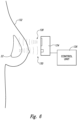
- FIG. 6 illustrates a monitoring system usable with the implant as of the type shown in any one of the Figures described above.
- the monitoring system includes one or more sensors 22 an interrogation module 124, and a control unit 126.
- the sensor 22 can be passive, wireless type which can operate on power received from a wireless source.
- sensors of this type are well known in the art and widely available.
- a pressure sensor of this type might be a MEMS pressure sensor, for example, Part No. LPS331AP, sold on the open market by STMicroelectronics.
- MEMS pressure sensors are well known to operate on very low power and suitable to remain unpowered and idle for long periods of time. They can be provided power wirelessly on an RF signal and, based on the power received wirelessly on the RF signal, perform the pressure sensing and then output the sensed data.
- an electrical generation system (as described above) is provided that can be utilized to power the sensors described herein.
- an interrogation module 124 outputs a signal 128.
- the signal 128 is a wireless signal, usually in the RF band, that contains power for the sensors 22 as well as an interrogation request that the sensors perform a sensing.
- the sensors 22 powers up and stores power in onboard capacitors sufficient to maintain operation during the sensing and data reporting.
- Such power receiving circuits and storing on onboard capacitors are well known in the art and therefore need not be shown in detail.
- the appropriate sensing is carried out by the sensors 22 and then the data is output from the sensor back to the interrogation module 124 on a signal 130, where it is received at an input port of the integration module.
- sufficient signal strength is provided in the initial signal 128 to provide power for the sensor and to carry out the sensing operation and output the signal back to the interrogation module 124.
- two or more signals 128 are sent, each signal providing additional power to the sensor to permit it to complete the sensing operation and then provide sufficient power to transfer the data via the signal path 130 back to the interrogation module 124.
- the signal 128 can be sent continuously, with a sensing request component at the first part of the signal and then continued providing, either as a steady signal or pulses to provide power to operate the sensor.
- the sensor When the sensor is ready to output the data, it sends a signal alerting the interrogation module 124 that data is coming and the signal 128 can be turned off to avoid interference.
- the integration signal 128 can be at a first frequency and the output signal 130 at a second frequency separated sufficiently that they do not interfere with each other. In a preferred embodiment, they are both the same frequency so that the same antenna on the sensor can receive the signal 128 and send signal 130.
- the interrogation signal 128 may contain data to select specific sensors on the implant.
- the signal 128 may power up all sensors on the implant at the same time and then send requests for data from each at different selected times so that with one interrogation signal 128 provided for a set time, such as 1-2 seconds, results in each of the sensors on the implant collecting data during this time period and then, at the end of the period, reporting the data out on respective signals 130 at different times over the next 0.5 to 2 seconds so that with one interrogation signal 128, the data from all sensors 22 is collected.
- the interrogation module 124 is operating under control of the control unit 126 which has a microprocessor for the controller, a memory, an I/O circuit to interface with the interrogation module and a power supply.
- the control unit may output data to a computer or other device for display and use by the physician to treat the subject.
- Figure 6 illustrates the operation according to a one embodiment within a subject.
- the subject has an outer skin 132.
- the interrogation module 124 and control unit 126 are positioned outside the skin 132 of the subject.
- the interrogation signal 128 passes through the skin of the subject with a wireless RF signal, and the data is received on a wireless RF signal 130 from the sensors within the implant 10 back to the interrogation module 124.
- the wireless signal can be in any frequency range, an RF range is preferred.
- a frequency in the VLF to LF ranges of between 3-1300 kHz is preferred to permit the signal to be carried to sufficient depth inside the body with low power, but frequencies below 3 kHz and above 1300 kHz can also be used.
- the sensing does not require a transfer of large amounts of data and low power is preferred; therefore, a low frequency RF signal is acceptable. This also avoids competition from and inadvertent activation by other wireless signal generators, such as blue tooth, cell phones and the like.
- FIG 7 illustrates one embodiment of an information and communication technology (ICT) system 800 arranged to process sensor data (e.g., data from the sensors 22).
- the ICT system 800 is illustrated to include computing devices that communicate via a network 804, however in other embodiments, the computing devices can communicate directly with each other or through other intervening devices, and in some cases, the computing devices do not communicate at all.
- the computing devices of Figure 7 include computing servers 802, control units 126, interrogation units 124, and other devices that are not shown for simplicity.
- one or more sensors 22 communicate with an interrogation module 124.
- the interrogation module 124 of Figure 7 is directed by a control unit 126, but in other cases, interrogation modules 124 operates autonomously and passes information to and from sensors 22.
- One or both of the interrogation module 124 and control unit 126 can communicate with the computing server 802.
- the interrogation module and/or the control unit may be a wearable device on the subject.
- the wearable device e.g., a watch-like device, a wrist-band, a bra, or other device that may be carried or worn by the subject
- the wearable device may collect data of its own accord which can also be transmitted to the network.
- Representative examples of data that may be collected include location (e.g., a GPS), body or skin temperature, and other physiologic data (e.g., pulse, glucose, etc.).
- the wearable device may notify the subject directly of any of a number of prescribed conditions, including but not limited to possible or actual failure of the implant.
- sensor data information is collected and analyzed expressly for the health of an individual subject.
- sensor data is collected and transmitted to another computing device to be aggregated with other data (for example, the sensor data from 22 may be collected and aggregated with other data collected from a wearable device (e.g., a device that may, in certain embodiments, include GPS data and the like).
- FIG. 7 illustrates aspects of a computing server 802 as a cooperative bank of servers further including computing servers 802a, 802b, and one or more other servers 802n. It is understood that computing server 802 may include any number of computing servers that operate individually or collectively to the benefit of users of the computing servers.
- the computing servers 802 are arranged as cloud computing devices created in one or more geographic locations, such as the United States and Canada.
- the cloud computing devices may be created as MICROSOFT AZURE cloud computing devices or as some other virtually accessible remote computing service.
- An interrogation module 124 and a control unit 126 are optionally illustrated as communicating with a computing server 802. Via the interrogation module 124 or control unit 126, sensor data is transferred to (and in addition or alternatively from) a computing server 802 through network 804.
- the network 804 includes some or all of cellular communication networks, conventional cable networks, satellite networks, fiber-optic networks, and the like configured as one or more local area networks, wide area networks, personal area networks, and any other type of computing network.
- the network 804 includes any communication hardware and software that cooperatively works to permit users of computing devices to view and interact with other computing devices.
- Computing server 802 includes a central processing unit (CPU) digital signal processing unit (DSP) 808, communication modules 810, Input/Output (I/O) modules 812, and storage module 814.
- the components of computing server 802 are cooperatively coupled by one or more buses 816 that facilitate transmission and control of information in and through computing server 802.
- Communication modules 810 are configurable to pass information between the computer server 802 and other computing devices (e.g., computing servers 802a, 802b, 802n, control unit 126, interrogation unit 124, and the like).
- I/O modules 812 are configurable to accept input from devices such as keyboards, computer mice, trackballs, and the like.
- I/O modules 812 are configurable to provide output to devices such as displays, recorders, LEDs, audio devices, and the like.
- Storage module 814 may include one or more types of storage media.
- storage module 814 of Figure 7 includes random access memory (RAM) 818, read only memory (ROM) 810, disk based memory 822, optical based memory 8124, and other types of memory storage media 8126.
- RAM random access memory
- ROM read only memory
- the storage module 814 may further include one or more portions of memory organized a non-transitory computer-readable media (CRM).
- CRM computer-readable media
- the CRM is configured to store computing instructions executable by a CPU 808.
- the computing instructions may be stored as one or more files, and each file may include one or more computer programs.
- a computer program can be standalone program or part of a larger computer program.
- each file may include data or other computational support material for an application that directs the collection, analysis, processing, and/or distribution of data from sensors (e.g., implant sensors).
- the sensor data application typically executes a set of instructions stored on computer-readable media.
- computing server 802 may be connected to other devices that are not illustrated, including through one or more networks such as the Internet or via the Web that are incorporated into network 804.
- a computing system or device e.g., a “client” or “server” or any part thereof may comprise any combination of hardware that can interact and perform the described types of functionality, optionally when programmed or otherwise configured with software, including without limitation desktop or other computers, database servers, network storage devices and other network devices, PDAs, cell phones, glasses, wrist bands, wireless phones, pagers, electronic organizers, Internet appliances, television-based systems (e.g., using set-top boxes and/or personal/digital video recorders), and various other products that include appropriate inter-communication capabilities.
- the functionality provided by the illustrated system modules may in some embodiments be combined in fewer modules or distributed in additional modules. Similarly, in some embodiments the functionality of some of the illustrated modules may not be provided and/or other additional functionality may be available.
- the illustrated modules and/or systems are software modules/systems that include software instructions which, when executed by the CPU/DSP 808 or other processor, will program the processor to automatically perform the described operations for a module/system.
- some or all of the software modules and/or systems may execute in memory on another device and communicate with the illustrated computing system/device via inter-computer communication.
- modules and/or systems may be implemented or provided in other manners, such as at least partially in firmware and/or hardware means, including, but not limited to, one or more application-specific integrated circuits (ASICs), standard integrated circuits, controllers (e.g., by executing appropriate instructions, and including microcontrollers and/or embedded controllers), field-programmable gate arrays (FPGAs), complex programmable logic devices (CPLDs), and the like.
- ASICs application-specific integrated circuits
- controllers e.g., by executing appropriate instructions, and including microcontrollers and/or embedded controllers
- FPGAs field-programmable gate arrays
- CPLDs complex programmable logic devices
- systems, modules, or data structures may also be stored (e.g., as software instructions or structured data) on a transitory or non-transitory computer-readable storage medium 814, such as a hard disk 822 or flash drive or other non-volatile storage device 8126, volatile 818 or non-volatile memory 810, a network storage device, or a portable media article (e.g., a DVD disk, a CD disk, an optical disk, a flash memory device, etc.) to be read by an appropriate input or output system or via an appropriate connection.
- the systems, modules, and data structures may also in some embodiments be transmitted as generated data signals ( e .
- the data signals can take a variety of forms such as part of a single or multiplexed analog signal, as multiple discrete digital packets or frames, as a discrete or streaming set of digital bits, or in some other form.
- Such computer program products may also take other forms in other embodiments. Accordingly, the present invention may be practiced with other computer system configurations.
- sensor data from, e.g., sensors 22 is provided to computing server 802.
- the sensor data represents data retrieved from a known subject and from a known sensor.
- the sensor data may possess include or be further associated with additional information such as the USI, UDI, a time stamp, a location (e.g., GPS) stamp, a date stamp, and other information.
- additional information such as the USI, UDI, a time stamp, a location (e.g., GPS) stamp, a date stamp, and other information.
- the differences between various sensors is that some may include more or fewer data bits that associate the data with a particular source, collection device, transmission characteristic, or the like.
- the sensor data may comprise sensitive information such as private health information associated with a specific subject.
- Sensitive information for example sensor data from sensors e.g., 22, may include any information that an associated party desires to keep from wide or easy dissemination. Sensitive information can stand alone or be combined with other non-sensitive information.
- a subject's medical information is typically sensitive information.
- the storage and transmission of a subject's medical information is protected by a government directive (e.g., law, regulation, etc.) such as the U.S. Health Insurance Portability and Accountability Act (HIPPA).
- a government directive e.g., law, regulation, etc.
- a reference to "sensitive” information includes information that is entirely sensitive and information that is some combination of sensitive and non-sensitive information.
- the sensitive information may be represented in a data file or in some other format.
- a data file that includes a subject's medical information may be referred to as "sensitive information.”
- Other information, such as employment information, financial information, identity information, and many other types of information may also be considered sensitive information.
- a computing system can represent sensitive information with an encoding algorithm (e.g., ASCII), a well-recognized file format (e.g., PDF), or by some other format.
- an encoding algorithm e.g., ASCII
- PDF well-recognized file format
- sensitive information can be protected from wide or easy dissemination with an encryption algorithm.
- sensitive information can be stored by a computing system as a discrete set of data bits.
- the set of data bits may be called "plaintext.”
- a computing system can use an encryption process to transform plaintext using an encryption algorithm (i.e., a cipher) into a set of data bits having a highly unreadable state (i.e., cipher text).
- a computing system having knowledge of the encryption key used to create the cipher text can restore the information to a plaintext readable state.
- sensitive data e.g., sensor data 806a, 806b
- sensitive data is optionally encrypted before being communicated to a computing device.
- the operation of the information and communication technology (ICT) system 800 of Figure 7 includes one or more sensor data computer programs stored on a computer-readable medium.
- the computer program may optionally direct and/or receive data from one or more implant sensors implanted in one or more subjects.
- a sensor data computer program may be executed in a computing server 802. Alternatively, or in addition, a sensor data computer program may be executed in a control unit 126, an interrogation unit 124.
- a computer program to direct the collection and use of implant sensor data is stored on a non-transitory computer-readable medium in storage module 814.
- the computer program is configured to identify a subject who has a wireless implant inserted in his or her body.
- the wireless implant may include one or more wireless sensors.
- the computer program identifies one subject, and in other cases, two or more subjects are identified.
- the subjects may each have one or more wireless implants, and each wireless implant may have one or more wireless sensors of the type described herein.
- the computer program is arranged to direct the collection of sensor data from the wireless implant devices.
- the sensor data is generally collected with a wireless interrogation unit 124.
- the program communicates with the wireless interrogation unit 124.
- the program communicates with a control unit 126, which in turn directs a wireless interrogation unit 124.
- some other mechanism is used direct the collection of the sensor data.
- the data may be further processed.
- the sensor data includes sensitive subject data, which can be removed or disassociated with the data.
- the sensor data can be individually stored (e.g., by unique sensor identification number, device number, etc.) or aggregated together with other sensor data by sensor type, time stamp, location stamp, date stamp, subject type, other subject characteristics, or by some other means.
- examples of such other devices and/or processes and/or systems might include-as appropriate to context and application-all or part of devices and/or processes and/or systems of (a) an air conveyance (e.g., an airplane, rocket, helicopter, etc.), (b) a ground conveyance (e.g., a car, ambulance, truck, locomotive, tank, armored personnel carrier, etc.), (c) a building (e.g., a home, hospital, warehouse, office, etc.), (d) an appliance (e.g., a refrigerator, a washing machine, a dryer, etc.), (e) a communications system (e.g., a networked system, a telephone system, a Voice over IP system, etc.), (f) a business entity (e.g., an Internet Service Provider (ISP) entity such as Comcast Cable, Qwest, Southwestern Bell, etc.), or (g) a wired/wireless services entity (e.g., AT&T,
- ISP Internet Service Provider
- use of a system or method may occur in a territory even if components are located outside the territory.
- use of a distributed computing system may occur in a territory even though parts of the system may be located outside of the territory (e.g., relay, server, processor, signal-bearing medium, transmitting computer, receiving computer, etc. located outside the territory).
- a sale of a system or method may likewise occur in a territory even if components of the system or method are located and/or used outside the territory. Further, implementation of at least part of a system for performing a method in one territory does not preclude use of the system in another territory.
- implants utilizing a variety of sensors can be utilized to serve a variety of critical clinical functions, such as safe, accurate and less traumatic placement and deployment of the implant, procedural and post-operative "real time" imaging of the implant and the surrounding anatomy, the early identification of the development of implant complications (often prior to becoming evident by other medical diagnostic procedures), and the patient's overall health status and response to treatment.
- post-operative (both in hospital and out-patient) evaluation of implant patients is through patient history, physical examination and medical monitoring that is supplemented with diagnostic imaging studies as required.
- the patient may have a reading device in their home which collates the data from the implant on a periodic basis, such as once per day or once per week.
- a reading device in their home which collates the data from the implant on a periodic basis, such as once per day or once per week.
- such information access can be expected to improve compliance and improve patient outcomes.
- their recovery experience can be shared via the web with other patients to compare their progress versus expected "norms" for function and rehabilitation and alert them to signs and symptoms that should be brought to their doctor's attention.
- the performance of different implants can be compared in different patients (different sexes, disease severity, activity levels, concurrent diseases such as hypertension and diabetes, smoking status, obesity, etc.) to help manufacturers design better implants and assist physicians in the selection of the right implant for a specific patient types. Payers, patients, manufacturers and physicians could all benefit from the collection of this comparative information. Poor and dangerous products could be identified and removed from the market and objective long-term effectiveness data collected and analyzed. Lastly, data accumulated at home can be collected and transmitted via the Internet to the physician's office for analysis - potentially eliminating unnecessary visits in some cases and encouraging immediate medical follow-up in others.
- Embodiment examples or feature examples specifically provided are intended to be exemplary only, that is, those examples are non-limiting on an embodiment.
- the term "e.g.” (latin, exempli gratia) is used herein to refer to a non-limiting example, and effectively means “for example”.
- the terms comprise, comprising and comprises are used to identify essential features of an embodiment, where the embodiment may be, for example, a composition, device, method or kit.
- the embodiment may optionally contain one or more additional unspecified features, and so the term comprises may be understood to mean includes.
Landscapes
- Health & Medical Sciences (AREA)
- Life Sciences & Earth Sciences (AREA)
- Engineering & Computer Science (AREA)
- Veterinary Medicine (AREA)
- Biomedical Technology (AREA)
- Heart & Thoracic Surgery (AREA)
- Animal Behavior & Ethology (AREA)
- General Health & Medical Sciences (AREA)
- Public Health (AREA)
- Physics & Mathematics (AREA)
- Surgery (AREA)
- Molecular Biology (AREA)
- Medical Informatics (AREA)
- Pathology (AREA)
- Biophysics (AREA)
- Transplantation (AREA)
- Vascular Medicine (AREA)
- Oral & Maxillofacial Surgery (AREA)
- Cardiology (AREA)
- Otolaryngology (AREA)
- Gynecology & Obstetrics (AREA)
- Reproductive Health (AREA)
- Computer Networks & Wireless Communication (AREA)
- Human Computer Interaction (AREA)
- Pulmonology (AREA)
- Obesity (AREA)
- Rheumatology (AREA)
- Rehabilitation Therapy (AREA)
- Orthopedic Medicine & Surgery (AREA)
- Measuring And Recording Apparatus For Diagnosis (AREA)
- Measurement Of The Respiration, Hearing Ability, Form, And Blood Characteristics Of Living Organisms (AREA)
Applications Claiming Priority (3)
| Application Number | Priority Date | Filing Date | Title |
|---|---|---|---|
| US201462017099P | 2014-06-25 | 2014-06-25 | |
| PCT/US2015/037803 WO2015200704A1 (en) | 2014-06-25 | 2015-06-25 | Devices, systems and methods for using and monitoring implants |
| EP15812631.8A EP3160393A4 (de) | 2014-06-25 | 2015-06-25 | Vorrichtungen, systeme und verfahren zur verwendung und überwachung von implantaten |
Related Parent Applications (1)
| Application Number | Title | Priority Date | Filing Date |
|---|---|---|---|
| EP15812631.8A Division EP3160393A4 (de) | 2014-06-25 | 2015-06-25 | Vorrichtungen, systeme und verfahren zur verwendung und überwachung von implantaten |
Publications (2)
| Publication Number | Publication Date |
|---|---|
| EP4449979A2 true EP4449979A2 (de) | 2024-10-23 |
| EP4449979A3 EP4449979A3 (de) | 2025-05-21 |
Family
ID=54938822
Family Applications (2)
| Application Number | Title | Priority Date | Filing Date |
|---|---|---|---|
| EP15812631.8A Withdrawn EP3160393A4 (de) | 2014-06-25 | 2015-06-25 | Vorrichtungen, systeme und verfahren zur verwendung und überwachung von implantaten |
| EP24198731.2A Pending EP4449979A3 (de) | 2014-06-25 | 2015-06-25 | Vorrichtungen, systeme und verfahren zur verwendung und überwachung von implantaten |
Family Applications Before (1)
| Application Number | Title | Priority Date | Filing Date |
|---|---|---|---|
| EP15812631.8A Withdrawn EP3160393A4 (de) | 2014-06-25 | 2015-06-25 | Vorrichtungen, systeme und verfahren zur verwendung und überwachung von implantaten |
Country Status (4)
| Country | Link |
|---|---|
| US (3) | US10874496B2 (de) |
| EP (2) | EP3160393A4 (de) |
| CA (1) | CA2990814A1 (de) |
| WO (1) | WO2015200704A1 (de) |
Families Citing this family (44)
| Publication number | Priority date | Publication date | Assignee | Title |
|---|---|---|---|---|
| CA3168375A1 (en) | 2013-03-15 | 2014-09-18 | Canary Medical Inc. | Devices, systems and methods for monitoring shoulder replacements |
| CA3225445A1 (en) | 2013-06-23 | 2014-12-31 | Canary Medical Inc. | Devices, systems and methods for monitoring knee replacements |
| EP3751574A3 (de) | 2014-06-25 | 2021-04-21 | Canary Medical Inc. | Vorrichtungen, systeme und verfahren zur verwendung und überwachung einer orthopädischen hardware |
| US10524694B2 (en) | 2014-06-25 | 2020-01-07 | Canaray Medical Inc. | Devices, systems and methods for using and monitoring tubes in body passageways |
| WO2015200707A1 (en) | 2014-06-25 | 2015-12-30 | Hunter William L | Devices, systems and methods for using and monitoring heart valves |
| CA3223705A1 (en) | 2014-06-25 | 2015-12-30 | Canary Medical Switzerland Ag | Devices, systems and methods for using and monitoring spinal implants |
| WO2015200704A1 (en) | 2014-06-25 | 2015-12-30 | Hunter William L | Devices, systems and methods for using and monitoring implants |
| CN112190236A (zh) | 2014-09-17 | 2021-01-08 | 卡纳里医疗公司 | 用于使用和监测医疗设备的设备、系统和方法 |
| US11042916B1 (en) | 2016-02-29 | 2021-06-22 | Canary Medical Inc. | Computer-based marketplace for information |
| US11191479B2 (en) | 2016-03-23 | 2021-12-07 | Canary Medical Inc. | Implantable reporting processor for an alert implant |
| KR102455911B1 (ko) | 2016-03-23 | 2022-10-19 | 카나리 메디칼 아이엔씨. | 경보 임플란트를 위한 이식 가능한 리포팅 프로세서 |
| US10586623B2 (en) | 2016-03-30 | 2020-03-10 | Livecare Corp. | Patient care device and system for service to individuals with diminishing dexterity and neurological physiological functionality |
| US11355250B2 (en) | 2016-03-30 | 2022-06-07 | Livecare Corp. | Gateway device and system for service to individuals with diminishing dexterity and neurological physiological functionality |
| CN106621042A (zh) * | 2016-12-21 | 2017-05-10 | 北京品驰医疗设备有限公司 | 一种植入装置组织破溃检测系统 |
| CN106667461A (zh) * | 2016-12-30 | 2017-05-17 | 北京品驰医疗设备有限公司 | 一种多电池的植入式远程监测定位系统 |
| CN106725435A (zh) * | 2016-12-30 | 2017-05-31 | 北京品驰医疗设备有限公司 | 一种多电池充电的植入式远程监测定位系统 |
| CN106510690A (zh) * | 2016-12-30 | 2017-03-22 | 北京品驰医疗设备有限公司 | 一种多电池充电控制的植入式远程监测定位系统 |
| CN106510723A (zh) * | 2016-12-30 | 2017-03-22 | 北京品驰医疗设备有限公司 | 一种多电池充电控制的植入式远程监测定位系统 |
| CN106621043A (zh) * | 2016-12-31 | 2017-05-10 | 北京品驰医疗设备有限公司 | 一种快速充电的组织破溃检测系统 |
| CN106621044A (zh) * | 2016-12-31 | 2017-05-10 | 北京品驰医疗设备有限公司 | 一种快速充电控制的组织破溃检测系统 |
| WO2019055336A1 (en) | 2017-09-13 | 2019-03-21 | Hologic, Inc. | ACTIVE WIRELESS SURVEILLANCE IMPLANT SYSTEM |
| CN107890338A (zh) * | 2017-09-22 | 2018-04-10 | 杭州爱上伊文化创意有限公司 | 一种胸部发育数据采集系统及其内衣 |
| US20190192280A1 (en) * | 2017-12-21 | 2019-06-27 | Biosense Webster (Israel) Ltd. | System for Adjusting the Shape of a Breast Implant |
| IT201800005509A1 (it) * | 2018-05-21 | 2018-08-21 | Vita Roy De | Kit formato da una protesi emittente radiazioni elettromagnetiche con differenti lunghezze d’onda e da un dispositivo indossabile, programmabile, che, combinati tra loro, favoriscono il trattamento delle contratture capsulari. |
| US11083604B2 (en) * | 2019-01-18 | 2021-08-10 | Lawrence Livermore National Security, Llc | Preventing stent failure using adaptive shear responsive endovascular implant |
| US11756681B2 (en) * | 2019-05-07 | 2023-09-12 | Medtronic, Inc. | Evaluation of post implantation patient status and medical device performance |
| US20210366610A1 (en) | 2019-06-06 | 2021-11-25 | Canary Medical Inc. | Intelligent joint prosthesis |
| CA3176861A1 (en) | 2019-06-06 | 2020-12-10 | Canary Medical Inc. | Intelligent joint prosthesis |
| US11224339B2 (en) * | 2019-07-16 | 2022-01-18 | International Business Machines Corporation | Dynamic eye condition self-diagnosis |
| CN114630615A (zh) * | 2019-10-02 | 2022-06-14 | 制定实验室公司 | 用于感测可植入设备中的参数的方法和系统 |
| US12268459B2 (en) * | 2019-11-26 | 2025-04-08 | Intuitive Surgical Operations, Inc. | Physical medical element affixation systems, methods, and materials |
| US11896403B2 (en) * | 2020-01-24 | 2024-02-13 | Medtronic, Inc. | Implantable medical device using temperature sensor to determine infection status of patient |
| US12408963B2 (en) | 2020-02-20 | 2025-09-09 | Canary Medical Switzerland Ag | Medical device for implanting in boney tissue and characterization of bone fractures |
| US11918382B2 (en) | 2020-04-13 | 2024-03-05 | International Business Machines Corporation | Continual background monitoring of eye health |
| US12262153B2 (en) | 2020-04-30 | 2025-03-25 | Medtronic, Inc. | Post operative implantation site monitoring |
| US12260555B2 (en) | 2020-04-30 | 2025-03-25 | Medtronic, Inc. | Post operative implantation site monitoring and medical device performance |
| US20220047174A1 (en) * | 2020-08-11 | 2022-02-17 | Predicor Llc | Device for human performance assessment and monitoring |
| JP6952209B1 (ja) * | 2021-02-21 | 2021-10-20 | キム ジェホンKim, Jae Hong | 豊胸用インプラントバッグ及び豊胸用インプラントバッグの異常感知装置 |
| EP4295752A4 (de) * | 2021-02-21 | 2024-12-25 | W.Al Co., Ltd. | Brustprothese und vorrichtung zur erkennung von anomalien in der brustprothese |
| US20220304595A1 (en) * | 2021-03-25 | 2022-09-29 | Zimmer, Inc. | Shoulder implant for center of rotation tracking |
| EP4356398A4 (de) | 2021-06-14 | 2025-04-16 | Preh Holding, LLC | Verbundenes körperoberflächenpflegemodul |
| KR102639503B1 (ko) * | 2021-10-03 | 2024-02-22 | 주식회사 더블유닷에이아이 | 보형물 이상 감지 장치 및 보형물 이상 감지 시스템 |
| US20250054613A1 (en) * | 2023-08-08 | 2025-02-13 | CalmWave, Inc. | Information Management System and Method |
| US12471787B2 (en) | 2023-09-27 | 2025-11-18 | Canary Medical Switzerland Ag | Implantable medical device with mechanical stress sensor |
Citations (51)
| Publication number | Priority date | Publication date | Assignee | Title |
|---|---|---|---|---|
| US4995882A (en) | 1989-08-28 | 1991-02-26 | Washington University | Radiolucent breast implant |
| US6251137B1 (en) | 1994-03-23 | 2001-06-26 | Mcghan Medical Corporation | Synthetic triglyceride filler material for surgically implanted prostheses |
| US6464726B1 (en) | 2000-07-13 | 2002-10-15 | Jenna Heljenek | Breast implant system and method of augmentation |
| US20050152945A1 (en) | 2003-11-20 | 2005-07-14 | Angiotech International Ag | Soft tissue implants and anti-scarring agents |
| US20060079836A1 (en) | 2004-10-12 | 2006-04-13 | Holman Thomas J | Reinforced and drug-eluting balloon catheters and methods for making same |
| US20060136056A1 (en) | 2004-12-21 | 2006-06-22 | Ishay Wohl | Implant device and method |
| US7383071B1 (en) | 2003-04-25 | 2008-06-03 | United States Of America As Represented By The Secretary Of The Navy | Microsensor system and method for measuring data |
| US7450332B2 (en) | 2004-06-28 | 2008-11-11 | Stmicroelectronics, Inc. | Free-fall detection device and free-fall protection system for a portable electronic apparatus |
| US7463997B2 (en) | 2005-10-03 | 2008-12-09 | Stmicroelectronics S.R.L. | Pedometer device and step detection method using an algorithm for self-adaptive computation of acceleration thresholds |
| US20090099656A1 (en) | 2007-10-15 | 2009-04-16 | Hatuna Gelda | Method and device for a breast implant |
| US20090254063A1 (en) | 2007-07-13 | 2009-10-08 | Randolf Von Oepen | Drug Coated Balloon Catheter |
| US20100023108A1 (en) | 2004-03-19 | 2010-01-28 | Toner John L | Multiple Drug Delivery From A Balloon And A Prosthesis |
| US20100042121A1 (en) | 2008-03-21 | 2010-02-18 | Peter Schneider | Pre-angioplasty serration of atherosclerotic plaque enabling low-pressure balloon angioplasty and avoidance of stenting |
| US20100037731A1 (en) | 2008-08-18 | 2010-02-18 | Xerox Corporation | Silver nanoparticles and process for producing same |
| WO2010040034A2 (en) | 2008-10-03 | 2010-04-08 | The Board Of Trustees Of The University Of Illinois | Metal nanoparticle inks |
| US20100285082A1 (en) | 2003-08-22 | 2010-11-11 | Fernandez Dennis S | Integrated Biosensor and Simulation System for Diagnosis and Therapy |
| US20110059234A1 (en) | 2009-09-10 | 2011-03-10 | Samsung Electronics Co., Ltd. | Metal pattern composition and method of forming metal pattern using the same |
| US7924267B2 (en) | 2004-12-29 | 2011-04-12 | Stmicroelectronics S.R.L. | Pointing device for a computer system with automatic detection of lifting, and relative control method |
| US20110092948A1 (en) | 2009-10-19 | 2011-04-21 | Pharmaco-Kinesis Corporation | Remotely Activated Piezoelectric Pump for Delivery of Biological Agents to the Intervertebral Disc and Spine |
| US20110184277A1 (en) | 2009-09-22 | 2011-07-28 | Jorge Ripoll Lorenzo | Systems and methods for virtual index-matching of diffusive media |
| WO2011126706A2 (en) | 2010-04-09 | 2011-10-13 | Henkel Corporation | Printable materials and methods of manufacture thereof |
| US8283793B2 (en) | 2008-08-21 | 2012-10-09 | Autonomic Technologies, Inc. | Device for energy harvesting within a vessel |
| US8311632B2 (en) | 2008-02-25 | 2012-11-13 | Autonomic Technologies, Inc. | Devices, methods, and systems for harvesting energy in the body |
| US8372420B2 (en) | 2002-05-24 | 2013-02-12 | Angiotech International Ag | Compositions and methods for coating medical implants |
| US8420077B2 (en) | 2009-04-20 | 2013-04-16 | Allergan, Inc. | Silk fibroin hydrogels and uses thereof |
| WO2013096664A1 (en) | 2011-12-23 | 2013-06-27 | The Board Of Trustees Of The University Of Illinois | Ink composition for making a conductive silver structure |
| US20130215979A1 (en) | 2012-01-04 | 2013-08-22 | The Board Of Trustees Of The Leland Stanford Junior University | Method and Apparatus for Efficient Communication with Implantable Devices |
| WO2013140147A1 (en) | 2012-03-19 | 2013-09-26 | Bae Systems Plc | Additive layer manufacturing |
| US8550090B2 (en) | 2007-12-07 | 2013-10-08 | Keller Medical, Inc. | Apparatus and process for delivering a silicone prosthesis into a surgical pocket |
| WO2013152751A1 (de) | 2012-04-13 | 2013-10-17 | Mtu Aero Engines Gmbh | Mehrfach-spulenanordnung für eine vorrichtung zur generativen herstellung von bauteilen und entsprechendes herstellungsverfahren |
| US20130270750A1 (en) | 2012-03-29 | 2013-10-17 | Gordon R. Green | Apparatus and methods for additive-layer manufacturing of an article |
| WO2013152805A1 (en) | 2012-04-13 | 2013-10-17 | European Space Agency | Method and system for production and additive manufacturing of metals and alloys |
| WO2013155500A1 (en) | 2012-04-13 | 2013-10-17 | Conformis, Inc. | Devices and methods for additive manufacturing of implant components |
| WO2013163585A1 (en) | 2012-04-26 | 2013-10-31 | Northeastern University | Device and method to additively fabricate structures containing embedded electronics or sensors |
| WO2013179017A1 (en) | 2012-05-28 | 2013-12-05 | Renishaw Plc | Manufacture of metal articles |
| US20130329258A1 (en) | 2012-06-08 | 2013-12-12 | Makerbot Industries, Llc | Downloadable three-dimensional models |
| US20130337256A1 (en) | 2012-06-19 | 2013-12-19 | Eads Uk Limited | Extrusion-based additive manufacturing system |
| US8634928B1 (en) | 2009-06-16 | 2014-01-21 | The Board Of Trustees Of The Leland Stanford Junior University | Wireless power transmission for implantable medical devices |
| WO2014018100A1 (en) | 2012-07-27 | 2014-01-30 | Pratt & Whitney Rocketdyne, Inc. | Solid axisymmetric powder bed for selective laser melting |
| US20140034626A1 (en) | 2012-08-06 | 2014-02-06 | Materials Solutions | Additive manufacturing |
| WO2014020085A2 (fr) | 2012-07-31 | 2014-02-06 | Compagnie Generale Des Etablissements Michelin | Machine et procédé pour la fabrication additive à base de poudre |
| US20140048970A1 (en) | 2012-08-16 | 2014-02-20 | Stratasys, Inc. | Draw control for extrusion-based additive manufacturing systems |
| US20140053956A1 (en) | 2012-08-21 | 2014-02-27 | Alstom Technology Ltd | Method for manufacturing a three-dimensional article |
| US20140077421A1 (en) | 2012-09-14 | 2014-03-20 | Alan B. Minick | Additive manufacturing chamber with reduced load |
| US20140088700A1 (en) | 2011-06-08 | 2014-03-27 | Allergan, Inc. | Method for using a silk derived bioresorbable scaffold in breast reconstruction |
| WO2014071135A1 (en) | 2012-11-01 | 2014-05-08 | General Electric Company | Additive manufacturing method and apparatus |
| WO2014074947A2 (en) | 2012-11-08 | 2014-05-15 | Das, Suman | Systems and methods for additive manufacturing and repair of metal components |
| WO2014071968A1 (en) | 2012-11-06 | 2014-05-15 | Arcam Ab | Powder pre-processing for additive manufacturing |
| WO2014081594A1 (en) | 2012-11-21 | 2014-05-30 | Stratasys, Inc. | Additive manufacturing with polyamide consumable materials |
| WO2014085170A1 (en) | 2012-11-30 | 2014-06-05 | Intel Corporation | Integrated circuits and systems and methods for producing the same |
| WO2014083277A1 (fr) | 2012-11-27 | 2014-06-05 | Snecma | Procédé de fabrication additive d'une pièce par fusion sélective ou frittage sélectif de lits de poudre à compacité optimisée par faisceau de haute énergie |
Family Cites Families (176)
| Publication number | Priority date | Publication date | Assignee | Title |
|---|---|---|---|---|
| US6120502A (en) | 1988-06-13 | 2000-09-19 | Michelson; Gary Karlin | Apparatus and method for the delivery of electrical current for interbody spinal arthrodesis |
| US5413604A (en) | 1992-12-24 | 1995-05-09 | Osteonics Corp. | Prosthetic knee implant for an anterior cruciate ligament deficient total knee replacement |
| GB9305279D0 (en) | 1993-03-15 | 1993-05-05 | Univ London | Total knee replacement prothesis |
| DE4322619C1 (de) | 1993-07-07 | 1994-09-22 | S & G Implants Gmbh | Tibiateil einer Kniegelenk-Endoprothese |
| GB9415180D0 (en) | 1994-07-28 | 1994-09-21 | Walker Peter S | Stabilised mobile bearing knee |
| US5626581A (en) | 1995-11-27 | 1997-05-06 | Volunteers For Medical Engineering | Implantable bone lengthening apparatus |
| US5833603A (en) * | 1996-03-13 | 1998-11-10 | Lipomatrix, Inc. | Implantable biosensing transponder |
| EP0912954B8 (de) | 1996-07-22 | 2006-06-14 | Cyva Research Corporation | Werkzeug zur sicherheit und zum austauch von persönlichen daten |
| WO2000038570A1 (en) | 1998-12-31 | 2000-07-06 | Ball Semiconductor, Inc. | Miniature implanted orthopedic sensors |
| US6358202B1 (en) | 1999-01-25 | 2002-03-19 | Sun Microsystems, Inc. | Network for implanted computer devices |
| ES2395057T3 (es) | 1999-03-25 | 2013-02-07 | Metabolix, Inc. | Dispositivos y aplicaciones médicas de polímeros polihidroxialcanoato |
| DE19924676A1 (de) | 1999-05-29 | 2000-11-30 | Dietmar Wolter | Hüftgelenkprothese |
| US6245109B1 (en) | 1999-11-18 | 2001-06-12 | Intellijoint Systems, Ltd. | Artificial joint system and method utilizing same for monitoring wear and displacement of artificial joint members |
| US7478108B2 (en) | 1999-12-06 | 2009-01-13 | Micro Strain, Inc. | Data collection using sensing units and separate control units with all power derived from the control units |
| RU2271779C2 (ru) | 2000-03-29 | 2006-03-20 | Массачусеттс Инститьют Оф Текнолоджи | Способ адаптивного управления амортизацией протезного колена в фазе стояния, способ адаптивного управления амортизацией момента протезного колена в фазе ходьбы, протезное колено, приспосабливающееся для управления моментом амортизации во время фазы стояния человека без ноги, и протезный узел |
| US6656135B2 (en) | 2000-05-01 | 2003-12-02 | Southwest Research Institute | Passive and wireless displacement measuring device |
| EP1195139A1 (de) | 2000-10-05 | 2002-04-10 | Ecole Polytechnique Féderale de Lausanne (EPFL) | Körperbewegungsüberwachungssystem und -Verfahren |
| US20030069644A1 (en) | 2001-10-05 | 2003-04-10 | Nebojsa Kovacevic | Dual-tray teletibial implant |
| US6755861B2 (en) * | 2001-10-16 | 2004-06-29 | Granit Medical Innovation, Inc. | Device for providing a portion of an organism with a desired shape |
| US6846985B2 (en) | 2002-01-22 | 2005-01-25 | Nanoset, Llc | Magnetically shielded assembly |
| ATE427699T1 (de) | 2002-02-07 | 2009-04-15 | Ecole Polytech | Kírperbewegungsuberwachungsgerat |
| US7575602B2 (en) | 2002-03-19 | 2009-08-18 | The Board Of Trustees Of The University Of Illinois | System and method for prosthetic fitting and balancing in joints |
| DE10216216A1 (de) | 2002-04-05 | 2003-10-16 | Biotronik Mess & Therapieg | Anordnung und Verfahren zur Überwachung, Kalibrierung und Optimierung einer Steuerung eines elektromedizinischen Implantats |
| US20030204267A1 (en) | 2002-04-30 | 2003-10-30 | Hazebrouck Stephen A. | Modular limb preservation system |
| AU2003253846A1 (en) | 2002-07-10 | 2004-01-23 | Orthodata Technologies Llc | Strain sensing system |
| US6821299B2 (en) | 2002-07-24 | 2004-11-23 | Zimmer Technology, Inc. | Implantable prosthesis for measuring six force components |
| AU2002330660A1 (en) | 2002-08-15 | 2004-03-03 | La Fondation De Soutien De L'hopital Orthopedique De La Suisse Romande | Knee prosthesis |
| US7009511B2 (en) | 2002-12-17 | 2006-03-07 | Cardiac Pacemakers, Inc. | Repeater device for communications with an implantable medical device |
| EP1575456B1 (de) | 2002-12-20 | 2011-02-09 | Smith & Nephew, Inc. | Hochleistungsknieprothese |
| US7127300B2 (en) * | 2002-12-23 | 2006-10-24 | Cardiac Pacemakers, Inc. | Method and apparatus for enabling data communication between an implantable medical device and a patient management system |
| US7364590B2 (en) | 2003-04-08 | 2008-04-29 | Thomas Siebel | Anatomical knee prosthesis |
| US20040243148A1 (en) | 2003-04-08 | 2004-12-02 | Wasielewski Ray C. | Use of micro- and miniature position sensing devices for use in TKA and THA |
| US7252685B2 (en) | 2003-06-05 | 2007-08-07 | Sdgi Holdings, Inc. | Fusion implant and method of making same |
| US7351262B2 (en) | 2003-06-05 | 2008-04-01 | Warsaw Orthopedic, Inc. | Bone implants and methods of making same |
| EP1648349B1 (de) | 2003-07-11 | 2010-12-08 | DePuy Products, Inc. | In-vivo-gelenkimplantat-zykluszähler |
| US7190273B2 (en) | 2003-07-11 | 2007-03-13 | Depuy Products, Inc. | Joint endoprosthesis with ambient condition sensing |
| DE10342823A1 (de) | 2003-09-17 | 2005-04-21 | Peter Brehm Gmbh | Vorrichtung zur Überprüfung des Sitzes einer implantierten Prothese |
| US20050165317A1 (en) | 2003-11-04 | 2005-07-28 | Turner Nicholas M. | Medical devices |
| US7324850B2 (en) | 2004-04-29 | 2008-01-29 | Cardiac Pacemakers, Inc. | Method and apparatus for communication between a handheld programmer and an implantable medical device |
| US8176922B2 (en) | 2004-06-29 | 2012-05-15 | Depuy Products, Inc. | System and method for bidirectional communication with an implantable medical device using an implant component as an antenna |
| WO2006008740A1 (en) | 2004-07-21 | 2006-01-26 | Aerotel Medical Systems (1998) Ltd. | Wearable device, system and method for measuring physiological and/or environmental parameters |
| US20060030771A1 (en) | 2004-08-03 | 2006-02-09 | Lewis Levine | System and method for sensor integration |
| US8366782B2 (en) | 2004-08-05 | 2013-02-05 | Depuy Products, Inc. | Modular orthopaedic implant system with multi-use stems |
| US7097662B2 (en) | 2004-08-25 | 2006-08-29 | Ut-Battelle, Llc | In-vivo orthopedic implant diagnostic device for sensing load, wear, and infection |
| CA2581320C (en) * | 2004-09-21 | 2021-04-27 | Shalon Ventures Inc. | Tissue expansion devices |
| US8439915B2 (en) * | 2004-09-29 | 2013-05-14 | The Regents Of The University Of California | Apparatus and methods for magnetic alteration of anatomical features |
| US7559951B2 (en) | 2004-09-30 | 2009-07-14 | Depuy Products, Inc. | Adjustable, remote-controllable orthopaedic prosthesis and associated method |
| KR101158952B1 (ko) | 2004-10-25 | 2012-07-09 | 신베이시브 테크놀로지 인코포레이티드 | 압력 감지를 수반하는 동적 무릎 평형 장치 |
| US8070807B2 (en) | 2004-11-19 | 2011-12-06 | Fulfillium, Inc. | Wireless breach detection |
| US9456915B2 (en) | 2004-11-19 | 2016-10-04 | Fulfilium, Inc. | Methods, devices, and systems for obesity treatment |
| US20060142670A1 (en) | 2004-12-29 | 2006-06-29 | Disilvestro Mark R | System and method for determining patient follow-up subsequent to an orthopaedic procedure |
| US7849751B2 (en) | 2005-02-15 | 2010-12-14 | Clemson University Research Foundation | Contact sensors and methods for making same |
| US20080214903A1 (en) | 2005-02-22 | 2008-09-04 | Tuvi Orbach | Methods and Systems for Physiological and Psycho-Physiological Monitoring and Uses Thereof |
| CA2601090C (en) | 2005-03-14 | 2013-08-20 | Inbone Technologies, Inc. | Ankle replacement system |
| US20110213221A1 (en) | 2005-03-29 | 2011-09-01 | Roche Martin W | Method for Detecting Body Parameters |
| EP2929836B1 (de) | 2005-03-29 | 2019-04-24 | Roche, Martin, W. | Biometrisches sensorsystem |
| US20100100011A1 (en) | 2008-10-22 | 2010-04-22 | Martin Roche | System and Method for Orthopedic Alignment and Measurement |
| US20100204551A1 (en) | 2008-10-22 | 2010-08-12 | Martin William Roche | Detection, Prevention and Treatment of Infections in Implantable Devices |
| US11457813B2 (en) | 2005-03-29 | 2022-10-04 | Martin W. Roche | Method for detecting body parameters |
| CN101257860B (zh) | 2005-04-05 | 2015-10-21 | 万能医药公司 | 可降解的植入式医疗装置 |
| CA2604563C (en) | 2005-04-15 | 2020-07-28 | Surgisense Corporation | Surgical instruments with sensors for detecting tissue properties, and systems using such instruments |
| US20060271199A1 (en) * | 2005-05-20 | 2006-11-30 | Johnson Lanny L | Navigational markers in implants |
| US20060282168A1 (en) | 2005-06-13 | 2006-12-14 | Sherman Jason T | Orthopaedic prosthesis having a superparamagnetic material and associated method |
| US7780613B2 (en) | 2005-06-30 | 2010-08-24 | Depuy Products, Inc. | Apparatus, system, and method for transcutaneously transferring energy |
| US20070005141A1 (en) | 2005-06-30 | 2007-01-04 | Jason Sherman | Apparatus, system, and method for transcutaneously transferring energy |
| DE102005034167B4 (de) | 2005-07-21 | 2012-01-26 | Siemens Ag | Einrichtung und Verfahren zur Ermittlung einer Position eines Implantats in einem Körper |
| AU2006282828B2 (en) | 2005-08-23 | 2013-01-31 | Smith & Nephew, Inc | Telemetric orthopaedic implant |
| US20070088442A1 (en) | 2005-10-14 | 2007-04-19 | Microchips, Inc. | Passive wear-indicating sensor for implantable prosthetic device |
| US20070089518A1 (en) | 2005-10-26 | 2007-04-26 | Ericson Milton N | Method and apparatus for orthopedic implant assessment |
| US7328131B2 (en) | 2006-02-01 | 2008-02-05 | Medtronic, Inc. | Implantable pedometer |
| US20070238992A1 (en) | 2006-02-01 | 2007-10-11 | Sdgi Holdings, Inc. | Implantable sensor |
| US8016859B2 (en) | 2006-02-17 | 2011-09-13 | Medtronic, Inc. | Dynamic treatment system and method of use |
| US20070233267A1 (en) | 2006-03-29 | 2007-10-04 | Farid Amirouche | Application of neural networks to prosthesis fitting and balancing in joints |
| US8075627B2 (en) | 2006-04-07 | 2011-12-13 | Depuy Products, Inc. | System and method for transmitting orthopaedic implant data |
| US9198563B2 (en) * | 2006-04-12 | 2015-12-01 | The Invention Science Fund I, Llc | Temporal control of a lumen traveling device in a body tube tree |
| US20070265662A1 (en) | 2006-04-27 | 2007-11-15 | Ufford Keith A | Implantable electromagnetic interference tolerant, wired sensors and methods for implementing same |
| US20090012372A1 (en) * | 2006-06-12 | 2009-01-08 | Novalert, Inc. | External sensing for implant rupture |
| AU2007269117A1 (en) | 2006-07-07 | 2008-01-10 | Endotronix, Inc. | Methods and systems for monitoring an endoprosthetic implant |
| US8556888B2 (en) | 2006-08-04 | 2013-10-15 | INTIO, Inc. | Methods and apparatuses for performing and monitoring thermal ablation |
| WO2008032316A2 (en) | 2006-09-12 | 2008-03-20 | Mor Research Applications Ltd. | Method of treatment of pressure sores |
| GB0618612D0 (en) | 2006-09-21 | 2006-11-01 | Smith & Nephew | Medical device |
| US20080076972A1 (en) | 2006-09-21 | 2008-03-27 | Apple Inc. | Integrated sensors for tracking performance metrics |
| WO2008042902A2 (en) | 2006-10-02 | 2008-04-10 | Emkinetics, Inc. | Method and apparatus for magnetic induction therapy |
| US7889070B2 (en) | 2006-10-17 | 2011-02-15 | At&T Intellectual Property I, L.P. | Methods, systems, devices and computer program products for transmitting medical information from mobile personal medical devices |
| JP2008196478A (ja) | 2007-01-19 | 2008-08-28 | Toyota Motor Corp | 内燃機関の排気浄化システム |
| US20080207983A1 (en) | 2007-02-22 | 2008-08-28 | Searete Llc, A Limited Liability Corporation Of The State Of Delaware | Coded-sequence activation of surgical implants |
| US9445720B2 (en) | 2007-02-23 | 2016-09-20 | Smith & Nephew, Inc. | Processing sensed accelerometer data for determination of bone healing |
| WO2008105874A1 (en) | 2007-02-28 | 2008-09-04 | Smith & Nephew, Inc. | Instrumented orthopaedic implant for identifying a landmark |
| US8204599B2 (en) | 2007-05-02 | 2012-06-19 | Cardiac Pacemakers, Inc. | System for anchoring an implantable sensor in a vessel |
| WO2008152549A2 (en) | 2007-06-13 | 2008-12-18 | Laboratory Of Movement Analysis And Measurement | Device for functional assessment of a shoulder |
| US8080064B2 (en) | 2007-06-29 | 2011-12-20 | Depuy Products, Inc. | Tibial tray assembly having a wireless communication device |
| US20090005708A1 (en) | 2007-06-29 | 2009-01-01 | Johanson Norman A | Orthopaedic Implant Load Sensor And Method Of Interpreting The Same |
| EP2018825A1 (de) | 2007-07-26 | 2009-01-28 | Ecole Polytechnique Fédérale de Lausanne (EPFL) | Verfahren und Vorrichtung zur Quantifizierung von Mustern menschlicher physischer Aktivitäten |
| DE102007038801A1 (de) | 2007-08-17 | 2009-02-19 | Biotronik Crm Patent Ag | Implantierbare Druckmesseinrichtung und Anordnung zur Innendruckmessung in einem Blutgefäß |
| US20090088756A1 (en) | 2007-10-01 | 2009-04-02 | General Electric Company | System and method for securing surgical implant |
| US8611319B2 (en) | 2007-10-24 | 2013-12-17 | Hmicro, Inc. | Methods and apparatus to retrofit wired healthcare and fitness systems for wireless operation |
| JP2011505964A (ja) | 2007-12-12 | 2011-03-03 | カーディアック ペースメイカーズ, インコーポレイテッド | ホールセンサを備えた移植式医療用デバイス |
| US8337389B2 (en) | 2008-01-28 | 2012-12-25 | Ethicon Endo-Surgery, Inc. | Methods and devices for diagnosing performance of a gastric restriction system |
| WO2009097485A1 (en) | 2008-02-01 | 2009-08-06 | Smith & Nephew, Inc. | System and method for communicating with an implant |
| US9092071B2 (en) | 2008-02-13 | 2015-07-28 | Logitech Europe S.A. | Control device with an accelerometer system |
| US8377073B2 (en) | 2008-04-21 | 2013-02-19 | Ray Wasielewski | Method of designing orthopedic implants using in vivo data |
| US8029566B2 (en) | 2008-06-02 | 2011-10-04 | Zimmer, Inc. | Implant sensors |
| US8078440B2 (en) | 2008-09-19 | 2011-12-13 | Smith & Nephew, Inc. | Operatively tuning implants for increased performance |
| US9662502B2 (en) | 2008-10-14 | 2017-05-30 | Great Lakes Neurotechnologies Inc. | Method and system for tuning of movement disorder therapy devices |
| CN101773387B (zh) | 2009-01-08 | 2011-12-14 | 香港中文大学 | 基于躯感网的无袖带动脉血压测量及自动校准装置 |
| US20100191100A1 (en) | 2009-01-23 | 2010-07-29 | Warsaw Orthopedic, Inc. | Methods and systems for diagnosing, treating, or tracking spinal disorders |
| JP5131243B2 (ja) | 2009-05-11 | 2013-01-30 | 富士通株式会社 | 伝送装置及び伝送装置の休止方法 |
| US9095275B2 (en) | 2009-06-03 | 2015-08-04 | Andrew C. Clark | Contact sensors and methods for making same |
| US8707782B2 (en) | 2009-06-30 | 2014-04-29 | Orthosensor Inc | Prosthetic component for monitoring synovial fluid and method |
| US8720270B2 (en) | 2010-06-29 | 2014-05-13 | Ortho Sensor Inc. | Prosthetic component for monitoring joint health |
| US20130079668A1 (en) | 2011-09-23 | 2013-03-28 | Orthosensor | Self-contained muscular-skeletal parameter measurement system having a first and second support structure |
| US8661893B2 (en) | 2010-06-29 | 2014-03-04 | Orthosensor Inc. | Prosthetic component having a compliant surface |
| US8876739B2 (en) | 2009-07-24 | 2014-11-04 | Oregon Health & Science University | System for clinical assessment of movement disorders |
| US9326705B2 (en) | 2009-09-01 | 2016-05-03 | Adidas Ag | Method and system for monitoring physiological and athletic performance characteristics of a subject |
| US20110077718A1 (en) * | 2009-09-30 | 2011-03-31 | Broadcom Corporation | Electromagnetic power booster for bio-medical units |
| US8417340B2 (en) | 2009-10-13 | 2013-04-09 | Empire Technology Development Llc | Implant with antenna array |
| JP2011115550A (ja) | 2009-10-26 | 2011-06-16 | Olympus Corp | 血圧センサシステム |
| DE102009052887B4 (de) | 2009-11-13 | 2016-09-15 | Otto Bock Healthcare Products Gmbh | Verfahren zur Steuerung eines orthetischen oder prothetischen Gelenkes einer unteren Extremität |
| EP2506802A4 (de) * | 2009-12-01 | 2014-12-24 | Hollstien David Stuart | Nichtinvasives implantat-risserkennungssystem |
| US20130079671A1 (en) | 2011-09-23 | 2013-03-28 | Orthosensor | Self-contained muscular-skeletal parameter measurement system having shims to adjust height |
| US20130079675A1 (en) | 2011-09-23 | 2013-03-28 | Orthosensor | Insert measuring system having an internal sensor assembly |
| US20110288436A1 (en) | 2010-05-20 | 2011-11-24 | Tronics MedTech | Materials and methods for insulating electronic components and services |
| US8979758B2 (en) | 2010-06-29 | 2015-03-17 | Orthosensor Inc | Sensing module for orthopedic load sensing insert device |
| WO2012007855A1 (en) | 2010-07-14 | 2012-01-19 | Ecole Polytechnique Federale De Lausanne (Epfl) | System and method for 3d gait assessment |
| US8996892B1 (en) | 2010-10-20 | 2015-03-31 | Marvell International Ltd. | Power smart peripheral devices with external power supplies |
| US20120232918A1 (en) | 2010-11-05 | 2012-09-13 | Mack Jonathan F | Electronic data capture, documentation, and clinical decision support system |
| US20120123498A1 (en) | 2010-11-15 | 2012-05-17 | Rainbow Medical Ltd. | Sleep apnea treatment system |
| EP2663237B1 (de) | 2011-01-13 | 2014-12-31 | Koninklijke Philips N.V. | Visualisierung eines katheters in dreidimensionalem ultraschall |
| EP2498196A2 (de) * | 2011-02-17 | 2012-09-12 | Broadcom Corporation | Biomedizinisches Einheitensystem zur Medikamentenverabreichungssteuerung |
| FR2972344B1 (fr) | 2011-03-07 | 2014-01-31 | Lape Medical | Dispositif de surveillance d'une prothese medicale et du corps humain |
| CN202036215U (zh) | 2011-03-14 | 2011-11-16 | 浙江大学 | 一种基于mems传感器技术的无创动脉脉搏波检测装置 |
| WO2012138148A2 (ko) | 2011-04-06 | 2012-10-11 | 엘지전자 주식회사 | 파라미터 업데이트 정보를 전송 및 수신하는 방법과 이를 위한 장치 |
| JP2012254121A (ja) | 2011-06-07 | 2012-12-27 | Olympus Corp | 無線通信システム |
| EP2717765A4 (de) | 2011-06-08 | 2015-05-06 | Nader Najafi | Implantierbare drahtlose sensorsysteme |
| CN107049233A (zh) | 2011-09-23 | 2017-08-18 | 奥索传感器公司 | 用于监测关节健康的假体部件 |
| US9839374B2 (en) | 2011-09-23 | 2017-12-12 | Orthosensor Inc. | System and method for vertebral load and location sensing |
| FR2988996B1 (fr) | 2012-04-06 | 2015-01-23 | Uromems | Methode et dispositif de controle d'un dispositif implantable |
| US10070973B2 (en) | 2012-03-31 | 2018-09-11 | Depuy Ireland Unlimited Company | Orthopaedic sensor module and system for determining joint forces of a patient's knee joint |
| US9144489B2 (en) | 2012-06-13 | 2015-09-29 | Elwha Llc | Breast implant with covering, analyte sensors and internal power source |
| US8795359B2 (en) * | 2012-06-13 | 2014-08-05 | Elwha Llc | Breast implant with regionalized analyte sensors and internal power source |
| US9144488B2 (en) * | 2012-06-13 | 2015-09-29 | Elwha Llc | Breast implant with analyte sensors responsive to external power source |
| US8790400B2 (en) * | 2012-06-13 | 2014-07-29 | Elwha Llc | Breast implant with covering and analyte sensors responsive to external power source |
| US9256222B2 (en) | 2012-07-18 | 2016-02-09 | International Business Machines Corporation | Sensor virtualization through cloud storage and retrieval mechanisms |
| CN102885626B (zh) | 2012-09-20 | 2015-01-14 | 清华大学 | 新型的髋置换术中获取髋臼及股骨头姿态的系统 |
| GB2506650A (en) | 2012-10-05 | 2014-04-09 | Wli Trading Ltd | Filter apparatus with lever operated cam mechanism |
| US12419564B2 (en) | 2012-11-15 | 2025-09-23 | Flint Hills Scientific, L.L.C. | Sensor systems implantable at bones of the face or the skull base |
| US8977555B2 (en) | 2012-12-20 | 2015-03-10 | Amazon Technologies, Inc. | Identification of utterance subjects |
| WO2014100795A1 (en) | 2012-12-21 | 2014-06-26 | Hunter William L | Stent graft monitoring assembly and method of use thereof |
| CA2909600A1 (en) * | 2013-02-21 | 2014-08-28 | Airxpanders, Inc. | Tissue expanders, implants, and methods of use |
| US9414776B2 (en) | 2013-03-06 | 2016-08-16 | Navigated Technologies, LLC | Patient permission-based mobile health-linked information collection and exchange systems and methods |
| US20140275861A1 (en) | 2013-03-15 | 2014-09-18 | Cardiomems, Inc. | Ambulatory sensing system and associated methods |
| US20140275849A1 (en) | 2013-03-15 | 2014-09-18 | Peerbridge Health, Inc. | System and method for monitoring and diagnosing a patient condition based on wireless sensor monitoring data |
| CA3168375A1 (en) | 2013-03-15 | 2014-09-18 | Canary Medical Inc. | Devices, systems and methods for monitoring shoulder replacements |
| JP2016520340A (ja) | 2013-03-15 | 2016-07-14 | ウィリアム エル ハンター | ステント監視組立体及びその使用方法 |
| CA3225445A1 (en) | 2013-06-23 | 2014-12-31 | Canary Medical Inc. | Devices, systems and methods for monitoring knee replacements |
| CN103393482B (zh) | 2013-08-14 | 2016-04-06 | 北京瑞健高科生物科技有限公司 | 一种基于组织基质材料的乳房假体支撑装置及其制备方法 |
| US20150057775A1 (en) | 2013-08-20 | 2015-02-26 | Naxin Dong | System and method for capturing and using move data |
| CN103735303B (zh) | 2014-01-07 | 2015-09-30 | 清华大学 | 全髋关节置换术中髋关节内部实时可视辅助定位系统 |
| WO2015200704A1 (en) | 2014-06-25 | 2015-12-30 | Hunter William L | Devices, systems and methods for using and monitoring implants |
| WO2015200707A1 (en) | 2014-06-25 | 2015-12-30 | Hunter William L | Devices, systems and methods for using and monitoring heart valves |
| US20170189553A1 (en) | 2014-06-25 | 2017-07-06 | Canary Medical Inc. | Polymers, systems, and methods for using and monitoring polymers for use in medical polymers, implants, and procedures |
| US10524694B2 (en) | 2014-06-25 | 2020-01-07 | Canaray Medical Inc. | Devices, systems and methods for using and monitoring tubes in body passageways |
| EP3751574A3 (de) | 2014-06-25 | 2021-04-21 | Canary Medical Inc. | Vorrichtungen, systeme und verfahren zur verwendung und überwachung einer orthopädischen hardware |
| CA3223705A1 (en) | 2014-06-25 | 2015-12-30 | Canary Medical Switzerland Ag | Devices, systems and methods for using and monitoring spinal implants |
| CN112190236A (zh) | 2014-09-17 | 2021-01-08 | 卡纳里医疗公司 | 用于使用和监测医疗设备的设备、系统和方法 |
| US10219699B2 (en) | 2014-11-10 | 2019-03-05 | Intellirod Spine Inc. | Implantable sensors and methods of use |
| US10285637B1 (en) | 2014-11-10 | 2019-05-14 | University Of Louisville Research Foundation, Inc. | Apparatus for sensing strain on a spinal fusion rod |
| US20180292429A1 (en) | 2015-04-28 | 2018-10-11 | Ecole Polytechnique Federale De Lausanne (Epfl) | High Precision Trajectory and Speed Sensor and Measuring Method |
| EP3090685A1 (de) | 2015-05-08 | 2016-11-09 | The Swatch Group Research and Development Ltd. | Schrittzähler und verfahren zur analyse von bewegungsdaten |
| EP3090684A1 (de) | 2015-05-08 | 2016-11-09 | The Swatch Group Research and Development Ltd. | Schrittzähler und verfahren zur analyse von bewegungsdaten |
| US10667745B2 (en) | 2015-08-12 | 2020-06-02 | Clemson University Research Foundation | Radiographic discernable sensors and orthopedic applications for same |
| US20200155327A1 (en) | 2015-12-21 | 2020-05-21 | Ctl Medical Corporation | Space bridging plate and modular components |
| KR102455911B1 (ko) | 2016-03-23 | 2022-10-19 | 카나리 메디칼 아이엔씨. | 경보 임플란트를 위한 이식 가능한 리포팅 프로세서 |
| US10893953B2 (en) | 2018-01-29 | 2021-01-19 | Seth Neubardt | Side pocket spinal fusion cage |
| US20190247197A1 (en) | 2018-02-09 | 2019-08-15 | Ctl Medical Corporation | Dual position cage systems and methods |
| JP6952209B1 (ja) | 2021-02-21 | 2021-10-20 | キム ジェホンKim, Jae Hong | 豊胸用インプラントバッグ及び豊胸用インプラントバッグの異常感知装置 |
-
2015
- 2015-06-25 WO PCT/US2015/037803 patent/WO2015200704A1/en not_active Ceased
- 2015-06-25 EP EP15812631.8A patent/EP3160393A4/de not_active Withdrawn
- 2015-06-25 US US15/320,279 patent/US10874496B2/en active Active
- 2015-06-25 CA CA2990814A patent/CA2990814A1/en active Pending
- 2015-06-25 EP EP24198731.2A patent/EP4449979A3/de active Pending
-
2020
- 2020-11-24 US US17/103,090 patent/US12213802B2/en active Active
-
2025
- 2025-01-17 US US19/029,763 patent/US20250169752A1/en active Pending
Patent Citations (55)
| Publication number | Priority date | Publication date | Assignee | Title |
|---|---|---|---|---|
| US4995882A (en) | 1989-08-28 | 1991-02-26 | Washington University | Radiolucent breast implant |
| US6251137B1 (en) | 1994-03-23 | 2001-06-26 | Mcghan Medical Corporation | Synthetic triglyceride filler material for surgically implanted prostheses |
| US6464726B1 (en) | 2000-07-13 | 2002-10-15 | Jenna Heljenek | Breast implant system and method of augmentation |
| US8372420B2 (en) | 2002-05-24 | 2013-02-12 | Angiotech International Ag | Compositions and methods for coating medical implants |
| US7383071B1 (en) | 2003-04-25 | 2008-06-03 | United States Of America As Represented By The Secretary Of The Navy | Microsensor system and method for measuring data |
| US20100285082A1 (en) | 2003-08-22 | 2010-11-11 | Fernandez Dennis S | Integrated Biosensor and Simulation System for Diagnosis and Therapy |
| US20050152945A1 (en) | 2003-11-20 | 2005-07-14 | Angiotech International Ag | Soft tissue implants and anti-scarring agents |
| US20050187639A1 (en) | 2003-11-20 | 2005-08-25 | Angiotech International Ag | Soft tissue implants and anti-scarring agents |
| US20100023108A1 (en) | 2004-03-19 | 2010-01-28 | Toner John L | Multiple Drug Delivery From A Balloon And A Prosthesis |
| US7450332B2 (en) | 2004-06-28 | 2008-11-11 | Stmicroelectronics, Inc. | Free-fall detection device and free-fall protection system for a portable electronic apparatus |
| US20060079836A1 (en) | 2004-10-12 | 2006-04-13 | Holman Thomas J | Reinforced and drug-eluting balloon catheters and methods for making same |
| US7491188B2 (en) | 2004-10-12 | 2009-02-17 | Boston Scientific Scimed, Inc. | Reinforced and drug-eluting balloon catheters and methods for making same |
| US20060136056A1 (en) | 2004-12-21 | 2006-06-22 | Ishay Wohl | Implant device and method |
| US7924267B2 (en) | 2004-12-29 | 2011-04-12 | Stmicroelectronics S.R.L. | Pointing device for a computer system with automatic detection of lifting, and relative control method |
| US7463997B2 (en) | 2005-10-03 | 2008-12-09 | Stmicroelectronics S.R.L. | Pedometer device and step detection method using an algorithm for self-adaptive computation of acceleration thresholds |
| US20090254063A1 (en) | 2007-07-13 | 2009-10-08 | Randolf Von Oepen | Drug Coated Balloon Catheter |
| US20090099656A1 (en) | 2007-10-15 | 2009-04-16 | Hatuna Gelda | Method and device for a breast implant |
| US20140074235A1 (en) | 2007-12-07 | 2014-03-13 | Keller Medical, Inc. | Apparatus And Process For Delivering A Silicone Prosthesis Into A Surgical Pocket |
| US20140074236A1 (en) | 2007-12-07 | 2014-03-13 | Keller Medical, Inc. | Apparatus And Process For Delivering A Silicone Prosthesis Into A Surgical Pocket |
| US8550090B2 (en) | 2007-12-07 | 2013-10-08 | Keller Medical, Inc. | Apparatus and process for delivering a silicone prosthesis into a surgical pocket |
| US8311632B2 (en) | 2008-02-25 | 2012-11-13 | Autonomic Technologies, Inc. | Devices, methods, and systems for harvesting energy in the body |
| US20100042121A1 (en) | 2008-03-21 | 2010-02-18 | Peter Schneider | Pre-angioplasty serration of atherosclerotic plaque enabling low-pressure balloon angioplasty and avoidance of stenting |
| US20100037731A1 (en) | 2008-08-18 | 2010-02-18 | Xerox Corporation | Silver nanoparticles and process for producing same |
| US8283793B2 (en) | 2008-08-21 | 2012-10-09 | Autonomic Technologies, Inc. | Device for energy harvesting within a vessel |
| WO2010040034A2 (en) | 2008-10-03 | 2010-04-08 | The Board Of Trustees Of The University Of Illinois | Metal nanoparticle inks |
| US8420077B2 (en) | 2009-04-20 | 2013-04-16 | Allergan, Inc. | Silk fibroin hydrogels and uses thereof |
| US8634928B1 (en) | 2009-06-16 | 2014-01-21 | The Board Of Trustees Of The Leland Stanford Junior University | Wireless power transmission for implantable medical devices |
| US20110059234A1 (en) | 2009-09-10 | 2011-03-10 | Samsung Electronics Co., Ltd. | Metal pattern composition and method of forming metal pattern using the same |
| US20110184277A1 (en) | 2009-09-22 | 2011-07-28 | Jorge Ripoll Lorenzo | Systems and methods for virtual index-matching of diffusive media |
| US20110092948A1 (en) | 2009-10-19 | 2011-04-21 | Pharmaco-Kinesis Corporation | Remotely Activated Piezoelectric Pump for Delivery of Biological Agents to the Intervertebral Disc and Spine |
| WO2011126706A2 (en) | 2010-04-09 | 2011-10-13 | Henkel Corporation | Printable materials and methods of manufacture thereof |
| US20140088700A1 (en) | 2011-06-08 | 2014-03-27 | Allergan, Inc. | Method for using a silk derived bioresorbable scaffold in breast reconstruction |
| WO2013096664A1 (en) | 2011-12-23 | 2013-06-27 | The Board Of Trustees Of The University Of Illinois | Ink composition for making a conductive silver structure |
| US20130215979A1 (en) | 2012-01-04 | 2013-08-22 | The Board Of Trustees Of The Leland Stanford Junior University | Method and Apparatus for Efficient Communication with Implantable Devices |
| WO2013140147A1 (en) | 2012-03-19 | 2013-09-26 | Bae Systems Plc | Additive layer manufacturing |
| US20130270750A1 (en) | 2012-03-29 | 2013-10-17 | Gordon R. Green | Apparatus and methods for additive-layer manufacturing of an article |
| WO2013155500A1 (en) | 2012-04-13 | 2013-10-17 | Conformis, Inc. | Devices and methods for additive manufacturing of implant components |
| WO2013152805A1 (en) | 2012-04-13 | 2013-10-17 | European Space Agency | Method and system for production and additive manufacturing of metals and alloys |
| WO2013152751A1 (de) | 2012-04-13 | 2013-10-17 | Mtu Aero Engines Gmbh | Mehrfach-spulenanordnung für eine vorrichtung zur generativen herstellung von bauteilen und entsprechendes herstellungsverfahren |
| WO2013163585A1 (en) | 2012-04-26 | 2013-10-31 | Northeastern University | Device and method to additively fabricate structures containing embedded electronics or sensors |
| WO2013179017A1 (en) | 2012-05-28 | 2013-12-05 | Renishaw Plc | Manufacture of metal articles |
| US20130329258A1 (en) | 2012-06-08 | 2013-12-12 | Makerbot Industries, Llc | Downloadable three-dimensional models |
| US20130337256A1 (en) | 2012-06-19 | 2013-12-19 | Eads Uk Limited | Extrusion-based additive manufacturing system |
| WO2014018100A1 (en) | 2012-07-27 | 2014-01-30 | Pratt & Whitney Rocketdyne, Inc. | Solid axisymmetric powder bed for selective laser melting |
| WO2014020085A2 (fr) | 2012-07-31 | 2014-02-06 | Compagnie Generale Des Etablissements Michelin | Machine et procédé pour la fabrication additive à base de poudre |
| US20140034626A1 (en) | 2012-08-06 | 2014-02-06 | Materials Solutions | Additive manufacturing |
| US20140048970A1 (en) | 2012-08-16 | 2014-02-20 | Stratasys, Inc. | Draw control for extrusion-based additive manufacturing systems |
| US20140053956A1 (en) | 2012-08-21 | 2014-02-27 | Alstom Technology Ltd | Method for manufacturing a three-dimensional article |
| US20140077421A1 (en) | 2012-09-14 | 2014-03-20 | Alan B. Minick | Additive manufacturing chamber with reduced load |
| WO2014071135A1 (en) | 2012-11-01 | 2014-05-08 | General Electric Company | Additive manufacturing method and apparatus |
| WO2014071968A1 (en) | 2012-11-06 | 2014-05-15 | Arcam Ab | Powder pre-processing for additive manufacturing |
| WO2014074947A2 (en) | 2012-11-08 | 2014-05-15 | Das, Suman | Systems and methods for additive manufacturing and repair of metal components |
| WO2014081594A1 (en) | 2012-11-21 | 2014-05-30 | Stratasys, Inc. | Additive manufacturing with polyamide consumable materials |
| WO2014083277A1 (fr) | 2012-11-27 | 2014-06-05 | Snecma | Procédé de fabrication additive d'une pièce par fusion sélective ou frittage sélectif de lits de poudre à compacité optimisée par faisceau de haute énergie |
| WO2014085170A1 (en) | 2012-11-30 | 2014-06-05 | Intel Corporation | Integrated circuits and systems and methods for producing the same |
Non-Patent Citations (10)
| Title |
|---|
| "Bio-MEMS: Technologies and Applications", 2012, CRC PRESS |
| ALBERT FOCH: "Introduction to BioMEMS", 2013, CRC PRESS |
| CHANDRAKASAN ET AL.: "Next Generation Micro-power Systems", 2008 SYMPOSIUM ON VLSI CIRCUITS DIGEST OF TECHNICAL PAPERS, pages 1 - 5 |
| LOH, N. C. ET AL.: "Sub-10 cm3 Interferometric Accelerometer with Nano-g Resolution", J. MICROELECTROMECHANICAL SYS., vol. 11, no. 3, June 2002 (2002-06-01), pages 182 - 187, XP011064762 |
| POLLA, D. L. ET AL.: "Microdevices in Medicine", ANN. REV. BIOMED. ENG., vol. 2000, no. 02, pages 551 - 576 |
| SIMONA BADILESCU: "From MEMS to Bio-MEMS and Bio-NEMS: Manufacturing Techniques and Applications", 2011, CAMBRIDGE UNIVERSITY PRESS |
| STEVEN S. SALITERMAN: "Fundamentals of BioMEMS and Medical Microdevices", 2006, SPIE-THE INTERNATIONAL SOCIETY OF OPTICAL ENGINEERING |
| U.K. SINGH ET AL.: "Piezoelectric Power Scavenging of Mechanical Vibration Energy", AUSTRALIAN MINING TECHNOLOGY CONFERENCE, 2 October 2007 (2007-10-02), pages 111 - 118 |
| YEH, R. ET AL.: "Single Mask, Large Force, and Large Displacement Electrostatic Linear Inchworm Motors", J. MICROELECTROMECHANICAL SYS., vol. 11, no. 4, August 2002 (2002-08-01), pages 330 - 336, XP011064780 |
| YUN, K. S. ET AL.: "A Surface-Tension Driven Micropump for Low-voltage and Low-Power Operations", J. MICROELECTROMECHANICAL SYS., vol. 11, no. 5, October 2002 (2002-10-01), pages 454 - 461, XP001192816, DOI: 10.1109/JMEMS.2002.803286 |
Also Published As
| Publication number | Publication date |
|---|---|
| US12213802B2 (en) | 2025-02-04 |
| EP4449979A3 (de) | 2025-05-21 |
| EP3160393A1 (de) | 2017-05-03 |
| EP3160393A4 (de) | 2018-12-12 |
| US10874496B2 (en) | 2020-12-29 |
| US20170181825A1 (en) | 2017-06-29 |
| WO2015200704A1 (en) | 2015-12-30 |
| US20250169752A1 (en) | 2025-05-29 |
| CA2990814A1 (en) | 2015-12-30 |
| US20210077241A1 (en) | 2021-03-18 |
Similar Documents
| Publication | Publication Date | Title |
|---|---|---|
| US20250169752A1 (en) | Devices, systems and methods for using and monitoring implants | |
| US11998349B2 (en) | Devices, systems and methods for monitoring hip replacements | |
| US20250152095A1 (en) | Devices, systems and methods for monitoring knee replacements | |
| US20200268316A1 (en) | Devices, systems and methods for using and monitoring heart valves | |
| HK40079812A (en) | Devices, systems and methods for monitoring hip replacements | |
| HK40101404A (en) | Devices, systems and methods for monitoring hip replacements | |
| HK40079812B (en) | Devices, systems and methods for monitoring hip replacements | |
| HK40056210A (en) | Devices, systems and methods for monitoring knee replacements | |
| HK1220350B (en) | Devices, systems and methods for monitoring hip replacements |
Legal Events
| Date | Code | Title | Description |
|---|---|---|---|
| PUAI | Public reference made under article 153(3) epc to a published international application that has entered the european phase |
Free format text: ORIGINAL CODE: 0009012 |
|
| STAA | Information on the status of an ep patent application or granted ep patent |
Free format text: STATUS: THE APPLICATION HAS BEEN PUBLISHED |
|
| AC | Divisional application: reference to earlier application |
Ref document number: 3160393 Country of ref document: EP Kind code of ref document: P |
|
| AK | Designated contracting states |
Kind code of ref document: A2 Designated state(s): AL AT BE BG CH CY CZ DE DK EE ES FI FR GB GR HR HU IE IS IT LI LT LU LV MC MK MT NL NO PL PT RO RS SE SI SK SM TR |
|
| REG | Reference to a national code |
Ref country code: DE Ref legal event code: R079 Free format text: PREVIOUS MAIN CLASS: A61B0005000000 Ipc: A61F0002120000 |
|
| PUAL | Search report despatched |
Free format text: ORIGINAL CODE: 0009013 |
|
| AK | Designated contracting states |
Kind code of ref document: A3 Designated state(s): AL AT BE BG CH CY CZ DE DK EE ES FI FR GB GR HR HU IE IS IT LI LT LU LV MC MK MT NL NO PL PT RO RS SE SI SK SM TR |
|
| RIC1 | Information provided on ipc code assigned before grant |
Ipc: A61B 5/06 20060101ALI20250411BHEP Ipc: A61B 5/01 20060101ALI20250411BHEP Ipc: A61B 5/00 20060101ALI20250411BHEP Ipc: A61F 2/12 20060101AFI20250411BHEP |
|
| STAA | Information on the status of an ep patent application or granted ep patent |
Free format text: STATUS: REQUEST FOR EXAMINATION WAS MADE |