EP4449865A1 - Stabile gele mit geringer peressigsäure zur anwendung in biozider behandlung auf oberflächen - Google Patents
Stabile gele mit geringer peressigsäure zur anwendung in biozider behandlung auf oberflächen Download PDFInfo
- Publication number
- EP4449865A1 EP4449865A1 EP24170264.6A EP24170264A EP4449865A1 EP 4449865 A1 EP4449865 A1 EP 4449865A1 EP 24170264 A EP24170264 A EP 24170264A EP 4449865 A1 EP4449865 A1 EP 4449865A1
- Authority
- EP
- European Patent Office
- Prior art keywords
- gel
- gel according
- apa
- peracetic acid
- hydrogen peroxide
- Prior art date
- Legal status (The legal status is an assumption and is not a legal conclusion. Google has not performed a legal analysis and makes no representation as to the accuracy of the status listed.)
- Pending
Links
Images

Classifications
-
- A—HUMAN NECESSITIES
- A01—AGRICULTURE; FORESTRY; ANIMAL HUSBANDRY; HUNTING; TRAPPING; FISHING
- A01P—BIOCIDAL, PEST REPELLANT, PEST ATTRACTANT OR PLANT GROWTH REGULATORY ACTIVITY OF CHEMICAL COMPOUNDS OR PREPARATIONS
- A01P1/00—Disinfectants; Antimicrobial compounds or mixtures thereof
-
- A—HUMAN NECESSITIES
- A01—AGRICULTURE; FORESTRY; ANIMAL HUSBANDRY; HUNTING; TRAPPING; FISHING
- A01N—PRESERVATION OF BODIES OF HUMANS OR ANIMALS OR PLANTS OR PARTS THEREOF; BIOCIDES, e.g. AS DISINFECTANTS, AS PESTICIDES OR AS HERBICIDES; PEST REPELLANTS OR ATTRACTANTS; PLANT GROWTH REGULATORS
- A01N37/00—Biocides, pest repellants or attractants, or plant growth regulators containing organic compounds containing a carbon atom having three bonds to hetero atoms with at the most two bonds to halogen, e.g. carboxylic acids
- A01N37/16—Biocides, pest repellants or attractants, or plant growth regulators containing organic compounds containing a carbon atom having three bonds to hetero atoms with at the most two bonds to halogen, e.g. carboxylic acids containing the group; Thio analogues thereof
Definitions
- the present invention relates to a new and stable gel having an apparent pH between 3 and 6 comprising peracetic acid (APA), an organic viscosifier and casein. It also relates to the method for adjusting the pH of such a gel and to the use of one of these gels as a cleaner and biocide in the field of disinfection, in the field of maintenance and hygiene. They are particularly suitable for use for outdoor biocide treatments. They are designed to be able to be used for the treatment of stone monuments and statues in gardens. The present invention also relates to the use of these gels as a preventive biocide after a manual moss removal or weeding action.
- APA peracetic acid
- casein casein
- biocidal active substances There are few biocidal active substances with a full spectrum of action (virucidal, bactericidal, fungicidal and sporicidal). However, sporicidal activity is a required property for outdoor applications. There is also a need for a product that works in the presence of complex contamination (air pollution containing organic, inorganic, metallic residues - Cu, Zn, Pb). Finally, there is a need for a product or product family that does not disperse biocidal substances into the environment, nor hazardous substances.
- hypochlorites are complete biocides. However, it is known that many supports cannot be treated with this substance. (1) most metals in contact with hypochlorites are oxidized; (2) chloride ions are responsible for long-term degradation by penetration and action on metal structures; (3) the generation of sodium chloride or table salt is harmful to stones.
- Quaternary ammoniums are widely used but they have the disadvantage of persisting and ending up in soils and waters. They provide also their counterions, chloride ions, in the media. These often have a deleterious action as described above.
- peracetic acid has bactericidal, fungicidal, sporicidal, virucidal activity at low concentrations, although modulated by temperature, pH, the presence or absence of hydrogen peroxide and contact time.
- bactericidal activity on Bacillus Subtilis spores is described in one hour for a concentration of 42 ppm (0.0042%) of APA in the presence of 0.56% of hydrogen peroxide.
- APA has the particularity of being a biocide without toxic residue. It is partly because of the instability of diluted APA solutions that its use remains limited.
- Diluted solutions to be prepared before use are commercially available but they contain soluble salts incompatible with stone monuments.
- a stable APA-based gel is understood to mean a gel that retains its homogeneity for at least two months (or easily recovers it after stirring) and has an APA percentage of more than 90% of the APA percentage measured immediately after preparation.
- its viscosity at two months is at least 0.1 Pa.s for a shear of 1s -1 .
- a gel is a colloidal dispersion that exhibits the properties of a physical gel (presence of a network and viscoelastic behavior).
- a homogeneous gel is a single-phase gel that does not have lumps immediately after preparation, i.e. at t0.
- a stable gel is understood to be a gel which retains its homogeneity for at least two months (or which recovers it easily after stirring) and whose dynamic viscosity at two months is at least 0.1 Pa.s for a shear of 1s -1 .
- the gels of the invention must have a dynamic viscosity at t0 of at least 3.0 Pa.s under a shear of 1s -1 . Quite surprisingly, this property is necessary but not sufficient to ensure the stability of the gel for at least two months.
- the apparent pH of the gel is the value obtained by direct reading with a glass electrode or using a colored pH paper indicator or by any other method.
- the apparent pH of the gel of the invention is between 3 and 6.
- the apparent pH of the gel of the invention is controlled by a buffer system to be maintained between 3 and 6.
- a buffer system for this, a mixture of weak acid(s)/salt(s) of the acid(s) may be used.
- the weak acid comprises acetic acid.
- the salt will comprise sodium, calcium, ammonium, magnesium, etc. ions. It will preferably be based on calcium and/or magnesium.
- Mixtures comprising other weak organic acids, comprising one or more carboxylic functions may also be used. Examples include, but are not limited to, citric acid, tartaric acid, etc.
- a strong soluble base is used to adjust the pH, in an amount of less than 0.02% by weight of the final gel, preferably less than 0.01% by weight of the final gel.
- the pH of the gel may be adjusted by acetic acid or magnesium oxide or a mixture of both.
- the magnesium oxide comprises basic magnesium hydroxide ( CAS 39409-82-0 ).
- the magnesium oxide comprises magnesium hydroxycarbonate ( CAS 12125-28-9 ).
- organic viscosifier is understood to mean a compound or a mixture of organic compounds which has the property of increasing the viscosity of an aqueous mixture when added thereto, and this for concentrations of viscosifier of between 0.5 and 6%, preferably between 0.5 and 4%, preferably between 1.5 and 6%, preferably still between 1.9 and 6%, preferably still between 1.9 and 4%. Furthermore, this viscosifier may be natural or synthetic.
- the organic viscosifiers may be chosen from the following list, without this being exhaustive: polyacrylics, polyacrylamides, crosslinked or not, polysaccharides, PEG, and their mixtures.
- polysaccharides mean all natural polysaccharides and their derivatives.
- the gel of the invention comprises one or more polysaccharides as organic viscosifier(s).
- the polysaccharide(s) is (are) selected from cellulose and its derivatives, hemicellulose and its derivatives, chitin and its derivatives, agar-agar and its derivatives, carrageenan and its derivatives, pectin, gums (xanthan, guar) and their sodium, potassium and calcium salts, xanthan, starch and its derivatives, dextrin and their mixtures.
- the cellulose and its derivatives include, but are not limited to, cellulose, microcrystalline cellulose, hydroxypropylcellulose, hydroxyethylcellulose, carboxymethylcellulose, sodium carboxymethylcellulose, and mixtures thereof.
- mixtures of microcrystalline cellulose and cellulose gum will be selected.
- these mixtures will be stable for pH values of 3 to 10.
- the gel of the invention comprises between 1.9% and 4% of a mixture of microcrystalline cellulose and cellulose gum.
- Cellulose gum means carboxymethylcellulose or its sodium derivative or a mixture of the two.
- mixtures will be selected which comprise cellulose and hydroxyethylcellulose.
- Peracetic acid means the compound designated by CAS No. 79-21-0.
- peracetic acid is present at concentrations sufficiently limited that the gel is not classified as an organic peroxide; APA is therefore present in the gel of the invention at concentrations of between 0.005% and 1%, preferably at concentrations of between 0.01% and 0.5%, preferably at concentrations of between 0.01% and 0.2%, more preferably at concentrations of between 0.01 and 0.1%, more preferably at concentrations of between 0.01 and 0.04%, more preferably at concentrations of between 0.01 and 0.03%.
- solutions comprising APA are added into a gelled preparation.
- a gelled preparation is understood to be a colloidal dispersion which exhibits the properties of a physical gel (presence of a network and viscoelastic behavior).
- a freshly diluted commercial APA solution is added to a gelled preparation.
- the APA present in the gel of the invention was generated in situ.
- the APA-containing solution is added into the gelled preparation after being produced in situ.
- the peracetic acid is generated in situ in the gel of the invention.
- Peracetic acid can be generated in situ in a number of ways. Examples include, but are not limited to, the reaction of hydrogen peroxide and/or sodium percarbonate with a peracetic acid precursor.
- a peracetic acid precursor is any molecule which, under the action of 5%, and/or 12% and/or 30% hydrogen peroxide, generates peracetic acid.
- the peracetic acid precursor is contained in the gelled preparation.
- the APA is added to a gelled preparation after being produced in situ from a peracetic acid precursor and hydrogen peroxide.
- the APA is generated in situ by adding hydrogen peroxide to a gel preparation already containing the peracetic acid precursor.
- the proportion of precursor relative to the final gel is from 0.1 to 3%, preferably from 0.1% to 0.5%, preferably from 0.1% to 0.33%.
- the APA is generated in situ by adding one or more peracetic acid precursors to a gelled preparation containing hydrogen peroxide.
- This precursor is present at concentrations ranging from 0.1 to 2%, preferably from 0.1% to 0.5%, preferably from 0.1% to 0.33%.
- the peracetic acid precursor is acetic acid, triacetin or 1,3 diacetyloxypropane-2-ylacetate (cas 102-76-1), tetraacetyldiamine (cas 10543-57-4), acetylcaprolactam (cas 1888-91-1).
- the peracetic acid precursor comprises triethylcitrate (cas 77-93-0).
- the peracetic acid precursor is triacetin.
- triacetin is introduced into the gel at concentrations ranging from 0.1 to 5%, preferably at concentrations of 0.8 to 2% (by mass relative to the total mass of the final gel)
- the APA-containing solution is generated in situ by adding triacetin to a solution comprising 34.9% hydrogen peroxide before being added to a gelled preparation.
- the APA-containing solution is generated in situ by adding triacetin to a solution comprising 12% hydrogen peroxide before being added to a gelled preparation.
- the temperature during the formation of APA in situ is between 12 and 30°C, preferably between 15 and 25°C.
- the APA is generated in situ in the gel in the presence of triacetin and 5% H2O2 or 12% H2O2.
- the gel comprises hydrogen peroxide
- its APA concentration can be 'regenerated' by adding an APA precursor to the gel after 2 months, preferably after 4 months, preferably after 6 months.
- the extension of the useful life of the gels in this way constitutes a further advantage of the invention.
- triacetin 0.8 to 2% triacetin will be added to the gel.
- Casein is a binder used by restorers of historical monuments in compresses that allows less penetration into limestone. It is quite surprising, and this is one of the objects of the invention, that casein can coexist with APA in a gel.
- Casein is introduced into the gelled preparation. It is present in the gel of the invention at concentrations of between 0.1 and 5%, preferably at concentrations of between 0.3 and 3%, preferably still between 0.3 and 2%, preferably between 0.5 and 1%.
- the gels of the invention having dilute concentrations of peracetic acid have demonstrated stabilities of at least two months, or even 4 months, or even 6 months and more.
- the first surprising point is the persistence of the APA over time.
- the second point concerns the persistence of the organization of the mixture in the form of a gel.
- the gel further comprises hydrogen peroxide, preferably between 0.5% and 15%, preferably between 0.5 and 12%, preferably again between 0.5 and 5%, preferably between 1 and 5%, preferably between 3 and 5%.
- this proportion of hydrogen peroxide in the gel will be between 11 and 12%.
- this proportion of hydrogen peroxide in the gel will be between 4 and 5%.
- the hydrogen peroxide is stabilized.
- the hydrogen peroxide stabilizers are disodium pyrophosphate, phosphoric acid and ammonium nitrate and mixtures thereof.
- the hydrogen peroxide introduced is stabilized by urea.
- the gel of the invention further comprises between 1 and 3% urea; the urea may be provided in the mixture as a hydrogen peroxide stabilizer or as a constituent of its own.
- the urea present in the gel contributes to the stabilization of the APA present in the gel.
- the speed of action of the gels of the invention can be modulated according to their composition, and their proportions of organic agent or mineral agent.
- mineral components can be added to the gel.
- these mineral components will not be soluble at a pH of 6 or greater.
- the gels of the invention will comprise alumina.
- the gels of the invention will contain up to 4% boehmite.
- the boehmite comprises up to 3%, preferably up to 1% nitric acid.
- the gel of the invention also comprises up to 2% of a nonionic surfactant, preferably between 0.1 and 1%, preferably between 0.2% and 0.8%, more preferably between 0.1 and 0.2%.
- a surfactant or mixtures thereof may be used from the following list, without this being exhaustive: alkylpolyglucoside or imidazoline type, propylene oxide and ethylene oxide polymer block type such as surfactant PE6200 (BASF, registered trademarks), surfactant Pantacare 12000 UR (BASF, registered trademarks), surfactant DPE 201 (Lankem, registered trademarks), or a sorbitan derivative such as surfactant Lansurf SMO (Lankem, registered trademarks) or Lansurf SMO 80 (Lankem, registered trademarks).
- alkylpolyglucoside or imidazoline type propylene oxide and ethylene oxide polymer block type
- surfactant PE6200 BASF, registered trademarks
- surfactant Pantacare 12000 UR BASF, registered trademarks
- surfactant DPE 201 Liankem, registered trademarks
- a sorbitan derivative such as surfactant Lansurf SMO (Lankem, registered trademarks) or Lansur
- This surfactant may improve the cleaning properties of the gel of the invention.
- the organic solvent(s) will be chosen from esters, for example and without this list being exhaustive. butyldiglycolacetate, butylglycolacetate, glyceroltriacetate, volatile esters of fatty acids, for example and without being exhaustive ethyl oleate.
- the gels of the invention are prepared using any method allowing the dispersion of the particles in the liquid phase(s).
- a person skilled in the art knows how to use suitable equipment.
- mechanical stirring is used; preferably, the casein and then the organic viscosifier or the mixture of organic viscosifiers are added to the water; preferably the surfactant is added after the organic viscosifier; preferably the alumina is added next.
- the solvent is then added, as well as the APA precursor(s).
- the pH of the gelled preparation thus prepared can optionally be adjusted to 6 or 7 before the addition or formation of APA in the gel. Depending on the waiting time before use and the nature of the material treated, the pH of the gel will or will not be readjusted at the time of use.
- the gelled preparations based on polysaccharides and casein will further comprise hydrogen peroxide so that they can be stored.
- they will comprise between 0.1 and 0.5% hydrogen peroxide, more preferably between 0.1 and 0.2% hydrogen peroxide.
- the pH of the gel immediately after preparation is 6.
- the second object of the invention consists in adjusting the pH of the gel of the invention to a specific pH just before its use using a base or an acid.
- the resulting gel will have a pH between 6 and 9, preferably between 6 and 8, more preferably the pH will be 7.
- the resulting gel will have a pH between 6 and 7 for at least 5 days, preferably at least 10 days.
- the base used is a base which is poorly soluble at pH values greater than 7 and more soluble at acidic pH values ( ⁇ 7).
- this base comprises basic magnesium hydroxide.
- this base comprises calcium hydroxide and/or calcium carbonate.
- the acid used comprises acetic acid, preferably at 8% in water.
- Modulation of this pH is an important element since it influences the intensity of the biocidal activity of APA.
- the third object of the invention is the use of the gels of the invention for the biocidal treatment of surfaces.
- Gels have rheological properties that allow them not to spread when poured onto a flat surface and not to flow when applied to an inclined or vertical surface. This property is essential for treating surfaces and significantly increasing contact times compared to a solution that would spread or flow.
- the gels are also characterized in dynamic rheology. Thus, for a satisfactory application on a vertical surface with a brush, they will have a viscosity for a shear of 1s -1 of 0.1 Pa.s minimum. For easy application, the viscosity at a shear of 100s -1 will not exceed 0.4 Pa.s. The viscosities are at 25°C.
- Treatment gels can be applied with a roller, brush, airless spray gun. They are then left on the surface for the time necessary for their action (between 15 minutes and 20 hours).
- they are rinsed with water or diluted lime water depending on the materials.
- a film forms upon drying; it can then be peeled off.
- the fourth object of the invention is the use of the gels of the invention for the preventive biocidal treatment of manually weeded surfaces.
- Grass regrowth after manual weeding can be very rapid, in the order of one or two months.
- the use of the gels of the invention for the treatment of these surfaces makes it possible to significantly increase the period before regrowth.
- the fifth object of the invention is the use of the gels of the invention for the treatment of stone surfaces.
- pollution-related fouling is treated by the gels of the invention.
- the black crusts observed on stone surfaces are treated by the gels of the invention.
- the gels of the invention will have a pH, optionally adjusted before use if necessary, between 6 and 9, preferably between 6 and 7.
- the treated stones will be limestones or marbles.
- the hydrogen peroxide and peracetic acid contents are determined by titrimetric assays, carried out respectively with potassium permanganate and sodium thiosulfate. (According to Afssaps report - December 2007-APA) These titrations are carried out at 19°C.
- Viscosities are measured at 25°C. They were carried out with an A2000 ex rheometer (TA instruments, registered trademarks).
- the oxidizing mixture (line 118) is added to 250g of gelled preparation described in line 117.
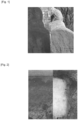
- Fig.1 presents part of a sculpture before and after treatment according to the rules of the art with freshly prepared gel 15-155.
- Tables 2 Characteristics of gel 15-155 over time: Time T0 2 months Appearance gelled Gelled pH 6 3-4 %APA. 0.13 0.13 %H2O2 12.4 11.6
- EXAMPLE 2 Process according to the invention for preparing gel 15-189 from gel 15-155 and use of this gel for treating a marble surface.
- Fig.2 shows the detail of a marble surface before and after treatment with this gel.
- the oxidizing mixture (line 130) is added to 290 g of gelled preparation described in line 129.
- the pH is adjusted to 6 with 17.83 g of 8% acetic acid and 1.8 g of basic magnesium hydroxide.
- EXAMPLE 4 Gel 16-43OXY according to the invention and use for cleaning facades and biocide treatment of a limestone sculpture.
- the oxidizing mixture (line [0144]) is added to 200 g of the gelled preparation described in line [0143].
- the oxidizing mixture (line [0151]) is added to 200g of the gelled preparation described in line [0143].
- the oxidizing mixture (line [0167]) is added to 200g of the gelled preparation described in line [0166].
Landscapes
- Life Sciences & Earth Sciences (AREA)
- Wood Science & Technology (AREA)
- Environmental Sciences (AREA)
- Pest Control & Pesticides (AREA)
- Plant Pathology (AREA)
- Engineering & Computer Science (AREA)
- Zoology (AREA)
- Health & Medical Sciences (AREA)
- General Health & Medical Sciences (AREA)
- Dentistry (AREA)
- Agronomy & Crop Science (AREA)
- Chemical & Material Sciences (AREA)
- Chemical Kinetics & Catalysis (AREA)
- General Chemical & Material Sciences (AREA)
- Agricultural Chemicals And Associated Chemicals (AREA)
- Cosmetics (AREA)
Applications Claiming Priority (1)
| Application Number | Priority Date | Filing Date | Title |
|---|---|---|---|
| FR2303902A FR3147932A1 (fr) | 2023-04-19 | 2023-04-19 | Des gels stables faiblement dosés en acide peracétique pour l’application d’un traitement biocide sur les surfaces. |
Publications (1)
| Publication Number | Publication Date |
|---|---|
| EP4449865A1 true EP4449865A1 (de) | 2024-10-23 |
Family
ID=87035867
Family Applications (1)
| Application Number | Title | Priority Date | Filing Date |
|---|---|---|---|
| EP24170264.6A Pending EP4449865A1 (de) | 2023-04-19 | 2024-04-15 | Stabile gele mit geringer peressigsäure zur anwendung in biozider behandlung auf oberflächen |
Country Status (2)
| Country | Link |
|---|---|
| EP (1) | EP4449865A1 (de) |
| FR (1) | FR3147932A1 (de) |
Citations (5)
| Publication number | Priority date | Publication date | Assignee | Title |
|---|---|---|---|---|
| US20100159028A1 (en) * | 2008-12-18 | 2010-06-24 | Minntech Corporation | Sporicidal hand sanitizing lotion |
| WO2013096321A2 (en) * | 2011-12-19 | 2013-06-27 | Colgate-Palmolive Company | Peracid-generating compositions |
| BE1020399A5 (nl) * | 2012-07-04 | 2013-09-03 | Sylphar Nv | Nieuwe samenstelling voor het wit maken van tanden. |
| US9283202B2 (en) * | 2012-10-18 | 2016-03-15 | Chd Bioscience, Inc. | Stable peracid-containing compositions |
| FR3089753A1 (fr) | 2018-12-13 | 2020-06-19 | Cécile Franc | Des gels bi-composants pour l’application contrôlée d’un traitement oxydant sur les surfaces |
-
2023
- 2023-04-19 FR FR2303902A patent/FR3147932A1/fr active Pending
-
2024
- 2024-04-15 EP EP24170264.6A patent/EP4449865A1/de active Pending
Patent Citations (5)
| Publication number | Priority date | Publication date | Assignee | Title |
|---|---|---|---|---|
| US20100159028A1 (en) * | 2008-12-18 | 2010-06-24 | Minntech Corporation | Sporicidal hand sanitizing lotion |
| WO2013096321A2 (en) * | 2011-12-19 | 2013-06-27 | Colgate-Palmolive Company | Peracid-generating compositions |
| BE1020399A5 (nl) * | 2012-07-04 | 2013-09-03 | Sylphar Nv | Nieuwe samenstelling voor het wit maken van tanden. |
| US9283202B2 (en) * | 2012-10-18 | 2016-03-15 | Chd Bioscience, Inc. | Stable peracid-containing compositions |
| FR3089753A1 (fr) | 2018-12-13 | 2020-06-19 | Cécile Franc | Des gels bi-composants pour l’application contrôlée d’un traitement oxydant sur les surfaces |
Also Published As
| Publication number | Publication date |
|---|---|
| FR3147932A1 (fr) | 2024-10-25 |
Similar Documents
| Publication | Publication Date | Title |
|---|---|---|
| EP0133827B1 (de) | Filmbildende Zusammensetzungen zur Umhüllung von pharmazeutischen Produkten oder Nahrungsmitteln in fester Form und mit diesen Zusammensetzungen erhaltene überzogene Produkte | |
| EP3077491B1 (de) | Verwendung eines alkalischen oxidierenden gels zum entfernen eines biofilms auf der oberfläche eines festkörpersubstrats | |
| EP0570413A1 (de) | Feuerlösch- und brandschutzmittel. | |
| EP0079836A1 (de) | Zusammensetzungen auf der Basis von wasserlöslichen Gummis, ihre Herstellung und Verwendung | |
| BE1023894B1 (fr) | Composition comprenant au moins un composant détergent et au moins un composant enzymatique pour l'élimination de biofilms | |
| EP0658596B1 (de) | Zusammensetzung auf Basis von Biopolymeren mit schneller Hydratation | |
| UA82609C2 (uk) | Інсектицидна дисперсія, яка містить гідрофобний діоксид кремнію, спосіб її одержання та спосіб боротьби з комахами | |
| EP4449865A1 (de) | Stabile gele mit geringer peressigsäure zur anwendung in biozider behandlung auf oberflächen | |
| FR2510870A1 (fr) | Suspensions aqueuses concentrees a base de neburon | |
| EP0244315A1 (de) | Verfahren zur Herstellung einer wässrigen pharmazeutischen Lösung einer organischen Säure als Wirkstoff | |
| CN1946373A (zh) | 吸汗化妆制品及其制备方法 | |
| EP0370911A1 (de) | Konzentrierte flüssige Lösungen von Polysacchariden | |
| FR2702930A1 (fr) | Iodophores perfectionnés, leur production et leur utilisation. | |
| IE51355B1 (en) | Concentrated aqueous metal aldonate and/or ammonium aldonate composition | |
| FR3089753A1 (fr) | Des gels bi-composants pour l’application contrôlée d’un traitement oxydant sur les surfaces | |
| EP2037896B1 (de) | Brausegranulat oder brausegranulatmaterial | |
| JP4324346B2 (ja) | 有機酸製剤 | |
| WO2011012709A2 (fr) | Composition désinfectante | |
| EP1035836B1 (de) | Zusammensetzung enthaltend ein enzym und einen stabilisator für dieses enzym und prozess um die stabilität des enzyms zu verbessern, seinen abbau zu verhindern, um es zu schützen und/oder um es zu immobilisieren | |
| CA1174970A (en) | Insecticidal compositions | |
| CA2872706A1 (fr) | Compositions d'agent fixatif, granules d'engrais, et procedes de fabrication et leurs utilisations | |
| JP5605772B2 (ja) | 有機液体吸収剤及びオイルゲルの製造方法 | |
| JP2000144177A (ja) | トイレ洗浄用固形剤 | |
| EP0799568A1 (de) | Desinfektionsmittel, deren Herstellung und damit impregnierter Träger | |
| FR3088074A1 (fr) | Composition detergente et kit pour la preparation de lessives |
Legal Events
| Date | Code | Title | Description |
|---|---|---|---|
| PUAI | Public reference made under article 153(3) epc to a published international application that has entered the european phase |
Free format text: ORIGINAL CODE: 0009012 |
|
| STAA | Information on the status of an ep patent application or granted ep patent |
Free format text: STATUS: THE APPLICATION HAS BEEN PUBLISHED |
|
| AK | Designated contracting states |
Kind code of ref document: A1 Designated state(s): AL AT BE BG CH CY CZ DE DK EE ES FI FR GB GR HR HU IE IS IT LI LT LU LV MC ME MK MT NL NO PL PT RO RS SE SI SK SM TR |
|
| STAA | Information on the status of an ep patent application or granted ep patent |
Free format text: STATUS: REQUEST FOR EXAMINATION WAS MADE |
|
| 17P | Request for examination filed |
Effective date: 20250410 |
|
| STAA | Information on the status of an ep patent application or granted ep patent |
Free format text: STATUS: EXAMINATION IS IN PROGRESS |
|
| 17Q | First examination report despatched |
Effective date: 20260323 |