EP4446148A1 - Fahrzeug, ausgestattet mit mindestens einem solarpanel, einem superkondensator und einem system zur rückgewinnung kinetischer energie - Google Patents
Fahrzeug, ausgestattet mit mindestens einem solarpanel, einem superkondensator und einem system zur rückgewinnung kinetischer energie Download PDFInfo
- Publication number
- EP4446148A1 EP4446148A1 EP23167366.6A EP23167366A EP4446148A1 EP 4446148 A1 EP4446148 A1 EP 4446148A1 EP 23167366 A EP23167366 A EP 23167366A EP 4446148 A1 EP4446148 A1 EP 4446148A1
- Authority
- EP
- European Patent Office
- Prior art keywords
- electric machine
- supercapacitor
- vehicle according
- solar panel
- vehicle
- Prior art date
- Legal status (The legal status is an assumption and is not a legal conclusion. Google has not performed a legal analysis and makes no representation as to the accuracy of the status listed.)
- Pending
Links
Images


Classifications
-
- B—PERFORMING OPERATIONS; TRANSPORTING
- B60—VEHICLES IN GENERAL
- B60L—PROPULSION OF ELECTRICALLY-PROPELLED VEHICLES; SUPPLYING ELECTRIC POWER FOR AUXILIARY EQUIPMENT OF ELECTRICALLY-PROPELLED VEHICLES; ELECTRODYNAMIC BRAKE SYSTEMS FOR VEHICLES IN GENERAL; MAGNETIC SUSPENSION OR LEVITATION FOR VEHICLES; MONITORING OPERATING VARIABLES OF ELECTRICALLY-PROPELLED VEHICLES; ELECTRIC SAFETY DEVICES FOR ELECTRICALLY-PROPELLED VEHICLES
- B60L15/00—Methods, circuits, or devices for controlling the traction-motor speed of electrically-propelled vehicles
- B60L15/20—Methods, circuits, or devices for controlling the traction-motor speed of electrically-propelled vehicles for control of the vehicle or its driving motor to achieve a desired performance, e.g. speed, torque, programmed variation of speed
- B60L15/2054—Methods, circuits, or devices for controlling the traction-motor speed of electrically-propelled vehicles for control of the vehicle or its driving motor to achieve a desired performance, e.g. speed, torque, programmed variation of speed by controlling transmissions or clutches
-
- B—PERFORMING OPERATIONS; TRANSPORTING
- B60—VEHICLES IN GENERAL
- B60L—PROPULSION OF ELECTRICALLY-PROPELLED VEHICLES; SUPPLYING ELECTRIC POWER FOR AUXILIARY EQUIPMENT OF ELECTRICALLY-PROPELLED VEHICLES; ELECTRODYNAMIC BRAKE SYSTEMS FOR VEHICLES IN GENERAL; MAGNETIC SUSPENSION OR LEVITATION FOR VEHICLES; MONITORING OPERATING VARIABLES OF ELECTRICALLY-PROPELLED VEHICLES; ELECTRIC SAFETY DEVICES FOR ELECTRICALLY-PROPELLED VEHICLES
- B60L50/00—Electric propulsion with power supplied within the vehicle
- B60L50/40—Electric propulsion with power supplied within the vehicle using propulsion power supplied by capacitors
-
- B—PERFORMING OPERATIONS; TRANSPORTING
- B60—VEHICLES IN GENERAL
- B60K—ARRANGEMENT OR MOUNTING OF PROPULSION UNITS OR OF TRANSMISSIONS IN VEHICLES; ARRANGEMENT OR MOUNTING OF PLURAL DIVERSE PRIME-MOVERS IN VEHICLES; AUXILIARY DRIVES FOR VEHICLES; INSTRUMENTATION OR DASHBOARDS FOR VEHICLES; ARRANGEMENTS IN CONNECTION WITH COOLING, AIR INTAKE, GAS EXHAUST OR FUEL SUPPLY OF PROPULSION UNITS IN VEHICLES
- B60K1/00—Arrangement or mounting of electrical propulsion units
-
- B—PERFORMING OPERATIONS; TRANSPORTING
- B60—VEHICLES IN GENERAL
- B60K—ARRANGEMENT OR MOUNTING OF PROPULSION UNITS OR OF TRANSMISSIONS IN VEHICLES; ARRANGEMENT OR MOUNTING OF PLURAL DIVERSE PRIME-MOVERS IN VEHICLES; AUXILIARY DRIVES FOR VEHICLES; INSTRUMENTATION OR DASHBOARDS FOR VEHICLES; ARRANGEMENTS IN CONNECTION WITH COOLING, AIR INTAKE, GAS EXHAUST OR FUEL SUPPLY OF PROPULSION UNITS IN VEHICLES
- B60K16/00—Arrangements in connection with power supply of propulsion units in vehicles from forces of nature, e.g. sun or wind
-
- B—PERFORMING OPERATIONS; TRANSPORTING
- B60—VEHICLES IN GENERAL
- B60K—ARRANGEMENT OR MOUNTING OF PROPULSION UNITS OR OF TRANSMISSIONS IN VEHICLES; ARRANGEMENT OR MOUNTING OF PLURAL DIVERSE PRIME-MOVERS IN VEHICLES; AUXILIARY DRIVES FOR VEHICLES; INSTRUMENTATION OR DASHBOARDS FOR VEHICLES; ARRANGEMENTS IN CONNECTION WITH COOLING, AIR INTAKE, GAS EXHAUST OR FUEL SUPPLY OF PROPULSION UNITS IN VEHICLES
- B60K20/00—Arrangement or mounting of change-speed gearing control devices in vehicles
-
- B—PERFORMING OPERATIONS; TRANSPORTING
- B60—VEHICLES IN GENERAL
- B60K—ARRANGEMENT OR MOUNTING OF PROPULSION UNITS OR OF TRANSMISSIONS IN VEHICLES; ARRANGEMENT OR MOUNTING OF PLURAL DIVERSE PRIME-MOVERS IN VEHICLES; AUXILIARY DRIVES FOR VEHICLES; INSTRUMENTATION OR DASHBOARDS FOR VEHICLES; ARRANGEMENTS IN CONNECTION WITH COOLING, AIR INTAKE, GAS EXHAUST OR FUEL SUPPLY OF PROPULSION UNITS IN VEHICLES
- B60K6/00—Arrangement or mounting of plural diverse prime-movers for mutual or common propulsion, e.g. hybrid propulsion systems comprising electric motors and internal combustion engines
- B60K6/20—Arrangement or mounting of plural diverse prime-movers for mutual or common propulsion, e.g. hybrid propulsion systems comprising electric motors and internal combustion engines the prime-movers consisting of electric motors and internal combustion engines, e.g. HEVs
- B60K6/42—Arrangement or mounting of plural diverse prime-movers for mutual or common propulsion, e.g. hybrid propulsion systems comprising electric motors and internal combustion engines the prime-movers consisting of electric motors and internal combustion engines, e.g. HEVs characterised by the architecture of the hybrid electric vehicle
- B60K6/48—Parallel type
-
- B—PERFORMING OPERATIONS; TRANSPORTING
- B60—VEHICLES IN GENERAL
- B60L—PROPULSION OF ELECTRICALLY-PROPELLED VEHICLES; SUPPLYING ELECTRIC POWER FOR AUXILIARY EQUIPMENT OF ELECTRICALLY-PROPELLED VEHICLES; ELECTRODYNAMIC BRAKE SYSTEMS FOR VEHICLES IN GENERAL; MAGNETIC SUSPENSION OR LEVITATION FOR VEHICLES; MONITORING OPERATING VARIABLES OF ELECTRICALLY-PROPELLED VEHICLES; ELECTRIC SAFETY DEVICES FOR ELECTRICALLY-PROPELLED VEHICLES
- B60L7/00—Electrodynamic brake systems for vehicles in general
- B60L7/10—Dynamic electric regenerative braking
-
- B—PERFORMING OPERATIONS; TRANSPORTING
- B60—VEHICLES IN GENERAL
- B60L—PROPULSION OF ELECTRICALLY-PROPELLED VEHICLES; SUPPLYING ELECTRIC POWER FOR AUXILIARY EQUIPMENT OF ELECTRICALLY-PROPELLED VEHICLES; ELECTRODYNAMIC BRAKE SYSTEMS FOR VEHICLES IN GENERAL; MAGNETIC SUSPENSION OR LEVITATION FOR VEHICLES; MONITORING OPERATING VARIABLES OF ELECTRICALLY-PROPELLED VEHICLES; ELECTRIC SAFETY DEVICES FOR ELECTRICALLY-PROPELLED VEHICLES
- B60L8/00—Electric propulsion with power supply from forces of nature, e.g. sun or wind
- B60L8/003—Converting light into electric energy, e.g. by using photo-voltaic systems
-
- B—PERFORMING OPERATIONS; TRANSPORTING
- B60—VEHICLES IN GENERAL
- B60K—ARRANGEMENT OR MOUNTING OF PROPULSION UNITS OR OF TRANSMISSIONS IN VEHICLES; ARRANGEMENT OR MOUNTING OF PLURAL DIVERSE PRIME-MOVERS IN VEHICLES; AUXILIARY DRIVES FOR VEHICLES; INSTRUMENTATION OR DASHBOARDS FOR VEHICLES; ARRANGEMENTS IN CONNECTION WITH COOLING, AIR INTAKE, GAS EXHAUST OR FUEL SUPPLY OF PROPULSION UNITS IN VEHICLES
- B60K6/00—Arrangement or mounting of plural diverse prime-movers for mutual or common propulsion, e.g. hybrid propulsion systems comprising electric motors and internal combustion engines
- B60K6/20—Arrangement or mounting of plural diverse prime-movers for mutual or common propulsion, e.g. hybrid propulsion systems comprising electric motors and internal combustion engines the prime-movers consisting of electric motors and internal combustion engines, e.g. HEVs
- B60K6/42—Arrangement or mounting of plural diverse prime-movers for mutual or common propulsion, e.g. hybrid propulsion systems comprising electric motors and internal combustion engines the prime-movers consisting of electric motors and internal combustion engines, e.g. HEVs characterised by the architecture of the hybrid electric vehicle
- B60K6/48—Parallel type
- B60K2006/4808—Electric machine connected or connectable to gearbox output shaft
-
- B—PERFORMING OPERATIONS; TRANSPORTING
- B60—VEHICLES IN GENERAL
- B60K—ARRANGEMENT OR MOUNTING OF PROPULSION UNITS OR OF TRANSMISSIONS IN VEHICLES; ARRANGEMENT OR MOUNTING OF PLURAL DIVERSE PRIME-MOVERS IN VEHICLES; AUXILIARY DRIVES FOR VEHICLES; INSTRUMENTATION OR DASHBOARDS FOR VEHICLES; ARRANGEMENTS IN CONNECTION WITH COOLING, AIR INTAKE, GAS EXHAUST OR FUEL SUPPLY OF PROPULSION UNITS IN VEHICLES
- B60K16/00—Arrangements in connection with power supply of propulsion units in vehicles from forces of nature, e.g. sun or wind
- B60K2016/003—Arrangements in connection with power supply of propulsion units in vehicles from forces of nature, e.g. sun or wind solar power driven
-
- B—PERFORMING OPERATIONS; TRANSPORTING
- B60—VEHICLES IN GENERAL
- B60L—PROPULSION OF ELECTRICALLY-PROPELLED VEHICLES; SUPPLYING ELECTRIC POWER FOR AUXILIARY EQUIPMENT OF ELECTRICALLY-PROPELLED VEHICLES; ELECTRODYNAMIC BRAKE SYSTEMS FOR VEHICLES IN GENERAL; MAGNETIC SUSPENSION OR LEVITATION FOR VEHICLES; MONITORING OPERATING VARIABLES OF ELECTRICALLY-PROPELLED VEHICLES; ELECTRIC SAFETY DEVICES FOR ELECTRICALLY-PROPELLED VEHICLES
- B60L2210/00—Converter types
- B60L2210/10—DC to DC converters
-
- B—PERFORMING OPERATIONS; TRANSPORTING
- B60—VEHICLES IN GENERAL
- B60L—PROPULSION OF ELECTRICALLY-PROPELLED VEHICLES; SUPPLYING ELECTRIC POWER FOR AUXILIARY EQUIPMENT OF ELECTRICALLY-PROPELLED VEHICLES; ELECTRODYNAMIC BRAKE SYSTEMS FOR VEHICLES IN GENERAL; MAGNETIC SUSPENSION OR LEVITATION FOR VEHICLES; MONITORING OPERATING VARIABLES OF ELECTRICALLY-PROPELLED VEHICLES; ELECTRIC SAFETY DEVICES FOR ELECTRICALLY-PROPELLED VEHICLES
- B60L2240/00—Control parameters of input or output; Target parameters
- B60L2240/40—Drive Train control parameters
- B60L2240/42—Drive Train control parameters related to electric machines
- B60L2240/423—Torque
-
- H—ELECTRICITY
- H02—GENERATION; CONVERSION OR DISTRIBUTION OF ELECTRIC POWER
- H02S—GENERATION OF ELECTRIC POWER BY CONVERSION OF INFRARED RADIATION, VISIBLE LIGHT OR ULTRAVIOLET LIGHT, e.g. USING PHOTOVOLTAIC [PV] MODULES
- H02S10/00—PV power plants; Combinations of PV energy systems with other systems for the generation of electric power
- H02S10/40—Mobile PV generator systems
Definitions
- the disclosure relates generally to energy consumption reduction.
- the disclosure relates to a vehicle equipped with at least one solar panel and a kinetic energy recovery system.
- the disclosure can be applied to any vehicle equipped with a drive shaft. This includes the trucks, certain utility vehicles, boats and some passenger cars, caravans, buses, and construction equipment, among other vehicle types.
- the disclosure may be described with respect to a truck, the disclosure is not restricted to any particular vehicle.
- KERS Kinetic Energy Recovery Systems
- HEVs Hybrid Electric Vehicles
- the most known system consists of having an electric machine that can apply a resistive torque, thereby having the double advantage of acting as a brake and recovering the kinetic energy by storing it into a reservoir for later use under acceleration.
- the reservoir to which it is referred to is most often a Lithium-ion battery, e.g. a 48V battery or 600 V battery depending on the degree of hybridization. In the end, this allows to reduce fuel consumption.
- the KERS On trucks and utility vehicles, the KERS consists in an electric machine fitted on transmission shaft.
- the electric machine can produce a magnetic field that can slow down the rotation of transmission shaft or add an additional torque depending on the use case.
- a vehicle comprising:
- the first aspect of the disclosure may seek to reduce fuel consumption.
- a technical benefit may include providing additional power to the electric motor using solar energy whenever positive torque is needed and offering another recharging solution for the supercapacitor whenever a null or negative torque is requested.
- the controller directs the energy of solar panel(s) to the electric machine, thereby operating as a motor, whenever torque demand is positive.
- the electric machine receives, in addition to the energy generated by supercapacitor discharge, some power from solar panel(s), thereby reducing the torque to be delivered by prime mover and therefore fuel consumption.
- torque demand is defined either manually by the driver or automatically by Cruise Control.
- the controller directs the energy of solar panel(s) to the supercapacitor whenever torque demand is negative or null.
- a technical benefit may be that solar power can be used to recharge supercapacitor whenever deceleration is requested. Supercapacitor recharge is then quicker and can store a maximum/optimal amount of energy. Solar power is therefore never wasted.
- the vehicle further includes a DC/DC converter to adapt the output voltage of the solar panel(s) to the input voltage of the electric machine or supercapacitor.
- the electric machine operates as a generator whenever torque demand is null or negative, thereby storing energy inside the supercapacitor.
- the electric machine operates as a motor whenever torque demand is positive and energy is available inside supercapacitor.
- the prime mover takes over the electric machine whenever supercapacitor is empty.
- the prime mover is controlled to compensate for the electric machine in order to reach said torque demand, consisting of the addition of the torque delivered by the electric machine and the torque delivered by prime mover.
- the electric machine includes a stator portion fixed to the vehicle chassis and a rotor portion that is coaxially fitted around the transmission shaft.
- a technical benefit may be that the KERS can be fitted on basically any vehicle provided with a transmission shaft, thereby providing a simple way to convert a thermal vehicle into a Hybrid Electric Vehicle (HEV).
- HEV Hybrid Electric Vehicle
- the vehicle further comprises a gearbox arranged between prime mover and transmission shaft.
- the electric machine is a DC motor-generator, e.g. a Brushless DC motor-generator.
- a technical benefit may be that the electric machine is easy to control, efficient and robust.
- the transmission shaft is a propeller shaft extending from a gearbox to a differential of a rear wheel axle.
- Figure 1 represents a heavy-duty vehicle 2, in particular a truck.
- the vehicle 2 comprises a prime mover 4 which, in the example, is an internal combustion engine.
- the prime mover 4 could be an electric motor or a hydraulic motor. Therefore, the vehicle can be a Hybrid Electric Vehicle (HEV) or Battery Electric Vehicle (BEV). Hydraulic motors are used for moving construction equipment and other special vehicles.
- HEV Hybrid Electric Vehicle
- BEV Battery Electric Vehicle Hydraulic motors are used for moving construction equipment and other special vehicles.
- the vehicle 2 includes a cab 16 mounted on a chassis 14 made of two longitudinal steel beams.
- the prime mover 4 engages preferably with a gearbox 6 from which extends a transmission shaft 8 (a.k.a "drive shaft” or “propeller shaft”).
- a transmission shaft 8 (a.k.a "drive shaft” or “propeller shaft”).
- drive shaft 8 extends between the gearbox 6 and a differential 10 of an axle 18 which, in the specific example of Figure 1 (and as it is usual on heavy-duty vehicles), is the rear axle.
- drive shaft could also engage front axle, meaning that the vehicle of the disclosure can be a Front Wheel Drive (FWD) vehicle (traction), a Rear Wheel Drive (RWD) vehicle (propulsion) or an All-Wheel Drive (AWD) Vehicle.
- FWD Front Wheel Drive
- RWD Rear Wheel Drive
- ATD All-Wheel Drive
- the vehicle includes a transfer box.
- transmission shaft could transmit a torque to a different organ, such as boat propeller.
- Gearbox is optional: Indeed, some BEVs do not include a gearbox. In such configuration, electric motor directly engages with drive shaft. Also, gearbox could be replaced by a Continuous Variable Transmission (CVT).
- CVT Continuous Variable Transmission
- the vehicle 2 also includes a Kinetic Energy Recuperation System (KERS), including an electric machine 12 fitted on the transmission shaft and a supercapacitor 20 for recovering the braking energy delivered by the electric machine 12.
- KERS Kinetic Energy Recuperation System
- SC supercapacitor 20
- SC is a high-capacity capacitor, with a capacitance value much higher than other capacitors but with lower voltage limits.
- One advantage is that it can accept and deliver charge much faster than batteries and tolerates many more charge and discharge cycles than rechargeable batteries.
- the whole point of having a supercapacitor instead of a Lithium-ion battery is that it can restitute a high level of power/energy within a very short time period. As a result, it is particularly useful for acceleration phases where fuel consumption is usually at its highest level. On the contrary, a battery is designed to deliver energy within a higher period of time, and therefore increase the vehicle's range.
- the supercapacitor 20 is mainly used to provide bursts of power and/or to achieve faster initial acceleration, resulting in a fuel consumption reduction.
- the electric machine 12 to which it is referred to above is a Direct-Current (DC) reversible motor.
- DC Direct-Current
- 'reversible' it is meant that it can be operated as a motor or a generator.
- this machine can be a Brushless DC motor (BLDC).
- BLDC Brushless DC motor
- the electric machine could also be an AC electric machine.
- the electric machine 12 includes a rotor that is hollow and that is coaxially fitted around transmission shaft.
- the electric machine also includes a stator portion that is fixed to the vehicle chassis 14.
- the electric machine and supercapacitor can be added to any thermal vehicle equipped with a transmission shaft, which constitutes a good and cheap retrofit solution to convert/transform a thermal vehicle into a Hybrid Electric Vehicle (HEV).
- HEV Hybrid Electric Vehicle
- Stator portion and rotor portion of the electric machine have been represented on Figure 1 with different pattern fill.
- stator portion is made of a plurality of windings.
- Rotor portion could be a permanent magnet to be fixed or fastened around drive shaft 8. In variant, it could also be made of windings.
- Figure 1 represents a 6 by 2 truck (6*2) in which the torque is only transmitted to rear wheels but obviously the disclosure can be applied to any other configuration, e.g. 8 by 4.
- the vehicle 2 also includes at least one solar panel (not shown).
- the vehicle includes a plurality of solar panels that are installed on the roof of the cab 16, preferably on deflector.
- the solar panel(s) are inclined to capture the maximum of solar rays.
- the solar panel(s) is connected to the electric machine 12 and to the supercapacitor 20. As a result, the energy captured by the solar panel(s) can be used for driving the electric machine or recharging supercapacitor.
- the total power of the solar panel(s) is at least of 2,5 kW.
- the vehicle 2 can be provided with two set of solar panels oriented in opposite directions (front and rear for example) to ensure that at least one of the two sets of solar panel(s) gets maximum sun rays.
- a commutation device is provided to transfer solar power to the electric motor or supercapacitor.
- said commutation device is Double Pole Double Throw (DPDT) switch.
- DPDT Double Pole Double Throw
- This switch enables to transfer solar power either to the electric machine, thereby operating as a motor or to the supercapacitor, thereby recharging it.
- Such switching element is known from one skilled in the art, which is why it is not detailed further herein.
- a H-bridge (well-known from one specialized in electronics) is used to connect the supercapacitor to the rest of the architecture.
- the supercapacitor is at the center of the bridge. This H-bridge advantageously enables to reverse the direction of current flowing through the supercapacitor depending on whether it gets charged or discharged.
- the vehicle includes a DC/DC converter in order to adapt the output voltage of the solar panel(s) to the input voltage of the electric machine 12 or supercapacitor 20.
- An on-board controller which can also be known as an Electronic Control Unit (ECU) is configured to direct the energy captured by the solar panel(s) either to the electric machine or to the supercapacitor as a function of the torque demand/request.
- This controller can be the one included into the KERS or another vehicle controller, such as engine ECU.
- Torque demand corresponds to the torque to be applied on transmission shaft in order to accelerate or decelerate a vehicle.
- the driver depresses the throttle, and therefore requests a torque that increases from 0 N.m to some value depending on how far the driver has pushed on acceleration pedal. In such configuration, torque demand to be applied on the drive shaft is positive.
- Torque demand gets negative when the driver hit the brake pedal. Indeed, in such configuration, the electric machine to which it is referred to above switches in generator mode. As a result, it generates a magnetic flux that slows down the rotation of drive shaft. A flow of current is generated within stator windings and such energy is stored inside the supercapacitor. As for the throttle, torque demand, in absolute value, increases from 0 N.m to some value depending on how far the driver depressed the brake pedal.
- Cm represents the torque demand, that can be either positive or negative as a function of the intention of the driver (accelerate or decelerate).
- Cr represents the resistive torque, which encompasses resistive moments in relation to road adherence, loading, gravity, engine brake, etc.
- CICE is the torque delivered by the prime mover
- Csc is the proportion of the torque applied by the electric machine that derives from energy supplied by the supercapacitor
- Csolar is the proportion of the torque applied by the electric machine that derives from energy supplied by the solar panel(s).
- the discharge of supercapacitor generates a high inflow of current/intensity inside the windings of the stator and the torque Csc to which it is referred to is proportional to that current value.
- the solar panel(s) The energy contained inside the sun rays in converted into a DC current that is sent to the stator windings, thereby applying a torque directly proportional to that current value.
- the throttle to which it is referred to above is an acceleration pedal.
- it could be any other control element, such as a lever (especially for boats).
- brake control The brake control element is not necessarily a brake pedal.
- the controller directs the energy of solar panel(s) to the electric machine 12, thereby operating as a motor, whenever torque demand is positive (acceleration is requested).
- the voltage generated by the solar panel(s) is converted by the DC/DC converter and an electric current is sent through the electric machine, thereby operating it as a motor.
- a positive torque is transmitted to drive shaft, in addition to that already provided by the prime mover.
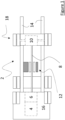
- FIG. 2 Shows on Figure 2 represent the direction of the flow of current (electrons).
- current delivered by the solar panel(s) flows through the electric motor.
- current originating from the discharge of supercapacitor also flows through the electric motor, meaning that the amount of current flowing inside the stator windings corresponds to the sum of the current provided by the solar panel(s) and the one delivered by the supercapacitor.
- Torque demand is set up either manually through the throttle or automatically by Cruise Control (if the vehicle is equipped with such function).
- the controller directs the energy of solar panel(s) to the supercapacitor whenever torque demand is negative or null (deceleration is requested).
- This is the example/configuration of figure 4.
- the controller/ECU to which it is referred to above controls the commutation device so as to divert the flow of current towards the supercapacitor, thereby bypassing the electric machine.
- the electric machine switches to generator mode, thereby slowing down the drive shaft and creating electrical energy that is stored inside supercapacitor.
- FIG. 3 represent the direction of the flow of current (electrons).
- current delivered by the solar panel(s) bypasses the electric machine and flows through the supercapacitor, thereby charging it.
- current originating from the generator also flows through the supercapacitor, meaning that the amount of current absorbed by the supercapacitor corresponds to the sum of the current provided by the solar panel(s) and the one delivered by the generator.
- the configuration in which torque demand is null can be a situation in which the driver has released the throttle but did not hit the brake. It can also correspond to a situation in which, while Cruise control is activated, the vehicle rolls on a downhill slope, thereby eliminating the need of any torque to be applied for keeping the speed constant/steady (cruising conditions). As a result, the action of releasing the throttle is interpreted as a wish or intention of the driver to decelerate.
- supercapacitor gets recharged by recovering the current generated inside the stator windings.
- the electric machine operates as a generator whenever torque demand is null or negative, thereby decelerating the vehicle and storing kinetic energy inside the supercapacitor.
- the following example consists of a vehicle traveling at a stabilized speed of 90 km/h, wherein the energy delivered by the engine is about 10,75 kW per Liter for a fuel consumption of about 28L per 100 km. In one hour, about 25,2 Liter of fuel (Diesel) will be burned. This corresponds to a total power of 270,9 kW/h. Then, considering that the solar panel(s) provides 2,5 kW/h, this represents a fuel economy of 1% (more or less), which is not unsignificant.
- Example 1 a vehicle is provided, said vehicle comprising:
- Example 2 The vehicle according to Example 1, wherein the controller directs the energy of solar panel(s) to the electric machine, thereby operating as a motor, whenever torque demand is positive.
- Example 3 The vehicle according to Example 1 or 2, wherein torque demand is defined either manually by the driver or automatically by Cruise Control.
- Example 4 The vehicle according to any previously listed Example, wherein the controller directs the energy of solar panel(s) to the supercapacitor whenever torque demand is negative or null.
- Example 5 The vehicle according to any previously listed Example, further including a DC/DC converter to adapt the output voltage of the solar panel(s) to the input voltage of the electric machine or supercapacitor.
- Example 6 The vehicle according to any previously listed Example, wherein the electric machine operates as a generator whenever torque demand is null or negative, thereby storing energy inside the supercapacitor.
- Example 7 The vehicle according to any previously listed Example, wherein the electric machine operates as a motor whenever torque demand is positive and energy is available inside supercapacitor.
- Example 8 The vehicle according to any previously listed Example, wherein the prime mover takes over the electric machine whenever supercapacitor is empty.
- Example 9 The vehicle according to any previously listed Example, wherein the prime mover is controlled to compensate for the electric machine in order to reach said torque demand, consisting of the addition of the torque delivered by the electric machine and the torque delivered by prime mover.
- Example 10 The vehicle according to any previously listed Example, wherein the electric machine includes a stator portion fixed to the vehicle chassis and a rotor portion that is coaxially fitted around the transmission shaft.
- Example 11 The vehicle according to any previously listed Example, wherein the vehicle further comprises a gearbox arranged between prime mover and transmission shaft.
- Example 12 The vehicle according to any previously listed Example, wherein the electric machine is a DC motor-generator, e.g. a Brushless DC motor-generator.
- the electric machine is a DC motor-generator, e.g. a Brushless DC motor-generator.
- a technical benefit may be that the electric machine is easy to control, efficient and robust.
- Example 13 The vehicle according to any previously listed Example, wherein the transmission shaft to which it is referred to is a propeller shaft extending from a gearbox to a differential of a rear wheel axle.
- Relative terms such as “below” or “above” or “upper” or “lower” or “horizontal” or “vertical” may be used herein to describe a relationship of one element to another element as illustrated in the Figures. It will be understood that these terms and those discussed above are intended to encompass different orientations of the device in addition to the orientation depicted in the Figures. It will be understood that when an element is referred to as being “connected” or “coupled” to another element, it can be directly connected or coupled to the other element, or intervening elements may be present. In contrast, when an element is referred to as being “directly connected” or “directly coupled” to another element, there are no intervening elements present.
Landscapes
- Engineering & Computer Science (AREA)
- Transportation (AREA)
- Mechanical Engineering (AREA)
- Power Engineering (AREA)
- Chemical & Material Sciences (AREA)
- Combustion & Propulsion (AREA)
- Electric Propulsion And Braking For Vehicles (AREA)
Priority Applications (2)
| Application Number | Priority Date | Filing Date | Title |
|---|---|---|---|
| EP23167366.6A EP4446148A1 (de) | 2023-04-11 | 2023-04-11 | Fahrzeug, ausgestattet mit mindestens einem solarpanel, einem superkondensator und einem system zur rückgewinnung kinetischer energie |
| US18/630,401 US20240343128A1 (en) | 2023-04-11 | 2024-04-09 | Vehicle equipped with at least one solar panel and a kinetic energy recovery system |
Applications Claiming Priority (1)
| Application Number | Priority Date | Filing Date | Title |
|---|---|---|---|
| EP23167366.6A EP4446148A1 (de) | 2023-04-11 | 2023-04-11 | Fahrzeug, ausgestattet mit mindestens einem solarpanel, einem superkondensator und einem system zur rückgewinnung kinetischer energie |
Publications (1)
| Publication Number | Publication Date |
|---|---|
| EP4446148A1 true EP4446148A1 (de) | 2024-10-16 |
Family
ID=86006639
Family Applications (1)
| Application Number | Title | Priority Date | Filing Date |
|---|---|---|---|
| EP23167366.6A Pending EP4446148A1 (de) | 2023-04-11 | 2023-04-11 | Fahrzeug, ausgestattet mit mindestens einem solarpanel, einem superkondensator und einem system zur rückgewinnung kinetischer energie |
Country Status (2)
| Country | Link |
|---|---|
| US (1) | US20240343128A1 (de) |
| EP (1) | EP4446148A1 (de) |
Citations (5)
| Publication number | Priority date | Publication date | Assignee | Title |
|---|---|---|---|---|
| US20050252696A1 (en) * | 2004-05-17 | 2005-11-17 | Kaufman Jay S | Motor vehicle energy recovery, storage, transfer and consumption system |
| WO2009086135A2 (en) * | 2007-12-19 | 2009-07-09 | Erlston Lester J | Kinetic energy recovery and electric drive for vehicles |
| WO2010019784A2 (en) * | 2008-08-14 | 2010-02-18 | General Electric Company | Vehicle, system and method |
| US20130306389A1 (en) * | 2012-05-21 | 2013-11-21 | Krassimire Penev | Self rechargeable synergy drive for a motor vehicle |
| US20140228168A1 (en) * | 2013-02-08 | 2014-08-14 | Efficient Drivetrains Inc. | Powertrain configurations for single-motor, two-clutch hybrid electric vehicles |
-
2023
- 2023-04-11 EP EP23167366.6A patent/EP4446148A1/de active Pending
-
2024
- 2024-04-09 US US18/630,401 patent/US20240343128A1/en active Pending
Patent Citations (5)
| Publication number | Priority date | Publication date | Assignee | Title |
|---|---|---|---|---|
| US20050252696A1 (en) * | 2004-05-17 | 2005-11-17 | Kaufman Jay S | Motor vehicle energy recovery, storage, transfer and consumption system |
| WO2009086135A2 (en) * | 2007-12-19 | 2009-07-09 | Erlston Lester J | Kinetic energy recovery and electric drive for vehicles |
| WO2010019784A2 (en) * | 2008-08-14 | 2010-02-18 | General Electric Company | Vehicle, system and method |
| US20130306389A1 (en) * | 2012-05-21 | 2013-11-21 | Krassimire Penev | Self rechargeable synergy drive for a motor vehicle |
| US20140228168A1 (en) * | 2013-02-08 | 2014-08-14 | Efficient Drivetrains Inc. | Powertrain configurations for single-motor, two-clutch hybrid electric vehicles |
Also Published As
| Publication number | Publication date |
|---|---|
| US20240343128A1 (en) | 2024-10-17 |
Similar Documents
| Publication | Publication Date | Title |
|---|---|---|
| US5345154A (en) | Electric continuously variable transmission and controls for operation of a heat engine in a closed-loop power-control mode | |
| US8195348B2 (en) | Driving power control apparatus for four wheel drive vehicle | |
| CN103043056B (zh) | 控制车轮轴扭矩的方法和用于其的控制系统 | |
| EP2371646B1 (de) | Vorrichtung zur Steuerung des Hybridantriebsdrehmoments | |
| US7958960B2 (en) | Driving force control apparatus for a vehicle that drives wheel units independently | |
| US7681676B2 (en) | Electric hybrid vehicle conversion | |
| US8727051B2 (en) | Hybrid vehicle | |
| CA2836671C (en) | Hybrid vehicle | |
| KR101248694B1 (ko) | 하이브리드 차량의 작동 방법 | |
| JP2005512498A (ja) | 車両の走行速度を調整するための装置及び方法 | |
| US20080308328A1 (en) | Low cost conversion of any internal combustion vehicle into plug-in hybrid electric vehicle | |
| EP2125414B1 (de) | Energieverwaltung von zusatzeinrichtungen von hybridfahrzeugen | |
| CN202896272U (zh) | 一种新型混联式混合动力汽车 | |
| JP2010058579A (ja) | ハイブリッド車両 | |
| US20120018236A1 (en) | Electric powertrain for off-highway trucks | |
| CN102991334B (zh) | 四驱混合动力汽车的驱动系统及驱动方法 | |
| CN101966810B (zh) | 一种用于汽车的基于轮毂电机混联驱动系统 | |
| JP3685924B2 (ja) | ハイブリッド車両の制御装置 | |
| JP2001206084A (ja) | ハイブリッド自動車 | |
| JPH07264708A (ja) | 車輌の減速エネルギー回生システム | |
| EP4446148A1 (de) | Fahrzeug, ausgestattet mit mindestens einem solarpanel, einem superkondensator und einem system zur rückgewinnung kinetischer energie | |
| EP3891001B1 (de) | Hochgeschwindigkeitsbetrieb einer elektrischen maschine | |
| CN212604467U (zh) | 商用车弱混系统 | |
| CN113787901A (zh) | 一种混合动力驱动系统及起重机 | |
| JP2002514880A (ja) | 電気駆動装置を備えた自動車を制御する方法 |
Legal Events
| Date | Code | Title | Description |
|---|---|---|---|
| PUAI | Public reference made under article 153(3) epc to a published international application that has entered the european phase |
Free format text: ORIGINAL CODE: 0009012 |
|
| STAA | Information on the status of an ep patent application or granted ep patent |
Free format text: STATUS: THE APPLICATION HAS BEEN PUBLISHED |
|
| AK | Designated contracting states |
Kind code of ref document: A1 Designated state(s): AL AT BE BG CH CY CZ DE DK EE ES FI FR GB GR HR HU IE IS IT LI LT LU LV MC ME MK MT NL NO PL PT RO RS SE SI SK SM TR |
|
| STAA | Information on the status of an ep patent application or granted ep patent |
Free format text: STATUS: REQUEST FOR EXAMINATION WAS MADE |
|
| 17P | Request for examination filed |
Effective date: 20241028 |
|
| RBV | Designated contracting states (corrected) |
Designated state(s): AL AT BE BG CH CY CZ DE DK EE ES FI FR GB GR HR HU IE IS IT LI LT LU LV MC ME MK MT NL NO PL PT RO RS SE SI SK SM TR |