EP4435915A2 - Elektrodenanordnung, elektrochemische vorrichtung und elektrische vorrichtung - Google Patents
Elektrodenanordnung, elektrochemische vorrichtung und elektrische vorrichtung Download PDFInfo
- Publication number
- EP4435915A2 EP4435915A2 EP24164467.3A EP24164467A EP4435915A2 EP 4435915 A2 EP4435915 A2 EP 4435915A2 EP 24164467 A EP24164467 A EP 24164467A EP 4435915 A2 EP4435915 A2 EP 4435915A2
- Authority
- EP
- European Patent Office
- Prior art keywords
- section
- dissociative
- electrode
- electrode plate
- wall
- Prior art date
- Legal status (The legal status is an assumption and is not a legal conclusion. Google has not performed a legal analysis and makes no representation as to the accuracy of the status listed.)
- Pending
Links
- 239000013543 active substance Substances 0.000 claims abstract description 93
- 239000011888 foil Substances 0.000 claims abstract description 59
- 230000007423 decrease Effects 0.000 claims description 8
- 239000000853 adhesive Substances 0.000 description 25
- 230000001070 adhesive effect Effects 0.000 description 25
- 229910052751 metal Inorganic materials 0.000 description 22
- 239000002184 metal Substances 0.000 description 22
- 238000005520 cutting process Methods 0.000 description 20
- 238000003466 welding Methods 0.000 description 11
- 238000000034 method Methods 0.000 description 9
- 238000010586 diagram Methods 0.000 description 8
- 238000000926 separation method Methods 0.000 description 7
- 238000004804 winding Methods 0.000 description 7
- 238000004080 punching Methods 0.000 description 6
- PXHVJJICTQNCMI-UHFFFAOYSA-N Nickel Chemical compound [Ni] PXHVJJICTQNCMI-UHFFFAOYSA-N 0.000 description 4
- 230000009286 beneficial effect Effects 0.000 description 4
- 238000005336 cracking Methods 0.000 description 4
- 239000011267 electrode slurry Substances 0.000 description 4
- 239000000463 material Substances 0.000 description 4
- BASFCYQUMIYNBI-UHFFFAOYSA-N platinum Chemical compound [Pt] BASFCYQUMIYNBI-UHFFFAOYSA-N 0.000 description 4
- 230000007704 transition Effects 0.000 description 4
- RYGMFSIKBFXOCR-UHFFFAOYSA-N Copper Chemical compound [Cu] RYGMFSIKBFXOCR-UHFFFAOYSA-N 0.000 description 2
- RTAQQCXQSZGOHL-UHFFFAOYSA-N Titanium Chemical compound [Ti] RTAQQCXQSZGOHL-UHFFFAOYSA-N 0.000 description 2
- 229910052782 aluminium Inorganic materials 0.000 description 2
- XAGFODPZIPBFFR-UHFFFAOYSA-N aluminium Chemical compound [Al] XAGFODPZIPBFFR-UHFFFAOYSA-N 0.000 description 2
- 230000015572 biosynthetic process Effects 0.000 description 2
- 238000000576 coating method Methods 0.000 description 2
- 229910052802 copper Inorganic materials 0.000 description 2
- 239000010949 copper Substances 0.000 description 2
- 230000000694 effects Effects 0.000 description 2
- 238000005516 engineering process Methods 0.000 description 2
- 238000004519 manufacturing process Methods 0.000 description 2
- 239000000155 melt Substances 0.000 description 2
- 229910052759 nickel Inorganic materials 0.000 description 2
- 229910052697 platinum Inorganic materials 0.000 description 2
- -1 polyethylene Polymers 0.000 description 2
- 230000000717 retained effect Effects 0.000 description 2
- 229910052715 tantalum Inorganic materials 0.000 description 2
- GUVRBAGPIYLISA-UHFFFAOYSA-N tantalum atom Chemical compound [Ta] GUVRBAGPIYLISA-UHFFFAOYSA-N 0.000 description 2
- 229910052719 titanium Inorganic materials 0.000 description 2
- 239000010936 titanium Substances 0.000 description 2
- 229910052727 yttrium Inorganic materials 0.000 description 2
- 239000004698 Polyethylene Substances 0.000 description 1
- 239000004743 Polypropylene Substances 0.000 description 1
- 238000004140 cleaning Methods 0.000 description 1
- 238000004146 energy storage Methods 0.000 description 1
- 230000014509 gene expression Effects 0.000 description 1
- 239000011521 glass Substances 0.000 description 1
- 238000002844 melting Methods 0.000 description 1
- 230000008018 melting Effects 0.000 description 1
- 238000012986 modification Methods 0.000 description 1
- 230000004048 modification Effects 0.000 description 1
- 239000002985 plastic film Substances 0.000 description 1
- 229920006255 plastic film Polymers 0.000 description 1
- 229920006267 polyester film Polymers 0.000 description 1
- 229920000573 polyethylene Polymers 0.000 description 1
- 229920001721 polyimide Polymers 0.000 description 1
- 229920001155 polypropylene Polymers 0.000 description 1
Images



Classifications
-
- H—ELECTRICITY
- H01—ELECTRIC ELEMENTS
- H01M—PROCESSES OR MEANS, e.g. BATTERIES, FOR THE DIRECT CONVERSION OF CHEMICAL ENERGY INTO ELECTRICAL ENERGY
- H01M4/00—Electrodes
- H01M4/02—Electrodes composed of, or comprising, active material
- H01M4/64—Carriers or collectors
- H01M4/70—Carriers or collectors characterised by shape or form
-
- H—ELECTRICITY
- H01—ELECTRIC ELEMENTS
- H01M—PROCESSES OR MEANS, e.g. BATTERIES, FOR THE DIRECT CONVERSION OF CHEMICAL ENERGY INTO ELECTRICAL ENERGY
- H01M10/00—Secondary cells; Manufacture thereof
- H01M10/04—Construction or manufacture in general
- H01M10/0431—Cells with wound or folded electrodes
-
- H—ELECTRICITY
- H01—ELECTRIC ELEMENTS
- H01M—PROCESSES OR MEANS, e.g. BATTERIES, FOR THE DIRECT CONVERSION OF CHEMICAL ENERGY INTO ELECTRICAL ENERGY
- H01M10/00—Secondary cells; Manufacture thereof
- H01M10/05—Accumulators with non-aqueous electrolyte
- H01M10/058—Construction or manufacture
- H01M10/0587—Construction or manufacture of accumulators having only wound construction elements, i.e. wound positive electrodes, wound negative electrodes and wound separators
-
- H—ELECTRICITY
- H01—ELECTRIC ELEMENTS
- H01M—PROCESSES OR MEANS, e.g. BATTERIES, FOR THE DIRECT CONVERSION OF CHEMICAL ENERGY INTO ELECTRICAL ENERGY
- H01M50/00—Constructional details or processes of manufacture of the non-active parts of electrochemical cells other than fuel cells, e.g. hybrid cells
- H01M50/50—Current conducting connections for cells or batteries
- H01M50/531—Electrode connections inside a battery casing
-
- H—ELECTRICITY
- H01—ELECTRIC ELEMENTS
- H01M—PROCESSES OR MEANS, e.g. BATTERIES, FOR THE DIRECT CONVERSION OF CHEMICAL ENERGY INTO ELECTRICAL ENERGY
- H01M50/00—Constructional details or processes of manufacture of the non-active parts of electrochemical cells other than fuel cells, e.g. hybrid cells
- H01M50/50—Current conducting connections for cells or batteries
- H01M50/531—Electrode connections inside a battery casing
- H01M50/533—Electrode connections inside a battery casing characterised by the shape of the leads or tabs
-
- Y—GENERAL TAGGING OF NEW TECHNOLOGICAL DEVELOPMENTS; GENERAL TAGGING OF CROSS-SECTIONAL TECHNOLOGIES SPANNING OVER SEVERAL SECTIONS OF THE IPC; TECHNICAL SUBJECTS COVERED BY FORMER USPC CROSS-REFERENCE ART COLLECTIONS [XRACs] AND DIGESTS
- Y02—TECHNOLOGIES OR APPLICATIONS FOR MITIGATION OR ADAPTATION AGAINST CLIMATE CHANGE
- Y02E—REDUCTION OF GREENHOUSE GAS [GHG] EMISSIONS, RELATED TO ENERGY GENERATION, TRANSMISSION OR DISTRIBUTION
- Y02E60/00—Enabling technologies; Technologies with a potential or indirect contribution to GHG emissions mitigation
- Y02E60/10—Energy storage using batteries
-
- Y—GENERAL TAGGING OF NEW TECHNOLOGICAL DEVELOPMENTS; GENERAL TAGGING OF CROSS-SECTIONAL TECHNOLOGIES SPANNING OVER SEVERAL SECTIONS OF THE IPC; TECHNICAL SUBJECTS COVERED BY FORMER USPC CROSS-REFERENCE ART COLLECTIONS [XRACs] AND DIGESTS
- Y02—TECHNOLOGIES OR APPLICATIONS FOR MITIGATION OR ADAPTATION AGAINST CLIMATE CHANGE
- Y02P—CLIMATE CHANGE MITIGATION TECHNOLOGIES IN THE PRODUCTION OR PROCESSING OF GOODS
- Y02P70/00—Climate change mitigation technologies in the production process for final industrial or consumer products
- Y02P70/50—Manufacturing or production processes characterised by the final manufactured product
Definitions
- This application relates to the technical field of energy storage, in particular to an electrode assembly, an electrochemical apparatus and an electrical device.
- the electrode assembly of the wound cell includes an electrode plate and an electrode tab connected to the electrode plate.
- the method for the connection between the electrode tab and the electrode plate is usually to remove the active substance layer on the electrode plate to obtain an empty foil area in which the current collector is exposed, and to weld the electrode tab to the empty foil area. Since the electrode tab itself occupies a certain thickness, in a case that the active substance layer on the electrode plate is thin, the electrode tab may go beyond the electrode plate in the thickness direction, resulting in low space utilization rate of the electrode assembly in the thickness direction.
- Some embodiments of this application provide an electrode assembly, including a first electrode tab, a first electrode plate, a second electrode plate and a separator, the separator being located between the first electrode plate and the second electrode plate, the first electrode plate, the separator and the second electrode plate being stacked and wound, the first electrode plate including a first current collector and a first active substance layer, the first current collector including a first section, a second section and a third section, a surface of the first section being at least partially provided with the first active substance layer, a surface of the second section being at least partially provided with the first active substance layer; along a first direction, the third section being located between the first section and the second section; along a second direction, the third section including a first dissociative portion and a first connection portion connected sequentially, the first connection portion connecting the first section and the second section; along the first direction, one side of the first dissociative portion being dissociated from the first section, the side of the first dissociative portion opposite to the first section being dissociated from the second section; the first
- the first dissociative portion is dissociated from the first section and the second section, which is conducive to making the first dissociative portion move along the third direction relative to the first section and the second section, thus improving the moving distance of the first electrode tab along the third direction relative to the first section and the second section, enabling the first electrode tab to not go beyond the first active substance layer of the first section and the second section in the third direction, and improving the spatial utilization rate of the electrode component in the third direction.
- the first electrode tab is connected to the first dissociative portion and the first dissociative portion is dissociated from the first section and the second section, which is conducive to reducing the deformation of the third section when the first dissociative portion moves along the third direction, thus reducing the risk that the first active substance layer at the boundary of the area without the first active substance layer and the area with the first active substance layer is separated from the first current collector.
- a first gap is provided between the first dissociative portion and the first section, and a second gap is provided between the first dissociative portion and the second section.
- the first dissociative portion is dissociated from the first section through the first gap and the first dissociative portion is dissociated from the second section through the second gap, which is conducive to reducing the cut-off part of the first electrode plate and increasing the retained part of the first electrode plate, thus improving the energy density of the electrode assembly.
- the first gap and the second gap both extend along the second direction.
- the first gap and the second gap both extend along the second direction, which is conducive to making the shape of the first dissociative portion more regular, thus facilitating the connection between the first electrode tab and the first empty foil area of the first dissociative portion.
- an extension direction of the first gap and an extension direction of the second gap are both inclined relative to the second direction; along the second direction, a distance between the first gap and the first electrode tab in the first direction gradually decreases, and a distance between the second gap and the first electrode tab in the first direction gradually decreases.
- the distance between the first gap and the first electrode tab in the first direction gradually decreases, and the distance between the second gap and the first electrode tab in the first direction gradually decreases, which is conducive to reducing the risk that the separation tool such as cutting knife or punching head interferes with the first electrode tab adhesive in the process of forming the first gap and the second gap.
- a projection of the first electrode tab on the first electrode plate has a length of Wi along the second direction, and along the second direction, a length of the first dissociative portion is W 2 , which satisfies W 1 /2 ⁇ W 2 ⁇ 3W 1 /2.
- W 1 and W 2 satisfy W 1 /2 ⁇ W 2 ⁇ 3W 1 /2, which is conducive to making the moving distance of the first dissociative portion along the third direction satisfy the requirement that the first electrode tab moves to a position in the third direction without going beyond the first active substance layer of the first section and the second section, and also to reducing the risk that the third section is separated from the first section and the second section since the length of the first gap and the second gap along the second direction is too large.
- the first dissociative portion has a first wall facing to the first section, the first section has a second wall facing to the first dissociative portion, a third wall is connected between the first wall and the second wall, and along the first direction, the distance between the first wall and the second wall is D 1 , which satisfies W 2 ⁇ D 1 ⁇ W 2 /20.
- a gap is formed between the first dissociative portion and the first section.
- D 1 and W 2 are enabled to satisfy W 2 ⁇ D 1 ⁇ W 2 /20, which is conducive to reducing the risk of cracking at the third wall due to stress concentration at the third wall since D 1 is too small.
- D 1 is not too large, which is conducive to reducing the risk that the part of the first electrode plate originally provided with the first active substance layer is removed, thus improving the energy density of the electrode assembly.
- the first dissociative portion has a first wall facing to the first section, the first section has a second wall facing to the first dissociative portion, a third wall is connected between the first wall and the second wall, and the third wall is a concave arc-shaped wall.
- the third wall is a concave arc-shaped wall, which is conducive to reducing the stress on the third wall, thus reducing the risk of cracking at the third wall.
- the distance between the first wall and the second wall is D 1
- a diameter corresponding to the third wall is T 1 , which satisfies D 1 ⁇ T 1 ⁇ 5D 1 .
- the diameter T 1 corresponding to the third walls satisfies D 1 ⁇ T 1 ⁇ 5D 1 , which can achieve the effect that the third wall is an arc-shaped wall, and is conducive to reducing the risk of stress concentration since the transition between the third wall and the first wall is not mild enough due to the excessive curvature of the third wall, or to reducing the risk of stress concentration since the transition between the third wall and the second wall is not mild enough.
- the first dissociative portion further has a collection layer area with the first active substance layer, and along the second direction, the collection layer area is located between the first connection portion and the first empty foil area.
- the provided collection layer area is conducive to increasing the area of the first active substance layer, thus improving the energy density of the electrode assembly.
- the collection layer area is provided between the first connection portion and the first empty foil area, rather than on the side of the first empty foil area facing to the first section or the side of the first empty foil area facing to the second section, thus reducing the risk that the first active substance layer in the collection layer area interferes with the movement of the first electrode tab in the third direction, and ensuring that the first electrode tab does not go beyond the first active substance layer of the first section and the second section in the third direction.
- the surface of the first section has a first side empty foil area without the first active substance layer, and along the first direction, the first side empty foil area is located on one side of the first empty foil area, and the first side empty foil area is dissociated from the first empty foil area.
- the first side empty foil area is provided, so that the two opposite sides of the part where the first dissociative portion is separated from the first section are not provided with the first active substance layer, thus reducing the risk that the first active substance layer interferes with the separation process, and facilitating the separation between the first dissociative portion and the first section.
- common methods such as cutting, punching and laser may be used to achieve the separation between the first dissociative portion and the first section.
- the first dissociative portion and the first connection portion are not provided with the first active substance layer.
- the first dissociative portion and the first connection portion are not provided with the first active substance layer, so that the first electrode tab can extend out of the first electrode plate along the second direction, thus making the same first electrode tab have two positions from which the polarity of the first electrode plate can be led out.
- this application further provides an electrochemical apparatus capable of improving energy density and reliability.
- Some embodiments of this application provide an electrochemical apparatus, including a housing and the electrode assembly in any one of the embodiments above, at least a portion of the electrode assembly being provided in the housing.
- the first electrode tab of the electrode assembly does not go beyond the first active substance layer of the first section and the second section in the third direction, thus improving the spatial utilization rate of the electrode assembly in the third direction, and improving the energy density of the electrochemical apparatus.
- the first dissociative portion is dissociated from the first section and the second section, which is conducive to reducing the deformation of the third section when the first dissociative portion moves along the third direction, thus reducing the risk that the first active substance layer at the boundary of the area without the first active substance layer and the area with the first active substance layer is separated from the first current collector, and improving the reliability of the electrochemical apparatus.
- this application further provides an electrical device capable of improving the use duration after charging and the service life.
- Some embodiments of this application provide an electrical device, including a device main body and the electrochemical apparatus in any one of the embodiments above, the electrochemical apparatus being mounted to the device main body.
- the energy density and reliability of the electrochemical apparatus are improved, which is conducive to improving the use duration after charging and the service life of the electrical device, and reducing the failure rate of the electrical device.
- an electrode assembly includes a first electrode tab, and a first electrode plate, a second electrode plate and a separator which are wound.
- the first electrode plate includes a first section, a second section and a third section.
- the third section includes a first dissociative portion and a first connection portion connected sequentially,
- one side of the first dissociative portion is dissociated from the first section, the side of the first dissociative portion opposite to the first section is dissociated from the second section, and a first empty foil area on the first dissociative portion is connected with the first electrode tab.
- the first dissociative portion being dissociated from the first section and the second section is conducive to increasing the moving distance of the first electrode tab along the third direction relative to the first section and the second section, so that the first electrode tab does not go beyond the first active substance layer of the first section and the second section in the third direction, thus improving the spatial utilization rate of the electrode assembly in the third direction.
- the first dissociative portion being dissociated from the first section and the second section is conducive to reducing the deformation of the third section when the first dissociative portion moves along the third direction, thus reducing the risk that the first active substance layer at the boundary of the area without the first active substance layer and the area with the first active substance layer is separated from the first current collector.
- perpendicular is used to describe the ideal state between two components. In actual production or use, there may be an approximately perpendicular state between two components. For example, by describing in conjunction with numerical values, “perpendicular” may refer to that an included angle is between two straight lines is 90° ⁇ 10°, “perpendicular” may also refer to that a dihedral angle between two planes is 90° ⁇ 10°, and “perpendicular” may also refer to that an included angle between a straight line and a plane is 90° ⁇ 10°.
- the two components described as “perpendicular” may not be absolute straight lines or planes, but may be roughly straight lines or planes. From a macro perspective, if the overall extension direction is straight lines or planes, the components may be considered as "straight lines” or "planes".
- the electrode assembly includes a first electrode tab, a first electrode plate, a second electrode plate and a separator.
- the separator is located between the first electrode plate and the second electrode plate.
- the first electrode plate, the separator and the second electrode plate are stacked and wound.
- the first electrode plate includes a first current collector and a first active substance layer.
- the first current collector includes a first section, a second section and a third section. A surface of the first section is at least partially provided with the first active substance layer. A surface of the second section is at least partially provided with the first active substance layer.
- the third section is located between the first section and the second section.
- the third section includes a first dissociative portion and a first connection portion connected sequentially.
- the first connection portion connects the first section and the second section. Along the first direction, one side of the first dissociative portion is dissociated from the first section, and the side of the first dissociative portion opposite to the first section is dissociated from the second section.
- the first dissociative portion has a first empty foil area without the first active substance layer.
- One side of the first empty foil area in a third direction is connected to the first electrode tab.
- the third direction is a thickness direction of the first electrode plate. Every two of the third direction, the first direction and the second direction are perpendicular to each other.
- the first dissociative portion is dissociated from the first section and the second section, which is conducive to making the first dissociative portion move along the third direction relative to the first section and the second section, thus improving the moving distance of the first electrode tab along the third direction relative to the first section and the second section, enabling the first electrode tab to not go beyond the first active substance layer of the first section and the second section in the third direction, and improving the spatial utilization rate of the electrode assembly in the third direction.
- the first electrode tab is connected to the first dissociative portion and the first dissociative portion is dissociated from the first section and the second section, which is conducive to reducing the deformation of the third section when the first dissociative portion moves along the third direction, thus reducing the risk that the first active substance layer at the boundary of the area without the active substance layer and the area with the active substance layer is separated.
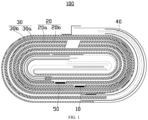
- the electrode assembly 100 includes a first electrode tab 10, a first electrode plate 20, a second electrode plate 30 and a separator 40.
- the separator 40 is located between the first electrode plate 20 and the second electrode plate 30.
- the first electrode plate 20, the separator 40 and the second electrode plate 30 are stacked and wound.
- the first electrode tab 10 is connected to the first electrode plate 20.
- the polarity of the first electrode tab 10 can be positive or negative, and the polarity of the first electrode tab 10 is the same as that of the first electrode plate 20.
- the first electrode tab 10 includes a first metal part 11 and a first electrode tab adhesive 12.
- the first metal part 11 is connected to the first electrode plate 20.
- the material of the first metal part 11 is the same as that of the first electrode plate 20.
- the first electrode tab adhesive 12 is coated on the first metal part 11.
- the first metal part 11 and the first electrode plate 20 are connected by welding.
- the welding method may be resistance welding, laser welding, arc welding or ultrasonic welding.
- the first electrode plate 20 may be a positive electrode plate or a negative electrode plate
- the second electrode plate 30 may be a positive electrode plate or a negative electrode plate
- the polarity of the first electrode plate 20 is opposite to that of the second electrode plate 30.
- the first electrode plate 20 is a positive electrode plate
- the second electrode plate 30 is a negative electrode plate
- the first electrode plate 20 is a negative electrode plate
- the second electrode plate 30 is a positive electrode plate.
- the first electrode plate 20 includes a first current collector 20a and a first active substance layer 20b.
- the first active substance layer 20b is provided on a surface of the first current collector 20a.
- the second electrode plate 30 includes a second current collector 30a and a second active substance layer 30b.
- the second active substance layer 30b is provided on a surface of the second current collector 30a.
- Each of the first current collector 20a and the second current collector 30a includes a metal layer.
- a material of the first active substance layer 20b is different from that of the second active substance layer 30b.
- the positive electrode plate may be combined onto a metal layer of at least one of aluminum, platinum, nickel, tantalum, titanium and the like by using positive electrode slurry.
- the positive electrode slurry combined onto the metal layer forms a positive electrode active substance layer.
- the negative electrode plate may be combined onto a metal layer of at least one of copper, platinum, nickel, tantalum, titanium and the like by using negative electrode slurry.
- the negative electrode slurry combined onto the metal layer forms a negative electrode active substance layer.
- the first electrode plate 20 is a positive electrode plate
- the first current collector 20a includes a metal aluminum layer
- the second electrode plate 30 is a negative electrode plate
- the second current collector 30a includes a metal copper layer.
- the first active substance layer 20b is coated on a surface of the first current collector 20a through a coating process
- the second active substance layer 30b is coated on a surface of the second current collector 30a through a coating process
- the separator 40 is provided between the first electrode plate 20 and the second electrode plate 30 to separate the first electrode plate 20 and the second electrode plate 30 with different polarities.
- the separator 40 is a film material that can insulate, such as a polyethylene film, a polypropylene film, a polyester film or a polyimide film, so as to separate the first electrode plate 20 and the second electrode plate 30.
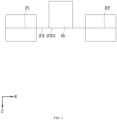
- the first current collector 20a includes a first section 21, a second section 22, and a third section 23.
- the third section 23 is located between the first section 21 and the second section 22.
- One of the first section 21 and the second section 22 serves as a starting section for the winding of the first electrode plate 20, while the other of the first section 21 and the second section 22 serves as an ending section for the winding of the first electrode plate 20.
- the surfaces of the first section 21 and the second section 22 are at least partially provided with the first active substance layer 20b.
- the third section 23 is connected to the first electrode tab 10.
- the third section 23 is provided with a first empty foil area 2311 without the first active substance layer 20b.
- the first empty foil area 2311 is connected to the first section 21 and the second section 22.
- the first electrode tab 10 is connected to the first empty foil area 2311.
- the first electrode tab 10 goes beyond the first active substance layer 20b of the first section 21 and the second section 22 along the thickness direction of the first electrode plate.
- the first electrode tab 10 is squeezed along the thickness direction of the first electrode plate, causing the first electrode tab 10 to move a certain distance along the thickness direction of the first electrode plate.
- the moving distance of the first electrode tab 10 is limited by the first section 21 and the second section 22, Therefore, the first electrode tab 10 still goes beyond the first active substance layer 20b of the first section 21 and the second section 22 along the thickness direction of the first electrode plate, and the movement of the first electrode tab 10 drives the deformation of the third section 23, which easily causes the first active substance layer 20b at the boundary of the first empty foil area 2311 to separate.
- the third section 23 includes a first dissociative portion 231 and a first connection portion 232 sequentially connected along a second direction Y.
- the first connection portion 232 connects the first section 21 and the second section 22.
- the third direction Z is a thickness direction of the first electrode plate.
- the surface of the first dissociative portion 231 has a first empty foil area 2311 without the first active substance layer 20b.
- One side of the first empty foil area 2311 in the third direction Z is connected with the first electrode tab 10, which is conducive to increasing the moving distance of the first electrode tab 10 along the third direction Z relative to the first section 21 and the second section 22.
- the first electrode tab 10 is squeezed along the third direction Z or in a direction opposite to the third direction Z, causing the first electrode tab 10 to move along the third direction Z until the first electrode tab 10 does not go beyond the first active substance layer 20b of the first section 21 and the second section 22 in the third direction Z.
- the first electrode tab 10 not going beyond the first active substance layer 20b of the first section 21 and the second section 22 in the third direction Z is conducive to improving the spatial utilization rate of the electrode assembly 100 in the third direction Z.
- first electrode tab 10 is connected to the first dissociative portion 231 and the first dissociative portion 231 is dissociated from the first section 21 and the second section 22, which is conducive to reducing the deformation of the third section 23 when the first dissociative portion 231 moves along the third direction Z, thus reducing the risk that the first active substance layer 20b at the boundary of the area without the first active substance layer 20b and the area with the first active substance layer 20b is separated from the first current collector 20a.
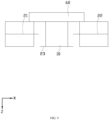
- a first gap 233 is provided between the first dissociative portion 231 and the first section 21, and a second gap 234 is provided between the first dissociative portion 231 and the second section 22.
- the first dissociative portion 231 is dissociated from the first section 21 through the first gap 233
- the first dissociative portion 231 is dissociated from the second section 22 through the second gap 234, which is conducive to reducing the cut-off part of the first electrode plate 20, increasing the retained part of the first electrode plate 20, and improving the energy density of the electrode assembly 100.
- the first gap 233 and the second gap 234 are formed by using a cutting knife 101 to cut the first electrode plate 20 along the second direction Y and cut off a part of the first electrode plate 20, so that the first gap 233 and the second gap 234 are formed in the first electrode plate 20.
- Cutting the first electrode plate 20 along the second direction Y is conducive to reducing the risk of deformation under stress when the first electrode plate 20 is cut.
- the first gap 233 and the second gap 234 are formed by using the cutting knife 101 to cut the first electrode plate 20 along a direction forming an included angle with the second direction Y and perpendicular to the third direction Z, and cut off a part of the first electrode plate 20, so that the first gap 233 and the second gap 234 are formed in the first electrode plate 20.
- Cutting the first electrode plate 20 in a direction forming an included angle with the second direction Y and perpendicular to the third direction Z is conducive to reducing the risk of deformation under stress when the first electrode plate 20 is cut.
- the first gap 233 and the second gap 234 are formed by using the cutting knife 101 to cut the first electrode plate 20 along the third direction Z, and cut off a part of the first electrode plate 20, so that the first gap 233 and the second gap 234 are formed in the first electrode plate 20.
- the first electrode tab 10 includes a first metal part 11 and a first electrode tab adhesive 12
- the first metal part 11 of the first electrode tab 10 is welded to the first electrode plate 20.
- the first electrode tab adhesive 12 is located on one side of the first electrode plate 20 along a direction opposite to the second direction Y. Cutting the first electrode plate 20 along the third direction Z is conducive to reducing the risk that the cutting knife 101 interferes with the first electrode tab adhesive 12 in the cutting process of the first gap 233 and the second gap 234.
- the cutting knife 101 is placed at a position to be dissociated of the first electrode plate 20, and the first electrode plate 20 is wound to wind the cutting knife 101 into the wound structure.
- the cutting knife 101 is extracted from the wound structure and cuts off a part of the first electrode plate 20, so that the first gap 233 and the second gap 234 are formed in the first electrode plate 20. Cutting the first electrode plate 20 after winding is conducive to reducing the risk that the cut-off part of the first electrode plate 20 punctures the separator 40 in the winding process.
- the first gap 233 and the second gap 234 are formed by using a laser emission tool to emit laser towards the first electrode plate 20 along the second direction Y, or in a direction forming an included angle with the second direction Y and perpendicular to the third direction Z.
- the laser melts a part of the first electrode plate 20, thus forming the first gap 233 and the second gap 234 in the first electrode plate 20.
- the first gap 233 and the second gap 234 are formed by using the laser emission tool to emit laser towards the first electrode plate 20 along the third direction Z, and then moving the laser emission tool along the second direction Y or in a direction forming an included angle with the second direction Y and perpendicular to the third direction Z.
- the laser melts a part of the first electrode plate 20, thus forming the first gap 233 and the second gap 234 in the first electrode plate 20.
- the methods for forming the first gap 233 and the second gap 234 are not limited to the method of cutting by using the cutting knife 101 and the laser melting method, and may be other methods such as punching that can form the first gap 233 and the second gap 234, which are omitted here.
- the first gap 233 and the second gap 234 both extend along the second direction Y, which is conducive to making the shape of the first dissociative portion 231 more regular, thus facilitating the connection between the first electrode tab 10 and the first empty foil area 2311 of the first dissociative portion 231.
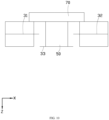
- an extension direction of the first gap 233 and an extension direction of the second gap 234 are both inclined relative to the second direction Y, and along the second direction Y, the distance between the first gap 233 and the first electrode tab 10 in the first direction X gradually decreases, and the distance between the second gap 234 and the first electrode tab 10 in the first direction X gradually decreases.
- the first electrode tab 10 includes a first metal part 11 and a first electrode tab adhesive 12
- the first metal part 11 of the first electrode tab 10 is welded to the first electrode plate 20.
- the first electrode tab adhesive 12 is located on one side of the first electrode plate 20.
- a projection of the first electrode tab 10 on the first electrode plate 20 has a length of Wi along the second direction Y, and along the second direction Y, the length of the first dissociative portion 231 is W 2 , which satisfies formula 1: W 1 /2 ⁇ W 2 ⁇ 3W 1 /2.
- the length W 2 of the first dissociative portion 231 along the second direction Y is equal to the length of the first gap 233 and the second gap 234 along the second direction Y.
- the first dissociative portion 231 has a first wall 2312 facing to the first section 21, the first section 21 has a second wall 211 facing to the first dissociative portion 231, and a third wall 24 is connected between the first wall 2312 and the second wall 211.
- the distance between the first wall 2312 and the second wall 211 is D 1 , which satisfies formula 2: W 2 ⁇ D 1 ⁇ W 2 /20.
- D 1 is conducive to reducing the risk of cracking at the third wall due to stress concentration at the third wall 24 since D 1 is too small.
- D 1 is not too large, which reduces the risk that the part of the first electrode plate 20 originally provided with the first active substance layer is removed, thus improving the energy density of the electrode assembly 100.
- the first dissociative portion 231 has a first wall 2312 facing to the first section 21, the first section 21 has a second wall 211 facing to the first dissociative portion 231, a third wall 24 is connected between the first wall 2312 and the second wall 211, and the third wall 24 is a concave arc-shaped wall.
- the third wall 24 being a concave arc-shaped wall is conducive to reducing the stress on the third wall 24, thus reducing the risk of cracking at the third wall 24.
- the distance between the first wall 2312 and the second wall 211 is D 1
- the diameter corresponding to the third wall 24 is T 1 , which satisfies formula 3: D 1 ⁇ T 1 ⁇ 5D 1 .
- the diameter T 1 corresponding to the third wall 24 satisfies formula 3
- the first dissociative portion 231 further has a collection layer area 2313 with the first active substance layer 20b, and along the second direction Y, the collection layer area 2313 is located between the first connection portion 232 and the first empty foil area 2311. Providing the collection layer area 2313 on the first dissociative portion 231 is conducive to increasing the area of the first active substance layer 20b, thus improving the energy density of the electrode assembly 100.
- the collection layer area 2313 is provided between the first connection portion 232 and the first empty foil area 2311, rather than on the side of the first empty foil area 2311 facing to the first section 21 or the side of the first empty foil area 2311 facing to the second section 22, thus reducing the risk that the first active substance layer 20b in the collection layer area 2313 interferes with the movement of the first electrode tab 10 in the third direction Z, and ensuring that the first electrode tab 10 does not go beyond the first active substance layer 20b of the first section 21 and the second section 22 in the third direction Z.
- the surface of the first section 21 has a first side empty foil area 212 without the first active substance layer 20b, and along the first direction X, the first side empty foil area 212 is located on one side of the first empty foil area 2311, and the first empty foil area 2311 is dissociated from the first side empty foil area 212.
- the first side empty foil area 212 is provided, so that the two opposite sides of the part where the first dissociative portion 231 is separated from the first section 21 are not provided with the first active substance layer 20b, thus reducing the risk that the first active substance layer 20b interferes with the separation tool such as the cutting knife 101 or punching head, and facilitating the formation of the first gap 233 and the second gap 234.
- the surface of the second section 22 has a second side empty foil area 221 without the first active substance layer 20b, and along the first direction X, the second side empty foil area 221 is located on one side of the first empty foil area 2311 opposite to the first side empty foil area 212, and the first empty foil area 2311 is dissociated from the second side empty foil area 221.
- the second side empty foil area 221 is provided, so that the two opposite sides of the part where the first dissociative portion 231 is separated from the second section 22 are not provided with the first active substance layer 20b, thus reducing the risk that the first active substance layer 20b interferes with the separation tool such as the cutting knife 101 or punching head, and facilitating the formation of the first gap 233 and the second gap 234.
- the first dissociative portion 231 and the first connection portion 232 are not provided with the first active substance layer 20b, so that the first electrode tab 10 can extend out of the first electrode plate 20 along the second direction Y, thus making the same first electrode tab 10 have two positions from which the polarity of the first electrode plate 20 can be led out.
- the electrode assembly 100 further includes a second electrode tab 50, and the second electrode tab 50 is connected to the second electrode plate 30.
- the polarity of the second electrode tab 50 may be positive or negative, and the polarity of the second electrode tab 50 is opposite to that of the first electrode tab 10.
- the first electrode tab 10 is a positive electrode tab
- the second electrode tab 50 is a negative electrode tab.
- the first electrode tab 10 is a negative electrode tab
- the second electrode tab 50 is a positive electrode tab.
- the second electrode tab 50 includes a second metal part 51 and a second electrode tab adhesive 52.
- the second metal part 51 is connected to the second electrode plate 30.
- the material of the second metal part 51 is the same as that of the second electrode plate 30.
- the second electrode tab adhesive 52 is coated on the second metal part 51.
- the second electrode tab 50 and the second electrode plate 30 are connected by welding such as resistance welding, laser welding, arc welding or ultrasonic welding.
- the second current collector 30a includes a fourth section 31, a fifth section 32 and a sixth section 33.
- the sixth section 33 is located between the fourth section 31 and the fifth section 32.
- One of the fourth section 31 and the fifth section 32 serves as a starting section for the winding of the second electrode plate 30, while the other of the fourth section 31 and the fifth section 32 serves as an ending section for the winding of the second electrode plate 30.
- Both the fourth section 31 and the fifth section 32 are at least partially provided with a second active substance layer 30b.
- the sixth section 33 is connected to the second electrode tab 50.
- the sixth section 33 includes a second dissociative portion 331 and a second connection portion 332 sequentially connected along the second direction Y.
- the second connection portion 332 connects the fourth section 31 and the fifth section 32.
- the second dissociative portion 331 has a second empty foil area 3311 without the second active substance layer 30b.
- One side of the second empty foil area 3311 in the third direction Z is connected to the second electrode tab 50.
- one side of the second dissociative portion 331 is dissociated from the fourth section 31, which is conducive to making the second dissociative portion 331 move along the third direction Z relative to the first section 21 and the second section 22, thus increasing the moving distance of the second electrode tab 50 along the third direction Z relative to the fourth section 31 and the fifth section 32.
- the second electrode tab 50 is squeezed along the third direction Z or in a direction opposite to the third direction Z, causing the second electrode tab 50 to move along the third direction Z until the second electrode tab 50 does not go beyond the second active substance layer 30b of the fourth section 31 and the fifth section 32 in the third direction Z.
- the second electrode tab 50 not going beyond the second active substance layer 30b of the fourth section 31 and the fifth section 32 in the third direction Z is conducive to improving the spatial utilization rate of the electrode assembly 100 in the third direction Z.
- the second electrode tab 50 is connected to the second dissociative portion 331 and the second dissociative portion 331 is dissociated from the fourth section 31 and the fifth section 32, which is conducive to reducing the deformation of the sixth section 33 when the second dissociative portion 331 moves along the third direction Z, thus reducing the risk that the second active substance layer 30b at the boundary of the area without the second active substance layer 30b and the area with the second active substance layer 30b is separated from the second current collector 30a.
- the electrode assembly 100 further includes a first insulating adhesive 60, the first insulating adhesive 60 is located on the side of the first electrode tab 10 opposite to the third section 23, and the first insulating adhesive 60 is connected to the first section 21, the second section 22 and the first electrode tab 10.
- the first insulating adhesive 60 pays a role of fixing the first electrode tab 10.
- the first insulating adhesive 60 can reduce the risk that the first electrode tab 10 damages the separator 40 or the second electrode plate 30.
- the electrode assembly 100 further includes a second insulating adhesive 70, the second insulating adhesive 70 is located on the side of the second electrode tab 50 opposite to the sixth section 33, and the second insulating adhesive 70 is connected to the fourth section 31, the fifth section 32 and the second electrode tab 50.
- the second insulating adhesive 70 plays a role of fixing the second electrode tab 50.
- the second insulating adhesive 70 can reduce the risk that the second electrode tab 50 damages the separator 40 or the first electrode plate 20.
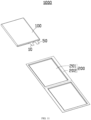
- An embodiment of this application further provides an electrochemical apparatus 1000.
- the electrochemical apparatus 1000 includes a housing 200 and the electrode assembly 100 in any one of the embodiments above. At least a portion of the electrode assembly 100 is provided in the housing 200.
- the first electrode tab 10 of the electrode assembly 100 does not go beyond the first active substance layer 20b of the first section 21 and the second section 22 in the third direction Z, thus improving the spatial utilization rate of the electrode assembly 100 in the third direction Z, and improving the energy density of the electrochemical apparatus 1000.
- the first dissociative portion 231 is dissociated from the first section 21 and the second section 22, which is conducive to reducing the deformation of the third section 23 when the first dissociative portion 231 moves along the third direction Z, thus reducing the risk that the first active substance layer 20b at the boundary of the area without the first active substance layer 20b and the area with the first active substance layer 20b is separated from the first current collector 20a, and improving the reliability of the electrochemical apparatus 1000.
- the housing 200 includes a first portion 201 and a second portion 202 extending outwards from the first portion 201.
- the wound structure formed by stacking and winding the first electrode plate 20, the separator 40 and the second electrode plate 30 is accommodated in the first portion 201.
- the first electrode tab 10 and the second electrode tab 50 extend out of the housing 200 from the second portion 202.
- the housing 200 includes an aluminum-plastic film
- the electrochemical apparatus 1000 includes a flexible battery.
- the electrochemical apparatus 1000 adopts the technical solution in any embodiment of the electrode assembly 100, it has at least the beneficial effects brought by the technical solution in any embodiment of the electrode assembly 100, which will not be repeated here.
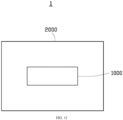
- An embodiment of this application further provide an electrical device 1.
- the electrical device 1 includes a device main body 2000 and the electrochemical apparatus 1000 in any one of the embodiments above.
- the electrochemical apparatus 1000 is mounted to the device main body 2000.
- the energy density and reliability of the electrochemical apparatus 1000 are improved, which is conducive to improving the use duration after charging and the service life of the electrical device 1, and reducing the failure rate of the electrical device 1.
- the electrical device 1 adopts the technical solution in any embodiment of the electrochemical apparatus 1000, it has at least the beneficial effects brought by the technical solution in any embodiment of the electrochemical apparatus 1000, which will not be repeated here.
- the electrical device 1 may be a smartphone, a laptop computer, head-mounted VR glasses, a smart bracelet, a drone, a cleaning robot, an electric car, an electric two-wheeled vehicle, an electric motorcycle, or a wireless vacuum cleaner.
Landscapes
- Chemical & Material Sciences (AREA)
- Chemical Kinetics & Catalysis (AREA)
- Electrochemistry (AREA)
- General Chemical & Material Sciences (AREA)
- Engineering & Computer Science (AREA)
- Manufacturing & Machinery (AREA)
- Battery Electrode And Active Subsutance (AREA)
- Connection Of Batteries Or Terminals (AREA)
- Secondary Cells (AREA)
- Electric Double-Layer Capacitors Or The Like (AREA)
Applications Claiming Priority (1)
| Application Number | Priority Date | Filing Date | Title |
|---|---|---|---|
| CN202310269177.0A CN115986330B (zh) | 2023-03-20 | 2023-03-20 | 电极组件、电化学装置以及用电设备 |
Publications (2)
| Publication Number | Publication Date |
|---|---|
| EP4435915A2 true EP4435915A2 (de) | 2024-09-25 |
| EP4435915A3 EP4435915A3 (de) | 2025-04-23 |
Family
ID=85966874
Family Applications (1)
| Application Number | Title | Priority Date | Filing Date |
|---|---|---|---|
| EP24164467.3A Pending EP4435915A3 (de) | 2023-03-20 | 2024-03-19 | Elektrodenanordnung, elektrochemische vorrichtung und elektrische vorrichtung |
Country Status (3)
| Country | Link |
|---|---|
| US (1) | US20240322189A1 (de) |
| EP (1) | EP4435915A3 (de) |
| CN (1) | CN115986330B (de) |
Families Citing this family (1)
| Publication number | Priority date | Publication date | Assignee | Title |
|---|---|---|---|---|
| CN116598674B (zh) * | 2023-07-03 | 2023-10-27 | 宁德新能源科技有限公司 | 二次电池及电化学装置 |
Family Cites Families (14)
| Publication number | Priority date | Publication date | Assignee | Title |
|---|---|---|---|---|
| CN207303263U (zh) * | 2017-03-12 | 2018-05-01 | 深圳格林德能源有限公司 | 一种快充聚合物锂离子电池电芯结构 |
| CN206697567U (zh) * | 2017-03-31 | 2017-12-01 | 宁德新能源科技有限公司 | 卷绕式电芯 |
| CN111740066B (zh) * | 2019-03-25 | 2023-05-12 | 宁德新能源科技有限公司 | 极片及具有所述极片的电极组件 |
| US20230076412A1 (en) * | 2020-01-20 | 2023-03-09 | Ningde Amperex Technology Limited | Electrode assembly and battery |
| CN112635774A (zh) * | 2020-12-24 | 2021-04-09 | 湖南立方新能源科技有限责任公司 | 一种纽扣电池用极片、纽扣电池及其制备方法 |
| CN214957264U (zh) * | 2021-03-02 | 2021-11-30 | 昆山宝创新能源科技有限公司 | 一种电芯及电池 |
| CN113054328B (zh) * | 2021-04-20 | 2025-11-04 | 珠海冠宇电池股份有限公司 | 一种极耳、极片及锂离子电池 |
| CN215869464U (zh) * | 2021-09-27 | 2022-02-18 | 珠海冠宇电池股份有限公司 | 极片组件和电池 |
| CN114094045A (zh) * | 2021-11-18 | 2022-02-25 | 珠海冠宇电池股份有限公司 | 极片和电池 |
| CN114583097A (zh) * | 2022-03-01 | 2022-06-03 | 珠海冠宇电池股份有限公司 | 极片、卷绕电芯以及电池 |
| CN218039277U (zh) * | 2022-06-27 | 2022-12-13 | 曙鹏科技(深圳)有限公司 | 一种电池极片及电池极片涂布装置 |
| CN217955938U (zh) * | 2022-07-25 | 2022-12-02 | 江苏正力新能电池技术有限公司 | 一种二次电池的电芯及二次电池 |
| CN217903385U (zh) * | 2022-09-14 | 2022-11-25 | 宁德时代新能源科技股份有限公司 | 电池单体、电池及用电装置 |
| CN115810879B (zh) * | 2022-12-31 | 2025-04-08 | 宁德新能源科技有限公司 | 电芯及用电设备 |
-
2023
- 2023-03-20 CN CN202310269177.0A patent/CN115986330B/zh active Active
-
2024
- 2024-03-19 EP EP24164467.3A patent/EP4435915A3/de active Pending
- 2024-03-19 US US18/609,069 patent/US20240322189A1/en active Pending
Also Published As
| Publication number | Publication date |
|---|---|
| CN115986330A (zh) | 2023-04-18 |
| CN115986330B (zh) | 2023-05-16 |
| US20240322189A1 (en) | 2024-09-26 |
| EP4435915A3 (de) | 2025-04-23 |
Similar Documents
| Publication | Publication Date | Title |
|---|---|---|
| CN113871762B (zh) | 电芯、电池、电芯的制造方法及电子设备 | |
| CN115224453B (zh) | 电池单体、电池、用电装置以及焊接设备 | |
| CN113611986B (zh) | 电芯、电池及电子设备 | |
| WO2023036267A1 (zh) | 电池极片、电池及电池极片的制作方法 | |
| CN213401441U (zh) | 电芯组件以及电池 | |
| CN111740066A (zh) | 极片及具有所述极片的电极组件 | |
| CN108807829B (zh) | 电芯及电化学装置 | |
| KR20140082585A (ko) | 내구성 향상을 위해 실링 마진을 가진 파우치형 이차 전지 | |
| WO2021073470A1 (zh) | 二次电池及其电极构件、电池模块和相关装置 | |
| WO2023131049A1 (zh) | 极片及电池 | |
| WO2024207972A1 (zh) | 电芯及用电设备 | |
| EP4435915A2 (de) | Elektrodenanordnung, elektrochemische vorrichtung und elektrische vorrichtung | |
| CN111799429B (zh) | 软包电池和软包电池的组装方法 | |
| CN106848385A (zh) | 一种多卷芯结构的动力软包锂离子电池 | |
| WO2024087957A1 (zh) | 卷绕式电芯、电池、电池组件及用电装置 | |
| EP3226338A1 (de) | Wickelzelle | |
| WO2023123274A1 (zh) | 极片、电极组件、电池、用电装置及极片的制作方法 | |
| US20240347785A1 (en) | Electrode core, battery apparatus, and electronic device | |
| CN216488280U (zh) | 一种具有新型电池盖板连接结构的电芯 | |
| CN113597709B (zh) | 电池和具有所述电池的电子装置 | |
| US20230061397A1 (en) | Cell, battery, manufacturing method of cell, and electronic device | |
| WO2024086971A1 (zh) | 圆柱电芯以及圆柱状二次电池 | |
| CN113661605B (zh) | 电化学装置和电子装置 | |
| WO2025201195A1 (zh) | 极片结构、极片制造方法及电化学装置 | |
| CN218039725U (zh) | 电池 |
Legal Events
| Date | Code | Title | Description |
|---|---|---|---|
| PUAI | Public reference made under article 153(3) epc to a published international application that has entered the european phase |
Free format text: ORIGINAL CODE: 0009012 |
|
| STAA | Information on the status of an ep patent application or granted ep patent |
Free format text: STATUS: REQUEST FOR EXAMINATION WAS MADE |
|
| 17P | Request for examination filed |
Effective date: 20240319 |
|
| AK | Designated contracting states |
Kind code of ref document: A2 Designated state(s): AL AT BE BG CH CY CZ DE DK EE ES FI FR GB GR HR HU IE IS IT LI LT LU LV MC ME MK MT NL NO PL PT RO RS SE SI SK SM TR |
|
| PUAL | Search report despatched |
Free format text: ORIGINAL CODE: 0009013 |
|
| AK | Designated contracting states |
Kind code of ref document: A3 Designated state(s): AL AT BE BG CH CY CZ DE DK EE ES FI FR GB GR HR HU IE IS IT LI LT LU LV MC ME MK MT NL NO PL PT RO RS SE SI SK SM TR |
|
| RIC1 | Information provided on ipc code assigned before grant |
Ipc: H01M 50/533 20210101ALI20250317BHEP Ipc: H01M 50/531 20210101ALI20250317BHEP Ipc: H01M 10/0587 20100101ALI20250317BHEP Ipc: H01M 10/04 20060101AFI20250317BHEP |