EP4435899A1 - Sekundärbatterieelektrodenisolationszusammensetzung mit verschiedenen bindemittelarten, herstellungsverfahren dafür und sekundärbatterieelektrode mit der isolationszusammensetzung - Google Patents
Sekundärbatterieelektrodenisolationszusammensetzung mit verschiedenen bindemittelarten, herstellungsverfahren dafür und sekundärbatterieelektrode mit der isolationszusammensetzung Download PDFInfo
- Publication number
- EP4435899A1 EP4435899A1 EP23846915.9A EP23846915A EP4435899A1 EP 4435899 A1 EP4435899 A1 EP 4435899A1 EP 23846915 A EP23846915 A EP 23846915A EP 4435899 A1 EP4435899 A1 EP 4435899A1
- Authority
- EP
- European Patent Office
- Prior art keywords
- aqueous
- secondary battery
- binder
- insulation composition
- battery electrode
- Prior art date
- Legal status (The legal status is an assumption and is not a legal conclusion. Google has not performed a legal analysis and makes no representation as to the accuracy of the status listed.)
- Pending
Links
Images


Classifications
-
- H—ELECTRICITY
- H01—ELECTRIC ELEMENTS
- H01M—PROCESSES OR MEANS, e.g. BATTERIES, FOR THE DIRECT CONVERSION OF CHEMICAL ENERGY INTO ELECTRICAL ENERGY
- H01M10/00—Secondary cells; Manufacture thereof
- H01M10/42—Methods or arrangements for servicing or maintenance of secondary cells or secondary half-cells
- H01M10/4235—Safety or regulating additives or arrangements in electrodes, separators or electrolyte
-
- H—ELECTRICITY
- H01—ELECTRIC ELEMENTS
- H01M—PROCESSES OR MEANS, e.g. BATTERIES, FOR THE DIRECT CONVERSION OF CHEMICAL ENERGY INTO ELECTRICAL ENERGY
- H01M4/00—Electrodes
- H01M4/02—Electrodes composed of, or comprising, active material
- H01M4/62—Selection of inactive substances as ingredients for active masses, e.g. binders, fillers
- H01M4/621—Binders
- H01M4/622—Binders being polymers
- H01M4/623—Binders being polymers fluorinated polymers
-
- H—ELECTRICITY
- H01—ELECTRIC ELEMENTS
- H01M—PROCESSES OR MEANS, e.g. BATTERIES, FOR THE DIRECT CONVERSION OF CHEMICAL ENERGY INTO ELECTRICAL ENERGY
- H01M10/00—Secondary cells; Manufacture thereof
- H01M10/05—Accumulators with non-aqueous electrolyte
- H01M10/052—Li-accumulators
-
- H—ELECTRICITY
- H01—ELECTRIC ELEMENTS
- H01M—PROCESSES OR MEANS, e.g. BATTERIES, FOR THE DIRECT CONVERSION OF CHEMICAL ENERGY INTO ELECTRICAL ENERGY
- H01M4/00—Electrodes
- H01M4/02—Electrodes composed of, or comprising, active material
- H01M4/13—Electrodes for accumulators with non-aqueous electrolyte, e.g. for lithium-accumulators; Processes of manufacture thereof
-
- H—ELECTRICITY
- H01—ELECTRIC ELEMENTS
- H01M—PROCESSES OR MEANS, e.g. BATTERIES, FOR THE DIRECT CONVERSION OF CHEMICAL ENERGY INTO ELECTRICAL ENERGY
- H01M4/00—Electrodes
- H01M4/02—Electrodes composed of, or comprising, active material
- H01M4/13—Electrodes for accumulators with non-aqueous electrolyte, e.g. for lithium-accumulators; Processes of manufacture thereof
- H01M4/139—Processes of manufacture
-
- H—ELECTRICITY
- H01—ELECTRIC ELEMENTS
- H01M—PROCESSES OR MEANS, e.g. BATTERIES, FOR THE DIRECT CONVERSION OF CHEMICAL ENERGY INTO ELECTRICAL ENERGY
- H01M4/00—Electrodes
- H01M4/02—Electrodes composed of, or comprising, active material
- H01M4/36—Selection of substances as active materials, active masses, active liquids
- H01M4/362—Composites
- H01M4/366—Composites as layered products
-
- H—ELECTRICITY
- H01—ELECTRIC ELEMENTS
- H01M—PROCESSES OR MEANS, e.g. BATTERIES, FOR THE DIRECT CONVERSION OF CHEMICAL ENERGY INTO ELECTRICAL ENERGY
- H01M4/00—Electrodes
- H01M4/02—Electrodes composed of, or comprising, active material
- H01M4/36—Selection of substances as active materials, active masses, active liquids
- H01M4/38—Selection of substances as active materials, active masses, active liquids of elements or alloys
- H01M4/381—Alkaline or alkaline earth metals elements
- H01M4/382—Lithium
-
- H—ELECTRICITY
- H01—ELECTRIC ELEMENTS
- H01M—PROCESSES OR MEANS, e.g. BATTERIES, FOR THE DIRECT CONVERSION OF CHEMICAL ENERGY INTO ELECTRICAL ENERGY
- H01M4/00—Electrodes
- H01M4/02—Electrodes composed of, or comprising, active material
- H01M4/62—Selection of inactive substances as ingredients for active masses, e.g. binders, fillers
-
- H—ELECTRICITY
- H01—ELECTRIC ELEMENTS
- H01M—PROCESSES OR MEANS, e.g. BATTERIES, FOR THE DIRECT CONVERSION OF CHEMICAL ENERGY INTO ELECTRICAL ENERGY
- H01M4/00—Electrodes
- H01M4/02—Electrodes composed of, or comprising, active material
- H01M2004/021—Physical characteristics, e.g. porosity, surface area
-
- H—ELECTRICITY
- H01—ELECTRIC ELEMENTS
- H01M—PROCESSES OR MEANS, e.g. BATTERIES, FOR THE DIRECT CONVERSION OF CHEMICAL ENERGY INTO ELECTRICAL ENERGY
- H01M4/00—Electrodes
- H01M4/02—Electrodes composed of, or comprising, active material
- H01M2004/026—Electrodes composed of, or comprising, active material characterised by the polarity
- H01M2004/028—Positive electrodes
-
- Y—GENERAL TAGGING OF NEW TECHNOLOGICAL DEVELOPMENTS; GENERAL TAGGING OF CROSS-SECTIONAL TECHNOLOGIES SPANNING OVER SEVERAL SECTIONS OF THE IPC; TECHNICAL SUBJECTS COVERED BY FORMER USPC CROSS-REFERENCE ART COLLECTIONS [XRACs] AND DIGESTS
- Y02—TECHNOLOGIES OR APPLICATIONS FOR MITIGATION OR ADAPTATION AGAINST CLIMATE CHANGE
- Y02E—REDUCTION OF GREENHOUSE GAS [GHG] EMISSIONS, RELATED TO ENERGY GENERATION, TRANSMISSION OR DISTRIBUTION
- Y02E60/00—Enabling technologies; Technologies with a potential or indirect contribution to GHG emissions mitigation
- Y02E60/10—Energy storage using batteries
Definitions
- the present invention relates to an insulation composition blended with heterogeneous binders, a manufacturing method thereof, and a secondary battery electrode including the insulation composition.
- a non-aqueous binder e.g., PVDF
- the insulating layer formed by a non-aqueous binder has a problem of poor adhesion (hereinafter referred to as wet adhesion) when impregnated with an electrolyte solution, which cannot prevent the migration of lithium ions to the overlay region of the electrode, resulting in the expression of capacity.
- aqueous binders such as styrene-butadiene rubber (SBR)
- SBR styrene-butadiene rubber
- water is used as a solvent in the process of preparing the coating solution.
- the active material components are very susceptible to moisture. Therefore, the use of water as a solvent can cause damage to the positive electrode active material layer.
- the insulation composition for forming the insulating layer includes an aqueous binder
- gelation occurs upon contact with the non-aqueous binder contained in the active material slurry.
- an object of the present invention to provide an insulation composition applicable as an insulating layer for an electrode and having excellent processability, a method for manufacturing the insulation composition, and an electrode including the insulation composition.
- an insulation composition for secondary battery electrodes according to an exemplary embodiment of the present invention is blended with non-aqueous solvent-dispersed aqueous binders and non-aqueous binders.
- the insulation composition for a secondary battery electrode includes: a non-aqueous solvent-dispersed aqueous binder, and a binder matrix blended with non-aqueous binders; and inorganic particles dispersed within the binder matrix.
- the insulation composition for a secondary battery electrode includes: 5 to 50 parts by weight of non-aqueous solvent-dispersed aqueous binder; 5 to 50 parts by weight of non-aqueous binder; and 30 to 90 parts by weight of inorganic particles.
- the insulation composition for a secondary battery electrode according to the present invention further includes a non-aqueous organic solvent.
- the non-aqueous organic solvent includes one or more species selected from the group consisting of N-methyl-pyrrolidone (NMP), dimethylformamide (DMF), dimethylacetamide (DMAc), dimethyl sulfoxide (DMSO), ethylene carbonate (EC), diethyl carbonate (DEC), ethyl methyl carbonate (EMC), dimethyl carbonate (DMC), propylene carbonate (PC), dipropyl carbonate (DPC), butyrene carbonate (BC), methylpropyl carbonate (MPC), ethylpropyl carbonate (EPC), acetonitrile, dimethoxyethane, tetrahydrofuran (THF), ⁇ -butyrolactone, methyl alcohol, ethyl alcohol, and isopropyl alcohol.
- NMP N-methyl-pyrrolidone
- DMF dimethyl
- the non-aqueous solvent is N-methyl-pyrrolidone (NMP)
- the aqueous binder is styrene-butadiene rubber (SBR)
- the non-aqueous binder is polyvinylidene fluoride (PVDF).
- the inorganic particles are one or more among boehmite (AlOOH) and alumina (Al 2 O 3 ).
- the insulation composition has a viscosity in the range of 50 cP to 50,000 cP at 25°C.
- manufacturing method of an insulation composition for a secondary battery electrode includes: manufacturing a non-aqueous solvent-dispersed aqueous binder by evaporating an aqueous solvent from the mixture of a aqueous binder dispersed in an aqueous solvent and a non-aqueous solvent; and manufacturing a blended binder by mixing a non-aqueous solvent-dispersed aqueous binder with a non-aqueous binder.
- manufacturing a blended binder includes mixing inorganic particles.
- manufacturing a non-aqueous solvent-dispersed aqueous binder is performed by evaporating an aqueous solvent by a heat treatment of a mixture of an aqueous binder dispersed in an aqueous solvent and a non-aqueous binder.
- the heat treatment is performed in the range of 80 to 150°C.
- the present invention provides a secondary battery electrode including an insulating layer formed by using the aforementioned insulation composition for a secondary battery electrode.
- the secondary battery electrode according to the present invention includes: an electrode current collector; an active material layer formed on one or both sides of the electrode current collector; and an insulating layer formed on one or both sides of the electrode current collector, but including an insulating layer located in an edge region of the active material layer.
- the insulating layer is a composition blended with a non-aqueous solvent-dispersed aqueous binder and a non-aqueous binder.
- the insulating layer is a composition in which inorganic particles are dispersed within a binder matrix blended with a non-aqueous solvent-dispersed aqueous binder and a non-aqueous binder.
- the insulating layer has an average thickness (D ave ) in the range of 1 to 50 ⁇ m.
- the secondary battery electrode is a positive electrode.
- the insulation composition according to the present invention when applied as an electrode insulating layer, has excellent wet adhesion while preventing gelation caused by the application of a heterogeneous binder between the active material slurry and the insulation composition, and can be effectively applied to a process of co-coating the active material slurry and the insulation composition.
- insulating coating layer means an insulating member formed by applying and drying at least a portion of the non-coated part of the electrode current collector to at least a portion of the electrode active material layer.
- wet adhesion refers to the adhesion of an insulating coating layer measured while impregnated in an electrolyte solution. More specifically, the wet adhesion can be measured by impregnating a metal specimen with an insulating coating layer in an electrolyte solution, applying ultrasonic waves, and checking for swelling or deintercalation of the insulating coating layer.
- the present invention relates to an insulation composition and is applicable as an insulation composition for a secondary battery electrode. Specifically, the present invention provides an insulation composition that is applied as an insulating layer formation located in an edge region of an electrode active material layer in the process of manufacturing a secondary battery electrode.
- non-aqueous binders have been used as a positive electrode insulating layer.
- the insulating layer applied with a non-aqueous binder has the limitation of poor wet adhesion when impregnated with electrolyte.
- using an aqueous binder for the positive electrode insulating layer has the problem of using water as a solvent.
- the positive electrode contains a large amount of lithium, which, when in contact with water, rapidly decreases its safety and can cause a fire in severe cases.
- the slurry for the insulating layer and the slurry for the positive electrode active material layer cannot be coated simultaneously using a non-aqueous binder. Specifically, gelation occurs between the slurry for the insulating layer and the slurry for the positive electrode active material layer due to different binder applications.
- the present invention addresses these problems by providing an insulation composition in which a non-aqueous solvent-dispersed aqueous binder and a non-aqueous binder are blended.
- the present invention provides an aqueous binder that does not contain "water” through solvent substitution. This eliminates a factor that degraded safety when applied to a positive electrode.
- the use of an aqueous binder prevents deterioration of the wet adhesion when impregnated in an electrolyte.
- the present invention does not cause gelation with the binder components contained in the slurry for the positive electrode active layer through blending with non-aqueous binders.
- an insulation composition according to the present invention includes a non-aqueous solvent-dispersed aqueous binder, a binder matrix in which the non-aqueous binder is blended; and inorganic particles dispersed within the binder matrix.
- the insulation composition by including the inorganic particles, increases the insulating properties and enables a more uniform insulating layer to be formed.
- an insulation composition according to the present invention may include a non-aqueous solvent-dispersed aqueous binder and a non-aqueous binder in a ratio of 5 to 95 : 5 to 95 parts by weight. More specifically, the content ratio of the non-aqueous solvent-dispersed aqueous binder to the non-aqueous binder may be, based on parts by weight, in the range of 10 to 90: 10 to 90, 30 to 80: 20 to 70, 40 to 60: 40 to 60, 35 to 55: 45 to 65, or 45 to 65: 35 to 55.
- the insulation composition according to the present invention may further include inorganic particles.
- the insulation composition includes 5 to 50 parts by weight of a non-aqueous solvent-dispersed aqueous binder; 5 to 50 parts by weight of a non-aqueous binder; and 30 to 90 parts by weight of inorganic particles.
- the insulation composition includes 20 to 55 parts by weight of a non-aqueous solvent-dispersed aqueous binder; 20 to 55 parts by weight of a non-aqueous binder; and 10 to 80 parts by weight of inorganic particles.
- the insulation composition includes 25 to 50 parts by weight of a non-aqueous solvent-dispersed aqueous binder; 25 to 50 parts by weight of a non-aqueous binder; and 20 to 50 parts by weight of inorganic particles.
- the aqueous binder is selected from the group consisting of styrene-butadiene rubber, acrylate styrene-butadiene rubber, acrylonitrile-butadiene rubber, acrylonitrile-butadiene-styrene rubber, acrylic rubber, butyl rubber, fluorinated rubber, polytetrafluoroethylene, polyethylene, polypropylene, ethylene propylene copolymer, polyethylene oxide, polyvinylpyrrolidone, polypichlorohydrin, polyphosphazene, polyacrylonitrile, polystyrene, ethylene propylene diene copolymer, polyvinylpyridine, chlorosulfonated polyethylene, latex, polyester resin, acrylic resin, phenolic resin, epoxy resin, polyvinyl alcohol, hydroxypropylmethylcellulose, hydroxypropylcellulose, and diacetylcellulose.
- the aqueous binder may be a styrene-but
- the present invention performs a pretreatment using a solvent-substitution method when applying the aqueous binder.
- the aqueous binder is applied in a state in which the aqueous binder, "water,” is substituted with an organic solvent.
- the solvent-substitution method may be performed in a state in which the aqueous binder dispersed in the aqueous solvent is mixed with a non-aqueous solvent, and the aqueous solvent is volatilized and removed by heat treatment.
- the wet adhesion of the insulating layer can be increased without causing inter-binder gelation.
- the non-aqueous binder may include one or more resins selected from the group consisting of polyvinylidenefluoride, polyvinylidenefluoride-hexafluoropropylene copolymer (PVDF-co-HFP), polyvinylidenefluoride, polyacrylonitrile, polymethylmethacrylate, and copolymers thereof.
- the non-aqueous binder may include polyvinylidenefluoride.
- the present invention by using a non-aqueous binder, it is possible to increase the adhesion of the active material layer, especially the positive electrode active material layer applied with a PVDF binder, and to suppress the occurrence of inter-binder gelation.
- the inorganic particles may be one or more selected from the group consisting of, for example, AlOOH, Al 2 O 3 , ⁇ -AlOOH, Al(OH) 3 , Mg(OH) 2 , Ti(OH) 4 , MgO, CaO, Cr 2 O 3 , MnO 2 , Fe 2 O 3 , Co 3 O 4 , NiO, ZrO 2 , BaTiO 3 , SnO 2 , CeO 2 , Y 2 O 3 , SiO 2 , silicon carbide (SIC) and boron nitride (BN).
- AlOOH Al 2 O 3
- ⁇ -AlOOH Al(OH) 3
- Mg(OH) 2 Ti(OH) 4 , MgO, CaO, Cr 2 O 3 , MnO 2 , Fe 2 O 3 , Co 3 O 4 , NiO, ZrO 2 , BaTiO 3 , SnO 2 , CeO 2 , Y 2 O 3 , SiO
- the inorganic particles may be one or more selected from the group consisting of AlOOH, Al 2 O 3 , ⁇ -AlOOH and Al(OH) 3 .
- the inorganic particle may be one or more among boehmite (AlOOH) and alumina (Al 2 O 3 ), or AlOOH.
- the average particle diameter of the inorganic particles may be from 0.1 ⁇ m to 100 ⁇ m; from 0.5 ⁇ m to 80 ⁇ m; from 1 ⁇ m to 50 ⁇ m; from 2 ⁇ m to 30 ⁇ m; from 3 ⁇ m to 20 ⁇ m; or from 5 ⁇ m to 10 ⁇ m.
- an insulation composition containing inorganic particles is provided, which increases insulation properties and enables a more uniform insulating layer to be formed.
- the insulation composition according to the present invention further includes a non-aqueous organic solvent.
- non-aqueous organic solvents included in the insulation composition may be one or more selected from the group consisting of N-methyl-pyrrolidone (NMP), dimethylformamide (DMF) and dimethylacetamide (DMAc), dimethyl sulfoxide (DMSO), ethylene carbonate (EC), diethyl carbonate (DEC), ethyl methyl carbonate (EMC), dimethyl carbonate (DMC), propylene carbonate (PC), dipropyl carbonate (DPC), butylene carbonate (BC), methylpropyl carbonate (MPC), ethylpropyl carbonate (EPC), acetonitrile, dimethoxyethane, tetrahydrofuran (THF), gamma-butyrolactone, methyl alcohol, ethyl alcohol, and isopropyl alcohol.
- NMP N-methyl-pyrrolidone
- DMF di
- the non-aqueous organic solvent may be one or more selected from the group consisting of N-methyl-pyrrolidone (NMP), dimethylformamide (DMF), dimethylacetamide (DMAc), and dimethylsulfoxide (DMSO), and may be one or more selected from the group consisting of N-methyl-pyrrolidone (NMP), dimethylformamide (DMF), and dimethylacetamide (DMAc).
- NMP N-methyl-pyrrolidone
- DMF dimethylformamide
- DMAc dimethylacetamide
- DMAc dimethylsulfoxide
- the non-aqueous organic solvent may be an amide-based organic solvent, the same as solvent used in the preparation of the positive electrode slurry, and the non-aqueous organic solvent may be N-methyl-pyrrolidone (NMP).
- NMP N-methyl-pyrrolidone
- the insulation composition may use the same non-aqueous organic solvent as the slurry for the positive electrode active material layer.
- the same solvent is used for the positive electrode active layer slurry and the insulation composition, crack formation due to boiling point differences during drying can be suppressed.
- the non-aqueous solvent may be N-methyl-pyrrolidone (NMP)
- the aqueous binder may be styrene-butadiene rubber (SBR)
- the non-aqueous binder may be polyvinylidene fluoride (PVDF).
- the insulating composition has a viscosity in the range of 50 cP to 50,000 cP at 25°C.
- the insulation composition may have a viscosity at 25°C of 50 cP to 50,000 cP, 100 cP to 45,000 cP, 1,000 cP to 40,000 cP, 2,000 cP to 35,000 cP, 3,000 cP to 30,000 cP, 4,000 cP to 20,000 cP, 5,000 cP to 10,000 cP, and may improve adhesion to the electrode active material layer, improve coating, processability, and the like when in the above range.
- a manufacturing method of an insulation composition according to the present invention includes,
- the "solvent-substitution" method eliminates the aqueous solvent, e.g., water, used for dispersing the aqueous binder.
- the blending effect with the non-aqueous binder can be improved.
- manufacturing the blended binder may include mixing inorganic particles.
- the inorganic particles By mixing the inorganic particles, the insulating properties can be increased and a more uniform insulating layer can be formed.
- non-aqueous solvent-dispersed aqueous binder in manufacturing non-aqueous solvent-dispersed aqueous binder, the mixture of an aqueous binder dispersed in an aqueous solvent and a non-aqueous binder is subjected to heat treatment to evaporate the aqueous solvent. By doing so, the aqueous solvent is substituted with a non-aqueous solvent.
- heat treatment to evaporate the aqueous solvent.
- ultrasonic waves in combination with the heat treatment.
- the heat treatment can be performed in the range of 80 to 150°C.
- the heat treatment can be performed in a range from 80 to 130°C, a range from 90 to 120°C, or a range from 100 to 120°C.
- the heat treatment temperature can be in the vicinity of about 100°C, but the heat treatment temperature can be lowered by forming a pressurization condition or the like.
- the present invention also provides a secondary battery electrode with the aforementioned insulation composition applied.
- the insulation composition can be applied as an insulating layer to insulate a boundary region between a non-coated part and a coated part in the manufacture of a secondary battery electrode.
- a secondary battery electrode includes an electrode current collector; an active material layer formed on one or both sides of the electrode current collector; and an insulating layer formed on one or both sides of the electrode collector but located in an edge region of the active material layer.
- the insulating layer is a composition in which a non-aqueous solvent-dispersed aqueous binder and a non-aqueous binder are blended.
- the insulating layer is a composition in which inorganic particles are dispersed within a binder matrix blended with a non-aqueous solvent-dispersed aqueous binder and a non-aqueous binder.
- the non-aqueous solvent-dispersed aqueous binder, the non-aqueous binder, and the inorganic particles are the same as described above.
- the insulating layer has an average thickness (D ave ) in the range of 1 to 50 ⁇ m.
- the average thickness (D ave ) of the insulating layer is in the range of 3 to 20 ⁇ m, in the range of 5 to 20 ⁇ m, or in the range of 5 to 15 ⁇ m.
- the secondary battery positive electrode according to the invention includes a structure in which an insulating layer is formed to cover a portion of the slurry for the positive electrode active material layer applied to the current collector from a portion of the non-coated part of the current collector.
- the insulating layer for example, does not include a section in which the thickness of the insulating layer is less than or equal to 30% of the average thickness (D ave ) of the insulating layer.
- the boundary region between the insulating layer and the active material layer refers to a region from the starting region where the insulating layer is applied to the point where the thickness of the insulating layer exceeds the average thickness (D ave ) before reaching the region where the active material is applied.
- the secondary battery electrode does not exclude a negative electrode, but specifically refers to a secondary battery positive electrode.
- the positive electrode can be manufactured by applying a slurry for a positive electrode active material layer to one or both sides of a current collector.
- the positive electrode for the lithium secondary battery according to the present invention may use as the current collector a material having a high conductivity without causing chemical changes in the battery.
- a material having a high conductivity for example, one or more among stainless steel, aluminum, nickel, titanium, and calcined carbon can be used, and in the case of aluminum or stainless steel, those that are surface-treated with one or more among carbon, nickel, titanium, and silver can be used.
- the current collector may be aluminum
- the positive electrode active material may be any positive electrode active material conventionally used in positive electrodes, and may include, but is not limited to, lithium manganese oxide, lithium cobalt oxide, lithium nickel oxide, lithium iron oxide, or lithium composite oxide, which is a combination thereof.
- Non-aqueous binders included in the slurry for the positive electrode active material may include one or more resins selected from the group consisting of polyvinylidenefluoride, polyvinylidenefluoride-hexafluoropropylene copolymer (PVDF-co-HFP), polyvinylidenefluoride. polyacrylonitrile, polymethylmethacrylate, and copolymers thereof.
- the binder may include polyvinylidenefluoride.
- the conductive material may be used to improve the performance, such as electrical conductivity, of the positive electrode, and may include one or more species selected from the group consisting of natural graphite, artificial graphite, carbon black, acetylene black, ketjen black, and carbon fiber.
- the conductive material may include acetylene black.
- a secondary battery positive electrode according to the present invention includes a structure in which an insulation composition is applied to cover a portion of a slurry for a positive electrode active material layer applied to the current collector from a portion of a non-coated part of the current collector.
- the slurry for the positive electrode active material layer may be in an undried state.
- "undried” may mean a slurry that has not undergone a separate drying process in a drying device or equipment.
- the slurry for the insulating coating layer can be co-coated on the current collector with the slurry for the positive electrode active material layer.
- the secondary battery electrode can be manufactured by drying the slurry for the positive electrode active material layer applied to the current collector and the insulation composition.
- the process of drying the slurry for the positive electrode active material layer applied to the current collector and the insulation composition may be performed at a temperature range of 50°C to 300°C on average.
- the process of drying the slurry for the positive electrode active material layer and the insulation composition can be carried out by drying methods conventionally known in the art to completely dry the slurry for the positive electrode active material layer and the insulating coating layer to remove the solvent.
- the drying can be applied by modifying a hot air method, a direct heating method, an induction heating method, etc. at a temperature at which all of the solvent is volatilized, but it is not limited thereto.
- the drying temperature may be in the temperature range of 50°C to 300°C, 60°C to 200°C, or 70°C to 150°C.
- the process of coating and drying the slurry for the positive electrode active material and insulation composition on the current collector may further include rolling.
- SBR styrene-butadiene rubber
- BM451B styrene-butadiene rubber
- ZEON styrene-butadiene rubber
- NMP N-methyl-2-pyrrolidone
- the stirred mixture was heated at 100 to 120 °C for 2 hours to evaporate the water contained therein to prepare the NMP-substituted SBR binder.
- the NMP-substituted SBR binder and the PVDF binder were mixed and stirred in a 50:50 weight ratio to prepare an insulation composition.
- the prepared insulation composition had a viscosity of 5,000 cP.
- Inorganic particles boehmite (AlOOH), were added to the insulation composition prepared in Example 1 and stirred. The mixing ratio of NMP-substituted SBR binder, PVDF binder, and inorganic particles was adjusted to be weight ratio of 20:20:60.
- the insulation composition was obtained in the same manner as in Example 2, except that the type and content of the binder and the inorganic particle content and the like were changed as disclosed in Table 1.
- a commercially available PVDF binder was used as the insulation composition.
- the insulation composition was controlled to a viscosity of 5,000 cP using NMP solvent.
- An insulation composition was obtained by mixing a commercially available PVDF binder with inorganic particles of boehmite (AlOOH) in a 50:50 parts by weight ratio and controlling the viscosity to 5,000 cP using NMP solvent.
- AlOOH boehmite
- An insulation composition was obtained by mixing a commercially available SBR binder with inorganic particle boehmite (AlOOH) in a 50:50 parts by weight ratio and controlling the viscosity to 5,000 cP using a water solvent.
- AlOOH inorganic particle boehmite
- Example 1 The specific compositions of Examples 1-5 and Comparative Examples 1-4 are shown in Table 1 below.
- Table 1 Category Solvent-dispersed aqueous binder
- Non-aqueous binder Inorganic particle Aqueous binder:
- Non-aqueous binder Inorganic particles (weight ratio)
- Example 1 NMP substituted SBR PVDF AlOOH 50:50:0
- Example 2 NMP substituted SBR PVDF AlOOH 30:30:40
- Example 3 NMP substituted SBR PVDF AlOOH 30:40:30
- Example 4 NMP substituted SBR PVDF AlOOH 40:30:30
- Example 5 NMP substituted SBR PVDF AlOOH 25:25:50 Comparative Example 1 SBR PVDF AlOOH 0:100:0 Comparative Example 2 SBR PVDF AlOOH 0:50:50 Comparative Example 3 SBR PVDF AlOOH 50:0:50 Comparative Example 4 SBR PVDF AlOOH 50:50:0
- FIG. 1 is a photograph of a metal specimen prepared according to Example 1.
- ultrasonic waves were applied to the electrolyte impregnated with the metal specimen using an ultrasonic disperser (BANDELIN, 4200).
- the ultrasonic application conditions were as follows.
- the metal specimen of Example 1 did not experience any swelling or deintercalation in the insulating coating layer.
- the boiling point of the EMC was 107.5°C due to the increase in the temperature of the electrolyte by ultrasonic application, and the measurement stopped when it reached 109°C due to the evaporation of the solvent and the change in the measurement environment.
- Example 2 the metal specimens in Examples 2 through 4 did not experience any swelling or deintercalation in the insulating coating layer, as in Example 1.
- the boiling point of EMC was 107.5°C, and the measurement was stopped when it reached 109°C due to the evaporation of the solvent and the change in the measurement environment.
- the metal specimens in Comparative Examples 1 and 2 exhibited swelling within 5 minutes of applying ultrasonic waves to the electrolyte.
- the metal specimen in Comparative Example 2 exhibited deintercalation along with swelling.
- a slurry for the positive electrode active material layer was prepared by weighing 96 parts by weight of LiNi 0.8 Co 0.1 Mn 0.1 O 2 as the positive electrode active material, 2 parts by weight of PVdF as the binder, and 2 parts by weight of carbon black as the conductive material and mixing them in N-methylpyrrolidone (NMP) solvent.
- NMP N-methylpyrrolidone
- a positive electrode was prepared by coating an insulation composition on an edge portion of the positive electrode active material layer with a thickness of about 10 ⁇ m and drying it in a convection oven (130°C).
- the thickness of the insulating layer was measured.
- the measurement results are shown in FIGS. 2 to 4 .
- the x-axis is a relative representation of the distance at which the insulating layer is formed, and after the x-axis value of 0.8, it is a region in which the active material layer is formed.
- the y-axis represents the thickness ( ⁇ m).
- FIG. 2 shows a variation in thickness of an electrode specimen in which an insulating layer was formed on the electrode using the insulation composition (PVDF) according to Comparative Example 1.
- PVDF insulation composition
- FIG. 3 shows a variation in thickness of an electrode specimen in which an insulating layer was formed on the electrode using the insulation composition (SBR + AlCOOH) according to Comparative Example 3.
- the insulation composition according to Comparative Example 3 has an average thickness of about 8 ⁇ m in the range of 0.3 to 0.8 along the x-axis (boundary region).
- the thickness of the insulating layer decreases rapidly to a point of about 2 ⁇ m. This means that the coating uniformity decreases rapidly in the boundary region with the active material layer when the insulating layer is formed.
- FIG. 4 shows a variation in thickness of an electrode specimen in which an insulating layer was formed on the electrode using the insulation composition (NMP-substituted SBR + PVDF + AlCOOH) according to Example 2.
- the insulation composition according to Example 2 has an average thickness of about 8 ⁇ m in the range of 0.3 to 0.8 along the x-axis (boundary region).
- the thickness of the insulating layer does not decrease rapidly at the point 0.8 along the x-axis. This means that the coating uniformity is excellent in the boundary region with the active material layer when forming the insulating layer.
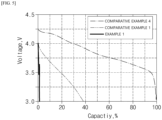
- the performance of the battery was evaluated after applying the positive electrode active material layer using the insulation composition according to the present invention. Specifically, to evaluate the performance of the positive electrode, a half cell was prepared and the capacity expression was evaluated.
- a slurry for the positive electrode active material layer was prepared by weighing 96 parts by weight of LiNi 0.8 Co 0.1 Mn 0.1 O 2 as the positive electrode active material, 2 parts by weight of PVDF as the binder, and 2 parts by weight of carbon black as the conductive material, and mixing them in N-methylpyrrolidone (NMP) solvent.
- NMP N-methylpyrrolidone
- the insulation composition was coated on the surface of the positive electrode with a thickness of about 10 ⁇ m and dried in a convection oven (130°C), and the positive electrode was prepared.
- FIG. 5 shows the results of the capacity expression evaluation.
- Example 1 is when the positive electrode surface is coated with the insulation composition (NMP-substituted SBR + PVDF) according to Example 1.
- Comparative Example 1 is when the positive electrode surface is coated with the insulation composition (PVDF) according to Comparative Example 1.
- Comparative Example 4 is a case where the positive electrode surface is not coated with an insulation composition.
- Comparative Example 4 the expressed capacity was 100%, while in Comparative Example 1, the cell capacity was about 40%.
- Example 1 shows a cell capacity of less than 1%. This means that when coated with the insulation composition of Example 1, there is very little migration of lithium ions.
- the insulating coating layer has excellent wet adhesion in the electrolyte, which prevents the migration of lithium ions in the overlay region of the electrode, thereby inhibiting capacity expression during discharge.
Landscapes
- Chemical & Material Sciences (AREA)
- Chemical Kinetics & Catalysis (AREA)
- Electrochemistry (AREA)
- General Chemical & Material Sciences (AREA)
- Engineering & Computer Science (AREA)
- Manufacturing & Machinery (AREA)
- Materials Engineering (AREA)
- Composite Materials (AREA)
- Battery Electrode And Active Subsutance (AREA)
Applications Claiming Priority (2)
| Application Number | Priority Date | Filing Date | Title |
|---|---|---|---|
| KR1020220093079A KR20240015343A (ko) | 2022-07-27 | 2022-07-27 | 이종 바인더가 블렌딩된 이차전지 전극용 절연 조성물, 그 제조방법 및 상기 전연 조성물을 포함하는 이차전지 전극 |
| PCT/KR2023/010523 WO2024025256A1 (ko) | 2022-07-27 | 2023-07-20 | 이종 바인더가 블렌딩된 이차전지 전극용 절연 조성물, 그 제조방법 및 상기 전연 조성물을 포함하는 이차전지 전극 |
Publications (2)
| Publication Number | Publication Date |
|---|---|
| EP4435899A1 true EP4435899A1 (de) | 2024-09-25 |
| EP4435899A4 EP4435899A4 (de) | 2025-09-10 |
Family
ID=89706843
Family Applications (1)
| Application Number | Title | Priority Date | Filing Date |
|---|---|---|---|
| EP23846915.9A Pending EP4435899A4 (de) | 2022-07-27 | 2023-07-20 | Sekundärbatterieelektrodenisolationszusammensetzung mit verschiedenen bindemittelarten, herstellungsverfahren dafür und sekundärbatterieelektrode mit der isolationszusammensetzung |
Country Status (6)
| Country | Link |
|---|---|
| US (1) | US20250062359A1 (de) |
| EP (1) | EP4435899A4 (de) |
| JP (1) | JP2024543666A (de) |
| KR (1) | KR20240015343A (de) |
| CN (1) | CN118451571A (de) |
| WO (1) | WO2024025256A1 (de) |
Families Citing this family (1)
| Publication number | Priority date | Publication date | Assignee | Title |
|---|---|---|---|---|
| CN120737770A (zh) * | 2025-08-14 | 2025-10-03 | 比亚迪股份有限公司 | 一种组合物、极片及其制备方法、电池、用电设备 |
Family Cites Families (15)
| Publication number | Priority date | Publication date | Assignee | Title |
|---|---|---|---|---|
| KR100727248B1 (ko) * | 2007-02-05 | 2007-06-11 | 주식회사 엘지화학 | 다공성 활성층이 코팅된 유기/무기 복합 분리막 및 이를구비한 전기화학소자 |
| JP2008305662A (ja) * | 2007-06-07 | 2008-12-18 | Sony Corp | 非水電解質二次電池 |
| JP4661843B2 (ja) * | 2007-08-28 | 2011-03-30 | ソニー株式会社 | 非水電解質二次電池 |
| US10096810B2 (en) * | 2012-05-10 | 2018-10-09 | Samsung Sdi Co., Ltd. | Separator and method of manufacturing the same and rechargeable lithium battery including the same |
| JP2014032758A (ja) * | 2012-08-01 | 2014-02-20 | Nippon Zeon Co Ltd | リチウムイオン二次電池用電極の製造方法、及びリチウムイオン二次電池 |
| JP2014165096A (ja) * | 2013-02-27 | 2014-09-08 | Nippon Zeon Co Ltd | リチウムイオン二次電池耐熱層用スラリーの製造方法及びリチウムイオン二次電池用電極の製造方法 |
| JP2014165097A (ja) * | 2013-02-27 | 2014-09-08 | Nippon Zeon Co Ltd | リチウムイオン二次電池耐熱層用スラリーの製造方法及びリチウムイオン二次電池用電極の製造方法 |
| JP6217129B2 (ja) * | 2013-05-14 | 2017-10-25 | 日本ゼオン株式会社 | 二次電池用多孔膜組成物、二次電池用電極、二次電池用セパレータ及び二次電池 |
| JP6766411B2 (ja) * | 2016-03-31 | 2020-10-14 | 東レ株式会社 | 電池用セパレータおよびその製造方法 |
| US12057566B2 (en) | 2018-02-01 | 2024-08-06 | Lg Energy Solution, Ltd. | Electrode for lithium secondary battery, method of preparing the same and lithium secondary battery including the same |
| KR102416099B1 (ko) | 2018-03-28 | 2022-07-01 | 에스케이하이닉스 주식회사 | 반도체 메모리 소자, 이의 구동 방법 및 이의 제조 방법 |
| JP7148422B2 (ja) * | 2019-01-22 | 2022-10-05 | トヨタ自動車株式会社 | 電極一体型セパレータの製造方法 |
| JP7341957B2 (ja) * | 2020-07-28 | 2023-09-11 | 帝人株式会社 | 非水系二次電池 |
| JP7413180B2 (ja) * | 2020-07-28 | 2024-01-15 | 帝人株式会社 | 非水系二次電池 |
| CN114156433B (zh) * | 2021-11-30 | 2024-06-28 | 宁德新能源科技有限公司 | 一种电化学装置和电子装置 |
-
2022
- 2022-07-27 KR KR1020220093079A patent/KR20240015343A/ko active Pending
-
2023
- 2023-07-20 US US18/721,306 patent/US20250062359A1/en active Pending
- 2023-07-20 WO PCT/KR2023/010523 patent/WO2024025256A1/ko not_active Ceased
- 2023-07-20 CN CN202380015487.8A patent/CN118451571A/zh active Pending
- 2023-07-20 EP EP23846915.9A patent/EP4435899A4/de active Pending
- 2023-07-20 JP JP2024534753A patent/JP2024543666A/ja active Pending
Also Published As
| Publication number | Publication date |
|---|---|
| JP2024543666A (ja) | 2024-11-21 |
| EP4435899A4 (de) | 2025-09-10 |
| CN118451571A (zh) | 2024-08-06 |
| KR20240015343A (ko) | 2024-02-05 |
| WO2024025256A1 (ko) | 2024-02-01 |
| US20250062359A1 (en) | 2025-02-20 |
Similar Documents
| Publication | Publication Date | Title |
|---|---|---|
| KR101223081B1 (ko) | 전지용 세퍼레이터 및 리튬 2차 전지 | |
| EP2808923B1 (de) | Verfahren zur herstellung eines separators, in diesem verfahren hergestellter separator und elektrochemische vorrichtung damit | |
| CN113422063B (zh) | 电化学装置和电子装置 | |
| US8835059B2 (en) | Lithium rechargeable battery, and separator for lithium rechargeable battery | |
| EP2838140B1 (de) | Elektrode mit einer porösen beschichtung, herstellungsverfahren dafür und elektrochemische vorrichtung | |
| EP3226325A1 (de) | Lithium-ionen-batterie und separator dafür | |
| EP2432066A1 (de) | Elektrode für eine lithiumionen-sekundärbatterie und lithiumionen-sekundärbatterie | |
| EP3276709A1 (de) | Negativelektrode mit netzartigem stromkollektor, lithiumsekundärbatterie damit und herstellungsverfahren dafür | |
| JP2009544135A (ja) | 電池、電池用電極、及びそれらの製造方法 | |
| KR20180029254A (ko) | 충전식 고체 리튬 이온 배터리용 캐소드 재료 | |
| KR102958887B1 (ko) | 음극 및 이의 제조방법 | |
| KR20250143736A (ko) | 비수계 용매 치환된 수계 바인더를 포함하는 절연 조성물을 이용한 이차전지용 전극 제조방법 | |
| KR20220128304A (ko) | 전극 및 이의 제조방법 | |
| WO2020153728A1 (ko) | 리튬 이차전지용 음극활물질, 이를 포함하는 음극 및 리튬 이차전지 | |
| WO2012066405A1 (en) | Electrode thin film, all-solid lithium battery, and method of manufacturing electrode thin film | |
| EP3996183A1 (de) | Verbundseparator für elektrochemische vorrichtung und elektrochemische vorrichtung damit | |
| KR102866079B1 (ko) | 비수계 용매 치환된 수계 바인더를 포함하는 절연 조성물을 이용한 이차전지용 전극 제조방법 | |
| KR20220027846A (ko) | 전기 화학 소자용 복합 입자 및 그 제조 방법, 전기 화학 소자 기능층용 바인더 조성물 및 그 제조 방법, 전극 합재층용 도전재 페이스트 및 그 제조 방법, 전극 합재층용 슬러리, 전기 화학 소자용 전극, 그리고 전기 화학 소자 | |
| US20250062359A1 (en) | Secondary Battery Electrode Insulation Composition in Which Different Types of Binders are Blended, Preparation Method Therefor, and Secondary Battery Electrode Comprising Insulation Composition | |
| KR102818181B1 (ko) | 이차전지용 분리막 및 이를 포함하는 전기화학 소자 | |
| US20250219164A1 (en) | Positive electrode plate and secondary battery | |
| KR20230067005A (ko) | 음극 및 이를 포함하는 리튬 이온 이차 전지 | |
| KR100824931B1 (ko) | 활물질. 그 제조방법 및 이를 구비한 리튬 이차 전지 | |
| KR102960101B1 (ko) | 이차전지용 분리막 및 이를 포함하는 전기화학 소자 | |
| KR102613021B1 (ko) | 일차전지, 일차전지용 양극 및 그 제조방법 |
Legal Events
| Date | Code | Title | Description |
|---|---|---|---|
| STAA | Information on the status of an ep patent application or granted ep patent |
Free format text: STATUS: THE INTERNATIONAL PUBLICATION HAS BEEN MADE |
|
| PUAI | Public reference made under article 153(3) epc to a published international application that has entered the european phase |
Free format text: ORIGINAL CODE: 0009012 |
|
| STAA | Information on the status of an ep patent application or granted ep patent |
Free format text: STATUS: REQUEST FOR EXAMINATION WAS MADE |
|
| 17P | Request for examination filed |
Effective date: 20240621 |
|
| AK | Designated contracting states |
Kind code of ref document: A1 Designated state(s): AL AT BE BG CH CY CZ DE DK EE ES FI FR GB GR HR HU IE IS IT LI LT LU LV MC ME MK MT NL NO PL PT RO RS SE SI SK SM TR |
|
| A4 | Supplementary search report drawn up and despatched |
Effective date: 20250807 |
|
| RIC1 | Information provided on ipc code assigned before grant |
Ipc: H01M 4/62 20060101AFI20250801BHEP Ipc: H01M 10/42 20060101ALI20250801BHEP Ipc: H01M 4/13 20100101ALI20250801BHEP Ipc: H01M 4/139 20100101ALI20250801BHEP Ipc: H01M 4/02 20060101ALI20250801BHEP Ipc: H01M 4/36 20060101ALI20250801BHEP Ipc: H01M 4/38 20060101ALI20250801BHEP Ipc: H01M 10/052 20100101ALI20250801BHEP |
|
| DAV | Request for validation of the european patent (deleted) | ||
| DAX | Request for extension of the european patent (deleted) | ||
| STAA | Information on the status of an ep patent application or granted ep patent |
Free format text: STATUS: EXAMINATION IS IN PROGRESS |