EP4435176A2 - Wiederverwendbare dosiervorrichtung - Google Patents
Wiederverwendbare dosiervorrichtung Download PDFInfo
- Publication number
- EP4435176A2 EP4435176A2 EP24188100.2A EP24188100A EP4435176A2 EP 4435176 A2 EP4435176 A2 EP 4435176A2 EP 24188100 A EP24188100 A EP 24188100A EP 4435176 A2 EP4435176 A2 EP 4435176A2
- Authority
- EP
- European Patent Office
- Prior art keywords
- dosing device
- accordance
- dosing
- pulp
- present
- Prior art date
- Legal status (The legal status is an assumption and is not a legal conclusion. Google has not performed a legal analysis and makes no representation as to the accuracy of the status listed.)
- Pending
Links
Images


Classifications
-
- G—PHYSICS
- G01—MEASURING; TESTING
- G01F—MEASURING VOLUME, VOLUME FLOW, MASS FLOW OR LIQUID LEVEL; METERING BY VOLUME
- G01F19/00—Calibrated capacity measures for fluids or fluent solid material, e.g. measuring cups
-
- D—TEXTILES; PAPER
- D21—PAPER-MAKING; PRODUCTION OF CELLULOSE
- D21C—PRODUCTION OF CELLULOSE BY REMOVING NON-CELLULOSE SUBSTANCES FROM CELLULOSE-CONTAINING MATERIALS; REGENERATION OF PULPING LIQUORS; APPARATUS THEREFOR
- D21C5/00—Other processes for obtaining cellulose, e.g. cooking cotton linters ; Processes characterised by the choice of cellulose-containing starting materials
- D21C5/02—Working-up waste paper
-
- D—TEXTILES; PAPER
- D21—PAPER-MAKING; PRODUCTION OF CELLULOSE
- D21J—FIBREBOARD; MANUFACTURE OF ARTICLES FROM CELLULOSIC FIBROUS SUSPENSIONS OR FROM PAPIER-MACHE
- D21J1/00—Fibreboard
- D21J1/16—Special fibreboard
-
- D—TEXTILES; PAPER
- D21—PAPER-MAKING; PRODUCTION OF CELLULOSE
- D21J—FIBREBOARD; MANUFACTURE OF ARTICLES FROM CELLULOSIC FIBROUS SUSPENSIONS OR FROM PAPIER-MACHE
- D21J3/00—Manufacture of articles by pressing wet fibre pulp, or papier-mâché, between moulds
-
- G—PHYSICS
- G01—MEASURING; TESTING
- G01F—MEASURING VOLUME, VOLUME FLOW, MASS FLOW OR LIQUID LEVEL; METERING BY VOLUME
- G01F19/00—Calibrated capacity measures for fluids or fluent solid material, e.g. measuring cups
- G01F19/002—Measuring spoons or scoops
Definitions
- the present invention relates generally to the field of recyclable dosing devices.
- the present invention relates to a dosing device made from moulded pulp fiber.
- the dosing device comprises a container member with a defined volume corresponding to a pre-determined amount of composition to be dosed.
- the dosing device may be to be used for dosing food materials.
- Embodiments of the present invention relate to biodegradable and/or compostable dosing devices.
- the present invention also relates to processes for manufacturing such a dosing device.
- Dosing devices for food and beverage powders are usually disposable and made from plastic. This has the advantage that no significant amount of weight is added, hygiene can easily be ensured and precise dosing is possible. While there can be great benefits derived from the use of plastics, which have a positive impact on the lives of people every day, there are also negative impacts that need consideration.
- Plastic waste is one of the great environmental challenges today. Despite the fact that many kinds of plastic are recyclable today, they often are not recycled and end up in the environment where they will remain for a long time, in particular if they are not - or only slowly - biodegradable. Plastics in the environment, for example in the oceans, are a threat to the environment and wildlife.
- plastic accounts for about 10% of all of the waste generated. Each year, at least 8 million tons of plastic end up in the oceans.
- Wood-based spoons for example are readily available, however, they are relatively heavy. Also, paper-based spoon alternatives are available, however, they usually do not allow precise dosing.
- a dosing device which is a dosing device comprising an elongated handle member and a container member with an essentially cylindrical shape.
- a shape is difficult to provide in a paper based form, as paper based spoons are usually folded. If manufactured from one piece of wood, making such a dosing device will require a lot of raw material. If it is made from several pieces of wood, these wood pieces would have to be joined using glue potentially leaving gaps, which will lead to inaccuracies in dosing. In addition, hygiene matters would have to be addressed.
- compositions to be reconstituted in a liquid need to be dosed precisely to ensure optimal taste, but also to ensure the optimal nutritional composition of the final product.
- This is essential, for example, for compositions such as powdered infant formula or powdered nutritional compositions, e.g., for frail or hospitalized people.
- Moulded pulp fiber is a material that is well known in the art. It is typically used for the manufacture of egg cartons, isolation material or storage or protection materials for larger items. Moulded pulp fiber is available from several manufacturers and is typically used to provide honeycomb type packaging, for example. It can be used in several shapes or forms, but to the inventors best knowledge has never been used for the manufacture of dosing devices. The inventors believe that this might be due to the typically rough surface of packaging items produced from moulded pulp fiber. Such a rough surface makes precise dosing difficult and leads to incomplete emptying of the dosing device, resulting in possible hygiene issues.
- the objective of the present invention was it, hence, to improve or enrich the state of the art and, in particular, to provide the art with a dosing device that is made from recyclable, ideally recycled, material, is recyclable itself, and that allows precise and hygienic dosing of, for example, food grade material; a method to produce such a dosing device and a use of that dosing device to dose a composition to be dosed; or to at least provide a useful alternative.
- the present invention provides a dosing device made from moulded pulp fiber comprising a container member and a handle member, wherein the container member has a defined volume corresponding to a pre-determined amount of a composition to be dosed.
- the present invention further provides a process to manufacture a dosing device in accordance with the present invention comprising the steps of dewatering the pulp, pressing the dewatered pulp into the form of the dosing device, and drying the formed dosing device.
- the present invention further provides the use of the dosing device in accordance with the present invention for dosing a composition to be dosed, wherein the composition to be dosed may be selected from the group consisting of powdered or granulated compositions.
- moulded pulp fiber can also be used to produce dosing devices, for example dosing devices of relatively small dimensions where precision of dosing is important.
- the present invention relates, for example, to a dosing device made from moulded pulp fiber comprising a container member and a handle member, wherein the container member has a defined volume corresponding to a pre-determined amount of a composition to be dosed.
- the dosing device of the present invention may be made from recycled material.
- the dosing device of the present invent may be recyclable, for example, recyclable with the paper stream.
- the present invention further relates to a process to manufacture a dosing device in accordance with the present invention comprising the following steps
- the present invention further relates to the use of a dosing device in accordance with the present invention for dosing a composition to be dosed, wherein the composition to be dosed may be selected from the group of powdered or granulated compositions, for example food compositions.
- the present invention relates in part to a dosing device made from moulded pulp fiber comprising a container member and a handle member, wherein the container member has a defined volume corresponding to a pre-determined amount of a composition to be dosed.
- the term "dosing device” as used herein refers to a device that can be used for dosing.
- it can mean any device intended to measure and deliver a certain quantity of a composition to be dosed.
- the certain quantity may be the dosage of the composition to be dosed for a single consumption occasion or a fraction thereof.
- the dosing device of the present invention comprises a container member and a handle member.
- the container member can have any shape that allows it to take up a certain volume of the material to be used.
- the shape of the container member may be adapted so that it corresponds to a typical shape that resembles the brand of the composition to be dosed.
- the container member may have a volume that corresponds exactly to the amount of the composition to be dosed for a single consumption occasion or a fraction thereof.
- the container member may have a cylindrical, oval, cubic or a cuboidal shape.
- the upper edge or upper edges of the container member of dosing device of the present invention form a plane. This has the consequence that after filling of the container member any excess composition to be dosed can be scraped off with any device with a straight edge, so that as a result the container member is precisely filled to the plane formed the upper edge or upper edges of the container member.
- the inventors were surprised to see that they could produce dosing devices of relatively small dimensions from moulded pulp fiber. For example, it was possible to produce dosing devices with a length of less than 15 cm, less than 13 cm, less than 11 cm, less than 9 cm, less than 7 cm or less than 5 cm in their longest dimension. If the longest dimension is considered the length of the dosing device, the width of the dosing device could be less than 5 cm, less than 4 cm, less than 3 cm, less than 2 cm or less than 1 cm. For example, a dosing device of the present invention could have a length of less than 15 cm and a width of less than 4 cm. It could also have a length of less than 15 cm and a width of less than 3 cm.
- the term "moulded pulp fiber” is a fibrous packaging material comprising lignocellulosic fibers, typically made from recycled paperboard, paper and/or newsprint, through pulping.
- the lignocellulosic fibrous material may also be obtained from chemically or mechanically separating cellulose fibers from wood, fiber crops, waste paper, or rags.
- the moulded fiber may be made from pulp comprising cellulosic fibrous material prepared by chemically and/or mechanically separating cellulose fibers from material containing cellulose fibers.
- the material containing cellulose fibers may be selected from the group consisting of wood, fiber crops, waste paper, rags, or combinations thereof.
- the inventors were able to produce particularly good results, if the material containing cellulose fibers comprised not less than 20 vol.-% of softwood long fibers, not less than 15 vol.-% of softwood long fibers, or not less than 10 vol.-% of softwood long fibers.
- the remaining fibers can be hardwood fibers, non-wood short fibers, or a combination thereof.
- the pulp comprises cellulose, hemicellulose and lignin.
- hemicellulose provides a better adhesion between cellulose nanofibrils, contributing enhanced tensile properties of the resulting dosing device.
- the inventors find that dosing devices made from pulp with higher hemicellulose content showed a higher stiffness and tensile strength, compared to dosing devices made from pulp with a lower hemicellulose content. Lignin in the pulp has an influence on the texture and flexibility of the final dosing device.
- the pulp may further comprise a compound selected from the group consisting of alkyl ketene dimer wax, a fluorine containing polymer moiety, sodium silicate, or combinations thereof.
- Alkyl ketene dimer wax may be used for the surface modification of the resulting dosing device.
- the use of alkyl ketene dimer wax in the pulp may provide the resulting dosing device with higher and longer-lasting hydrophobicity.
- the use of a fluorine containing polymer moiety in the pulp may impart to the dosing device an improved resistance to low surface tension fluids, leading for example to an improved grease, oil, wax and solvent repellency.
- the fluorine containing polymer moiety may be a fluorine containing polymer moiety approved for use in contact with food products, for example.
- the fluorine containing polymer moiety may be a copolymer comprising carbon and fluorine moieties, a polymer comprising phosphate and fluorine moieties, or a fluoroalkyl polymer.
- examples may be selected from the group consisting of perfluoroalkylethylphosphate diethanolamine, ammonium di-[2-(N-ethyl-heptadecafluorosulfonamido)ethyl] phosphate, poly(2-(N-methyl-heptadecafluorosulfonamido)ethyl acrylate)-co-(2,3-epoxypropylacrylate)-co-(2-ethoxyethylacrylate)-co-(2-(2 -methylpropenyloyloxy)ethyl-trimethylammonium chloride), or combinations thereof.
- sodium silicate in the pulp may lead to a dosing device with an increased strength. It may also be used as additive during
- the dosing device may be coated with a compound or a mixture of compounds. Suitable coatings are well-known to those skilled in the art. A coating can serve to impart certain qualities to the surface of the dosing device, including weight, surface gloss, smoothness or reduced ink absorbency.
- the dosing device can be coated with wax, kaolinite, calcium carbonate, bentonite, talc, polyethylene, polyolefin, silicone, and biopolymers.
- the dosing device of the present invention may be recyclable.
- "Recyclable" means that the material can be treated or processed to make it suitable for reuse or a different use. This has the advantage, for example, that not only plastic waste is avoided, but also that by eliminating the need for conventional waste disposal energy usage can be reduced, greenhouse gas emission can be reduced, the consumption of fresh raw materials is reduced, and/or air pollution and water pollution (, e.g., from land filling) is reduced.
- the dosing device of the present invention may be made from recyclable and/or recycled material.
- the dosing device of the present invention may be made from material that is recyclable with the paper stream. It may also be made from material recycled with the paper stream. This has the advantage that - as paper recycling streams are widely available - such dosing devices are not only recyclable but can also be easily recycled wherever paper recycling is available.
- the dosing device of the present invention is biodegradable and/or compostable.
- Biodegradable materials break down and decompose into natural elements. Consequently, biodegradation helps to reduce the buildup of waste.
- Compostable materials also break down and decompose into natural elements within a relatively short time after disposal and provide the earth with nutrients once the material has completely broken down. Typically, such materials can be added to compost sites with specific biological conditions.
- a product such as the dosing device of the present invention is manufactured from sustainable resources.
- the dosing device may be manufactured from sustainable resources.
- the dosing device is recyclable and/or compostable.
- the dosing device of the present invention must be stable enough that it does not break during transport or usage. This stability depends, for example, on the thickness of the material that forms the container and on the thickness of the material that forms the handle member.
- the person skilled in the art will be able to devise an appropriate material thickness.
- the container member may have a material thickness in the range of 300 ⁇ m - 3 mm, 500 ⁇ m - 2 mm, 600 ⁇ m - 1 mm.
- the handle member may have a material thickness in the range of 300 ⁇ m - 5 mm, 500 ⁇ m - 4 mm, or 700 ⁇ m - 3 mm.
- the handle member of the dosing device of the present invention may have a bigger material thickness than the container member of the dosing device. This has the advantage that a thicker handle member is usually more pleasant to handle than a thinner handle member.
- the handle member and the container member may have a material thickness ratio in the range of 1.5:1 to 10:1, 2:1 to 5:1, or 3:1 to 4:1.
- the volume of the container member of the dosing device may be adjusted so that if the container member is filled completely with the composition to be dosed, the volume of the composition to be dosed corresponds to the amount of composition needed for a single consumption occasion.
- the container member may have a volume that holds 1, 1/2, 1/3, 1/4, 1/5, 1/6, 1/7, 1/8, 1/9 or 1/10 of a serving size of the composition to be dosed.
- the container member may have a volume of 1-20 cm 3 , 2-15 cm 3 , or 3-8 cm 3 .
- the handle member may have a length that is convenient to handle.
- the handle member may have a length of 3- 20 cm, 5-15 cm, or 7-13 cm.
- the dosing device may have a bending stiffness in the range of 10 to 80 mNm in machine direction (MD) and/or 5 to 40 mNm in cross direction (CD).
- MD machine direction
- CD cross direction
- the bending stiffness can be determined in accordance with ISO 5628.
- the surface of the container member of the dosing device made from moulded pulp fiber in accordance with the present invention in particular the inner surface of the container member may be smoothened.
- Such smoothening can be achieved by several methods. For example, pressing and heat application may be used to flatten the surface.
- the surface of the dosing device is at least partially smoothened by pressing and heat application, for example, in order to ensure complete emptying.
- the surface, in particular the inner surface of the container member may be smoothened by pressing and heat application. This will result in a less uneven surface.
- the dosing device of the present invention, or a part thereof, for example the container member may be coated with a material that will result in a smooth surface.
- the dosing device of the present invention may be compacted by pressing and heat application.
- the dosing device of the present invention may be further customized, e.g., by making it visually more attractive.
- the pulp may be colored. This can be achieved by adding colors to the pulp. Certain further optical effects may be achieved.
- glitter particles may be added to the pulp.
- the dosing device may be further modified, e.g., by embossing and/or debossing it. This way, for example, a brand name can be added to the dosing device, for example, to its handle member. This is not only useful in brand communication, but can also have a safety effect.
- an anti-slip surface pattern may be added to the dosing device of the present invention, for example to its handle member. This will help to avoid wasting the composition to be dosed doe to unintentional spilling of composition during the handling of the dosing device in operation.
- the subject matter of the present invention further comprises a process to manufacture a dosing device in accordance with the present invention comprising the steps of dewatering the pulp, pressing the dewatered pulp into the form of the dosing device, and drying the formed dosing device.
- a further embodiment of the present invention relates to the use of the dosing device of the present invention for dosing a composition to be dosed.
- the composition to be dosed may be any powdered or granulated composition to be dosed, for example.
- the composition to be dosed may also be a liquid composition for example. If the composition to be dosed is a liquid, it is preferred that the dosing device or at least the part of the dosing device that forms the container member is coated. This will have the advantage that it is avoided that the container member is wetted so that it eventually loses its shape.
- the composition to be dosed may be a powdered or granulated food composition.
- the term "food” shall mean in accordance with Codex Alimentarius any substance, whether processed, semi-processed or raw, which is intended for human consumption, and includes drink, chewing gum and any substance which has been used in the manufacture, preparation or treatment of "food” but does not include cosmetics or tobacco or substances used only as drugs.
- Such a powdered or granulated food composition may be selected from the group consisting of nutritional formulas; infant formulas; milk modifiers; cocoa-based beverage powders; cocoa malt-based beverage powders; coffee; instant food compositions; fruit flavored beverage powders; spice mixtures; drink thickeners; and pet food.
- the container member of the dosing device is filled with the composition to be dosed and a device with a straight edge is used to scrape off any excess material from the filled container member, so that the container member contains exactly the predetermined amount of the composition to be dosed.
- a mould can be prepared from plastic, steel or aluminum, for example. In this case, as plastic mould was used.
- the mould contained the negative form of the dosing device of the present invention. After preparation, the mould was cleaned.
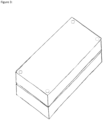
- Figure 1 shows a schematic drafing of a moulding device that can be used in the manufacture of a dosing device in accordance with the present invention.
- a pulp was prepared from recycled paper and cardboard by mixing it for 20 minutes in 60°C warm water. This paper pulp was then dewatered to a water content of 20% w/w and was then injected into the cavity of the mould as shown in figure 2 .
- the mould is opened and the dosing device is removed from the mould. Any debossed or embossed design element that was part of the negative form of the mould is now revealed in its positive form.
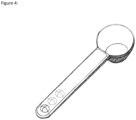
- the resulting dosing device is shown in figure 4 .
- the container member has a material thickness of 800 ⁇ m
- the handle member has a material thickness 1.5 mm
- the container member has a volume of 5 cm 3
- the handle member has a length of 10 cm.
- the resulting dosing device can then be further treated, for example, by applying a functional surface coating or artwork elements.
Landscapes
- Physics & Mathematics (AREA)
- Fluid Mechanics (AREA)
- General Physics & Mathematics (AREA)
- Engineering & Computer Science (AREA)
- Manufacturing & Machinery (AREA)
- Paper (AREA)
- Fertilizers (AREA)
- Packages (AREA)
- Biological Depolymerization Polymers (AREA)
Applications Claiming Priority (3)
| Application Number | Priority Date | Filing Date | Title |
|---|---|---|---|
| EP20152545 | 2020-01-17 | ||
| PCT/EP2021/050213 WO2021144194A1 (en) | 2020-01-17 | 2021-01-08 | Recyclable dosing device |
| EP21700193.2A EP4090917B1 (de) | 2020-01-17 | 2021-01-08 | Wiederverwendbare dosiervorrichtung |
Related Parent Applications (3)
| Application Number | Title | Priority Date | Filing Date |
|---|---|---|---|
| EP21700193.2A Division-Into EP4090917B1 (de) | 2020-01-17 | 2021-01-08 | Wiederverwendbare dosiervorrichtung |
| EP21700193.2A Division EP4090917B1 (de) | 2020-01-17 | 2021-01-08 | Wiederverwendbare dosiervorrichtung |
| EP21700193.2A Previously-Filed-Application EP4090917B1 (de) | 2020-01-17 | 2021-01-08 | Wiederverwendbare dosiervorrichtung |
Publications (2)
| Publication Number | Publication Date |
|---|---|
| EP4435176A2 true EP4435176A2 (de) | 2024-09-25 |
| EP4435176A3 EP4435176A3 (de) | 2024-11-27 |
Family
ID=69185328
Family Applications (2)
| Application Number | Title | Priority Date | Filing Date |
|---|---|---|---|
| EP24188100.2A Pending EP4435176A3 (de) | 2020-01-17 | 2021-01-08 | Wiederverwendbare dosiervorrichtung |
| EP21700193.2A Active EP4090917B1 (de) | 2020-01-17 | 2021-01-08 | Wiederverwendbare dosiervorrichtung |
Family Applications After (1)
| Application Number | Title | Priority Date | Filing Date |
|---|---|---|---|
| EP21700193.2A Active EP4090917B1 (de) | 2020-01-17 | 2021-01-08 | Wiederverwendbare dosiervorrichtung |
Country Status (11)
| Country | Link |
|---|---|
| US (2) | US12196595B2 (de) |
| EP (2) | EP4435176A3 (de) |
| CN (1) | CN114902023A (de) |
| AU (1) | AU2021208302A1 (de) |
| BR (1) | BR112022013316A2 (de) |
| ES (1) | ES2993505T3 (de) |
| FI (1) | FI4090917T3 (de) |
| MX (1) | MX2022008368A (de) |
| PH (1) | PH12022551380A1 (de) |
| PT (1) | PT4090917T (de) |
| WO (1) | WO2021144194A1 (de) |
Families Citing this family (1)
| Publication number | Priority date | Publication date | Assignee | Title |
|---|---|---|---|---|
| US12169140B1 (en) * | 2024-03-15 | 2024-12-17 | Compostable, LLC | Compostable scoop and method of making same |
Family Cites Families (21)
| Publication number | Priority date | Publication date | Assignee | Title |
|---|---|---|---|---|
| JPH08176999A (ja) * | 1994-12-26 | 1996-07-09 | Toomoku:Kk | 繊維材料から成るリブ付容器及びその製造方法 |
| JPH09123300A (ja) * | 1995-11-02 | 1997-05-13 | San Chem Kk | 紙製計量具の製造方法 |
| US5876815A (en) | 1996-01-25 | 1999-03-02 | James River Corporation Of Virginia | Oil and grease resistant paper products and process for producing the products |
| RU2249636C2 (ru) | 2000-06-29 | 2005-04-10 | СиПи ЭНД Пи КО., Лтд. | Способ получения целлюлозной массы из стеблей кукурузы |
| JP2004191248A (ja) | 2002-12-12 | 2004-07-08 | Izumi Kasei Kogyo Kk | 計量スプーン |
| US7470818B2 (en) | 2006-11-13 | 2008-12-30 | E.I. Du Pont De Nemours & Company | Fluoroalkyl phosphate compositions |
| GB2449721A (en) | 2007-09-24 | 2008-12-03 | Vernacare Ltd | Receptacles, particularly of moulded paper pulp |
| US8212087B2 (en) | 2008-04-30 | 2012-07-03 | Xyleco, Inc. | Processing biomass |
| KR101728576B1 (ko) | 2009-11-13 | 2017-04-19 | 아사히 가라스 가부시키가이샤 | 내수 내유제 조성물, 이것으로 처리된 물품 및 이들의 제조 방법 |
| WO2013141687A1 (en) * | 2012-03-22 | 2013-09-26 | Parasuraman Ramaness | Pulp composition, pulp article(s) and preparation process thereof |
| US9445971B2 (en) | 2012-05-01 | 2016-09-20 | Johnson & Johnson Consumer Inc. | Method of manufacturing solid dosage form |
| IN2015DN02472A (de) | 2012-09-06 | 2015-09-04 | Exxonmobil Chem Patents Inc | |
| FI125024B (fi) * | 2012-11-22 | 2015-04-30 | Teknologian Tutkimuskeskus Vtt | Muotoiltava kuitutuote ja menetelmä sen valmistamiseksi |
| WO2014129887A1 (en) | 2013-02-22 | 2014-08-28 | N.V. Nutricia | Thermoformed container with lid |
| WO2014131936A1 (en) | 2013-02-26 | 2014-09-04 | Kwh Mirka Ltd | A method to provide an abrasive product surface and abrasive products thereof |
| CA2978243A1 (en) | 2015-04-21 | 2016-10-27 | Kemira Oyj | Use of a strength composition for increasing wet dimensional stability of a moulded pulp article |
| WO2017108431A1 (en) | 2015-12-22 | 2017-06-29 | Metgen Oy | Method for producing mechanical pulp from a biomass comprising lignocellulosic material |
| US9988199B2 (en) | 2016-07-26 | 2018-06-05 | Footprint International, LLC | Methods and apparatus for manufacturing fiber-based microwavable food containers |
| JP6313513B1 (ja) | 2016-10-14 | 2018-04-18 | 大王製紙株式会社 | セルロースナノファイバー成形体 |
| CN208148676U (zh) | 2018-04-10 | 2018-11-27 | 玉溪自强玉新包装材料有限公司 | 一种高阻隔包装材料结构 |
| MX2022012122A (es) * | 2020-03-30 | 2022-10-18 | Nestle Sa | Dispositivo dosificador. |
-
2021
- 2021-01-08 AU AU2021208302A patent/AU2021208302A1/en active Pending
- 2021-01-08 FI FIEP21700193.2T patent/FI4090917T3/fi active
- 2021-01-08 ES ES21700193T patent/ES2993505T3/es active Active
- 2021-01-08 BR BR112022013316A patent/BR112022013316A2/pt unknown
- 2021-01-08 CN CN202180007797.6A patent/CN114902023A/zh active Pending
- 2021-01-08 PH PH1/2022/551380A patent/PH12022551380A1/en unknown
- 2021-01-08 US US17/758,822 patent/US12196595B2/en active Active
- 2021-01-08 PT PT217001932T patent/PT4090917T/pt unknown
- 2021-01-08 EP EP24188100.2A patent/EP4435176A3/de active Pending
- 2021-01-08 MX MX2022008368A patent/MX2022008368A/es unknown
- 2021-01-08 EP EP21700193.2A patent/EP4090917B1/de active Active
- 2021-01-08 WO PCT/EP2021/050213 patent/WO2021144194A1/en not_active Ceased
-
2024
- 2024-12-09 US US18/973,470 patent/US20250102342A1/en active Pending
Also Published As
| Publication number | Publication date |
|---|---|
| AU2021208302A1 (en) | 2022-06-23 |
| US20230042230A1 (en) | 2023-02-09 |
| US20250102342A1 (en) | 2025-03-27 |
| MX2022008368A (es) | 2022-09-05 |
| PT4090917T (pt) | 2024-11-08 |
| US12196595B2 (en) | 2025-01-14 |
| CN114902023A (zh) | 2022-08-12 |
| EP4090917A1 (de) | 2022-11-23 |
| BR112022013316A2 (pt) | 2022-09-06 |
| WO2021144194A1 (en) | 2021-07-22 |
| PH12022551380A1 (en) | 2023-05-03 |
| EP4090917B1 (de) | 2024-08-21 |
| FI4090917T3 (fi) | 2024-11-06 |
| ES2993505T3 (en) | 2025-01-02 |
| EP4435176A3 (de) | 2024-11-27 |
Similar Documents
| Publication | Publication Date | Title |
|---|---|---|
| EP4127614B1 (de) | Dosiervorrichtung | |
| US20250102342A1 (en) | Recyclable dosing device | |
| EP2547599B1 (de) | Formteile und verfahren zu deren herstellung | |
| WO2017221055A1 (es) | Material compuesto de celulosa obtenida a partir de cascarilla de café o cacao, artículo que comprende el mismo y proceso de obtención | |
| WO2023004076A1 (en) | Hemp paper sleeves and other devices made from hemp for holding cups | |
| Jasmani et al. | Sustainable Paper‐Based Packaging | |
| EP4090918B1 (de) | Wiederverwendbare dosiervorrichtung | |
| HK40085346B (en) | Recyclable dosing device | |
| HK40085346A (en) | Recyclable dosing device | |
| RU2852095C1 (ru) | Пригодное для вторичной переработки устройство дозирования | |
| BR122025009112A2 (pt) | Dispositivo dosador, processo para fabricação de um dispositivo dosador e uso de um dispositivo dosador | |
| HK40129550A (en) | Dosing device | |
| HK40088527A (en) | Dosing device | |
| HK40088527B (en) | Dosing device | |
| RU2837747C1 (ru) | Дозирующее устройство | |
| WO2021144405A1 (en) | Packaging assembly comprising a dosing device and blanks therefor | |
| US20240191437A1 (en) | Paper material for fluid containers having characteristics of calibrated fragility and rigidity and a barrier property | |
| KR20260015897A (ko) | 친환경 포장재 | |
| CN107956189A (zh) | 一种翠绿色包装纸及其制备方法 | |
| TWM418101U (en) | Degradable container |
Legal Events
| Date | Code | Title | Description |
|---|---|---|---|
| PUAI | Public reference made under article 153(3) epc to a published international application that has entered the european phase |
Free format text: ORIGINAL CODE: 0009012 |
|
| STAA | Information on the status of an ep patent application or granted ep patent |
Free format text: STATUS: THE APPLICATION HAS BEEN PUBLISHED |
|
| AC | Divisional application: reference to earlier application |
Ref document number: 4090917 Country of ref document: EP Kind code of ref document: P |
|
| AK | Designated contracting states |
Kind code of ref document: A2 Designated state(s): AL AT BE BG CH CY CZ DE DK EE ES FI FR GB GR HR HU IE IS IT LI LT LU LV MC MK MT NL NO PL PT RO RS SE SI SK SM TR |
|
| REG | Reference to a national code |
Ref country code: DE Ref legal event code: R079 Free format text: PREVIOUS MAIN CLASS: D21C0005020000 Ipc: G01F0019000000 |
|
| PUAL | Search report despatched |
Free format text: ORIGINAL CODE: 0009013 |
|
| AK | Designated contracting states |
Kind code of ref document: A3 Designated state(s): AL AT BE BG CH CY CZ DE DK EE ES FI FR GB GR HR HU IE IS IT LI LT LU LV MC MK MT NL NO PL PT RO RS SE SI SK SM TR |
|
| RIC1 | Information provided on ipc code assigned before grant |
Ipc: D21C 5/02 20060101ALI20241018BHEP Ipc: D21J 3/00 20060101ALI20241018BHEP Ipc: G01F 19/00 20060101AFI20241018BHEP |
|
| P01 | Opt-out of the competence of the unified patent court (upc) registered |
Free format text: CASE NUMBER: APP_58398/2024 Effective date: 20241025 |
|
| STAA | Information on the status of an ep patent application or granted ep patent |
Free format text: STATUS: REQUEST FOR EXAMINATION WAS MADE |
|
| 17P | Request for examination filed |
Effective date: 20250527 |
|
| STAA | Information on the status of an ep patent application or granted ep patent |
Free format text: STATUS: EXAMINATION IS IN PROGRESS |