EP4429007A1 - Zylindrische sekundärbatterie und verfahren zur herstellung einer sekundärbatterie - Google Patents
Zylindrische sekundärbatterie und verfahren zur herstellung einer sekundärbatterie Download PDFInfo
- Publication number
- EP4429007A1 EP4429007A1 EP22890254.0A EP22890254A EP4429007A1 EP 4429007 A1 EP4429007 A1 EP 4429007A1 EP 22890254 A EP22890254 A EP 22890254A EP 4429007 A1 EP4429007 A1 EP 4429007A1
- Authority
- EP
- European Patent Office
- Prior art keywords
- hole
- cap
- secondary battery
- plate
- electrode
- Prior art date
- Legal status (The legal status is an assumption and is not a legal conclusion. Google has not performed a legal analysis and makes no representation as to the accuracy of the status listed.)
- Pending
Links
Images
Classifications
-
- H—ELECTRICITY
- H01—ELECTRIC ELEMENTS
- H01M—PROCESSES OR MEANS, e.g. BATTERIES, FOR THE DIRECT CONVERSION OF CHEMICAL ENERGY INTO ELECTRICAL ENERGY
- H01M50/00—Constructional details or processes of manufacture of the non-active parts of electrochemical cells other than fuel cells, e.g. hybrid cells
- H01M50/30—Arrangements for facilitating escape of gases
- H01M50/394—Gas-pervious parts or elements
-
- H—ELECTRICITY
- H01—ELECTRIC ELEMENTS
- H01M—PROCESSES OR MEANS, e.g. BATTERIES, FOR THE DIRECT CONVERSION OF CHEMICAL ENERGY INTO ELECTRICAL ENERGY
- H01M50/00—Constructional details or processes of manufacture of the non-active parts of electrochemical cells other than fuel cells, e.g. hybrid cells
- H01M50/30—Arrangements for facilitating escape of gases
- H01M50/342—Non-re-sealable arrangements
- H01M50/3425—Non-re-sealable arrangements in the form of rupturable membranes or weakened parts, e.g. pierced with the aid of a sharp member
-
- H—ELECTRICITY
- H01—ELECTRIC ELEMENTS
- H01M—PROCESSES OR MEANS, e.g. BATTERIES, FOR THE DIRECT CONVERSION OF CHEMICAL ENERGY INTO ELECTRICAL ENERGY
- H01M10/00—Secondary cells; Manufacture thereof
- H01M10/04—Construction or manufacture in general
- H01M10/0431—Cells with wound or folded electrodes
-
- H—ELECTRICITY
- H01—ELECTRIC ELEMENTS
- H01M—PROCESSES OR MEANS, e.g. BATTERIES, FOR THE DIRECT CONVERSION OF CHEMICAL ENERGY INTO ELECTRICAL ENERGY
- H01M10/00—Secondary cells; Manufacture thereof
- H01M10/04—Construction or manufacture in general
- H01M10/049—Processes for forming or storing electrodes in the battery container
-
- H—ELECTRICITY
- H01—ELECTRIC ELEMENTS
- H01M—PROCESSES OR MEANS, e.g. BATTERIES, FOR THE DIRECT CONVERSION OF CHEMICAL ENERGY INTO ELECTRICAL ENERGY
- H01M10/00—Secondary cells; Manufacture thereof
- H01M10/05—Accumulators with non-aqueous electrolyte
- H01M10/058—Construction or manufacture
-
- H—ELECTRICITY
- H01—ELECTRIC ELEMENTS
- H01M—PROCESSES OR MEANS, e.g. BATTERIES, FOR THE DIRECT CONVERSION OF CHEMICAL ENERGY INTO ELECTRICAL ENERGY
- H01M50/00—Constructional details or processes of manufacture of the non-active parts of electrochemical cells other than fuel cells, e.g. hybrid cells
- H01M50/10—Primary casings; Jackets or wrappings
- H01M50/102—Primary casings; Jackets or wrappings characterised by their shape or physical structure
- H01M50/107—Primary casings; Jackets or wrappings characterised by their shape or physical structure having curved cross-section, e.g. round or elliptic
-
- H—ELECTRICITY
- H01—ELECTRIC ELEMENTS
- H01M—PROCESSES OR MEANS, e.g. BATTERIES, FOR THE DIRECT CONVERSION OF CHEMICAL ENERGY INTO ELECTRICAL ENERGY
- H01M50/00—Constructional details or processes of manufacture of the non-active parts of electrochemical cells other than fuel cells, e.g. hybrid cells
- H01M50/10—Primary casings; Jackets or wrappings
- H01M50/147—Lids or covers
- H01M50/148—Lids or covers characterised by their shape
- H01M50/152—Lids or covers characterised by their shape for cells having curved cross-section, e.g. round or elliptic
-
- H—ELECTRICITY
- H01—ELECTRIC ELEMENTS
- H01M—PROCESSES OR MEANS, e.g. BATTERIES, FOR THE DIRECT CONVERSION OF CHEMICAL ENERGY INTO ELECTRICAL ENERGY
- H01M50/00—Constructional details or processes of manufacture of the non-active parts of electrochemical cells other than fuel cells, e.g. hybrid cells
- H01M50/10—Primary casings; Jackets or wrappings
- H01M50/183—Sealing members
- H01M50/186—Sealing members characterised by the disposition of the sealing members
-
- H—ELECTRICITY
- H01—ELECTRIC ELEMENTS
- H01M—PROCESSES OR MEANS, e.g. BATTERIES, FOR THE DIRECT CONVERSION OF CHEMICAL ENERGY INTO ELECTRICAL ENERGY
- H01M50/00—Constructional details or processes of manufacture of the non-active parts of electrochemical cells other than fuel cells, e.g. hybrid cells
- H01M50/30—Arrangements for facilitating escape of gases
- H01M50/317—Re-sealable arrangements
-
- H—ELECTRICITY
- H01—ELECTRIC ELEMENTS
- H01M—PROCESSES OR MEANS, e.g. BATTERIES, FOR THE DIRECT CONVERSION OF CHEMICAL ENERGY INTO ELECTRICAL ENERGY
- H01M10/00—Secondary cells; Manufacture thereof
- H01M10/04—Construction or manufacture in general
- H01M10/0422—Cells or battery with cylindrical casing
-
- Y—GENERAL TAGGING OF NEW TECHNOLOGICAL DEVELOPMENTS; GENERAL TAGGING OF CROSS-SECTIONAL TECHNOLOGIES SPANNING OVER SEVERAL SECTIONS OF THE IPC; TECHNICAL SUBJECTS COVERED BY FORMER USPC CROSS-REFERENCE ART COLLECTIONS [XRACs] AND DIGESTS
- Y02—TECHNOLOGIES OR APPLICATIONS FOR MITIGATION OR ADAPTATION AGAINST CLIMATE CHANGE
- Y02E—REDUCTION OF GREENHOUSE GAS [GHG] EMISSIONS, RELATED TO ENERGY GENERATION, TRANSMISSION OR DISTRIBUTION
- Y02E60/00—Enabling technologies; Technologies with a potential or indirect contribution to GHG emissions mitigation
- Y02E60/10—Energy storage using batteries
-
- Y—GENERAL TAGGING OF NEW TECHNOLOGICAL DEVELOPMENTS; GENERAL TAGGING OF CROSS-SECTIONAL TECHNOLOGIES SPANNING OVER SEVERAL SECTIONS OF THE IPC; TECHNICAL SUBJECTS COVERED BY FORMER USPC CROSS-REFERENCE ART COLLECTIONS [XRACs] AND DIGESTS
- Y02—TECHNOLOGIES OR APPLICATIONS FOR MITIGATION OR ADAPTATION AGAINST CLIMATE CHANGE
- Y02P—CLIMATE CHANGE MITIGATION TECHNOLOGIES IN THE PRODUCTION OR PROCESSING OF GOODS
- Y02P70/00—Climate change mitigation technologies in the production process for final industrial or consumer products
- Y02P70/50—Manufacturing or production processes characterised by the final manufactured product
Definitions
- An embodiment of the present invention relates to a cylindrical secondary battery in which removal of internal gas is possible and a method of manufacturing the secondary battery.
- a secondary battery includes a cell including an electrode assembly including a positive electrode, a negative electrode, and a separator interposed between the positive electrode and the negative electrode, and an electrolyte impregnated in the electrode assembly.
- Secondary batteries may have various exterior shapes such as a cylindrical shape, a prismatic shape, a pouch shape, and the like depending on their use.
- the cylindrical secondary battery has a structure in which an electrode assembly and an electrolyte are accommodated in a cylindrical can, and one end of the can is sealed by a cap assembly.
- gas may be generated in the secondary battery due to repeated charging and discharging and internal chemical factors. There is a problem in that deformation of the cap assembly and the can occur due to the generation of gas.
- An embodiment of the present invention provides a cylindrical secondary battery in which removal of internal gas is possible and a method of manufacturing the secondary battery.
- a cylindrical secondary battery includes: a cylindrical can; an electrode assembly in which a first electrode plate, a second electrode plate, and a separator are wound and accommodated in the can; and a cap assembly insulated from the can, electrically connected to the electrode assembly, and having a hole formed therethrough to communicate with the inside of the can.
- the cap assembly may include a vent plate coupled to one side of the can, a cap down plate disposed between the vent plate and the electrode assembly to be electrically connected to the electrode assembly, and a gasket disposed between the vent plate and the can to insulate the vent plate and the can from each other.
- the hole may include a degassing hole formed through a center of the vent plate, and a through hole formed through a center of the cap down plate.
- the vent plate may include a notch formed to be spaced apart from the degassing hole.
- a thickness of a region where the notch is formed may be thinner than a thickness of a region where the degassing hole is formed.
- a diameter of the cap down plate may be smaller than a diameter of the vent plate, and an upper surface of an edge of the cap down plate may be welded in close contact with a portion of a lower surface of an edge of the vent plate.
- the cap assembly may further include a cap stopper that is detachably inserted into the degassing hole and the through hole to close the degassing hole and the through hole after the cap assembly is assembled to the can.
- the cap assembly may further include a rivet inserted into the degassing hole and the through hole to close the degassing hole and the through hole after removing the cap stopper when gas is generated in the can.
- the present invention provides a method of manufacturing a cylindrical secondary battery including: accommodating an electrode assembly in a can and electrically connecting the electrode assembly and the can; electrically connecting a cap assembly to the electrode assembly; assembling the cap assembly to the can; inserting a cap stopper into a hole passing through the cap assembly to close the hole; and coupling a rivet to the hole passing through the cap assembly to close the hole after removing the cap stopper and discharging gas when the gas is generated.
- a degassing function is applied and thus gas generated can be removed before product shipment, deformation of a can and a cap assembly can be reduced. Further, the occurrence of swelling of an electrode assembly according to internal gas generation can be prevented to reduce performance degradation of a secondary battery.
- first, second, and the like are used in the present specification to describe various members, components, regions, layers and/or parts, it is obvious that these members, components, regions, layers and/or parts should not be limited by these terms. These terms are used only to distinguish one member, component, region, layer, or part from another member, component, region, layer, or part. Accordingly, a first member, component, region, layer, or part to be described later may refer to a second member, component, region, layer, or part without departing from the teachings of the present invention.
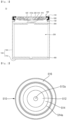
- an upper side will be defined as an upper portion and a lower side will be defined as a lower portion based on FIG. 1 .
- FIG. 1 is a cross-sectional view illustrating a cylindrical secondary battery according to one embodiment of the present invention.
- FIG. 2 is a plan view of a cap assembly according to FIG. 1 .
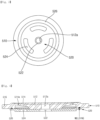
- FIG. 3 is a plan view illustrating a rear surface of the cap assembly according to FIG. 1 .
- FIG. 4 is a cross-sectional view of the cap assembly according to FIG. 1 .
- a cylindrical secondary battery 10 may include a cylindrical can 100, an electrode assembly 200 inserted into the can 100, a first electrode current collector plate 300 and a second electrode current collector plate 400 electrically connected to the electrode assembly 200, and a cap assembly 500 coupled to one end of the can 100.
- the can 100 may include a circular bottom portion 110 and a side portion 130 extending in an upward direction from the bottom portion 110.
- the side portion 130 has a cylindrical shape, and an upper end thereof is open to form an opening.
- the bottom portion 110 and the side portion 130 may be integrally formed, or may be separately formed and coupled to each other.
- the electrode assembly 200 is accommodated in the can 100 along with an electrolyte through the opening, and the cap assembly 500 is coupled to the opening to seal the can 100.
- the can 100 may be formed of steel, a steel alloy, nickel-plated steel, a nickel-plated steel alloy, aluminum, an aluminum alloy, or equivalents thereof, but is not limited thereto.
- a beading portion 132 may be concavely formed inward adjacent to the upper end of the side portion 130, and a crimping portion 134 in which an end portion of the side portion 130 is bent may be formed above the beading portion 132.
- the beading portion 132 supports a lower portion of the cap assembly 500 and the crimping portion 134 supports an upper portion of the cap assembly 500.
- the electrode assembly 200 may include a first electrode plate, a second electrode plate, and a separator.
- the first electrode plate may be a positive electrode plate in which a positive electrode active material layer (for example, a transition metal oxide (LiCoO 2 , LiNiO 2 , LiMn 2 O 4 , or the like)) is formed on both surfaces.
- a positive electrode active material layer for example, a transition metal oxide (LiCoO 2 , LiNiO 2 , LiMn 2 O 4 , or the like)
- a second electrode uncoated portion where the positive electrode active material layer is not formed may be formed in a portion of the first electrode plate.
- the first electrode uncoated portion may be disposed to face the opening of the can 100.
- the second electrode plate may be a negative electrode plate in which a negative electrode active material layer (for example, graphite, carbon, or the like) is formed on both surfaces.
- a first electrode uncoated portion where the negative electrode active material layer is not formed may be formed in a portion of the second electrode plate.
- the second electrode uncoated portion may be disposed to face the bottom portion 110 of the can 100.
- the separator may be interposed between the first electrode plate and the second electrode plate to prevent a short circuit and allow only lithium ions to move.
- the first electrode plate may be an aluminum (Al) foil
- the second electrode plate may be a copper (Cu) or nickel (Ni) foil
- the separator may be polyethylene (PE) or polypropylene (PP), but the present invention is not limited to the above-described materials.
- the first electrode plate, the second electrode plate, and the separator may be wound in a roughly cylindrical shape and accommodated in the can 100.
- the first electrode uncoated portion may be electrically connected to the first electrode current collector plate 300
- the second electrode uncoated portion may be electrically connected to the second electrode current collector plate 400.
- the first electrode current collector plate 300 may be welded to the first electrode uncoated portion of the positive electrode plate and electrically connected to the cap assembly 500 through a first electrode lead 310. Accordingly, the first electrode plate and the cap assembly 500 may be electrically connected.
- the first electrode current collector plate 300 may have a roughly disk shape.
- a base material tab may be formed in the first electrode plate, and the first electrode current collector plate 300 may be directly welded to the base material tab of the first electrode plate.
- the second electrode current collector plate 400 may be welded to the second electrode uncoated portion of the negative electrode plate and the bottom portion 110 of the can 100. Accordingly, the second electrode plate and the can 100 may be electrically connected.
- the second electrode current collector plate 400 may have a roughly disk shape.
- a base material tab may be formed in the second electrode plate, and the second electrode current collector plate 400 may be welded to the bottom portion 110 of the can 100.
- the cap assembly 500 may include a vent plate 510, a cap down plate 520, and a gasket 530.
- the vent plate 510 has a roughly disk shape and may include a first support 512 through which a degassing hole 512a is formed, a vent portion 514 connected to the first support 512 and having a notch 514a, and a second support 516 connected to the vent portion 514 and coupled to the side portion 130 of the can 100.
- the first support 512 is a portion having a certain thickness, and the degassing hole 512a is formed through a center of the first support 512.
- a lower surface of the first support 512 is in contact with an upper surface of the cap down plate 520.
- a thickness of the first support 512 may gradually decrease toward the outside.
- the vent portion 514 is integrally formed with the outside of the first support 512.
- the degassing hole 512a communicates with the inside of the can 100 through the cap down plate 520. When gas is generated in the secondary battery 10, the gas may be discharged to the outside through the degassing hole 512a.
- a lower surface of the first support 512 may protrude more downward than a lower surface of the second support 516.
- the vent portion 514 is formed between the first support 512 and the second support 516 and has a relatively thin thickness compared to the first support 512 and the second support 516.
- the notch 514a is formed in a circular shape on the vent portion 514 and broken when the gas pressure exceeds a certain level or more when gas is generated and thus becomes a gas discharge path.
- the notch 514a may be formed at a side close to the second support 516.
- the second support 516 is an edge portion of the vent plate 510, is connected to the outside of the vent portion 514, and is integrally formed with the vent portion 514. A height of an upper surface of the second support 516 may be lower than a height of an edge of the vent portion 514.
- the gasket 530 is coupled to the outside of the second support 516, and the second support 516 is fixed by the crimping portion 134 of the can 100 with the gasket 530 interposed therebetween. Further, a portion of the cap down plate 520 is in close contact with the lower surface of the second support 516.
- the cap down plate 520 is disposed under the vent plate 510, and electrically connected to the vent plate 510 and the first electrode current collector plate 300.
- FIG. 1 illustrates that the cap down plate 520 is electrically connected to the first electrode current collector plate 300 by the first electrode lead 310, but the cap down plate 520 may also be directly connected to the first electrode current collector plate 300 by welding.
- the cap down plate 520 has a roughly disk shape and may have a smaller diameter than the vent plate 510.
- a through hole 522 which communicates with the above-described degassing hole 512a is formed through a center of the cap down plate 520.
- An upper surface of the edge of the cap down plate 520 is in close contact with the lower surface of the second support 516 of the vent plate 510.
- This portion is defined as a third support 526.
- other portions may have lower upper surface heights than the third support 526. That is, an upper surface of the cap down plate 520 other than the third support 526 may be formed concavely toward the first electrode current collector plate 300.
- a plurality of slots 524 which serve as flow paths when gas is generated may be formed to pass through a region between an outer region of the through hole 522 and the third support 526.
- the upper surface of the cap down plate 520 is in close contact with the lower surface of the first support 512, and an upper surface of the third support 526 is in close contact with the lower surface of the second support 516.
- a welded portion may be formed by welding a portion where the second support 516 and the third support 526 are in close contact. Since the second support 516 and the third support 526 are welded to each other, electrical connection between the electrode assembly 200 and the cap assembly 500 is maintained as coupling between the vent plate 510 and the cap down plate 520 is maintained even when the notch 514a is broken and the first support 512 is removed when gas is generated in the secondary battery 10.
- the gasket 530 has a roughly ring shape and may be formed to have a certain width.
- the gasket 530 may be formed to surround part or all of the second support 516.
- the cap assembly 500 is insulated from the can 100 by the gasket 530 and electrically connected to the first electrode current collector plate 300. Accordingly, when the first electrode current collector plate 300 is a negative electrode current collector plate, the cap assembly 500 may serve as a negative electrode.
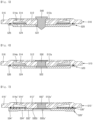
- FIG. 5 is a cross-sectional view illustrating a temporarily sealed state of the cap assembly according to FIG. 4 .
- FIG. 6 is a cross-sectional view illustrating a riveted state of the cap assembly according to FIG. 4 .
- the electrode assembly 200 After welding each of the first electrode current collector plate 300 and the second electrode current collector plate 400 to the electrode assembly 200, the electrode assembly 200 is inserted into the can 100 so that the first electrode current collector plate 300 faces upward and the electrolyte is injected. After welding the vent plate 510 and the cap down plate 520 and coupling the gasket 530 to form the cap assembly 500, the cap assembly 500 is seated on the beading portion 132 of the side portion 130. Thereafter, the crimping portion 134 is formed to assemble the cap assembly 500 to the can 100.
- the secondary battery 10 is sealed by inserting a cap stopper 240 into the degassing hole 512a.
- the cap stopper 240 is a removable component, and may be made of a resin or the like and press-fitted into the degassing hole 512a.
- the internal gas may be discharged through the degassing hole 512a by removing the cap stopper 240.
- a rivet 550 may be inserted into the degassing hole 512a to close the degassing hole 512a.
- the rivet 550 may be a blind rivet.
- the structure of the above-described cap assembly may also be applied to a cap structure having a current interrupt device (CID) function (detailed descriptions of the same structure and features as the above-described embodiment will be omitted).
- CID current interrupt device
- FIG. 7 is a cross-sectional view illustrating a cap assembly of a cylindrical secondary battery according to another embodiment of the present invention.
- a cap assembly 500' may include a vent plate 510' and a cap down plate 520', and an insulating member 530' disposed between the vent plate 510' and the cap down plate 520'.
- the structures of a cap stopper and a rivet 550' may be applied in the same manner as the above-described embodiment.
- vent plate 510' A structure of the vent plate 510' may be the same as the above-described embodiment (only reference numbers are shown differently for distinction).
- a through hole 522' may be formed in a center of the cap down plate 520', and a plurality of slots 524' may be formed through the cap down plate 520' to be spaced apart from the through hole 522'.
- a certain region of an outer edge of a portion where the through hole 522' and the slots 524' are formed is defined as a third support 526'.
- An upper surface and a lower surface of the third support 526' may be disposed relatively lower than other portions. That is, the cap down plate 520' has a shape in which a region other than the third support 526' may be formed convexly toward an upper portion.
- An upper surface of the convex portion is in close contact with a lower surface of a first support 512' of the vent plate 510', and the third support 526 is in close contact with the insulating member 530'. Accordingly, the cap down plate 520' is electrically connected to the vent plate 510' only in a region of the first support 512'.
- a cross-section of the through hole 522' may be formed in a stepped form.
- a diameter of the through hole 522' in a direction of the electrode assembly may be formed to be larger than a diameter of the through hole 522' in a direction of the degassing hole 512a'.
- a CID notch 532b' may be formed in a plate surface of the cap down plate 520' adjacent to the upper portion of the through hole 522'.
- the CID notch 532b' is a portion broken by a gas pressure above a certain level when gas is generated and performs the same function as a notch 514a' of the vent plate 510'.
- the rivet 550' is coupled, the rivet 550' is inserted into the degassing hole 512a' and the upper portion of the through hole 522', and the vent plate 510' and the cap down plate 520' are connected to each other.
- the notch 514a' is broken and the first support 512' is lifted in an upward direction by the gas pressure, the upper region of the through hole 522' connected by the rivet 550' is also lifted upward.
- the CID notch 532b' is broken, and the first support 512' and a region around the CID notch 532b' are removed together. Accordingly, since there is no portion electrically connected to the electrode assembly, current between the electrode assembly and the cap assembly 500' is blocked. That is, the cap down plate 520' functions as a current interrupt device (CID).
- CID current interrupt device
Landscapes
- Chemical & Material Sciences (AREA)
- Chemical Kinetics & Catalysis (AREA)
- Electrochemistry (AREA)
- General Chemical & Material Sciences (AREA)
- Engineering & Computer Science (AREA)
- Manufacturing & Machinery (AREA)
- Sealing Battery Cases Or Jackets (AREA)
- Connection Of Batteries Or Terminals (AREA)
- Gas Exhaust Devices For Batteries (AREA)
Applications Claiming Priority (2)
| Application Number | Priority Date | Filing Date | Title |
|---|---|---|---|
| KR1020210148844A KR102809614B1 (ko) | 2021-11-02 | 2021-11-02 | 원통형 이차전지 및 이차전지의 제조방법 |
| PCT/KR2022/016357 WO2023080519A1 (ko) | 2021-11-02 | 2022-10-25 | 원통형 이차전지 및 이차전지의 제조방법 |
Publications (2)
| Publication Number | Publication Date |
|---|---|
| EP4429007A1 true EP4429007A1 (de) | 2024-09-11 |
| EP4429007A4 EP4429007A4 (de) | 2025-11-12 |
Family
ID=86241393
Family Applications (1)
| Application Number | Title | Priority Date | Filing Date |
|---|---|---|---|
| EP22890254.0A Pending EP4429007A4 (de) | 2021-11-02 | 2022-10-25 | Zylindrische sekundärbatterie und verfahren zur herstellung einer sekundärbatterie |
Country Status (5)
| Country | Link |
|---|---|
| US (1) | US20250070370A1 (de) |
| EP (1) | EP4429007A4 (de) |
| KR (1) | KR102809614B1 (de) |
| CN (1) | CN118202513A (de) |
| WO (1) | WO2023080519A1 (de) |
Families Citing this family (1)
| Publication number | Priority date | Publication date | Assignee | Title |
|---|---|---|---|---|
| KR102946352B1 (ko) * | 2024-12-12 | 2026-03-30 | 주식회사 엘지에너지솔루션 | 캡 플레이트, 배터리 셀 및 이를 포함하는 배터리 팩 및 자동차 |
Family Cites Families (6)
| Publication number | Priority date | Publication date | Assignee | Title |
|---|---|---|---|---|
| JP4592315B2 (ja) * | 2004-03-29 | 2010-12-01 | 三洋電機株式会社 | 密閉型二次電池 |
| KR101285898B1 (ko) * | 2006-07-10 | 2013-07-12 | 삼성에스디아이 주식회사 | 이차전지 |
| JP5994670B2 (ja) * | 2013-02-15 | 2016-09-21 | 株式会社豊田自動織機 | 蓄電装置及び蓄電装置の製造方法 |
| JP2015082495A (ja) * | 2013-10-24 | 2015-04-27 | 株式会社豊田自動織機 | 蓄電装置用の仮封止栓 |
| KR102487217B1 (ko) * | 2018-02-01 | 2023-01-11 | 주식회사 엘지에너지솔루션 | 리벳을 포함하는 캡 어셈블리 및 이를 포함하는 비딩부/클림핑부가 생략된 원통형 전지 |
| KR102706444B1 (ko) * | 2020-02-06 | 2024-09-13 | 주식회사 엘지에너지솔루션 | 이차전지 제조방법 및 그를 포함하는 전지팩 제조방법 |
-
2021
- 2021-11-02 KR KR1020210148844A patent/KR102809614B1/ko active Active
-
2022
- 2022-10-25 EP EP22890254.0A patent/EP4429007A4/de active Pending
- 2022-10-25 CN CN202280073464.8A patent/CN118202513A/zh active Pending
- 2022-10-25 WO PCT/KR2022/016357 patent/WO2023080519A1/ko not_active Ceased
- 2022-10-25 US US18/706,645 patent/US20250070370A1/en active Pending
Also Published As
| Publication number | Publication date |
|---|---|
| US20250070370A1 (en) | 2025-02-27 |
| EP4429007A4 (de) | 2025-11-12 |
| KR20230063612A (ko) | 2023-05-09 |
| WO2023080519A1 (ko) | 2023-05-11 |
| CN118202513A (zh) | 2024-06-14 |
| KR102809614B1 (ko) | 2025-05-20 |
Similar Documents
| Publication | Publication Date | Title |
|---|---|---|
| US20230231242A1 (en) | Secondary battery | |
| CN115799591B (zh) | 圆柱形二次电池 | |
| EP4468506A1 (de) | Sekundärbatterie | |
| CN115298892A (zh) | 圆柱形二次电池 | |
| KR102530339B1 (ko) | 이차전지 | |
| KR102688976B1 (ko) | 이차 전지 | |
| US20140045009A1 (en) | Secondary battery | |
| EP4439748A1 (de) | Sekundärbatterie | |
| CN116325328B (zh) | 圆柱形二次电池 | |
| JP2006324244A (ja) | 二次電池 | |
| KR20190098495A (ko) | 전극 조립체 및 이를 포함하는 이차전지 | |
| KR20110056117A (ko) | 원통형 이차 전지 | |
| EP4629432A1 (de) | Sekundärbatterie | |
| US20080226981A1 (en) | Center pin cylindrical secondary battery and cylindrical secondary battery having the same | |
| EP4210139A2 (de) | Sekundärbatterie | |
| EP4429007A1 (de) | Zylindrische sekundärbatterie und verfahren zur herstellung einer sekundärbatterie | |
| EP4175031A1 (de) | Zylindrische sekundärbatterie und verfahren zur herstellung davon | |
| US20230006292A1 (en) | Battery | |
| EP4571957A1 (de) | Zylindrische sekundärbatterie | |
| KR102795101B1 (ko) | 원통형 이차 전지 | |
| EP4513613A1 (de) | Sekundärbatterie | |
| EP4513612A1 (de) | Sekundärbatterie | |
| EP4723268A1 (de) | Batteriezelle, vorrichtung zur herstellung einer batteriezelle und verfahren zur herstellung einer batteriezelle | |
| EP4475244A2 (de) | Zylindrische sekundärbatterie | |
| EP4451435A2 (de) | Sekundärbatterie |
Legal Events
| Date | Code | Title | Description |
|---|---|---|---|
| STAA | Information on the status of an ep patent application or granted ep patent |
Free format text: STATUS: THE INTERNATIONAL PUBLICATION HAS BEEN MADE |
|
| PUAI | Public reference made under article 153(3) epc to a published international application that has entered the european phase |
Free format text: ORIGINAL CODE: 0009012 |
|
| STAA | Information on the status of an ep patent application or granted ep patent |
Free format text: STATUS: REQUEST FOR EXAMINATION WAS MADE |
|
| 17P | Request for examination filed |
Effective date: 20240502 |
|
| AK | Designated contracting states |
Kind code of ref document: A1 Designated state(s): AL AT BE BG CH CY CZ DE DK EE ES FI FR GB GR HR HU IE IS IT LI LT LU LV MC ME MK MT NL NO PL PT RO RS SE SI SK SM TR |
|
| DAV | Request for validation of the european patent (deleted) | ||
| DAX | Request for extension of the european patent (deleted) | ||
| A4 | Supplementary search report drawn up and despatched |
Effective date: 20251013 |
|
| RIC1 | Information provided on ipc code assigned before grant |
Ipc: H01M 50/30 20210101AFI20251007BHEP Ipc: H01M 50/317 20210101ALI20251007BHEP Ipc: H01M 50/152 20210101ALI20251007BHEP Ipc: H01M 50/342 20210101ALI20251007BHEP Ipc: H01M 10/058 20100101ALI20251007BHEP Ipc: H01M 10/04 20060101ALI20251007BHEP |