EP4513612A1 - Sekundärbatterie - Google Patents
Sekundärbatterie Download PDFInfo
- Publication number
- EP4513612A1 EP4513612A1 EP24185340.7A EP24185340A EP4513612A1 EP 4513612 A1 EP4513612 A1 EP 4513612A1 EP 24185340 A EP24185340 A EP 24185340A EP 4513612 A1 EP4513612 A1 EP 4513612A1
- Authority
- EP
- European Patent Office
- Prior art keywords
- secondary battery
- plate
- terminal
- electrode plate
- diameter
- Prior art date
- Legal status (The legal status is an assumption and is not a legal conclusion. Google has not performed a legal analysis and makes no representation as to the accuracy of the status listed.)
- Pending
Links
Images
Classifications
-
- H—ELECTRICITY
- H01—ELECTRIC ELEMENTS
- H01M—PROCESSES OR MEANS, e.g. BATTERIES, FOR THE DIRECT CONVERSION OF CHEMICAL ENERGY INTO ELECTRICAL ENERGY
- H01M10/00—Secondary cells; Manufacture thereof
- H01M10/04—Construction or manufacture in general
- H01M10/0431—Cells with wound or folded electrodes
-
- H—ELECTRICITY
- H01—ELECTRIC ELEMENTS
- H01M—PROCESSES OR MEANS, e.g. BATTERIES, FOR THE DIRECT CONVERSION OF CHEMICAL ENERGY INTO ELECTRICAL ENERGY
- H01M10/00—Secondary cells; Manufacture thereof
- H01M10/05—Accumulators with non-aqueous electrolyte
- H01M10/058—Construction or manufacture
- H01M10/0587—Construction or manufacture of accumulators having only wound construction elements, i.e. wound positive electrodes, wound negative electrodes and wound separators
-
- H—ELECTRICITY
- H01—ELECTRIC ELEMENTS
- H01M—PROCESSES OR MEANS, e.g. BATTERIES, FOR THE DIRECT CONVERSION OF CHEMICAL ENERGY INTO ELECTRICAL ENERGY
- H01M50/00—Constructional details or processes of manufacture of the non-active parts of electrochemical cells other than fuel cells, e.g. hybrid cells
- H01M50/10—Primary casings; Jackets or wrappings
- H01M50/14—Primary casings; Jackets or wrappings for protecting against damage caused by external factors
-
- H—ELECTRICITY
- H01—ELECTRIC ELEMENTS
- H01M—PROCESSES OR MEANS, e.g. BATTERIES, FOR THE DIRECT CONVERSION OF CHEMICAL ENERGY INTO ELECTRICAL ENERGY
- H01M10/00—Secondary cells; Manufacture thereof
- H01M10/04—Construction or manufacture in general
- H01M10/0422—Cells or battery with cylindrical casing
-
- H—ELECTRICITY
- H01—ELECTRIC ELEMENTS
- H01M—PROCESSES OR MEANS, e.g. BATTERIES, FOR THE DIRECT CONVERSION OF CHEMICAL ENERGY INTO ELECTRICAL ENERGY
- H01M10/00—Secondary cells; Manufacture thereof
- H01M10/05—Accumulators with non-aqueous electrolyte
- H01M10/052—Li-accumulators
- H01M10/0525—Rocking-chair batteries, i.e. batteries with lithium insertion or intercalation in both electrodes; Lithium-ion batteries
-
- H—ELECTRICITY
- H01—ELECTRIC ELEMENTS
- H01M—PROCESSES OR MEANS, e.g. BATTERIES, FOR THE DIRECT CONVERSION OF CHEMICAL ENERGY INTO ELECTRICAL ENERGY
- H01M50/00—Constructional details or processes of manufacture of the non-active parts of electrochemical cells other than fuel cells, e.g. hybrid cells
- H01M50/10—Primary casings; Jackets or wrappings
- H01M50/102—Primary casings; Jackets or wrappings characterised by their shape or physical structure
- H01M50/107—Primary casings; Jackets or wrappings characterised by their shape or physical structure having curved cross-section, e.g. round or elliptic
-
- H—ELECTRICITY
- H01—ELECTRIC ELEMENTS
- H01M—PROCESSES OR MEANS, e.g. BATTERIES, FOR THE DIRECT CONVERSION OF CHEMICAL ENERGY INTO ELECTRICAL ENERGY
- H01M50/00—Constructional details or processes of manufacture of the non-active parts of electrochemical cells other than fuel cells, e.g. hybrid cells
- H01M50/10—Primary casings; Jackets or wrappings
- H01M50/147—Lids or covers
- H01M50/166—Lids or covers characterised by the methods of assembling casings with lids
- H01M50/167—Lids or covers characterised by the methods of assembling casings with lids by crimping
-
- H—ELECTRICITY
- H01—ELECTRIC ELEMENTS
- H01M—PROCESSES OR MEANS, e.g. BATTERIES, FOR THE DIRECT CONVERSION OF CHEMICAL ENERGY INTO ELECTRICAL ENERGY
- H01M50/00—Constructional details or processes of manufacture of the non-active parts of electrochemical cells other than fuel cells, e.g. hybrid cells
- H01M50/10—Primary casings; Jackets or wrappings
- H01M50/172—Arrangements of electric connectors penetrating the casing
- H01M50/174—Arrangements of electric connectors penetrating the casing adapted for the shape of the cells
- H01M50/179—Arrangements of electric connectors penetrating the casing adapted for the shape of the cells for cells having curved cross-section, e.g. round or elliptic
-
- H—ELECTRICITY
- H01—ELECTRIC ELEMENTS
- H01M—PROCESSES OR MEANS, e.g. BATTERIES, FOR THE DIRECT CONVERSION OF CHEMICAL ENERGY INTO ELECTRICAL ENERGY
- H01M50/00—Constructional details or processes of manufacture of the non-active parts of electrochemical cells other than fuel cells, e.g. hybrid cells
- H01M50/10—Primary casings; Jackets or wrappings
- H01M50/183—Sealing members
- H01M50/186—Sealing members characterised by the disposition of the sealing members
-
- H—ELECTRICITY
- H01—ELECTRIC ELEMENTS
- H01M—PROCESSES OR MEANS, e.g. BATTERIES, FOR THE DIRECT CONVERSION OF CHEMICAL ENERGY INTO ELECTRICAL ENERGY
- H01M50/00—Constructional details or processes of manufacture of the non-active parts of electrochemical cells other than fuel cells, e.g. hybrid cells
- H01M50/30—Arrangements for facilitating escape of gases
- H01M50/342—Non-re-sealable arrangements
- H01M50/3425—Non-re-sealable arrangements in the form of rupturable membranes or weakened parts, e.g. pierced with the aid of a sharp member
-
- H—ELECTRICITY
- H01—ELECTRIC ELEMENTS
- H01M—PROCESSES OR MEANS, e.g. BATTERIES, FOR THE DIRECT CONVERSION OF CHEMICAL ENERGY INTO ELECTRICAL ENERGY
- H01M50/00—Constructional details or processes of manufacture of the non-active parts of electrochemical cells other than fuel cells, e.g. hybrid cells
- H01M50/50—Current conducting connections for cells or batteries
- H01M50/528—Fixed electrical connections, i.e. not intended for disconnection
-
- H—ELECTRICITY
- H01—ELECTRIC ELEMENTS
- H01M—PROCESSES OR MEANS, e.g. BATTERIES, FOR THE DIRECT CONVERSION OF CHEMICAL ENERGY INTO ELECTRICAL ENERGY
- H01M50/00—Constructional details or processes of manufacture of the non-active parts of electrochemical cells other than fuel cells, e.g. hybrid cells
- H01M50/50—Current conducting connections for cells or batteries
- H01M50/543—Terminals
- H01M50/552—Terminals characterised by their shape
- H01M50/559—Terminals adapted for cells having curved cross-section, e.g. round, elliptic or button cells
-
- H—ELECTRICITY
- H01—ELECTRIC ELEMENTS
- H01M—PROCESSES OR MEANS, e.g. BATTERIES, FOR THE DIRECT CONVERSION OF CHEMICAL ENERGY INTO ELECTRICAL ENERGY
- H01M50/00—Constructional details or processes of manufacture of the non-active parts of electrochemical cells other than fuel cells, e.g. hybrid cells
- H01M50/10—Primary casings; Jackets or wrappings
- H01M50/147—Lids or covers
- H01M50/148—Lids or covers characterised by their shape
- H01M50/152—Lids or covers characterised by their shape for cells having curved cross-section, e.g. round or elliptic
-
- Y—GENERAL TAGGING OF NEW TECHNOLOGICAL DEVELOPMENTS; GENERAL TAGGING OF CROSS-SECTIONAL TECHNOLOGIES SPANNING OVER SEVERAL SECTIONS OF THE IPC; TECHNICAL SUBJECTS COVERED BY FORMER USPC CROSS-REFERENCE ART COLLECTIONS [XRACs] AND DIGESTS
- Y02—TECHNOLOGIES OR APPLICATIONS FOR MITIGATION OR ADAPTATION AGAINST CLIMATE CHANGE
- Y02E—REDUCTION OF GREENHOUSE GAS [GHG] EMISSIONS, RELATED TO ENERGY GENERATION, TRANSMISSION OR DISTRIBUTION
- Y02E60/00—Enabling technologies; Technologies with a potential or indirect contribution to GHG emissions mitigation
- Y02E60/10—Energy storage using batteries
-
- Y—GENERAL TAGGING OF NEW TECHNOLOGICAL DEVELOPMENTS; GENERAL TAGGING OF CROSS-SECTIONAL TECHNOLOGIES SPANNING OVER SEVERAL SECTIONS OF THE IPC; TECHNICAL SUBJECTS COVERED BY FORMER USPC CROSS-REFERENCE ART COLLECTIONS [XRACs] AND DIGESTS
- Y02—TECHNOLOGIES OR APPLICATIONS FOR MITIGATION OR ADAPTATION AGAINST CLIMATE CHANGE
- Y02P—CLIMATE CHANGE MITIGATION TECHNOLOGIES IN THE PRODUCTION OR PROCESSING OF GOODS
- Y02P70/00—Climate change mitigation technologies in the production process for final industrial or consumer products
- Y02P70/50—Manufacturing or production processes characterised by the final manufactured product
Definitions
- aspects of embodiments of the present disclosure relate to a secondary battery.
- Lithium ion secondary batteries are used as power sources for hybrid or electric vehicles, as well as portable electronic devices, because of their advantages of a high operating voltage and a high energy density per unit weight.
- Such secondary batteries may be classified into cylindrical, prismatic, and pouch-type secondary batteries in shape.
- a cylindrical secondary battery is generally constituted by a can that is provided in a cylindrical shape, an electrode assembly that is wound in a cylindrical shape and inserted into the can, an electrolyte that is injected into the can, and a cap assembly that is coupled to the can.
- a secondary battery capable of preventing or substantially preventing an electrode assembly from being inappropriately deformed after a formation process or during use is provided.
- a secondary battery includes: an electrode assembly comprising a first electrode plate, a second electrode plate, and a separator, and wound to have a hollow part at a center thereof; a can having a cylindrical shape, of which a first surface (a top surface) is closed, and a second surface (a bottom surface) is open to accommodate the electrode assembly, the can being electrically connected to the first electrode plate; a cap plate coupled to the second surface of the can; and a terminal passing through the first surface of the can and comprising an inner portion supported inside the can (fixed to an inner surface of the top surface of the can) and an outer portion supported outside the can, the terminal being electrically connected to the second electrode plate, wherein the hollow part of the electrode assembly has a diameter less than a diameter of the inner portion of the terminal.
- the diameter of the hollow part of the electrode assembly may be about 0.07 times to about 0.22 times a diameter of the can, preferably 0.09 times to 0.20 times, 0.11 times to 0.19 times, or 0.13 times to 0.17 times, more preferably 0.15 times.
- the can may have a diameter of about 46 mm, and the diameter of the hollow part of the electrode assembly may be about 3 mm to about 10 mm, preferably 4 mm to 9 mm, 5 mm to 8 mm, more preferably 6 mm to 7 mm.
- the diameter of the inner portion of the terminal may be less than that of the outer portion of the terminal.
- the can may include a through-hole in the first surface thereof, and the terminal may be installed by being deformed to have a diameter greater than that of the through-hole after being inserted into the through-hole from the outside of the can in a state in which the inner portion of the terminal has a diameter less than that of the through-hole.
- the first electrode plate may include a coating portion coated with an active material on a corresponding base material and a non-coating portion that is not coated with the active material, wherein the non-coating portion of the first electrode plate is arranged to face the second surface of the can
- the second electrode plate may include a coating portion coated with an active material on a corresponding base material and a non-coating portion that is not coated with the active material, wherein the non-coating portion of the second electrode plate is arranged to face the first surface of the can.
- the can may be configured such that the first surface and a side surface extending from an edge of the first surface are integrated with each other.
- the can may include: a beading part that is concavely recessed inward from a side surface to seat the cap plate; and a crimping part that is disposed lower than the beading part and bent inward to cover an edge of the cap plate at the side surface so as to fix the cap plate.
- the cap plate may include a notch configured as a safety vent.
- the secondary battery may further include a first current collector plate configured to electrically connect the first electrode plate to the can.
- the first current collector plate may include: a flat portion having a shape corresponding to one surface (a bottom surface) of the electrode assembly; and an extension portion extending from the flat portion such that an edge thereof is in contact with the beading part of the can.
- the secondary battery may further include a first gasket between the can and the cap plate.
- the secondary battery may further include a second current collector plate configured to electrically connect the second electrode plate to the terminal.
- the second current collector plate may be in contact with an inner portion of the terminal.
- the secondary battery may further include a second gasket between the can and the terminal.
- the secondary battery may further include a pin inserted in the hollow part of the electrode assembly.
- Embodiments of the present invention may, however, be embodied in many different forms and should not be construed as being limited to the embodiments set forth herein; rather, these embodiments are provided so that those skilled in the art may thoroughly understand the present invention. Rather, these embodiments are provided so that this disclosure will be thorough and complete, and will fully convey the scope of the present disclosure to those skilled in the art.
- each layer may be exaggerated for convenience and clarity of description, and the same reference numerals in the drawings refer to the same elements.
- the term "and/or" includes any and all combinations of one or more of the associated listed items. In this specification, it is to be understood that if a member A is referred to as being connected to a member B, the member A may be directly connected to the member B or indirectly connected to the member B with one or more members C therebetween.
- first As used herein, terms such as "first,” “second,” etc. are used to describe various members, components, areas, layers, and/or portions. However, it is to be understood that the members, components, areas, layers, and/or portions are not to be defined by these terms. The terms do not mean a particular order, up and down, or superiority, and are used for distinguishing one member, component, region, layer, or portion from another member, component, region, layer, or portion. Thus, a first member, component, area, layer, or portion described herein may also refer to a second member, component, area, layer, or portion, without departing from the teaching of the present invention.
- spatially relative terms such as “below,” “beneath,” “lower,” “above,” “upper,” , “top”, “bottom” and the like, may be used herein for ease of description to describe one element or feature's relationship to another element(s) or feature(s), referring to the figures. These spatially relative terms are intended for ease of comprehension of the present invention according to various process states or usage states of the present invention, and, thus, the present disclosure is not limited thereto. In case of non-specified definitions of the terms, the spatially relative terms may refer to the directions shown in the drawings.
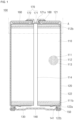
- FIG. 1 illustrates a cross-sectional view of a secondary battery 100 according to one or more embodiments.
- the secondary battery 100 may include an electrode assembly 110, a can 120, a first current collector plate 130, a cap plate 140, a first gasket 150, a second current collector plate 160, a terminal 170, and a second gasket 180.
- the electrode assembly 110 may include a first electrode plate 111, a second electrode plate 112, and a separator 113.
- the first electrode plate 111 may be any one of a negative electrode plate and a positive electrode plate.
- the first electrode plate 111 may include a coating portion (negative electrode coating portion) 111a coated with an active material (negative electrode active material) on a base material (negative electrode base material) provided as a conductive metal thin plate, for example, copper or nickel foil or mesh, and a non-coating portion (negative electrode non-coating portion) 111b that is not coated with the negative electrode active material (see FIG. 3 ).
- the negative electrode active material may include a carbon-based material, Si, Sn, tin oxide, a tin alloy composite, transition metal oxide, lithium metal nitrite, or metal oxide.
- the negative electrode non-coating portion 111b may be disposed at a lower side such that the first electrode plate 111 is electrically connected to the can 120 through the first current collector plate 130.
- the can 120 may have a negative polarity.
- the second electrode plate 112 may be the other of the negative electrode plate and the positive electrode plate.
- the second electrode plate 112 may include a coating portion (positive electrode coating portion) 112a coated with an active material (positive electrode active material) on a base material (positive electrode base material) provided as a conductive metal thin plate, for example, copper or nickel foil or mesh, and a non-coating portion (positive electrode non-coating portion) 112b that is not coated with the positive electrode active material.
- the positive electrode active material may be made of a chalcogenide compound, for example, composite metal oxide, such as LiCoO 2 , LiMn2O 4 , LiNiO 2 , LiNiMnO 2 , and the like.
- the positive non-coating portion 112b may be disposed at an upper side such that the second electrode plate 112 is electrically connected to the terminal 170 through the second current collector plate 160.
- the terminal 170 may have a positive polarity.
- the separator 113 may be interposed between the first electrode plate 111 and the second electrode plate 112 to prevent or substantially prevent a short circuit between the first electrode plate 111 and the second electrode plate 112.
- the separator 113 may be made of, for example, polyethylene, polypropylene, a porous copolymer of polyethylene and polypropylene, or the like.
- the electrode assembly 110 may be provided by sequentially stacking the first electrode plate 111, the separator 113, and the second electrode plate 112, for example, by being wound such that a hollow part 114 is defined in a center by a mandrel.
- a separate pin (not shown) may be inserted into the hollow part 114 of the electrode assembly 110 to support the hollow part 114, thereby preventing or substantially preventing the hollow part 114 from being inappropriately deformed.
- the can 120 may be provided in a cylindrical shape.
- the can 120 may include a top surface 121 provided in a disk shape and a side surface 122 extending downward from an edge of the top surface 121.
- the can 120 may have an open bottom surface, and, thus, after the electrode assembly 110 is inserted together with an electrolyte into the can 120 through the bottom surface of the can 120, the bottom surface of the can 120 may be closed using the cap plate 140.
- the electrolyte may be a non-aqueous organic electrolyte that is a mixture of lithium salt and a high-purity organic solvent.
- the electrolyte may be a polymer using a polymer electrolyte or a solid electrolyte.
- the can 120 may have the top surface 121 and the side surface 122 which are integrated with each other.
- the can 120 may be made of, for example, steel, a steel alloy, aluminum, an aluminum alloy, etc.
- the can 120 may include a through-hole 121a for installing the terminal 170 on the top surface 121.
- the through-hole 121a may be defined at a center of the top surface 121 of the can 120.
- the can 120 may include a beading part 122a and a crimping part 122b on the side surface 122.
- the beading part 122a may be configured to fix the electrode assembly 110 and seat the cap plate 140 and may be provided by concavely recessing a lower portion inward from the side surface 122 of the can 120.
- the crimping part 122b may be configured to fix the cap plate 140 and may be provided by bending a lower end inward from the side surface 122 of the can 120 to cover an edge of the cap plate 140.
- the first current collector plate 130 may electrically connect the first electrode plate 111 of the electrode assembly 110 to the can 120.
- the first current collector plate 130 may be welded to each of the non-coating portion 111b of the first electrode plate 111 of the electrode assembly 110 and the can 120.
- the first current collector plate 130 may include a flat portion provided in a shape corresponding to a bottom surface of the electrode assembly 110 and an extension portion extending outward and upward from the flat portion. The flat portion may be fixed and electrically connected to the non-coating portion 111b of the first electrode plate 111 of the electrode assembly 110 by, for example, welding in a state of being in contact with the non-coating portion 111b of the first electrode plate 111 of the electrode assembly 110.
- the extension portion may be fixed and electrically connected to the beading part 122a of the can 120 by, for example, welding in a state in which an edge thereof is in contact with the beading part 122a of the can 120.
- the extension part may be fixed in a state in which the edge is interposed between the beading part 122a and the first gasket 150.
- the cap plate 140 may be coupled to the bottom surface of the can 120.
- the beading part 122a may be provided such that the lower portion of the side surface 122 of the can 120 is concavely recessed inward, and, then, the cap plate 140 may be seated on the beading part 122a, and the crimping part 122b is provided to be bent inward together with the first gasket 150 such that a lower end of the side surface 122 of the can 120 covers an edge of the cap plate 140, and, thus, the cap plate 140 may be installed.
- the cap plate 140 may include a notch 141 that functions as a safety vent. Therefore, if a gas is generated due to an abnormal operation of the secondary battery 100, and an internal pressure increases above a certain pressure, the cap plate 140 may be cut along the notch 141 by the pressure to release the gas, thereby preventing or substantially preventing explosion from occurring.
- the first gasket 150 may be disposed between the can 120 and the cap plate 140 to prevent or substantially prevent the electrolyte from leaking to the outside or foreign substances (moisture, dust, etc.) from being introduced therein.
- the first gasket 150 may be made of, for example, polypropylene (PP), polyethylene (PE), ethylene propylene diene monomer (EPDM), or nitrile butadiene rubber (NBR).
- the second current collector plate 160 may be disposed between the second electrode plate 112 and the terminal 170 of the electrode assembly 110 to electrically connect the second electrode plate 112 to the terminal 170.
- the second current collector plate 160 may be provided in a shape corresponding to the top surface of the electrode assembly 110 so as to be fixed and electrically connected to the non-coating portion 112b of the second electrode plate 112 by, for example, welding in a state of being in contact with the non-coating portion 112b of the second electrode plate 112 of the electrode assembly 110 or be fixed and electrically connected to the terminal 170 by, for example, welding in a state of being in contact with the terminal 170.
- the second current collector plate 160 may be made of, for example, aluminum.
- the terminal 170 may be installed in the through-hole 121a of the top surface 121 of the can 120.
- the terminal 170 may be installed in, for example, a rivet manner.
- the terminal 170 may be deformed such that a portion (inner portion) 171 of the terminal 170, which is inserted inward after inserted from the outside of the can 120 to the through-hole 121a, has a diameter greater than that of the through-hole 121a so as to be supported on and fixed to an inner surface of the top surface 121 of the can 120.
- a portion (outer portion) 172 of the terminal 170 which is disposed outside the can 120, may be provided to have a diameter greater than that of the through-hole 121a and supported on an outer surface of the top surface 121 of the can 120 and also may be provided to have a relatively large diameter, for example, a diameter greater than that of the deformed inner portion 171 so as to be more stably supported on the top surface 121 of the can 120.
- the terminal 170 may be deformed such that a portion (outer portion) 172, which protrudes outward after inserted from the inside of the can 120 to the through-hole 121a, has a diameter greater than that of the through-hole 121a so as to be supported on and fixed to an outer surface of the top surface 121 of the can 120.
- a portion (inner portion) 171 of the terminal 170 which is disposed inside the can 120, may be provided to have a diameter greater than that of the through-hole 121a and supported on an inner surface of the top surface 121 of the can 120 and also may be provided to have a relatively large diameter, for example, a diameter greater than that of the deformed outer portion 172 so as to be more stably supported on the top surface 121 of the can 120.
- the former case may be illustrated, and the diameter of the inner portion 171 may be illustrated to be less than that of the outer portion 172.
- the inner portion 171 of the terminal 170 may be welded to the second current collector plate 160.
- the second gasket 180 may be disposed between the can 120 and the terminal 170 to electrically insulate the can 120 from the terminal 170 and prevent or substantially prevent the electrolyte from leaking to the outside or foreign substances (moisture, dust, etc.) from being introduced therein.
- the second gasket 180 may be made of, for example, PP, PE, or PET.
- the electrode assembly may be improperly deformed.
- a phenomenon in which the electrode plates droops downward may occur in an area adjacent to the hollow part, and, thus, the electrode plate that is initially aligned higher may have a same height as the electrode plate that is aligned lower or may have a height less than that of the electrode plate.
- the larger the diameter of the hollow part of the electrode assembly the more disadvantageous it is in terms of the above limitation, and, as a result, in the secondary battery 100 according to embodiments of the present disclosure, the diameter of the hollow part 114 of the electrode assembly 110 is provided to be relatively small.
- FIG. 2 illustrates an enlarged view of a region "A" of FIG. 1 .
- a diameter d1 of the hollow part 114 of the electrode assembly 110 may be relatively small and, in an embodiment, less than a diameter d2 of the inner portion 171 of the terminal 170.
- the diameter d1 of the hollow part 114 of the electrode assembly 110 may be about 3 mm or more, and, if a diameter d3 of the can 120 is about 46 mm, the diameter d1 of the hollow part 114 of the electrode assembly 110 may be about 0.07 times or more than the diameter d3 of the can 120.
- the diameter d1 of the hollow part 114 of the electrode assembly 110 may be about 0.22 times or less than the diameter d3 of the can 120, and, if the diameter d3 of the can 120 is about 46 mm, the diameter d1 of the hollow part 114 of the electrode assembly 110 may be about 10 mm or less.
- the diameter d1 of the hollow part 114 of the electrode assembly 110 may be about 0.07 times to 0.22 times the diameter d3 of the can 120.
- a first end of the second electrode plate 112, which is close (proximal or relatively close) to the hollow part 114 (i.e., at which winding starts) may be relatively spaced apart from a first end of the first electrode plate 111, which is close (proximal or relatively close) to the hollow part 114 (at which the winding starts) toward a second end that is far (distal or relatively far) from the hollow part 114 (i.e., at which the winding is ended).
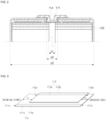
- FIG. 3 illustrates a schematic view of an alignment between the first electrode plate 111 and the second electrode plate 112 in the secondary battery 100 according to one or more embodiments.
- the first electrode plate 111, the separator 113, and the second electrode plate 112 are sequentially stacked to manufacture the electrode assembly 110 (in FIG.
- a first end 112c of the second electrode plate 112, which is close (proximal or relatively close) to the hollow part 114 may have a first offset f1 so as to be spaced apart from a first end 111c of the first electrode plate 111, which is close (proximal or relatively close) to the hollow part 114, toward a second end 111d, which is far (distal or relatively far) from the hollow part 114.
- a second end 112d of the second electrode plate 112, which is far (distal or relatively far) from the hollow part 114, may have a second offset f2 so as to be spaced apart from the second end 111d of the first electrode plate 111, which is far from the hollow part 114, toward the first end 111c that is close to the hollow part 114.
- the first offset f1 may be greater than the second offset f2.
- the first end 112c of the second electrode plate 112 may be spaced relatively far from the first end 111c to the second end 111d of the first electrode plate 111 toward the second end 111d, and, thus, the second electrode plate 112 may not exist in at least one turn section starting from the hollow part 114 of the electrode assembly 110.
- the lithium may be prevented or substantially prevented from being deposited due to the gap between the first electrode plate 111 and the second electrode plate 112.
- the first offset f1 may be about 1.5 times or more than the second offset f2. If the first offset f1 is less than about 1.5 times the second offset f2, the second electrode plate 112 may not be spaced sufficiently apart from the first electrode plate 111 such that the second electrode plate 112 does not exist in at least one turn section that starts from the hollow part 114 of the electrode assembly 110.
- the first offset f1 may be about 3.5 times or less than the second offset f2.
- the first offset f1 may be about 1.5 times to 3.5 times the second offset f2.
- the first offset f1 is about 10 mm to about 50 mm
- a diameter of the mandrel for winding the electrode assembly 110 is about 8 mm
- the first offset f1 may be about 25 mm
- the second offset f2 may be about 7.1 mm.
- the end of the second electrode plate from the point at which the winding starts is spaced relatively far inward from the end of the first electrode plate to prevent or substantially prevent the electrode plates from drooping downward from the area adjacent to, in particular, the hollow part or prevent or substantially prevent the lithium from being precipitated due to a gap between the electrode plates.
- the first method and the second method may be applied alone or together.
Landscapes
- Chemical & Material Sciences (AREA)
- Chemical Kinetics & Catalysis (AREA)
- Electrochemistry (AREA)
- General Chemical & Material Sciences (AREA)
- Engineering & Computer Science (AREA)
- Manufacturing & Machinery (AREA)
- Materials Engineering (AREA)
- Secondary Cells (AREA)
- Sealing Battery Cases Or Jackets (AREA)
Applications Claiming Priority (1)
| Application Number | Priority Date | Filing Date | Title |
|---|---|---|---|
| KR1020230111872A KR20250030647A (ko) | 2023-08-25 | 2023-08-25 | 이차전지 |
Publications (1)
| Publication Number | Publication Date |
|---|---|
| EP4513612A1 true EP4513612A1 (de) | 2025-02-26 |
Family
ID=91738315
Family Applications (1)
| Application Number | Title | Priority Date | Filing Date |
|---|---|---|---|
| EP24185340.7A Pending EP4513612A1 (de) | 2023-08-25 | 2024-06-28 | Sekundärbatterie |
Country Status (4)
| Country | Link |
|---|---|
| US (1) | US20250070331A1 (de) |
| EP (1) | EP4513612A1 (de) |
| KR (1) | KR20250030647A (de) |
| CN (1) | CN119518120A (de) |
Citations (3)
| Publication number | Priority date | Publication date | Assignee | Title |
|---|---|---|---|---|
| WO2023068889A1 (ko) * | 2021-10-22 | 2023-04-27 | 주식회사 엘지에너지솔루션 | 원통형 배터리, 그리고 이를 포함하는 배터리 팩 및 자동차 |
| US20230178826A1 (en) * | 2021-12-02 | 2023-06-08 | Samsung Sdi Co., Ltd. | Cylindrical secondary battery |
| US20230231242A1 (en) * | 2021-03-24 | 2023-07-20 | Samsung Sdi Co., Ltd. | Secondary battery |
-
2023
- 2023-08-25 KR KR1020230111872A patent/KR20250030647A/ko not_active Ceased
-
2024
- 2024-04-15 US US18/635,972 patent/US20250070331A1/en active Pending
- 2024-06-28 EP EP24185340.7A patent/EP4513612A1/de active Pending
- 2024-07-17 CN CN202410959457.9A patent/CN119518120A/zh active Pending
Patent Citations (3)
| Publication number | Priority date | Publication date | Assignee | Title |
|---|---|---|---|---|
| US20230231242A1 (en) * | 2021-03-24 | 2023-07-20 | Samsung Sdi Co., Ltd. | Secondary battery |
| WO2023068889A1 (ko) * | 2021-10-22 | 2023-04-27 | 주식회사 엘지에너지솔루션 | 원통형 배터리, 그리고 이를 포함하는 배터리 팩 및 자동차 |
| US20230178826A1 (en) * | 2021-12-02 | 2023-06-08 | Samsung Sdi Co., Ltd. | Cylindrical secondary battery |
Also Published As
| Publication number | Publication date |
|---|---|
| US20250070331A1 (en) | 2025-02-27 |
| CN119518120A (zh) | 2025-02-25 |
| KR20250030647A (ko) | 2025-03-05 |
Similar Documents
| Publication | Publication Date | Title |
|---|---|---|
| US20250105478A1 (en) | Secondary battery | |
| CN105280874B (zh) | 二次电池 | |
| US20240097291A1 (en) | Cylindrical lithium ion secondary battery | |
| CN111406338B (zh) | 电极组件以及包括该电极组件的二次电池 | |
| KR20200041625A (ko) | 이차전지 | |
| EP2495784A2 (de) | Sekundärbatterie | |
| KR20190040699A (ko) | 이차 전지 | |
| EP3975283A1 (de) | Sekundärbatterie | |
| US20230253568A1 (en) | Secondary battery | |
| KR20120099167A (ko) | 이차 전지 | |
| EP4439748A1 (de) | Sekundärbatterie | |
| KR102530339B1 (ko) | 이차전지 | |
| US20210005936A1 (en) | Electrode assembly and secondary battery comprising same | |
| EP3799198A1 (de) | Sekundärbatterie | |
| CN114270558A (zh) | 电极组件和包括该电极组件的二次电池 | |
| KR102824568B1 (ko) | 이차전지 | |
| US20080226981A1 (en) | Center pin cylindrical secondary battery and cylindrical secondary battery having the same | |
| EP4243163A1 (de) | Sekundärbatterie | |
| KR101318569B1 (ko) | 이차 전지 | |
| EP4629432A1 (de) | Sekundärbatterie | |
| EP4513612A1 (de) | Sekundärbatterie | |
| EP4513613A1 (de) | Sekundärbatterie | |
| EP4262010A1 (de) | Sekundärbatterie | |
| US20230223643A1 (en) | Secondary battery | |
| EP4195400A1 (de) | Sekundärbatterie |
Legal Events
| Date | Code | Title | Description |
|---|---|---|---|
| PUAI | Public reference made under article 153(3) epc to a published international application that has entered the european phase |
Free format text: ORIGINAL CODE: 0009012 |
|
| STAA | Information on the status of an ep patent application or granted ep patent |
Free format text: STATUS: REQUEST FOR EXAMINATION WAS MADE |
|
| 17P | Request for examination filed |
Effective date: 20240628 |
|
| AK | Designated contracting states |
Kind code of ref document: A1 Designated state(s): AL AT BE BG CH CY CZ DE DK EE ES FI FR GB GR HR HU IE IS IT LI LT LU LV MC ME MK MT NL NO PL PT RO RS SE SI SK SM TR |