EP4418367A1 - Kohlenstoffmaterial für negativelektrodenaktivmaterial, negativelektrodenaktivmaterial, wiederaufladbare lithiumbatterie damit und verfahren zur herstellung von negativelektrodenaktivmaterial - Google Patents
Kohlenstoffmaterial für negativelektrodenaktivmaterial, negativelektrodenaktivmaterial, wiederaufladbare lithiumbatterie damit und verfahren zur herstellung von negativelektrodenaktivmaterial Download PDFInfo
- Publication number
- EP4418367A1 EP4418367A1 EP22881276.4A EP22881276A EP4418367A1 EP 4418367 A1 EP4418367 A1 EP 4418367A1 EP 22881276 A EP22881276 A EP 22881276A EP 4418367 A1 EP4418367 A1 EP 4418367A1
- Authority
- EP
- European Patent Office
- Prior art keywords
- negative electrode
- electrode active
- active material
- coke
- raw material
- Prior art date
- Legal status (The legal status is an assumption and is not a legal conclusion. Google has not performed a legal analysis and makes no representation as to the accuracy of the status listed.)
- Pending
Links
Images





Classifications
-
- H—ELECTRICITY
- H01—ELECTRIC ELEMENTS
- H01M—PROCESSES OR MEANS, e.g. BATTERIES, FOR THE DIRECT CONVERSION OF CHEMICAL ENERGY INTO ELECTRICAL ENERGY
- H01M4/00—Electrodes
- H01M4/02—Electrodes composed of, or comprising, active material
- H01M4/36—Selection of substances as active materials, active masses, active liquids
- H01M4/58—Selection of substances as active materials, active masses, active liquids of inorganic compounds other than oxides or hydroxides, e.g. sulfides, selenides, tellurides, halogenides or LiCoFy; of polyanionic structures, e.g. phosphates, silicates or borates
- H01M4/583—Carbonaceous material, e.g. graphite-intercalation compounds or CFx
- H01M4/587—Carbonaceous material, e.g. graphite-intercalation compounds or CFx for inserting or intercalating light metals
-
- C—CHEMISTRY; METALLURGY
- C01—INORGANIC CHEMISTRY
- C01B—NON-METALLIC ELEMENTS; COMPOUNDS THEREOF; METALLOIDS OR COMPOUNDS THEREOF NOT COVERED BY SUBCLASS C01C
- C01B32/00—Carbon; Compounds thereof
- C01B32/05—Preparation or purification of carbon not covered by groups C01B32/15, C01B32/20, C01B32/25, C01B32/30
-
- C—CHEMISTRY; METALLURGY
- C01—INORGANIC CHEMISTRY
- C01B—NON-METALLIC ELEMENTS; COMPOUNDS THEREOF; METALLOIDS OR COMPOUNDS THEREOF NOT COVERED BY SUBCLASS C01C
- C01B32/00—Carbon; Compounds thereof
- C01B32/20—Graphite
- C01B32/205—Preparation
-
- C—CHEMISTRY; METALLURGY
- C01—INORGANIC CHEMISTRY
- C01B—NON-METALLIC ELEMENTS; COMPOUNDS THEREOF; METALLOIDS OR COMPOUNDS THEREOF NOT COVERED BY SUBCLASS C01C
- C01B32/00—Carbon; Compounds thereof
- C01B32/20—Graphite
- C01B32/21—After-treatment
-
- H—ELECTRICITY
- H01—ELECTRIC ELEMENTS
- H01M—PROCESSES OR MEANS, e.g. BATTERIES, FOR THE DIRECT CONVERSION OF CHEMICAL ENERGY INTO ELECTRICAL ENERGY
- H01M10/00—Secondary cells; Manufacture thereof
- H01M10/05—Accumulators with non-aqueous electrolyte
- H01M10/052—Li-accumulators
-
- H—ELECTRICITY
- H01—ELECTRIC ELEMENTS
- H01M—PROCESSES OR MEANS, e.g. BATTERIES, FOR THE DIRECT CONVERSION OF CHEMICAL ENERGY INTO ELECTRICAL ENERGY
- H01M10/00—Secondary cells; Manufacture thereof
- H01M10/05—Accumulators with non-aqueous electrolyte
- H01M10/052—Li-accumulators
- H01M10/0525—Rocking-chair batteries, i.e. batteries with lithium insertion or intercalation in both electrodes; Lithium-ion batteries
-
- H—ELECTRICITY
- H01—ELECTRIC ELEMENTS
- H01M—PROCESSES OR MEANS, e.g. BATTERIES, FOR THE DIRECT CONVERSION OF CHEMICAL ENERGY INTO ELECTRICAL ENERGY
- H01M4/00—Electrodes
- H01M4/02—Electrodes composed of, or comprising, active material
- H01M4/04—Processes of manufacture in general
- H01M4/0471—Processes of manufacture in general involving thermal treatment, e.g. firing, sintering, backing particulate active material, thermal decomposition, pyrolysis
-
- H—ELECTRICITY
- H01—ELECTRIC ELEMENTS
- H01M—PROCESSES OR MEANS, e.g. BATTERIES, FOR THE DIRECT CONVERSION OF CHEMICAL ENERGY INTO ELECTRICAL ENERGY
- H01M4/00—Electrodes
- H01M4/02—Electrodes composed of, or comprising, active material
- H01M4/13—Electrodes for accumulators with non-aqueous electrolyte, e.g. for lithium-accumulators; Processes of manufacture thereof
- H01M4/133—Electrodes based on carbonaceous material, e.g. graphite-intercalation compounds or CFx
-
- H—ELECTRICITY
- H01—ELECTRIC ELEMENTS
- H01M—PROCESSES OR MEANS, e.g. BATTERIES, FOR THE DIRECT CONVERSION OF CHEMICAL ENERGY INTO ELECTRICAL ENERGY
- H01M4/00—Electrodes
- H01M4/02—Electrodes composed of, or comprising, active material
- H01M4/13—Electrodes for accumulators with non-aqueous electrolyte, e.g. for lithium-accumulators; Processes of manufacture thereof
- H01M4/139—Processes of manufacture
- H01M4/1393—Processes of manufacture of electrodes based on carbonaceous material, e.g. graphite-intercalation compounds or CFx
-
- H—ELECTRICITY
- H01—ELECTRIC ELEMENTS
- H01M—PROCESSES OR MEANS, e.g. BATTERIES, FOR THE DIRECT CONVERSION OF CHEMICAL ENERGY INTO ELECTRICAL ENERGY
- H01M4/00—Electrodes
- H01M4/02—Electrodes composed of, or comprising, active material
- H01M4/36—Selection of substances as active materials, active masses, active liquids
- H01M4/362—Composites
- H01M4/366—Composites as layered products
-
- H—ELECTRICITY
- H01—ELECTRIC ELEMENTS
- H01M—PROCESSES OR MEANS, e.g. BATTERIES, FOR THE DIRECT CONVERSION OF CHEMICAL ENERGY INTO ELECTRICAL ENERGY
- H01M4/00—Electrodes
- H01M4/02—Electrodes composed of, or comprising, active material
- H01M4/62—Selection of inactive substances as ingredients for active masses, e.g. binders, fillers
- H01M4/624—Electric conductive fillers
- H01M4/625—Carbon or graphite
-
- C—CHEMISTRY; METALLURGY
- C01—INORGANIC CHEMISTRY
- C01P—INDEXING SCHEME RELATING TO STRUCTURAL AND PHYSICAL ASPECTS OF SOLID INORGANIC COMPOUNDS
- C01P2002/00—Crystal-structural characteristics
- C01P2002/70—Crystal-structural characteristics defined by measured X-ray, neutron or electron diffraction data
- C01P2002/78—Crystal-structural characteristics defined by measured X-ray, neutron or electron diffraction data by stacking-plane distances or stacking sequences
-
- C—CHEMISTRY; METALLURGY
- C01—INORGANIC CHEMISTRY
- C01P—INDEXING SCHEME RELATING TO STRUCTURAL AND PHYSICAL ASPECTS OF SOLID INORGANIC COMPOUNDS
- C01P2004/00—Particle morphology
- C01P2004/60—Particles characterised by their size
- C01P2004/61—Micrometer sized, i.e. from 1-100 micrometer
-
- C—CHEMISTRY; METALLURGY
- C01—INORGANIC CHEMISTRY
- C01P—INDEXING SCHEME RELATING TO STRUCTURAL AND PHYSICAL ASPECTS OF SOLID INORGANIC COMPOUNDS
- C01P2006/00—Physical properties of inorganic compounds
- C01P2006/40—Electric properties
-
- H—ELECTRICITY
- H01—ELECTRIC ELEMENTS
- H01M—PROCESSES OR MEANS, e.g. BATTERIES, FOR THE DIRECT CONVERSION OF CHEMICAL ENERGY INTO ELECTRICAL ENERGY
- H01M4/00—Electrodes
- H01M4/02—Electrodes composed of, or comprising, active material
- H01M2004/021—Physical characteristics, e.g. porosity, surface area
-
- H—ELECTRICITY
- H01—ELECTRIC ELEMENTS
- H01M—PROCESSES OR MEANS, e.g. BATTERIES, FOR THE DIRECT CONVERSION OF CHEMICAL ENERGY INTO ELECTRICAL ENERGY
- H01M4/00—Electrodes
- H01M4/02—Electrodes composed of, or comprising, active material
- H01M2004/026—Electrodes composed of, or comprising, active material characterised by the polarity
- H01M2004/027—Negative electrodes
-
- Y—GENERAL TAGGING OF NEW TECHNOLOGICAL DEVELOPMENTS; GENERAL TAGGING OF CROSS-SECTIONAL TECHNOLOGIES SPANNING OVER SEVERAL SECTIONS OF THE IPC; TECHNICAL SUBJECTS COVERED BY FORMER USPC CROSS-REFERENCE ART COLLECTIONS [XRACs] AND DIGESTS
- Y02—TECHNOLOGIES OR APPLICATIONS FOR MITIGATION OR ADAPTATION AGAINST CLIMATE CHANGE
- Y02E—REDUCTION OF GREENHOUSE GAS [GHG] EMISSIONS, RELATED TO ENERGY GENERATION, TRANSMISSION OR DISTRIBUTION
- Y02E60/00—Enabling technologies; Technologies with a potential or indirect contribution to GHG emissions mitigation
- Y02E60/10—Energy storage using batteries
Definitions
- the present disclosure relates to a carbon raw material for a negative electrode active material, a negative electrode active material, a lithium secondary battery including the same, and a method for manufacturing a negative electrode active material.
- a lithium secondary battery is being widely used due to the merits such as high energy density and high voltage, and among commercially available lithium secondary batteries, a metal oxide-based positive electrode active material and a carbon-based negative electrode active material such as graphite are being employed.
- Graphite which is a negative electrode active material is classified into natural graphite which is processed through physical sorting and high purification after mining in the mine and artificial graphite obtained by processing and heat treatment at a high temperature of coke which is a carbon body obtained by heat treating organic matter such as coal or petroleum residues.
- a natural graphite-based negative electrode material is favorable for configuration of a high-capacity battery as compared with artificial graphite, but a degree of capacity decrease according to charge/discharge cycle progress is poor.
- natural graphite generally has a scaly (platy) form, it is used generally after being processed into a spheroidized form for increasing filling density and improving output characteristics during manufacture of an electrode.
- spheroidization, milling and the like are generally used, but it is known that a capacity is decreased during the repeated charging and discharging process of a battery due to the increased stress and defects inside graphite particles occurring due to the above process, thereby degrading lifespan characteristics.
- artificial graphite has a somewhat poorer capacity than natural graphite and has a drawback of high price due to its manufacturing process costs, but has a merit of better lifespan characteristics, and thus, is spotlighted as a material for a battery for a portable electronic device of which the long lifespan characteristics are emphasized and is replacing natural graphite at a rapid pace.
- coal or petroleum-based residues or pitch as a processed product is manufactured by carbonization and a heat treatment at a high temperature (graphitization), and a process of adding a small amount of a material capable of a catalytic graphitization reaction for increasing a capacity to perform a graphitization heat treatment is being applied.
- a composite negative electrode material in a mixed form of natural graphite and artificial graphite may also be used.
- a process of manufacturing a negative electrode material having high capacity, high output, and long lifespan characteristics by a catalyst graphitization heat treatment using a catalyst material added after compositing spheroidized natural graphite and artificial graphite powder has been suggested.
- a process of manufacturing a negative electrode material by mixing and compositing coke which is a raw material of artificial graphite and spheroidized natural graphite and performing a final graphitization heat treatment has been suggested.
- a method of manufacturing a composite negative electrode material by coating each of natural graphite and artificial graphite with a pitch material, carbonizing them to form a carbonaceous layer on the surface, adding a catalyst and mixing, and then performing a final graphitization heat treatment has been suggested.
- a graphitization heat treatment temperature is maintained high to increase a graphitization degree, or a catalyst material is added for inducing a catalyst graphitization reaction and a heat treatment is performed.
- a method of minimizing exposure of a graphite edge portion on a particle surface by surface coating, particle grinding of artificial graphite, or the like to suppress excessive formation of a passivated film produced by decomposition of an electrolyte solution and the like is also used.
- mutual orientation of graphite particles in a processed product may be adjusted to be irregular or a carbonaceous coating may be introduced to the surface of particles.
- an artificial graphite processed product may be manufactured so that the mutual orientation of graphite particles therein is irregular or a method of increasing strength of the material itself to improve dimensional stability during the charge and discharge reaction may be used.
- a method for manufacturing an artificial graphite negative electrode active material by adjusting particle diameters of the primary particles and secondary particles, adding an additional carbon raw material to the primary particles and the secondary particles, or further processing the primary particles and the secondary particles to form tertiary particles is disclosed in Korean Patent Application Nos. 10-2018-0165645 , 10-2018-0116043 , 10-2015-0186817 , and the like.
- the negative electrode active material as such has problems of lowered productivity and increased production costs due to addition of a granulation process and the like.
- the present disclosure attempts to provide a negative electrode active material having a high discharge capacity, a high charge output, and also excellent discharge output characteristics, and a carbon raw material therefor.
- the present disclosure also attempts to provide a negative electrode active material having a high graphitization degree, a low orientation degree, and a low distance between faces, and a carbon raw material therefor.
- the present disclosure also attempts to provide a method for manufacturing a negative electrode active material capable of providing a high performance artificial graphite negative electrode active material without a granulation process.
- An exemplary embodiment of the present disclosure provides a carbon raw material for a negative electrode active material including a carbon raw material having a total fibrosity index (TFI) of 0.58 to 0.78.
- TFI total fibrosity index
- the carbon raw material may include one or two or more selected from the group consisting of petroleum-based pitch coke, petroleum-based isotropic coke, petroleum-based needle coke, coal-based pitch coke, coal-based isotropic coke, and coal-based needle coke.
- the carbon raw material may be a green type or a calcination type.
- Another exemplary embodiment of the present disclosure provides a method for manufacturing a negative electrode active material including: a pulverization step of pulverizing the carbon raw material for a negative electrode active material according to an exemplary embodiment of the present disclosure; a grinding step of grinding the pulverized carbon raw material; and a graphitization step of graphitizing the ground carbon raw material to manufacture a graphite material.
- the method for manufacturing a negative electrode active material may further include a coating step of coating a surface of graphite material particles with a carbon layer.
- Another exemplary embodiment of the present disclosure provides a negative electrode active material manufactured by the method for manufacturing a negative electrode active material of the present disclosure described above.
- Still another exemplary embodiment of the present disclosure provides a lithium secondary battery including: a positive electrode; a negative electrode; and an electrolyte wherein the negative electrode includes the negative electrode active material according to another exemplary embodiment of the present disclosure described above.
- the negative electrode active material may have a particle diameter (D50) of preferably 5 to 30 ⁇ m.
- the negative electrode active material may have a graphitization degree of preferably 89 to 94%.
- the negative electrode active material may have an orientation degree of preferably 6.0 or less.
- the negative electrode active material may have a d(002) spacing in a range of preferably 3.360 to 3.363 ⁇ .
- a negative electrode active material having a high discharge capacity, high charge and discharge efficiency, and excellent charge output and discharge output characteristics is provided.
- a method for manufacturing a negative electrode active material using the carbon raw material according to an exemplary embodiment of the present disclosure may produce a negative electrode active material having excellent performance without a granulation process by selecting a raw material having an appropriate anisotropic optical structure, raw material costs and production costs may be reduced and productivity is excellent.
- FIG. 1 schematically shows a flow chart of a method for manufacturing a negative electrode active material according to an exemplary embodiment of the present disclosure.
- the flow chart of the method for manufacturing a negative electrode active material of FIG. 1 is only for illustrating the present disclosure, and the present disclosure is not limited thereto. Therefore, the method for manufacturing a negative electrode active material may be variously modified.
- the method for manufacturing a negative electrode active material includes processes of pulverizing a carbon raw material for a negative electrode active material, grinding the pulverized carbon raw material, graphitizing the ground carbon raw material to manufacture a graphite material.
- a coating step of coating a surface of graphite material particles with a carbon layer may be further performed.
- a process of granulating separate graphite particles having a particle diameter at a several ⁇ m level is further performed.
- the granulation process is a process of manufacturing an artificial graphite negative electrode material having a secondary particle form by intentionally agglomerating or granulating primary particles, and the reason for performing the granulation process as such is for improving the charge output of the negative electrode active material.
- the granulation process is performed as such, there is a problem of lowered discharge capacity.
- a carbon raw material having a total fibrosity index (TFI) of 0.58 to 0.78 is selected as a carbon raw material for a negative electrode active material, a negative electrode active material having excellent charge output and excellent discharge capacity may be manufactured.
- TFI total fibrosity index
- the negative electrode active material is manufactured without performing a granulation process according to the present disclosure as such, production cost reduction and productivity improvement may be achieved together.
- the total fibrosity index (TFI) is used as an optical structure quantification indicator and is measured as follows (see International Journal of Coal Geology 139 2015 184-190 and ASTM D5061-07): A coke piece having a width, a length, and a height of about 10 x 10 x 10 mm is fixed to a mold having a specific size, and a process of adding an epoxy resin and a curing agent to harden the piece is performed to prepare a cylindrical specimen having a diameter of 30 mm and a height of 25 mm.
- the sizes of the coke piece and the final specimen may be freely changed without being limited to the numerical values.
- the observation surface of the specimen is smoothly polished.
- the specimen is observed by a polarizing microscope having a 500x magnification to obtain an image of a structure having a size of a width and a height of 1280 ⁇ m x 950 ⁇ m.
- An area having a continuous same color on the image is defined as one domain and the size and the area of each domain are measured.
- a structure type is classified by the width (W) and a relationship between the length (L) and the width (W) and a fibrosity index (W i ) depending on the type is imparted, as shown in the following Table 1.
- an area of the corresponding domain is divided by the total area of the image to obtain a fraction (X i ).
- the area fractions of all domains shown in the image are measured and recorded.
- the fibrosity index (W i ) and the area fraction (X i ) of each domain are multiplied according to the following equation and the values of the entire domain are added to determine the total fibrosity index (TFI) value.
- TFI ⁇ X i W i
- a D50 particle diameter in the present specification refers to a particle size when particles in which various particle sizes are distributed are accumulated to a volume ratio of 50%.
- the total fibrosity index (TFI) of the carbon raw material for a negative electrode active material according to the present disclosure is preferably 0.58 to 0.78, and when the TFI is too high, charge output is decreased, and when the TFI is too low, discharge output is decreased.
- the carbon raw material those including one or two or more selected from the group consisting of petroleum-based pitch coke, petroleum-based isotropic coke, petroleum-based needle coke, coal-based pitch coke, coal-based isotropic coke, and coal-based needle coke may be used.
- the carbon raw material may be a green type or a calcination type.
- green coke may be manufactured by a coking reaction of coal or petroleum-based residues or pitch which is a processed product under high pressure and high temperature conditions. Since the green coke as such does not undergo a heat treatment such as calcination or carbonization in a state of being obtained immediately after the coking process, it includes a specific fraction of a volatile content. Further, calcined coke may be manufactured by calcining or carbonizing green coke to remove the volatile content. Anisotropic or needle coke having a high carbonaceous structure orientation degree in a uniaxial direction is obtained or isotropic or pitch coke having a low carbonaceous structure orientation degree is obtained, depending on the composition of a raw material and the coking process conditions.
- the D50 particle diameter of the pulverized coke particles is preferably 5 to 30 ⁇ m.
- the D50 particle diameter of the coke particles is too large, the particle diameter of the particles of the manufactured negative electrode active material may be excessively increased, and when it is too small, the specific surface area of the manufactured negative electrode active material may be excessively increased or a tap density or electrode density may be decreased.
- a pulverizer for pulverizing the carbon raw material is not particularly limited. Specifically, an impact mill, a jet mill, a roller mill, or a common type of continuous or batch pulverizer capable of air classification simultaneously with pulverization may be used.
- a grinding step is performed for smoothening the surface.
- Properly ground coke has increased tap density and has excellent processability for an electrode manufacturing process such as slurry formation and current collector coating.
- a device for the grinding process as such is not particularly limited, and a shaping mill, a spheroidization mill, or a modified pulverizer capable of spheroidized effect improvement and fine particle classification may be used.
- ground carbon raw material particles are graphitized to manufacture a graphite material.
- the process may be performed at a temperature of about 2800 to 3200°C.
- Equipment which performs this is not particularly limited, and an Acheson furnace may be used.
- graphitization may be performed in accordance with the operation manner of the Acheseon furnace without using a separate atmosphere gas, but when the atmosphere gas is used, inert gas may be used and the process may be performed in a nitrogen or argon atmosphere. The process may be performed for 10 minutes to 10 hours.
- a secondary battery manufactured by an exemplary embodiment of the present disclosure may have a particle diameter (D50) of preferably 5 to 30 ⁇ m.
- D50 particle diameter
- the specific surface area may be increased to deteriorate charge and discharge efficiency and lower tap density, thereby causing deterioration of electrode manufacturing processability and energy density decline, and when it is more than the range, electrode resistance is increased, so that high speed charge and discharge may be difficult.
- the graphitization degree of the negative electrode active material is preferably 89 to 94%. Since the graphitization degree is closely related to a discharge capacity, when the graphitization degree of the negative electrode active material is less than the range, the discharge capacity may be excessively lowered, when it is more than the range, internal diffusion resistance is increased, so that high speed charge and discharge may be difficult.
- the orientation degree of the negative electrode active material is preferably 6.0 or less. When the orientation degree of the negative electrode active material is more than the range, charge/discharge output may be greatly lowered.
- a lithium secondary battery including a positive electrode; a negative electrode; and an electrolyte wherein the negative electrode includes the negative electrode active material manufactured by the method described above is provided.
- the characteristics of the carbon raw material, the negative electrode active material, and the lithium secondary battery therefrom are as described above.
- the battery configurations other than the negative electrode active material are as commonly known in the art. Therefore, detailed description thereof will be omitted.
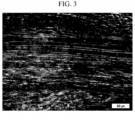
- coke having a TFI of 0.84 was used as a carbon raw material.
- the photograph of the structure obtained by observing the microstructure of the coke through the polarizing microscope is as shown in FIG. 3 .
- the coke was pulverized and classified using an impact mill so that D50 was 8 ⁇ m.
- the pulverized coke particles were added to a grinder (shaping mill) and ground for 5 minutes.
- the ground particles were charged into an Acheson type heat treatment furnace and subjected to a graphitization heat treatment at a temperature of about 3,000°C, and naturally cooled to room temperature to manufacture a negative electrode active material.
- the particle diameter (D50) of the final artificial graphite negative electrode active material obtained after graphitization was 9.2 ⁇ m, and its graphitization degree was 94.2%.
- a negative electrode active material was manufactured in the same manner as in Example 1, except that coke having a TFI of 0.70 was used as the carbon raw material.
- the photograph of the structure obtained by observing the microstructure of the coke through a polarizing microscope is as shown in FIG. 4 .
- the particle diameter (D50) of the final artificial graphite negative electrode active material obtained after graphitization was 9.5 ⁇ m, and its graphitization degree was 91.9%.
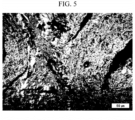
- a negative electrode active material was manufactured in the same manner as in Example 1, except that coke having a TFI of 0.39 was used as the carbon raw material.
- the photograph of the structure obtained by observing the microstructure of the coke through a polarizing microscope is as shown in FIG. 5 .
- the particle diameter (D50) of the final artificial graphite negative electrode active material obtained after graphitization was 11.5 ⁇ m, and its graphitization degree was 88.4%.
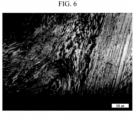
- a negative electrode active material was manufactured in the same manner as in Example 1, except that coke having a TFI of 0.74 was used as the carbon raw material.
- the photograph of the structure obtained by observing the microstructure of the coke through a polarizing microscope is as shown in FIG. 6 .
- the graphitization degree of the final artificial graphite negative electrode active material obtained after graphitization was 91.9%.
- a negative electrode active material was manufactured in the same manner as in Example 1, except that coke having a TFI of 0.78 was used as the carbon raw material.
- the graphitization degree of the final artificial graphite negative electrode active material obtained after graphitization was 93.0%.
- a negative electrode active material was manufactured in the same manner as in Example 1, except that coke having a TFI of 0.64 was used as the carbon raw material.
- the photograph of the structure obtained by observing the microstructure of the coke through a polarizing microscope is as shown in FIG. 7 .
- the graphitization degree of the final artificial graphite negative electrode active material obtained after graphitization was 90.7%.
- a negative electrode active material was manufactured in the same manner as in Example 1, except that coke having a TFI of 0.58 was used as the carbon raw material.
- the graphitization degree of the final artificial graphite negative electrode active material obtained after graphitization was 90.7%.
- a negative electrode active material was manufactured in the same manner as in Example 1, except that coke having a TFI of 0.45 was used as the carbon raw material.
- the photograph of the structure obtained by observing the microstructure of the coke through a polarizing microscope is as shown in FIG. 8 .
- the graphitization degree of the final artificial graphite negative electrode active material obtained after graphitization was 86%.
- the product was heated to 675°C at a rate of 2.6°C/min for carbonization, maintained at the temperature for 3 hours, and then cooled to room temperature.
- the granulated/carbonized coke particles were charged into an Acheson type heat treatment furnace and subjected to a graphitization heat treatment at a temperature of 3,000°C, and naturally cooled to room temperature to manufacture a negative electrode active material.
- the particle diameter of the final artificial graphite negative electrode active material obtained after graphitization was 12.7 ⁇ m, and its graphitization degree was 91.9%.
- a negative electrode active material slurry 97 wt% of the negative electrode active materials manufactured in the examples and the comparative example, 2 wt% of a binder including carboxymethyl cellulose and styrene butadiene rubber, and 1 wt% of a Super P conductive material were mixed in a distilled water solvent to prepare a negative electrode active material slurry.
- the negative electrode active material slurry was applied to a copper (Cu) current collector, dried at 100°C for 10 minutes, and compressed in a roll press. Thereafter, it was vacuum dried in a vacuum oven at 100°C for 12 hours to manufacture a negative electrode.
- Cu copper
- the electrode density of the negative electrode after vacuum drying was set to 1.5 to 1.7 g/cc.
- the negative electrodes manufactured in (2) were used as a negative electrode, a Li-metal was used as a counter electrode, and 1 M LiPF 6 solution dissolved in a mixed solvent of ethylene carbonate (EC) and dimethyl carbonate (DMC) at a volume ratio of 1:1 was used as an electrolyte solution.
- EC ethylene carbonate
- DMC dimethyl carbonate
- Each of the constituent elements was used to manufacture a 2032 coin cell type half battery (half coin cell) according to a common manufacturing method.
- the orientation degree is a value obtained by dividing a (004) peak area on the XRD graph by a (110) peak area and related to the output and lifespan of the negative electrode active material, and a higher orientation degree means poor output and lifespan characteristics.
- the orientation degree of Example 1 having a high TFI was high, the orientation degree of Comparative Example 1 was low due to the granulation process, and the orientation degrees of Examples 2 to 4 and 6 to 8 were low as in Comparative Example 1 though the granulation was not performed.
- d(002) is an indicator showing a distance between faces of a graphene layer and a lower d(002) means higher crystallinity and graphitization degree, and it was shown that Example 1 having a high TFI was low and its graphitization degree was as high as 94.2%, and since the interlayer distance value was increased as the TFI was lowered, Examples 3 and 8 having the lowest TIF of 0.39 and 0.45 had very low graphitization degree values of 87.2% and 86.0%.
- Example 1 The capacity of Example 1 was higher than those of Examples 2 to 8, and this is considered to be due to the fact that a higher TFI increased the graphitization degree to express a high discharge capacity.
- Comparative Example 1 had the same TFI as, but had a lower capacity than Example 1, and this is considered to be due to the granulation process performed in Comparative Example 1.
- Example 3 and Example 8 showed very low discharge capacities of 324.1 mAh/g and 320.3 mAh/g, respectively, and this is considered to be due to the fact that a lower TFI (0.6 or less) deteriorated the graphitization degree and when it was applied to the negative electrode material, the capacity was not expressed well.
- Charge output is a value of time when a lithium layer is formed on the surface of a negative electrode during charge of a battery at a high speed current amount of 3 C-rate, shown as a SOC (state of charge) percentage, and a higher value means higher charge output.
- Example 2 to 8 showed high output characteristics at the same level as Comparative Example 1 which was a granulated product though the granulation process was not performed.
Landscapes
- Chemical & Material Sciences (AREA)
- Chemical Kinetics & Catalysis (AREA)
- Electrochemistry (AREA)
- General Chemical & Material Sciences (AREA)
- Organic Chemistry (AREA)
- Engineering & Computer Science (AREA)
- Inorganic Chemistry (AREA)
- Manufacturing & Machinery (AREA)
- General Life Sciences & Earth Sciences (AREA)
- Geology (AREA)
- Life Sciences & Earth Sciences (AREA)
- Composite Materials (AREA)
- Materials Engineering (AREA)
- Battery Electrode And Active Subsutance (AREA)
- Carbon And Carbon Compounds (AREA)
Applications Claiming Priority (2)
| Application Number | Priority Date | Filing Date | Title |
|---|---|---|---|
| KR1020210134804A KR102767021B1 (ko) | 2021-10-12 | 2021-10-12 | 음극 활물질용 탄소 원료, 음극 활물질, 이를 포함하는 리튬 이차 전지 및 음극 활물질의 제조 방법 |
| PCT/KR2022/015049 WO2023063647A1 (ko) | 2021-10-12 | 2022-10-06 | 음극 활물질용 탄소 원료, 음극 활물질, 이를 포함하는 리튬 이차 전지 및 음극 활물질의 제조 방법 |
Publications (2)
| Publication Number | Publication Date |
|---|---|
| EP4418367A1 true EP4418367A1 (de) | 2024-08-21 |
| EP4418367A4 EP4418367A4 (de) | 2025-11-26 |
Family
ID=85988431
Family Applications (1)
| Application Number | Title | Priority Date | Filing Date |
|---|---|---|---|
| EP22881276.4A Pending EP4418367A4 (de) | 2021-10-12 | 2022-10-06 | Kohlenstoffmaterial für negativelektrodenaktivmaterial, negativelektrodenaktivmaterial, wiederaufladbare lithiumbatterie damit und verfahren zur herstellung von negativelektrodenaktivmaterial |
Country Status (4)
| Country | Link |
|---|---|
| US (1) | US20240405221A1 (de) |
| EP (1) | EP4418367A4 (de) |
| KR (1) | KR102767021B1 (de) |
| WO (1) | WO2023063647A1 (de) |
Cited By (1)
| Publication number | Priority date | Publication date | Assignee | Title |
|---|---|---|---|---|
| EP4618196A4 (de) * | 2022-11-11 | 2026-03-25 | Posco Future M Co Ltd | Kohlenstoffmaterial für negativelektrodenaktivmaterial, negativelektrodenaktivmaterial für lithiumsekundärbatterie und lithiumsekundärbatterie damit |
Family Cites Families (6)
| Publication number | Priority date | Publication date | Assignee | Title |
|---|---|---|---|---|
| PL232619B1 (pl) * | 2014-01-08 | 2019-07-31 | Inst Chemicznej Przerobki Wegla | Sposób określania morfologii koksów i karbonizatów |
| KR102124948B1 (ko) * | 2015-07-09 | 2020-06-22 | 주식회사 엘지화학 | 혼합 흑연을 포함하는 음극 활물질, 이를 포함하는 음극 및 상기 음극을 이용한 리튬 이차전지 |
| KR101932976B1 (ko) | 2017-04-14 | 2018-12-28 | 한국원자력연구원 | 절단 공정 소요 시간 산출 장치 및 방법 |
| KR102474533B1 (ko) * | 2017-05-15 | 2022-12-05 | 에스케이온 주식회사 | 리튬 이차 전지용 음극 및 리튬 이차 전지 |
| CN108807848B (zh) * | 2018-05-11 | 2019-10-08 | 宁德时代新能源科技股份有限公司 | 负极极片及含有它的二次电池 |
| KR102378529B1 (ko) * | 2019-12-20 | 2022-03-23 | 주식회사 포스코 | 리튬 이차전지용 음극 및 이의 제조방법 |
-
2021
- 2021-10-12 KR KR1020210134804A patent/KR102767021B1/ko active Active
-
2022
- 2022-10-06 EP EP22881276.4A patent/EP4418367A4/de active Pending
- 2022-10-06 WO PCT/KR2022/015049 patent/WO2023063647A1/ko not_active Ceased
- 2022-10-06 US US18/700,475 patent/US20240405221A1/en active Pending
Cited By (1)
| Publication number | Priority date | Publication date | Assignee | Title |
|---|---|---|---|---|
| EP4618196A4 (de) * | 2022-11-11 | 2026-03-25 | Posco Future M Co Ltd | Kohlenstoffmaterial für negativelektrodenaktivmaterial, negativelektrodenaktivmaterial für lithiumsekundärbatterie und lithiumsekundärbatterie damit |
Also Published As
| Publication number | Publication date |
|---|---|
| KR102767021B1 (ko) | 2025-02-12 |
| US20240405221A1 (en) | 2024-12-05 |
| KR20230052329A (ko) | 2023-04-20 |
| EP4418367A4 (de) | 2025-11-26 |
| WO2023063647A1 (ko) | 2023-04-20 |
Similar Documents
| Publication | Publication Date | Title |
|---|---|---|
| JP7471303B2 (ja) | リチウム二次電池用負極活物質、及びその製造方法 | |
| CN111225888A (zh) | 负极活性材料的制备方法及包含它的锂二次电池 | |
| CN111492515B (zh) | 锂离子二次电池用负极材料及锂离子二次电池用负极材料的制造方法 | |
| KR102087465B1 (ko) | 리튬 이차전지 음극재용 흑연분말의 제조방법 | |
| KR102176343B1 (ko) | 리튬 이차전지용 음극 활물질의 제조방법 | |
| KR102240777B1 (ko) | 리튬 이차전지용 음극 활물질의 제조방법 | |
| EP1981104B1 (de) | Negativ-elektrodenmaterial für eine lithiumionen-sekundärbatterie und herstellungsprozess dafür | |
| KR20090045350A (ko) | 리튬이온 이차전지 음극용 탄소재료, 저결정성 탄소 함침 리튬이온 이차 전지 음극용 탄소재료, 음극 전극판, 및 리튬이온 이차전지 | |
| KR20150074295A (ko) | 리튬 이차 전지용 인조흑연 음극재의 제조 방법 및 이로부터 제조된 리튬 이차 전지용 인조흑연 음극재 | |
| KR20190054045A (ko) | 리튬 이차 전지용 음극 활물질의 제조 방법, 및 이를 포함하는 리튬 이차 전지 | |
| EP4447155A1 (de) | Schnellaufladendes anodenmaterial für eine lithiumsekundärbatterie und herstellungsverfahren für eine lithiumsekundärbatterie damit | |
| KR102691511B1 (ko) | 신규한 조립구상흑연의 제조방법, 이를 이용하여 제조된 조립구상흑연, 및 이를 음극활물질로 포함하는 이차전지 | |
| EP4418367A1 (de) | Kohlenstoffmaterial für negativelektrodenaktivmaterial, negativelektrodenaktivmaterial, wiederaufladbare lithiumbatterie damit und verfahren zur herstellung von negativelektrodenaktivmaterial | |
| KR100960139B1 (ko) | 리튬 이차 전지용 음극 활물질, 이의 제조방법 및 이를포함하는 리튬 이차 전지 | |
| KR20250070030A (ko) | 리튬 이차전지용 음극 활물질 및 이를 포함하는 리튬 이차전지 | |
| EP3331068A1 (de) | Negativelektrodenmaterial für lithium-ionen-sekundärbatterie, herstellungsverfahren dafür sowie lithium-ionen-sekundärbatterie | |
| KR101562961B1 (ko) | 리튬 이차 전지용 탄소계 음극재의 제조 방법 및 이로부터 제조된 리튬 이차 전지용 탄소계 음극재 | |
| KR102731099B1 (ko) | 이차 전지용 음극 활물질의 제조 방법 | |
| EP4618196A1 (de) | Kohlenstoffmaterial für negativelektrodenaktivmaterial, negativelektrodenaktivmaterial für lithiumsekundärbatterie und lithiumsekundärbatterie damit | |
| KR20240172366A (ko) | 흑연 재료의 제조 방법 |
Legal Events
| Date | Code | Title | Description |
|---|---|---|---|
| STAA | Information on the status of an ep patent application or granted ep patent |
Free format text: STATUS: THE INTERNATIONAL PUBLICATION HAS BEEN MADE |
|
| PUAI | Public reference made under article 153(3) epc to a published international application that has entered the european phase |
Free format text: ORIGINAL CODE: 0009012 |
|
| STAA | Information on the status of an ep patent application or granted ep patent |
Free format text: STATUS: REQUEST FOR EXAMINATION WAS MADE |
|
| 17P | Request for examination filed |
Effective date: 20240430 |
|
| AK | Designated contracting states |
Kind code of ref document: A1 Designated state(s): AL AT BE BG CH CY CZ DE DK EE ES FI FR GB GR HR HU IE IS IT LI LT LU LV MC ME MK MT NL NO PL PT RO RS SE SI SK SM TR |
|
| DAV | Request for validation of the european patent (deleted) | ||
| DAX | Request for extension of the european patent (deleted) | ||
| REG | Reference to a national code |
Ref country code: DE Ref legal event code: R079 Free format text: PREVIOUS MAIN CLASS: H01M0004587000 Ipc: C01B0032205000 |
|
| A4 | Supplementary search report drawn up and despatched |
Effective date: 20251027 |
|
| RIC1 | Information provided on ipc code assigned before grant |
Ipc: C01B 32/205 20170101AFI20251021BHEP Ipc: H01M 4/587 20100101ALI20251021BHEP Ipc: H01M 4/36 20060101ALI20251021BHEP Ipc: H01M 4/62 20060101ALI20251021BHEP Ipc: H01M 10/0525 20100101ALI20251021BHEP Ipc: C01B 32/05 20170101ALI20251021BHEP Ipc: H01M 4/133 20100101ALI20251021BHEP Ipc: H01M 4/1393 20100101ALI20251021BHEP Ipc: H01M 4/02 20060101ALI20251021BHEP Ipc: H01M 10/052 20100101ALI20251021BHEP |