EP4417040A1 - Tiertoilette - Google Patents
Tiertoilette Download PDFInfo
- Publication number
- EP4417040A1 EP4417040A1 EP22880616.2A EP22880616A EP4417040A1 EP 4417040 A1 EP4417040 A1 EP 4417040A1 EP 22880616 A EP22880616 A EP 22880616A EP 4417040 A1 EP4417040 A1 EP 4417040A1
- Authority
- EP
- European Patent Office
- Prior art keywords
- animal toilet
- urine
- opening
- toilet according
- collection receptacle
- Prior art date
- Legal status (The legal status is an assumption and is not a legal conclusion. Google has not performed a legal analysis and makes no representation as to the accuracy of the status listed.)
- Pending
Links
Images






Classifications
-
- A—HUMAN NECESSITIES
- A01—AGRICULTURE; FORESTRY; ANIMAL HUSBANDRY; HUNTING; TRAPPING; FISHING
- A01K—ANIMAL HUSBANDRY; AVICULTURE; APICULTURE; PISCICULTURE; FISHING; REARING OR BREEDING ANIMALS, NOT OTHERWISE PROVIDED FOR; NEW BREEDS OF ANIMALS
- A01K1/00—Housing animals; Equipment therefor
- A01K1/01—Removal of dung or urine ; Removal of manure from stables
- A01K1/0107—Cat trays; Dog urinals; Toilets for pets
- A01K1/011—Cat trays; Dog urinals; Toilets for pets with means for removing excrement
-
- A—HUMAN NECESSITIES
- A01—AGRICULTURE; FORESTRY; ANIMAL HUSBANDRY; HUNTING; TRAPPING; FISHING
- A01K—ANIMAL HUSBANDRY; AVICULTURE; APICULTURE; PISCICULTURE; FISHING; REARING OR BREEDING ANIMALS, NOT OTHERWISE PROVIDED FOR; NEW BREEDS OF ANIMALS
- A01K1/00—Housing animals; Equipment therefor
- A01K1/01—Removal of dung or urine ; Removal of manure from stables
- A01K1/0107—Cat trays; Dog urinals; Toilets for pets
-
- A—HUMAN NECESSITIES
- A01—AGRICULTURE; FORESTRY; ANIMAL HUSBANDRY; HUNTING; TRAPPING; FISHING
- A01K—ANIMAL HUSBANDRY; AVICULTURE; APICULTURE; PISCICULTURE; FISHING; REARING OR BREEDING ANIMALS, NOT OTHERWISE PROVIDED FOR; NEW BREEDS OF ANIMALS
- A01K1/00—Housing animals; Equipment therefor
- A01K1/01—Removal of dung or urine ; Removal of manure from stables
- A01K1/0107—Cat trays; Dog urinals; Toilets for pets
- A01K1/0114—Litter boxes with screens for separating excrement from litter
-
- A—HUMAN NECESSITIES
- A01—AGRICULTURE; FORESTRY; ANIMAL HUSBANDRY; HUNTING; TRAPPING; FISHING
- A01K—ANIMAL HUSBANDRY; AVICULTURE; APICULTURE; PISCICULTURE; FISHING; REARING OR BREEDING ANIMALS, NOT OTHERWISE PROVIDED FOR; NEW BREEDS OF ANIMALS
- A01K23/00—Manure or urine pouches
- A01K23/005—Manure or urine collecting devices used independently from the animal, i.e. not worn by the animal but operated by a person
-
- G—PHYSICS
- G01—MEASURING; TESTING
- G01N—INVESTIGATING OR ANALYSING MATERIALS BY DETERMINING THEIR CHEMICAL OR PHYSICAL PROPERTIES
- G01N1/00—Sampling; Preparing specimens for investigation
- G01N1/02—Devices for withdrawing samples
- G01N1/10—Devices for withdrawing samples in the liquid or fluent state
Definitions
- the present invention relates to an animal toilet.
- a conventional animal toilet is disclosed, for example, in Patent Document 1.
- the animal toilet disclosed in Patent Document 1 includes a tray-shaped body portion (toilet container), and an excrement treatment material laid in the body portion.
- the excrement treatment material is composed of a mixture of a base grain that is a water-absorbent grain, and a drug grain that is a grain containing a test drug.
- the test drug is a drug for a urine test that is discolored depending on components of animal urine. In this animal toilet, the test drug is discolored when excreted urine comes in contact with the test drug in the drug grain.
- Patent Document 1 JP 2015-226503 A
- the present invention has been made in view of the above-described problem, and it is an object thereof to provide an animal toilet suitable for improving test accuracy of urine.
- An animal toilet includes: a partition portion that has a through hole allowing urine to pass therethrough; an upper space in which a plurality of grains are disposed, the upper space being present above the partition portion; a lower space in which the urine having passed through the through hole falls, the lower space being present below the partition portion; and a urine collection receptacle that collects the urine, wherein a bottom face of the lower space inclines so that the urine having fallen in the lower space will flow toward the urine collection receptacle.
- FIG. 1 is an end view showing an embodiment of an animal toilet according to the present invention.
- An animal toilet 1 is a toilet used for excretion of animals such as cats or dogs, and includes a body container 10, a partition portion 20, a plurality of grains 30, and a urine collection receptacle 40.
- the body container 10 has a bottom face part 10a (first bottom face part) and a side face part 10b (first side face part), and is in a box shape.
- the outer shape of the body container 10 is an approximately rectangular parallelepiped shape.
- plastic such as polypropylene or polyethylene can be used.
- the body container 10 has an overhanging part 10c that is provided so as to overhang from the side face part 10b toward the inside of the body container 10.
- the overhanging part 10c may be a projection or a projected rim.
- the overhanging part 10c may be formed integrally with the side face part 10b, or may be attached to the side face part 10b after being formed separately from the side face part 10b.
- the overhang length of the overhanging part 10c (the length in the direction perpendicular to the inner surface of the side face part 10b provided with the overhanging part 10c) is, for example, between 5 mm and 15 mm inclusive.
- the partition portion 20 is placed on the overhanging part 10c.
- the partition portion 20 is not fixed to the body container 10.
- the partition portion 20 is detachable relative to the body container 10.
- the partition portion 20 has a plate shape, and is arranged in parallel with the bottom face part 10a.
- the partition portion 20 is provided at a position apart from both the bottom face part 10a and the upper end of the body container 10.
- the partition portion 20 divides the inside of the body container 10 vertically. That is, the partition portion 20 is disposed so as to divide the internal space of the body container 10 into an upper space 24 and a lower space 26. Therefore, the internal space of the body container 10 includes at least the lower space 26. In the present embodiment, the internal space of the body container 10 includes both the upper space 24 and the lower space 26.
- the upper space 24 is present above the partition portion 20, and is a space in which the plurality of grains 30 are disposed.
- the lower space 26 is present below the partition portion 20, and is a space in which urine that has passed through a through hole 22 falls. In this way, the animal toilet 1 includes the upper space 24 and the lower space 26 that are separated by the partition portion 20.
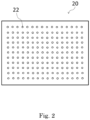
- FIG. 2 is a plane view showing the partition portion 20.
- the partition portion 20 has an approximately rectangular shape in a plane view. As used herein, "approximately rectangular shape” means that the shape includes not only a rectangle but also a shape similar to a rectangle such as a round corner rectangle.
- the partition portion 20 has the through hole 22 that allows urine to pass through the through hole 22.
- the partition portion 20 has a plurality of the through holes 22.
- the plurality of through holes 22 are arranged two-dimensionally in the partition portion 20.
- the plane shape of each through hole 22 is a circle. Each through hole 22 allows urine to pass therethrough, but does not allow the grain 30 to pass therethrough.
- plastic such as polypropylene or polyethylene can be used.
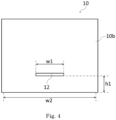
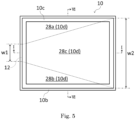
- FIG. 3 , FIG. 4 and FIG. 5 are, respectively, an end view, a front view and a plane view showing the body container 10.
- FIG. 6 is an end view taken along line VI-VI in FIG. 5 .
- the end face of the body container 10 shown in FIG. 1 is the end face taken along I-I in FIG. 5 .
- the side face part 10b of the body container 10 is provided with an opening 12 (first opening).
- the opening 12 has a horizontally long shape.
- the vertical length (the length in the top/bottom direction of the side face part 10b) of the opening 12 is, for example, between 3 mm and 10 mm inclusive.
- the horizontal length (the length in the right/left direction of the side face part 10b provided with the opening 12) of the opening 12 is, for example, between 30 mm and 100 mm inclusive.
- the horizontal length w1 (see FIG. 4 and FIG. 5 ) of the opening 12 is smaller than the horizontal width (inner size) w2 of the side face part 10b provided with the opening 12.
- the length w1 is preferably one-third or less of the horizontal width w2.
- the height h1 (see FIG. 3 and FIG. 4 ) of the lower end of the opening 12 is preferably 30 mm or more.
- the height h1 is equal to the distance from the lower end of the side face part 10b to the lower end of the opening 12.
- the bottom face of the opening 12 inclines downward toward the outside of the body container 10. In other words, the bottom face of the opening 12 inclines downward from the inner surface of the side face part 10b toward the outer surface of the side face part 10b.
- the opening 12 is a part through which urine excreted in the body container 10 is discharged outside the body container 10.
- a bottom face 28 of the lower space 26 inclines so that urine having fallen in the lower space 26 will flow toward the urine collection receptacle 40 described later. Specifically, the bottom face 28 inclines so that the urine will flow into the opening 12. The urine having flowed on the bottom face 28 arrives in the urine collection receptacle 40 through the opening 12.
- the bottom face 28 is continuous with the bottom face of the opening 12. In the present embodiment, the entirety of the bottom face 28 inclines. None is laid on the bottom face 28 in order not to prevent urine from flowing.
- the bottom face 28 is composed of a plurality of continuous planes 28a, 28b, 28c. The plane 28a and the plane 28b incline downward toward the plane 28c.
- the plane 28c inclines downward toward the opening 12.
- the overhanging part 10c is composed of a projected rim that is provided annularly over the entirety of the inner surface of the side face part 10b in a plane view in the present embodiment (see FIG. 5 ).
- the body container 10 includes an intermediate plate 10d.
- the intermediate plate 10d is provided between the bottom face part 10a and the partition portion 20.
- the intermediate plate 10d is disposed obliquely to the bottom face part 10a and the partition portion 20.
- the upper surface of the intermediate plate 10d constitutes the bottom face 28 of the lower space 26.
- the peripheral part of the intermediate plate 10d is connected to the side face part 10b of the body container 10.
- the entire peripheral part of the intermediate plate 10d is connected to the side face part 10b without a gap so that urine will not leak into the space below the intermediate plate 10d (the space surrounded by the bottom face part 10a, the side face part 10b and the intermediate plate 10d) in the body container 10.
- the intermediate plate 10d may be formed integrally with the side face part 10b, or may be attached to the side face part 10b after being formed separately from the side face part 10b.
- the plurality of grains 30 for treating excrement are disposed in the upper space 24.
- the plurality of grains 30 are disposed in the upper space 24 in a state of being laid on the partition portion 20.
- the grains 30 directly receive excreted urine.
- the grains 30 have a hydrophobic property. That is, the grains 30 have the property of not absorbing liquid such as urine at all, or hardly absorbing it.
- the grains 30 having the hydrophobic property require the liquid passing rate of 80 % or more measured by the following test.
- approximate 50 grams of the grains 30 (sample) are placed in a sieve with the inner diameter of 10 cm and the mesh size of 1 mm.
- An empty beaker is set under the sieve.
- 30 ml of water is dripped on the sample over 10 seconds using a syringe with the inner diameter of its outer cylinder of 3 cm and the inner diameter of its cylinder tip of 4 mm (60 ml syringe manufactured by Terumo Corp.). After waiting 1 minute, the quantity of the water in the beaker is measured.
- the ratio of the measured water quantity with respect to the quantity of the dripped water (30 ml) shall be the liquid passing rate. That is, if the water quantity in the beaker is 24 ml or more, the liquid passing rate is 80 % or more, and therefore the grains 30 are found to have the hydrophobic property.
- the liquid passing rate of general water-absorbing cat litter which is commercially available, is about 5 %.
- the grains 30 are each formed in a granular shape. Examples of the granular shape include a sphere, column, and ellipsoid.
- the particle diameter of the grain 30 is, for example, between 5 mm and 20 mm inclusive. As used herein, the particle diameter is defined as the diameter of the minimum sphere that can include the grain 30.
- the grain 30 contains an organic substance as its main material, and it is particularly preferable that the grain 30 is made only of the organic substance.
- the main material refers to the material that accounts for the highest weight ratio in the grain 30, out of one or more materials constituting the grain 30.
- the organic substance for example, papers, used tea leaves, plastics, or bean curd lees can be used.
- the papers refer to a material composed mainly of pulp.
- the papers include, in addition to ordinary paper, a vinyl chloride wallpaper classified product, photographic paper, release paper, fluff pulp, papermaking sludge, and pulp sludge.
- the vinyl chloride wallpaper classified product is obtained by removing part of polyvinyl chloride from vinyl chloride wallpaper containing paper and polyvinyl chloride.
- the plastics include, in addition to ordinary plastic, an aluminum deposited film, and a disposable diaper classified product (plastic obtained by classifying disposable diapers).
- the bean curd lees are preferably dried bean curd lees. These materials may be subjected to hydrophobic treatment (water repellency treatment).
- the material(s) constituting the grain 30 may be only one material, or two or more materials.
- the main material described above is the only material constituting the grain 30.
- the grain 30 is made of a mixture of the main material and other material(s).
- the other material include gypsum, and baking soda. Adding gypsum or baking soda can enhance the hydrophobic property of the grain 30.
- the quantity of gypsum or baking soda is, for example, 5 wt.% or more and less than 50 wt.% with respect to the entirety of the grain 30.
- the grains 30 can be manufactured by, for example, the following method. First, granules that will serve as the grains 30 are formed by granulating a granulating material (the material(s) constituting the grains 30) with a granulation apparatus. As the granulation apparatus, for example, an extrusion granulator can be used. The granules may be subjected to hydrophobic treatment as needed. The hydrophobic treatment can be performed by, for example, coating the surfaces of the granules with a hydrophobic agent (water repellent agent).
- a hydrophobic agent water repellent agent
- crevices are prevented from forming in the granules as much as possible by increasing the pressure that is applied to the granulating material during granulation. This is because the crevices serve as a path through which moisture such as urine enters inside the grains 30.
- pretreatment such as pulverization, kneading, and adding water is performed on the granulating material as needed.
- posttreatment such as sieving (sizing), and drying is performed as needed.
- FIG. 7 is an end view showing the urine collection receptacle 40.
- the urine collection receptacle 40 is a receptacle that collects urine.
- the urine collection receptacle 40 houses only urine. Therefore, the urine collection receptacle 40 is empty before use (before urine is collected by the urine collection receptacle 40).
- the urine collection receptacle 40 has a bottom face part 40a (second bottom face part) and a side face part 40b (second side face part), and is in a box shape.
- the outer shape of the urine collection receptacle 40 is an approximately rectangular parallelepiped shape similarly with the outer shape of the body container 10. However, the capacity of the urine collection receptacle 40 is smaller than the capacity of the body container 10. Also, the height of the urine collection receptacle 40 is smaller than the height of the body container 10.
- the side face part 40b is provided with an opening 42 (second opening).
- the opening 42 is provided so that urine discharged from the opening 12 will flow into the urine collection receptacle 40. That is, the urine having flowed on the bottom face 28 of the lower space 26 arrives in the urine collection receptacle 40 through the opening 12 and the opening 42.
- the opening 42 has approximately the same shape and size as the opening 12. Strictly, the shape and size of the opening 12 in the outer surface of the side face part 10b coincide with the shape and size of the opening 42 in the outer surface of the side face part 40b.
- the bottom face of the opening 42 inclines downward toward the inside of the urine collection receptacle 40. In other words, the bottom face of the opening 42 inclines downward from the outer surface of the side face part 40b toward the inner surface of the side face part 40b.
- the urine collection receptacle 40 includes a lid portion 44 that covers the space surrounded by the bottom face part 40a and the side face part 40b from above.
- the lid portion 44 is provided openably and closably. When the animal toilet 1 is used, the lid portion 44 is closed. In the state in which the lid portion 44 is closed, the urine collection receptacle 40 is hermetically sealed except for the opening 42.
- the urine collection receptacle 40 is provided with a grip 46. Specifically, the grip 46 is provided to the side face part 40b opposite to the side face part 40b provided with the opening 42.
- plastic such as polypropylene or polyethylene can be used.
- the urine collection receptacle 40 When the animal toilet 1 is used, the urine collection receptacle 40 is disposed outside the body container 10 (see FIG. 1 ). The urine collection receptacle 40 is disposed in a state of being in contact with the side face part 10b provided with the opening 12 without a gap. At this time, the opening 42 of the urine collection receptacle 40 overlaps with the opening 12 of the body container 10. In the present embodiment, the opening 12 and the opening 42 overlap with each other completely. That is, the entirety of the opening 12 overlaps with the opening 42, and the entirety of the opening 42 also overlaps with the opening 12. The upper end of the side face part 40b is located higher than the upper end of the opening 12.
- the urine collection receptacle 40 is fixed to the body container 10 detachably.
- "detachably” means that the urine collection receptacle 40 can be easily attached to and detached from the body container 10 without causing damage to the body container 10 or the urine collection receptacle 40.
- FIG. 8 is a diagram in which the side face part 10b and the side face part 40b are seen from above.
- the projected rim 52 is provided in a part of the side face part 10b that faces the side face part 40b.
- the projected rim 52 has a tapered cross-sectional shape in which the width thereof widens as going away from the side face part 10b, and extends in the top/bottom direction of the side face part 10b (the direction perpendicular to the paper surface in FIG. 8 ).
- the groove 54 is provided in a part of the side face part 40b that faces the side face part 10b.
- the groove 54 has a tapered cross-sectional shape in which the width thereof widens as approaching the inside of the side face part 40b, and extends in the top/bottom direction of the side face part 40b.
- the cross-section of the groove 54 has approximately the same shape and size as the cross-section of the projected rim 52.
- the urine collection receptacle 40 can be attached and fixed to the body container 10 by sliding the urine collection receptacle 40 in the top/bottom direction relative to the body container 10 to make the projected rim 52 and the groove 54 be fitted to each other as shown in FIG. 9 . Also, the urine collection receptacle 40 can be detached from the body container 10 by sliding the urine collection receptacle 40 in the top/bottom direction relative to the body container 10 to make the projected rim 52 and the groove 54 be disengaged from each other.
- the animal toilet 1 The effects of the animal toilet 1 will be described.
- the bottom face 28 of the lower space 26 inclines so that urine having passed through the through hole 22 to fall in the lower space 26 will flow toward the urine collection receptacle 40. Therefore, urine excreted by an animal accumulates in the urine collection receptacle 40. Thus, it is possible to collect urine in a state of being independent of the grains 30. Using the urine as a test object makes test results less likely to be affected by components of materials constituting the grains 30. Accordingly, the animal toilet 1 suitable for improving test accuracy of urine is implemented.
- Testing the urine accumulating in the urine collection receptacle 40 makes it possible to grasp various information concerning urine such as urine quantity, specific gravity of urine, frequency of urination, occult blood in urine, urinary protein, urinary sugar, and urinary pH at high accuracy.
- animal health can be preferably checked.
- a urine test can be performed more precisely and detailedly than the conventional animal toilet.
- the entirety of the bottom face 28 of the lower space 26 inclines. Thus, urine can flow toward the urine collection receptacle 40 regardless of on what position of the bottom face 28 the urine falls.
- the urine collection receptacle 40 is disposed outside the body container 10. In this case, it becomes easier to collect urine accumulating in the urine collection receptacle 40 than in a case where the urine collection receptacle 40 is disposed inside the body container 10.
- the height of the urine collection receptacle 40 is smaller than the height of the body container 10.
- the urine collection receptacle 40 can be used also as a stool when an animal enters or leaves the body container 10. Thus, it becomes easier for the animal to enter or leave the body container 10.
- the side face part 10b of the body container 10 is provided with the opening 12.
- urine can be guided to the urine collection receptacle 40 disposed outside the body container 10 with simple constitution.
- the opening 12 has a horizontally long shape. That is, the opening 12 is longer horizontally and shorter vertically. Liquid such as urine has a tendency to spread out horizontally. Therefore, enlarging the horizontal length of the opening 12 facilitates the quick passage of a large amount of urine. Thus, even in a case where a large amount of urine is excreted, the urine can be smoothly discharged outside the body container 10 through the opening 12. On the other hand, reducing the vertical length of the opening 12 is advantageous for preventing a solid (e.g. a part of the grain 30 that has collapsed) from passing through the opening 12.
- a solid e.g. a part of the grain 30 that has collapsed
- the horizontal length of the opening 12 is smaller than the horizontal width of the side face part 10b provided with the opening 12. That is, the opening 12 is provided in only a part of the side face part 10b with respect to the right/left direction of the side face part 10b. Thus, it becomes easier to restrain an odor generated from the urine discharged outside the body container 10 from flowing into the body container 10 through the opening 12, compared to a case where the opening 12 is provided in the entirety of the side face part 10b. From this viewpoint, the horizontal length of the opening 12 is preferably one-third or less of the horizontal width of the side face part 10b.
- the bottom face of the opening 12 inclines downward toward the outside of the body container 10. Thus, urine excreted in the body container 10 can be more smoothly discharged outside the body container 10 through the opening 12.
- the urine collection receptacle 40 is disposed in the state of being in contact with the side face part 10b provided with the opening 12 without a gap. Thus, the urine discharged from the opening 12 can be guided directly into the urine collection receptacle 40 without providing a means of transferring the urine between the body container 10 and the urine collection receptacle 40.
- the urine collection receptacle 40 includes the lid portion 44 that covers the space surrounded by the bottom face part 40a and the side face part 40b from above. Thus, an odor generated from the urine accumulating in the urine collection receptacle 40 can be prevented from leaking outside from the upper part of the urine collection receptacle 40.
- the upper end of the side face part 40b is located higher than the upper end of the opening 12 in the state in which the urine collection receptacle 40 is disposed in the animal toilet 1.
- an odor generated from the urine accumulating in the urine collection receptacle 40 can be restrained from flowing into the body container 10 through the opening 12.
- the side face part 40b is provided with the opening 42.
- urine discharged from the opening 12 can be guided into the urine collection receptacle 40 with simple constitution. That is, the urine discharged from the opening 12 flows into the urine collection receptacle 40 through the opening 42 that is continuous with the opening 12. Also, because urine can be taken into the urine collection receptacle 40 from the side face part 40b, it is possible to enlarge the height of the side face part 40b freely.
- the bottom face of the opening 42 inclines downward toward the inside of the urine collection receptacle 40.
- urine discharged from the opening 12 can more smoothly flow into the urine collection receptacle 40 through the opening 42.
- Locating the opening 12 (and the opening 42) at a high position is advantageous for preventing the urine accumulating in the urine collection receptacle 40 from leaking outside the urine collection receptacle 40 through the opening 42.
- the height h1 (see FIG. 3 ) of the lower end of the opening 12 is preferably 30 mm or more.
- the urine collection receptacle 40 is detachable relative to the body container 10. Thus, it becomes easier to collect the urine accumulating in the urine collection receptacle 40, or to clean the body container 10 and the urine collection receptacle 40. That is, detaching the urine collection receptacle 40 from the body container 10 makes it easier to collect or clean urine.
- the urine collection receptacle 40 is provided with the grip 46. Thus, the urine collection receptacle 40 can be attached to and detached from the body container 10 easily.
- the internal space of the body container 10 includes both the upper space 24 and the lower space 26.
- the animal toilet 1 including the upper space 24 and the lower space 26 with one container (the body container 10). This is advantageous for simplifying the constitution of the animal toilet 1.
- the partition portion 20 is not fixed to the body container 10. In this case, the partition portion 20 can be attached to and detached from the body container 10 easily.
- the partition portion 20 is placed on the overhanging part 10c. Thus, the partition portion 20 can stay at a predetermined position in the body container 10 without being fixed to the body container 10.
- Each grain 30 has a hydrophobic property. In this case, most of urine excreted on the grains 30 is not absorbed by the grains 30, and passes through gaps between the grains 30. Thus, a large amount of urine can be guided to the urine collection receptacle 40.
- each grain 30 contains an organic substance as its main material, it is possible to obtain the grains 30 suitable for being disposed of by incineration. If the grains 30 are suitable for being disposed of by incineration in this way, the grains 30 after use can be disposed of as burnable garbage, which therefore increases convenience for users. In the case where each grain 30 is made only of the organic substance, it is possible to obtain the grains 30 particularly suitable for being disposed of by incineration.
- the shape, the size, the position, and the number of the opening 12 are arbitrary.
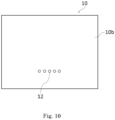
- a plurality of the openings 12 may be provided as shown in FIG. 10 .
- five openings 12 having a circular shape in a front view are provided. These openings 12 are arranged on a straight line at regular intervals in the right/left direction of the side face part 10b.
- the shape, the size, the position, and the number of the opening 42 are also arbitrary.
- the opening 12 may be provided with a block member 62 that blocks a part of the opening 12 as shown, for example, in FIG. 11 and FIG. 12 .
- the block member 62 in FIG. 11 has a net shape.
- the block member 62 in FIG. 12 has a comb shape. Providing the block member 62 can make a solid less likely to pass through the opening 12.
- the plane shape of the through hole 22 is a circle.
- the plane shape of the through hole 22 is arbitrary, and may be, for example, a polygon such as a rectangle, or an ellipse.
- the animal toilet 1 may include water absorbing materials that are housed in the urine collection receptacle 40, and absorb urine.
- the water absorbing materials are housed in the water absorbing material as needed.
- the shape of the water absorbing materials is arbitrary, and is, for example, granular, powdery, or sheet. In the case where the water absorbing materials are granular or powdery, the water absorbing materials may be configured to bond together and agglomerate when absorbing urine.
- the water absorbing materials may be provided on the entirety or only a part of the bottom face part 40a of the urine collection receptacle 40.
- the urine collection receptacle 40 In the case where the water absorbing materials are housed in the urine collection receptacle 40, at least some of urine accumulates in the urine collection receptacle 40 in a state of being absorbed in the water absorbing materials. For this reason, it is possible to restrain an odor from being generated from urine accumulating in the urine collection receptacle 40, and the urine can be easily disposed of.
- the urine collection receptacle 40 does not house the water absorbing materials, and therefore is empty before use. That is, in a case where it is not necessary to test urine whenever an animal urinates, the urine collection receptacle 40 may be empty only when wanting to collect urine for a test, and may house the water absorbing materials at any other time.
- the urine collection receptacle 40 is disposed outside the body container 10.
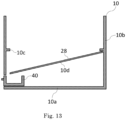
- the urine collection receptacle 40 may be disposed inside the body container 10 as shown, for example, in FIG. 13 .
- the urine collection receptacle 40 in FIG. 13 is disposed below the intermediate plate 10d.
- the urine collection receptacle 40 is configured to be capable of being inserted in and extracted from the body container 10 like a drawer.
- the lower end of the intermediate plate 10d is apart from the side face part 10b of the body container 10. Thus, urine having flowed on the bottom face 28 falls down from the lower end of the intermediate plate 10d into the urine collection receptacle 40.
- the upper space 24 and the lower space 26 are constituted by one body container 10.
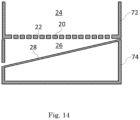
- a container 72 constituting the upper space 24 and a container 74 constituting the lower space 26 may be provided separately as shown, for example, in FIG. 14 .
- the container 72 and the container 74 each have a bottom face part and a side face part, and are in a box shape.
- the container 72 is put on the container 74.
- the bottom face part of the container 72 is the partition portion 20.
Landscapes
- Life Sciences & Earth Sciences (AREA)
- Environmental Sciences (AREA)
- Animal Husbandry (AREA)
- Biodiversity & Conservation Biology (AREA)
- Zoology (AREA)
- Chemical & Material Sciences (AREA)
- Physics & Mathematics (AREA)
- Health & Medical Sciences (AREA)
- Hydrology & Water Resources (AREA)
- Analytical Chemistry (AREA)
- Biochemistry (AREA)
- General Health & Medical Sciences (AREA)
- General Physics & Mathematics (AREA)
- Immunology (AREA)
- Pathology (AREA)
- Sampling And Sample Adjustment (AREA)
- Housing For Livestock And Birds (AREA)
Applications Claiming Priority (2)
| Application Number | Priority Date | Filing Date | Title |
|---|---|---|---|
| JP2021166552A JP2023057191A (ja) | 2021-10-11 | 2021-10-11 | 動物用トイレ |
| PCT/JP2022/029494 WO2023062916A1 (ja) | 2021-10-11 | 2022-08-01 | 動物用トイレ |
Publications (2)
| Publication Number | Publication Date |
|---|---|
| EP4417040A1 true EP4417040A1 (de) | 2024-08-21 |
| EP4417040A4 EP4417040A4 (de) | 2025-09-03 |
Family
ID=85988277
Family Applications (1)
| Application Number | Title | Priority Date | Filing Date |
|---|---|---|---|
| EP22880616.2A Pending EP4417040A4 (de) | 2021-10-11 | 2022-08-01 | Tiertoilette |
Country Status (5)
| Country | Link |
|---|---|
| US (1) | US20240215530A1 (de) |
| EP (1) | EP4417040A4 (de) |
| JP (1) | JP2023057191A (de) |
| CN (1) | CN117956895A (de) |
| WO (1) | WO2023062916A1 (de) |
Families Citing this family (1)
| Publication number | Priority date | Publication date | Assignee | Title |
|---|---|---|---|---|
| US20240260534A1 (en) * | 2023-02-02 | 2024-08-08 | Richard A. Carmody, III | Pet Grass Potty Station |
Family Cites Families (13)
| Publication number | Priority date | Publication date | Assignee | Title |
|---|---|---|---|---|
| FR2530923B1 (fr) * | 1982-07-30 | 1985-06-14 | Vernay Jacques | Bloc sanitaire pour besoins hygieniques des chats |
| JPH01144911A (ja) * | 1987-12-02 | 1989-06-07 | Shoji Sakurai | 愛玩動物用の便器 |
| US5148771A (en) * | 1991-09-03 | 1992-09-22 | Schuett Daniel L | Veterinarian infectious waste containment system |
| US5355837A (en) * | 1993-09-21 | 1994-10-18 | Reyes Richard B | Canine trainer and toilet station |
| JP2006149372A (ja) * | 2004-11-04 | 2006-06-15 | Kurosaki Hakudo Kogyo Kk | 簡易トイレ具 |
| EP1864570A1 (de) * | 2006-06-09 | 2007-12-12 | Evaristo Torres Salcedo | Sanitäreinrichtung mit Behälter für Haustierexkremente |
| JP5514079B2 (ja) * | 2010-11-09 | 2014-06-04 | 花王株式会社 | ペット用トイレ |
| JP6444065B2 (ja) | 2014-05-30 | 2018-12-26 | ユニ・チャーム株式会社 | 排泄物処理材 |
| WO2017149643A1 (ja) * | 2016-03-01 | 2017-09-08 | 株式会社無有 | トイレ |
| JP2016208975A (ja) * | 2016-05-20 | 2016-12-15 | 株式会社無有 | トイレ用敷材及びトイレ |
| JP6975966B2 (ja) * | 2017-10-17 | 2021-12-01 | 株式会社大貴 | 排泄物処理材 |
| JP7092645B2 (ja) * | 2018-11-14 | 2022-06-28 | 花王株式会社 | ペット用尿採集トイレ |
| JP7308114B2 (ja) * | 2019-09-24 | 2023-07-13 | 株式会社大貴 | 動物用トイレ |
-
2021
- 2021-10-11 JP JP2021166552A patent/JP2023057191A/ja active Pending
-
2022
- 2022-08-01 CN CN202280062622.XA patent/CN117956895A/zh active Pending
- 2022-08-01 WO PCT/JP2022/029494 patent/WO2023062916A1/ja not_active Ceased
- 2022-08-01 EP EP22880616.2A patent/EP4417040A4/de active Pending
-
2024
- 2024-03-14 US US18/604,994 patent/US20240215530A1/en not_active Abandoned
Also Published As
| Publication number | Publication date |
|---|---|
| JP2023057191A (ja) | 2023-04-21 |
| CN117956895A (zh) | 2024-04-30 |
| US20240215530A1 (en) | 2024-07-04 |
| WO2023062916A1 (ja) | 2023-04-20 |
| EP4417040A4 (de) | 2025-09-03 |
Similar Documents
| Publication | Publication Date | Title |
|---|---|---|
| US20220183251A1 (en) | Animal toilet | |
| US20240215530A1 (en) | Animal toilet | |
| US12389873B2 (en) | Animal toilet | |
| US12232483B2 (en) | Animal toilet | |
| US12324406B2 (en) | Animal toilet | |
| EP4268587A1 (de) | Tiertoilette | |
| JP2023162815A (ja) | 動物用トイレ | |
| EP4609706A1 (de) | Tiertoilette | |
| US20250212834A1 (en) | Animal toilet | |
| JP2023073540A (ja) | 動物用トイレ | |
| US20240357992A1 (en) | Animal toilet | |
| JP2024099874A (ja) | 尿溜容器、及び動物用トイレ | |
| CN116761507A (zh) | 动物用厕所 | |
| HK40103829A (zh) | 动物用厕所 | |
| JP2023151705A (ja) | 動物用トイレ | |
| JP2024015549A (ja) | 動物用トイレ | |
| HK40118880A (zh) | 动物用厕所 | |
| HK40118881A (zh) | 动物用厕所 | |
| JP2024156282A (ja) | 清掃具及び動物用トイレ | |
| HK40070443A (en) | Animal toilet |
Legal Events
| Date | Code | Title | Description |
|---|---|---|---|
| STAA | Information on the status of an ep patent application or granted ep patent |
Free format text: STATUS: THE INTERNATIONAL PUBLICATION HAS BEEN MADE |
|
| PUAI | Public reference made under article 153(3) epc to a published international application that has entered the european phase |
Free format text: ORIGINAL CODE: 0009012 |
|
| STAA | Information on the status of an ep patent application or granted ep patent |
Free format text: STATUS: REQUEST FOR EXAMINATION WAS MADE |
|
| 17P | Request for examination filed |
Effective date: 20240314 |
|
| AK | Designated contracting states |
Kind code of ref document: A1 Designated state(s): AL AT BE BG CH CY CZ DE DK EE ES FI FR GB GR HR HU IE IS IT LI LT LU LV MC MK MT NL NO PL PT RO RS SE SI SK SM TR |
|
| DAV | Request for validation of the european patent (deleted) | ||
| DAX | Request for extension of the european patent (deleted) | ||
| A4 | Supplementary search report drawn up and despatched |
Effective date: 20250730 |
|
| RIC1 | Information provided on ipc code assigned before grant |
Ipc: A01K 1/01 20060101AFI20250725BHEP Ipc: A01K 23/00 20060101ALI20250725BHEP |
|
| STAA | Information on the status of an ep patent application or granted ep patent |
Free format text: STATUS: EXAMINATION IS IN PROGRESS |
|
| 17Q | First examination report despatched |
Effective date: 20260226 |
|
| STAA | Information on the status of an ep patent application or granted ep patent |
Free format text: STATUS: THE APPLICATION HAS BEEN WITHDRAWN |