EP4415134A1 - Ensemble couvercle d'extrémité, appareil de stockage d'énergie et dispositif de consommation d'électricité - Google Patents
Ensemble couvercle d'extrémité, appareil de stockage d'énergie et dispositif de consommation d'électricité Download PDFInfo
- Publication number
- EP4415134A1 EP4415134A1 EP23218192.5A EP23218192A EP4415134A1 EP 4415134 A1 EP4415134 A1 EP 4415134A1 EP 23218192 A EP23218192 A EP 23218192A EP 4415134 A1 EP4415134 A1 EP 4415134A1
- Authority
- EP
- European Patent Office
- Prior art keywords
- flow passage
- plastic member
- lower plastic
- hollow hole
- sealing portion
- Prior art date
- Legal status (The legal status is an assumption and is not a legal conclusion. Google has not performed a legal analysis and makes no representation as to the accuracy of the status listed.)
- Granted
Links
Images

Classifications
-
- H—ELECTRICITY
- H01—ELECTRIC ELEMENTS
- H01M—PROCESSES OR MEANS, e.g. BATTERIES, FOR THE DIRECT CONVERSION OF CHEMICAL ENERGY INTO ELECTRICAL ENERGY
- H01M50/00—Constructional details or processes of manufacture of the non-active parts of electrochemical cells other than fuel cells, e.g. hybrid cells
- H01M50/10—Primary casings; Jackets or wrappings
- H01M50/183—Sealing members
- H01M50/186—Sealing members characterised by the disposition of the sealing members
- H01M50/188—Sealing members characterised by the disposition of the sealing members the sealing members being arranged between the lid and terminal
-
- H—ELECTRICITY
- H01—ELECTRIC ELEMENTS
- H01M—PROCESSES OR MEANS, e.g. BATTERIES, FOR THE DIRECT CONVERSION OF CHEMICAL ENERGY INTO ELECTRICAL ENERGY
- H01M50/00—Constructional details or processes of manufacture of the non-active parts of electrochemical cells other than fuel cells, e.g. hybrid cells
- H01M50/10—Primary casings; Jackets or wrappings
- H01M50/183—Sealing members
- H01M50/186—Sealing members characterised by the disposition of the sealing members
-
- H—ELECTRICITY
- H01—ELECTRIC ELEMENTS
- H01M—PROCESSES OR MEANS, e.g. BATTERIES, FOR THE DIRECT CONVERSION OF CHEMICAL ENERGY INTO ELECTRICAL ENERGY
- H01M50/00—Constructional details or processes of manufacture of the non-active parts of electrochemical cells other than fuel cells, e.g. hybrid cells
- H01M50/10—Primary casings; Jackets or wrappings
- H01M50/147—Lids or covers
- H01M50/148—Lids or covers characterised by their shape
-
- H—ELECTRICITY
- H01—ELECTRIC ELEMENTS
- H01M—PROCESSES OR MEANS, e.g. BATTERIES, FOR THE DIRECT CONVERSION OF CHEMICAL ENERGY INTO ELECTRICAL ENERGY
- H01M50/00—Constructional details or processes of manufacture of the non-active parts of electrochemical cells other than fuel cells, e.g. hybrid cells
- H01M50/10—Primary casings; Jackets or wrappings
- H01M50/147—Lids or covers
- H01M50/148—Lids or covers characterised by their shape
- H01M50/15—Lids or covers characterised by their shape for prismatic or rectangular cells
-
- H—ELECTRICITY
- H01—ELECTRIC ELEMENTS
- H01M—PROCESSES OR MEANS, e.g. BATTERIES, FOR THE DIRECT CONVERSION OF CHEMICAL ENERGY INTO ELECTRICAL ENERGY
- H01M50/00—Constructional details or processes of manufacture of the non-active parts of electrochemical cells other than fuel cells, e.g. hybrid cells
- H01M50/10—Primary casings; Jackets or wrappings
- H01M50/172—Arrangements of electric connectors penetrating the casing
- H01M50/174—Arrangements of electric connectors penetrating the casing adapted for the shape of the cells
- H01M50/176—Arrangements of electric connectors penetrating the casing adapted for the shape of the cells for prismatic or rectangular cells
-
- H—ELECTRICITY
- H01—ELECTRIC ELEMENTS
- H01M—PROCESSES OR MEANS, e.g. BATTERIES, FOR THE DIRECT CONVERSION OF CHEMICAL ENERGY INTO ELECTRICAL ENERGY
- H01M50/00—Constructional details or processes of manufacture of the non-active parts of electrochemical cells other than fuel cells, e.g. hybrid cells
- H01M50/50—Current conducting connections for cells or batteries
- H01M50/543—Terminals
- H01M50/552—Terminals characterised by their shape
-
- Y—GENERAL TAGGING OF NEW TECHNOLOGICAL DEVELOPMENTS; GENERAL TAGGING OF CROSS-SECTIONAL TECHNOLOGIES SPANNING OVER SEVERAL SECTIONS OF THE IPC; TECHNICAL SUBJECTS COVERED BY FORMER USPC CROSS-REFERENCE ART COLLECTIONS [XRACs] AND DIGESTS
- Y02—TECHNOLOGIES OR APPLICATIONS FOR MITIGATION OR ADAPTATION AGAINST CLIMATE CHANGE
- Y02E—REDUCTION OF GREENHOUSE GAS [GHG] EMISSIONS, RELATED TO ENERGY GENERATION, TRANSMISSION OR DISTRIBUTION
- Y02E60/00—Enabling technologies; Technologies with a potential or indirect contribution to GHG emissions mitigation
- Y02E60/10—Energy storage using batteries
Definitions
- the disclosure relates to the field of energy storage technologies, and in particular, to an end cover assembly, an energy storage apparatus, and an electricity-consumption device.
- a secondary battery typically includes an electrode assembly, and a housing and an end cover assembly that accommodate an electrode assembly.
- the end cover assembly and the housing form a sealing structure.
- the end cover assembly generally includes a top cover, a positive post body, and a negative post body.
- the top cover defines through holes.
- the positive post body and the negative post body extend through the through holes, respectively.
- the electrode assembly is configured to deliver electric energy outsides through the positive post body and the negative post body.
- electrolyte leakage may easily occur after long-term use of the secondary battery.
- An end cover assembly, an energy storage apparatus, and an electricity-consumption device are provided in the disclosure and have a good sealing effect.
- an end cover assembly in a first aspect, includes a top cover, a lower plastic member, a sealing member, and a terminal post.
- the lower plastic member is fixed to the top cover and defines a hollow hole and a first flow passage.
- the hollow hole extends through the lower plastic member in a direction from the lower plastic member to the top cover.
- One end of the first flow passage is in communication with a side wall of the hollow hole, and another end of the first flow passage is in communication with an outside.
- the sealing member includes a first sealing portion disposed in the hollow hole.
- the terminal post has a flange portion.
- the flange portion is disposed on one side of the first sealing portion facing away from the top cover and covers the first sealing portion.
- the flange portion and the top cover cooperatively compress the first sealing portion.
- the flange portion is insulated and separated from the top cover by the lower plastic member.
- a recess in communication with the hollow hole is defined at an edge of the hollow hole to serve as the first flow passage.
- the lower plastic member has an end surface facing away from the top cover and further defines an accommodating recess.
- the accommodating recess is recessed from the end surface and in communication with the hollow hole.
- the flange portion is received in the accommodating recess.
- the lower plastic member has a first surface.
- the first surface serves as a side surface of the accommodating recess.
- a second flow passage is defined to extend from the first surface. One end of the second flow passage is in communication with the first flow passage, and another end of the second flow passage is in communication with the outside.
- the flange portion is provided with a fool-proof portion.
- the accommodating recess is provided with a fitting portion matching the fool-proof portion.
- the lower plastic member has a first surface. The first surface serves as a side surface of the accommodating recess and abuts against the flange portion of the terminal post.
- the lower plastic member has a second surface. A part of the second surface serves as a bottom surface of the accommodating recess.
- the lower plastic member further defines a recess recessed from the second surface. The recess is annular and is in communication with the hollow hole to form a step structure.
- the first flow passage is recessed from the second surface, and the first flow passage is in communication with the recess.
- a gap is defined between an outer peripheral surface of the first sealing portion and a side surface of the hollow hole, a thickness of the first sealing portion is H1
- the lower plastic member has a second surface and a third surface that abuts against a surface of the top cover, a part of the second surface serves as a bottom surface of the accommodating recess, and a distance between the second surface and the third surface is H2, where H1 is greater than H2.
- a reduction in a thickness of the first sealing portion subject to compression deformation is H1-H2
- a size of the gap between the outer peripheral surface of the first sealing portion and the side surface of the hollow hole is H3, wherein 0.9 ⁇ (H1-H2)/H3 ⁇ 1.6.
- the thickness H1 of the first sealing portion ranges from 0.8 mm to 3 mm.
- the size of the gap between the outer peripheral surface of the first sealing portion and the side surface of the hollow hole ranges from 0.05 mm to 1.85 mm.
- the end cover assembly further includes a metal block.
- the metal block is disposed on one side of the top cover facing away from the lower plastic member.
- the top cover defines a through hole facing towards the hollow hole.
- the terminal post further includes a post body protruding from one side of the flange portion. One end of the post body facing away from the flange portion extends through the through hole to connect to the metal block.
- the sealing member further includes a second sealing portion protruding from one side of the first sealing portion.
- the second sealing portion extends through the through hole and is sleeved on an outer periphery of the post body.
- the first flow passage is curvedly connected to the second flow passage.
- a width of the first flow passage ranges from 0.6 mm to 2.4 mm
- a width of the second flow passage ranges from 0.6 mm to 2.4 mm.
- a depth of the first flow passage ranges from 0.2 mm to 2.8 mm, and a depth of the second flow passage ranges from 0.2 mm to 2.8 mm.
- an energy storage apparatus is further provided.
- the energy storage apparatus includes an electrode assembly, a housing, and the end cover assembly.
- the electrode assembly is received in the housing, and the end cover assembly is electrically connected to the electrode assembly.
- an electricity-consumption device is further provided.
- the electricity-consumption device includes the energy storage apparatus.
- the energy storage apparatus is configured to power the electricity-consumption device.
- the sealing member is deformed under compression, thereby tightly abutting against a contact surface to achieve a sealing effect. If air is not expelled from the contact surface, air bubbles can easily form during compression to affect mutual abutment between the sealing member and the contact surface, thereby reducing the sealing effect.
- an upper surface of the flange portion of the terminal post is moved to abut against the first sealing portion of the sealing member and a lower surface of the lower plastic member (i.e., a surface of the lower plastic member facing towards the flange portion).
- air between the lower surface of the lower plastic member, a lower surface of the first sealing portion, and the upper surface of the flange portion, as well as air between an outer circumferential wall of the first sealing portion and an inner circumferential wall of the hollow hole, can be expelled through the first flow passage, thereby avoiding formation of air bubbles and improving the sealing effect of the sealing member.
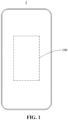
- an electricity-consumption device 1 is provided in the disclosure.
- the electricity-consumption device 1 includes an energy storage apparatus 100 described in the following embodiments.
- the energy storage apparatus 100 is configured to power the electricity-consumption device 1.
- the electricity-consumption device 1 may be, but is not limited to, a vehicle, an intelligent electronic device (such as a mobile phone or a computer), and the like.
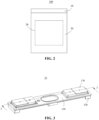
- the energy storage apparatus 100 is further provided in the disclosure.
- the energy storage apparatus 100 includes an electrode assembly 20, a housing 30, and an end cover assembly 10.
- the electrode assembly 20 is disposed in the housing 30.
- the end cover assembly 10 is electrically connected to the electrode assembly 20.
- the electrode assembly 20 is configured to deliver electric energy outwards through the end cover assembly 10.
- the housing 30 is further provided with an electrolyte.
- the electrode assembly 20 is soaked in the electrolyte.
- the energy storage apparatus 100 may be a battery or a battery pack.
- the battery pack includes a box body and multiple batteries (greater than or equal to two batteries). The multiple batteries are received in the box body. The multiple batteries are electrically connected to one another.
- a shape of the energy storage apparatus 100 may be, but is not limited to, a cylindrical shape, a cuboid shape, a cube shape, etc.
- the energy storage apparatus 100 may be applied in, but is not limited to, fields such as household energy storage, large-scale industry and commerce, 5Gbase stations, microgrids, integrated optical storage and charging, and virtual power plants.
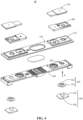
- the end cover assembly 10 is further provided in the disclosure.
- the end cover assembly 10 includes a top cover 110, a lower plastic member 120, a sealing member 130, and a terminal post 140.
- the top cover 110 may also be referred to as a smooth aluminum sheet, a top cover, a cover plate, and the like.
- the top cover 110 is generally made of a conductive material. In terms of structure, the top cover 110 is insulated from the terminal post 140.
- the lower plastic member 120 is fixed to the top cover 110.
- the lower plastic member 120 is made of an insulating material.
- the lower plastic member 120 may be made of a plastic material. In other embodiments, the lower plastic member 120 may also be made of a non-plastic material.
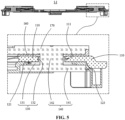
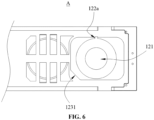
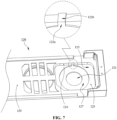
- the lower plastic member 120 defines a hollow hole 121 and a first flow passage 122a (as illustrated in FIG. 5 to FIG. 7 ).
- the hollow hole 121 extends through the lower plastic member 120 in a direction from the lower plastic member 120 to the top cover 110. That is, the hollow hole 121 is a through hole extending through the lower plastic member 120. Because the hollow hole 121 is a through hole, part of the top cover 110 facing the hollow hole 121 is exposed.
- the first flow passage 122a extends from the hollow hole 121 to an outside of the lower plastic member 120. That is, one end of the first flow passage 122a is in communication with a side wall of the hollow hole 121, and another end of the first flow passage 122a is in communication with an outside.
- a recess in communication with the hollow hole 121 is defined at an edge of the hollow hole 121 to form the first flow passage 122a. That is, the recess serves as the first flow passage 122a.
- the outside refers to a space outside the end cover assembly 10.
- air in a gap between the first sealing portion 131 and the side wall of the hollow hole 121 can be expelled to the space outside the end cover assembly 10 through the first flow passage 122a, thereby achieving an enhanced sealing effect of the sealing member 130.
- the sealing member 130 includes a first sealing portion 131 (as illustrated in FIG. 5 ) disposed in the hollow hole 121.
- the sealing member 130 may be made of an elastic and insulating material, such as rubber.
- the terminal post 140 includes a flange portion 141 (as illustrated in FIG. 5 ).
- the flange portion 141 is disposed on one side of the first sealing portion 131 facing away from the top cover 110 and covers the first sealing portion 131.
- the flange portion 141 and the top cover 110 cooperatively compress the first sealing portion 131.
- the first sealing portion 131 is positioned in the hollow hole 121, the first sealing portion 131 is positioned between the flange portion 141 and the top cover 110. Therefore, the flange portion 141 and the top cover 110 cooperatively compress the first sealing portion 131, so that the first sealing portion 131 can seal a gap between the flange portion 141 and the top cover 110.
- the flange portion 141 is insulated and separated from the top cover 110 by the lower plastic member 120. That is, the flange portion 141 and the top cover 110 are disposed on two opposite sides of the lower plastic member 120, respectively.
- the lower plastic member 120 is configured to insulate and separate the flange portion 141 from the top cover 110.
- the terminal post 140 in the disclosure may be a positive terminal post or a negative terminal post of the energy storage apparatus 100, which is not limited herein.
- the end cover assembly 10 further includes a metal block 170 and an upper plastic member 160.
- the metal block 170 is disposed at one side of the top cover 110 facing away from the lower plastic member 120.
- the upper plastic member 160 is at least partially positioned between the metal block 170 and the top cover 110.
- the upper plastic member 160 is configured to insulate and separate the metal block 170 from the top cover 110.
- the upper plastic member 160 may be made of, but is not limited to, a plastic material. In some embodiments, when the lower plastic member 120 and the upper plastic member 160 are both made of plastic, the lower plastic member 120 may also be referred to as a lower plastic, and the upper plastic member 160 may also be referred to as an upper plastic.
- the top cover 110 defines a through hole 111, and the through hole 111 faces the hollow hole 121.
- the terminal post 140 further includes a post body 142 protruding from one side of the flange portion 141. One end of the post body 142 facing away from the flange portion 141 extends through the hollow hole 121 and is electrically connected to the metal block 170.
- the electrode assembly 20 is electrically connected to the flange portion 141 directly or indirectly. When the energy storage apparatus 100 outputs electric energy to the outside, the electric energy is output through the flange portion 141, the post body 142, and the metal block 170 in sequence.
- the top cover 110 defines the through hole 111, it is required to prevent the electrolyte in the energy storage apparatus 100 from leaking to the outside through the through hole 111, or prevent external impurities from entering the interior of the energy storage apparatus 100 through the through hole 111 and contaminating the electrolyte.
- the first sealing portion 131 of the sealing member 130 is disposed between the flange portion 141 and the top cover 110, so that a passage of the energy storage apparatus 100 in the vicinity of the through hole 111 can be blocked, thereby avoiding or weakening the described problem.
- the metal block 170, the top cover 110, and the lower plastic member 120 may be first stacked together, then the terminal post 140 is attached to the lower plastic member 120, and finally, one end of the post body 142 of the terminal post 140 facing away from the flange portion 141 is connected to the metal block 170.
- the terminal post 140 is moved in a direction from the lower plastic member 120 to the top cover 110.
- a radial size of the through hole 111 is less than a radial size of the hollow hole 121. Because the through hole 111 faces the hollow hole 121, at least part of the top cover 110 will be exposed to face the hollow hole 121, and the first sealing portion 131 disposed in the hollow hole 121 is in contact with part of the top cover 110 that is exposed. That is, the radial size of the through hole 111 is set to be less than the radial size of the hollow hole 121, thereby ensuring that the first sealing portion 131 can be positioned between the top cover 110 and the flange portion 141. Therefore, the top cover 110 and the flange portion 141 can cooperatively compress the first sealing portion 131, thereby ensuring that the first sealing portion 131 can achieve a sealing function.
- the sealing member 130 further includes a second sealing portion 132 protruding from one side of the first sealing portion 131.
- the second sealing portion 132 has a hollow cylindrical shape.
- the second sealing portion 132 extends through the through hole 111 and is sleeved on an outer periphery of the post body 142. That is, the second sealing portion 132 is positioned in the through hole 111 and wraps around the outer periphery of the post body 142.
- the second sealing portion 132 may have at least two beneficial effects as follows. On the one hand, the second sealing portion 132 can seal the through hole 111. On the other hand, the second sealing portion 132 can separate the post body 142 from the top cover 110.
- the second sealing portion 132 also facilitates mounting of the sealing member 130.
- the second sealing portion 132 can be positioned by the through hole 111, and inserted into the through hole 111, thereby mounting the sealing member 130 while also ensuring that the sealing member 130 is not easily displaced after mounting.
- the end cover assembly 10 has a sealing state and a non-sealing state.
- the non-sealing state refers to a state of the end cover assembly 10 before a sealing assembly.
- the sealing state refers to a state of the end cover assembly 10 after the sealing assembly is completed.
- an outer diameter of the first sealing portion 131 is a first size R1
- the first size R1 is less than a diameter of the hollow hole 121.
- an outer diameter of the first sealing portion 131 is a second size R2, and the second size R2 is greater than the first size R1.
- the first flow passage 122a is configured to expel air from the hollow hole 121.
- the non-sealing state may be understood as a state of the end cover assembly 10 in which the first sealing portion 131 is not compressed by the flange portion 141 and the top cover 110.
- the sealed state may be understood as a state of the end cover assembly 10 in which the first sealing portion 131 is compressed by the flange portion 141 and the top cover 110.
- the radial size of the first sealing portion 131 is less than the inner diameter of the hollow hole 121.
- a gap is defined between the outer periphery of the first sealing portion 131 and the side wall of the hollow hole 121.
- the first flow passage 122a is defined on the lower plastic member 120, and the first flow passage 122a is in communication with the hollow hole 121 and extends to the outside of the lower plastic member 120. Therefore, during reduction of the gap between the first sealing portion 131 and the hollow hole 121, the air in the gap can be expelled from the first flow passage 122a to the outside of the lower plastic member 120. As a result, the first sealing portion 131 can be compressed continuously by the flange portion 141 to expand in the radial direction. Finally, the first sealing portion 131 can sufficiently seal the gap between the flange portion 141 and the top cover 110.
- the sealing member 130 is generally an elastic member.
- the sealing member 130 is deformed under compression, thereby tightly abutting against a contact surface to achieve a sealing effect. If air is not expelled from the contact surface, air bubbles can easily form during compression to affect mutual abutment between the sealing member 130 and the contact surface, thereby reducing the sealing effect.
- an upper surface of the flange portion 141 of the terminal post 140 is moved to abut against the first sealing portion 131 of the sealing member 130 and a lower surface of the lower plastic member 120 (i.e., a surface of the lower plastic member 120 facing towards the flange portion) 141.
- air between the lower surface of the lower plastic member 120, a lower surface of the first sealing portion 131, and the upper surface of the flange portion 141, as well as air between an outer peripheral wall of the first sealing portion 131 and an inner peripheral wall of the hollow hole 121, can be expelled through the first flow passage 122a, thereby avoiding formation of air bubbles and enhancing the sealing effect of the sealing member 130.
- the first flow passage 122a is defined on the lower plastic member 120, and the first flow passage 122a is in communication with the hollow hole 121 and extends to the outside of the lower plastic member 120.
- the radial size of the first sealing portion 131 is increased from the first size R1 to the second size R2
- the air between the outer periphery of the first sealing portion 131 and the side wall of the hollow hole 121 can be expelled to the outside of the lower plastic member 120 through the first flow passage 122a. Therefore, during assembly, the flange portion 141 and the top cover 110 may cooperate to smoothly compress the first sealing portion 131, so that the first sealing portion 131 can sufficiently seal the gap between the flange portion 141 and the top cover 110.
- the lower plastic member 120 has an end surface 129.
- the end surface 129 is a surface of the lower plastic member 120 facing away from the top cover 110.
- the lower plastic member 120 further defines an accommodating recess 123.
- the accommodating recess 123 is recessed from the end surface 129.
- the accommodating recess 123 is in communication with the hollow hole 121.
- the flange portion 141 is received in the accommodating recess 123. It may be understood that, the lower plastic member 120 is mated with the flange portion 141 through the accommodating recess 123, which facilitates stability of the connection between the lower plastic member 120 and the flange portion 141.
- the flange portion 141 is disposed in the accommodating recess 123, so that the lower plastic member 120 is in interference fitting with the flange portion 141, thereby enhancing the sealing effect.
- the accommodating recess 123 is in communication with the hollow hole 121, during assembly of the flange portion 141 to the accommodating recess 123, air in the accommodating recess 123 may also be expelled through the first flow passage 122a.
- the lower plastic member 120 has a first surface 124.
- the first surface 124 serves as a side surface of the accommodating recess 123.
- a second flow passage 122b is defined on the first surface 124.
- One end of the second flow passage 122b is in communication with the first flow passage 122a, and another end of the second flow passage 122b is in communication with the outside. That is, the second flow passage 122b is recessed from the first surface 124, and the second flow passage 122b extends through the end surface 129.
- the second flow passage 122b extends through the end surface 129, so that the second flow passage 122b can be used to expel the air in the hollow hole 121 to the outside of the lower plastic member 120.
- the second flow passage 122b may be a rectangular recess, an arc-shaped recess, or the like.
- the number of the second flow passages 122b may be one.
- the number of the second flow passages 122b may be more than one, for example, two, three, four, or the like. It may be understood that, the larger the number of the second flow passages 122b is, the faster the air is expelled, which facilitates quick assembly of the flange portion 141 and improves production efficiency.
- the first flow passage 122a is curvedly connected to the second flow passage 122b. That is, a junction between the first flow passage 122a and the second flow passage 122b is curved.
- This arrangement can prevent an airflow, flowing from the first flow passage 122a to the second flow passage 122b, from hitting against the bottom of the second flow passage 122b to form a backflow when flowing through the junction between the first flow passage 122a and the second flow passage 122b. That is, the curved junction may play a role in guiding airflow, thereby improving capacity of air expelling.
- a width of the first flow passage 122a (i.e., a width of a recess of the first flow passage 122a) ranges from 0.6 mm to 2.4 mm
- a width of the second flow passage 122b (i.e., a width of a recess of the second flow passage 122b) ranges from 0.6 mm to 2.4 mm
- the width of the first flow passage 122a may be 0.6 mm, 0.7 mm, 0.8 mm, 0.9 mm, 1.0 mm, 1.1 mm, 1.5 mm, 1.6 mm, 1.7 mm, 1.9 mm, 2.0 mm, 2.1 mm, 2.2 mm, 2.3 mm, 2.4 mm, and the like.
- the width of the second flow passage 122b may be 0.6 mm, 0.7 mm, 0.8 mm, 0.9 mm, 1.0 mm, 1.1 mm, 1.5 mm, 1.6 mm, 1.7 mm, 1.9 mm, 2.0 mm, 2.1 mm, 2.2 mm, 2.3 mm, 2.4 mm, and the like.
- a depth of the first flow passage 122a (i.e., a depth of the recess of the first flow passage 122a) ranges from 0.2 mm to 2.8 mm
- a depth of the second flow passage 122b (i.e., a depth of the recess of the second flow passage 122b) ranges from 0.2 mm to 2.8 mm.
- the depth of the first flow passage 122a may be 0.2 mm, 0.5 mm, 0.6 mm, 0.8 mm, 0.9 mm, 1.0 mm, 1.1 mm, 1.2 mm, 1.6 mm, 1.9 mm, 2.1 mm, 2.2 mm, 2.5 mm, 2.6 mm, 2.8 mm, and the like.
- the depth of the second flow passage 122b may be 0.2 mm, 0.5 mm, 0.6 mm, 0.8 mm, 0.9 mm, 1.0 mm, 1.1 mm, 1.2 mm, 1.6 mm, 1.9 mm, 2.1 mm, 2.2 mm, 2.5 mm, 2.6 mm, 2.8 mm, and the like.
- the flange portion 141 is provided with a fool-proof portion 1411, and the accommodating recess 123 is provided with a fitting portion 1231 matching the fool-proof portion 1411.
- the flange portion 141 is provided with the fool-proof portion 1411
- the accommodating recess 123 is correspondingly provided with the fitting portion 1231
- the fool-proof portion 1411 matches the fitting portion 1231.
- the lower plastic member 120 has a first surface 124 serving as a side surface of the accommodating recess 123 and abutting against the flange portion 141 of the terminal post 140. This arrangement can further enhance the sealing performance of mating between the terminal post 140 and the lower plastic member 120.
- the lower plastic member 120 has a second surface 125 facing away from the top cover 110. Apart of the second surface 125 is defined as a bottom surface of the accommodating recess 123. That is, a part of the second surface 125 serves as the bottom surface of the accommodating recess 123.
- the lower plastic member 120 further defines a recess 127 recessed from the second surface 125.
- the recess 127 surrounds the hollow hole 121 and is in communication with the hollow hole 121. That is, the recess 127 is annular.
- a step structure (defined as a first step structure 128 herein) is formed at a position where the recess 127 is positioned.
- the outer periphery of the first sealing portion 131 gradually enters the recess 127 from the hollow hole 121, and gradually compresses the first step structure 128 on the lower plastic member 120.
- the outer periphery of the first sealing portion 131 will also form a step structure (defined as a second step structure 1311 herein) under continuous compression.
- the second step structure 1311 and the first step structure 128 have the same shape and are stacked to form a fitting state, as illustrated in FIG. 12 . It may be understood that, the tight fitting state of the first step structure 128 and the second step structure 1311 can further enhance the sealing performance. In addition, the step structure can also increase a creep age distance, thereby improving the safety performance of the energy storage apparatus 100.
- the recess 127 enables an abutting surface between the outer peripheral wall of the first sealing portion 131 and the inner peripheral wall of the hollow hole 121 of the sealing member 130 to be extended into a Z-shape, increasing a contact area between the outer peripheral wall of the first sealing portion 131 and the inner peripheral wall of the hollow hole 121 of the lower plastic member 120, and further enhancing the sealing effect.
- the creep age distance between the flange portion 141 of the terminal post and the top cover 110 is increased, thereby improving the electrical safety performance.
- the first flow passage 122a is recessed from the second surface 125. One end of the first flow passage 122a is in communication with the recess 127, and another end of the first flow passage 122a is in communication with the second flow passage 122b.
- a gap is defined between an outer peripheral surface of the first sealing portion 131 and a side surface of the hollow hole 121.
- the lower plastic member 120 has a second surface 125 and a third surface 126 that abuts against a surface of the top cover 110.
- a part of the second surface 125 serves as a bottom surface of the accommodating recess 123.
- a distance between the second surface 125 and the third surface 126 is H2, and a thickness of the first sealing portion 131 is H1, and H1 is greater than H2.
- the first sealing portion 131 protrudes from the second surface 125 in a direction from the third surface 126 to the second surface 125.
- the thickness of the first sealing portion 131 refers to a size of the first sealing portion 131 in the opposite direction of the second surface 125 and the third surface 126.
- the thickness H1 of the first sealing portion 131 decreases, and the first sealing portion 131 expands in the radial direction of the first sealing portion 131.
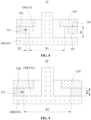
- the gap between the outer periphery of the first sealing portion 131 and the side wall of the hollow hole 121 is gradually filled by the first sealing portion 131, until the seal assembly as illustrated in FIG. 9 is achieved.
- H1 is greater than H2
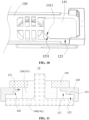
- a space defined by the flange portion 141 of the terminal post 140, the first sealing portion 131 of the sealing member 130, the lower plastic member 120, and the top cover 110 is relatively closed, and the space is simply referred to as a closed space (see FIG. 11 ).
- the flange portion 141 is continue moved upward to compress the first sealing portion 131, and the first sealing portion 131 is compressed to be thinner and expand outwards, the gap between the outer peripheral wall of the first sealing portion 131 and the inner peripheral wall of the hollow hole 121 is closed (see FIG.
- a reduction in the thickness of the first sealing portion 131 subject to compression is (H1-H2), and a size of the gap between the outer peripheral surface of the first sealing portion 131 and the side surface of the hollow hole 121 is H3, where 0.9 ⁇ (H1-H2)/H3 ⁇ 1.6. That is, a ratio of (H1-H2) to H3 ranges from 0.9 to 1.6.
- the ratio of (H1-H2) to H3 can be, but is not limited to, 0.9, 1.0, 1.1, 1.2, 1.25, 1.3, 1.4, 1.5, 1.6, etc.
- the thickness H1 of the first sealing portion 131 when not compressed, ranges from 0.8mm to 3mm.
- the thickness H1 of the first sealing portion 131, when not compressed, may be 0.8mm, 0.9mm, 1.0mm, 1.1mm, 1.15mm, 1.2mm, 1.5mm, 1.8mm, 2.0mm, 2.3mm, 2.5mm, 2.6mm, 2.9mm, 3.0mm, and the like.
- the size of the gap H3 between the outer peripheral surface of the first sealing portion 131 and the side surface of the hollow hole 121 ranges from 0.05 mm to 1.85 mm.
- the size of the gap H3 may be 0.05 mm, 0.06 mm, 0.10 mm, 0.15 mm, 0.20 mm, 0.26 mm, 0.3 mm, 0.41 mm, 0.5 mm, 0.55 mm, 0.6 mm, 0.9 mm, 1.5 mm, 1.85 mm, and the like. If H3 ⁇ 0.05 mm, the first sealing portion 131 may not sufficiently expand in the radial direction, so that the first sealing portion 131 cannot be further compressed by the flange portion 141, finally resulting in a poor sealing effect.
- H3 may be still greater than zero when the end cover assembly 10 is in the sealed state, that is, the side wall of the hollow hole 121 and an edge of the first sealing portion 131 will not abut against each other, resulting in a poor sealing effect.
Landscapes
- Chemical & Material Sciences (AREA)
- Chemical Kinetics & Catalysis (AREA)
- Electrochemistry (AREA)
- General Chemical & Material Sciences (AREA)
- Sealing Battery Cases Or Jackets (AREA)
Applications Claiming Priority (1)
| Application Number | Priority Date | Filing Date | Title |
|---|---|---|---|
| CN202310091084.3A CN115810841B (zh) | 2023-02-09 | 2023-02-09 | 端盖组件、储能装置、用电设备 |
Publications (2)
| Publication Number | Publication Date |
|---|---|
| EP4415134A1 true EP4415134A1 (fr) | 2024-08-14 |
| EP4415134B1 EP4415134B1 (fr) | 2025-09-24 |
Family
ID=85487821
Family Applications (1)
| Application Number | Title | Priority Date | Filing Date |
|---|---|---|---|
| EP23218192.5A Active EP4415134B1 (fr) | 2023-02-09 | 2023-12-19 | Ensemble couvercle d'extrémité, appareil de stockage d'énergie et dispositif de consommation d'électricité |
Country Status (3)
| Country | Link |
|---|---|
| US (1) | US12057590B1 (fr) |
| EP (1) | EP4415134B1 (fr) |
| CN (1) | CN115810841B (fr) |
Families Citing this family (2)
| Publication number | Priority date | Publication date | Assignee | Title |
|---|---|---|---|---|
| CN116207462B (zh) * | 2023-03-30 | 2024-05-31 | 厦门海辰储能科技股份有限公司 | 端盖组件、储能装置和用电设备 |
| CN116864881B (zh) * | 2023-09-05 | 2023-12-29 | 中宏科创新能源科技(浙江)有限公司 | 顶盖组件、电池及电子设备 |
Citations (2)
| Publication number | Priority date | Publication date | Assignee | Title |
|---|---|---|---|---|
| CN113270667A (zh) * | 2020-11-11 | 2021-08-17 | 厦门海辰新能源科技有限公司 | 顶盖组件及具有其的锂电池 |
| CN217848117U (zh) * | 2022-07-14 | 2022-11-18 | 蜂巢能源科技股份有限公司 | 电池盖板以及具有其的电池和动力装置 |
Family Cites Families (17)
| Publication number | Priority date | Publication date | Assignee | Title |
|---|---|---|---|---|
| CN101587965B (zh) * | 2009-04-24 | 2010-12-08 | 湖南神舟科技股份有限公司 | 一种内连接方形塑壳蓄电池 |
| DE102017216874A1 (de) | 2017-09-25 | 2019-03-28 | Robert Bosch Gmbh | Deckelplatte für eine Batteriezelle und Verfahren zum Herstellen einer Deckelplatte |
| CN110021728B (zh) * | 2018-01-10 | 2021-11-09 | 宁德时代新能源科技股份有限公司 | 单向透气阀、二次电池的顶盖组件及二次电池 |
| CN208986033U (zh) | 2018-08-08 | 2019-06-14 | 深圳市瑞德丰精密制造有限公司 | 用于电池极柱的密封圈结构、电池极柱结构和电池盖板 |
| CN209747563U (zh) | 2019-05-27 | 2019-12-06 | 宁德时代新能源科技股份有限公司 | 顶盖组件以及二次电池 |
| CN110379953A (zh) * | 2019-07-31 | 2019-10-25 | 江苏塔菲尔新能源科技股份有限公司 | 一种电池顶盖的装配结构及其装配方法 |
| CN210272526U (zh) | 2019-09-18 | 2020-04-07 | 东莞百思利新能源科技有限公司 | 二次电池极柱组件及其二次电池顶盖 |
| CN213401337U (zh) * | 2020-10-16 | 2021-06-08 | 东莞塔菲尔新能源科技有限公司 | 一种动力电池顶盖的装配结构及动力电池 |
| CN215451569U (zh) | 2021-04-13 | 2022-01-07 | 欣旺达电动汽车电池有限公司 | 电池顶盖及电芯 |
| CN215266471U (zh) | 2021-06-04 | 2021-12-21 | 欣旺达电动汽车电池有限公司 | 动力电池顶盖及动力电池 |
| CN113178651B (zh) * | 2021-06-07 | 2021-08-24 | 蜂巢能源科技有限公司 | 电池极柱密封安装结构及其安装方法 |
| CN215896540U (zh) | 2021-08-12 | 2022-02-22 | 湖北亿纬动力有限公司 | 顶盖结构及电池 |
| CN215869708U (zh) | 2021-08-20 | 2022-02-18 | 苏州炬鸿通讯电脑科技有限公司 | 一种高容量高性能的锂电池盖板结构 |
| CN217361751U (zh) | 2022-01-28 | 2022-09-02 | 上海兰钧新能源科技有限公司 | 一种二次电池下塑胶结构 |
| CN217507473U (zh) * | 2022-06-10 | 2022-09-27 | 中创新航科技股份有限公司 | 电池包 |
| CN218039478U (zh) * | 2022-07-28 | 2022-12-13 | 湖北亿纬动力有限公司 | 一种塑胶件、顶盖组件及电池 |
| CN218039495U (zh) * | 2022-07-28 | 2022-12-13 | 湖北亿纬动力有限公司 | 一种顶盖组件及动力电池 |
-
2023
- 2023-02-09 CN CN202310091084.3A patent/CN115810841B/zh active Active
- 2023-11-30 US US18/525,461 patent/US12057590B1/en active Active
- 2023-12-19 EP EP23218192.5A patent/EP4415134B1/fr active Active
Patent Citations (2)
| Publication number | Priority date | Publication date | Assignee | Title |
|---|---|---|---|---|
| CN113270667A (zh) * | 2020-11-11 | 2021-08-17 | 厦门海辰新能源科技有限公司 | 顶盖组件及具有其的锂电池 |
| CN217848117U (zh) * | 2022-07-14 | 2022-11-18 | 蜂巢能源科技股份有限公司 | 电池盖板以及具有其的电池和动力装置 |
Also Published As
| Publication number | Publication date |
|---|---|
| CN115810841B (zh) | 2023-05-09 |
| US12057590B1 (en) | 2024-08-06 |
| EP4415134B1 (fr) | 2025-09-24 |
| CN115810841A (zh) | 2023-03-17 |
| US20240274940A1 (en) | 2024-08-15 |
Similar Documents
| Publication | Publication Date | Title |
|---|---|---|
| KR100467703B1 (ko) | 캡 조립체 및 이를 채용한 이차전지 | |
| EP4415134A1 (fr) | Ensemble couvercle d'extrémité, appareil de stockage d'énergie et dispositif de consommation d'électricité | |
| CN100495800C (zh) | 可再充电电池 | |
| CN106058134B (zh) | 可再充电电池 | |
| US11721861B2 (en) | Top cover assembly for battery, battery, and energy storage device | |
| KR20090081197A (ko) | 이차 전지 | |
| CN115882176A (zh) | 绝缘组件、端盖组件、储能装置及用电设备 | |
| WO2023036291A1 (fr) | Pôle composite, couvercle supérieur et batterie | |
| CN116231179A (zh) | 端盖组件、电池和储能装置 | |
| CN211629137U (zh) | 纽扣电池 | |
| US20240266642A1 (en) | Battery housing, lithium battery and electronic product thereof | |
| US8771865B2 (en) | Secondary battery | |
| CN216850095U (zh) | 一种结构紧凑的电池组件 | |
| CN207690845U (zh) | 二次电池顶盖组件、二次电池及汽车 | |
| US20250158178A1 (en) | Battery, battery module, and electric device | |
| CN221328040U (zh) | 二次电池及电池包 | |
| WO2024094179A1 (fr) | Ensemble couvercle d'extrémité de batterie, élément de batterie, dispositif de stockage d'énergie et appareil électrique | |
| CN214226975U (zh) | 纽扣电池封装结构及纽扣电池 | |
| KR20040022715A (ko) | 리튬이차전지 | |
| US20250364651A1 (en) | Insulation assembly, end cover assembly, energy storage device, and electric device | |
| CN223109038U (zh) | 电池 | |
| CN222483513U (zh) | 电池壳和电池 | |
| CN219419255U (zh) | 电池 | |
| KR20030053601A (ko) | 이차전지 | |
| CN116864881B (zh) | 顶盖组件、电池及电子设备 |
Legal Events
| Date | Code | Title | Description |
|---|---|---|---|
| PUAI | Public reference made under article 153(3) epc to a published international application that has entered the european phase |
Free format text: ORIGINAL CODE: 0009012 |
|
| STAA | Information on the status of an ep patent application or granted ep patent |
Free format text: STATUS: THE APPLICATION HAS BEEN PUBLISHED |
|
| AK | Designated contracting states |
Kind code of ref document: A1 Designated state(s): AL AT BE BG CH CY CZ DE DK EE ES FI FR GB GR HR HU IE IS IT LI LT LU LV MC ME MK MT NL NO PL PT RO RS SE SI SK SM TR |
|
| STAA | Information on the status of an ep patent application or granted ep patent |
Free format text: STATUS: REQUEST FOR EXAMINATION WAS MADE |
|
| 17P | Request for examination filed |
Effective date: 20240917 |
|
| RBV | Designated contracting states (corrected) |
Designated state(s): AL AT BE BG CH CY CZ DE DK EE ES FI FR GB GR HR HU IE IS IT LI LT LU LV MC ME MK MT NL NO PL PT RO RS SE SI SK SM TR |
|
| STAA | Information on the status of an ep patent application or granted ep patent |
Free format text: STATUS: EXAMINATION IS IN PROGRESS |
|
| 17Q | First examination report despatched |
Effective date: 20241211 |
|
| RAP1 | Party data changed (applicant data changed or rights of an application transferred) |
Owner name: HITHIUM TECH HK LIMITED |
|
| GRAP | Despatch of communication of intention to grant a patent |
Free format text: ORIGINAL CODE: EPIDOSNIGR1 |
|
| STAA | Information on the status of an ep patent application or granted ep patent |
Free format text: STATUS: GRANT OF PATENT IS INTENDED |
|
| INTG | Intention to grant announced |
Effective date: 20250424 |
|
| GRAS | Grant fee paid |
Free format text: ORIGINAL CODE: EPIDOSNIGR3 |
|
| GRAA | (expected) grant |
Free format text: ORIGINAL CODE: 0009210 |
|
| STAA | Information on the status of an ep patent application or granted ep patent |
Free format text: STATUS: THE PATENT HAS BEEN GRANTED |
|
| AK | Designated contracting states |
Kind code of ref document: B1 Designated state(s): AL AT BE BG CH CY CZ DE DK EE ES FI FR GB GR HR HU IE IS IT LI LT LU LV MC ME MK MT NL NO PL PT RO RS SE SI SK SM TR |
|
| REG | Reference to a national code |
Ref country code: GB Ref legal event code: FG4D |
|
| REG | Reference to a national code |
Ref country code: CH Ref legal event code: EP |
|
| REG | Reference to a national code |
Ref country code: DE Ref legal event code: R096 Ref document number: 602023006944 Country of ref document: DE |
|
| REG | Reference to a national code |
Ref country code: IE Ref legal event code: FG4D |
|
| PGFP | Annual fee paid to national office [announced via postgrant information from national office to epo] |
Ref country code: DE Payment date: 20251212 Year of fee payment: 3 |
|
| PG25 | Lapsed in a contracting state [announced via postgrant information from national office to epo] |
Ref country code: NO Free format text: LAPSE BECAUSE OF FAILURE TO SUBMIT A TRANSLATION OF THE DESCRIPTION OR TO PAY THE FEE WITHIN THE PRESCRIBED TIME-LIMIT Effective date: 20251224 |
|
| REG | Reference to a national code |
Ref country code: LT Ref legal event code: MG9D |
|
| PGFP | Annual fee paid to national office [announced via postgrant information from national office to epo] |
Ref country code: AT Payment date: 20260113 Year of fee payment: 3 |
|
| PG25 | Lapsed in a contracting state [announced via postgrant information from national office to epo] |
Ref country code: FI Free format text: LAPSE BECAUSE OF FAILURE TO SUBMIT A TRANSLATION OF THE DESCRIPTION OR TO PAY THE FEE WITHIN THE PRESCRIBED TIME-LIMIT Effective date: 20250924 |
|
| PG25 | Lapsed in a contracting state [announced via postgrant information from national office to epo] |
Ref country code: HR Free format text: LAPSE BECAUSE OF FAILURE TO SUBMIT A TRANSLATION OF THE DESCRIPTION OR TO PAY THE FEE WITHIN THE PRESCRIBED TIME-LIMIT Effective date: 20250924 |
|
| PGFP | Annual fee paid to national office [announced via postgrant information from national office to epo] |
Ref country code: HU Payment date: 20251209 Year of fee payment: 3 |
|
| PG25 | Lapsed in a contracting state [announced via postgrant information from national office to epo] |
Ref country code: GR Free format text: LAPSE BECAUSE OF FAILURE TO SUBMIT A TRANSLATION OF THE DESCRIPTION OR TO PAY THE FEE WITHIN THE PRESCRIBED TIME-LIMIT Effective date: 20251225 |
|
| PG25 | Lapsed in a contracting state [announced via postgrant information from national office to epo] |
Ref country code: SE Free format text: LAPSE BECAUSE OF FAILURE TO SUBMIT A TRANSLATION OF THE DESCRIPTION OR TO PAY THE FEE WITHIN THE PRESCRIBED TIME-LIMIT Effective date: 20250924 |
|
| PG25 | Lapsed in a contracting state [announced via postgrant information from national office to epo] |
Ref country code: LV Free format text: LAPSE BECAUSE OF FAILURE TO SUBMIT A TRANSLATION OF THE DESCRIPTION OR TO PAY THE FEE WITHIN THE PRESCRIBED TIME-LIMIT Effective date: 20250924 |
|
| PG25 | Lapsed in a contracting state [announced via postgrant information from national office to epo] |
Ref country code: BG Free format text: LAPSE BECAUSE OF FAILURE TO SUBMIT A TRANSLATION OF THE DESCRIPTION OR TO PAY THE FEE WITHIN THE PRESCRIBED TIME-LIMIT Effective date: 20250924 |
|
| PG25 | Lapsed in a contracting state [announced via postgrant information from national office to epo] |
Ref country code: RS Free format text: LAPSE BECAUSE OF FAILURE TO SUBMIT A TRANSLATION OF THE DESCRIPTION OR TO PAY THE FEE WITHIN THE PRESCRIBED TIME-LIMIT Effective date: 20251224 |
|
| REG | Reference to a national code |
Ref country code: NL Ref legal event code: MP Effective date: 20250924 |
|
| REG | Reference to a national code |
Ref country code: ES Ref legal event code: FG2A Ref document number: 3054400 Country of ref document: ES Kind code of ref document: T3 Effective date: 20260203 |