EP4411698A1 - Trägerbandloses etikett für fluggepäck - Google Patents
Trägerbandloses etikett für fluggepäck Download PDFInfo
- Publication number
- EP4411698A1 EP4411698A1 EP22875743.1A EP22875743A EP4411698A1 EP 4411698 A1 EP4411698 A1 EP 4411698A1 EP 22875743 A EP22875743 A EP 22875743A EP 4411698 A1 EP4411698 A1 EP 4411698A1
- Authority
- EP
- European Patent Office
- Prior art keywords
- layer
- pressure
- label
- sensitive adhesive
- tackiness agent
- Prior art date
- Legal status (The legal status is an assumption and is not a legal conclusion. Google has not performed a legal analysis and makes no representation as to the accuracy of the status listed.)
- Pending
Links
Images

Classifications
-
- G—PHYSICS
- G09—EDUCATION; CRYPTOGRAPHY; DISPLAY; ADVERTISING; SEALS
- G09F—DISPLAYING; ADVERTISING; SIGNS; LABELS OR NAME-PLATES; SEALS
- G09F3/00—Labels, tag tickets, or similar identification or indication means; Seals; Postage or like stamps
- G09F3/02—Forms or constructions
-
- C—CHEMISTRY; METALLURGY
- C09—DYES; PAINTS; POLISHES; NATURAL RESINS; ADHESIVES; COMPOSITIONS NOT OTHERWISE PROVIDED FOR; APPLICATIONS OF MATERIALS NOT OTHERWISE PROVIDED FOR
- C09J—ADHESIVES; NON-MECHANICAL ASPECTS OF ADHESIVE PROCESSES IN GENERAL; ADHESIVE PROCESSES NOT PROVIDED FOR ELSEWHERE; USE OF MATERIALS AS ADHESIVES
- C09J7/00—Adhesives in the form of films or foils
- C09J7/20—Adhesives in the form of films or foils characterised by their carriers
- C09J7/29—Laminated material
-
- B—PERFORMING OPERATIONS; TRANSPORTING
- B32—LAYERED PRODUCTS
- B32B—LAYERED PRODUCTS, i.e. PRODUCTS BUILT-UP OF STRATA OF FLAT OR NON-FLAT, e.g. CELLULAR OR HONEYCOMB, FORM
- B32B27/00—Layered products comprising a layer of synthetic resin
-
- B—PERFORMING OPERATIONS; TRANSPORTING
- B32—LAYERED PRODUCTS
- B32B—LAYERED PRODUCTS, i.e. PRODUCTS BUILT-UP OF STRATA OF FLAT OR NON-FLAT, e.g. CELLULAR OR HONEYCOMB, FORM
- B32B27/00—Layered products comprising a layer of synthetic resin
- B32B27/06—Layered products comprising a layer of synthetic resin as the main or only constituent of a layer, which is next to another layer of the same or of a different material
- B32B27/10—Layered products comprising a layer of synthetic resin as the main or only constituent of a layer, which is next to another layer of the same or of a different material of paper or cardboard
-
- B—PERFORMING OPERATIONS; TRANSPORTING
- B32—LAYERED PRODUCTS
- B32B—LAYERED PRODUCTS, i.e. PRODUCTS BUILT-UP OF STRATA OF FLAT OR NON-FLAT, e.g. CELLULAR OR HONEYCOMB, FORM
- B32B27/00—Layered products comprising a layer of synthetic resin
- B32B27/32—Layered products comprising a layer of synthetic resin comprising polyolefins
-
- B—PERFORMING OPERATIONS; TRANSPORTING
- B32—LAYERED PRODUCTS
- B32B—LAYERED PRODUCTS, i.e. PRODUCTS BUILT-UP OF STRATA OF FLAT OR NON-FLAT, e.g. CELLULAR OR HONEYCOMB, FORM
- B32B27/00—Layered products comprising a layer of synthetic resin
- B32B27/36—Layered products comprising a layer of synthetic resin comprising polyesters
-
- B—PERFORMING OPERATIONS; TRANSPORTING
- B32—LAYERED PRODUCTS
- B32B—LAYERED PRODUCTS, i.e. PRODUCTS BUILT-UP OF STRATA OF FLAT OR NON-FLAT, e.g. CELLULAR OR HONEYCOMB, FORM
- B32B3/00—Layered products comprising a layer with external or internal discontinuities or unevennesses, or a layer of non-planar shape; Layered products comprising a layer having particular features of form
- B32B3/26—Layered products comprising a layer with external or internal discontinuities or unevennesses, or a layer of non-planar shape; Layered products comprising a layer having particular features of form characterised by a particular shape of the outline of the cross-section of a continuous layer; characterised by a layer with cavities or internal voids ; characterised by an apertured layer
- B32B3/266—Layered products comprising a layer with external or internal discontinuities or unevennesses, or a layer of non-planar shape; Layered products comprising a layer having particular features of form characterised by a particular shape of the outline of the cross-section of a continuous layer; characterised by a layer with cavities or internal voids ; characterised by an apertured layer characterised by an apertured layer, the apertures going through the whole thickness of the layer, e.g. expanded metal, perforated layer, slit layer regular cells B32B3/12
-
- B—PERFORMING OPERATIONS; TRANSPORTING
- B32—LAYERED PRODUCTS
- B32B—LAYERED PRODUCTS, i.e. PRODUCTS BUILT-UP OF STRATA OF FLAT OR NON-FLAT, e.g. CELLULAR OR HONEYCOMB, FORM
- B32B7/00—Layered products characterised by the relation between layers; Layered products characterised by the relative orientation of features between layers, or by the relative values of a measurable parameter between layers, i.e. products comprising layers having different physical, chemical or physicochemical properties; Layered products characterised by the interconnection of layers
- B32B7/04—Interconnection of layers
- B32B7/06—Interconnection of layers permitting easy separation
-
- B—PERFORMING OPERATIONS; TRANSPORTING
- B32—LAYERED PRODUCTS
- B32B—LAYERED PRODUCTS, i.e. PRODUCTS BUILT-UP OF STRATA OF FLAT OR NON-FLAT, e.g. CELLULAR OR HONEYCOMB, FORM
- B32B7/00—Layered products characterised by the relation between layers; Layered products characterised by the relative orientation of features between layers, or by the relative values of a measurable parameter between layers, i.e. products comprising layers having different physical, chemical or physicochemical properties; Layered products characterised by the interconnection of layers
- B32B7/04—Interconnection of layers
- B32B7/12—Interconnection of layers using interposed adhesives or interposed materials with bonding properties
-
- C—CHEMISTRY; METALLURGY
- C09—DYES; PAINTS; POLISHES; NATURAL RESINS; ADHESIVES; COMPOSITIONS NOT OTHERWISE PROVIDED FOR; APPLICATIONS OF MATERIALS NOT OTHERWISE PROVIDED FOR
- C09J—ADHESIVES; NON-MECHANICAL ASPECTS OF ADHESIVE PROCESSES IN GENERAL; ADHESIVE PROCESSES NOT PROVIDED FOR ELSEWHERE; USE OF MATERIALS AS ADHESIVES
- C09J7/00—Adhesives in the form of films or foils
- C09J7/20—Adhesives in the form of films or foils characterised by their carriers
- C09J7/21—Paper; Textile fabrics
-
- C—CHEMISTRY; METALLURGY
- C09—DYES; PAINTS; POLISHES; NATURAL RESINS; ADHESIVES; COMPOSITIONS NOT OTHERWISE PROVIDED FOR; APPLICATIONS OF MATERIALS NOT OTHERWISE PROVIDED FOR
- C09J—ADHESIVES; NON-MECHANICAL ASPECTS OF ADHESIVE PROCESSES IN GENERAL; ADHESIVE PROCESSES NOT PROVIDED FOR ELSEWHERE; USE OF MATERIALS AS ADHESIVES
- C09J7/00—Adhesives in the form of films or foils
- C09J7/30—Adhesives in the form of films or foils characterised by the adhesive composition
- C09J7/38—Pressure-sensitive adhesives [PSA]
-
- G—PHYSICS
- G09—EDUCATION; CRYPTOGRAPHY; DISPLAY; ADVERTISING; SEALS
- G09F—DISPLAYING; ADVERTISING; SIGNS; LABELS OR NAME-PLATES; SEALS
- G09F3/00—Labels, tag tickets, or similar identification or indication means; Seals; Postage or like stamps
- G09F3/08—Fastening or securing by means not forming part of the material of the label itself
- G09F3/10—Fastening or securing by means not forming part of the material of the label itself by an adhesive layer
-
- B—PERFORMING OPERATIONS; TRANSPORTING
- B32—LAYERED PRODUCTS
- B32B—LAYERED PRODUCTS, i.e. PRODUCTS BUILT-UP OF STRATA OF FLAT OR NON-FLAT, e.g. CELLULAR OR HONEYCOMB, FORM
- B32B2255/00—Coating on the layer surface
- B32B2255/10—Coating on the layer surface on synthetic resin layer or on natural or synthetic rubber layer
-
- B—PERFORMING OPERATIONS; TRANSPORTING
- B32—LAYERED PRODUCTS
- B32B—LAYERED PRODUCTS, i.e. PRODUCTS BUILT-UP OF STRATA OF FLAT OR NON-FLAT, e.g. CELLULAR OR HONEYCOMB, FORM
- B32B2255/00—Coating on the layer surface
- B32B2255/26—Polymeric coating
-
- B—PERFORMING OPERATIONS; TRANSPORTING
- B32—LAYERED PRODUCTS
- B32B—LAYERED PRODUCTS, i.e. PRODUCTS BUILT-UP OF STRATA OF FLAT OR NON-FLAT, e.g. CELLULAR OR HONEYCOMB, FORM
- B32B2307/00—Properties of the layers or laminate
- B32B2307/40—Properties of the layers or laminate having particular optical properties
- B32B2307/402—Coloured
- B32B2307/4023—Coloured on the layer surface, e.g. ink
-
- B—PERFORMING OPERATIONS; TRANSPORTING
- B32—LAYERED PRODUCTS
- B32B—LAYERED PRODUCTS, i.e. PRODUCTS BUILT-UP OF STRATA OF FLAT OR NON-FLAT, e.g. CELLULAR OR HONEYCOMB, FORM
- B32B2519/00—Labels, badges
-
- C—CHEMISTRY; METALLURGY
- C09—DYES; PAINTS; POLISHES; NATURAL RESINS; ADHESIVES; COMPOSITIONS NOT OTHERWISE PROVIDED FOR; APPLICATIONS OF MATERIALS NOT OTHERWISE PROVIDED FOR
- C09J—ADHESIVES; NON-MECHANICAL ASPECTS OF ADHESIVE PROCESSES IN GENERAL; ADHESIVE PROCESSES NOT PROVIDED FOR ELSEWHERE; USE OF MATERIALS AS ADHESIVES
- C09J2203/00—Applications of adhesives in processes or use of adhesives in the form of films or foils
- C09J2203/334—Applications of adhesives in processes or use of adhesives in the form of films or foils as a label
-
- C—CHEMISTRY; METALLURGY
- C09—DYES; PAINTS; POLISHES; NATURAL RESINS; ADHESIVES; COMPOSITIONS NOT OTHERWISE PROVIDED FOR; APPLICATIONS OF MATERIALS NOT OTHERWISE PROVIDED FOR
- C09J—ADHESIVES; NON-MECHANICAL ASPECTS OF ADHESIVE PROCESSES IN GENERAL; ADHESIVE PROCESSES NOT PROVIDED FOR ELSEWHERE; USE OF MATERIALS AS ADHESIVES
- C09J2301/00—Additional features of adhesives in the form of films or foils
- C09J2301/10—Additional features of adhesives in the form of films or foils characterized by the structural features of the adhesive tape or sheet
- C09J2301/16—Additional features of adhesives in the form of films or foils characterized by the structural features of the adhesive tape or sheet by the structure of the carrier layer
-
- C—CHEMISTRY; METALLURGY
- C09—DYES; PAINTS; POLISHES; NATURAL RESINS; ADHESIVES; COMPOSITIONS NOT OTHERWISE PROVIDED FOR; APPLICATIONS OF MATERIALS NOT OTHERWISE PROVIDED FOR
- C09J—ADHESIVES; NON-MECHANICAL ASPECTS OF ADHESIVE PROCESSES IN GENERAL; ADHESIVE PROCESSES NOT PROVIDED FOR ELSEWHERE; USE OF MATERIALS AS ADHESIVES
- C09J2301/00—Additional features of adhesives in the form of films or foils
- C09J2301/10—Additional features of adhesives in the form of films or foils characterized by the structural features of the adhesive tape or sheet
- C09J2301/18—Additional features of adhesives in the form of films or foils characterized by the structural features of the adhesive tape or sheet characterized by perforations in the adhesive tape
-
- C—CHEMISTRY; METALLURGY
- C09—DYES; PAINTS; POLISHES; NATURAL RESINS; ADHESIVES; COMPOSITIONS NOT OTHERWISE PROVIDED FOR; APPLICATIONS OF MATERIALS NOT OTHERWISE PROVIDED FOR
- C09J—ADHESIVES; NON-MECHANICAL ASPECTS OF ADHESIVE PROCESSES IN GENERAL; ADHESIVE PROCESSES NOT PROVIDED FOR ELSEWHERE; USE OF MATERIALS AS ADHESIVES
- C09J2301/00—Additional features of adhesives in the form of films or foils
- C09J2301/30—Additional features of adhesives in the form of films or foils characterized by the chemical, physicochemical or physical properties of the adhesive or the carrier
- C09J2301/302—Additional features of adhesives in the form of films or foils characterized by the chemical, physicochemical or physical properties of the adhesive or the carrier the adhesive being pressure-sensitive, i.e. tacky at temperatures inferior to 30°C
-
- C—CHEMISTRY; METALLURGY
- C09—DYES; PAINTS; POLISHES; NATURAL RESINS; ADHESIVES; COMPOSITIONS NOT OTHERWISE PROVIDED FOR; APPLICATIONS OF MATERIALS NOT OTHERWISE PROVIDED FOR
- C09J—ADHESIVES; NON-MECHANICAL ASPECTS OF ADHESIVE PROCESSES IN GENERAL; ADHESIVE PROCESSES NOT PROVIDED FOR ELSEWHERE; USE OF MATERIALS AS ADHESIVES
- C09J2400/00—Presence of inorganic and organic materials
- C09J2400/20—Presence of organic materials
- C09J2400/28—Presence of paper
- C09J2400/283—Presence of paper in the substrate
Definitions
- the present invention relates to a linerless label for flight baggage.
- Patent Document 1 One example of labels usable for baggage tags that are attached to flight baggage is disclosed in Patent Document 1.
- Patent Document 1 JP 2017-116937 A
- the conventional label as described above is formed by stacking a number of layers and a label formed of fewer layers has been demanded.
- the present disclosure provides a linerless label for flight baggage, and the linerless label includes four layers of a surface base-material layer in which a heat-sensitive coloring layer and a resin layer are integrated, a tackiness agent layer, a glassine paper layer, and a pressure-sensitive adhesive layer in this order.
- the four layers can be provided all over the linerless label for flight baggage, a tackiness agent of the tackiness agent layer and glassine paper of the glassine paper layer be in direct contact with each other without an interposed substance therebetween, the tackiness agent of the tackiness agent layer adhere to the surface base-material layer and stick to the glassine paper layer so that peeling is possible, and a pressure-sensitive adhesive of the pressure-sensitive adhesive layer adhere to the glassine paper layer, adhere to another pressure-sensitive adhesive, and stick to the surface base-material layer so that peeling is possible.
- this pressure-sensitive adhesive layer does not easily adhere to other objects including surfaces of human skin, paper, clothes, and a suitcase.
- the surface base-material layer may include a plurality of small pieces and one main piece arranged in a length direction of the surface base-material layer, between the small pieces and between the small piece and the main piece, notches may be formed at both ends and fine perforated lines may be formed at a central part in a width direction of the linerless label for flight baggage and the small pieces and the main piece may be connected so that separation is possible.
- the present disclosure provides a roll of the aforementioned linerless label for flight baggage, in which a plurality of the linerless labels for flight baggage are connected with a cutoff line therebetween and wound, the cutoff line being formed by a perforated line.
- the label formed of fewer layers is provided.
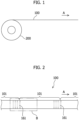
- the label 100 is provided in a shape of a roll 200 in which the label 100 is wound continuously into a roll shape.
- the label 100 is extracted from the roll 200 in a direction of arrow A and used.
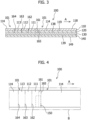
- a plurality of label pieces 101 are formed so as to continue in the direction of arrow A.
- One label piece 101 is used for a piece of flight baggage to be checked in.
- Both ends of the label piece 101 have a cutoff line 161 corresponding to a perforated line.
- the cutoff line 161 may be omitted and the terminal or the automated baggage drop described above may automatically cut each label piece 101 that is printed and sent.
- FIG. 3 is a cross-sectional view of this label.
- each layer has the same thickness in order to help the understanding of this example, the actual thickness of each layer is different to a large degree, and the thickness is to be determined as appropriate in accordance with a material to be used, for example.
- the label 100 includes a surface base-material layer 110, which constitutes an uppermost layer or an outermost layer, a tackiness agent layer 120, a glassine paper layer 130, and a pressure-sensitive adhesive layer 140 in this order.
- the surface base-material layer 110 includes a resin layer formed of polyethylene terephthalate (PET), polypropylene (PP), or the like, and high-quality paper that is attached onto the resin layer.
- This surface base-material layer 110 has a thickness of about 70 ⁇ m to 120 ⁇ m (DIN 53370) and preferably 80 ⁇ m to 110 ⁇ m, and has a weight of preferably 60 g/m 2 to 120 g/m 2 (DIN 53352).
- the resin is PET
- the surface base-material layer 110 can be formed in such a manner that a sheet of thin high-quality paper on which a heat-sensitive coloring dye or a heat-sensitive coloring agent used for printing is applied is attached to the resin so as to be integrated.
- a pigment coating layer can be provided on the resin layer and the heat-sensitive coloring dye can be applied thereon (in the case of PP).
- the heat-sensitive coloring dye for example, a leuco dye-based substance including a leuco dye and a color developing agent is suitably used. Although the color is not limited, black may be preferred in general.
- an anti-stick agent can be applied on the heat-sensitive coloring dye of the surface base-material layer 110.
- the anti-stick agent for example, polyamide, amide, amide wax, montane wax, ester wax, or other wax can be suitably used.
- the tackiness agent layer 120 is provided between a bottom surface 119 of the surface base-material layer 110 and an upper surface 138 of the glassine paper layer 130. While the tackiness agent layer 120 adheres to the surface base-material layer 110 relatively firmly, the tackiness agent layer 120 sticks to the glassine paper layer 130 in a peelable manner.
- a tackiness agent used for the tackiness agent layer 120 has a characteristic of being able to adhere to a target attachment surface with small pressure because of being viscous and having semi-solid character, and stable uniform adhesive power can be instantaneously obtained when used.
- An acrylic-based adhesive, a urethane adhesive, or a water-soluble adhesive is suitably used for this tackiness agent.
- the water-soluble adhesive for example, acrylic-based, natural rubber latex-based, synthetic rubber latex-based, and other agents, in which emulsified resin is diffused in water, are suitably used.
- the initial tackiness of this tackiness agent is preferably 13 N/in to 17 N/in (FTM#9 stainless steel) (1 in is equal to 2.54 cm).
- the attachment surfaces to be considered include surfaces of cardboard, vinyl packaging materials, suitcases, and the like.
- the term "adhesion” or “bonding” in this specification means the phenomenon that occurs based on a force that operates when two objects are brought into contact with each other to make molecules attract each other, and by this phenomenon, the objects are bonded to each other.
- the term "tackiness” can be regarded as one kind of adhesion but also as having peelable character.
- the glassine paper layer 130 is made up of or consists of glassine paper.
- the glassine paper uses sulfite pulp that is finely beaten as an ingredient, and is normally manufactured by the high-pressure processing of the sulfite pulp using rollers with smooth surface called “super calender.” In this process, the fiber of the pulp is compressed and flattened, so that internal spacings are nearly lost. Accordingly, the surface becomes smooth and glossy, and has oil and water resistance.
- This glassine paper may be white glassine paper with a thickness of 50 ⁇ m to 90 ⁇ m, preferably 60 ⁇ m to 80 ⁇ m (ISO 534), and a weight of 60 g/m 2 to 90 g/m 2 (ISO 536).
- the tackiness agent used for the aforementioned tackiness agent layer 120 is selected so as to stick relatively strongly to the surface base-material layer 110 formed of the resin layer, and to peel easily from the glassine paper layer 130. Also, it should stick to or adhere to the surface of cardboards or suitcases with sufficient strength. Once the glassine paper layer 130 is removed, this tackiness agent layer 120 sticks to the surface of the cardboard or a suitcase with the sufficient strength; thus, the label piece 101 can be directly attached to the surfaces of cardboard boxes, baggage packaged with vinyl, or suitcases that do not have handles. Since the glassine paper layer 130 itself can easily peel from the tackiness agent layer 120, it is unnecessary to additionally provide a plastic layer or the like that constitutes a peeling layer between the glassine paper layer 130 and the tackiness agent layer 120.
- a pressure-sensitive adhesive (also referred to as adhesive) of the pressure-sensitive adhesive layer 140 refers to an adhesive that adheres immediately upon application of pressure at room temperature, and that is not cured but has the stickiness or cohesiveness causing adhesion and retention.
- a pressure-sensitive adhesive having a self-adhering property which is observed in natural rubber, may be selected to firmly adhere to another pressure-sensitive adhesive and not to easily adhere to other materials.
- the pressure-sensitive adhesives (application surfaces thereof), which are often called “adhere” or “cold-seal type"
- the pressure-sensitive adhesive layer 140 may be provided all over a lower surface 139 of the glassine paper layer 130.
- the pressure-sensitive adhesive layers 140 When the pressure-sensitive adhesive layers 140 are pressed to each other, its application surfaces will adhere to each other firmly and will not peel even from the glassine paper layer 130. Therefore, when a passenger or a ground staff member loops the label piece 101 through a handle of a suitcase, for example, and attaches both ends of the label piece 101 together so that the pressure-sensitive adhesive layers 140 are overlapped on each other, the label piece 101 will not easily separate from the handle.
- the pressure-sensitive adhesive layers 140 adhere to each other strongly when pressed by fingers, the pressure-sensitive adhesive layer 140 does not easily adhere to hands, clothing, paper, or other materials.
- the pressure-sensitive adhesive layer 140 does not adhere to an upper surface 118 of the surface base-material layer 110 either and is loosely bonded to the upper surface 118 because of its viscosity. Therefore, if the label 100 is wound into a roll shape as the roll 200 (see FIG. 1 ), the pressure-sensitive adhesive layer 140 is also bonded suitably to, or simply overlaps with, the upper surface 118 of the heat-sensitive coloring paper layer 110 on an inner side of the previous turn but can be easily separated.
- the pressure-sensitive adhesive layer 140 may preferably be provided entirely in a length direction and a lateral direction of the label piece 101, but it may also be provided partially.
- an adhesive containing about 40% of a natural rubber-based material for example, natural rubber latex
- about 5% of silica for example, silica
- about 50% of water before drying
- the viscosity should preferably be high (for example, 1000 to 4000 mPa ⁇ s, B type, 6 rpm).
- the glassine paper can be coated with this adhesive by a roll coater, a knife coater, or the like and dried at about 60°C. After drying, the pressure-sensitive adhesive adheres strongly to the glassine paper but does not easily adhere to other objects to which the pressure-sensitive adhesive is not applied or to surfaces of paper, clothing, hands, suitcases, or the like.
- the label piece 101 according to this embodiment is configured as a linerless label without peeling paper. Therefore, it is unnecessary to dispose trash that is generated when the peeling paper is peeled to expose the tackiness agent. This is very advantageous when a passenger checks in baggage by himself/herself. While the pressure-sensitive adhesive layer 140 does not easily adhere to hands, clothing, paper, or the like, the passenger can securely attach a baggage tag to his/her suitcase or the like by himself/herself by having the pressure-sensitive adhesive layers 140 adhere to each other as the tag is placed around the handle of the baggage, for example.
- the label piece 101 can be directly attached to the surface of the suitcase that does not have a handle or the cardboard box with this tackiness agent layer 120. This enables the passenger to attach the label piece 101 by him or herself, the handling becomes easy for both the passengers and the ground staff. In some cases of the existing labels for flight baggage, it has been necessary to prepare other label pieces for the cardboard or only the ground staffs can attach the label piece.
- the cutoff line 161 is provided between the label pieces 101.
- the cutoff line 161 is a perforated line provided ranging from the upper surface 118 of the surface base-material layer 110 to the pressure-sensitive adhesive layer 140. By cutting the label 100 along the cutoff line 161, the plurality of label pieces 101 are formed.
- a cutting mark 150 representing the position of the cutoff line 161 can be printed in advance on the lower surface 139 of the glassine paper layer 130. This is a bar-shaped mark printed in black, grey, or the like on the label piece 101 entirely or partially in the width direction.
- the cutting mark 150 can be provided so that the cutoff line 161 comes to a position inside this cutting mark 150 or a position along the cutting mark 150 in the direction of arrow A where the label 100 is extracted from the roll 200.
- the cutting mark 150 can be used when the automated baggage drop detects a cutting position of the label 100. Even if there is print on the front surface 118 of the label piece 101, the cutting mark 150 is easily detectable from the back surface side.
- the cutoff line 161 may be omitted and the terminal or the automated baggage drop machine may cut the label 100 with a cutter at the cutting mark 150.
- the surface base-material layer 110 of the label piece 101 can be formed so as to be separated into small pieces (stubs) 111, 112, and 113, and a main piece 114 in this order when viewed from the direction of arrow A.
- the small piece 111 exists between the cutoff line 161 and a separation line 162
- the small piece 112 exists between the separation line 162 and a separation line 163
- the small piece 113 exists between the separation line 163 and a separation line 164
- the main piece 114 exists between the separation line 164 and the next cutoff line 161.
- the number of small pieces is three here, this is arbitrarily chosen. It is possible to omit the small pieces altogether or provide one small piece, two small pieces, or four or more small pieces.
- the separation lines 162, 163, and 164 are provided penetrating from the upper surface 118 to the lower surface 119 of the surface base-material layer 110.
- the separation lines 162, 163, and 164 may penetrate to reach the tackiness agent layer 120 but should not penetrate to reach the glassine paper layer 130.
- the small piece 111 and the small piece 112 can be separated from each other by the separation line 162, the small piece 112 and the small piece 113 can be separated from each other by the separation line 163, and the small piece 113 and the main piece 114 of the label piece 101 can be separated from each other by the separation line 164.
- the separation lines 162 to 164 are formed by continuous notches on the outside and fine perforated lines on a central part in the width direction of the label piece 101.
- the small pieces 111 to 113 can keep attached to the main piece 114 while being easily separable by human hands. Even after the label piece 101 is peeled from the glassine paper layer 130 by human hands, the small pieces 111 to 113 are still attached to the main piece 114 in one piece.
- the main piece 114 is in contact with the glassine paper layer 130 in a large area; thus, it is difficult to peel the main piece 114 from the glassine paper layer 130 but peeling is possible.
- the resin of the surface base-material layer 110 is preferably PET. If PP is used, the proper separation along the perforated line may fail.
- a separation line (notch and perforated line) denoted by 165 exists in the vicinity of the cutoff line 161 and on the opposite side to the small piece 111, and is formed in order to make the surface base-material layer 110 easily peel from the glassine paper layer 130.
- the upper surface 118 of the surface base-material layer 110 can be printed using a thermal head (not illustrated). As necessary, surfaces of the main piece 114 and the small pieces 111 to 113 described above can be printed.
- One label piece 101 that is separated along the cutoff line 161 is looped through the handle of the baggage or the like and the pressure-sensitive adhesive layers 140 are made adhere to each other at both ends of the label piece 101 so that the label piece 101 can be attached to the baggage as the baggage tag. Since the passenger can attach the label piece 101 easily by himself/herself, this is very useful for self check-in or for self baggage drop.
- the passenger or the ground staff can peel small pieces 111 to 113, and use small pieces 111 to 113 as passenger copies with a barcode or letters printed thereon or attach small pieces 111 to 113 to another place on the baggage.
- FIG. 6 illustrates another aspect of the separation lines used for forming the small pieces 111 to 113.
- separation lines 166 to 168 in FIG. 6 perforated lines (notches) with the same size are provided entirely in the width direction of the label piece 101; in this point, the separation lines 166 to 168 are different from the aforementioned separation lines 162 to 164.
- Such notches may take a variety of forms.
Landscapes
- Chemical & Material Sciences (AREA)
- Organic Chemistry (AREA)
- Physics & Mathematics (AREA)
- General Physics & Mathematics (AREA)
- Engineering & Computer Science (AREA)
- Theoretical Computer Science (AREA)
- Adhesive Tapes (AREA)
- Laminated Bodies (AREA)
Applications Claiming Priority (2)
| Application Number | Priority Date | Filing Date | Title |
|---|---|---|---|
| JP2021161333 | 2021-09-30 | ||
| PCT/JP2022/033541 WO2023053871A1 (ja) | 2021-09-30 | 2022-09-07 | 航空手荷物用ライナーレスラベル |
Publications (2)
| Publication Number | Publication Date |
|---|---|
| EP4411698A1 true EP4411698A1 (de) | 2024-08-07 |
| EP4411698A4 EP4411698A4 (de) | 2025-10-01 |
Family
ID=85782386
Family Applications (1)
| Application Number | Title | Priority Date | Filing Date |
|---|---|---|---|
| EP22875743.1A Pending EP4411698A4 (de) | 2021-09-30 | 2022-09-07 | Trägerbandloses etikett für fluggepäck |
Country Status (4)
| Country | Link |
|---|---|
| US (1) | US20250197683A1 (de) |
| EP (1) | EP4411698A4 (de) |
| JP (1) | JPWO2023053871A1 (de) |
| WO (1) | WO2023053871A1 (de) |
Families Citing this family (1)
| Publication number | Priority date | Publication date | Assignee | Title |
|---|---|---|---|---|
| DE102023130734A1 (de) * | 2023-11-07 | 2025-05-08 | All4Labels Group GmbH | Verfahren zur Etikettierung von durch Blasform hergestellten Kunststoffflaschen |
Family Cites Families (13)
| Publication number | Priority date | Publication date | Assignee | Title |
|---|---|---|---|---|
| US7063265B2 (en) * | 2001-09-03 | 2006-06-20 | Oji Paper Co., Ltd. | Baggage tag and method for using baggage tag |
| CN102666092B (zh) * | 2009-12-23 | 2015-09-30 | 艾利丹尼森公司 | 行李标签和/或生产其的方法 |
| US8881438B2 (en) * | 2012-12-21 | 2014-11-11 | Hitachi Systems, Ltd. | Luggage tag |
| JP2014174523A (ja) * | 2013-03-13 | 2014-09-22 | Sato Holdings Corp | 台紙なしラベル |
| JP2014174522A (ja) * | 2013-03-13 | 2014-09-22 | Sato Holdings Corp | 台紙なしラベル |
| CN203311749U (zh) * | 2013-06-19 | 2013-11-27 | 深圳市骄冠科技实业有限公司 | 一种对粘胶航空行李标签 |
| JP6212325B2 (ja) * | 2013-08-16 | 2017-10-11 | トッパン・フォームズ株式会社 | 航空手荷物用タグ |
| JP6683507B2 (ja) * | 2015-07-22 | 2020-04-22 | サトーホールディングス株式会社 | ラベルを用いた加工物の生産を管理する方法 |
| CN205230493U (zh) * | 2015-12-14 | 2016-05-11 | 深圳市骄冠科技实业有限公司 | 一种两层纸膜的对粘胶行李标签 |
| JP6792442B2 (ja) * | 2015-12-22 | 2020-11-25 | 全日本空輸株式会社 | 手荷物タグロール及び手荷物タグ |
| JP2018169532A (ja) * | 2017-03-30 | 2018-11-01 | リンテック株式会社 | 擬似接着ラベル |
| JP6933049B2 (ja) * | 2017-08-22 | 2021-09-08 | 大日本印刷株式会社 | 積層シートおよび手荷物用タグ |
| JP3231867U (ja) * | 2021-02-18 | 2021-05-06 | 大阪シーリング印刷株式会社 | 粘着シート |
-
2022
- 2022-09-07 JP JP2023550502A patent/JPWO2023053871A1/ja active Pending
- 2022-09-07 WO PCT/JP2022/033541 patent/WO2023053871A1/ja not_active Ceased
- 2022-09-07 EP EP22875743.1A patent/EP4411698A4/de active Pending
- 2022-09-07 US US18/696,520 patent/US20250197683A1/en active Pending
Also Published As
| Publication number | Publication date |
|---|---|
| WO2023053871A1 (ja) | 2023-04-06 |
| JPWO2023053871A1 (de) | 2023-04-06 |
| EP4411698A4 (de) | 2025-10-01 |
| US20250197683A1 (en) | 2025-06-19 |
Similar Documents
| Publication | Publication Date | Title |
|---|---|---|
| US11651708B1 (en) | Combination wristband and label form | |
| US10249221B2 (en) | Combination wristband and label form | |
| US6016618A (en) | Laminated article | |
| AU669024B2 (en) | ID cards for impact and non-impact printers | |
| US20070212509A1 (en) | Adhesive cutout | |
| US10217385B2 (en) | Dual-faced labelling systems | |
| HUT76651A (en) | Self-adhesive stamps | |
| AU5828599A (en) | Bag laminate with a removable sticker portion | |
| US10311758B2 (en) | Self laminating wristband | |
| US6541090B2 (en) | Resealable label having laminate cover | |
| EP0600622A1 (de) | Trägerfreier thermisch bedruckbaren Gepäckanhänger | |
| EP4411698A1 (de) | Trägerbandloses etikett für fluggepäck | |
| JP2018513045A (ja) | 接着されたリストバンドを有するシート状医療用物品 | |
| WO1998045125A1 (en) | Composite business form for use as a tag and label | |
| US6349974B1 (en) | Hanger label | |
| US20090197032A1 (en) | Multi-layer sheet and method of manufacturing same | |
| US20160365011A1 (en) | Combination wristband and label form | |
| CA2067115C (en) | Labels and manufacture thereof | |
| JP6599683B2 (ja) | 筒状ラベル、及び筒状ラベル付き容器 | |
| KR102184126B1 (ko) | 절개라인이 형성된 레이어드 커버 시트 시스템 | |
| EP3570265B1 (de) | Etikett für ein gepäckstück und eine etikettenbahn, etikettenrolle und eine anordnung zur bereitstellung von etiketten | |
| CN209962573U (zh) | 一种标签纸带 | |
| CN102666092B (zh) | 行李标签和/或生产其的方法 | |
| EP2509058A2 (de) | Verbesserungen bei Etiketten und Mittel zu deren Herstellung | |
| EP0100658A2 (de) | Etikettierbänder |
Legal Events
| Date | Code | Title | Description |
|---|---|---|---|
| STAA | Information on the status of an ep patent application or granted ep patent |
Free format text: STATUS: THE INTERNATIONAL PUBLICATION HAS BEEN MADE |
|
| PUAI | Public reference made under article 153(3) epc to a published international application that has entered the european phase |
Free format text: ORIGINAL CODE: 0009012 |
|
| STAA | Information on the status of an ep patent application or granted ep patent |
Free format text: STATUS: REQUEST FOR EXAMINATION WAS MADE |
|
| 17P | Request for examination filed |
Effective date: 20240307 |
|
| AK | Designated contracting states |
Kind code of ref document: A1 Designated state(s): AL AT BE BG CH CY CZ DE DK EE ES FI FR GB GR HR HU IE IS IT LI LT LU LV MC MK MT NL NO PL PT RO RS SE SI SK SM TR |
|
| DAV | Request for validation of the european patent (deleted) | ||
| DAX | Request for extension of the european patent (deleted) | ||
| REG | Reference to a national code |
Ref country code: DE Ref legal event code: R079 Free format text: PREVIOUS MAIN CLASS: G09F0003020000 Ipc: G09F0003100000 |
|
| A4 | Supplementary search report drawn up and despatched |
Effective date: 20250828 |
|
| RIC1 | Information provided on ipc code assigned before grant |
Ipc: G09F 3/10 20060101AFI20250822BHEP Ipc: G09F 3/02 20060101ALI20250822BHEP Ipc: B32B 27/00 20060101ALI20250822BHEP Ipc: B32B 7/06 20190101ALI20250822BHEP Ipc: B32B 7/12 20060101ALI20250822BHEP Ipc: C09J 7/21 20180101ALI20250822BHEP Ipc: C09J 7/29 20180101ALI20250822BHEP Ipc: C09J 7/38 20180101ALI20250822BHEP Ipc: C09J 201/00 20060101ALI20250822BHEP |