EP4411297A1 - Batteriezellenbrennvorrichtung und steuerungssystem dafür sowie batteriezellenbrennverfahren - Google Patents
Batteriezellenbrennvorrichtung und steuerungssystem dafür sowie batteriezellenbrennverfahren Download PDFInfo
- Publication number
- EP4411297A1 EP4411297A1 EP22891901.5A EP22891901A EP4411297A1 EP 4411297 A1 EP4411297 A1 EP 4411297A1 EP 22891901 A EP22891901 A EP 22891901A EP 4411297 A1 EP4411297 A1 EP 4411297A1
- Authority
- EP
- European Patent Office
- Prior art keywords
- battery cell
- gas
- vacuum
- reaction chamber
- branch
- Prior art date
- Legal status (The legal status is an assumption and is not a legal conclusion. Google has not performed a legal analysis and makes no representation as to the accuracy of the status listed.)
- Pending
Links
Images



Classifications
-
- H—ELECTRICITY
- H01—ELECTRIC ELEMENTS
- H01M—PROCESSES OR MEANS, e.g. BATTERIES, FOR THE DIRECT CONVERSION OF CHEMICAL ENERGY INTO ELECTRICAL ENERGY
- H01M10/00—Secondary cells; Manufacture thereof
- H01M10/05—Accumulators with non-aqueous electrolyte
- H01M10/058—Construction or manufacture
-
- F—MECHANICAL ENGINEERING; LIGHTING; HEATING; WEAPONS; BLASTING
- F26—DRYING
- F26B—DRYING SOLID MATERIALS OR OBJECTS BY REMOVING LIQUID THEREFROM
- F26B21/00—Arrangements for supplying or controlling air or other gases for drying solid materials or objects
- F26B21/30—Controlling, e.g. regulating, parameters of gas supply
- F26B21/35—Temperature; Pressure
-
- F—MECHANICAL ENGINEERING; LIGHTING; HEATING; WEAPONS; BLASTING
- F26—DRYING
- F26B—DRYING SOLID MATERIALS OR OBJECTS BY REMOVING LIQUID THEREFROM
- F26B21/00—Arrangements for supplying or controlling air or other gases for drying solid materials or objects
- F26B21/40—Arrangements for supplying or controlling air or other gases for drying solid materials or objects using gases other than air
-
- F—MECHANICAL ENGINEERING; LIGHTING; HEATING; WEAPONS; BLASTING
- F26—DRYING
- F26B—DRYING SOLID MATERIALS OR OBJECTS BY REMOVING LIQUID THEREFROM
- F26B25/00—Details of general application not covered by group F26B21/00 or F26B23/00
- F26B25/005—Treatment of dryer exhaust gases
-
- F—MECHANICAL ENGINEERING; LIGHTING; HEATING; WEAPONS; BLASTING
- F26—DRYING
- F26B—DRYING SOLID MATERIALS OR OBJECTS BY REMOVING LIQUID THEREFROM
- F26B25/00—Details of general application not covered by group F26B21/00 or F26B23/00
- F26B25/22—Controlling the drying process in dependence on liquid content of solid materials or objects
-
- F—MECHANICAL ENGINEERING; LIGHTING; HEATING; WEAPONS; BLASTING
- F26—DRYING
- F26B—DRYING SOLID MATERIALS OR OBJECTS BY REMOVING LIQUID THEREFROM
- F26B3/00—Drying solid materials or objects by processes involving the application of heat
- F26B3/02—Drying solid materials or objects by processes involving the application of heat by convection, i.e. heat being conveyed from a heat source to the materials or objects to be dried by a gas or vapour, e.g. air
- F26B3/04—Drying solid materials or objects by processes involving the application of heat by convection, i.e. heat being conveyed from a heat source to the materials or objects to be dried by a gas or vapour, e.g. air the gas or vapour circulating over or surrounding the materials or objects to be dried
-
- F—MECHANICAL ENGINEERING; LIGHTING; HEATING; WEAPONS; BLASTING
- F26—DRYING
- F26B—DRYING SOLID MATERIALS OR OBJECTS BY REMOVING LIQUID THEREFROM
- F26B5/00—Drying solid materials or objects by processes not involving the application of heat
- F26B5/04—Drying solid materials or objects by processes not involving the application of heat by evaporation or sublimation of moisture under reduced pressure, e.g. in a vacuum
-
- F—MECHANICAL ENGINEERING; LIGHTING; HEATING; WEAPONS; BLASTING
- F26—DRYING
- F26B—DRYING SOLID MATERIALS OR OBJECTS BY REMOVING LIQUID THEREFROM
- F26B9/00—Machines or apparatus for drying solid materials or objects at rest or with only local agitation; Domestic airing cupboards
- F26B9/06—Machines or apparatus for drying solid materials or objects at rest or with only local agitation; Domestic airing cupboards in stationary drums or chambers
-
- H—ELECTRICITY
- H01—ELECTRIC ELEMENTS
- H01M—PROCESSES OR MEANS, e.g. BATTERIES, FOR THE DIRECT CONVERSION OF CHEMICAL ENERGY INTO ELECTRICAL ENERGY
- H01M4/00—Electrodes
- H01M4/02—Electrodes composed of, or comprising, active material
- H01M4/04—Processes of manufacture in general
- H01M4/0471—Processes of manufacture in general involving thermal treatment, e.g. firing, sintering, backing particulate active material, thermal decomposition, pyrolysis
-
- Y—GENERAL TAGGING OF NEW TECHNOLOGICAL DEVELOPMENTS; GENERAL TAGGING OF CROSS-SECTIONAL TECHNOLOGIES SPANNING OVER SEVERAL SECTIONS OF THE IPC; TECHNICAL SUBJECTS COVERED BY FORMER USPC CROSS-REFERENCE ART COLLECTIONS [XRACs] AND DIGESTS
- Y02—TECHNOLOGIES OR APPLICATIONS FOR MITIGATION OR ADAPTATION AGAINST CLIMATE CHANGE
- Y02E—REDUCTION OF GREENHOUSE GAS [GHG] EMISSIONS, RELATED TO ENERGY GENERATION, TRANSMISSION OR DISTRIBUTION
- Y02E60/00—Enabling technologies; Technologies with a potential or indirect contribution to GHG emissions mitigation
- Y02E60/10—Energy storage using batteries
-
- Y—GENERAL TAGGING OF NEW TECHNOLOGICAL DEVELOPMENTS; GENERAL TAGGING OF CROSS-SECTIONAL TECHNOLOGIES SPANNING OVER SEVERAL SECTIONS OF THE IPC; TECHNICAL SUBJECTS COVERED BY FORMER USPC CROSS-REFERENCE ART COLLECTIONS [XRACs] AND DIGESTS
- Y02—TECHNOLOGIES OR APPLICATIONS FOR MITIGATION OR ADAPTATION AGAINST CLIMATE CHANGE
- Y02P—CLIMATE CHANGE MITIGATION TECHNOLOGIES IN THE PRODUCTION OR PROCESSING OF GOODS
- Y02P70/00—Climate change mitigation technologies in the production process for final industrial or consumer products
- Y02P70/50—Manufacturing or production processes characterised by the final manufactured product
Definitions
- This application relates to the field of battery technologies and particularly to a battery cell baking apparatus, a control system thereof, and a battery cell baking process.
- the current method used is to bake the battery cells.
- the introduced ambient temperature protective gas comes into contact with the high-temperature battery cells, the water molecules carried by the gas will adhere to the interior of the battery cells, affecting the water removal effect of the battery cells.
- this application provides a battery cell baking apparatus, including:
- the provision of the first branch and the second branch enables gas to be heated and pressure-regulated while the battery cell is placed in the reaction chamber for preheating, so that gas that has not reached a target value is discharged from the vacuum breaking pipeline through the first branch, and when the gas reaches the target value, it is introduced into the reaction chamber through the second branch.
- This allows the battery cell to respire in a high-temperature and high-pressure gas environment, thereby removing moisture and improving moisture removal efficiency of the battery cell.
- the first branch is equipped with an exhaust duct and a first baffle valve, where one end of the exhaust duct is connected to the vacuum breaking pipeline through the first baffle valve and the other end thereof is connected to the external environment, and the first baffle valve is configured to control opening and closing of the first branch.
- gas is treated in a plant exhaust gas treatment apparatus before being discharged into the atmosphere, thereby reducing environmental pollution.
- the second branch is equipped with a second baffle valve, and the second baffle valve is configured to control opening and closing of the second branch.
- the heating and pressure regulating component includes a hot air gun and a pressure regulating valve, the hot air gun being connected to an external gas source, and the pressure regulating valve being positioned between the hot air gun and the vacuum breaking pipeline.
- the external gas source supplies gas to the hot air gun, and the hot air gun heats the gas.
- the heated gas then passes through the pressure regulating valve for a pressure regulation, so that the gas reaches a target temperature and pressure.
- the heating and pressure regulating component includes a filter, the filter being positioned between the external gas source and the hot air gun.
- the filter filters the gas that enters the hot air gun for heating, removing impurities from the gas to ensure that the gas entering the reaction chamber is clean and free of impurities.
- the heating and pressure regulating component includes a flow meter, and the flow meter is positioned between the external gas source and the hot air gun to monitor gas flow.
- this application provides a control system for monitoring gas heating status inside the foregoing battery cell baking apparatus.
- the control system includes:
- control system can simultaneously detect temperature abnormality and signal abnormality, allowing for more precise control of temperature of the gas entering the reaction chamber, thus ensuring normal operation of the battery cell baking apparatus from multiple aspects.
- control module includes a first controller
- detection module includes a first detector, the first detector being positioned at the gas outlet of the heating and pressure regulating component and communicatively connected to the first controller.
- control module includes a second controller
- detection module includes a second detector, the second detector being positioned at the gas outlet of the heating and pressure regulating component and communicatively connected to the second controller; where the first controller is communicatively connected to the second controller, and the first controller is configured to receive a detection result transmitted by the second controller and issue an instruction.
- the first controller and the second controller can communicate and compare the detection result in real-time, achieving a dual-redundancy design and improving safety of the control system.
- this application provides a battery cell baking process using the foregoing battery cell baking apparatus.
- the battery cell baking process includes steps of:
- a vacuum lower limit for vacuuming is 50 Pa.
- the protective gas is a gas heated to a target temperature and regulated to a target pressure by the heating and pressure regulating component.
- the target temperature ranges from 80°C to 120°C.
- the target temperature is 90°C.
- the target pressure ranges from 0.2 MPa to 0.6 MPa.
- the target pressure ranges from 0.2 MPa to 0.3 MPa.
- the vacuum breaking pipeline is divided into the first branch and the second branch that are independent of each other.
- the gas is heated and pressure-regulated by the heating and pressure regulating component.
- the first branch is configured to discharge gas that does not meet the standard, and once the gas meets the standard, the second branch is quickly switched on to introduce the gas into the reaction chamber. This avoids the problem of low moisture removal efficiency of the battery cell caused by battery cell aspiration in a gas environment of ambient temperature and pressure, thereby accelerating moisture removal of the battery cell.
- 100 battery cell baking apparatus; 200, control system; 10, battery; 20, reaction furnace; 30, heating and pressure regulating component; 40, vacuum breaking pipeline; 50, control module; 60, detection module; 70, collection module; 11, box; 12, battery cell; 21, reaction chamber; 31, hot air gun; 32, pressure regulating valve; 33, filter; 34, flow meter; 41, first branch; 42, second branch; 51, first controller; 52, second controller; 61, first detector; 62, second detector; 111, first part; 112, second part; 121, end cap; 122, housing; 123, electrode assembly; 411, exhaust duct; 412, first baffle valve; 413, plant exhaust gas treatment apparatus; 421, second baffle valve; 121a, electrode terminal.
- the term "and/or" is only an associative relationship for describing associated objects, indicating that three relationships may be present.
- a and/or B may indicate the following three cases: presence of only A, presence of both A and B, and presence of only B.
- the character "/" in this specification generally indicates an "or" relationship between contextually associated objects.
- a plurality of means more than two (inclusive).
- a plurality of groups means more than two (inclusive) groups
- a plurality of pieces means more than two (inclusive) pieces.
- the terms “mount”, “connect”, “join”, and “fasten” should be understood in their general senses. For example, they may refer to a fixed connection, a detachable connection, or an integral connection, may refer to a mechanical connection or electrical connection, and may refer to a direct connection, an indirect connection via an intermediate medium, or an interaction between two elements. Persons of ordinary skill in the art can understand specific meanings of these terms in this application as appropriate to specific situations.
- lithium-ion batteries are widely used in electric vehicles and consumer electronics due to their advantages of high energy density, high power output, long cycle life, and low environmental pollution. With the continuous expansion of application fields of lithium-ion batteries, market demands for them are also constantly increasing.
- a production process of lithium-ion batteries generally includes the following steps: the first step is electrode slurry preparation, which mainly involves mixing together an electrode active material, a binder, a solvent, and the like, and after sufficient stirring and dispersion, forming a slurry; the second step is coating, which involves uniformly coating a current collector (such as aluminum foil or copper foil) with the slurry prepared in the previous step in a specified thickness, followed by drying of the solvent; the third step is electrode plate cutting, which involves cutting an electrode plate prepared in the previous step into a specified size and shape; the fourth step is stacking, which involves assembling a positive electrode plate, a negative electrode plate, and a separator together, and after applying an adhesive, forming a jelly roll; the fifth step is battery assembly, which involves placing the jelly roll produced in a previous step into a housing and completing top sealing, side sealing, and the like (with a port reserved for electrolyte injection), forming a battery without electrolyte injected; the sixth step is electrolyte injection,
- vacuum baking which involves vacuuming a baking reaction furnace during a baking process to lower the boiling point of water, and then introducing a dry gas (usually nitrogen) to replace gas inside the reaction furnace, thereby removing the water molecules.
- the applicant has observed that, because the battery cell has been preheated to a high temperature in the reaction furnace, when an ambient-temperature dry gas is introduced into the vacuum reaction furnace and the ambient-temperature dry gas comes into contact with the high-temperature battery cell inside the furnace, the water molecules carried by the gas will adhere to the interior of the battery cell, resulting in an increase rather than a decrease of water molecules inside the battery cell, which affects the moisture removal effect of the battery cell.
- the applicant in order to improve the moisture removal efficiency during a battery cell baking process and accelerate moisture removal of the battery cell, the applicant has conducted in-depth research and designed a battery cell baking apparatus that allows the battery cell to respire in a high-temperature and high-pressure gas environment, thereby improving moisture removal efficiency of the battery cell.
- the gas is heated and pressure-regulated by a heating and pressure regulating component, and then the gas heated to a target temperature and regulated to a target pressure is introduced into the reaction chamber where the battery cell is placed.
- a high-temperature and high-pressure gas entering the reaction chamber when coming into contact with the high-temperature battery cell, will not cause moisture in the gas to adhere to the battery cell, thereby improving the moisture removal effect during the battery cell baking.
- the battery cell disclosed in the embodiments of this application can be used without limitation in electric apparatuses such as vehicles, ships, or aircrafts.
- a battery cell is the most basic element of a battery, and a plurality of battery cells are arranged and sealed in a box to form a battery, which serves as a power supply for various electric apparatuses.
- Such electric apparatuses can include, but are not limited to, mobile phones, tablets, laptops, electric toys, electric tools, electric bicycles, electric vehicles, ships, and spacecrafts.
- FIG. 1 is an exploded view of a battery 10 provided in some embodiments of this application.
- the battery 10 includes a box 11 and a battery cell 12, the battery cell 12 being accommodated within the box 11.
- the box 11 provides a space for accommodating the battery cell 12 and the box 11 may have various structures.
- the box 11 may include a first part 111 and a second part 112, the first part 111 and the second part 112 being mutually engaged and the first part 111 and the second part 112 together defining the space for accommodating the battery cell 12.
- the second part 112 may be a hollow structure with one end open, and the first part 111 may be a plate-like structure, the first part 111 being engaged with the open side of the second part 112, so that the first part 111 and the second part 112 together defining the accommodating space.
- the first part 111 and the second part 112 may alternatively be both hollow structures with one side open, the open side of the first part 111 being engaged with the open side of the second part 112.
- the box 11 formed by the first part 111 and the second part 112 may be in various shapes, such as a cylinder or a cuboid.
- the battery 10 there may be a plurality of battery cells 12, the plurality of battery cells 12 may be connected in series, in parallel, or in series-parallel.
- a series-parallel connection means that the plurality of battery cells 12 are connected both in series and in parallel.
- the plurality of battery cells 12 may be directly connected in series, in parallel, or in series-parallel, and then a complete unit formed by the plurality of battery cells 12 is accommodated within the box 11.
- the battery 10 may alternatively be formed by first connecting the plurality of battery cells 12 in series, in parallel, or in series-parallel to form battery modules, and then connecting the battery modules in series, in parallel, or in series-parallel to form a complete unit, which is accommodated within the box 11.
- the battery 10 may also include other structures, for example, the battery 10 may also include a busbar component, which is configured to realize electrical connections between the plurality of battery cells 12.
- Each battery cell 12 may be a secondary battery or a primary battery; it may also be a lithium-sulfur battery, a sodium-ion battery, or a magnesium-ion battery, but is not limited to those.
- the battery cell 12 may be cylindrical, flat, cuboid, or in other shapes.
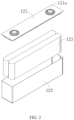
- FIG. 2 is a schematic exploded view of a structure of the battery cell 12 provided in some embodiments of this application.
- the battery cell 12 refers to the smallest unit that constitutes a battery.
- the battery cell 12 includes an end cap 121, a housing 122, an electrode assembly 123, and other functional components.
- the end cap 121 is a component that covers an opening of the housing 122 to isolate an internal environment of the battery cell 12 from an external environment.
- shape of the end cap 121 may be adapted to shape of the housing 122 to match the housing 122.
- the end cap 121 may be made of a material with certain hardness and strength (such as aluminum alloy), so that the end cap 121 is less likely to deform under compression or a collision, enabling the battery cell 12 to have higher structural strength and better safety performance.
- Functional components such as an electrode terminal 121a may be provided on the end cap 121.
- the electrode terminal 121a can be configured to electrically connect to the electrode assembly 123 for outputting or inputting electric energy of the battery cell 12.
- the end cap 121 may also be equipped with a pressure relief mechanism for releasing internal pressure when the internal pressure or temperature of the battery cell 12 reaches a threshold.
- the end cap 121 may also be made of various materials, such as copper, iron, aluminum, stainless steel, aluminum alloy, or plastic, which is not particularly limited in the embodiments of this application.
- an insulating component may be provided on an inner side of the end cap 121, the insulating component being configured to isolate electrical connection components inside the housing 122 from the end cap 121, thereby reducing the risk of a short circuit.
- the insulating component may be made of plastic, rubber, or the like.
- the housing 122 is a component used to cooperate with the end cap 121 to create the internal environment of the battery cell 12, where the internal environment created can be used to accommodate the electrode assembly 123, an electrolyte, and other components.
- the housing 122 and the end cap 121 may be separate components, and an opening may be provided in the housing 122.
- the end cap 121 covers the opening to create the internal environment of the battery cell 12.
- the end cap 121 and the housing 122 may be integrated.
- the end cap 121 and the housing 122 may form a common connecting surface before other components are housed, and when it is necessary to seal the interior of the housing 122, the end cap 121 is placed to cover the housing 122.
- the housing 122 may be in various shapes and sizes, such as cuboid, cylindrical, and hexagonal. Specifically, the shape of the housing 122 may be determined based on a specific shape and size of the electrode assembly 123.
- the housing 122 may be made of various materials, such as copper, iron, aluminum, stainless steel, aluminum alloy, or plastic, which is not particularly limited in the embodiments of this application.
- the electrode assembly 123 is a component where electrochemical reactions occur within the battery cell 12.
- the housing 122 may contain one or more electrode assemblies 123.
- the electrode assembly 123 is mainly composed of a positive electrode plate and a negative electrode plate that are wound or stacked together, and there is usually a separator between the positive electrode plate and the negative electrode plate. Portions of the positive electrode plate and the negative electrode plate that contain an active material constitute a main body of the electrode assembly 123, and portions of the positive electrode plate and the negative electrode plate without the active material each constitute a tab.
- the positive electrode tab and the negative electrode tab may be both positioned at one end of the main body or respectively positioned at opposite ends of the main body.
- the positive electrode active material and the negative electrode active material react with the electrolyte, and the tabs are connected to electrode terminals to form a current loop.
- An embodiment of this application provides a battery cell baking apparatus 100, including a reaction furnace 20, a heating and pressure regulating component 30, and a vacuum breaking pipeline 40 connecting the two.
- the reaction furnace 20 includes a reaction chamber 21 configured for placing and baking the battery cell.
- the heating and pressure regulating component 30 is configured to heat and regulate pressure of gas entering the reaction chamber 21.
- the vacuum breaking pipeline 40 includes a first branch 41 and a second branch 42 that are independent of each other. Specifically, the first branch 41 is connected between the heating and pressure regulating component 30 and the external environment to discharge residual waste gas, and the second branch 42 is connected between the heating and pressure regulating component 30 and the reaction chamber 21 to introduce heated and pressure-regulated gas into the reaction chamber 21.
- the vacuum breaking pipeline 40 is provided with an inlet, a first outlet, and a second outlet.
- the inlet is connected to the heating and pressure regulating component 30, the first outlet is connected to the external environment, and the second outlet is connected to the reaction chamber 21.
- the first branch 41 is formed between the inlet and the first outlet, and the second branch 42 is formed between the inlet and the second outlet.
- the battery cell is first placed in the reaction chamber 21 for preheating and baking.
- gas flows between the heating and pressure regulating component 30 and the vacuum breaking pipeline 40 and is heated and pressure-regulated.
- the inlet and the first outlet are opened while the second outlet is closed, and the gas is discharged from the vacuum breaking pipeline 40 through the first branch 41.
- the residual waste gas in the vacuum breaking pipeline 40 can also be discharged.
- the inlet and the second outlet are opened while the first outlet is closed, and the gas is introduced into the reaction chamber 21 through the second branch 42, allowing the battery cell to respire in a high-temperature and high-pressure gas environment, thereby removing moisture and significantly improving moisture removal efficiency of the battery cell.
- the first branch 41 is equipped with an exhaust duct 411 and a first baffle valve 412.
- One end of the exhaust duct 411 is connected to the vacuum breaking pipeline 40 through the first baffle valve 412 and the other end thereof is connected to the external environment, and the first baffle valve 412 is configured to control opening and closing of the first branch 41.
- one end of the exhaust duct 411 is connected to the vacuum breaking pipeline 40 through the first baffle valve 412, and the other end thereof is connected to a plant exhaust gas treatment apparatus 413.
- the first baffle valve 412 is positioned between the first outlet and the exhaust duct 411. When gas temperature or pressure has not reached the target value, the first baffle valve 412 is opened, and the gas in the vacuum breaking pipeline 41 is drawn out to the plant exhaust gas treatment apparatus 413 through the exhaust duct 411. The gas is treated in the plant exhaust gas treatment apparatus 413 before being discharged into the atmosphere, thereby reducing environmental pollution.
- the second branch 42 is equipped with a second baffle valve 421, the second baffle valve 421 being configured to control opening and closing of the second branch 42.
- the second baffle valve 421 is positioned between the second outlet and the reaction chamber 21.
- the second baffle valve 421 is opened to allow the gas to enter the reaction chamber 21.
- gas flow into the reaction chamber 21 can be flexibly controlled to ensure stability of the gas environment inside the reaction chamber 21.
- the reaction furnace 20 may include a plurality of independent reaction chambers 21, thereby allowing separate baking of a plurality of battery cells.
- each reaction chamber 21 is equipped with a second baffle valve 421 to independently control the gas environment inside each reaction chamber 21. This allows for simultaneous baking of the plurality of battery cells and ensures precise control of the gas environment inside each reaction chamber 21, making the battery cell baking process safer and more reliable.
- the heating and pressure regulating component 30 includes a hot air gun 31 and a pressure regulating valve 32.
- the hot air gun 31 is connected to an external gas source, and the pressure regulating valve 32 is positioned between the hot air gun 31 and the vacuum breaking pipeline 40.
- the external gas source supplies gas to the hot air gun 31, and the hot air gun 31 heats the gas.
- the heated gas then passes through the pressure regulating valve 32 for a pressure regulation, so that the gas reaches a target temperature and pressure.
- the heating and pressure regulating component 30 includes a filter 33, and the filter 33 is positioned between the external gas source and the hot air gun 31.
- the filter 33 filters the gas that enters the hot air gun 31 for heating, removing impurities from the gas to ensure that the gas entering the reaction chamber 21 is clean and free of the impurities.
- the heating and pressure regulating component 30 includes a flow meter 34, and the flow meter 34 is positioned between the external gas source and the hot air gun 31 to monitor the gas flow.
- the gas flow monitored in real-time it is possible to determine whether gas delivery in the battery cell baking apparatus 100 is normal.
- the gas flow entering the vacuum breaking pipeline 40 is abnormal, it will inevitably affect the gas entering the reaction chamber 21, thereby affecting the battery cell baking process. Therefore, by setting the flow meter 34, the battery cell baking process can be quickly reflected, ensuring normal operation of the battery cell baking apparatus 100.
- this application also provides a control system 200 for monitoring gas heating status inside the foregoing battery cell baking apparatus 100, including a control module 50, a detection module 60, and a collection module 70, which are communicatively connected.
- the detection module 60 is positioned at a gas outlet of the heating and pressure regulating component 30 and communicatively connected to the control module 50 to detect gas temperature at the gas outlet and transmit the gas temperature to the control module 50.
- the collection module 70 is communicatively connected to both the control module 50 and the detection module 60 to monitor signal transmission status of the control system 200 and transmit the signal transmission status to the control module 50.
- the control module is configured to generate an alarm instruction when the gas temperature and/or the signal transmission status of the control system is abnormal.
- the control system 200 monitors the battery cell baking apparatus 100 in real-time.
- the detection module 60 is positioned at the gas outlet of the hot air gun 31 to detect temperature of the heated gas, ensuring that gas temperature reaches the target value and remains stable.
- the collection module 70 monitors the signal transmission status between modules within the control system 200, ensuring normal transmission between the modules, and transmits the monitoring result to the control module 50 for handling.
- control module 50 When the control module 50 receives a signal indicating abnormal gas temperature, such as a gas temperature significantly exceeding a specified value, a gas temperature significantly lower than the specified value, or abnormal gas temperature fluctuation, or when the control module 50 receives a signal indicating abnormal signal transmission, such as a network communication alarm, a contactor on-off abnormality alarm, a solid-state on-off abnormality alarm, the control module issues an alarm signal or directly sends an instruction to disconnect the abnormal circuit.
- a signal indicating abnormal gas temperature such as a gas temperature significantly exceeding a specified value, a gas temperature significantly lower than the specified value, or abnormal gas temperature fluctuation
- a signal indicating abnormal signal transmission such as a network communication alarm, a contactor on-off abnormality alarm, a solid-state on-off abnormality alarm
- the control system 200 includes an alarm module (not shown in the figure), and the alarm module is communicatively connected to the control module 50.
- the detection module 60 detects abnormal gas temperature, such as low temperature, high temperature, abnormal temperature fluctuation, or no change in temperature within one minute
- the collection module 70 transmits an abnormal signal to the control module 50, and the control module 50 conducts handling and sends the signal to the alarm module to trigger an alarm.
- the collection module 70 collects an abnormal signal between the modules, such as communication connection abnormality or system signal on-off abnormality
- the collection module also transmits the abnormal signal to the control module 50, and the control module 50 conducts handling and sends the signal to the alarm module to trigger an alarm.
- control system 200 can simultaneously detect temperature abnormality and signal abnormality, allowing for more precise control of temperature of the gas entering the reaction chamber 21 and ensuring normal operation of the battery cell baking apparatus 100 from multiple aspects.
- control module 50 includes a first controller 51
- detection module 60 includes a first detector 61.
- the first detector 61 is positioned at the gas outlet of the heating and pressure regulating component 30 and is communicatively connected to the first controller 51.
- control module 50 includes a second controller 52
- detection module 60 includes a second detector 62.
- the second detector 62 is positioned at the gas outlet of the heating and pressure regulating component 30 and is communicatively connected to the second controller 52.
- the first controller 51 is communicatively connected to the second controller 52, and the first controller 51 is configured to receive a detection result from the second controller 52 and issue a command accordingly.
- the first controller 51 serves as a primary PLC
- the second controller 52 serves as a secondary PLC.
- the primary PLC and the secondary PLC are communicatively connected via Ethernet.
- the first detector 61 and the second detector 62 independently detect gas temperature at the gas outlet of the hot air gun 31 and provide a detection result to the primary PLC and the secondary PLC, respectively.
- the secondary PLC only functions to receive, analyze, and transmit signals, and does not issue instructions. Therefore, after receiving a signal, the secondary PLC analyzes the signal and transmits an analysis result to the primary PLC, and the primary PLC then sends instructions uniformly.
- the primary PLC and the secondary PLC can communicate and compare the detection result in real-time, thereby achieving a dual-redundancy design and improving safety of the control system.
- this application further provides a battery cell baking process for operating the battery cell baking apparatus 100.
- the process includes the following steps.
- Preheating and baking where a preheating and baking time is set to a first preset time and a vacuum holding time to a second preset time, and after the battery cell is placed into the reaction chamber 21 and preheated and baked for a duration of the first preset time, a vacuum is created and held for a duration of the second preset time, then protective gas is introduced into the reaction chamber 21 to break the vacuum to the standard atmospheric pressure, and the reaction chamber 21 is closed.
- the battery cell itself contains a certain amount of water molecules inside before being baked, it is necessary to preheat and bake the battery cell to rapidly evaporate the water molecules inside and reach a relatively stable value before proceeding to further vacuum baking.
- the reaction chamber 21 When the reaction chamber 21 is in a vacuum state, the water molecules inside the battery cell reach equilibrium with the external environment. In this case, the water molecules inside the battery cell remain in a stable state and cannot be released. Therefore, it is necessary to periodically break the vacuum in the reaction chamber 21 to disrupt the equilibrium state and allow the water molecules to be released.
- the first preset time is set to 30 minutes
- the second preset time is set to 1 minute
- a respiration interval of the battery cell is set to 30 minutes.
- the battery cell is placed into the reaction chamber 21 and preheated and baked. During this time, the water molecules inside the battery cell are released into the reaction chamber 21. After preheating and baking for 30 minutes, a vacuum is created and held for 1 minute to remove the water molecules from the reaction chamber 21. During the 1-minute vacuum holding period, the water molecules inside the battery cell remain in the equilibrium state with the vacuum environment of the reaction chamber 21, and therefore the water molecules inside the battery cell cannot be released into the reaction chamber 21. After the 1 minute, the protective gas is introduced into the reaction chamber 21, and the vacuum is broken to the standard atmospheric pressure. During the vacuum breaking process, the equilibrium state inside the reaction chamber 21 is disrupted, allowing the water molecules inside the battery cell to be released into the reaction chamber 21. This completes a complete respiration cycle. After a plurality of such respiration cycles, the moisture content inside the battery cell is measured. Once the moisture content is within a specified range, the preheating and baking step is completed.
- S20 Vacuum baking, where a vacuum holding time is set to a third preset time and a vacuum-breaking holding time to a fourth preset time, and a vacuum is created inside the reaction chamber 21 and held for a duration of the third preset time for vacuum-baking the battery cell, then the protective gas is introduced into the reaction chamber 21 to break the vacuum to the standard atmospheric pressure which is held for a duration of the fourth preset time, and then another vacuum is created.
- the third preset time is set to 30 minutes
- the fourth preset time is set to 1 minute
- the respiration interval of the battery cell is set to 30 minutes.
- a vacuum is created in the reaction chamber 21 and held for 30 minutes and the battery cell is baked under the vacuum.
- the water molecules inside the battery cell evaporate into the reaction chamber 21.
- the battery cell and the vacuum environment of the reaction chamber 21 are in the equilibrium state, and no further water molecules can be evaporated.
- the protective gas is introduced into the reaction chamber 21 to break the vacuum to the standard atmospheric pressure which is held for 1 minute to disrupt the equilibrium state.
- another vacuum is created in the reaction chamber 21 and held for 30 minutes.
- a complete respiration cycle is completed. After a plurality of such respiration cycles, the moisture content inside the battery cell is measured. Once the moisture content reaches a standard value, the vacuum baking step is completed.
- the protective gas is a gas that has been heated to a target temperature and regulated to a target pressure by the heating and pressure regulating component 30. That is, the protective gas is heated to the target temperature by the hot air gun 31 and regulated to the target pressure by the pressure regulating valve 32 before entering the reaction chamber 21. Since the battery cell is already at a high temperature inside the reaction chamber 21, introducing the gas that has been heated by the hot air gun 31 and pressure-regulated by the pressure regulating valve 32 into the reaction chamber 21 can prevent the water molecules carried by the gas from adhering to the interior of the battery cell, thereby improving the moisture removal efficiency.
- a vacuum lower limit for vacuuming is set to 50 Pa
- the target temperature ranges from 80°C to 120°C
- the target pressure ranges from 0.2 MPa to 0.6 MPa.
- the target temperature is 90°C
- the target pressure ranges from 0.2 MPa to 0.3 MPa.
- the battery cell is first placed into the reaction chamber 21 and preheated and baked. After preheating and baking for 30 minutes, the reaction chamber 21 is vacuumed to the vacuum lower limit of 50 Pa which is held for 1 minute. At the same time, the gas is introduced into the battery cell baking apparatus. After passing through the filter 33, the gas is heated by the hot air gun 31, and the heated gas is then pressure-regulated by the pressure regulating valve 32.
- the gas pressure is adjusted to 0.2 MPa to 0.3 MPa.
- the first baffle valve 412 is opened and the second baffle valve 421 is closed.
- the exhaust duct 411 is used to extract gas that has not reached the target temperature into the plant exhaust gas treatment apparatus 413. During this process, the exhaust duct 411 can also extract other remaining gas in the vacuum breaking pipeline 40 into the plant exhaust gas treatment apparatus 413. After being treated by the plant exhaust gas treatment apparatus 413, the gas is discharged into the atmosphere.
- the first baffle valve 412 When the gas temperature reaches 90°C, the first baffle valve 412 is closed and the second baffle valve 421 is opened. The gas is introduced into the reaction chamber 21 to break the vacuum to the standard atmospheric pressure, and then another vacuum is created in the reaction chamber 21. This completes the complete respiration cycle. After a plurality of such respiration cycles, when moisture content inside the battery cell reaches the specified range, the vacuum baking step continues.
- the reaction chamber 21 is first vacuumed to the vacuum lower limit of 50 Pa which is held for 30 minutes. Then the gas whose pressure has been regulated to 0.2 MPa to 0.3 MPa and temperature heated to 90°C is introduced into the reaction chamber 21 to break the vacuum to the standard atmospheric pressure, which is held for 1 minute. Then another vacuuming process follows until the vacuum lower limit of 50 Pa is reached. This completes the complete respiration cycle. After a plurality of such respiration cycles, when the moisture content inside the battery cell reaches the standard value, the entire battery cell baking process is completed.
- the first detector 61 and the second detector 62 independently detect temperature at the gas outlet of the hot air gun 31, and feedback a detection result to the primary PLC and the secondary PLC, respectively.
- the primary PLC and the secondary PLC then compare the data to realize dual-redundancy detection of gas temperature to ensure accuracy of the gas temperature.
- the battery cell baking apparatus 100, the control system 200 thereof, and the battery cell baking process in the foregoing embodiments have at least the following advantages:
Landscapes
- Engineering & Computer Science (AREA)
- Mechanical Engineering (AREA)
- General Engineering & Computer Science (AREA)
- Chemical & Material Sciences (AREA)
- Manufacturing & Machinery (AREA)
- Life Sciences & Earth Sciences (AREA)
- Chemical Kinetics & Catalysis (AREA)
- Electrochemistry (AREA)
- General Chemical & Material Sciences (AREA)
- Microbiology (AREA)
- Health & Medical Sciences (AREA)
- Molecular Biology (AREA)
- Battery Electrode And Active Subsutance (AREA)
- Secondary Cells (AREA)
Applications Claiming Priority (2)
| Application Number | Priority Date | Filing Date | Title |
|---|---|---|---|
| CN202111343340.0A CN115839603B (zh) | 2021-11-13 | 2021-11-13 | 一种电芯烘烤装置及其控制系统、电芯烘烤工艺 |
| PCT/CN2022/129796 WO2023083106A1 (zh) | 2021-11-13 | 2022-11-04 | 一种电芯烘烤装置及其控制系统、电芯烘烤工艺 |
Publications (2)
| Publication Number | Publication Date |
|---|---|
| EP4411297A1 true EP4411297A1 (de) | 2024-08-07 |
| EP4411297A4 EP4411297A4 (de) | 2026-01-14 |
Family
ID=85574601
Family Applications (1)
| Application Number | Title | Priority Date | Filing Date |
|---|---|---|---|
| EP22891901.5A Pending EP4411297A4 (de) | 2021-11-13 | 2022-11-04 | Batteriezellenbrennvorrichtung und steuerungssystem dafür sowie batteriezellenbrennverfahren |
Country Status (3)
| Country | Link |
|---|---|
| EP (1) | EP4411297A4 (de) |
| CN (1) | CN115839603B (de) |
| WO (1) | WO2023083106A1 (de) |
Families Citing this family (3)
| Publication number | Priority date | Publication date | Assignee | Title |
|---|---|---|---|---|
| CN119436748A (zh) * | 2023-07-31 | 2025-02-14 | 宁德时代新能源科技股份有限公司 | 电池烘烤治具、电池烘烤装置及电池生产设备 |
| CN119755926B (zh) * | 2024-12-19 | 2025-10-28 | 深圳市新瑞隆设备有限公司 | 烘烤工件的智能烘烤方法及系统 |
| CN120109266A (zh) * | 2025-05-06 | 2025-06-06 | 浙江晶科储能有限公司 | 二次电池及其制备方法与装置、储能系统、用电设备 |
Family Cites Families (16)
| Publication number | Priority date | Publication date | Assignee | Title |
|---|---|---|---|---|
| JP2010243000A (ja) * | 2009-04-02 | 2010-10-28 | Omc Co Ltd | 真空乾燥機およびこれを用いたワークの乾燥方法 |
| CN104913601A (zh) * | 2014-12-29 | 2015-09-16 | 深圳市信宇人科技有限公司 | 隧道式烘烤锂离子电池或电池极片的方法 |
| CN105115250B (zh) * | 2015-07-27 | 2017-03-29 | 山东精工电子科技有限公司 | 一种锂离子电池电芯快速干燥方法 |
| US10199635B2 (en) * | 2016-09-22 | 2019-02-05 | Grst International Limited | Method of drying electrode assemblies |
| US10254043B2 (en) * | 2016-09-22 | 2019-04-09 | Grst International Limited | Method of drying electrode assemblies |
| CN107425216A (zh) * | 2017-07-26 | 2017-12-01 | 成都特隆美储能技术有限公司 | 一种高效烘烤的电芯及其烘烤方法 |
| CN107741122A (zh) * | 2017-09-13 | 2018-02-27 | 东莞市创明电池技术有限公司 | 锂离子电芯烘烤方法和制备方法 |
| CN207317486U (zh) * | 2017-09-13 | 2018-05-04 | 河北银隆新能源有限公司 | 一种锂离子电池极片的烘烤装置 |
| CN207570211U (zh) * | 2017-11-02 | 2018-07-03 | 东莞市创明电池技术有限公司 | 智能锂离子电池烘箱 |
| CN108375285B (zh) * | 2018-02-10 | 2020-07-31 | 嘉兴晟源工业设计有限公司 | 一种锂离子动力电池干燥装置与干燥方法 |
| CN111238168A (zh) * | 2018-11-29 | 2020-06-05 | 深圳格林德能源集团有限公司 | 一种软包装锂电芯烘烤方法 |
| CN110425825B (zh) * | 2019-07-09 | 2020-09-15 | 惠州市恒泰科技股份有限公司 | 锂离子电池电芯注液前干燥方法 |
| CN110767942A (zh) * | 2019-10-30 | 2020-02-07 | 东莞维科电池有限公司 | 一种电芯烘烤方法及烘烤设备 |
| CN211400523U (zh) * | 2019-11-05 | 2020-09-01 | 东莞市沃泰通新能源有限公司 | 电池电芯真空干燥装置 |
| CN112864463B (zh) * | 2020-12-31 | 2022-05-10 | 合肥国轩高科动力能源有限公司 | 一种方形锂离子电池的快速烘烤方法 |
| CN113488701A (zh) * | 2021-07-07 | 2021-10-08 | 湖北亿纬动力有限公司 | 一种铝壳锂离子电池烘烤方法 |
-
2021
- 2021-11-13 CN CN202111343340.0A patent/CN115839603B/zh active Active
-
2022
- 2022-11-04 EP EP22891901.5A patent/EP4411297A4/de active Pending
- 2022-11-04 WO PCT/CN2022/129796 patent/WO2023083106A1/zh not_active Ceased
Also Published As
| Publication number | Publication date |
|---|---|
| EP4411297A4 (de) | 2026-01-14 |
| CN115839603B (zh) | 2024-10-01 |
| WO2023083106A1 (zh) | 2023-05-19 |
| CN115839603A (zh) | 2023-03-24 |
Similar Documents
| Publication | Publication Date | Title |
|---|---|---|
| EP4411297A1 (de) | Batteriezellenbrennvorrichtung und steuerungssystem dafür sowie batteriezellenbrennverfahren | |
| CN102072620B (zh) | 一种用于电池极片的真空烘箱 | |
| CN223285200U (zh) | 储能装置 | |
| KR20130127578A (ko) | 이차전지 제조용 전극 건조 오븐 자동 급기 유량 제어 장치 | |
| CN209981412U (zh) | 锂离子电池组热失控处理系统 | |
| EP3096373A1 (de) | Lithiumakkumulator mit flüssigem elektrolyt und verfahren zur herstellung davon | |
| US20240313290A1 (en) | Safety control mechanism and method, battery system, and electrical apparatus | |
| CN110212215A (zh) | 一种固体氧化物燃料电池的气路结构及其调整方法 | |
| WO2025043980A1 (zh) | 储能装置及其气体浓度的检测方法 | |
| CN218334178U (zh) | 用于锂电池的泄压阀、锂电池和用电设备 | |
| CN107768777B (zh) | 一种带有气压调节系统的金属空气电池 | |
| CN209088022U (zh) | 锂离子电池组热失控处理系统 | |
| EP4254532B1 (de) | Vorrichtung und verfahren zur herstellung von elektroden | |
| EP4328533B1 (de) | Elektrodenblatt-ofentrocknungsvorrichtung, batterieherstellungsvorrichtung und elektrodenblatt-ofentrocknungsverfahren | |
| CN213304217U (zh) | 一种电池控温充电防爆装置 | |
| CN118398950A (zh) | 一种用于锂电池内部信号测量及状态调控的系统及方法 | |
| CN222812115U (zh) | 烘干装置及电池生产设备 | |
| CN213599674U (zh) | 一种锂离子电芯烘烤冷却设备 | |
| CN222088686U (zh) | 用于原位测试整电池产气及热安全性的装置 | |
| CN112234269A (zh) | 一种电池控温充电防爆装置 | |
| EP2704232B1 (de) | System zur Speicherung elektrischer Energie für ein Fahrzeug mit elektrischem Antrieb | |
| CN221926579U (zh) | 一种测试设备和测试系统 | |
| CN224096901U (zh) | 储能装置、储能系统、充电网络及电池装置 | |
| CN112342396A (zh) | 从铂碳催化剂/微孔聚合物复合膜中回收金属铂的方法 | |
| US20120077063A1 (en) | Electrical system |
Legal Events
| Date | Code | Title | Description |
|---|---|---|---|
| STAA | Information on the status of an ep patent application or granted ep patent |
Free format text: STATUS: THE INTERNATIONAL PUBLICATION HAS BEEN MADE |
|
| PUAI | Public reference made under article 153(3) epc to a published international application that has entered the european phase |
Free format text: ORIGINAL CODE: 0009012 |
|
| STAA | Information on the status of an ep patent application or granted ep patent |
Free format text: STATUS: REQUEST FOR EXAMINATION WAS MADE |
|
| 17P | Request for examination filed |
Effective date: 20240430 |
|
| AK | Designated contracting states |
Kind code of ref document: A1 Designated state(s): AL AT BE BG CH CY CZ DE DK EE ES FI FR GB GR HR HU IE IS IT LI LT LU LV MC ME MK MT NL NO PL PT RO RS SE SI SK SM TR |
|
| RAP1 | Party data changed (applicant data changed or rights of an application transferred) |
Owner name: CONTEMPORARY AMPEREX TECHNOLOGY(HONG KONG) LIMITED |
|
| DAV | Request for validation of the european patent (deleted) | ||
| DAX | Request for extension of the european patent (deleted) | ||
| A4 | Supplementary search report drawn up and despatched |
Effective date: 20251215 |
|
| RIC1 | Information provided on ipc code assigned before grant |
Ipc: F26B 5/04 20060101AFI20251209BHEP Ipc: F26B 21/14 20060101ALI20251209BHEP Ipc: F26B 25/22 20060101ALI20251209BHEP Ipc: H01M 10/058 20100101ALI20251209BHEP Ipc: F26B 3/04 20060101ALI20251209BHEP Ipc: F26B 9/06 20060101ALI20251209BHEP |