EP4406944A1 - Spiro-lochtransportmaterialien mit verlängerter pi-konjugationslänge am rand - Google Patents
Spiro-lochtransportmaterialien mit verlängerter pi-konjugationslänge am rand Download PDFInfo
- Publication number
- EP4406944A1 EP4406944A1 EP23153617.8A EP23153617A EP4406944A1 EP 4406944 A1 EP4406944 A1 EP 4406944A1 EP 23153617 A EP23153617 A EP 23153617A EP 4406944 A1 EP4406944 A1 EP 4406944A1
- Authority
- EP
- European Patent Office
- Prior art keywords
- compound
- ring
- spirobifluorene
- present
- phenyl
- Prior art date
- Legal status (The legal status is an assumption and is not a legal conclusion. Google has not performed a legal analysis and makes no representation as to the accuracy of the status listed.)
- Granted
Links
Images


Classifications
-
- C—CHEMISTRY; METALLURGY
- C07—ORGANIC CHEMISTRY
- C07D—HETEROCYCLIC COMPOUNDS
- C07D307/00—Heterocyclic compounds containing five-membered rings having one oxygen atom as the only ring hetero atom
- C07D307/77—Heterocyclic compounds containing five-membered rings having one oxygen atom as the only ring hetero atom ortho- or peri-condensed with carbocyclic rings or ring systems
- C07D307/91—Dibenzofurans; Hydrogenated dibenzofurans
-
- C—CHEMISTRY; METALLURGY
- C07—ORGANIC CHEMISTRY
- C07C—ACYCLIC OR CARBOCYCLIC COMPOUNDS
- C07C217/00—Compounds containing amino and etherified hydroxy groups bound to the same carbon skeleton
- C07C217/78—Compounds containing amino and etherified hydroxy groups bound to the same carbon skeleton having amino groups and etherified hydroxy groups bound to carbon atoms of six-membered aromatic rings of the same carbon skeleton
- C07C217/80—Compounds containing amino and etherified hydroxy groups bound to the same carbon skeleton having amino groups and etherified hydroxy groups bound to carbon atoms of six-membered aromatic rings of the same carbon skeleton having amino groups and etherified hydroxy groups bound to carbon atoms of non-condensed six-membered aromatic rings
- C07C217/82—Compounds containing amino and etherified hydroxy groups bound to the same carbon skeleton having amino groups and etherified hydroxy groups bound to carbon atoms of six-membered aromatic rings of the same carbon skeleton having amino groups and etherified hydroxy groups bound to carbon atoms of non-condensed six-membered aromatic rings of the same non-condensed six-membered aromatic ring
- C07C217/92—Compounds containing amino and etherified hydroxy groups bound to the same carbon skeleton having amino groups and etherified hydroxy groups bound to carbon atoms of six-membered aromatic rings of the same carbon skeleton having amino groups and etherified hydroxy groups bound to carbon atoms of non-condensed six-membered aromatic rings of the same non-condensed six-membered aromatic ring the nitrogen atom of at least one of the amino groups being further bound to a carbon atom of a six-membered aromatic ring
-
- C—CHEMISTRY; METALLURGY
- C07—ORGANIC CHEMISTRY
- C07C—ACYCLIC OR CARBOCYCLIC COMPOUNDS
- C07C217/00—Compounds containing amino and etherified hydroxy groups bound to the same carbon skeleton
- C07C217/78—Compounds containing amino and etherified hydroxy groups bound to the same carbon skeleton having amino groups and etherified hydroxy groups bound to carbon atoms of six-membered aromatic rings of the same carbon skeleton
- C07C217/94—Compounds containing amino and etherified hydroxy groups bound to the same carbon skeleton having amino groups and etherified hydroxy groups bound to carbon atoms of six-membered aromatic rings of the same carbon skeleton having amino groups bound to carbon atoms of six-membered aromatic rings being part of condensed ring systems and etherified hydroxy groups bound to carbon atoms of six-membered aromatic rings of the same carbon skeleton
-
- C—CHEMISTRY; METALLURGY
- C07—ORGANIC CHEMISTRY
- C07D—HETEROCYCLIC COMPOUNDS
- C07D307/00—Heterocyclic compounds containing five-membered rings having one oxygen atom as the only ring hetero atom
- C07D307/77—Heterocyclic compounds containing five-membered rings having one oxygen atom as the only ring hetero atom ortho- or peri-condensed with carbocyclic rings or ring systems
-
- H—ELECTRICITY
- H10—SEMICONDUCTOR DEVICES; ELECTRIC SOLID-STATE DEVICES NOT OTHERWISE PROVIDED FOR
- H10K—ORGANIC ELECTRIC SOLID-STATE DEVICES
- H10K85/00—Organic materials used in the body or electrodes of devices covered by this subclass
- H10K85/60—Organic compounds having low molecular weight
- H10K85/615—Polycyclic condensed aromatic hydrocarbons, e.g. anthracene
-
- H—ELECTRICITY
- H10—SEMICONDUCTOR DEVICES; ELECTRIC SOLID-STATE DEVICES NOT OTHERWISE PROVIDED FOR
- H10K—ORGANIC ELECTRIC SOLID-STATE DEVICES
- H10K85/00—Organic materials used in the body or electrodes of devices covered by this subclass
- H10K85/60—Organic compounds having low molecular weight
- H10K85/631—Amine compounds having at least two aryl rest on at least one amine-nitrogen atom, e.g. triphenylamine
-
- H—ELECTRICITY
- H10—SEMICONDUCTOR DEVICES; ELECTRIC SOLID-STATE DEVICES NOT OTHERWISE PROVIDED FOR
- H10K—ORGANIC ELECTRIC SOLID-STATE DEVICES
- H10K85/00—Organic materials used in the body or electrodes of devices covered by this subclass
- H10K85/60—Organic compounds having low molecular weight
- H10K85/631—Amine compounds having at least two aryl rest on at least one amine-nitrogen atom, e.g. triphenylamine
- H10K85/633—Amine compounds having at least two aryl rest on at least one amine-nitrogen atom, e.g. triphenylamine comprising polycyclic condensed aromatic hydrocarbons as substituents on the nitrogen atom
-
- H—ELECTRICITY
- H10—SEMICONDUCTOR DEVICES; ELECTRIC SOLID-STATE DEVICES NOT OTHERWISE PROVIDED FOR
- H10K—ORGANIC ELECTRIC SOLID-STATE DEVICES
- H10K85/00—Organic materials used in the body or electrodes of devices covered by this subclass
- H10K85/60—Organic compounds having low molecular weight
- H10K85/631—Amine compounds having at least two aryl rest on at least one amine-nitrogen atom, e.g. triphenylamine
- H10K85/636—Amine compounds having at least two aryl rest on at least one amine-nitrogen atom, e.g. triphenylamine comprising heteroaromatic hydrocarbons as substituents on the nitrogen atom
-
- H—ELECTRICITY
- H10—SEMICONDUCTOR DEVICES; ELECTRIC SOLID-STATE DEVICES NOT OTHERWISE PROVIDED FOR
- H10K—ORGANIC ELECTRIC SOLID-STATE DEVICES
- H10K85/00—Organic materials used in the body or electrodes of devices covered by this subclass
- H10K85/60—Organic compounds having low molecular weight
- H10K85/649—Aromatic compounds comprising a hetero atom
- H10K85/657—Polycyclic condensed heteroaromatic hydrocarbons
- H10K85/6574—Polycyclic condensed heteroaromatic hydrocarbons comprising only oxygen in the heteroaromatic polycondensed ring system, e.g. cumarine dyes
-
- C—CHEMISTRY; METALLURGY
- C07—ORGANIC CHEMISTRY
- C07C—ACYCLIC OR CARBOCYCLIC COMPOUNDS
- C07C2603/00—Systems containing at least three condensed rings
- C07C2603/93—Spiro compounds
- C07C2603/94—Spiro compounds containing "free" spiro atoms
-
- H—ELECTRICITY
- H10—SEMICONDUCTOR DEVICES; ELECTRIC SOLID-STATE DEVICES NOT OTHERWISE PROVIDED FOR
- H10K—ORGANIC ELECTRIC SOLID-STATE DEVICES
- H10K30/00—Organic devices sensitive to infrared radiation, light, electromagnetic radiation of shorter wavelength or corpuscular radiation
- H10K30/80—Constructional details
- H10K30/84—Layers having high charge carrier mobility
- H10K30/86—Layers having high hole mobility, e.g. hole-transporting layers or electron-blocking layers
-
- H—ELECTRICITY
- H10—SEMICONDUCTOR DEVICES; ELECTRIC SOLID-STATE DEVICES NOT OTHERWISE PROVIDED FOR
- H10K—ORGANIC ELECTRIC SOLID-STATE DEVICES
- H10K85/00—Organic materials used in the body or electrodes of devices covered by this subclass
- H10K85/50—Organic perovskites; Hybrid organic-inorganic perovskites [HOIP], e.g. CH3NH3PbI3
-
- Y—GENERAL TAGGING OF NEW TECHNOLOGICAL DEVELOPMENTS; GENERAL TAGGING OF CROSS-SECTIONAL TECHNOLOGIES SPANNING OVER SEVERAL SECTIONS OF THE IPC; TECHNICAL SUBJECTS COVERED BY FORMER USPC CROSS-REFERENCE ART COLLECTIONS [XRACs] AND DIGESTS
- Y02—TECHNOLOGIES OR APPLICATIONS FOR MITIGATION OR ADAPTATION AGAINST CLIMATE CHANGE
- Y02E—REDUCTION OF GREENHOUSE GAS [GHG] EMISSIONS, RELATED TO ENERGY GENERATION, TRANSMISSION OR DISTRIBUTION
- Y02E10/00—Energy generation through renewable energy sources
- Y02E10/50—Photovoltaic [PV] energy
- Y02E10/549—Organic PV cells
Definitions
- the present invention relates to organic hole transporting materials (HTMs) useful to increase power conversion efficiency (PCE) of perovskite solar cells (PSCs).
- HTMs organic hole transporting materials
- PCE power conversion efficiency
- PSCs perovskite solar cells
- HTM has an important effect on efficiency and stability.
- HTM materials with good properties.
- the conventional HTM material used is spiro-OMeTAD, which has the following structure:
- Spiro-OMeTAD maintains the highest device PCE due to the advantages of the unique twisted spiro core, which may grant suitable energy levels for transferring holes and blocking electrons.
- the molecular structures of HTMs have a significant effect on PSC performance. Therefore, it would be of interest to obtain efficient and stable PSCs through molecular engineering of spiro-typed HTMs.
- the ideal HTMs for efficient and stable PSCs should meet suitable energy levels, and show high hole mobility and thermal stability.
- a closer HOMO energy level between HTMs and perovskite would result in minor voltage loss of PSCs.
- a higher hole mobility would accelerate the hole transfer to the electrode.
- a higher glass transition temperature (T g ) would enhance the thermal stability of PSCs.
- HTMs with extended ⁇ -conjugation have been reported [ J. Mater. Chem. C, 2018, 6, 8280 ; Chem. Sci., 2014, 5, 2702 ; Chem. Sci., 2016, 7, 6068 ; Dyes Pigments, 2017, 139, 129; https://doi.org/10.1038/s41560-018-0200-6 ].
- it has been intended to design and develop a series of facile spiro-typed HTM by extending the edge ⁇ -conjugation length.
- extending the edge ⁇ -conjugation of spiro-OMeTAD could decrease HOMO level, enhance the hole mobility, conductivity as well as T g value.
- the invention described herein provides spiro-type HTM compounds with an extension of the edge ⁇ -conjugation length, as well as methods of synthesis of these compounds and perovskite solar cells containing the spiro-typed HTM compounds.
- the spiro-type HTM compounds of the present invention contain the spirobifluorene helical structure as the core, and extend the terminal structure of the spirobifluorene molecule to improve the conjugation of the spirobifluorene molecule. It is postulated that this will lower the HOMO energy level, thereby reducing the open-circuit voltage ( V oc ) loss of PSCs, enhancing the hole extraction ability, and improving the photoelectric conversion efficiency (PCE). Moreover, the extended molecular terminal structure increases the volume of the compound molecule, so that the glass transition temperature of the compound may be enhanced, and may thereby improve the stability of the HTM compounds of the present invention.
- the spiro-type HTMs with an extended edge ⁇ -conjugation length, having a low HOMO energy level may show excellent electrical conductivity and excellent thermal stability, and when these spiro-type HTMs are used in a PSC hole transport layer, they may increase the photovoltaic performance and stability of PSC devices.
- PSC devices may display higher power conversion efficiency than traditional spiro-OMeTAD-based devices and exhibit better thermal stability.
- the present invention thus relates to organic hole transporting materials (HTMs) useful to increase power conversion efficiency (PCE) of perovskite solar cells (PSCs).
- HTMs organic hole transporting materials
- PCE power conversion efficiency
- the present invention relates to spirobifluorene compounds having the following structure: wherein R 1 and R 3 are both ring structures containing one or more aromatic or heteroaromatic rings, R 1 and R 3 not both being phenyl at the same time, and the -R 1 -(R 2 ) n and -R 3 -(R 2 ) n structures are selected from the group consisting of:
- substitution position of R 2 on the R 1 or R 3 ring is one or more of the para position, the meta position and the ortho position for phenyl rings.
- n is 1 or 2, and preferably n is 1.
- At least one R 2 group is positioned para to the closest nitrogen atom in the compound, on the opposite site of a phenyl ring in a compound having a group of type (1), or positioned para to a phenyl group where R 1 or R 3 is a biphenyl ring system of type (2).
- At least one nitrogen atom of the central spirobifluorene structure is positioned in a 2-position on a naphthyl ring, and at least one R 2 group is positioned in a 6- position or a 7-position on said naphthyl ring.
- Another aspect of the present invention relates to a method of preparing a compound (I) according to the invention wherein groups R 1 and R 3 are different, the method comprising the following steps (1) and then (2):
- Another aspect of the present invention relates to a method of preparing a compound (I) according to the invention wherein groups R 1 and R 3 are the same, the method comprising the following step:
- a perovskite solar cell according to the present invention comprises the following layers:
- the present invention relates to spirobifluorene compounds having the following structure: wherein R 1 and R 3 are both ring structures containing one or more aromatic or heteroaromatic rings, R 1 and R 3 not both being phenyl at the same time.
- the R 1 and R 3 structures which may each bear one or more R 2 groups, are chosen among: (1) phenyl, (2) biphenyl, (3) naphthyl, (4) triphenylamine; and (5) dibenzofuran, the site of branching of the R 1 / R 3 ring structure to the nitrogen atom to which it is joined, one of the four bound to the spirobifluorene ring of compound I in positions 2, 2', 7 and 7' as shown above, being as follows:
- the phenyl group is thus in para (4-) position with respect to the nitrogen atom bound to the spirobifluorene ring in biphenyl system (2), the R 2 group being most preferably in the para position furthest removed from the phenyl group bound to the nitrogen atom attached to the spirobifluorene ring.
- the nitrogen atom bound to the spirobifluorene ring is attached to a 2-position of the naphthyl ring, and the R 2 group is most preferably attached to positions 6 or 7 of the naphthyl ring.
- the nitrogen atom bound to the spirobifluorene ring is attached opposite (para) to the nitrogen atom attached to three aryl (phenyl) groups, and most preferably the R 2 group(s) is (are) also attached attached opposite (para) to the nitrogen atom attached to three aryl (phenyl) groups.
- the oxygen atom within the dibenzofuran ring system being at position 5, the nitrogen atom bound to the spirobifluorene ring is attached to position 2.
- R 1 and R 3 structures which may each bear one or more R 2 groups, may be (6) triphenylamine linked by a double bond to one of the nitrogen atoms N shown above in compound I:
- one of the -R 1 -(R 2 ) n and -R 3 -(R 2 ) n structures is a p-(MeO-)-phenyl group with a MeO group on the phenyl aromatic group in the para position relative to the nitrogen atom appearing in the general formula of compound (I).
- One particularly preferred option is thus for one or more, most preferably all four, of the nitrogen atoms of the spirobifluorene core to be joined to one phenyl group (group (1)) and to one other type of group, the phenyl group preferably having a methoxy (MeO-) substituent, most preferably in the para-position as in spiro-OMeTAD, which has only such groups attached to the nitrogen atoms of the spirobifluorene core.
- group (1) phenyl group
- MeO- methoxy
- the molar ratio of the 2,2',7,7'-tetrabromo-9,9'-spirobifluorene to NH 2 -R 3 -(R 2 ) n in step (1) above is preferably 1:(4 ⁇ 10), more preferably, 1:(6-10), most preferably 1:(8-10).
- the first palladium-based catalyst preferably includes one or both of tris(dibenzylideneacetone)dipalladium (Pd 2 (dba) 3 (0)) and palladium acetate.
- the mass ratio of the 2,2',7,7'-tetrabromo-9,9'-spirobifluorene to the first palladium-based catalyst is preferably 1:(0.25 ⁇ 0.4), more preferably 1: (0.3-0.35).
- the first metal alcoholate reagent preferably includes an one or both of potassium tert-butoxide and sodium tert-butoxide.
- the mass ratio of the 2,2',7,7'-tetrabromo-9,9'-spirobifluorene to the first metal alcoholate reagent is preferably 1:(0.8 ⁇ 1.2), more preferably 1: (0.9 to 1.1), more preferably 1:1.
- the first alkyl phosphine is preferably tri-tert-butyl phosphine.
- the molar ratio of the 2,2',7,7'-tetrabromo-9,9'-spirobifluorene to the first alkylphosphine is preferably (20 ⁇ 40):1, more preferably (32-35): 1.
- the first alkyl phosphine is preferably used in the form of an alkyl phosphine solution, and the solvent in the alkyl phosphine solution is preferably toluene; the concentration of the alkyl phosphine solution is preferably 0.05-0.2 mol/L, more preferably 0.1 to 0.15 mol/L.
- the first aromatic solvent preferably includes toluene.
- the present invention does not specifically limit the amount of the first aromatic solvent, as long as the first Buchwald-Hartwig reaction can be ensured smoothly.
- the mixing is not particularly limited, and the raw materials can be mixed uniformly, such as stirring and mixing.
- degassing exclusion of air
- the protective atmosphere preferably includes nitrogen or an inert gas
- the inert gas preferably includes helium or argon gas.
- the temperature of the first Buchwald-Hartwig reaction is preferably 90 to 120° C, more preferably performed under reflux conditions.
- the first Buchwald-Hartwig reaction time is preferably 24-48 h, more preferably 30-48 h.
- the method of the present invention preferably further includes post-treatment (referred to as the first post-treatment), and the first post-treatment preferably includes: diluting the obtained first Buchwald-Hartwig reaction solution with an organic solvent and washing with water, and subsequently the obtained organic phase is dried over anhydrous Na 2 SO 4 , and then concentrated, the obtained concentrate is purified by column chromatography, and the obtained eluted product is washed with an organic solvent and then dried to obtain a compound II.
- the first post-treatment preferably includes: diluting the obtained first Buchwald-Hartwig reaction solution with an organic solvent and washing with water, and subsequently the obtained organic phase is dried over anhydrous Na 2 SO 4 , and then concentrated, the obtained concentrate is purified by column chromatography, and the obtained eluted product is washed with an organic solvent and then dried to obtain a compound II.
- the organic solvent for dilution at this stage preferably includes dichloromethane and/or ethyl acetate; the volume ratio of the first aromatic solvent to the organic solvent for dilution is preferably 1:(1 ⁇ 3), more preferably is 1: (1.5 ⁇ 2). In the present invention, the number of times of the water washing is preferably 2 to 4 times.
- the present invention is not particularly limited as regards the procedure for concentration, and a concentration method well-known to those skilled in the art can be used, such as rotary evaporation under reduced pressure.
- the eluent for column chromatography purification preferably comprises a dichloromethane-petroleum ether mixed solvent, and the volume ratio of dichloromethane and petroleum ether in the dichloromethane-petroleum ether mixed solvent is preferably (6 ⁇ 1):1, more preferably (3 ⁇ 4):1.
- the organic solvent for washing preferably includes an ethyl acetate-petroleum ether mixed solvent, and the volume ratio of ethyl acetate to petroleum ether is preferably 1: (4 ⁇ 10), more preferably 1:(5 ⁇ 8).
- the drying temperature is preferably 50 to 90 °C, more preferably 60 to 80 °C. The present invention does not specifically limit the drying time, and it is sufficient to dry to a constant weight.
- the compound II is obtained, in a method of the present invention, one mixes the compound II, a compound Br-R 1 -(R 2 ) n , the second palladium catalyst, the second alkali metal alcoholate, the second alkyl phosphine and the second aromatic solvent to carry out the second Buchwald-Hartwig reaction to obtain the spirobifluorene compound with terminal extension.
- the molar ratio of the compound II to Br-R 1 -(R 2 ) n is preferably 1:(4 ⁇ 10), more preferably 1:(6 ⁇ 10), further preferably 1:(8-10).
- the second alkyl phosphine in this second step of synthesis, is preferably tri-tert-butyl phosphine.
- the mass ratio of the compound II to the second alkylphosphine is preferably (2-10): 1, more preferably (4-8):1.
- the second palladium-based catalyst in this second step of synthesis, preferably includes one or both of tris(dibenzylideneacetone)dipalladium (Pd 2 (dba) 3 (0)) and palladium acetate.
- the mass ratio of the compound II to the second palladium-based catalyst is preferably (2-10):1, more preferably (3-6):1.
- the second alkaline reagent preferably includes an alkali metal alcoholate, more preferably includes one or both of potassium tert-butoxide and sodium tert-butoxide.
- the mass ratio of the compound II to the second basic reagent is preferably 1:(1 ⁇ 5), more preferably 1:(2 ⁇ 4).
- the second aromatic solvent is preferably toluene.
- the present invention does not specifically limit the amount of the second aromatic solvent, as long as the first Buchwald-Hartwig reaction can be ensured smoothly.
- the ratio of the amount of the compound II to the volume of the second aromatic solvent is preferably 1 mmol: 60-125 mL.
- the conditions of the mixing with the second Buchwald-Hartwig reaction are the same as those of the mixing with the first Buchwald-Hartwig reaction in the preparation process of the aforementioned compound II.
- the present invention preferably further includes post-treatment (referred to as the second post-treatment), and the second post-treatment preferably includes: diluting the obtained second Buchwald-Hartwig reaction solution and then extracting with an organic solvent, the obtained organic phase is concentrated, and the obtained concentrate is purified by column chromatography to obtain the spirobifluorene compound with end extension.
- the dilution solvent preferably includes one or more of dichloromethane, chloroform and ethyl acetate, and the dilution ratio is preferably 1 to 2 times.
- the number of times of the extraction is preferably 4 to 8 times;
- the organic solvent for extraction preferably includes dichloromethane and/or ethyl acetate;
- the difference between the first aromatic solvent and the organic solvent for single extraction is the volume ratio of preferably 1:(0.7 to 1.5), more preferably (1 to 1.2): 1.
- the present invention does not have a special limitation on the concentration, and a concentration method well-known to those skilled in the art can be used, such as rotary evaporation under reduced pressure.
- the eluent for column chromatography purification preferably includes dichloromethane-petroleum ether solvent, and the volume ratio of dichloromethane and petroleum ether in the dichloromethane-petroleum ether solvent is preferably (1-3): (0 ⁇ 3).
- compounds may be prepared wherein the R 1 and R 3 groups are the same.
- Compounds 5 and 6 of the present invention, as shown in Figure 7 are examples where the groups R 1 and R 3 , in compound (I) of the invention, are identical.
- the preparation method (denoted as method II) in the present invention comprises the following step:
- the molar ratio of the 2,2',7,7'-tetraamino-9,9'-bispironic fluorene to Br-R 1 -(R 2 ) n is preferably 1:(8 ⁇ 16), more preferably, 1:(10-15), and still more preferably 1:(13-14).
- the third alkyl phosphine is preferably tri-tert-butyl phosphine.
- the mass ratio of the 2,2',7,7'-tetraamino-9,9'-bibisspiral fluorene to the third alkylphosphine is preferably (1-5): 1, more preferably (2-4): 1.
- the third palladium-based catalyst preferably includes one or both of tris(dibenzylideneacetone)dipalladium (Pd 2 (dba) 3 (0)) and palladium acetate.
- the mass ratio of the 2,2',7,7'-tetraamino-9,9'-bibisspiral fluorene to the third palladium-based catalyst is preferably (1.5 ⁇ 4):1, more preferably (1.5 ⁇ 3):1.
- the third alkaline reagent preferably includes an alkali metal alcoholate, more preferably includes one or both of potassium tert-butoxide and sodium tert-butoxide.
- the mass ratio of the 2,2',7,7'-tetraamino-9,9'-bispiral fluorene to the third basic reagent is preferably 1:(2-8), more preferably 1: (4 ⁇ 5).
- the third aromatic solvent is preferably toluene.
- the present invention has no special limitation on the amount of the third aromatic solvent, as long as it can ensure that the first Buchwald-Hartwig reaction proceeds smoothly; in a specific embodiment of the present invention, the ratio of the amount of the 2,2',7,7'-tetraamino-9,9'-bibisspiral fluorene to the volume of the third aromatic solvent is preferably 1 mmol: 60-125 mL.
- the conditions of the mixing with the third Buchwald-Hartwig reaction are the same as those of the mixing with the first Buchwald-Hartwig reaction in the preparation process of the aforementioned compound II.
- the present invention preferably further includes post-treatment (referred to as the third post-treatment), and the third post-treatment is preferably the same as the second post-treatment.
- a most preferred mixture of palladium-based catalyst, alkali metal alcoholate and alkylphosphine reagent for the Buchwald-Hartwig reaction is: palladium(II) acetate, potassium tert-butoxide, and tri-tert-butylphosphine.
- Another preferred mixture is tris(dibenzylideneacetone)dipalladium(0), potassium tert-butoxide, and tri-tert-butylphosphonium tetrafluoroborate.
- the present invention provides the application of the spiro-bifluorene compound with an end extension according to the above technical solution as a hole transport material in perovskite solar cells.
- a perovskite solar cell according to the present invention may comprise the following layers:
- the perovskite solar cell can further comprise one or more of: (b) an electron transport layer and (b') an electron-blocking layer.
- an electron transport layer (b) situated between the transparent conducting layer (a) and the perovskite layer (c).
- the perovskite solar cell may have a conventional n-i-p structure comprising a transparent conducting layer, an electron transport later, a perovskite layer, a hole transport layer and an electrode layer in this order.
- the perovskite solar cell may have an inverted p-i-n structure comprising a transparent conducting layer, a hole transport later, a perovskite layer, an electron transport layer and an electrode layer in this order.
- the perovskite solar cell can further comprise mesoporous scaffold, in the perovskite layer.
- the electron (n) or hole (p) blocking layers are situated in the bottom and top of the perovskite layer (i), in a sandwich configuration, with the perovskite layer (i) being in the middle.
- a mesoporous TiO 2 layer is usually an electron transport layer (on the n side), but it can also be a hole transport layer (p side).
- a transparent conductive layer is not particularly limited and can comprise or consist of, for example, a fluorine-doped tin oxide (FTO), indium tin oxide (ITO), doped zinc oxide, carbon nanotube networks or graphene, and preferably an FTO.
- FTO fluorine-doped tin oxide
- ITO indium tin oxide
- doped zinc oxide carbon nanotube networks or graphene, and preferably an FTO.
- the electron transport layer is not particularly limited and can comprise or consist of, for example, TiO 2 , SnO 2 , Nb-doped SnO 2 , Sb-doped SnO 2 , C60 and C60 derivatives, bathocuproine (BCP), a combination of C60/BCP, and a combination of TiO 2 /SnO 2 bilayer.
- a combination of TiO 2 /SnO 2 layer is preferred for n-i-p configuration, and a combination of C60/BCP is preferred for p-i-n configuration.
- a hole-blocking layer In the context of a perovskite solar cell, it is possible for there to be (b') a hole-blocking layer.
- An optional hole blocking layer can be, for example, 2,9-dimethyl-4, 7-diphenylphenanthroline (BCP), TiO 2 , or ZnO.
- the electron transport layer may be the same as the hole-blocking layer.
- a same layer (b)/(b') will transport electrons and block holes at the same time.
- the electron transport layer (ETL) material is TiO 2
- TiO 2 behaves as both electron transport and hole blocking, given that the layer is compact.
- the perovskite solution infiltrates and touches the FTO electrode (which will produce losses).
- a compact layer of TiO 2 may be advantageously incorporated between FTO and mesoporous-TiO 2 (blocking layer).
- the perovskite layers most favorably contain "organic-inorganic hybrid perovskites", hereinafter also referred to as “hybrid perovskites”, which are ABX 3 materials with A being organic cation groups such as methylammonium (MA), butylammonium (BA), formamidinium (FA), or the alkali metals Cs or Rb, and their mixtures; B being a metal such as Pb, Sn, Bi, Cu, Ag and their mixtures; and X being halides such as Cl, Br, I and their mixtures.
- A organic cation groups
- MA methylammonium
- BA butylammonium
- FA formamidinium
- X being halides such as Cl, Br, I and their mixtures.
- a perovskite can be represented by the formula A1 w A2 x A3 (1-w-x) B1 y B2 (1-y) X1 z X2 (3-z) , wherein A1, A2 and A3 are the same or different organic cation groups such as methylammonium (MA), butylammonium (BA), formamidinium (FA), or the alkali metal cations Cs + or Rb + ; w and x are both 0 or more and 1 or less; B1 and B2 are the same or different metals such as Pb, Sn, Bi, Cu or Ag; y is 0 or more and 1 or less; X1 and X2 are the same or different halides such as Cl, Br or I; and z is 0 or more and 1 or less.
- A1, A2 and A3 are the same or different organic cation groups such as methylammonium (MA), butylammonium (BA), formamidinium (FA), or the al
- Preferred organic-inorganic hybrid perovskites in the present invention have lead (Pb) as the majority metal B in molar terms, and most preferably lead (Pb) is the sole metal B, so that the perovskite is of the form A1 w A2 x A3 (1-w-x) PbX1 z X2 (3-z) . More preferably X1 and X2 are Br and I, with I being most preferred.
- Layered perovskites contain additional bulkier molecules such as phenethylamine (PEA) or phenyethylammonium, hexylammonium (HA) and longer chain ammonium species, which confine different perovskite domains into different repeating units.
- PDA phenethylamine
- HA hexylammonium
- longer chain ammonium species which confine different perovskite domains into different repeating units.
- Specific examples given here comprise inorganic metal-halide multi-layered perovskites. These examples are non-limiting.
- perovskite (precursor) material for the present invention, a combination of caesium (Cs) metal cation and organic cations such as formamidinium (FA) and/or methylammonium (MA) may be used.
- a particularly preferred cation system is the triple cation system Cs-FA-MA.
- the anions used as perovskite (precursor) material for the present invention may appropriately contain a mixture of iodide (I) and bromide (Br) anions.
- a particularly preferred peroxide precursor system is (Cs 0.05 MA 0.05 FA 0.9 )PbI 3 .
- a passivation layer may be present between the perovskite layer and the hole transport layer (HTL) containing hole transport materials (HTM).
- HTL hole transport layer
- HTM hole transport materials
- a preferred component of the passivation layer is phenethylammonium iodide (C 6 H 5 )-(CH 2 ) 2 NH 3 + I - (PEAI).
- PEAI phenethylammonium iodide
- a passivation layer containing a material such as PEAI layer may be used to reduce defects in the perovskite layer, for improving the voltage and fill factor in solar cells, as discussed in literature reference https://doi.org/10.1038/s41566-019-0398-2 .
- PSCs perovskite solar cells
- OAI octyl ammonium iodide
- An optional electron blocking layer can be, for example, AlGaN.
- the electron-blocking layer can be the same as the hole transport layer (d), a layer thus used both to block electrons and transport holes.
- the hole transport layer (d) can be the same as the hole transport layer (d), a layer thus used both to block electrons and transport holes.
- compounds similar to Spiro-OMeTAD as hole transport materials for the hole transport layer, with their LUMO being higher than perovskite, they also block electron transport.
- the hole transport layer in the perovskite solar cell according to the present invention contains a spirobifluorene compound of formula (I), such as the compounds (1) to (8) whose synthesis is described in the present invention.
- the electrode layer is not particularly limited and can comprise or consist of, for example, Au, C, Ag, Cu or Al.
- Au is preferred on the laboratory scale since it is very efficient but expensive.
- carbon and Cu are preferred.
- the structure (a)-(b/b')-(c)-(c')-(d)-(e) is preferably:
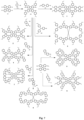
- Figure 7 show the synthetic procedures used to transform a functionalized spirobifluorene starting material, specifically compound W1 (2,2',7,7'-tetrabromo-9,9'-spirobifluorene) and compound Y1 (2,2',7,7'-tetraamino-9,9'-bibispirfluorene), into new compounds of the present invention.
- compound W3 (0.2 mmol, 0.16 g), compound W9 (1.6 mmol, 0.48 g), tri-tert-butylphosphonium tetrafluoroborate (25 mg), potassium tert-butoxide (400 mg), and toluene (20 mL) were added to a 50 mL round-bottomed flask, degassed with nitrogen, Then, tris(dibenzylideneacetone)dipalladium(0) (25 mg) was added to the reaction mixture, which was then heated to reflux for 48 h with stirring, cooled to room temperature, and diluted with 20 mL of dichloromethane.
- Cyclic voltaic curves of the compounds were performed using a CHI660D electrochemical analyzer (CH Instruments, Inc., China), using a common three-electrode system consisting of a platinum wire counter electrode, a platinum working electrode, and a calomel reference electrode.
- the redox potentials of the compounds were tested in dichloromethane solution of tetrabutylammonium hexafluorophosphate (the concentration of tetrabutylammonium hexafluorophosphate was 0.1 mol/L), and the scan rate was 50 mV ⁇ s-1.
- the devices tested for conductivity included FTO/hole transport layer/metal electrode.
- the hole transport layer was prepared by spin coating, and the hole transport material solution used in spin coating was prepared by dissolving each compound in dry chlorobenzene (concentration of 60 mg/mL).
- 5.7 ⁇ L of bistrifluoromethanesulfonimide lithium salt (520 mg/mL in acetonitrile solution) and 1.4 ⁇ L of tris(2-(1H-pyrazol-1-yl) pyridine) cobalt (300 mg/mL in acetonitrile) and 9.4 ⁇ L of 4-tert-butylpyridine.
- the differential thermal analysis test was carried out on a differential scanning calorimeter (METATEST E3-300) under nitrogen conditions with a heating rate of 10 °C/min.
- Figs. 1 to 3 The results of compounds tested are shown in Figs. 1 to 3 , and Table 1.
- Fig. 1 is the cyclic voltammetry test of spiro-OMeTAD, Compound 1 and Compound 2, and the HOMO energy level of each compound is calculated according to Fig. 1.
- Fig. 2 show test results for spiro-OMeTAD, Compound 1 and Compound 2, and the electrical conductivity of each compound is calculated according to Figure 2 .
- Figure 3 is a differential thermal test result of spiro-OMeTAD, Compound 1 and Compound 2.
- Table 1 Energy level, conductivity, and glass transition temperature (T g ) of compound spiro-OMeTAD, compound 1 and compound 2 Samples HOMO level (eV) Conductivity (S ⁇ cm -2 ) T g (°C) spiro-OMeTAD -5.10 4.1 ⁇ 10 -4 122 Compound 1 -5.18 9.7 ⁇ 10 -4 149 Compound 2 -5.22 8.9 ⁇ 10 -4 132
- the HOMO energy level of the spirobifluorene compounds with terminal extensions prepared by the present invention is significantly lower than that of spiro-OMeTAD.
- the electrical conductivity is significantly higher than that of spiro-OMeTAD, and the glass transition temperature is significantly higher.
- the spirobifluorene compound with terminal extension provided by the present invention has high stability and high electrical conductivity.
- a PSC device with an architecture of FTO glass/compact TiO 2 layer (c-TiO 2 ) /compact SnO 2 layer (c-SnO 2 )/Cs 0.05 MA 0.05 FA 0.9 PbI 3 (PVK)/spiro-OMeTAD (HTM)/Au structure was fabricated.
- the patterned FTO substrate (Asahi FTO glass, 12-13 ⁇ cm -2 ) was sequentially cleaned with detergent (5% Hellmanex in water), deionized water, acetone, and isopropanol in the ultrasonic bath for 30 min, respectively.
- the FTO substrate was then further cleaned with ultraviolet-ozone surface treatment for 15 min.
- the compact TiO 2 layer (c-TiO 2 ) and SnO 2 layer were sequentially deposited on the clean FTO substrate by the chemical bath deposition (CBD) method.
- the substrate was annealed on a hotplate at 190 °C for 60 min.
- the perovskite precursor solution (1.4 M) was prepared by adding 645.4 mg of PbI 2 , 216.7 mg of formamidinium iodide (FAI), 11.1 mg of methylamonium iodide (MAI), and 11.8 mg of CsCl into 200 ⁇ L of N, N'-dimethylsulfoxide (DMSO) and 800 ⁇ L of dimethyformamide (DMF) mixture.
- the perovskite precursor solution was spin-coated onto the surface of the FTO/c-TiO 2 /c-SnO 2 substrate at 1000 rpm for 10 s, accelerated to 5000 rpm for 5s and maintained at this speed for 20 s. This process was carried out in an N 2 -filled glove box. Then, the substrate was placed in a homemade rapid vacuum drying equipment. After pumping for 20 s, a brown, transparent perovskite film with a mirror-like surface was obtained. The fresh perovskite layer was annealed at 100 °C for 1 h and then at 150 °C for 10 min.
- PEAI solution (5 mg/mL in isopropanol) was spin-coated on the perovskite film at 5000 rpm for 30 s.
- a hole transport layer was deposited on the perovskite film by depositing a doped spiro-OMeTAD solution at 3000 rpm for 30 s.
- the doped spiro-OMeTAD solution was prepared by dissolving 105 mg of spiro-OMeTAD and 41 ⁇ L of 4-tert-butylpyridine in 1343 ⁇ L of chlorobenzene with an additional 25 ⁇ L of bis(trifluoromethane)sulfonimide lithium salt solution (517 mg/mL in acetonitrile) and 19 ⁇ L of cobalt-complex solution (376 mg/mL in acetonitrile). Finally, a ⁇ 70 nm-thick gold layer was evaporated on the spiro-OMeTAD layer as the back electrode.
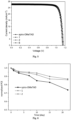
- Fig. 4a is a cross-sectional SEM image and Fig. 4b a corresponding schematic structural diagram of PSC device.
- the active areas of the PSCs are covered a metal mask with a size of 0.06 cm 2 .
- Table 2 Photovoltaic parameters of PSC devices of spiro-OMeTAD, Compound 1 and Compound 2 Devices Voltage (V) Current density (mA ⁇ cm -2 ) Fill factor (%) Efficiency (%) spiro-OMeTAD 1.140 25.95 83.0 24.56 Compound 1 1.143 26.11 85.0 25.37 Compound 2 1.160 26.45 82.4 25.27
- the PSC devices based on different hole transport materials were stored in an environment with a temperature of 65 °C for thermal aging tests.
- the test results are shown in Figure 6 . It can be seen from Fig. 6 that the device stability of devices based on the spirobifluorene compound with terminal extension is significantly enhanced compared to the spiro-OMeTAD-based devices.
Landscapes
- Chemical & Material Sciences (AREA)
- Organic Chemistry (AREA)
- Physics & Mathematics (AREA)
- Spectroscopy & Molecular Physics (AREA)
- Engineering & Computer Science (AREA)
- Materials Engineering (AREA)
- Organic Low-Molecular-Weight Compounds And Preparation Thereof (AREA)
- Low-Molecular Organic Synthesis Reactions Using Catalysts (AREA)
Priority Applications (1)
| Application Number | Priority Date | Filing Date | Title |
|---|---|---|---|
| EP23153617.8A EP4406944B1 (de) | 2023-01-27 | 2023-01-27 | Spiro-lochtransportmaterialien mit verlängerter pi-konjugationslänge am rand |
Applications Claiming Priority (1)
| Application Number | Priority Date | Filing Date | Title |
|---|---|---|---|
| EP23153617.8A EP4406944B1 (de) | 2023-01-27 | 2023-01-27 | Spiro-lochtransportmaterialien mit verlängerter pi-konjugationslänge am rand |
Publications (3)
| Publication Number | Publication Date |
|---|---|
| EP4406944A1 true EP4406944A1 (de) | 2024-07-31 |
| EP4406944C0 EP4406944C0 (de) | 2025-10-29 |
| EP4406944B1 EP4406944B1 (de) | 2025-10-29 |
Family
ID=85132960
Family Applications (1)
| Application Number | Title | Priority Date | Filing Date |
|---|---|---|---|
| EP23153617.8A Active EP4406944B1 (de) | 2023-01-27 | 2023-01-27 | Spiro-lochtransportmaterialien mit verlängerter pi-konjugationslänge am rand |
Country Status (1)
| Country | Link |
|---|---|
| EP (1) | EP4406944B1 (de) |
Citations (13)
| Publication number | Priority date | Publication date | Assignee | Title |
|---|---|---|---|---|
| EP2180029A1 (de) * | 2008-10-23 | 2010-04-28 | Novaled AG | Radialenverbindungen und deren Verwendung |
| JP2011113650A (ja) * | 2009-11-24 | 2011-06-09 | Konica Minolta Business Technologies Inc | 光電変換素子及び太陽電池 |
| JP2012023266A (ja) * | 2010-07-16 | 2012-02-02 | Konica Minolta Business Technologies Inc | 太陽電池 |
| CN103589419A (zh) * | 2013-09-17 | 2014-02-19 | 吉林奥来德光电材料股份有限公司 | 一种螺二芴类有机电致发光材料及其制备方法 |
| CN105859678A (zh) * | 2016-03-29 | 2016-08-17 | 中节能万润股份有限公司 | 一种含苯并二氧六环基团的空穴传输材料及其制备方法和应用 |
| US20180197688A1 (en) * | 2017-01-12 | 2018-07-12 | Tamotsu Horiuchi | Photoelectric conversion element and solar cell |
| CN109879767A (zh) * | 2019-01-21 | 2019-06-14 | 武汉大学 | 有机空穴传输材料及其制备方法与应用 |
| US20190288207A1 (en) * | 2016-11-09 | 2019-09-19 | Korea Research Institute Of Chemical Technology | Spirobifluorene compound and perovskite solar cell comprising same |
| CN111689867A (zh) * | 2020-06-05 | 2020-09-22 | 南京邮电大学 | 一种空穴传输层材料及其制备方法、钙钛矿太阳电池及其制备方法 |
| WO2021167214A1 (ko) * | 2020-02-21 | 2021-08-26 | 울산과학기술원 | 태양 전지용 정공 수송 재료 및 이를 포함하는 태양 전지 |
| CN115215754A (zh) * | 2022-07-28 | 2022-10-21 | 华北电力大学 | 一种具有末端延伸的螺二芴类化合物及其制备方法和应用 |
| WO2022249789A1 (ja) * | 2021-05-24 | 2022-12-01 | 日本精化株式会社 | 正孔輸送材料、正孔輸送材料を合成するための前駆体および正孔輸送材料の製造方法 |
| CN115490632A (zh) * | 2022-10-12 | 2022-12-20 | 福建师范大学 | 一种螺型空穴传输材料及其制备方法与应用 |
-
2023
- 2023-01-27 EP EP23153617.8A patent/EP4406944B1/de active Active
Patent Citations (13)
| Publication number | Priority date | Publication date | Assignee | Title |
|---|---|---|---|---|
| EP2180029A1 (de) * | 2008-10-23 | 2010-04-28 | Novaled AG | Radialenverbindungen und deren Verwendung |
| JP2011113650A (ja) * | 2009-11-24 | 2011-06-09 | Konica Minolta Business Technologies Inc | 光電変換素子及び太陽電池 |
| JP2012023266A (ja) * | 2010-07-16 | 2012-02-02 | Konica Minolta Business Technologies Inc | 太陽電池 |
| CN103589419A (zh) * | 2013-09-17 | 2014-02-19 | 吉林奥来德光电材料股份有限公司 | 一种螺二芴类有机电致发光材料及其制备方法 |
| CN105859678A (zh) * | 2016-03-29 | 2016-08-17 | 中节能万润股份有限公司 | 一种含苯并二氧六环基团的空穴传输材料及其制备方法和应用 |
| US20190288207A1 (en) * | 2016-11-09 | 2019-09-19 | Korea Research Institute Of Chemical Technology | Spirobifluorene compound and perovskite solar cell comprising same |
| US20180197688A1 (en) * | 2017-01-12 | 2018-07-12 | Tamotsu Horiuchi | Photoelectric conversion element and solar cell |
| CN109879767A (zh) * | 2019-01-21 | 2019-06-14 | 武汉大学 | 有机空穴传输材料及其制备方法与应用 |
| WO2021167214A1 (ko) * | 2020-02-21 | 2021-08-26 | 울산과학기술원 | 태양 전지용 정공 수송 재료 및 이를 포함하는 태양 전지 |
| CN111689867A (zh) * | 2020-06-05 | 2020-09-22 | 南京邮电大学 | 一种空穴传输层材料及其制备方法、钙钛矿太阳电池及其制备方法 |
| WO2022249789A1 (ja) * | 2021-05-24 | 2022-12-01 | 日本精化株式会社 | 正孔輸送材料、正孔輸送材料を合成するための前駆体および正孔輸送材料の製造方法 |
| CN115215754A (zh) * | 2022-07-28 | 2022-10-21 | 华北电力大学 | 一种具有末端延伸的螺二芴类化合物及其制备方法和应用 |
| CN115490632A (zh) * | 2022-10-12 | 2022-12-20 | 福建师范大学 | 一种螺型空穴传输材料及其制备方法与应用 |
Non-Patent Citations (4)
| Title |
|---|
| CHEM. SCI., vol. 5, 2014, pages 2702 |
| CHEM. SCI., vol. 7, 2016, pages 6068 |
| DYES PIGMENTS, vol. 139, 2017, pages 129, Retrieved from the Internet <URL:https://doi.org/10.1038/s41560-018-0200-6> |
| J. MATER. CHEM. C, vol. 6, 2018, pages 8280 |
Also Published As
| Publication number | Publication date |
|---|---|
| EP4406944C0 (de) | 2025-10-29 |
| EP4406944B1 (de) | 2025-10-29 |
Similar Documents
| Publication | Publication Date | Title |
|---|---|---|
| EP2828902B1 (de) | Mit einer inerten lösung bearbeitbare molekulare chromophoren für organische elektronische vorrichtungen | |
| Shi et al. | Two methoxyaniline-substituted dibenzofuran derivatives as hole-transport materials for perovskite solar cells | |
| Li et al. | A facilely synthesized ‘spiro’hole-transporting material based on spiro [3.3] heptane-2, 6-dispirofluorene for efficient planar perovskite solar cells | |
| Ji et al. | D–π–A–π–D-type low band gap diketopyrrolopyrrole based small molecules containing an ethynyl-linkage: synthesis and photovoltaic properties | |
| EP3648187B1 (de) | Perowskit-solarzelle | |
| Liu et al. | Two simple hole-transporting materials for perovskite solar cells: A DFT calculation and experimental study | |
| Li et al. | Fluorine substitution position effects on spiro (fluorene-9, 9′-xanthene) cored hole transporting materials for high-performance planar perovskite solar cells | |
| CN108467402A (zh) | 氟取代有机小分子空穴传输材料及其应用 | |
| Wu et al. | Effect of bridging group configuration on photophysical and photovoltaic performance in dye-sensitized solar cells | |
| Wang et al. | Constructing a donor–acceptor linear-conjugation structure for heterologous perylene diimides to greatly improve the photovoltaic performance | |
| Wu et al. | Simple and low-cost thiophene and benzene-conjugated triaryamines as hole-transporting materials for perovskite solar cells | |
| Liu et al. | Effect of fluorine substitution in organoboron electron acceptors for photovoltaic application | |
| JP6414450B2 (ja) | ホール輸送層材料およびホール輸送層材料を用いた太陽電池 | |
| CN110343119A (zh) | 一种含苯并噻二唑单元的非掺杂空穴传输材料及制备与应用 | |
| Li et al. | A low-cost asymmetric carbazole-based hole-transporting material for efficient perovskite solar cells | |
| Fu et al. | Dopant-free hole transport materials for perovskite solar cells: Isoindigo and dibenzonaphthyridine derivatives | |
| EP2966145A1 (de) | Carbazolbasierte Lochleitermaterialen | |
| CN115215754B (zh) | 一种具有末端延伸的螺二芴类化合物及其制备方法和应用 | |
| CN119912474B (zh) | 一种酚嗪衍生物超窄带隙受体及其制备方法和在有机太阳能电池中的用途 | |
| CN110746440A (zh) | 一类以二茚并双噻吩为核的有机太阳能电池受体材料及其制备方法和应用 | |
| EP4406944A1 (de) | Spiro-lochtransportmaterialien mit verlängerter pi-konjugationslänge am rand | |
| CN118126065B (zh) | 基于硒吩衍生物π桥的非富勒烯受体材料、其制备方法和应用 | |
| CN111875579A (zh) | 基于双氟连噻吩单元的有机分子及其作为空穴传输材料在钙钛矿太阳能电池中的应用 | |
| CN114349771B (zh) | 一种六苯并蔻基非富勒烯受体材料及其制备和应用 | |
| CN116947809A (zh) | 一种三苯胺类空穴传输材料及其制备方法和应用 |
Legal Events
| Date | Code | Title | Description |
|---|---|---|---|
| PUAI | Public reference made under article 153(3) epc to a published international application that has entered the european phase |
Free format text: ORIGINAL CODE: 0009012 |
|
| STAA | Information on the status of an ep patent application or granted ep patent |
Free format text: STATUS: REQUEST FOR EXAMINATION WAS MADE |
|
| 17P | Request for examination filed |
Effective date: 20230127 |
|
| AK | Designated contracting states |
Kind code of ref document: A1 Designated state(s): AL AT BE BG CH CY CZ DE DK EE ES FI FR GB GR HR HU IE IS IT LI LT LU LV MC ME MK MT NL NO PL PT RO RS SE SI SK SM TR |
|
| STAA | Information on the status of an ep patent application or granted ep patent |
Free format text: STATUS: EXAMINATION IS IN PROGRESS |
|
| 17Q | First examination report despatched |
Effective date: 20250130 |
|
| GRAP | Despatch of communication of intention to grant a patent |
Free format text: ORIGINAL CODE: EPIDOSNIGR1 |
|
| STAA | Information on the status of an ep patent application or granted ep patent |
Free format text: STATUS: GRANT OF PATENT IS INTENDED |
|
| INTG | Intention to grant announced |
Effective date: 20250805 |
|
| GRAS | Grant fee paid |
Free format text: ORIGINAL CODE: EPIDOSNIGR3 |
|
| GRAA | (expected) grant |
Free format text: ORIGINAL CODE: 0009210 |
|
| STAA | Information on the status of an ep patent application or granted ep patent |
Free format text: STATUS: THE PATENT HAS BEEN GRANTED |
|
| AK | Designated contracting states |
Kind code of ref document: B1 Designated state(s): AL AT BE BG CH CY CZ DE DK EE ES FI FR GB GR HR HU IE IS IT LI LT LU LV MC ME MK MT NL NO PL PT RO RS SE SI SK SM TR |
|
| REG | Reference to a national code |
Ref country code: CH Ref legal event code: F10 Free format text: ST27 STATUS EVENT CODE: U-0-0-F10-F00 (AS PROVIDED BY THE NATIONAL OFFICE) Effective date: 20251029 Ref country code: GB Ref legal event code: FG4D |
|
| REG | Reference to a national code |
Ref country code: IE Ref legal event code: FG4D |
|
| REG | Reference to a national code |
Ref country code: DE Ref legal event code: R096 Ref document number: 602023007856 Country of ref document: DE |
|
| U01 | Request for unitary effect filed |
Effective date: 20251127 |
|
| U07 | Unitary effect registered |
Designated state(s): AT BE BG DE DK EE FI FR IT LT LU LV MT NL PT RO SE SI Effective date: 20251204 |
|
| U20 | Renewal fee for the european patent with unitary effect paid |
Year of fee payment: 4 Effective date: 20260106 |