EP4404665A1 - Planungsverfahren und -vorrichtung - Google Patents
Planungsverfahren und -vorrichtung Download PDFInfo
- Publication number
- EP4404665A1 EP4404665A1 EP22882489.2A EP22882489A EP4404665A1 EP 4404665 A1 EP4404665 A1 EP 4404665A1 EP 22882489 A EP22882489 A EP 22882489A EP 4404665 A1 EP4404665 A1 EP 4404665A1
- Authority
- EP
- European Patent Office
- Prior art keywords
- cell
- symbol
- time unit
- physical downlink
- occupied
- Prior art date
- Legal status (The legal status is an assumption and is not a legal conclusion. Google has not performed a legal analysis and makes no representation as to the accuracy of the status listed.)
- Pending
Links
- 238000000034 method Methods 0.000 title claims abstract description 134
- 238000001228 spectrum Methods 0.000 claims abstract description 43
- 238000004891 communication Methods 0.000 claims description 88
- 238000012545 processing Methods 0.000 claims description 34
- 230000005540 biological transmission Effects 0.000 claims description 31
- 238000004590 computer program Methods 0.000 claims description 17
- 230000008859 change Effects 0.000 claims description 5
- 238000005516 engineering process Methods 0.000 abstract description 20
- TVZRAEYQIKYCPH-UHFFFAOYSA-N 3-(trimethylsilyl)propane-1-sulfonic acid Chemical compound C[Si](C)(C)CCCS(O)(=O)=O TVZRAEYQIKYCPH-UHFFFAOYSA-N 0.000 abstract description 16
- 230000003595 spectral effect Effects 0.000 abstract description 7
- 238000013468 resource allocation Methods 0.000 abstract description 2
- 230000006870 function Effects 0.000 description 28
- 238000010586 diagram Methods 0.000 description 24
- 230000008569 process Effects 0.000 description 16
- 230000006399 behavior Effects 0.000 description 3
- 239000013256 coordination polymer Substances 0.000 description 3
- 238000013461 design Methods 0.000 description 3
- 238000010295 mobile communication Methods 0.000 description 3
- 230000004044 response Effects 0.000 description 3
- 230000003190 augmentative effect Effects 0.000 description 2
- 230000007774 longterm Effects 0.000 description 2
- 238000012986 modification Methods 0.000 description 2
- 230000004048 modification Effects 0.000 description 2
- 101000741965 Homo sapiens Inactive tyrosine-protein kinase PRAG1 Proteins 0.000 description 1
- 102100038659 Inactive tyrosine-protein kinase PRAG1 Human genes 0.000 description 1
- 230000003247 decreasing effect Effects 0.000 description 1
- 230000004069 differentiation Effects 0.000 description 1
- 230000000977 initiatory effect Effects 0.000 description 1
- 230000003993 interaction Effects 0.000 description 1
- 238000013507 mapping Methods 0.000 description 1
- 230000003287 optical effect Effects 0.000 description 1
- 230000011664 signaling Effects 0.000 description 1
- 230000007704 transition Effects 0.000 description 1
- 230000001960 triggered effect Effects 0.000 description 1
- 239000002699 waste material Substances 0.000 description 1
Images



Classifications
-
- H—ELECTRICITY
- H04—ELECTRIC COMMUNICATION TECHNIQUE
- H04L—TRANSMISSION OF DIGITAL INFORMATION, e.g. TELEGRAPHIC COMMUNICATION
- H04L1/00—Arrangements for detecting or preventing errors in the information received
- H04L1/12—Arrangements for detecting or preventing errors in the information received by using return channel
- H04L1/16—Arrangements for detecting or preventing errors in the information received by using return channel in which the return channel carries supervisory signals, e.g. repetition request signals
- H04L1/18—Automatic repetition systems, e.g. Van Duuren systems
-
- H—ELECTRICITY
- H04—ELECTRIC COMMUNICATION TECHNIQUE
- H04L—TRANSMISSION OF DIGITAL INFORMATION, e.g. TELEGRAPHIC COMMUNICATION
- H04L5/00—Arrangements affording multiple use of the transmission path
- H04L5/003—Arrangements for allocating sub-channels of the transmission path
- H04L5/0032—Distributed allocation, i.e. involving a plurality of allocating devices, each making partial allocation
- H04L5/0035—Resource allocation in a cooperative multipoint environment
-
- H—ELECTRICITY
- H04—ELECTRIC COMMUNICATION TECHNIQUE
- H04L—TRANSMISSION OF DIGITAL INFORMATION, e.g. TELEGRAPHIC COMMUNICATION
- H04L1/00—Arrangements for detecting or preventing errors in the information received
- H04L1/12—Arrangements for detecting or preventing errors in the information received by using return channel
- H04L1/16—Arrangements for detecting or preventing errors in the information received by using return channel in which the return channel carries supervisory signals, e.g. repetition request signals
- H04L1/18—Automatic repetition systems, e.g. Van Duuren systems
- H04L1/1812—Hybrid protocols; Hybrid automatic repeat request [HARQ]
-
- H—ELECTRICITY
- H04—ELECTRIC COMMUNICATION TECHNIQUE
- H04L—TRANSMISSION OF DIGITAL INFORMATION, e.g. TELEGRAPHIC COMMUNICATION
- H04L1/00—Arrangements for detecting or preventing errors in the information received
- H04L1/12—Arrangements for detecting or preventing errors in the information received by using return channel
- H04L1/16—Arrangements for detecting or preventing errors in the information received by using return channel in which the return channel carries supervisory signals, e.g. repetition request signals
- H04L1/18—Automatic repetition systems, e.g. Van Duuren systems
- H04L1/1867—Arrangements specially adapted for the transmitter end
- H04L1/1887—Scheduling and prioritising arrangements
-
- H—ELECTRICITY
- H04—ELECTRIC COMMUNICATION TECHNIQUE
- H04L—TRANSMISSION OF DIGITAL INFORMATION, e.g. TELEGRAPHIC COMMUNICATION
- H04L5/00—Arrangements affording multiple use of the transmission path
- H04L5/0001—Arrangements for dividing the transmission path
- H04L5/0003—Two-dimensional division
- H04L5/0005—Time-frequency
- H04L5/0007—Time-frequency the frequencies being orthogonal, e.g. OFDM(A) or DMT
- H04L5/001—Time-frequency the frequencies being orthogonal, e.g. OFDM(A) or DMT the frequencies being arranged in component carriers
-
- H—ELECTRICITY
- H04—ELECTRIC COMMUNICATION TECHNIQUE
- H04W—WIRELESS COMMUNICATION NETWORKS
- H04W16/00—Network planning, e.g. coverage or traffic planning tools; Network deployment, e.g. resource partitioning or cells structures
- H04W16/14—Spectrum sharing arrangements between different networks
-
- H—ELECTRICITY
- H04—ELECTRIC COMMUNICATION TECHNIQUE
- H04W—WIRELESS COMMUNICATION NETWORKS
- H04W72/00—Local resource management
- H04W72/04—Wireless resource allocation
-
- H—ELECTRICITY
- H04—ELECTRIC COMMUNICATION TECHNIQUE
- H04W—WIRELESS COMMUNICATION NETWORKS
- H04W72/00—Local resource management
- H04W72/12—Wireless traffic scheduling
- H04W72/1263—Mapping of traffic onto schedule, e.g. scheduled allocation or multiplexing of flows
- H04W72/1273—Mapping of traffic onto schedule, e.g. scheduled allocation or multiplexing of flows of downlink data flows
-
- H—ELECTRICITY
- H04—ELECTRIC COMMUNICATION TECHNIQUE
- H04W—WIRELESS COMMUNICATION NETWORKS
- H04W72/00—Local resource management
- H04W72/20—Control channels or signalling for resource management
- H04W72/23—Control channels or signalling for resource management in the downlink direction of a wireless link, i.e. towards a terminal
- H04W72/232—Control channels or signalling for resource management in the downlink direction of a wireless link, i.e. towards a terminal the control data signalling from the physical layer, e.g. DCI signalling
Definitions
- This application relates to the field of communication technologies, and in particular, to a scheduling method and an apparatus.
- a dynamic spectrum sharing (dynamic spectrum sharing, DSS) technology is a technology in which a new radio (new radio, NR) system and a long term evolution (long term evolution, LTE) system share a same spectrum. Because spectrum resources are scarce, this technology is used to improve resource utilization.
- the DSS technology implements gradual smooth transition from the LTE system to the NR system. When the DSS technology is used, resources that can be used by the NR system are limited, and a resource allocated by a network device to the LTE system is not fully used. Consequently, a resource waste is caused, and resource utilization in a network is reduced.
- This application provides a scheduling method and an apparatus, to resolve a problem of how to improve resource utilization of a network.
- this application provides a scheduling method.
- the method may be performed by a network device, or a chip or a module in the network device.
- An example in which the method is performed by the network device is used for description herein.
- the method includes: The network device determines a quantity of symbols occupied by a first physical downlink control channel of a first cell in a time unit; and the network device may determine, based on the quantity of symbols, a 1st symbol occupied by a physical downlink shared channel of a second cell in the time unit, where the first cell and the second cell are dynamic spectrum sharing cells.
- the method shown in this implementation is implemented, so that when the first cell and the second cell share a same spectrum resource by using a DSS technology, the network device can adjust, based on the quantity of symbols occupied by the first physical downlink control channel, the 1st symbol occupied by the physical downlink shared channel of the second cell, to flexibly adjust a scheduling range of the physical downlink shared channel, and improve resource utilization and spectral efficiency of the second cell.
- the determining, based on the quantity of symbols, a 1st symbol occupied by a physical downlink shared channel of a second cell in the time unit includes: if the quantity of symbols is 0, determining that the 1st symbol occupied by the physical downlink shared channel of the second cell in the time unit is a 1st symbol in the time unit.
- the method shown in this implementation is implemented, so that when the quantity of symbols occupied by the first physical downlink control channel is 0, the physical downlink shared channel of the second cell starts to be scheduled from the 1st symbol in the time unit. In this way, the physical downlink shared channel can occupy more resources in a shared spectrum resource, to improve resource utilization of the second cell in the shared spectrum resource.
- the method further includes: transmitting data of the second cell by using a resource corresponding to a physical hybrid automatic repeat request indicator channel in the first cell, where the physical hybrid automatic repeat request indicator channel is located on the 1st symbol in the time unit.
- the method shown in this implementation is implemented, so that data is not sent on the physical hybrid automatic repeat request indicator channel in the first cell.
- the resource corresponding to the physical hybrid automatic repeat request indicator channel may be used by the second cell to perform data transmission, to improve resource utilization of the second cell in a shared spectrum resource.
- the method further includes: transmitting the data of the second cell by using a resource corresponding to a physical control format indicator channel in the first cell, where the physical control format indicator channel is located on the 1st symbol in the time unit.
- the method shown in this implementation is implemented, so that in the first cell, data is not mapped to the resource corresponding to the physical control format indicator channel, and the resource corresponding to the physical control format indicator channel may be used by the second cell to perform data transmission, to improve resource utilization of the second cell in a shared spectrum resource.
- the determining a quantity of symbols occupied by a first physical downlink control channel of a first cell in a time unit includes: if it is determined not to use the first physical downlink control channel in the first cell, determining that the quantity of symbols occupied by the first physical downlink control channel is 0.
- the method shown in this implementation is implemented, so that when the first physical downlink control channel is not used in the first cell, the network device can accurately determine the quantity of symbols occupied by the first physical downlink control channel, to determine a position of the 1st symbol that can be occupied by the physical downlink shared channel of the second cell.
- the determining, based on the quantity of symbols, a 1st symbol occupied by a physical downlink shared channel of a second cell in the time unit includes: if the quantity of symbols is 1, determining that the 1st symbol occupied by the physical downlink shared channel of the second cell in the time unit is a 2nd symbol in the time unit, where the first physical downlink control channel of the first cell occupies a 1st symbol in the time unit.
- the method shown in this implementation is implemented, so that when the quantity of symbols occupied by the first physical downlink control channel is 1, the network device starts to schedule the physical downlink shared channel of the second cell from the 2nd symbol in the time unit. In this way, the physical downlink shared channel can occupy more resources in a shared spectrum resource, to improve resource utilization of the second cell in the shared spectrum resource.
- the determining a quantity of symbols occupied by a first physical downlink control channel of a first cell in a time unit includes: if it is determined to use the first physical downlink control channel in the first cell and it is determined that the quantity of symbols occupied by the used first physical downlink control channel is less than 2, determining that the quantity of symbols occupied by the first physical downlink control channel is 1.
- a 1st symbol occupied by a second physical downlink control channel of the second cell in the time unit is the 2nd symbol or a 3rd symbol in the time unit.
- the method shown in this implementation is implemented, so that the second physical downlink control channel of the second cell starts to be scheduled from the 2nd symbol or the 3rd symbol in the time unit.
- the second physical downlink control channel can occupy more resources in a shared spectrum resource, to improve resource utilization of the second cell in the shared spectrum resource.
- the method further includes: sending first information to a terminal device in the second cell, where the first information indicates the 1st symbol occupied by the physical downlink shared channel in the time unit.
- this application provides a scheduling method.
- the method may be performed by a terminal device, or a chip or a module in the terminal device.
- An example in which the method is performed by the terminal device is used for description herein.
- the method includes: A terminal device located in a second cell receives first information from a network device, where the first information indicates a 1st symbol occupied by a physical downlink shared channel of the second cell in a time unit; and the terminal device receives the physical downlink shared channel by using the 1st symbol, where a first cell and the second cell dynamically share a same spectrum resource.
- the 1st symbol occupied by the physical downlink shared channel in the time unit is determined by the network device based on a quantity of symbols occupied by a first physical downlink control channel of the first cell in the time unit.
- the 1st symbol occupied by the physical downlink shared channel of the second cell in the time unit is a 1st symbol in the time unit.
- the method further includes: sending or receiving data in a resource corresponding to a physical hybrid automatic repeat request indicator channel in the first cell, where the physical hybrid automatic repeat request indicator channel is located on the 1st symbol in the time unit.
- the method further includes: sending or receiving data in a resource corresponding to a physical control format indicator channel in the first cell, where the physical control format indicator channel is located on the 1st symbol in the time unit.
- this application provides a scheduling method.
- the method may be performed by a network device, or a chip or a module in the network device.
- An example in which the method is performed by the network device is used for description herein.
- the method includes: if a preset condition is met, the network device reconfigures a quantity of cell-specific reference signal resources of a first cell, where the reconfigured quantity of cell-specific reference signal resources is less than a quantity of cell-specific reference signal resources before the reconfiguration; and the network device sends reconfiguration information to a terminal device in a second cell, where the reconfiguration information indicates a position of the cell-specific reference signal resource and the quantity of cell-specific reference signal resources, and a resource other than the cell-specific reference signal resource in a resource shared by the first cell and the second cell is used for data transmission of the terminal device in the second cell; and the first cell and the second cell are dynamic spectrum sharing cells.
- the method shown in this implementation is implemented, so that when the preset condition is met, the network device reduces the quantity of cell-specific reference signal resources in the first cell, to increase a quantity of resources that can be used by the second cell. Therefore, spectral efficiency of the second cell is improved.
- reconfiguring a quantity of cell-specific reference signal resources of a first cell includes: changing a port quantity of a cell-specific reference signal of the first cell from a first quantity to a second quantity, where the first quantity is greater than the second quantity.
- the method further includes: changing a manner of sending a multimedia broadcast multicast service single frequency network subframe of the first cell from a first manner to a second manner, where periodicity duration corresponding to the first manner is first duration, and a quantity of multimedia broadcast multicast service single frequency network subframes sent in a periodicity corresponding to the first manner is a third quantity; periodicity duration corresponding to the second manner is second duration, and a quantity of multimedia broadcast multicast service single frequency network subframes included in a periodicity corresponding to the second manner is a fourth quantity; and the changing a manner of sending a multimedia broadcast multicast service single frequency network subframe of the first cell from a first manner to a second manner includes: the first duration is greater than the second duration, and/or the third quantity is less than the fourth quantity.
- the method shown in this implementation is implemented, so that the network device can increase a quantity of MBSFN subframes by reducing periodicity duration of a sending periodicity of the MBSFN subframes, to reduce the quantity of cell-specific reference signal (cell-specific reference signal, CRS) resources.
- CRS cell-specific reference signal
- a CRS resource originally used for CRS transmission may be used for data transmission of a PDSCH of the second cell, to add a resource that can be used by the PDSCH of the second cell, reduce resource overheads in the second cell, and improve resource utilization of the second cell.
- the network device reduces the quantity of CRS resources by increasing a quantity of MBSFN subframes in each periodicity, to reduce the resource overheads in the second cell and improve the resource utilization of the second cell.
- the preset condition includes at least one of the following: a service load of the first cell is less than or equal to a first load, and a service load of a co-coverage neighboring cell of the first cell is less than or equal to a second load.
- the method further includes: suspending providing a service for a terminal device in the first cell.
- the method further includes: a 1st symbol occupied by a physical downlink shared channel of the second cell in a time unit is a 1st symbol in the time unit.
- the method shown in this implementation is implemented, so that the network device starts to schedule the physical downlink shared channel of the second cell from the 1st symbol in the time unit.
- the physical downlink shared channel can occupy more resources in a shared spectrum resource, to improve resource utilization of the second cell in the shared spectrum resource.
- this application provides a scheduling method.
- the method may be performed by a terminal device, or a chip or a module in the terminal device.
- An example in which the method is performed by the terminal device is used for description herein.
- the method includes: A terminal device located in a second cell receives reconfiguration information from a network device, where the reconfiguration information indicates a position of a cell-specific reference signal resource and a quantity of cell-specific reference signal resources of a first cell, and a resource other than the cell-specific reference signal resource in a resource shared by the first cell and the second cell is used for data transmission of the terminal device in the second cell; and the first cell and the second cell are dynamic spectrum sharing cells.
- a reconfigured quantity of cell-specific reference signal resources is less than a quantity of cell-specific reference signal resources before reconfiguration.
- this application further provides a communication apparatus, and the communication apparatus has a function of implementing any method or implementation provided in any one of the first aspect to the fourth aspect.
- the communication apparatus may be implemented by using hardware, or may be implemented by executing corresponding software by hardware.
- the hardware or software includes one or more units or modules corresponding to the foregoing functions.
- the communication apparatus includes a processor, and the processor is configured to support the communication apparatus in performing a corresponding function of the network device in the foregoing method.
- the communication apparatus may further include a memory.
- the memory may be coupled to the processor, and the memory stores program instructions and data that are necessary for the communication apparatus.
- the communication apparatus further includes an interface circuit, and the interface circuit is configured to support communication between the communication apparatus and a device such as a terminal device or a network device.
- a structure of the communication apparatus includes a processing unit and a communication unit. These units may perform corresponding functions in the foregoing method examples. For details, refer to descriptions in the method provided in the first aspect or the third aspect. Details are not described herein again.
- a communication apparatus including a processor and an interface circuit.
- the interface circuit is configured to: receive a signal from another communication apparatus other than the communication apparatus and transmit the signal to the processor, or send a signal from the processor to another communication apparatus other than the communication apparatus.
- the processor is configured to execute a computer program or instructions stored in a memory, to implement the method in any possible implementation of the first aspect to the fourth aspect.
- the apparatus further includes the memory, and the memory stores the computer program or the instructions.
- a computer-readable storage medium stores a computer program or instructions.
- the computer program or the instructions are run on a computer, the computer is enabled to implement the method in any possible implementation of any one of the first aspect to the fourth aspect.
- a computer program product that stores computer-readable instructions.
- the computer is enabled to implement the method in any possible implementation of the first aspect to the fourth aspect.
- a chip includes a processor, and may further include a memory.
- the processor is coupled to the memory, and is configured to execute a computer program or instructions stored in the memory, so that the chip implements the method in any possible implementation of the first aspect to the fourth aspect.
- a communication system includes an apparatus (for example, a network device) for implementing the first aspect and an apparatus (for example, a terminal device) for implementing the second aspect.
- an apparatus for example, a network device
- an apparatus for example, a terminal device
- Embodiments of this application may be applied to various mobile communication systems, for example, an NR system, an LTE system, a global system of mobile communication (global system of mobile communication, GSM) system, a code division multiple access (code division multiple access, CDMA) system, a general packet radio service (general packet radio service, GPRS) system, a future communication system and other communication systems. Specifically, this is not limited herein.
- GSM global system of mobile communication
- CDMA code division multiple access
- GPRS general packet radio service
- a terminal device may be a device with a wireless transceiver function or a chip that may be disposed in any device, or may be referred to as user equipment (user equipment, UE), an access terminal, a subscriber unit, a subscriber station, a mobile station, a remote station, a remote terminal, a mobile device, a user terminal, a wireless communication device, a user agent, or a user apparatus.
- user equipment user equipment
- UE user equipment
- an access terminal a subscriber unit, a subscriber station, a mobile station, a remote station, a remote terminal, a mobile device, a user terminal, a wireless communication device, a user agent, or a user apparatus.
- the terminal device in embodiments of this application may be a mobile phone (mobile phone), a tablet computer (tablet computer), a computer with a wireless transceiver function, a virtual reality (virtual reality, VR) terminal, an augmented reality (augmented reality, AR) terminal, a wireless terminal in industrial control (industrial control), a wireless terminal in self-driving (self-driving), or the like.
- a virtual reality virtual reality, VR
- an augmented reality augmented reality
- a wireless terminal in industrial control industrial control
- self-driving self-driving
- a network device may be a radio access device in various standards, for example, may be a next generation NodeB (next Generation NodeB, gNB) in an NR system, may be an evolved NodeB (evolved NodeB, eNB), a radio network controller (radio network controller, RNC) or a NodeB (NodeB, NB), a base station controller (base station controller, BSC), a base transceiver station (base transceiver station, BTS), a home base station (for example, a home evolved NodeB or a home NodeB, HNB), a baseband unit (baseband unit, BBU), an access point (access point, AP), or a wireless relay node, a wireless backhaul node, or a transmission point (transmission and reception point, TRP or transmission point, TP) in a wireless fidelity (wireless fidelity, Wi-Fi) system, or may be a gNB or a transmission point in a 5
- eNB evolved
- the base station in the 5G system may also be referred to as a transmission reception point (transmission reception point, TRP) or a next generation NodeB (generation NodeB, gNB or gNodeB).
- the base station in embodiments of this application may be an integrated base station, or may be a base station that includes a central unit (central unit, CU) and a distributed unit (distributed unit, DU).
- the base station including the CU and the DU may also be referred to as a base station in which the CU and the DU are separated.
- the base station includes a gNB-CU and a gNB-DU.
- the CU may further be separated into a CU control plane (CU control plane, CU-CP) and a CU user plane (CU user plane, CU-CP).
- CU control plane CU control plane
- CU user plane CU-CP
- the base station includes a gNB-CU-CP, a gNB-CU-UP, and the gNB-DU.
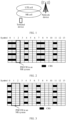
- FIG. 1 is a schematic diagram of a network architecture applicable to an embodiment of this application.
- the network architecture includes a network device and a terminal device.
- the network device may support a plurality of communication systems, and may configure a plurality of cells.
- the network device may support an LTE system and an NR system, and may configure both an LTE cell and an NR cell.
- the LTE cell and the NR cell may share a same spectrum resource.
- This technology may be a dynamic spectrum sharing (dynamic spectrum sharing, DSS) technology.
- DSS dynamic spectrum sharing
- the foregoing technology is merely an example.
- a scenario in which the DSS technology is used is not limited in this application.
- the DSS technology may also be applicable to another network. This is not limited in this application.
- the terminal device may be a device that supports one or more of the foregoing plurality of communication systems. A type of the terminal device is not limited.
- a scenario in which the LTE system and the NR system dynamically share a spectrum is used as an example.
- a physical downlink control channel (physical downlink control channel, PDCCH) in the NR system cannot occupy a cell-specific reference signal (cell-specific reference signal, CRS) resource in the LTE system
- an orthogonal frequency division multiplexing (orthogonal frequency division multiplexing, OFDM) OFDM symbol (symbol) that can be scheduled and used by the PDCCH and a physical downlink shared channel (physical downlink shared channel, PDSCH) in the NR system is limited.
- the OFDM symbol may be a signal waveform generated by using an OFDM technology, and a length of the OFDM symbol in time domain is equal to a reciprocal of a subcarrier spacing of the waveform.
- the OFDM symbol is referred to as a symbol for short in the following descriptions.
- a time unit, a subframe, and a multimedia broadcast multicast service single frequency network (multimedia broadcast multicast service single frequency network, MBSFN) subframe are first described herein.
- one subframe includes 14 symbols
- one slot includes 14 symbols.
- the subframe in the LTE system and the slot in the NR system may be collectively referred to as a time unit.
- the subframe in the LTE system may further be classified into two types: an MBSFN subframe and a non-MBSFN subframe.
- Resource element (resource element, RE) resources used for CRS transmission in the MBSFN subframe are fewer than RE resources used for CRS transmission in the non-MBSFN subframe. For example, when a port quantity of a CRS is 4, in a range of one resource block (resource block, RB), one non-MBSFN subframe includes 24 RE resources used for CRS transmission, and the MBSFN subframe includes only eight RE resources used for CRS transmission.
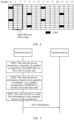
- FIG. 2 is a schematic diagram of a structure of one slot.
- One slot includes 14 symbols, and a 1st symbol to a 14th symbol are sequentially referred to as a symbol 0 to a symbol 13.
- the RE resources occupied by the CRS are located on the symbol 0, the symbol 1, the symbol 4, the symbol 7, the symbol 8, and the symbol 11.
- the PDCCH in the NR system is configured on the symbol 2.
- a range of symbols that can be scheduled and used by the PDSCH in the NR system is the symbol 2 to the symbol 13, and the first two symbols cannot be scheduled.
- a small black grid represents the RE resource occupied by the CRS
- a small white grid represents an RE resource that is not occupied by the CRS.
- 2 ⁇ 8 represents a quantity of RE resources other than the RE resources occupied by the CRS on the symbol 0 and the symbol 1
- 6 ⁇ 4 represents a quantity of RE resources occupied by the CRS on the symbol 0, the symbol 1, the symbol 4, the symbol 7, the symbol 8, and the symbol 11.
- FIG. 3 shows one slot.
- One slot includes 14 symbols, which are respectively a symbol 0 to a symbol 13.
- the RE resources occupied by the CRS are located on the symbol 0, the symbol 4, the symbol 7, and the symbol 11.
- the PDCCH in the NR system is configured on the symbol 1 and/or the symbol 2 (where the figure shows a case in which the PDCCH in the NR system is configured on the symbol 1 and the symbol 2, and other cases are not shown).
- a range of symbols that can be scheduled and used by the PDSCH in the NR system is the symbol 1 to the symbol 13, and the symbol 0 cannot be scheduled.
- 1 ⁇ 8 represents a quantity of RE resources other than the RE resources occupied by the CRS on the symbol 0
- 4 ⁇ 4 represents a quantity of RE resources occupied by the CRS on the symbol 0, the symbol 4, the symbol 7, and the symbol 11.
- FIG. 4 shows one slot.
- One slot includes 14 symbols, which are respectively a symbol 0 to a symbol 13.
- the RE resources occupied by the CRS are located on the symbol 0, the symbol 4, the symbol 7, and the symbol 11.
- the PDCCH in the NR system is configured on the symbol 1 and/or the symbol 2 (where the figure shows a case in which the PDCCH in the NR system is configured on the symbol 1 and the symbol 2, and other cases are not shown).
- a range of symbols that can be scheduled and used by the PDSCH in the NR system is the symbol 1 to the symbol 13, and the symbol 0 cannot be scheduled.
- 1 ⁇ 10 represents a quantity of RE resources other than the RE resources occupied by the CRS on the symbol 0
- 4 ⁇ 2 represents a quantity of RE resources occupied by the CRS on the symbol 0, the symbol 4, the symbol 7, and the symbol 11.
- Embodiments of this application provide a method.
- resource overheads of an NR system can be reduced, a downlink rate of the NR system can be increased, and spectral efficiency of the NR system can be improved.
- a network architecture and a service scenario described in embodiments of this application are intended to describe the technical solutions in embodiments of this application more clearly, but do not constitute a limitation on the technical solutions provided in embodiments of this application.
- a person of ordinary skill in the art may know that with evolution of the network architecture and emergence of new service scenarios, the technical solutions provided in embodiments of this application are also applicable to similar technical problems.
- interaction between a network device and a terminal device is used as an example for description.
- An operation performed by the network device may alternatively be performed by a chip or a module inside the network device, and an operation performed by the terminal device may alternatively be performed by a chip or a module inside the terminal device.
- FIG. 5 is a schematic flowchart of a scheduling method according to an embodiment of this application.
- a network device may support a plurality of communication systems.
- the network device may support an LTE system and an NR system.
- the network device may establish a plurality of cells, for example, establish a first cell and a second cell.
- the first cell and the second cell are dynamic spectrum sharing cells.
- the first cell and the second cell dynamically share a same spectrum resource, to be specific, the first cell and the second cell share the same spectrum resource by using a DSS technology.
- the first cell is an LTE cell
- the second cell is an NR cell.
- the first cell is an NR cell
- the second cell is an LTE cell.
- the first cell and the second cell may alternatively be cells of another type. This is not limited in this embodiment of this application.
- the first cell includes physical channels such as a first PDCCH, a physical hybrid automatic repeat request (hybrid automatic repeat request, HARQ) indicator channel (physical HARQ indicator channel, PHICH), and a physical control format indicator channel (physical control format indicator channel, PCFICH).
- physical channels such as a first PDCCH, a physical hybrid automatic repeat request (hybrid automatic repeat request, HARQ) indicator channel (physical HARQ indicator channel, PHICH), and a physical control format indicator channel (physical control format indicator channel, PCFICH).
- HARQ hybrid automatic repeat request
- PHICH physical HARQ indicator channel
- PCFICH physical control format indicator channel
- the first PDCCH may carry information such as uplink and downlink resource scheduling information sent to a terminal device, and the PHICH may carry a HARQ acknowledgment (acknowledgment, ACK) feedback or a HARQ negative acknowledgement (negative acknowledgment, NACK) feedback.
- the PCFICH indicates a quantity of symbols occupied by the first PDCCH in a time unit.
- the method shown in this embodiment an example in which the first cell is the LTE cell and the second cell is the NR cell is used for description.
- the method may include the following steps.
- the network device determines the quantity of symbols occupied by the first PDCCH of the first cell in the time unit.
- One symbol may be understood as one signal waveform, and a length of one symbol in time domain is equal to a reciprocal of a subcarrier spacing of the waveform.
- the length of the symbol in time domain may be used as a basic unit of the time unit.
- one time unit may include a plurality of symbols.
- the symbol in this application may be an OFDM symbol, or may be a symbol similar to the OFDM symbol. This is not limited in this application.
- the time unit may be a period of time. Because dynamic spectrum sharing between two different systems is used in this embodiment of this application, names of the time unit in different systems may be different.
- the time unit in the NR system, the time unit may be a slot (slot), and in the LTE system, the time unit may be duration of a subframe (subframe).
- a quantity of symbols that can be occupied by the first PDCCH of the first cell is not a fixed value, a maximum of two symbols can be occupied, and a minimum of zero symbols can be occupied. How the network device specifically determines the quantity of symbols occupied by the first PDCCH is not limited in this embodiment of this application.
- the network device determines not to use the first PDCCH in the first cell, the quantity of symbols occupied by the first PDCCH is 0. For example, if a quantity of terminal devices in a radio resource control (radio resource control, RRC) connected mode in the first cell is less than or equal to a first threshold, it is determined not to use the first PDCCH, and the quantity of symbols occupied by the first PDCCH is 0.
- RRC radio resource control
- the PHICH and the PCFICH occupy a 1st symbol by default, and the PHICH and the PCFICH occupy different frequency domain resources.
- the network device may transmit data of the second cell by using a resource occupied by the PHICH and/or a resource occupied by the PCFICH, to further improve resource utilization efficiency of a network.
- the network device may alternatively not send data on the PHICH.
- the PHICH occupies a 1st symbol in the time unit.
- the network device may schedule, in a resource corresponding to the PHICH, the terminal device to perform data transmission. For example, the network device may transmit data to the terminal device in the resource corresponding to the PHICH, or receive data from the terminal device in the resource corresponding to the PHICH.
- the PHICH occupies the 1st symbol in the time unit, when the network device does not send the data on the PHICH, the PHICH may not be occupied by the first cell. Therefore, the PHICH in the first cell may be used for data transmission of the second cell, to improve resource utilization of the second cell.
- the network device may alternatively not map data to a resource corresponding to the PCFICH in the first cell.
- the PCFICH occupies the 1st symbol in the time unit. Mapping data to the resource may mean modulating data to the resource.
- the network device may schedule, in the resource corresponding to the PCFICH, the terminal device to perform data transmission. For example, the network device may transmit data to the terminal device in the resource corresponding to the PCFICH, or receive data from the terminal device in the resource corresponding to the PCFICH.
- the resource corresponding to the PCFICH may be used for data transmission of the second cell, to improve resource utilization of the second cell.
- the network device determines to use the first PDCCH in the first cell, and determines that the quantity of symbols occupied by the first PDCCH is less than 2, the quantity of symbols occupied by the first PDCCH may be 1. For example, if a quantity of terminal devices in an RRC connected mode in the first cell is greater than a first threshold, the network device determines to use the first PDCCH in the first cell, determines that the quantity of symbols occupied by the first PDCCH is less than 2, to further determine that the quantity of symbols occupied by the first PDCCH is 1.
- the first threshold may be a number greater than or equal to 0.
- the first threshold may be determined based on an actual requirement. A specific value of the first threshold is not limited in this application. For example, the network device determines to use the first PDCCH in the first cell if the first threshold is equal to 0, to be specific, provided that there is at least one terminal device in the RRC connected mode in the first cell.
- a specific value of the quantity of symbols occupied by the first PDCCH may be determined based on a factor such as a service requirement of the terminal device. For example, if a quantity of resources blocks RBs needed by the terminal device in the RRC connected mode in the first cell is less than or equal to a second threshold, the quantity of symbols occupied by the first PDCCH is 1; or if a quantity of resources blocks RBs needed by the terminal device in the RRC connected mode in the first cell is greater than a second threshold, the quantity of symbols occupied by the first PDCCH is 2.
- the second threshold may be determined based on an actual requirement. This is not limited in this application.
- the second threshold is 10 RBs
- the quantity of symbols occupied by the first PDCCH is 1; otherwise, the quantity of symbols occupied by the first PDCCH is 2.
- 10 RBs are a boundary value.
- the network device may alternatively determine, when a quantity of resource blocks RBs needed by the terminal device in the RRC connected mode in the first cell is less than 10, that the quantity of symbols occupied by the first PDCCH is 1. This is not limited in this application.
- the network device may send information to the second cell through an internal interface, where the information includes the quantity of symbols occupied by the first PDCCH of the first cell, and optionally, the information may further include information such as an index of a 1st symbol occupied by the first PDCCH.
- This manner helps the network device subsequently determine, based on the quantity of symbols occupied by the first PDCCH, a symbol occupied by a PDSCH of the second cell in the time unit.
- the network device determines, based on the quantity of symbols, a 1st symbol occupied by the PDSCH of the second cell in the time unit.
- a specific position of the 1st symbol occupied by the PDSCH of the second cell in the time unit may be determined by the network device based on the quantity of symbols occupied by the first PDCCH of the first cell. Specifically, this may include but is not limited to the following several cases.
- the network device may configure a scheduling range of the PDSCH of the second cell in the time unit as the 1st symbol to a last symbol in the time unit.
- the network device may configure the 1st symbol occupied by the PDSCH of the second cell in the time unit as the 1st symbol in the time unit.
- the time unit includes 14 symbols
- the scheduling range of the PDSCH of the second cell in the time unit is the 1st symbol to a 14th symbol in the time unit.
- the network device configures that the PDSCH of the second cell can occupy the 1st symbol in the time unit does not mean that the network device definitely sends data on the 1st symbol in the time unit through the PDSCH of the second cell. Whether the network device specifically sends the data on the 1 st symbol in the time unit through the PDSCH of the second cell needs to be determined based on an actual data transmission requirement. Similarly, that the network device configures the scheduling range of the PDSCH of the second cell as the 1st symbol to the last symbol in the time unit does not mean that the network device definitely sends data on the 1st symbol to the last symbol in the time unit through the PDSCH of the second cell. Whether the network device specifically sends the data on the 1st symbol to the last symbol in the time unit through the PDSCH of the second cell needs to be determined based on an actual data transmission requirement.
- a scheduling range of a second PDCCH of the second cell in the time unit is the 1st symbol to the 3rd symbol in the time unit, and a symbol occupied by the second PDCCH cannot be the same as a symbol occupied by a CRS in the first cell.
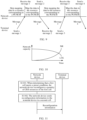
- FIG. 6 is a schematic diagram of PDSCH scheduling.
- a resource shown in FIG. 6 includes one resource block (resource block, RB) in frequency domain, and the RB includes 12 subcarriers.
- the resource includes one subframe in the LTE system or one slot in the NR system in time domain.
- a length of one subframe in the LTE system is the same as a length of one slot in the NR system.
- FIG. 6 an example in which one subframe in the LTE system includes 14 symbols is used. A 1st symbol to a 14th symbol in the 14 symbols are sequentially referred to as a symbol 0 to a symbol 13.
- FIG. 6 an example in which a port quantity of the CRS of the first cell is 4 is used.
- the 1st symbol and the 2nd symbol in the time unit include the CRS of the first cell.
- the network device may transmit data of the PDSCH of the second cell on the 1st symbol to the 14th symbol (namely, the symbol 0 to the symbol 13) in the time unit.
- the network device may configure a 1st symbol occupied by the second PDCCH of the second cell as the 3rd symbol, namely, the symbol 2, in the time unit.
- the network device may configure the scheduling range of the second PDCCH of the second cell as the 2nd symbol and the 3rd symbol in the time unit, and the network device may configure the scheduling range of the PDSCH of the second cell as the 2nd symbol to the 14th symbol in the time unit.
- the network device may configure the symbol occupied by the second PDCCH as the 2nd symbol (namely, the symbol 1) in the time unit, and the network device may configure that the PDSCH of the second cell can occupy the 1st symbol (namely, the symbol 0) in the time unit.
- the network device may send the data of the PDSCH in time of the 1st symbol.
- the second PDCCH of the second cell when a condition that the second PDCCH of the second cell does not occupy a symbol configured with the CRS of the first cell and the second PDCCH of the second cell is located on first three symbols in one time unit is met, if the quantity of symbols occupied by the first PDCCH of the first cell is 0, that is, the first PDCCH does not occupy any symbol, the PDSCH of the second cell may occupy the symbol originally occupied by the first PDCCH of the first cell, to increase a quantity of symbols that can be occupied by the PDSCH of the second cell. Therefore, utilization efficiency of a network resource is improved.
- Case 2 If the quantity of symbols occupied by the first PDCCH of the first cell is 1, the network device may configure the first PDCCH of the first cell to occupy the 1st symbol in the time unit. Correspondingly, the network device may configure a scheduling range of the PDSCH of the second cell in the time unit as a 2nd symbol to a last symbol in the time unit. In other words, the network device may configure the 1st symbol occupied by the PDSCH of the second cell in the time unit as the 2nd symbol in the time unit. For example, the time unit includes 14 symbols, and the scheduling range of the PDSCH of the second cell in the time unit is the 2nd symbol to a 14th symbol in the time unit.
- a scheduling range of a second PDCCH of the second cell in the time unit is the 2nd symbol and the 3rd symbol in the time unit, and a symbol occupied by the second PDCCH cannot not overlap a symbol occupied by a CRS in the first cell.
- FIG. 7 is a schematic diagram of PDSCH scheduling. Similar to FIG. 6 , in FIG. 7 , an example in which a port quantity of the CRS of the first cell is 4 used. When the port quantity of the CRS of the first cell is 4, the 1st symbol and the 2nd symbol in the time unit include the CRS of the first cell.
- the network device may transmit data of the PDSCH of the second cell on the 2nd symbol to the 14th symbol (a symbol 1 to a symbol 13) in the time unit.
- the network device may configure the symbol occupied by the second PDCCH of the second cell as the 3rd symbol, namely, the symbol 2, in the time unit.
- the network device may configure a 1st symbol occupied by the second PDCCH of the second cell as the 3rd symbol in the time unit, and configure the 1st symbol occupied by the PDSCH of the second cell as the 2nd symbol in the time unit.
- the network device configures the first PDCCH to occupy the 1st symbol in the time unit, and the network device configures the second PDCCH of the second cell to occupy the 3rd symbol in the time unit, and configures the PDSCH of the second cell to occupy the 2nd symbol in the time unit, to increase a quantity of symbols that can be occupied by the PDSCH of the second cell. Therefore, utilization efficiency of a network resource is further improved.
- the network device may further indicate, to a terminal device in the second cell, the 1st symbol occupied by the PDSCH.
- the network device may further indicate, to a terminal device in the second cell, the 1st symbol occupied by the PDSCH.
- S503 The network device sends first information to the terminal device in the second cell.
- the first information indicates the 1st symbol occupied by the PDSCH in the time unit, to be specific, indicates the position of the 1st symbol occupied by the PDSCH in the time unit.
- the first information may indicate a symbol number of the 1st symbol occupied by the PDSCH. For example, if the 1st symbol occupied by the PDSCH is the 1st symbol in the time unit, the symbol number indicated by the first information is the symbol 0; or if the 1st symbol occupied by the PDSCH is the 2nd symbol in the time unit, the symbol number indicated by the first information is the symbol 1.
- the first information may further indicate the quantity of symbols occupied by the PDSCH.
- the first information may be carried by using downlink control information (downlink control information, DCI), or may be carried by using RRC signaling. This is not limited in this embodiment of this application.
- the network device may further send second information to the terminal device in the second cell.
- the second information indicates information such as the 1st symbol occupied by the second PDCCH in the time unit and a quantity of symbols occupied by the second PDCCH.
- the terminal device in the second cell may receive, based on the first information, the data of the PDSCH on the 1st symbol occupied by the PDSCH, or may receive, based on the second information, data of the second PDCCH on the 1 st symbol occupied by the second PDCCH.
- a specific process is not limited. Details are not described herein again.
- the network device may adjust, based on the quantity of symbols occupied by the first PDCCH of the first cell, the quantity of symbols occupied by the PDSCH of the second cell, to implement flexible resource allocation, and improve resource utilization and spectral efficiency of the second cell.
- a network device may determine a quantity of terminal devices in an RRC connected mode in the first cell.
- FIG. 8 an example in which a first threshold is equal to 0 is used to describe how the network device performs resource scheduling on a PDSCH of the second cell when the quantity of terminal devices in the RRC connected mode in the first cell changes.
- FIG. 8 illustrates four scenarios, which are separately described below.
- the quantity of terminal devices in the RRC connected mode in the first cell is equal to 0, that is, equal to the first threshold, and the first cell is in a state in which no user is connected.
- a quantity of symbols occupied by a first PDCCH of the first cell may be 0, and a 1st symbol occupied by the PDSCH of the second cell is a 1st symbol in a time unit.
- a scheduling range of the PDSCH of the second cell in a time unit is a symbol 0 to a symbol 13 in the time unit. This maximizes a downlink throughput of the second cell.
- the network device may alternatively not send data on a PHICH in the first cell.
- the network device may perform data transmission of the second cell by using the PHICH in the first cell, to improve resource utilization of the second cell.
- the network device may alternatively not map data to a resource corresponding to a PCFICH in the first cell.
- the network device may perform data transmission of the second cell by using the resource corresponding to the PCFICH in the first cell, to improve resource utilization of the second cell.
- the network device may not send the data on the PHICH, and/or not map the data to the resource corresponding to the PCFICH.
- paging paging
- SIB system information block
- That the data is not sent on the PHICH may represent that data to be carried on the PHICH is not generated, and therefore the data is not sent on the PHICH. That the data is not mapped to the resource corresponding to the PCFICH may represent that data to be carried on the PCFICH is generated, but finally the data is not modulated to the resource corresponding to the PCFICH.
- the random access process may successively include a four-step message procedure:
- the terminal device sends a message 1, where the message 1 includes a preamble;
- the network device sends a message 2, where the message 2 may be a random access response (random access response, RAR) message;
- the terminal device sends a message 3, where the message 3 may be a response message of the message 2;
- the network device sends a message 4, where the message 4 may be a contention resolution message.
- the scenario 2 may be described with reference to FIG. 9 .
- the network device when receiving the message 1 in the first cell, may continue to map data to a resource corresponding to a PCFICH. Before sending the message 2 to the terminal device, the network device maps the data to the resource corresponding to the PCFICH in the first cell. After sending the message 2, the network device does not map the data to the resource corresponding to the PCFICH in the first cell. When receiving the message 3 from the terminal device, the network device maps the data to the resource corresponding to the PCFICH. After the terminal device accesses the first cell, the network device may send data on a PHICH.
- the network device dynamically adjusts whether to map the data to the resource corresponding to the PCFICH, to improve resource utilization of the second cell and ensure that the data mapped to the resource corresponding to the PCFICH in the first cell can be received by the terminal device, so that the terminal device can successfully access the first cell.
- a terminal device in the RRC connected mode in the first cell there is a terminal device in the RRC connected mode in the first cell, and the network device maps data to a resource corresponding to a PCFICH, sends data on a PHICH, and no longer shares a 1st symbol in a time unit with the second cell for use.
- the network device may determine, based on a service requirement of the terminal device, a quantity of symbols occupied by a first PDCCH of the first cell, and may determine, based on the quantity of symbols, a 1st symbol occupied by the PDSCH of the second cell in the time unit.
- a service requirement of the terminal device a quantity of symbols occupied by a first PDCCH of the first cell
- a 1st symbol occupied by the PDSCH of the second cell in the time unit For details about how to determine the 1 st symbol occupied by the PDSCH of the second cell in the time unit, refer to the descriptions of S502 in FIG. 5 . Details are not described herein again.
- the network device When determining that the quantity of terminal devices in the RRC connected mode is 0, in the first cell, the network device does not map data to a resource corresponding to a PCFICH, and does not send data on a PHICH.
- a quantity of symbols occupied by a first PDCCH of the first cell may be 0, and a scheduling range of the PDSCH of the second cell in a time unit is a symbol 0 to a symbol 13 in the time unit.
- the PDSCH of the second cell may occupy the first two symbols in the time unit.
- a quantity of RE resources that can be used in a time unit in the second cell is increased from 128 to 144, resource overheads are reduced from 23.81% to 14.29%, and resource utilization is improved from 76.19% to 85.71%.
- a quantity of RE resources that can be used in a time unit in the second cell is increased from 144 to 152, resource overheads are reduced from 14.29% to 9.52%, and resource utilization is improved from 85.71% to 90.48%.
- a quantity of RE resources that can be used in a time unit in the second cell is increased from 150 to 160, resource overheads are reduced from 10.71% to 4.76%, and resource utilization is improved from 89.29% to 95.24%.
- a quantity of RE resources that can be occupied by the PDSCH in the NR cell is increased significantly, to further improve the utilization efficiency of the network resource. Therefore, a downlink throughput of the NR cell may be increased.
- a network can meet NR cell coverage while considering an LTE cell capacity.
- NR a quantity of users/an amount of traffic in an NR cell is increased, and the LTE cell capacity is decreased.
- embodiments of this application further provide a method. The method may improve resource utilization of the NR cell and implement smooth evolution from an LTE network to an NR network.
- FIG. 11 is a schematic flowchart of a scheduling method according to an embodiment of this application.
- a first cell may be an LTE cell and a second cell may be an NR cell is used.
- the first cell and the second cell dynamically share a same spectrum resource.
- the method includes the following steps.
- a network device When determining that the first cell meets a preset condition, a network device reconfigures a quantity of CRS resources of the first cell, where the reconfigured quantity of CRS resources is less than a quantity of CRS resources before the reconfiguration.
- the CRS resource may be a resource occupied by a CRS.
- the resource occupied by the CRS is an RE resource
- one CRS resource may be one RE resource occupied by the CRS.
- the preset condition may be determined based on a service load of the first cell and a service load of a co-coverage neighboring cell surrounding the first cell.
- the preset condition may include at least one of the following:
- the network device may reconfigure the quantity of CRS resources by using but not limited to at least one of the following manners.
- the network device changes a port quantity of the CRS of the first cell from a first quantity to a second quantity, where the first quantity is greater than the second quantity. Because a larger port quantity of the CRS indicates a larger quantity of CRS resources, the quantity of CRS resources may be reduced by reducing the port quantity of the CRS, to reduce resource overheads in the second cell, further save more resources that can be used for data transmission, and improve resource utilization of the second cell.
- the network device changes a manner of sending an MBSFN subframe in the first cell from a first manner to a second manner, where periodicity duration corresponding to the first manner is first duration, and a quantity of MBSFN subframes included in a periodicity corresponding to the first manner is a third quantity; and periodicity duration corresponding to the second manner is second duration, and a quantity of MBSFN subframes included in a periodicity corresponding to the second manner is a fourth quantity.
- the first duration is greater than the second duration, and the third quantity is less than the fourth quantity.
- a quantity of CRS resources included in the MBSFN subframe is far less than a quantity of CRS resources included in a non-MBSFN subframe. Periodicity duration of a sending periodicity of the MBSFN subframe is reduced, so that a quantity of MBSFN subframes can be increased, thereby reducing the quantity of CRS resources.
- a CRS resource originally used for CRS transmission may be used for data transmission of a PDSCH of the second cell, to add a resource that can be used by the PDSCH of the second cell, reduce resource overheads in the second cell, and improve the resource utilization of the second cell.
- the quantity of CRS resources is reduced by increasing a quantity of MBSFN subframes in each periodicity, to reduce the resource overheads in the second cell and improve the resource utilization of the second cell.
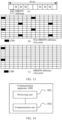
- the manner of sending the MBSFN subframe is: The network device sends two MBSFN subframes every 40 milliseconds. A subframe marked with "M” represents the MBSFN subframe, and a subframe that is not marked with "M” represents the non-MBSFN subframe. A structure of the non-MBSFN subframe is shown in (b) in FIG. 12 . When the port quantity of the CRS is 4, the quantity of CRS resources included in the non-MBSFN subframe is 24. A structure of the MBSFN subframe is shown in (c) in FIG. 12 . When the port quantity of the CRS is 4, the quantity of CRS resources included in the MBSFN subframe is 8, and is less than the quantity of CRS resources included in the non-MBSFN subframe.
- FIG. 13 When the preset condition is met, refer to FIG. 13 .
- the manner of sending the MBSFN subframe is changed to the following:
- the network device sends six MBSFN subframes every 10 milliseconds.
- a subframe marked with "M” represents the MBSFN subframe
- a subframe that is not marked with "M” represents the non-MBSFN subframe.
- the port quantity of the CRS of the first cell is changed from 4 to 1.
- FIG. 13 is a schematic diagram of a structure of the non-MBSFN subframe when the port quantity of the CRS is 1. In this case, the quantity of CRS resources included in the non-MBSFN subframe is 8.
- 13 is a schematic diagram of a structure of the MBSFN subframe when the port quantity of the CRS is 1.
- the quantity of CRS resources included in the MBSFN subframe is 2, and is less than the quantity of CRS resources included in the non-MBSFN subframe.
- the method may include a plurality of implementations.
- the network device only increases the sending periodicity of the MBSFN subframe (in other words, increases the quantity of MBSFN subframes), or the network device only reduces the port quantity of the CRS resource, or may increase both the quantity of MBSFN subframes and the port quantity of the CRS resource in the MBSFN subframe, to finally increase a quantity of resources that can be used by the NR cell. Therefore, spectral efficiency of the NR cell is improved.
- the network device may consider that a condition for shutting down the first cell is met, and therefore suspend providing a service for a terminal device in the first cell.
- the network device may further perform at least one of the following procedures.
- an LTE intra-frequency handover procedure is no longer triggered, but an inter-frequency/inter-system handover procedure starts.
- the terminal device is migrated to an inter-frequency/inter-RAT cell instead of the first cell, so that uplink and downlink co-channel interference between an LTE system and an NR system that is caused by untimely handover of the terminal device can be eliminated.
- That the first cell is the strongest neighboring cell may represent that a signal of the first cell is the strongest. For example, reference signal received power (reference signal received power, RSRP) of the signal of the first cell is the largest.
- reference signal received power reference signal received power
- the network device sends reconfiguration information to a terminal device in the second cell.
- the reconfiguration information indicates a position of the CRS resource and the quantity of CRS resources in the first cell.
- a resource other than the CRS resource in a resource shared by the first cell and the second cell may be used for data transmission of the terminal device in the second cell. Because the quantity of CRS resources in the first cell is reduced, a quantity of resources that can be used by the second cell is increased, thereby improving spectral efficiency and increasing a data throughput of the second cell.
- the resource herein may be a time-frequency resource, for example, may be an RE resource.
- the network device may send the reconfiguration information by using a first RRC reconfiguration (reconfiguration) message.
- the reconfiguration information may be a CRS rate matching pattern (CRS Rate Matching Pattern) in the first RRC reconfiguration message.
- the CRS rate matching pattern may indicate the position of the CRS resource and the quantity of CRS resources in the first cell to the terminal device in the second cell, so that the terminal device in the second cell determines RE resources that are occupied by the CRS. Therefore, the terminal device performs processing on an RE resource other than the RE resource occupied by the CRS. For example, the processing may be demodulating data on a channel.
- the network device may further cancel the first PDCCH in the first cell, and start to schedule the PDSCH from a 1st symbol in a time unit in the second cell.
- a scheduling range of the PDSCH of the second cell is a symbol 0 to a symbol 13 in the time unit.
- the port quantity of the CRS of the first cell may be further restored to the port quantity that is of the CRS and that exits before the preset condition is met, and the manner of sending the MBSFN subframe in the first cell may be restored to the manner that is of sending the MBSFN subframe and that exists before the preset condition is met.
- the network device may restore the port quantity of the CRS of the first cell to the port quantity that is of the CRS and that exists before the preset condition is met, and restore the manner of sending the MBSFN subframe in the first cell to the manner that is of sending the MBSFN subframe and that exists before the preset condition is met.
- a process in which the network device restores the first cell to a state that exists before the preset condition is met may include at least one of the following.
- the network device may further send a second RRC reconfiguration message to the terminal device in the second cell, where the second RRC reconfiguration message indicates that the port quantity of the CRS and the manner of sending the MBSFN subframe in the first cell are restored to the quantity and the manner that exist before the preset condition is met.
- the LTE cell may be deployed based on a requirement.
- the LTE cell when an LTE network capacity is large, the LTE cell is activated to absorb LTE traffic; or when an LTE network capacity is small, the LTE cell is shut down to effectively reduce impact of the LTE cell on performance of the NR cell in a DSS scenario.
- the uplink and downlink co-channel interference between the LTE system and the NR system that is caused by handover of the terminal device can be reduced, thereby improving system stability.
- the network device, the terminal device or the communication apparatus may include a hardware structure and/or a software module, and implement the foregoing functions in a form of the hardware structure, the software module, or a combination of the hardware structure and the software module. Whether a function in the foregoing functions is performed by using the hardware structure, the software module, or the combination of the hardware structure and the software module depends on particular applications and design constraints of the technical solutions.
- the module division in embodiments of this application is an example, and is merely logical function division. In an actual implementation, there may be another division manner.
- function modules in embodiments of this application may be integrated into one processor, or may exist alone physically, or two or more modules may be integrated into one module.
- the integrated module may be implemented in a form of hardware, or may be implemented in a form of a software function module.
- an embodiment of this application further provides a communication apparatus 1400.
- the communication apparatus 1400 may be the terminal device in FIG. 1 , and is configured to implement the method corresponding to the terminal device in the foregoing method embodiments.
- the communication apparatus may be the network device in FIG. 1 , and is configured to implement the method corresponding to the network device in the foregoing method embodiments.
- the communication apparatus 1400 may include a processing unit 1401 and a communication unit 1402.
- the communication unit may also be referred to as a transceiver unit, and may include a sending unit and/or a receiving unit, which are respectively configured to perform sending and receiving steps of the network device or the terminal device in the foregoing method embodiments.
- the following describes in detail the communication apparatus provided in this embodiment of this application with reference to FIG. 14 to FIG. 15 .
- the communication apparatus when the behavior and the function of the network device in the method embodiment shown in FIG. 5 are implemented by using the communication apparatus 1400, the communication apparatus includes:
- the processing unit is specifically configured to: if the quantity of symbols is 0, determine that the 1st symbol occupied by the physical downlink shared channel of the second cell in the time unit is a 1st symbol in the time unit.
- the communication unit is further configured to transmit data of the second cell by using a resource corresponding to a physical hybrid automatic repeat request indicator channel in the first cell, where the physical hybrid automatic repeat request indicator channel is located on the 1st symbol in the time unit.
- the communication unit is further configured to transmit the data of the second cell by using a resource corresponding to a physical control format indicator channel in the first cell, where the physical control format indicator channel is located on the 1st symbol in the time unit.
- the processing unit is specifically configured to: if it is determined not to use the first physical downlink control channel in the first cell, determine that the quantity of symbols occupied by the first physical downlink control channel is 0.
- the processing unit is specifically configured to: if the quantity of symbols is 1, determine that the 1st symbol occupied by the physical downlink shared channel of the second cell in the time unit is a 2nd symbol in the time unit, where the first physical downlink control channel of the first cell occupies a 1st symbol in the time unit.
- the processing unit is specifically configured to: if it is determined to use the first physical downlink control channel in the first cell and it is determined that the quantity of symbols occupied by the used first physical downlink control channel is less than 2, determine that the quantity of symbols occupied by the first physical downlink control channel is 1.
- the communication unit is configured to send first information to a terminal device in the second cell, where the first information indicates the 1st symbol occupied by the physical downlink shared channel in the time unit.
- the communication apparatus when the behavior and the function of the terminal device in the method embodiment shown in FIG. 5 are implemented by using the communication apparatus 1400, the communication apparatus includes:
- the 1st symbol occupied by the physical downlink shared channel of the second cell in the time unit is a 1st symbol in the time unit.
- the communication unit is further configured to send or receive data in a resource corresponding to a physical hybrid automatic repeat request indicator channel in the first cell, where the physical hybrid automatic repeat request indicator channel is located on the 1st symbol in the time unit.
- the communication unit is further configured to: send or receive data in a resource corresponding to a physical control format indicator channel in the first cell, where the physical control format indicator channel is located on the 1st symbol in the time unit.
- the communication apparatus when the behavior and the function of the network device in the method embodiment shown in FIG. 11 are implemented by using the communication apparatus 1400, the communication apparatus includes:
- reconfiguring the quantity of cell-specific reference signal resources of the first cell includes: changing a port quantity of a cell-specific reference signal of the first cell from a first quantity to a second quantity, where the first quantity is greater than the second quantity.
- the processing unit is specifically configured to: change a manner of sending a multimedia broadcast multicast service single frequency network subframe of the first cell from a first manner to a second manner, where periodicity duration corresponding to the first manner is first duration, and a quantity of multimedia broadcast multicast service single frequency network subframes sent in a periodicity corresponding to the first manner is a third quantity; periodicity duration corresponding to the second manner is second duration, and a quantity of multimedia broadcast multicast service single frequency network subframes included in a periodicity corresponding to the second manner is a fourth quantity; and changing the manner of sending the multimedia broadcast multicast service single frequency network subframe of the first cell from the first manner to the second manner includes: the first duration is greater than the second duration, and/or the third quantity is less than the fourth quantity.
- the preset condition includes at least one of the following: a service load of the first cell is less than or equal to a first load; and a service load of a co-coverage neighboring cell of the first cell is less than or equal to a second load.
- the communication unit is further configured to suspend providing a service for a terminal device in the first cell.
- a 1st symbol occupied by a physical downlink shared channel of the second cell in a time unit is a 1st symbol in the time unit.
- the communication unit may also be referred to as a transceiver, a transceiver machine, a transceiver apparatus, or the like.
- the processing unit may also be referred to as a processor, a processing board, a processing module, a processing apparatus, or the like.
- a component configured to implement a receiving function in the communication unit 1402 may be considered as a receiving unit, and a component configured to implement a sending function in the communication unit 1402 may be considered as a sending unit. That is, the communication unit 1402 includes a receiving unit and a sending unit.
- the communication unit sometimes may also be referred to as a transceiver machine, a transceiver, a transceiver circuit, or the like.
- the receiving unit sometimes may also be referred to as a receiver, a receiver machine, a receiving circuit, or the like.
- the sending unit sometimes may also be referred to as a transmitter, a transmitter machine, a transmitter circuit, or the like.
- the processing unit 1401 and the communication unit 1402 may further perform other functions.
- the processing unit 1401 and the communication unit 1402 may further perform other functions.
- FIG. 15 shows a communication apparatus 1500 according to an embodiment of this application.
- the communication apparatus shown in FIG. 15 may be an implementation of a hardware circuit of the communication apparatus shown in FIG. 14 .
- the communication apparatus may be applicable to the foregoing flowchart, and may perform the functions of the terminal device or the network device in the foregoing method embodiments.
- FIG. 15 shows only main components of the communication apparatus.
- a communication apparatus 1500 includes a processor 1510 and an interface circuit 1520.
- the processor 1510 and the interface circuit 1520 are coupled to each other.
- the interface circuit 1520 may be a transceiver or an input/output interface.
- the communication apparatus 1500 may further include a memory 1530, which is configured to store instructions executed by the processor 1510, or store input data needed by the processor 1510 to run the instructions, or store data generated after the processor 1510 runs the instructions.
- the processor 1510 is configured to implement the function of the processing unit 1401
- the interface circuit 1520 is configured to implement the function of the communication unit 1402.
- the chip in the terminal device implements the functions of the terminal device in the foregoing method embodiments.
- the chip in the terminal device receives information from another module (for example, a radio frequency module or an antenna) in the terminal device, where the information is sent by a network device to the terminal device; or the chip in the terminal device sends information to another module (for example, a radio frequency module or an antenna) in the terminal device, where the information is sent by the terminal device to a network device.
- another module for example, a radio frequency module or an antenna
- the chip in the network device implements the functions of the network device in the foregoing method embodiments.
- the chip in the network device receives information from another module (for example, a radio frequency module or an antenna) in the network device, where the information is sent by a terminal device to the network device; or the chip in the network device sends information to another module (for example, a radio frequency module or an antenna) in the network device, where the information is sent by the network device to a terminal device.
- the processor in embodiments of this application may be a central processing unit (Central Processing Unit, CPU), or may be another general-purpose processor, a digital signal processor (Digital Signal Processor, DSP), an application-specific integrated circuit (Application-Specific Integrated Circuit, ASIC), a field programmable gate array (Field Programmable Gate Array, FPGA), or another programmable logic device or a transistor logic device.
- the general-purpose processor may be a microprocessor, or may be any conventional processor.
- the memory in embodiments of this application may be a random access memory (Random Access Memory, RAM), a flash memory, a read-only memory (Read-Only Memory, ROM), a programmable read-only memory (Programmable ROM, PROM), an erasable programmable read-only memory (Erasable PROM, EPROM), an electrically erasable programmable read-only memory (Electrically EPROM, EEPROM), a register, a hard disk, a removable hard disk, or any other form of storage medium well known in the art.
- An example storage medium is coupled to the processor, so that the processor can read information from the storage medium and can write information to the storage medium. It is clear that the storage medium may alternatively be a component of the processor.
- the processor and the storage medium may be located in an ASIC.
- the ASIC may be located in a network device or a terminal device.
- the processor and the storage medium may alternatively exist in the network device or the terminal device as discrete components.
- this application may be provided as a method, a system, or a computer program product. Therefore, this application may use a form of hardware-only embodiments, software-only embodiments, or embodiments with a combination of software and hardware. In addition, this application may use a form of a computer program product that is implemented on one or more computer-usable storage media (including but not limited to a disk memory, an optical memory, and the like) that include computer-usable program code.
- computer-usable storage media including but not limited to a disk memory, an optical memory, and the like
- These computer program instructions may be provided for a general-purpose computer, a dedicated computer, an embedded processor, or a processor of any other programmable data processing device to generate a machine, so that the instructions executed by a computer or a processor of any other programmable data processing device generate an apparatus for implementing a specific function in one or more processes in the flowcharts and/or in one or more blocks in the block diagrams.
- These computer program instructions may alternatively be stored in a computer-readable memory that can indicate a computer or another programmable data processing device to work in a specific manner, so that the instructions stored in the computer-readable memory generate an artifact that includes an instruction apparatus.
- the instruction apparatus implements a specific function in one or more processes in the flowcharts and/or in one or more blocks in the block diagrams.
Landscapes
- Engineering & Computer Science (AREA)
- Signal Processing (AREA)
- Computer Networks & Wireless Communication (AREA)
- Mobile Radio Communication Systems (AREA)
Applications Claiming Priority (2)
| Application Number | Priority Date | Filing Date | Title |
|---|---|---|---|
| CN202111217641.9A CN116017734A (zh) | 2021-10-19 | 2021-10-19 | 一种调度方法及装置 |
| PCT/CN2022/117646 WO2023065874A1 (zh) | 2021-10-19 | 2022-09-07 | 一种调度方法及装置 |
Publications (2)
| Publication Number | Publication Date |
|---|---|
| EP4404665A1 true EP4404665A1 (de) | 2024-07-24 |
| EP4404665A4 EP4404665A4 (de) | 2025-01-22 |
Family
ID=86025311
Family Applications (1)
| Application Number | Title | Priority Date | Filing Date |
|---|---|---|---|
| EP22882489.2A Pending EP4404665A4 (de) | 2021-10-19 | 2022-09-07 | Planungsverfahren und -vorrichtung |
Country Status (4)
| Country | Link |
|---|---|
| US (1) | US20240275538A1 (de) |
| EP (1) | EP4404665A4 (de) |
| CN (1) | CN116017734A (de) |
| WO (1) | WO2023065874A1 (de) |
Families Citing this family (1)
| Publication number | Priority date | Publication date | Assignee | Title |
|---|---|---|---|---|
| US20250324418A1 (en) * | 2024-04-10 | 2025-10-16 | Dish Wireless L.L.C. | Dynamic Determination of A Physical Downlink Control Channel Symbol Count in A Subframe for A Radio Access Network |
Family Cites Families (11)
| Publication number | Priority date | Publication date | Assignee | Title |
|---|---|---|---|---|
| CA2771150C (en) * | 2009-09-28 | 2017-02-14 | Samsung Electronics Co., Ltd. | Extending physical downlink control channels |
| CN102869106B (zh) * | 2011-07-07 | 2018-04-10 | 中兴通讯股份有限公司 | Pdcch自适应调整方法及装置 |
| CN103024908B (zh) * | 2011-09-23 | 2015-07-22 | 普天信息技术研究院有限公司 | 一种自适应调整pdcch占用符号数的方法 |
| CN103716888B (zh) * | 2012-09-29 | 2017-04-12 | 普天信息技术研究院有限公司 | 一种控制信道资源的分配方法和基站 |
| CN104144503B (zh) * | 2013-05-10 | 2017-11-24 | 中国电信股份有限公司 | 动态提高pdcch容量上限的方法、系统与移动终端 |
| CN108024348B (zh) * | 2016-11-04 | 2024-05-07 | 华为技术有限公司 | 一种载波传输的方法、基站、用户设备和系统 |
| CN108366375B (zh) * | 2017-01-26 | 2021-09-14 | 华为技术有限公司 | 一种共享下行频谱的方法和装置 |
| CN109391396B (zh) * | 2017-08-10 | 2021-06-29 | 中国电信股份有限公司 | 下行载波资源复用的方法、装置和计算机可读存储介质 |
| CN112004232A (zh) * | 2019-05-27 | 2020-11-27 | 中兴通讯股份有限公司 | 一种lte和nr资源共享方法及装置 |
| CN118250806A (zh) * | 2019-08-16 | 2024-06-25 | 瑞典爱立信有限公司 | 用于利用动态频谱共享的非相干联合传输的速率匹配 |
| US11490404B2 (en) * | 2019-08-23 | 2022-11-01 | At&T Intellectual Property I, L.P. | Demodulation reference signal patterns for dynamic spectrum sharing with increased spectral efficiency for 5G or other next generation network |
-
2021
- 2021-10-19 CN CN202111217641.9A patent/CN116017734A/zh active Pending
-
2022
- 2022-09-07 WO PCT/CN2022/117646 patent/WO2023065874A1/zh not_active Ceased
- 2022-09-07 EP EP22882489.2A patent/EP4404665A4/de active Pending
-
2024
- 2024-04-10 US US18/632,201 patent/US20240275538A1/en active Pending
Also Published As
| Publication number | Publication date |
|---|---|
| CN116017734A (zh) | 2023-04-25 |
| WO2023065874A1 (zh) | 2023-04-27 |
| EP4404665A4 (de) | 2025-01-22 |
| US20240275538A1 (en) | 2024-08-15 |
Similar Documents
| Publication | Publication Date | Title |
|---|---|---|
| JP6776337B2 (ja) | 無線フレーム構成 | |
| EP3833129B1 (de) | Verfahren zur übertragung von konfigurationsinformationen und endgerätevorrichtung | |
| EP3883315A1 (de) | Verfahren zum umschalten zwischen uplinks, kommunikationsvorrichtung und kommunikationssystem | |
| US11343814B2 (en) | Slot scheduling method and apparatus | |
| US12010676B2 (en) | Method for determining frequency domain location of control resource set and related device | |
| JP7074764B2 (ja) | 送信方向構成方法、デバイス及びシステム | |
| US12150127B2 (en) | Handling physical downlink shared channel multi-TRP transmissions | |
| US20240032004A1 (en) | Wireless communication method and apparatus | |
| KR20210095699A (ko) | 데이터 송신 방법 및 디바이스 | |
| US20240313926A1 (en) | Communication method and apparatus | |
| JP7503656B2 (ja) | リソース決定方法及び装置 | |
| US20240275538A1 (en) | Scheduling method and apparatus | |
| JP7778840B2 (ja) | 無線フレーム構成 | |
| EP4557858A1 (de) | Verfahren zur bestimmung von direktkommunikationsschnittstellenressourcen, endgerät und netzwerkvorrichtung | |
| EP4354997A1 (de) | Signalübertragungsverfahren und -vorrichtung | |
| WO2025167774A1 (zh) | 一种通信方法及装置 | |
| WO2025162199A1 (zh) | 通信方法、装置及系统 | |
| CN113784438A (zh) | 信道配置方法及设备 | |
| HK40086691A (zh) | 无线电帧配置 |
Legal Events
| Date | Code | Title | Description |
|---|---|---|---|
| STAA | Information on the status of an ep patent application or granted ep patent |
Free format text: STATUS: THE INTERNATIONAL PUBLICATION HAS BEEN MADE |
|
| PUAI | Public reference made under article 153(3) epc to a published international application that has entered the european phase |
Free format text: ORIGINAL CODE: 0009012 |
|
| STAA | Information on the status of an ep patent application or granted ep patent |
Free format text: STATUS: REQUEST FOR EXAMINATION WAS MADE |
|
| 17P | Request for examination filed |
Effective date: 20240417 |
|
| AK | Designated contracting states |
Kind code of ref document: A1 Designated state(s): AL AT BE BG CH CY CZ DE DK EE ES FI FR GB GR HR HU IE IS IT LI LT LU LV MC MK MT NL NO PL PT RO RS SE SI SK SM TR |
|
| A4 | Supplementary search report drawn up and despatched |
Effective date: 20250102 |
|
| DAV | Request for validation of the european patent (deleted) | ||
| DAX | Request for extension of the european patent (deleted) | ||
| RIC1 | Information provided on ipc code assigned before grant |
Ipc: H04W 16/14 20090101ALI20241219BHEP Ipc: H04L 5/00 20060101ALI20241219BHEP Ipc: H04L 1/18 20230101ALI20241219BHEP Ipc: H04W 72/04 20230101AFI20241219BHEP |