EP4404334A1 - Temperaturverwaltungsvorrichtung und testsystem - Google Patents
Temperaturverwaltungsvorrichtung und testsystem Download PDFInfo
- Publication number
- EP4404334A1 EP4404334A1 EP23773483.5A EP23773483A EP4404334A1 EP 4404334 A1 EP4404334 A1 EP 4404334A1 EP 23773483 A EP23773483 A EP 23773483A EP 4404334 A1 EP4404334 A1 EP 4404334A1
- Authority
- EP
- European Patent Office
- Prior art keywords
- refrigerant
- valve
- management device
- inlet
- temperature management
- Prior art date
- Legal status (The legal status is an assumption and is not a legal conclusion. Google has not performed a legal analysis and makes no representation as to the accuracy of the status listed.)
- Pending
Links
Images

Classifications
-
- H—ELECTRICITY
- H01—ELECTRIC ELEMENTS
- H01M—PROCESSES OR MEANS, e.g. BATTERIES, FOR THE DIRECT CONVERSION OF CHEMICAL ENERGY INTO ELECTRICAL ENERGY
- H01M10/00—Secondary cells; Manufacture thereof
- H01M10/60—Heating or cooling; Temperature control
-
- H—ELECTRICITY
- H01—ELECTRIC ELEMENTS
- H01M—PROCESSES OR MEANS, e.g. BATTERIES, FOR THE DIRECT CONVERSION OF CHEMICAL ENERGY INTO ELECTRICAL ENERGY
- H01M10/00—Secondary cells; Manufacture thereof
- H01M10/60—Heating or cooling; Temperature control
- H01M10/65—Means for temperature control structurally associated with the cells
- H01M10/656—Means for temperature control structurally associated with the cells characterised by the type of heat-exchange fluid
- H01M10/6569—Fluids undergoing a liquid-gas phase change or transition, e.g. evaporation or condensation
-
- F—MECHANICAL ENGINEERING; LIGHTING; HEATING; WEAPONS; BLASTING
- F25—REFRIGERATION OR COOLING; COMBINED HEATING AND REFRIGERATION SYSTEMS; HEAT PUMP SYSTEMS; MANUFACTURE OR STORAGE OF ICE; LIQUEFACTION SOLIDIFICATION OF GASES
- F25B—REFRIGERATION MACHINES, PLANTS OR SYSTEMS; COMBINED HEATING AND REFRIGERATION SYSTEMS; HEAT PUMP SYSTEMS
- F25B1/00—Compression machines, plants or systems with non-reversible cycle
-
- F—MECHANICAL ENGINEERING; LIGHTING; HEATING; WEAPONS; BLASTING
- F25—REFRIGERATION OR COOLING; COMBINED HEATING AND REFRIGERATION SYSTEMS; HEAT PUMP SYSTEMS; MANUFACTURE OR STORAGE OF ICE; LIQUEFACTION SOLIDIFICATION OF GASES
- F25B—REFRIGERATION MACHINES, PLANTS OR SYSTEMS; COMBINED HEATING AND REFRIGERATION SYSTEMS; HEAT PUMP SYSTEMS
- F25B41/00—Fluid-circulation arrangements
- F25B41/20—Disposition of valves, e.g. of on-off valves or flow control valves
-
- F—MECHANICAL ENGINEERING; LIGHTING; HEATING; WEAPONS; BLASTING
- F25—REFRIGERATION OR COOLING; COMBINED HEATING AND REFRIGERATION SYSTEMS; HEAT PUMP SYSTEMS; MANUFACTURE OR STORAGE OF ICE; LIQUEFACTION SOLIDIFICATION OF GASES
- F25B—REFRIGERATION MACHINES, PLANTS OR SYSTEMS; COMBINED HEATING AND REFRIGERATION SYSTEMS; HEAT PUMP SYSTEMS
- F25B49/00—Arrangement or mounting of control or safety devices
- F25B49/02—Arrangement or mounting of control or safety devices for compression type machines, plants or systems
-
- H—ELECTRICITY
- H01—ELECTRIC ELEMENTS
- H01M—PROCESSES OR MEANS, e.g. BATTERIES, FOR THE DIRECT CONVERSION OF CHEMICAL ENERGY INTO ELECTRICAL ENERGY
- H01M10/00—Secondary cells; Manufacture thereof
- H01M10/42—Methods or arrangements for servicing or maintenance of secondary cells or secondary half-cells
-
- H—ELECTRICITY
- H01—ELECTRIC ELEMENTS
- H01M—PROCESSES OR MEANS, e.g. BATTERIES, FOR THE DIRECT CONVERSION OF CHEMICAL ENERGY INTO ELECTRICAL ENERGY
- H01M10/00—Secondary cells; Manufacture thereof
- H01M10/42—Methods or arrangements for servicing or maintenance of secondary cells or secondary half-cells
- H01M10/4285—Testing apparatus
-
- H—ELECTRICITY
- H01—ELECTRIC ELEMENTS
- H01M—PROCESSES OR MEANS, e.g. BATTERIES, FOR THE DIRECT CONVERSION OF CHEMICAL ENERGY INTO ELECTRICAL ENERGY
- H01M10/00—Secondary cells; Manufacture thereof
- H01M10/42—Methods or arrangements for servicing or maintenance of secondary cells or secondary half-cells
- H01M10/48—Accumulators combined with arrangements for measuring, testing or indicating the condition of cells, e.g. the level or density of the electrolyte
-
- H—ELECTRICITY
- H01—ELECTRIC ELEMENTS
- H01M—PROCESSES OR MEANS, e.g. BATTERIES, FOR THE DIRECT CONVERSION OF CHEMICAL ENERGY INTO ELECTRICAL ENERGY
- H01M10/00—Secondary cells; Manufacture thereof
- H01M10/42—Methods or arrangements for servicing or maintenance of secondary cells or secondary half-cells
- H01M10/48—Accumulators combined with arrangements for measuring, testing or indicating the condition of cells, e.g. the level or density of the electrolyte
- H01M10/486—Accumulators combined with arrangements for measuring, testing or indicating the condition of cells, e.g. the level or density of the electrolyte for measuring temperature
-
- H—ELECTRICITY
- H01—ELECTRIC ELEMENTS
- H01M—PROCESSES OR MEANS, e.g. BATTERIES, FOR THE DIRECT CONVERSION OF CHEMICAL ENERGY INTO ELECTRICAL ENERGY
- H01M10/00—Secondary cells; Manufacture thereof
- H01M10/60—Heating or cooling; Temperature control
- H01M10/61—Types of temperature control
- H01M10/613—Cooling or keeping cold
-
- H—ELECTRICITY
- H01—ELECTRIC ELEMENTS
- H01M—PROCESSES OR MEANS, e.g. BATTERIES, FOR THE DIRECT CONVERSION OF CHEMICAL ENERGY INTO ELECTRICAL ENERGY
- H01M10/00—Secondary cells; Manufacture thereof
- H01M10/60—Heating or cooling; Temperature control
- H01M10/62—Heating or cooling; Temperature control specially adapted for specific applications
- H01M10/625—Vehicles
-
- H—ELECTRICITY
- H01—ELECTRIC ELEMENTS
- H01M—PROCESSES OR MEANS, e.g. BATTERIES, FOR THE DIRECT CONVERSION OF CHEMICAL ENERGY INTO ELECTRICAL ENERGY
- H01M10/00—Secondary cells; Manufacture thereof
- H01M10/60—Heating or cooling; Temperature control
- H01M10/63—Control systems
-
- H—ELECTRICITY
- H01—ELECTRIC ELEMENTS
- H01M—PROCESSES OR MEANS, e.g. BATTERIES, FOR THE DIRECT CONVERSION OF CHEMICAL ENERGY INTO ELECTRICAL ENERGY
- H01M10/00—Secondary cells; Manufacture thereof
- H01M10/60—Heating or cooling; Temperature control
- H01M10/63—Control systems
- H01M10/637—Control systems characterised by the use of reversible temperature-sensitive devices, e.g. NTC, PTC or bimetal devices; characterised by control of the internal current flowing through the cells, e.g. by switching
-
- H—ELECTRICITY
- H01—ELECTRIC ELEMENTS
- H01M—PROCESSES OR MEANS, e.g. BATTERIES, FOR THE DIRECT CONVERSION OF CHEMICAL ENERGY INTO ELECTRICAL ENERGY
- H01M10/00—Secondary cells; Manufacture thereof
- H01M10/60—Heating or cooling; Temperature control
- H01M10/65—Means for temperature control structurally associated with the cells
- H01M10/656—Means for temperature control structurally associated with the cells characterised by the type of heat-exchange fluid
- H01M10/6561—Gases
-
- H—ELECTRICITY
- H01—ELECTRIC ELEMENTS
- H01M—PROCESSES OR MEANS, e.g. BATTERIES, FOR THE DIRECT CONVERSION OF CHEMICAL ENERGY INTO ELECTRICAL ENERGY
- H01M10/00—Secondary cells; Manufacture thereof
- H01M10/60—Heating or cooling; Temperature control
- H01M10/65—Means for temperature control structurally associated with the cells
- H01M10/656—Means for temperature control structurally associated with the cells characterised by the type of heat-exchange fluid
- H01M10/6567—Liquids
-
- F—MECHANICAL ENGINEERING; LIGHTING; HEATING; WEAPONS; BLASTING
- F25—REFRIGERATION OR COOLING; COMBINED HEATING AND REFRIGERATION SYSTEMS; HEAT PUMP SYSTEMS; MANUFACTURE OR STORAGE OF ICE; LIQUEFACTION SOLIDIFICATION OF GASES
- F25B—REFRIGERATION MACHINES, PLANTS OR SYSTEMS; COMBINED HEATING AND REFRIGERATION SYSTEMS; HEAT PUMP SYSTEMS
- F25B2700/00—Sensing or detecting of parameters; Sensors therefor
- F25B2700/19—Pressures
- F25B2700/193—Pressures of the compressor
- F25B2700/1933—Suction pressures
-
- F—MECHANICAL ENGINEERING; LIGHTING; HEATING; WEAPONS; BLASTING
- F25—REFRIGERATION OR COOLING; COMBINED HEATING AND REFRIGERATION SYSTEMS; HEAT PUMP SYSTEMS; MANUFACTURE OR STORAGE OF ICE; LIQUEFACTION SOLIDIFICATION OF GASES
- F25B—REFRIGERATION MACHINES, PLANTS OR SYSTEMS; COMBINED HEATING AND REFRIGERATION SYSTEMS; HEAT PUMP SYSTEMS
- F25B2700/00—Sensing or detecting of parameters; Sensors therefor
- F25B2700/21—Temperatures
- F25B2700/2115—Temperatures of a compressor or the drive means therefor
- F25B2700/21151—Temperatures of a compressor or the drive means therefor at the suction side of the compressor
-
- F—MECHANICAL ENGINEERING; LIGHTING; HEATING; WEAPONS; BLASTING
- F25—REFRIGERATION OR COOLING; COMBINED HEATING AND REFRIGERATION SYSTEMS; HEAT PUMP SYSTEMS; MANUFACTURE OR STORAGE OF ICE; LIQUEFACTION SOLIDIFICATION OF GASES
- F25B—REFRIGERATION MACHINES, PLANTS OR SYSTEMS; COMBINED HEATING AND REFRIGERATION SYSTEMS; HEAT PUMP SYSTEMS
- F25B2700/00—Sensing or detecting of parameters; Sensors therefor
- F25B2700/21—Temperatures
- F25B2700/2117—Temperatures of an evaporator
- F25B2700/21171—Temperatures of an evaporator of the fluid cooled by the evaporator
- F25B2700/21173—Temperatures of an evaporator of the fluid cooled by the evaporator at the outlet
-
- H—ELECTRICITY
- H01—ELECTRIC ELEMENTS
- H01M—PROCESSES OR MEANS, e.g. BATTERIES, FOR THE DIRECT CONVERSION OF CHEMICAL ENERGY INTO ELECTRICAL ENERGY
- H01M2220/00—Batteries for particular applications
- H01M2220/20—Batteries in motive systems, e.g. vehicle, ship, plane
-
- Y—GENERAL TAGGING OF NEW TECHNOLOGICAL DEVELOPMENTS; GENERAL TAGGING OF CROSS-SECTIONAL TECHNOLOGIES SPANNING OVER SEVERAL SECTIONS OF THE IPC; TECHNICAL SUBJECTS COVERED BY FORMER USPC CROSS-REFERENCE ART COLLECTIONS [XRACs] AND DIGESTS
- Y02—TECHNOLOGIES OR APPLICATIONS FOR MITIGATION OR ADAPTATION AGAINST CLIMATE CHANGE
- Y02E—REDUCTION OF GREENHOUSE GAS [GHG] EMISSIONS, RELATED TO ENERGY GENERATION, TRANSMISSION OR DISTRIBUTION
- Y02E60/00—Enabling technologies; Technologies with a potential or indirect contribution to GHG emissions mitigation
- Y02E60/10—Energy storage using batteries
Definitions
- This application relates to the field of batteries and more specifically to a temperature management device and a test system.
- Embodiments of this application provide a temperature management device and a test system, which can maintain a stable and suitable temperature for a battery pack in a battery pack test.
- a temperature management device configured to perform temperature management on a battery pack cooled by a refrigerant.
- the temperature management device includes a first port configured to detachably connect to a refrigerant outlet of the battery pack; a second port configured to detachably connect to a refrigerant inlet of the battery pack; a compressor; a condenser, where an inlet of the condenser is connected to an outlet of the compressor; an expansion valve, where a first inlet of the expansion valve is connected to an outlet of the condenser, and the first outlet of the expansion valve is connected to the second port; a pressure regulating valve, where a first end of the pressure regulating valve is connected to the first port, a second end of the pressure regulating valve is connected to an inlet of the compressor, and the pressure regulating valve is configured to regulate pressure of gas discharged from the refrigerant outlet of the battery pack so that a pressure value of gas discharged from the second end of the pressure regulating
- a loop is formed, circularly providing the refrigerant for the battery pack through the compressor, condenser, expansion valve, and pressure regulating valve.
- the monitoring device can monitor the state of the refrigerant at corresponding positions, for example, can monitor temperature, pressure, and amount of the refrigerant, thereby enabling temperature management for the battery pack connected to the temperature management device.
- a relatively stable temperature is maintained for the battery pack, and the temperature management device can be widely used in various test processes for battery packs.
- the temperature of the battery pack drops faster by using the refrigerant in the embodiments of this application.
- the preset range is 300 ⁇ 30 kPa, which can ensure the working efficiency of the compressor and reduce power consumption.
- the temperature management device further includes an adjustment assembly, where the adjustment assembly is configured to connect the inlet of the compressor and the outlet of the condenser, and the adjustment assembly is configured to adjust a proportion of a refrigerant entering the first inlet of the expansion valve to a refrigerant discharged through the outlet of the condenser.
- the pressure regulating valve in the embodiments of this application is configured to provide gas with a relatively stable pressure value to the compressor. Therefore, when the pressure of the refrigerant discharged from the battery pack does not fall within the preset range, adjustment can be made through the adjustment assembly.
- the adjustment assembly is configured to increase the proportion of the refrigerant entering the first inlet of the expansion valve to the refrigerant discharged through the outlet of the condenser if pressure of gas at the first end of the pressure regulating valve is higher than the preset range; and/or decrease the proportion of the refrigerant entering the first inlet of the expansion valve to the refrigerant discharged through the outlet of the condenser if pressure of gas at the first end of the pressure regulating valve is lower than the preset range.
- the adjustment assembly is configured to control at least some of the refrigerant discharged through the outlet of the condenser to flow to the inlet of the compressor if the pressure of the gas at the first end of the pressure regulating valve is lower than the preset range, to reduce the refrigerant entering the expansion valve, so as to prevent inadequate utilization of the refrigerant in the battery pack.
- the temperature management device further includes a control unit, where the control unit is configured to control the adjustment assembly based on the pressure of the gas at the first end of the pressure regulating valve. This allows for high regulation efficiency, thereby avoiding waste of power.
- the adjustment assembly includes a capillary tube; and an electromagnetic valve, where an inlet of the electromagnetic valve is connected to the outlet of the condenser, and an outlet of the electromagnetic valve is connected to the inlet of the compressor via the capillary tube.
- the monitoring device includes at least one of the following: a first sight glass disposed between the inlet of the compressor and the pressure regulating valve and configured to monitor liquid mixed in gas entering the inlet of the compressor; a first temperature sensor disposed between the pressure regulating valve and the first port and configured to monitor temperature of a refrigerant entering the pressure regulating valve; and a first pressure sensor disposed between the pressure regulating valve and the first port and configured to monitor pressure of the refrigerant entering the pressure regulating valve.
- the detected temperature and pressure of the refrigerant discharged from the battery pack may be recorded as data or used for adjusting another component within the temperature management device. For example, when the refrigerant discharged by the battery pack has a pressure value lower than a preset pressure value, it is determined that there is excessive refrigerant inside the battery pack, and therefore, the refrigerant entering the battery pack is reduced.
- the expansion valve is an H-type thermal expansion valve, and the expansion valve further includes a second inlet and a second outlet; the second inlet of the expansion valve is connected to the first port, allowing gas discharged from the refrigerant outlet of the battery pack to be discharged through the second outlet of the expansion valve; and the expansion valve is configured to adjust, based on the gas discharged from the refrigerant outlet of the battery pack, a refrigerant discharged from the first outlet of the expansion valve.
- the expansion valve can determine, based on the state such as temperature or pressure of the refrigerant passing through the second inlet and second outlet, whether the refrigerant is fully used in the battery pack, so as to increase or reduce the refrigerant discharged from the first outlet of the expansion valve.
- the temperature management device further includes a liquid storage tank, where an inlet of the liquid storage tank is connected to the outlet of the condenser, and the liquid storage tank is configured to store a refrigerant discharged from the outlet of the condenser; a dry filter, where the dry filter is disposed between an outlet of the liquid storage tank and the first inlet of the expansion valve and configured to filter impurities in a refrigerant discharged from the outlet of the liquid storage tank; and a fan configured to cool the condenser.
- the liquid storage tank stores the refrigerant to prevent refrigerant waste.
- the dry filter is configured to filter impurities in the refrigerant discharged from the outlet of the liquid storage tank, so as to improve the cooling effect of the refrigerant entering the battery pack.
- the fan may be configured to cool the condenser to improve the efficiency of the condenser.
- the monitoring device includes at least one of the following: a second sight glass disposed between the dry filter and the first inlet of the expansion valve and configured to monitor a state of a refrigerant entering the first inlet of the expansion valve; a second temperature sensor disposed between the dry filter and the first inlet of the expansion valve and configured to monitor temperature of the refrigerant entering the first inlet of the expansion valve; and a second pressure sensor disposed between the dry filter and the first inlet of the expansion valve and configured to monitor pressure of the refrigerant entering the first inlet of the expansion valve.
- the detected temperature and pressure of the refrigerant discharged from the dry filter may be recorded as data or used for adjusting another component within the temperature management device, so as to improve the cooling efficiency for the battery pack.
- the monitoring device further includes a third temperature sensor connected to the battery pack, where the third temperature sensor is configured to monitor internal temperature of the battery pack.
- the temperature management device is controlled to be turned on. Conversely, when the measured temperature meets the test requirement or the normal temperature of the battery pack, the temperature management device is controlled to be turned off, avoiding waste.
- the temperature management device further includes a first valve and a second valve, where the first valve is disposed between the outlet of the condenser and the first inlet of the expansion valve, and the second valve is disposed between the first port and the inlet of the compressor; and when the first valve and the second valve are closed, the battery pack is used to replace another battery pack and connected to the temperature management device, so that when the first valve and the second valve are opened again, the temperature management device performs temperature management on the battery pack.
- the temperature management device further includes a vacuum assembly, where the vacuum assembly is configured to evacuate the battery pack after the battery pack is connected to the temperature management device and before the first valve and the second valve are opened again, so as to remove excessive gas from the battery pack.
- the vacuum assembly is configured to evacuate the battery pack after the battery pack is connected to the temperature management device and before the first valve and the second valve are opened again, so as to remove excessive gas from the battery pack.
- a test system including the temperature management device according to the first aspect or any embodiment of the first aspect, and multiple battery packs, where the temperature management device is configured to separately perform, at different times, temperature management for the multiple battery packs cooled by a refrigerant, so as to test the multiple battery packs.
- connection should be understood in their general senses. For example, they may refer to a fixed connection, a detachable connection, or an integral connection, and may refer to a direct connection, an indirect connection via an intermediate medium, or an internal communication between two elements. Persons of ordinary skills in the art can understand specific meanings of these terms in this application as appropriate to specific situations.
- a plurality of means more than two (inclusive).
- a plurality of groups means more than two (inclusive) groups
- a plurality of pieces means more than two (inclusive) pieces.
- the battery in the embodiments of this application can be used in various electric devices to provide electrical power to the electric devices.
- the electric device may be a vehicle, a mobile phone, a portable device, a notebook computer, a ship, a spacecraft, an electric toy, an electric tool, or the like.
- the vehicle may be a fossil fuel vehicle, a natural gas vehicle, or a new energy vehicle.
- the new energy vehicle may be a battery electric vehicle, a hybrid electric vehicle, a range-extended electric vehicle, or the like.
- the spacecraft includes an airplane, a rocket, a space shuttle, a spaceship, and the like.
- the electric toy includes a fixed or mobile electric toy, for example, a game console, an electric toy car, an electric toy ship, an electric toy airplane, and the like.
- the electric tool includes an electric metal cutting tool, an electric grinding tool, an electric assembly tool, and an electric railway-specific tool, for example, an electric drill, an electric grinder, an electric wrench, an electric screwdriver, an electric hammer, an electric impact drill, a concrete vibrator, and an electric planer.
- the embodiments of this application impose no special limitation on the foregoing electric device.
- the battery may also be called a battery pack.
- the battery may include multiple battery cells, and the multiple battery cells may be connected in series, parallel, or series-parallel, where being connected in series-parallel means a combination of series and parallel connections.
- the multiple battery cells may be connected in series, parallel, or series-parallel to form a battery module first, and then a plurality of battery modules are connected in series, parallel, or series-parallel to form the battery.
- the multiple battery cells may be directly combined into a battery, or may first be combined into battery modules that are then combined into a battery.
- the battery cell may include a lithium-ion secondary battery, a lithium-ion primary battery, a lithium-sulfur battery, a sodium-lithium-ion battery, a sodium-ion battery, a magnesium-ion battery, or the like. This is not limited in the embodiments of this application.
- the battery cell may be cylindrical, flat, cuboid, or of other shapes, which is not limited in the embodiments of this application either.
- battery cells are typically divided into three types by packaging method: cylindrical battery cell, prismatic battery cell, and pouch battery cell. The type of battery is not limited in the embodiments of this application either.
- the battery mentioned in the embodiments of this application is a single physical module that includes one or more battery cells for providing a higher voltage and capacity.
- the battery mentioned in this application may include a battery module, a battery pack, or the like.
- a battery typically includes a box configured to enclose one or more battery cells. The box can prevent liquids or other foreign matter from affecting charging or discharging of the battery cell.
- the battery cell includes an electrode assembly and an electrolyte.
- the electrode assembly includes a positive electrode plate, a negative electrode plate, and a separator.
- Working of the battery cell mainly relies on migration of metal ions between the positive electrode plate and the negative electrode plate.
- the positive electrode plate includes a positive electrode current collector and a positive electrode active substance layer.
- the positive electrode active substance layer is applied on a surface of the positive electrode current collector. A part of positive electrode current collector uncoated with the positive electrode active substance layer protrudes out of a part of positive electrode current collector coated with the positive electrode active substance layer and serves as a positive tab.
- a lithium-ion battery is used as an example, for which, the positive electrode current collector may be made of aluminum and the positive electrode active substance may be lithium cobaltate, lithium iron phosphate, ternary lithium, lithium manganate, or the like.
- the negative electrode plate includes a negative electrode current collector and a negative electrode active substance layer.
- the negative electrode active substance layer is applied on a surface of the negative electrode current collector.
- a part of negative electrode current collector uncoated with the negative electrode active substance layer protrudes out of a part of negative electrode current collector coated with the negative electrode active substance layer and serves as a negative tab.
- the negative electrode current collector may be made of copper, and the negative electrode active substance may be carbon, silicon, or the like.
- the separator may be made of polypropylene (polypropylene, PP), polyethylene (polyethylene, PE), or the like.
- the electrode assembly may be a wound structure or a stacked structure.
- the embodiments of this application are not limited thereto.
- FIG. 1 is a schematic block diagram of a temperature management device 1 according to an embodiment of this application.
- the temperature management device 1 in this embodiment of this application is configured to perform temperature management on a battery pack 2 cooled by a refrigerant.
- the temperature management device 1 includes a first port 11 configured to detachably connect to a refrigerant outlet 21 of the battery pack 2; a second port 12 configured to detachably connect to a refrigerant inlet 22 of the battery pack 2; a compressor 10; a condenser 20, where an inlet 201 of the condenser 20 is connected to an outlet 102 of the compressor 10; an expansion valve 30, where a first inlet 301 of the expansion valve 30 is connected to an outlet 202 of the condenser 20, and the first outlet 302 of the expansion valve 30 is connected to the second port 12; a pressure regulating valve 40, where a first end 401 of the pressure regulating valve 40 is connected to the first port 11, a second end 402 of the pressure regulating valve 40
- the temperature management device 1 in this embodiment of this application is connected to the battery pack 2, a loop is formed, circularly providing the refrigerant for the battery pack 2 through the compressor 10, condenser 20, expansion valve 30, and pressure regulating valve 40.
- the monitoring device 50 can monitor the state of the refrigerant at corresponding positions, for example, can monitor temperature, pressure, and amount of the refrigerant, thereby enabling temperature management for the battery pack 2 connected to the temperature management device 1. In this way, a relatively stable temperature is maintained for the battery pack 2, and the temperature management device 1 can be widely used in various test processes for battery packs 2. Particularly, during charge and discharge of battery packs 2, a significant amount of heat is generated. As compared with other cooling methods, temperature of the battery pack 2 drops faster by using the refrigerant in the embodiments of this application.
- FIG. 2 is a schematic block diagram of a temperature management device 1 performing temperature management for a battery pack 2 according to an embodiment of this application.
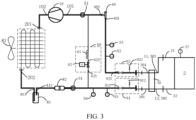
- FIG. 3 is another schematic block diagram of a temperature management device 1 performing temperature management for a battery pack 2 according to an embodiment of this application.
- both the first port 22 and the battery pack 2 and the second port 12 and the battery pack 2 are detachably connected, allowing the temperature management device 1 to perform temperature management on different battery packs.
- the temperature management device 1 may be configured to separately perform, at different times, temperature management for multiple battery packs cooled by a refrigerant, so as to test the multiple battery packs.
- the temperature management device 1 can be reused, and easy to dismount and mount.
- the temperature management device 1 in this embodiment of this application can be used in a test system.
- the test system includes the temperature management device 1 and multiple battery packs.
- the temperature management device 1 is configured to separately perform, at different times, temperature management for multiple battery packs cooled by a refrigerant, so as to test the multiple battery packs.
- the test system including the temperature management device 1 and the multiple battery packs can be used in various test processes.
- the temperature management device 1 can be used in at least one of the following test processes of the battery pack 2: mud resistance (Mud resistance) test, high-temperature operating endurance test (High Temperature Operating Endurance Test, HTOE), and seasonal test.
- test conditions may include: the battery pack 2 is placed in an ambient temperature box, where the temperature of the ambient temperature box is kept at a constant temperature of 25°C; when the surface temperature of battery cells inside the battery pack 2 is higher than or equal to 38°C, the temperature management device 1 needs to be turned on, and when the temperature drops to 35°C, the temperature management device 1 can be turned off; and the test period is 1 year.
- the temperature of the battery cells can be monitored using a negative temperature coefficient (Negative Temperature Coefficient, NTC) thermistor.
- NTC Negative Temperature Coefficient
- test conditions usually include: the surface temperature (for example, as measured through an NTC test) of the battery cells inside the battery pack 2 needs to be controlled at 50°C ⁇ 2°C for a continuous test period of four months. If the temperature management device 1 is not used and the battery pack 2 is provided with a charge and discharge motor, the NTC detected temperature can reach 58°C, but the maximum temperature of the battery cells cannot exceed 57°C. Therefore, the temperature management device 1 can be turned on at any time after the battery pack 2 exceeds the test temperature, and the temperature management device 1 is turned off when the temperature drops to the required test temperature.
- temperature management being performed for any battery pack 2 is used as an example for description in this application.
- the battery pack 2 needs to be maintained at a preset temperature value.
- This preset temperature value may be a specific value or a range of values.
- the preset temperature value may be set to be lower than or equal to 38°C.
- the length, width, and height of the battery pack 2 in this embodiment of this application may be 450*650* 1200, which are all measured in millimeters (mm), but this embodiment of this application is not limited thereto.
- the temperature management device 1 further includes a first valve 91 and a second valve 92.
- the first valve 91 is disposed between the outlet 202 of the condenser 20 and the first inlet 301 of the expansion valve 30, and the second valve 92 is disposed between the first port 11 and the inlet 101 of the compressor 10.
- the battery pack 2 is used to replace another battery pack and connected to the temperature management device 1.
- the temperature management device 1 performs temperature management on the battery pack 2.
- the opening and closing of the first valve 91 and the second valve 92 can implement change of the battery pack 2 without wasting the refrigerant discharged from the condenser 20 or introducing impurities into the compressor 10.
- the temperature management device 1 and the battery pack 2 can form a closed loop, and the internal refrigerant circulates in this loop, improving refrigerant utilization.
- the temperature management device 1 can also be set to a closed state. For example, closing the compressor 10 and/or the condenser 20 can save power and prevent waste.
- first valve 91 and the second valve 92 in this embodiment of this application can be implemented in various ways.
- first valve 91 and the second valve 92 can be implemented in the same or different ways.
- the first valve 91 in this embodiment of this application may include a first manual ball valve 911 and/or a first needle valve 912; and the second valve 92 may include a second manual ball valve 921 and/or a second needle valve 922.
- the first valve 91 and the second valve 92 can use a same valve for ease of operation.
- the first valve 91 may include the first manual ball valve 911, and the second valve 92 may include the second manual ball valve 921.
- the battery pack 2 may be used to replace another battery pack and then mounted, or the battery pack 2 may be dismounted and replaced with another battery pack.
- the first valve 91 may further include the first needle valve 912, or the second valve 92 may include the second needle valve 922.
- the first needle valve 912 or the second needle valve 922 may be connected to a refrigerant recycling machine to recycle the remaining refrigerant inside the battery pack 2. After the recycling, the battery pack 2 is dismounted and replaced with another battery pack. This allows the refrigerant to be recycled for reuse, avoiding refrigerant waste and environmental pollution.
- the temperature management device 1 in this embodiment of this application may further include a vacuum assembly.
- the vacuum assembly is configured to evacuate the battery pack 2 after the battery pack 2 is connected to the temperature management device 1 and before the first valve 91 and the second valve 92 are opened again.
- the vacuum assembly may be first used to evacuate the battery pack 2 to remove excess gas from the battery pack 2.
- the vacuum assembly may be connected to the first needle valve 912 of the first valve 91 and/or the second needle valve 922 of the second valve 92, and the battery pack 2 is evacuated through the first needle valve 912 and/or the second needle valve 922.
- the first valve 91 and the second valve 92 are opened again, to be specific, after the first manual ball valve 911 of the first valve 91 and the second manual ball valve 921 of the second valve 92 are opened again, in the process of the temperature management device 1 performing temperature management on the battery pack 2, only the refrigerant circulates in the closed loop formed by the temperature management device 1 and the battery pack 2, avoiding the influence of other gases and improving the cooling effect of the refrigerant and system stability.
- the refrigerant may be added to the closed loop formed by the temperature management device 1 and the battery pack 2.
- the temperature management device 1 may be turned on at any time. For example, the temperature management device 1 may be turned on at any time when the temperature of the battery pack 2 exceeds the test condition, allowing to cool the battery pack 2.
- the refrigerant in this embodiment of this application may be made of various materials.
- the refrigerant may be a 134a refrigerant, which has a good cooling effect on the battery pack 2, but the embodiments of this application are not limited thereto.
- the refrigerant in this embodiment of this application may be added at any position of the temperature management device 1.
- the refrigerant is usually added at a low-pressure end or high-pressure end of the compressor 10, allowing the temperature management device 1 to be turned on at any time after the refrigerant is added.
- the refrigerant may alternatively be added through the first needle valve 912 of the first valve and/or the second needle valve 922 of the second valve 92, and the embodiments of this application are not limited thereto.
- the inlet 101 of the compressor 10 is connected to the refrigerant outlet 21 of the battery pack 2 in this embodiment of this application and may be configured to compress gas discharged from the refrigerant outlet 21 of the battery pack 2.
- the refrigerant may cool the battery pack 2 in a way of vaporizing a liquid refrigerant to absorb heat, and the refrigerant outlet 21 of the battery pack 2 discharges vaporized gas of a high temperature.
- This vaporized gas enters through the inlet 101 of the compressor 10, where the compressor 10 increases the pressure of the gas.
- the compressed high-pressure gas is then discharged from the outlet 102 of the compressor 10 to the condenser 20.
- the type of the compressor 10 in this embodiment of this application may be flexibly selected depending on practical applications.
- the compressor 10 may be a direct current variable frequency compressor and may be powered in a manner of alternating current (Alternating current, AC) to direct current (Direct current, DC) to enhance the working efficiency of the compressor 10, but the embodiments of this application are not limited thereto.
- the working frequency of the compressor 10 may be adjusted based on the temperature change of the battery pack 2. For example, during the test of the battery pack 2, the temperature of the battery pack 2 needs to be maintained at a preset temperature value.
- the working frequency of the compressor 10 may be increased to rapidly reduce the temperature of the battery pack 2. Conversely, if the temperature of the battery pack 2 increases only slightly as compared with the preset temperature value, the working frequency of the compressor 10 may be appropriately reduced to avoid power waste of the compressor 10 and prevent resource waste and equipment failure caused by repeated activation and deactivation of the temperature management device 1.
- the outlet 102 of the compressor 10 is connected to the inlet 201 of the condenser 20.
- the condenser 20 is configured to liquefy the high-temperature, high-pressure gas discharged from the outlet 102 of the compressor 10 to obtain a low-temperature liquid refrigerant.
- the type of the condenser 20 in this embodiment of this application may be flexibly selected depending on practical applications.
- the condenser 20 may be a fin condenser to improve the heat dissipation efficiency of the condenser 20.
- the temperature management device 1 in this embodiment of this application further includes a fan 83 configured to cool the condenser 20, to further improve the efficiency of the condenser 20.
- the temperature management device 1 in this embodiment of this application further includes a liquid storage tank 81.
- the inlet 811 of the liquid storage tank 81 is connected to the outlet 202 of the condenser 20, and the outlet 812 of the liquid storage tank 81 is connected to the second port.
- the outlet 812 of the liquid storage tank 81 may be connected to the first valve 91.
- the liquid storage tank 81 is configured to store the refrigerant discharged from the outlet 202 of the condenser 20.
- the liquid storage tank 81 stores the refrigerant to prevent refrigerant waste.
- the temperature management device 1 in this embodiment of this application further includes a dry filter 82.
- the dry filter 82 is disposed between the outlet 202 of the condenser 20 and the first inlet 301 of the expansion valve 30.
- the dry filter 82 may be located between the outlet 812 of the liquid storage tank 81 and the first inlet 301 of the expansion valve 30.
- the dry filter 82 may be located between the outlet 812 of the liquid storage tank 81 and the first valve 91.
- the dry filter 82 is configured to filter impurities in the refrigerant discharged from the outlet 812 of the liquid storage tank 81, so as to improve the cooling effect of the refrigerant entering the battery pack 2.
- the refrigerant may contain impurities such as water.
- the monitoring device 50 in this embodiment of this application may include at least one of the following: a second sight glass 54 disposed between the dry filter 82 and the first inlet 301 of the expansion valve 30 and configured to monitor a state of a refrigerant entering the first inlet 301 of the expansion valve 30, for example, observing the amount of bubbles in the refrigerant or observing the amount of water in the refrigerant; a second temperature sensor 55 disposed between the dry filter 82 and the first inlet 301 of the expansion valve 30 and configured to monitor temperature of the refrigerant entering the first inlet 301 of the expansion valve 30; and a second pressure sensor 56 disposed between the dry filter 82 and the first inlet 301 of the expansion valve 30 and configured to monitor pressure of the refrigerant entering the first inlet 301 of the expansion valve 30.
- a second sight glass 54 disposed between the dry filter 82 and the first inlet 301 of the expansion valve 30 and configured to monitor a state of a refrigerant entering the first inlet 301 of the expansion
- the second sight glass 54, the second temperature sensor 55, and the second pressure sensor 56 in this embodiment of this application may be located between the dry filter 82 and the first valve 91 to monitor the state of the refrigerant at respective positions.
- the relative positions between the second sight glass 54, the second temperature sensor 55, and the second pressure sensor 56 are not limited in this embodiment of this application. They may be arranged in the order shown in FIGs. 2 and 3 or in other orders.
- the temperature management device 1 in this embodiment of this application may further include a control unit 70.
- the control unit 70 may be connected to the second temperature sensor 55 and the second pressure sensor 56 to timely obtain the temperature and pressure of the refrigerant discharged from the dry filter 82.
- the temperature and pressure may be recorded as data or used for adjusting another component within the temperature management device 1.
- the control unit 70 shown in FIG. 2 is not illustrated in FIG. 3 of this embodiment of this application.
- control unit 70 of this embodiment of this application may be implemented in various ways.
- the control unit 70 may be a controller, such as a programmable controller (Programmable Controller, PLC), to control a component connected thereto.
- PLC Programmable Controller
- the refrigerant discharged from the condenser 20 in this embodiment of this application may enter the battery pack 2 through the expansion valve 30.
- the expansion valve 30 in this embodiment of this application may include a first inlet 301 and a first outlet 302.
- the first outlet 302 may serve as the first port of the temperature management device 1 for connecting to the battery pack 2.
- the expansion valve 30 may be configured to depressurize the liquid refrigerant discharged from the condenser 20. The depressurized refrigerant enters the battery pack 2 through the refrigerant inlet 22 of the battery pack 2.
- the internal refrigerant of the battery pack 2 may be vaporized to cool the battery pack 2. The vaporized gas is then discharged from the refrigerant outlet 21 of the battery pack 2.
- the refrigerant entering the expansion valve 30 is typically a low-temperature, high-pressure refrigerant.
- the refrigerant is typically in a pressure range of 1500 kPa (kPa) ⁇ 60 kPa.
- the expansion valve 30 may depressurize the refrigerant, and the depressurized refrigerant enters the vacuum battery pack 2 through the refrigerant inlet 22 of the battery pack 2, to cool the battery pack 2.
- the expansion valve 30 may further be configured to adjust the amount of the refrigerant entering the battery pack 2. For example, when the temperature of the battery pack 2 increases significantly, in other words, when the temperature of the battery pack 2 is much higher than the preset temperature value, the expansion valve 30 may release a larger amount of refrigerants. Conversely, when the temperature increase of the battery pack 2 is small, a smaller amount of refrigerants is released.
- the type of the expansion valve 30 in this embodiment of this application may be flexibly selected depending on practical applications.
- the expansion valve 30 may be an H-type thermal expansion valve.
- the expansion valve 30 may further include a second inlet 303 and a second outlet 304.
- the second inlet 303 of the expansion valve 30 is connected to the first port 11, or the second inlet 303 of the expansion valve 30 may function as the first port 11. This allows gas discharged from the refrigerant outlet 21 of the battery pack 2 to be discharged through the second outlet 304 of the expansion valve 30.
- the expansion valve 30 is configured to adjust, based on the gas discharged from the refrigerant outlet 21 of the battery pack 2, the refrigerant discharged from the first outlet 302 of the expansion valve 30 to the battery pack 2. Specifically, the expansion valve 30 may determine, based on the state such as temperature or pressure of the refrigerant passing through the second inlet 303 and second outlet 304, whether the refrigerant is fully used in the battery pack 2. The expansion valve 30 may further include a temperature monitoring structure to sense or measure the temperature of the refrigerant passing through the battery pack 2.
- the expansion valve 30 may reduce the refrigerant discharged from the first outlet 302 to the battery pack 2. Conversely, if there is insufficient refrigerant in the battery pack 2, the temperature of the battery pack 2 is high, and the temperature of the refrigerant passing through the second inlet 303 of the expansion valve 30 is also higher than the preset temperature value. In this case, the expansion valve 30 may increase the refrigerant discharged from the first outlet 302 to the battery pack 2.
- the preset temperature value for the discharged refrigerant is typically set to 0°C to 5°C
- the pressure of the refrigerant discharged from the battery pack 2 decreases.
- the preset pressure value for the discharged refrigerant is typically set to 300 kPa ⁇ 30 kPa or 300 kPa ⁇ 20 kPa, but the embodiments of this application are not limited thereto.
- the vaporized gas discharged from the refrigerant outlet 21 of the battery pack 2 of this embodiment of this application may carry some liquid.
- incomplete vaporization of the refrigerant may result in discharge of a mixture of vaporized refrigerant and liquid.
- the embodiments of this application are not limited thereto.
- the monitoring device 50 further includes a third temperature sensor 57 connected to the battery pack 2.
- the third temperature sensor 57 is configured to monitor the internal temperature of the battery pack 2. For example, when the temperature measured by the third temperature sensor 57 exceeds the required test temperature or the normal temperature of the battery pack 2, the temperature management device 1 is controlled to be turned on. Conversely, when the measured temperature meets the test requirement or the normal temperature of the battery pack 2, the temperature management device is controlled to be turned off.
- the third temperature sensor 57 may be connected to the control unit 70, enabling the control unit 70 to obtain the internal temperature of the battery pack 2. This temperature value may be recorded as experimental data and used for adjusting the temperature management device 1.
- the gas discharged from the battery pack 2 may either directly enter the compressor 10 or pass through the pressure regulating valve 40 to enter the compressor 10.
- the first end 401 of the pressure regulating valve 40 in this embodiment of this application is connected to the refrigerant outlet 21 of the battery pack 2.
- the first end 401 of the pressure regulating valve 40 may be connected to the second valve 92.
- the second end 402 of the pressure regulating valve 40 is connected to the inlet 101 of the compressor 10.
- the pressure regulating valve 40 may be configured to regulate the pressure value of the gas discharged from the second end 402 of the pressure regulating valve 40 to the inlet 101 of the compressor 10 to be within a preset range.
- the preset range in this embodiment of this application may be set depending on practical applications. For example, it may be set depending on the working efficiency of the compressor 10.
- the preset pressure value for the refrigerant discharged from the battery pack 2 in this embodiment of this application is typically 300 kPa ⁇ 30 kPa.
- the preset range may be set to 300 ⁇ 30 kPa to ensure the working efficiency of the compressor 10 and reduce power consumption.
- the monitoring device 50 in this embodiment of this application further includes at least one of the following: a first sight glass 51 disposed between the inlet 101 of the compressor 10 and the pressure regulating valve 40 and configured to monitor liquid mixed in gas entering the inlet 101 of the compressor 10; a first temperature sensor 52 disposed between the pressure regulating valve 40 and the first port 11 and configured to monitor temperature of a refrigerant entering the pressure regulating valve 40; and a first pressure sensor 53 disposed between the pressure regulating valve 40 and the first port 11 and configured to monitor pressure of the refrigerant entering the pressure regulating valve 40.
- the first sight glass 51 in this embodiment of this application is typically disposed between the compressor 10 and the pressure regulating valve 40 to monitor the state of a liquid mixed in the gas entering the compressor 10.
- it may be configured to observe the state of a liquid refrigerant mixed in the gas entering the compressor 10.
- the liquid refrigerant mixed in the gas entering the compressor 10 can be reduced in a timely manner when excessive liquid refrigerant mixed in the gas enters the compressor 10. This avoids that the excess low-temperature refrigerant enters the compressor 10, causing too much ice at the low-pressure end of the compressor 10 and avoiding a liquid impact accident with the compressor 10.
- the first temperature sensor 52 and the first pressure sensor 53 of this embodiment of this application may be disposed between the pressure regulating valve 40 and the second valve 92 to monitor the temperature and pressure of the refrigerant entering the pressure regulating valve 40.
- the relative order of the first temperature sensor 52 and the first pressure sensor 53 is not limited in this embodiment of this application.
- the first temperature sensor 52 and the first pressure sensor 53 may be arranged in an order shown in FIGs. 2 and 3 or in other orders.
- control unit 70 of this embodiment of this application may be connected to the first temperature sensor 52 and the first pressure sensor 53 to obtain the temperature and pressure of the refrigerant discharged from the battery pack 2 in a timely manner.
- the obtained temperature and pressure of the refrigerant discharged from the battery pack 2 may be recorded as data or used for adjusting another component within the temperature management device 1. For example, when the refrigerant discharged by the battery pack 2 has a pressure value lower than a preset pressure value, it is determined that there is excessive refrigerant inside the battery pack 2, and therefore, the refrigerant entering the battery pack 2 is reduced.
- the second end 402 of the pressure regulating valve 40 in this embodiment of this application may be configured to input gas whose pressure value is within the preset range to the inlet 101 of the compressor 10.
- the pressure value of the refrigerant at the first end 401 of the pressure regulating valve 40 may not fall within this preset range. Therefore, the temperature management device 1 needs to be adjusted. Specifically, various reasons may lead to the pressure of the refrigerant at the first end 401 of the pressure regulating valve 40 being lower than the preset range. For example, the temperature of the refrigerant discharged from the condenser 20 being too low may lead to a too low pressure value of the refrigerant at the first end 401 of the pressure regulating valve 40.
- the pressure value of the gas at the first end 401 of the pressure regulating valve 40 may alternatively be caused by the pressure value of the gas at the high-pressure end of the compressor 10 being low, that is, the pressure value of the gas discharged from the outlet 102 of the compressor 10 to the condenser 20 being low.
- the temperature of the battery pack 2 being too low may also lead to a too low pressure value of the refrigerant at the first end 401 of the pressure regulating valve 40.
- the foregoing reasons may be present alone or together.
- the pressure regulating valve 40 may be disposed to prevent the temperature of the refrigerant temperature entering the compressor 10 from being too low.
- the temperature management device 1 in this embodiment of this application may further include an adjustment assembly 60.
- the adjustment assembly 60 is configured to connects the inlet 101 of the compressor 10 and the outlet 202 of the condenser 20.
- the adjustment assembly 60 is configured to adjust the proportion of the refrigerant entering the first inlet 301 of the expansion valve 30 to the refrigerant discharged from the outlet 202 of the condenser 20.
- the pressure regulating valve 40 in the embodiments of this application is configured to provide gas with a relatively stable pressure value to the compressor 10. Therefore, when the pressure of the refrigerant discharged from the battery pack 2 does not fall within the preset range, adjustment may be made through the adjustment assembly 60.
- the pressure regulating valve 40 of this embodiment of this application may be connected to the control unit 70.
- the adjustment assembly 60 may also be connected to the control unit 70.
- the control unit 70 is configured to control the adjustment assembly 60 based on the pressure of the gas at the first end 401 of the pressure regulating valve 40, to facilitate timely adjustment of the temperature management device 1, thereby improving the cooling efficiency and avoiding waste.
- the adjustment assembly 60 of this embodiment of this application may be configured to increase the proportion of the refrigerant entering the first inlet 301 of the expansion valve 30 to the refrigerant discharged through the outlet 202 of the condenser 20 if pressure of gas at the first end 401 of the pressure regulating valve 40 is higher than the preset range. Specifically, if the pressure of the gas entering the first end 401 of the pressure regulating valve 40 is higher than the preset range, or if the temperature of the gas entering the first end 401 of the pressure regulating valve 40 is higher than the preset temperature value, the refrigerant in the battery pack 2 may be insufficient.
- the refrigerant entering the first inlet 301 of the expansion valve 30 may be increased by using the adjustment assembly 60, to increase the refrigerant in the battery pack 2, thereby implementing rapid temperature drop and reducing the pressure of the gas at the first end 401 of the pressure regulating valve 40.
- the adjustment assembly 60 of this embodiment of this application may be further configured to decrease the proportion of the refrigerant entering the first inlet 301 of the expansion valve 30 to the refrigerant discharged through the outlet 202 of the condenser 20 if pressure of gas at the first end 401 of the pressure regulating valve 40 is lower than the preset range. Specifically, if the pressure of the gas entering the first end 401 of the pressure regulating valve 40 is lower than the preset range, or if the temperature of the gas entering the first end 401 of the pressure regulating valve 40 is lower than the preset temperature value, the refrigerant in the battery pack 2 may be excessive or the temperature of the refrigerant in the battery pack 2 may be too low. Therefore, the refrigerant entering the first inlet 301 of the expansion valve 30 may be reduced by using the adjustment assembly 60, to reduce the refrigerant in the battery pack 2, thereby avoiding refrigerant waste.
- the adjustment assembly 60 is configured to control at least some of the refrigerant discharged from the outlet 202 of the condenser 20 to flow to the inlet 101 of the compressor 10. This can reduce the refrigerant discharged by the condenser 20 entering the expansion valve 30, thereby reducing the refrigerant entering the battery pack 2 and avoiding waste.
- the adjustment assembly 60 of this embodiment of this application may be configured depending on practical applications.
- the adjustment assembly 60 may include a capillary tube 61 and an electromagnetic valve 62.
- An inlet 621 of the electromagnetic valve 62 is connected to the outlet 202 of the condenser 20, and an outlet 622 of the electromagnetic valve 62 is connected to the inlet 101 of the compressor 10 via the capillary tube 61.
- This configuration is not only convenient for adjustment but also relatively simple in terms of wiring.
- the electromagnetic valve 62 of this embodiment of this application may have two states: open and closed.
- the amount of the refrigerant flowing from the electromagnetic valve 62 to the capillary tube 61 may be adjusted by controlling the duration or frequency of the electromagnetic valve 62 being open.
- the electromagnetic valve 62 is closed, or the duration or frequency of the electromagnetic valve 62 being open is reduced. This allows a large amount of refrigerant discharged from the condenser 20 to enter the expansion valve 30, that is, enter the battery pack 2, and relatively a small amount of refrigerant or no refrigerant enters the compressor 10 through the capillary tube 61.
- the electromagnetic valve 62 is opened, or the duration or frequency of the electromagnetic valve 62 being open is increased.
- electromagnetic valves 62 may be selected in the embodiments of this application depending on practical applications.
- the electromagnetic valve 62 may be a liquid electromagnetic valve.
- the pressure of the refrigerant at the first end 401 of the pressure regulating valve 40 of this embodiment of this application may be increased through other manner than the adjustment manner based on the adjustment assembly 60.
- the pressure of the refrigerant at the first end 401 of the regulating valve 40 may be increased through another manner together with the adjustment manner based on the adjustment assembly 60.
- the amount of the refrigerant entering the battery pack 2 may be controlled through the expansion valve 30.
- the adjustment may be made through the compressor 10, where the compressor 10 is a variable frequency compressor 10. Specifically, if the pressure of the refrigerant at the first end 401 of the pressure regulating valve 40 is lower than the preset range, or if in the case that the electromagnetic valve 62 is fully opened, the pressure of the refrigerant at the first end 401 of the pressure regulating valve 40 is still lower than the preset range, the working frequency of the compressor 10 may be reduced to decrease the gas displacement of the compressor 10, in other words, reduce the compression rate of the refrigerant inside the compressor 10, thereby increasing the pressure of the refrigerant at the first end 401 of the pressure regulating valve 40.
- the pressure of the refrigerant at the first end 401 of the pressure regulating valve 40 may be reduced by increasing the working frequency of the compressor 10, for example, increasing the gas displacement of the compressor 10, in other words, increasing the compression rate of the refrigerant inside the compressor 10.
- the pressure regulating valve 40, the adjustment assembly 60, and the monitoring device 50 are disposed. This can not only detect changes in the temperature and pressure of the refrigerant at various locations within the temperature management device 1 in real-time but also effectively adjust the amount of the refrigerant inside the battery pack 2. This can not only ensure the temperature required by the battery pack 2 to implement rapid cooling, but also effectively avoid resource waste, thereby improving the working efficiency of the temperature management device 1.
Landscapes
- Engineering & Computer Science (AREA)
- Manufacturing & Machinery (AREA)
- Chemical & Material Sciences (AREA)
- Chemical Kinetics & Catalysis (AREA)
- Electrochemistry (AREA)
- General Chemical & Material Sciences (AREA)
- Physics & Mathematics (AREA)
- Mechanical Engineering (AREA)
- Thermal Sciences (AREA)
- General Engineering & Computer Science (AREA)
- Automation & Control Theory (AREA)
- Secondary Cells (AREA)
Applications Claiming Priority (2)
| Application Number | Priority Date | Filing Date | Title |
|---|---|---|---|
| CN202210290309.3A CN116845397A (zh) | 2022-03-23 | 2022-03-23 | 温度管理设备和测试系统 |
| PCT/CN2023/075230 WO2023179232A1 (zh) | 2022-03-23 | 2023-02-09 | 温度管理设备和测试系统 |
Publications (2)
| Publication Number | Publication Date |
|---|---|
| EP4404334A1 true EP4404334A1 (de) | 2024-07-24 |
| EP4404334A4 EP4404334A4 (de) | 2025-04-02 |
Family
ID=88099813
Family Applications (1)
| Application Number | Title | Priority Date | Filing Date |
|---|---|---|---|
| EP23773483.5A Pending EP4404334A4 (de) | 2022-03-23 | 2023-02-09 | Temperaturverwaltungsvorrichtung und testsystem |
Country Status (6)
| Country | Link |
|---|---|
| US (1) | US20240413433A1 (de) |
| EP (1) | EP4404334A4 (de) |
| JP (1) | JP7665868B2 (de) |
| KR (1) | KR20240044462A (de) |
| CN (1) | CN116845397A (de) |
| WO (1) | WO2023179232A1 (de) |
Families Citing this family (3)
| Publication number | Priority date | Publication date | Assignee | Title |
|---|---|---|---|---|
| CN118281430A (zh) * | 2023-12-29 | 2024-07-02 | 比亚迪股份有限公司 | 电池冷却的热管理控制方法、热管理系统及控制器 |
| CN118794722B (zh) * | 2024-09-13 | 2025-01-24 | 无锡冠亚恒温制冷技术有限公司 | 一种电池包热管理测试系统 |
| CN121123494B (zh) * | 2025-11-07 | 2026-02-06 | 无锡冠亚恒温制冷技术有限公司 | 一种自适应制冷系统 |
Family Cites Families (22)
| Publication number | Priority date | Publication date | Assignee | Title |
|---|---|---|---|---|
| US5230223A (en) * | 1992-03-20 | 1993-07-27 | Envirosystems Corporation | Method and apparatus for efficiently controlling refrigeration and air conditioning systems |
| JP4268931B2 (ja) * | 2004-12-30 | 2009-05-27 | 中山エンジニヤリング株式会社 | 冷蔵・冷凍設備及びその制御方法 |
| JP5870903B2 (ja) * | 2012-11-07 | 2016-03-01 | 株式会社デンソー | 冷凍サイクル装置 |
| JP2015020685A (ja) * | 2013-07-23 | 2015-02-02 | 株式会社ヴァレオジャパン | 封止部材及びこれを用いた蓄電池温度調整装置 |
| CN106440545A (zh) * | 2015-08-10 | 2017-02-22 | 杭州三花家电热管理系统有限公司 | 制冷剂系统、烘干装置及制冷剂系统的控制方法 |
| CN105937810A (zh) * | 2016-06-20 | 2016-09-14 | 合肥卡诺汽车空调有限公司 | 一种兼有电池热管理功能的汽车空调系统 |
| KR101802107B1 (ko) * | 2017-02-09 | 2017-11-27 | 장판홍 | 냉동시스템 |
| GB201802559D0 (en) * | 2018-02-16 | 2018-04-04 | Jaguar Land Rover Ltd | Apparatus and method for lubricant management in an electric vehicle |
| JP7008393B2 (ja) | 2018-04-27 | 2022-01-25 | 株式会社デンソー | 電池温調装置 |
| JP7275621B2 (ja) | 2019-02-11 | 2023-05-18 | 株式会社デンソー | 冷凍サイクル装置 |
| CN110075448A (zh) * | 2019-04-22 | 2019-08-02 | 泰州市盛飞液压件有限公司 | 一种乘用车动力电池系统自动灭火系统及控制方法 |
| JP7263116B2 (ja) * | 2019-05-20 | 2023-04-24 | サンデン株式会社 | 車両搭載機器の温度調整装置及びそれを備えた車両用空気調和装置 |
| CN114207911B (zh) * | 2019-08-03 | 2024-08-27 | 三洋电机株式会社 | 电源装置和具有该电源装置的电动车辆以及蓄电装置 |
| JP7316872B2 (ja) * | 2019-08-06 | 2023-07-28 | サンデン株式会社 | 車両搭載発熱機器の温度調整装置及びそれを備えた車両用空気調和装置 |
| CN110849008A (zh) * | 2019-12-02 | 2020-02-28 | 江苏拓米洛环境试验设备有限公司 | 一种制冷系统及其制冷方法 |
| CN111141053B (zh) * | 2019-12-10 | 2020-10-09 | 清华大学 | 基于两相流动传热的动力电池组强制循环系统和控制方法 |
| CN211653087U (zh) * | 2019-12-12 | 2020-10-09 | 山东凌工新能源科技有限公司 | 一种用于电池包模组的直冷机组 |
| US20210188043A1 (en) * | 2019-12-23 | 2021-06-24 | Nio Usa, Inc. | Thermal management system topology with cascaded refrigerant and coolant circuits |
| CN212720356U (zh) * | 2020-07-02 | 2021-03-16 | 江苏拓米洛环境试验设备有限公司 | 一种多箱体试验箱的制冷系统 |
| US11162388B1 (en) * | 2020-08-12 | 2021-11-02 | Rolls-Royce North American Technologies Inc. | Thermal management system to cool transient heat loads with low power consumption |
| JP2022034162A (ja) * | 2020-08-18 | 2022-03-03 | 株式会社豊田自動織機 | 電池温調システム |
| JP7444749B2 (ja) * | 2020-09-24 | 2024-03-06 | サンデン株式会社 | 車両用空調装置 |
-
2022
- 2022-03-23 CN CN202210290309.3A patent/CN116845397A/zh active Pending
-
2023
- 2023-02-09 EP EP23773483.5A patent/EP4404334A4/de active Pending
- 2023-02-09 KR KR1020247007211A patent/KR20240044462A/ko active Pending
- 2023-02-09 WO PCT/CN2023/075230 patent/WO2023179232A1/zh not_active Ceased
- 2023-02-09 JP JP2024514442A patent/JP7665868B2/ja active Active
-
2024
- 2024-08-19 US US18/808,085 patent/US20240413433A1/en active Pending
Also Published As
| Publication number | Publication date |
|---|---|
| WO2023179232A1 (zh) | 2023-09-28 |
| US20240413433A1 (en) | 2024-12-12 |
| EP4404334A4 (de) | 2025-04-02 |
| JP2024532530A (ja) | 2024-09-05 |
| JP7665868B2 (ja) | 2025-04-21 |
| KR20240044462A (ko) | 2024-04-04 |
| CN116845397A (zh) | 2023-10-03 |
Similar Documents
| Publication | Publication Date | Title |
|---|---|---|
| EP4404334A1 (de) | Temperaturverwaltungsvorrichtung und testsystem | |
| US20220093995A1 (en) | Battery pack, vehicle and control method for alleviating thermal runaway spreading of battery pack | |
| Behi et al. | Aluminum heat sink assisted air-cooling thermal management system for high current applications in electric vehicles | |
| JP7637136B2 (ja) | 電池、電力消費機器、電池の製造方法及び機器 | |
| Sirikasemsuk et al. | Experimental investigation of the thermal management system of a battery pack using a thermoelectric air‐cooling module | |
| EP4579878A1 (de) | Batterie und elektrische vorrichtung | |
| US20240266634A1 (en) | Battery, method for manufacturing same, and electrical device | |
| Martellucci et al. | Analysis of air-cooling battery thermal management system for formula student car | |
| US12218330B2 (en) | Battery, power consumption device, and method and device for producing battery | |
| Shaikh et al. | A review on cooling methods of lithium-ion battery pack for electric vehicles applications | |
| US20230268588A1 (en) | Battery, power consumption device, and method and device for producing battery | |
| EP4187681A1 (de) | Schnelles kühl- und temperaturwartungssystem für eine leistungsbatterie während des schnellen ladens | |
| Mishra et al. | EV's Battery Thermal Management analysis using various cooling techniques-A Case study | |
| Shelare et al. | Battery thermal management system: a review on recent progress, challenges and limitations | |
| US20230361423A1 (en) | Battery, electric device, and method and device for manufacturing battery | |
| CN114039122A (zh) | 一种用于电动汽车用动力蓄电池的冷却系统 | |
| EP4697448A1 (de) | Wärmeaustauschsystem, batterie und steuerungsverfahren | |
| Muthukrishnan et al. | Study on the effect of tab cooling on the lithium-ion battery pack life cycle | |
| Karamkar et al. | Design and Development of Thermal Management System (Tms) for Battery Packs of Electric Vehicles-A Review | |
| US11973243B2 (en) | Battery, power consumption device, and method and device for producing battery | |
| CN219180610U (zh) | 储能装置 | |
| CN220604803U (zh) | 一种壳体、电池和用电设备 | |
| CN117500690A (zh) | 一种热管理装置、换电站及储能电站 | |
| Chavan et al. | A Numerical Study on the Cooling Performance of Electric Vehicle Batteries | |
| CN118556303A (zh) | 极片、电极组件、电池单体、电池及用电设备 |
Legal Events
| Date | Code | Title | Description |
|---|---|---|---|
| STAA | Information on the status of an ep patent application or granted ep patent |
Free format text: STATUS: THE INTERNATIONAL PUBLICATION HAS BEEN MADE |
|
| PUAI | Public reference made under article 153(3) epc to a published international application that has entered the european phase |
Free format text: ORIGINAL CODE: 0009012 |
|
| STAA | Information on the status of an ep patent application or granted ep patent |
Free format text: STATUS: REQUEST FOR EXAMINATION WAS MADE |
|
| 17P | Request for examination filed |
Effective date: 20240418 |
|
| AK | Designated contracting states |
Kind code of ref document: A1 Designated state(s): AL AT BE BG CH CY CZ DE DK EE ES FI FR GB GR HR HU IE IS IT LI LT LU LV MC ME MK MT NL NO PL PT RO RS SE SI SK SM TR |
|
| RAP1 | Party data changed (applicant data changed or rights of an application transferred) |
Owner name: CONTEMPORARY AMPEREX TECHNOLOGY(HONG KONG) LIMITED |
|
| A4 | Supplementary search report drawn up and despatched |
Effective date: 20250227 |
|
| RIC1 | Information provided on ipc code assigned before grant |
Ipc: H01M 10/6561 20140101ALI20250221BHEP Ipc: H01M 10/625 20140101ALI20250221BHEP Ipc: H01M 10/48 20060101ALI20250221BHEP Ipc: H01M 10/42 20060101ALI20250221BHEP Ipc: F25B 49/02 20060101ALI20250221BHEP Ipc: F25B 41/20 20210101ALI20250221BHEP Ipc: F25B 1/00 20060101ALI20250221BHEP Ipc: H01M 10/613 20140101AFI20250221BHEP |
|
| DAV | Request for validation of the european patent (deleted) | ||
| DAX | Request for extension of the european patent (deleted) | ||
| STAA | Information on the status of an ep patent application or granted ep patent |
Free format text: STATUS: EXAMINATION IS IN PROGRESS |
|
| 17Q | First examination report despatched |
Effective date: 20251023 |